www.sanjivanimba.org.in
Presented By
Dr. Niraj Chaudahri
Assistant Professor,
Sanjivani College of Engineering ,
Dept.of MBA,
Kopargaon
1
Sanjivani College of Engineering, Kopargaon
Department of MBA
www.sanjivanimba.org.in
203- Operation Management
Production Planning
www.sanjivanimba.org.in
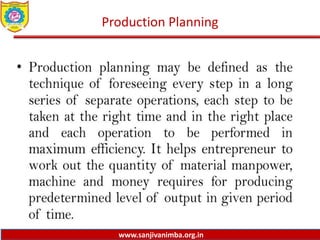
Production Planning
www.sanjivanimba.org.in
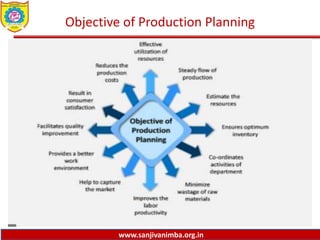
Objective of Production Planning
www.sanjivanimba.org.in
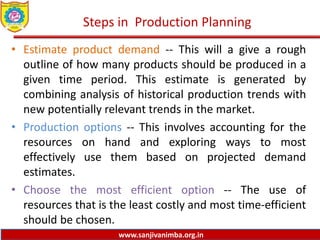
Steps in Production Planning
• Estimate product demand -- This will a give a rough
outline of how many products should be produced in a
given time period. This estimate is generated by
combining analysis of historical production trends with
new potentially relevant trends in the market.
• Production options -- This involves accounting for the
resources on hand and exploring ways to most
effectively use them based on projected demand
estimates.
• Choose the most efficient option -- The use of
resources that is the least costly and most time-efficient
should be chosen.
www.sanjivanimba.org.in
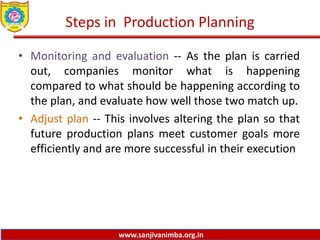
Steps in Production Planning
• Monitoring and evaluation -- As the plan is carried
out, companies monitor what is happening
compared to what should be happening according to
the plan, and evaluate how well those two match up.
• Adjust plan -- This involves altering the plan so that
future production plans meet customer goals more
efficiently and are more successful in their execution
www.sanjivanimba.org.in
Aggregate Production Planning
• Aggregate production planning is concerned with the
determination of production, inventory, and work
force levels to meet fluctuating demand
requirements over a planning horizon that ranges
from six months to one year. Typically the planning
horizon incorporate the next seasonal peak in
demand. The planning horizon is often divided into
periods. For example, a one year planning horizon
may be composed of six one-month periods plus two
three-month periods.
www.sanjivanimba.org.in
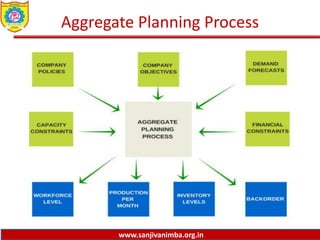
Aggregate Planning Process
www.sanjivanimba.org.in
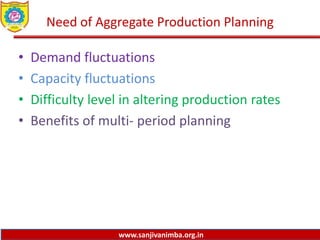
Need of Aggregate Production Planning
• Demand fluctuations
• Capacity fluctuations
• Difficulty level in altering production rates
• Benefits of multi- period planning
www.sanjivanimba.org.in
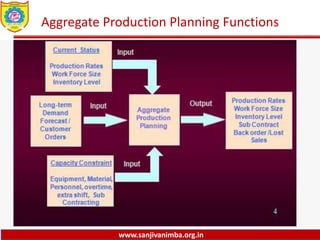
Aggregate Production Planning Functions
www.sanjivanimba.org.in
Master Production Schedule (MPS)
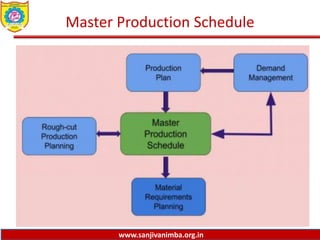
• Master Production Scheduling (MPS) is a
process in manufacturing to decide which
products to produce and how much quantity
is required to meet the requirement in a
given interval of time
• Bill of Materials (BOM) and Material
Requirements Planning (MRP) are the two
crucial aspects of the Master Production
Schedule.
www.sanjivanimba.org.in
Master Production Schedule (MPS)
• Master Production Schedule is generally
regarded as the heart of manufacturing
Enterprise Resource Planning because it
correlated manufacturing and planning.
• The MPS management system has been
extensively used as a useful tool for the most
precise calculation of resources required to
fulfill production plans.
www.sanjivanimba.org.in
Master Production Schedule
www.sanjivanimba.org.in
Input of Master Production Schedule
www.sanjivanimba.org.in
Methodologies for Master Production Schedule (MPS)
www.sanjivanimba.org.in
Material requirements planning (MRP)
• Material requirements planning is a computer-based
inventory management system designed to improve
productivity for businesses.
• Companies use material requirements-
planning systems to estimate quantities of raw
materials and schedule their utility.
• MRP works backward from a production plan for
finished goods to develop inventory requirements for
components and raw materials
www.sanjivanimba.org.in
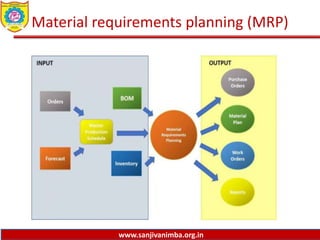
Material requirements planning (MRP)
www.sanjivanimba.org.in
Material requirements planning (MRP)
• MRP is designed to answer three questions:
1. What is needed?
2. How much is needed?
3. When is it needed?
• MRP works backward from a production plan for
finished goods, which is converted into a list of
requirements for the subassemblies, component
parts, and raw materials needed to produce the final
product within the established schedule.
www.sanjivanimba.org.in
Steps of Material Requirements Planning (MRP)
1. Estimating demand and the materials
required to meet it.
2. Check demand against inventory and
allocate resources.
3. Production scheduling.
4. Monitor the process.
www.sanjivanimba.org.in
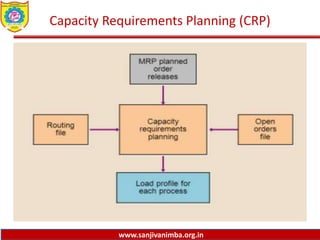
Capacity Requirements Planning (CRP)
www.sanjivanimba.org.in
Capacity requirements planning (CRP)
• Capacity requirements planning (CRP) is the process
of discerning a firm's available capacity and whether
it can meet its production goals. The CRP method
first assesses the company's planned manufacturing
schedule. Then, capacity requirements planning
weighs this schedule against the company's actual
production capabilities to see if the current capacity
can successfully meet the existing production
schedule.
www.sanjivanimba.org.in
Capacity requirements planning (CRP)
• Capacity requirements planning (CRP) is the process
of discerning a firm's production capacity and
whether it can meet its production goals.
• Conducting a CRP analysis is a critical management
tool, as it helps a company to know if it can meet the
demand for its product.
• Capacity requirements planning is also the name of
an enterprise application—software that manages
the CRP process for a company.
www.sanjivanimba.org.in
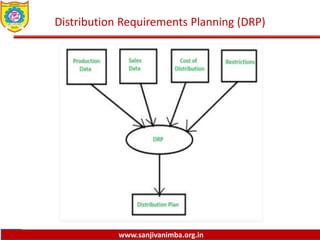
Distribution Requirements Planning (DRP)
• Distribution requirements planning (DRP) is a
systematic process to make the delivery of goods
more efficient by determining which goods, in what
quantities, and at what location are required to meet
anticipated demand. The goal is to minimize
shortages and reduce the costs of ordering,
transporting, and holding goods.
www.sanjivanimba.org.in
Distribution Requirements Planning (DRP)
www.sanjivanimba.org.in
Elements of Distribution Requirements Planning (DRP)
• Forecast demands
• Current inventory levels
• Target safety stock
• Recommended replenishment quantities
• Replenishment lead times
www.sanjivanimba.org.in
Manufacturing Resource Planning (MRP II)
• Manufacturing Resource Planning is a computer-
based integrated information system that can devise
the most precise and accurate production schedule
by leveraging the real-time data to create a harmony
between the arrival of raw material components
with the machine and labor availability.
• MRP II is software that can effectively address all the
requirements of manufacturers. For the sake of
maintaining backward compatibility, it contains all
the critical features of MRP I
www.sanjivanimba.org.in
Importance of Manufacture Resource Planning (MRP II)
Automated software of MRP II allows the user
to,
• Acquire valuable details about the right time
of ordering.
• How much quantity of raw material he needs
to order from the suppliers.
• Generate orders for raw material input. The
periodic arrangement of all the orders
www.sanjivanimba.org.in
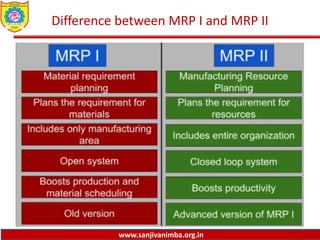
Difference between MRP I and MRP II

Production Planning

  • 1.
    www.sanjivanimba.org.in Presented By Dr. NirajChaudahri Assistant Professor, Sanjivani College of Engineering , Dept.of MBA, Kopargaon 1 Sanjivani College of Engineering, Kopargaon Department of MBA www.sanjivanimba.org.in 203- Operation Management Production Planning
  • 2.
  • 3.
  • 4.
    www.sanjivanimba.org.in Steps in ProductionPlanning • Estimate product demand -- This will a give a rough outline of how many products should be produced in a given time period. This estimate is generated by combining analysis of historical production trends with new potentially relevant trends in the market. • Production options -- This involves accounting for the resources on hand and exploring ways to most effectively use them based on projected demand estimates. • Choose the most efficient option -- The use of resources that is the least costly and most time-efficient should be chosen.
  • 5.
    www.sanjivanimba.org.in Steps in ProductionPlanning • Monitoring and evaluation -- As the plan is carried out, companies monitor what is happening compared to what should be happening according to the plan, and evaluate how well those two match up. • Adjust plan -- This involves altering the plan so that future production plans meet customer goals more efficiently and are more successful in their execution
  • 6.
    www.sanjivanimba.org.in Aggregate Production Planning •Aggregate production planning is concerned with the determination of production, inventory, and work force levels to meet fluctuating demand requirements over a planning horizon that ranges from six months to one year. Typically the planning horizon incorporate the next seasonal peak in demand. The planning horizon is often divided into periods. For example, a one year planning horizon may be composed of six one-month periods plus two three-month periods.
  • 7.
  • 8.
    www.sanjivanimba.org.in Need of AggregateProduction Planning • Demand fluctuations • Capacity fluctuations • Difficulty level in altering production rates • Benefits of multi- period planning
  • 9.
  • 10.
    www.sanjivanimba.org.in Master Production Schedule(MPS) • Master Production Scheduling (MPS) is a process in manufacturing to decide which products to produce and how much quantity is required to meet the requirement in a given interval of time • Bill of Materials (BOM) and Material Requirements Planning (MRP) are the two crucial aspects of the Master Production Schedule.
  • 11.
    www.sanjivanimba.org.in Master Production Schedule(MPS) • Master Production Schedule is generally regarded as the heart of manufacturing Enterprise Resource Planning because it correlated manufacturing and planning. • The MPS management system has been extensively used as a useful tool for the most precise calculation of resources required to fulfill production plans.
  • 12.
  • 13.
  • 14.
  • 15.
    www.sanjivanimba.org.in Material requirements planning(MRP) • Material requirements planning is a computer-based inventory management system designed to improve productivity for businesses. • Companies use material requirements- planning systems to estimate quantities of raw materials and schedule their utility. • MRP works backward from a production plan for finished goods to develop inventory requirements for components and raw materials
  • 16.
  • 17.
    www.sanjivanimba.org.in Material requirements planning(MRP) • MRP is designed to answer three questions: 1. What is needed? 2. How much is needed? 3. When is it needed? • MRP works backward from a production plan for finished goods, which is converted into a list of requirements for the subassemblies, component parts, and raw materials needed to produce the final product within the established schedule.
  • 18.
    www.sanjivanimba.org.in Steps of MaterialRequirements Planning (MRP) 1. Estimating demand and the materials required to meet it. 2. Check demand against inventory and allocate resources. 3. Production scheduling. 4. Monitor the process.
  • 19.
  • 20.
    www.sanjivanimba.org.in Capacity requirements planning(CRP) • Capacity requirements planning (CRP) is the process of discerning a firm's available capacity and whether it can meet its production goals. The CRP method first assesses the company's planned manufacturing schedule. Then, capacity requirements planning weighs this schedule against the company's actual production capabilities to see if the current capacity can successfully meet the existing production schedule.
  • 21.
    www.sanjivanimba.org.in Capacity requirements planning(CRP) • Capacity requirements planning (CRP) is the process of discerning a firm's production capacity and whether it can meet its production goals. • Conducting a CRP analysis is a critical management tool, as it helps a company to know if it can meet the demand for its product. • Capacity requirements planning is also the name of an enterprise application—software that manages the CRP process for a company.
  • 22.
    www.sanjivanimba.org.in Distribution Requirements Planning(DRP) • Distribution requirements planning (DRP) is a systematic process to make the delivery of goods more efficient by determining which goods, in what quantities, and at what location are required to meet anticipated demand. The goal is to minimize shortages and reduce the costs of ordering, transporting, and holding goods.
  • 23.
  • 24.
    www.sanjivanimba.org.in Elements of DistributionRequirements Planning (DRP) • Forecast demands • Current inventory levels • Target safety stock • Recommended replenishment quantities • Replenishment lead times
  • 25.
    www.sanjivanimba.org.in Manufacturing Resource Planning(MRP II) • Manufacturing Resource Planning is a computer- based integrated information system that can devise the most precise and accurate production schedule by leveraging the real-time data to create a harmony between the arrival of raw material components with the machine and labor availability. • MRP II is software that can effectively address all the requirements of manufacturers. For the sake of maintaining backward compatibility, it contains all the critical features of MRP I
  • 26.
    www.sanjivanimba.org.in Importance of ManufactureResource Planning (MRP II) Automated software of MRP II allows the user to, • Acquire valuable details about the right time of ordering. • How much quantity of raw material he needs to order from the suppliers. • Generate orders for raw material input. The periodic arrangement of all the orders
  • 27.