MBA (FT) 3rd Semester
Subject : - Project Management
Submitted By: - Shruti Pendharkar
PROJECT MANAGEMENT AND
CONTROL
CONTENTS
 Project organization
 Human Aspect of Project Management
 Project Planning and Control
 Gantt Chart
 Line Of Balance
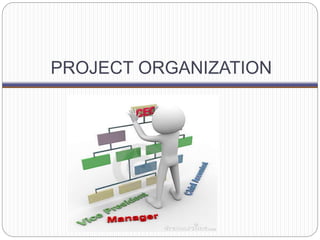
PROJECT ORGANIZATION
 Defining who is part of the project team and their
respective roles is probably one of the most important,
yet commonly overlooked aspect of project
management.
 Based on the activities that need to be done, who has
the skills to complete the work, Project managers and
coordinators must be divided.
 It is also essential for workload management.
 FEATURES OF A PROJECT: -
 A Project is a non-routine, non-repetitive undertaking often
plagued with many uncertainties.
 The relationships in a project setting are dynamic,
temporary and flexible.
 A project requires a coordination of the efforts of persons
drawn form different functional areas and contribution of
external agencies.
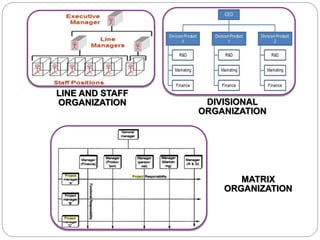
 Suitable organization types for project management are:
-
 Line and Staff Organization
 Divisional Organization
 Matrix Organization
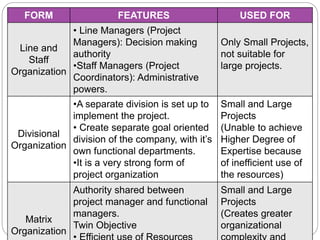
FORM FEATURES USED FOR
Line and
Staff
Organization
• Line Managers (Project
Managers): Decision making
authority
•Staff Managers (Project
Coordinators): Administrative
powers.
Only Small Projects,
not suitable for
large projects.
Divisional
Organization
•A separate division is set up to
implement the project.
• Create separate goal oriented
division of the company, with it’s
own functional departments.
•It is a very strong form of
project organization
Small and Large
Projects
(Unable to achieve
Higher Degree of
Expertise because
of inefficient use of
the resources)
Matrix
Organization
Authority shared between
project manager and functional
managers.
Twin Objective
Small and Large
Projects
(Creates greater
organizational
LINE AND STAFF
ORGANIZATION DIVISIONAL
ORGANIZATION
MATRIX
ORGANIZATION
HUMAN ASPECT OF PROJECT
MANAGEMENT
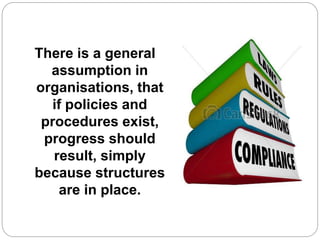
There is a general
assumption in
organisations, that
if policies and
procedures exist,
progress should
result, simply
because structures
are in place.
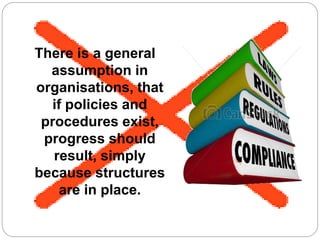
There is a general
assumption in
organisations, that
if policies and
procedures exist,
progress should
result, simply
because structures
are in place.
The key to project success is
PEOPLE
“Few people are motivated by fancy project plans, mind maps or
business intelligence software designs.
They need motivation, encouragement, empathy and leadership.”
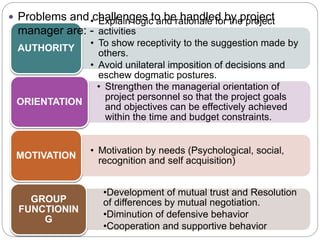
• Explain logic and rationale for the project
activities
• To show receptivity to the suggestion made by
others.
• Avoid unilateral imposition of decisions and
eschew dogmatic postures.
AUTHORITY
• Strengthen the managerial orientation of
project personnel so that the project goals
and objectives can be effectively achieved
within the time and budget constraints.
ORIENTATION
• Motivation by needs (Psychological, social,
recognition and self acquisition)
MOTIVATION
•Development of mutual trust and Resolution
of differences by mutual negotiation.
•Diminution of defensive behavior
•Cooperation and supportive behavior
GROUP
FUNCTIONIN
G
 Problems and challenges to be handled by project
manager are: -
PROJECT PLANNING &
CONTROL
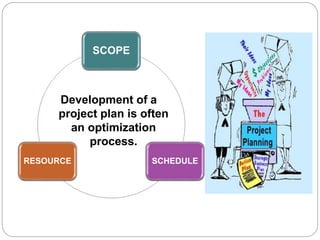
SCOPE
SCHEDULERESOURCE
Development of a
project plan is often
an optimization
process.
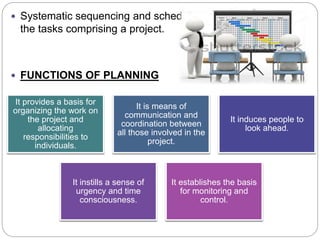
 Systematic sequencing and scheduling of
the tasks comprising a project.
 FUNCTIONS OF PLANNING
It provides a basis for
organizing the work on
the project and
allocating
responsibilities to
individuals.
It is means of
communication and
coordination between
all those involved in the
project.
It induces people to
look ahead.
It instills a sense of
urgency and time
consciousness.
It establishes the basis
for monitoring and
control.
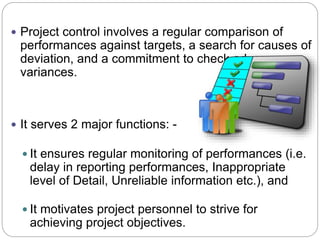
 Project control involves a regular comparison of
performances against targets, a search for causes of
deviation, and a commitment to check adverse
variances.
 It serves 2 major functions: -
 It ensures regular monitoring of performances (i.e.
delay in reporting performances, Inappropriate
level of Detail, Unreliable information etc.), and
 It motivates project personnel to strive for
achieving project objectives.
Planning and Control Tools
 Program Evaluation Review Technique (PERT)
 Gantt Charts
 Line of Balance (LOB)
 CPM (Critical Path Method)
 Work Breakdown Structures
 Earned Value Management(EVM)
 Risk Analysis
GANTT CHART
 Gantt chart is a type of bar chart developed by Henry
Gantt in the 1910s,that illustrates a project schedule.
 A Gantt chart is one of the most popular and useful ways
of showing activities (tasks or events) displayed against
time.
 Gantt charts are useful for planning and scheduling
projects. They help you assess how long a project
should take, determine the resources needed, and plan
the order in which you'll complete tasks. They're also
helpful for managing the dependencies between tasks.
 Gantt charts are useful for monitoring a project's
progress once it's underway, too. You can immediately
see what should have been achieved by a certain date
and, if the project is behind schedule, you can take
FEATURES OF GANTT CHART
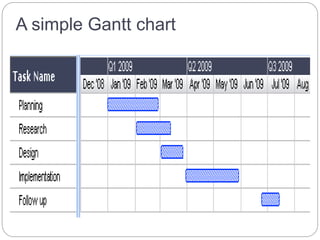
 On the left of the chart is a list of the activities and along the
top is a suitable time scale. Each activity is represented by a
bar; the position and length of the bar reflects the start date,
duration and end date of the activity.
 This allows you to see at a glance:
 What the various activities are.
 When each activity begins and ends,
 How long each activity is scheduled to last
 Where activities overlap with other activities and by how
much.
 The start and end date of the whole project.
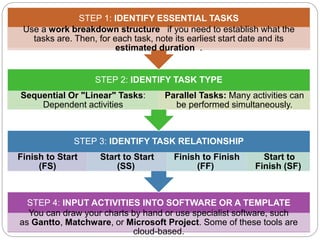
A simple Gantt chart
STEP 4: INPUT ACTIVITIES INTO SOFTWARE OR A TEMPLATE
You can draw your charts by hand or use specialist software, such
as Gantto, Matchware, or Microsoft Project. Some of these tools are
cloud-based.
STEP 3: IDENTIFY TASK RELATIONSHIP
Finish to Start
(FS)
Start to Start
(SS)
Finish to Finish
(FF)
Start to
Finish (SF)
STEP 2: IDENTIFY TASK TYPE
Sequential Or "Linear" Tasks:
Dependent activities
Parallel Tasks: Many activities can
be performed simultaneously.
STEP 1: IDENTIFY ESSENTIAL TASKS
Use a work breakdown structure if you need to establish what the
tasks are. Then, for each task, note its earliest start date and its
estimated duration .
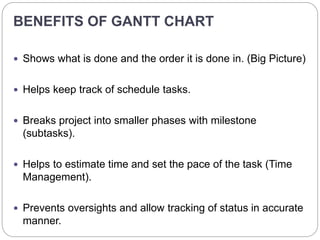
BENEFITS OF GANTT CHART
 Shows what is done and the order it is done in. (Big Picture)
 Helps keep track of schedule tasks.
 Breaks project into smaller phases with milestone
(subtasks).
 Helps to estimate time and set the pace of the task (Time
Management).
 Prevents oversights and allow tracking of status in accurate
manner.
LINE OF BALANCE (LOB)
 Extension of Gantt Chart.
 “The minimum number required to balance the
project activities”
 Tool for scheduling and tracking of repetitive projects.
 Also called as ‘Repetitive Scheduling Method’.
 For example: -
 Manufacturing of number of units,
 Construction of identical houses on a housing estate,
 Floors of multi-storey buildings.
 History: -
 LOB was devised by the members of a group headed
by George E. Fouch. During 1941, the Goodyear Tire &
Rubber Company monitored production with LOB.
 It was successfully applied to the production planning
and scheduling of the huge Navy mobilization program
of World War ll.
 Definition: -
 It collects, measures, and presents information relating
to time and accomplishment of the project phases.
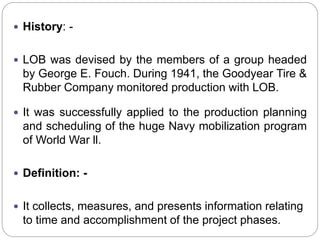
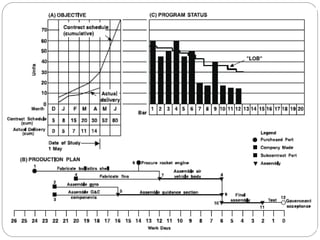
Contract Schedule
/Objective Chart
Required delivery schedule
Planned: -the contractual
delivery requirement.
Actual: - the delivery actually
made by the producer to the
time of analysis
Production Plan/Lead-
Time Chart Of Production
Process
Plan for meeting the
objective, indicating
interrelationships, and how
each part of component fits
into the assembly process, as
well as the exact point in the
cycle when each one is
required to be available.
Progress Chart
Appraisal of the progress that
has been achieved.
Line Of Balance
a measure of the level of
progress that must have
been reached if the objective
is to be met on schedule,
according to the established
plan.
ELEMEN
TS OF
LOB
These four basic elements are vital
ingredients of any effective
management system. Together they
will provide for the continuous
exercise of authority and create a
balanced and integrated operation
out of a large number of individual
and uncoordinated transactions
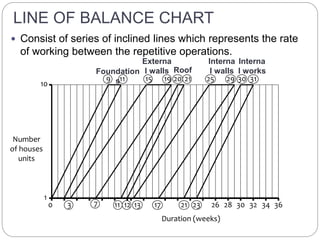
LINE OF BALANCE CHART
 Consist of series of inclined lines which represents the rate
of working between the repetitive operations.
Number
of houses
units
Duration (weeks)
1
10
0 3 11 12
Foundation
s9 11
7
15 19
Externa
l walls
26 30 32 34 3628
2120
Roof
Interna
l walls
25 29 30 31
21 2313 17
Interna
l works
USES OF LOB
 It shows the process, status, background, timing and
phasing of the project activities, thus providing
management with measuring tools that help:
 Comparing actual progress with a formal objective plan.
 Examining only the deviations from established plans, and
gauging their degree of severity with respect to the
remainder of the project.
 Receiving timely information concerning trouble areas and
indicating areas where appropriate corrective action is
required.
 Forecasting future performance.
 Enabling the project manager to ensure that the project
activities are ‘in balance’ and to determine whether any
Project management and control

Project management and control

  • 1.
    MBA (FT) 3rdSemester Subject : - Project Management Submitted By: - Shruti Pendharkar PROJECT MANAGEMENT AND CONTROL
  • 2.
    CONTENTS  Project organization Human Aspect of Project Management  Project Planning and Control  Gantt Chart  Line Of Balance
  • 3.
  • 4.
     Defining whois part of the project team and their respective roles is probably one of the most important, yet commonly overlooked aspect of project management.
  • 5.
     Based onthe activities that need to be done, who has the skills to complete the work, Project managers and coordinators must be divided.  It is also essential for workload management.
  • 6.
     FEATURES OFA PROJECT: -  A Project is a non-routine, non-repetitive undertaking often plagued with many uncertainties.  The relationships in a project setting are dynamic, temporary and flexible.  A project requires a coordination of the efforts of persons drawn form different functional areas and contribution of external agencies.  Suitable organization types for project management are: -  Line and Staff Organization  Divisional Organization  Matrix Organization
  • 7.
    FORM FEATURES USEDFOR Line and Staff Organization • Line Managers (Project Managers): Decision making authority •Staff Managers (Project Coordinators): Administrative powers. Only Small Projects, not suitable for large projects. Divisional Organization •A separate division is set up to implement the project. • Create separate goal oriented division of the company, with it’s own functional departments. •It is a very strong form of project organization Small and Large Projects (Unable to achieve Higher Degree of Expertise because of inefficient use of the resources) Matrix Organization Authority shared between project manager and functional managers. Twin Objective Small and Large Projects (Creates greater organizational
  • 8.
    LINE AND STAFF ORGANIZATIONDIVISIONAL ORGANIZATION MATRIX ORGANIZATION
  • 9.
    HUMAN ASPECT OFPROJECT MANAGEMENT
  • 10.
    There is ageneral assumption in organisations, that if policies and procedures exist, progress should result, simply because structures are in place.
  • 11.
    There is ageneral assumption in organisations, that if policies and procedures exist, progress should result, simply because structures are in place.
  • 13.
    The key toproject success is PEOPLE “Few people are motivated by fancy project plans, mind maps or business intelligence software designs. They need motivation, encouragement, empathy and leadership.”
  • 14.
    • Explain logicand rationale for the project activities • To show receptivity to the suggestion made by others. • Avoid unilateral imposition of decisions and eschew dogmatic postures. AUTHORITY • Strengthen the managerial orientation of project personnel so that the project goals and objectives can be effectively achieved within the time and budget constraints. ORIENTATION • Motivation by needs (Psychological, social, recognition and self acquisition) MOTIVATION •Development of mutual trust and Resolution of differences by mutual negotiation. •Diminution of defensive behavior •Cooperation and supportive behavior GROUP FUNCTIONIN G  Problems and challenges to be handled by project manager are: -
  • 15.
  • 16.
    SCOPE SCHEDULERESOURCE Development of a projectplan is often an optimization process.
  • 17.
     Systematic sequencingand scheduling of the tasks comprising a project.  FUNCTIONS OF PLANNING It provides a basis for organizing the work on the project and allocating responsibilities to individuals. It is means of communication and coordination between all those involved in the project. It induces people to look ahead. It instills a sense of urgency and time consciousness. It establishes the basis for monitoring and control.
  • 18.
     Project controlinvolves a regular comparison of performances against targets, a search for causes of deviation, and a commitment to check adverse variances.  It serves 2 major functions: -  It ensures regular monitoring of performances (i.e. delay in reporting performances, Inappropriate level of Detail, Unreliable information etc.), and  It motivates project personnel to strive for achieving project objectives.
  • 19.
    Planning and ControlTools  Program Evaluation Review Technique (PERT)  Gantt Charts  Line of Balance (LOB)  CPM (Critical Path Method)  Work Breakdown Structures  Earned Value Management(EVM)  Risk Analysis
  • 20.
  • 21.
     Gantt chartis a type of bar chart developed by Henry Gantt in the 1910s,that illustrates a project schedule.  A Gantt chart is one of the most popular and useful ways of showing activities (tasks or events) displayed against time.  Gantt charts are useful for planning and scheduling projects. They help you assess how long a project should take, determine the resources needed, and plan the order in which you'll complete tasks. They're also helpful for managing the dependencies between tasks.  Gantt charts are useful for monitoring a project's progress once it's underway, too. You can immediately see what should have been achieved by a certain date and, if the project is behind schedule, you can take
  • 22.
    FEATURES OF GANTTCHART  On the left of the chart is a list of the activities and along the top is a suitable time scale. Each activity is represented by a bar; the position and length of the bar reflects the start date, duration and end date of the activity.  This allows you to see at a glance:  What the various activities are.  When each activity begins and ends,  How long each activity is scheduled to last  Where activities overlap with other activities and by how much.  The start and end date of the whole project.
  • 23.
  • 24.
    STEP 4: INPUTACTIVITIES INTO SOFTWARE OR A TEMPLATE You can draw your charts by hand or use specialist software, such as Gantto, Matchware, or Microsoft Project. Some of these tools are cloud-based. STEP 3: IDENTIFY TASK RELATIONSHIP Finish to Start (FS) Start to Start (SS) Finish to Finish (FF) Start to Finish (SF) STEP 2: IDENTIFY TASK TYPE Sequential Or "Linear" Tasks: Dependent activities Parallel Tasks: Many activities can be performed simultaneously. STEP 1: IDENTIFY ESSENTIAL TASKS Use a work breakdown structure if you need to establish what the tasks are. Then, for each task, note its earliest start date and its estimated duration .
  • 25.
    BENEFITS OF GANTTCHART  Shows what is done and the order it is done in. (Big Picture)  Helps keep track of schedule tasks.  Breaks project into smaller phases with milestone (subtasks).  Helps to estimate time and set the pace of the task (Time Management).  Prevents oversights and allow tracking of status in accurate manner.
  • 26.
  • 27.
     Extension ofGantt Chart.  “The minimum number required to balance the project activities”  Tool for scheduling and tracking of repetitive projects.  Also called as ‘Repetitive Scheduling Method’.  For example: -  Manufacturing of number of units,  Construction of identical houses on a housing estate,  Floors of multi-storey buildings.
  • 28.
     History: - LOB was devised by the members of a group headed by George E. Fouch. During 1941, the Goodyear Tire & Rubber Company monitored production with LOB.  It was successfully applied to the production planning and scheduling of the huge Navy mobilization program of World War ll.  Definition: -  It collects, measures, and presents information relating to time and accomplishment of the project phases.
  • 29.
    Contract Schedule /Objective Chart Requireddelivery schedule Planned: -the contractual delivery requirement. Actual: - the delivery actually made by the producer to the time of analysis Production Plan/Lead- Time Chart Of Production Process Plan for meeting the objective, indicating interrelationships, and how each part of component fits into the assembly process, as well as the exact point in the cycle when each one is required to be available. Progress Chart Appraisal of the progress that has been achieved. Line Of Balance a measure of the level of progress that must have been reached if the objective is to be met on schedule, according to the established plan. ELEMEN TS OF LOB
  • 30.
    These four basicelements are vital ingredients of any effective management system. Together they will provide for the continuous exercise of authority and create a balanced and integrated operation out of a large number of individual and uncoordinated transactions
  • 32.
    LINE OF BALANCECHART  Consist of series of inclined lines which represents the rate of working between the repetitive operations. Number of houses units Duration (weeks) 1 10 0 3 11 12 Foundation s9 11 7 15 19 Externa l walls 26 30 32 34 3628 2120 Roof Interna l walls 25 29 30 31 21 2313 17 Interna l works
  • 33.
    USES OF LOB It shows the process, status, background, timing and phasing of the project activities, thus providing management with measuring tools that help:  Comparing actual progress with a formal objective plan.  Examining only the deviations from established plans, and gauging their degree of severity with respect to the remainder of the project.  Receiving timely information concerning trouble areas and indicating areas where appropriate corrective action is required.  Forecasting future performance.  Enabling the project manager to ensure that the project activities are ‘in balance’ and to determine whether any

Editor's Notes

  • #12 It is somewhat a wrong notion
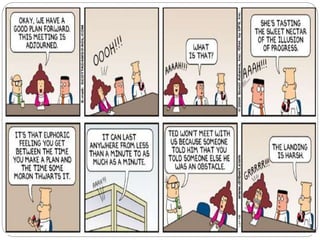
  • #13 It’s from famous dilbert comic showing how in actual a virtual and real planning differ just cause of the human behariour
  • #17  This optimization revolves around the "triple constraint" of project management: scope management, schedule management, and resource/budget management. These three elements of project planning are so significant that I have dedicated a separate page for each of them.