
SURELY GOOD DEEDS ERASE BAD DEEDS.
(11:114)
PRODUCTION SCHEDULING AND
CONTROL
Prepared by: Sohaib Hassan Khan
shk9@live.com
SCOPE OF PRESENTATION
The scope of this lecture is give a brief introduction about
modern techniques required in Industries.
This lecture will enable them to understand the impor tance
of decisions; which are required.
Af ter completion of this presentation, it is hoped that
viewers will get an insight regarding Scheduling, Planning
and Production Control.
PRODUCTION SCHEDULING
AND CONTROL
TOPICS TO BE COVERED:
1 . Introduction to Production Planning
2 . Aggregate Production Planning
3 . Demand Forecasting
4 . Workforce Planning
5 . Production Routing
6 . Production Scheduling
PRODUCTION SCHEDULING
AND CONTROL
TOPICS TO BE COVERED:
Continued…
7 . Follow-up and Expediting
8 . Production Control
9 . Inspection and Quality Control
Progress Check
1 . I n t r o d u c t i o n To P r o d u c t i o n
S c h e d u l i n g a n d C o n t r o l
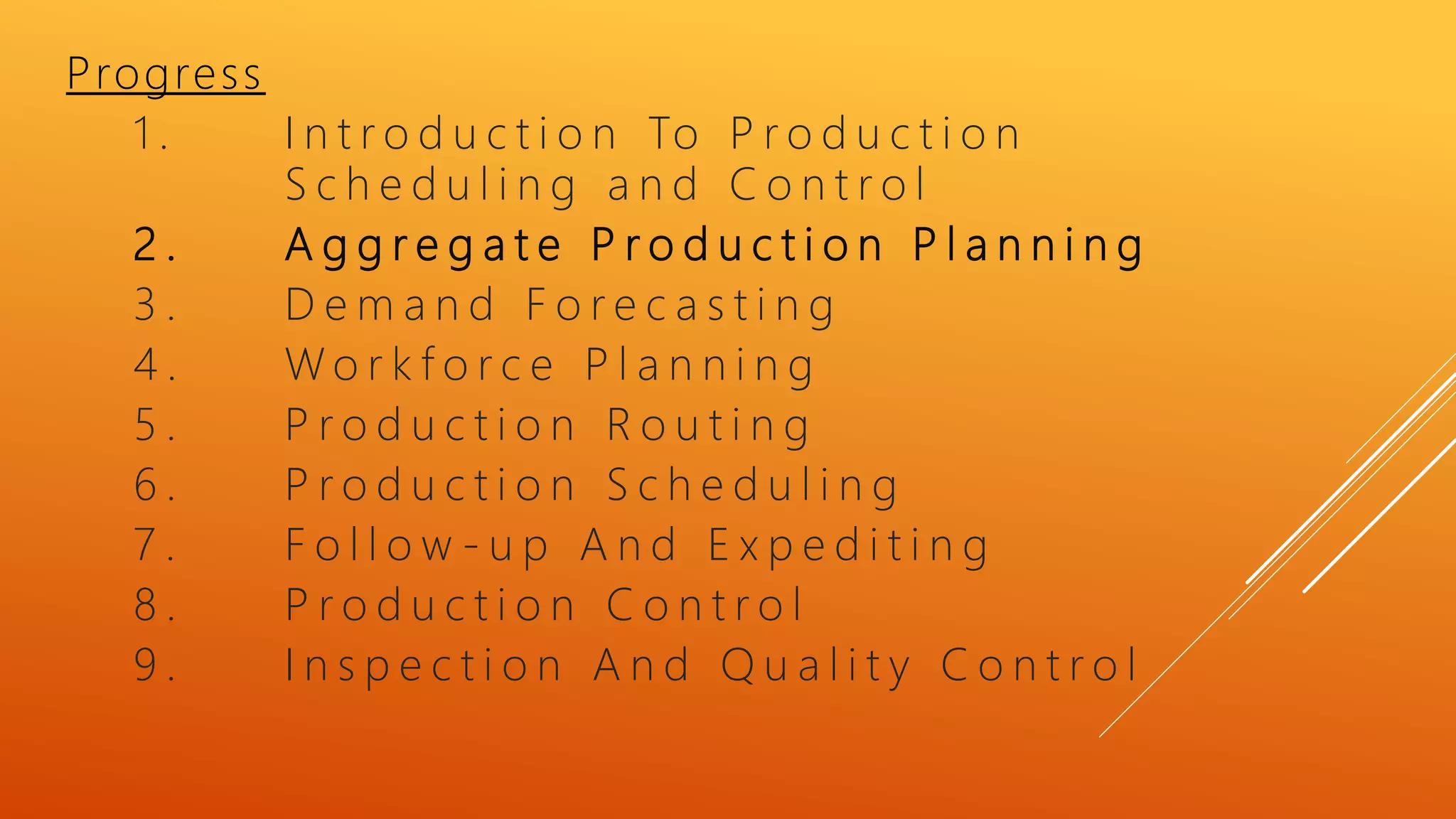
2 . A g g r e g a t e P r o d u c t i o n P l a n n i n g
3 . P r o d u c t i o n F o r e c a s t i n g
4 . W o r k f o r c e P l a n n i n g
5 . P r o d u c t i o n R o u t i n g
6 . P r o d u c t i o n S c h e d u l i n g
7 . F o l l o w - u p A n d E x p e d i t i n g
8 . P r o d u c t i o n C o n t r o l
9 . I n s p e c t i o n A n d Q u a l i t y C o n t r o l
INTRODUCTION
Production scheduling and control is a subject
evolved after years of industrial advancement in
order to streamline production flow and confront
shop floor challenges.
It majorly focuses on tracking resources and finding
constraints that will effect different volume levels of
production.
INTRODUCTION
This concept is also defined as, planning,
implementation and control of industrial production
process to ensure smooth and efficient operations.
These techniques are used in both, Manufacturing
and Ser vices Industries.
INTRODUCTION
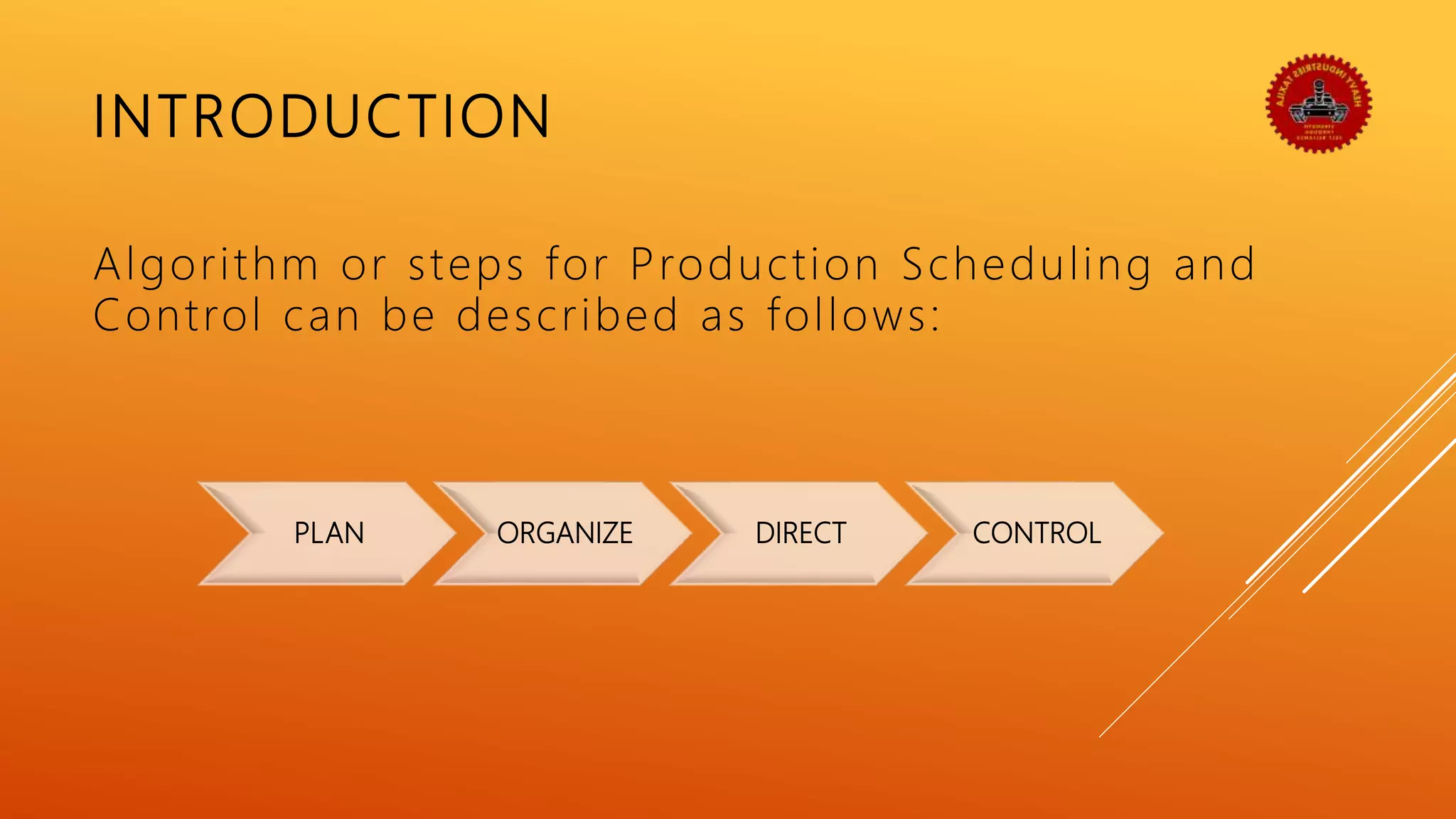
Algorithm or steps for Production Scheduling and
Control can be described as follows:
PLAN ORGANIZE DIRECT CONTROL
INTRODUCTION
AIMS & OBJECTIVES:
1 . Efficiently Utilizing Inputs Like Material, Men And
Machines
2 . Preparation Of Production Budget
3 . Regularizing All Events From Procurement Of Raw
Material Up-to The Final Product.
4 . Sequence Of Operation Is Determined For Continuous
Production
INTRODUCTION
AIMS & OBJECTIVES:
5 . Planning Plant/ Shop Capacity For Future Production Is
Determined
6 . Maintenance Of Sufficient Inventories To Suppor t
Continuous Of Flow Production.
7 . Tracking Production Schedules To Ensure In Time
Completion Of The Production.
INTRODUCTION
SIGNIFICANCE & REQUIREMENT
Why do we need to study production scheduling and
control?
1. For Increasing Production
2. For Coordinating Plant Activities
3. For Cost Control
4. For Rationalizing Production Activities
Progress
1 . I n t r o d u c t i o n To P r o d u c t i o n
S c h e d u l i n g a n d C o n t r o l
2 . A g g r e g a t e P r o d u c t i o n P l a n n i n g
3 . D e m a n d F o r e c a s t i n g
4 . W o r k f o r c e P l a n n i n g
5 . P r o d u c t i o n R o u t i n g
6 . P r o d u c t i o n S c h e d u l i n g
7 . F o l l o w - u p A n d E x p e d i t i n g
8 . P r o d u c t i o n C o n t r o l
9 . I n s p e c t i o n A n d Q u a l i t y C o n t r o l
AGGREGATE PRODUCTION PLANNING
Aggregate Planning:
Planning refers to the decisions taken prior to the
commencement of production. It refers to What is to
be done, and how it is going to be done.
An organizational setup is created to prepare plans
and policies, char ts, manuals and production budget.
Planning provides foundation for production control.
AGGREGATE PRODUCTION PLANNING
OBJECTIVES OF PRODUCTION PL ANNING
1. To Generate Medium Term Production Plan
2. To Establish Rough Product Mix
3. To Anticipate The Bottlenecks
4. To Align The Capacity And Workforce Plans.
AGGREGATE PRODUCTION PLANNING
Requirement Of Production Plan
Production Plan is required in order to address the
acquisition, utilization and allocation of limited
production resources.
Resources: It includes the production facilities, labor
and material.
Constraints: Includes availability of resources,
deliver y times of raw material and management
policies.
AGGREGATE PRODUCTION PLANNING
Demand of required material, workforce and spares
may fluctuate over the period of time.
These fluctuations occurs due to uncontrolled and
unforeseen constraints.
Aggregate Production Plans are used to absorb these
fluctuations.
AGGREGATE PRODUCTION PLANNING
Production plans are based on following mentioned
assumptions.
1. The regular output capacity is same in all periods
2. Plans are feasible
a. Sufficient Inventor y Capacity exists in order to
accommodate the production plan.
AGGREGATE PRODUCTION PLANNING
Continued…
b. Subcontractors with appropriate quality and
capacity are standing by
c. Changes in output can be varied as required
3. Inventories are built up and drawn at a uniform
rate.
AGGREGATE PRODUCTION PLANNING
“ The Planning Of Industrial Operations Involves
Four Considerations, Namely, What Work Shall
Be Done, How The Work Shall Be Done And
Lastly, When The Work Shall Be Done.”
KIMBALL AND KIMBALL JR
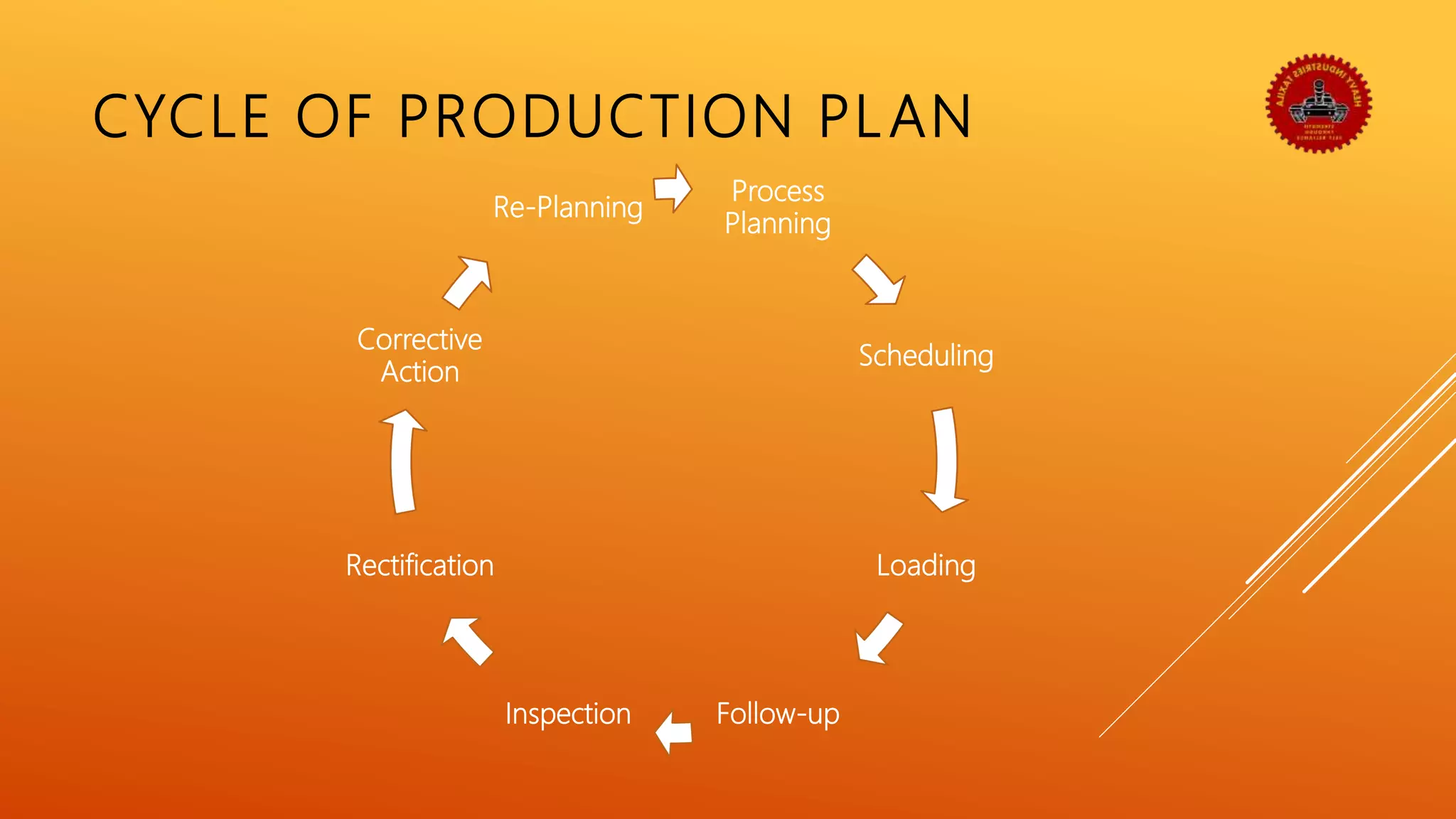
CYCLE OF PRODUCTION PLAN
Process
Planning
Scheduling
Loading
Follow-upInspection
Rectification
Corrective
Action
Re-Planning
Progress
1 . I n t r o d u c t i o n To P r o d u c t i o n
S c h e d u l i n g a n d C o n t r o l
2 . A g g r e g a t e P r o d u c t i o n P l a n n i n g
3 . P r o d u c t i o n F o r e c a s t i n g
4 . W o r k f o r c e P l a n n i n g
5 . P r o d u c t i o n R o u t i n g
6 . P r o d u c t i o n S c h e d u l i n g
7 . F o l l o w - u p A n d E x p e d i t i n g
8 . P r o d u c t i o n C o n t r o l
9 . I n s p e c t i o n A n d Q u a l i t y C o n t r o l
PRODUCTION FORECASTING
The main objective of forecasting is to predict the
requirement of all possible future events.
It also includes the forecasting of required machiner y,
men and material necessar y for production.
Forecasting allocation of budget and related
resources also falls into this categor y. e -g budget for
spares, over time and maintenance etc
LIMITATIONS OF FORECASTING
Limitations of Forecasting are listed below:
1. Forecasts are usually wrong
2. Forecasts always change
3. The fur ther into the future, the less reliable the
forecast will be.
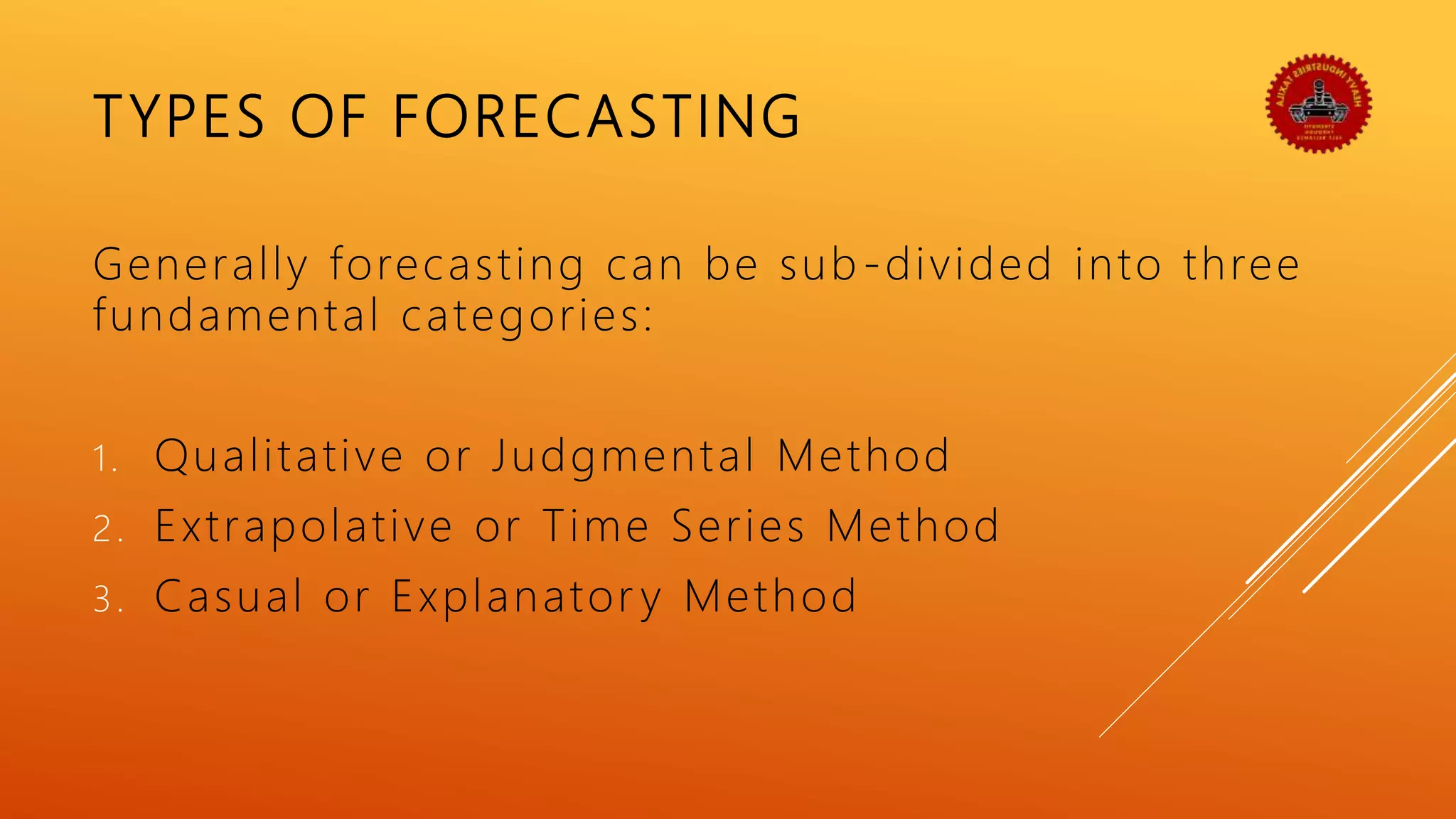
TYPES OF FORECASTING
Generally forecasting can be sub-divided into three
fundamental categories:
1. Qualitative or Judgmental Method
2. Extrapolative or Time Series Method
3. Casual or Explanator y Method
TYPES OF FORECASTING
Qualitative Method:
• Rely on exper ts or managers opinion in making
predictions for the future
• Useful from medium to long range forecasting
tasks
• Provide the basis for some impor tant decisions
TYPES OF FORECASTING
Qualitative Method:
The impor tant techniques adopted for Qualitative
Methods are:
1. Delphi Technique
2. Sur veys and Research
3. Historical Analogy
4. Executive Judgments
5. Panel Consensus
TYPES OF FORECASTING
Qualitative Method:
Delphi Technique: Develop forecast through group
consensus.
1. Choose the exper ts to par ticipate. There should be
a variety of knowledgeable people of different
areas.
2. Through a questionnaire (or E-mail), obtain
forecasts (and any premises or qualifications for
the forecasts) from all par ticipants.
TYPES OF FORECASTING
Qualitative Method:
Delphi Technique Continued…
3. Summarize the results and redistribute them to the
par ticipants along with appropriate new questions.
4. Summarize again, refining forecasts and
conditions, and again develop new questions.
5. Repeat Step 4 if necessar y. Distribute the final
results to all par ticipants.
TYPES OF FORECASTING
Extrapolative Method:
• It uses past histor y of requirements, items consumed per
product and replacement rates.
• It consist of three separate categories of par ts:
a . Essential Components
b . Cyclic Components
c . Irregular Components
The objective of the method is to identif y the pattern from
historic data and extrapolate this for future.
TYPES OF FORECASTING
Extrapolative Method:
There are three types of techniques which are used to
extrapolate past/old data:
1. Moving average method
2. Weighted moving Average
3. Exponential smoothing
4. Linear Regression
TYPES OF FORECASTING
Extrapolative Method:
These extrapolative methods are selected based
availability and reliability of following factors:
1 . Time Horizon To Forecast
2 . Data Availability
3 . Accuracy Required
4 . Size Of Forecasting Budget
5 . Availability Of Qualified Personnel
TYPES OF FORECASTING
Casual Forecasting:
It is a statistical forecasting model based on historic
demand data; as well as on variables believed to
influence demand.
In other words, our knowledge of the value of one
variable (or perhaps several variables) enables us to
forecast the value of another variable.
TYPES OF FORECASTING
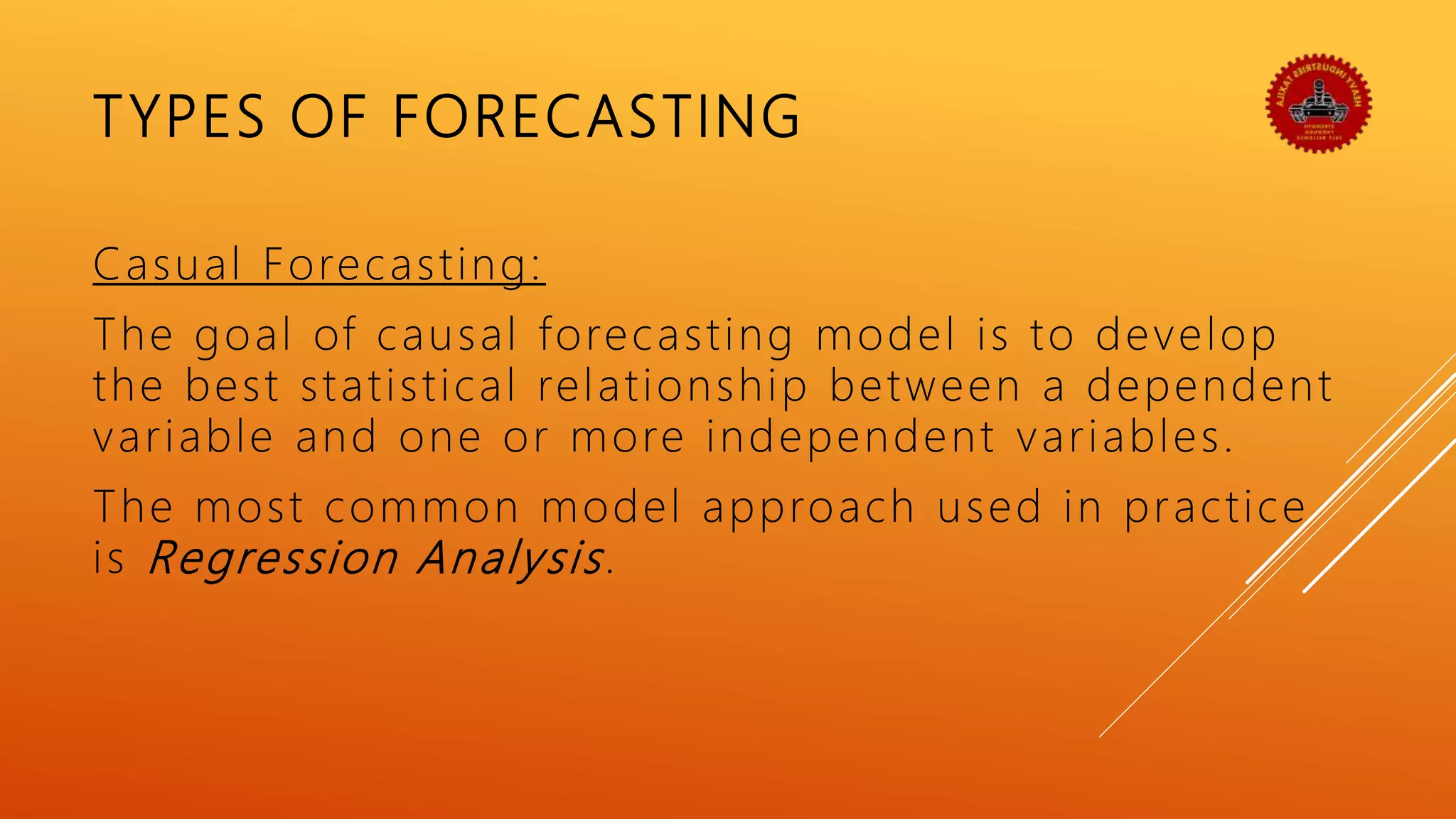
Casual Forecasting:
The goal of causal forecasting model is to develop
the best statistical relationship between a dependent
variable and one or more independent variables.
The most common model approach used in practice
is Regression Analysis.
Progress
1 . I n t r o d u c t i o n To P r o d u c t i o n
S c h e d u l i n g a n d C o n t r o l
2 . A g g r e g a t e P r o d u c t i o n P l a n n i n g
3 . P r o d u c t i o n F o r e c a s t i n g
4 . W o r k f o r c e P l a n n i n g
5 . P r o d u c t i o n R o u t i n g
6 . P r o d u c t i o n S c h e d u l i n g
7 . F o l l o w - u p A n d E x p e d i t i n g
8 . P r o d u c t i o n C o n t r o l
9 . I n s p e c t i o n A n d Q u a l i t y C o n t r o l
WORKFORCE PLAN
Workforce includes the total pool of employees
available in the organization.
The objective of workforce plan is to find out and
direct the Right People, Right Place and at Right
Time.
WORKFORCE PLAN
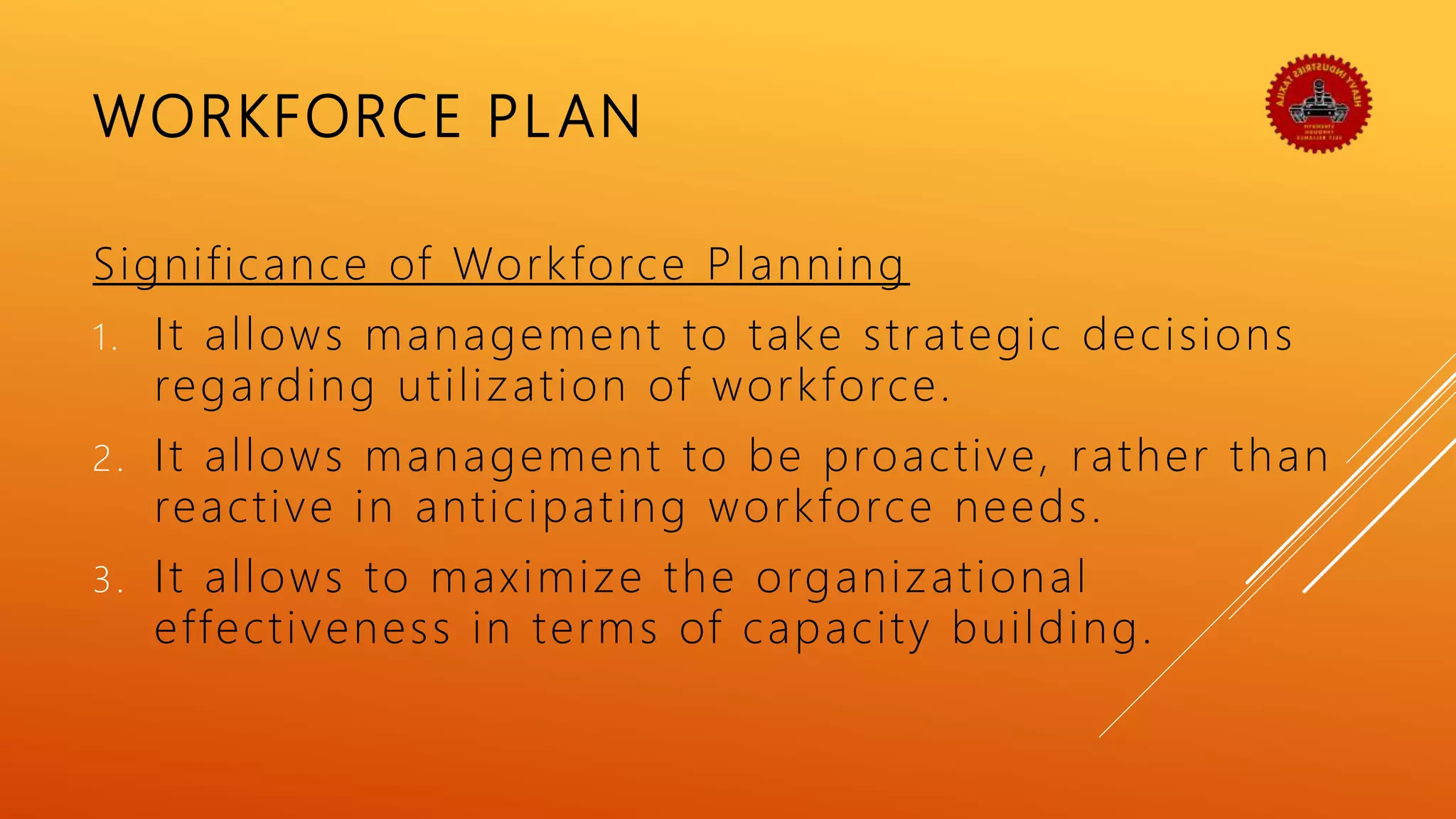
Significance of Workforce Planning
1. It allows management to take strategic decisions
regarding utilization of workforce.
2. It allows management to be proactive, rather than
reactive in anticipating workforce needs.
3. It allows to maximize the organizational
effectiveness in terms of capacity building.
WORKFORCE PLAN
Lack of workforce planning results in:
1. Gaps In Staffing.
2. Lesser Equipped/ Experienced Workforce.
3. Production/ Level Of Ser vice Suffers.
4. Reduction In Funding.
5. Increase Over time Costs.
6. Decreased Employee Morale.
Progress
1 . I n t r o d u c t i o n To P r o d u c t i o n
S c h e d u l i n g a n d C o n t r o l
2 . A g g r e g a t e P r o d u c t i o n P l a n n i n g
3 . P r o d u c t i o n F o r e c a s t i n g
4 . W o r k f o r c e P l a n n i n g
5 . P r o d u c t i o n R o u t i n g
6 . P r o d u c t i o n S c h e d u l i n g
7 . F o l l o w - u p A n d E x p e d i t i n g
8 . P r o d u c t i o n C o n t r o l
9 . I n s p e c t i o n A n d Q u a l i t y C o n t r o l
PRODUCTION ROUTING
ROUTING:
Routing is determining the exact path which will be
followed in production.
It is the selection of the path from where each unit
have to pass before reaching the final stage.
The stages from which goods are to pass are decided
in this process.
PRODUCTION ROUTING
Elements of Routing:
1. Determining What Are The Required Par ts
2. Determining Material Required For Par ts
3. Determining Manufacturing Operations And
Sequences
4. Determining Lot Sizes
5. Determining Scrap Factor
6. Analysis Of Cost Of The Product
Progress
1 . I n t r o d u c t i o n To P r o d u c t i o n
S c h e d u l i n g a n d C o n t r o l
2 . A g g r e g a t e P r o d u c t i o n P l a n n i n g
3 . P r o d u c t i o n F o r e c a s t i n g
4 . W o r k f o r c e P l a n n i n g
5 . P r o d u c t i o n R o u t i n g
6 . P r o d u c t i o n S c h e d u l i n g
8 . F o l l o w - u p A n d E x p e d i t i n g
7 . P r o d u c t i o n C o n t r o l
8 . I n s p e c t i o n A n d Q u a l i t y C o n t r o l
PRODUCTION SCHEDULING
Production scheduling is concerned with the
timetable of production.
Scheduling arranges the different manufacturing
operations in order of priority, fixing the time date
for the commencement and completion of each
operation.
PRODUCTION SCHEDULING
SCHEDULING:
Scheduling is determining the exact time and date
when each operation is to be commenced or
completed.
The time and date of manufacturing each component
is fixed in such a way that assembly for final product
is not delayed in any way.
PRODUCTION SCHEDULING
DESCRIPTION:
Production scheduling is a technique of forecasting
different aspects of production flow. And deliver y
Time Frame for future production.
It includes management and allocation of
a) Resources
b) Events
c) Processes
PRODUCTION SCHEDULING
Production scheduling requires strong focus on the
resources required for production. Timelines are
decided for each categor y. Resources mainly includes.
1. Budget Allocation
2. Raw Material, Equipment/Machiner y and Tools
3. Trained and Skilled Manpower
PRODUCTION SCHEDULING
The pattern of scheduling differs from one job to
another job. Basic Production Scheduling adopt by
industries is listed below:
1. Master Schedule
2. Production Schedule
3. Manufacturing Schedule
4. Deliver y Schedule
Progress
1 . I n t r o d u c t i o n To P r o d u c t i o n
S c h e d u l i n g a n d C o n t r o l
2 . A g g r e g a t e P r o d u c t i o n P l a n n i n g
3 . P r o d u c t i o n F o r e c a s t i n g
4 . W o r k f o r c e P l a n n i n g
5 . P r o d u c t i o n R o u t i n g
6 . P r o d u c t i o n S c h e d u l i n g
7 . F o l l o w - u p A n d E x p e d i t i n g
8 . P r o d u c t i o n C o n t r o l
9 . I n s p e c t i o n A n d Q u a l i t y C o n t r o l
FOLLOW-UP & EXPEDITING
Follow-up & expediting is that branch of production
scheduling which regulates the progress of materials
and par ts through production process.
The follow-up process is used for expediting and
checking the progress.
Progress
1 . I n t r o d u c t i o n To P r o d u c t i o n
S c h e d u l i n g a n d C o n t r o l
2 . A g g r e g a t e P r o d u c t i o n P l a n n i n g
3 . P r o d u c t i o n F o r e c a s t i n g
4 . W o r k f o r c e P l a n n i n g
5 . C a p a c i t y P l a n n i n g
6 . R o u t i n g
7 . S c h e d u l i n g
8 . F o l l o w - u p A n d E x p e d i t i n g
9 . P r o d u c t i o n C o n t r o l
1 0 . I n s p e c t i o n A n d Q u a l i t y C o n t r o l
PRODUCTION CONTROL
Production control is the process of keeping track of
production activities and resources.
Production control is a preventive measure. It ensures
ever ything is in accordance with the production
schedule.
If any event deviates from the production schedule, it
prompts adjustments so that production may run
according to the original schedule.
PRODUCTION CONTROL
“Production control refers to ensuring that all
which occurs is in accordance with the rules
established and instructions issued.”
Henr y Fayol
Progress
1 . I n t r o d u c t i o n To P r o d u c t i o n
S c h e d u l i n g a n d C o n t r o l
2 . A g g r e g a t e P r o d u c t i o n P l a n n i n g
3 . P r o d u c t i o n F o r e c a s t i n g
4 . W o r k f o r c e P l a n n i n g
5 . P r o d u c t i o n R o u t i n g
6 . P r o d u c t i o n S c h e d u l i n g
7 . F o l l o w - u p A n d E x p e d i t i n g
8 . P r o d u c t i o n C o n t r o l
9 . I n s p e c t i o n A n d Q u a l i t y C o n t r o l
PRODUCTION SCHEDULING AND CONTROL
INSPECTION:
Inspection is the process of ensuring whether the
products manufactured are of the requisite quality or
not.
Inspection is under taken both of products and inputs.
It is carried on at various levels of production process
so that predetermined standards of quality are
achieved.
Summar y
1 . I n t r o d u c t i o n To P r o d u c t i o n
S c h e d u l i n g a n d C o n t r o l
2 . A g g r e g a t e P r o d u c t i o n P l a n n i n g
3 . P r o d u c t i o n F o r e c a s t i n g
4 . W o r k f o r c e P l a n n i n g
5 . P r o d u c t i o n R o u t i n g
6 . P r o d u c t i o n S c h e d u l i n g
7 . F o l l o w - u p A n d E x p e d i t i n g
8 . P r o d u c t i o n C o n t r o l
9 . I n s p e c t i o n A n d Q u a l i t y C o n t r o l

Production Planning, Scheduling and Control

  • 2.
    SURELY GOOD DEEDSERASE BAD DEEDS. (11:114)
  • 3.
    PRODUCTION SCHEDULING AND CONTROL Preparedby: Sohaib Hassan Khan shk9@live.com
  • 4.
    SCOPE OF PRESENTATION Thescope of this lecture is give a brief introduction about modern techniques required in Industries. This lecture will enable them to understand the impor tance of decisions; which are required. Af ter completion of this presentation, it is hoped that viewers will get an insight regarding Scheduling, Planning and Production Control.
  • 5.
    PRODUCTION SCHEDULING AND CONTROL TOPICSTO BE COVERED: 1 . Introduction to Production Planning 2 . Aggregate Production Planning 3 . Demand Forecasting 4 . Workforce Planning 5 . Production Routing 6 . Production Scheduling
  • 6.
    PRODUCTION SCHEDULING AND CONTROL TOPICSTO BE COVERED: Continued… 7 . Follow-up and Expediting 8 . Production Control 9 . Inspection and Quality Control
  • 7.
    Progress Check 1 .I n t r o d u c t i o n To P r o d u c t i o n S c h e d u l i n g a n d C o n t r o l 2 . A g g r e g a t e P r o d u c t i o n P l a n n i n g 3 . P r o d u c t i o n F o r e c a s t i n g 4 . W o r k f o r c e P l a n n i n g 5 . P r o d u c t i o n R o u t i n g 6 . P r o d u c t i o n S c h e d u l i n g 7 . F o l l o w - u p A n d E x p e d i t i n g 8 . P r o d u c t i o n C o n t r o l 9 . I n s p e c t i o n A n d Q u a l i t y C o n t r o l
  • 8.
    INTRODUCTION Production scheduling andcontrol is a subject evolved after years of industrial advancement in order to streamline production flow and confront shop floor challenges. It majorly focuses on tracking resources and finding constraints that will effect different volume levels of production.
  • 9.
    INTRODUCTION This concept isalso defined as, planning, implementation and control of industrial production process to ensure smooth and efficient operations. These techniques are used in both, Manufacturing and Ser vices Industries.
  • 10.
    INTRODUCTION Algorithm or stepsfor Production Scheduling and Control can be described as follows: PLAN ORGANIZE DIRECT CONTROL
  • 11.
    INTRODUCTION AIMS & OBJECTIVES: 1. Efficiently Utilizing Inputs Like Material, Men And Machines 2 . Preparation Of Production Budget 3 . Regularizing All Events From Procurement Of Raw Material Up-to The Final Product. 4 . Sequence Of Operation Is Determined For Continuous Production
  • 12.
    INTRODUCTION AIMS & OBJECTIVES: 5. Planning Plant/ Shop Capacity For Future Production Is Determined 6 . Maintenance Of Sufficient Inventories To Suppor t Continuous Of Flow Production. 7 . Tracking Production Schedules To Ensure In Time Completion Of The Production.
  • 13.
    INTRODUCTION SIGNIFICANCE & REQUIREMENT Whydo we need to study production scheduling and control? 1. For Increasing Production 2. For Coordinating Plant Activities 3. For Cost Control 4. For Rationalizing Production Activities
  • 14.
    Progress 1 . In t r o d u c t i o n To P r o d u c t i o n S c h e d u l i n g a n d C o n t r o l 2 . A g g r e g a t e P r o d u c t i o n P l a n n i n g 3 . D e m a n d F o r e c a s t i n g 4 . W o r k f o r c e P l a n n i n g 5 . P r o d u c t i o n R o u t i n g 6 . P r o d u c t i o n S c h e d u l i n g 7 . F o l l o w - u p A n d E x p e d i t i n g 8 . P r o d u c t i o n C o n t r o l 9 . I n s p e c t i o n A n d Q u a l i t y C o n t r o l
  • 15.
    AGGREGATE PRODUCTION PLANNING AggregatePlanning: Planning refers to the decisions taken prior to the commencement of production. It refers to What is to be done, and how it is going to be done. An organizational setup is created to prepare plans and policies, char ts, manuals and production budget. Planning provides foundation for production control.
  • 16.
    AGGREGATE PRODUCTION PLANNING OBJECTIVESOF PRODUCTION PL ANNING 1. To Generate Medium Term Production Plan 2. To Establish Rough Product Mix 3. To Anticipate The Bottlenecks 4. To Align The Capacity And Workforce Plans.
  • 17.
    AGGREGATE PRODUCTION PLANNING RequirementOf Production Plan Production Plan is required in order to address the acquisition, utilization and allocation of limited production resources. Resources: It includes the production facilities, labor and material. Constraints: Includes availability of resources, deliver y times of raw material and management policies.
  • 18.
    AGGREGATE PRODUCTION PLANNING Demandof required material, workforce and spares may fluctuate over the period of time. These fluctuations occurs due to uncontrolled and unforeseen constraints. Aggregate Production Plans are used to absorb these fluctuations.
  • 19.
    AGGREGATE PRODUCTION PLANNING Productionplans are based on following mentioned assumptions. 1. The regular output capacity is same in all periods 2. Plans are feasible a. Sufficient Inventor y Capacity exists in order to accommodate the production plan.
  • 20.
    AGGREGATE PRODUCTION PLANNING Continued… b.Subcontractors with appropriate quality and capacity are standing by c. Changes in output can be varied as required 3. Inventories are built up and drawn at a uniform rate.
  • 21.
    AGGREGATE PRODUCTION PLANNING “The Planning Of Industrial Operations Involves Four Considerations, Namely, What Work Shall Be Done, How The Work Shall Be Done And Lastly, When The Work Shall Be Done.” KIMBALL AND KIMBALL JR
  • 22.
    CYCLE OF PRODUCTIONPLAN Process Planning Scheduling Loading Follow-upInspection Rectification Corrective Action Re-Planning
  • 23.
    Progress 1 . In t r o d u c t i o n To P r o d u c t i o n S c h e d u l i n g a n d C o n t r o l 2 . A g g r e g a t e P r o d u c t i o n P l a n n i n g 3 . P r o d u c t i o n F o r e c a s t i n g 4 . W o r k f o r c e P l a n n i n g 5 . P r o d u c t i o n R o u t i n g 6 . P r o d u c t i o n S c h e d u l i n g 7 . F o l l o w - u p A n d E x p e d i t i n g 8 . P r o d u c t i o n C o n t r o l 9 . I n s p e c t i o n A n d Q u a l i t y C o n t r o l
  • 24.
    PRODUCTION FORECASTING The mainobjective of forecasting is to predict the requirement of all possible future events. It also includes the forecasting of required machiner y, men and material necessar y for production. Forecasting allocation of budget and related resources also falls into this categor y. e -g budget for spares, over time and maintenance etc
  • 25.
    LIMITATIONS OF FORECASTING Limitationsof Forecasting are listed below: 1. Forecasts are usually wrong 2. Forecasts always change 3. The fur ther into the future, the less reliable the forecast will be.
  • 26.
    TYPES OF FORECASTING Generallyforecasting can be sub-divided into three fundamental categories: 1. Qualitative or Judgmental Method 2. Extrapolative or Time Series Method 3. Casual or Explanator y Method
  • 27.
    TYPES OF FORECASTING QualitativeMethod: • Rely on exper ts or managers opinion in making predictions for the future • Useful from medium to long range forecasting tasks • Provide the basis for some impor tant decisions
  • 28.
    TYPES OF FORECASTING QualitativeMethod: The impor tant techniques adopted for Qualitative Methods are: 1. Delphi Technique 2. Sur veys and Research 3. Historical Analogy 4. Executive Judgments 5. Panel Consensus
  • 29.
    TYPES OF FORECASTING QualitativeMethod: Delphi Technique: Develop forecast through group consensus. 1. Choose the exper ts to par ticipate. There should be a variety of knowledgeable people of different areas. 2. Through a questionnaire (or E-mail), obtain forecasts (and any premises or qualifications for the forecasts) from all par ticipants.
  • 30.
    TYPES OF FORECASTING QualitativeMethod: Delphi Technique Continued… 3. Summarize the results and redistribute them to the par ticipants along with appropriate new questions. 4. Summarize again, refining forecasts and conditions, and again develop new questions. 5. Repeat Step 4 if necessar y. Distribute the final results to all par ticipants.
  • 31.
    TYPES OF FORECASTING ExtrapolativeMethod: • It uses past histor y of requirements, items consumed per product and replacement rates. • It consist of three separate categories of par ts: a . Essential Components b . Cyclic Components c . Irregular Components The objective of the method is to identif y the pattern from historic data and extrapolate this for future.
  • 32.
    TYPES OF FORECASTING ExtrapolativeMethod: There are three types of techniques which are used to extrapolate past/old data: 1. Moving average method 2. Weighted moving Average 3. Exponential smoothing 4. Linear Regression
  • 33.
    TYPES OF FORECASTING ExtrapolativeMethod: These extrapolative methods are selected based availability and reliability of following factors: 1 . Time Horizon To Forecast 2 . Data Availability 3 . Accuracy Required 4 . Size Of Forecasting Budget 5 . Availability Of Qualified Personnel
  • 34.
    TYPES OF FORECASTING CasualForecasting: It is a statistical forecasting model based on historic demand data; as well as on variables believed to influence demand. In other words, our knowledge of the value of one variable (or perhaps several variables) enables us to forecast the value of another variable.
  • 35.
    TYPES OF FORECASTING CasualForecasting: The goal of causal forecasting model is to develop the best statistical relationship between a dependent variable and one or more independent variables. The most common model approach used in practice is Regression Analysis.
  • 36.
    Progress 1 . In t r o d u c t i o n To P r o d u c t i o n S c h e d u l i n g a n d C o n t r o l 2 . A g g r e g a t e P r o d u c t i o n P l a n n i n g 3 . P r o d u c t i o n F o r e c a s t i n g 4 . W o r k f o r c e P l a n n i n g 5 . P r o d u c t i o n R o u t i n g 6 . P r o d u c t i o n S c h e d u l i n g 7 . F o l l o w - u p A n d E x p e d i t i n g 8 . P r o d u c t i o n C o n t r o l 9 . I n s p e c t i o n A n d Q u a l i t y C o n t r o l
  • 37.
    WORKFORCE PLAN Workforce includesthe total pool of employees available in the organization. The objective of workforce plan is to find out and direct the Right People, Right Place and at Right Time.
  • 38.
    WORKFORCE PLAN Significance ofWorkforce Planning 1. It allows management to take strategic decisions regarding utilization of workforce. 2. It allows management to be proactive, rather than reactive in anticipating workforce needs. 3. It allows to maximize the organizational effectiveness in terms of capacity building.
  • 39.
    WORKFORCE PLAN Lack ofworkforce planning results in: 1. Gaps In Staffing. 2. Lesser Equipped/ Experienced Workforce. 3. Production/ Level Of Ser vice Suffers. 4. Reduction In Funding. 5. Increase Over time Costs. 6. Decreased Employee Morale.
  • 40.
    Progress 1 . In t r o d u c t i o n To P r o d u c t i o n S c h e d u l i n g a n d C o n t r o l 2 . A g g r e g a t e P r o d u c t i o n P l a n n i n g 3 . P r o d u c t i o n F o r e c a s t i n g 4 . W o r k f o r c e P l a n n i n g 5 . P r o d u c t i o n R o u t i n g 6 . P r o d u c t i o n S c h e d u l i n g 7 . F o l l o w - u p A n d E x p e d i t i n g 8 . P r o d u c t i o n C o n t r o l 9 . I n s p e c t i o n A n d Q u a l i t y C o n t r o l
  • 41.
    PRODUCTION ROUTING ROUTING: Routing isdetermining the exact path which will be followed in production. It is the selection of the path from where each unit have to pass before reaching the final stage. The stages from which goods are to pass are decided in this process.
  • 42.
    PRODUCTION ROUTING Elements ofRouting: 1. Determining What Are The Required Par ts 2. Determining Material Required For Par ts 3. Determining Manufacturing Operations And Sequences 4. Determining Lot Sizes 5. Determining Scrap Factor 6. Analysis Of Cost Of The Product
  • 43.
    Progress 1 . In t r o d u c t i o n To P r o d u c t i o n S c h e d u l i n g a n d C o n t r o l 2 . A g g r e g a t e P r o d u c t i o n P l a n n i n g 3 . P r o d u c t i o n F o r e c a s t i n g 4 . W o r k f o r c e P l a n n i n g 5 . P r o d u c t i o n R o u t i n g 6 . P r o d u c t i o n S c h e d u l i n g 8 . F o l l o w - u p A n d E x p e d i t i n g 7 . P r o d u c t i o n C o n t r o l 8 . I n s p e c t i o n A n d Q u a l i t y C o n t r o l
  • 44.
    PRODUCTION SCHEDULING Production schedulingis concerned with the timetable of production. Scheduling arranges the different manufacturing operations in order of priority, fixing the time date for the commencement and completion of each operation.
  • 45.
    PRODUCTION SCHEDULING SCHEDULING: Scheduling isdetermining the exact time and date when each operation is to be commenced or completed. The time and date of manufacturing each component is fixed in such a way that assembly for final product is not delayed in any way.
  • 46.
    PRODUCTION SCHEDULING DESCRIPTION: Production schedulingis a technique of forecasting different aspects of production flow. And deliver y Time Frame for future production. It includes management and allocation of a) Resources b) Events c) Processes
  • 47.
    PRODUCTION SCHEDULING Production schedulingrequires strong focus on the resources required for production. Timelines are decided for each categor y. Resources mainly includes. 1. Budget Allocation 2. Raw Material, Equipment/Machiner y and Tools 3. Trained and Skilled Manpower
  • 48.
    PRODUCTION SCHEDULING The patternof scheduling differs from one job to another job. Basic Production Scheduling adopt by industries is listed below: 1. Master Schedule 2. Production Schedule 3. Manufacturing Schedule 4. Deliver y Schedule
  • 49.
    Progress 1 . In t r o d u c t i o n To P r o d u c t i o n S c h e d u l i n g a n d C o n t r o l 2 . A g g r e g a t e P r o d u c t i o n P l a n n i n g 3 . P r o d u c t i o n F o r e c a s t i n g 4 . W o r k f o r c e P l a n n i n g 5 . P r o d u c t i o n R o u t i n g 6 . P r o d u c t i o n S c h e d u l i n g 7 . F o l l o w - u p A n d E x p e d i t i n g 8 . P r o d u c t i o n C o n t r o l 9 . I n s p e c t i o n A n d Q u a l i t y C o n t r o l
  • 50.
    FOLLOW-UP & EXPEDITING Follow-up& expediting is that branch of production scheduling which regulates the progress of materials and par ts through production process. The follow-up process is used for expediting and checking the progress.
  • 51.
    Progress 1 . In t r o d u c t i o n To P r o d u c t i o n S c h e d u l i n g a n d C o n t r o l 2 . A g g r e g a t e P r o d u c t i o n P l a n n i n g 3 . P r o d u c t i o n F o r e c a s t i n g 4 . W o r k f o r c e P l a n n i n g 5 . C a p a c i t y P l a n n i n g 6 . R o u t i n g 7 . S c h e d u l i n g 8 . F o l l o w - u p A n d E x p e d i t i n g 9 . P r o d u c t i o n C o n t r o l 1 0 . I n s p e c t i o n A n d Q u a l i t y C o n t r o l
  • 52.
    PRODUCTION CONTROL Production controlis the process of keeping track of production activities and resources. Production control is a preventive measure. It ensures ever ything is in accordance with the production schedule. If any event deviates from the production schedule, it prompts adjustments so that production may run according to the original schedule.
  • 53.
    PRODUCTION CONTROL “Production controlrefers to ensuring that all which occurs is in accordance with the rules established and instructions issued.” Henr y Fayol
  • 54.
    Progress 1 . In t r o d u c t i o n To P r o d u c t i o n S c h e d u l i n g a n d C o n t r o l 2 . A g g r e g a t e P r o d u c t i o n P l a n n i n g 3 . P r o d u c t i o n F o r e c a s t i n g 4 . W o r k f o r c e P l a n n i n g 5 . P r o d u c t i o n R o u t i n g 6 . P r o d u c t i o n S c h e d u l i n g 7 . F o l l o w - u p A n d E x p e d i t i n g 8 . P r o d u c t i o n C o n t r o l 9 . I n s p e c t i o n A n d Q u a l i t y C o n t r o l
  • 55.
    PRODUCTION SCHEDULING ANDCONTROL INSPECTION: Inspection is the process of ensuring whether the products manufactured are of the requisite quality or not. Inspection is under taken both of products and inputs. It is carried on at various levels of production process so that predetermined standards of quality are achieved.
  • 56.
    Summar y 1 .I n t r o d u c t i o n To P r o d u c t i o n S c h e d u l i n g a n d C o n t r o l 2 . A g g r e g a t e P r o d u c t i o n P l a n n i n g 3 . P r o d u c t i o n F o r e c a s t i n g 4 . W o r k f o r c e P l a n n i n g 5 . P r o d u c t i o n R o u t i n g 6 . P r o d u c t i o n S c h e d u l i n g 7 . F o l l o w - u p A n d E x p e d i t i n g 8 . P r o d u c t i o n C o n t r o l 9 . I n s p e c t i o n A n d Q u a l i t y C o n t r o l