Acute Angle
Closure Crisis
BY
DR SAFAA REFAAT
FRCSG, M.Sc., MBBS
Glaucoma
Definition:
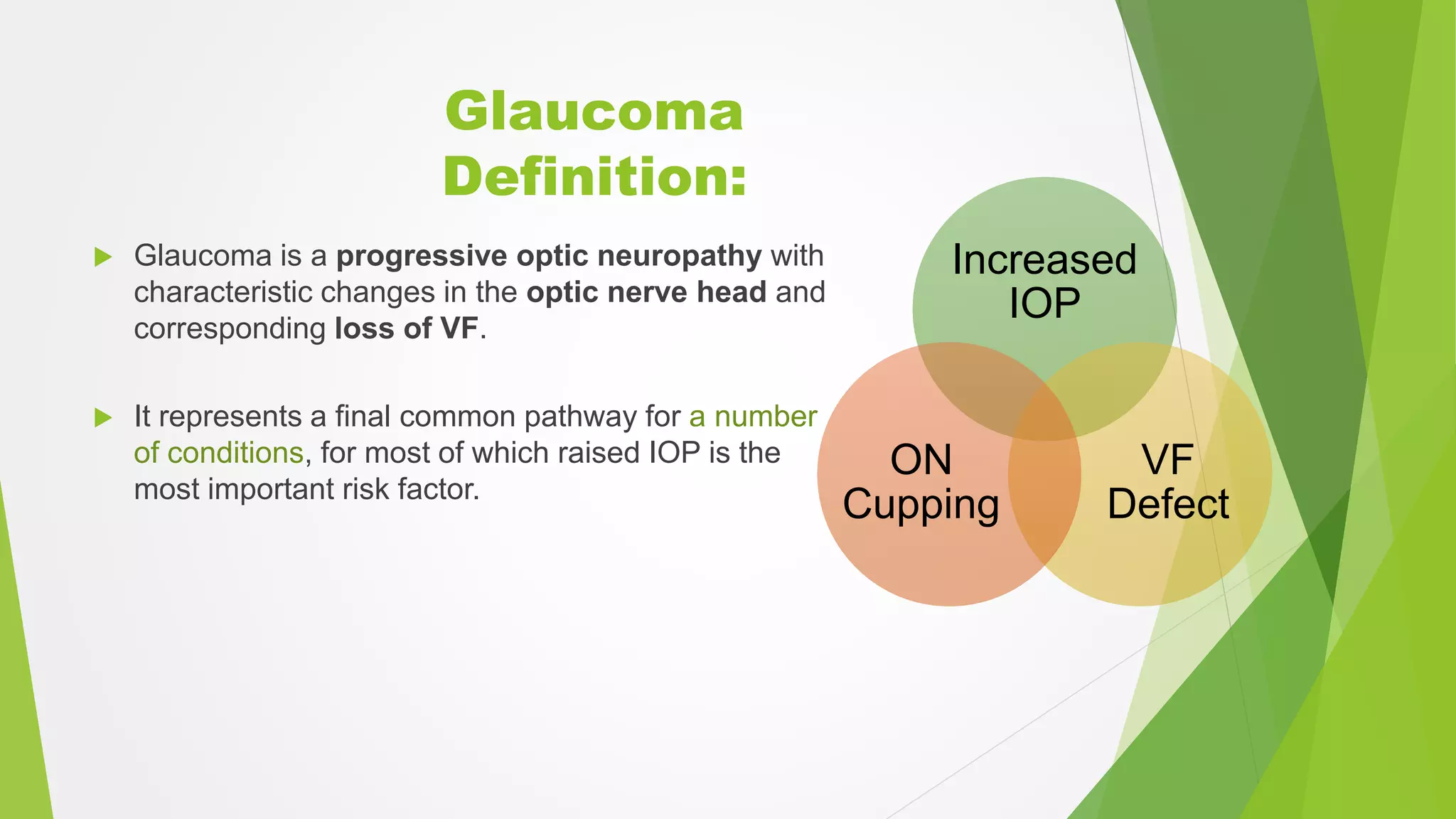
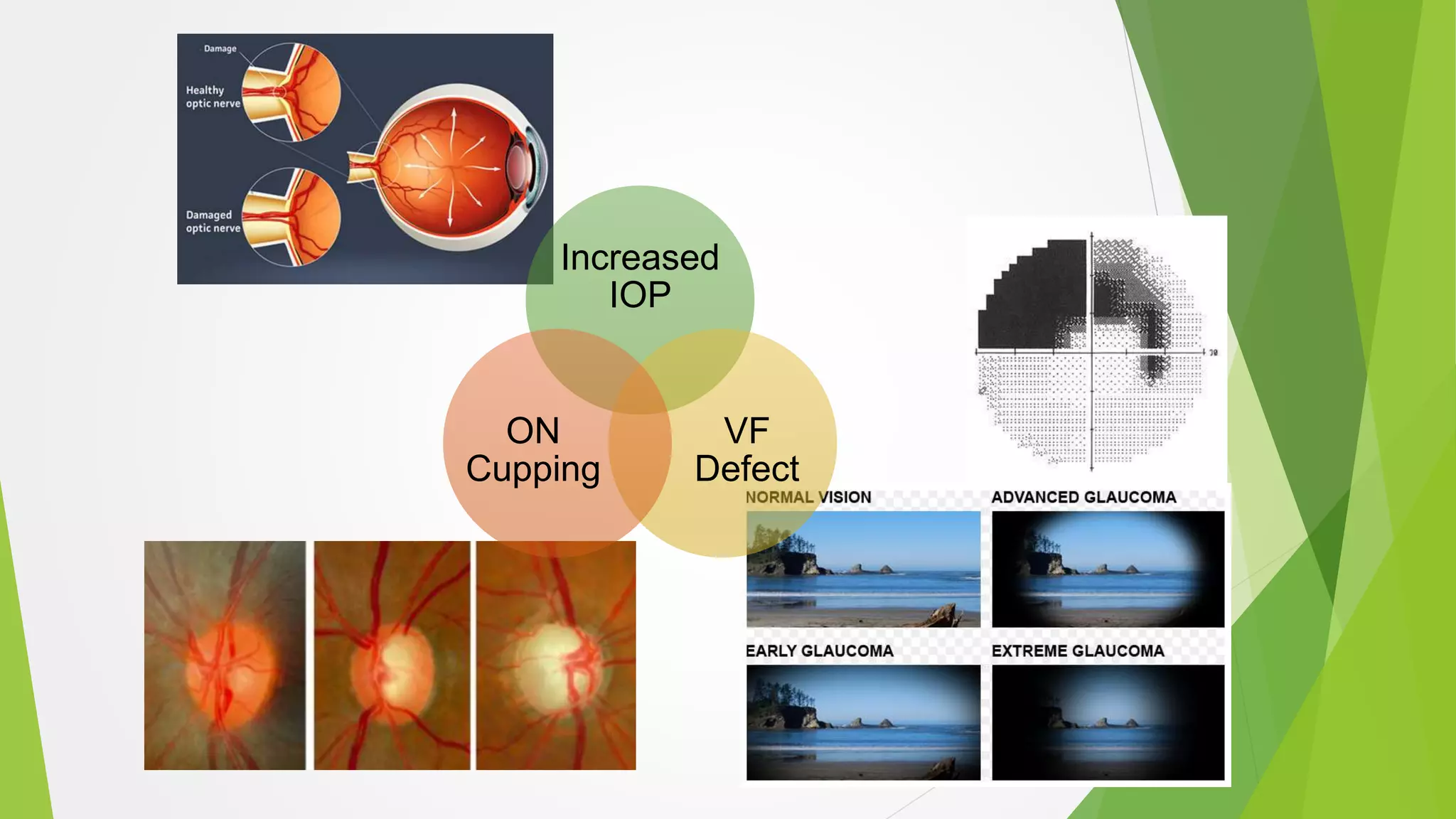
 Glaucoma is a progressive optic neuropathy with
characteristic changes in the optic nerve head and
corresponding loss of VF.
 It represents a final common pathway for a number
of conditions, for most of which raised IOP is the
most important risk factor.
Increased
IOP
VF
Defect
ON
Cupping
Increased
IOP
VF
Defect
ON
Cupping
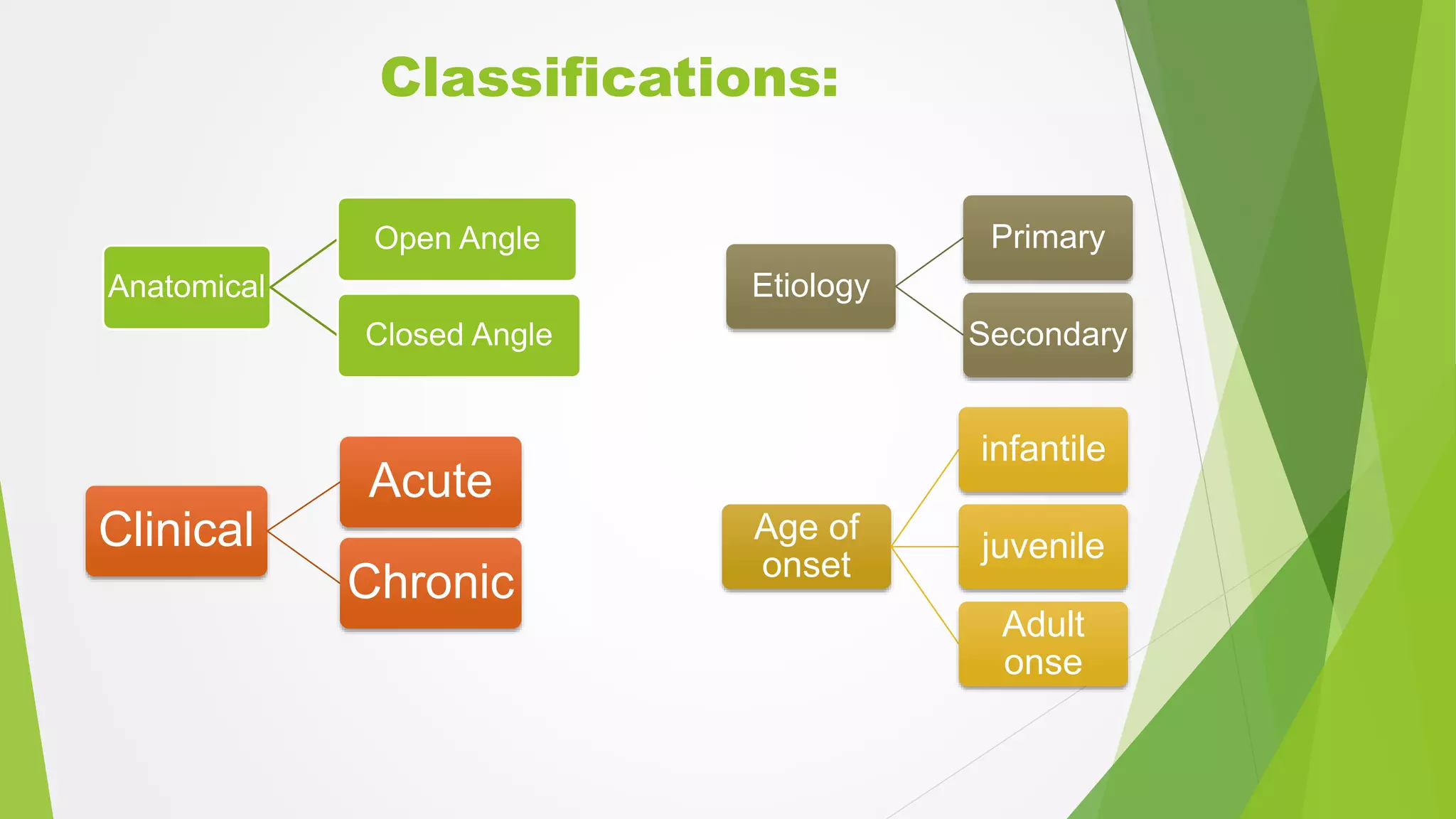
Classifications:
Etiology
Primary
Secondary
Anatomical
Open Angle
Closed Angle
Age of
onset
infantile
juvenile
Adult
onse
Clinical
Acute
Chronic
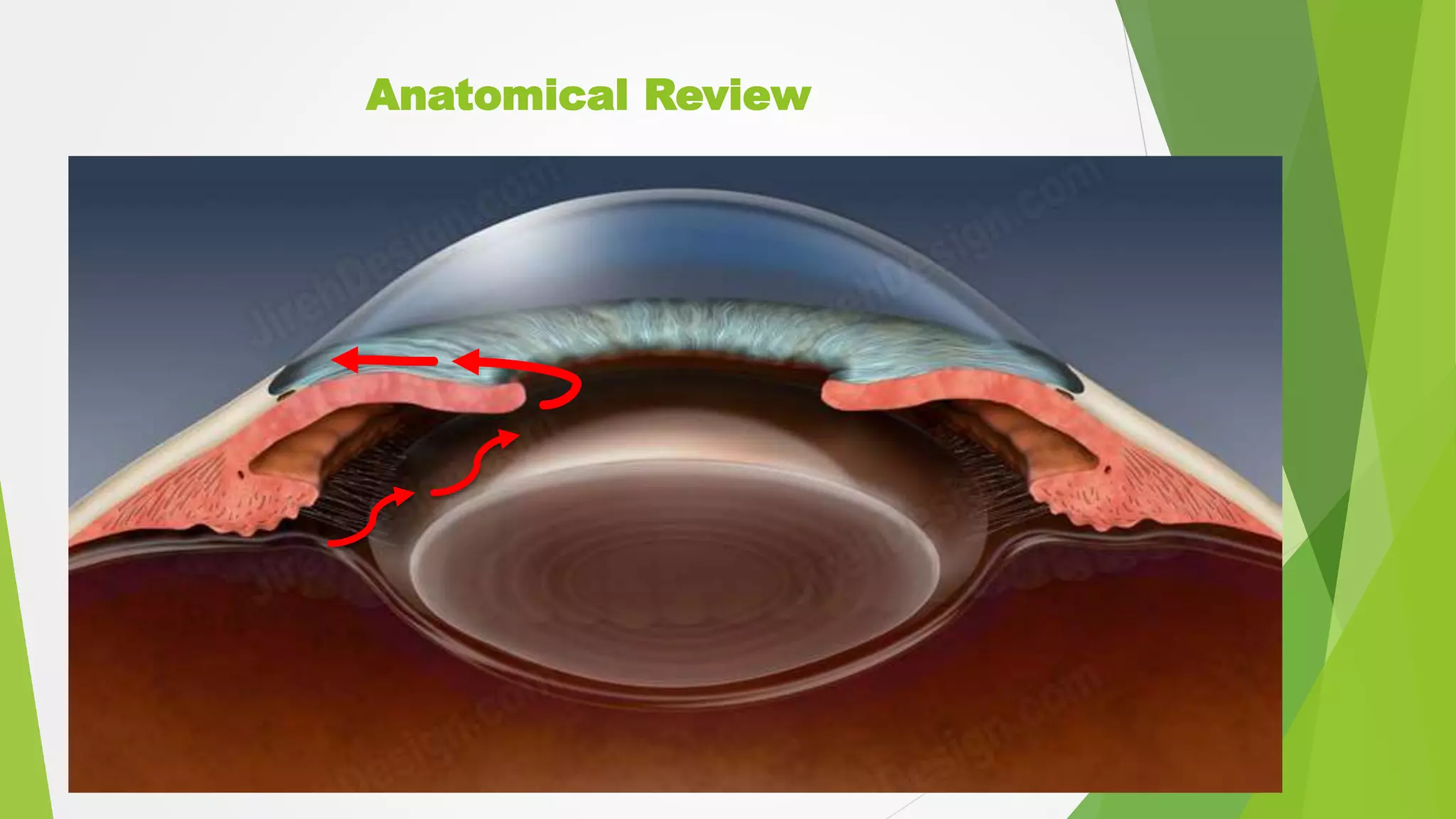
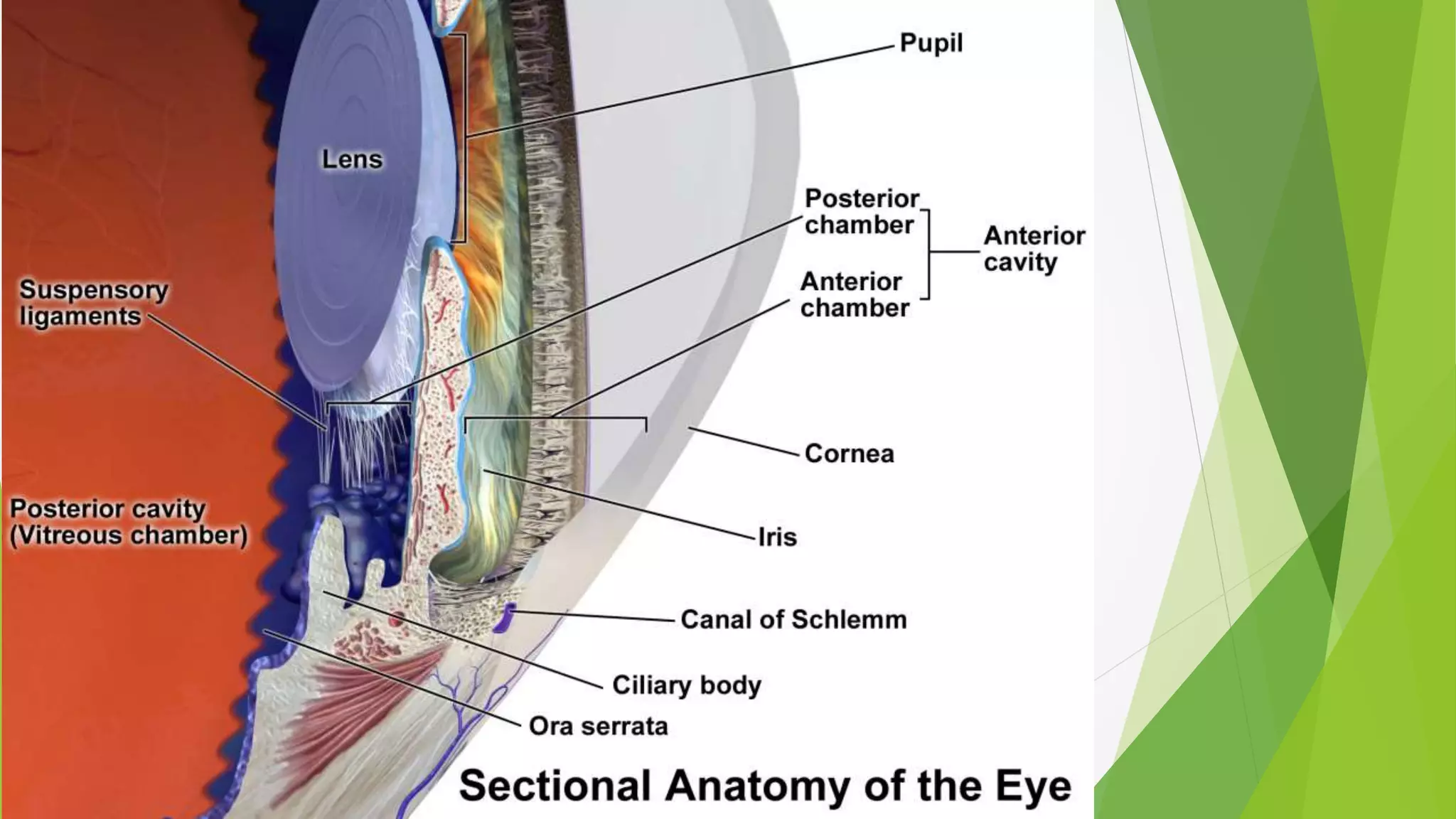
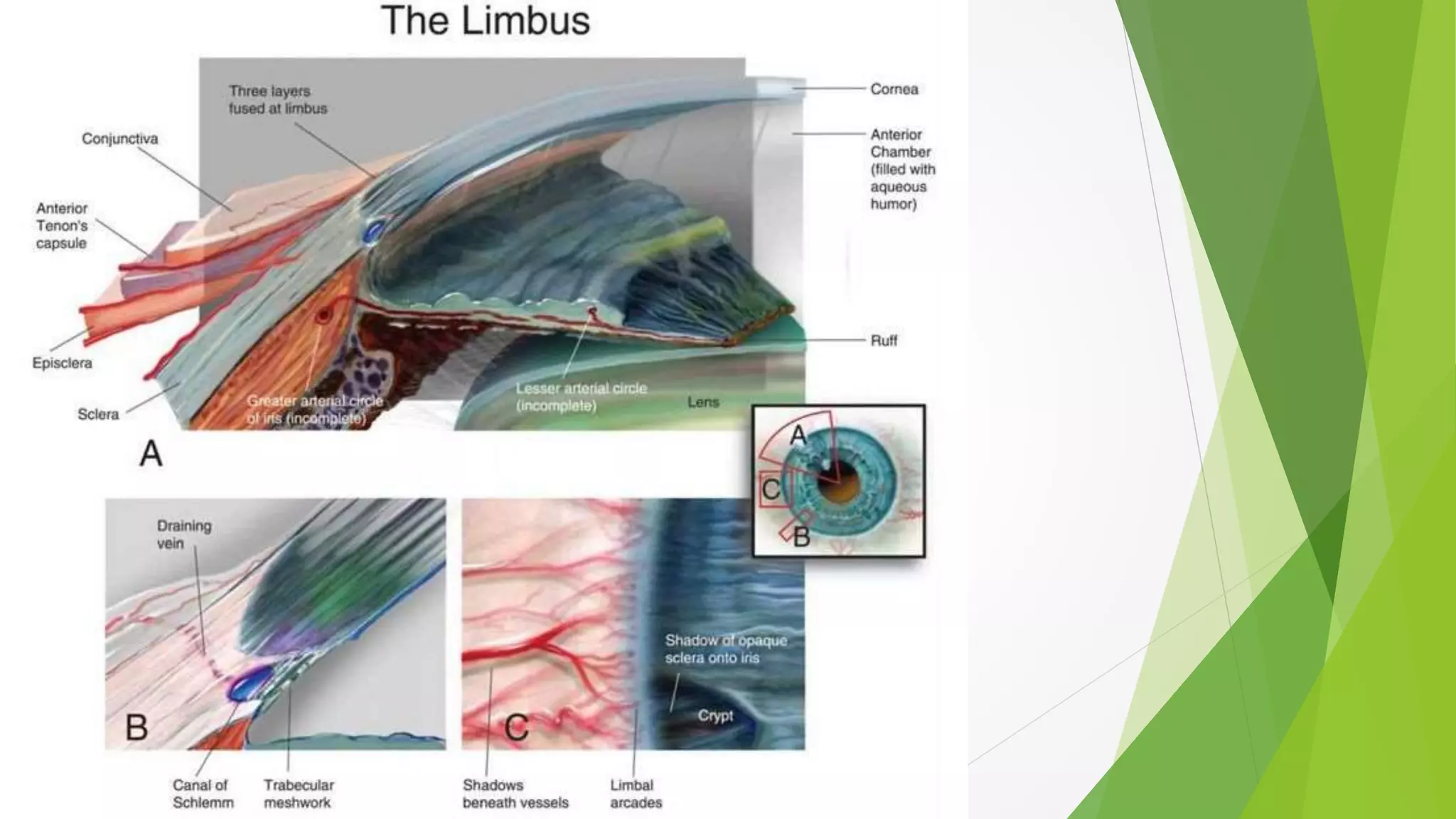
Anatomical Review
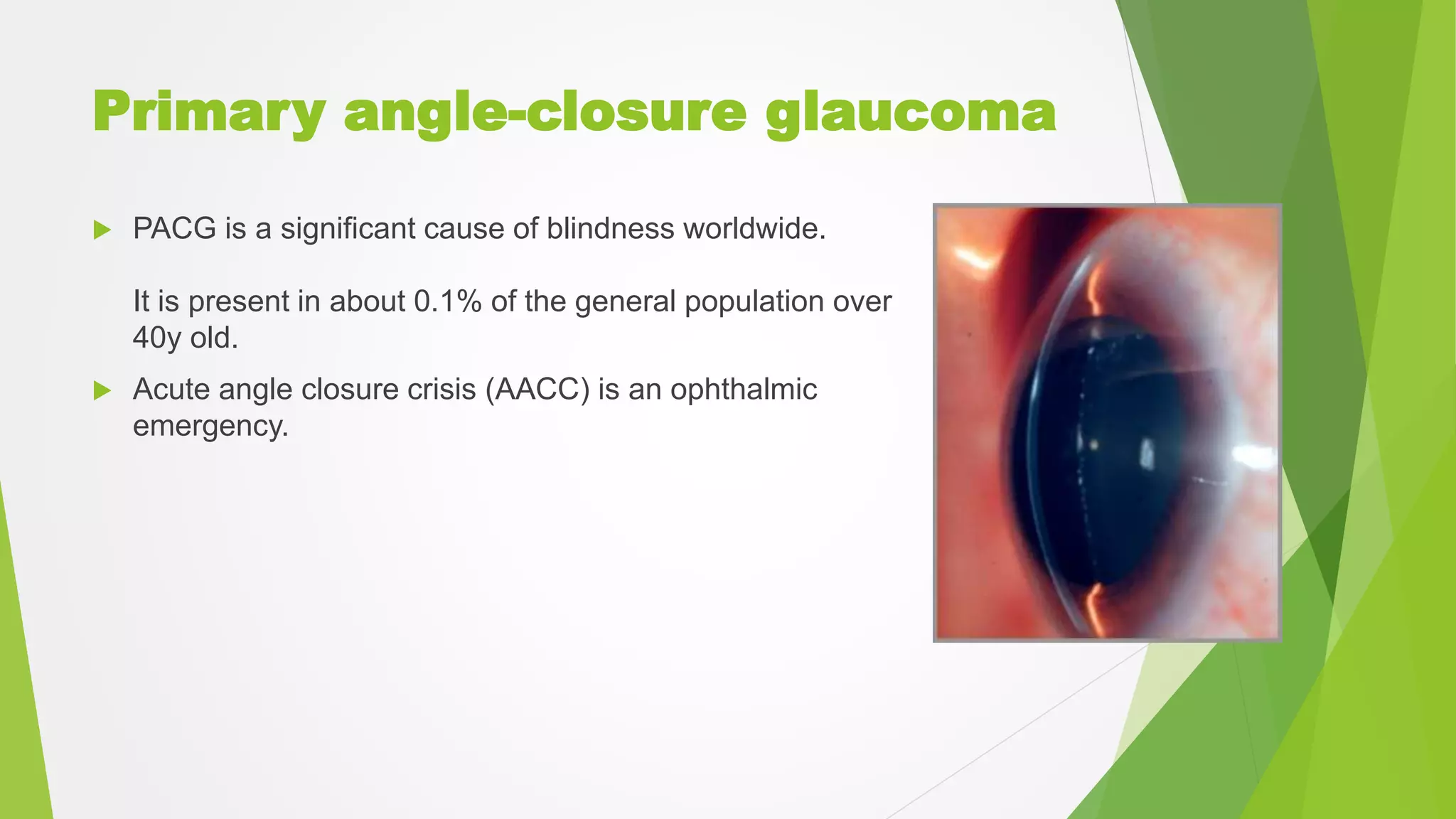
Primary angle-closure glaucoma
 PACG is a significant cause of blindness worldwide.
It is present in about 0.1% of the general population over
40y old.
 Acute angle closure crisis (AACC) is an ophthalmic
emergency.
Risk factors
Epidemiological
 Age: >40y old; mean age of diagnosis ± 60y.
 Female sex.
Ethnicity: Chinese, South East Asians.
Anatomical
 Pupil block mechanism
 Plateau iris mechanism
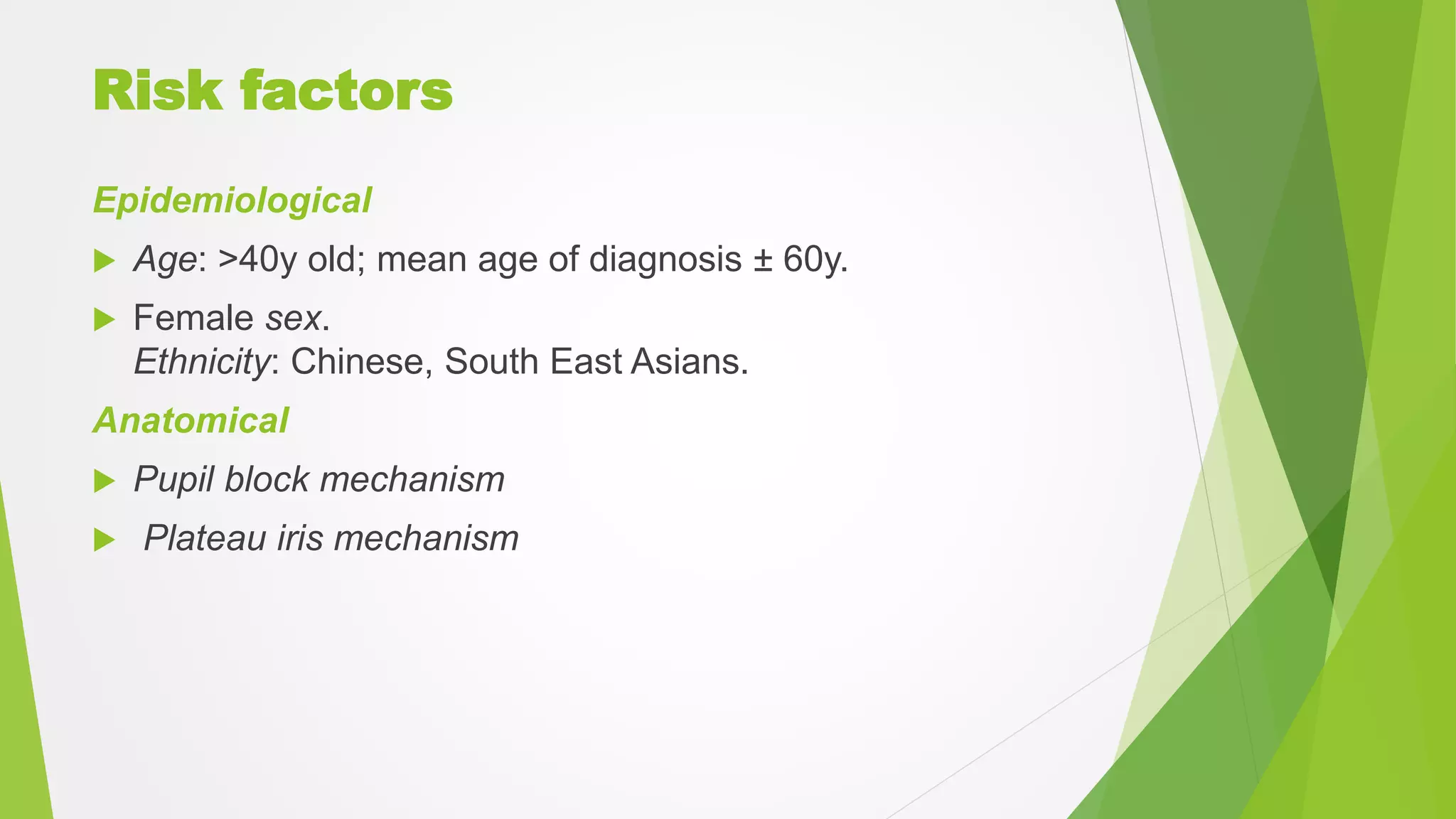
Pupil block mechanism
 Narrow angle, shallow AC,
 relatively anterior iris–lens diaphragm,
 large lens (older, cataract),
 short axial length (usually hypermetropic);
 risk increases with increasing lens thickness to axial length ratio.
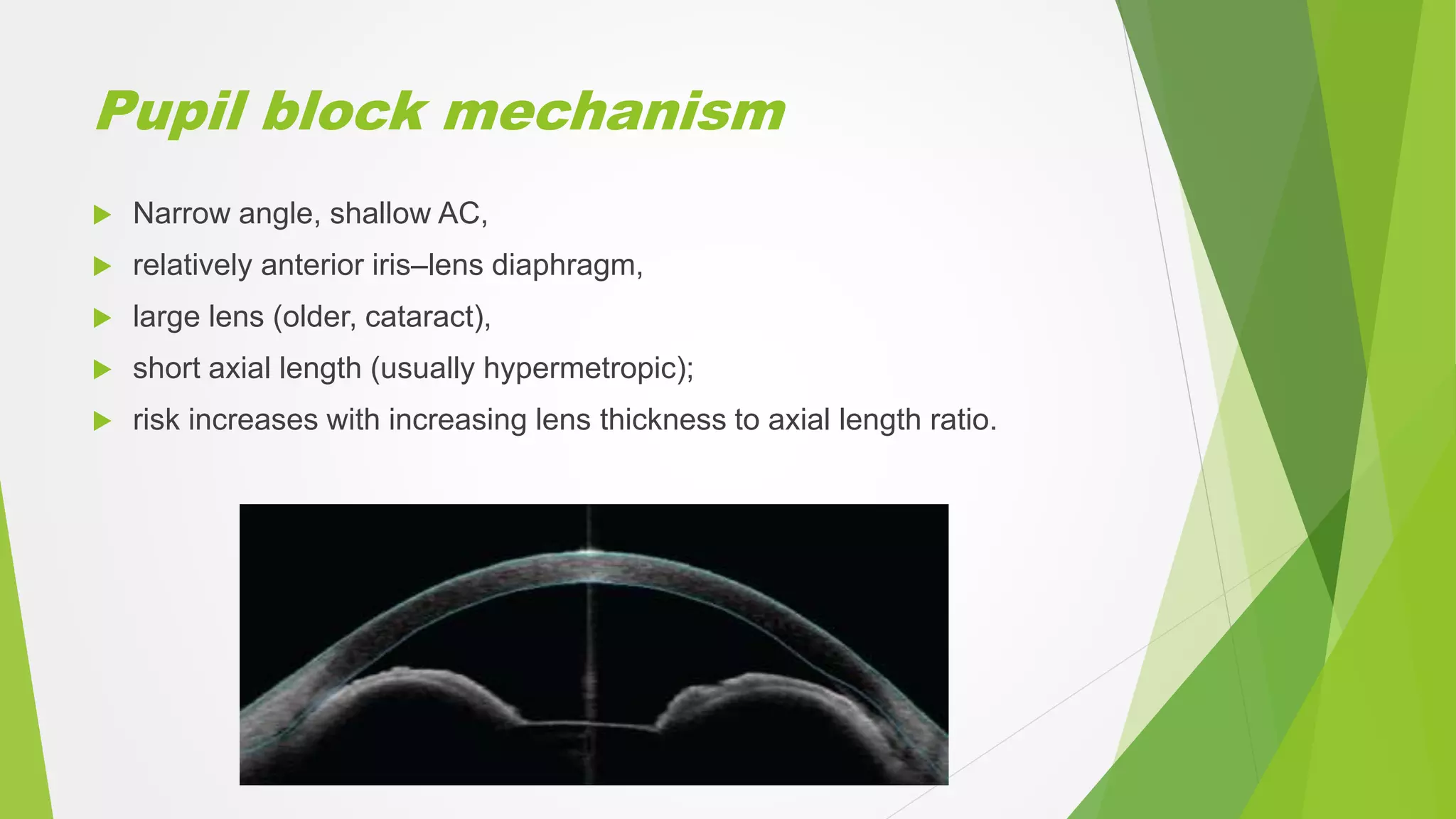
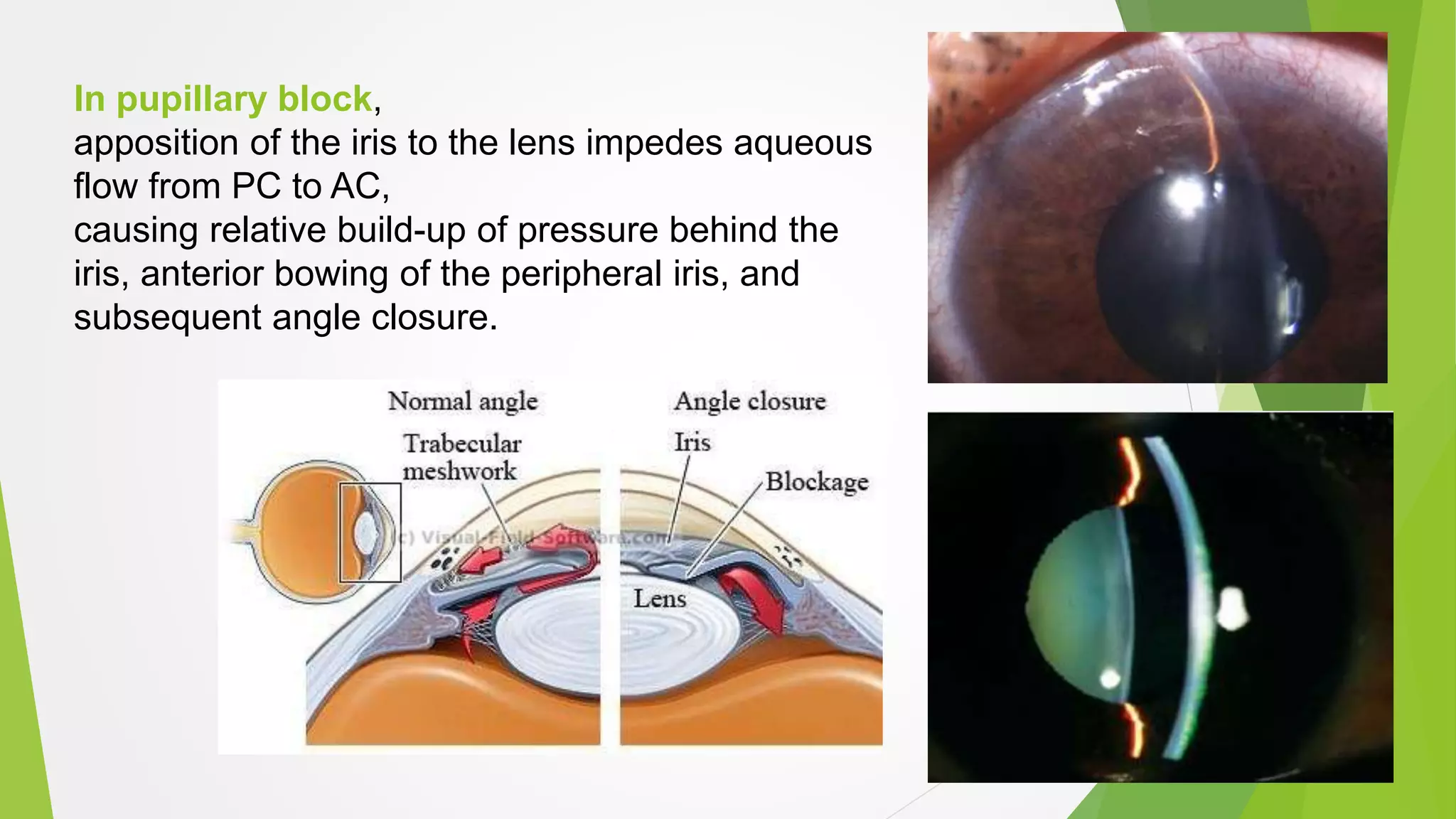
In pupillary block,
apposition of the iris to the lens impedes aqueous
flow from PC to AC,
causing relative build-up of pressure behind the
iris, anterior bowing of the peripheral iris, and
subsequent angle closure.
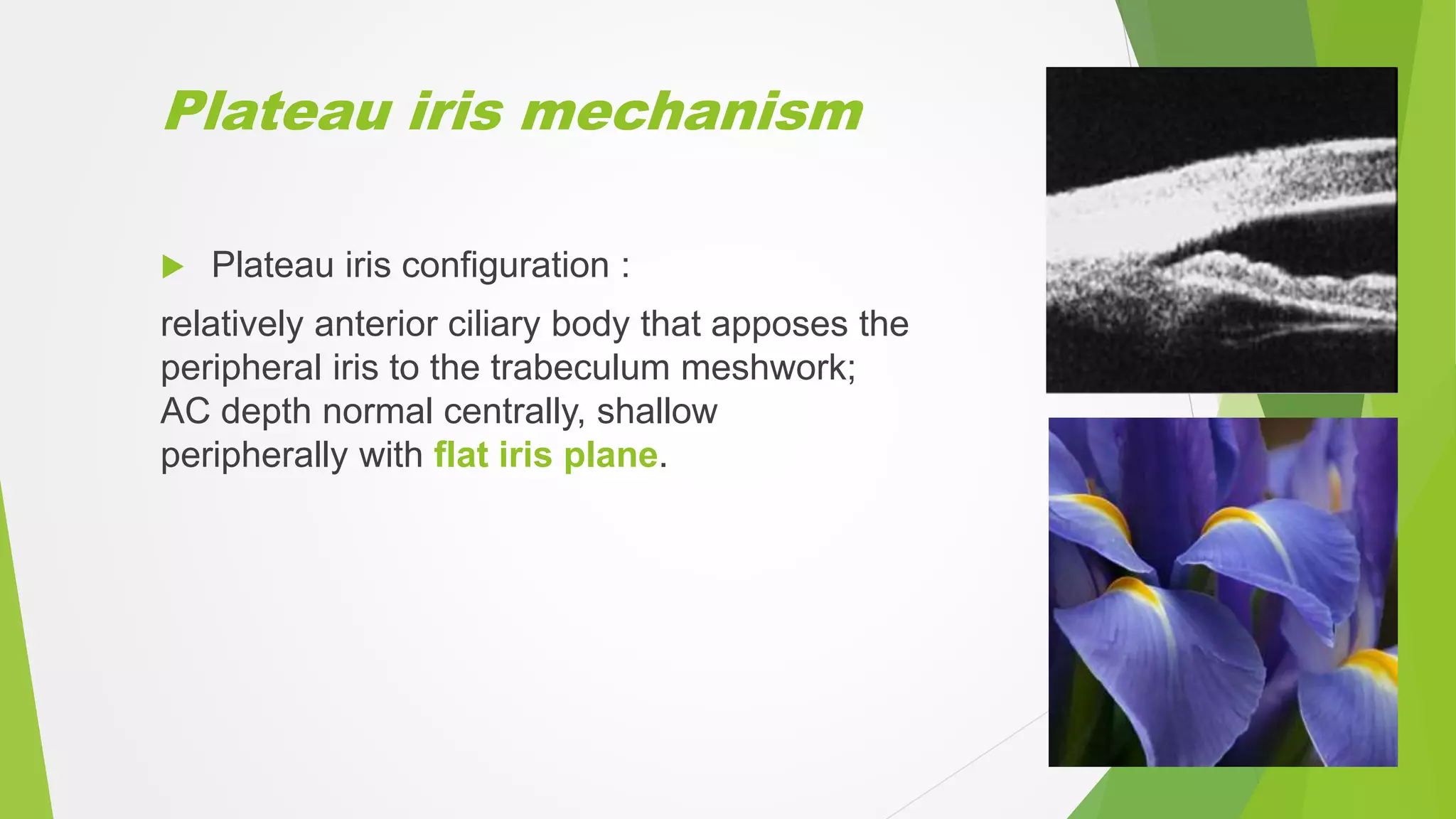
Plateau iris mechanism
 Plateau iris configuration :
relatively anterior ciliary body that apposes the
peripheral iris to the trabeculum meshwork;
AC depth normal centrally, shallow
peripherally with flat iris plane.
Important Terminology:
 Acute angle closure Crisis (AACC): Irido-trabecular
contact ITC with acute symptomatic elevated IOP.
 Primary angle closure glaucoma (PACG): Primary angle
closure PAC with glaucomatous damage (changes in the
optic disc and VF).
Acute angle closure crisis
 Acute angle closure (AACC) is an ophthalmic emergency
requiring urgent treatment to prevent irreversible optic
nerve damage.
 Severe, permanent damage may occur within several
hours. If visual acuity is hand motions or worse, IOP
reduction is usually urgent
 Recurrent episodes of acute/subacute angle closure may
lead to synechial angle closure, and eventually to Primary
angle closure glaucoma (PACG)
Acute angle closure Crisis (AACC)
Clinical Picture;
symptoms:
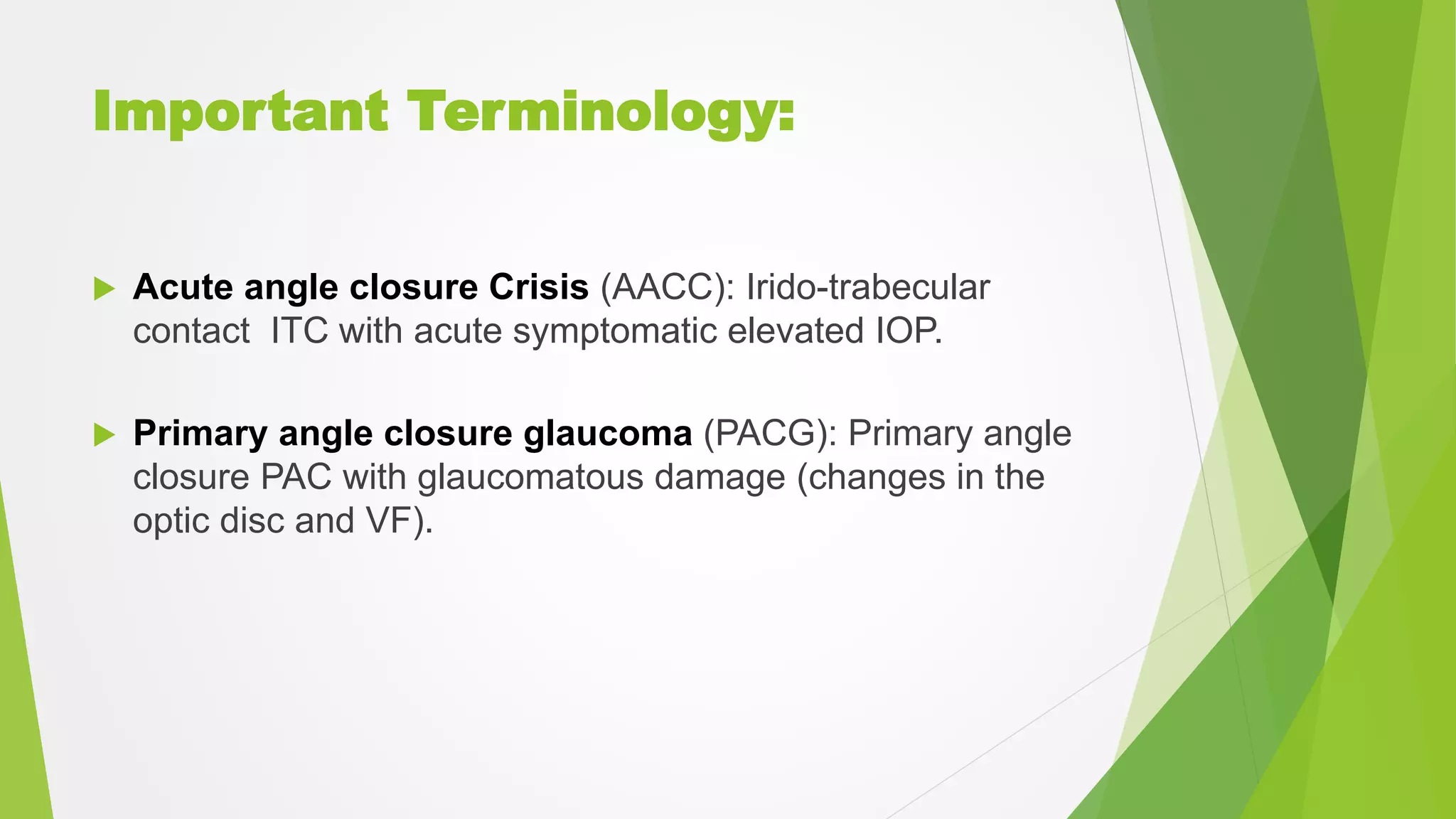
 Pain (periocular pain , headache, abdominal
colic),
 Blurred vision, Haloes around the light.
 Nausea, vomiting.
Clinical Picture;
Signs:
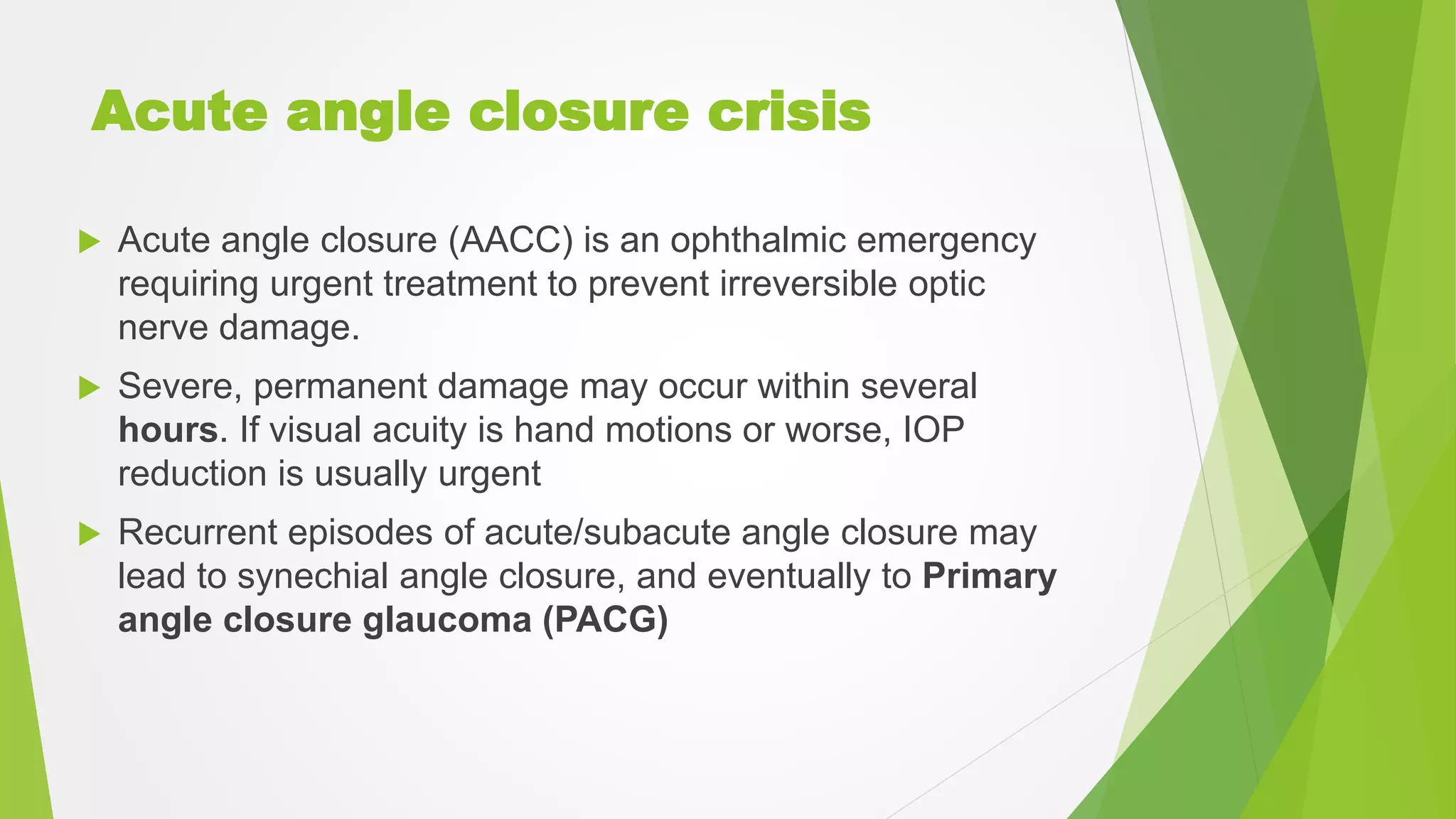
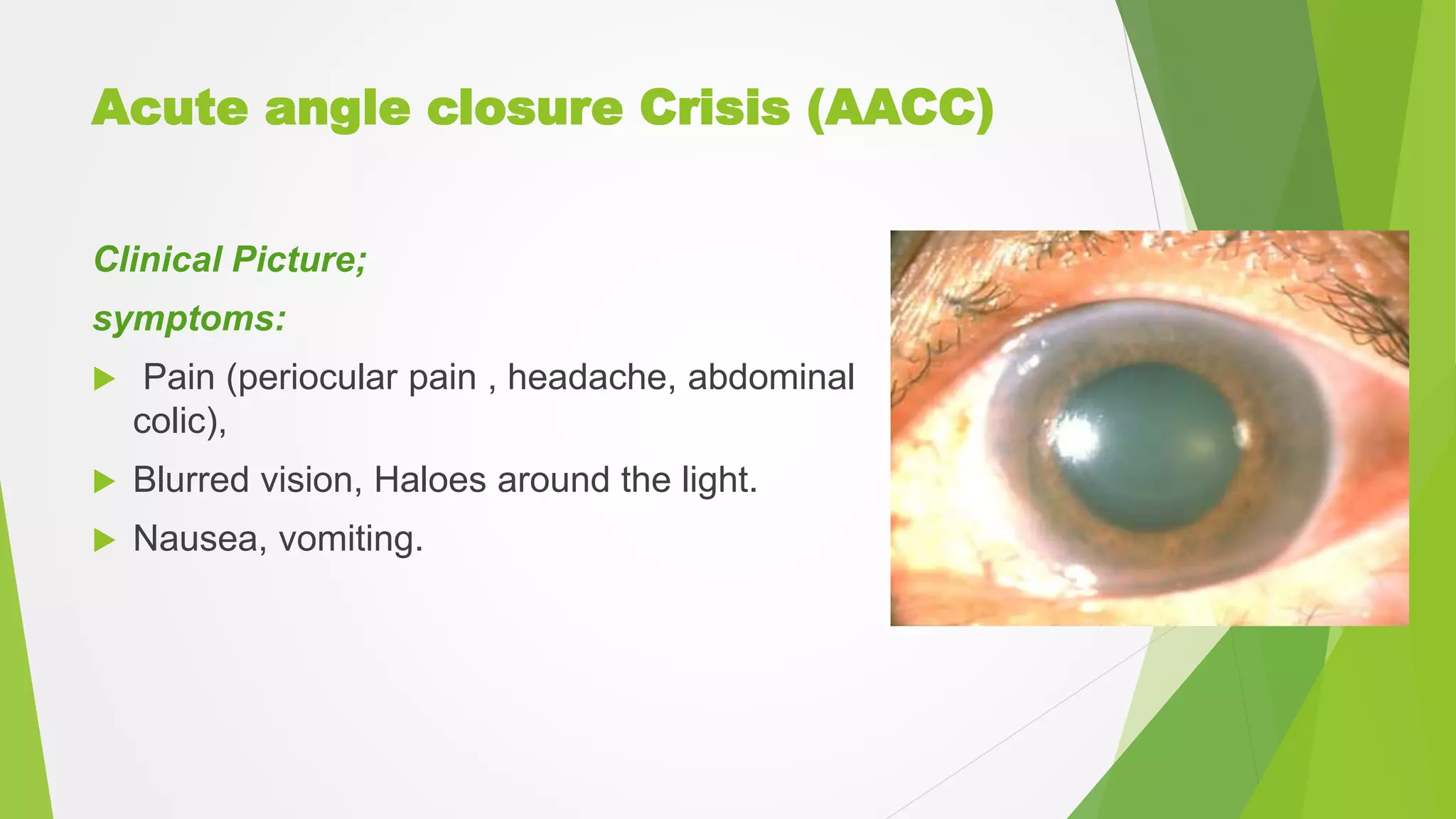
 Red eye, Ciliary Congestion.
 Pupil; fixed semi-dilated,
 Visual Acuity may be as worse as HM
 Raised IOP (usually 50–80mmHg),
 Corneal oedema,
 Angle closed,
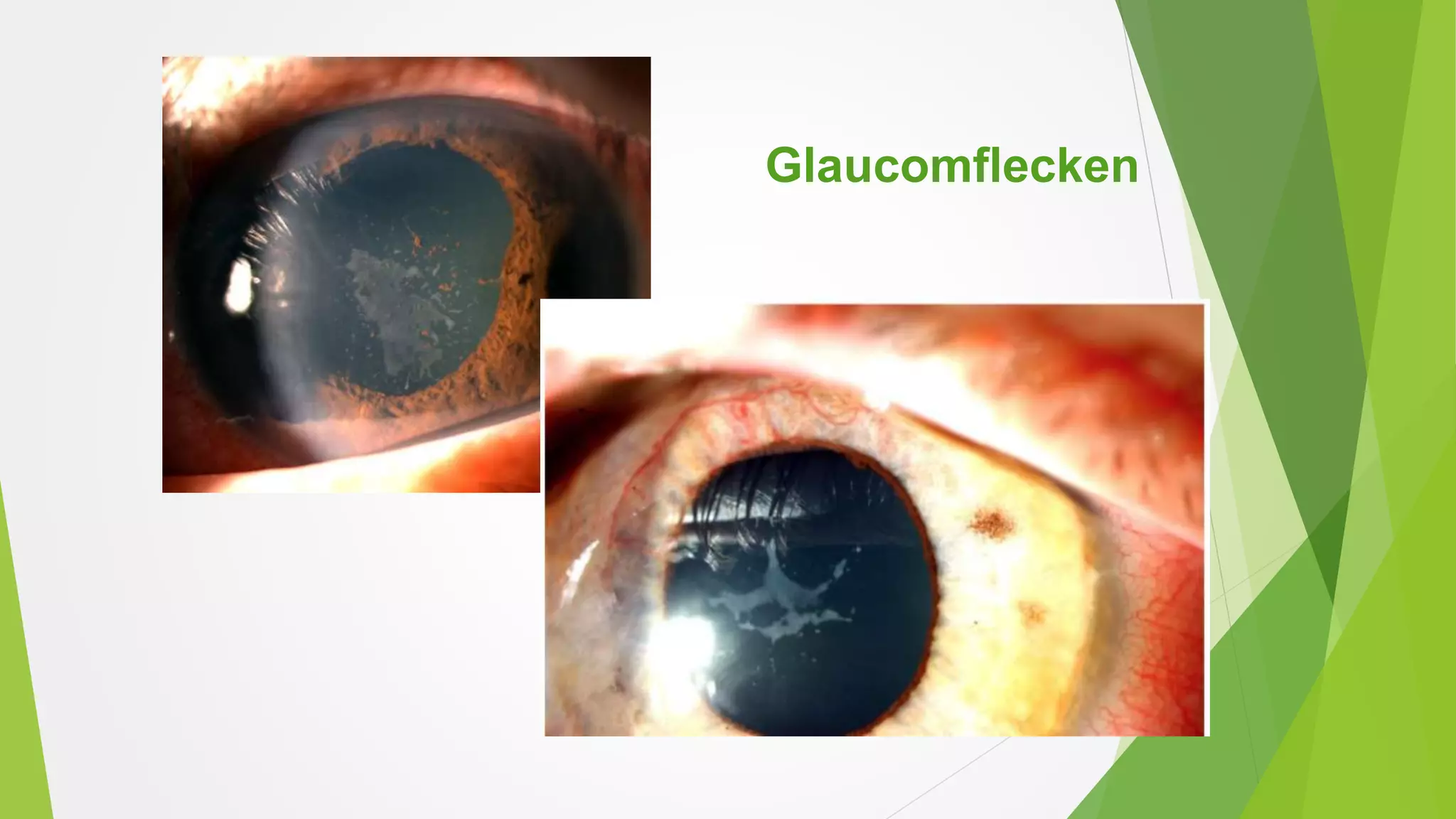
 Glaucomflecken;
 Contralateral angle narrow;
 Bilateral shallow AC.
Glaucomflecken
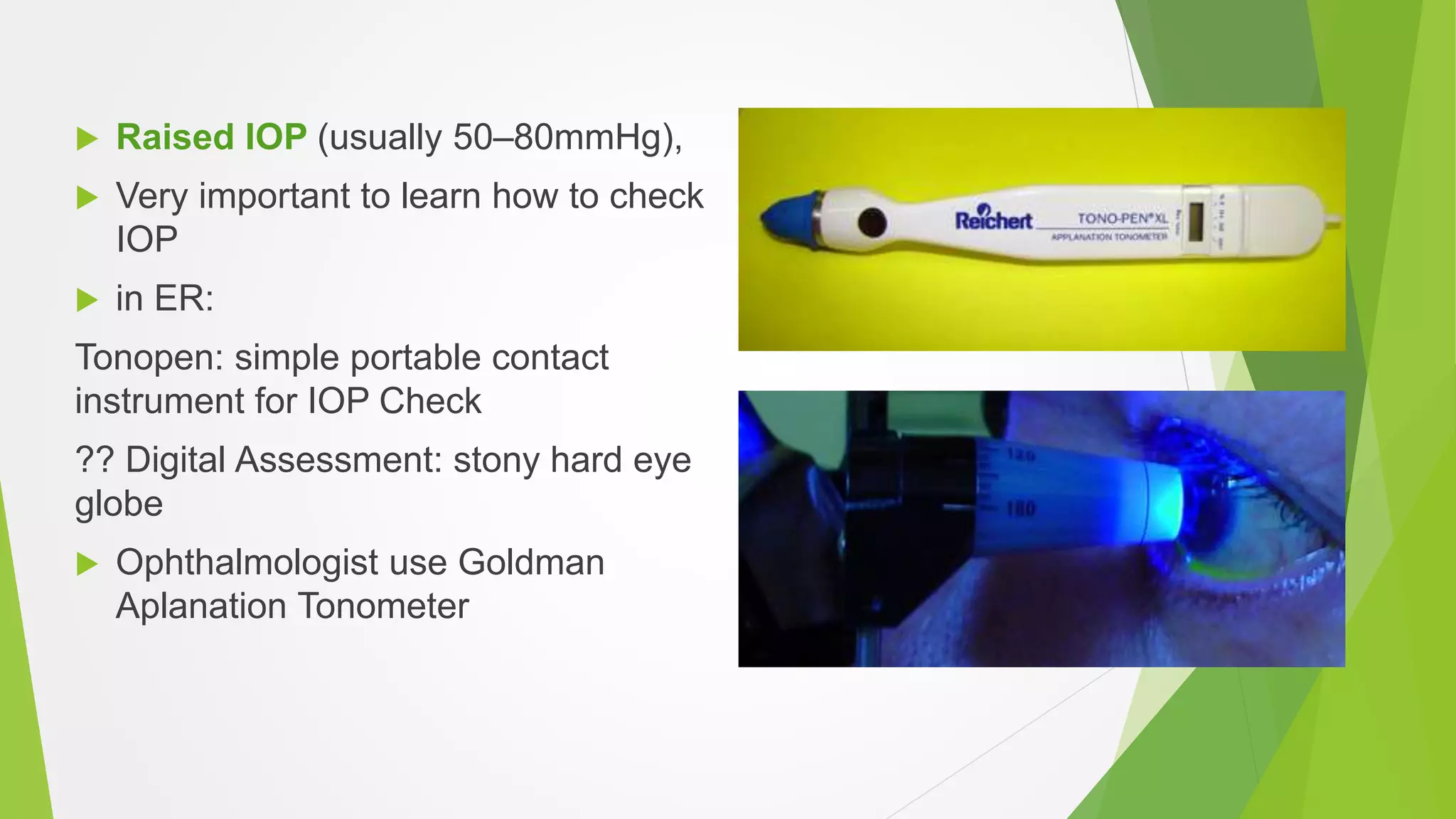
 Raised IOP (usually 50–80mmHg),
 Very important to learn how to check
IOP
 in ER:
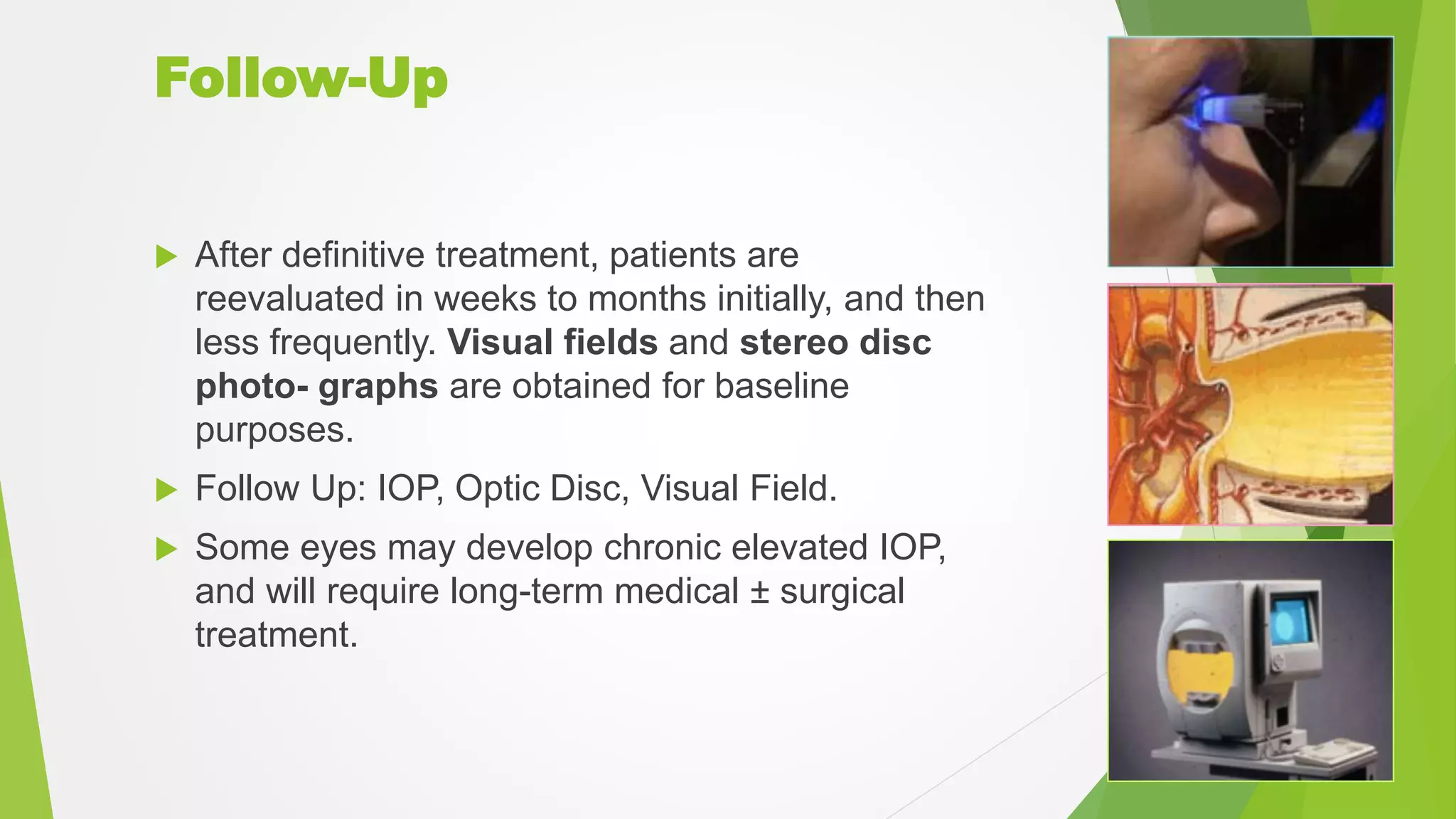
Tonopen: simple portable contact
instrument for IOP Check
?? Digital Assessment: stony hard eye
globe
 Ophthalmologist use Goldman
Aplanation Tonometer
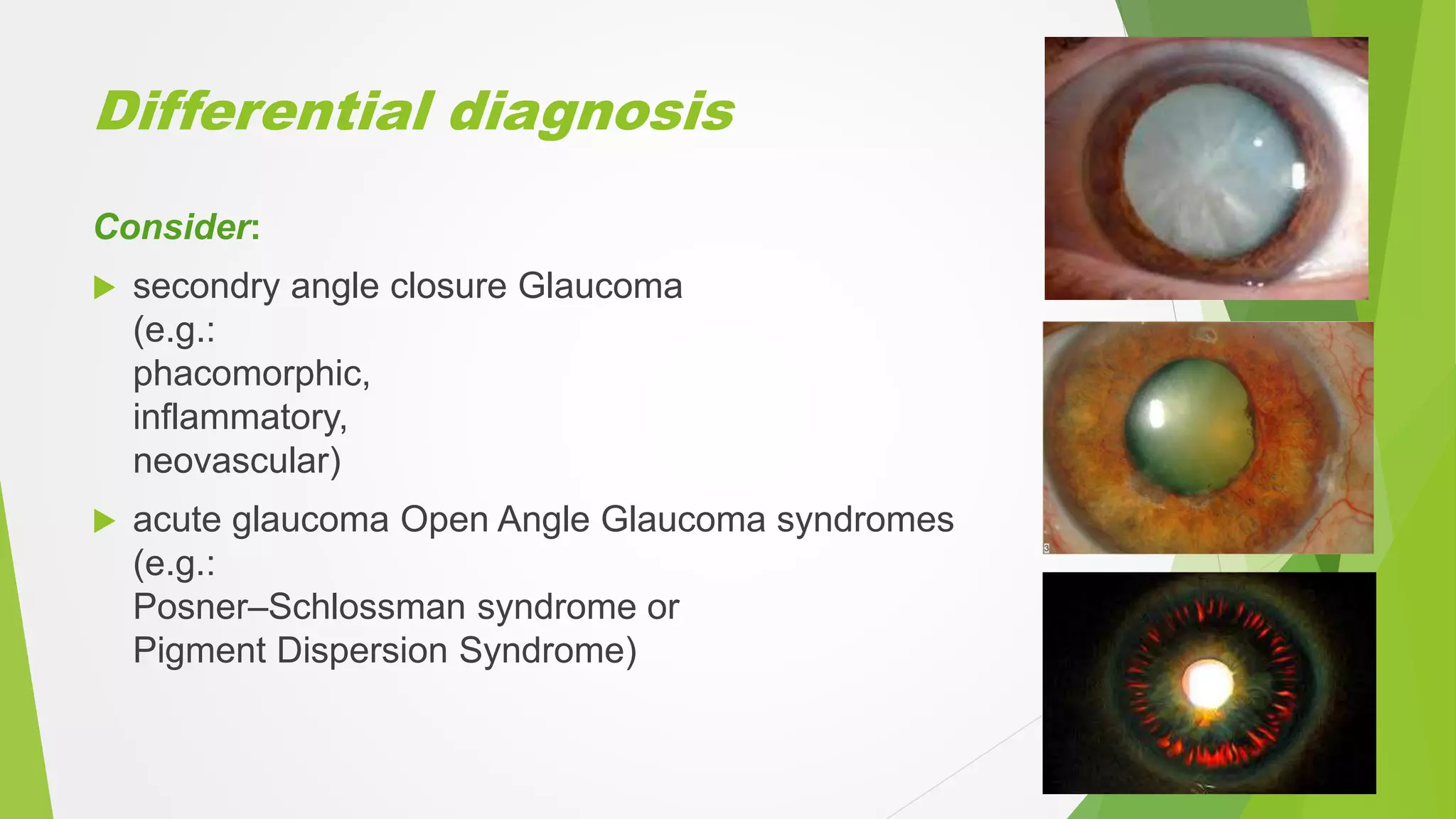
Differential diagnosis
Consider:
 secondry angle closure Glaucoma
(e.g.:
phacomorphic,
inflammatory,
neovascular)
 acute glaucoma Open Angle Glaucoma syndromes
(e.g.:
Posner–Schlossman syndrome or
Pigment Dispersion Syndrome)
Approach to the treatment of APAC
Immediate
 Systemic: Acetazolamide 500mg IV stat (then 250mg PO
4×/d).
 β-blocker (e.g. Timolol 0.5% Eye Drops stat, then every
12 hours).
 Sympathomimetic (e.g. Apraclonidine 1% ED stat).
 Steroid (e.g. Prednisolone 1% ED stat, then every 30 to 60
min.)
 Pilocarpine 2%ED (once IOP <50mmHg, e.g. twice in first
hour, then eye 6 hours).
Consider:
 Indentation Gonioscopy with a 4-mirror goniolens may help
relieve pupil block;
 lying the patient supine may allow the lens to fall back
away from the iris;
 Analgesics and Anti-emetics may be necessary.
 Pilocarpine 1% is often given to the contralateral eye
while awaiting Nd-YAG PI.
Intermediate
 Check IOP hourly until adequate control.
 If IOP not improving:
consider systemic Hyperosmotics (e.g.
Glycerol PO
Mannitol 20% 1g/kg of 50% solution in lemon juice or
solution IV 1–1.5g/kg).
 If IOP still not improving: consider acute Nd-YAG PI
(YAG Laser Peripheral Iridectomy)
 If IOP still not improving:
 Review the diagnosis
 Review the patency of PI or
proceed to surgical PI,
argon laser iridoplasty,
paracentesis,
cyclodiode photocoagulation,
or emergency cataract extraction/trabeculectomy.
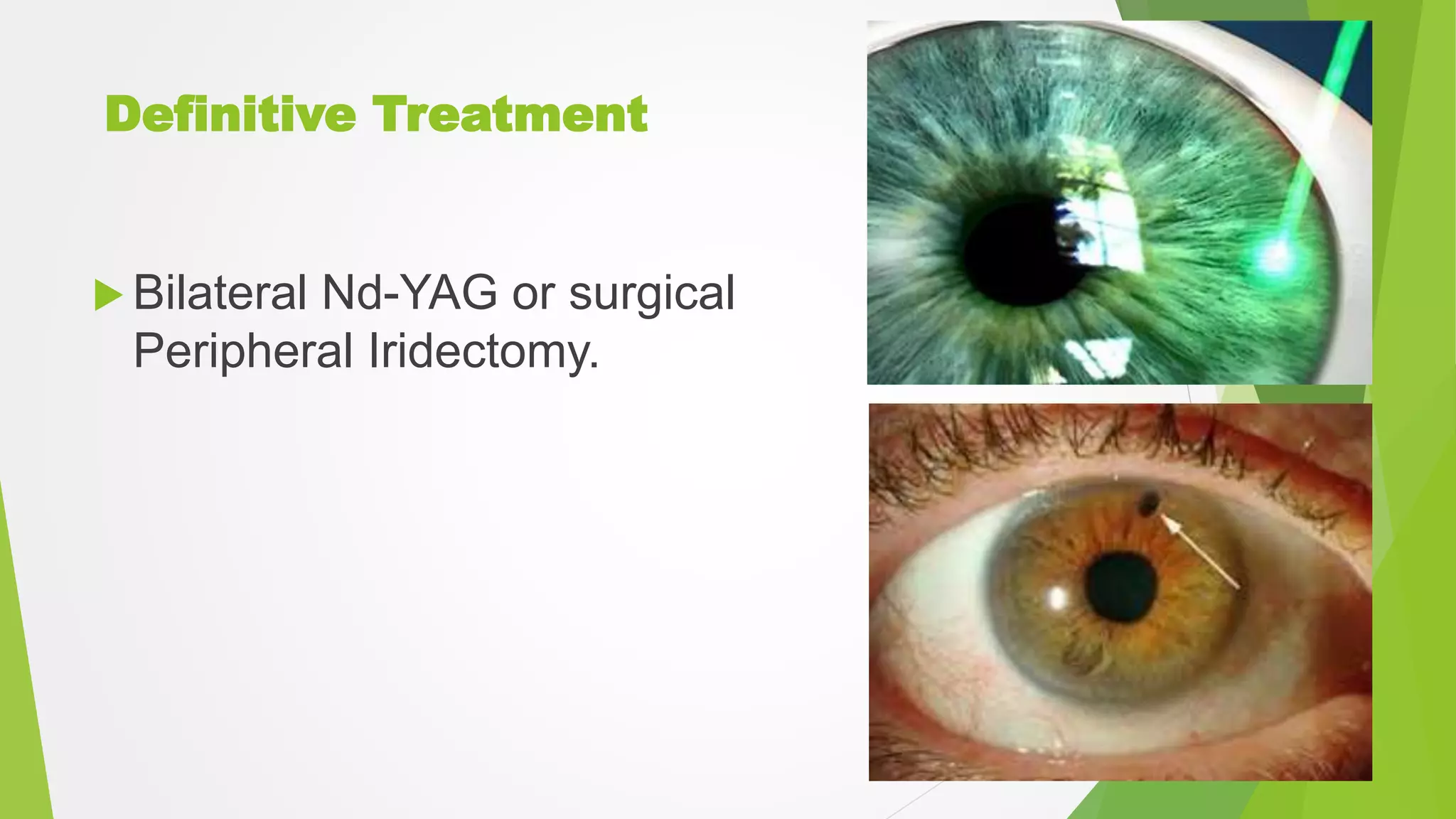
Definitive Treatment
 Bilateral Nd-YAG or surgical
Peripheral Iridectomy.
Follow-Up
 After definitive treatment, patients are
reevaluated in weeks to months initially, and then
less frequently. Visual fields and stereo disc
photo- graphs are obtained for baseline
purposes.
 Follow Up: IOP, Optic Disc, Visual Field.
 Some eyes may develop chronic elevated IOP,
and will require long-term medical ± surgical
treatment.
Refrences:
 Oxoford Hand Book Of Ophthalmology, third edition, 2014
 Will’s Eye Manual, fifth edition 2008
 Preferred Practice Pattern, AAO, 2015.
 Photos copied from internet open sources.
THANK YOU

ACUTE ANGLE CLOSURE CRISIS

  • 1.
    Acute Angle Closure Crisis BY DRSAFAA REFAAT FRCSG, M.Sc., MBBS
  • 2.
    Glaucoma Definition:  Glaucoma isa progressive optic neuropathy with characteristic changes in the optic nerve head and corresponding loss of VF.  It represents a final common pathway for a number of conditions, for most of which raised IOP is the most important risk factor. Increased IOP VF Defect ON Cupping
  • 3.
  • 4.
    Classifications: Etiology Primary Secondary Anatomical Open Angle Closed Angle Ageof onset infantile juvenile Adult onse Clinical Acute Chronic
  • 5.
  • 8.
    Primary angle-closure glaucoma PACG is a significant cause of blindness worldwide. It is present in about 0.1% of the general population over 40y old.  Acute angle closure crisis (AACC) is an ophthalmic emergency.
  • 9.
    Risk factors Epidemiological  Age:>40y old; mean age of diagnosis ± 60y.  Female sex. Ethnicity: Chinese, South East Asians. Anatomical  Pupil block mechanism  Plateau iris mechanism
  • 10.
    Pupil block mechanism Narrow angle, shallow AC,  relatively anterior iris–lens diaphragm,  large lens (older, cataract),  short axial length (usually hypermetropic);  risk increases with increasing lens thickness to axial length ratio.
  • 11.
    In pupillary block, appositionof the iris to the lens impedes aqueous flow from PC to AC, causing relative build-up of pressure behind the iris, anterior bowing of the peripheral iris, and subsequent angle closure.
  • 12.
    Plateau iris mechanism Plateau iris configuration : relatively anterior ciliary body that apposes the peripheral iris to the trabeculum meshwork; AC depth normal centrally, shallow peripherally with flat iris plane.
  • 13.
    Important Terminology:  Acuteangle closure Crisis (AACC): Irido-trabecular contact ITC with acute symptomatic elevated IOP.  Primary angle closure glaucoma (PACG): Primary angle closure PAC with glaucomatous damage (changes in the optic disc and VF).
  • 14.
    Acute angle closurecrisis  Acute angle closure (AACC) is an ophthalmic emergency requiring urgent treatment to prevent irreversible optic nerve damage.  Severe, permanent damage may occur within several hours. If visual acuity is hand motions or worse, IOP reduction is usually urgent  Recurrent episodes of acute/subacute angle closure may lead to synechial angle closure, and eventually to Primary angle closure glaucoma (PACG)
  • 15.
    Acute angle closureCrisis (AACC) Clinical Picture; symptoms:  Pain (periocular pain , headache, abdominal colic),  Blurred vision, Haloes around the light.  Nausea, vomiting.
  • 16.
    Clinical Picture; Signs:  Redeye, Ciliary Congestion.  Pupil; fixed semi-dilated,  Visual Acuity may be as worse as HM  Raised IOP (usually 50–80mmHg),  Corneal oedema,  Angle closed,  Glaucomflecken;  Contralateral angle narrow;  Bilateral shallow AC.
  • 17.
  • 18.
     Raised IOP(usually 50–80mmHg),  Very important to learn how to check IOP  in ER: Tonopen: simple portable contact instrument for IOP Check ?? Digital Assessment: stony hard eye globe  Ophthalmologist use Goldman Aplanation Tonometer
  • 19.
    Differential diagnosis Consider:  secondryangle closure Glaucoma (e.g.: phacomorphic, inflammatory, neovascular)  acute glaucoma Open Angle Glaucoma syndromes (e.g.: Posner–Schlossman syndrome or Pigment Dispersion Syndrome)
  • 20.
    Approach to thetreatment of APAC Immediate  Systemic: Acetazolamide 500mg IV stat (then 250mg PO 4×/d).  β-blocker (e.g. Timolol 0.5% Eye Drops stat, then every 12 hours).  Sympathomimetic (e.g. Apraclonidine 1% ED stat).  Steroid (e.g. Prednisolone 1% ED stat, then every 30 to 60 min.)  Pilocarpine 2%ED (once IOP <50mmHg, e.g. twice in first hour, then eye 6 hours).
  • 21.
    Consider:  Indentation Gonioscopywith a 4-mirror goniolens may help relieve pupil block;  lying the patient supine may allow the lens to fall back away from the iris;  Analgesics and Anti-emetics may be necessary.  Pilocarpine 1% is often given to the contralateral eye while awaiting Nd-YAG PI.
  • 22.
    Intermediate  Check IOPhourly until adequate control.  If IOP not improving: consider systemic Hyperosmotics (e.g. Glycerol PO Mannitol 20% 1g/kg of 50% solution in lemon juice or solution IV 1–1.5g/kg).  If IOP still not improving: consider acute Nd-YAG PI (YAG Laser Peripheral Iridectomy)
  • 23.
     If IOPstill not improving:  Review the diagnosis  Review the patency of PI or proceed to surgical PI, argon laser iridoplasty, paracentesis, cyclodiode photocoagulation, or emergency cataract extraction/trabeculectomy.
  • 24.
    Definitive Treatment  BilateralNd-YAG or surgical Peripheral Iridectomy.
  • 25.
    Follow-Up  After definitivetreatment, patients are reevaluated in weeks to months initially, and then less frequently. Visual fields and stereo disc photo- graphs are obtained for baseline purposes.  Follow Up: IOP, Optic Disc, Visual Field.  Some eyes may develop chronic elevated IOP, and will require long-term medical ± surgical treatment.
  • 26.
    Refrences:  Oxoford HandBook Of Ophthalmology, third edition, 2014  Will’s Eye Manual, fifth edition 2008  Preferred Practice Pattern, AAO, 2015.  Photos copied from internet open sources.
  • 27.