Care label
Need for care label
• It indicates how to clean textile articles in
the best possible way . It provide info on
washing ,bleaching , ironing ,dry cleaning
and tumble drying.
• Symbols refer to maximum permissible
treatment that a textile article can bear
without irrerversible damage.
Who needs to label and what
needs labeling
• Following needs to be aware of the use of care
labels
• - mfgers and importers of textile wearing apparel
• Mfgers & Importers of pieces good sold to
consumers for making apparel
• Any person or organisation that controls the
manufacturing and importing of textiles wearing
apparel or piece goods for making wearing
apparel
As per FTC ,US following
exempted
• Textile apparel worn to cover the body
• Exempt apparel- shoes ,gloves and hats
• Excluded items
hankerchiefs,belts,suspenderr and neckties as they donot protect
body
Non woven garments made for onetime use as the donot need
ordinary care
Pieces goods sold for making apparel at home
exempt piece goods
marked mfgers remnants upto 10 yards when the fibre content is
not known and cannot easily be determined
trims upto 5 inches wide
American care labeling system
• Generally written instructions have been used on
care labels . But from july 1997 the FTC
permitted mfgers to use care symbols dvpd by
ASTM
• FTC wanted the written info explaining what
symbols mean on hangtags with garments till
the end of 1998 so that consumers become
familiar with these symbols and understand
which symbol means what. This was due to
NAFTA in 1994
FTC decided that adaption of the
ISO system of symbols used by EU
is not appropriate for US at this
time as its not comprehensive as
ASTM and also due to issues
associated with the fact that the
ISO stds is trademarked have not
been adequately resolved.
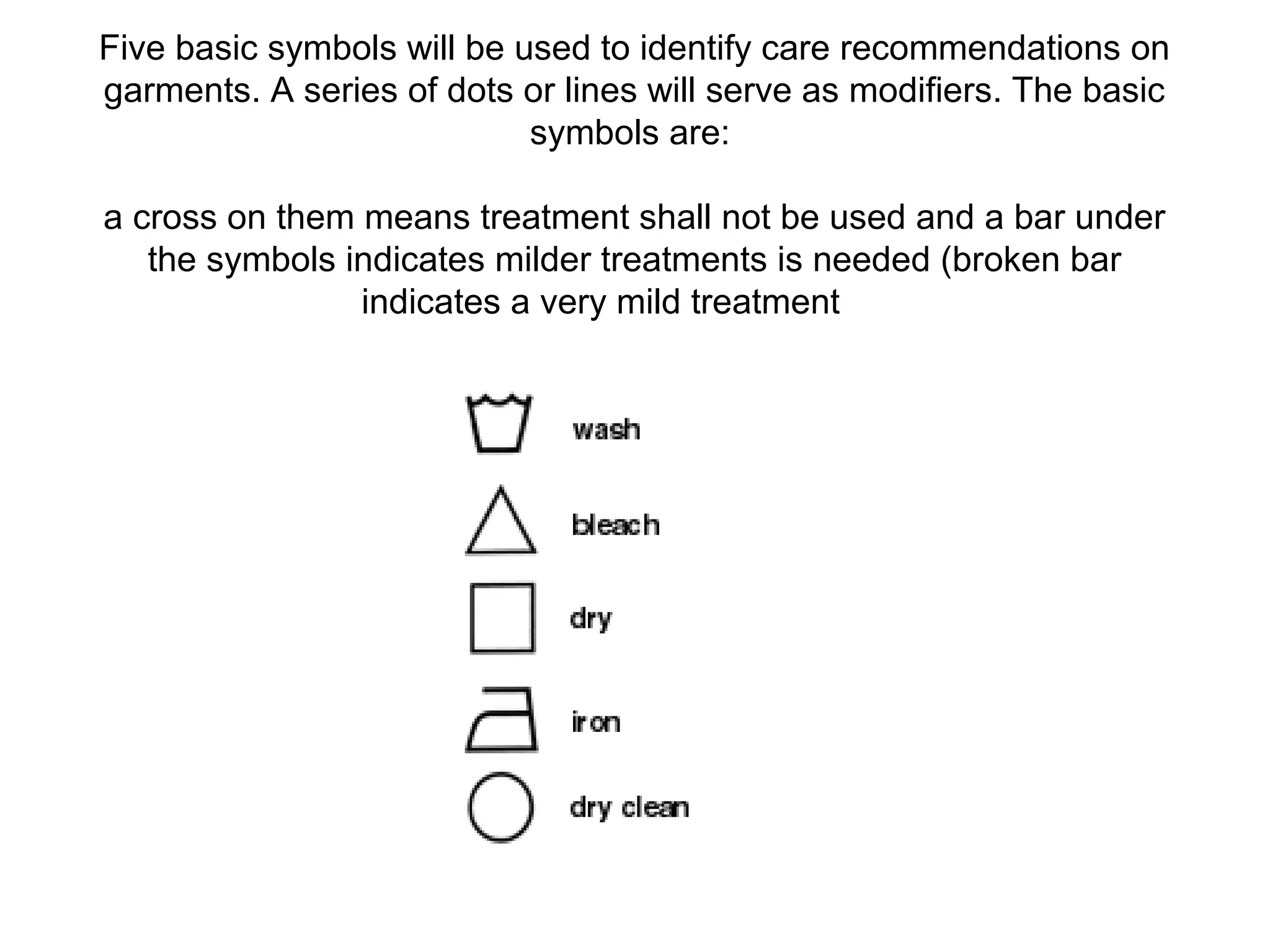
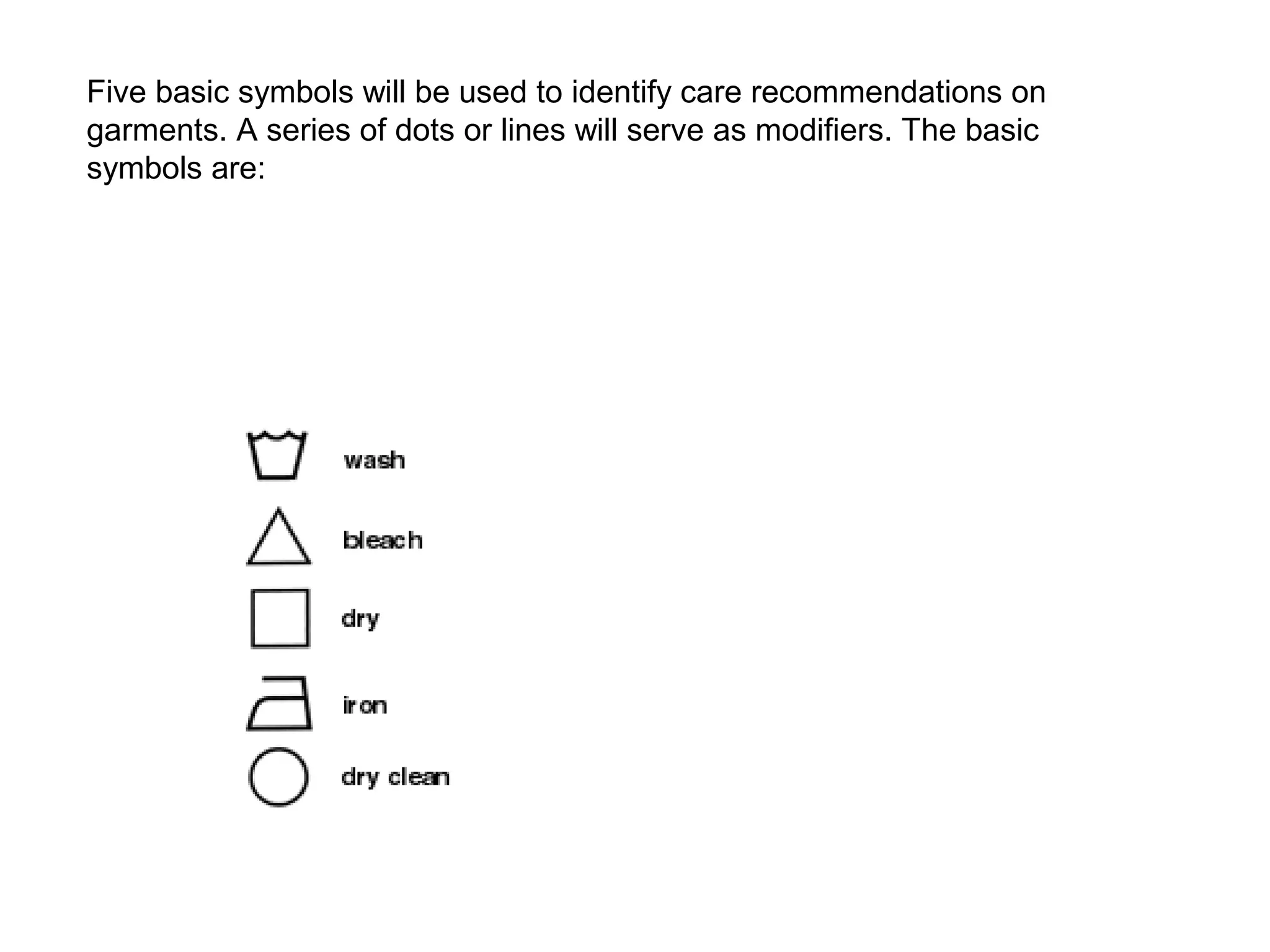
Five basic symbols will be used to identify care recommendations on
garments. A series of dots or lines will serve as modifiers. The basic
symbols are:
a cross on them means treatment shall not be used and a bar under
the symbols indicates milder treatments is needed (broken bar
indicates a very mild treatment
ISO care symbols --it requires that the symbols
be legible and proportional to size of garment.
It does not have symbols for natural drying , use
of non chloring bleach or use of steam in ironing.
Its symbols for drycleaning does not address all
the warnings required by the american rule for
care labeling.
In ISO an underlined circle warns professional
drycleaners generally about potential harm from
mechanical action and drying temp and water
addition in the solvent
International care labeling system-
GINETEX
• Internationally many countries follow
different care instructions and have
different laws and rules governing the
same. The International care labeling
system-(GINETEX) had therefore dvpd a
language independent care labeling
system in 1975
• ISO 3758 1991 provides a code of
reference for the use of these symbols.
Washing by hand or by machine
• Washing by hand or by machine
Lbl must say if its machine or handwash. It should also give a water
temp setting if regular use of hot water will harm the product.
• Bleaching – if all commercially avbl bleaches can be used on a
regular basis without harming the product the label does not have to
mention bleach.
• If using cholrine bleach on a regular basis would harm the product
but using non chlorine bleach on a regular basis would not , the
label must say “only non chlorine bleach when needed”
• If all commercially avbl bleaches would harm the product when used
on a regular basis the label must say “no bleach or donot bleach “
• Drying – label must say whether the product should be dried by
machine or method. Unless regular use of high temp will harm the
product when machine dried its not necessary to indicate temp
setting.
Ironing
ironing info must be given on a care label if ironing will be
needed on a regular basis. if regular use of a hot iron will
not harm a product its not necessary to indicate a temp
setting.
Warning (including dry cleaning)
if consumer reasonably could be expected to use care
procedure that would harm the product, the label must
contain a warning like “do not “ ,”no “ “only “ to warn against
the harmful procedure . For example if ironing will harm a
garment even if ironing is not regularly needed , the label
should state “do not iron” if the customer can be expected
to “touch up” the garment occasionally .
If a care procedure on one product could cause harm to
another product being washed with it ,a warning must be
included. For example if an item is not colorfast ,the label
must say,”wash with like colors or wash seperately.
Warnings are not necessary for alternative procedures that
could be harmful . For
Dry cleaning instructions
a simple “dryclean” instructions may be
used under two conditions
first if all commercially avbl types of solvent can be used
the label does not have mention any particular solvent. If
one or more solvent would harm the product a safe solvent
must be mentioned(ex – “dryclean ,petroleum solvent)
second – a simple “dryclean” may be used if the
drycleaning process as can be used on a garment with no
modifications. If any part of the drycleaning process would
harm the product the “dryclean ‘ instructions must include
the warning to avoid or modify that part of the process. For
ex- if steam would damage a garment the label would say
“dry clean .no steam”
“Dryclean only” is a warning that
the garment cannot be washed .
You may label “Dryclean only “
but only if you have evidence
that washing will damage the
garment.
ISO care symbols
• The astm and iso use same basic five
symbols. The difference in system consist
in the manner in which refinements to the
basic processes are conveyed.
ISO care labeling system assumes that
washing machine have internal
mechanisms for heating water to a
precise temperature setting. In addition
it includes only normal and low temp
ranges for tumble drying. Both of these
aspects of ISO are inconsistent with
the technology of laundry equipment
used in the US
ISO care labeling system has no
symbols for natural drying , the use of
non- cholrine bleach or use of steam in
ironing .
ISO care labeling system for
drycleaning does not address all the
warnings required by american rule for
care labeling.
in the iso system an underlined circle
warns professional drycleaners
generally about the potential harm from
mechanical action and or drying tem
and or water addition in the solvent.
American care labeling system
from july 1,1997, the FTC has permitted mfgers to use specified care
symbols dvpd by ASTM in place of written instructions to indicate a
method for properly cleaning them.
The FTC requires mfgers to include written information explaining
what the symbols mean on hangtags or elsewhere with garment till
the end of 1998 so that consumers become familiar with these
symbols and understand which symbols means what.
The FTC decided that ISO system of symbols used by EU is not
appropriate for the US at this time in part because its not as
comprehensive as the ASTM system
The Federal Trade Commission approved a
change in the care label format effective July 1,
1997. New guidelines allow manufacturers to use
care symbols on a voluntary basis rather than
written instructions. Manufacturers can still use
written instructions; however, the option of
symbols is now permitted. For the first 18 months,
hang tags or written guides must be provided on
garments to explain the care symbol system.
Care Symbol Guidelines
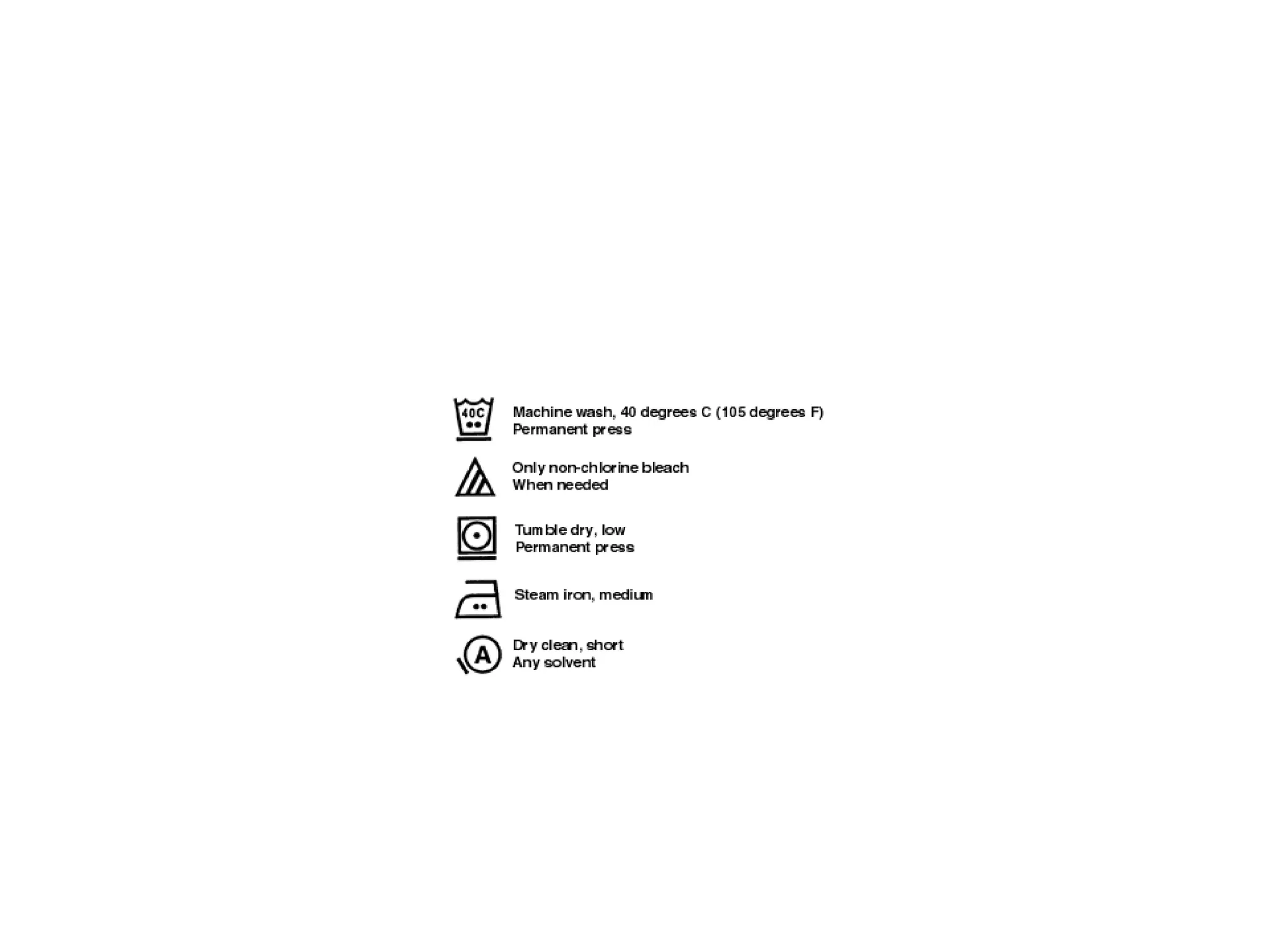
Five basic symbols will be used to identify care recommendations on
garments. A series of dots or lines will serve as modifiers. The basic
symbols are:
Dots added to the symbols will indicate increasing heat or temperature.
For example, one dot on the tumble dry symbol means low temperature
for delicate items; two dots mean medium for permanent press; and
three dots identify high temperatures for cottons and linens.
Lines added to a basic care symbol mean "minus" or reduced action or
treatment. No lines under the wash symbol means normal wash cycle
for cottons; one line under the wash symbol is for permanent press
cycles; and two lines are for even gentler treatment or reduced action
for delicate items.
Additional modifiers exist such as an "X" over a symbol.
This is a warning symbol. For example, an "X" over the dry-
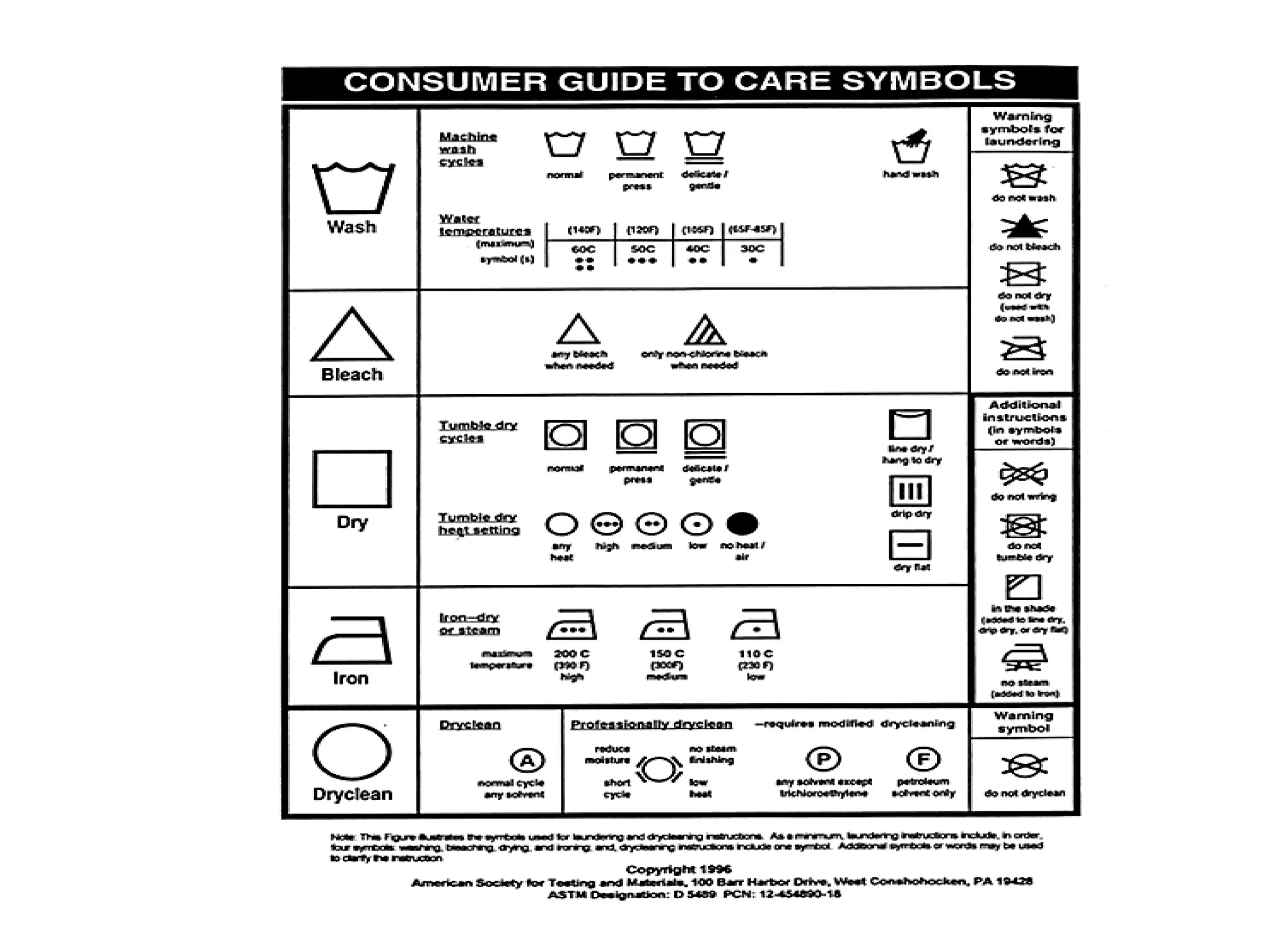
cleaning symbol means "do not dry clean." A complete
chart of symbols and modifiers is given on page 2.
The need for care label symbols as an alternative to written
instructions results from increased international trade and,
more specifically, from the North American Free Trade
Agreement (NAFTA). NAFTA requires standardization of
care instructions for apparel sold in Mexico, Canada, and
the United States. Manufacturers can prepare labels written
in three languages: English, French, and Spanish, or use
more universal care symbols.
Consumers will reap additional benefits once the care
symbol system is adopted. Apparel should have fewer,
smaller, and less annoying labels in garments. Smaller
label inventories and reduced production costs will be an
economic benefit for manufacturers. Also, as U.S. citizens
travel to other countries, they will now understand care
recommendations on apparel they are purchasing.
Although the new U.S. care symbols system is not identical
to that used in Europe, it is very similar and differs primarily
in its comprehensiveness as well as user friendly
approach.
Five basic symbols will be used to identify care recommendations on
garments. A series of dots or lines will serve as modifiers. The basic
symbols are:
Dots added to the symbols will indicate increasing heat or temperature. For
example, one dot on the tumble dry symbol means low temperature for delicate
items; two dots mean medium for permanent press; and three dots identify high
temperatures for cottons and linens.
Lines added to a basic care symbol mean "minus" or reduced action or
treatment. No lines under the wash symbol means normal wash cycle for
cottons; one line under the wash symbol is for permanent press cycles; and two
lines are for even gentler treatment or reduced action for delicate items.
Additional modifiers exist such as an "X" over a symbol. This is a warning
symbol. For example, an "X" over the dry-cleaning symbol means "do not dry
clean." A complete chart of symbols and modifiers is given on page 2.
The need for care label symbols as an alternative to written instructions results
from increased international trade and, more specifically, from the North
American Free Trade Agreement (NAFTA). NAFTA requires standardization of
care instructions for apparel sold in Mexico, Canada, and the United States.
Manufacturers can prepare labels written in three languages: English, French,
and Spanish, or use more universal care symbols.
Sampling process
• Proto sample- made with alternate fabric ,trims ,labels.usually one
size is made
• Fit sample- made to check proper fittings
• Size set samples- all sizes is made with actual fabric and trims
• Pre production samples (PP sample)- before production starts all
the sizes are made for checking everything about the style.used as
a reference for production .shown to buyer for comments which is
incorporated during production.
• Top of Production (TOP sample)- the first few pieces from the
production
• Sealer sample -the sample taken as a reference that the shipment
will be just like it with all packing ,hangtags ,finish

Presentation3 about labels

  • 1.
  • 2.
    Need for carelabel • It indicates how to clean textile articles in the best possible way . It provide info on washing ,bleaching , ironing ,dry cleaning and tumble drying. • Symbols refer to maximum permissible treatment that a textile article can bear without irrerversible damage.
  • 3.
    Who needs tolabel and what needs labeling • Following needs to be aware of the use of care labels • - mfgers and importers of textile wearing apparel • Mfgers & Importers of pieces good sold to consumers for making apparel • Any person or organisation that controls the manufacturing and importing of textiles wearing apparel or piece goods for making wearing apparel
  • 4.
    As per FTC,US following exempted • Textile apparel worn to cover the body • Exempt apparel- shoes ,gloves and hats • Excluded items hankerchiefs,belts,suspenderr and neckties as they donot protect body Non woven garments made for onetime use as the donot need ordinary care Pieces goods sold for making apparel at home exempt piece goods marked mfgers remnants upto 10 yards when the fibre content is not known and cannot easily be determined trims upto 5 inches wide
  • 5.
    American care labelingsystem • Generally written instructions have been used on care labels . But from july 1997 the FTC permitted mfgers to use care symbols dvpd by ASTM • FTC wanted the written info explaining what symbols mean on hangtags with garments till the end of 1998 so that consumers become familiar with these symbols and understand which symbol means what. This was due to NAFTA in 1994
  • 6.
    FTC decided thatadaption of the ISO system of symbols used by EU is not appropriate for US at this time as its not comprehensive as ASTM and also due to issues associated with the fact that the ISO stds is trademarked have not been adequately resolved.
  • 7.
    Five basic symbolswill be used to identify care recommendations on garments. A series of dots or lines will serve as modifiers. The basic symbols are: a cross on them means treatment shall not be used and a bar under the symbols indicates milder treatments is needed (broken bar indicates a very mild treatment
  • 8.
    ISO care symbols--it requires that the symbols be legible and proportional to size of garment. It does not have symbols for natural drying , use of non chloring bleach or use of steam in ironing. Its symbols for drycleaning does not address all the warnings required by the american rule for care labeling. In ISO an underlined circle warns professional drycleaners generally about potential harm from mechanical action and drying temp and water addition in the solvent
  • 9.
    International care labelingsystem- GINETEX • Internationally many countries follow different care instructions and have different laws and rules governing the same. The International care labeling system-(GINETEX) had therefore dvpd a language independent care labeling system in 1975 • ISO 3758 1991 provides a code of reference for the use of these symbols.
  • 10.
    Washing by handor by machine • Washing by hand or by machine Lbl must say if its machine or handwash. It should also give a water temp setting if regular use of hot water will harm the product. • Bleaching – if all commercially avbl bleaches can be used on a regular basis without harming the product the label does not have to mention bleach. • If using cholrine bleach on a regular basis would harm the product but using non chlorine bleach on a regular basis would not , the label must say “only non chlorine bleach when needed” • If all commercially avbl bleaches would harm the product when used on a regular basis the label must say “no bleach or donot bleach “ • Drying – label must say whether the product should be dried by machine or method. Unless regular use of high temp will harm the product when machine dried its not necessary to indicate temp setting.
  • 11.
    Ironing ironing info mustbe given on a care label if ironing will be needed on a regular basis. if regular use of a hot iron will not harm a product its not necessary to indicate a temp setting.
  • 12.
    Warning (including drycleaning) if consumer reasonably could be expected to use care procedure that would harm the product, the label must contain a warning like “do not “ ,”no “ “only “ to warn against the harmful procedure . For example if ironing will harm a garment even if ironing is not regularly needed , the label should state “do not iron” if the customer can be expected to “touch up” the garment occasionally . If a care procedure on one product could cause harm to another product being washed with it ,a warning must be included. For example if an item is not colorfast ,the label must say,”wash with like colors or wash seperately. Warnings are not necessary for alternative procedures that could be harmful . For
  • 13.
    Dry cleaning instructions asimple “dryclean” instructions may be used under two conditions first if all commercially avbl types of solvent can be used the label does not have mention any particular solvent. If one or more solvent would harm the product a safe solvent must be mentioned(ex – “dryclean ,petroleum solvent) second – a simple “dryclean” may be used if the drycleaning process as can be used on a garment with no modifications. If any part of the drycleaning process would harm the product the “dryclean ‘ instructions must include the warning to avoid or modify that part of the process. For ex- if steam would damage a garment the label would say “dry clean .no steam”
  • 14.
    “Dryclean only” isa warning that the garment cannot be washed . You may label “Dryclean only “ but only if you have evidence that washing will damage the garment.
  • 15.
    ISO care symbols •The astm and iso use same basic five symbols. The difference in system consist in the manner in which refinements to the basic processes are conveyed.
  • 16.
    ISO care labelingsystem assumes that washing machine have internal mechanisms for heating water to a precise temperature setting. In addition it includes only normal and low temp ranges for tumble drying. Both of these aspects of ISO are inconsistent with the technology of laundry equipment used in the US
  • 17.
    ISO care labelingsystem has no symbols for natural drying , the use of non- cholrine bleach or use of steam in ironing .
  • 18.
    ISO care labelingsystem for drycleaning does not address all the warnings required by american rule for care labeling. in the iso system an underlined circle warns professional drycleaners generally about the potential harm from mechanical action and or drying tem and or water addition in the solvent.
  • 19.
    American care labelingsystem from july 1,1997, the FTC has permitted mfgers to use specified care symbols dvpd by ASTM in place of written instructions to indicate a method for properly cleaning them. The FTC requires mfgers to include written information explaining what the symbols mean on hangtags or elsewhere with garment till the end of 1998 so that consumers become familiar with these symbols and understand which symbols means what. The FTC decided that ISO system of symbols used by EU is not appropriate for the US at this time in part because its not as comprehensive as the ASTM system
  • 20.
    The Federal TradeCommission approved a change in the care label format effective July 1, 1997. New guidelines allow manufacturers to use care symbols on a voluntary basis rather than written instructions. Manufacturers can still use written instructions; however, the option of symbols is now permitted. For the first 18 months, hang tags or written guides must be provided on garments to explain the care symbol system.
  • 21.
    Care Symbol Guidelines Fivebasic symbols will be used to identify care recommendations on garments. A series of dots or lines will serve as modifiers. The basic symbols are: Dots added to the symbols will indicate increasing heat or temperature. For example, one dot on the tumble dry symbol means low temperature for delicate items; two dots mean medium for permanent press; and three dots identify high temperatures for cottons and linens. Lines added to a basic care symbol mean "minus" or reduced action or treatment. No lines under the wash symbol means normal wash cycle for cottons; one line under the wash symbol is for permanent press cycles; and two lines are for even gentler treatment or reduced action for delicate items.
  • 22.
    Additional modifiers existsuch as an "X" over a symbol. This is a warning symbol. For example, an "X" over the dry- cleaning symbol means "do not dry clean." A complete chart of symbols and modifiers is given on page 2. The need for care label symbols as an alternative to written instructions results from increased international trade and, more specifically, from the North American Free Trade Agreement (NAFTA). NAFTA requires standardization of care instructions for apparel sold in Mexico, Canada, and the United States. Manufacturers can prepare labels written in three languages: English, French, and Spanish, or use more universal care symbols.
  • 23.
    Consumers will reapadditional benefits once the care symbol system is adopted. Apparel should have fewer, smaller, and less annoying labels in garments. Smaller label inventories and reduced production costs will be an economic benefit for manufacturers. Also, as U.S. citizens travel to other countries, they will now understand care recommendations on apparel they are purchasing. Although the new U.S. care symbols system is not identical to that used in Europe, it is very similar and differs primarily in its comprehensiveness as well as user friendly approach.
  • 24.
    Five basic symbolswill be used to identify care recommendations on garments. A series of dots or lines will serve as modifiers. The basic symbols are:
  • 25.
    Dots added tothe symbols will indicate increasing heat or temperature. For example, one dot on the tumble dry symbol means low temperature for delicate items; two dots mean medium for permanent press; and three dots identify high temperatures for cottons and linens. Lines added to a basic care symbol mean "minus" or reduced action or treatment. No lines under the wash symbol means normal wash cycle for cottons; one line under the wash symbol is for permanent press cycles; and two lines are for even gentler treatment or reduced action for delicate items. Additional modifiers exist such as an "X" over a symbol. This is a warning symbol. For example, an "X" over the dry-cleaning symbol means "do not dry clean." A complete chart of symbols and modifiers is given on page 2. The need for care label symbols as an alternative to written instructions results from increased international trade and, more specifically, from the North American Free Trade Agreement (NAFTA). NAFTA requires standardization of care instructions for apparel sold in Mexico, Canada, and the United States. Manufacturers can prepare labels written in three languages: English, French, and Spanish, or use more universal care symbols.
  • 28.
    Sampling process • Protosample- made with alternate fabric ,trims ,labels.usually one size is made • Fit sample- made to check proper fittings • Size set samples- all sizes is made with actual fabric and trims • Pre production samples (PP sample)- before production starts all the sizes are made for checking everything about the style.used as a reference for production .shown to buyer for comments which is incorporated during production. • Top of Production (TOP sample)- the first few pieces from the production • Sealer sample -the sample taken as a reference that the shipment will be just like it with all packing ,hangtags ,finish