
Seams and Stitches
By Introcanvas
https://introcanvas.wordpress.com/
https://twitter.com/introcanvas
https://fb.com/introcanvas
Objective
By the end of this session we would be able to understand
 Classification of Stitches
 Types of seams and classification
 Seams and stitches of Men's Shirt
 Ladies kurta or top
 Baby jabla or suit
 Skirt
Stitch Classifications
© All Rights Reserved 3
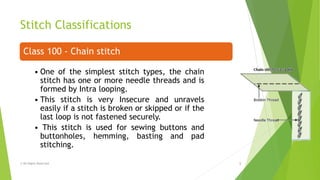
Class 100 - Chain stitch
• One of the simplest stitch types, the chain
stitch has one or more needle threads and is
formed by Intra looping.
• This stitch is very Insecure and unravels
easily if a stitch is broken or skipped or if the
last loop is not fastened securely.
• This stitch is used for sewing buttons and
buttonholes, hemming, basting and pad
stitching.
Stitch Classifications
© All Rights Reserved 4
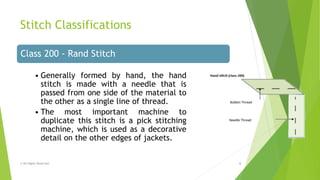
Class 200 - Rand Stitch
• Generally formed by hand, the hand
stitch is made with a needle that is
passed from one side of the material to
the other as a single line of thread.
• The most important machine to
duplicate this stitch is a pick stitching
machine, which is used as a decorative
detail on the other edges of jackets.
Stitch Classifications
© All Rights Reserved 5
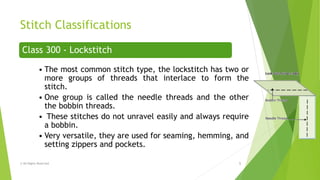
Class 300 - Lockstitch
• The most common stitch type, the lockstitch has two or
more groups of threads that interlace to form the
stitch.
• One group is called the needle threads and the other
the bobbin threads.
• These stitches do not unravel easily and always require
a bobbin.
• Very versatile, they are used for seaming, hemming, and
setting zippers and pockets.
Stitch Classifications
© All Rights Reserved 6
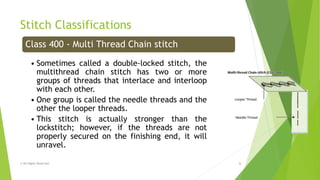
Class 400 - Multi Thread Chain stitch
• Sometimes called a double-locked stitch, the
multithread chain stitch has two or more
groups of threads that interlace and interloop
with each other.
• One group is called the needle threads and the
other the looper threads.
• This stitch is actually stronger than the
lockstitch; however, if the threads are not
properly secured on the finishing end, it will
unravel.
Stitch Classifications
© All Rights Reserved 7
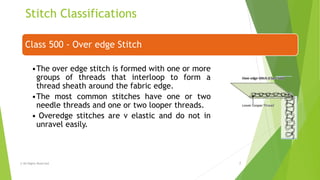
Class 500 - Over edge Stitch
•The over edge stitch is formed with one or more
groups of threads that interloop to form a
thread sheath around the fabric edge.
•The most common stitches have one or two
needle threads and one or two looper threads.
• Overedge stitches are v elastic and do not in
unravel easily.
Stitch Classifications
© All Rights Reserved 8
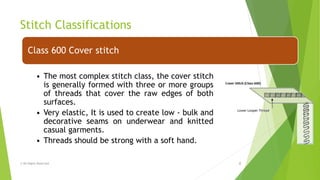
Class 600 Cover stitch
• The most complex stitch class, the cover stitch
is generally formed with three or more groups
of threads that cover the raw edges of both
surfaces.
• Very elastic, It is used to create low - bulk and
decorative seams on underwear and knitted
casual garments.
• Threads should be strong with a soft hand.
Seam Types and Classifications
© All Rights Reserved 9
Seams are basic element of construction formed when two or more pieces
of material are sewn together, they are used for joining garment sections
In the production of sewn products.
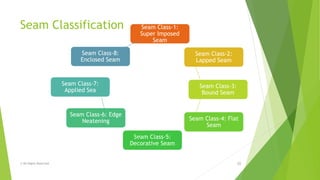
Seam Classification
© All Rights Reserved 10
Seam Class-1:
Super Imposed
Seam
Seam Class-2:
Lapped Seam
Seam Class-3:
Bound Seam
Seam Class-4: Flat
Seam
Seam Class-5:
Decorative Seam
Seam Class-6: Edge
Neatening
Seam Class-7:
Applied Sea
Seam Class-8:
Enclosed Seam
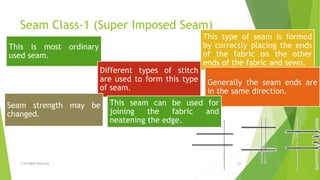
Seam Class-1 (Super Imposed Seam)
© All Rights Reserved 11
This is most ordinary
used seam.
This type of seam is formed
by correctly placing the ends
of the fabric on the other
ends of the fabric and sewn.
Generally the seam ends are
in the same direction.
Different types of stitch
are used to form this type
of seam.
Seam strength may be
changed.
This seam can be used for
joining the fabric and
neatening the edge.
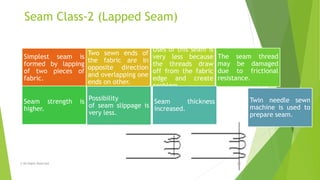
Seam Class-2 (Lapped Seam)
© All Rights Reserved 12
Simplest seam is
formed by lapping
of two pieces of
fabric.
Two sewn ends of
the fabric are in
opposite direction
and overlapping one
ends on other.
Uses of this seam is
very less because
the threads draw
off from the fabric
edge and create
problem.
The seam thread
may be damaged
due to frictional
resistance.
Seam strength is
higher.
Possibility
of seam slippage is
very less.
Seam thickness
increased.
Twin needle sewn
machine is used to
prepare seam.
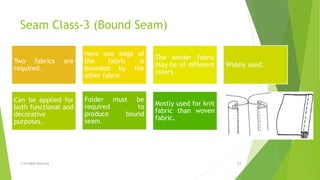
Seam Class-3 (Bound Seam)
© All Rights Reserved 13
Two fabrics are
required.
Here one edge of
the fabric is
bounded by the
other fabric.
The binder fabric
may be of different
colors.
Widely used.
Can be applied for
both functional and
decorative
purposes.
Folder must be
required to
produce bound
seam.
Mostly used for knit
fabric than woven
fabric.
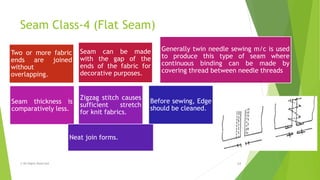
Seam Class-4 (Flat Seam)
© All Rights Reserved 14
Two or more fabric
ends are joined
without
overlapping.
Seam can be made
with the gap of the
ends of the fabric for
decorative purposes.
Generally twin needle sewing m/c is used
to produce this type of seam where
continuous binding can be made by
covering thread between needle threads
Seam thickness is
comparatively less.
Zigzag stitch causes
sufficient stretch
for knit fabrics.
Neat join forms.
Before sewing, Edge
should be cleaned.
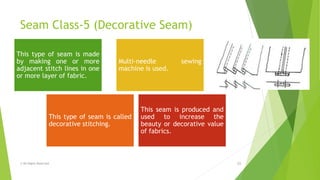
Seam Class-5 (Decorative Seam)
© All Rights Reserved 15
This type of seam is made
by making one or more
adjacent stitch lines in one
or more layer of fabric.
Multi-needle sewing
machine is used.
This type of seam is called
decorative stitching.
This seam is produced and
used to increase the
beauty or decorative value
of fabrics.
Seam Class-6 (Edge Neatening)
© All Rights Reserved 16
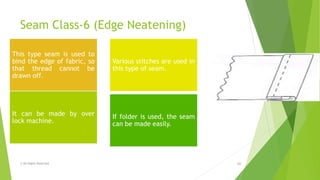
This type seam is used to
bind the edge of fabric, so
that thread cannot be
drawn off.
Various stitches are used in
this type of seam.
It can be made by over
lock machine.
If folder is used, the seam
can be made easily.
Seam Class-7 (Applied Seam)
© All Rights Reserved 17
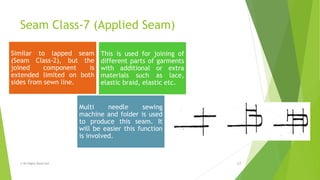
Similar to lapped seam
(Seam Class-2), but the
joined component is
extended limited on both
sides from sewn line.
This is used for joining of
different parts of garments
with additional or extra
materials such as lace,
elastic braid, elastic etc.
Multi needle sewing
machine and folder is used
to produce this seam. It
will be easier this function
is involved.
Seam Class-8 (Enclosed Seam)
© All Rights Reserved 18
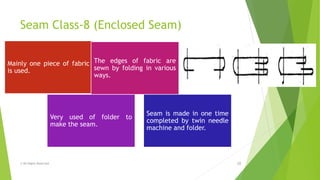
Mainly one piece of fabric
is used.
The edges of fabric are
sewn by folding in various
ways.
Very used of folder to
make the seam.
Seam is made in one time
completed by twin needle
machine and folder.
© All Rights Reserved 19
For more information on topics related to Technology,
Android, iOS, Windows, Mac and Study Notes, kindly visit
to Introcanvas

Seams and Stitches

  • 1.
    Seams and Stitches ByIntrocanvas https://introcanvas.wordpress.com/ https://twitter.com/introcanvas https://fb.com/introcanvas
  • 2.
    Objective By the endof this session we would be able to understand  Classification of Stitches  Types of seams and classification  Seams and stitches of Men's Shirt  Ladies kurta or top  Baby jabla or suit  Skirt
  • 3.
    Stitch Classifications © AllRights Reserved 3 Class 100 - Chain stitch • One of the simplest stitch types, the chain stitch has one or more needle threads and is formed by Intra looping. • This stitch is very Insecure and unravels easily if a stitch is broken or skipped or if the last loop is not fastened securely. • This stitch is used for sewing buttons and buttonholes, hemming, basting and pad stitching.
  • 4.
    Stitch Classifications © AllRights Reserved 4 Class 200 - Rand Stitch • Generally formed by hand, the hand stitch is made with a needle that is passed from one side of the material to the other as a single line of thread. • The most important machine to duplicate this stitch is a pick stitching machine, which is used as a decorative detail on the other edges of jackets.
  • 5.
    Stitch Classifications © AllRights Reserved 5 Class 300 - Lockstitch • The most common stitch type, the lockstitch has two or more groups of threads that interlace to form the stitch. • One group is called the needle threads and the other the bobbin threads. • These stitches do not unravel easily and always require a bobbin. • Very versatile, they are used for seaming, hemming, and setting zippers and pockets.
  • 6.
    Stitch Classifications © AllRights Reserved 6 Class 400 - Multi Thread Chain stitch • Sometimes called a double-locked stitch, the multithread chain stitch has two or more groups of threads that interlace and interloop with each other. • One group is called the needle threads and the other the looper threads. • This stitch is actually stronger than the lockstitch; however, if the threads are not properly secured on the finishing end, it will unravel.
  • 7.
    Stitch Classifications © AllRights Reserved 7 Class 500 - Over edge Stitch •The over edge stitch is formed with one or more groups of threads that interloop to form a thread sheath around the fabric edge. •The most common stitches have one or two needle threads and one or two looper threads. • Overedge stitches are v elastic and do not in unravel easily.
  • 8.
    Stitch Classifications © AllRights Reserved 8 Class 600 Cover stitch • The most complex stitch class, the cover stitch is generally formed with three or more groups of threads that cover the raw edges of both surfaces. • Very elastic, It is used to create low - bulk and decorative seams on underwear and knitted casual garments. • Threads should be strong with a soft hand.
  • 9.
    Seam Types andClassifications © All Rights Reserved 9 Seams are basic element of construction formed when two or more pieces of material are sewn together, they are used for joining garment sections In the production of sewn products.
  • 10.
    Seam Classification © AllRights Reserved 10 Seam Class-1: Super Imposed Seam Seam Class-2: Lapped Seam Seam Class-3: Bound Seam Seam Class-4: Flat Seam Seam Class-5: Decorative Seam Seam Class-6: Edge Neatening Seam Class-7: Applied Sea Seam Class-8: Enclosed Seam
  • 11.
    Seam Class-1 (SuperImposed Seam) © All Rights Reserved 11 This is most ordinary used seam. This type of seam is formed by correctly placing the ends of the fabric on the other ends of the fabric and sewn. Generally the seam ends are in the same direction. Different types of stitch are used to form this type of seam. Seam strength may be changed. This seam can be used for joining the fabric and neatening the edge.
  • 12.
    Seam Class-2 (LappedSeam) © All Rights Reserved 12 Simplest seam is formed by lapping of two pieces of fabric. Two sewn ends of the fabric are in opposite direction and overlapping one ends on other. Uses of this seam is very less because the threads draw off from the fabric edge and create problem. The seam thread may be damaged due to frictional resistance. Seam strength is higher. Possibility of seam slippage is very less. Seam thickness increased. Twin needle sewn machine is used to prepare seam.
  • 13.
    Seam Class-3 (BoundSeam) © All Rights Reserved 13 Two fabrics are required. Here one edge of the fabric is bounded by the other fabric. The binder fabric may be of different colors. Widely used. Can be applied for both functional and decorative purposes. Folder must be required to produce bound seam. Mostly used for knit fabric than woven fabric.
  • 14.
    Seam Class-4 (FlatSeam) © All Rights Reserved 14 Two or more fabric ends are joined without overlapping. Seam can be made with the gap of the ends of the fabric for decorative purposes. Generally twin needle sewing m/c is used to produce this type of seam where continuous binding can be made by covering thread between needle threads Seam thickness is comparatively less. Zigzag stitch causes sufficient stretch for knit fabrics. Neat join forms. Before sewing, Edge should be cleaned.
  • 15.
    Seam Class-5 (DecorativeSeam) © All Rights Reserved 15 This type of seam is made by making one or more adjacent stitch lines in one or more layer of fabric. Multi-needle sewing machine is used. This type of seam is called decorative stitching. This seam is produced and used to increase the beauty or decorative value of fabrics.
  • 16.
    Seam Class-6 (EdgeNeatening) © All Rights Reserved 16 This type seam is used to bind the edge of fabric, so that thread cannot be drawn off. Various stitches are used in this type of seam. It can be made by over lock machine. If folder is used, the seam can be made easily.
  • 17.
    Seam Class-7 (AppliedSeam) © All Rights Reserved 17 Similar to lapped seam (Seam Class-2), but the joined component is extended limited on both sides from sewn line. This is used for joining of different parts of garments with additional or extra materials such as lace, elastic braid, elastic etc. Multi needle sewing machine and folder is used to produce this seam. It will be easier this function is involved.
  • 18.
    Seam Class-8 (EnclosedSeam) © All Rights Reserved 18 Mainly one piece of fabric is used. The edges of fabric are sewn by folding in various ways. Very used of folder to make the seam. Seam is made in one time completed by twin needle machine and folder.
  • 19.
    © All RightsReserved 19 For more information on topics related to Technology, Android, iOS, Windows, Mac and Study Notes, kindly visit to Introcanvas