By.
Tanvi Kumari
 Care instructions are small solutions to big problems.
Care labels provide guidelines to consumers about
apparel care, and the best cleaning procedures to be
used for a particular combination of fabric, thread
decoration and construction techniques. Following the
instructions on the care labels is an assurance that the
appearance and fit of the garment will be maintained
after repeated cleaning treatments.
 The country where the garment is sewn is the country
of origin listed on the care label
 Care labels must be permanently attached so that they
are easily accessible to the consumer at the point of
purchase. Generally, it is placed on the side or bottom
 The manufacturer or importer who directs production
is responsible for the accuracy of care instructions
 A product may be imported without a care label, but it
must be attached before the product is sold
 There are five care labeling systems which are
generally used on care labels. These systems are:
 The International Care Labeling System
 The Japanese Care Labeling System
 The Canadian Care Labeling System
 The European Care Labeling System
 The American Care Labeling System
 The International Association for Textile Care
Labelling (GINETEX) is the world body which governs
care labels since 1975.
 Member nations of GINETEX are Belgium, France,
Germany, England, Netherlands, Israel, Austria,
Switzerland, and Spain.
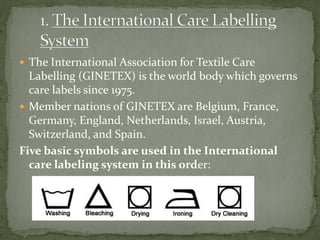
Five basic symbols are used in the International
care labeling system in this order:
 The care symbols provide information on the
maximum permitted type of treatment
 The care symbols must always be used in full and in
the prescribed sequence
 The care labelling must be clear, readily
understandable, easy to use and not dependent on any
particular language
 The care symbols must not leave room for possible
misinterpretation by the consumer
 The Japanese system, like other care labeling systems must have
symbols placed in a specified order. Labels should be designed
based on the following convention:
 Symbols should be arranged from left to right according to the
following sequence: 1) Washing, 2) Bleaching, 3) Ironing, 4) Dry-
Cleaning, 5) Wringing & 6) Drying
 For colored products which are not usually bleached, the symbol
for possibility of chlorine bleached may be omitted
 For products which are not usually ironed, the symbols for
ironing may be omitted. (Except 'cannot be ironed')
 For products which can be washed with water, the symbols for
dry-cleaning may be omitted. (Except ‘cannot be dry-cleaned’)
 The symbols should be either in black or dark blue whereas the
prohibition symbols are in red and on a white background
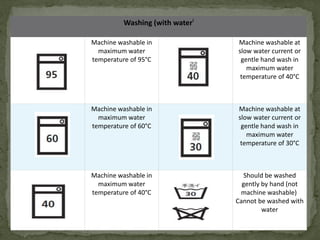
Washing (with water)
Machine washable in
maximum water
temperature of 95°C
Machine washable at
slow water current or
gentle hand wash in
maximum water
temperature of 40°C
Machine washable in
maximum water
temperature of 60°C
Machine washable at
slow water current or
gentle hand wash in
maximum water
temperature of 30°C
Machine washable in
maximum water
temperature of 40°C
Should be washed
gently by hand (not
machine washable)
Cannot be washed with
water
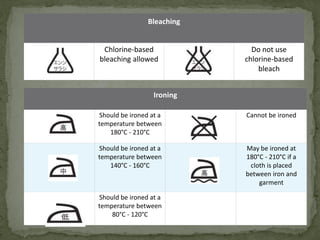
Bleaching
Chlorine-based
bleaching allowed
Do not use
chlorine-based
bleach
Ironing
Should be ironed at a
temperature between
180°C - 210°C
Cannot be ironed
Should be ironed at a
temperature between
140°C - 160°C
May be ironed at
180°C - 210°C if a
cloth is placed
between iron and
garment
Should be ironed at a
temperature between
80°C - 120°C
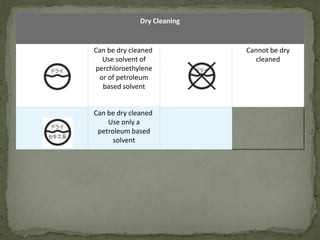
Dry Cleaning
Can be dry cleaned
Use solvent of
perchloroethylene
or of petroleum
based solvent
Cannot be dry
cleaned
Can be dry cleaned
Use only a
petroleum based
solvent
 Until July 1973 care labeling was not a legal
requirement in Canada. After this date a new care
labeling system was introduced. The new Canadian
care symbol system used green (go ahead), amber
(caution), and red (don’t try) with five symbols which
were wash tub, bleach triangle, square dryer, iron, and
dry cleaning circle. In 2003 the Canadian system was
updated to harmonies with the North American Free
Trade Agreement (NAFTA) and (ISO) standards, and
the color code was discontinued.
 Individual committees of the European Union are
reviewing existing care label standards by collaborating
with other international bodies so that they can create a
unified system under the ISO scheme.
 The symbols used in Europe are trademarked by GENETEX
and a trademark fee needs to be paid to GENETEX, the
trademark holder, if the garments are to be sold in a
GENETEX country.
 A correct care label for European countries is required to
consist of at least four and sometimes five symbols in the
following sequence: 1) Washing, 2) Bleaching, 3) Ironing, 4)
Dry-Cleaning & 5) Drying.
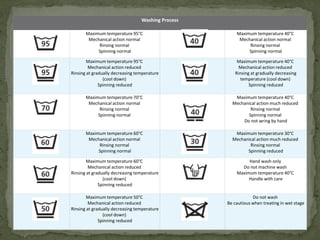
Washing Process
Maximum temperature 95°C
Mechanical action normal
Rinsing normal
Spinning normal
Maximum temperature 40°C
Mechanical action normal
Rinsing normal
Spinning normal
Maximum temperature 95°C
Mechanical action reduced
Rinsing at gradually decreasing temperature
(cool down)
Spinning reduced
Maximum temperature 40°C
Mechanical action reduced
Rinsing at gradually decreasing
temperature (cool down)
Spinning reduced
Maximum temperature 70°C
Mechanical action normal
Rinsing normal
Spinning normal
Maximum temperature 40°C
Mechanical action much reduced
Rinsing normal
Spinning normal
Do not wring by hand
Maximum temperature 60°C
Mechanical action normal
Rinsing normal
Spinning normal
Maximum temperature 30°C
Mechanical action much reduced
Rinsing normal
Spinning reduced
Maximum temperature 60°C
Mechanical action reduced
Rinsing at gradually decreasing temperature
(cool down)
Spinning reduced
Hand wash only
Do not machine wash
Maximum temperature 40°C
Handle with care
Maximum temperature 50°C
Mechanical action reduced
Rinsing at gradually decreasing temperature
(cool down)
Spinning reduced
Do not wash
Be cautious when treating in wet stage
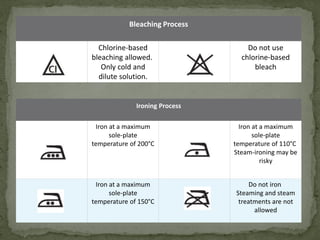
Bleaching Process
Chlorine-based
bleaching allowed.
Only cold and
dilute solution.
Do not use
chlorine-based
bleach
Ironing Process
Iron at a maximum
sole-plate
temperature of 200°C
Iron at a maximum
sole-plate
temperature of 110°C
Steam-ironing may be
risky
Iron at a maximum
sole-plate
temperature of 150°C
Do not iron
Steaming and steam
treatments are not
allowed
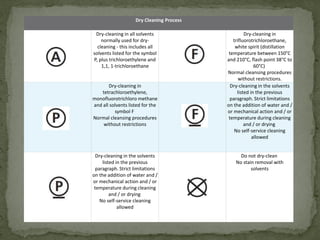
Dry Cleaning Process
Dry-cleaning in all solvents
normally used for dry-
cleaning - this includes all
solvents listed for the symbol
P, plus trichloroethylene and
1,1, 1-trichloroethane
Dry-cleaning in
trifluorotrichloroethane,
white spirit (distillation
temperature between 150°C
and 210°C, flash point 38°C to
60°C)
Normal cleansing procedures
without restrictions.
Dry-cleaning in
tetrachloroethylene,
monofluorotrichloro methane
and all solvents listed for the
symbol F
Normal cleansing procedures
without restrictions
Dry-cleaning in the solvents
listed in the previous
paragraph. Strict limitations
on the addition of water and /
or mechanical action and / or
temperature during cleaning
and / or drying
No self-service cleaning
allowed
Dry-cleaning in the solvents
listed in the previous
paragraph. Strict limitations
on the addition of water and /
or mechanical action and / or
temperature during cleaning
and / or drying
No self-service cleaning
allowed
Do not dry-clean
No stain removal with
solvents
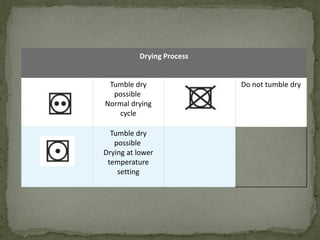
Drying Process
Tumble dry
possible
Normal drying
cycle
Do not tumble dry
Tumble dry
possible
Drying at lower
temperature
setting
 According to the Federal Trade Commission’s Care Label rule,
care labels may be composed of either words or symbols.
Irrespective of whether the content is words, symbols, or both,
care instructions appear in the following order:
 Machine wash / hand wash / dry-clean
 Washing temperature (hot / warm / cold)
 Washing machine programme (delicate / permanent press /
normal cycle)
 Bleaching instruction (do not bleach / non-chlorine bleach /
chlorine bleach)
 Drying method (tumble dry / line dry / flat dry / drip dry)
 Ironing (do not iron / cool iron / warm iron / hot iron)
 Warnings
 In addition to the care label instructions, manufacturers
and importers must provide labels that:
 Are permanently attached so that they can be easily seen at
the point of sale. If the product is packaged, displayed or
folded so that the customers cannot find the label, care
information must also appear on the side of the package or
on a hang tag
 Remain fastened and legible during the useful life of the
product
 Mention the regular care needed for the ordinary use of the
product
 Warn the customer about additional factors which may
harm the garment
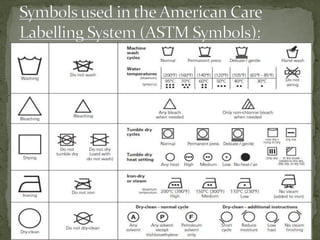
 Since December 1996, a new system using only symbols
and no words has been used in the United States of
America. The revised care symbols developed by the
American Society for Testing and Materials (ASTM) with
their meanings are listed below.
Care labels converted

Care labels converted

  • 1.
  • 2.
     Care instructionsare small solutions to big problems. Care labels provide guidelines to consumers about apparel care, and the best cleaning procedures to be used for a particular combination of fabric, thread decoration and construction techniques. Following the instructions on the care labels is an assurance that the appearance and fit of the garment will be maintained after repeated cleaning treatments.
  • 3.
     The countrywhere the garment is sewn is the country of origin listed on the care label  Care labels must be permanently attached so that they are easily accessible to the consumer at the point of purchase. Generally, it is placed on the side or bottom  The manufacturer or importer who directs production is responsible for the accuracy of care instructions  A product may be imported without a care label, but it must be attached before the product is sold
  • 4.
     There arefive care labeling systems which are generally used on care labels. These systems are:  The International Care Labeling System  The Japanese Care Labeling System  The Canadian Care Labeling System  The European Care Labeling System  The American Care Labeling System
  • 5.
     The InternationalAssociation for Textile Care Labelling (GINETEX) is the world body which governs care labels since 1975.  Member nations of GINETEX are Belgium, France, Germany, England, Netherlands, Israel, Austria, Switzerland, and Spain. Five basic symbols are used in the International care labeling system in this order:
  • 6.
     The caresymbols provide information on the maximum permitted type of treatment  The care symbols must always be used in full and in the prescribed sequence  The care labelling must be clear, readily understandable, easy to use and not dependent on any particular language  The care symbols must not leave room for possible misinterpretation by the consumer
  • 7.
     The Japanesesystem, like other care labeling systems must have symbols placed in a specified order. Labels should be designed based on the following convention:  Symbols should be arranged from left to right according to the following sequence: 1) Washing, 2) Bleaching, 3) Ironing, 4) Dry- Cleaning, 5) Wringing & 6) Drying  For colored products which are not usually bleached, the symbol for possibility of chlorine bleached may be omitted  For products which are not usually ironed, the symbols for ironing may be omitted. (Except 'cannot be ironed')  For products which can be washed with water, the symbols for dry-cleaning may be omitted. (Except ‘cannot be dry-cleaned’)  The symbols should be either in black or dark blue whereas the prohibition symbols are in red and on a white background
  • 8.
    Washing (with water) Machinewashable in maximum water temperature of 95°C Machine washable at slow water current or gentle hand wash in maximum water temperature of 40°C Machine washable in maximum water temperature of 60°C Machine washable at slow water current or gentle hand wash in maximum water temperature of 30°C Machine washable in maximum water temperature of 40°C Should be washed gently by hand (not machine washable) Cannot be washed with water
  • 9.
    Bleaching Chlorine-based bleaching allowed Do notuse chlorine-based bleach Ironing Should be ironed at a temperature between 180°C - 210°C Cannot be ironed Should be ironed at a temperature between 140°C - 160°C May be ironed at 180°C - 210°C if a cloth is placed between iron and garment Should be ironed at a temperature between 80°C - 120°C
  • 10.
    Dry Cleaning Can bedry cleaned Use solvent of perchloroethylene or of petroleum based solvent Cannot be dry cleaned Can be dry cleaned Use only a petroleum based solvent
  • 11.
     Until July1973 care labeling was not a legal requirement in Canada. After this date a new care labeling system was introduced. The new Canadian care symbol system used green (go ahead), amber (caution), and red (don’t try) with five symbols which were wash tub, bleach triangle, square dryer, iron, and dry cleaning circle. In 2003 the Canadian system was updated to harmonies with the North American Free Trade Agreement (NAFTA) and (ISO) standards, and the color code was discontinued.
  • 12.
     Individual committeesof the European Union are reviewing existing care label standards by collaborating with other international bodies so that they can create a unified system under the ISO scheme.  The symbols used in Europe are trademarked by GENETEX and a trademark fee needs to be paid to GENETEX, the trademark holder, if the garments are to be sold in a GENETEX country.  A correct care label for European countries is required to consist of at least four and sometimes five symbols in the following sequence: 1) Washing, 2) Bleaching, 3) Ironing, 4) Dry-Cleaning & 5) Drying.
  • 13.
    Washing Process Maximum temperature95°C Mechanical action normal Rinsing normal Spinning normal Maximum temperature 40°C Mechanical action normal Rinsing normal Spinning normal Maximum temperature 95°C Mechanical action reduced Rinsing at gradually decreasing temperature (cool down) Spinning reduced Maximum temperature 40°C Mechanical action reduced Rinsing at gradually decreasing temperature (cool down) Spinning reduced Maximum temperature 70°C Mechanical action normal Rinsing normal Spinning normal Maximum temperature 40°C Mechanical action much reduced Rinsing normal Spinning normal Do not wring by hand Maximum temperature 60°C Mechanical action normal Rinsing normal Spinning normal Maximum temperature 30°C Mechanical action much reduced Rinsing normal Spinning reduced Maximum temperature 60°C Mechanical action reduced Rinsing at gradually decreasing temperature (cool down) Spinning reduced Hand wash only Do not machine wash Maximum temperature 40°C Handle with care Maximum temperature 50°C Mechanical action reduced Rinsing at gradually decreasing temperature (cool down) Spinning reduced Do not wash Be cautious when treating in wet stage
  • 14.
    Bleaching Process Chlorine-based bleaching allowed. Onlycold and dilute solution. Do not use chlorine-based bleach Ironing Process Iron at a maximum sole-plate temperature of 200°C Iron at a maximum sole-plate temperature of 110°C Steam-ironing may be risky Iron at a maximum sole-plate temperature of 150°C Do not iron Steaming and steam treatments are not allowed
  • 15.
    Dry Cleaning Process Dry-cleaningin all solvents normally used for dry- cleaning - this includes all solvents listed for the symbol P, plus trichloroethylene and 1,1, 1-trichloroethane Dry-cleaning in trifluorotrichloroethane, white spirit (distillation temperature between 150°C and 210°C, flash point 38°C to 60°C) Normal cleansing procedures without restrictions. Dry-cleaning in tetrachloroethylene, monofluorotrichloro methane and all solvents listed for the symbol F Normal cleansing procedures without restrictions Dry-cleaning in the solvents listed in the previous paragraph. Strict limitations on the addition of water and / or mechanical action and / or temperature during cleaning and / or drying No self-service cleaning allowed Dry-cleaning in the solvents listed in the previous paragraph. Strict limitations on the addition of water and / or mechanical action and / or temperature during cleaning and / or drying No self-service cleaning allowed Do not dry-clean No stain removal with solvents
  • 16.
    Drying Process Tumble dry possible Normaldrying cycle Do not tumble dry Tumble dry possible Drying at lower temperature setting
  • 17.
     According tothe Federal Trade Commission’s Care Label rule, care labels may be composed of either words or symbols. Irrespective of whether the content is words, symbols, or both, care instructions appear in the following order:  Machine wash / hand wash / dry-clean  Washing temperature (hot / warm / cold)  Washing machine programme (delicate / permanent press / normal cycle)  Bleaching instruction (do not bleach / non-chlorine bleach / chlorine bleach)  Drying method (tumble dry / line dry / flat dry / drip dry)  Ironing (do not iron / cool iron / warm iron / hot iron)  Warnings
  • 18.
     In additionto the care label instructions, manufacturers and importers must provide labels that:  Are permanently attached so that they can be easily seen at the point of sale. If the product is packaged, displayed or folded so that the customers cannot find the label, care information must also appear on the side of the package or on a hang tag  Remain fastened and legible during the useful life of the product  Mention the regular care needed for the ordinary use of the product  Warn the customer about additional factors which may harm the garment  Since December 1996, a new system using only symbols and no words has been used in the United States of America. The revised care symbols developed by the American Society for Testing and Materials (ASTM) with their meanings are listed below.