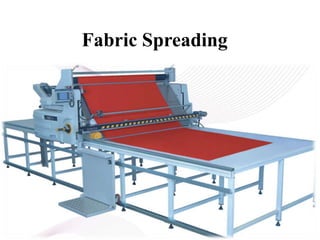
Fabric Spreading
Spreading:
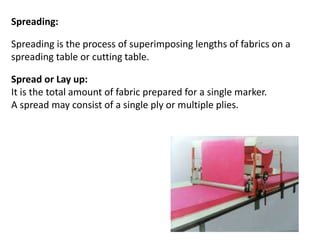
Spreading is the process of superimposing lengths of fabrics on a
spreading table or cutting table.
Spread or Lay up:
It is the total amount of fabric prepared for a single marker.
A spread may consist of a single ply or multiple plies.
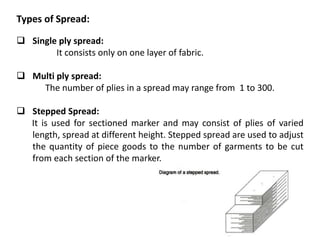
Types of Spread:
 Single ply spread:
It consists only on one layer of fabric.
 Multi ply spread:
The number of plies in a spread may range from 1 to 300.
 Stepped Spread:
It is used for sectioned marker and may consist of plies of varied
length, spread at different height. Stepped spread are used to adjust
the quantity of piece goods to the number of garments to be cut
from each section of the marker.
The height of spread is limited by
Fabric Characteristics
Size of the order to be cut
Cutting method
Vertical capacity of the spreader
Spreading Methods:
Manual Method:
Operating Procedure:
Two person may be used for manual spreading unless the spread is very
short. One person may work each side of the table to keep the fabric
flat, smooth and tension free.
Advantages:
Easy working
Low investment
Suitable for small scale industries
Disadvantage:
Speed limitation
Skilled labor required
Small roll size
Chances for improper fabric edge alignment
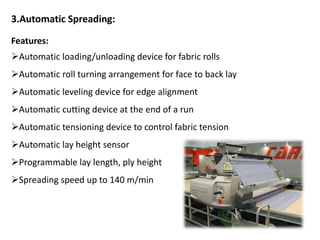
2. spreading carriage method or Semi automatic method:
Operating Procedure:
The cloth is unwound and spread through semi automatic method. The
spreading head or carriage is moved to and fro and spread fabric over
the table.
Movement along the table and fabric pulling can be controlled by the
buttons.
Advantages:
Fast and economical
Proper selvedge alignment
Ease to operate with electronic clutch
Disadvantages:
Fabric roll loading, cutting is still manual
No suitable for larger scale industry
Small role size
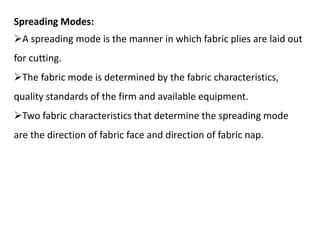
3.Automatic Spreading:
Features:
Automatic loading/unloading device for fabric rolls
Automatic roll turning arrangement for face to back lay
Automatic leveling device for edge alignment
Automatic cutting device at the end of a run
Automatic tensioning device to control fabric tension
Automatic lay height sensor
Programmable lay length, ply height
Spreading speed up to 140 m/min
Spreading Modes:
A spreading mode is the manner in which fabric plies are laid out
for cutting.
The fabric mode is determined by the fabric characteristics,
quality standards of the firm and available equipment.
Two fabric characteristics that determine the spreading mode
are the direction of fabric face and direction of fabric nap.
Face to Face:
With this method of spreading the face is up on one ply and down on
the next ply as the spreader goes back and forth. Often symmetric , non
directional fabrics are spread continuously which places alternate plies
face to face or back to back.
•Fastest method of spreading
•Least costly
•Lowest quality(Quality is affected because the operator is only able to monitor the
face of fabric half the time.)
Face One Way:
Face up or down is more time consuming and expensive because must
be cut at each end of the spread and the new end is repositioned.
F/O/W may be done with the fabric face up or face down.
When the face is up operator is able to monitor the face for flaws.
This method is particularly helpful when spreading prints.
Pile fabrics, corduroy and velvet are often spread face down.
Spreading Quality:
A high quality spread has the following characteristics:
Free of noticeable defects in the fabric
Tension free
Flat
Selvedges are aligned at least on one edge
Free of static electricity
Accurately spliced with minimal waste
Precise length, mode and number of plies
Fabric Defects:
It have a major effect on quality of spread. When a flaw appears, the
spreading operator determine its severity, where in the spread the flaw is
located and whether it must be removed.
Tension:
Fabric should be as tension free as possible when spread. Fabric under too
much tension as it is spread may be stretched or elongated. A tight spread
will contract in length, and the ends may be tend to draw inward. This
may occur while the fabric is waiting to be cut, which may result in a
spread that is shorter than marker. if the fabric contracts after it is cut
garment parts will be smaller than pattern. This is known as snap back.
To avoid excessive tension
Fabric may be spread manually or spreading equipment may synchronize
fabric unrolling with the rate of spreading.
Slack Tension:
A slack spread contains excess fabric in each ply that may create billows
and ridges in the spread. Slack tension is more visible than high tension.
As the other plies are positioned over the loose folds, creases form that
may distort cut garment parts.
Cutting a slack spread may cause
Oversize Pieces
Inaccuracies in assembly
Waste fabric
Flatness of a Spread:
Flatness is affected by finish and behavior of selvedge. Selvedges may
shrink excessively or be stretched during fabric finishing. If either edge of
the fabric draws together, it will cause the fabric to pucker. Flatness may
also be an issue with tubular goods that is skewed. When the skewing is
excessive, the tube will twist and distort.
Ply Alignment:
It relates to accuracy with which fabric edges, both length and width are
aligned during spreading. Ply alignment affects fabric waste and accuracy
in cutting department.
Static Electricity:
Static charge produce due to the friction between the material and
spreading equipment. This problem is severe with the fabrics made from
manmade fibers. Static may cause fabric to cling to machinery or other
fabric plies and cause the problem with flatness and accuracy of
alignment.
Set up for Spreading:
 Verifying cutting orders
• Interpretation of cutting orders
• Identify fabric and marker
• move the fabric to spreading table.
 Preparing cutting tables
• Marking off the table for precise length of marker
• placing the spreading paper.
 Preparing loading machines
• Move spreader to the loading position
• Loading the fabric roll
• Register fabric data(length, width, vendor, UPC code
• Threading the fabric through the tensioning device
• Cutting of the edge
• Move the machine to spreading position
• Positioning of fabric
Placement of marker
•Placing of marker on the lay
•Marker may be held in place with help of adhesive, weight or staple pins
•Spread set up for computer controlled cutting are covered with thin sheet
of plastic film. This restricts spread movement and maximize fabric
compression when vacuum tables extract air to compact the spread prior
to cutting.
Spreading Equipment:
Spreading equipment includes
Spreading surfaces
Spreading machines
Fabric control devices
Fabric cutting devices
Spreading Surfaces:
Spreading surface is determined by
•Fabric type
•Spreading equipment
•Cutting method
•Cutting equipment
•Quality standards
Spreading and cutting may be done on same table, but for automatic
cutting separate but adjacent tables are required.
Spreading surface need to be 10 inches wider than fabric width.
Pin tables:
It have rows of pins that are located below the surface that can be
extended through the slats to hold fabric at a precise location for
accurate matching of pattern repeats.
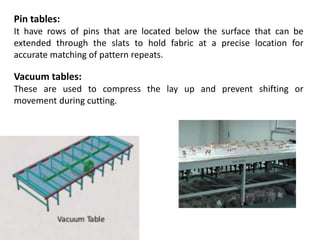
Vacuum tables:
These are used to compress the lay up and prevent shifting or
movement during cutting.
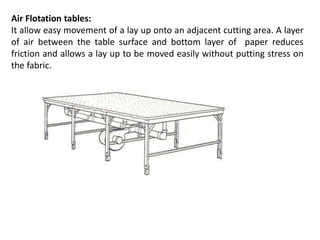
Air Flotation tables:
It allow easy movement of a lay up onto an adjacent cutting area. A layer
of air between the table surface and bottom layer of paper reduces
friction and allows a lay up to be moved easily without putting stress on
the fabric.
Spreading Machines:
Manual
Automatic
Fabric Control Devices:
Fabric control devices are the mechanism that control the fabric as it is
carried up and down the table and unrolled by spreading machine.
Tension Control Device:
Tensioning involves synchronizing the rate of spreading with the rate of
fabric unrolled.
Position devices:
Positioning devices and sensor monitor position and control fabric
placement during spreading. Electronic edge sensor monitor selvedges
as fabric is spread. A deviation from the proposed alignment triggers a
motor that shift the roll to the correct position.
Width indicator:
It work as an alarm to alert the operator when the width of fabric
become narrower than the established width.
Width variations are analyzed to determine
•Where in the marker they fall
•Whether the fabric still fit the marker
•Whether the width variation should be treated as defect and removed
End treatment devices:
These are used with spreader and placed at the end of spreader.
End catcher and folding device:
These parts are used together for face to face spreading. These are
mechanical parts that are placed on opposite site of marker to catch and
hold the fabric. End treatment devices have major impact on fabric
waste. There must be enough fabric at the end of the lay to retain it in
place, but any fabric beyond the end of marker is wasted.
End catcher and Knife box:
For FOW spreads, a knife box contains a cutting unit that operate in a
track and cut across the fabric width. The catcher simply hold the fabric
during cutting.
Spreading Cost:
Labor cost
Fabric waste
•Splicing loss
•End loss
•Width loss
Equipment purchase

fabric spreading

  • 1.
  • 2.
    Spreading: Spreading is theprocess of superimposing lengths of fabrics on a spreading table or cutting table. Spread or Lay up: It is the total amount of fabric prepared for a single marker. A spread may consist of a single ply or multiple plies.
  • 3.
    Types of Spread: Single ply spread: It consists only on one layer of fabric.  Multi ply spread: The number of plies in a spread may range from 1 to 300.  Stepped Spread: It is used for sectioned marker and may consist of plies of varied length, spread at different height. Stepped spread are used to adjust the quantity of piece goods to the number of garments to be cut from each section of the marker.
  • 4.
    The height ofspread is limited by Fabric Characteristics Size of the order to be cut Cutting method Vertical capacity of the spreader
  • 5.
    Spreading Methods: Manual Method: OperatingProcedure: Two person may be used for manual spreading unless the spread is very short. One person may work each side of the table to keep the fabric flat, smooth and tension free. Advantages: Easy working Low investment Suitable for small scale industries Disadvantage: Speed limitation Skilled labor required Small roll size Chances for improper fabric edge alignment
  • 6.
    2. spreading carriagemethod or Semi automatic method: Operating Procedure: The cloth is unwound and spread through semi automatic method. The spreading head or carriage is moved to and fro and spread fabric over the table. Movement along the table and fabric pulling can be controlled by the buttons. Advantages: Fast and economical Proper selvedge alignment Ease to operate with electronic clutch Disadvantages: Fabric roll loading, cutting is still manual No suitable for larger scale industry Small role size
  • 7.
    3.Automatic Spreading: Features: Automatic loading/unloadingdevice for fabric rolls Automatic roll turning arrangement for face to back lay Automatic leveling device for edge alignment Automatic cutting device at the end of a run Automatic tensioning device to control fabric tension Automatic lay height sensor Programmable lay length, ply height Spreading speed up to 140 m/min
  • 8.
    Spreading Modes: A spreadingmode is the manner in which fabric plies are laid out for cutting. The fabric mode is determined by the fabric characteristics, quality standards of the firm and available equipment. Two fabric characteristics that determine the spreading mode are the direction of fabric face and direction of fabric nap.
  • 9.
    Face to Face: Withthis method of spreading the face is up on one ply and down on the next ply as the spreader goes back and forth. Often symmetric , non directional fabrics are spread continuously which places alternate plies face to face or back to back. •Fastest method of spreading •Least costly •Lowest quality(Quality is affected because the operator is only able to monitor the face of fabric half the time.) Face One Way: Face up or down is more time consuming and expensive because must be cut at each end of the spread and the new end is repositioned. F/O/W may be done with the fabric face up or face down. When the face is up operator is able to monitor the face for flaws. This method is particularly helpful when spreading prints. Pile fabrics, corduroy and velvet are often spread face down.
  • 10.
    Spreading Quality: A highquality spread has the following characteristics: Free of noticeable defects in the fabric Tension free Flat Selvedges are aligned at least on one edge Free of static electricity Accurately spliced with minimal waste Precise length, mode and number of plies
  • 11.
    Fabric Defects: It havea major effect on quality of spread. When a flaw appears, the spreading operator determine its severity, where in the spread the flaw is located and whether it must be removed. Tension: Fabric should be as tension free as possible when spread. Fabric under too much tension as it is spread may be stretched or elongated. A tight spread will contract in length, and the ends may be tend to draw inward. This may occur while the fabric is waiting to be cut, which may result in a spread that is shorter than marker. if the fabric contracts after it is cut garment parts will be smaller than pattern. This is known as snap back. To avoid excessive tension Fabric may be spread manually or spreading equipment may synchronize fabric unrolling with the rate of spreading.
  • 12.
    Slack Tension: A slackspread contains excess fabric in each ply that may create billows and ridges in the spread. Slack tension is more visible than high tension. As the other plies are positioned over the loose folds, creases form that may distort cut garment parts. Cutting a slack spread may cause Oversize Pieces Inaccuracies in assembly Waste fabric Flatness of a Spread: Flatness is affected by finish and behavior of selvedge. Selvedges may shrink excessively or be stretched during fabric finishing. If either edge of the fabric draws together, it will cause the fabric to pucker. Flatness may also be an issue with tubular goods that is skewed. When the skewing is excessive, the tube will twist and distort.
  • 13.
    Ply Alignment: It relatesto accuracy with which fabric edges, both length and width are aligned during spreading. Ply alignment affects fabric waste and accuracy in cutting department. Static Electricity: Static charge produce due to the friction between the material and spreading equipment. This problem is severe with the fabrics made from manmade fibers. Static may cause fabric to cling to machinery or other fabric plies and cause the problem with flatness and accuracy of alignment.
  • 14.
    Set up forSpreading:  Verifying cutting orders • Interpretation of cutting orders • Identify fabric and marker • move the fabric to spreading table.  Preparing cutting tables • Marking off the table for precise length of marker • placing the spreading paper.
  • 15.
     Preparing loadingmachines • Move spreader to the loading position • Loading the fabric roll • Register fabric data(length, width, vendor, UPC code • Threading the fabric through the tensioning device • Cutting of the edge • Move the machine to spreading position • Positioning of fabric
  • 16.
    Placement of marker •Placingof marker on the lay •Marker may be held in place with help of adhesive, weight or staple pins •Spread set up for computer controlled cutting are covered with thin sheet of plastic film. This restricts spread movement and maximize fabric compression when vacuum tables extract air to compact the spread prior to cutting.
  • 17.
    Spreading Equipment: Spreading equipmentincludes Spreading surfaces Spreading machines Fabric control devices Fabric cutting devices
  • 18.
    Spreading Surfaces: Spreading surfaceis determined by •Fabric type •Spreading equipment •Cutting method •Cutting equipment •Quality standards Spreading and cutting may be done on same table, but for automatic cutting separate but adjacent tables are required. Spreading surface need to be 10 inches wider than fabric width.
  • 19.
    Pin tables: It haverows of pins that are located below the surface that can be extended through the slats to hold fabric at a precise location for accurate matching of pattern repeats. Vacuum tables: These are used to compress the lay up and prevent shifting or movement during cutting.
  • 20.
    Air Flotation tables: Itallow easy movement of a lay up onto an adjacent cutting area. A layer of air between the table surface and bottom layer of paper reduces friction and allows a lay up to be moved easily without putting stress on the fabric.
  • 21.
  • 22.
    Fabric Control Devices: Fabriccontrol devices are the mechanism that control the fabric as it is carried up and down the table and unrolled by spreading machine. Tension Control Device: Tensioning involves synchronizing the rate of spreading with the rate of fabric unrolled. Position devices: Positioning devices and sensor monitor position and control fabric placement during spreading. Electronic edge sensor monitor selvedges as fabric is spread. A deviation from the proposed alignment triggers a motor that shift the roll to the correct position.
  • 23.
    Width indicator: It workas an alarm to alert the operator when the width of fabric become narrower than the established width. Width variations are analyzed to determine •Where in the marker they fall •Whether the fabric still fit the marker •Whether the width variation should be treated as defect and removed
  • 24.
    End treatment devices: Theseare used with spreader and placed at the end of spreader. End catcher and folding device: These parts are used together for face to face spreading. These are mechanical parts that are placed on opposite site of marker to catch and hold the fabric. End treatment devices have major impact on fabric waste. There must be enough fabric at the end of the lay to retain it in place, but any fabric beyond the end of marker is wasted. End catcher and Knife box: For FOW spreads, a knife box contains a cutting unit that operate in a track and cut across the fabric width. The catcher simply hold the fabric during cutting.
  • 25.
    Spreading Cost: Labor cost Fabricwaste •Splicing loss •End loss •Width loss Equipment purchase