Presentation
On
Marker Making
Submitted By
Md. Sirajul Islam Sagor
Department of Textile Engineering
30th Batch
Daffodil International University
• A marker is a diagram of a precise arrangement of pattern
pieces for sizes of a specific style that are to be cut from in one
spread. (source: Apparel Manufacturing, Glock and Kunz)
What is Marker?
• Marker making is the process of determining a most efficient
layout of pattern pieces for a style, fabric and distribution of sizes
(source: Apparel Manufacturing, Factories those don't have CAD
system perform this process manually.
What Is Marker Making?
• There are two different methods of marker making followed in
apparel industry.
• Those are-
(a) Manual method,
(b) Computerized method.
Different Methods of Marker Making
• Manual method can be done by two ways:
– Marker planning with full size pattern,
– Marker with minimized pattern.
1. Marker planning with full size pattern: According to the standard measurement, all
the patterns are in full dimension here. At first, all the hard patterns are placed on the paper and
then those patterns are marked by turning various directions to reduce the fabric usages. Here the
tables, on which the markers are placed, arranged in the way so that they do not tilt. Vacuum
system is arranged here under the table for suction. This method is suitable for reducing the marker
length
2. Marker with minimized pattern: Here, full sized patterns are reduced 1/5 part by a
pantograph and the patterns are made by hard paper or plastic sheet. Marker is
planned here with the small pattern pieces and after making, snaps are taken by using
camera. Planimeter is used here to measure covered area of pattern lies in the marker. In
case of this method, marker efficiency is determined by calculating marker area
and fabric area.
Manual method:
• Computerized method can be performed by two ways:
– Automatic marker making,
– Interactive method.
• Automatic marker making: It is the most efficient marker making system. Here, the computer
makes the marker itself according the command given to computer. Small pattern pieces are
displayed in computer screen but full size in computer memory. Though it is time consuming
method but modern automatic marker making system overcome that problem of time and
needs only two minutes to make a marker.
• Interactive method: Interactive marker making method is a common process where
the operator plans markers by connecting directly with the system through a computer screen.
Here, all the pattern pieces are displayed at the top of the screen in the miniature form. Those are
dragged and draped to the pre-determined place by data pen or tablet. It is less efficient and
less time required than automatic marker making system.
Computerized method:
• Marker efficiency is defined as a ratio of area of marker used in a
garment and area of total marker.
Secondly, Glock and Kunz have defined this term in their book,
Apparel Manufacturing as Marker efficiency is determined from
fabric utilization, the percentage of total fabric that is actually
used in garment parts.
Note: Marker efficiency and Fabric utilization is not same thing. In
marker efficiency calculation fabric wastage due to end bits
and end loss is not included but in fabric utilization calculation all
kinds of fabric wastage are included.
What is marker efficiency?
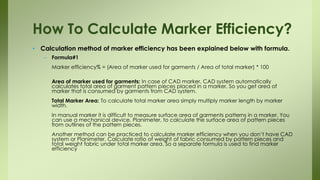
• Calculation method of marker efficiency has been explained below with formula.
– Formula#1
Marker efficiency% = (Area of marker used for garments / Area of total marker) * 100
Area of marker used for garments: In case of CAD marker, CAD system automatically
calculates total area of garment pattern pieces placed in a marker. So you get area of
marker that is consumed by garments from CAD system.
Total Marker Area: To calculate total marker area simply multiply marker length by marker
width.
In manual marker it is difficult to measure surface area of garments patterns in a marker. You
can use a mechanical device, Planimeter, to calculate the surface area of pattern pieces
from outlines of the pattern pieces.
Another method can be practiced to calculate marker efficiency when you don’t have CAD
system or Planimeter. Calculate ratio of weight of fabric consumed by pattern pieces and
total weight fabric under total marker area. So a separate formula is used to find marker
efficiency
How To Calculate Marker Efficiency?
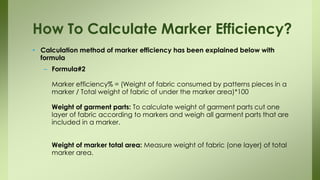
• Calculation method of marker efficiency has been explained below with
formula
– Formula#2
Marker efficiency% = (Weight of fabric consumed by patterns pieces in a
marker / Total weight of fabric of under the marker area)*100
Weight of garment parts: To calculate weight of garment parts cut one
layer of fabric according to markers and weigh all garment parts that are
included in a marker.
Weight of marker total area: Measure weight of fabric (one layer) of total
marker area.
How To Calculate Marker Efficiency?
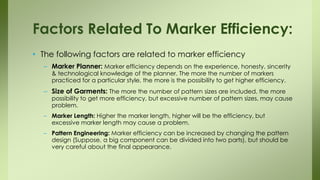
• The following factors are related to marker efficiency
– Marker Planner: Marker efficiency depends on the experience, honesty, sincerity
& technological knowledge of the planner. The more the number of markers
practiced for a particular style, the more is the possibility to get higher efficiency.
– Size of Garments: The more the number of pattern sizes are included, the more
possibility to get more efficiency, but excessive number of pattern sizes, may cause
problem.
– Marker Length: Higher the marker length, higher will be the efficiency, but
excessive marker length may cause a problem.
– Pattern Engineering: Marker efficiency can be increased by changing the pattern
design (Suppose, a big component can be divided into two parts), but should be
very careful about the final appearance.
Factors Related To Marker Efficiency:
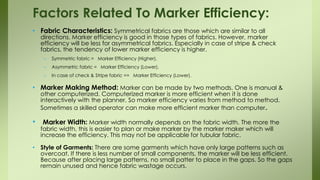
• Fabric Characteristics: Symmetrical fabrics are those which are similar to all
directions. Marker efficiency is good in those types of fabrics. However, marker
efficiency will be less for asymmetrical fabrics. Especially in case of stripe & check
fabrics, the tendency of lower marker efficiency is higher.
– Symmetric fabric = Marker Efficiency (Higher).
– Asymmetric fabric = Marker Efficiency (Lower).
– In case of check & Stripe fabric == Marker Efficiency (Lower).
• Marker Making Method: Marker can be made by two methods. One is manual &
other computerized. Computerized marker is more efficient when it is done
interactively with the planner. So marker efficiency varies from method to method.
Sometimes a skilled operator can make more efficient marker than computer.
• Marker Width: Marker width normally depends on the fabric width. The more the
fabric width, this is easier to plan or make marker by the marker maker which will
increase the efficiency. This may not be applicable for tubular fabric.
• Style of Garments: There are some garments which have only large patterns such as
overcoat. If there is less number of small components, the marker will be less efficient.
Because after placing large patterns, no small patter to place in the gaps. So the gaps
remain unused and hence fabric wastage occurs.
Factors Related To Marker Efficiency:
• Various key points which should be considered before marker making
are pointed out in the below:
• During marker making it should be followed that fabric width must be
higher than marker width (At least ½ inch).
• Fabric length must be higher than marker length (At least one inch).
• Marker width should be taken according to the fabric width and fabric
spreading must be done by taking the guideline from the marker
length.
• During marker making, length of fabric cutting table should be
considered.
Key Points of Marker Making:
• When garments pattern pieces are laid down on the layer of fabric, in that
time the grain line must be parallel to the line of warp in a woven fabric and
Wales in knitted fabric. It should be noted here that, when pattern pieces are
laid down across the layers, then the line is kept parallel to the weft for woven
fabric and course in knit fabric.
• All the pattern pieces of a garment should be along the same direction when
laid down on an asymmetric fabric.
• Plan for garments production should also be considered during marker
making.
• During marker making, marker should be started with the large pattern pieces.
Then fits the smaller pieces in the gap of larger pieces. In this way, fabric
wastage is minimized and marker efficiency is also increased.
• In the last step of marker making, all the patterns are shuffled in various
directions to reduce the marker length. It also helps to increase the marker
efficiency.
Key Points of Marker Making:
That’s All

Presentation On Marker Making

  • 1.
  • 2.
    Submitted By Md. SirajulIslam Sagor Department of Textile Engineering 30th Batch Daffodil International University
  • 3.
    • A markeris a diagram of a precise arrangement of pattern pieces for sizes of a specific style that are to be cut from in one spread. (source: Apparel Manufacturing, Glock and Kunz) What is Marker?
  • 4.
    • Marker makingis the process of determining a most efficient layout of pattern pieces for a style, fabric and distribution of sizes (source: Apparel Manufacturing, Factories those don't have CAD system perform this process manually. What Is Marker Making?
  • 5.
    • There aretwo different methods of marker making followed in apparel industry. • Those are- (a) Manual method, (b) Computerized method. Different Methods of Marker Making
  • 6.
    • Manual methodcan be done by two ways: – Marker planning with full size pattern, – Marker with minimized pattern. 1. Marker planning with full size pattern: According to the standard measurement, all the patterns are in full dimension here. At first, all the hard patterns are placed on the paper and then those patterns are marked by turning various directions to reduce the fabric usages. Here the tables, on which the markers are placed, arranged in the way so that they do not tilt. Vacuum system is arranged here under the table for suction. This method is suitable for reducing the marker length 2. Marker with minimized pattern: Here, full sized patterns are reduced 1/5 part by a pantograph and the patterns are made by hard paper or plastic sheet. Marker is planned here with the small pattern pieces and after making, snaps are taken by using camera. Planimeter is used here to measure covered area of pattern lies in the marker. In case of this method, marker efficiency is determined by calculating marker area and fabric area. Manual method:
  • 7.
    • Computerized methodcan be performed by two ways: – Automatic marker making, – Interactive method. • Automatic marker making: It is the most efficient marker making system. Here, the computer makes the marker itself according the command given to computer. Small pattern pieces are displayed in computer screen but full size in computer memory. Though it is time consuming method but modern automatic marker making system overcome that problem of time and needs only two minutes to make a marker. • Interactive method: Interactive marker making method is a common process where the operator plans markers by connecting directly with the system through a computer screen. Here, all the pattern pieces are displayed at the top of the screen in the miniature form. Those are dragged and draped to the pre-determined place by data pen or tablet. It is less efficient and less time required than automatic marker making system. Computerized method:
  • 8.
    • Marker efficiencyis defined as a ratio of area of marker used in a garment and area of total marker. Secondly, Glock and Kunz have defined this term in their book, Apparel Manufacturing as Marker efficiency is determined from fabric utilization, the percentage of total fabric that is actually used in garment parts. Note: Marker efficiency and Fabric utilization is not same thing. In marker efficiency calculation fabric wastage due to end bits and end loss is not included but in fabric utilization calculation all kinds of fabric wastage are included. What is marker efficiency?
  • 9.
    • Calculation methodof marker efficiency has been explained below with formula. – Formula#1 Marker efficiency% = (Area of marker used for garments / Area of total marker) * 100 Area of marker used for garments: In case of CAD marker, CAD system automatically calculates total area of garment pattern pieces placed in a marker. So you get area of marker that is consumed by garments from CAD system. Total Marker Area: To calculate total marker area simply multiply marker length by marker width. In manual marker it is difficult to measure surface area of garments patterns in a marker. You can use a mechanical device, Planimeter, to calculate the surface area of pattern pieces from outlines of the pattern pieces. Another method can be practiced to calculate marker efficiency when you don’t have CAD system or Planimeter. Calculate ratio of weight of fabric consumed by pattern pieces and total weight fabric under total marker area. So a separate formula is used to find marker efficiency How To Calculate Marker Efficiency?
  • 10.
    • Calculation methodof marker efficiency has been explained below with formula – Formula#2 Marker efficiency% = (Weight of fabric consumed by patterns pieces in a marker / Total weight of fabric of under the marker area)*100 Weight of garment parts: To calculate weight of garment parts cut one layer of fabric according to markers and weigh all garment parts that are included in a marker. Weight of marker total area: Measure weight of fabric (one layer) of total marker area. How To Calculate Marker Efficiency?
  • 11.
    • The followingfactors are related to marker efficiency – Marker Planner: Marker efficiency depends on the experience, honesty, sincerity & technological knowledge of the planner. The more the number of markers practiced for a particular style, the more is the possibility to get higher efficiency. – Size of Garments: The more the number of pattern sizes are included, the more possibility to get more efficiency, but excessive number of pattern sizes, may cause problem. – Marker Length: Higher the marker length, higher will be the efficiency, but excessive marker length may cause a problem. – Pattern Engineering: Marker efficiency can be increased by changing the pattern design (Suppose, a big component can be divided into two parts), but should be very careful about the final appearance. Factors Related To Marker Efficiency:
  • 12.
    • Fabric Characteristics:Symmetrical fabrics are those which are similar to all directions. Marker efficiency is good in those types of fabrics. However, marker efficiency will be less for asymmetrical fabrics. Especially in case of stripe & check fabrics, the tendency of lower marker efficiency is higher. – Symmetric fabric = Marker Efficiency (Higher). – Asymmetric fabric = Marker Efficiency (Lower). – In case of check & Stripe fabric == Marker Efficiency (Lower). • Marker Making Method: Marker can be made by two methods. One is manual & other computerized. Computerized marker is more efficient when it is done interactively with the planner. So marker efficiency varies from method to method. Sometimes a skilled operator can make more efficient marker than computer. • Marker Width: Marker width normally depends on the fabric width. The more the fabric width, this is easier to plan or make marker by the marker maker which will increase the efficiency. This may not be applicable for tubular fabric. • Style of Garments: There are some garments which have only large patterns such as overcoat. If there is less number of small components, the marker will be less efficient. Because after placing large patterns, no small patter to place in the gaps. So the gaps remain unused and hence fabric wastage occurs. Factors Related To Marker Efficiency:
  • 13.
    • Various keypoints which should be considered before marker making are pointed out in the below: • During marker making it should be followed that fabric width must be higher than marker width (At least ½ inch). • Fabric length must be higher than marker length (At least one inch). • Marker width should be taken according to the fabric width and fabric spreading must be done by taking the guideline from the marker length. • During marker making, length of fabric cutting table should be considered. Key Points of Marker Making:
  • 14.
    • When garmentspattern pieces are laid down on the layer of fabric, in that time the grain line must be parallel to the line of warp in a woven fabric and Wales in knitted fabric. It should be noted here that, when pattern pieces are laid down across the layers, then the line is kept parallel to the weft for woven fabric and course in knit fabric. • All the pattern pieces of a garment should be along the same direction when laid down on an asymmetric fabric. • Plan for garments production should also be considered during marker making. • During marker making, marker should be started with the large pattern pieces. Then fits the smaller pieces in the gap of larger pieces. In this way, fabric wastage is minimized and marker efficiency is also increased. • In the last step of marker making, all the patterns are shuffled in various directions to reduce the marker length. It also helps to increase the marker efficiency. Key Points of Marker Making:
  • 15.