COMPONENTS AND
TRIMS
Prepared by
Rasmin Thahani Z,
Assistant Professor,
Syed Ammal Arts and Science
College,
Ramanathapuram.
 The items and components other than the main
fabric of the garment, which are essential part of
the construction of the garment or which act as
trimmings or fastenings of some kind are called
trims or accessories in sewing.
 The total number of items available for use in
garments in addition to the main fabric is
extremely large.
 The aspects of these items which are important
are the functions they serve, the materials from
which they are made, the methods by which they
become part of the garment.
 Labels and motifs
 Linings
 Interlinings
 Wadding
 Lace, braid and elastic
 Hook and loop fastening
 Seam binding and tape
 Shoulder pads
 Eyelets and laces
 Zip fasteners
 Buttons
 Tack buttons, snap fastener and rivets
 Label is an attached component of garment on
which important information regarding the
garment are written or printed. No garment
can be sold without some kind of label attached
to it.
 Specially in case of exporting labels on a
garments is must.
 For example the size of garment trade mark of
country of origin type of fiber etc. are written
on label.
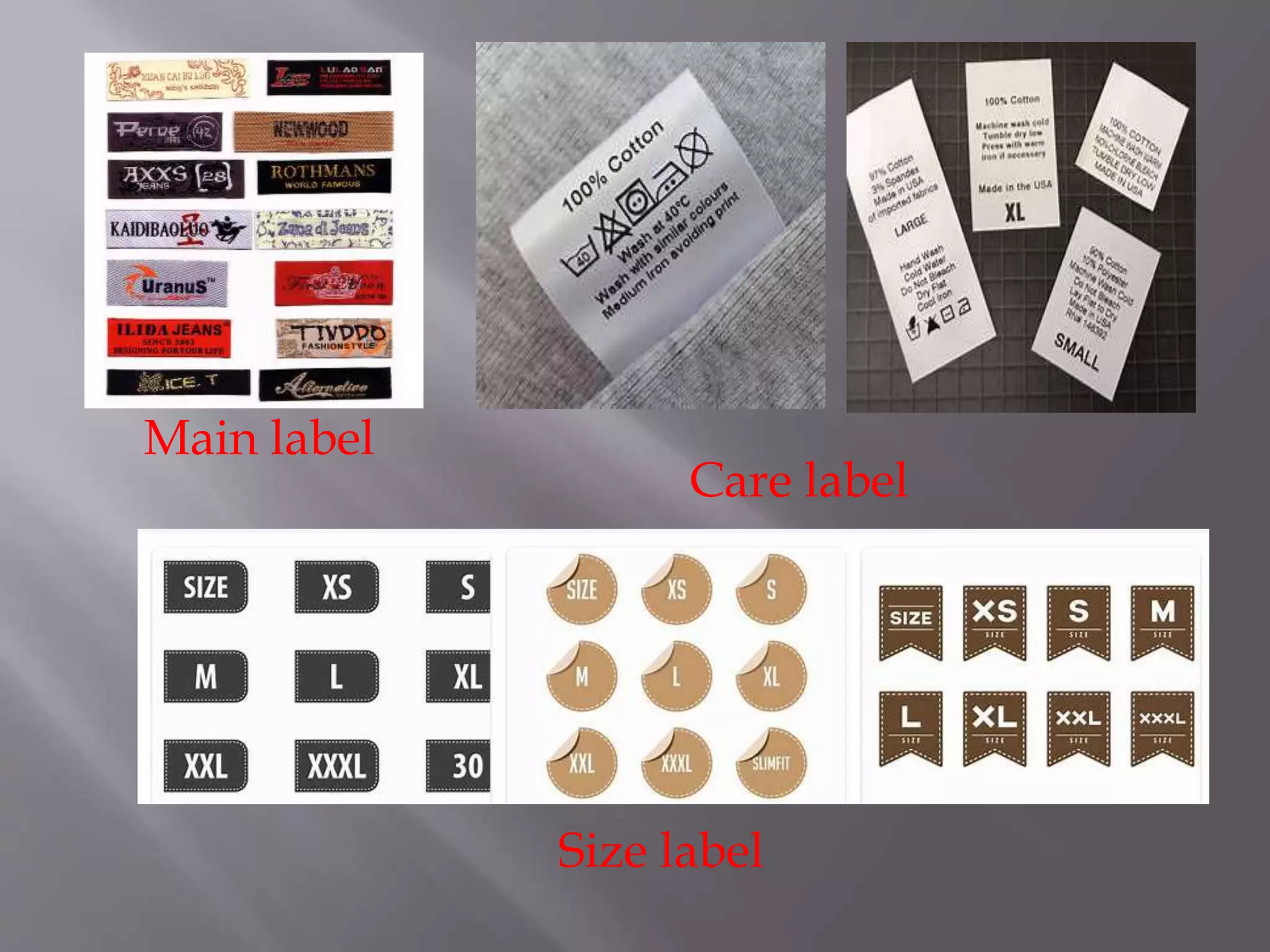
There are mainly three types of label.
MAIN LABEL:
 Main label contains brand name or trade name of
buyer which is registered by the buyer. For
example Levis, Polo, Lee, etc.
SIZE LABEL:
 Indicates the size of garment i.e. L, M, XL, XXL or
collar length of shirt 15, 16, 17, 18, etc.
CARE LABEL:
 It indicates the care instruction of the garment by
some internationally recognized signs. It shows the
washing, drying, dry-cleaning, and ironing
conditions of garments. The all other labels are
called sub-labels.
Main label
Size label
Care label
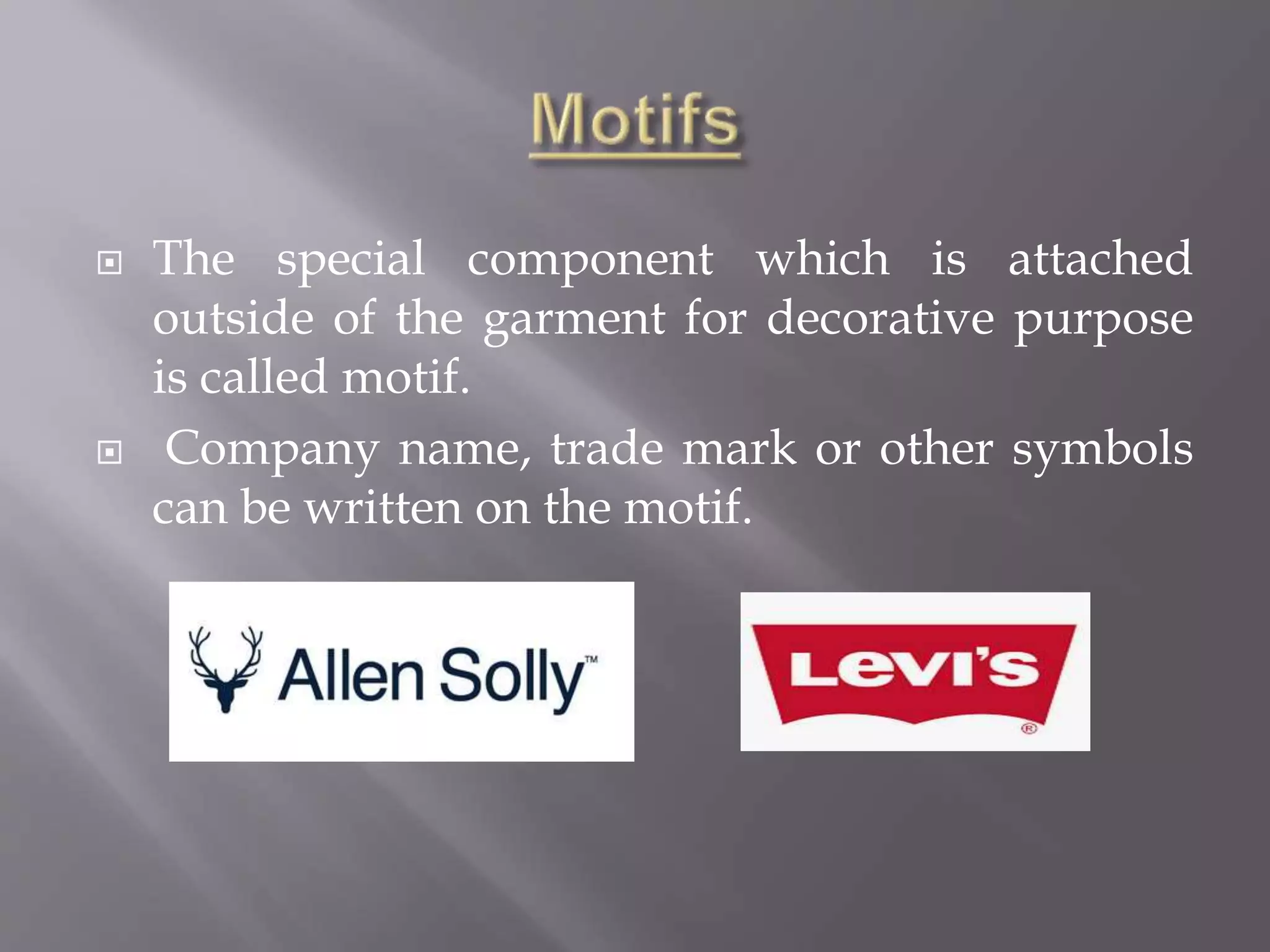
 The special component which is attached
outside of the garment for decorative purpose
is called motif.
 Company name, trade mark or other symbols
can be written on the motif.
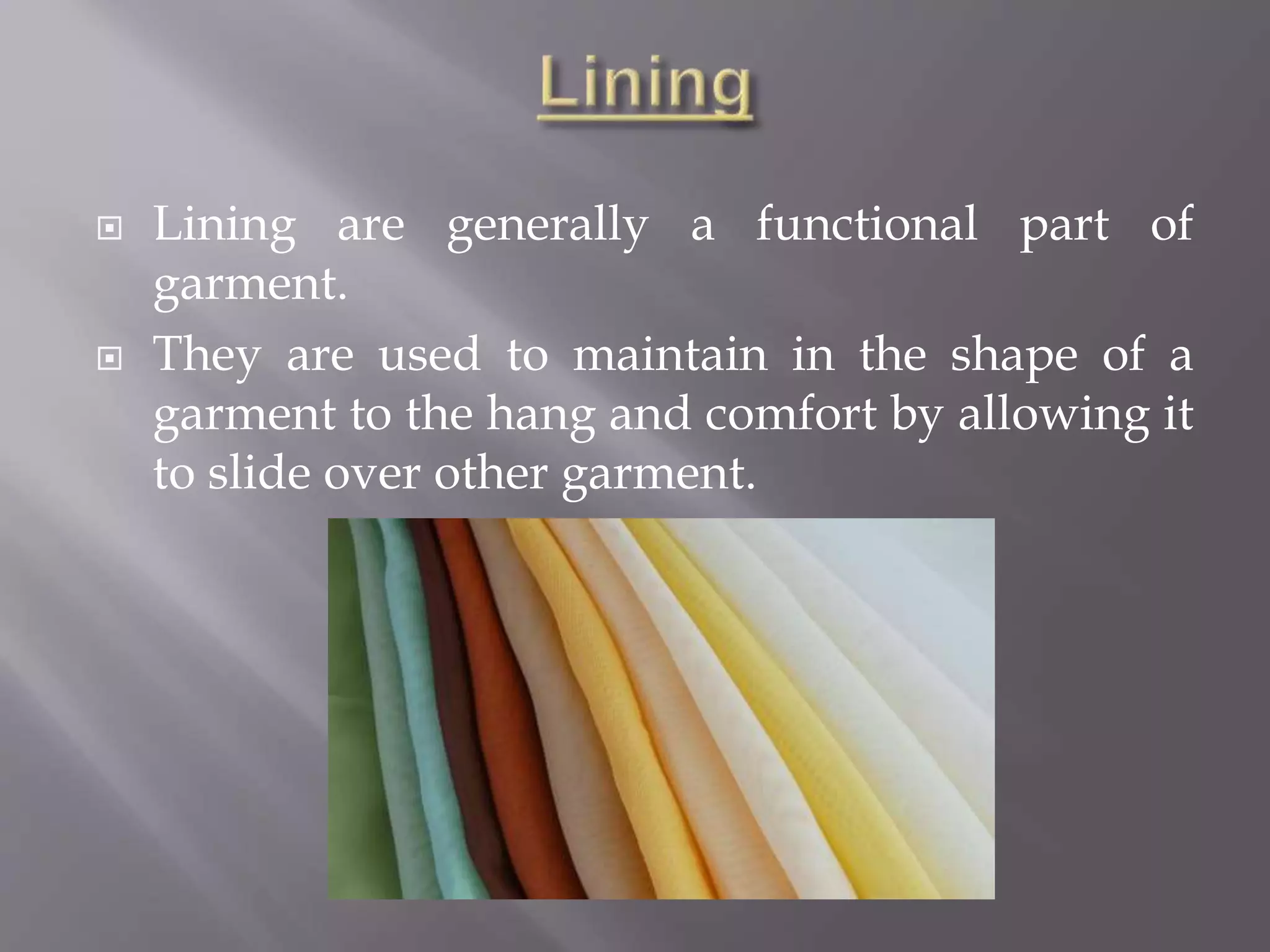
 Lining are generally a functional part of
garment.
 They are used to maintain in the shape of a
garment to the hang and comfort by allowing it
to slide over other garment.
 Lining are available as knitted and woven
fabric made from polyester, Polyamide, acetate,
viscose for use where slippery material is
required and from cotton, polyester cotton
wool where decoration and worn handle is
required.
 Linings are joined to main garment by sewing
and for this purpose normal plain swing
machines are used.
 Linings are widely used in jackets, coats,
overcoats, pockets, flaps, children wear, etc.
 Generally cheap fabrics are used as lining
material.
 Interlining are used to support reinforce and
control the shape of some areas of garments such
as collar, cuffs, waist bands, and facings.
 They may be sewn into the garments or they may
be attached by the fusing.
 Nowadays sewn interlining are hardly used and
usable interlinings are widely used.
 Interlining is available in a wide variety of weights
and constructions to match the fabric of garment.
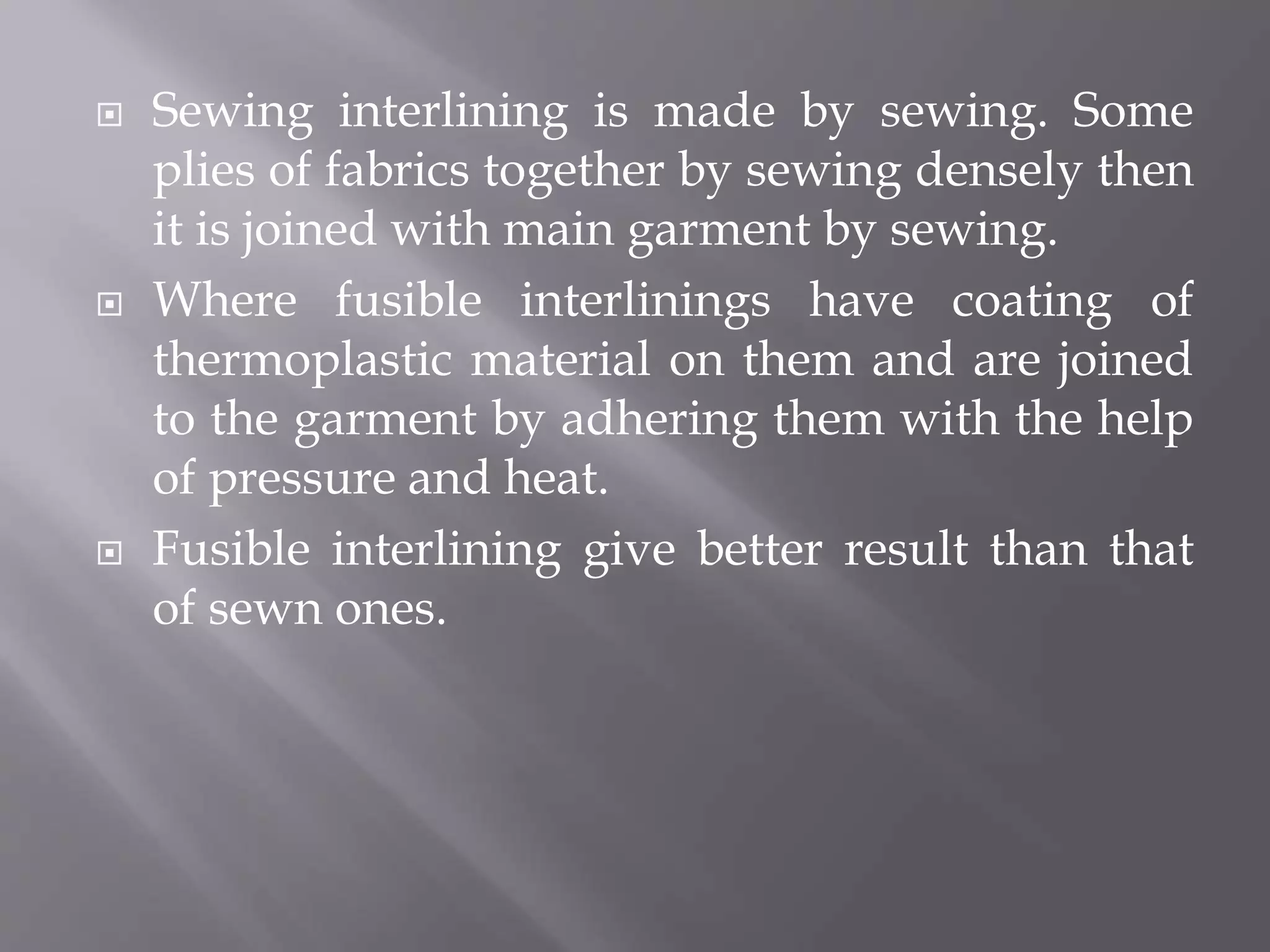
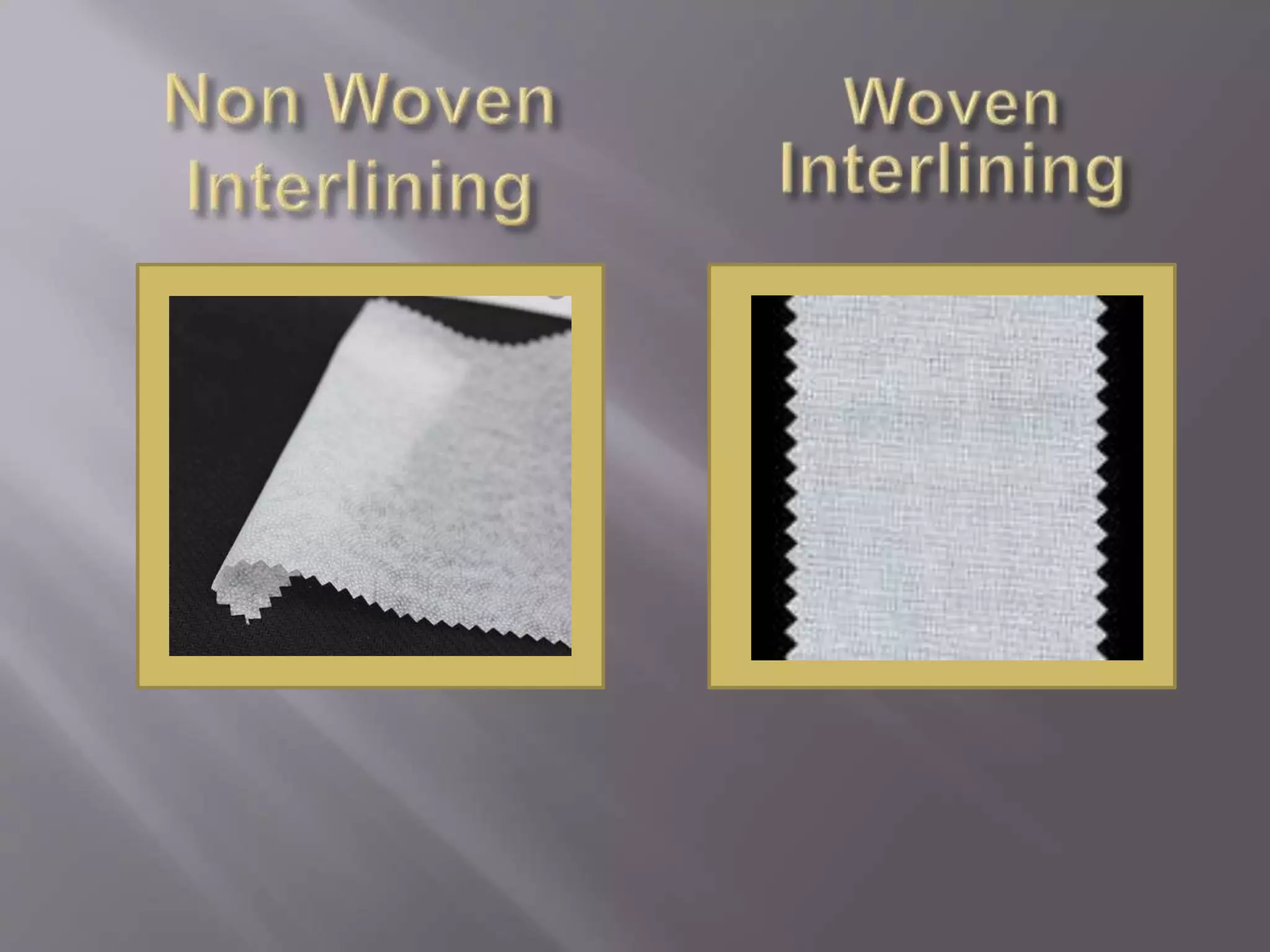
 They can be woven and non - woven product.
 Woven interlining are most commonly of plain
weave construction, whereas non – woven
interlining are made directly from textile fibers
and are held together by mechanical, chemical
thermal, or solvent means or combination of these.
 Sewing interlining is made by sewing. Some
plies of fabrics together by sewing densely then
it is joined with main garment by sewing.
 Where fusible interlinings have coating of
thermoplastic material on them and are joined
to the garment by adhering them with the help
of pressure and heat.
 Fusible interlining give better result than that
of sewn ones.
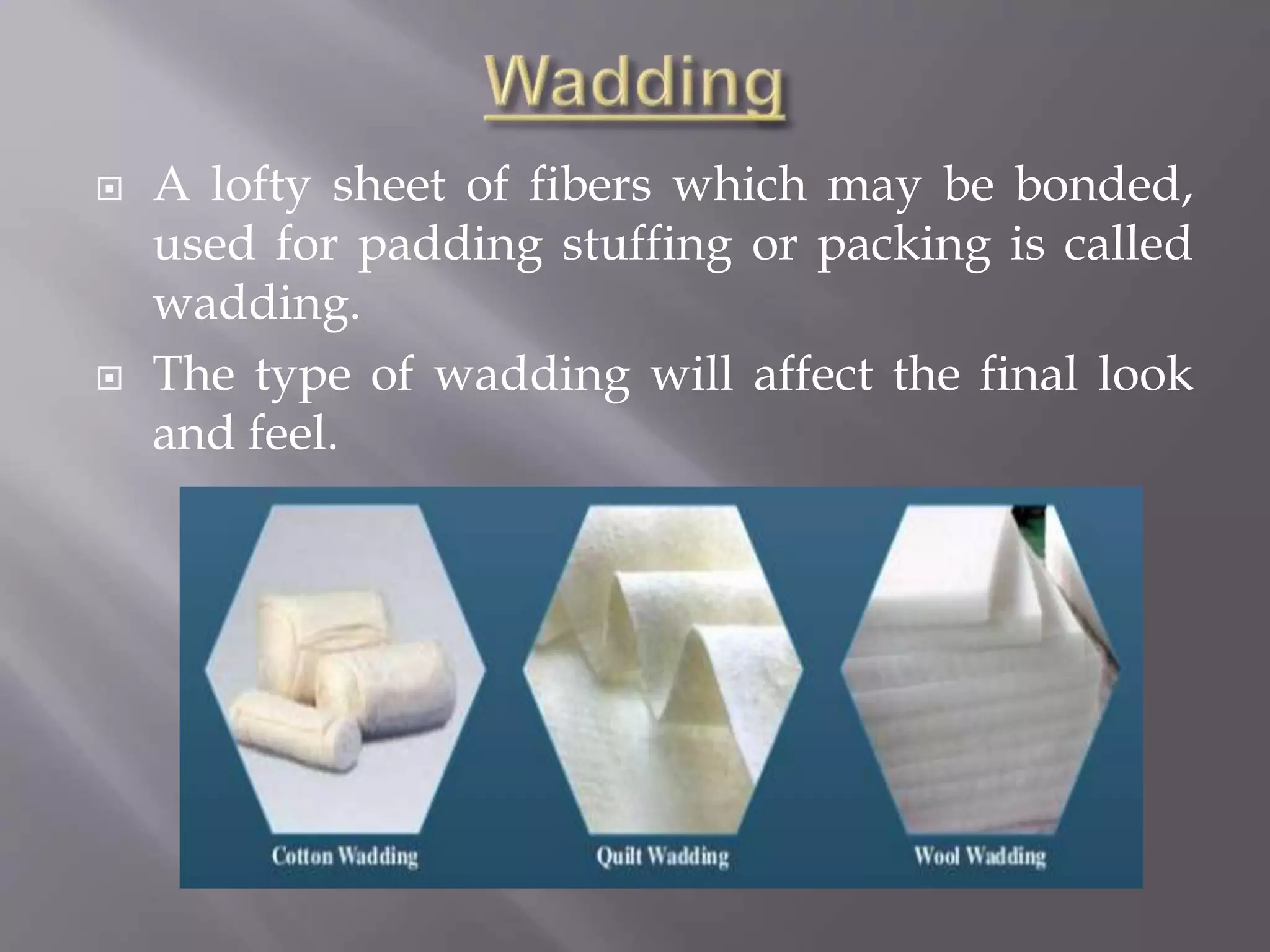
 A lofty sheet of fibers which may be bonded,
used for padding stuffing or packing is called
wadding.
 The type of wadding will affect the final look
and feel.
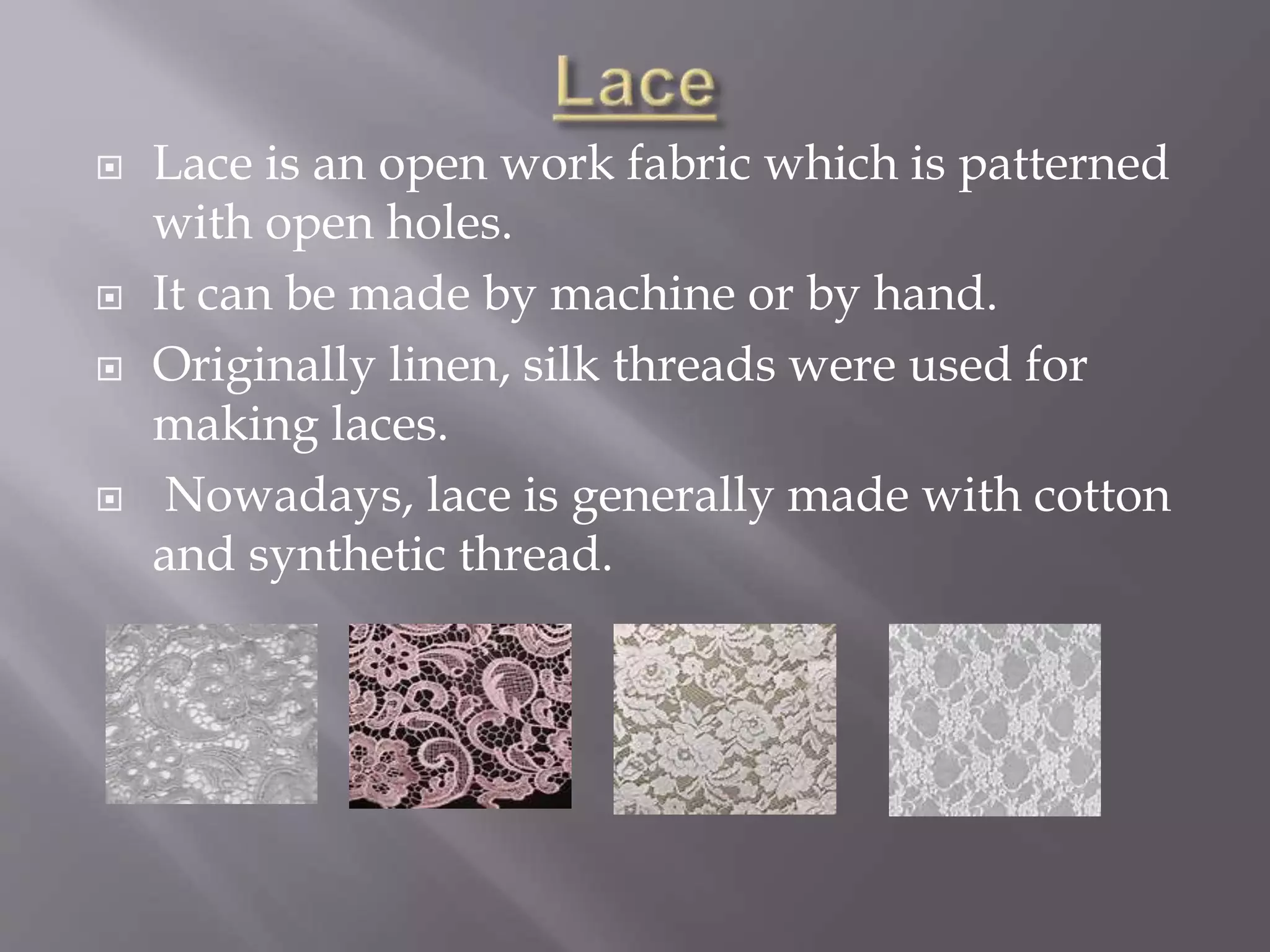
 Lace is an open work fabric which is patterned
with open holes.
 It can be made by machine or by hand.
 Originally linen, silk threads were used for
making laces.
 Nowadays, lace is generally made with cotton
and synthetic thread.
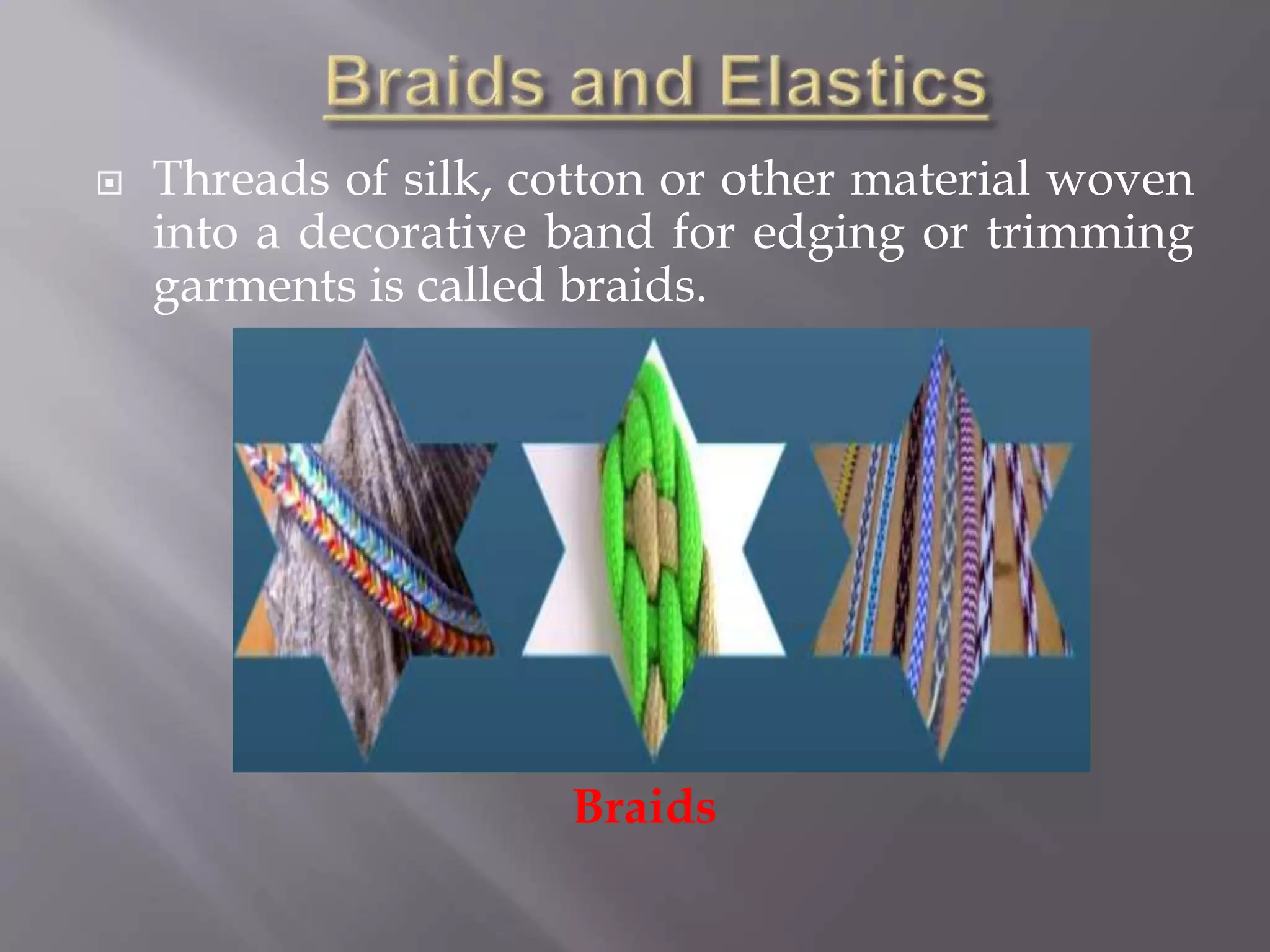
 Threads of silk, cotton or other material woven
into a decorative band for edging or trimming
garments is called braids.
Braids
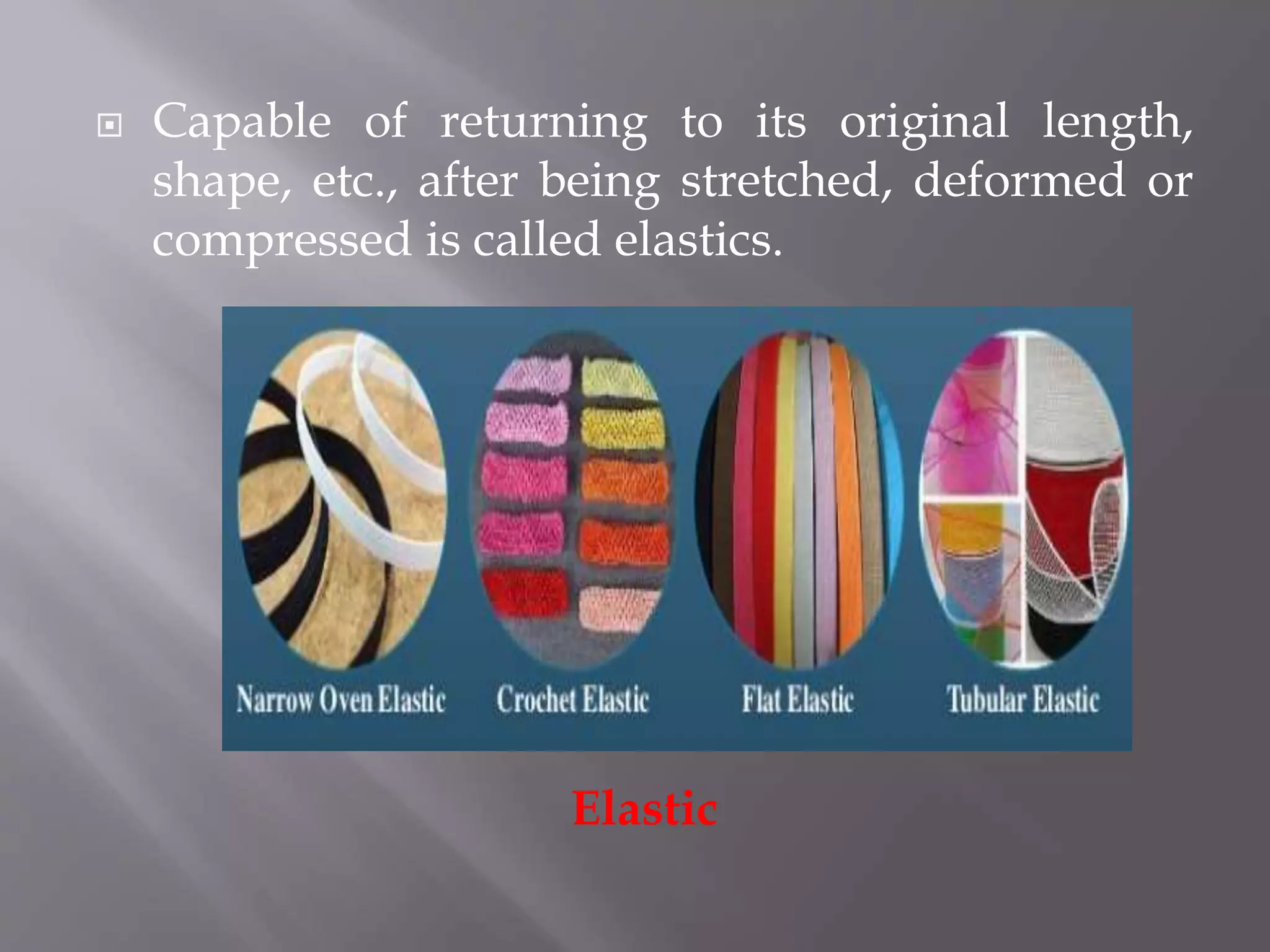
 Capable of returning to its original length,
shape, etc., after being stretched, deformed or
compressed is called elastics.
Elastic
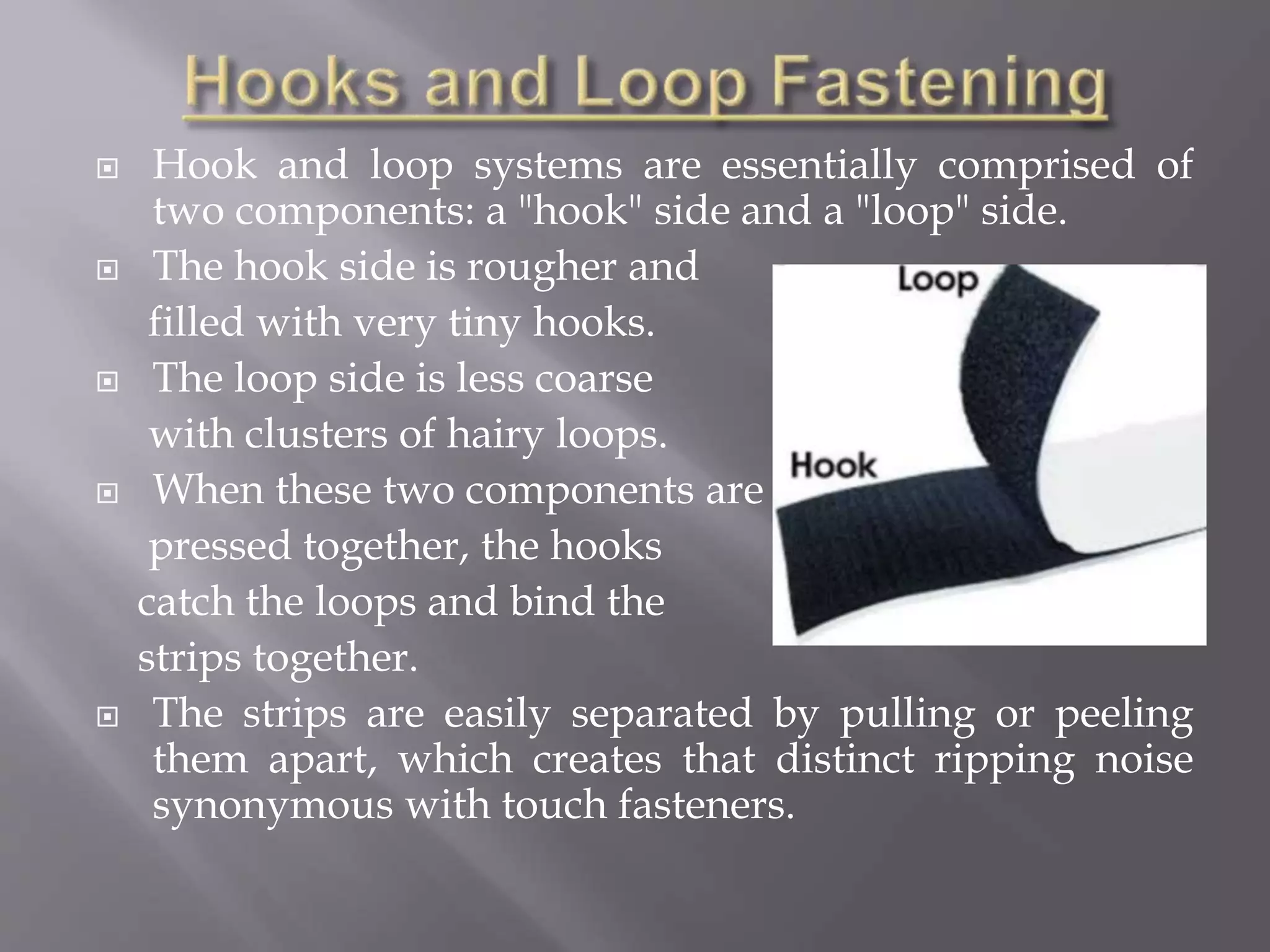
 Hook and loop systems are essentially comprised of
two components: a "hook" side and a "loop" side.
 The hook side is rougher and
filled with very tiny hooks.
 The loop side is less coarse
with clusters of hairy loops.
 When these two components are
pressed together, the hooks
catch the loops and bind the
strips together.
 The strips are easily separated by pulling or peeling
them apart, which creates that distinct ripping noise
synonymous with touch fasteners.
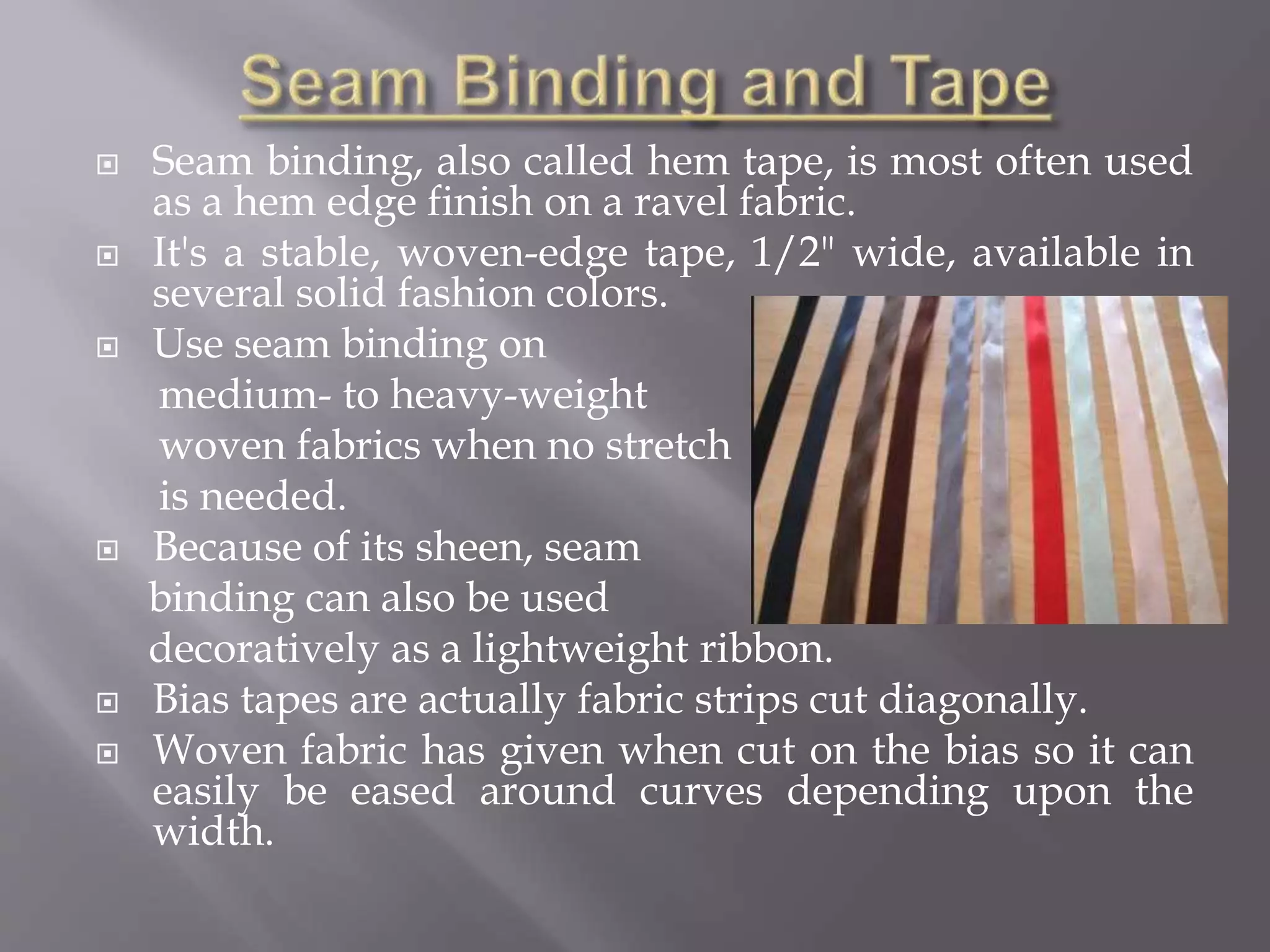
 Seam binding, also called hem tape, is most often used
as a hem edge finish on a ravel fabric.
 It's a stable, woven-edge tape, 1/2" wide, available in
several solid fashion colors.
 Use seam binding on
medium- to heavy-weight
woven fabrics when no stretch
is needed.
 Because of its sheen, seam
binding can also be used
decoratively as a lightweight ribbon.
 Bias tapes are actually fabric strips cut diagonally.
 Woven fabric has given when cut on the bias so it can
easily be eased around curves depending upon the
width.
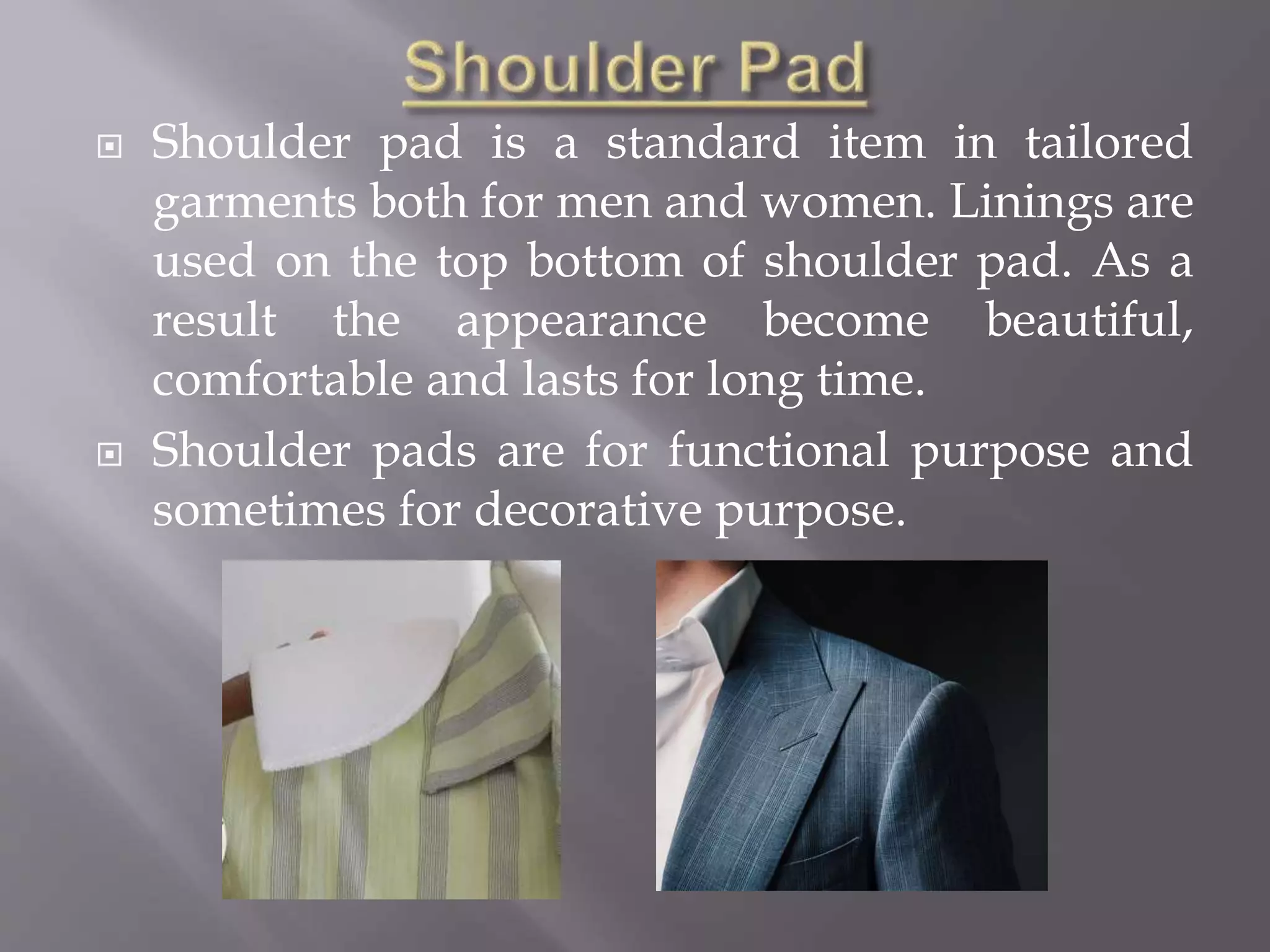
 Shoulder pad is a standard item in tailored
garments both for men and women. Linings are
used on the top bottom of shoulder pad. As a
result the appearance become beautiful,
comfortable and lasts for long time.
 Shoulder pads are for functional purpose and
sometimes for decorative purpose.
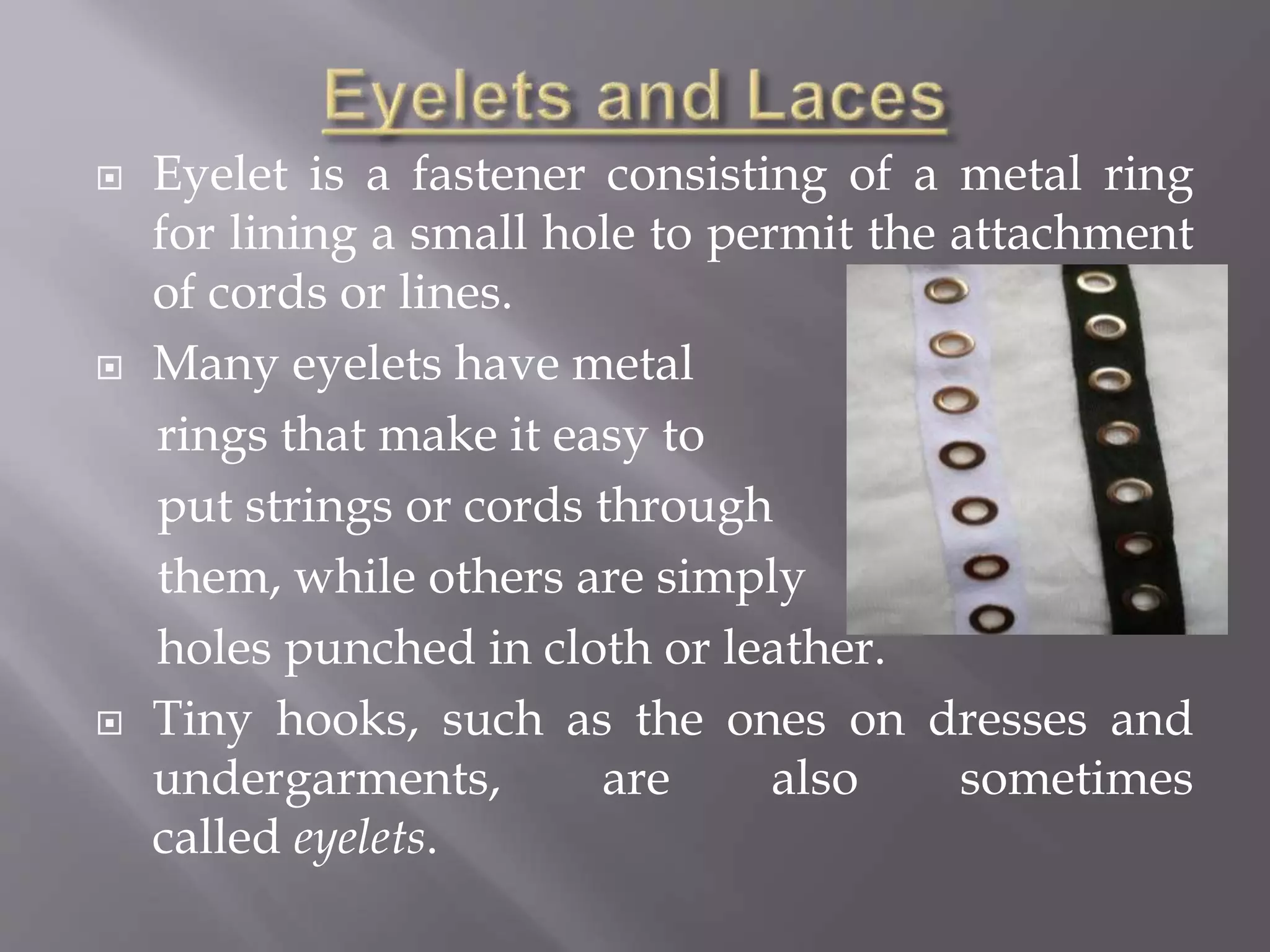
 Eyelet is a fastener consisting of a metal ring
for lining a small hole to permit the attachment
of cords or lines.
 Many eyelets have metal
rings that make it easy to
put strings or cords through
them, while others are simply
holes punched in cloth or leather.
 Tiny hooks, such as the ones on dresses and
undergarments, are also sometimes
called eyelets.
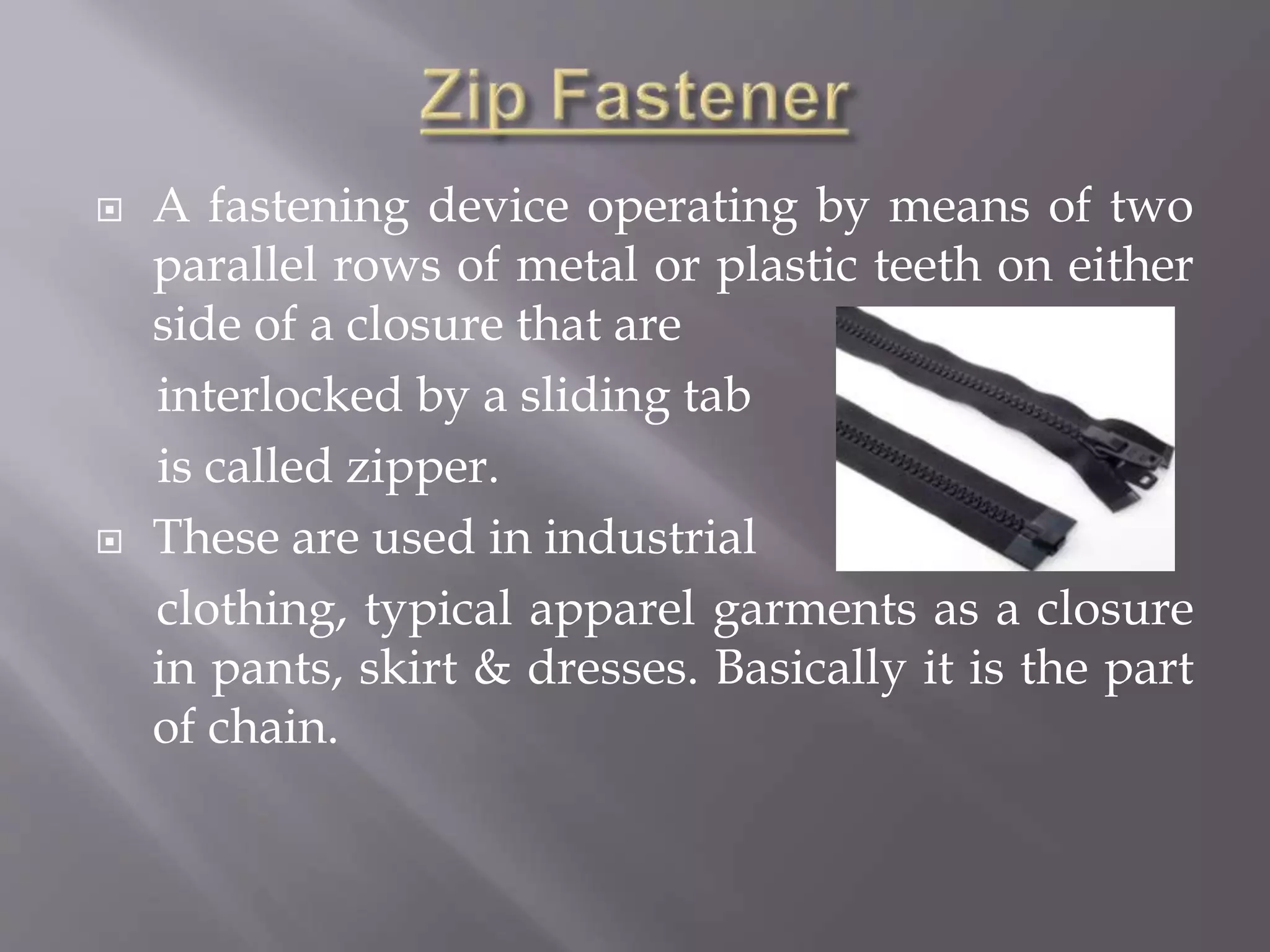
 A fastening device operating by means of two
parallel rows of metal or plastic teeth on either
side of a closure that are
interlocked by a sliding tab
is called zipper.
 These are used in industrial
clothing, typical apparel garments as a closure
in pants, skirt & dresses. Basically it is the part
of chain.
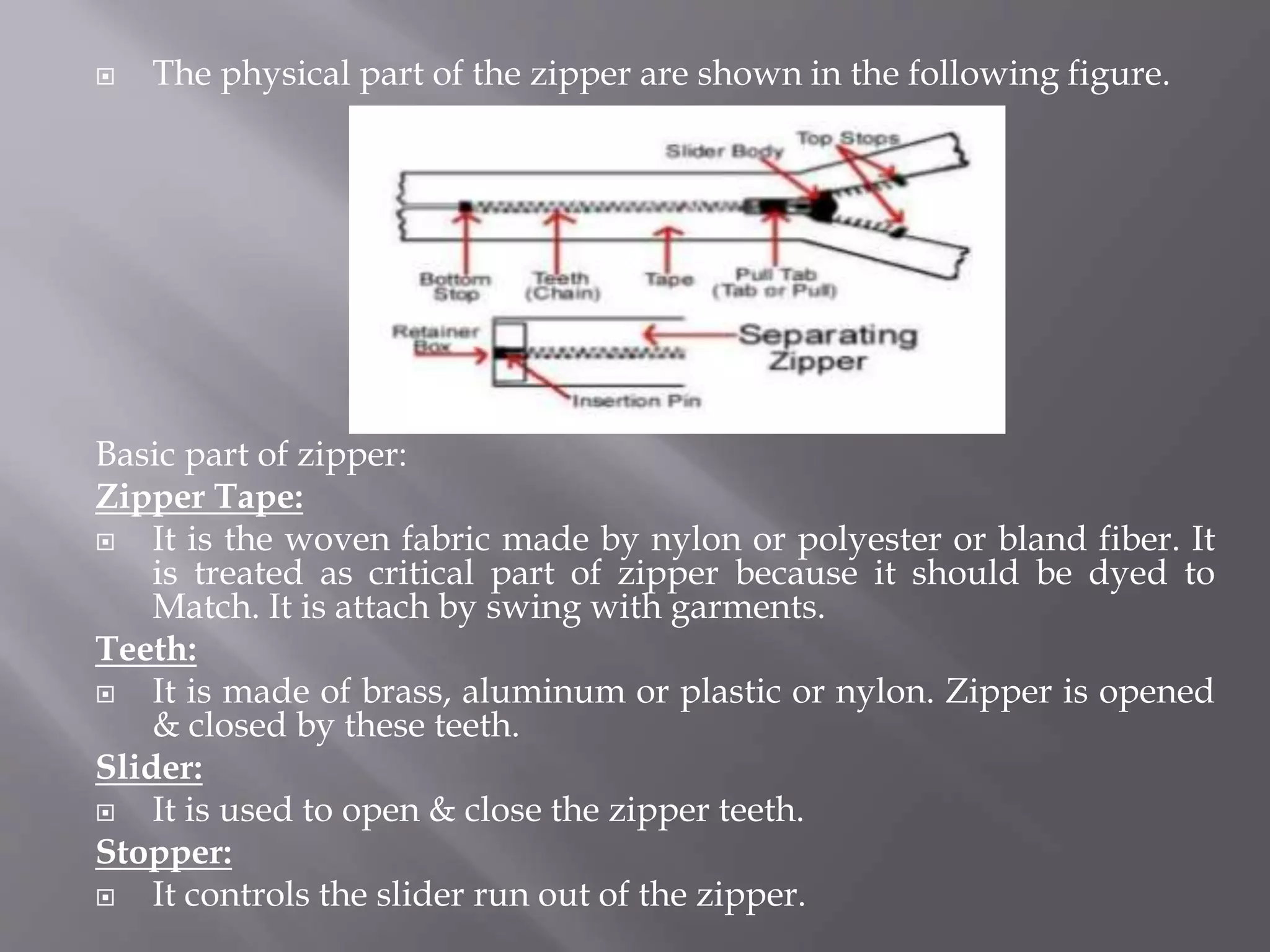
 The physical part of the zipper are shown in the following figure.
Basic part of zipper:
Zipper Tape:
 It is the woven fabric made by nylon or polyester or bland fiber. It
is treated as critical part of zipper because it should be dyed to
Match. It is attach by swing with garments.
Teeth:
 It is made of brass, aluminum or plastic or nylon. Zipper is opened
& closed by these teeth.
Slider:
 It is used to open & close the zipper teeth.
Stopper:
 It controls the slider run out of the zipper.
Types of Zipper:
 Plastic Zipper or nylon zipper
 Metal Zipper
 Vislon Zipper
Purpose:
 Functional purpose of zipper is as a part of a
garment here zipper is used to open and close
the openings.
 Decorative purpose of Zipper is given the
beauty of garments.
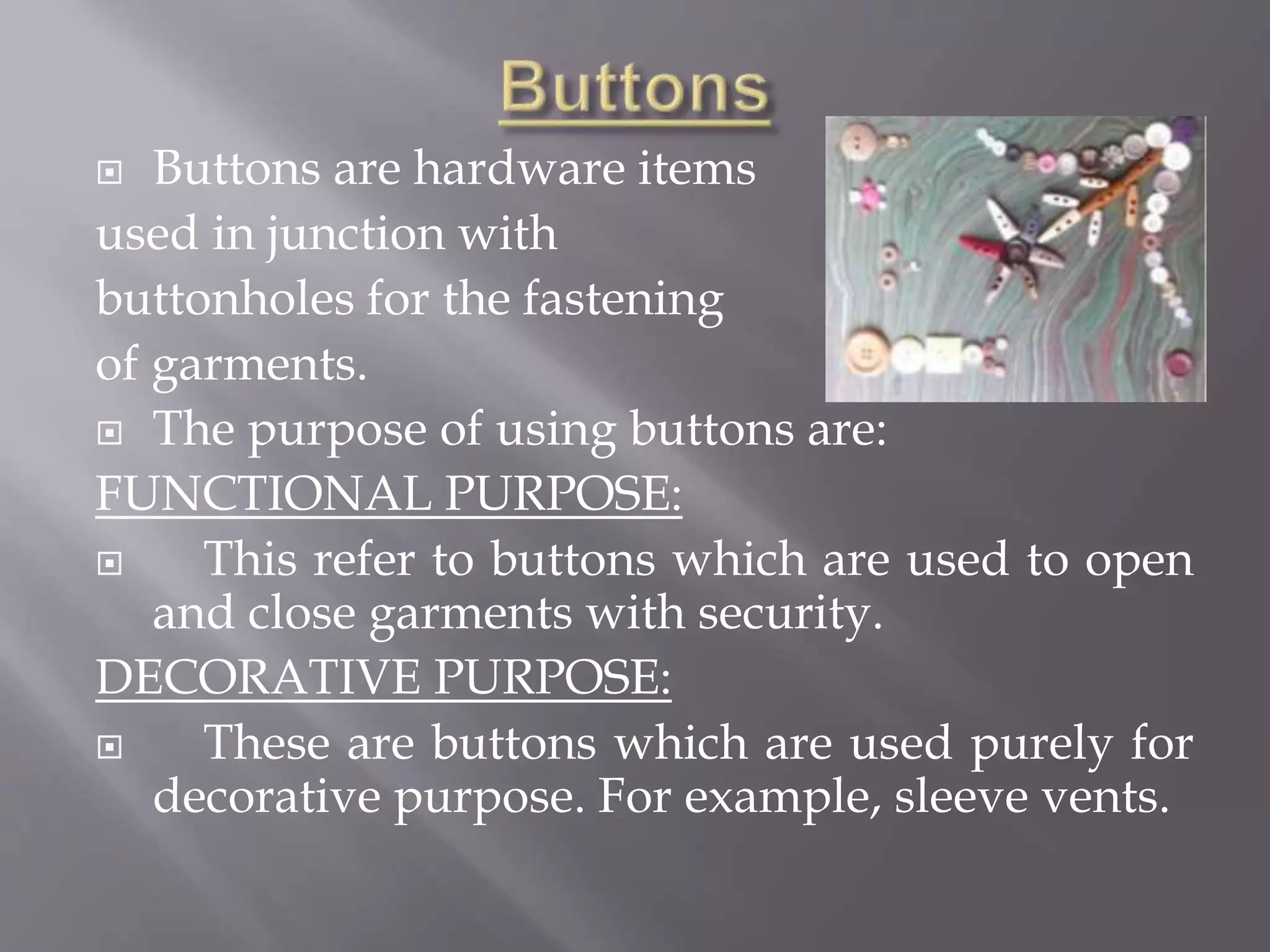
 Buttons are hardware items
used in junction with
buttonholes for the fastening
of garments.
 The purpose of using buttons are:
FUNCTIONAL PURPOSE:
 This refer to buttons which are used to open
and close garments with security.
DECORATIVE PURPOSE:
 These are buttons which are used purely for
decorative purpose. For example, sleeve vents.
Types of buttons:
 According to the no of holes:
There are three types of button
 2 hole button
 4 hole button
 1 hole button
 According to the material:
 Plastic Button: It is made of polyester,
polyamide, polyacrylonitrile, etc. cheap, not
glossy and widely used in shirts.
 Metal Button: Used in normally
denim pants, trousers, etc.
 Wooden Button: Used in decorative purposes.
 Horn Button: Made up of horns of animals,
used in shits, pants. Artificial horns are also
used which is made of nylon and plastic and
additives.
 Chalk Button: Used to make plastic glossy,
used in shirts.
 Printed Button: Used in decorative purposes.
 Stud or tack buttons, are the types found on
jeans.
 They are made of metal and are comprised of
two parts: the grooved tack section that pushes
up through the denim and the top button that
is then hammered on to the tack.
 The majority of jeans have a zipper fly with a
stud button at the top to secure the pants.
 A snap fastener is a pair of interlocking discs,
made out of a metal or plastic, commonly used in
place of buttons to fasten clothing and for similar
purposes.
 A rivet is a round rod of circular cross section. It
consists of two parts: head and shank.
 A rivet is first placed in the hole drilled through
the two parts to be joined. Then the shank end is
made into a rivet head by applying pressure, when
it is either in cold or hot condition.
Snap Fasteners Rivet
Components and trims

Components and trims

  • 1.
    COMPONENTS AND TRIMS Prepared by RasminThahani Z, Assistant Professor, Syed Ammal Arts and Science College, Ramanathapuram.
  • 2.
     The itemsand components other than the main fabric of the garment, which are essential part of the construction of the garment or which act as trimmings or fastenings of some kind are called trims or accessories in sewing.  The total number of items available for use in garments in addition to the main fabric is extremely large.  The aspects of these items which are important are the functions they serve, the materials from which they are made, the methods by which they become part of the garment.
  • 3.
     Labels andmotifs  Linings  Interlinings  Wadding  Lace, braid and elastic  Hook and loop fastening  Seam binding and tape  Shoulder pads  Eyelets and laces  Zip fasteners  Buttons  Tack buttons, snap fastener and rivets
  • 4.
     Label isan attached component of garment on which important information regarding the garment are written or printed. No garment can be sold without some kind of label attached to it.  Specially in case of exporting labels on a garments is must.  For example the size of garment trade mark of country of origin type of fiber etc. are written on label.
  • 5.
    There are mainlythree types of label. MAIN LABEL:  Main label contains brand name or trade name of buyer which is registered by the buyer. For example Levis, Polo, Lee, etc. SIZE LABEL:  Indicates the size of garment i.e. L, M, XL, XXL or collar length of shirt 15, 16, 17, 18, etc. CARE LABEL:  It indicates the care instruction of the garment by some internationally recognized signs. It shows the washing, drying, dry-cleaning, and ironing conditions of garments. The all other labels are called sub-labels.
  • 6.
  • 7.
     The specialcomponent which is attached outside of the garment for decorative purpose is called motif.  Company name, trade mark or other symbols can be written on the motif.
  • 8.
     Lining aregenerally a functional part of garment.  They are used to maintain in the shape of a garment to the hang and comfort by allowing it to slide over other garment.
  • 9.
     Lining areavailable as knitted and woven fabric made from polyester, Polyamide, acetate, viscose for use where slippery material is required and from cotton, polyester cotton wool where decoration and worn handle is required.  Linings are joined to main garment by sewing and for this purpose normal plain swing machines are used.  Linings are widely used in jackets, coats, overcoats, pockets, flaps, children wear, etc.  Generally cheap fabrics are used as lining material.
  • 10.
     Interlining areused to support reinforce and control the shape of some areas of garments such as collar, cuffs, waist bands, and facings.  They may be sewn into the garments or they may be attached by the fusing.  Nowadays sewn interlining are hardly used and usable interlinings are widely used.  Interlining is available in a wide variety of weights and constructions to match the fabric of garment.  They can be woven and non - woven product.  Woven interlining are most commonly of plain weave construction, whereas non – woven interlining are made directly from textile fibers and are held together by mechanical, chemical thermal, or solvent means or combination of these.
  • 11.
     Sewing interliningis made by sewing. Some plies of fabrics together by sewing densely then it is joined with main garment by sewing.  Where fusible interlinings have coating of thermoplastic material on them and are joined to the garment by adhering them with the help of pressure and heat.  Fusible interlining give better result than that of sewn ones.
  • 13.
     A loftysheet of fibers which may be bonded, used for padding stuffing or packing is called wadding.  The type of wadding will affect the final look and feel.
  • 14.
     Lace isan open work fabric which is patterned with open holes.  It can be made by machine or by hand.  Originally linen, silk threads were used for making laces.  Nowadays, lace is generally made with cotton and synthetic thread.
  • 15.
     Threads ofsilk, cotton or other material woven into a decorative band for edging or trimming garments is called braids. Braids
  • 16.
     Capable ofreturning to its original length, shape, etc., after being stretched, deformed or compressed is called elastics. Elastic
  • 17.
     Hook andloop systems are essentially comprised of two components: a "hook" side and a "loop" side.  The hook side is rougher and filled with very tiny hooks.  The loop side is less coarse with clusters of hairy loops.  When these two components are pressed together, the hooks catch the loops and bind the strips together.  The strips are easily separated by pulling or peeling them apart, which creates that distinct ripping noise synonymous with touch fasteners.
  • 18.
     Seam binding,also called hem tape, is most often used as a hem edge finish on a ravel fabric.  It's a stable, woven-edge tape, 1/2" wide, available in several solid fashion colors.  Use seam binding on medium- to heavy-weight woven fabrics when no stretch is needed.  Because of its sheen, seam binding can also be used decoratively as a lightweight ribbon.  Bias tapes are actually fabric strips cut diagonally.  Woven fabric has given when cut on the bias so it can easily be eased around curves depending upon the width.
  • 19.
     Shoulder padis a standard item in tailored garments both for men and women. Linings are used on the top bottom of shoulder pad. As a result the appearance become beautiful, comfortable and lasts for long time.  Shoulder pads are for functional purpose and sometimes for decorative purpose.
  • 20.
     Eyelet isa fastener consisting of a metal ring for lining a small hole to permit the attachment of cords or lines.  Many eyelets have metal rings that make it easy to put strings or cords through them, while others are simply holes punched in cloth or leather.  Tiny hooks, such as the ones on dresses and undergarments, are also sometimes called eyelets.
  • 21.
     A fasteningdevice operating by means of two parallel rows of metal or plastic teeth on either side of a closure that are interlocked by a sliding tab is called zipper.  These are used in industrial clothing, typical apparel garments as a closure in pants, skirt & dresses. Basically it is the part of chain.
  • 22.
     The physicalpart of the zipper are shown in the following figure. Basic part of zipper: Zipper Tape:  It is the woven fabric made by nylon or polyester or bland fiber. It is treated as critical part of zipper because it should be dyed to Match. It is attach by swing with garments. Teeth:  It is made of brass, aluminum or plastic or nylon. Zipper is opened & closed by these teeth. Slider:  It is used to open & close the zipper teeth. Stopper:  It controls the slider run out of the zipper.
  • 23.
    Types of Zipper: Plastic Zipper or nylon zipper  Metal Zipper  Vislon Zipper Purpose:  Functional purpose of zipper is as a part of a garment here zipper is used to open and close the openings.  Decorative purpose of Zipper is given the beauty of garments.
  • 24.
     Buttons arehardware items used in junction with buttonholes for the fastening of garments.  The purpose of using buttons are: FUNCTIONAL PURPOSE:  This refer to buttons which are used to open and close garments with security. DECORATIVE PURPOSE:  These are buttons which are used purely for decorative purpose. For example, sleeve vents.
  • 25.
    Types of buttons: According to the no of holes: There are three types of button  2 hole button  4 hole button  1 hole button  According to the material:  Plastic Button: It is made of polyester, polyamide, polyacrylonitrile, etc. cheap, not glossy and widely used in shirts.
  • 26.
     Metal Button:Used in normally denim pants, trousers, etc.  Wooden Button: Used in decorative purposes.  Horn Button: Made up of horns of animals, used in shits, pants. Artificial horns are also used which is made of nylon and plastic and additives.
  • 27.
     Chalk Button:Used to make plastic glossy, used in shirts.  Printed Button: Used in decorative purposes.
  • 28.
     Stud ortack buttons, are the types found on jeans.  They are made of metal and are comprised of two parts: the grooved tack section that pushes up through the denim and the top button that is then hammered on to the tack.  The majority of jeans have a zipper fly with a stud button at the top to secure the pants.
  • 29.
     A snapfastener is a pair of interlocking discs, made out of a metal or plastic, commonly used in place of buttons to fasten clothing and for similar purposes.  A rivet is a round rod of circular cross section. It consists of two parts: head and shank.  A rivet is first placed in the hole drilled through the two parts to be joined. Then the shank end is made into a rivet head by applying pressure, when it is either in cold or hot condition. Snap Fasteners Rivet