AKSUM UNIVERSITY
COLLEGE OF ENGINEERING AND TECHNOLOGY
DEPARTMENT OF TEXTILE ENGINEERING
Course Name: Garment Manufacturing Technology
Chapter six :finishing department
Prepared by :kibrom g/her 1
Pressing
• It is the process of application of heat, pressure and moisture to shape
or crease garments or garment components into the geometric forms
proposed by the designer. The pressing process influences the final
garment appearance and hence the garment appeal.
• Purpose of Pressing
• To flatten out the undesirable wrinkles, creases and crush marks.
• To make creases where the garment design needs it.
• To prepare garments for further sewing.
• To refinish the garment after completion of the production process.
Classification of Pressing
• The basic processes that are involved in pressing can be
divided into two groups:
1. Under pressing – It is the pressing operation
performed on garment components as they are made up
2. Top pressing/Final pressing – This refers to the
finishing operation, which a garment undergoes after
being completely assembled.
Categories of Pressing
• Garment pressing are divided into various classes according to the
amount and kind of pressing required.
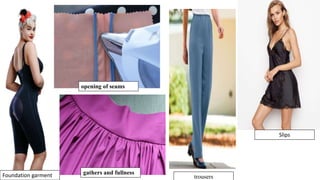
1. Garments, which require no pressing – e.g Foundation
garments, stretch swimwear, bras and underwear.
2. Garments requiring minimal pressing – e.g slips,
nightgowns and T-shirts.
3. Garments requiring the use of an iron in under pressing and
final pressing – For the opening of seams and creasing of
edges and for pressing garments with gathers and fullness and
in situations where style change is frequent.
4. Garments requiring extensive under pressing and final
pressing – e.g Men’s jackets, trousers and waistcoats, women’s
tailored jackets, skirts, top coats.
5. Garments requiring pleating or ‘permanent press’ finishing.
Foundation garment
Slips
trousers
gathers and fullness
opening of seams
Basic elements of Pressing
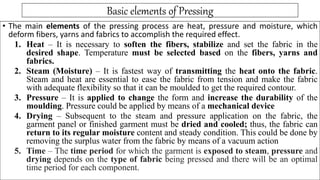
• The main elements of the pressing process are heat, pressure and moisture, which
deform fibers, yarns and fabrics to accomplish the required effect.
1. Heat – It is necessary to soften the fibers, stabilize and set the fabric in the
desired shape. Temperature must be selected based on the fibers, yarns and
fabrics.
2. Steam (Moisture) – It is fastest way of transmitting the heat onto the fabric.
Steam and heat are essential to ease the fabric from tension and make the fabric
with adequate flexibility so that it can be moulded to get the required contour.
3. Pressure – It is applied to change the form and increase the durability of the
moulding. Pressure could be applied by means of a mechanical device
4. Drying – Subsequent to the steam and pressure application on the fabric, the
garment panel or finished garment must be dried and cooled; thus, the fabric can
return to its regular moisture content and steady condition. This could be done by
removing the surplus water from the fabric by means of a vacuum action
5. Time – The time period for which the garment is exposed to steam, pressure and
drying depends on the type of fabric being pressed and there will be an optimal
time period for each component.
Hand Irons
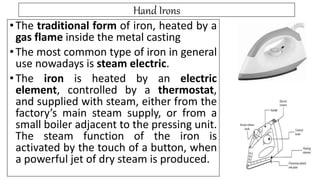
• The traditional form of iron, heated by a
gas flame inside the metal casting
• The most common type of iron in general
use nowadays is steam electric.
• The iron is heated by an electric
element, controlled by a thermostat,
and supplied with steam, either from the
factory’s main steam supply, or from a
small boiler adjacent to the pressing unit.
The steam function of the iron is
activated by the touch of a button, when
a powerful jet of dry steam is produced.
Steam Presses
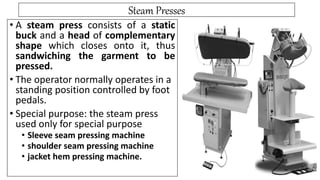
• A steam press consists of a static
buck and a head of complementary
shape which closes onto it, thus
sandwiching the garment to be
pressed.
• The operator normally operates in a
standing position controlled by foot
pedals.
• Special purpose: the steam press
used only for special purpose
• Sleeve seam pressing machine
• shoulder seam pressing machine
• jacket hem pressing machine.
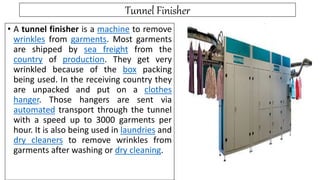
Tunnel Finisher
• A tunnel finisher is a machine to remove
wrinkles from garments. Most garments
are shipped by sea freight from the
country of production. They get very
wrinkled because of the box packing
being used. In the receiving country they
are unpacked and put on a clothes
hanger. Those hangers are sent via
automated transport through the tunnel
with a speed up to 3000 garments per
hour. It is also being used in laundries and
dry cleaners to remove wrinkles from
garments after washing or dry cleaning.
Garment Packaging
• This is the final process in the production of garments, which
prepares the finished merchandise for delivery to the customer.
• After completing the entire manufacturing task, apparel is
required to be packed. After packing, it is placed in cartons as per
instructions and then it is stored in a store section before it is
delivered to the respective buyer
• Packaging refers to the container that carries a product. Two basic
objectives of packaging are preventing any damage to the
product during transportation and enhancing the features of the
product to the consumer for a sale of it.
Garment labelling
• Labelling or labeling is describing something in a
word or short phrase or diagram
• A label is a piece of paper, cloth, metal, or
other material affixed to the garment
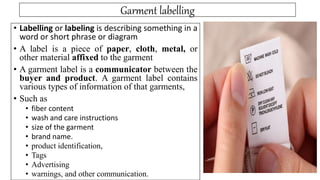
• A garment label is a communicator between the
buyer and product. A garment label contains
various types of information of that garments,
• Such as
• fiber content
• wash and care instructions
• size of the garment
• brand name.
• product identification,
• Tags
• Advertising
• warnings, and other communication.
IMPORTANCE OF LABELLING
•Care label is important that the customer is given
accurate information as to how to take care of
their garments, so they can make informed
purchase decision concerning the care
characteristics and cleaners to avoid product damage
caused by the use of improper cleaning procedures.
•Before the care instructions are put on care labels, the
items are tested and these testing are:-
• Shrinkage
• colorfastness
Types of Label used in Garments:
There are mainly two types of label and these are
1. Main Label
2. Sub Label.
Main Label
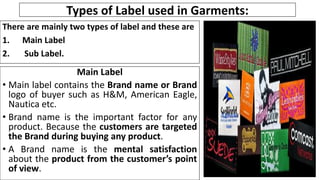
• Main label contains the Brand name or Brand
logo of buyer such as H&M, American Eagle,
Nautica etc.
• Brand name is the important factor for any
product. Because the customers are targeted
the Brand during buying any product.
• A Brand name is the mental satisfaction
about the product from the customer’s point
of view.
Sub Label
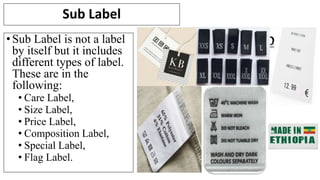
•Sub Label is not a label
by itself but it includes
different types of label.
These are in the
following:
• Care Label,
• Size Label,
• Price Label,
• Composition Label,
• Special Label,
• Flag Label.
1. Care labels
Care labels
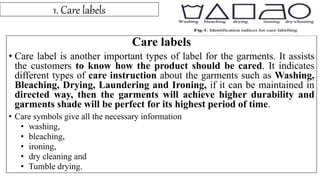
• Care label is another important types of label for the garments. It assists
the customers to know how the product should be cared. It indicates
different types of care instruction about the garments such as Washing,
Bleaching, Drying, Laundering and Ironing, if it can be maintained in
directed way, then the garments will achieve higher durability and
garments shade will be perfect for its highest period of time.
• Care symbols give all the necessary information
• washing,
• bleaching,
• ironing,
• dry cleaning and
• Tumble drying.
Symbols of care label
1. WASHING OR LAUNDERING
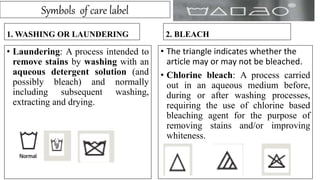
• Laundering: A process intended to
remove stains by washing with an
aqueous detergent solution (and
possibly bleach) and normally
including subsequent washing,
extracting and drying.
2. BLEACH
• The triangle indicates whether the
article may or may not be bleached.
• Chlorine bleach: A process carried
out in an aqueous medium before,
during or after washing processes,
requiring the use of chlorine based
bleaching agent for the purpose of
removing stains and/or improving
whiteness.
Symbols of care label
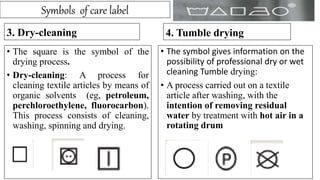
3. Dry-cleaning
• The square is the symbol of the
drying process.
• Dry-cleaning: A process for
cleaning textile articles by means of
organic solvents (eg, petroleum,
perchloroethylene, fluorocarbon).
This process consists of cleaning,
washing, spinning and drying.
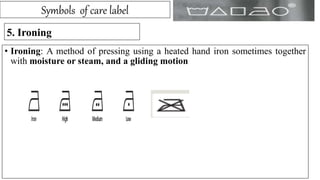
4. Tumble drying
• The symbol gives information on the
possibility of professional dry or wet
cleaning Tumble drying:
• A process carried out on a textile
article after washing, with the
intention of removing residual
water by treatment with hot air in a
rotating drum
Symbols of care label
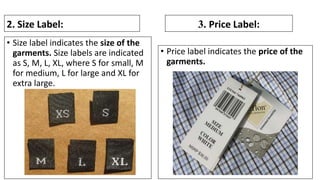
5. Ironing
• Ironing: A method of pressing using a heated hand iron sometimes together
with moisture or steam, and a gliding motion
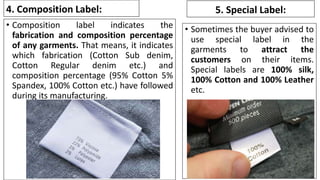
2. Size Label:
• Size label indicates the size of the
garments. Size labels are indicated
as S, M, L, XL, where S for small, M
for medium, L for large and XL for
extra large.
3. Price Label:
• Price label indicates the price of the
garments.
4. Composition Label:
• Composition label indicates the
fabrication and composition percentage
of any garments. That means, it indicates
which fabrication (Cotton Sub denim,
Cotton Regular denim etc.) and
composition percentage (95% Cotton 5%
Spandex, 100% Cotton etc.) have followed
during its manufacturing.
5. Special Label:
• Sometimes the buyer advised to
use special label in the
garments to attract the
customers on their items.
Special labels are 100% silk,
100% Cotton and 100% Leather
etc.
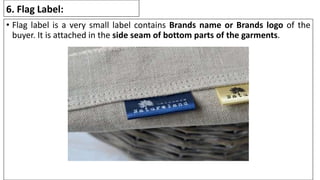
6. Flag Label:
• Flag label is a very small label contains Brands name or Brands logo of the
buyer. It is attached in the side seam of bottom parts of the garments.

U 6 finishing technology

  • 1.
    AKSUM UNIVERSITY COLLEGE OFENGINEERING AND TECHNOLOGY DEPARTMENT OF TEXTILE ENGINEERING Course Name: Garment Manufacturing Technology Chapter six :finishing department Prepared by :kibrom g/her 1
  • 2.
    Pressing • It isthe process of application of heat, pressure and moisture to shape or crease garments or garment components into the geometric forms proposed by the designer. The pressing process influences the final garment appearance and hence the garment appeal. • Purpose of Pressing • To flatten out the undesirable wrinkles, creases and crush marks. • To make creases where the garment design needs it. • To prepare garments for further sewing. • To refinish the garment after completion of the production process.
  • 3.
    Classification of Pressing •The basic processes that are involved in pressing can be divided into two groups: 1. Under pressing – It is the pressing operation performed on garment components as they are made up 2. Top pressing/Final pressing – This refers to the finishing operation, which a garment undergoes after being completely assembled.
  • 4.
    Categories of Pressing •Garment pressing are divided into various classes according to the amount and kind of pressing required. 1. Garments, which require no pressing – e.g Foundation garments, stretch swimwear, bras and underwear. 2. Garments requiring minimal pressing – e.g slips, nightgowns and T-shirts. 3. Garments requiring the use of an iron in under pressing and final pressing – For the opening of seams and creasing of edges and for pressing garments with gathers and fullness and in situations where style change is frequent. 4. Garments requiring extensive under pressing and final pressing – e.g Men’s jackets, trousers and waistcoats, women’s tailored jackets, skirts, top coats. 5. Garments requiring pleating or ‘permanent press’ finishing.
  • 5.
  • 6.
    Basic elements ofPressing • The main elements of the pressing process are heat, pressure and moisture, which deform fibers, yarns and fabrics to accomplish the required effect. 1. Heat – It is necessary to soften the fibers, stabilize and set the fabric in the desired shape. Temperature must be selected based on the fibers, yarns and fabrics. 2. Steam (Moisture) – It is fastest way of transmitting the heat onto the fabric. Steam and heat are essential to ease the fabric from tension and make the fabric with adequate flexibility so that it can be moulded to get the required contour. 3. Pressure – It is applied to change the form and increase the durability of the moulding. Pressure could be applied by means of a mechanical device 4. Drying – Subsequent to the steam and pressure application on the fabric, the garment panel or finished garment must be dried and cooled; thus, the fabric can return to its regular moisture content and steady condition. This could be done by removing the surplus water from the fabric by means of a vacuum action 5. Time – The time period for which the garment is exposed to steam, pressure and drying depends on the type of fabric being pressed and there will be an optimal time period for each component.
  • 7.
    Hand Irons • Thetraditional form of iron, heated by a gas flame inside the metal casting • The most common type of iron in general use nowadays is steam electric. • The iron is heated by an electric element, controlled by a thermostat, and supplied with steam, either from the factory’s main steam supply, or from a small boiler adjacent to the pressing unit. The steam function of the iron is activated by the touch of a button, when a powerful jet of dry steam is produced.
  • 8.
    Steam Presses • Asteam press consists of a static buck and a head of complementary shape which closes onto it, thus sandwiching the garment to be pressed. • The operator normally operates in a standing position controlled by foot pedals. • Special purpose: the steam press used only for special purpose • Sleeve seam pressing machine • shoulder seam pressing machine • jacket hem pressing machine.
  • 9.
    Tunnel Finisher • Atunnel finisher is a machine to remove wrinkles from garments. Most garments are shipped by sea freight from the country of production. They get very wrinkled because of the box packing being used. In the receiving country they are unpacked and put on a clothes hanger. Those hangers are sent via automated transport through the tunnel with a speed up to 3000 garments per hour. It is also being used in laundries and dry cleaners to remove wrinkles from garments after washing or dry cleaning.
  • 10.
    Garment Packaging • Thisis the final process in the production of garments, which prepares the finished merchandise for delivery to the customer. • After completing the entire manufacturing task, apparel is required to be packed. After packing, it is placed in cartons as per instructions and then it is stored in a store section before it is delivered to the respective buyer • Packaging refers to the container that carries a product. Two basic objectives of packaging are preventing any damage to the product during transportation and enhancing the features of the product to the consumer for a sale of it.
  • 11.
    Garment labelling • Labellingor labeling is describing something in a word or short phrase or diagram • A label is a piece of paper, cloth, metal, or other material affixed to the garment • A garment label is a communicator between the buyer and product. A garment label contains various types of information of that garments, • Such as • fiber content • wash and care instructions • size of the garment • brand name. • product identification, • Tags • Advertising • warnings, and other communication.
  • 12.
    IMPORTANCE OF LABELLING •Carelabel is important that the customer is given accurate information as to how to take care of their garments, so they can make informed purchase decision concerning the care characteristics and cleaners to avoid product damage caused by the use of improper cleaning procedures. •Before the care instructions are put on care labels, the items are tested and these testing are:- • Shrinkage • colorfastness
  • 13.
    Types of Labelused in Garments: There are mainly two types of label and these are 1. Main Label 2. Sub Label. Main Label • Main label contains the Brand name or Brand logo of buyer such as H&M, American Eagle, Nautica etc. • Brand name is the important factor for any product. Because the customers are targeted the Brand during buying any product. • A Brand name is the mental satisfaction about the product from the customer’s point of view.
  • 14.
    Sub Label •Sub Labelis not a label by itself but it includes different types of label. These are in the following: • Care Label, • Size Label, • Price Label, • Composition Label, • Special Label, • Flag Label.
  • 15.
    1. Care labels Carelabels • Care label is another important types of label for the garments. It assists the customers to know how the product should be cared. It indicates different types of care instruction about the garments such as Washing, Bleaching, Drying, Laundering and Ironing, if it can be maintained in directed way, then the garments will achieve higher durability and garments shade will be perfect for its highest period of time. • Care symbols give all the necessary information • washing, • bleaching, • ironing, • dry cleaning and • Tumble drying.
  • 16.
    Symbols of carelabel 1. WASHING OR LAUNDERING • Laundering: A process intended to remove stains by washing with an aqueous detergent solution (and possibly bleach) and normally including subsequent washing, extracting and drying. 2. BLEACH • The triangle indicates whether the article may or may not be bleached. • Chlorine bleach: A process carried out in an aqueous medium before, during or after washing processes, requiring the use of chlorine based bleaching agent for the purpose of removing stains and/or improving whiteness.
  • 17.
    Symbols of carelabel 3. Dry-cleaning • The square is the symbol of the drying process. • Dry-cleaning: A process for cleaning textile articles by means of organic solvents (eg, petroleum, perchloroethylene, fluorocarbon). This process consists of cleaning, washing, spinning and drying. 4. Tumble drying • The symbol gives information on the possibility of professional dry or wet cleaning Tumble drying: • A process carried out on a textile article after washing, with the intention of removing residual water by treatment with hot air in a rotating drum
  • 18.
    Symbols of carelabel 5. Ironing • Ironing: A method of pressing using a heated hand iron sometimes together with moisture or steam, and a gliding motion
  • 19.
    2. Size Label: •Size label indicates the size of the garments. Size labels are indicated as S, M, L, XL, where S for small, M for medium, L for large and XL for extra large. 3. Price Label: • Price label indicates the price of the garments.
  • 20.
    4. Composition Label: •Composition label indicates the fabrication and composition percentage of any garments. That means, it indicates which fabrication (Cotton Sub denim, Cotton Regular denim etc.) and composition percentage (95% Cotton 5% Spandex, 100% Cotton etc.) have followed during its manufacturing. 5. Special Label: • Sometimes the buyer advised to use special label in the garments to attract the customers on their items. Special labels are 100% silk, 100% Cotton and 100% Leather etc.
  • 21.
    6. Flag Label: •Flag label is a very small label contains Brands name or Brands logo of the buyer. It is attached in the side seam of bottom parts of the garments.

Editor's Notes

  • #5 A foundation garment is an undergarment designed to temporarily alter the wearer's body shape, to achieve a more fashionable figure. The function of a foundation garment is not to enhance a bodily feature but to smooth or control the display of one A slip is a woman's undergarment worn beneath a dress or skirt to help it hang smoothly and to prevent chafing of the skin from coarse fabrics such as wool. Slips are also worn for warmth, and to protect fine fabrics from perspiration.
  • #17 1.The empty triangle is the symbol for chlorine and oxygen bleach. Any bleaching agent is allowed. 2. The triangle with two oblique lines indicates that only oxygen / non chlorine bleach (contained in most universal detergents) is permitted but not chlorine bleach.
  • #18  The circle inside the square is a reference to tumble drying, the line (s) inside the square symbolizes natural drying