COLLECTION AND HANDLING OF SPECIMENS FOR MICROBIOLOGICAL AND IMMUNOLOGICAL INVESTIGATIONS: lusu'11,mwendesha,sunday
Malakbungu Lusubilo Simsokwe Sunday Mwendesha Mathias lusu'11,mwendesha,sunday
At the end of this seminar, the following should be understood: Concept of proper specimen collection Handling of collected specimen Proper transportation of specimen Rejection criteria for mishandled specimen. lusu'11,mwendesha,sunday
Specimen collection is a prior procedure towards a better diagnosis. Collection should be of a quality, that means; right specimen, collected at right time and transported at a right way to the right laboratory. Collection should be from a right patient. Handling ensures right collection and quality of specimen as specified by SOP. lusu'11,mwendesha,sunday
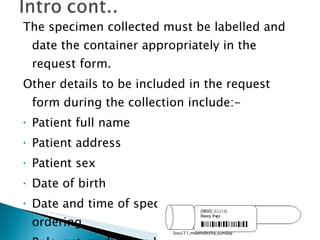
The specimen collected must be labelled and date the container appropriately in the request form. Other details to be included in the request form during the collection include:- Patient full name Patient address Patient sex Date of birth Date and time of specimen collection and ordering. Relevant medication history. lusu'11,mwendesha,sunday
Apply strict aseptic techniques throughout the procedure. Wash hands before and after collection. Collect the specimen at the appropriate phase of disease. Collect and place specimen aseptically in a sterile and appropriate container. Ensure that the outside of the specimen container is clean and uncontaminated. Close the container tightly to prevent leaking of contents. lusu'11,mwendesha,sunday
Some of the specimens collected in microbiology laboratory -blood -Cerebral spinal fluid  -sputum -urine -stool -throat swab -bone marrow -rectal swab -vaginal swab lusu'11,mwendesha,sunday
BLOOD -C ollect blood during early stage of disease . -C ollect blood during paroxysm of fever since the number of bacteria is higher. -Collect  blood in the absence of antibiotic administration for the case of bacterial infections. lusu'11,mwendesha,sunday
Age  Volum e  <2years  2ml 2-5years  8ml 6-10years  12ml >10years  20ml lusu'11,mwendesha,sunday
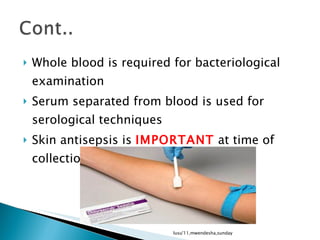
Whole blood is required for bacteriological examination Serum separated from blood is used for serological techniques Skin antisepsis is  IMPORTANT  at time of collection of blood sample. lusu'11,mwendesha,sunday
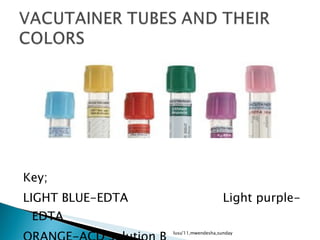
Key; LIGHT BLUE-EDTA  Light purple-EDTA ORANGE-ACD solution B RED- GREEN-heparin PURPLE-EDTA lusu'11,mwendesha,sunday
Essential for diagnosis of any patient with evidence of meninged irritation or affected cerebrum. Three to 5 millilitres are collected and part of it is used for biochemical,immunological and microscopic examination. lusu'11,mwendesha,sunday
Collect CSF before antimicrobial therapy is started. Collect CSF in a screw capped sterile container. Do not delay transport Store at 37C  if delay is in processing is inevitable. lusu'11,mwendesha,sunday
Sputum is processed in the laboratory for aetiological investigation of bacteria and fungal infections of the lower respiratory tract.Eg MTB. During collection -Select a good wide mouthed sputum container. -Give the patient a sputum a container with the laboratory serial number written in it. -Instruct the patient to inhale deeply 2-3 times,cough up deeply from chest and spit in the sputum container.  lusu'11,mwendesha,sunday
lusu'11,mwendesha,sunday
Urine is sterile under normal circumstances. Lower part of urethra and the Genitalia are normally colonized by bacteria which may also cause UTI’s For microbiological examination urine must be collected as a  “clean catch-mid-stream ” specimen. lusu'11,mwendesha,sunday
Collected for diagnosis of acute infection diarhoeas aetiologies. Collected prior adminstration of antimicrobial. Faeces specimens should not contaminate with urine. Do not collect the specimen from the bed pan 1 to 2g is sufficient. Fresh stool specimen should be received 1-2hrs of after passage. Store at 2-8C. Modified cary and Blair medium is recommended as a good transport medium lusu'11,mwendesha,sunday
lusu'11,mwendesha,sunday
Depress the tongue with a tongue blade. Swab the inflammed are of the throat,pharynx or tonsils with a sterile swab taking care to collect the PUS. lusu'11,mwendesha,sunday
COLLECTED by a doctor and a well trained personell. Decontaminate the skin overlaying the site from where specimen is to be collected. Aspirate 1ml or more of bone marrow. Collect in a sterile screw-cap tube. Send to laboratory immediately. lusu'11,mwendesha,sunday
lusu'11,mwendesha,sunday
Insert swab at least 2.5cm beyond the anal sphincter so that it enters the rectum. Rotate it once before withdrawing. Transport in Cary and Blair transport medium lusu'11,mwendesha,sunday
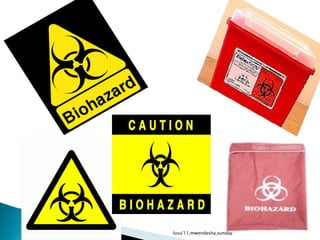
Every specimen collected should be considered as a potentially hazardous. Those delivering,receiving and examining specimens must be informed when a specimen is likely to contain highly infectious . Such specimen should be labelled HIGH RISK SIGNS/SYMBOLS such as a red dot,star or triangle to recognize the dangerment of specimen. lusu'11,mwendesha,sunday
Example of specimens of HIGH RISK include; -sputum for Microbacterium tuberculosis -faecal specimen for vibrio cholerae -fluid from ulcers that contain anthranx bacilli -specimens from patients with suspected HIV infections. lusu'11,mwendesha,sunday
lusu'11,mwendesha,sunday
Specimens require special attention during transportation to the laboratory. Specimens should be placed UPRIGHT. For long distance transport it should be placed in three containers -A primary container which has the specimen and is leak proof. -A secondary container which is durable,water proof and made of metal and plastic with a screw cap. -A tertiary container is ussually made of wood or cardbox lusu'11,mwendesha,sunday
lusu'11,mwendesha,sunday
&quot;http://www.w3c.org/TR/1999/REC-html401-19991224/loose.dtd Cheesebrough M.District Laboratory practice in tropical countries,Volume 2. lusu'11,mwendesha,sunday

specimen collection&handling,Lusubilo2012

  • 1.
    COLLECTION AND HANDLINGOF SPECIMENS FOR MICROBIOLOGICAL AND IMMUNOLOGICAL INVESTIGATIONS: lusu'11,mwendesha,sunday
  • 2.
    Malakbungu Lusubilo SimsokweSunday Mwendesha Mathias lusu'11,mwendesha,sunday
  • 3.
    At the endof this seminar, the following should be understood: Concept of proper specimen collection Handling of collected specimen Proper transportation of specimen Rejection criteria for mishandled specimen. lusu'11,mwendesha,sunday
  • 4.
    Specimen collection isa prior procedure towards a better diagnosis. Collection should be of a quality, that means; right specimen, collected at right time and transported at a right way to the right laboratory. Collection should be from a right patient. Handling ensures right collection and quality of specimen as specified by SOP. lusu'11,mwendesha,sunday
  • 5.
    The specimen collectedmust be labelled and date the container appropriately in the request form. Other details to be included in the request form during the collection include:- Patient full name Patient address Patient sex Date of birth Date and time of specimen collection and ordering. Relevant medication history. lusu'11,mwendesha,sunday
  • 6.
    Apply strict aseptictechniques throughout the procedure. Wash hands before and after collection. Collect the specimen at the appropriate phase of disease. Collect and place specimen aseptically in a sterile and appropriate container. Ensure that the outside of the specimen container is clean and uncontaminated. Close the container tightly to prevent leaking of contents. lusu'11,mwendesha,sunday
  • 7.
    Some of thespecimens collected in microbiology laboratory -blood -Cerebral spinal fluid -sputum -urine -stool -throat swab -bone marrow -rectal swab -vaginal swab lusu'11,mwendesha,sunday
  • 8.
    BLOOD -C ollectblood during early stage of disease . -C ollect blood during paroxysm of fever since the number of bacteria is higher. -Collect blood in the absence of antibiotic administration for the case of bacterial infections. lusu'11,mwendesha,sunday
  • 9.
    Age Volume <2years 2ml 2-5years 8ml 6-10years 12ml >10years 20ml lusu'11,mwendesha,sunday
  • 10.
    Whole blood isrequired for bacteriological examination Serum separated from blood is used for serological techniques Skin antisepsis is IMPORTANT at time of collection of blood sample. lusu'11,mwendesha,sunday
  • 11.
    Key; LIGHT BLUE-EDTA Light purple-EDTA ORANGE-ACD solution B RED- GREEN-heparin PURPLE-EDTA lusu'11,mwendesha,sunday
  • 12.
    Essential for diagnosisof any patient with evidence of meninged irritation or affected cerebrum. Three to 5 millilitres are collected and part of it is used for biochemical,immunological and microscopic examination. lusu'11,mwendesha,sunday
  • 13.
    Collect CSF beforeantimicrobial therapy is started. Collect CSF in a screw capped sterile container. Do not delay transport Store at 37C if delay is in processing is inevitable. lusu'11,mwendesha,sunday
  • 14.
    Sputum is processedin the laboratory for aetiological investigation of bacteria and fungal infections of the lower respiratory tract.Eg MTB. During collection -Select a good wide mouthed sputum container. -Give the patient a sputum a container with the laboratory serial number written in it. -Instruct the patient to inhale deeply 2-3 times,cough up deeply from chest and spit in the sputum container. lusu'11,mwendesha,sunday
  • 15.
  • 16.
    Urine is sterileunder normal circumstances. Lower part of urethra and the Genitalia are normally colonized by bacteria which may also cause UTI’s For microbiological examination urine must be collected as a “clean catch-mid-stream ” specimen. lusu'11,mwendesha,sunday
  • 17.
    Collected for diagnosisof acute infection diarhoeas aetiologies. Collected prior adminstration of antimicrobial. Faeces specimens should not contaminate with urine. Do not collect the specimen from the bed pan 1 to 2g is sufficient. Fresh stool specimen should be received 1-2hrs of after passage. Store at 2-8C. Modified cary and Blair medium is recommended as a good transport medium lusu'11,mwendesha,sunday
  • 18.
  • 19.
    Depress the tonguewith a tongue blade. Swab the inflammed are of the throat,pharynx or tonsils with a sterile swab taking care to collect the PUS. lusu'11,mwendesha,sunday
  • 20.
    COLLECTED by adoctor and a well trained personell. Decontaminate the skin overlaying the site from where specimen is to be collected. Aspirate 1ml or more of bone marrow. Collect in a sterile screw-cap tube. Send to laboratory immediately. lusu'11,mwendesha,sunday
  • 21.
  • 22.
    Insert swab atleast 2.5cm beyond the anal sphincter so that it enters the rectum. Rotate it once before withdrawing. Transport in Cary and Blair transport medium lusu'11,mwendesha,sunday
  • 23.
    Every specimen collectedshould be considered as a potentially hazardous. Those delivering,receiving and examining specimens must be informed when a specimen is likely to contain highly infectious . Such specimen should be labelled HIGH RISK SIGNS/SYMBOLS such as a red dot,star or triangle to recognize the dangerment of specimen. lusu'11,mwendesha,sunday
  • 24.
    Example of specimensof HIGH RISK include; -sputum for Microbacterium tuberculosis -faecal specimen for vibrio cholerae -fluid from ulcers that contain anthranx bacilli -specimens from patients with suspected HIV infections. lusu'11,mwendesha,sunday
  • 25.
  • 26.
    Specimens require specialattention during transportation to the laboratory. Specimens should be placed UPRIGHT. For long distance transport it should be placed in three containers -A primary container which has the specimen and is leak proof. -A secondary container which is durable,water proof and made of metal and plastic with a screw cap. -A tertiary container is ussually made of wood or cardbox lusu'11,mwendesha,sunday
  • 27.
  • 28.
    &quot;http://www.w3c.org/TR/1999/REC-html401-19991224/loose.dtd Cheesebrough M.DistrictLaboratory practice in tropical countries,Volume 2. lusu'11,mwendesha,sunday