MUNI UNIVERSITY
FACULTY HEALTH SCIENCE
DEPARTMENT OF NURSING
BNS II, SEMESTER I
MICROBIOLOGY, NSM 2115
PRACTICAL 2: SPECIMEN MANAGEMENT
INSTRUCTORS:
1. William Edema
2. Cosmas Andruga
Scope of the practical
In this practical, you will:
• Have an overview of specimen management
• Get acquainted with common sample
collection materials.
• Demonstrate blood and urine sample
collection procedures
Objectives
• General consideration for sample collection
• Sample safety considerations
• Rejection criteria
• Collection of different samples from different sites
• Packaging & Transportation
Why Specimen Management?
The Quality of any
Laboratory Test Result is
only as good as the
specimen received in the
laboratory
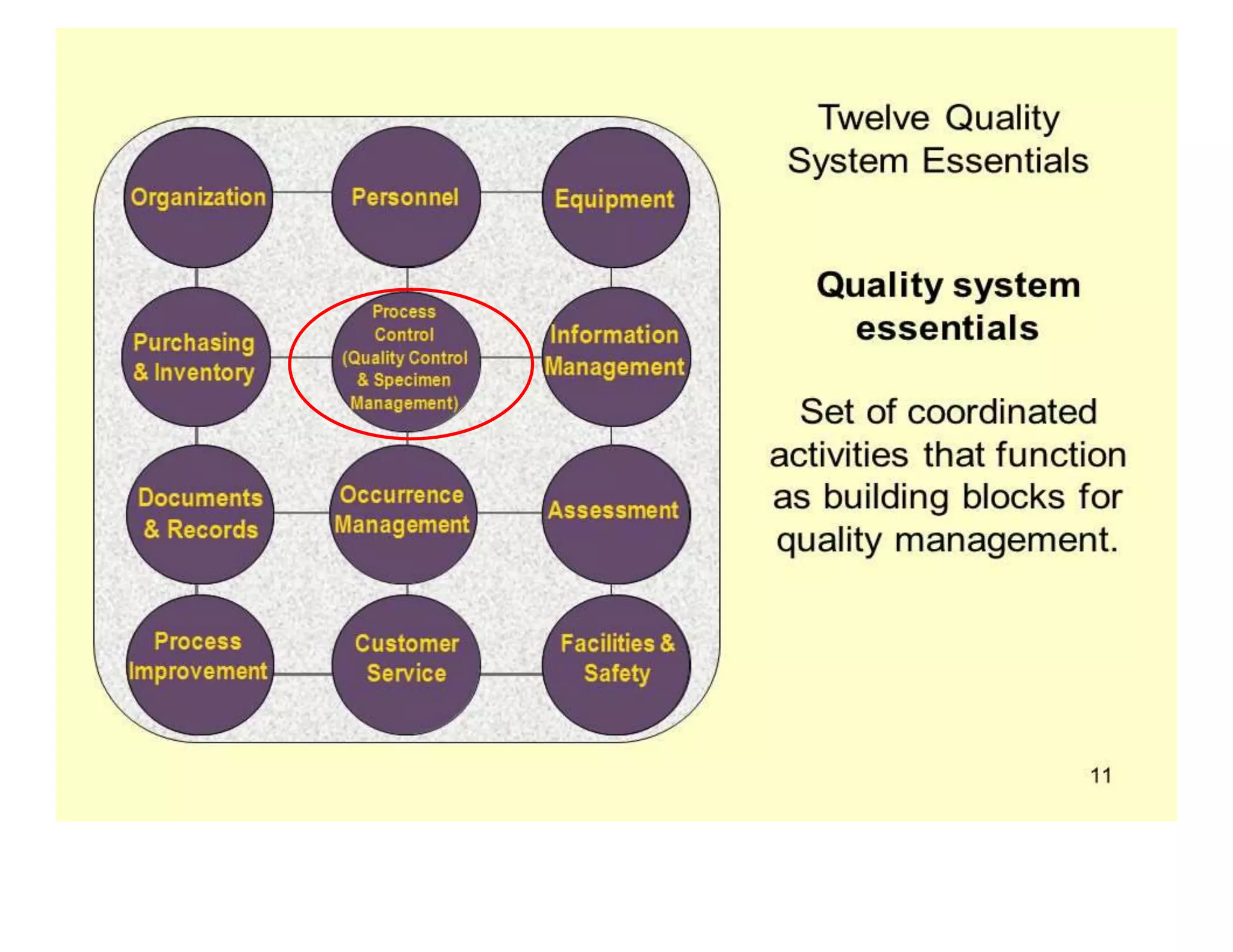
How do we achieve Quality?
Specimen Management
Part of process control, one of the essentials of
a quality management system.
Encompasses:
 Proper instructions to patient
 Patient preparation
 Specimen collection
 Specimen handling
 Specimen transportation
 Specimen storage
 Specimen preparation/processing
Specimen management activities
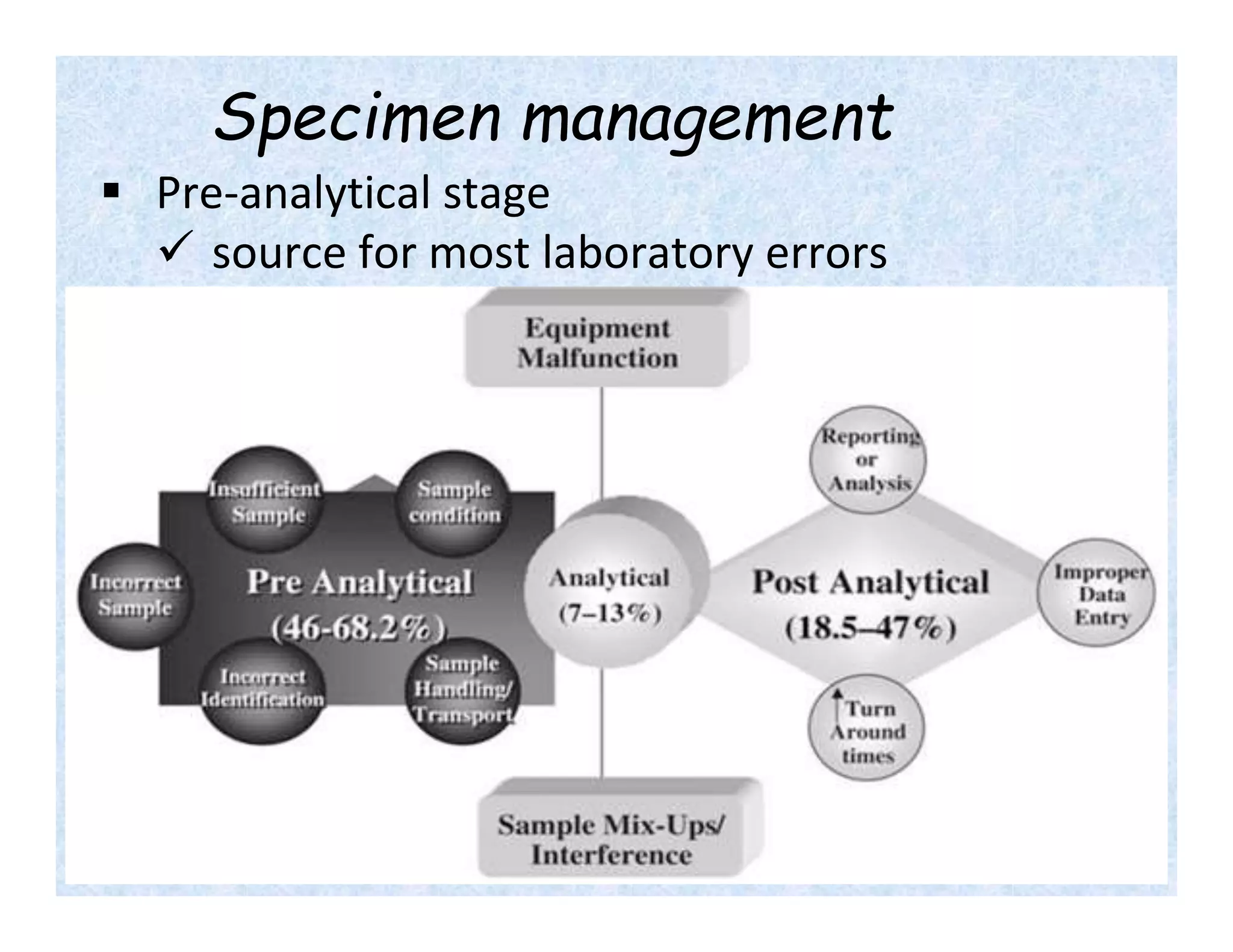
Specimen management
 Pre-analytical stage
 source for most laboratory errors
or
Important questions before
collecting a specimen
• Are you suspecting an Infection ?
• If so what is the Nature of infection,
eg Bacterial, Viral, Mycological
Parasitological
• Which tests are your priority ?
• When to collect the specimen ?
• How to collect the specimen ?
• Am I choosing the correct container ?
• Why to send the specimens promptly,
if not what I should do ?
Specimen management responsibilities
.......improper instruction to patient!!!!
Sample Collection &
transport
General consideration for proper
sample collection
-Every laboratory should provide proper
guidelines for collection of samples
-All diagnostic information depends on
quality of sample recieved
-If sample collection, transport, media are
not proper, it will give false results
General consideration for proper
sample collection
Choice of specimen depends on the type of
infection e.g. blood stream, GIT, urethral tract, etc.
 Aseptic techniques essential
 Anatomic sites and locations
 Adequate amount/volume
 Tissue/body fluids preferred to swabs
 Proper timing for collection
 Accompanied by request form
• Collect sample before administering
antimicrobial agents when possible.
• Collect sample with as little
contamination from indigenous
microbiota as possible to ensure that
the sample will be representative of the
infected site.
• Utilize appropriate collection devices.
Use sterile equipment and aseptic
technique to collect specimens to
prevent introduction of microorganisms
during invasive procedures.
• Clearly label the specimen container
with the patient’s name and
identification number. Always include
date and time of collection and your
initials.
• Collect an adequate amount of
specimen. Inadequate amounts of
specimen may yield false-negative
results.
• Identify the specimen source
and/or specific site correctly so
that proper culture media will be
selected during processing the
laboratory.
• Collect specimens in sturdy, sterile,
screw-cap, leak proof containers with
lids that do not create an aerosol when
opened.
• Collect sample after proper preparation
of area by spirit and povidone iodine
Sample Safety considerations
• Follow universal precaution guidelines. Treat
all specimens as potentially biohazardous.
• Laboratory workers should use appropriate
barrier protection (such as gloves and
laboratory coat or gown) when collecting or
handling specimens. If splashing may occur,
protective eyewear, face masks, and aprons
may be necessary.
• Do not contaminate the external
surface of the collection container
and/or its accompanying paperwork.
• Minimize direct handling of specimens
in transit from the patient to the
laboratory. Use plastic sealable bags
with a separate pouch for the
laboratory requisition orders or
transport carriers (for example, small
buckets with rigid handles).
Label High risk Specimens
• Sputum with
suspected
Tuberculosis
• Fecal samples
suspected with
Cholera, Typhoid,
• Serum when
suspected with
HIV/ HBV/HCV,
infections
Specimen containers
Must be:
 Leak proof
 Shatterproof (unbreakable)
 Sterile (for culture and sensitivity)
Specimen containers
Stool
Sterile universal container with spoon
attached to inside of the screw cap
Urine
Sterile wide
mouthed container
Sputum
Squat wide-mouthed container
Blood
Sterile bottle, large enough to hold 50
ml of pre-added liquid medium and
about 5 – 10 ml of patient’s blood
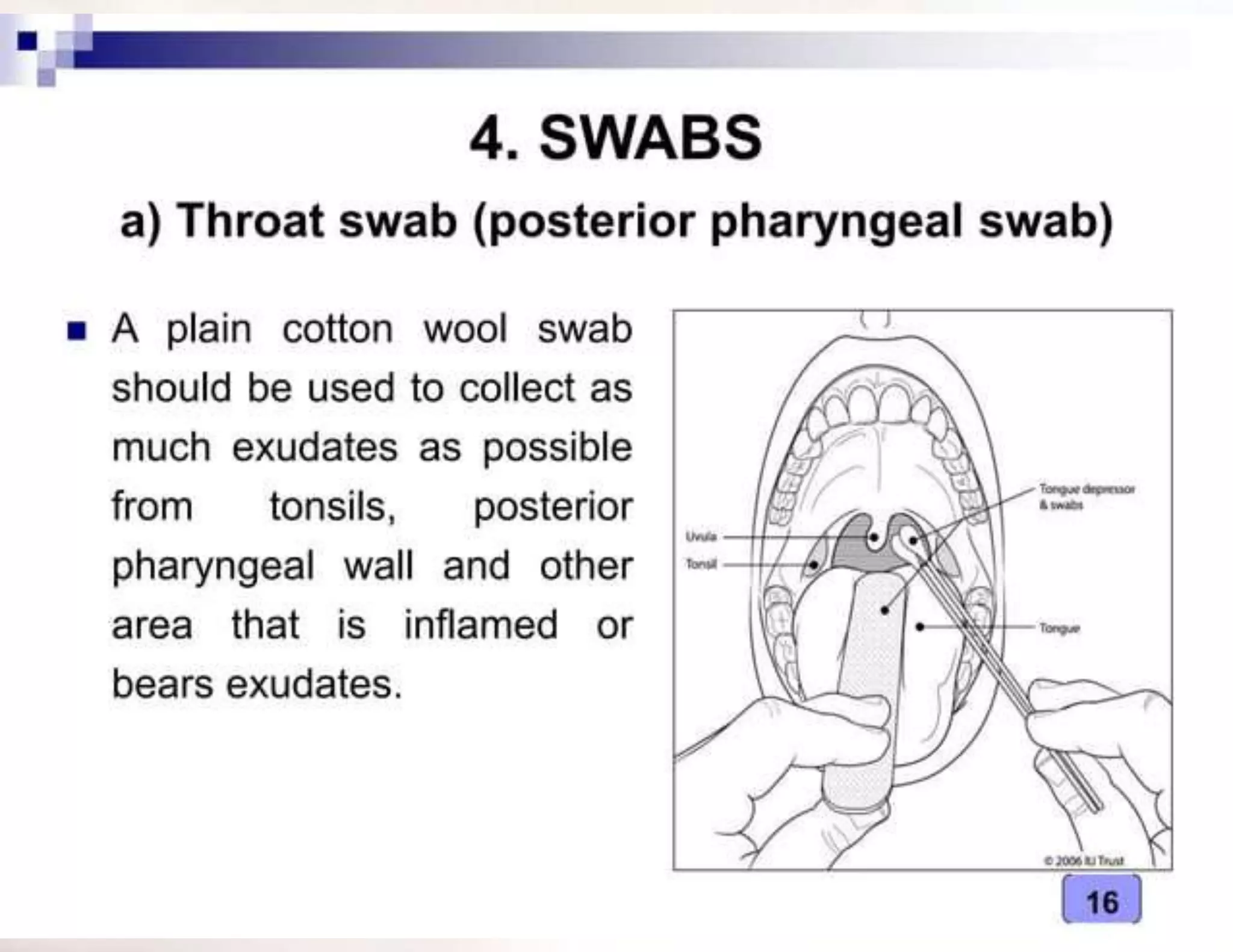
Swabs
A sterile pledget of
absorbent material, usually
cotton wool, mounted on a
thin stick.
A Request form
• Should include:
-Name ,Age ,Sex,Address
-IPD/ OPD No ,ward,
-Time and Date,
-Urgent / Routine,
-Type of specimen
-Investigation needed
-History of patient
-Provisional diagnosis
-Doctor’s name and sign
When to Request Transport
Medium
• When facilities are not available to perform
the desired tests at the place of collection or
laboratory located far away, request the
Diagnostic laboratories to advice on
transportation of specimens, and consider how
to preserve and transport in ideal medium
before it is processed
• Popularly used transport medium are
-Amie 's transport Medium:
Gonococcal infection
-Carry blair medium: stool
-V.R Medium: Stool
Collection of different samples
• Blood
• Urine
• Stool
• Rectal swab
• Sputum
• Csf
• Mycology samples
• Wound swabs
• Water sample
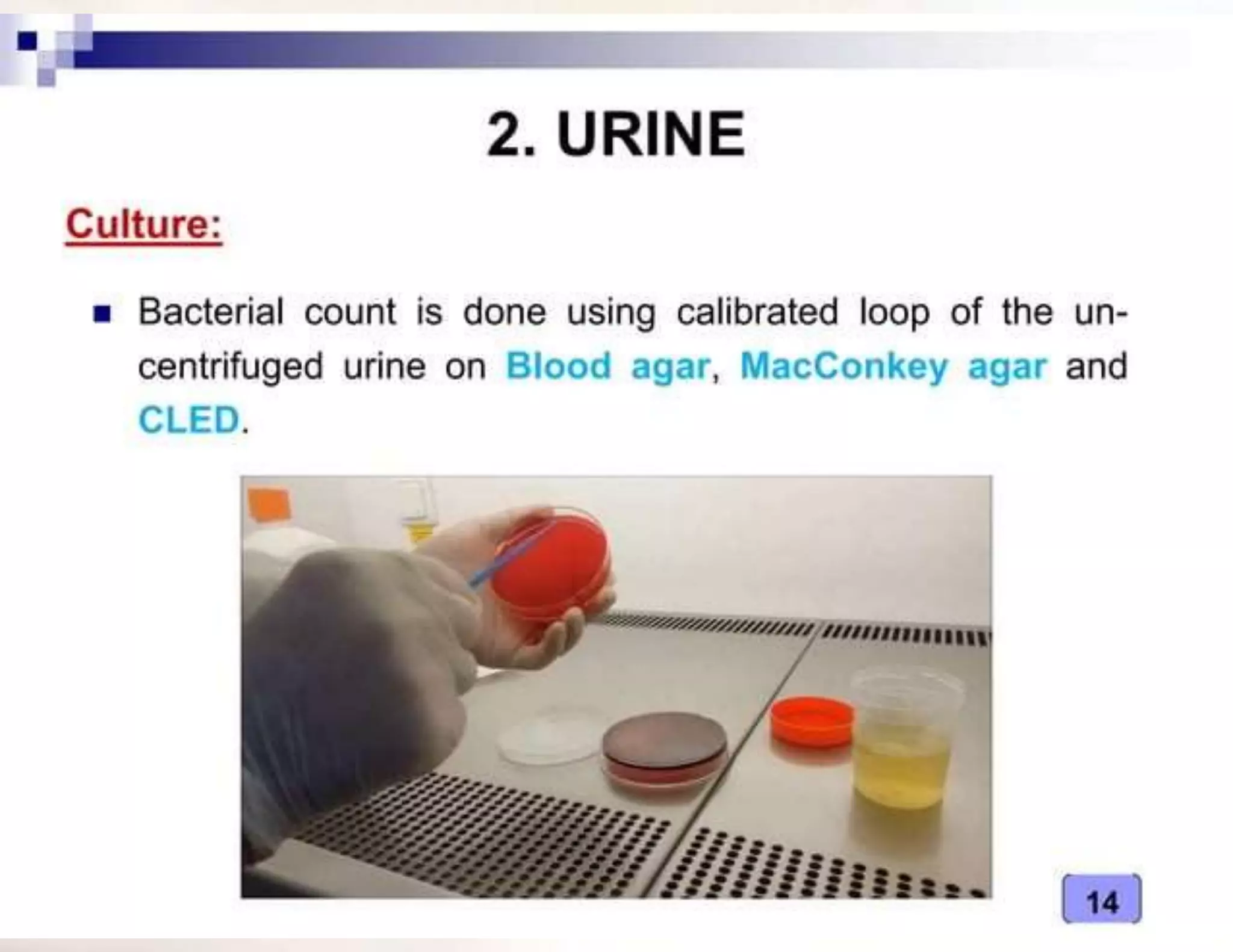
Urine
For females
• Rinse area with soap and water
• Clean it with sterile gauze piece
• With both labia apart allow first few ml of urine
to drain
• Take mid stream clean catch urine
• This will prevent contamination
• Collect it into wide,sterile,leak proof
container
For males
• Wash hands and retract
prepuce before collecting
sample
• If it is not possible to
obtain urine, suprapubic
aspiration or
catheterization may be
used
• Catheterised urine
should not be used
ideally bcz of presence
of bacteria in urethra
• For that first apply
disinfectant over
infusion port and then
collect urine
Blood for serology
• Take proper precaution (gloves)
• Avoid contamination
• Palpate vein
• Apply disinfectant
• Use sterile needle and syringe
• Collect blood into plain
vacutte
• It will coagulate
• Centrifuge it at 1500-2000 rpm
for 5 mins
• Thus serum will be separated
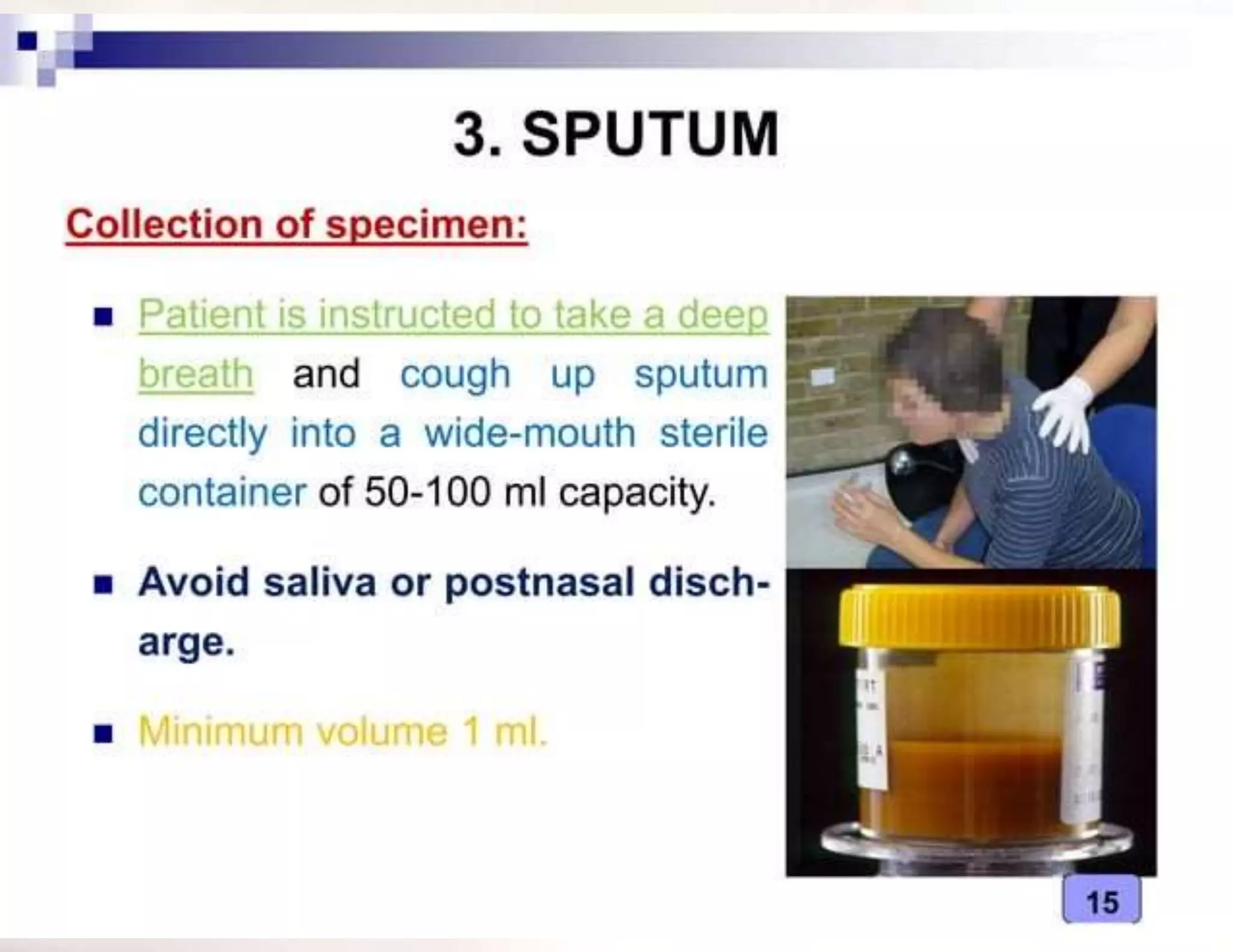
Sputum
• Wide container of 50-100 ml capacity
• For M.TB two samples are collected
• 1st at on the spot and 2nd at next day
morning
• Morning sample is more reliable bcz of
colonization of bacteria in LRT at night
• Before this ask patient to gargle with
normal saline and take deep breath and
then take sample in one bout
• This will prevent contamination
• There should not be saliva or liquid
• If there are >25 epithelial cell per LPF,
sample is rejected as it shows
contamination
• It should be collected before antibiotic
treatment has started
Stool
• Collect it into wide mouth,clean,
sterile,leak proof container
• Label properly
• Min 5 gms is needed if solid stool
• And 2 ml if liquid stool
• It should not be contaminated with
urine
• If not possible to collect it as in
children, elderly, debilitated patients–
collect rectal swab
• Do not referigerate stool
• If delay in transport preserve it into
10% formalin, buffered glycerol saline
Rectal swab
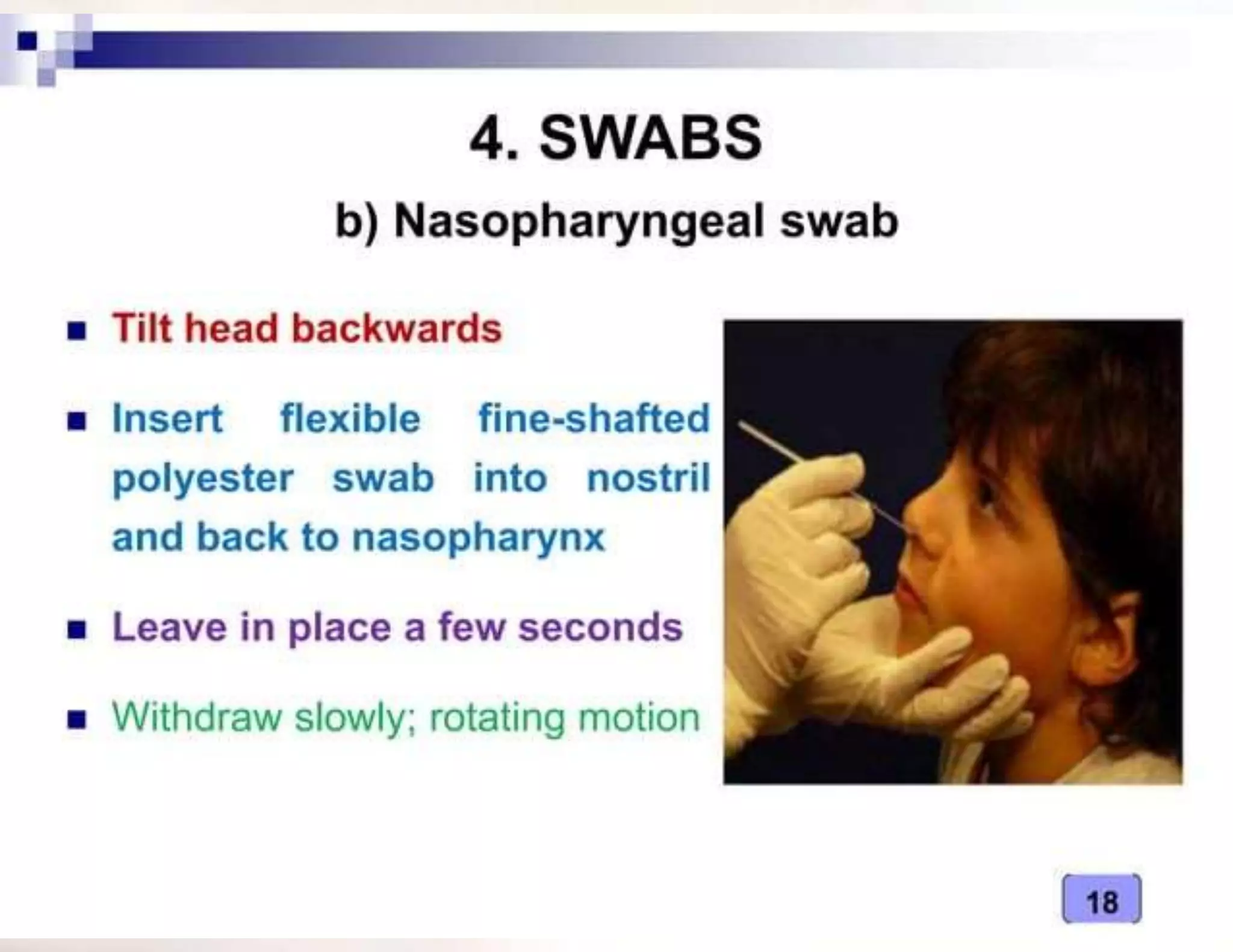
• Take sterile swab
• Apply it in anal canal
• Rotate it for 10 seconds
• Avoid contact with skin
• Seal it directly into swab
container to prevent
contamination
• Transport immediately to lab
, if not possible,preserve at
4-6 degree centigrade
Procedure to collect CSF
• Collect only 3-5 ml into
a labeled sterile
container
• Removal of large volume
of CSF lead to
headache,
• The fluid to be
collected at the rate of
4-5 drops per second.
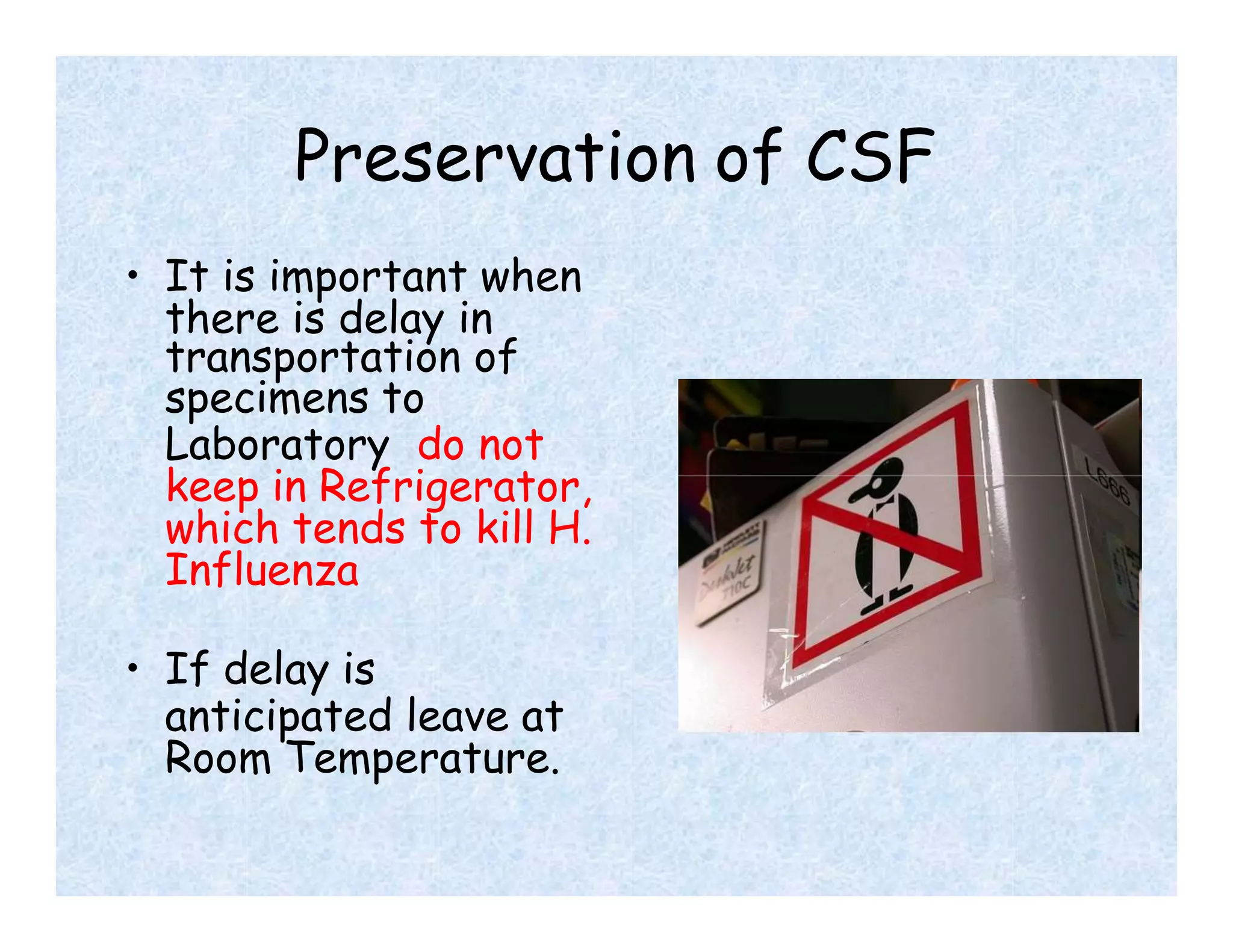
Preservation of CSF
• It is important when
there is delay in
transportation of
specimens to
Laboratory do not
keep in Refrigerator,
which tends to kill H.
Influenza
• If delay is
anticipated leave at
Room Temperature.
MYCOLOGY SAMPLES
• Clean site with 70% ethanol to help eliminate
surface contaminants. Using a scalpel, skin
scrapings should be made from the active
periphery of the lesion. For nails Scrapings
should be deep enough to assure acquiring
recently invaded tissue Submit scrapings in a
sterile Petri dish or container.
• Hair - Use forceps to pluck involved hairs
from the edges of the patches. Submit hair,
including shaft, in a sterile Petri dish or
container.
Water for bacteriology
• Water course or reservoir - collect from a
depth of at least 20 cm
• Dug well - do not allow the bottle to touch
the sides of the well
Specimen Transportation
•Necessary when specimens are collected outside
the testing laboratory
•Collection and transportation system
Sterile, self contained
Transport medium
Aerobic or anaerobic
•Specific environmental conditions for specific
specimens must be provided during transportation
Transportation of samples
• Stool, csf and sputum should be
transported at room temperature, not in
refrigerator
• Urine , swabs, skin samples,water & food
samples are transported asap at room
temp,but if it is not possible, preserve
them in refrigerator
Specimen Transportation
Examples of transport media
Transport media for stool specimens
Transport medium for viral pathogens: Virus Transport Medium (VTM)
Transport medium Use
Carry-Blair All enteric organisms
Stuart All enteric organisms
Amies All enteric organisms
Buffered glycerol saline All enteric organisms except
Vibrio and Campylobacter
Alkaline peptone water Vibrio
V-R fluid Vibrio
Specimen Transportation
Transport medium
A nutrient solution used to
maintain the viability of patient
specimens as they are being
carried the site of collection to
the laboratory for culture
Purpose:
 Keeps suspected
microorganisms alive
 Suppresses growth of
unwanted organisms.
Specimen Packaging
 Biological specimens are classified as dangerous
goods.
 International safety requirements and regulations
should be followed when shipping:
 National transport regulations
 International Civil Aviation Organization (ICAO)
 International Air Transport Association (IATA)
 Rail and road traffic agencies
 Postal services.
Specimen Packaging
Specimen Packaging
• Category A: An infectious substance that if an
exposure occurs when transported is capable of
causing permanent disability, life threatening or
fatal disease in otherwise healthy humans.
 Infectious substance, affecting humans, UN 2814
 Infectious substance affecting animals only, UN 2900
• Category B: An infectious substance which does not
meet the criteria for inclusion in Category A UN 3373
Safe packaging
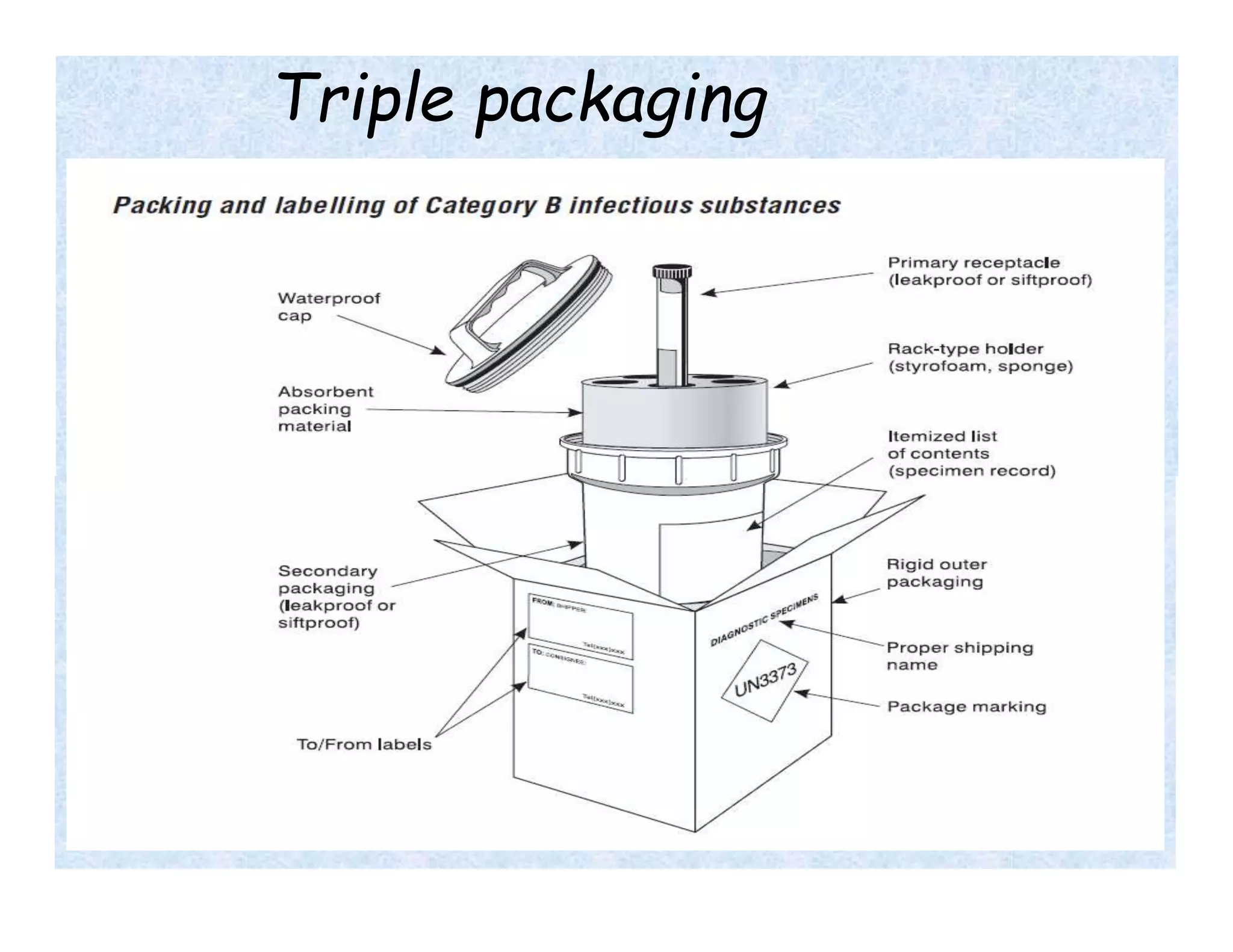
 All categories require triple packaging:
 Leak proof primary container (tube/vial
containing the specimen)
 Leak proof secondary container (holds more
than one primary container) absorbent material
added to absorb fluid in case of breakage.
Cushioning if more than one specimen.
 Rigid tertiary container (strengthened
cardboard or cool box)
Triple packaging
Triple packaging
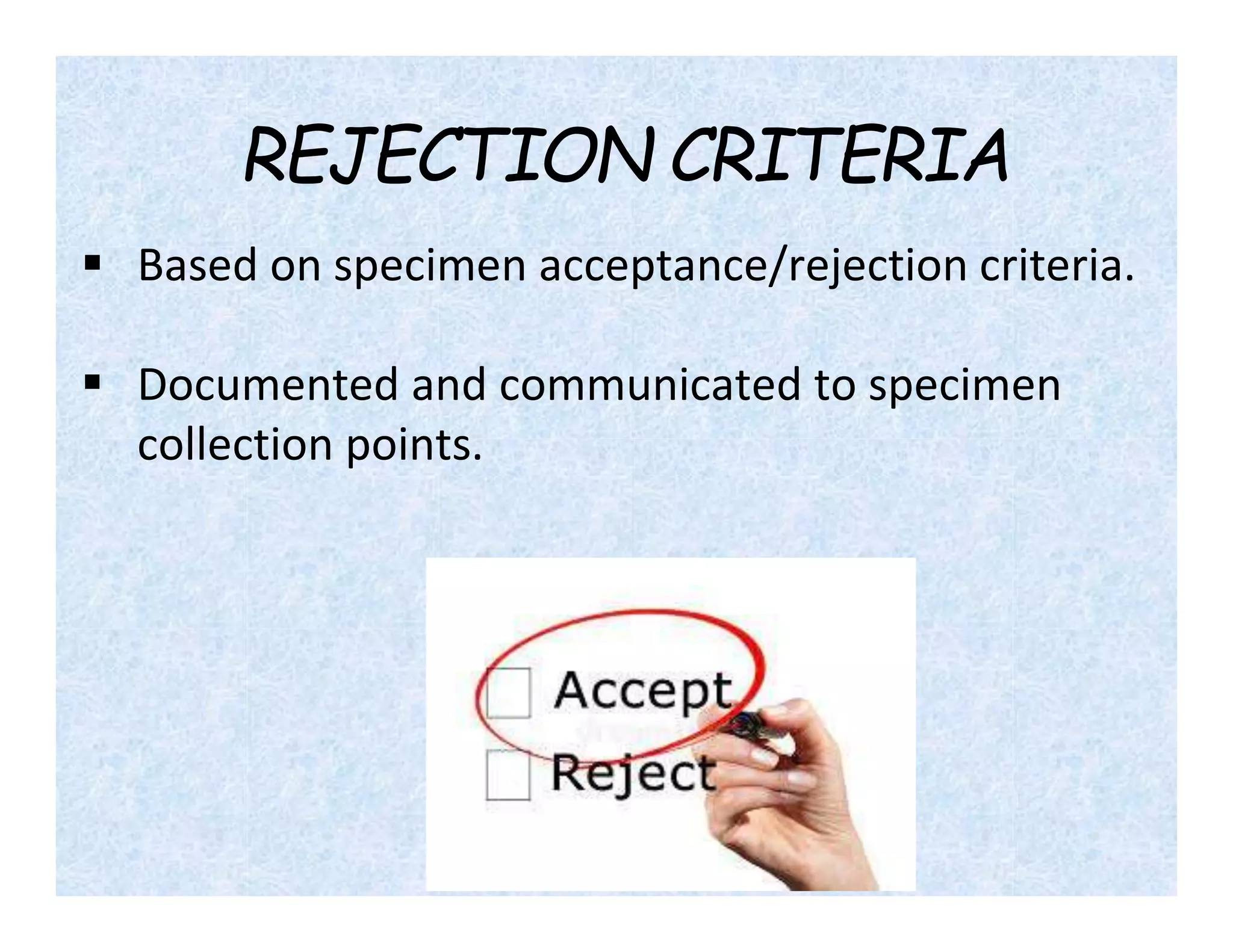
REJECTION CRITERIA
 Based on specimen acceptance/rejection criteria.
 Documented and communicated to specimen
collection points.
REJECTION CRITERIA
• Leaking/broken container
• Insufficient amount
• Improper labelling
• More time lag between collection and
transport
• Improper transport media
• Improper transport temperature
• Hemolysed sample
Thank You

microbiology_sample_collection.pptx

  • 1.
    MUNI UNIVERSITY FACULTY HEALTHSCIENCE DEPARTMENT OF NURSING BNS II, SEMESTER I MICROBIOLOGY, NSM 2115 PRACTICAL 2: SPECIMEN MANAGEMENT INSTRUCTORS: 1. William Edema 2. Cosmas Andruga
  • 2.
    Scope of thepractical In this practical, you will: • Have an overview of specimen management • Get acquainted with common sample collection materials. • Demonstrate blood and urine sample collection procedures
  • 3.
    Objectives • General considerationfor sample collection • Sample safety considerations • Rejection criteria • Collection of different samples from different sites • Packaging & Transportation
  • 4.
    Why Specimen Management? TheQuality of any Laboratory Test Result is only as good as the specimen received in the laboratory
  • 5.
    How do weachieve Quality?
  • 6.
    Specimen Management Part ofprocess control, one of the essentials of a quality management system. Encompasses:  Proper instructions to patient  Patient preparation  Specimen collection  Specimen handling  Specimen transportation  Specimen storage  Specimen preparation/processing
  • 7.
  • 8.
    Specimen management  Pre-analyticalstage  source for most laboratory errors
  • 9.
    or Important questions before collectinga specimen • Are you suspecting an Infection ? • If so what is the Nature of infection, eg Bacterial, Viral, Mycological Parasitological • Which tests are your priority ? • When to collect the specimen ? • How to collect the specimen ? • Am I choosing the correct container ? • Why to send the specimens promptly, if not what I should do ?
  • 10.
  • 11.
  • 12.
  • 13.
  • 14.
    General consideration forproper sample collection -Every laboratory should provide proper guidelines for collection of samples -All diagnostic information depends on quality of sample recieved -If sample collection, transport, media are not proper, it will give false results
  • 15.
    General consideration forproper sample collection Choice of specimen depends on the type of infection e.g. blood stream, GIT, urethral tract, etc.  Aseptic techniques essential  Anatomic sites and locations  Adequate amount/volume  Tissue/body fluids preferred to swabs  Proper timing for collection  Accompanied by request form
  • 16.
    • Collect samplebefore administering antimicrobial agents when possible. • Collect sample with as little contamination from indigenous microbiota as possible to ensure that the sample will be representative of the infected site.
  • 17.
    • Utilize appropriatecollection devices. Use sterile equipment and aseptic technique to collect specimens to prevent introduction of microorganisms during invasive procedures. • Clearly label the specimen container with the patient’s name and identification number. Always include date and time of collection and your initials.
  • 18.
    • Collect anadequate amount of specimen. Inadequate amounts of specimen may yield false-negative results. • Identify the specimen source and/or specific site correctly so that proper culture media will be selected during processing the laboratory.
  • 19.
    • Collect specimensin sturdy, sterile, screw-cap, leak proof containers with lids that do not create an aerosol when opened. • Collect sample after proper preparation of area by spirit and povidone iodine
  • 20.
    Sample Safety considerations •Follow universal precaution guidelines. Treat all specimens as potentially biohazardous. • Laboratory workers should use appropriate barrier protection (such as gloves and laboratory coat or gown) when collecting or handling specimens. If splashing may occur, protective eyewear, face masks, and aprons may be necessary.
  • 21.
    • Do notcontaminate the external surface of the collection container and/or its accompanying paperwork. • Minimize direct handling of specimens in transit from the patient to the laboratory. Use plastic sealable bags with a separate pouch for the laboratory requisition orders or transport carriers (for example, small buckets with rigid handles).
  • 22.
    Label High riskSpecimens • Sputum with suspected Tuberculosis • Fecal samples suspected with Cholera, Typhoid, • Serum when suspected with HIV/ HBV/HCV, infections
  • 23.
    Specimen containers Must be: Leak proof  Shatterproof (unbreakable)  Sterile (for culture and sensitivity)
  • 24.
    Specimen containers Stool Sterile universalcontainer with spoon attached to inside of the screw cap Urine Sterile wide mouthed container Sputum Squat wide-mouthed container Blood Sterile bottle, large enough to hold 50 ml of pre-added liquid medium and about 5 – 10 ml of patient’s blood Swabs A sterile pledget of absorbent material, usually cotton wool, mounted on a thin stick.
  • 25.
    A Request form •Should include: -Name ,Age ,Sex,Address -IPD/ OPD No ,ward, -Time and Date, -Urgent / Routine, -Type of specimen -Investigation needed -History of patient -Provisional diagnosis -Doctor’s name and sign
  • 26.
    When to RequestTransport Medium • When facilities are not available to perform the desired tests at the place of collection or laboratory located far away, request the Diagnostic laboratories to advice on transportation of specimens, and consider how to preserve and transport in ideal medium before it is processed • Popularly used transport medium are -Amie 's transport Medium: Gonococcal infection -Carry blair medium: stool -V.R Medium: Stool
  • 27.
    Collection of differentsamples • Blood • Urine • Stool • Rectal swab • Sputum • Csf • Mycology samples • Wound swabs • Water sample
  • 33.
    Urine For females • Rinsearea with soap and water • Clean it with sterile gauze piece • With both labia apart allow first few ml of urine to drain • Take mid stream clean catch urine • This will prevent contamination • Collect it into wide,sterile,leak proof container For males • Wash hands and retract prepuce before collecting sample
  • 34.
    • If itis not possible to obtain urine, suprapubic aspiration or catheterization may be used • Catheterised urine should not be used ideally bcz of presence of bacteria in urethra • For that first apply disinfectant over infusion port and then collect urine
  • 35.
    Blood for serology •Take proper precaution (gloves) • Avoid contamination • Palpate vein • Apply disinfectant • Use sterile needle and syringe • Collect blood into plain vacutte • It will coagulate • Centrifuge it at 1500-2000 rpm for 5 mins • Thus serum will be separated
  • 37.
    Sputum • Wide containerof 50-100 ml capacity • For M.TB two samples are collected • 1st at on the spot and 2nd at next day morning • Morning sample is more reliable bcz of colonization of bacteria in LRT at night • Before this ask patient to gargle with normal saline and take deep breath and then take sample in one bout
  • 38.
    • This willprevent contamination • There should not be saliva or liquid • If there are >25 epithelial cell per LPF, sample is rejected as it shows contamination • It should be collected before antibiotic treatment has started
  • 48.
    Stool • Collect itinto wide mouth,clean, sterile,leak proof container • Label properly • Min 5 gms is needed if solid stool • And 2 ml if liquid stool • It should not be contaminated with urine • If not possible to collect it as in children, elderly, debilitated patients– collect rectal swab
  • 49.
    • Do notreferigerate stool • If delay in transport preserve it into 10% formalin, buffered glycerol saline
  • 50.
    Rectal swab • Takesterile swab • Apply it in anal canal • Rotate it for 10 seconds • Avoid contact with skin • Seal it directly into swab container to prevent contamination • Transport immediately to lab , if not possible,preserve at 4-6 degree centigrade
  • 53.
    Procedure to collectCSF • Collect only 3-5 ml into a labeled sterile container • Removal of large volume of CSF lead to headache, • The fluid to be collected at the rate of 4-5 drops per second.
  • 55.
    Preservation of CSF •It is important when there is delay in transportation of specimens to Laboratory do not keep in Refrigerator, which tends to kill H. Influenza • If delay is anticipated leave at Room Temperature.
  • 56.
    MYCOLOGY SAMPLES • Cleansite with 70% ethanol to help eliminate surface contaminants. Using a scalpel, skin scrapings should be made from the active periphery of the lesion. For nails Scrapings should be deep enough to assure acquiring recently invaded tissue Submit scrapings in a sterile Petri dish or container. • Hair - Use forceps to pluck involved hairs from the edges of the patches. Submit hair, including shaft, in a sterile Petri dish or container.
  • 57.
    Water for bacteriology •Water course or reservoir - collect from a depth of at least 20 cm • Dug well - do not allow the bottle to touch the sides of the well
  • 58.
    Specimen Transportation •Necessary whenspecimens are collected outside the testing laboratory •Collection and transportation system Sterile, self contained Transport medium Aerobic or anaerobic •Specific environmental conditions for specific specimens must be provided during transportation
  • 59.
    Transportation of samples •Stool, csf and sputum should be transported at room temperature, not in refrigerator • Urine , swabs, skin samples,water & food samples are transported asap at room temp,but if it is not possible, preserve them in refrigerator
  • 60.
    Specimen Transportation Examples oftransport media Transport media for stool specimens Transport medium for viral pathogens: Virus Transport Medium (VTM) Transport medium Use Carry-Blair All enteric organisms Stuart All enteric organisms Amies All enteric organisms Buffered glycerol saline All enteric organisms except Vibrio and Campylobacter Alkaline peptone water Vibrio V-R fluid Vibrio
  • 61.
    Specimen Transportation Transport medium Anutrient solution used to maintain the viability of patient specimens as they are being carried the site of collection to the laboratory for culture Purpose:  Keeps suspected microorganisms alive  Suppresses growth of unwanted organisms.
  • 62.
    Specimen Packaging  Biologicalspecimens are classified as dangerous goods.  International safety requirements and regulations should be followed when shipping:  National transport regulations  International Civil Aviation Organization (ICAO)  International Air Transport Association (IATA)  Rail and road traffic agencies  Postal services.
  • 63.
    Specimen Packaging Specimen Packaging •Category A: An infectious substance that if an exposure occurs when transported is capable of causing permanent disability, life threatening or fatal disease in otherwise healthy humans.  Infectious substance, affecting humans, UN 2814  Infectious substance affecting animals only, UN 2900 • Category B: An infectious substance which does not meet the criteria for inclusion in Category A UN 3373
  • 64.
    Safe packaging  Allcategories require triple packaging:  Leak proof primary container (tube/vial containing the specimen)  Leak proof secondary container (holds more than one primary container) absorbent material added to absorb fluid in case of breakage. Cushioning if more than one specimen.  Rigid tertiary container (strengthened cardboard or cool box)
  • 65.
  • 66.
  • 67.
    REJECTION CRITERIA  Basedon specimen acceptance/rejection criteria.  Documented and communicated to specimen collection points.
  • 68.
    REJECTION CRITERIA • Leaking/brokencontainer • Insufficient amount • Improper labelling • More time lag between collection and transport • Improper transport media • Improper transport temperature • Hemolysed sample
  • 69.