Kundan Gautam
Medical Lab Technologist
Grande International Hospital
Introduction:
 Antoni Van Leeuwenhoek is universally
acknowledged as the father of microbiology.
 Microbiology is the study of microscopic
organisms, such as bacteria, viruses, algae,
helminths , fungi, Actinomycetes and protozoa .
 Microbiology can be divided into various broad
branches i.e Virology , Bacteriology , Mycology
and Parasitology.
Specimen Collection
Introduction:
 Specimen collection requires withdrawing
blood, cerebrospinal fluid, collecting urine,
sputum , pus or swabs from mucosal surfaces.
 Specimen collection is performed using aseptic
techniques to ensure sterility of the sample and
avoid contamination.
What are the steps in specimen
collection?
(a) Collection of the specimen following
aseptic precaution.
(b) Processing the specimen.
(c) Storing and/or transporting the
specimen.
Successful Laboratories
Investigation:
 Collection of adequate and appropriate Specimens.
 Sufficient Documentation and appropriate labelling.
 Biosafety and decontamination.
 Correct packaging and rapid transport.
 Timely interpretation of results.
Common Specimen :
 Blood
 Urine
 Sputum
 Swabs ( Throat , Nasal , Eye , Ear , HVS , Wound ,
Cervical )
 Body Fluid ( CSF , Synovial , Ascitic, Pleural etc )
 Stool
 Pus
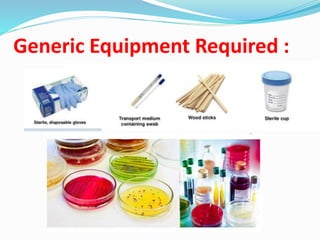
Generic Equipment Required :
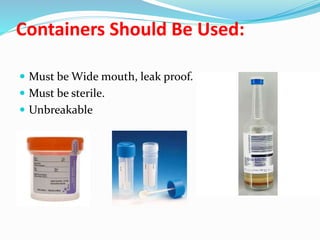
Containers Should Be Used:
 Must be Wide mouth, leak proof.
 Must be sterile.
 Unbreakable
Blood Collection For Culture:
 Venous Blood ( During High Peak Fever) :
 Infant : 0.5-2 ml
 Children : 2-5 ml
 Adults :5-10ml
 The Goal in blood collection is avoiding
contamination during withdraw.
 Request Slip must contain relevant patient
information.
 Send immediately to laboratory with request slip.
Urine Collection For Culture:
 Early morning clean catch, midstream urine is
obtained ascetically.
 Transport to laboratory within one hour or keep at 4- 8
degree celcius to avoid multiplication of bacteria in
urine.
Sputum collection for culture:
 Patient is instructed to take a deep breath and cough
up sputum directly into a wide – mouth sterile
container of 50-100 ml capacity.
 Patients should be instructed not to spill out saliva
during sputum collection.
 Minimum volume 1 ml is needed.
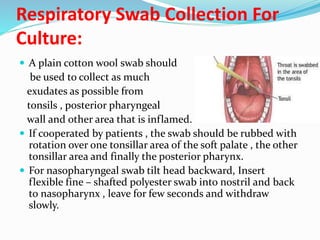
Respiratory Swab Collection For
Culture:
 A plain cotton wool swab should
be used to collect as much
exudates as possible from
tonsils , posterior pharyngeal
wall and other area that is inflamed.
 If cooperated by patients , the swab should be rubbed with
rotation over one tonsillar area of the soft palate , the other
tonsillar area and finally the posterior pharynx.
 For nasopharyngeal swab tilt head backward, Insert
flexible fine – shafted polyester swab into nostril and back
to nasopharynx , leave for few seconds and withdraw
slowly.
Pus Swab:
 Pus should always be aspirated if possible, rather then,
collecting a wound swab.
 After Careful cleaning of the wound site , a swab was
taken from the inner side of wound or the area where
pus is accumulated.
Specimen Preservation and
Storage:
Preservation is also an important factor in the
microbiology department because samples need
to be properly stored in case of delay.
 For urine, boric acid is used be added to preserve
and refrigerated.
 Stool is normally refrigerated for up to 2 hours
for bacterial culture, but it’s used with Cary-Blair
transport media for delays greater than 2 hours.
 Specimens such as urine, stool, viral specimens,
sputum, foreign devices like catheters, as well as
swabs should be stored in the fridge.
 CSF should always be stored at room temperature
because of sensitivity of fastidious organisms to cold
temperature.
 Serum for serological studies may be frozen for one
week at -20 C, and tissues or specimens for long term
storage as well as for PCR purpose should be frozen at
-70 C.
Specimen Requirements and
Rejection Criteria :
 Once you receive a sample in the lab, there are certain
requirements that need to be done before you accept
it.
 For example, you need to make sure you have proper
labelings, such as patient name, hospital number, date
of collection and source.
 Like, some rejected samples include improper
transport temperature, insufficient quantity (QNS),
and unpreserved/leaking specimens.
Standard Precaution:
 All specimen should be presumed to contain
transmissible agents and therefore should be collected
and handled using standard precaution.
 Use of gloves , gown , mask and protective eyewear
when there is a risk of coming in contact with the
specimen.
 In most clinical laboratories , a special area is designed
for processing clinical samples for culture.
Media for Specimens:
 CLED Media For : Urine Culture
 MA , BA , Chocolate For : All Other Specimen ( Sputum , Pus ,
Fluids etc)
 SDA For : Fungus Culture
 MHA For : AST
 Once the sample is permitted, you need to know what media you plate
your sample on.
 There are different media that either support or inhibit the growth of
some organisms.
 For example, non-selective media support the growth of a wide range of
microorganisms. Examples of non-selective media include blood agar
plate.
 Another agar is enriched , this type of media supports the growth of
fastidious organisms and include chocolate agars. ie Lactobacilli
 Differential media are nutritive media that can be differentiated on the
basis of certain growth characteristics. For eg: MacConkey agars inhibit
gram-positive organisms and produce pink colonies for lactose
fermenters.
Specimen Inoculation :
 Inoculation is transfer of a bacterial sample onto a
growth media for the purpose of growing the
organisms.
 Before inoculating a plate of culture medium , check if
the surface of the medium is dry , If not the plate is
kept inverted for 10-15 min.
 Media to be inoculated should be labelled with
patient name or lab no. and Specimen.
 A sterile loopful of specimen is taken and inoculate on
respective media.
 Temperature: 35ºC -37ºC
 Atmosphere: Blood Agar plate in carbon dioxide
enriched atmosphere (e.g. 5% CO2 incubator or in a
candle jar) ie. Clostridium , Actinomyces
Fusobacterium , and MacConkey agar and CLED agar
plate in normal incubator.
 Time: Up to 48 hours (observe the plate after 24
hours of incubation, if growth is seen do further
processing AST and Biochemical test, if not Re-
incubate the plates with little or no growth for another
24 hour.)
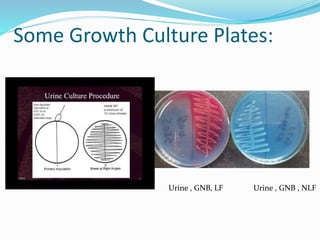
Some Growth Culture Plates:
Urine , GNB, LF Urine , GNB , NLF
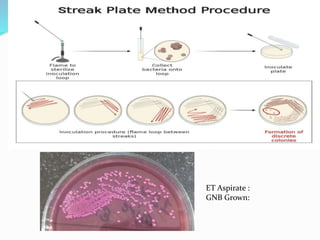
ET Aspirate :
GNB Grown:
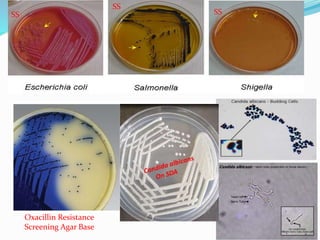
Oxacillin Resistance
Screening Agar Base
SS
SS
SS
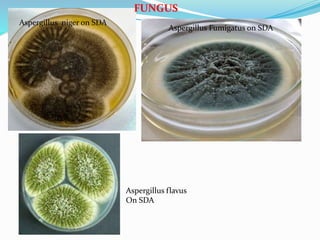
FUNGUS
Aspergillus niger on SDA
Aspergillus Fumigatus on SDA
Aspergillus flavus
On SDA
Collection and Processing of Microbiological Specimen Slides.pptx

Collection and Processing of Microbiological Specimen Slides.pptx

  • 1.
    Kundan Gautam Medical LabTechnologist Grande International Hospital
  • 2.
    Introduction:  Antoni VanLeeuwenhoek is universally acknowledged as the father of microbiology.  Microbiology is the study of microscopic organisms, such as bacteria, viruses, algae, helminths , fungi, Actinomycetes and protozoa .  Microbiology can be divided into various broad branches i.e Virology , Bacteriology , Mycology and Parasitology.
  • 3.
    Specimen Collection Introduction:  Specimencollection requires withdrawing blood, cerebrospinal fluid, collecting urine, sputum , pus or swabs from mucosal surfaces.  Specimen collection is performed using aseptic techniques to ensure sterility of the sample and avoid contamination.
  • 4.
    What are thesteps in specimen collection? (a) Collection of the specimen following aseptic precaution. (b) Processing the specimen. (c) Storing and/or transporting the specimen.
  • 5.
    Successful Laboratories Investigation:  Collectionof adequate and appropriate Specimens.  Sufficient Documentation and appropriate labelling.  Biosafety and decontamination.  Correct packaging and rapid transport.  Timely interpretation of results.
  • 6.
    Common Specimen : Blood  Urine  Sputum  Swabs ( Throat , Nasal , Eye , Ear , HVS , Wound , Cervical )  Body Fluid ( CSF , Synovial , Ascitic, Pleural etc )  Stool  Pus
  • 7.
  • 8.
    Containers Should BeUsed:  Must be Wide mouth, leak proof.  Must be sterile.  Unbreakable
  • 9.
    Blood Collection ForCulture:  Venous Blood ( During High Peak Fever) :  Infant : 0.5-2 ml  Children : 2-5 ml  Adults :5-10ml  The Goal in blood collection is avoiding contamination during withdraw.  Request Slip must contain relevant patient information.  Send immediately to laboratory with request slip.
  • 10.
    Urine Collection ForCulture:  Early morning clean catch, midstream urine is obtained ascetically.  Transport to laboratory within one hour or keep at 4- 8 degree celcius to avoid multiplication of bacteria in urine.
  • 11.
    Sputum collection forculture:  Patient is instructed to take a deep breath and cough up sputum directly into a wide – mouth sterile container of 50-100 ml capacity.  Patients should be instructed not to spill out saliva during sputum collection.  Minimum volume 1 ml is needed.
  • 12.
    Respiratory Swab CollectionFor Culture:  A plain cotton wool swab should be used to collect as much exudates as possible from tonsils , posterior pharyngeal wall and other area that is inflamed.  If cooperated by patients , the swab should be rubbed with rotation over one tonsillar area of the soft palate , the other tonsillar area and finally the posterior pharynx.  For nasopharyngeal swab tilt head backward, Insert flexible fine – shafted polyester swab into nostril and back to nasopharynx , leave for few seconds and withdraw slowly.
  • 13.
    Pus Swab:  Pusshould always be aspirated if possible, rather then, collecting a wound swab.  After Careful cleaning of the wound site , a swab was taken from the inner side of wound or the area where pus is accumulated.
  • 14.
    Specimen Preservation and Storage: Preservationis also an important factor in the microbiology department because samples need to be properly stored in case of delay.  For urine, boric acid is used be added to preserve and refrigerated.  Stool is normally refrigerated for up to 2 hours for bacterial culture, but it’s used with Cary-Blair transport media for delays greater than 2 hours.  Specimens such as urine, stool, viral specimens, sputum, foreign devices like catheters, as well as swabs should be stored in the fridge.
  • 15.
     CSF shouldalways be stored at room temperature because of sensitivity of fastidious organisms to cold temperature.  Serum for serological studies may be frozen for one week at -20 C, and tissues or specimens for long term storage as well as for PCR purpose should be frozen at -70 C.
  • 16.
    Specimen Requirements and RejectionCriteria :  Once you receive a sample in the lab, there are certain requirements that need to be done before you accept it.  For example, you need to make sure you have proper labelings, such as patient name, hospital number, date of collection and source.  Like, some rejected samples include improper transport temperature, insufficient quantity (QNS), and unpreserved/leaking specimens.
  • 17.
    Standard Precaution:  Allspecimen should be presumed to contain transmissible agents and therefore should be collected and handled using standard precaution.  Use of gloves , gown , mask and protective eyewear when there is a risk of coming in contact with the specimen.  In most clinical laboratories , a special area is designed for processing clinical samples for culture.
  • 18.
    Media for Specimens: CLED Media For : Urine Culture  MA , BA , Chocolate For : All Other Specimen ( Sputum , Pus , Fluids etc)  SDA For : Fungus Culture  MHA For : AST  Once the sample is permitted, you need to know what media you plate your sample on.  There are different media that either support or inhibit the growth of some organisms.  For example, non-selective media support the growth of a wide range of microorganisms. Examples of non-selective media include blood agar plate.  Another agar is enriched , this type of media supports the growth of fastidious organisms and include chocolate agars. ie Lactobacilli  Differential media are nutritive media that can be differentiated on the basis of certain growth characteristics. For eg: MacConkey agars inhibit gram-positive organisms and produce pink colonies for lactose fermenters.
  • 19.
    Specimen Inoculation : Inoculation is transfer of a bacterial sample onto a growth media for the purpose of growing the organisms.  Before inoculating a plate of culture medium , check if the surface of the medium is dry , If not the plate is kept inverted for 10-15 min.  Media to be inoculated should be labelled with patient name or lab no. and Specimen.  A sterile loopful of specimen is taken and inoculate on respective media.
  • 20.
     Temperature: 35ºC-37ºC  Atmosphere: Blood Agar plate in carbon dioxide enriched atmosphere (e.g. 5% CO2 incubator or in a candle jar) ie. Clostridium , Actinomyces Fusobacterium , and MacConkey agar and CLED agar plate in normal incubator.  Time: Up to 48 hours (observe the plate after 24 hours of incubation, if growth is seen do further processing AST and Biochemical test, if not Re- incubate the plates with little or no growth for another 24 hour.)
  • 21.
    Some Growth CulturePlates: Urine , GNB, LF Urine , GNB , NLF
  • 22.
  • 23.
  • 24.
    FUNGUS Aspergillus niger onSDA Aspergillus Fumigatus on SDA Aspergillus flavus On SDA