Collection, handling and
transportation of laboratory
specimens
1
Definition
 Definition of specimen
o Specimen is a part taken to determine the
character of the whole.
 Safety during collection, processing &
transportation
o Masks (e.g. sputum)
o Gloves
o Protective eye ware (goggles)
o Protective clothing (gown) 2
Specimen collection…..
 Several different kinds of specimens are used routinely
in the clinical laboratory.
 These are:
 Blood
 Urine
 Stool
 Sputum
 Pus (discharge)
3
Specimen collection…..
Throat, eye, ear, vaginal swabs
 Skin snips
 Body fluids (pleural, pericardial, peritoneal, synovial,
and cerebro spinal)
Hair, nail, cutaneous tissue
Biopsy tissue from an organ.
4
Basic Concept in Specimen Collection
1. Site selection
a. Clinician
• Should locate right anatomic site & select
appropriate tests & specimens based on:
• - Physical examination (sign & symptoms)
 - Radiological examination
b. Laboratory personnel
• Should collect specimens from actual infection site
with little external contamination by using :
Aseptic technique
• To prevent contamination of specimen &
• To protect the patient from infection
Sterile container
• . Should collect specimens from right site
5
Basic Concept in Specimen Collection …..
 Sites of Infection where the Specimen is Likely to
Become Contaminated During Collection
o Lower respiratory tract ----- Oro-pharynx
o Bladder ……………..… Urethra
o Cervix …………. Vagina
6
Basic Concept in Specimen Collection
…..
 Approaches to Avoid contamination :
o Careful patient education
 There are occasions when patients participate
actively in specimen collection (e.g. sputum, urine).
 Therefore, they must be given full instructions &
cooperation by the care giver.
o Educating the clinicians
 How to collect & transport specimens through
written document & make available at every patient
care unit.
7
Specimen collection…..
2. Volume of specimens
 Collecting & processing too little specimen will give us
lower sensitivity.
 Collecting adequate volume:
o enhance recovery of the pathogen.
o enable to perform all procedures required or to
permit complete examination.
8
Specimen collection…..
 For example;
o Sputum: 5 -10 ml for mycobacterium examination.
o Blood:
 Serology: minimum 2 - 3 ml.
 Culture: 10 – 20 ml (adult) & 1-5ml (infant).
o CSF: 5 – 10 ml.
9
Specimen collection…..
3. Time of collection
 Provide best chance of recovery of the causative
agent .
Sputum & urine
 early in the morning soon after the patient
awaken.
Blood
 when the patients temperature begins to rise. 10
Specimen collection…..
4. Collect specimens before the administration of
antimicrobial
 Because antimicrobials limits recovery of pathogens.
5. Age of specimens
o Age of the specimen directly influences the recovery
of protozoan organism.
11
Specimen collection…..
6. Stage of the disease at which the specimen is
collected
o Enteric pathogens are present in great numbers
during the acute or diarrheal stage of intestinal
infection.
12
Specimen collection…..
7. Labeling
 Make sure that you are collecting/drawing the right
person first.
 Then label with:
o Patient name
o Unique identification number
o Patient demographic information
o Specimen collection date
o Specimen collection location
o Diagnostic test results
13
Specimen collection…..
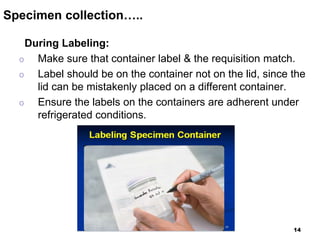
 During Labeling:
o Make sure that container label & the requisition match.
o Label should be on the container not on the lid, since the
lid can be mistakenly placed on a different container.
o Ensure the labels on the containers are adherent under
refrigerated conditions.
14
3.3 General Rejection Criteria
1. Unlabelled Specimens
o Common specimen like blood, urine, swabs, sputum,
stool, can be easily recollected.
o less common specimens like CSF, fluids, tissues,
etc. are more difficult to recollect.
o Call the person who collected it for the identification of
the specimen.
o If he is unable to identify the specimen, the ordering
physician will be notified. 15
General Rejection Criteria……
2. Incorrectly labeled (mislabeled) specimens
o Use same criteria as for Unlabelled Specimens.
3. Incorrect container or Preservative
o Specimens received in an incorrect container, or
without appropriate preservative, will require
recollection.
o So the patient will be contacted to arrange for
recollection of the specimen. 16
General Rejection Criteria……
4. Insufficient specimen for procedure
o If insufficient, recollect (urine, stool, sputum, blood,
etc.)
o If the specimen is not recollectable (CSF, fluids, etc.),
the physician will be contacted to establish a priority
order of tests.
17
General Rejection Criteria……
5. Unsuitable Specimen for Procedures
 Specimens which are unsuitable for the procedure
requested saliva for sputum test or specimen too long
for a valid result.
18
Specimen Transportation
 Required when:
o Specimens are to be sent to referral laboratory.
o For teaching purpose.
o For Quality assurance.
o Unavailability of trained personnel around the
collection site.
o Specimens are collected in the field.
o Lack of time to examine within the recommended time
due to laboratory workload. 19
Specimen Transportation......
 This transportation is made by using different
preservation methods
 Physical
 chemical.
- chemical method of preservation is most
common.
20
Specimen Transportation......
 Purpose of preservation :
o Maintain protozoan morphology
o Prevent development of helminthes eggs & larvae
o Maintain viability of microorganisms
o Prevent overgrowth of normal flora
o Prevent instability of solutes & degeneration of
sediments (e.g. urine)
21
Specimen Transportation......
 Specimen packaging
o Screw container tops on firmly
o Wrap in absorbent wadding to absorb any fluid
leakage
o Place in a self-sealing plastic bag
22
Specimen Transportation......
o Place the request form into the secondary pocket of
the specimen bag.
o Hazard labels with internationally accepted biohazard
label (HIGH RISK).
o Pack specimens in strong cardboard box or a
grooved polystyrene box.
o Seal with self-adhesive tape.
23
Specimen Transportation......
 Specimen Storage (Prior to Dispatch)
o Urine can be stored at either freezer or refrigerator at
+4 oc.
o Blood samples should be kept at +4 oc.
o Serum & plasma can be stored either frozen or at
+4oc.
24
Specimen Transportation......
Note: If they are frozen, they should not be unfrozen until
dispatch to the laboratory.
 Transport
o Urgent requests within normal laboratory hours.
o Transport with labelled, tightly fitted, leak proof
container.
o Wet ice or ice pack should be used.
25

Specimen collection and transportation.ppt

  • 1.
    Collection, handling and transportationof laboratory specimens 1
  • 2.
    Definition  Definition ofspecimen o Specimen is a part taken to determine the character of the whole.  Safety during collection, processing & transportation o Masks (e.g. sputum) o Gloves o Protective eye ware (goggles) o Protective clothing (gown) 2
  • 3.
    Specimen collection…..  Severaldifferent kinds of specimens are used routinely in the clinical laboratory.  These are:  Blood  Urine  Stool  Sputum  Pus (discharge) 3
  • 4.
    Specimen collection….. Throat, eye,ear, vaginal swabs  Skin snips  Body fluids (pleural, pericardial, peritoneal, synovial, and cerebro spinal) Hair, nail, cutaneous tissue Biopsy tissue from an organ. 4
  • 5.
    Basic Concept inSpecimen Collection 1. Site selection a. Clinician • Should locate right anatomic site & select appropriate tests & specimens based on: • - Physical examination (sign & symptoms)  - Radiological examination b. Laboratory personnel • Should collect specimens from actual infection site with little external contamination by using : Aseptic technique • To prevent contamination of specimen & • To protect the patient from infection Sterile container • . Should collect specimens from right site 5
  • 6.
    Basic Concept inSpecimen Collection …..  Sites of Infection where the Specimen is Likely to Become Contaminated During Collection o Lower respiratory tract ----- Oro-pharynx o Bladder ……………..… Urethra o Cervix …………. Vagina 6
  • 7.
    Basic Concept inSpecimen Collection …..  Approaches to Avoid contamination : o Careful patient education  There are occasions when patients participate actively in specimen collection (e.g. sputum, urine).  Therefore, they must be given full instructions & cooperation by the care giver. o Educating the clinicians  How to collect & transport specimens through written document & make available at every patient care unit. 7
  • 8.
    Specimen collection….. 2. Volumeof specimens  Collecting & processing too little specimen will give us lower sensitivity.  Collecting adequate volume: o enhance recovery of the pathogen. o enable to perform all procedures required or to permit complete examination. 8
  • 9.
    Specimen collection…..  Forexample; o Sputum: 5 -10 ml for mycobacterium examination. o Blood:  Serology: minimum 2 - 3 ml.  Culture: 10 – 20 ml (adult) & 1-5ml (infant). o CSF: 5 – 10 ml. 9
  • 10.
    Specimen collection….. 3. Timeof collection  Provide best chance of recovery of the causative agent . Sputum & urine  early in the morning soon after the patient awaken. Blood  when the patients temperature begins to rise. 10
  • 11.
    Specimen collection….. 4. Collectspecimens before the administration of antimicrobial  Because antimicrobials limits recovery of pathogens. 5. Age of specimens o Age of the specimen directly influences the recovery of protozoan organism. 11
  • 12.
    Specimen collection….. 6. Stageof the disease at which the specimen is collected o Enteric pathogens are present in great numbers during the acute or diarrheal stage of intestinal infection. 12
  • 13.
    Specimen collection….. 7. Labeling Make sure that you are collecting/drawing the right person first.  Then label with: o Patient name o Unique identification number o Patient demographic information o Specimen collection date o Specimen collection location o Diagnostic test results 13
  • 14.
    Specimen collection…..  DuringLabeling: o Make sure that container label & the requisition match. o Label should be on the container not on the lid, since the lid can be mistakenly placed on a different container. o Ensure the labels on the containers are adherent under refrigerated conditions. 14
  • 15.
    3.3 General RejectionCriteria 1. Unlabelled Specimens o Common specimen like blood, urine, swabs, sputum, stool, can be easily recollected. o less common specimens like CSF, fluids, tissues, etc. are more difficult to recollect. o Call the person who collected it for the identification of the specimen. o If he is unable to identify the specimen, the ordering physician will be notified. 15
  • 16.
    General Rejection Criteria…… 2.Incorrectly labeled (mislabeled) specimens o Use same criteria as for Unlabelled Specimens. 3. Incorrect container or Preservative o Specimens received in an incorrect container, or without appropriate preservative, will require recollection. o So the patient will be contacted to arrange for recollection of the specimen. 16
  • 17.
    General Rejection Criteria…… 4.Insufficient specimen for procedure o If insufficient, recollect (urine, stool, sputum, blood, etc.) o If the specimen is not recollectable (CSF, fluids, etc.), the physician will be contacted to establish a priority order of tests. 17
  • 18.
    General Rejection Criteria…… 5.Unsuitable Specimen for Procedures  Specimens which are unsuitable for the procedure requested saliva for sputum test or specimen too long for a valid result. 18
  • 19.
    Specimen Transportation  Requiredwhen: o Specimens are to be sent to referral laboratory. o For teaching purpose. o For Quality assurance. o Unavailability of trained personnel around the collection site. o Specimens are collected in the field. o Lack of time to examine within the recommended time due to laboratory workload. 19
  • 20.
    Specimen Transportation......  Thistransportation is made by using different preservation methods  Physical  chemical. - chemical method of preservation is most common. 20
  • 21.
    Specimen Transportation......  Purposeof preservation : o Maintain protozoan morphology o Prevent development of helminthes eggs & larvae o Maintain viability of microorganisms o Prevent overgrowth of normal flora o Prevent instability of solutes & degeneration of sediments (e.g. urine) 21
  • 22.
    Specimen Transportation......  Specimenpackaging o Screw container tops on firmly o Wrap in absorbent wadding to absorb any fluid leakage o Place in a self-sealing plastic bag 22
  • 23.
    Specimen Transportation...... o Placethe request form into the secondary pocket of the specimen bag. o Hazard labels with internationally accepted biohazard label (HIGH RISK). o Pack specimens in strong cardboard box or a grooved polystyrene box. o Seal with self-adhesive tape. 23
  • 24.
    Specimen Transportation......  SpecimenStorage (Prior to Dispatch) o Urine can be stored at either freezer or refrigerator at +4 oc. o Blood samples should be kept at +4 oc. o Serum & plasma can be stored either frozen or at +4oc. 24
  • 25.
    Specimen Transportation...... Note: Ifthey are frozen, they should not be unfrozen until dispatch to the laboratory.  Transport o Urgent requests within normal laboratory hours. o Transport with labelled, tightly fitted, leak proof container. o Wet ice or ice pack should be used. 25
Editor's Notes