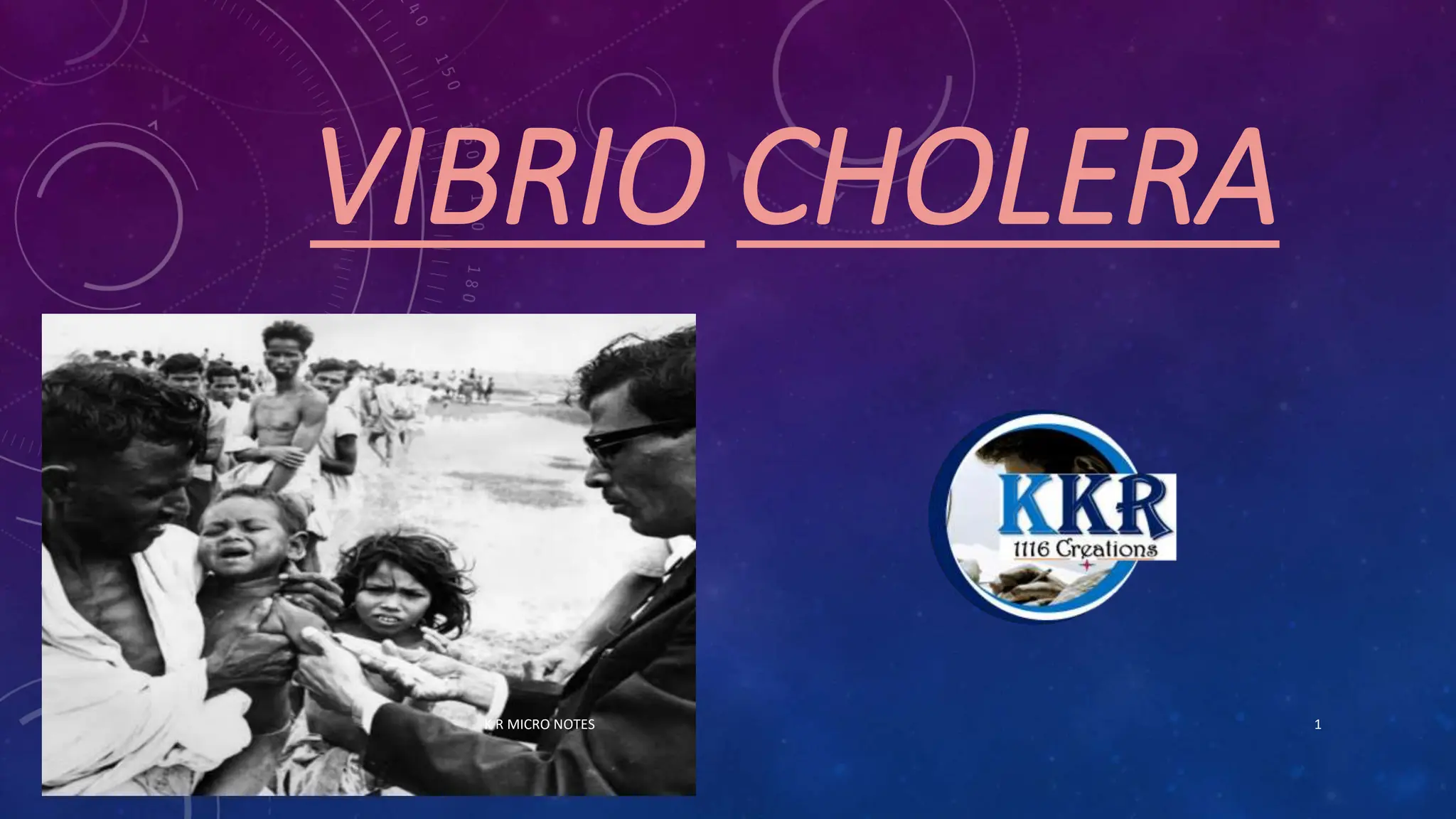
VIBRIO CHOLERA
K R MICRO NOTES 1
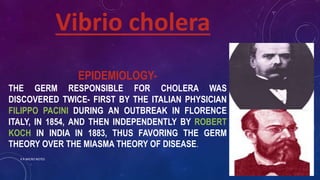
EPIDEMIOLOGY-
THE GERM RESPONSIBLE FOR CHOLERA WAS
DISCOVERED TWICE- FIRST BY THE ITALIAN PHYSICIAN
FILIPPO PACINI DURING AN OUTBREAK IN FLORENCE
ITALY, IN 1854, AND THEN INDEPENDENTLY BY ROBERT
KOCH IN INDIA IN 1883, THUS FAVORING THE GERM
THEORY OVER THE MIASMA THEORY OF DISEASE.
Vibrio cholera
K R MICRO NOTES 2
TAXONOMY-
CLASS : GAMMA PROTEOBACTERIA
ORDER: VIBRIONALES
FAMILY: VIBRIONACEAE
GENUS: VIBRIO
SPECIES: V.CHOLERAE
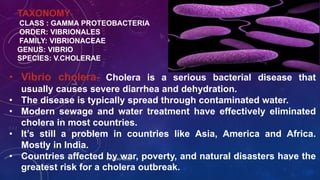
• Vibrio cholera- Cholera is a serious bacterial disease that
usually causes severe diarrhea and dehydration.
• The disease is typically spread through contaminated water.
• Modern sewage and water treatment have effectively eliminated
cholera in most countries.
• It’s still a problem in countries like Asia, America and Africa.
Mostly in India.
• Countries affected by war, poverty, and natural disasters have the
greatest risk for a cholera outbreak.
K R MICRO NOTES 3
MORPHOLOGY-
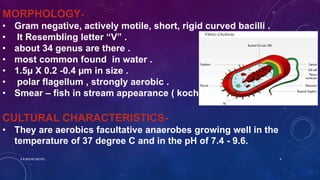
• Gram negative, actively motile, short, rigid curved bacilli .
• It Resembling letter “V” .
• about 34 genus are there .
• most common found in water .
• 1.5µ X 0.2 -0.4 µm in size .
• polar flagellum , strongly aerobic .
• Smear – fish in stream appearance ( koch).
CULTURAL CHARACTERISTICS-
• They are aerobics facultative anaerobes growing well in the
temperature of 37 degree C and in the pH of 7.4 - 9.6.
K R MICRO NOTES 4
ORDINARY MEDIA-
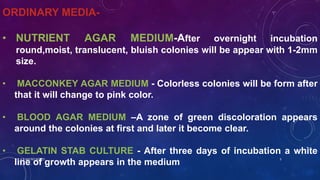
• NUTRIENT AGAR MEDIUM-After overnight incubation
round,moist, translucent, bluish colonies will be appear with 1-2mm
size.
• MACCONKEY AGAR MEDIUM - Colorless colonies will be form after
that it will change to pink color.
• BLOOD AGAR MEDIUM –A zone of green discoloration appears
around the colonies at first and later it become clear.
• GELATIN STAB CULTURE - After three days of incubation a white
line of growth appears in the medium
K R MICRO NOTES 5
TRANSPORT MEDIA -
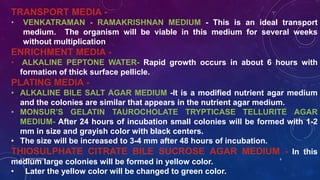
• VENKATRAMAN - RAMAKRISHNAN MEDIUM - This is an ideal transport
medium. The organism will be viable in this medium for several weeks
without multiplication
ENRICHMENT MEDIA -
• ALKALINE PEPTONE WATER- Rapid growth occurs in about 6 hours with
formation of thick surface pellicle.
PLATING MEDIA -
• ALKALINE BILE SALT AGAR MEDIUM -It is a modified nutrient agar medium
and the colonies are similar that appears in the nutrient agar medium.
• MONSUR’S GELATIN TAUROCHOLATE TRYPTICASE TELLURITE AGAR
MEDIUM- After 24 hours of incubation small colonies will be formed with 1-2
mm in size and grayish color with black centers.
• The size will be increased to 3-4 mm after 48 hours of incubation.
THIOSULPHATE CITRATE BILE SUCROSE AGAR MEDIUM - In this
medium large colonies will be formed in yellow color.
• Later the yellow color will be changed to green color.
K R MICRO NOTES 6
K R MICRO NOTES 7
BIOCHEMICAL TESTS –
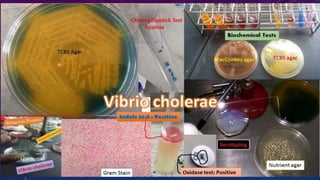
Sugar fermentation test: fermentation of glucose, sucrose and Beta-
maltose will occur with the production of gas.
Nitrate reduction test: positive
Iodole test. : positive
Catalase test : positive
Oxidase test. : positive
Motility test. : positive
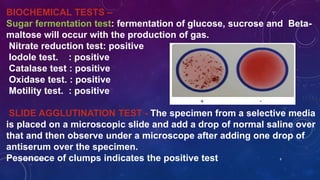
SLIDE AGGLUTINATION TEST - The specimen from a selective media
is placed on a microscopic slide and add a drop of normal saline over
that and then observe under a microscope after adding one drop of
antiserum over the specimen.
Pesencece of clumps indicates the positive test
K R MICRO NOTES 8
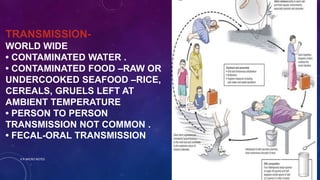
TRANSMISSION-
WORLD WIDE
• CONTAMINATED WATER .
• CONTAMINATED FOOD –RAW OR
UNDERCOOKED SEAFOOD –RICE,
CEREALS, GRUELS LEFT AT
AMBIENT TEMPERATURE
• PERSON TO PERSON
TRANSMISSION NOT COMMON .
• FECAL-ORAL TRANSMISSION
K R MICRO NOTES 9
K R MICRO NOTES 10
K R MICRO NOTES 11
PATHOGENESIS-
Source: Ingestion of contaminated water, food, fruits and
vegetables etc.,
INCUBATION PERIODS - 1-5 days.
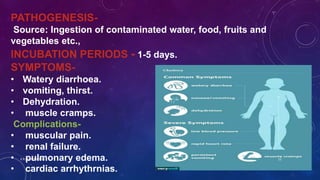
SYMPTOMS-
• Watery diarrhoea.
• vomiting, thirst.
• Dehydration.
• muscle cramps.
Complications-
• muscular pain.
• renal failure.
• pulmonary edema.
• cardiac arrhythrnias.
K R MICRO NOTES 12
DIAGNOSIS-
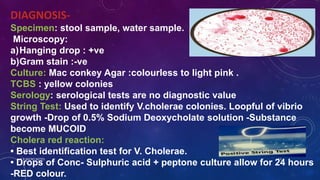
Specimen: stool sample, water sample.
Microscopy:
a)Hanging drop : +ve
b)Gram stain :-ve
Culture: Mac conkey Agar :colourless to light pink .
TCBS : yellow colonies
Serology: serological tests are no diagnostic value
String Test: Used to identify V.cholerae colonies. Loopful of vibrio
growth -Drop of 0.5% Sodium Deoxycholate solution -Substance
become MUCOID
Cholera red reaction:
• Best identification test for V. Cholerae.
• Drops of Conc- Sulphuric acid + peptone culture allow for 24 hours
-RED colour.
K R MICRO NOTES 13
TREATMENT- Adequate replacement of fluids and electrolytes
• Oral tetracycline reduces the period of vibrio excreation.
Cholera vaccines and vaccination
• Two types of oral cholera vaccines are available:
(i) Dukoral an
(ii) Shanchol and mORCVAX.
PREVENTION-
• Drink and use bottled water.
• Frequent washing hands.
• Sanitary environment.
• Defecate in water.
• Cook food thoroughly.
K R MICRO NOTES 14
REFERENCE-
1.TEXT BOOK OF MICROBIOLOGY, 9 TH EDITION BY ANANTHANARYAN AND
PANIKERS.
2.TEXT BOOK OF MICROBIOLOGY, 3 RD. EDITION BY R ANANTHANARYAN AND C K
JAYARAM PANIKERS.AND BY PROF. C P BAVEJA.
HTTPS://EN.M.WIKIPEDIA.ORG
HTTPS://WWW.SCIENCEDIRECT.COM
HTTPS://WWW.NCBI.NLM.NIH.GOV
HTTPS://GLOBALHEALTHMEDIA.ORG
THANK YOU😊
K R MICRO NOTES 15

Vibrio cholera PATHOGENESIS K R.pptx

  • 1.
    VIBRIO CHOLERA K RMICRO NOTES 1
  • 2.
    EPIDEMIOLOGY- THE GERM RESPONSIBLEFOR CHOLERA WAS DISCOVERED TWICE- FIRST BY THE ITALIAN PHYSICIAN FILIPPO PACINI DURING AN OUTBREAK IN FLORENCE ITALY, IN 1854, AND THEN INDEPENDENTLY BY ROBERT KOCH IN INDIA IN 1883, THUS FAVORING THE GERM THEORY OVER THE MIASMA THEORY OF DISEASE. Vibrio cholera K R MICRO NOTES 2
  • 3.
    TAXONOMY- CLASS : GAMMAPROTEOBACTERIA ORDER: VIBRIONALES FAMILY: VIBRIONACEAE GENUS: VIBRIO SPECIES: V.CHOLERAE • Vibrio cholera- Cholera is a serious bacterial disease that usually causes severe diarrhea and dehydration. • The disease is typically spread through contaminated water. • Modern sewage and water treatment have effectively eliminated cholera in most countries. • It’s still a problem in countries like Asia, America and Africa. Mostly in India. • Countries affected by war, poverty, and natural disasters have the greatest risk for a cholera outbreak. K R MICRO NOTES 3
  • 4.
    MORPHOLOGY- • Gram negative,actively motile, short, rigid curved bacilli . • It Resembling letter “V” . • about 34 genus are there . • most common found in water . • 1.5µ X 0.2 -0.4 µm in size . • polar flagellum , strongly aerobic . • Smear – fish in stream appearance ( koch). CULTURAL CHARACTERISTICS- • They are aerobics facultative anaerobes growing well in the temperature of 37 degree C and in the pH of 7.4 - 9.6. K R MICRO NOTES 4
  • 5.
    ORDINARY MEDIA- • NUTRIENTAGAR MEDIUM-After overnight incubation round,moist, translucent, bluish colonies will be appear with 1-2mm size. • MACCONKEY AGAR MEDIUM - Colorless colonies will be form after that it will change to pink color. • BLOOD AGAR MEDIUM –A zone of green discoloration appears around the colonies at first and later it become clear. • GELATIN STAB CULTURE - After three days of incubation a white line of growth appears in the medium K R MICRO NOTES 5
  • 6.
    TRANSPORT MEDIA - •VENKATRAMAN - RAMAKRISHNAN MEDIUM - This is an ideal transport medium. The organism will be viable in this medium for several weeks without multiplication ENRICHMENT MEDIA - • ALKALINE PEPTONE WATER- Rapid growth occurs in about 6 hours with formation of thick surface pellicle. PLATING MEDIA - • ALKALINE BILE SALT AGAR MEDIUM -It is a modified nutrient agar medium and the colonies are similar that appears in the nutrient agar medium. • MONSUR’S GELATIN TAUROCHOLATE TRYPTICASE TELLURITE AGAR MEDIUM- After 24 hours of incubation small colonies will be formed with 1-2 mm in size and grayish color with black centers. • The size will be increased to 3-4 mm after 48 hours of incubation. THIOSULPHATE CITRATE BILE SUCROSE AGAR MEDIUM - In this medium large colonies will be formed in yellow color. • Later the yellow color will be changed to green color. K R MICRO NOTES 6
  • 7.
    K R MICRONOTES 7
  • 8.
    BIOCHEMICAL TESTS – Sugarfermentation test: fermentation of glucose, sucrose and Beta- maltose will occur with the production of gas. Nitrate reduction test: positive Iodole test. : positive Catalase test : positive Oxidase test. : positive Motility test. : positive SLIDE AGGLUTINATION TEST - The specimen from a selective media is placed on a microscopic slide and add a drop of normal saline over that and then observe under a microscope after adding one drop of antiserum over the specimen. Pesencece of clumps indicates the positive test K R MICRO NOTES 8
  • 9.
    TRANSMISSION- WORLD WIDE • CONTAMINATEDWATER . • CONTAMINATED FOOD –RAW OR UNDERCOOKED SEAFOOD –RICE, CEREALS, GRUELS LEFT AT AMBIENT TEMPERATURE • PERSON TO PERSON TRANSMISSION NOT COMMON . • FECAL-ORAL TRANSMISSION K R MICRO NOTES 9
  • 10.
    K R MICRONOTES 10
  • 11.
    K R MICRONOTES 11
  • 12.
    PATHOGENESIS- Source: Ingestion ofcontaminated water, food, fruits and vegetables etc., INCUBATION PERIODS - 1-5 days. SYMPTOMS- • Watery diarrhoea. • vomiting, thirst. • Dehydration. • muscle cramps. Complications- • muscular pain. • renal failure. • pulmonary edema. • cardiac arrhythrnias. K R MICRO NOTES 12
  • 13.
    DIAGNOSIS- Specimen: stool sample,water sample. Microscopy: a)Hanging drop : +ve b)Gram stain :-ve Culture: Mac conkey Agar :colourless to light pink . TCBS : yellow colonies Serology: serological tests are no diagnostic value String Test: Used to identify V.cholerae colonies. Loopful of vibrio growth -Drop of 0.5% Sodium Deoxycholate solution -Substance become MUCOID Cholera red reaction: • Best identification test for V. Cholerae. • Drops of Conc- Sulphuric acid + peptone culture allow for 24 hours -RED colour. K R MICRO NOTES 13
  • 14.
    TREATMENT- Adequate replacementof fluids and electrolytes • Oral tetracycline reduces the period of vibrio excreation. Cholera vaccines and vaccination • Two types of oral cholera vaccines are available: (i) Dukoral an (ii) Shanchol and mORCVAX. PREVENTION- • Drink and use bottled water. • Frequent washing hands. • Sanitary environment. • Defecate in water. • Cook food thoroughly. K R MICRO NOTES 14
  • 15.
    REFERENCE- 1.TEXT BOOK OFMICROBIOLOGY, 9 TH EDITION BY ANANTHANARYAN AND PANIKERS. 2.TEXT BOOK OF MICROBIOLOGY, 3 RD. EDITION BY R ANANTHANARYAN AND C K JAYARAM PANIKERS.AND BY PROF. C P BAVEJA. HTTPS://EN.M.WIKIPEDIA.ORG HTTPS://WWW.SCIENCEDIRECT.COM HTTPS://WWW.NCBI.NLM.NIH.GOV HTTPS://GLOBALHEALTHMEDIA.ORG THANK YOU😊 K R MICRO NOTES 15