BLOOD COLLECTION
SUNIL KUMAR. P
Department of Clinical Pathology
St.John’s Medical College
Bangalore
10/13/2018 1
SUNIL KUMAR. P, ST.JOHN'S MEDICAL
COLLEGE
• What is Phlebotomy
• Order of Draw
• Different Sources of Blood Collection
• Methods of Blood collection
• Different Blood Collection tubes
• Procedure of blood collections..
10/13/2018 2
SUNIL KUMAR. P, ST.JOHN'S MEDICAL
COLLEGE
Phlebotomy
• Phlebotomy is the process of making an
incision in a vein with a needle.
• The procedure is known as a Venipuncture.
• A person who performs phlebotomy is called a
phlebotomist, although doctors, nurses &
medical laboratory scientists.
10/13/2018 3
SUNIL KUMAR. P, ST.JOHN'S MEDICAL
COLLEGE
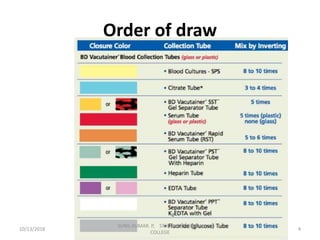
Order of draw
10/13/2018 4
SUNIL KUMAR. P, ST.JOHN'S MEDICAL
COLLEGE
Blood can be collected from 3
different sources:
• I. Venous blood.
• II. Arterial blood.
• III. Capillary blood.
10/13/2018 5
SUNIL KUMAR. P, ST.JOHN'S MEDICAL
COLLEGE
Blood Specimen Collection and
Processing
• The first step in acquiring a quality lab. Test
result for any patient is the specimen collection
procedure.
• Blood specimens are obtained through
• skin Prick method (finger, toe, heel)
• venous sampling or Venipuncture
• capillary
• Arterial ( or )
• Capillary / dermal /skin puncture, earlobe stick,
finger stick, heel stick (infants).
• Venous puncture (direct puncture of vein )
10/13/2018 6
SUNIL KUMAR. P, ST.JOHN'S MEDICAL
COLLEGE
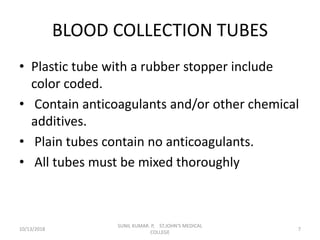
BLOOD COLLECTION TUBES
• Plastic tube with a rubber stopper include
color coded.
• Contain anticoagulants and/or other chemical
additives.
• Plain tubes contain no anticoagulants.
• All tubes must be mixed thoroughly
10/13/2018 7
SUNIL KUMAR. P, ST.JOHN'S MEDICAL
COLLEGE
ANTICOAGULANT TUBE
EDTA (Ethylene Diamine Tetra-Acetic Acid) liquid
10/13/2018 8
SUNIL KUMAR. P, ST.JOHN'S MEDICAL
COLLEGE
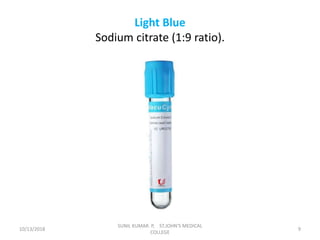
Light Blue
Sodium citrate (1:9 ratio).
10/13/2018 9
SUNIL KUMAR. P, ST.JOHN'S MEDICAL
COLLEGE
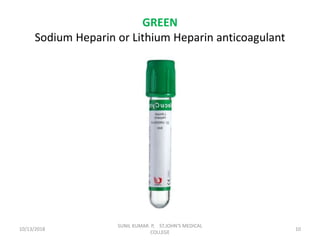
GREEN
Sodium Heparin or Lithium Heparin anticoagulant
10/13/2018 10
SUNIL KUMAR. P, ST.JOHN'S MEDICAL
COLLEGE
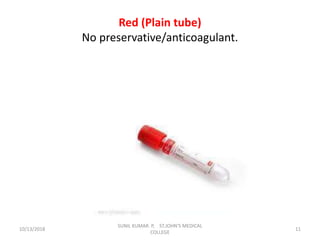
Red (Plain tube)
No preservative/anticoagulant.
10/13/2018 11
SUNIL KUMAR. P, ST.JOHN'S MEDICAL
COLLEGE
SST/ Gold top tube
SST (Serum Separator Tube)
10/13/2018 12
SUNIL KUMAR. P, ST.JOHN'S MEDICAL
COLLEGE
METHODS OF BLOOD COLLECTION
• SKIN PRICK METHOD :
• Materials and Equipment :
• 1. Disposable gloves
• 2 .Sharps disposal containers
• 3 .Alcohol swabs
• 4 .Sterile blood lancets
• 5 .Cotton wool
• 6 .10% house hold bleach
• 7 .Capillary tubes or disposable Pasteur pipettes
10/13/2018 13
SUNIL KUMAR. P, ST.JOHN'S MEDICAL
COLLEGE
Procedure
• 1 .Explain to the patient about the procedure.
• 2 .Wear disposable gloves and use aseptic technique
for blood collection.
• 3 .Position the patient ; he/she should sit in a chair and
hyperextend his/her arm.
• 4 .The best locations for a finger prick are the third and
fourth fingers of the hand. Do not use the tip or the
centre of the finger. Avoid the side of the finger
10/13/2018 14
SUNIL KUMAR. P, ST.JOHN'S MEDICAL
COLLEGE
• 5. Avoid puncturing a finger that is cold or blue,
swollen, scarred or covered with a rash.
• 6.Warm the finger by wrapping a warm cloth
during cold or by rubbing the finger with your
hand.
• 7. Clean the finger prick site with an alcohol
swab. Allow the alcohol to air dry completely
before making the prick.
10/13/2018 15
SUNIL KUMAR. P, ST.JOHN'S MEDICAL
COLLEGE
• 8. Use a sterile lancet. Full skin penetration by the tip
of the lancet should be accomplished in order to
obtain adequate blood flow for collection.
• 9. Make the skin puncture just off the centre of the
finger pad.
• 10.With dry and clean cotton wool, wipe off the first
drop of blood.
10/13/2018 16
SUNIL KUMAR. P, ST.JOHN'S MEDICAL
COLLEGE
• 11. Gently message the finger to allow a drop to form
at the punctured site. Collect sufficient quantities of
blood for the technique in question using the
recommended equipment.
• 12. Have the patient hold a small ball of dry cotton
wool over the puncture site for a few minutes to stop
the bleeding.
10/13/2018 17
SUNIL KUMAR. P, ST.JOHN'S MEDICAL
COLLEGE
• Venipuncture :
• Venipuncture is the process of obtaining
blood samples from veins for laboratory
testing, It is probably the most common
procedure in the medical field, usually
performed for the following reasons…….
10/13/2018 18
SUNIL KUMAR. P, ST.JOHN'S MEDICAL
COLLEGE
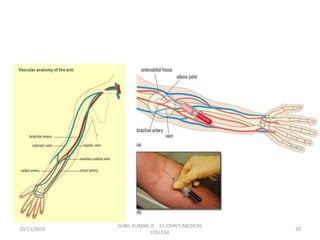
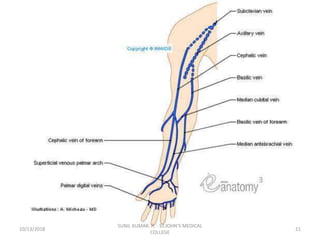
Venous blood ….??
• Most commonly required ….WHY??
• Because most majority of routine tests are
performed on venous blood.
• Blood can be taken directly from the vein.
• The best site for venous collection is the deep
veins of theante-cubital fossa.
10/13/2018 19
SUNIL KUMAR. P, ST.JOHN'S MEDICAL
COLLEGE
10/13/2018 20
SUNIL KUMAR. P, ST.JOHN'S MEDICAL
COLLEGE
10/13/2018 21
SUNIL KUMAR. P, ST.JOHN'S MEDICAL
COLLEGE
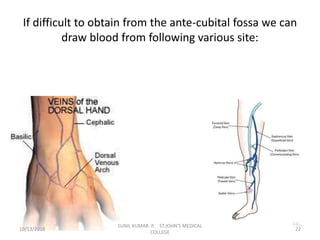
If difficult to obtain from the ante-cubital fossa we can
draw blood from following various site:
10/13/2018 22
SUNIL KUMAR. P, ST.JOHN'S MEDICAL
COLLEGE
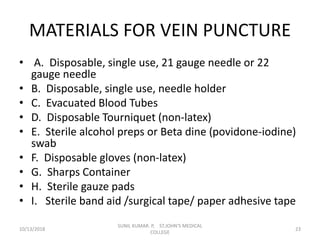
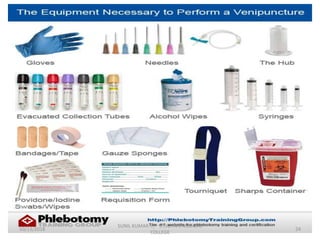
MATERIALS FOR VEIN PUNCTURE
• A. Disposable, single use, 21 gauge needle or 22
gauge needle
• B. Disposable, single use, needle holder
• C. Evacuated Blood Tubes
• D. Disposable Tourniquet (non-latex)
• E. Sterile alcohol preps or Beta dine (povidone-iodine)
swab
• F. Disposable gloves (non-latex)
• G. Sharps Container
• H. Sterile gauze pads
• I. Sterile band aid /surgical tape/ paper adhesive tape
10/13/2018 23
SUNIL KUMAR. P, ST.JOHN'S MEDICAL
COLLEGE
10/13/2018 24
SUNIL KUMAR. P, ST.JOHN'S MEDICAL
COLLEGE
Select the vein site.
• Apply tourniquet.
• Place tourniquet 3-4 inches above the
venipuncture site and hold ends up.
• Cross left hand over the right.
• With the right hand, hold the left strap.
• With the left hand, stretch the right strap.
• Maintain the tension and tuck a loop of
tourniquet, which is held in the left hand under
the tourniquet which encircles the arm.
• Check tension.
10/13/2018 25
SUNIL KUMAR. P, ST.JOHN'S MEDICAL
COLLEGE
Clean the venipuncture site
• Cleansing agents –
• Iodine,
• alcohol,
• chloroprep.
10/13/2018 26
SUNIL KUMAR. P, ST.JOHN'S MEDICAL
COLLEGE
10/13/2018 27
SUNIL KUMAR. P, ST.JOHN'S MEDICAL
COLLEGE
Cleaning Procedure…..
• Move in circular motion from the center of the site
outward.
• Allow to air dry. Do not wipe, fan or blow area dry.
• Prevents hemolysis.
• Avoids burning sensation at site.
• Avoids contamination of the specimen.
• Increased bacteriostatic properties of cleansing agents.
• Do not touch after cleansing.
• Sterile vs. antiseptic puncture site
• Sterile - free from living microorganisms.
• Antiseptic - clean but not sterile.
10/13/2018 28
SUNIL KUMAR. P, ST.JOHN'S MEDICAL
COLLEGE
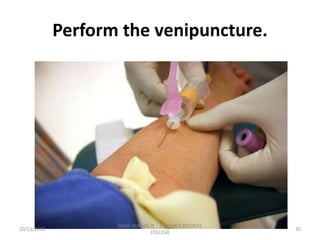
Perform the venipuncture
10/13/2018 29
SUNIL KUMAR. P, ST.JOHN'S MEDICAL
COLLEGE
Perform the venipuncture.
10/13/2018 30
SUNIL KUMAR. P, ST.JOHN'S MEDICAL
COLLEGE
Perform the venipuncture.
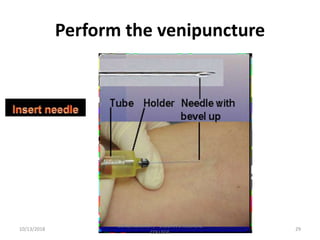
• Position the holder and needle in the direction of the
vein and parallel to it.
• Needle bevel should be facing up with the needle at a
15-30 degree angle.
• Place the tube in the holder.
• Enter the vein in a smooth quick motion.
• Grasp wings of the holder with index finger and
middle finger and push forward on the bottom of the
tube with thumb until the needle punctures the
stopper.
10/13/2018 31
SUNIL KUMAR. P, ST.JOHN'S MEDICAL
COLLEGE
• When pushing tube on the needle, it is
important to center the tube in the holder.
• Eliminates side wall penetration.
• Prevents potential loss of vacuum in tube.
10/13/2018 32
SUNIL KUMAR. P, ST.JOHN'S MEDICAL
COLLEGE
Collect the specimen.
• Fill the tube until the vacuum is exhausted and blood
flow ceases.
• Assures adequate specimen volume.
• Assures proper anticoagulant to specimen ratio.
• Remove tube
• Grasp holder tightly.
• Push wing with thumb and at the same time pull tube
off with fingers.
• Invert gently 5-10 times.
• Do not shake tube - vigorous mixing will cause
hemolysis.
10/13/2018 33
SUNIL KUMAR. P, ST.JOHN'S MEDICAL
COLLEGE
Provide care to the venipuncture site
• Apply non-latex adhesive, expandable or
coflex gauze and leave in place at least 15
minutes.
• Apply pressure bandage if patient has
bleeding problems or is on anticoagulant
therapy.
• Don't leave the patient until the bleeding has
stopped
10/13/2018 34
SUNIL KUMAR. P, ST.JOHN'S MEDICAL
COLLEGE
Label the specimen
• Specimens must be labeled following collection.
• Do not dismiss the patient until the specimen has
been properly labeled.
• Do not leave the bedside until the specimen has
been labeled.
• Do not pre-label tubes.
• Required Information
• Patient's full first and last name.
• Date of birth
10/13/2018 35
SUNIL KUMAR. P, ST.JOHN'S MEDICAL
COLLEGE
• Date and time of collection.
• Test(s) ordered.
• York Hospital Blood Bank specimens must also
include the Blood Bank armband identification
number and phlebotomist's identification.
• Gettysburg Hospital Blood Bank specimens and
Hollister card must also include patient location
at time of collection including bed number,
patient MRN #, and phlebotomist's identification)
• Include any other pertinent information such as
drawn from IV arm.
10/13/2018 36
SUNIL KUMAR. P, ST.JOHN'S MEDICAL
COLLEGE
Arterial Blood Collection
• Specially required for estimation of blood
gases (ABG):
• PH, CO2 and O2
• Collect quickly, fill completely and seal both
ends immediately
• No air bubbles
• Put in ice water and deliver STAT to the lab
10/13/2018 37
SUNIL KUMAR. P, ST.JOHN'S MEDICAL
COLLEGE
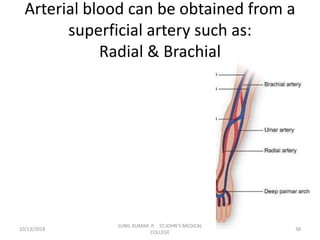
Arterial blood can be obtained from a
superficial artery such as:
Radial & Brachial
10/13/2018 38
SUNIL KUMAR. P, ST.JOHN'S MEDICAL
COLLEGE
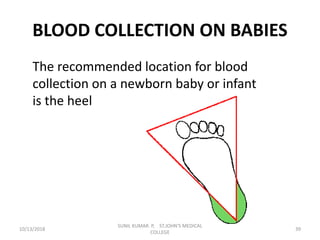
BLOOD COLLECTION ON BABIES
The recommended location for blood
collection on a newborn baby or infant
is the heel
10/13/2018 39
SUNIL KUMAR. P, ST.JOHN'S MEDICAL
COLLEGE
• Prewarming the infant's heel (42 C for 3 to5
minutes) is important to obtain capillary blood
gas samples and warming also greatly increases
the flow of blood for collection of other
specimens. However, do not use too high a
temperature warmer, because baby's skin is thin
and susceptible to thermal injury. Clean the site
to be punctured with an alcohol sponge. Dry the
cleaned area with a dry cotton sponge. Hold the
baby's foot firmly to avoid sudden movement.
10/13/2018 40
SUNIL KUMAR. P, ST.JOHN'S MEDICAL
COLLEGE
• Using a sterile blood lancet, puncture the side
of the heel in the appropriate regions shown
above in green. Do not use the central
portion of the heel because you might injure
the underlying bone, which is close to the
skin surface.
Do not use a previous puncture site. Make the cut
across the heel print lines so that a drop of blood
can well up and not run down along the lines.
10/13/2018 41
SUNIL KUMAR. P, ST.JOHN'S MEDICAL
COLLEGE
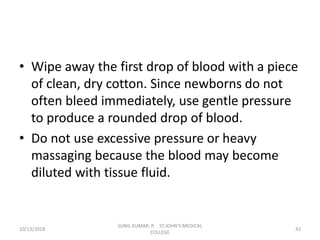
• Wipe away the first drop of blood with a piece
of clean, dry cotton. Since newborns do not
often bleed immediately, use gentle pressure
to produce a rounded drop of blood.
• Do not use excessive pressure or heavy
massaging because the blood may become
diluted with tissue fluid.
10/13/2018 42
SUNIL KUMAR. P, ST.JOHN'S MEDICAL
COLLEGE
• Fill the capillary tube(s) or micro collection
device(s) as needed.
10/13/2018 43
SUNIL KUMAR. P, ST.JOHN'S MEDICAL
COLLEGE
Any Questions…??
10/13/2018 44
SUNIL KUMAR. P, ST.JOHN'S MEDICAL
COLLEGE
References
• EssentialHaematology by Hoffbrand and Moss
• Practical Haematology by Dacie, Lewis
• Diagnostic Haematology by B F Rodak
• Handbook of CMAI Medical laboratory
Technology .
10/13/2018 45
SUNIL KUMAR. P, ST.JOHN'S MEDICAL
COLLEGE

Blood collection sunil

  • 1.
    BLOOD COLLECTION SUNIL KUMAR.P Department of Clinical Pathology St.John’s Medical College Bangalore 10/13/2018 1 SUNIL KUMAR. P, ST.JOHN'S MEDICAL COLLEGE
  • 2.
    • What isPhlebotomy • Order of Draw • Different Sources of Blood Collection • Methods of Blood collection • Different Blood Collection tubes • Procedure of blood collections.. 10/13/2018 2 SUNIL KUMAR. P, ST.JOHN'S MEDICAL COLLEGE
  • 3.
    Phlebotomy • Phlebotomy isthe process of making an incision in a vein with a needle. • The procedure is known as a Venipuncture. • A person who performs phlebotomy is called a phlebotomist, although doctors, nurses & medical laboratory scientists. 10/13/2018 3 SUNIL KUMAR. P, ST.JOHN'S MEDICAL COLLEGE
  • 4.
    Order of draw 10/13/20184 SUNIL KUMAR. P, ST.JOHN'S MEDICAL COLLEGE
  • 5.
    Blood can becollected from 3 different sources: • I. Venous blood. • II. Arterial blood. • III. Capillary blood. 10/13/2018 5 SUNIL KUMAR. P, ST.JOHN'S MEDICAL COLLEGE
  • 6.
    Blood Specimen Collectionand Processing • The first step in acquiring a quality lab. Test result for any patient is the specimen collection procedure. • Blood specimens are obtained through • skin Prick method (finger, toe, heel) • venous sampling or Venipuncture • capillary • Arterial ( or ) • Capillary / dermal /skin puncture, earlobe stick, finger stick, heel stick (infants). • Venous puncture (direct puncture of vein ) 10/13/2018 6 SUNIL KUMAR. P, ST.JOHN'S MEDICAL COLLEGE
  • 7.
    BLOOD COLLECTION TUBES •Plastic tube with a rubber stopper include color coded. • Contain anticoagulants and/or other chemical additives. • Plain tubes contain no anticoagulants. • All tubes must be mixed thoroughly 10/13/2018 7 SUNIL KUMAR. P, ST.JOHN'S MEDICAL COLLEGE
  • 8.
    ANTICOAGULANT TUBE EDTA (EthyleneDiamine Tetra-Acetic Acid) liquid 10/13/2018 8 SUNIL KUMAR. P, ST.JOHN'S MEDICAL COLLEGE
  • 9.
    Light Blue Sodium citrate(1:9 ratio). 10/13/2018 9 SUNIL KUMAR. P, ST.JOHN'S MEDICAL COLLEGE
  • 10.
    GREEN Sodium Heparin orLithium Heparin anticoagulant 10/13/2018 10 SUNIL KUMAR. P, ST.JOHN'S MEDICAL COLLEGE
  • 11.
    Red (Plain tube) Nopreservative/anticoagulant. 10/13/2018 11 SUNIL KUMAR. P, ST.JOHN'S MEDICAL COLLEGE
  • 12.
    SST/ Gold toptube SST (Serum Separator Tube) 10/13/2018 12 SUNIL KUMAR. P, ST.JOHN'S MEDICAL COLLEGE
  • 13.
    METHODS OF BLOODCOLLECTION • SKIN PRICK METHOD : • Materials and Equipment : • 1. Disposable gloves • 2 .Sharps disposal containers • 3 .Alcohol swabs • 4 .Sterile blood lancets • 5 .Cotton wool • 6 .10% house hold bleach • 7 .Capillary tubes or disposable Pasteur pipettes 10/13/2018 13 SUNIL KUMAR. P, ST.JOHN'S MEDICAL COLLEGE
  • 14.
    Procedure • 1 .Explainto the patient about the procedure. • 2 .Wear disposable gloves and use aseptic technique for blood collection. • 3 .Position the patient ; he/she should sit in a chair and hyperextend his/her arm. • 4 .The best locations for a finger prick are the third and fourth fingers of the hand. Do not use the tip or the centre of the finger. Avoid the side of the finger 10/13/2018 14 SUNIL KUMAR. P, ST.JOHN'S MEDICAL COLLEGE
  • 15.
    • 5. Avoidpuncturing a finger that is cold or blue, swollen, scarred or covered with a rash. • 6.Warm the finger by wrapping a warm cloth during cold or by rubbing the finger with your hand. • 7. Clean the finger prick site with an alcohol swab. Allow the alcohol to air dry completely before making the prick. 10/13/2018 15 SUNIL KUMAR. P, ST.JOHN'S MEDICAL COLLEGE
  • 16.
    • 8. Usea sterile lancet. Full skin penetration by the tip of the lancet should be accomplished in order to obtain adequate blood flow for collection. • 9. Make the skin puncture just off the centre of the finger pad. • 10.With dry and clean cotton wool, wipe off the first drop of blood. 10/13/2018 16 SUNIL KUMAR. P, ST.JOHN'S MEDICAL COLLEGE
  • 17.
    • 11. Gentlymessage the finger to allow a drop to form at the punctured site. Collect sufficient quantities of blood for the technique in question using the recommended equipment. • 12. Have the patient hold a small ball of dry cotton wool over the puncture site for a few minutes to stop the bleeding. 10/13/2018 17 SUNIL KUMAR. P, ST.JOHN'S MEDICAL COLLEGE
  • 18.
    • Venipuncture : •Venipuncture is the process of obtaining blood samples from veins for laboratory testing, It is probably the most common procedure in the medical field, usually performed for the following reasons……. 10/13/2018 18 SUNIL KUMAR. P, ST.JOHN'S MEDICAL COLLEGE
  • 19.
    Venous blood ….?? •Most commonly required ….WHY?? • Because most majority of routine tests are performed on venous blood. • Blood can be taken directly from the vein. • The best site for venous collection is the deep veins of theante-cubital fossa. 10/13/2018 19 SUNIL KUMAR. P, ST.JOHN'S MEDICAL COLLEGE
  • 20.
    10/13/2018 20 SUNIL KUMAR.P, ST.JOHN'S MEDICAL COLLEGE
  • 21.
    10/13/2018 21 SUNIL KUMAR.P, ST.JOHN'S MEDICAL COLLEGE
  • 22.
    If difficult toobtain from the ante-cubital fossa we can draw blood from following various site: 10/13/2018 22 SUNIL KUMAR. P, ST.JOHN'S MEDICAL COLLEGE
  • 23.
    MATERIALS FOR VEINPUNCTURE • A. Disposable, single use, 21 gauge needle or 22 gauge needle • B. Disposable, single use, needle holder • C. Evacuated Blood Tubes • D. Disposable Tourniquet (non-latex) • E. Sterile alcohol preps or Beta dine (povidone-iodine) swab • F. Disposable gloves (non-latex) • G. Sharps Container • H. Sterile gauze pads • I. Sterile band aid /surgical tape/ paper adhesive tape 10/13/2018 23 SUNIL KUMAR. P, ST.JOHN'S MEDICAL COLLEGE
  • 24.
    10/13/2018 24 SUNIL KUMAR.P, ST.JOHN'S MEDICAL COLLEGE
  • 25.
    Select the veinsite. • Apply tourniquet. • Place tourniquet 3-4 inches above the venipuncture site and hold ends up. • Cross left hand over the right. • With the right hand, hold the left strap. • With the left hand, stretch the right strap. • Maintain the tension and tuck a loop of tourniquet, which is held in the left hand under the tourniquet which encircles the arm. • Check tension. 10/13/2018 25 SUNIL KUMAR. P, ST.JOHN'S MEDICAL COLLEGE
  • 26.
    Clean the venipuncturesite • Cleansing agents – • Iodine, • alcohol, • chloroprep. 10/13/2018 26 SUNIL KUMAR. P, ST.JOHN'S MEDICAL COLLEGE
  • 27.
    10/13/2018 27 SUNIL KUMAR.P, ST.JOHN'S MEDICAL COLLEGE
  • 28.
    Cleaning Procedure….. • Movein circular motion from the center of the site outward. • Allow to air dry. Do not wipe, fan or blow area dry. • Prevents hemolysis. • Avoids burning sensation at site. • Avoids contamination of the specimen. • Increased bacteriostatic properties of cleansing agents. • Do not touch after cleansing. • Sterile vs. antiseptic puncture site • Sterile - free from living microorganisms. • Antiseptic - clean but not sterile. 10/13/2018 28 SUNIL KUMAR. P, ST.JOHN'S MEDICAL COLLEGE
  • 29.
    Perform the venipuncture 10/13/201829 SUNIL KUMAR. P, ST.JOHN'S MEDICAL COLLEGE
  • 30.
    Perform the venipuncture. 10/13/201830 SUNIL KUMAR. P, ST.JOHN'S MEDICAL COLLEGE
  • 31.
    Perform the venipuncture. •Position the holder and needle in the direction of the vein and parallel to it. • Needle bevel should be facing up with the needle at a 15-30 degree angle. • Place the tube in the holder. • Enter the vein in a smooth quick motion. • Grasp wings of the holder with index finger and middle finger and push forward on the bottom of the tube with thumb until the needle punctures the stopper. 10/13/2018 31 SUNIL KUMAR. P, ST.JOHN'S MEDICAL COLLEGE
  • 32.
    • When pushingtube on the needle, it is important to center the tube in the holder. • Eliminates side wall penetration. • Prevents potential loss of vacuum in tube. 10/13/2018 32 SUNIL KUMAR. P, ST.JOHN'S MEDICAL COLLEGE
  • 33.
    Collect the specimen. •Fill the tube until the vacuum is exhausted and blood flow ceases. • Assures adequate specimen volume. • Assures proper anticoagulant to specimen ratio. • Remove tube • Grasp holder tightly. • Push wing with thumb and at the same time pull tube off with fingers. • Invert gently 5-10 times. • Do not shake tube - vigorous mixing will cause hemolysis. 10/13/2018 33 SUNIL KUMAR. P, ST.JOHN'S MEDICAL COLLEGE
  • 34.
    Provide care tothe venipuncture site • Apply non-latex adhesive, expandable or coflex gauze and leave in place at least 15 minutes. • Apply pressure bandage if patient has bleeding problems or is on anticoagulant therapy. • Don't leave the patient until the bleeding has stopped 10/13/2018 34 SUNIL KUMAR. P, ST.JOHN'S MEDICAL COLLEGE
  • 35.
    Label the specimen •Specimens must be labeled following collection. • Do not dismiss the patient until the specimen has been properly labeled. • Do not leave the bedside until the specimen has been labeled. • Do not pre-label tubes. • Required Information • Patient's full first and last name. • Date of birth 10/13/2018 35 SUNIL KUMAR. P, ST.JOHN'S MEDICAL COLLEGE
  • 36.
    • Date andtime of collection. • Test(s) ordered. • York Hospital Blood Bank specimens must also include the Blood Bank armband identification number and phlebotomist's identification. • Gettysburg Hospital Blood Bank specimens and Hollister card must also include patient location at time of collection including bed number, patient MRN #, and phlebotomist's identification) • Include any other pertinent information such as drawn from IV arm. 10/13/2018 36 SUNIL KUMAR. P, ST.JOHN'S MEDICAL COLLEGE
  • 37.
    Arterial Blood Collection •Specially required for estimation of blood gases (ABG): • PH, CO2 and O2 • Collect quickly, fill completely and seal both ends immediately • No air bubbles • Put in ice water and deliver STAT to the lab 10/13/2018 37 SUNIL KUMAR. P, ST.JOHN'S MEDICAL COLLEGE
  • 38.
    Arterial blood canbe obtained from a superficial artery such as: Radial & Brachial 10/13/2018 38 SUNIL KUMAR. P, ST.JOHN'S MEDICAL COLLEGE
  • 39.
    BLOOD COLLECTION ONBABIES The recommended location for blood collection on a newborn baby or infant is the heel 10/13/2018 39 SUNIL KUMAR. P, ST.JOHN'S MEDICAL COLLEGE
  • 40.
    • Prewarming theinfant's heel (42 C for 3 to5 minutes) is important to obtain capillary blood gas samples and warming also greatly increases the flow of blood for collection of other specimens. However, do not use too high a temperature warmer, because baby's skin is thin and susceptible to thermal injury. Clean the site to be punctured with an alcohol sponge. Dry the cleaned area with a dry cotton sponge. Hold the baby's foot firmly to avoid sudden movement. 10/13/2018 40 SUNIL KUMAR. P, ST.JOHN'S MEDICAL COLLEGE
  • 41.
    • Using asterile blood lancet, puncture the side of the heel in the appropriate regions shown above in green. Do not use the central portion of the heel because you might injure the underlying bone, which is close to the skin surface. Do not use a previous puncture site. Make the cut across the heel print lines so that a drop of blood can well up and not run down along the lines. 10/13/2018 41 SUNIL KUMAR. P, ST.JOHN'S MEDICAL COLLEGE
  • 42.
    • Wipe awaythe first drop of blood with a piece of clean, dry cotton. Since newborns do not often bleed immediately, use gentle pressure to produce a rounded drop of blood. • Do not use excessive pressure or heavy massaging because the blood may become diluted with tissue fluid. 10/13/2018 42 SUNIL KUMAR. P, ST.JOHN'S MEDICAL COLLEGE
  • 43.
    • Fill thecapillary tube(s) or micro collection device(s) as needed. 10/13/2018 43 SUNIL KUMAR. P, ST.JOHN'S MEDICAL COLLEGE
  • 44.
    Any Questions…?? 10/13/2018 44 SUNILKUMAR. P, ST.JOHN'S MEDICAL COLLEGE
  • 45.
    References • EssentialHaematology byHoffbrand and Moss • Practical Haematology by Dacie, Lewis • Diagnostic Haematology by B F Rodak • Handbook of CMAI Medical laboratory Technology . 10/13/2018 45 SUNIL KUMAR. P, ST.JOHN'S MEDICAL COLLEGE