SampleCollection &
transport
Prof. Ranadeep Ghosh
Objectives
• General consideration for
sample collection
• Sample safety considerations
• Rejection criteria
• Collection of different samples
from different sites
• Transportation
• Reference
General consideration for proper
sample collection
-Every laboratory should follow proper
guidelines for collection of samples
-All diagnostic information depends
on quality of sample received
-If sample collection, transport, media
are not proper, it will give false results
• Collect sample before administering
antimicrobial agents when possible.
(for Microbiological culture)
• Collect sample with as little
contamination from indigenous
microbiota as possible to ensure that
the sample will be representative of the
infected site.
• Utilize appropriate collection devices.
Use sterile equipment and aseptic
technique to collect specimens to
prevent introduction of microorganisms
during invasive procedures.
• Vacutainers- NOT SUITABLE for
collection of samples meant for culture
• Clearly label the specimen container
with the patient’s name and
identification number. Always include
date and time of collection and your
initials.
• Collect an adequate amount of
specimen. Inadequate amounts
of specimen may yield false-
negative results/ may be
rejected.
• Identify the specimen source
and/or specific site correctly so
that proper culture media will be
selected during processing in the
laboratory.
• Collect specimens in sturdy, sterile,
screw-cap, leak proof containers with
lids that do not create an aerosol when
opened.
• Collect sample after proper preparation
of area by alcohol and povidone iodine/
chlorhexidine gluconate.
• Microbiology culture samples to be sent
in normal saline if needed, NOT
FORMALIN!
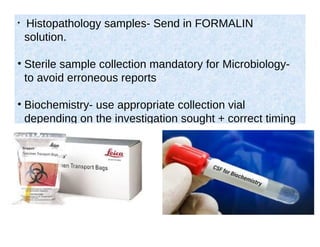
• Histopathology samples- Send in FORMALIN
solution.
• Sterile sample collection mandatory for Microbiology-
to avoid erroneous reports
• Biochemistry- use appropriate collection vial
depending on the investigation sought + correct timing
is essential
Sample Safety considerations
• Follow standard precaution guidelines.
Treat all specimens as potentially
biohazardous.
• Laboratory workers should use appropriate
barrier protection (such as gloves,
goggles and laboratory coat or gown) when
collecting or handling specimens.
• If splashing may occur, protective
eyewear, face masks, and aprons may be
necessary.
• Do not contaminate the external
surface of the collection container
and/or its accompanying paperwork.
• Minimize direct handling of
specimens
in transit from the patient to the
laboratory. Use plastic sealable
bags
with a separate pouch for the
laboratory requisition orders or
transport carriers (for example, small
buckets/trays with rigid handles).
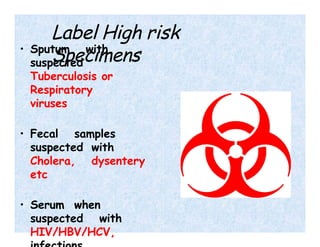
Label High risk
Specimens
• Sputum with
suspected
Tuberculosis or
Respiratory
viruses
• Fecal samples
suspected with
Cholera, dysentery
etc
• Serum when
suspected with
HIV/HBV/HCV,
REJECTION
CRITERIA
• Leaking/broken container
• Insufficient amount
• Improper labelling
• More time lag between collection and
transport
• Improper transport media
• Improper transport temperature
• Haemolysed sample
• Lipaemic sample
or
Important questions before
collecting a specimen
• Are you suspecting an Infection ?
• If so what is the Nature of infection,
Eg. Bacterial, Viral, Mycological
Parasitological
• Which tests are your priority ?
• When to collect the specimen ?
• How to collect the specimen –correct
site?
• Am I choosing the correct container ?
• Why to send the specimens promptly, if not
what I should do ?
• Look for post collection complications if any
A Request
form
• Should include:
-Name ,Age ,Sex,Address
-IPD/ OPD No ,ward,
-Time and Date,
-Urgent / Routine,
-Type of specimen
-Investigation needed
-Brief History of patient
-Provisional diagnosis
-Doctor’s name and sign
-Antimicrobial treatment received
When to Request
Transport
Medium
• When facilities are not available to perform
the desired tests at the place of collection or
laboratory located far away, or suspecting
fastidious organisms request the
Diagnostic laboratories to advice on
transportation of specimens, and consider
how
to preserve and transport in ideal medium
before it is processed
• Popularly used transport medium are
-Amie 's transport Medium:
Gonococcal infection
-Cary Blair medium:
stool
Collection of different samples
• Blood
• Urine
• Stool
• Rectal swab
• Sputum
• Csf
• Mycology samples
• Wound swabs
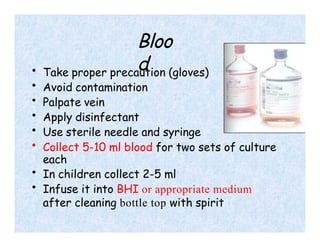
Bloo
d
• Take proper precaution (gloves)
• Avoid contamination
• Palpate vein
• Apply disinfectant
• Use sterile needle and syringe
• Collect 5-10 ml blood for two sets of culture
each
• In children collect 2-5 ml
• Infuse it into BHI or appropriate medium
after cleaning bottle top with spirit
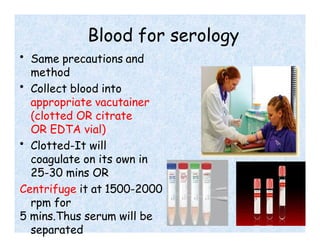
Blood for serology
• Same precautions and
method
• Collect blood into
appropriate vacutainer
(clotted OR citrate
OR EDTA vial)
• Clotted-It will
coagulate on its own in
25-30 mins OR
Centrifuge it at 1500-2000
rpm for
5 mins.Thus serum will be
separated
Urine
For females
• Rinse area with mild soap and water
• Clean it with sterile gauze piece
• With both labia apart allow first few ml
of urine to drain off.
• Take mid stream clean catch urine
• This will prevent contamination
• Collect it into wide,sterile,leak proof
container (universal container)
• Transport it directly to the laboratory
after proper labelling
• If delay in transport, preserve it at 4-6
degree centigrade
• Avoid contamination.
For males
• Wash hands and retract
prepuce before
collecting sample
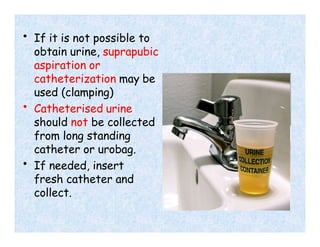
• If it is not possible to
obtain urine, suprapubic
aspiration or
catheterization may be
used (clamping)
• Catheterised urine
should not be collected
from long standing
catheter or urobag.
• If needed, insert
fresh catheter and
collect.
Stool
• Collect it into wide mouth,clean,
sterile,leak proof container
• Label properly
• Min 5 gms is needed if solid
stool
• And 2 ml if liquid stool
• It should not be contaminated with
urine
• If not possible to collect it as in
children, elderly, debilitated patients–
collect rectal swab
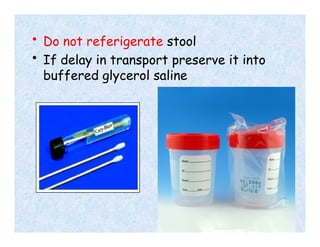
• Do not referigerate stool
• If delay in transport preserve it into
buffered glycerol saline
Rectal swab
• Take sterile swab
• Apply it in anal canal
• Rotate it for 10 seconds
• Avoid contact with perianal skin
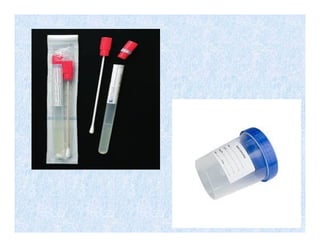
• Seal it directly into swab container to
prevent contamination
• Transport immediately to lab , if not
possible,preserve at 4-6 degree
centigrade
Sputum
• Wide container of 50-100 ml capacity
• For MTB two samples are collected
• 1st at on the spot and 2nd at next day
morning
• Morning sample is more reliable bcz of
colonization of bacteria in LRT at night
• Before this ask patient to gargle with
normal saline and take deep breath and
then take sample in one bout
• This will prevent contamination
• There should not be saliva or liquid
• If there are >25 epithelial cell per LPF,
sample is rejected as it shows
contamination
• It should be collected before antibiotic
treatment has started
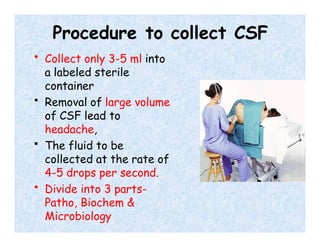
Procedure to collect CSF
• Collect only 3-5 ml into
a labeled sterile
container
• Removal of large volume
of CSF lead to
headache,
• The fluid to be
collected at the rate of
4-5 drops per second.
• Divide into 3 parts-
Patho, Biochem &
Microbiology
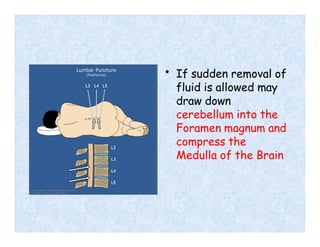
• If sudden removal of
fluid is allowed may
draw down
cerebellum into the
Foramen magnum and
compress the
Medulla of the Brain
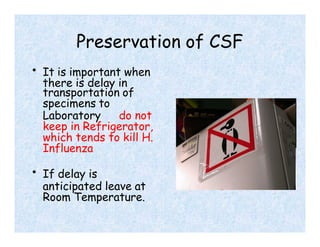
Preservation of CSF
• It is important when
there is delay in
transportation of
specimens to
Laboratory do not
keep in Refrigerator,
which tends to kill H.
Influenza
• If delay is
anticipated leave at
Room Temperature.
MYCOLOGY SAMPLES
• Clean site with 70% ethanol to help eliminate
surface contaminants. Using a scalpel, skin
scrapings should be made from the active
periphery of the lesion. For nails Scrapings
should be deep enough to assure acquiring
recently invaded tissue Submit scrapings in a
sterile Petri dish or container.
• Hair - Use forceps to pluck involved hairs
from the edges of the patches. Submit
hair, including shaft, in a sterile Petri dish or
container.
• Other - Collect and submit specimens
as described for specific type.
Specimens associated with the
systemic and deep seated mycoses are
obtained from a wide variety of
sources. They should be obtained,
whenever possible, under aseptic
conditions and in sufficient quantity
for both microscopic and cultural
examinations.
Samples from wounds
• The ideal sample is pus or exudates
should be submitted in a small screw-
capped bottle in firmly stoppered tube
or syringe or a sealed capillary tube.
• Fragments of excised tissue removed at
wound toilet or curettings from
infected sinuses and other tissues
should be sent in a sterile container.
• The wound swabs are inferior
comparatively.
• tends to desiccate the specimen and
trap the bacteria which are then not
released on to culture plate
• Special bacteria like Chlamydia, and
fungi should not be collected
using cotton swabs but rayon/
dacron swabs. *
Transportation of samples
• Stool, csf and sputum should be
transported at room temperature, not in
refrigerator
• Pleural & peritoneal fluids etc- also
stored at room temperature
• Urine , rectal swabs & skin samples are
transported asap at room temp,but if it
is not possible, preserve them in
refrigerator
References
• Koneman’s color atlas and Textbook of
diagnostic microbiology,sixth
addition,chapter 2-guidelines for
collection,page-74,76,81,83,93,100
• Mackie & McCartney:Practical Medical
Microbiology,14th edition,chapter:5,Sample
collection:page-95-96
• IDSP guidelines-
www.idsp.nic.in/idsp/IDSP_2WeekCourse.../
WorkLaboIDSP.ppt
• NACO guidelines- naco.gov.in/upload/Blood
%20Saftey/Sample%20 Trtansport.pdf
• Role of specimen collection in infectious disease
by Dr. T. V. Rao MD
• WHO guidelines 2011
Thank You

microbiology_sample_collection - RG.pptx

  • 1.
  • 2.
    Objectives • General considerationfor sample collection • Sample safety considerations • Rejection criteria • Collection of different samples from different sites • Transportation • Reference
  • 3.
    General consideration forproper sample collection -Every laboratory should follow proper guidelines for collection of samples -All diagnostic information depends on quality of sample received -If sample collection, transport, media are not proper, it will give false results
  • 4.
    • Collect samplebefore administering antimicrobial agents when possible. (for Microbiological culture) • Collect sample with as little contamination from indigenous microbiota as possible to ensure that the sample will be representative of the infected site.
  • 5.
    • Utilize appropriatecollection devices. Use sterile equipment and aseptic technique to collect specimens to prevent introduction of microorganisms during invasive procedures. • Vacutainers- NOT SUITABLE for collection of samples meant for culture • Clearly label the specimen container with the patient’s name and identification number. Always include date and time of collection and your initials.
  • 6.
    • Collect anadequate amount of specimen. Inadequate amounts of specimen may yield false- negative results/ may be rejected. • Identify the specimen source and/or specific site correctly so that proper culture media will be selected during processing in the laboratory.
  • 7.
    • Collect specimensin sturdy, sterile, screw-cap, leak proof containers with lids that do not create an aerosol when opened. • Collect sample after proper preparation of area by alcohol and povidone iodine/ chlorhexidine gluconate. • Microbiology culture samples to be sent in normal saline if needed, NOT FORMALIN!
  • 8.
    • Histopathology samples-Send in FORMALIN solution. • Sterile sample collection mandatory for Microbiology- to avoid erroneous reports • Biochemistry- use appropriate collection vial depending on the investigation sought + correct timing is essential
  • 9.
    Sample Safety considerations •Follow standard precaution guidelines. Treat all specimens as potentially biohazardous. • Laboratory workers should use appropriate barrier protection (such as gloves, goggles and laboratory coat or gown) when collecting or handling specimens. • If splashing may occur, protective eyewear, face masks, and aprons may be necessary.
  • 10.
    • Do notcontaminate the external surface of the collection container and/or its accompanying paperwork. • Minimize direct handling of specimens in transit from the patient to the laboratory. Use plastic sealable bags with a separate pouch for the laboratory requisition orders or transport carriers (for example, small buckets/trays with rigid handles).
  • 11.
    Label High risk Specimens •Sputum with suspected Tuberculosis or Respiratory viruses • Fecal samples suspected with Cholera, dysentery etc • Serum when suspected with HIV/HBV/HCV,
  • 12.
    REJECTION CRITERIA • Leaking/broken container •Insufficient amount • Improper labelling • More time lag between collection and transport • Improper transport media • Improper transport temperature • Haemolysed sample • Lipaemic sample
  • 13.
    or Important questions before collectinga specimen • Are you suspecting an Infection ? • If so what is the Nature of infection, Eg. Bacterial, Viral, Mycological Parasitological • Which tests are your priority ? • When to collect the specimen ? • How to collect the specimen –correct site? • Am I choosing the correct container ? • Why to send the specimens promptly, if not what I should do ? • Look for post collection complications if any
  • 14.
    A Request form • Shouldinclude: -Name ,Age ,Sex,Address -IPD/ OPD No ,ward, -Time and Date, -Urgent / Routine, -Type of specimen -Investigation needed -Brief History of patient -Provisional diagnosis -Doctor’s name and sign -Antimicrobial treatment received
  • 15.
    When to Request Transport Medium •When facilities are not available to perform the desired tests at the place of collection or laboratory located far away, or suspecting fastidious organisms request the Diagnostic laboratories to advice on transportation of specimens, and consider how to preserve and transport in ideal medium before it is processed • Popularly used transport medium are -Amie 's transport Medium: Gonococcal infection -Cary Blair medium: stool
  • 16.
    Collection of differentsamples • Blood • Urine • Stool • Rectal swab • Sputum • Csf • Mycology samples • Wound swabs
  • 17.
    Bloo d • Take properprecaution (gloves) • Avoid contamination • Palpate vein • Apply disinfectant • Use sterile needle and syringe • Collect 5-10 ml blood for two sets of culture each • In children collect 2-5 ml • Infuse it into BHI or appropriate medium after cleaning bottle top with spirit
  • 18.
    Blood for serology •Same precautions and method • Collect blood into appropriate vacutainer (clotted OR citrate OR EDTA vial) • Clotted-It will coagulate on its own in 25-30 mins OR Centrifuge it at 1500-2000 rpm for 5 mins.Thus serum will be separated
  • 19.
    Urine For females • Rinsearea with mild soap and water • Clean it with sterile gauze piece • With both labia apart allow first few ml of urine to drain off. • Take mid stream clean catch urine • This will prevent contamination • Collect it into wide,sterile,leak proof container (universal container)
  • 20.
    • Transport itdirectly to the laboratory after proper labelling • If delay in transport, preserve it at 4-6 degree centigrade • Avoid contamination. For males • Wash hands and retract prepuce before collecting sample
  • 21.
    • If itis not possible to obtain urine, suprapubic aspiration or catheterization may be used (clamping) • Catheterised urine should not be collected from long standing catheter or urobag. • If needed, insert fresh catheter and collect.
  • 22.
    Stool • Collect itinto wide mouth,clean, sterile,leak proof container • Label properly • Min 5 gms is needed if solid stool • And 2 ml if liquid stool • It should not be contaminated with urine • If not possible to collect it as in children, elderly, debilitated patients– collect rectal swab
  • 23.
    • Do notreferigerate stool • If delay in transport preserve it into buffered glycerol saline
  • 24.
    Rectal swab • Takesterile swab • Apply it in anal canal • Rotate it for 10 seconds • Avoid contact with perianal skin • Seal it directly into swab container to prevent contamination • Transport immediately to lab , if not possible,preserve at 4-6 degree centigrade
  • 26.
    Sputum • Wide containerof 50-100 ml capacity • For MTB two samples are collected • 1st at on the spot and 2nd at next day morning • Morning sample is more reliable bcz of colonization of bacteria in LRT at night • Before this ask patient to gargle with normal saline and take deep breath and then take sample in one bout
  • 27.
    • This willprevent contamination • There should not be saliva or liquid • If there are >25 epithelial cell per LPF, sample is rejected as it shows contamination • It should be collected before antibiotic treatment has started
  • 28.
    Procedure to collectCSF • Collect only 3-5 ml into a labeled sterile container • Removal of large volume of CSF lead to headache, • The fluid to be collected at the rate of 4-5 drops per second. • Divide into 3 parts- Patho, Biochem & Microbiology
  • 29.
    • If suddenremoval of fluid is allowed may draw down cerebellum into the Foramen magnum and compress the Medulla of the Brain
  • 30.
    Preservation of CSF •It is important when there is delay in transportation of specimens to Laboratory do not keep in Refrigerator, which tends to kill H. Influenza • If delay is anticipated leave at Room Temperature.
  • 31.
    MYCOLOGY SAMPLES • Cleansite with 70% ethanol to help eliminate surface contaminants. Using a scalpel, skin scrapings should be made from the active periphery of the lesion. For nails Scrapings should be deep enough to assure acquiring recently invaded tissue Submit scrapings in a sterile Petri dish or container. • Hair - Use forceps to pluck involved hairs from the edges of the patches. Submit hair, including shaft, in a sterile Petri dish or container.
  • 32.
    • Other -Collect and submit specimens as described for specific type. Specimens associated with the systemic and deep seated mycoses are obtained from a wide variety of sources. They should be obtained, whenever possible, under aseptic conditions and in sufficient quantity for both microscopic and cultural examinations.
  • 33.
    Samples from wounds •The ideal sample is pus or exudates should be submitted in a small screw- capped bottle in firmly stoppered tube or syringe or a sealed capillary tube. • Fragments of excised tissue removed at wound toilet or curettings from infected sinuses and other tissues should be sent in a sterile container.
  • 34.
    • The woundswabs are inferior comparatively. • tends to desiccate the specimen and trap the bacteria which are then not released on to culture plate • Special bacteria like Chlamydia, and fungi should not be collected using cotton swabs but rayon/ dacron swabs. *
  • 35.
    Transportation of samples •Stool, csf and sputum should be transported at room temperature, not in refrigerator • Pleural & peritoneal fluids etc- also stored at room temperature • Urine , rectal swabs & skin samples are transported asap at room temp,but if it is not possible, preserve them in refrigerator
  • 36.
    References • Koneman’s coloratlas and Textbook of diagnostic microbiology,sixth addition,chapter 2-guidelines for collection,page-74,76,81,83,93,100 • Mackie & McCartney:Practical Medical Microbiology,14th edition,chapter:5,Sample collection:page-95-96 • IDSP guidelines- www.idsp.nic.in/idsp/IDSP_2WeekCourse.../ WorkLaboIDSP.ppt
  • 37.
    • NACO guidelines-naco.gov.in/upload/Blood %20Saftey/Sample%20 Trtansport.pdf • Role of specimen collection in infectious disease by Dr. T. V. Rao MD • WHO guidelines 2011

  • 38.