 .A sputum culture is test to be detect and identify
bacteria or fungi that infect the lungs or breathing
passages & cause infections. Sputum is a thick fluid
produced in the lungs and in the adjacent airways.
 BACTERIA
Gram Positive
Streptococcus pneumoniae
Strephylococcus Aureus
Streptococcus pyogenes
Gram Negative
Haemophilus influenzae
Klebsiella pneumoniae
Pseudomonas aeruginosa
Proteus Species
Yersina pestis
 Mycobacterium tuberclosis
Mycoplasma pneumoniae & Legionella Pneumophila
 FUNGI & ACTINOMYCETES
Pneumosystis carinii
Blastomyces dermatidis
Histoplasma capsulatum
Aspergillus species
Candida Albicans
Nocardia species
 PARASITES
Paragonimus Species
 Production of sputum
 Collection of sample
 Examination
 Macroscopic
 Microscopic
1.Before collecting sputum the mouth should be prerinsed
and this removes contaminants from oral cavity.
2.Give the patient a clean dry wide necked leak-proof
container and request him or her to cough deeply to
produce a sputum specimen.
3.For best results early morning freshly expectorated
sputum specimen should be collected.
4.Label the container, and complete the request form.
5.When Pneumonia or Bronchopneumonia is suspected,
deliver the sputum to the laboratory with a little delay as
soon as possible because organisms such as S.
pneumoniae & H. influenzae require culturing as soon
as possible.
Specimen for the isolation for S. Pneumoniae & H.
Influenzae must never be refrigerated.
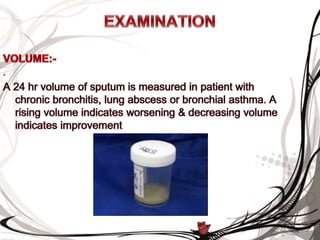
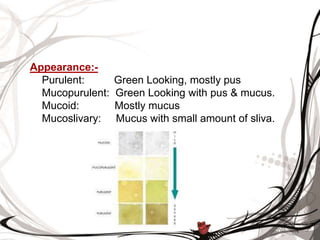
Appearance:-
Purulent: Green Looking, mostly pus
Mucopurulent: Green Looking with pus & mucus.
Mucoid: Mostly mucus
Mucoslivary: Mucus with small amount of sliva.
Microscopic:-
After macroscopic examination transfer material to a clean
slides.
Smears made on clear slides should be air dried, fixed
over flame and stained.
Different stains used:-
1:- Gram’s stain
2:- Ziehl-Neelsen stain for AFB
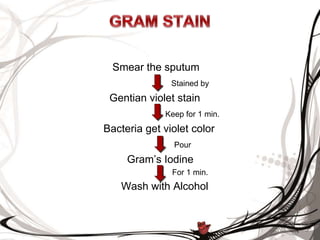
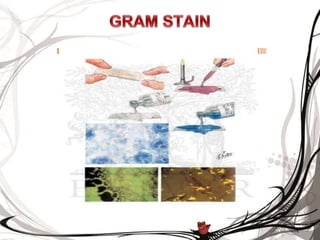
Smear the sputum
Stained by
Gentian violet stain
Keep for 1 min.
Bacteria get violet color
Pour
Gram’s Iodine
For 1 min.
Wash with Alcohol
Wash with water and dry
Mount under oil immersion
Examine the smear for pus cells and predominat bacteria.
Look specially among the pus cells for:-
 Gram positive Diplococci (capsulated) that could be S.
Pneumoniae,.
 Gram positive cocci in groups that could be S. Aureus.
 Gram negative Rods & cocco-bacilli that could be H.
influenza.
 Gram negative Diplococci in and between pus cells that
could be M. catarrhalis.
 Chance of detecting AFB in sputum smears are
significantly increased if the organisms are first
concentrated by centrifugation sodium
hypochlorite(Bleach) is recommended for liquefying the
sputum because it kills M. Tuberculosis.
 NaOC1 centrifugation technique to concentrate AFB
1:Transfer 1-2 ml of sputum to a screw cap universal
bottle.
2:Add an equal volume of concentrated NaOC1 solution
and mix well.
3:Leave at room temperature for 10-15 min shaking at
interval to break down the mucus in the sputum.
4:Add about 8ml of distilled water mix well.
5:Centrifuge at 3000g for 15 min.
6:Using a glass pasture pipette to remove and discard the
supernatant fluid. Mix the sediment.Transfer a drop of
well mixed sediment to a clean glass slide. Make a thin
smear & Allow to air dry.
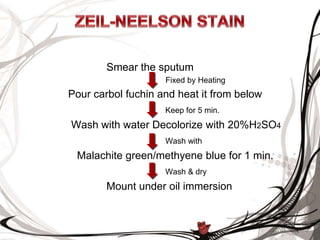
Smear the sputum
Fixed by Heating
Pour carbol fuchin and heat it from below
Keep for 5 min.
Wash with water Decolorize with 20%H2SO4
Wash with
Malachite green/methyene blue for 1 min.
Wash & dry
Mount under oil immersion
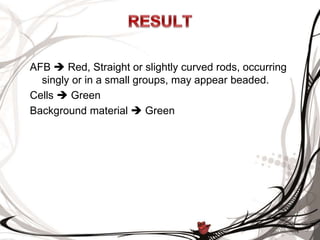
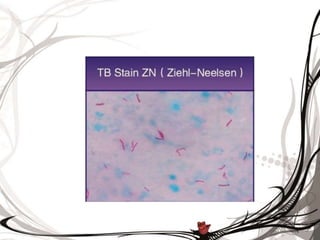
AFB  Red, Straight or slightly curved rods, occurring
singly or in a small groups, may appear beaded.
Cells  Green
Background material  Green
To obtain as pure a culture as possible of a respiratory
pathogens it is necessary to reduce the number of
commensals inoculated. Ways of reducing commensal
number include washing the sputum free from sliva or
liquefying and diluting it. The technique using saline-
washed sputum described. The dilution technique
requires a liquid agent such as dithiothreitol (Sputolysin,
Sputasol) which is expensive and unstable.
Each specimen received for culture should be plated on
agar.
Different agars:-
1: Blood agar
2: Chocolate agar
3: MacConkey’s agar
4: Thioglycollate broth
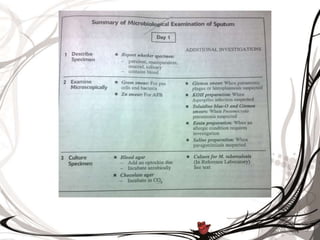
1: Wash a purulent part of sputum in about 5ml of sterile
physiological saline.
2: Inoculate the washed sputum on plate of:
Blood agar
Chocolate agar
3: Add an aptochin disc to the blood plate within the area
of 2nd spread. This will help to identify S. pneumoniae.
4: Incubate the blood agar plate aerobically and the
chocolate agar plate in a carbon dioxide enriched
atmosphere.
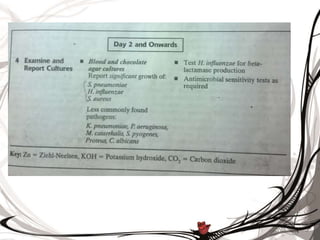
Examine and report the cultures
Blood agar and chocolate agar cultures:-
Look especially for a significant growth of:
streptococcus Pneumoniae
Haemophilus influenzae
Stephlococcus aureus
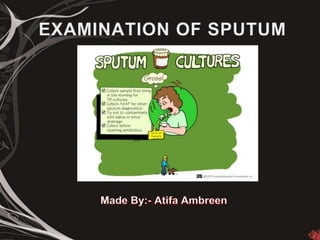
Examination of sputum

Examination of sputum

  • 3.
     .A sputumculture is test to be detect and identify bacteria or fungi that infect the lungs or breathing passages & cause infections. Sputum is a thick fluid produced in the lungs and in the adjacent airways.
  • 4.
     BACTERIA Gram Positive Streptococcuspneumoniae Strephylococcus Aureus Streptococcus pyogenes Gram Negative Haemophilus influenzae Klebsiella pneumoniae Pseudomonas aeruginosa Proteus Species Yersina pestis
  • 5.
     Mycobacterium tuberclosis Mycoplasmapneumoniae & Legionella Pneumophila  FUNGI & ACTINOMYCETES Pneumosystis carinii Blastomyces dermatidis Histoplasma capsulatum Aspergillus species Candida Albicans Nocardia species  PARASITES Paragonimus Species
  • 6.
     Production ofsputum  Collection of sample  Examination  Macroscopic  Microscopic
  • 7.
    1.Before collecting sputumthe mouth should be prerinsed and this removes contaminants from oral cavity. 2.Give the patient a clean dry wide necked leak-proof container and request him or her to cough deeply to produce a sputum specimen. 3.For best results early morning freshly expectorated sputum specimen should be collected.
  • 8.
    4.Label the container,and complete the request form. 5.When Pneumonia or Bronchopneumonia is suspected, deliver the sputum to the laboratory with a little delay as soon as possible because organisms such as S. pneumoniae & H. influenzae require culturing as soon as possible. Specimen for the isolation for S. Pneumoniae & H. Influenzae must never be refrigerated.
  • 10.
    Appearance:- Purulent: Green Looking,mostly pus Mucopurulent: Green Looking with pus & mucus. Mucoid: Mostly mucus Mucoslivary: Mucus with small amount of sliva.
  • 11.
    Microscopic:- After macroscopic examinationtransfer material to a clean slides. Smears made on clear slides should be air dried, fixed over flame and stained. Different stains used:- 1:- Gram’s stain 2:- Ziehl-Neelsen stain for AFB
  • 12.
    Smear the sputum Stainedby Gentian violet stain Keep for 1 min. Bacteria get violet color Pour Gram’s Iodine For 1 min. Wash with Alcohol
  • 13.
    Wash with waterand dry Mount under oil immersion
  • 15.
    Examine the smearfor pus cells and predominat bacteria. Look specially among the pus cells for:-  Gram positive Diplococci (capsulated) that could be S. Pneumoniae,.  Gram positive cocci in groups that could be S. Aureus.  Gram negative Rods & cocco-bacilli that could be H. influenza.  Gram negative Diplococci in and between pus cells that could be M. catarrhalis.
  • 16.
     Chance ofdetecting AFB in sputum smears are significantly increased if the organisms are first concentrated by centrifugation sodium hypochlorite(Bleach) is recommended for liquefying the sputum because it kills M. Tuberculosis.  NaOC1 centrifugation technique to concentrate AFB 1:Transfer 1-2 ml of sputum to a screw cap universal bottle. 2:Add an equal volume of concentrated NaOC1 solution and mix well.
  • 17.
    3:Leave at roomtemperature for 10-15 min shaking at interval to break down the mucus in the sputum. 4:Add about 8ml of distilled water mix well. 5:Centrifuge at 3000g for 15 min. 6:Using a glass pasture pipette to remove and discard the supernatant fluid. Mix the sediment.Transfer a drop of well mixed sediment to a clean glass slide. Make a thin smear & Allow to air dry.
  • 18.
    Smear the sputum Fixedby Heating Pour carbol fuchin and heat it from below Keep for 5 min. Wash with water Decolorize with 20%H2SO4 Wash with Malachite green/methyene blue for 1 min. Wash & dry Mount under oil immersion
  • 19.
    AFB  Red,Straight or slightly curved rods, occurring singly or in a small groups, may appear beaded. Cells  Green Background material  Green
  • 21.
    To obtain aspure a culture as possible of a respiratory pathogens it is necessary to reduce the number of commensals inoculated. Ways of reducing commensal number include washing the sputum free from sliva or liquefying and diluting it. The technique using saline- washed sputum described. The dilution technique requires a liquid agent such as dithiothreitol (Sputolysin, Sputasol) which is expensive and unstable.
  • 22.
    Each specimen receivedfor culture should be plated on agar. Different agars:- 1: Blood agar 2: Chocolate agar 3: MacConkey’s agar 4: Thioglycollate broth
  • 23.
    1: Wash apurulent part of sputum in about 5ml of sterile physiological saline. 2: Inoculate the washed sputum on plate of: Blood agar Chocolate agar 3: Add an aptochin disc to the blood plate within the area of 2nd spread. This will help to identify S. pneumoniae. 4: Incubate the blood agar plate aerobically and the chocolate agar plate in a carbon dioxide enriched atmosphere.
  • 24.
    Examine and reportthe cultures Blood agar and chocolate agar cultures:- Look especially for a significant growth of: streptococcus Pneumoniae Haemophilus influenzae Stephlococcus aureus