Specimens collection (1)Specimens collection (1)
INTRODUCTION :INTRODUCTION :
๏‚— The result of any laboratory
examination is only as good as the
sample received in the laboratory
๏‚— The quality of the work a laboratory
produces is only as good as the
quality of the samples it uses for
testing. The laboratory should ensure
that the samples it receives meet all of
the requirements needed to produce
accurate test results.
๏‚— The result of any laboratory
examination is only as good as the
sample received in the laboratory
๏‚— The quality of the work a laboratory
produces is only as good as the
quality of the samples it uses for
testing. The laboratory should ensure
that the samples it receives meet all of
the requirements needed to produce
accurate test results.
Sample ManagementSample Management
o
d
s
a
m
p
l
e
m
a
n
a
g
e
m
e
n
t
t
o
a
c
c
u
r
a
t
e
l
a
b
o
r
a
t
o
r
y
d
i
a
g
n
o
s
i
s
u
e
n
c
e
s
t
h
e
r
a
p
e
u
t
i
c
d
e
c
i
s
i
o
n
s
f
f
e
c
t
s
p
a
t
i
e
n
t
c
a
r
e
a
n
d
o
u
t
c
o
m
e
e
n
c
e
s
l
a
b
o
r
a
t
o
r
y
e
f
f
i
c
i
e
n
c
y
o
d
s
a
m
p
l
e
m
a
n
a
g
e
m
e
n
t
t
o
a
c
c
u
r
a
t
e
l
a
b
o
r
a
t
o
r
y
d
i
a
g
n
o
s
i
s
u
e
n
c
e
s
t
h
e
r
a
p
e
u
t
i
c
d
e
c
i
s
i
o
n
s
f
f
e
c
t
s
p
a
t
i
e
n
t
c
a
r
e
a
n
d
o
u
t
c
o
m
e
e
n
c
e
s
l
a
b
o
r
a
t
o
r
y
e
f
f
i
c
i
e
n
c
y
Sample Management cont,Sample Management cont,
๏‚—Sample Collection
๏‚—Sample Labeling and documentation
๏‚—Sample Transport
๏‚—Sample Referral
๏‚—Sample Storage
๏‚—Sample Disposal
๏‚—Sample Collection
๏‚—Sample Labeling and documentation
๏‚—Sample Transport
๏‚—Sample Referral
๏‚—Sample Storage
๏‚—Sample Disposal
Sample Management cont,Sample Management cont,
๏‚— Sample collection and preservation will vary,
depending on the test and the type of sample
to be collected. The laboratory must carefully
define a sample collection process for all
tests it performs. The following should be
considered when preparing instructions:
๏‚— Patient preparationโ€”Some tests require
that the patient be fasting. There may also
be special timing issues for tests such as
blood glucose, drug levels, and hormone
tests.
๏‚— Sample collection and preservation will vary,
depending on the test and the type of sample
to be collected. The laboratory must carefully
define a sample collection process for all
tests it performs. The following should be
considered when preparing instructions:
๏‚— Patient preparationโ€”Some tests require
that the patient be fasting. There may also
be special timing issues for tests such as
blood glucose, drug levels, and hormone
tests.
Sample Management cont,Sample Management cont,
๏‚— Patient identificationโ€”The person
collecting the sample must accurately
identify the patient. This might be
done by questioning the patient, by
questioning an accompanying family
member, or by the use of an
identifying wrist band or other device.
๏‚— Patient identificationโ€”The person
collecting the sample must accurately
identify the patient. This might be
done by questioning the patient, by
questioning an accompanying family
member, or by the use of an
identifying wrist band or other device.
Sample Management cont,Sample Management cont,
๏‚— Type of sample requiredโ€”Blood
tests might require serum, plasma, or
whole blood. Other tests might
require urine or saliva. Microbiology
testing deals with a variety of sample
types, so specific information as to
what is required for the test is needed.
๏‚— Type of sample requiredโ€”Blood
tests might require serum, plasma, or
whole blood. Other tests might
require urine or saliva. Microbiology
testing deals with a variety of sample
types, so specific information as to
what is required for the test is needed.
Sample Management cont,Sample Management cont,
๏‚— Type of containerโ€”The container for
the sample is often very important, as it
will affect volume and any needed
additives such as anti-coagulants and
preservatives. If the container does not
control volume, for example as with
Vacutainerยฎ tubes, this will need to be
clearly specified. Some microbiology
samples will require specific transport
media to preserve microorganisms.
๏‚— Type of containerโ€”The container for
the sample is often very important, as it
will affect volume and any needed
additives such as anti-coagulants and
preservatives. If the container does not
control volume, for example as with
Vacutainerยฎ tubes, this will need to be
clearly specified. Some microbiology
samples will require specific transport
media to preserve microorganisms.
Sample Management cont,Sample Management cont,
๏‚— Sample labelingโ€”All requirements for
labeling of the sample at the time of
collection will need to be explained in
detail in the instructions for collection.
๏‚— Special handlingโ€”Some samples may
require special handling, such as
immediate refrigeration, protection from
light, or prompt delivery to the laboratory.
Any important safety precautions
should be explained.
๏‚— Sample labelingโ€”All requirements for
labeling of the sample at the time of
collection will need to be explained in
detail in the instructions for collection.
๏‚— Special handlingโ€”Some samples may
require special handling, such as
immediate refrigeration, protection from
light, or prompt delivery to the laboratory.
Any important safety precautions
should be explained.
Sample management entails theSample management entails the
following:following:
โ€ข Information needed on requisitions or forms
โ€ข Handling urgent requests
โ€ข Collection, labeling, preservation and
transport
โ€ข Safety practices (leaking or broken
containers, contaminated forms, other
biohazards)
โ€ข Processing and tracking samples
โ€ข Storage, retention, and disposal.
โ€ข Information needed on requisitions or forms
โ€ข Handling urgent requests
โ€ข Collection, labeling, preservation and
transport
โ€ข Safety practices (leaking or broken
containers, contaminated forms, other
biohazards)
โ€ข Processing and tracking samples
โ€ข Storage, retention, and disposal.
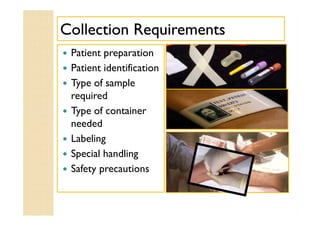
Collection RequirementsCollection Requirements
๏‚— Patient preparation
๏‚— Patient identification
๏‚— Type of sample
required
๏‚— Type of container
needed
๏‚— Labeling
๏‚— Special handling
๏‚— Safety precautions
๏‚— Patient preparation
๏‚— Patient identification
๏‚— Type of sample
required
๏‚— Type of container
needed
๏‚— Labeling
๏‚— Special handling
๏‚— Safety precautions
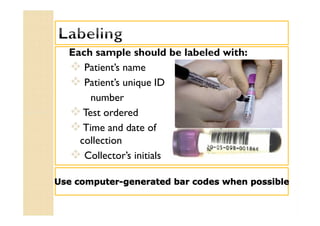
Each sample should be labeled with:
๏ถ Patientโ€™s name
๏ถ Patientโ€™s unique ID
number
๏ถTest ordered
๏ถTime and date of
collection
๏ถ Collectorโ€™s initials
Each sample should be labeled with:
๏ถ Patientโ€™s name
๏ถ Patientโ€™s unique ID
number
๏ถTest ordered
๏ถTime and date of
collection
๏ถ Collectorโ€™s initials
Use computer-generated bar codes when possible
SAMPLES REJECTION CRITERIASAMPLES REJECTION CRITERIA
๏‚— The laboratory should establish rejection
criteria and follow them closely. It is the
responsibility of the laboratory to enforce
its policies on sample rejection so that
patient care is not compromised.
๏‚— Management should regularly review the
number of rejected samples and reasons
for rejections, conduct training on sample
collection, and revise written procedures
for sample management as needed.
๏‚— The laboratory should establish rejection
criteria and follow them closely. It is the
responsibility of the laboratory to enforce
its policies on sample rejection so that
patient care is not compromised.
๏‚— Management should regularly review the
number of rejected samples and reasons
for rejections, conduct training on sample
collection, and revise written procedures
for sample management as needed.
The following are examples ofThe following are examples of
samples that should be rejected:samples that should be rejected:
1. Unlabeled sample;
2. Broken or leaking tube/container;
3. Insufficient patient information;
4. Sample label and patient name on
the test request form do not match;
5. Haemolyzed sample (depending on
test requested);
1. Unlabeled sample;
2. Broken or leaking tube/container;
3. Insufficient patient information;
4. Sample label and patient name on
the test request form do not match;
5. Haemolyzed sample (depending on
test requested);
The examples of samples thatThe examples of samples that
should be rejected cont,should be rejected cont,
6. Non-fasting samples, for tests that
require fasting;
7. Sample collected in wrong
tube/container; for example, using the
wrong preservative or non-sterile
container;
8. Inadequate volume for the quantity of
preservative;
9. Insufficient quantity for the test
requested;
10. Prolonged transport time, or other
poor handling during transport.
6. Non-fasting samples, for tests that
require fasting;
7. Sample collected in wrong
tube/container; for example, using the
wrong preservative or non-sterile
container;
8. Inadequate volume for the quantity of
preservative;
9. Insufficient quantity for the test
requested;
10. Prolonged transport time, or other
poor handling during transport.
Outcomes of Improper CollectionOutcomes of Improper Collection
๏‚— Delays in reporting test results
๏‚— Unnecessary re-draws/re-tests
๏‚— Decreased customer satisfaction
๏‚— Increased costs
๏‚— Incorrect diagnosis / treatment
๏‚— Injury
๏‚— Death
๏‚— Delays in reporting test results
๏‚— Unnecessary re-draws/re-tests
๏‚— Decreased customer satisfaction
๏‚— Increased costs
๏‚— Incorrect diagnosis / treatment
๏‚— Injury
๏‚— Death
TYPES OF SPECIMENS :TYPES OF SPECIMENS :
๏‚— Specimens consist
โ—ฆ Blood
โ—ฆ Urine
โ—ฆ Stool
โ—ฆ Sputum
โ—ฆ Wound drainage
โ—ฆ Others
๏‚— Specimens consist
โ—ฆ Blood
โ—ฆ Urine
โ—ฆ Stool
โ—ฆ Sputum
โ—ฆ Wound drainage
โ—ฆ Others
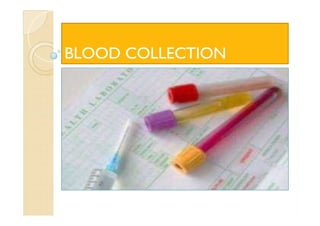
BLOOD COLLECTIONBLOOD COLLECTION
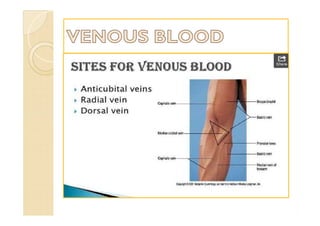
๏‚— Veins : Anticubital vein, veins of arm,
dorsum of hands, long saphenous vein,
femoral vein, umbilical and scalp vein.
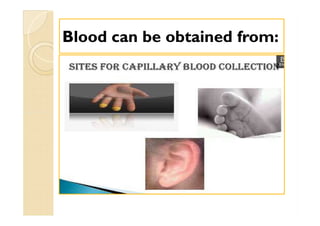
๏‚— Capillaries : Finger tips, lobule of ear, heel
and thumb.
๏‚— Arteries : femoral artery .
๏‚— Veins : Anticubital vein, veins of arm,
dorsum of hands, long saphenous vein,
femoral vein, umbilical and scalp vein.
๏‚— Capillaries : Finger tips, lobule of ear, heel
and thumb.
๏‚— Arteries : femoral artery .
๏‚— Veins : Anticubital vein, veins of arm,
dorsum of hands, long saphenous vein,
femoral vein, umbilical and scalp vein.
๏‚— Capillaries : Finger tips, lobule of ear, heel
and thumb.
๏‚— Arteries : femoral artery .
๏‚— Veins : Anticubital vein, veins of arm,
dorsum of hands, long saphenous vein,
femoral vein, umbilical and scalp vein.
๏‚— Capillaries : Finger tips, lobule of ear, heel
and thumb.
๏‚— Arteries : femoral artery .
BLOOD COLLECTION TOOLSBLOOD COLLECTION TOOLS
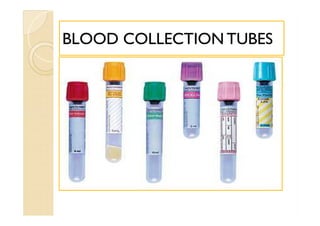
BLOOD COLLECTION TUBESBLOOD COLLECTION TUBES
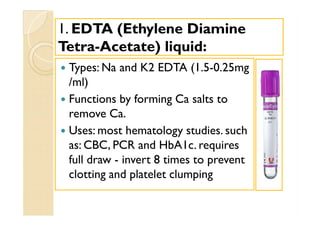
11.. EDTA (Ethylene DiamineEDTA (Ethylene Diamine
TetraTetra--Acetate) liquid:Acetate) liquid:
๏‚— Types: Na and K2 EDTA (1.5-0.25mg
/ml)
๏‚— Functions by forming Ca salts to
remove Ca.
๏‚— Uses: most hematology studies. such
as: CBC, PCR and HbA1c. requires
full draw - invert 8 times to prevent
clotting and platelet clumping
๏‚— Types: Na and K2 EDTA (1.5-0.25mg
/ml)
๏‚— Functions by forming Ca salts to
remove Ca.
๏‚— Uses: most hematology studies. such
as: CBC, PCR and HbA1c. requires
full draw - invert 8 times to prevent
clotting and platelet clumping
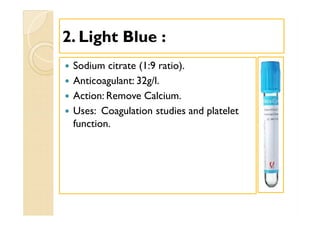
22. Light Blue :. Light Blue :
๏‚— Sodium citrate (1:9 ratio).
๏‚— Anticoagulant: 32g/l.
๏‚— Action: Remove Calcium.
๏‚— Uses: Coagulation studies and platelet
function.
๏‚— Sodium citrate (1:9 ratio).
๏‚— Anticoagulant: 32g/l.
๏‚— Action: Remove Calcium.
๏‚— Uses: Coagulation studies and platelet
function.
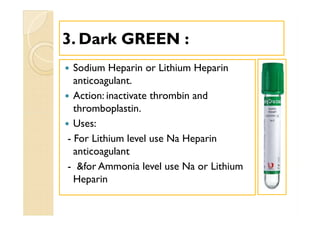
33. Dark GREEN :. Dark GREEN :
๏‚— Sodium Heparin or Lithium Heparin
anticoagulant.
๏‚— Action: inactivate thrombin and
thromboplastin.
๏‚— Uses:
- For Lithium level use Na Heparin
anticoagulant
- &for Ammonia level use Na or Lithium
Heparin
๏‚— Sodium Heparin or Lithium Heparin
anticoagulant.
๏‚— Action: inactivate thrombin and
thromboplastin.
๏‚— Uses:
- For Lithium level use Na Heparin
anticoagulant
- &for Ammonia level use Na or Lithium
Heparin
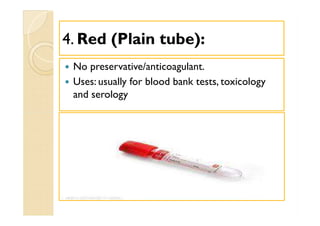
44.. Red (Plain tube):Red (Plain tube):
๏‚— No preservative/anticoagulant.
๏‚— Uses: usually for blood bank tests, toxicology
and serology
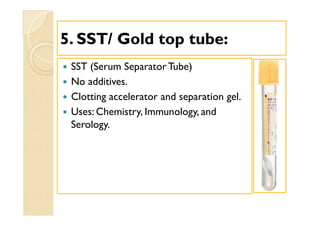
55. SST/ Gold top tube:. SST/ Gold top tube:
๏‚— SST (Serum Separator Tube)
๏‚— No additives.
๏‚— Clotting accelerator and separation gel.
๏‚— Uses: Chemistry, Immunology, and
Serology.
๏‚— SST (Serum Separator Tube)
๏‚— No additives.
๏‚— Clotting accelerator and separation gel.
๏‚— Uses: Chemistry, Immunology, and
Serology.
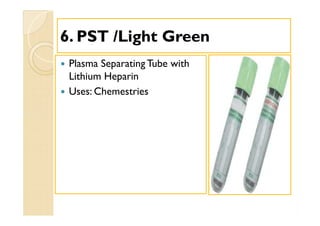
66. PST /Light Green. PST /Light Green
๏‚— Plasma Separating Tube with
Lithium Heparin
๏‚— Uses: Chemestries
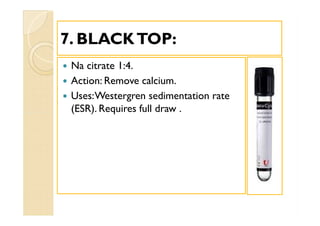
77. BLACKTOP:. BLACKTOP:
๏‚— Na citrate 1:4.
๏‚— Action: Remove calcium.
๏‚— Uses:Westergren sedimentation rate
(ESR). Requires full draw .
๏‚— Na citrate 1:4.
๏‚— Action: Remove calcium.
๏‚— Uses:Westergren sedimentation rate
(ESR). Requires full draw .
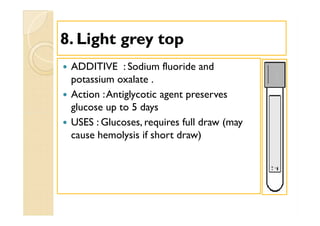
88. Light grey top. Light grey top
๏‚— ADDITIVE : Sodium fluoride and
potassium oxalate .
๏‚— Action :Antiglycotic agent preserves
glucose up to 5 days
๏‚— USES : Glucoses, requires full draw (may
cause hemolysis if short draw)
๏‚— ADDITIVE : Sodium fluoride and
potassium oxalate .
๏‚— Action :Antiglycotic agent preserves
glucose up to 5 days
๏‚— USES : Glucoses, requires full draw (may
cause hemolysis if short draw)
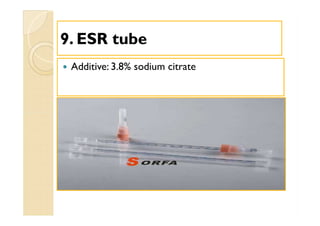
99. ESR tube. ESR tube
๏‚— Additive: 3.8% sodium citrate
๏‚— For fasting BS- empty stomach with a
preferable fasting of 8-10 hours
๏‚— For PPBS- a full meal or 75 gm of glucose
intake
๏‚— For lipid profile- a fasting sample of not
less than 12 hours, no fatty foods in
previous meal
๏‚— No alcohol before sample collection
๏‚— For fasting BS- empty stomach with a
preferable fasting of 8-10 hours
๏‚— For PPBS- a full meal or 75 gm of glucose
intake
๏‚— For lipid profile- a fasting sample of not
less than 12 hours, no fatty foods in
previous meal
๏‚— No alcohol before sample collection
๏‚— For fasting BS- empty stomach with a
preferable fasting of 8-10 hours
๏‚— For PPBS- a full meal or 75 gm of glucose
intake
๏‚— For lipid profile- a fasting sample of not
less than 12 hours, no fatty foods in
previous meal
๏‚— No alcohol before sample collection
๏‚— For fasting BS- empty stomach with a
preferable fasting of 8-10 hours
๏‚— For PPBS- a full meal or 75 gm of glucose
intake
๏‚— For lipid profile- a fasting sample of not
less than 12 hours, no fatty foods in
previous meal
๏‚— No alcohol before sample collection
VENOUS BLOOD cont,VENOUS BLOOD cont,
๏‚— Most commonly required โ€ฆ.WHY??
๏‚— Because most majority of routine tests
are performed on venous blood.
๏‚— Blood can be taken directly from the vein.
๏‚— The best site for venous collection is the
deep veins of the ante-cubital fossa.
๏‚— Most commonly required โ€ฆ.WHY??
๏‚— Because most majority of routine tests
are performed on venous blood.
๏‚— Blood can be taken directly from the vein.
๏‚— The best site for venous collection is the
deep veins of the ante-cubital fossa.
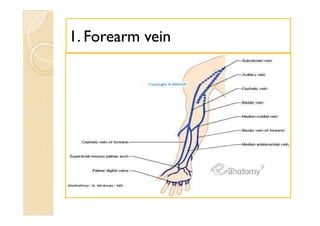
11. Forearm vein. Forearm vein
If difficult to obtain from the anteIf difficult to obtain from the ante--cubitalcubital fossafossa
we can draw blood from following various site:we can draw blood from following various site:
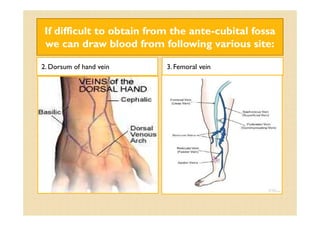
2. Dorsum of hand vein 3. Femoral vein
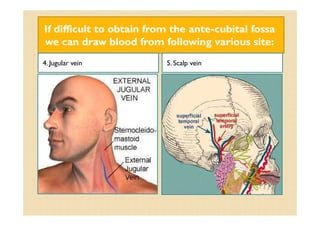
If difficult to obtain from the anteIf difficult to obtain from the ante--cubitalcubital fossafossa
we can draw blood from following various site:we can draw blood from following various site:
4. Jugular vein 5. Scalp vein
๏‚— Purpose :
๏ƒผPatient identification
๏ƒผOrganization of equipment
๏ƒผCollection of appropriate specimens
๏‚— Purpose :
๏ƒผPatient identification
๏ƒผOrganization of equipment
๏ƒผCollection of appropriate specimens
๏‚— Introduce yourself
๏ƒ˜ Begin communication process
๏ƒ˜ Look and listen
๏ƒ˜ Explain purpose of visit
๏ƒ˜ Informed consent
๏ƒ˜ Patient has the right to refuse - Patient Bill of
Rights
๏‚— Guilty of assault if patient has the perception that
blood collector is ignoring his or her refusal
๏‚— Wake a sleeping patient
๏‚— Greet unconscious patients
๏‚— Introduce yourself
๏ƒ˜ Begin communication process
๏ƒ˜ Look and listen
๏ƒ˜ Explain purpose of visit
๏ƒ˜ Informed consent
๏ƒ˜ Patient has the right to refuse - Patient Bill of
Rights
๏‚— Guilty of assault if patient has the perception that
blood collector is ignoring his or her refusal
๏‚— Wake a sleeping patient
๏‚— Greet unconscious patients
๏‚— THIS ISTHE MOST IMPORTANT STEP !
๏‚— Written protocol
๏ƒ˜ Hospital inpatients
๏ƒ˜Outpatients
๏‚— THIS ISTHE MOST IMPORTANT STEP !
๏‚— Written protocol
๏ƒ˜ Hospital inpatients
๏ƒ˜Outpatients
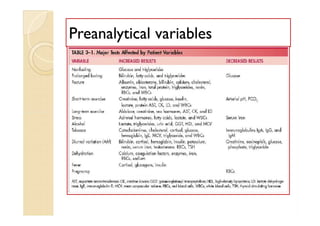
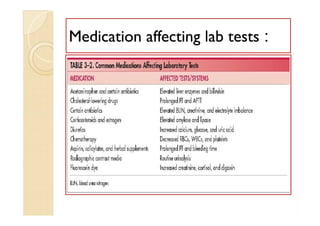
PreanalyticalPreanalytical variablesvariables
::Medication affecting lab testsMedication affecting lab tests
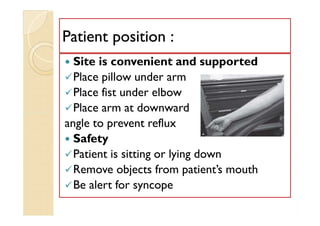
Patient position :Patient position :
๏‚— Site is convenient and supported
๏ƒผPlace pillow under arm
๏ƒผPlace fist under elbow
๏ƒผPlace arm at downward
angle to prevent reflux
๏‚— Safety
๏ƒผPatient is sitting or lying down
๏ƒผRemove objects from patientโ€™s mouth
๏ƒผBe alert for syncope
๏‚— Site is convenient and supported
๏ƒผPlace pillow under arm
๏ƒผPlace fist under elbow
๏ƒผPlace arm at downward
angle to prevent reflux
๏‚— Safety
๏ƒผPatient is sitting or lying down
๏ƒผRemove objects from patientโ€™s mouth
๏ƒผBe alert for syncope
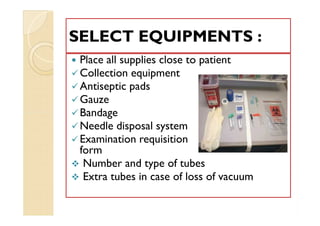
SELECT EQUIPMENTS :SELECT EQUIPMENTS :
๏‚— Place all supplies close to patient
๏ƒผCollection equipment
๏ƒผAntiseptic pads
๏ƒผGauze
๏ƒผBandage
๏ƒผNeedle disposal system
๏ƒผExamination requisition
form
๏ถ Number and type of tubes
๏ถ Extra tubes in case of loss of vacuum
๏‚— Place all supplies close to patient
๏ƒผCollection equipment
๏ƒผAntiseptic pads
๏ƒผGauze
๏ƒผBandage
๏ƒผNeedle disposal system
๏ƒผExamination requisition
form
๏ถ Number and type of tubes
๏ถ Extra tubes in case of loss of vacuum
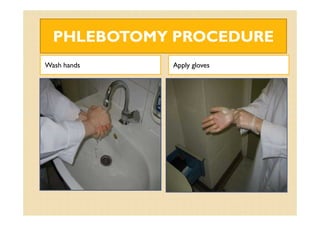
PHLEBOTOMY PROCEDUREPHLEBOTOMY PROCEDURE
Wash hands Apply gloves
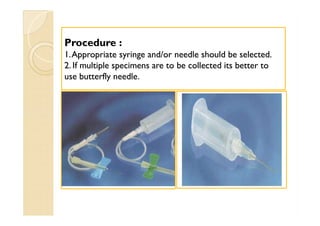
Procedure :Procedure :
11.Appropriate syringe and/or needle should be selected..Appropriate syringe and/or needle should be selected.
22. If multiple specimens are to be collected its better to. If multiple specimens are to be collected its better to
use butterfly needle.use butterfly needle.
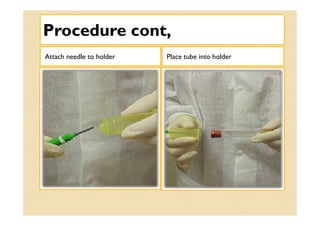
Procedure cont,Procedure cont,
Attach needle to holder Place tube into holder
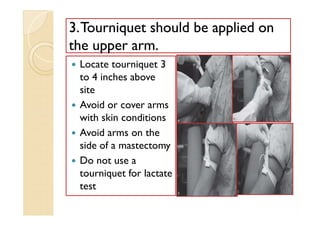
33.Tourniquet should be applied on.Tourniquet should be applied on
the upper arm.the upper arm.
๏‚— Locate tourniquet 3
to 4 inches above
site
๏‚— Avoid or cover arms
with skin conditions
๏‚— Avoid arms on the
side of a mastectomy
๏‚— Do not use a
tourniquet for lactate
test
๏‚— Locate tourniquet 3
to 4 inches above
site
๏‚— Avoid or cover arms
with skin conditions
๏‚— Avoid arms on the
side of a mastectomy
๏‚— Do not use a
tourniquet for lactate
test
Length Of Application :Length Of Application :
๏‚— Maximum time is 1 minute
๏‚— Apply for site selection
๏‚— Release for 2 minutes
๏‚— Reapply
๏‚— Release when blood flows
๏‚— Prolonged tourniquet application :
๏ƒ˜Causes hemoconcentration
๏ƒผ Increase in the ratio of certain analytes to
plasma
๏ƒผ Biochemical changes take place in the
trapped blood
๏‚— Maximum time is 1 minute
๏‚— Apply for site selection
๏‚— Release for 2 minutes
๏‚— Reapply
๏‚— Release when blood flows
๏‚— Prolonged tourniquet application :
๏ƒ˜Causes hemoconcentration
๏ƒผ Increase in the ratio of certain analytes to
plasma
๏ƒผ Biochemical changes take place in the
trapped blood
Too tightly applied tourniquet :Too tightly applied tourniquet :
Causes :
๏‚— Uncomfortable for patient
๏‚— Obstruct blood flow
๏‚— No radial pulse
๏‚— Appearance of petechiae
Causes :
๏‚— Uncomfortable for patient
๏‚— Obstruct blood flow
๏‚— No radial pulse
๏‚— Appearance of petechiae
Procedure cont,Procedure cont,
4. Sterilize puncture area with a
spirit/alcohol swab and allow it to dry.
5.Visualize and palpate the vein.
๏ƒ˜Feeling is more important than sight
๏ƒ˜Probe with index finger, thumb has a pulse
๏ƒ˜Push, donโ€™t stroke
๏ƒ˜Determine: size, depth, direction
๏ƒ˜Remember: veins are spongy, tendons are
rigid, arteries have a pulse
4. Sterilize puncture area with a
spirit/alcohol swab and allow it to dry.
5.Visualize and palpate the vein.
๏ƒ˜Feeling is more important than sight
๏ƒ˜Probe with index finger, thumb has a pulse
๏ƒ˜Push, donโ€™t stroke
๏ƒ˜Determine: size, depth, direction
๏ƒ˜Remember: veins are spongy, tendons are
rigid, arteries have a pulse
Having difficulty locating a vein ?Having difficulty locating a vein ?
๏‚— Check both arms
๏‚— Listen to patientโ€™s suggestions of
previously successful areas
Enhancement of the vein :
๏ƒผMassage the arm upward from the wrist
๏ƒผBriefly hang the arm down
๏ƒผApply heat
๏ƒผTransilluminator device
๏‚— Check both arms
๏‚— Listen to patientโ€™s suggestions of
previously successful areas
Enhancement of the vein :
๏ƒผMassage the arm upward from the wrist
๏ƒผBriefly hang the arm down
๏ƒผApply heat
๏ƒผTransilluminator device
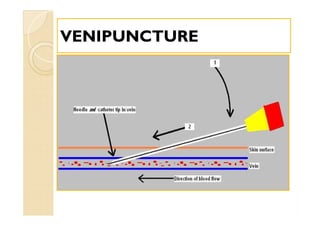
6. Donโ€™t enter the vein directly and vertically.
Why?
๏ƒ˜Because there is more chance of puncturing
the other side of the venous wall by this
way.
๏ƒ˜Insert the needle :
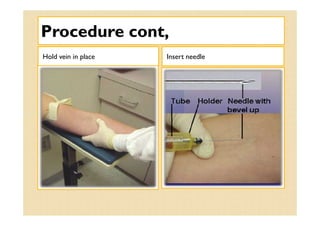
๏‚— Bevel up
๏‚— 15-to-30 degree angle
๏‚— Resistance lessens when the needle enters
the vein
Procedure cont,Procedure cont,
6. Donโ€™t enter the vein directly and vertically.
Why?
๏ƒ˜Because there is more chance of puncturing
the other side of the venous wall by this
way.
๏ƒ˜Insert the needle :
๏‚— Bevel up
๏‚— 15-to-30 degree angle
๏‚— Resistance lessens when the needle enters
the vein
Procedure cont,Procedure cont,
Hold vein in place Insert needle
VENIPUNCTUREVENIPUNCTURE
Procedure cont,Procedure cont,
7. Draw blood according to required tests.
8.Withdraw the needle. Loosen the
tourniquet.
9. Press down on the gauze, applying
adequate pressure.
10.Apply a piece of band or medi-plast.
11. Dispose of contaminated material in
designated container.
12. Put blood into a suitable container.
7. Draw blood according to required tests.
8.Withdraw the needle. Loosen the
tourniquet.
9. Press down on the gauze, applying
adequate pressure.
10.Apply a piece of band or medi-plast.
11. Dispose of contaminated material in
designated container.
12. Put blood into a suitable container.
TROUBLESHOOTING GUIDELINES:TROUBLESHOOTING GUIDELINES:
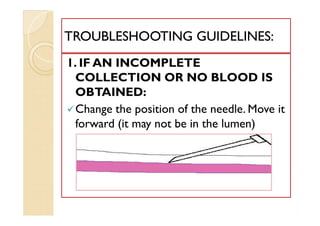
1. IF AN INCOMPLETE
COLLECTION OR NO BLOOD IS
OBTAINED:
๏ƒผChange the position of the needle. Move it
forward (it may not be in the lumen)
1. IF AN INCOMPLETE
COLLECTION OR NO BLOOD IS
OBTAINED:
๏ƒผChange the position of the needle. Move it
forward (it may not be in the lumen)
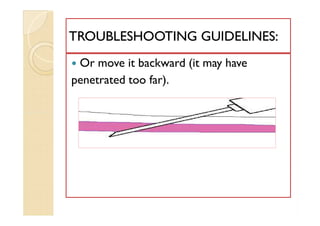
๏‚— Or move it backward (it may have
penetrated too far).
TROUBLESHOOTING GUIDELINES:TROUBLESHOOTING GUIDELINES:
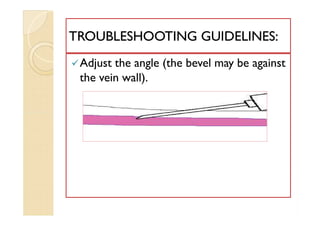
๏ƒผAdjust the angle (the bevel may be against
the vein wall).
TROUBLESHOOTING GUIDELINES:TROUBLESHOOTING GUIDELINES:
๏ƒผLoosen the tourniquet.
๏ƒผTry another tube.There may be no
vacuum in the one being used.
๏ƒผRe-anchor the vein.Veins sometimes roll
away from the point of the needle and
puncture site.
TROUBLESHOOTING GUIDELINES:TROUBLESHOOTING GUIDELINES:
๏ƒผLoosen the tourniquet.
๏ƒผTry another tube.There may be no
vacuum in the one being used.
๏ƒผRe-anchor the vein.Veins sometimes roll
away from the point of the needle and
puncture site.
2. IF BLOOD STOPS FLOWING INTO
THETUBE:
๏‚— The vein may have collapsed; resecure the
tourniquet to increase venous filling. If this is
not successful, remove the needle, take care
of the puncture site, and redraw.
๏‚— The needle may have pulled out of the vein
when switching tubes. Hold equipment firmly
and place fingers against patient's arm, using
the flange for leverage when withdrawing
and inserting tubes.
TROUBLESHOOTING GUIDELINES:TROUBLESHOOTING GUIDELINES:
2. IF BLOOD STOPS FLOWING INTO
THETUBE:
๏‚— The vein may have collapsed; resecure the
tourniquet to increase venous filling. If this is
not successful, remove the needle, take care
of the puncture site, and redraw.
๏‚— The needle may have pulled out of the vein
when switching tubes. Hold equipment firmly
and place fingers against patient's arm, using
the flange for leverage when withdrawing
and inserting tubes.
3. PROBLEMS OTHERTHAN AN
INCOMPLETE COLLECTION:
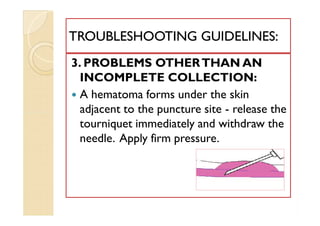
๏‚— A hematoma forms under the skin
adjacent to the puncture site - release the
tourniquet immediately and withdraw the
needle. Apply firm pressure.
TROUBLESHOOTING GUIDELINES:TROUBLESHOOTING GUIDELINES:
3. PROBLEMS OTHERTHAN AN
INCOMPLETE COLLECTION:
๏‚— A hematoma forms under the skin
adjacent to the puncture site - release the
tourniquet immediately and withdraw the
needle. Apply firm pressure.
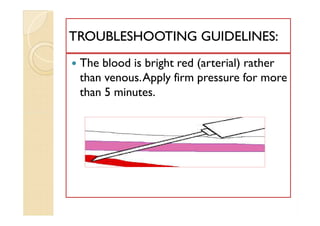
๏‚— The blood is bright red (arterial) rather
than venous.Apply firm pressure for more
than 5 minutes.
TROUBLESHOOTING GUIDELINES:TROUBLESHOOTING GUIDELINES:
๏‚— To draw only a small amount of blood in a
microtube or strip for blood sugar and
bleeding time tests.
๏‚— For infants and young children.
๏‚— To draw only a small amount of blood in a
microtube or strip for blood sugar and
bleeding time tests.
๏‚— For infants and young children.
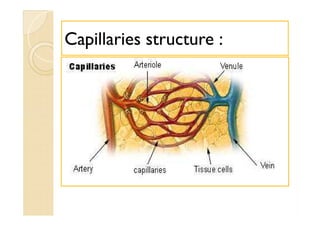
Capillaries structure :Capillaries structure :
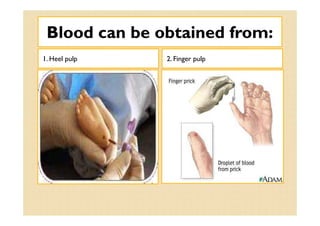
Blood can be obtained from:Blood can be obtained from:
1. Heel pulp 2. Finger pulp
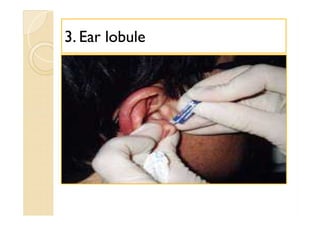
33. Ear lobule. Ear lobule
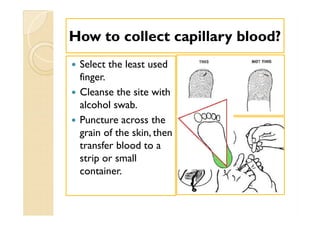
How to collect capillary blood?How to collect capillary blood?
๏‚— Select the least used
finger.
๏‚— Cleanse the site with
alcohol swab.
๏‚— Puncture across the
grain of the skin, then
transfer blood to a
strip or small
container.
๏‚— Select the least used
finger.
๏‚— Cleanse the site with
alcohol swab.
๏‚— Puncture across the
grain of the skin, then
transfer blood to a
strip or small
container.
Specimen collection part 1

Specimen collection part 1

  • 1.
  • 3.
    INTRODUCTION :INTRODUCTION : ๏‚—The result of any laboratory examination is only as good as the sample received in the laboratory ๏‚— The quality of the work a laboratory produces is only as good as the quality of the samples it uses for testing. The laboratory should ensure that the samples it receives meet all of the requirements needed to produce accurate test results. ๏‚— The result of any laboratory examination is only as good as the sample received in the laboratory ๏‚— The quality of the work a laboratory produces is only as good as the quality of the samples it uses for testing. The laboratory should ensure that the samples it receives meet all of the requirements needed to produce accurate test results.
  • 4.
  • 5.
    Sample Management cont,SampleManagement cont, ๏‚—Sample Collection ๏‚—Sample Labeling and documentation ๏‚—Sample Transport ๏‚—Sample Referral ๏‚—Sample Storage ๏‚—Sample Disposal ๏‚—Sample Collection ๏‚—Sample Labeling and documentation ๏‚—Sample Transport ๏‚—Sample Referral ๏‚—Sample Storage ๏‚—Sample Disposal
  • 6.
    Sample Management cont,SampleManagement cont, ๏‚— Sample collection and preservation will vary, depending on the test and the type of sample to be collected. The laboratory must carefully define a sample collection process for all tests it performs. The following should be considered when preparing instructions: ๏‚— Patient preparationโ€”Some tests require that the patient be fasting. There may also be special timing issues for tests such as blood glucose, drug levels, and hormone tests. ๏‚— Sample collection and preservation will vary, depending on the test and the type of sample to be collected. The laboratory must carefully define a sample collection process for all tests it performs. The following should be considered when preparing instructions: ๏‚— Patient preparationโ€”Some tests require that the patient be fasting. There may also be special timing issues for tests such as blood glucose, drug levels, and hormone tests.
  • 7.
    Sample Management cont,SampleManagement cont, ๏‚— Patient identificationโ€”The person collecting the sample must accurately identify the patient. This might be done by questioning the patient, by questioning an accompanying family member, or by the use of an identifying wrist band or other device. ๏‚— Patient identificationโ€”The person collecting the sample must accurately identify the patient. This might be done by questioning the patient, by questioning an accompanying family member, or by the use of an identifying wrist band or other device.
  • 8.
    Sample Management cont,SampleManagement cont, ๏‚— Type of sample requiredโ€”Blood tests might require serum, plasma, or whole blood. Other tests might require urine or saliva. Microbiology testing deals with a variety of sample types, so specific information as to what is required for the test is needed. ๏‚— Type of sample requiredโ€”Blood tests might require serum, plasma, or whole blood. Other tests might require urine or saliva. Microbiology testing deals with a variety of sample types, so specific information as to what is required for the test is needed.
  • 9.
    Sample Management cont,SampleManagement cont, ๏‚— Type of containerโ€”The container for the sample is often very important, as it will affect volume and any needed additives such as anti-coagulants and preservatives. If the container does not control volume, for example as with Vacutainerยฎ tubes, this will need to be clearly specified. Some microbiology samples will require specific transport media to preserve microorganisms. ๏‚— Type of containerโ€”The container for the sample is often very important, as it will affect volume and any needed additives such as anti-coagulants and preservatives. If the container does not control volume, for example as with Vacutainerยฎ tubes, this will need to be clearly specified. Some microbiology samples will require specific transport media to preserve microorganisms.
  • 10.
    Sample Management cont,SampleManagement cont, ๏‚— Sample labelingโ€”All requirements for labeling of the sample at the time of collection will need to be explained in detail in the instructions for collection. ๏‚— Special handlingโ€”Some samples may require special handling, such as immediate refrigeration, protection from light, or prompt delivery to the laboratory. Any important safety precautions should be explained. ๏‚— Sample labelingโ€”All requirements for labeling of the sample at the time of collection will need to be explained in detail in the instructions for collection. ๏‚— Special handlingโ€”Some samples may require special handling, such as immediate refrigeration, protection from light, or prompt delivery to the laboratory. Any important safety precautions should be explained.
  • 11.
    Sample management entailstheSample management entails the following:following: โ€ข Information needed on requisitions or forms โ€ข Handling urgent requests โ€ข Collection, labeling, preservation and transport โ€ข Safety practices (leaking or broken containers, contaminated forms, other biohazards) โ€ข Processing and tracking samples โ€ข Storage, retention, and disposal. โ€ข Information needed on requisitions or forms โ€ข Handling urgent requests โ€ข Collection, labeling, preservation and transport โ€ข Safety practices (leaking or broken containers, contaminated forms, other biohazards) โ€ข Processing and tracking samples โ€ข Storage, retention, and disposal.
  • 12.
    Collection RequirementsCollection Requirements ๏‚—Patient preparation ๏‚— Patient identification ๏‚— Type of sample required ๏‚— Type of container needed ๏‚— Labeling ๏‚— Special handling ๏‚— Safety precautions ๏‚— Patient preparation ๏‚— Patient identification ๏‚— Type of sample required ๏‚— Type of container needed ๏‚— Labeling ๏‚— Special handling ๏‚— Safety precautions
  • 13.
    Each sample shouldbe labeled with: ๏ถ Patientโ€™s name ๏ถ Patientโ€™s unique ID number ๏ถTest ordered ๏ถTime and date of collection ๏ถ Collectorโ€™s initials Each sample should be labeled with: ๏ถ Patientโ€™s name ๏ถ Patientโ€™s unique ID number ๏ถTest ordered ๏ถTime and date of collection ๏ถ Collectorโ€™s initials Use computer-generated bar codes when possible
  • 14.
    SAMPLES REJECTION CRITERIASAMPLESREJECTION CRITERIA ๏‚— The laboratory should establish rejection criteria and follow them closely. It is the responsibility of the laboratory to enforce its policies on sample rejection so that patient care is not compromised. ๏‚— Management should regularly review the number of rejected samples and reasons for rejections, conduct training on sample collection, and revise written procedures for sample management as needed. ๏‚— The laboratory should establish rejection criteria and follow them closely. It is the responsibility of the laboratory to enforce its policies on sample rejection so that patient care is not compromised. ๏‚— Management should regularly review the number of rejected samples and reasons for rejections, conduct training on sample collection, and revise written procedures for sample management as needed.
  • 15.
    The following areexamples ofThe following are examples of samples that should be rejected:samples that should be rejected: 1. Unlabeled sample; 2. Broken or leaking tube/container; 3. Insufficient patient information; 4. Sample label and patient name on the test request form do not match; 5. Haemolyzed sample (depending on test requested); 1. Unlabeled sample; 2. Broken or leaking tube/container; 3. Insufficient patient information; 4. Sample label and patient name on the test request form do not match; 5. Haemolyzed sample (depending on test requested);
  • 16.
    The examples ofsamples thatThe examples of samples that should be rejected cont,should be rejected cont, 6. Non-fasting samples, for tests that require fasting; 7. Sample collected in wrong tube/container; for example, using the wrong preservative or non-sterile container; 8. Inadequate volume for the quantity of preservative; 9. Insufficient quantity for the test requested; 10. Prolonged transport time, or other poor handling during transport. 6. Non-fasting samples, for tests that require fasting; 7. Sample collected in wrong tube/container; for example, using the wrong preservative or non-sterile container; 8. Inadequate volume for the quantity of preservative; 9. Insufficient quantity for the test requested; 10. Prolonged transport time, or other poor handling during transport.
  • 17.
    Outcomes of ImproperCollectionOutcomes of Improper Collection ๏‚— Delays in reporting test results ๏‚— Unnecessary re-draws/re-tests ๏‚— Decreased customer satisfaction ๏‚— Increased costs ๏‚— Incorrect diagnosis / treatment ๏‚— Injury ๏‚— Death ๏‚— Delays in reporting test results ๏‚— Unnecessary re-draws/re-tests ๏‚— Decreased customer satisfaction ๏‚— Increased costs ๏‚— Incorrect diagnosis / treatment ๏‚— Injury ๏‚— Death
  • 18.
    TYPES OF SPECIMENS:TYPES OF SPECIMENS : ๏‚— Specimens consist โ—ฆ Blood โ—ฆ Urine โ—ฆ Stool โ—ฆ Sputum โ—ฆ Wound drainage โ—ฆ Others ๏‚— Specimens consist โ—ฆ Blood โ—ฆ Urine โ—ฆ Stool โ—ฆ Sputum โ—ฆ Wound drainage โ—ฆ Others
  • 19.
  • 20.
    ๏‚— Veins :Anticubital vein, veins of arm, dorsum of hands, long saphenous vein, femoral vein, umbilical and scalp vein. ๏‚— Capillaries : Finger tips, lobule of ear, heel and thumb. ๏‚— Arteries : femoral artery . ๏‚— Veins : Anticubital vein, veins of arm, dorsum of hands, long saphenous vein, femoral vein, umbilical and scalp vein. ๏‚— Capillaries : Finger tips, lobule of ear, heel and thumb. ๏‚— Arteries : femoral artery . ๏‚— Veins : Anticubital vein, veins of arm, dorsum of hands, long saphenous vein, femoral vein, umbilical and scalp vein. ๏‚— Capillaries : Finger tips, lobule of ear, heel and thumb. ๏‚— Arteries : femoral artery . ๏‚— Veins : Anticubital vein, veins of arm, dorsum of hands, long saphenous vein, femoral vein, umbilical and scalp vein. ๏‚— Capillaries : Finger tips, lobule of ear, heel and thumb. ๏‚— Arteries : femoral artery .
  • 21.
  • 22.
  • 23.
    11.. EDTA (EthyleneDiamineEDTA (Ethylene Diamine TetraTetra--Acetate) liquid:Acetate) liquid: ๏‚— Types: Na and K2 EDTA (1.5-0.25mg /ml) ๏‚— Functions by forming Ca salts to remove Ca. ๏‚— Uses: most hematology studies. such as: CBC, PCR and HbA1c. requires full draw - invert 8 times to prevent clotting and platelet clumping ๏‚— Types: Na and K2 EDTA (1.5-0.25mg /ml) ๏‚— Functions by forming Ca salts to remove Ca. ๏‚— Uses: most hematology studies. such as: CBC, PCR and HbA1c. requires full draw - invert 8 times to prevent clotting and platelet clumping
  • 24.
    22. Light Blue:. Light Blue : ๏‚— Sodium citrate (1:9 ratio). ๏‚— Anticoagulant: 32g/l. ๏‚— Action: Remove Calcium. ๏‚— Uses: Coagulation studies and platelet function. ๏‚— Sodium citrate (1:9 ratio). ๏‚— Anticoagulant: 32g/l. ๏‚— Action: Remove Calcium. ๏‚— Uses: Coagulation studies and platelet function.
  • 25.
    33. Dark GREEN:. Dark GREEN : ๏‚— Sodium Heparin or Lithium Heparin anticoagulant. ๏‚— Action: inactivate thrombin and thromboplastin. ๏‚— Uses: - For Lithium level use Na Heparin anticoagulant - &for Ammonia level use Na or Lithium Heparin ๏‚— Sodium Heparin or Lithium Heparin anticoagulant. ๏‚— Action: inactivate thrombin and thromboplastin. ๏‚— Uses: - For Lithium level use Na Heparin anticoagulant - &for Ammonia level use Na or Lithium Heparin
  • 26.
    44.. Red (Plaintube):Red (Plain tube): ๏‚— No preservative/anticoagulant. ๏‚— Uses: usually for blood bank tests, toxicology and serology
  • 27.
    55. SST/ Goldtop tube:. SST/ Gold top tube: ๏‚— SST (Serum Separator Tube) ๏‚— No additives. ๏‚— Clotting accelerator and separation gel. ๏‚— Uses: Chemistry, Immunology, and Serology. ๏‚— SST (Serum Separator Tube) ๏‚— No additives. ๏‚— Clotting accelerator and separation gel. ๏‚— Uses: Chemistry, Immunology, and Serology.
  • 28.
    66. PST /LightGreen. PST /Light Green ๏‚— Plasma Separating Tube with Lithium Heparin ๏‚— Uses: Chemestries
  • 29.
    77. BLACKTOP:. BLACKTOP: ๏‚—Na citrate 1:4. ๏‚— Action: Remove calcium. ๏‚— Uses:Westergren sedimentation rate (ESR). Requires full draw . ๏‚— Na citrate 1:4. ๏‚— Action: Remove calcium. ๏‚— Uses:Westergren sedimentation rate (ESR). Requires full draw .
  • 30.
    88. Light greytop. Light grey top ๏‚— ADDITIVE : Sodium fluoride and potassium oxalate . ๏‚— Action :Antiglycotic agent preserves glucose up to 5 days ๏‚— USES : Glucoses, requires full draw (may cause hemolysis if short draw) ๏‚— ADDITIVE : Sodium fluoride and potassium oxalate . ๏‚— Action :Antiglycotic agent preserves glucose up to 5 days ๏‚— USES : Glucoses, requires full draw (may cause hemolysis if short draw)
  • 31.
    99. ESR tube.ESR tube ๏‚— Additive: 3.8% sodium citrate
  • 33.
    ๏‚— For fastingBS- empty stomach with a preferable fasting of 8-10 hours ๏‚— For PPBS- a full meal or 75 gm of glucose intake ๏‚— For lipid profile- a fasting sample of not less than 12 hours, no fatty foods in previous meal ๏‚— No alcohol before sample collection ๏‚— For fasting BS- empty stomach with a preferable fasting of 8-10 hours ๏‚— For PPBS- a full meal or 75 gm of glucose intake ๏‚— For lipid profile- a fasting sample of not less than 12 hours, no fatty foods in previous meal ๏‚— No alcohol before sample collection ๏‚— For fasting BS- empty stomach with a preferable fasting of 8-10 hours ๏‚— For PPBS- a full meal or 75 gm of glucose intake ๏‚— For lipid profile- a fasting sample of not less than 12 hours, no fatty foods in previous meal ๏‚— No alcohol before sample collection ๏‚— For fasting BS- empty stomach with a preferable fasting of 8-10 hours ๏‚— For PPBS- a full meal or 75 gm of glucose intake ๏‚— For lipid profile- a fasting sample of not less than 12 hours, no fatty foods in previous meal ๏‚— No alcohol before sample collection
  • 34.
    VENOUS BLOOD cont,VENOUSBLOOD cont, ๏‚— Most commonly required โ€ฆ.WHY?? ๏‚— Because most majority of routine tests are performed on venous blood. ๏‚— Blood can be taken directly from the vein. ๏‚— The best site for venous collection is the deep veins of the ante-cubital fossa. ๏‚— Most commonly required โ€ฆ.WHY?? ๏‚— Because most majority of routine tests are performed on venous blood. ๏‚— Blood can be taken directly from the vein. ๏‚— The best site for venous collection is the deep veins of the ante-cubital fossa.
  • 35.
    11. Forearm vein.Forearm vein
  • 36.
    If difficult toobtain from the anteIf difficult to obtain from the ante--cubitalcubital fossafossa we can draw blood from following various site:we can draw blood from following various site: 2. Dorsum of hand vein 3. Femoral vein
  • 37.
    If difficult toobtain from the anteIf difficult to obtain from the ante--cubitalcubital fossafossa we can draw blood from following various site:we can draw blood from following various site: 4. Jugular vein 5. Scalp vein
  • 38.
    ๏‚— Purpose : ๏ƒผPatientidentification ๏ƒผOrganization of equipment ๏ƒผCollection of appropriate specimens ๏‚— Purpose : ๏ƒผPatient identification ๏ƒผOrganization of equipment ๏ƒผCollection of appropriate specimens
  • 39.
    ๏‚— Introduce yourself ๏ƒ˜Begin communication process ๏ƒ˜ Look and listen ๏ƒ˜ Explain purpose of visit ๏ƒ˜ Informed consent ๏ƒ˜ Patient has the right to refuse - Patient Bill of Rights ๏‚— Guilty of assault if patient has the perception that blood collector is ignoring his or her refusal ๏‚— Wake a sleeping patient ๏‚— Greet unconscious patients ๏‚— Introduce yourself ๏ƒ˜ Begin communication process ๏ƒ˜ Look and listen ๏ƒ˜ Explain purpose of visit ๏ƒ˜ Informed consent ๏ƒ˜ Patient has the right to refuse - Patient Bill of Rights ๏‚— Guilty of assault if patient has the perception that blood collector is ignoring his or her refusal ๏‚— Wake a sleeping patient ๏‚— Greet unconscious patients
  • 40.
    ๏‚— THIS ISTHEMOST IMPORTANT STEP ! ๏‚— Written protocol ๏ƒ˜ Hospital inpatients ๏ƒ˜Outpatients ๏‚— THIS ISTHE MOST IMPORTANT STEP ! ๏‚— Written protocol ๏ƒ˜ Hospital inpatients ๏ƒ˜Outpatients
  • 41.
  • 42.
    ::Medication affecting labtestsMedication affecting lab tests
  • 43.
    Patient position :Patientposition : ๏‚— Site is convenient and supported ๏ƒผPlace pillow under arm ๏ƒผPlace fist under elbow ๏ƒผPlace arm at downward angle to prevent reflux ๏‚— Safety ๏ƒผPatient is sitting or lying down ๏ƒผRemove objects from patientโ€™s mouth ๏ƒผBe alert for syncope ๏‚— Site is convenient and supported ๏ƒผPlace pillow under arm ๏ƒผPlace fist under elbow ๏ƒผPlace arm at downward angle to prevent reflux ๏‚— Safety ๏ƒผPatient is sitting or lying down ๏ƒผRemove objects from patientโ€™s mouth ๏ƒผBe alert for syncope
  • 44.
    SELECT EQUIPMENTS :SELECTEQUIPMENTS : ๏‚— Place all supplies close to patient ๏ƒผCollection equipment ๏ƒผAntiseptic pads ๏ƒผGauze ๏ƒผBandage ๏ƒผNeedle disposal system ๏ƒผExamination requisition form ๏ถ Number and type of tubes ๏ถ Extra tubes in case of loss of vacuum ๏‚— Place all supplies close to patient ๏ƒผCollection equipment ๏ƒผAntiseptic pads ๏ƒผGauze ๏ƒผBandage ๏ƒผNeedle disposal system ๏ƒผExamination requisition form ๏ถ Number and type of tubes ๏ถ Extra tubes in case of loss of vacuum
  • 45.
  • 46.
    Procedure :Procedure : 11.Appropriatesyringe and/or needle should be selected..Appropriate syringe and/or needle should be selected. 22. If multiple specimens are to be collected its better to. If multiple specimens are to be collected its better to use butterfly needle.use butterfly needle.
  • 47.
    Procedure cont,Procedure cont, Attachneedle to holder Place tube into holder
  • 48.
    33.Tourniquet should beapplied on.Tourniquet should be applied on the upper arm.the upper arm. ๏‚— Locate tourniquet 3 to 4 inches above site ๏‚— Avoid or cover arms with skin conditions ๏‚— Avoid arms on the side of a mastectomy ๏‚— Do not use a tourniquet for lactate test ๏‚— Locate tourniquet 3 to 4 inches above site ๏‚— Avoid or cover arms with skin conditions ๏‚— Avoid arms on the side of a mastectomy ๏‚— Do not use a tourniquet for lactate test
  • 49.
    Length Of Application:Length Of Application : ๏‚— Maximum time is 1 minute ๏‚— Apply for site selection ๏‚— Release for 2 minutes ๏‚— Reapply ๏‚— Release when blood flows ๏‚— Prolonged tourniquet application : ๏ƒ˜Causes hemoconcentration ๏ƒผ Increase in the ratio of certain analytes to plasma ๏ƒผ Biochemical changes take place in the trapped blood ๏‚— Maximum time is 1 minute ๏‚— Apply for site selection ๏‚— Release for 2 minutes ๏‚— Reapply ๏‚— Release when blood flows ๏‚— Prolonged tourniquet application : ๏ƒ˜Causes hemoconcentration ๏ƒผ Increase in the ratio of certain analytes to plasma ๏ƒผ Biochemical changes take place in the trapped blood
  • 50.
    Too tightly appliedtourniquet :Too tightly applied tourniquet : Causes : ๏‚— Uncomfortable for patient ๏‚— Obstruct blood flow ๏‚— No radial pulse ๏‚— Appearance of petechiae Causes : ๏‚— Uncomfortable for patient ๏‚— Obstruct blood flow ๏‚— No radial pulse ๏‚— Appearance of petechiae
  • 51.
    Procedure cont,Procedure cont, 4.Sterilize puncture area with a spirit/alcohol swab and allow it to dry. 5.Visualize and palpate the vein. ๏ƒ˜Feeling is more important than sight ๏ƒ˜Probe with index finger, thumb has a pulse ๏ƒ˜Push, donโ€™t stroke ๏ƒ˜Determine: size, depth, direction ๏ƒ˜Remember: veins are spongy, tendons are rigid, arteries have a pulse 4. Sterilize puncture area with a spirit/alcohol swab and allow it to dry. 5.Visualize and palpate the vein. ๏ƒ˜Feeling is more important than sight ๏ƒ˜Probe with index finger, thumb has a pulse ๏ƒ˜Push, donโ€™t stroke ๏ƒ˜Determine: size, depth, direction ๏ƒ˜Remember: veins are spongy, tendons are rigid, arteries have a pulse
  • 52.
    Having difficulty locatinga vein ?Having difficulty locating a vein ? ๏‚— Check both arms ๏‚— Listen to patientโ€™s suggestions of previously successful areas Enhancement of the vein : ๏ƒผMassage the arm upward from the wrist ๏ƒผBriefly hang the arm down ๏ƒผApply heat ๏ƒผTransilluminator device ๏‚— Check both arms ๏‚— Listen to patientโ€™s suggestions of previously successful areas Enhancement of the vein : ๏ƒผMassage the arm upward from the wrist ๏ƒผBriefly hang the arm down ๏ƒผApply heat ๏ƒผTransilluminator device
  • 53.
    6. Donโ€™t enterthe vein directly and vertically. Why? ๏ƒ˜Because there is more chance of puncturing the other side of the venous wall by this way. ๏ƒ˜Insert the needle : ๏‚— Bevel up ๏‚— 15-to-30 degree angle ๏‚— Resistance lessens when the needle enters the vein Procedure cont,Procedure cont, 6. Donโ€™t enter the vein directly and vertically. Why? ๏ƒ˜Because there is more chance of puncturing the other side of the venous wall by this way. ๏ƒ˜Insert the needle : ๏‚— Bevel up ๏‚— 15-to-30 degree angle ๏‚— Resistance lessens when the needle enters the vein
  • 54.
    Procedure cont,Procedure cont, Holdvein in place Insert needle
  • 55.
  • 56.
    Procedure cont,Procedure cont, 7.Draw blood according to required tests. 8.Withdraw the needle. Loosen the tourniquet. 9. Press down on the gauze, applying adequate pressure. 10.Apply a piece of band or medi-plast. 11. Dispose of contaminated material in designated container. 12. Put blood into a suitable container. 7. Draw blood according to required tests. 8.Withdraw the needle. Loosen the tourniquet. 9. Press down on the gauze, applying adequate pressure. 10.Apply a piece of band or medi-plast. 11. Dispose of contaminated material in designated container. 12. Put blood into a suitable container.
  • 57.
    TROUBLESHOOTING GUIDELINES:TROUBLESHOOTING GUIDELINES: 1.IF AN INCOMPLETE COLLECTION OR NO BLOOD IS OBTAINED: ๏ƒผChange the position of the needle. Move it forward (it may not be in the lumen) 1. IF AN INCOMPLETE COLLECTION OR NO BLOOD IS OBTAINED: ๏ƒผChange the position of the needle. Move it forward (it may not be in the lumen)
  • 58.
    ๏‚— Or moveit backward (it may have penetrated too far). TROUBLESHOOTING GUIDELINES:TROUBLESHOOTING GUIDELINES:
  • 59.
    ๏ƒผAdjust the angle(the bevel may be against the vein wall). TROUBLESHOOTING GUIDELINES:TROUBLESHOOTING GUIDELINES:
  • 60.
    ๏ƒผLoosen the tourniquet. ๏ƒผTryanother tube.There may be no vacuum in the one being used. ๏ƒผRe-anchor the vein.Veins sometimes roll away from the point of the needle and puncture site. TROUBLESHOOTING GUIDELINES:TROUBLESHOOTING GUIDELINES: ๏ƒผLoosen the tourniquet. ๏ƒผTry another tube.There may be no vacuum in the one being used. ๏ƒผRe-anchor the vein.Veins sometimes roll away from the point of the needle and puncture site.
  • 61.
    2. IF BLOODSTOPS FLOWING INTO THETUBE: ๏‚— The vein may have collapsed; resecure the tourniquet to increase venous filling. If this is not successful, remove the needle, take care of the puncture site, and redraw. ๏‚— The needle may have pulled out of the vein when switching tubes. Hold equipment firmly and place fingers against patient's arm, using the flange for leverage when withdrawing and inserting tubes. TROUBLESHOOTING GUIDELINES:TROUBLESHOOTING GUIDELINES: 2. IF BLOOD STOPS FLOWING INTO THETUBE: ๏‚— The vein may have collapsed; resecure the tourniquet to increase venous filling. If this is not successful, remove the needle, take care of the puncture site, and redraw. ๏‚— The needle may have pulled out of the vein when switching tubes. Hold equipment firmly and place fingers against patient's arm, using the flange for leverage when withdrawing and inserting tubes.
  • 62.
    3. PROBLEMS OTHERTHANAN INCOMPLETE COLLECTION: ๏‚— A hematoma forms under the skin adjacent to the puncture site - release the tourniquet immediately and withdraw the needle. Apply firm pressure. TROUBLESHOOTING GUIDELINES:TROUBLESHOOTING GUIDELINES: 3. PROBLEMS OTHERTHAN AN INCOMPLETE COLLECTION: ๏‚— A hematoma forms under the skin adjacent to the puncture site - release the tourniquet immediately and withdraw the needle. Apply firm pressure.
  • 63.
    ๏‚— The bloodis bright red (arterial) rather than venous.Apply firm pressure for more than 5 minutes. TROUBLESHOOTING GUIDELINES:TROUBLESHOOTING GUIDELINES:
  • 64.
    ๏‚— To drawonly a small amount of blood in a microtube or strip for blood sugar and bleeding time tests. ๏‚— For infants and young children. ๏‚— To draw only a small amount of blood in a microtube or strip for blood sugar and bleeding time tests. ๏‚— For infants and young children.
  • 65.
  • 66.
    Blood can beobtained from:Blood can be obtained from:
  • 67.
    Blood can beobtained from:Blood can be obtained from: 1. Heel pulp 2. Finger pulp
  • 68.
    33. Ear lobule.Ear lobule
  • 69.
    How to collectcapillary blood?How to collect capillary blood? ๏‚— Select the least used finger. ๏‚— Cleanse the site with alcohol swab. ๏‚— Puncture across the grain of the skin, then transfer blood to a strip or small container. ๏‚— Select the least used finger. ๏‚— Cleanse the site with alcohol swab. ๏‚— Puncture across the grain of the skin, then transfer blood to a strip or small container.