by Gerard B. Hawkins
Managing Director, CEO
C2PT Catalyst Process Technology
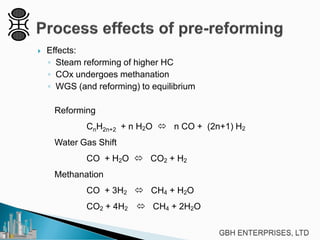
 Effects:
◦ Steam reforming of higher HC
◦ COx undergoes methanation
◦ WGS (and reforming) to equilibrium
Reforming
CnH2n+2 + n H2O  n CO + (2n+1) H2
Water Gas Shift
CO + H2O  CO2 + H2
Methanation
CO + 3H2  CH4 + H2O
CO2 + 4H2  CH4 + 2H2O
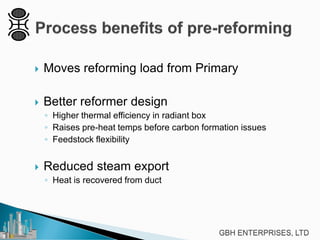
 Moves reforming load from Primary
 Better reformer design
◦ Higher thermal efficiency in radiant box
◦ Raises pre-heat temps before carbon formation issues
◦ Feedstock flexibility
 Reduced steam export
◦ Heat is recovered from duct
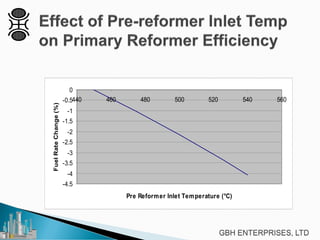
-4.5
-4
-3.5
-3
-2.5
-2
-1.5
-1
-0.5
0
440 460 480 500 520 540 560
Pre Reformer Inlet Temperature (°C)
FuelRateChange(%)
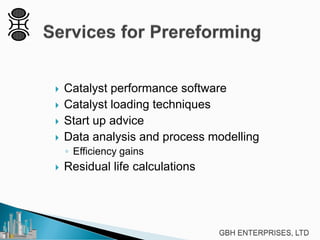
 Catalyst performance software
 Catalyst loading techniques
 Start up advice
 Data analysis and process modelling
◦ Efficiency gains
 Residual life calculations
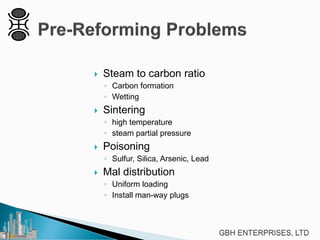
 Steam to carbon ratio
◦ Carbon formation
◦ Wetting
 Sintering
◦ high temperature
◦ steam partial pressure
 Poisoning
◦ Sulfur, Silica, Arsenic, Lead
 Mal distribution
◦ Uniform loading
◦ Install man-way plugs
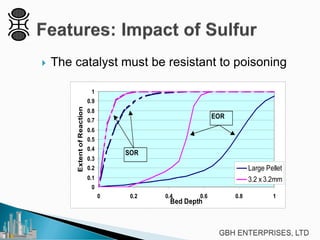
 The catalyst must be resistant to poisoning
0
0.1
0.2
0.3
0.4
0.5
0.6
0.7
0.8
0.9
1
0 0.2 0.4 0.6 0.8 1
Bed Depth
ExtentofReaction
Large Pellet
3.2 x 3.2mm
EOR
SOR
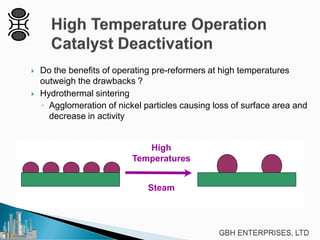
 Do the benefits of operating pre-reformers at high temperatures
outweigh the drawbacks ?
 Hydrothermal sintering
◦ Agglomeration of nickel particles causing loss of surface area and
decrease in activity
High
Temperatures
Steam
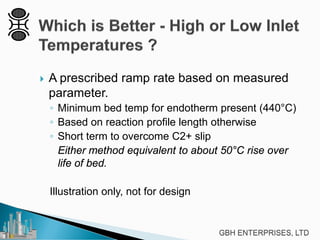
 A prescribed ramp rate based on measured
parameter.
◦ Minimum bed temp for endotherm present (440°C)
◦ Based on reaction profile length otherwise
◦ Short term to overcome C2+ slip
Either method equivalent to about 50°C rise over
life of bed.
Illustration only, not for design
 Extremely important to achieve a uniform loading
 Any zones of low or high voidage will reduce
catalyst life
◦ Check manway plugs
 No meshes should be used in the vessel
 Thermocouples must be positioned correctly and
height recorded
 Follow loading diagram
 Loading assistance can be provided (not usual)
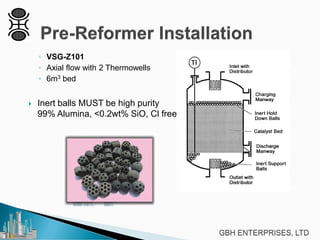
◦ VSG-Z101
◦ Axial flow with 2 Thermowells
◦ 6m3 bed
 Inert balls MUST be high purity
99% Alumina, <0.2wt% SiO, Cl free
 Drying
 Heating
 Startup
 Reduction
 (What follows are not detailed instructions!)
For catalyst subjected to low temperatures
 Dry using Nitrogen
 175 to 250°C
 NG can be used below 200°C
 4 to 24 hours (monitor water in KO pot)
 Dry air, not suitable for prereduced
 First startup of prereduced
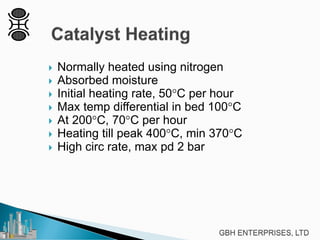
 Normally heated using nitrogen
 Absorbed moisture
 Initial heating rate, 50°C per hour
 Max temp differential in bed 100°C
 At 200°C, 70°C per hour
 Heating till peak 400°C, min 370°C
 High circ rate, max pd 2 bar
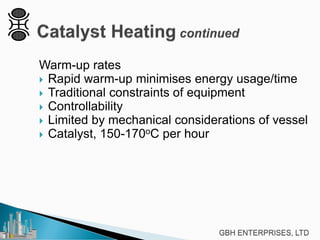
Warm-up rates
 Rapid warm-up minimises energy usage/time
 Traditional constraints of equipment
 Controllability
 Limited by mechanical considerations of vessel
 Catalyst, 150-170oC per hour
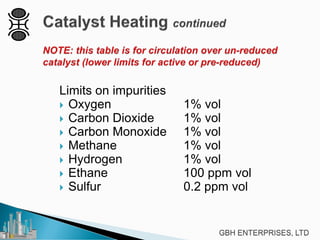
Limits on impurities
 Oxygen 1% vol
 Carbon Dioxide 1% vol
 Carbon Monoxide 1% vol
 Methane 1% vol
 Hydrogen 1% vol
 Ethane 100 ppm vol
 Sulfur 0.2 ppm vol
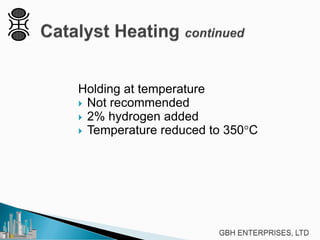
Holding at temperature
 Not recommended
 2% hydrogen added
 Temperature reduced to 350°C
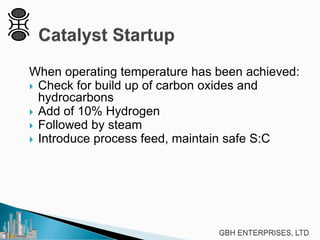
When operating temperature has been achieved:
 Check for build up of carbon oxides and
hydrocarbons
 Add of 10% Hydrogen
 Followed by steam
 Introduce process feed, maintain safe S:C
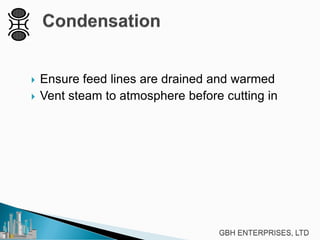
 Ensure feed lines are drained and warmed
 Vent steam to atmosphere before cutting in
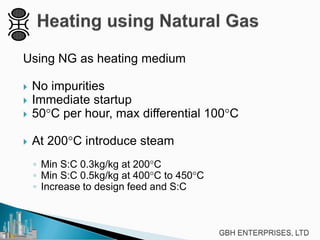
Using NG as heating medium
 No impurities
 Immediate startup
 50°C per hour, max differential 100°C
 At 200°C introduce steam
◦ Min S:C 0.3kg/kg at 200°C
◦ Min S:C 0.5kg/kg at 400°C to 450°C
◦ Increase to design feed and S:C
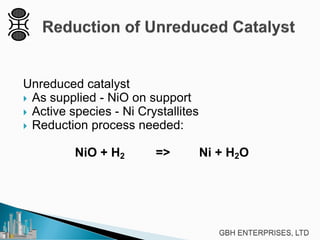
Unreduced catalyst
 As supplied - NiO on support
 Active species - Ni Crystallites
 Reduction process needed:
NiO + H2 => Ni + H2O
Reduction aspects
 Bed temperature between 450°C and 500°C (normal op temp)
 12 to 16 hours
 Hydrogen must be
◦ free of poisons (S, Cl)
 Special consideration must be given to the
presence in impure hydrogen sources of
◦ oxygen
◦ carbon oxides
◦ hydrocarbons
Reduction procedure
 Hydrogen set at 15 –25%
 Slowly increased to 50% (or 100%)
 Regularly check hydrogen levels
 Water cooled and collected
Reduction complete
 85% of reduction water collected
 Consumption of hydrogen stopped
 Temperatures equalised
 Over 16 hours at bed temps above 450°C
Information contained in this publication or as otherwise
supplied to Users is believed to be accurate and correct at time
of going to press, and is given in good faith, but it is for the
User to satisfy itself of the suitability of the Product for its own
particular purpose. GBHE gives no warranty as to the fitness of
the Product for any particular purpose and any implied warranty
or condition (statutory or otherwise) is excluded except to the
extent that exclusion is prevented by law. GBHE accepts no
liability for loss or damage resulting from reliance on this
information. Freedom under Patent, Copyright and Designs
cannot be assumed.
Process Information Disclaimer
Pre-reformer Operations Technical Supplement

Pre-reformer Operations Technical Supplement

  • 1.
    by Gerard B.Hawkins Managing Director, CEO C2PT Catalyst Process Technology
  • 2.
     Effects: ◦ Steamreforming of higher HC ◦ COx undergoes methanation ◦ WGS (and reforming) to equilibrium Reforming CnH2n+2 + n H2O  n CO + (2n+1) H2 Water Gas Shift CO + H2O  CO2 + H2 Methanation CO + 3H2  CH4 + H2O CO2 + 4H2  CH4 + 2H2O
  • 3.
     Moves reformingload from Primary  Better reformer design ◦ Higher thermal efficiency in radiant box ◦ Raises pre-heat temps before carbon formation issues ◦ Feedstock flexibility  Reduced steam export ◦ Heat is recovered from duct
  • 4.
    -4.5 -4 -3.5 -3 -2.5 -2 -1.5 -1 -0.5 0 440 460 480500 520 540 560 Pre Reformer Inlet Temperature (°C) FuelRateChange(%)
  • 5.
     Catalyst performancesoftware  Catalyst loading techniques  Start up advice  Data analysis and process modelling ◦ Efficiency gains  Residual life calculations
  • 6.
     Steam tocarbon ratio ◦ Carbon formation ◦ Wetting  Sintering ◦ high temperature ◦ steam partial pressure  Poisoning ◦ Sulfur, Silica, Arsenic, Lead  Mal distribution ◦ Uniform loading ◦ Install man-way plugs
  • 7.
     The catalystmust be resistant to poisoning 0 0.1 0.2 0.3 0.4 0.5 0.6 0.7 0.8 0.9 1 0 0.2 0.4 0.6 0.8 1 Bed Depth ExtentofReaction Large Pellet 3.2 x 3.2mm EOR SOR
  • 8.
     Do thebenefits of operating pre-reformers at high temperatures outweigh the drawbacks ?  Hydrothermal sintering ◦ Agglomeration of nickel particles causing loss of surface area and decrease in activity High Temperatures Steam
  • 9.
     A prescribedramp rate based on measured parameter. ◦ Minimum bed temp for endotherm present (440°C) ◦ Based on reaction profile length otherwise ◦ Short term to overcome C2+ slip Either method equivalent to about 50°C rise over life of bed. Illustration only, not for design
  • 10.
     Extremely importantto achieve a uniform loading  Any zones of low or high voidage will reduce catalyst life ◦ Check manway plugs  No meshes should be used in the vessel  Thermocouples must be positioned correctly and height recorded  Follow loading diagram  Loading assistance can be provided (not usual)
  • 11.
    ◦ VSG-Z101 ◦ Axialflow with 2 Thermowells ◦ 6m3 bed  Inert balls MUST be high purity 99% Alumina, <0.2wt% SiO, Cl free
  • 12.
     Drying  Heating Startup  Reduction  (What follows are not detailed instructions!)
  • 13.
    For catalyst subjectedto low temperatures  Dry using Nitrogen  175 to 250°C  NG can be used below 200°C  4 to 24 hours (monitor water in KO pot)  Dry air, not suitable for prereduced  First startup of prereduced
  • 14.
     Normally heatedusing nitrogen  Absorbed moisture  Initial heating rate, 50°C per hour  Max temp differential in bed 100°C  At 200°C, 70°C per hour  Heating till peak 400°C, min 370°C  High circ rate, max pd 2 bar
  • 15.
    Warm-up rates  Rapidwarm-up minimises energy usage/time  Traditional constraints of equipment  Controllability  Limited by mechanical considerations of vessel  Catalyst, 150-170oC per hour
  • 16.
    Limits on impurities Oxygen 1% vol  Carbon Dioxide 1% vol  Carbon Monoxide 1% vol  Methane 1% vol  Hydrogen 1% vol  Ethane 100 ppm vol  Sulfur 0.2 ppm vol
  • 17.
    Holding at temperature Not recommended  2% hydrogen added  Temperature reduced to 350°C
  • 18.
    When operating temperaturehas been achieved:  Check for build up of carbon oxides and hydrocarbons  Add of 10% Hydrogen  Followed by steam  Introduce process feed, maintain safe S:C
  • 19.
     Ensure feedlines are drained and warmed  Vent steam to atmosphere before cutting in
  • 20.
    Using NG asheating medium  No impurities  Immediate startup  50°C per hour, max differential 100°C  At 200°C introduce steam ◦ Min S:C 0.3kg/kg at 200°C ◦ Min S:C 0.5kg/kg at 400°C to 450°C ◦ Increase to design feed and S:C
  • 21.
    Unreduced catalyst  Assupplied - NiO on support  Active species - Ni Crystallites  Reduction process needed: NiO + H2 => Ni + H2O
  • 22.
    Reduction aspects  Bedtemperature between 450°C and 500°C (normal op temp)  12 to 16 hours  Hydrogen must be ◦ free of poisons (S, Cl)  Special consideration must be given to the presence in impure hydrogen sources of ◦ oxygen ◦ carbon oxides ◦ hydrocarbons
  • 23.
    Reduction procedure  Hydrogenset at 15 –25%  Slowly increased to 50% (or 100%)  Regularly check hydrogen levels  Water cooled and collected Reduction complete  85% of reduction water collected  Consumption of hydrogen stopped  Temperatures equalised  Over 16 hours at bed temps above 450°C
  • 24.
    Information contained inthis publication or as otherwise supplied to Users is believed to be accurate and correct at time of going to press, and is given in good faith, but it is for the User to satisfy itself of the suitability of the Product for its own particular purpose. GBHE gives no warranty as to the fitness of the Product for any particular purpose and any implied warranty or condition (statutory or otherwise) is excluded except to the extent that exclusion is prevented by law. GBHE accepts no liability for loss or damage resulting from reliance on this information. Freedom under Patent, Copyright and Designs cannot be assumed. Process Information Disclaimer