Gerard B. Hawkins
Managing Director
WWW.GBHENTERPRISES.COM
 The aim of this presentation is to
• Give an understanding of the reasons for carbon
formation
◦ Look at two main types
◦ Explain mechanisms
◦ Explain prevention of cracking
WWW.GBHENTERPRISES.COM
 Carbon formation
• Is side reaction
• Unwanted due to catalyst damage
◦ Breakage of catalyst
 Pressure drop increase
◦ Loss of activity and heat transfer
 Increased process gas temperature
◦ Hot bands
 Increased outside tube temperatures
 Reduction of tube life
WWW.GBHENTERPRISES.COM
Weld
Hot Bands
WWW.GBHENTERPRISES.COM
 Three main types
 1 Carbon cracking
 2 Boudouard carbon formation
 3 CO reduction
 Main focus on number 1 since it is most common
WWW.GBHENTERPRISES.COM
 Carbon is formed when
• Catalyst has low activity
◦ End of life
◦ Poisoned
◦ Wrong catalyst
• Steam to carbon to low
◦ Either during transient or normal operation
• Increased higher hydrocarbons
• Catalyst has poor heat transfer
WWW.GBHENTERPRISES.COM
 Natural gas feeds can produce carbon
• High temperatures can cause methane cracking
• Not likely at tube inlet
CH4 C + 2 H2
C2H6 2C + 3H2
C3H8 3C + 4H2
• High concentrations of H2 inhibit carbon formation
• Not likely at bottom of reformer tube
• Carbon formation zone at ~30% of tube length
WWW.GBHENTERPRISES.COM
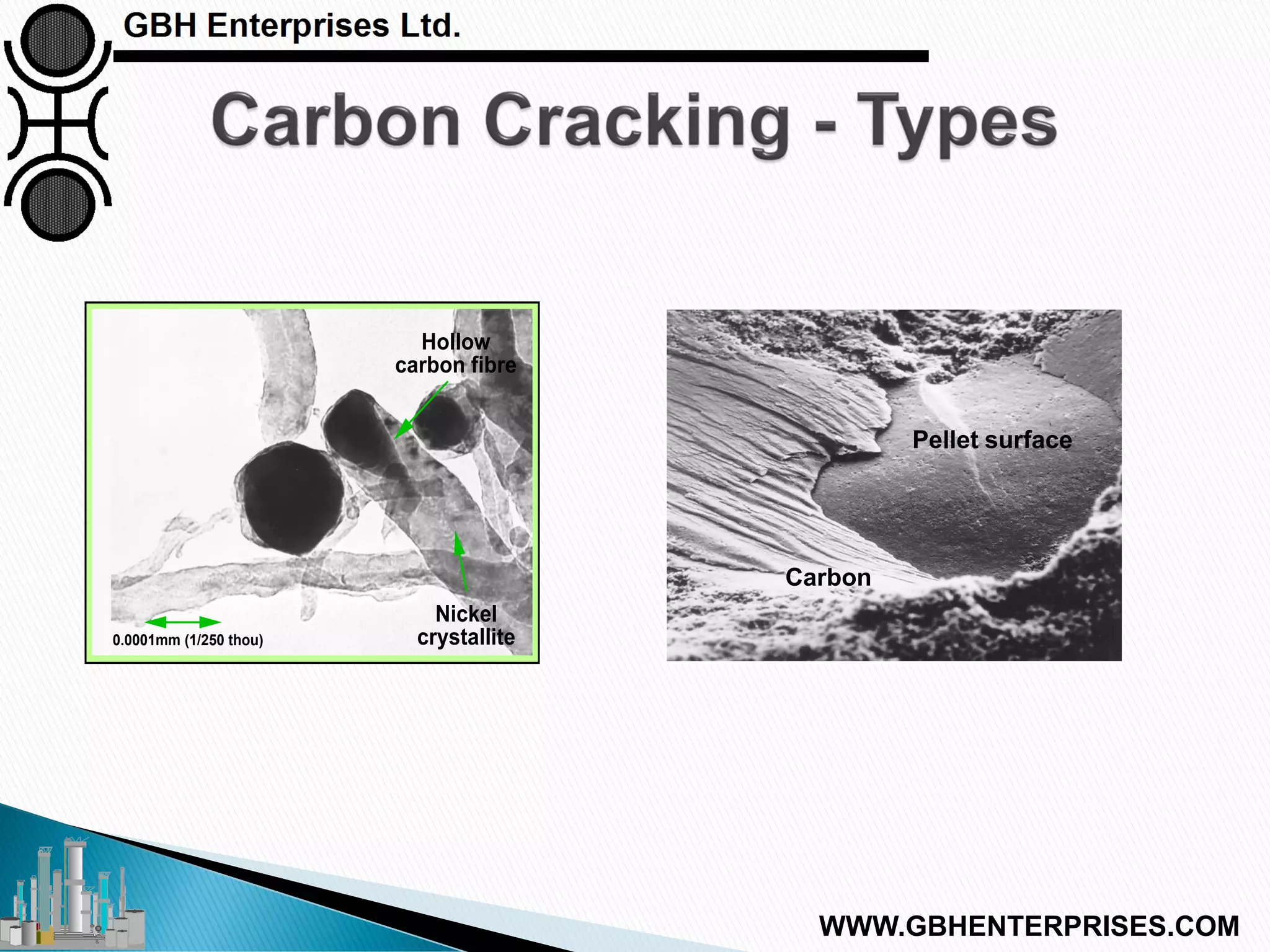
 Methane cracking forms two types of carbon :
Whisker carbon :
• High concentrations of
carbon are dissolved within
the nickel metal crystallites
• Carbon precipitates as
tubular “whiskers” containing
nickel crystallites
• Filaments are robust and can
weaken catalyst pellets
Pyrolytic carbon :
• Carbon deposits across
catalyst surface
• Carbon covers active
surfaces
• Reduced catalyst activity
WWW.GBHENTERPRISES.COM
Hollow
carbon fibre
Nickel
crystallite0.0001mm (1/250 thou)
Pellet surface
Carbon
WWW.GBHENTERPRISES.COM
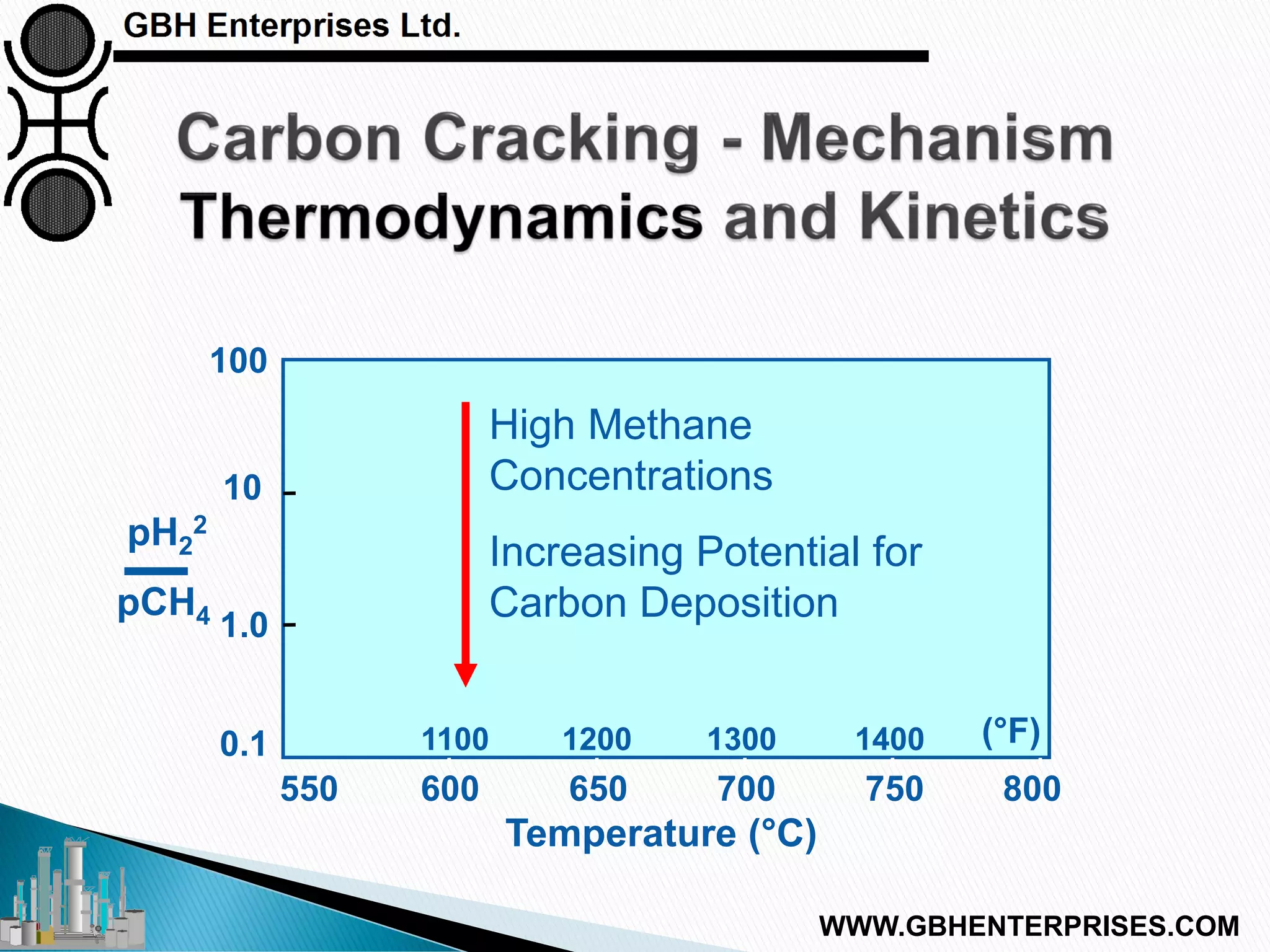
pH2
2
pCH4
10
1.0
0.1
550 600 650 700 750 800
1100 1200 1300 1400 (°F)
100
Temperature (°C)
High Methane
Concentrations
Increasing Potential for
Carbon Deposition
WWW.GBHENTERPRISES.COM
pH2
2
pCH4
10
1.0
0.1
550 600 650 700 750 800
1100 1200 1300 1400 (°F)
100
Temperature (°C)
Increasing Rate of
Carbon Deposition
WWW.GBHENTERPRISES.COM
pH2
2
pCH4
10
1.0
0.1
550 600 650 700 750 800
1100
100
Temperature (°C)
Carbon Deposition Zone
1200 1300 1400 (°F)
Deposition
possible but
rate low
Deposition not favored
WWW.GBHENTERPRISES.COM
pH2
2
pCH4
10
1.0
0.1
550 600 650 700 750 800
1100
100
Temperature (°C)
CDZ
1200 1300 1400 (°F)
Composition - temperature
profile along reformer tube
No carbon
deposition
WWW.GBHENTERPRISES.COM
pH2
2
pCH4
10
1.0
0.1
550 600 650 700 750 800
1100
100
Temperature (°C)
CDZ
1200 1300 1400 (°F)
Zone of carbon deposition
30% of tube length
WWW.GBHENTERPRISES.COM
 If carbon deposition occurs by :
CH4 C + H2
 Then carbon deposition rate > carbon removal rate
 Deposition rate is difficult to modify
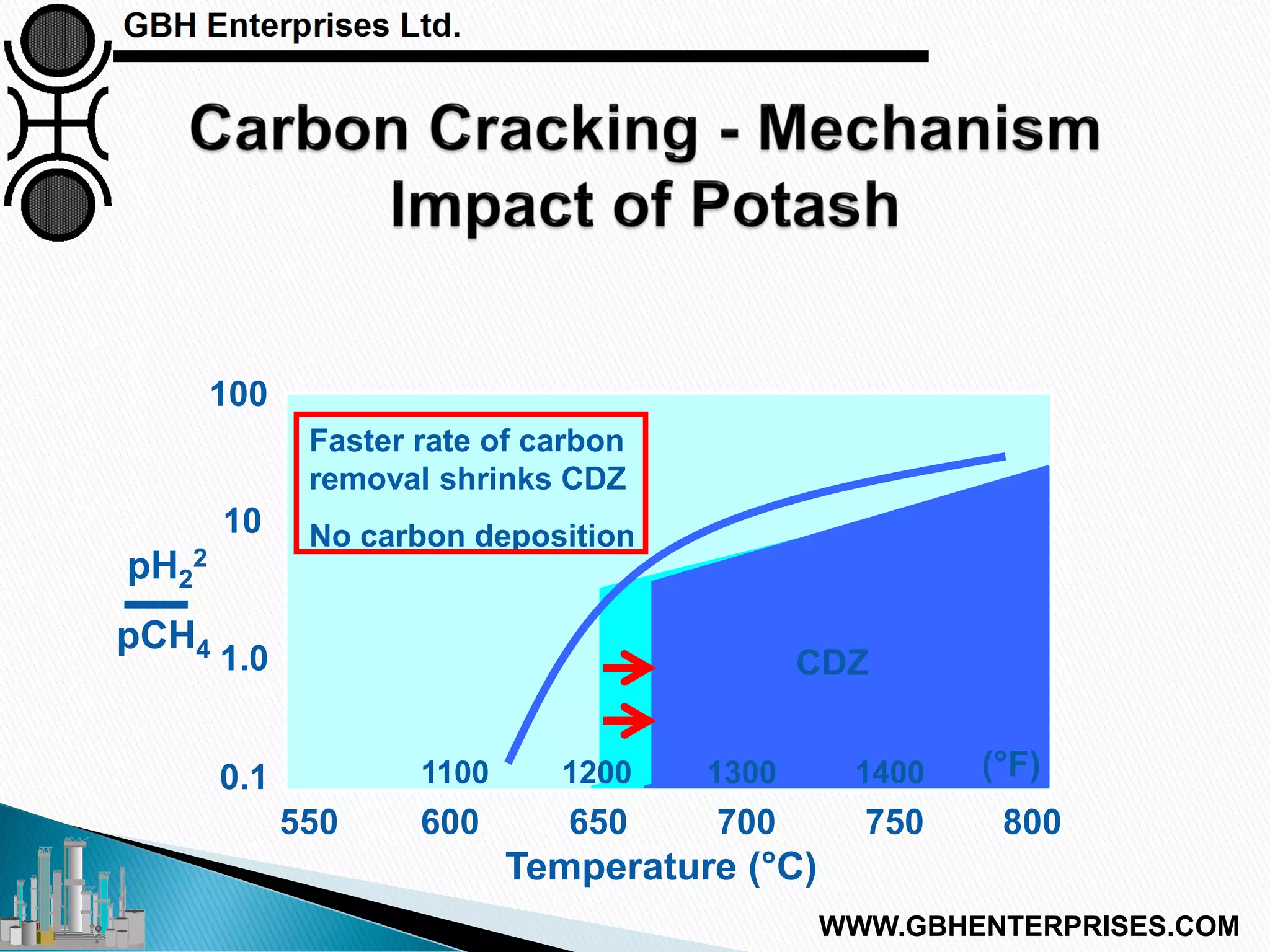
 Faster carbon removal is possible by leveraging an
additional removal reaction :
 C + H2O CO + H2
 Potash acts to increase the rate of this reaction
WWW.GBHENTERPRISES.COM
pH2
2
pCH4
10
1.0
0.1
550 600 650 700 750 800
1100
100
Temperature (°C)
1200
Faster rate of carbon
removal shrinks CDZ
No carbon deposition
CDZ
1300 1400 (°F)
WWW.GBHENTERPRISES.COM
pH2
2
pCH4
10
1.0
0.1
550 600 650 700 750 800
1100
100
Temperature (°C)
1200 1300 1400 (°F)
CDZ
WWW.GBHENTERPRISES.COM
pH2
2
pCH4
10
1.0
0.1
550 600 650 700 750 800
1100
100
Temperature (°C)
1200 1300 1400 (°F)
CDZ
WWW.GBHENTERPRISES.COM
pH2
2
pCH4
10
1.0
0.1
550 600 650 700 750 800
1100
100
Temperature (°C)
1200 1300 1400 (°F)
Margin
WWW.GBHENTERPRISES.COM
 Once carbon is formed then
• Activity of the catalyst is reduced
◦ Nickel sites blocked off - less reaction
◦ Higher process gas temperatures
• More resistance to flow - lower flow
◦ Higher process gas temperatures
• More heat transfer resistance
◦ Higher temperatures
• All cause temperature to be increased
◦ therefore an increased rate of carbon formation
WWW.GBHENTERPRISES.COM
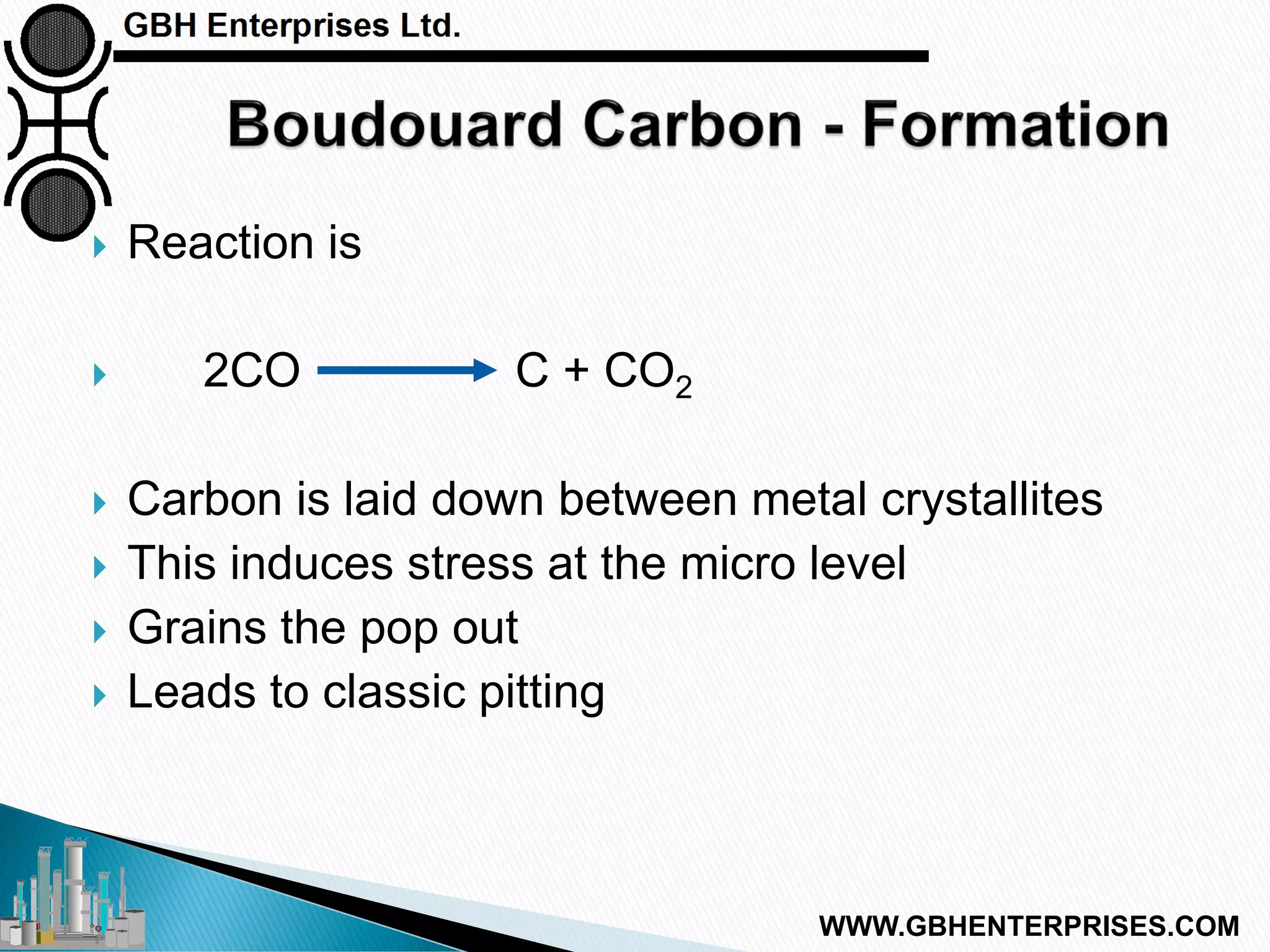
 Reaction is
 2CO C + CO2
 Carbon is laid down between metal crystallites
 This induces stress at the micro level
 Grains the pop out
 Leads to classic pitting
WWW.GBHENTERPRISES.COM
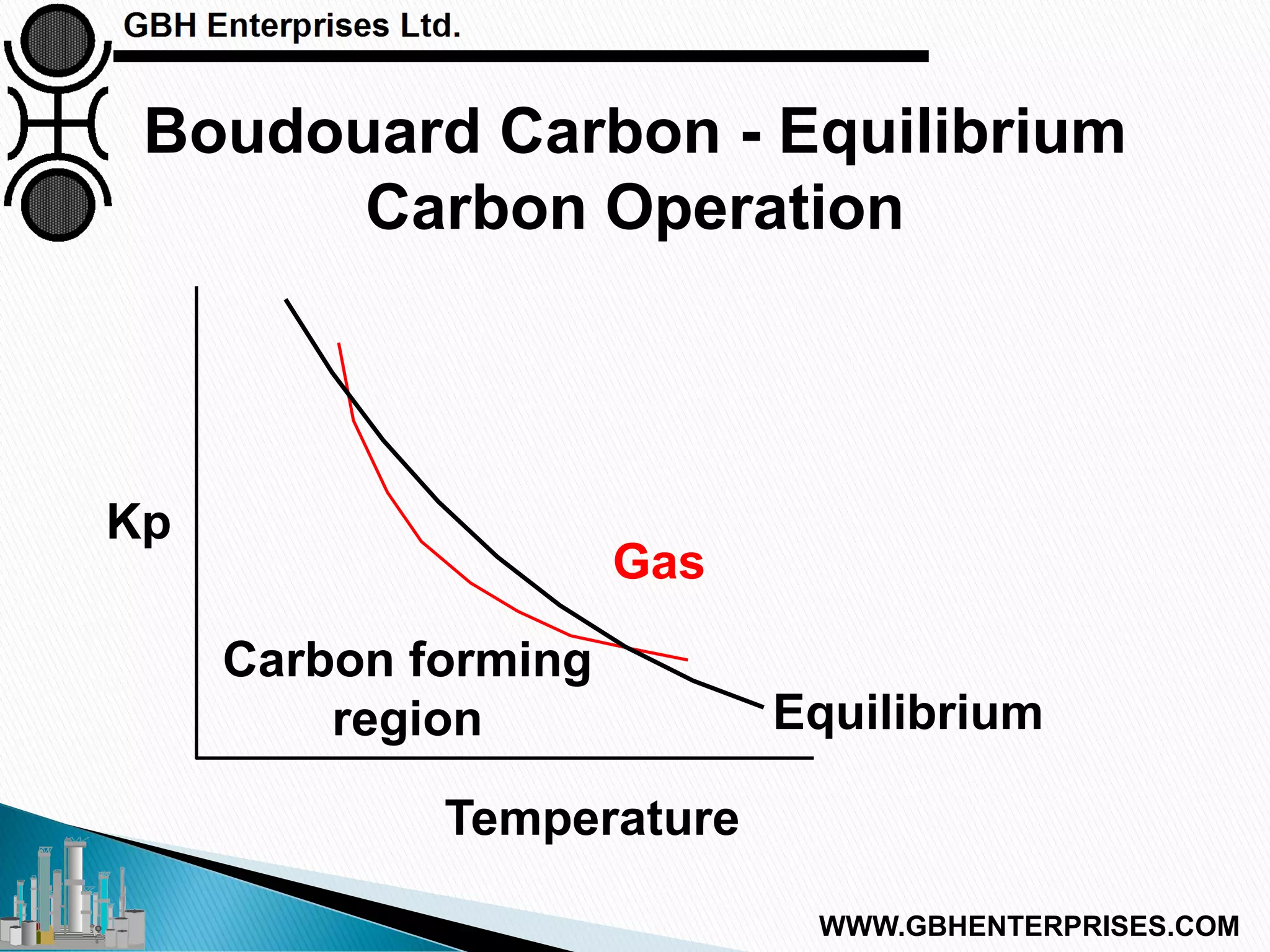
Temperature
Kp Gas
Equilibrium
Carbon forming
region
WWW.GBHENTERPRISES.COM
Boudouard Carbon - Equilibrium
Carbon Operation
Temperature
Kp
Gas
Equilibrium
Carbon forming
region
WWW.GBHENTERPRISES.COM
2CO C + CO
10.0
1.0
0.1
0.01
Temperature (°C)
400 500 600 700 800 900 1000 1100
Carbon Free Region
Carbon Forming
Region
2
k
p=PCO2/(PCO2)bar-1
WWW.GBHENTERPRISES.COM
Steam Reforming - Carbon Formation

Steam Reforming - Carbon Formation

  • 1.
    Gerard B. Hawkins ManagingDirector WWW.GBHENTERPRISES.COM
  • 2.
     The aimof this presentation is to • Give an understanding of the reasons for carbon formation ◦ Look at two main types ◦ Explain mechanisms ◦ Explain prevention of cracking WWW.GBHENTERPRISES.COM
  • 3.
     Carbon formation •Is side reaction • Unwanted due to catalyst damage ◦ Breakage of catalyst  Pressure drop increase ◦ Loss of activity and heat transfer  Increased process gas temperature ◦ Hot bands  Increased outside tube temperatures  Reduction of tube life WWW.GBHENTERPRISES.COM
  • 4.
  • 5.
     Three maintypes  1 Carbon cracking  2 Boudouard carbon formation  3 CO reduction  Main focus on number 1 since it is most common WWW.GBHENTERPRISES.COM
  • 6.
     Carbon isformed when • Catalyst has low activity ◦ End of life ◦ Poisoned ◦ Wrong catalyst • Steam to carbon to low ◦ Either during transient or normal operation • Increased higher hydrocarbons • Catalyst has poor heat transfer WWW.GBHENTERPRISES.COM
  • 7.
     Natural gasfeeds can produce carbon • High temperatures can cause methane cracking • Not likely at tube inlet CH4 C + 2 H2 C2H6 2C + 3H2 C3H8 3C + 4H2 • High concentrations of H2 inhibit carbon formation • Not likely at bottom of reformer tube • Carbon formation zone at ~30% of tube length WWW.GBHENTERPRISES.COM
  • 8.
     Methane crackingforms two types of carbon : Whisker carbon : • High concentrations of carbon are dissolved within the nickel metal crystallites • Carbon precipitates as tubular “whiskers” containing nickel crystallites • Filaments are robust and can weaken catalyst pellets Pyrolytic carbon : • Carbon deposits across catalyst surface • Carbon covers active surfaces • Reduced catalyst activity WWW.GBHENTERPRISES.COM
  • 9.
    Hollow carbon fibre Nickel crystallite0.0001mm (1/250thou) Pellet surface Carbon WWW.GBHENTERPRISES.COM
  • 10.
    pH2 2 pCH4 10 1.0 0.1 550 600 650700 750 800 1100 1200 1300 1400 (°F) 100 Temperature (°C) High Methane Concentrations Increasing Potential for Carbon Deposition WWW.GBHENTERPRISES.COM
  • 11.
    pH2 2 pCH4 10 1.0 0.1 550 600 650700 750 800 1100 1200 1300 1400 (°F) 100 Temperature (°C) Increasing Rate of Carbon Deposition WWW.GBHENTERPRISES.COM
  • 12.
    pH2 2 pCH4 10 1.0 0.1 550 600 650700 750 800 1100 100 Temperature (°C) Carbon Deposition Zone 1200 1300 1400 (°F) Deposition possible but rate low Deposition not favored WWW.GBHENTERPRISES.COM
  • 13.
    pH2 2 pCH4 10 1.0 0.1 550 600 650700 750 800 1100 100 Temperature (°C) CDZ 1200 1300 1400 (°F) Composition - temperature profile along reformer tube No carbon deposition WWW.GBHENTERPRISES.COM
  • 14.
    pH2 2 pCH4 10 1.0 0.1 550 600 650700 750 800 1100 100 Temperature (°C) CDZ 1200 1300 1400 (°F) Zone of carbon deposition 30% of tube length WWW.GBHENTERPRISES.COM
  • 15.
     If carbondeposition occurs by : CH4 C + H2  Then carbon deposition rate > carbon removal rate  Deposition rate is difficult to modify  Faster carbon removal is possible by leveraging an additional removal reaction :  C + H2O CO + H2  Potash acts to increase the rate of this reaction WWW.GBHENTERPRISES.COM
  • 16.
    pH2 2 pCH4 10 1.0 0.1 550 600 650700 750 800 1100 100 Temperature (°C) 1200 Faster rate of carbon removal shrinks CDZ No carbon deposition CDZ 1300 1400 (°F) WWW.GBHENTERPRISES.COM
  • 17.
    pH2 2 pCH4 10 1.0 0.1 550 600 650700 750 800 1100 100 Temperature (°C) 1200 1300 1400 (°F) CDZ WWW.GBHENTERPRISES.COM
  • 18.
    pH2 2 pCH4 10 1.0 0.1 550 600 650700 750 800 1100 100 Temperature (°C) 1200 1300 1400 (°F) CDZ WWW.GBHENTERPRISES.COM
  • 19.
    pH2 2 pCH4 10 1.0 0.1 550 600 650700 750 800 1100 100 Temperature (°C) 1200 1300 1400 (°F) Margin WWW.GBHENTERPRISES.COM
  • 20.
     Once carbonis formed then • Activity of the catalyst is reduced ◦ Nickel sites blocked off - less reaction ◦ Higher process gas temperatures • More resistance to flow - lower flow ◦ Higher process gas temperatures • More heat transfer resistance ◦ Higher temperatures • All cause temperature to be increased ◦ therefore an increased rate of carbon formation WWW.GBHENTERPRISES.COM
  • 21.
     Reaction is 2CO C + CO2  Carbon is laid down between metal crystallites  This induces stress at the micro level  Grains the pop out  Leads to classic pitting WWW.GBHENTERPRISES.COM
  • 22.
  • 23.
  • 24.
    Boudouard Carbon -Equilibrium Carbon Operation Temperature Kp Gas Equilibrium Carbon forming region WWW.GBHENTERPRISES.COM
  • 25.
    2CO C +CO 10.0 1.0 0.1 0.01 Temperature (°C) 400 500 600 700 800 900 1000 1100 Carbon Free Region Carbon Forming Region 2 k p=PCO2/(PCO2)bar-1 WWW.GBHENTERPRISES.COM