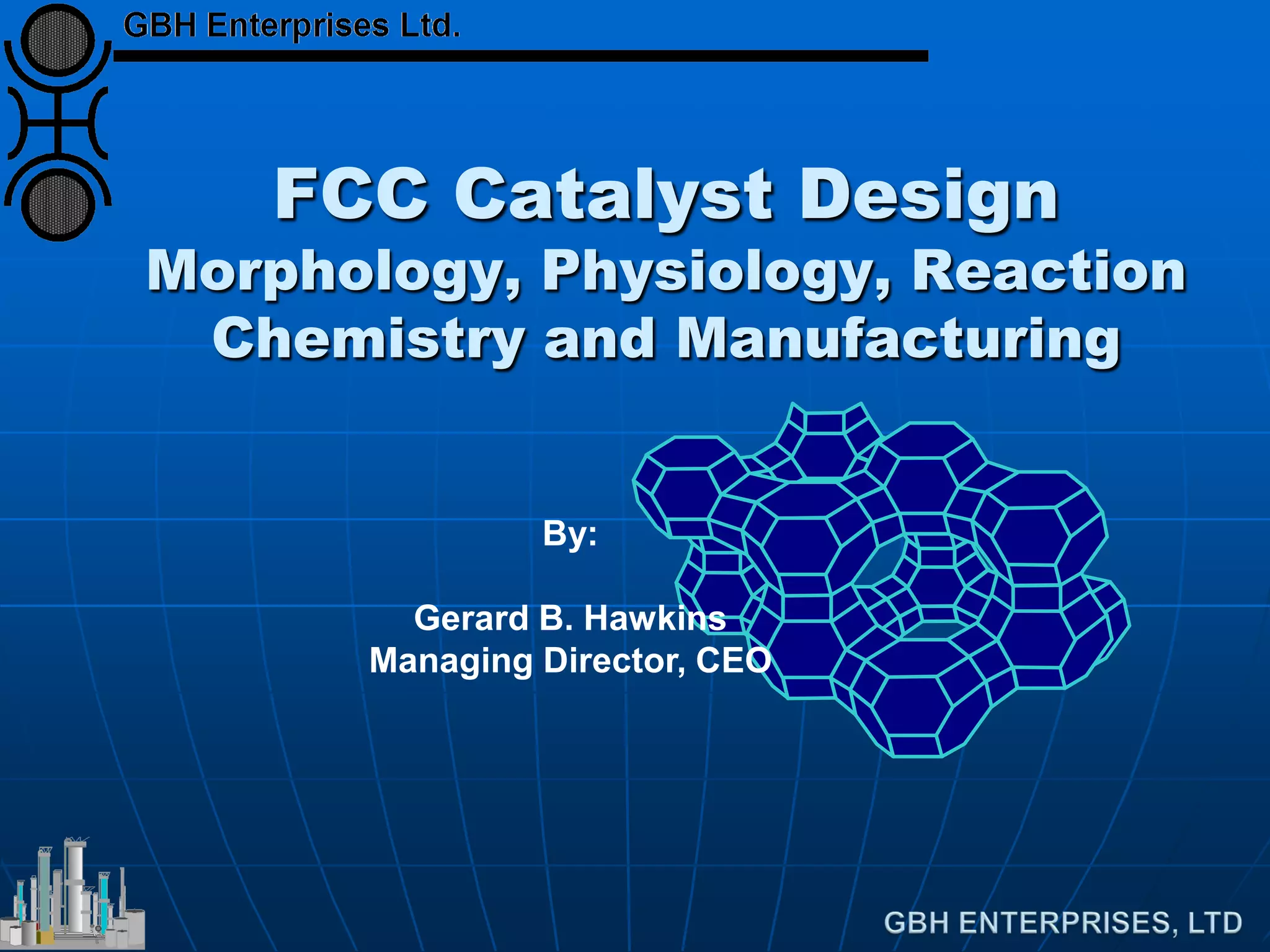
FCC Catalyst Design
Morphology, Physiology, Reaction
Chemistry and Manufacturing
By:
Gerard B. Hawkins
Managing Director, CEO
 Introduction
 FCC Catalyst Components
 - the Zeolite
 - the Matrix
 - Additives ( ZSM-5, other )
 Catalyst Manufacturing
 Reaction Chemistry
 - b scission (cracking)
 - hydrogen transfer
 - heat balance considerations
 Selecting the Right Combination
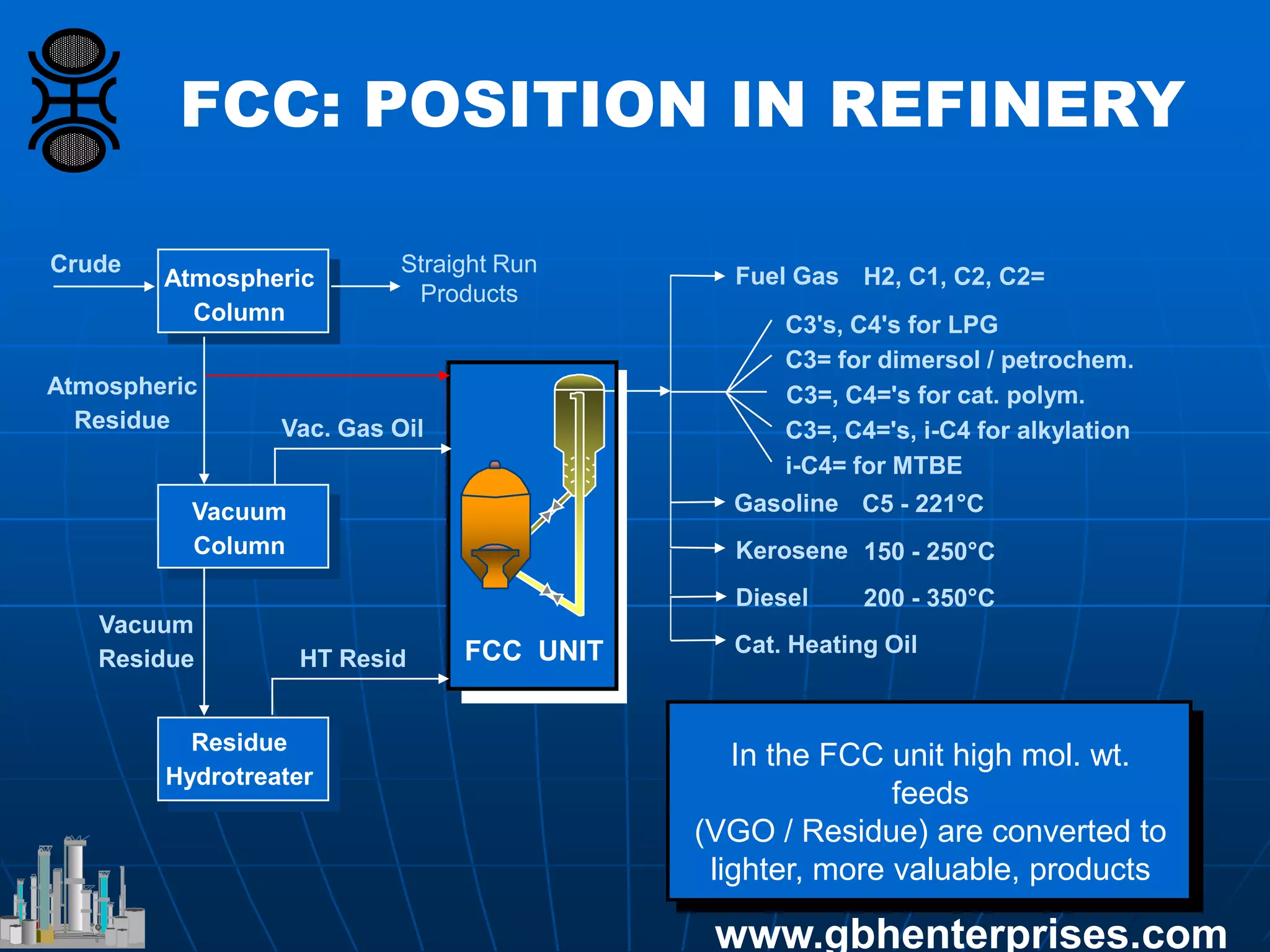
FCC: POSITION IN REFINERY
In the FCC unit high mol. wt.
feeds
(VGO / Residue) are converted to
lighter, more valuable, products
C3=, C4='s for cat. polym.
C3= for dimersol / petrochem.
C3's, C4's for LPG
C3=, C4='s, i-C4 for alkylation
i-C4= for MTBE
Fuel Gas H2, C1, C2, C2=
Gasoline C5 - 221°C
Kerosene 150 - 250°C
Cat. Heating Oil
Diesel 200 - 350°C
FCC UNIT
Crude
Atmospheric
Column
Straight Run
Products
Atmospheric
Residue Vac. Gas Oil
Vacuum
Residue
Vacuum
Column
Residue
Hydrotreater
HT Resid
www.gbhenterprises.com
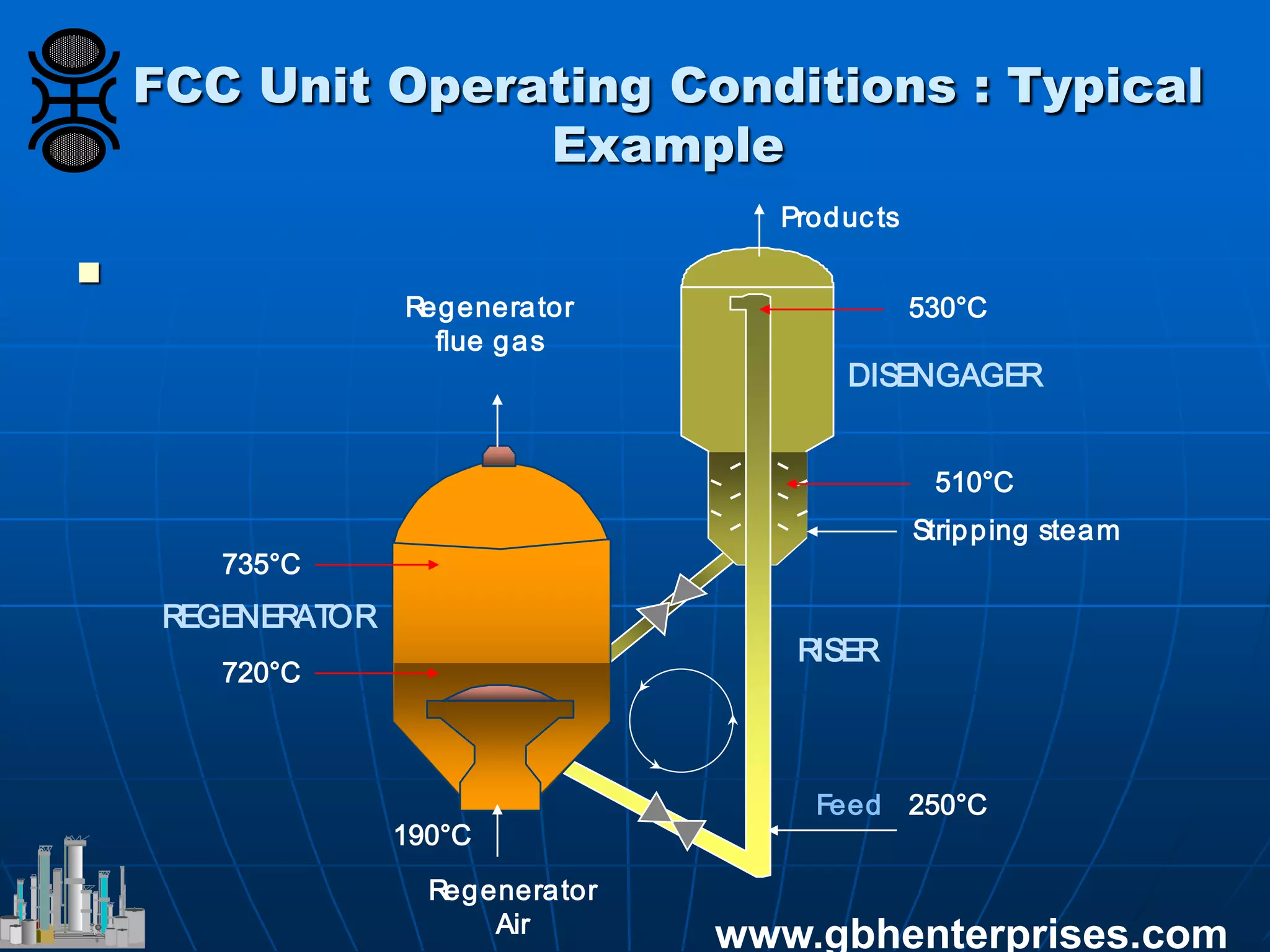
FCC Unit Operating Conditions : Typical
Example

DISENGAGER
RISER
REGENERATOR
190°C
735°C
720°C
Feed
Stripping steam
Products
Regenerator
flue gas
Regenerator
Air
530°C
510°C
250°C
www.gbhenterprises.com
Catalyst Physical Properties
RETENTION / LOSSES
- Attrition Resistance
FLUIDIZATION
- Particle Size Distribution
- Average Bulk Density
HEAT TRANSPORT
- Specific Heat Capacity
www.gbhenterprises.com
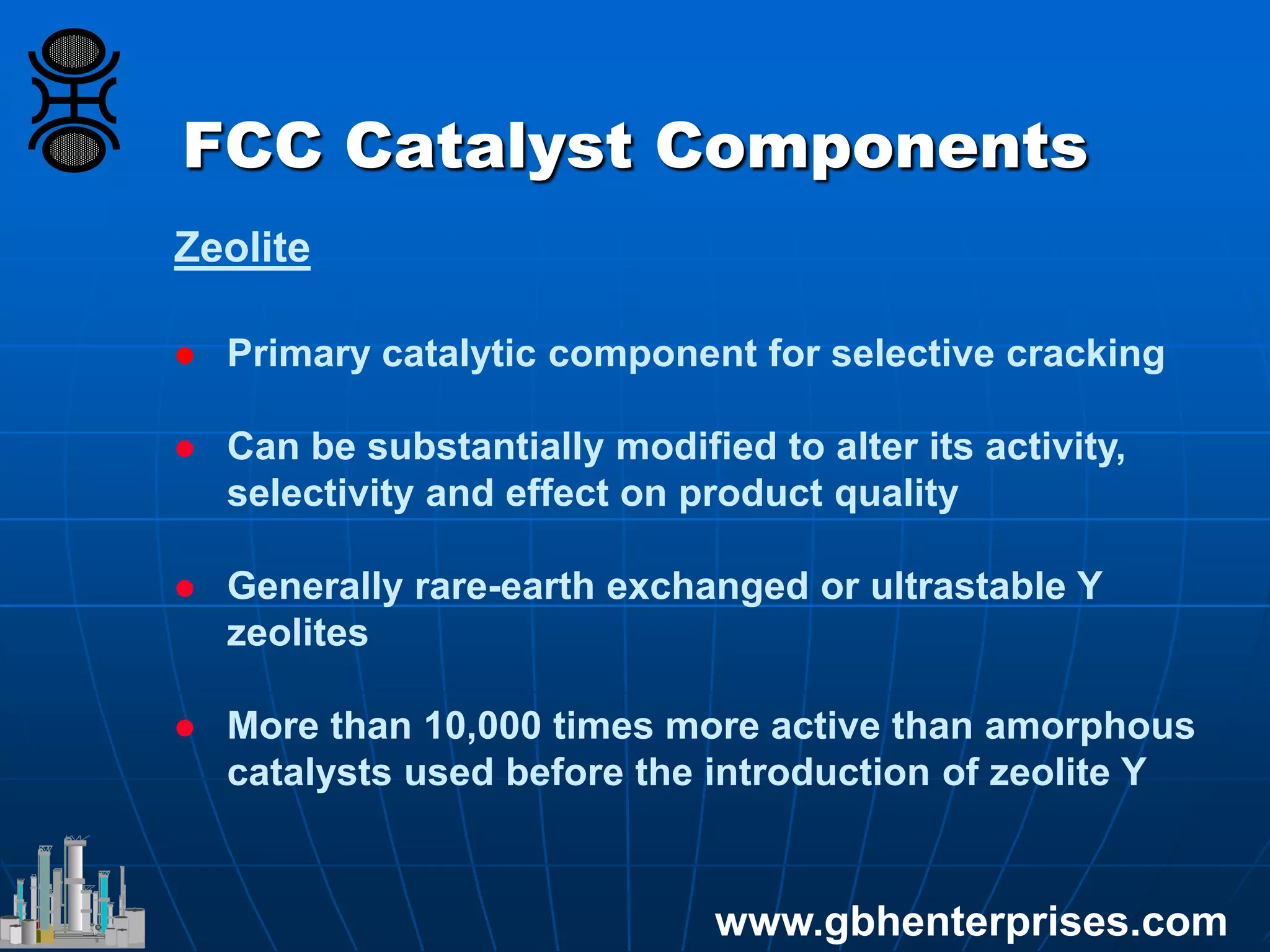
FCC Catalyst Components
70 µm (avg.)
7 µm
Pseudo crystalline
Matrix Aluminas
Pores
Clay
Binder
Zeolite Y
www.gbhenterprises.com
FCC Catalyst Components
 Primary catalytic component for selective cracking
 Can be substantially modified to alter its activity,
selectivity and effect on product quality
 Generally rare-earth exchanged or ultrastable Y
zeolites
 More than 10,000 times more active than amorphous
catalysts used before the introduction of zeolite Y
Zeolite
www.gbhenterprises.com
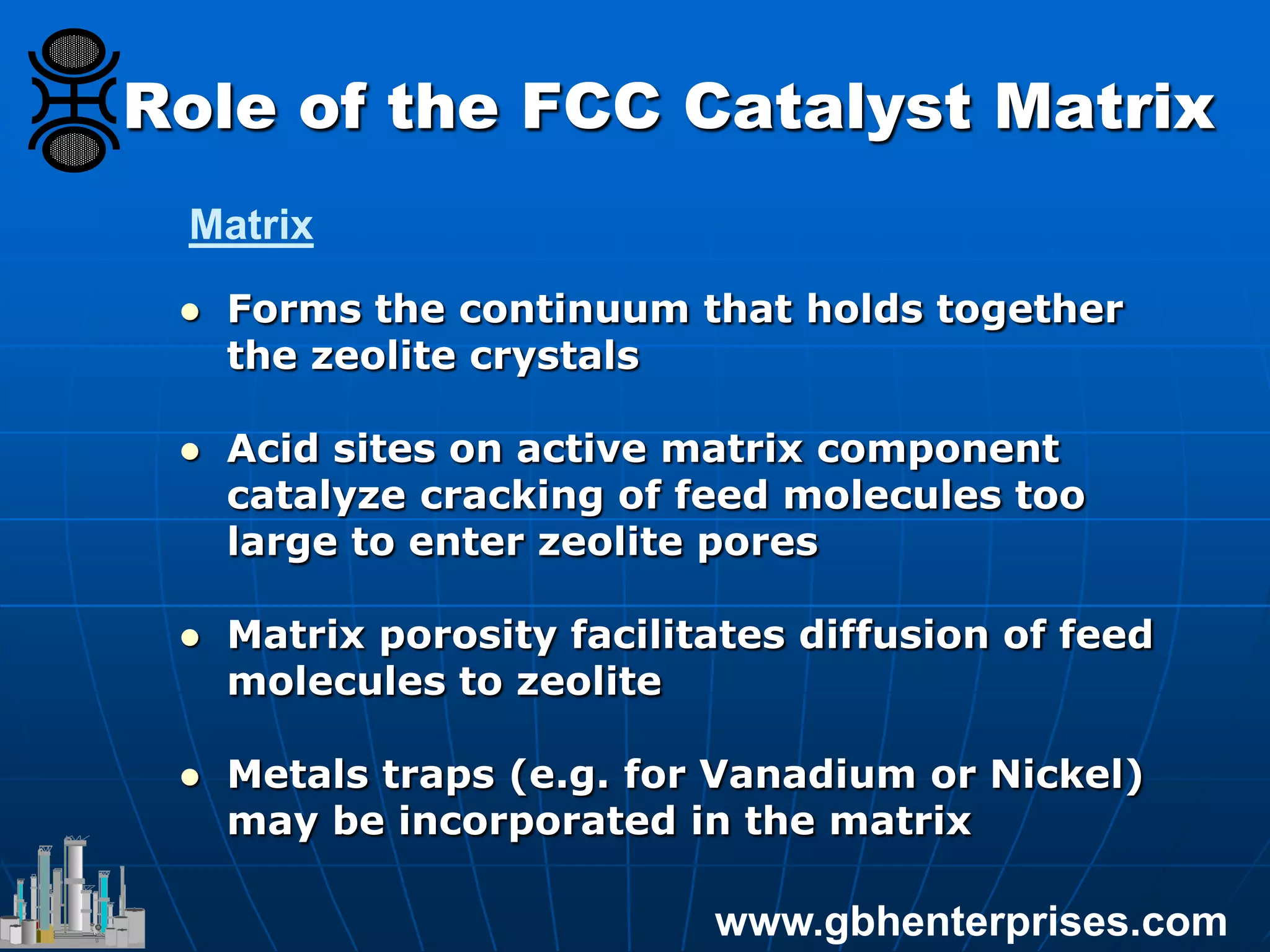
Role of the FCC Catalyst Matrix
 Forms the continuum that holds together
the zeolite crystals
 Acid sites on active matrix component
catalyze cracking of feed molecules too
large to enter zeolite pores
 Matrix porosity facilitates diffusion of feed
molecules to zeolite
 Metals traps (e.g. for Vanadium or Nickel)
may be incorporated in the matrix
Matrix
www.gbhenterprises.com
The Zeolite
Structure of Zeolite Y
Sodalite cage
(β-cage)
Supercage
(α-cage)
www.gbhenterprises.com
(Mn+)z/n {(SiO2)y (AlO2)-
z} framework
 Zeolites are crystalline
microporous, alumino silicates
 Framework alumina (AlO2)- units
are associated with Acidic Active
Sites
 Cations within microporous
cages and channels (Mn+ = H+,
La3+, Ce3+, Ce4+)
 Hydrocarbon conversion
catalyzed at acid sites within
microporous channels
 Acid Site Activity and Acid Site
Density determine the Activity
and Selectivity of the zeolite
Zeolite Structure and Properties
www.gbhenterprises.com
Zeolite Acidity
 Brönsted acid
site
Al
Lewis acid site
OO
O
AlSi Si
OO
H
Proton (H) donor
Trivalent Al - hydride ion abstractor
www.gbhenterprises.com
Brönsted Acid Site
O
-
O
O
O
H+
O
O
O
Si Al
www.gbhenterprises.com
Routes for Zeolite Y
Stabilization
 HREY
 RE ion-exchange calcine NH4
+ ion-exchange
 NaY REY CREY NH4CRE
 USY
 NH4
+ ion-exchange ultrastabilize RE3+ ion-exchange
 NaY NH4Y USY REUSY

www.gbhenterprises.com
Ion Exchange to Generate Acid
Sites (H+)
 Na+-Z- + NH4
+ Na+ + NH4
+-Z-

 NH4
+-Z- H+-Z- + NH3
↑

calcine
3Na+-Z- + RE(H2O)6
3+ 3Na+ + RE(H2O)6
3+-[Z]3
-
RE(H2O)6
3+-[Z]3
- RE(H2O)5(OH)2+ -H+-[Z]3
-
hydrolysis
Ammonium Exchange
Rare Earth Exchange
www.gbhenterprises.com
Reaction Mechanism for Hydrothermal
Dealumination and Stabilization of Y Zeolites
Framework
Dealumination
Framework
Stabilization
Al O SiOSi
O
Si
O
Si
O SiOSi
O
Si
O
Si
H H
H
H
+H2O
(Steam)
+Al(OH)3
O SiOSi
O
Si
O
Si
H H
H
H
Hydroxyl Nest
(defect site)
Si O SiOSi
O
Si
O
Si
+SiO2
(Steam)
Hydroxyl Nest
(defect site)
www.gbhenterprises.com
Unit-Cell Size and Si/Al ratio
 Numerous relationships given in the literature
 Breck and Flanigen relationship widely used
 NAl / ucs = 115.2 [ ao - 24.191 ]
 and: NSi / ucs = 192 - NAl / ucs
 thus: Si / Alframework = NSi / NAl
www.gbhenterprises.com
Control of the equilibrium UCS
 UCS (Å)
 As-synthesized NaY 24.64 (54 Al / uc)
 Ultra stabilized Y 24.54 (40 Al / uc)
 Steam deactivated USY 24.21-24.30*(2-13 Al /uc)
 *Depends on rare-earth level
 - (the higher the RE, the higher the UCS)
www.gbhenterprises.com
RE level vs UCS (Å)
0
10
20
30
40
50
60
70
80
90
100
24.21 24.26 24.31 24.36 24.41
UCS (Å)
RElevel,%
www.gbhenterprises.com
Zeolite Active Site Distribution

Equilibrium US-Y Zeolite
unit cell size 24.25 Å
Framework Si/Al = 27
7 Al atoms / unit cell
Equilibrium CREY Zeolite
unit cell size 24.38 Å
Framework Si/Al = 7.8
22 Al atoms / unit cell
www.gbhenterprises.com
Dealumination
 Effect of Si / Al ratio on Zeolite
Properties
 High Al Low Al
zeolite unit cell size
thermal stability
hydrothermal stability
intrinsic cracking activity
hydrogen transfer activity
low
high
high
low
low
high
low
low
high
high
www.gbhenterprises.com
Major Effects of Equilibrium
Unit Cell Size
 Increasing Unit Cell Size :
 Increases Active Site Density
 Decreases Active Site Strength
 Hence, Increased Hydrogen Transfer vs. Cracking :
 Increased Gasoline Selectivity
 Lower Gasoline Octane Numbers (RONc and MONc)
 Decreased LPG (C3 and C4) Selectivity
 Lower LPG Olefinicity
www.gbhenterprises.com
Octane Response vs. Zeolite
Unit-Cell Size
Gasoline
MON
RON
0
1
2
3
0
1
2
24.24 24.28 24.32 24.36 24.40
Zeolite Unit Cell Size, Å
DeltaRON,DeltaMON
DeltaGasolineYield,Wt%FF
Increasing rare earth
www.gbhenterprises.com
Relative Coke Selectivity of Zeolite Types
Equilibrium Unit Cell Size
RelativeCokeSelectivity
REUSY
CREYunit cell size range
for minimum coke
24.28 - 24.34 Å
USY
CSSN CSX
www.gbhenterprises.com
The Matrix
Selective Active Matrices
 Catalytically active surface
 Less selective in cracking than zeolite
 Variable acid site strength and pore structure
 Helps crack the bottoms to provide ‘feed’ for
the zeolite component
 Important for metals tolerance
www.gbhenterprises.com
Matrix Design Considerations
 Crack bottoms with minimum coke and gas penalty
 Provide resistance to Nickel, Vanadium and Nitrogen
 Controlled porosity eliminates heavy feed diffusion limitations
 The appropriate Matrix type depends upon feed characteristics
(e.g. aromaticity, Concarbon, metals, nitrogen, etc.)
 Optimize Zeolite / Matrix ratio for low coke and gas as well as
low SA/K number
Matrix Requirements
www.gbhenterprises.com
Example Morphologies
Tuneable Matrix Alumina (TMA)
www.gbhenterprises.com
Matrix Technology

Matrix
System
Type 1
Type 2
Type 3
Bottoms
Cracking
+++
+
++
Coke/Gas
Selectivity
+
+++
++
Vanadium
Tolerance
+++
+
++
Nickel
Tolerance
+
+++
++
Optimal matrix system is selected depending on the
main operating objectives / constraints as below
www.gbhenterprises.com
d(PoreVolume)/dlog(PoreDiameter)
0
0.1
0.2
0.3
0.4
0.5
0.6
10 100 1,000 10,000
Catalyst A (steamed)
REUSY
High Matrix Activity
Catalyst B (steamed)
REUSY
Moderate Matrix Activity
Pore Diameter, (Å)
www.gbhenterprises.com
Ni
Ni
Ni
Ni
Ni
Ni
Ni
Ni
Ni
Ni
Ni
Ni Ni
NiNi
Highly Dispersed - Poor Ni Tolerance
Good Ni Support
High Ni dehydrogenation activity
Nickel Tolerance - Matrix Consideration
Ni Ni
Ni Ni Ni
Ni
Ni Ni
NiNi
Nickel Agglomeration
Chemical Reaction
Poor Ni Support
Low Ni dehydrogenation activity Å 100
Ni
Al
Al
Al
Al
Al
NiAl2O4
Solid State Diffusion
Chemical Reaction
Strong Metal-Support Interaction
Low Ni dehydrogenation activity
Ni trapping matrix
solid state
diffusion
www.gbhenterprises.com
SA/K Number
 Lower SA/K number:
 improves catalyst strip ability (decreasing occluded coke)
 provides a poorer support for contaminant metals
(decreasing contaminant coke)
 Both the above contribute to improved coke and gas
selectivity
 AVOID EXCESS CATALYST SURFACE AREA - ONLY NEED
SURFACE AREA THAT CONTRIBUTES TO PRODUCING DESIRED
CONVERSION PRODUCTS
SA/K number =
Total ECat Surface Area
Kinetic Conversion
=
Total ECat Surface Area
MAT Conv. / (100 - MAT Conv.)
www.gbhenterprises.com
Major Effects of Increased Z/M
Ratio
Increasing Z/M :
 Increases Selective Zeolite Cracking
 Lower Coke and Fuel Gas (C2-) Yields
 Increased Gasoline Selectivity
But,
 Lower LCO Selectivity
 Increased Bottoms Selectivity
www.gbhenterprises.com
Effect of Zeolite/Matrix Ratio on Product Selectivity's
MAT Reaction Conditions: 60 wt% conversion Feed: 0.919 g/ml, 11.5 Watson K
Zeolite / Matrix Surface Area Ratio of Steamed Catalyst
Amorphous
Cracking
Zeolite
Cracking
LCO,wt%Coke,wt%
0 2 4
2.0
4.0
24.0
25.0
26.0
38.0
40.0
42.0
44.0
Gasoline,wt%
DryGas,wt%HCO,wt%C3+C4,wt%
1.0
1.4
1.8
16.0
15.0
14.0
13.0
15.0
14.0
13.0
12.0
www.gbhenterprises.com
FCC Additives
ZSM-5 Additives
ZSM-5 Additive Particle
MICROSTRUCTURE MESOSTRUCTURE
MACROSTRUCTURE
75 µm
Zeolite
ZSM-5
7 µm
Binder
Filler
www.gbhenterprises.com
ZSM-5 framework structure ZSM-5 pore structure
Zeolite ZSM-5 Crystal Structure
www.gbhenterprises.com
ZSM-5 Shape Selectivity
slow
Products
Products
Reactants
fast
Non-reactants
www.gbhenterprises.com
Selective Conversion of Low
Octane Species
The relative cracking for various hydrocarbons are:
Rel. rate Rel. octaneHydrocarbon Type
Straight chain paraffins & olefins
Moderately branched paraffins & olefins
Highly branched paraffins & olefins
Naphthenes
Aromatic side-chains
Fast
Moderate
Slow
Slow
Slow
Low
Moderate
High
Low
High
www.gbhenterprises.com
ZSM-5 Additive Technology
Cracking Mechanism
Hydrogen Transfer
Low active site density of ZSM-5 (relative to H-Y) results
in low hydrogen transfer activity thus products have a
high degree of olefinicity
Isomerization
Isomerization of lower to higher branching is favored
due to the relative stabilities of carbo-cation
intermediates (tertiary > secondary > primary)
www.gbhenterprises.com
Commercial Data: Unit Response
to 3 wt% Additive Addition
89
90
91
92
93
94
95
-40 -30 -20 -10 0 10 20 30
Days into ZSM-5 Usage
GasolineResearchOctane
ZSM-5 Additive
Provided an Immediate
1.8 RON Gain
www.gbhenterprises.com
2
4
6
8
10
12
64 68 72 76 80 84
Conversion (wt%)
C3=(wt%)
ECAT 521°C ECAT 543°C ECAT 566°C
4% Additive 521°C 4% Additive 543°C 4% Additive 566°C
DCR Testing of ZSM-5 Additive:
Propylene Yield
www.gbhenterprises.com
7
9
11
13
15
17
64 68 72 76 80 84
Conversion (wt%)
TotalC4=+iC4(wt%)
DCR Testing of ZSM-5 Additive: Alky
Feed Yield
ECAT 521°C ECAT 543°C ECAT 566°C
4% Additive 521°C 4% Additive 543°C 4% Additive 566°C
www.gbhenterprises.com
Yield and Octane Shifts With ZSM-5 Additives
 Low octane gasoline components are converted
to LPG olefins
 Gasoline composition changes:
decreased paraffins and olefins in "octane-dip" range
increased light iso-paraffins
increased light olefins
increased aromatics (via concentration)
 No change in coke, dry gas, or bottoms yield
 Gasoline RONc and MONc increased
www.gbhenterprises.com
Environmental Additives
Sulfur Balance in an FCC
Unit
F
C
C
Feed Sulfur
Sulfides
Thiophenes
Benzothiophenes
Multi-ring Thiophenes
Light Gases, H2S 20 - 60%
Gasoline 2 - 10%
Light Cycle Oil 10 - 25 %
Heavy Cycle Oil 5 - 35 %
Coke, SOx 2 - 30 %
• FCC gasoline typically contributes >90% of the total gasoline pool
sulfur
• Up to 50% of FCC gasoline sulfur is usually concentrated in the
back end of the gasoline
www.gbhenterprises.com
Catalytic SOx Reduction

PRODUCTS
( with H2S )
MeSO4 (s) + 4 H2 (g) = MeS (s) + 4 H2O (g)
RISER:
Reduction of Metal Sulfate
MeSO4 (s) + 4 H2 (g) = MeO (s) + H2S (g) + 3 H2O (g)
Stripping Steam
STRIPPER:
Hydrolysis of Metal Sulfide
MeS (s) + H2O (g) = MeO (s) + H2S (g)
FEED
( with Sulfur )
FLUE GAS
( with SOx )
Regenerator
Air
REGENERATOR:
Formation of SOx
S (coke) + O2 (g) = SO2 (g)
SO2 (g) + ½ O2 (g) = SO3 (g)
Formation of Metal Sulfate
SO3 (g) + MeO (s) = MeSO4 (s)
www.gbhenterprises.com
FEED SULFUR IN GASOLINE vs GASOLINE CUT POINT
1
2
3
4
5
6
7
8
9
180 185 190 195 200 205 210 215 220 225 230
Gasoline C.P. (ºC)
FeedSulphurinGasoline(%)
W/O Additive Comp X
Comp X Allowed Refinery C to
Reduce Sulfur by ca. 20-25%
www.gbhenterprises.com
NOx Emissions: XNOx vs. Pt. Promoter
0
100
200
300
400
500
-1.5 -1.0 -0.5 0.0 0.5 1.0 1.5 2.0
NO(ppm)
Hours
Addition of 0.5% XNOx
Addition of Pt
based Promoter
60% Reduction
www.gbhenterprises.com
Catalyst Manufacturing
Synthesis of Zeolite Y
NaSiO3 NaAlO2
Al2(SO4)3 Seeds
ca. 100°C, 1-2 days
www.gbhenterprises.com
Sulfate Aluminate
Silicate
Aluminium
Sodium
Sodium
SeedsML-Gel
Sulfate
Beltfilter
Effluent
Aluminium
Water
Beltfilter
Na-Y Zeolite
ZEOLITE PLANT (Part 1)
RE-Y Zeolite
(NH4)2SO4
RECl3 /
Water
Beltfilter
Effluent
NH4-Y /
www.gbhenterprises.com
Bag Filter System
Calciner
US-Y Zeolite
CREY /
ZEOLITE PLANT (Part 2)
RE-Y Zeolite
NH4-Y /
Hot Air
Dryer
www.gbhenterprises.com
BinderWater
Clay
Mixing
Water
Calciner
CATALYST
FCC
FCC PLANT
Water
Beltfilter
LS-USY
(NH4)2SO4
Effluent
RECl3 /
WET END
Spray
Drier
Hot
Air
Scrubbing System
DRY END
Zeolite
(e.g.. CREY/USY)
Mixing
www.gbhenterprises.com
Reaction Chemistry
Boiling Range Distribution of
FCC Feed and Products

Wt%FF
Boiling Point, °C
Gas LPG Naphtha LCO Slurry /
FEED
Feedstock400°C
221°C
C4
C2
PRODUCTS
www.gbhenterprises.com
Hydrocarbon Types
CHAIN STRUCTURES
Paraffin
HH HH
H H H H
RR
HHH H H H
RING STRUCTURES
Olefin
H HH
H H H H
RR
HHH H H
Naphthene
H
H
H
H
R
H
H H
H H
H H
R
H H
H
H H
H
H
Alkylaromatic
H
H
H
HH
H H H H
RR
H H
H
Crackability (Conversion): Paraffinic > Naphthenic > Aromatic
Coke-forming tendency (Heat Balance): Paraffinic < Naphthenic < Aromatic
www.gbhenterprises.com
Principles of Catalysis
Catalysts Lower Activation Energies
of Forward & Backwards Reactions,
Increasing the Rates of Both
The Heat of Reaction is Unchanged
by the Catalyst
The Position of Thermodynamic
Equilibrium is Unchanged by the
Catalyst
Non-Equilibrium Distributions Occur
Under Kinetic Controlled Conditions
FreeEnergy
Reaction Co-ordinate
ECatalytic
∆ Hreaction
EThermal
EB
EA
www.gbhenterprises.com
0
50
100
150
Thermal vs Catalytic Cracking
n-Hexadecane @ 500°C
MolesProduct/100MolesCracked
Carbon Number
C1 C2 C3 C4 C5 C6 C7 C8 C9 C10 C11 C12 C13 C14
Catalytic Cracking
Thermal Cracking
www.gbhenterprises.com
Principle Reactions in FCC

Olefins Cracking Light Olefins
Isomerisation
other Naphthenes
Naphthenes
Cracking
Olefins
Transalkylation
other Aromatics
Aromatics
Side-chain Cracking
unsubstituted Aromatics + Olefins
Dehydrogenation
poly-Aromatics
Dehydrogenation
Coke
Condensation Condensation
Dehydrogenation
cyclo-Olefins
Dehydrogenation
Aromatics
Cracking Paraffins + OlefinsParaffins
H Transfer
Paraffins
Condensation
Cyclisation
Naphthenes
Dehydrogenation
Coke
Olefins Paraffins
Isomerisation H TransferBranched Branched
www.gbhenterprises.com
β - Scission (cracking)
Reactions
Cracking Reaction Mechanism
H
+
Si
O
Al
O
Si
O -
Catalyst (Acid Site)
H
H HH
H H H H
RR
HHH H
Carbenium Ion
H
H HH
H H H
RR
HHH H
+
H H
Protonation
H
H HH
H H H
RR
HHH H
+
H H
ß-scission
Olefin Product
HH
H H
R
HHH H
+
H
H
H
R
H
H
HH
H H
R
HHH H
+
H
H
H
H H
R
H
H
+
H
Intermolecular
Rearrangemen
t
H
H
H
H H
R
H
H
+
H
H
H
H H
R
H
H
H
Deprotonation
-
H+
www.gbhenterprises.com
Thermal Reaction Mechanism
Thermal cracking gives high yields of methane,
alpha-olefins and ethylene, no increased branching
H
H
H
HH
H H H H H
HR
HH H H
Free radical
formation
- H.
Secondary Free radical
H H
HH
H H
R
HH
H
H H H
H
H.
ß-scission
(Cracking)
Primary Free
radical
.
H H
HH
H H
R
HH
alpha- Olefin
Product
H
H H
H
H
H
ß-scission
(cracking)Ethylene
H
H
H
H
New free
radical
H
H
H
R
H
.
homolytic fission
C H
homolytic fission
C Chomolytic fission
C C
www.gbhenterprises.com
Summary of Cracking Reactions

Relative Cracking Rates:
Olefin > Naphthene = Alkylaromatic > Paraffin
Olefins most readily form carbocations
Aromatic side-chains readily undergo cracking
reactions, however, aromatic rings do not crack
Alkylaromatic Alkylaromatic + Olefin
Naphthene Olefin
Paraffin Paraffin + Olefin
Olefin Olefin + Olefin
www.gbhenterprises.com
Hydrogen Transfer Reactions
olefin + naphthene paraffin + cyclo-olefin
Hydrogen Transfer Reactions

olefin + cyclo-olefin paraffin + cyclo-diolefin
olefin + cyclo-diolefin paraffin + aromatic
H
CH - CH2
CH2 - CH2
CH - R”H2 C
R - CH - CH2 - R’
+
H
+
R - CH = CH - R’
olefin
protonation
R - CH - CH - R’
H
+
hydrogen
transfer
H
R - CH - CH2 - R’
CH - CH2
CH2 - CH2
CH - R”H2 C
+
H
CH - CH
CH2 - CH2
CH - R”H2 C
+
CH = CH
CH2 - CH2
CH - R”H2 C
- H+
proton loss
www.gbhenterprises.com
Heat Balance Considerations
FCC Heat Balance Considerations
 Most FCC process variables have an effect
on the heat balance - which, in turn, affects:
Conversion, Yields and Product Qualities
 The FCC unit will always adjust itself to
remain in heat balance by burning enough
coke for the energy requirements
www.gbhenterprises.com
Heat Demands are Satisfied by
Burning Coke

∆H air
ENERGY IS
REQUIRED TO
HEAT AIR
∆H cracking
ENERGY IS
REQUIRED TO
CRACK FEED
∆H vaporization
ENERGY IS
REQUIRED TO
VAPORISE FEED
∆H losses
ENERGY IS
REQUIRED FOR
HEAT LOSSES TO
ATMOSPHERE
www.gbhenterprises.com
FCC Delta Coke Types
Occluded
Feed
Metals
Catalytic
 unstripped hydrocarbons
(product to regenerator)
high hydrogen content
 uncracked heavy feed
components e.g. asphaltenes,
Conradson carbon residue
 Formed via dehydrogenation
activity of contaminant metals
e.g. nickel, vanadium
 formed as a bi-product of
desired catalytic cracking
15%
15%
5%
65%
VGO
14%
28%
28%
30%
Resid
www.gbhenterprises.com
Feed Dependence of
Delta Coke
Contaminant Coke
(Metals Coke) Increases
Feed Residue Coke
(Conradson Carbon)
Increases
Occluded Coke (Cat/Oil
Coke) Same / Slight
Increase
Catalytic Coke
(Conversion Coke)
Decreases
Contaminant
Coke
Feed Residue
Coke
Occluded Coke0.10
0.30
0.50
0.80
1.60
DeltaCoke
Catalytic Coke
Decreasing Feed Quality
Increasing: Density, ConCarbon, Metals, S, N.
Increasing Resid Content
Increasing Ca/Cp ratio, Endpoint
www.gbhenterprises.com
Conversion Dependence on
Delta Coke
 Lower conversion by :
 higher regen.
temperature
 lower cat/oil (lower
severity)
 Lower effective activity
due to :
 coke blockage of pores
 metals contamination
 increased nitrogen
poisoning
FCCUnitConversion
Regen T
Cat/Oil
Ratio
Unit
Conversion
Delta Coke, wt.%
Increasing Resid content
Constant Riser Outlet Temp.
Constant Coke Operation
(Unit at Max. Blower Capacity)
www.gbhenterprises.com
Selecting the Right
Combination
Gasoline Mode Operation
FCC Optimization for Gasoline Production
 high Zeolite / Matrix ratio (Z/M)
 high Hydrogen Transfer (high ucs)
 high Catalyst Activity (Conversion)
C3=, C4='s for cat. polym.
C3= for dimersol / petrochem.
C3's, C4's for LPG
C3=, C4='s, i-C4 for alkylation
i-C4= for MTBE
Fuel Gas H2, C1, C2, C2=
Gasoline C5 - 221°C
Kerosene 150 - 250°C
Cat. Heating Oil
Diesel 200 - 350°C
FCC UNIT
Crude
Atmospheric
Column
Straight Run
Products
Atmospheric
Residue Vac. Gas Oil
Vacuum
Residue
Vacuum
Column
Residue
Hydrotreater
HT Resid
Gasoline Selectivity is favored by:
www.gbhenterprises.com
FCC Optimization for Gasoline Production
 high Catalyst / Oil ratio
 moderate Riser Outlet Temperature
 high ECat Activity (MAT)
C3=, C4='s for cat. polym.
C3= for dimersol / petrochem.
C3's, C4's for LPG
C3=, C4='s, i-C4 for alkylation
i-C4= for MTBE
Fuel Gas H2, C1, C2, C2=
Gasoline C5 - 221°C
Kerosene 150 - 250°C
Cat. Heating Oil
Diesel 200 - 350°C
FCC UNIT
Crude
Atmospheric
Column
Straight Run
Products
Atmospheric
Residue Vac. Gas Oil
Vacuum
Residue
Vacuum
Column
Residue
Hydrotreater
HT Resid
Gasoline Selectivity is favored by:
www.gbhenterprises.com
Distillate Mode Operation
FCC Optimization for Middle Distillates
Production
 high Matrix Activity (lower Z/M)
 high Hydrogen Transfer (high ucs)
 low Catalyst Activity (low Conversion)
C3=, C4='s for cat. polym.
C3= for dimersol / petrochem.
C3's, C4's for LPG
C3=, C4='s, i-C4 for alkylation
i-C4= for MTBE
Fuel Gas H2, C1, C2, C2=
Gasoline C5 - 221°C
Kerosene 150 - 250°C
Cat. Heating Oil
Diesel 200 - 350°C
FCC UNIT
Crude
Atmospheric
Column
Straight Run
Products
Atmospheric
Residue Vac. Gas Oil
Vacuum
Residue
Vacuum
Column
Residue
Hydrotreater
HT Resid
Middle Distillate Selectivity is favored by:
www.gbhenterprises.com
FCC Optimization for Middle Distillates
Production
 low Catalyst / Oil ratio
 low Riser Outlet Temperature
 low ECat Activity (MAT)
 use of Recycle (HCO/Slurry)
C3=, C4='s for cat. polym.
C3= for dimersol / petrochem.
C3's, C4's for LPG
C3=, C4='s, i-C4 for alkylation
i-C4= for MTBE
Fuel Gas H2, C1, C2, C2=
Gasoline C5 - 221°C
Kerosene 150 - 250°C
Cat. Heating Oil
Diesel 200 - 350°C
FCC UNIT
Crude
Atmospheric
Column
Straight Run
Products
Atmospheric
Residue Vac. Gas Oil
Vacuum
Residue
Vacuum
Column
Residue
Hydrotreater
HT Resid
Middle Distillate Selectivity is favored by:
www.gbhenterprises.com
Light Olefins Mode Operation
FCC Optimization for Light Olefins Production
 low Hydrogen Transfer (low ucs)
 use of ZSM-5 Zeolite containing additives
 high Catalyst Activity (very high Conversion)
C3=, C4='s for cat. polym.
C3= for dimersol / petrochem.
C3's, C4's for LPG
C3=, C4='s, i-C4 for alkylation
i-C4= for MTBE
Fuel Gas H2, C1, C2, C2=
Gasoline C5 - 221°C
Kerosene 150 - 250°C
Cat. Heating Oil
Diesel 200 - 350°C
FCC UNIT
Crude
Atmospheric
Column
Straight Run
Products
Atmospheric
Residue Vac. Gas Oil
Vacuum
Residue
Vacuum
Column
Residue
Hydrotreater
HT Resid
Light Olefin Selectivity is favored by:
www.gbhenterprises.com
FCC Optimization for Light Olefins Production
 high Riser Outlet Temperature
 high Catalyst / Oil ratio
 high ECat Activity (MAT)
C3=, C4='s for cat. polym.
C3= for dimersol / petrochem.
C3's, C4's for LPG
C3=, C4='s, i-C4 for alkylation
i-C4= for MTBE
Fuel Gas H2, C1, C2, C2=
Gasoline C5 - 221°C
Kerosene 150 - 250°C
Cat. Heating Oil
Diesel 200 - 350°C
FCC UNIT
Crude
Atmospheric
Column
Straight Run
Products
Atmospheric
Residue Vac. Gas Oil
Vacuum
Residue
Vacuum
Column
Residue
Hydrotreater
HT Resid
Light Olefin Selectivity is favored by:
www.gbhenterprises.com
Short Contact Time Operation
FCC Optimization for Short Contact Time
Operations
 high Catalyst Activity
 balanced Zeolite/Matrix ratio (Z/M)
 high Hydrogen Transfer (high ucs)
C3=, C4='s for cat. polym.
C3= for dimersol / petrochem.
C3's, C4's for LPG
C3=, C4='s, i-C4 for alkylation
i-C4= for MTBE
Fuel Gas H2, C1, C2, C2=
Gasoline C5 - 221°C
Kerosene 150 - 250°C
Cat. Heating Oil
Diesel 200 - 350°C
FCC UNIT
Crude
Atmospheric
Column
Straight Run
Products
Atmospheric
Residue Vac. Gas Oil
Vacuum
Residue
Vacuum
Column
Residue
Hydrotreater
HT Resid
Short Contact Time Operation is favored by:
www.gbhenterprises.com
FCC Optimization for Short Contact Time
Operations
 high Riser Outlet Temperature
 high Catalyst / Oil ratio
 high ECat Activity (MAT)
C3=, C4='s for cat. polym.
C3= for dimersol / petrochem.
C3's, C4's for LPG
C3=, C4='s, i-C4 for alkylation
i-C4= for MTBE
Fuel Gas H2, C1, C2, C2=
Gasoline C5 - 221°C
Kerosene 150 - 250°C
Cat. Heating Oil
Diesel 200 - 350°C
FCC UNIT
Crude
Atmospheric
Column
Straight Run
Products
Atmospheric
Residue Vac. Gas Oil
Vacuum
Residue
Vacuum
Column
Residue
Hydrotreater
HT Resid
Short Contact Time Operation is favored by:
www.gbhenterprises.com
Gasoline Olefins Reduction
FCC Optimization for Gasoline Olefins
Reduction
 high Zeolite / Matrix ratio (Z/M)
 high Hydrogen Transfer (high ucs)
 moderate Matrix Activity (SAM-700)
 high Metals Tolerance (e.g. Ni and V)
C3=, C4='s for cat. polym.
C3= for dimersol / petrochem.
C3's, C4's for LPG
C3=, C4='s, i-C4 for alkylation
i-C4= for MTBE
Fuel Gas H2, C1, C2, C2=
Gasoline C5 - 221°C
Kerosene 150 - 250°C
Cat. Heating Oil
Diesel 200 - 350°C
FCC UNIT
Crude
Atmospheric
Column
Straight Run
Products
Atmospheric
Residue Vac. Gas Oil
Vacuum
Residue
Vacuum
Column
Residue
Hydrotreater
HT Resid
Gasoline Olefins Reduction is favored by:
www.gbhenterprises.com
FCC Optimization for Gasoline Olefins
Reduction
 high Catalyst / Oil ratio
 low Riser Outlet Temperature
 high ECat Activity
 high Conversion
C3=, C4='s for cat. polym.
C3= for dimersol / petrochem.
C3's, C4's for LPG
C3=, C4='s, i-C4 for alkylation
i-C4= for MTBE
Fuel Gas H2, C1, C2, C2=
Gasoline C5 - 221°C
Kerosene 150 - 250°C
Cat. Heating Oil
Diesel 200 - 350°C
FCC UNIT
Crude
Atmospheric
Column
Straight Run
Products
Atmospheric
Residue Vac. Gas Oil
Vacuum
Residue
Vacuum
Column
Residue
Hydrotreater
HT Resid
Gasoline Olefins Reduction is favoured by:
www.gbhenterprises.com
Questions ?

FCC Catalyst Design: Morphology, Physiology, Reaction Chemistry and Manufacturing

  • 1.
    FCC Catalyst Design Morphology,Physiology, Reaction Chemistry and Manufacturing By: Gerard B. Hawkins Managing Director, CEO
  • 2.
     Introduction  FCCCatalyst Components  - the Zeolite  - the Matrix  - Additives ( ZSM-5, other )  Catalyst Manufacturing  Reaction Chemistry  - b scission (cracking)  - hydrogen transfer  - heat balance considerations  Selecting the Right Combination
  • 3.
    FCC: POSITION INREFINERY In the FCC unit high mol. wt. feeds (VGO / Residue) are converted to lighter, more valuable, products C3=, C4='s for cat. polym. C3= for dimersol / petrochem. C3's, C4's for LPG C3=, C4='s, i-C4 for alkylation i-C4= for MTBE Fuel Gas H2, C1, C2, C2= Gasoline C5 - 221°C Kerosene 150 - 250°C Cat. Heating Oil Diesel 200 - 350°C FCC UNIT Crude Atmospheric Column Straight Run Products Atmospheric Residue Vac. Gas Oil Vacuum Residue Vacuum Column Residue Hydrotreater HT Resid www.gbhenterprises.com
  • 4.
    FCC Unit OperatingConditions : Typical Example  DISENGAGER RISER REGENERATOR 190°C 735°C 720°C Feed Stripping steam Products Regenerator flue gas Regenerator Air 530°C 510°C 250°C www.gbhenterprises.com
  • 5.
    Catalyst Physical Properties RETENTION/ LOSSES - Attrition Resistance FLUIDIZATION - Particle Size Distribution - Average Bulk Density HEAT TRANSPORT - Specific Heat Capacity www.gbhenterprises.com
  • 6.
  • 7.
    FCC Catalyst Components 70µm (avg.) 7 µm Pseudo crystalline Matrix Aluminas Pores Clay Binder Zeolite Y www.gbhenterprises.com
  • 8.
    FCC Catalyst Components Primary catalytic component for selective cracking  Can be substantially modified to alter its activity, selectivity and effect on product quality  Generally rare-earth exchanged or ultrastable Y zeolites  More than 10,000 times more active than amorphous catalysts used before the introduction of zeolite Y Zeolite www.gbhenterprises.com
  • 9.
    Role of theFCC Catalyst Matrix  Forms the continuum that holds together the zeolite crystals  Acid sites on active matrix component catalyze cracking of feed molecules too large to enter zeolite pores  Matrix porosity facilitates diffusion of feed molecules to zeolite  Metals traps (e.g. for Vanadium or Nickel) may be incorporated in the matrix Matrix www.gbhenterprises.com
  • 10.
  • 11.
    Structure of ZeoliteY Sodalite cage (β-cage) Supercage (α-cage) www.gbhenterprises.com
  • 12.
    (Mn+)z/n {(SiO2)y (AlO2)- z}framework  Zeolites are crystalline microporous, alumino silicates  Framework alumina (AlO2)- units are associated with Acidic Active Sites  Cations within microporous cages and channels (Mn+ = H+, La3+, Ce3+, Ce4+)  Hydrocarbon conversion catalyzed at acid sites within microporous channels  Acid Site Activity and Acid Site Density determine the Activity and Selectivity of the zeolite Zeolite Structure and Properties www.gbhenterprises.com
  • 13.
    Zeolite Acidity  Brönstedacid site Al Lewis acid site OO O AlSi Si OO H Proton (H) donor Trivalent Al - hydride ion abstractor www.gbhenterprises.com
  • 14.
  • 15.
    Routes for ZeoliteY Stabilization  HREY  RE ion-exchange calcine NH4 + ion-exchange  NaY REY CREY NH4CRE  USY  NH4 + ion-exchange ultrastabilize RE3+ ion-exchange  NaY NH4Y USY REUSY  www.gbhenterprises.com
  • 16.
    Ion Exchange toGenerate Acid Sites (H+)  Na+-Z- + NH4 + Na+ + NH4 +-Z-   NH4 +-Z- H+-Z- + NH3 ↑  calcine 3Na+-Z- + RE(H2O)6 3+ 3Na+ + RE(H2O)6 3+-[Z]3 - RE(H2O)6 3+-[Z]3 - RE(H2O)5(OH)2+ -H+-[Z]3 - hydrolysis Ammonium Exchange Rare Earth Exchange www.gbhenterprises.com
  • 17.
    Reaction Mechanism forHydrothermal Dealumination and Stabilization of Y Zeolites Framework Dealumination Framework Stabilization Al O SiOSi O Si O Si O SiOSi O Si O Si H H H H +H2O (Steam) +Al(OH)3 O SiOSi O Si O Si H H H H Hydroxyl Nest (defect site) Si O SiOSi O Si O Si +SiO2 (Steam) Hydroxyl Nest (defect site) www.gbhenterprises.com
  • 18.
    Unit-Cell Size andSi/Al ratio  Numerous relationships given in the literature  Breck and Flanigen relationship widely used  NAl / ucs = 115.2 [ ao - 24.191 ]  and: NSi / ucs = 192 - NAl / ucs  thus: Si / Alframework = NSi / NAl www.gbhenterprises.com
  • 19.
    Control of theequilibrium UCS  UCS (Å)  As-synthesized NaY 24.64 (54 Al / uc)  Ultra stabilized Y 24.54 (40 Al / uc)  Steam deactivated USY 24.21-24.30*(2-13 Al /uc)  *Depends on rare-earth level  - (the higher the RE, the higher the UCS) www.gbhenterprises.com
  • 20.
    RE level vsUCS (Å) 0 10 20 30 40 50 60 70 80 90 100 24.21 24.26 24.31 24.36 24.41 UCS (Å) RElevel,% www.gbhenterprises.com
  • 21.
    Zeolite Active SiteDistribution  Equilibrium US-Y Zeolite unit cell size 24.25 Å Framework Si/Al = 27 7 Al atoms / unit cell Equilibrium CREY Zeolite unit cell size 24.38 Å Framework Si/Al = 7.8 22 Al atoms / unit cell www.gbhenterprises.com
  • 22.
    Dealumination  Effect ofSi / Al ratio on Zeolite Properties  High Al Low Al zeolite unit cell size thermal stability hydrothermal stability intrinsic cracking activity hydrogen transfer activity low high high low low high low low high high www.gbhenterprises.com
  • 23.
    Major Effects ofEquilibrium Unit Cell Size  Increasing Unit Cell Size :  Increases Active Site Density  Decreases Active Site Strength  Hence, Increased Hydrogen Transfer vs. Cracking :  Increased Gasoline Selectivity  Lower Gasoline Octane Numbers (RONc and MONc)  Decreased LPG (C3 and C4) Selectivity  Lower LPG Olefinicity www.gbhenterprises.com
  • 24.
    Octane Response vs.Zeolite Unit-Cell Size Gasoline MON RON 0 1 2 3 0 1 2 24.24 24.28 24.32 24.36 24.40 Zeolite Unit Cell Size, Å DeltaRON,DeltaMON DeltaGasolineYield,Wt%FF Increasing rare earth www.gbhenterprises.com
  • 25.
    Relative Coke Selectivityof Zeolite Types Equilibrium Unit Cell Size RelativeCokeSelectivity REUSY CREYunit cell size range for minimum coke 24.28 - 24.34 Å USY CSSN CSX www.gbhenterprises.com
  • 26.
  • 27.
    Selective Active Matrices Catalytically active surface  Less selective in cracking than zeolite  Variable acid site strength and pore structure  Helps crack the bottoms to provide ‘feed’ for the zeolite component  Important for metals tolerance www.gbhenterprises.com
  • 28.
    Matrix Design Considerations Crack bottoms with minimum coke and gas penalty  Provide resistance to Nickel, Vanadium and Nitrogen  Controlled porosity eliminates heavy feed diffusion limitations  The appropriate Matrix type depends upon feed characteristics (e.g. aromaticity, Concarbon, metals, nitrogen, etc.)  Optimize Zeolite / Matrix ratio for low coke and gas as well as low SA/K number Matrix Requirements www.gbhenterprises.com
  • 29.
    Example Morphologies Tuneable MatrixAlumina (TMA) www.gbhenterprises.com
  • 30.
    Matrix Technology  Matrix System Type 1 Type2 Type 3 Bottoms Cracking +++ + ++ Coke/Gas Selectivity + +++ ++ Vanadium Tolerance +++ + ++ Nickel Tolerance + +++ ++ Optimal matrix system is selected depending on the main operating objectives / constraints as below www.gbhenterprises.com
  • 31.
    d(PoreVolume)/dlog(PoreDiameter) 0 0.1 0.2 0.3 0.4 0.5 0.6 10 100 1,00010,000 Catalyst A (steamed) REUSY High Matrix Activity Catalyst B (steamed) REUSY Moderate Matrix Activity Pore Diameter, (Å) www.gbhenterprises.com
  • 32.
    Ni Ni Ni Ni Ni Ni Ni Ni Ni Ni Ni Ni Ni NiNi Highly Dispersed- Poor Ni Tolerance Good Ni Support High Ni dehydrogenation activity Nickel Tolerance - Matrix Consideration Ni Ni Ni Ni Ni Ni Ni Ni NiNi Nickel Agglomeration Chemical Reaction Poor Ni Support Low Ni dehydrogenation activity Å 100 Ni Al Al Al Al Al NiAl2O4 Solid State Diffusion Chemical Reaction Strong Metal-Support Interaction Low Ni dehydrogenation activity Ni trapping matrix solid state diffusion www.gbhenterprises.com
  • 33.
    SA/K Number  LowerSA/K number:  improves catalyst strip ability (decreasing occluded coke)  provides a poorer support for contaminant metals (decreasing contaminant coke)  Both the above contribute to improved coke and gas selectivity  AVOID EXCESS CATALYST SURFACE AREA - ONLY NEED SURFACE AREA THAT CONTRIBUTES TO PRODUCING DESIRED CONVERSION PRODUCTS SA/K number = Total ECat Surface Area Kinetic Conversion = Total ECat Surface Area MAT Conv. / (100 - MAT Conv.) www.gbhenterprises.com
  • 34.
    Major Effects ofIncreased Z/M Ratio Increasing Z/M :  Increases Selective Zeolite Cracking  Lower Coke and Fuel Gas (C2-) Yields  Increased Gasoline Selectivity But,  Lower LCO Selectivity  Increased Bottoms Selectivity www.gbhenterprises.com
  • 35.
    Effect of Zeolite/MatrixRatio on Product Selectivity's MAT Reaction Conditions: 60 wt% conversion Feed: 0.919 g/ml, 11.5 Watson K Zeolite / Matrix Surface Area Ratio of Steamed Catalyst Amorphous Cracking Zeolite Cracking LCO,wt%Coke,wt% 0 2 4 2.0 4.0 24.0 25.0 26.0 38.0 40.0 42.0 44.0 Gasoline,wt% DryGas,wt%HCO,wt%C3+C4,wt% 1.0 1.4 1.8 16.0 15.0 14.0 13.0 15.0 14.0 13.0 12.0 www.gbhenterprises.com
  • 36.
  • 37.
  • 38.
    ZSM-5 Additive Particle MICROSTRUCTUREMESOSTRUCTURE MACROSTRUCTURE 75 µm Zeolite ZSM-5 7 µm Binder Filler www.gbhenterprises.com
  • 39.
    ZSM-5 framework structureZSM-5 pore structure Zeolite ZSM-5 Crystal Structure www.gbhenterprises.com
  • 40.
  • 41.
    Selective Conversion ofLow Octane Species The relative cracking for various hydrocarbons are: Rel. rate Rel. octaneHydrocarbon Type Straight chain paraffins & olefins Moderately branched paraffins & olefins Highly branched paraffins & olefins Naphthenes Aromatic side-chains Fast Moderate Slow Slow Slow Low Moderate High Low High www.gbhenterprises.com
  • 42.
    ZSM-5 Additive Technology CrackingMechanism Hydrogen Transfer Low active site density of ZSM-5 (relative to H-Y) results in low hydrogen transfer activity thus products have a high degree of olefinicity Isomerization Isomerization of lower to higher branching is favored due to the relative stabilities of carbo-cation intermediates (tertiary > secondary > primary) www.gbhenterprises.com
  • 43.
    Commercial Data: UnitResponse to 3 wt% Additive Addition 89 90 91 92 93 94 95 -40 -30 -20 -10 0 10 20 30 Days into ZSM-5 Usage GasolineResearchOctane ZSM-5 Additive Provided an Immediate 1.8 RON Gain www.gbhenterprises.com
  • 44.
    2 4 6 8 10 12 64 68 7276 80 84 Conversion (wt%) C3=(wt%) ECAT 521°C ECAT 543°C ECAT 566°C 4% Additive 521°C 4% Additive 543°C 4% Additive 566°C DCR Testing of ZSM-5 Additive: Propylene Yield www.gbhenterprises.com
  • 45.
    7 9 11 13 15 17 64 68 7276 80 84 Conversion (wt%) TotalC4=+iC4(wt%) DCR Testing of ZSM-5 Additive: Alky Feed Yield ECAT 521°C ECAT 543°C ECAT 566°C 4% Additive 521°C 4% Additive 543°C 4% Additive 566°C www.gbhenterprises.com
  • 46.
    Yield and OctaneShifts With ZSM-5 Additives  Low octane gasoline components are converted to LPG olefins  Gasoline composition changes: decreased paraffins and olefins in "octane-dip" range increased light iso-paraffins increased light olefins increased aromatics (via concentration)  No change in coke, dry gas, or bottoms yield  Gasoline RONc and MONc increased www.gbhenterprises.com
  • 47.
  • 48.
    Sulfur Balance inan FCC Unit F C C Feed Sulfur Sulfides Thiophenes Benzothiophenes Multi-ring Thiophenes Light Gases, H2S 20 - 60% Gasoline 2 - 10% Light Cycle Oil 10 - 25 % Heavy Cycle Oil 5 - 35 % Coke, SOx 2 - 30 % • FCC gasoline typically contributes >90% of the total gasoline pool sulfur • Up to 50% of FCC gasoline sulfur is usually concentrated in the back end of the gasoline www.gbhenterprises.com
  • 49.
    Catalytic SOx Reduction  PRODUCTS (with H2S ) MeSO4 (s) + 4 H2 (g) = MeS (s) + 4 H2O (g) RISER: Reduction of Metal Sulfate MeSO4 (s) + 4 H2 (g) = MeO (s) + H2S (g) + 3 H2O (g) Stripping Steam STRIPPER: Hydrolysis of Metal Sulfide MeS (s) + H2O (g) = MeO (s) + H2S (g) FEED ( with Sulfur ) FLUE GAS ( with SOx ) Regenerator Air REGENERATOR: Formation of SOx S (coke) + O2 (g) = SO2 (g) SO2 (g) + ½ O2 (g) = SO3 (g) Formation of Metal Sulfate SO3 (g) + MeO (s) = MeSO4 (s) www.gbhenterprises.com
  • 50.
    FEED SULFUR INGASOLINE vs GASOLINE CUT POINT 1 2 3 4 5 6 7 8 9 180 185 190 195 200 205 210 215 220 225 230 Gasoline C.P. (ºC) FeedSulphurinGasoline(%) W/O Additive Comp X Comp X Allowed Refinery C to Reduce Sulfur by ca. 20-25% www.gbhenterprises.com
  • 51.
    NOx Emissions: XNOxvs. Pt. Promoter 0 100 200 300 400 500 -1.5 -1.0 -0.5 0.0 0.5 1.0 1.5 2.0 NO(ppm) Hours Addition of 0.5% XNOx Addition of Pt based Promoter 60% Reduction www.gbhenterprises.com
  • 52.
  • 53.
    Synthesis of ZeoliteY NaSiO3 NaAlO2 Al2(SO4)3 Seeds ca. 100°C, 1-2 days www.gbhenterprises.com
  • 54.
    Sulfate Aluminate Silicate Aluminium Sodium Sodium SeedsML-Gel Sulfate Beltfilter Effluent Aluminium Water Beltfilter Na-Y Zeolite ZEOLITEPLANT (Part 1) RE-Y Zeolite (NH4)2SO4 RECl3 / Water Beltfilter Effluent NH4-Y / www.gbhenterprises.com
  • 55.
    Bag Filter System Calciner US-YZeolite CREY / ZEOLITE PLANT (Part 2) RE-Y Zeolite NH4-Y / Hot Air Dryer www.gbhenterprises.com
  • 56.
    BinderWater Clay Mixing Water Calciner CATALYST FCC FCC PLANT Water Beltfilter LS-USY (NH4)2SO4 Effluent RECl3 / WETEND Spray Drier Hot Air Scrubbing System DRY END Zeolite (e.g.. CREY/USY) Mixing www.gbhenterprises.com
  • 57.
  • 58.
    Boiling Range Distributionof FCC Feed and Products  Wt%FF Boiling Point, °C Gas LPG Naphtha LCO Slurry / FEED Feedstock400°C 221°C C4 C2 PRODUCTS www.gbhenterprises.com
  • 59.
    Hydrocarbon Types CHAIN STRUCTURES Paraffin HHHH H H H H RR HHH H H H RING STRUCTURES Olefin H HH H H H H RR HHH H H Naphthene H H H H R H H H H H H H R H H H H H H H Alkylaromatic H H H HH H H H H RR H H H Crackability (Conversion): Paraffinic > Naphthenic > Aromatic Coke-forming tendency (Heat Balance): Paraffinic < Naphthenic < Aromatic www.gbhenterprises.com
  • 60.
    Principles of Catalysis CatalystsLower Activation Energies of Forward & Backwards Reactions, Increasing the Rates of Both The Heat of Reaction is Unchanged by the Catalyst The Position of Thermodynamic Equilibrium is Unchanged by the Catalyst Non-Equilibrium Distributions Occur Under Kinetic Controlled Conditions FreeEnergy Reaction Co-ordinate ECatalytic ∆ Hreaction EThermal EB EA www.gbhenterprises.com
  • 61.
    0 50 100 150 Thermal vs CatalyticCracking n-Hexadecane @ 500°C MolesProduct/100MolesCracked Carbon Number C1 C2 C3 C4 C5 C6 C7 C8 C9 C10 C11 C12 C13 C14 Catalytic Cracking Thermal Cracking www.gbhenterprises.com
  • 62.
    Principle Reactions inFCC  Olefins Cracking Light Olefins Isomerisation other Naphthenes Naphthenes Cracking Olefins Transalkylation other Aromatics Aromatics Side-chain Cracking unsubstituted Aromatics + Olefins Dehydrogenation poly-Aromatics Dehydrogenation Coke Condensation Condensation Dehydrogenation cyclo-Olefins Dehydrogenation Aromatics Cracking Paraffins + OlefinsParaffins H Transfer Paraffins Condensation Cyclisation Naphthenes Dehydrogenation Coke Olefins Paraffins Isomerisation H TransferBranched Branched www.gbhenterprises.com
  • 63.
    β - Scission(cracking) Reactions
  • 64.
    Cracking Reaction Mechanism H + Si O Al O Si O- Catalyst (Acid Site) H H HH H H H H RR HHH H Carbenium Ion H H HH H H H RR HHH H + H H Protonation H H HH H H H RR HHH H + H H ß-scission Olefin Product HH H H R HHH H + H H H R H H HH H H R HHH H + H H H H H R H H + H Intermolecular Rearrangemen t H H H H H R H H + H H H H H R H H H Deprotonation - H+ www.gbhenterprises.com
  • 65.
    Thermal Reaction Mechanism Thermalcracking gives high yields of methane, alpha-olefins and ethylene, no increased branching H H H HH H H H H H HR HH H H Free radical formation - H. Secondary Free radical H H HH H H R HH H H H H H H. ß-scission (Cracking) Primary Free radical . H H HH H H R HH alpha- Olefin Product H H H H H H ß-scission (cracking)Ethylene H H H H New free radical H H H R H . homolytic fission C H homolytic fission C Chomolytic fission C C www.gbhenterprises.com
  • 66.
    Summary of CrackingReactions  Relative Cracking Rates: Olefin > Naphthene = Alkylaromatic > Paraffin Olefins most readily form carbocations Aromatic side-chains readily undergo cracking reactions, however, aromatic rings do not crack Alkylaromatic Alkylaromatic + Olefin Naphthene Olefin Paraffin Paraffin + Olefin Olefin Olefin + Olefin www.gbhenterprises.com
  • 67.
  • 68.
    olefin + naphtheneparaffin + cyclo-olefin Hydrogen Transfer Reactions  olefin + cyclo-olefin paraffin + cyclo-diolefin olefin + cyclo-diolefin paraffin + aromatic H CH - CH2 CH2 - CH2 CH - R”H2 C R - CH - CH2 - R’ + H + R - CH = CH - R’ olefin protonation R - CH - CH - R’ H + hydrogen transfer H R - CH - CH2 - R’ CH - CH2 CH2 - CH2 CH - R”H2 C + H CH - CH CH2 - CH2 CH - R”H2 C + CH = CH CH2 - CH2 CH - R”H2 C - H+ proton loss www.gbhenterprises.com
  • 69.
  • 70.
    FCC Heat BalanceConsiderations  Most FCC process variables have an effect on the heat balance - which, in turn, affects: Conversion, Yields and Product Qualities  The FCC unit will always adjust itself to remain in heat balance by burning enough coke for the energy requirements www.gbhenterprises.com
  • 71.
    Heat Demands areSatisfied by Burning Coke  ∆H air ENERGY IS REQUIRED TO HEAT AIR ∆H cracking ENERGY IS REQUIRED TO CRACK FEED ∆H vaporization ENERGY IS REQUIRED TO VAPORISE FEED ∆H losses ENERGY IS REQUIRED FOR HEAT LOSSES TO ATMOSPHERE www.gbhenterprises.com
  • 72.
    FCC Delta CokeTypes Occluded Feed Metals Catalytic  unstripped hydrocarbons (product to regenerator) high hydrogen content  uncracked heavy feed components e.g. asphaltenes, Conradson carbon residue  Formed via dehydrogenation activity of contaminant metals e.g. nickel, vanadium  formed as a bi-product of desired catalytic cracking 15% 15% 5% 65% VGO 14% 28% 28% 30% Resid www.gbhenterprises.com
  • 73.
    Feed Dependence of DeltaCoke Contaminant Coke (Metals Coke) Increases Feed Residue Coke (Conradson Carbon) Increases Occluded Coke (Cat/Oil Coke) Same / Slight Increase Catalytic Coke (Conversion Coke) Decreases Contaminant Coke Feed Residue Coke Occluded Coke0.10 0.30 0.50 0.80 1.60 DeltaCoke Catalytic Coke Decreasing Feed Quality Increasing: Density, ConCarbon, Metals, S, N. Increasing Resid Content Increasing Ca/Cp ratio, Endpoint www.gbhenterprises.com
  • 74.
    Conversion Dependence on DeltaCoke  Lower conversion by :  higher regen. temperature  lower cat/oil (lower severity)  Lower effective activity due to :  coke blockage of pores  metals contamination  increased nitrogen poisoning FCCUnitConversion Regen T Cat/Oil Ratio Unit Conversion Delta Coke, wt.% Increasing Resid content Constant Riser Outlet Temp. Constant Coke Operation (Unit at Max. Blower Capacity) www.gbhenterprises.com
  • 75.
  • 76.
  • 77.
    FCC Optimization forGasoline Production  high Zeolite / Matrix ratio (Z/M)  high Hydrogen Transfer (high ucs)  high Catalyst Activity (Conversion) C3=, C4='s for cat. polym. C3= for dimersol / petrochem. C3's, C4's for LPG C3=, C4='s, i-C4 for alkylation i-C4= for MTBE Fuel Gas H2, C1, C2, C2= Gasoline C5 - 221°C Kerosene 150 - 250°C Cat. Heating Oil Diesel 200 - 350°C FCC UNIT Crude Atmospheric Column Straight Run Products Atmospheric Residue Vac. Gas Oil Vacuum Residue Vacuum Column Residue Hydrotreater HT Resid Gasoline Selectivity is favored by: www.gbhenterprises.com
  • 78.
    FCC Optimization forGasoline Production  high Catalyst / Oil ratio  moderate Riser Outlet Temperature  high ECat Activity (MAT) C3=, C4='s for cat. polym. C3= for dimersol / petrochem. C3's, C4's for LPG C3=, C4='s, i-C4 for alkylation i-C4= for MTBE Fuel Gas H2, C1, C2, C2= Gasoline C5 - 221°C Kerosene 150 - 250°C Cat. Heating Oil Diesel 200 - 350°C FCC UNIT Crude Atmospheric Column Straight Run Products Atmospheric Residue Vac. Gas Oil Vacuum Residue Vacuum Column Residue Hydrotreater HT Resid Gasoline Selectivity is favored by: www.gbhenterprises.com
  • 79.
  • 80.
    FCC Optimization forMiddle Distillates Production  high Matrix Activity (lower Z/M)  high Hydrogen Transfer (high ucs)  low Catalyst Activity (low Conversion) C3=, C4='s for cat. polym. C3= for dimersol / petrochem. C3's, C4's for LPG C3=, C4='s, i-C4 for alkylation i-C4= for MTBE Fuel Gas H2, C1, C2, C2= Gasoline C5 - 221°C Kerosene 150 - 250°C Cat. Heating Oil Diesel 200 - 350°C FCC UNIT Crude Atmospheric Column Straight Run Products Atmospheric Residue Vac. Gas Oil Vacuum Residue Vacuum Column Residue Hydrotreater HT Resid Middle Distillate Selectivity is favored by: www.gbhenterprises.com
  • 81.
    FCC Optimization forMiddle Distillates Production  low Catalyst / Oil ratio  low Riser Outlet Temperature  low ECat Activity (MAT)  use of Recycle (HCO/Slurry) C3=, C4='s for cat. polym. C3= for dimersol / petrochem. C3's, C4's for LPG C3=, C4='s, i-C4 for alkylation i-C4= for MTBE Fuel Gas H2, C1, C2, C2= Gasoline C5 - 221°C Kerosene 150 - 250°C Cat. Heating Oil Diesel 200 - 350°C FCC UNIT Crude Atmospheric Column Straight Run Products Atmospheric Residue Vac. Gas Oil Vacuum Residue Vacuum Column Residue Hydrotreater HT Resid Middle Distillate Selectivity is favored by: www.gbhenterprises.com
  • 82.
  • 83.
    FCC Optimization forLight Olefins Production  low Hydrogen Transfer (low ucs)  use of ZSM-5 Zeolite containing additives  high Catalyst Activity (very high Conversion) C3=, C4='s for cat. polym. C3= for dimersol / petrochem. C3's, C4's for LPG C3=, C4='s, i-C4 for alkylation i-C4= for MTBE Fuel Gas H2, C1, C2, C2= Gasoline C5 - 221°C Kerosene 150 - 250°C Cat. Heating Oil Diesel 200 - 350°C FCC UNIT Crude Atmospheric Column Straight Run Products Atmospheric Residue Vac. Gas Oil Vacuum Residue Vacuum Column Residue Hydrotreater HT Resid Light Olefin Selectivity is favored by: www.gbhenterprises.com
  • 84.
    FCC Optimization forLight Olefins Production  high Riser Outlet Temperature  high Catalyst / Oil ratio  high ECat Activity (MAT) C3=, C4='s for cat. polym. C3= for dimersol / petrochem. C3's, C4's for LPG C3=, C4='s, i-C4 for alkylation i-C4= for MTBE Fuel Gas H2, C1, C2, C2= Gasoline C5 - 221°C Kerosene 150 - 250°C Cat. Heating Oil Diesel 200 - 350°C FCC UNIT Crude Atmospheric Column Straight Run Products Atmospheric Residue Vac. Gas Oil Vacuum Residue Vacuum Column Residue Hydrotreater HT Resid Light Olefin Selectivity is favored by: www.gbhenterprises.com
  • 85.
  • 86.
    FCC Optimization forShort Contact Time Operations  high Catalyst Activity  balanced Zeolite/Matrix ratio (Z/M)  high Hydrogen Transfer (high ucs) C3=, C4='s for cat. polym. C3= for dimersol / petrochem. C3's, C4's for LPG C3=, C4='s, i-C4 for alkylation i-C4= for MTBE Fuel Gas H2, C1, C2, C2= Gasoline C5 - 221°C Kerosene 150 - 250°C Cat. Heating Oil Diesel 200 - 350°C FCC UNIT Crude Atmospheric Column Straight Run Products Atmospheric Residue Vac. Gas Oil Vacuum Residue Vacuum Column Residue Hydrotreater HT Resid Short Contact Time Operation is favored by: www.gbhenterprises.com
  • 87.
    FCC Optimization forShort Contact Time Operations  high Riser Outlet Temperature  high Catalyst / Oil ratio  high ECat Activity (MAT) C3=, C4='s for cat. polym. C3= for dimersol / petrochem. C3's, C4's for LPG C3=, C4='s, i-C4 for alkylation i-C4= for MTBE Fuel Gas H2, C1, C2, C2= Gasoline C5 - 221°C Kerosene 150 - 250°C Cat. Heating Oil Diesel 200 - 350°C FCC UNIT Crude Atmospheric Column Straight Run Products Atmospheric Residue Vac. Gas Oil Vacuum Residue Vacuum Column Residue Hydrotreater HT Resid Short Contact Time Operation is favored by: www.gbhenterprises.com
  • 88.
  • 89.
    FCC Optimization forGasoline Olefins Reduction  high Zeolite / Matrix ratio (Z/M)  high Hydrogen Transfer (high ucs)  moderate Matrix Activity (SAM-700)  high Metals Tolerance (e.g. Ni and V) C3=, C4='s for cat. polym. C3= for dimersol / petrochem. C3's, C4's for LPG C3=, C4='s, i-C4 for alkylation i-C4= for MTBE Fuel Gas H2, C1, C2, C2= Gasoline C5 - 221°C Kerosene 150 - 250°C Cat. Heating Oil Diesel 200 - 350°C FCC UNIT Crude Atmospheric Column Straight Run Products Atmospheric Residue Vac. Gas Oil Vacuum Residue Vacuum Column Residue Hydrotreater HT Resid Gasoline Olefins Reduction is favored by: www.gbhenterprises.com
  • 90.
    FCC Optimization forGasoline Olefins Reduction  high Catalyst / Oil ratio  low Riser Outlet Temperature  high ECat Activity  high Conversion C3=, C4='s for cat. polym. C3= for dimersol / petrochem. C3's, C4's for LPG C3=, C4='s, i-C4 for alkylation i-C4= for MTBE Fuel Gas H2, C1, C2, C2= Gasoline C5 - 221°C Kerosene 150 - 250°C Cat. Heating Oil Diesel 200 - 350°C FCC UNIT Crude Atmospheric Column Straight Run Products Atmospheric Residue Vac. Gas Oil Vacuum Residue Vacuum Column Residue Hydrotreater HT Resid Gasoline Olefins Reduction is favoured by: www.gbhenterprises.com
  • 91.