Principles of Pre-reforming
Technology
Contents
 Pre-reforming
 Flow-schemes
• Feed-stocks
• Catalyst handling, loading & start-up
 Benefits of a pre-reformer
• Case studies
• Effects upon primary reformer
• Data analysis
• Reactor temperature profiles
• Catalyst management
 Summary
Markets
 Towns Gas
• Naphtha => Town Gas, reforming &
methanation
• Market declining due to NG availability
 Hydrogen
• Utility/chemical/refinery
• C1 though to naphtha => H2
• Feedstock flexibility/smaller primary
• Growing market for pre-reforming
Markets (contd)
 Methanol
• Retrofits, increase output/efficiency
• Growing market, technology enabler, big
reactors
 Ammonia
• Retrofits only
 GTL
• 1,2 stage
• Very big reactors
Contents
 GBHE pre-reforming background
• Markets
• Flow-schemes
• Feed-stocks
• Catalyst handling, loading & start-up
 Benefits of a pre-reformer
• Case studies
• Effects upon primary reformer
• Data analysis
• Reactor temperature profiles
• Catalyst management
 Summary
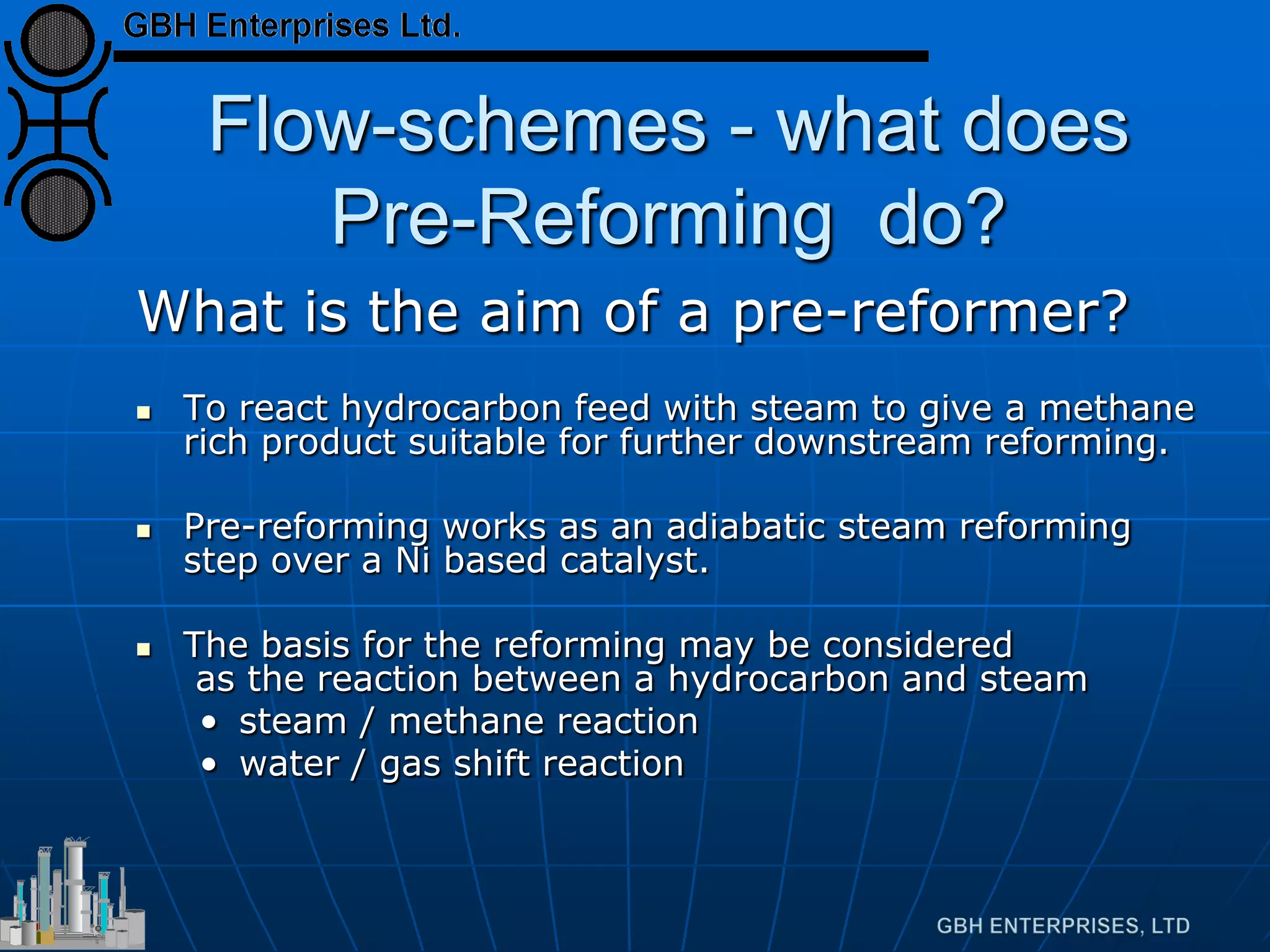
Flow-schemes - what does
Pre-Reforming do?
What is the aim of a pre-reformer?
 To react hydrocarbon feed with steam to give a methane
rich product suitable for further downstream reforming.
 Pre-reforming works as an adiabatic steam reforming
step over a Ni based catalyst.
 The basis for the reforming may be considered
as the reaction between a hydrocarbon and steam
• steam / methane reaction
• water / gas shift reaction
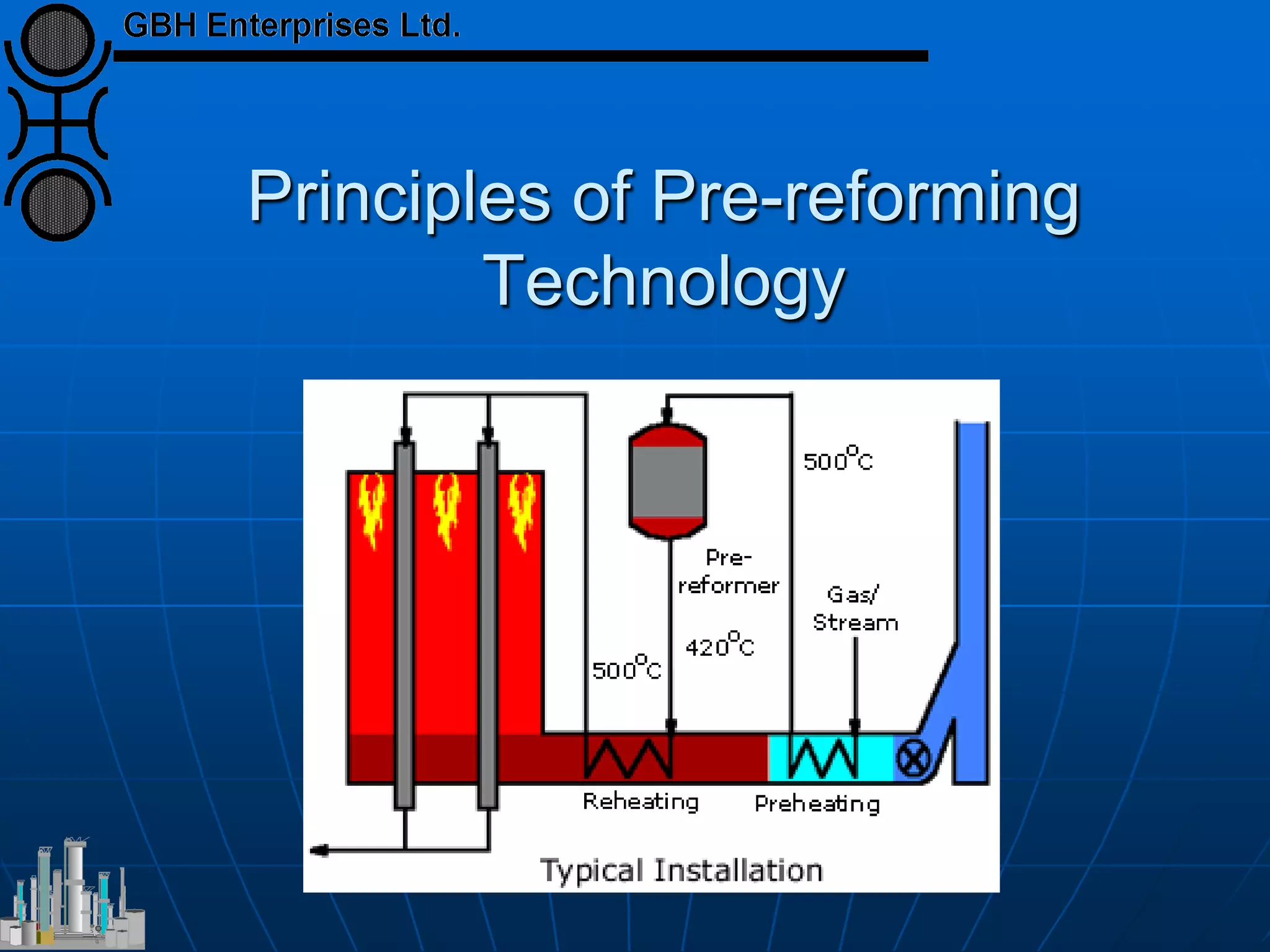
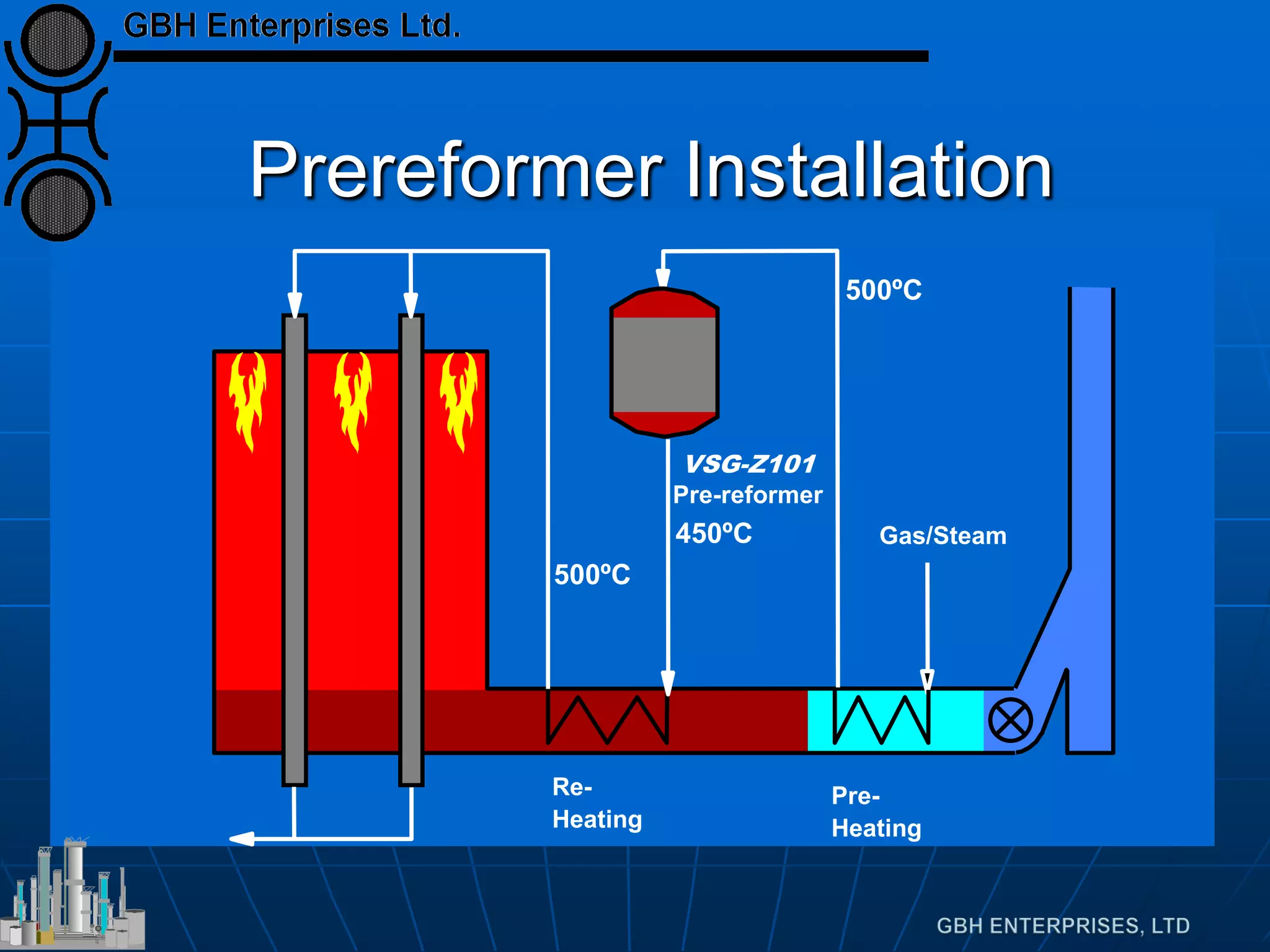
Prereformer Installation
Pre-
Heating
Re-
Heating
Gas/Steam
VSG-Z101
Pre-reformer
500ºC
500ºC
450ºC
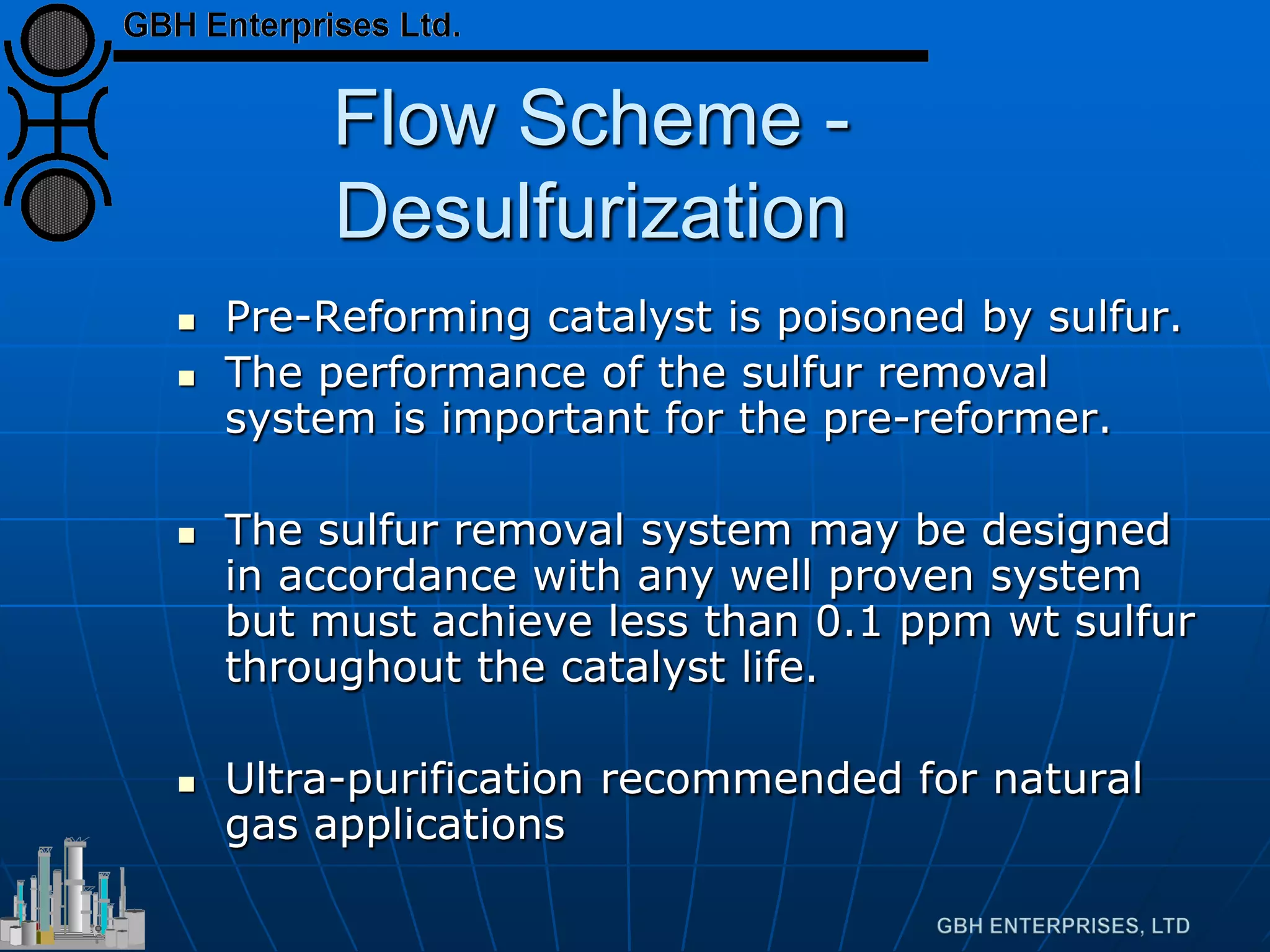
Flow Scheme -
Desulfurization
 Pre-Reforming catalyst is poisoned by sulfur.
 The performance of the sulfur removal
system is important for the pre-reformer.
 The sulfur removal system may be designed
in accordance with any well proven system
but must achieve less than 0.1 ppm wt sulfur
throughout the catalyst life.
 Ultra-purification recommended for natural
gas applications
Advantages of Pre-reforming
 Fuel savings over stand alone primary reformer
 Reduced capital cost of reformer
 Higher primary reformer preheat temperatures
 Lower involuntary steam production
 Increased feedstock flexibility
 Higher activity primary reforming catalyst for
naphtha based plants
 Lower overall steam to carbon ratios
 Provides protection for the main reformer
 Reliable and easy operation
Contents
 GBHE pre-reforming background
• Markets
• Flow-schemes
• Feed-stocks
• Catalyst handling, loading & start-up
 Benefits of a pre-reformer
• Case studies
• Effects upon primary reformer
• Data analysis
• Reactor temperature profiles
• Catalyst management
 Summary
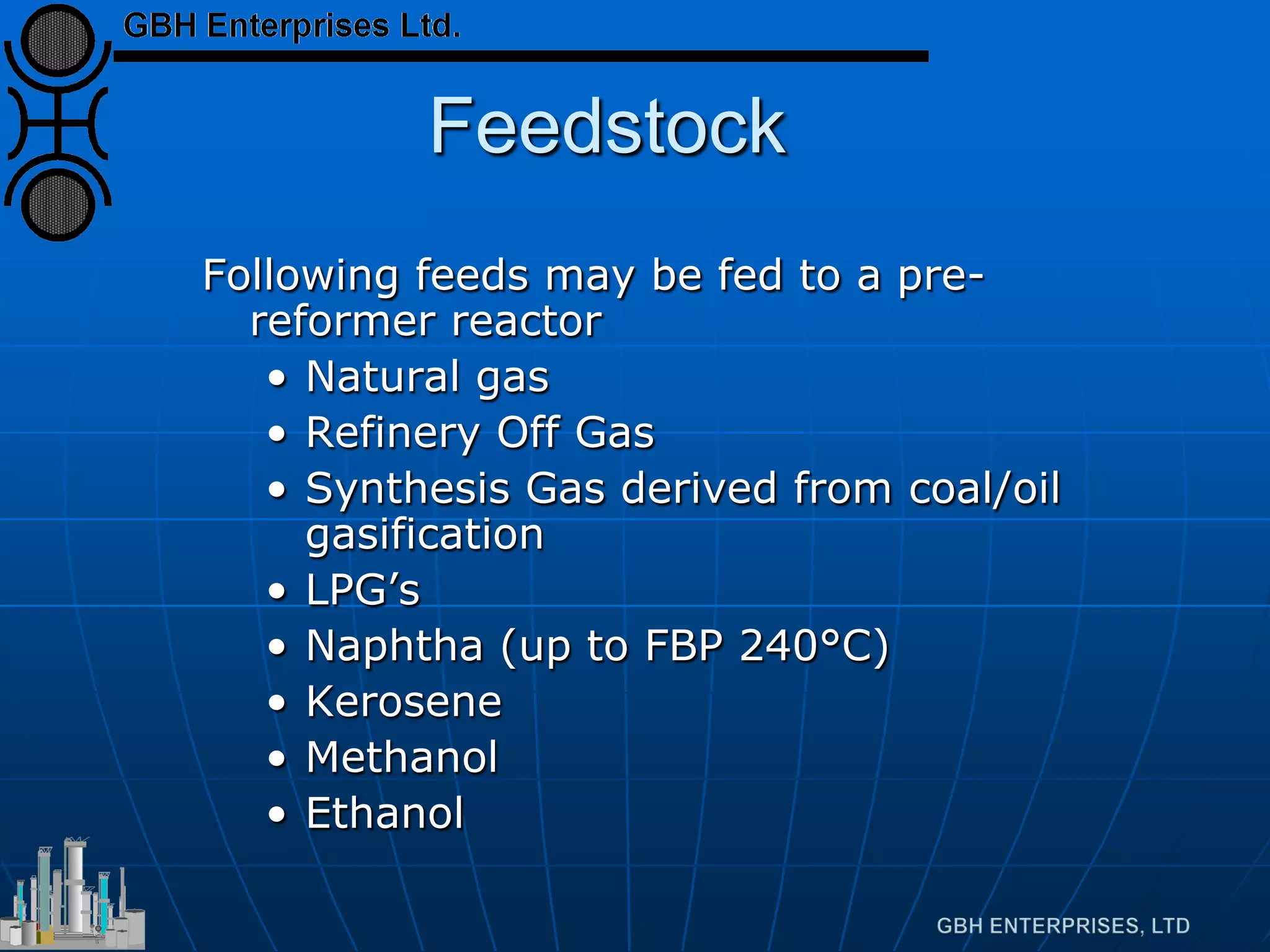
Feedstock
Following feeds may be fed to a pre-
reformer reactor
• Natural gas
• Refinery Off Gas
• Synthesis Gas derived from coal/oil
gasification
• LPG’s
• Naphtha (up to FBP 240°C)
• Kerosene
• Methanol
• Ethanol
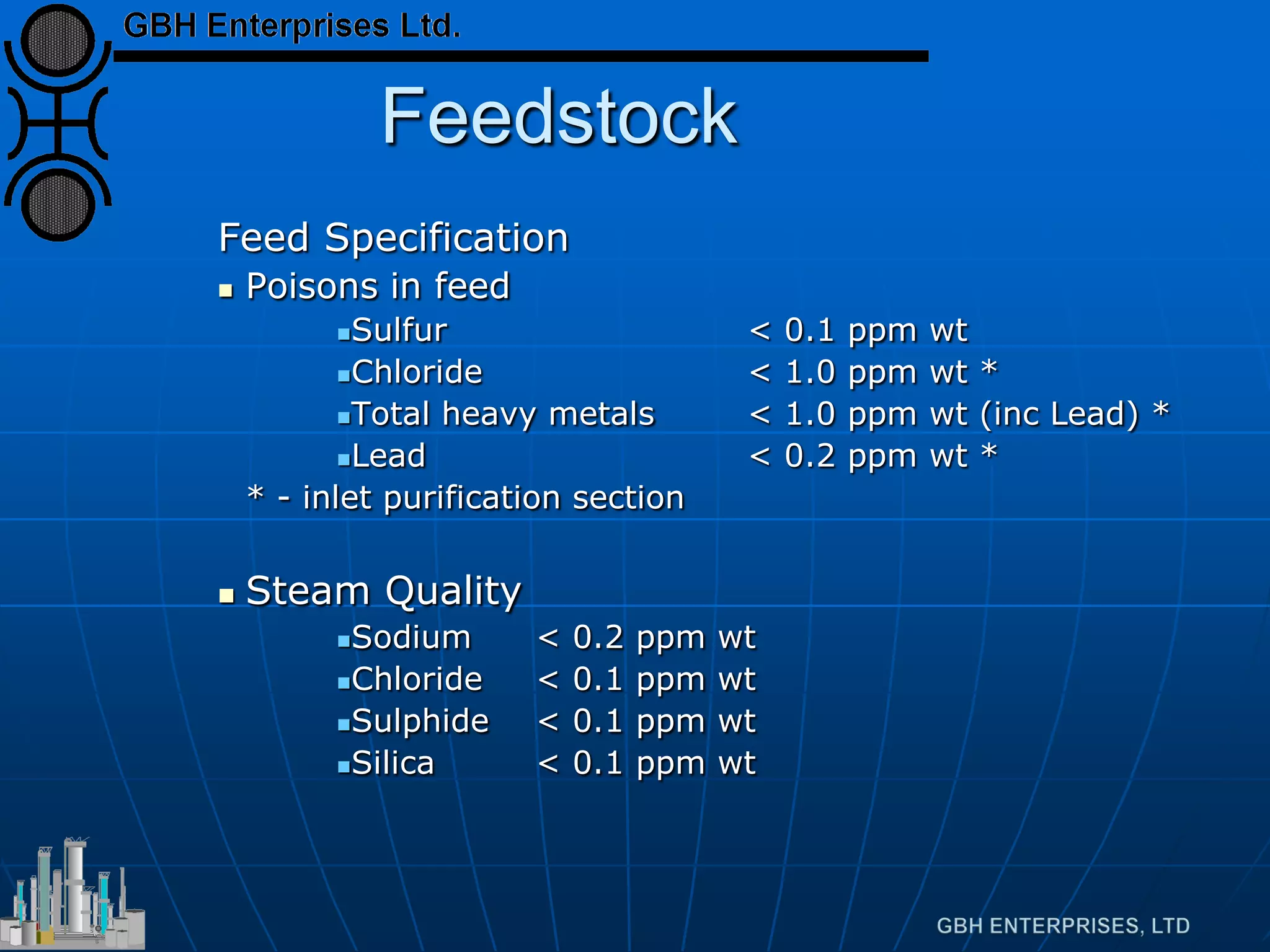
Feedstock
Feed Specification
 Poisons in feed
Sulfur < 0.1 ppm wt
Chloride < 1.0 ppm wt *
Total heavy metals < 1.0 ppm wt (inc Lead) *
Lead < 0.2 ppm wt *
* - inlet purification section
 Steam Quality
Sodium < 0.2 ppm wt
Chloride < 0.1 ppm wt
Sulphide < 0.1 ppm wt
Silica < 0.1 ppm wt
Feedstock contd
For naphtha feeds over pre-reforming
catalyst there are limits on
• Aromatic content – normally 10 wt%
• Naphthene content – normally 25 wt%
• When considered together < 40 wt% has
been applied
Feedstock contd
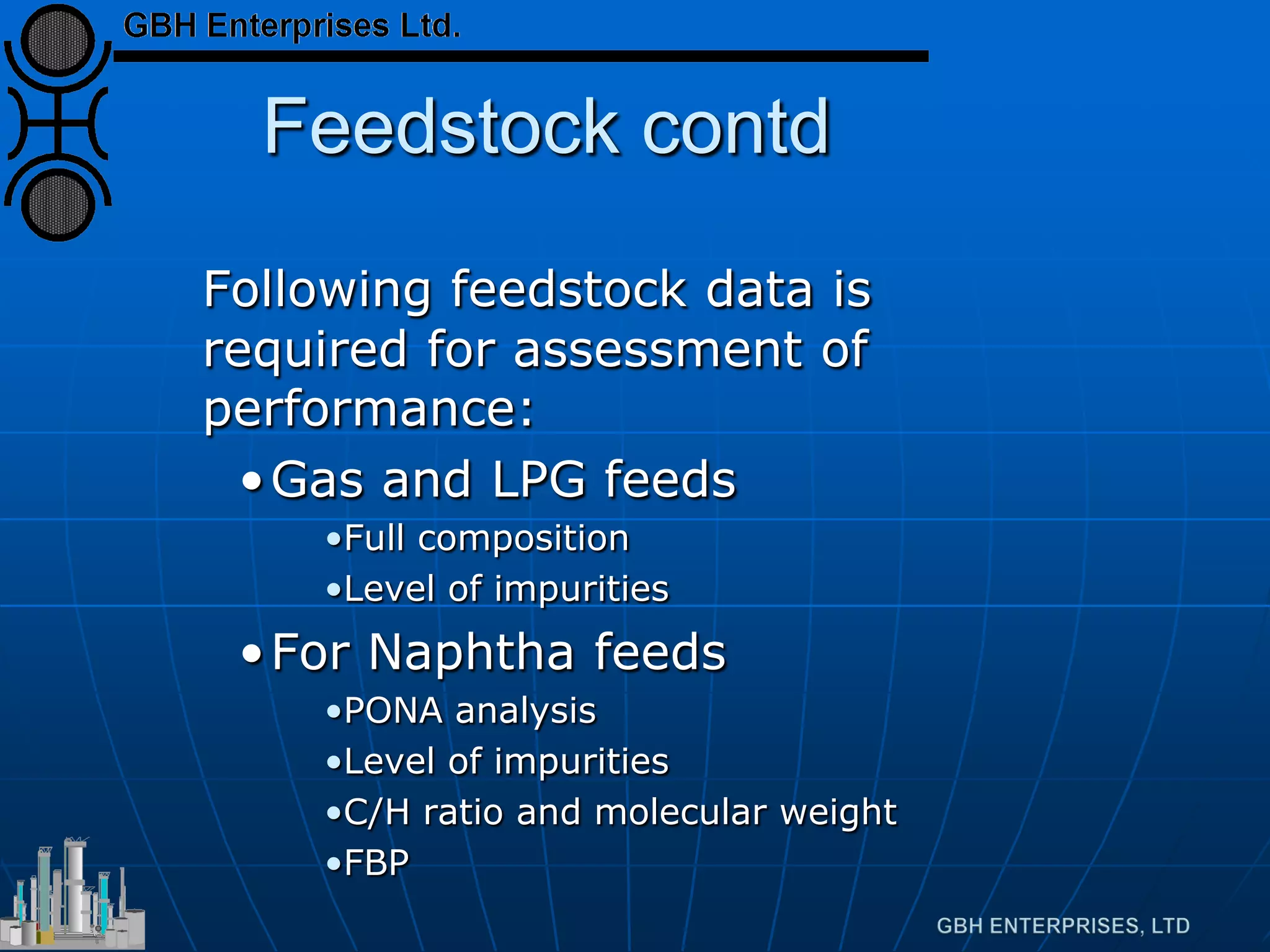
Following feedstock data is
required for assessment of
performance:
•Gas and LPG feeds
•Full composition
•Level of impurities
•For Naphtha feeds
•PONA analysis
•Level of impurities
•C/H ratio and molecular weight
•FBP
Contents
 GBHE pre-reforming background
• Markets
• Flow-schemes
• Feed-stocks
• Catalyst handling, loading & start-up
 Benefits of a pre-reformer
• Case studies
• Effects upon primary reformer
• Data analysis
• Reactor temperature profiles
• Catalyst management
 Summary
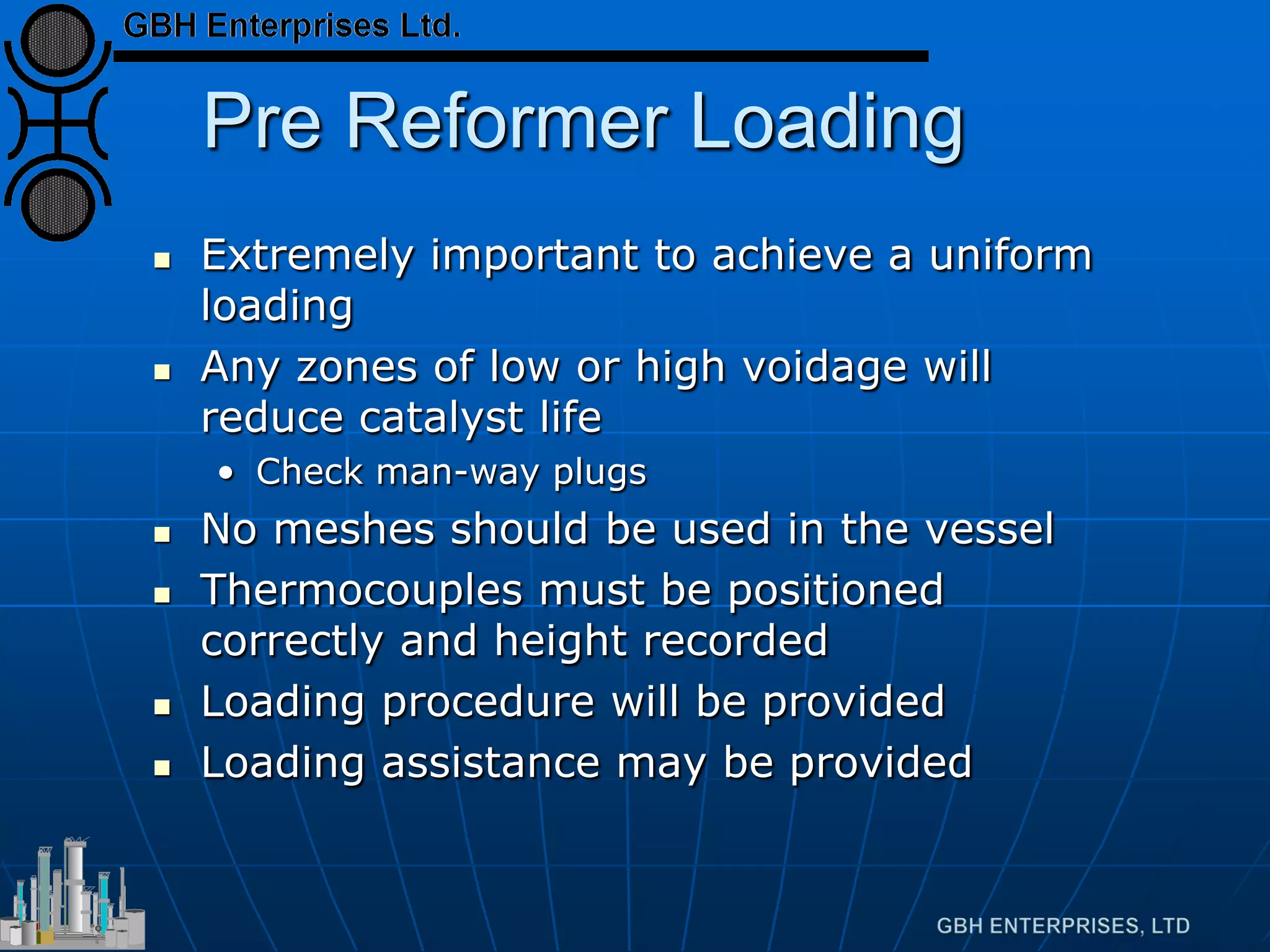
Pre Reformer Loading
 Extremely important to achieve a uniform
loading
 Any zones of low or high voidage will
reduce catalyst life
• Check man-way plugs
 No meshes should be used in the vessel
 Thermocouples must be positioned
correctly and height recorded
 Loading procedure will be provided
 Loading assistance may be provided
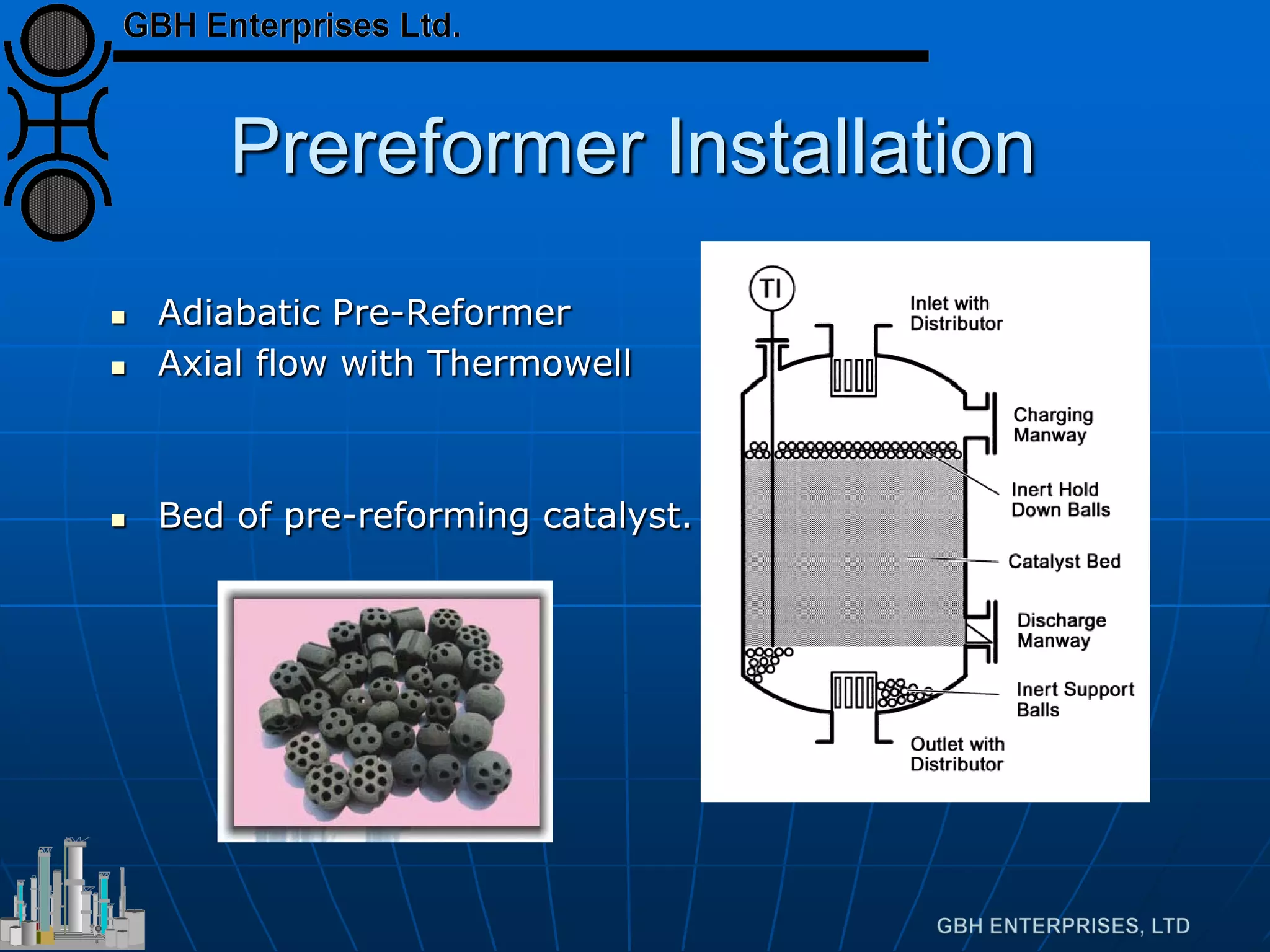
Prereformer Installation
 Adiabatic Pre-Reformer
 Axial flow with Thermowell
 Bed of pre-reforming catalyst.
Pre-reformer Start-up
 Drying
 Heating
 Start-up
 Reduction
Catalyst Drying
For catalyst subjected to low temperature
(ie <0oC)
 Dry using Nitrogen
 175 to 250°C
 NG can be used below 200°C
 4 to 24 hours
 Dry air, not suitable for prereduced
 First start-up of prereduced
Catalyst Heating
 Normally heated using nitrogen
 Absorbed moisture
 Initial heating rate, 50°C per hour
 Max temp differential in bed 100°C
 At 200°C, 70°C per hour
 Heating till peak 400°C, min 370°C
 High circ rate, max pd 2 bar
Catalyst Heating continued
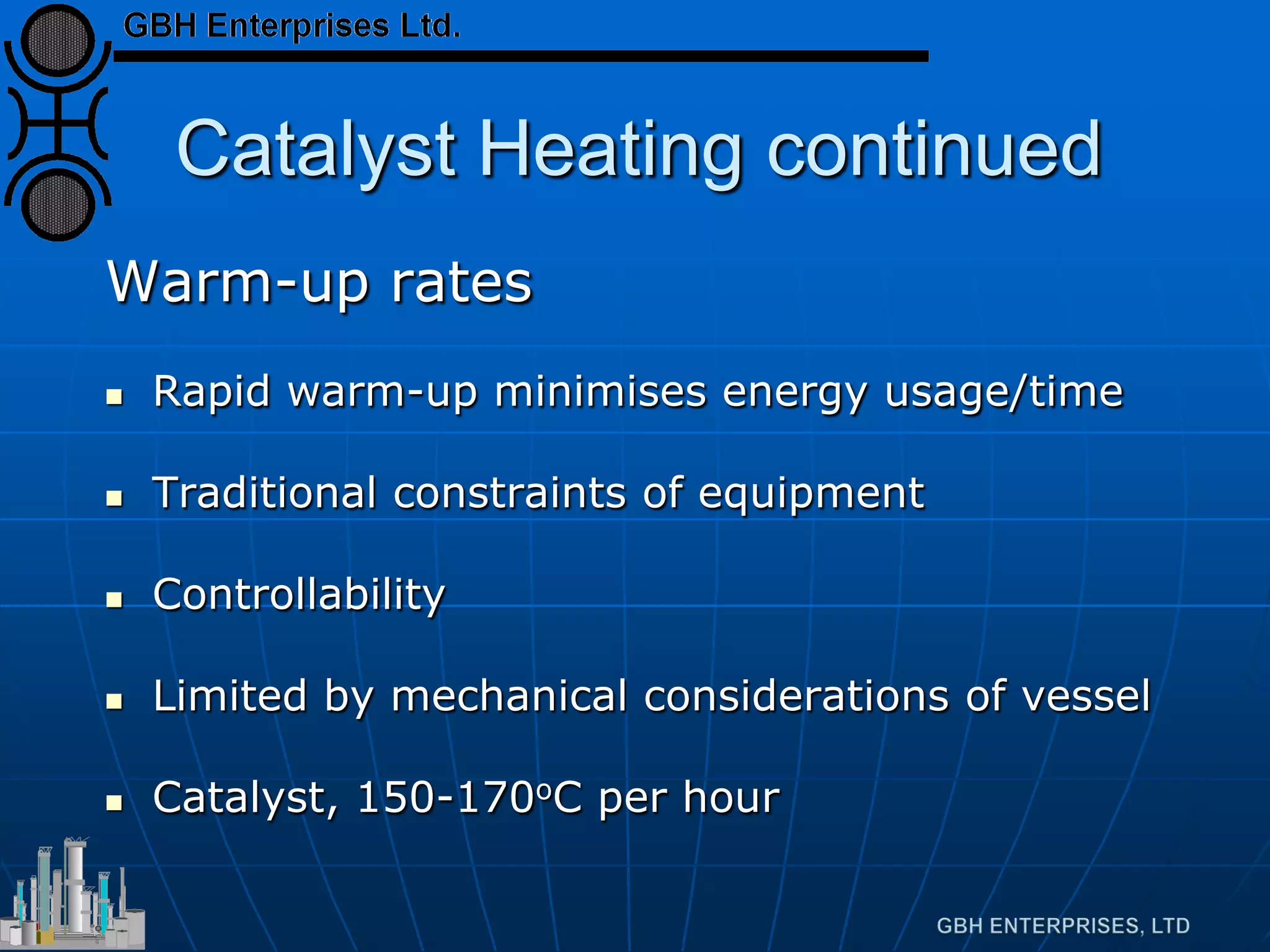
Warm-up rates
 Rapid warm-up minimises energy usage/time
 Traditional constraints of equipment
 Controllability
 Limited by mechanical considerations of vessel
 Catalyst, 150-170oC per hour
Catalyst Heating contd
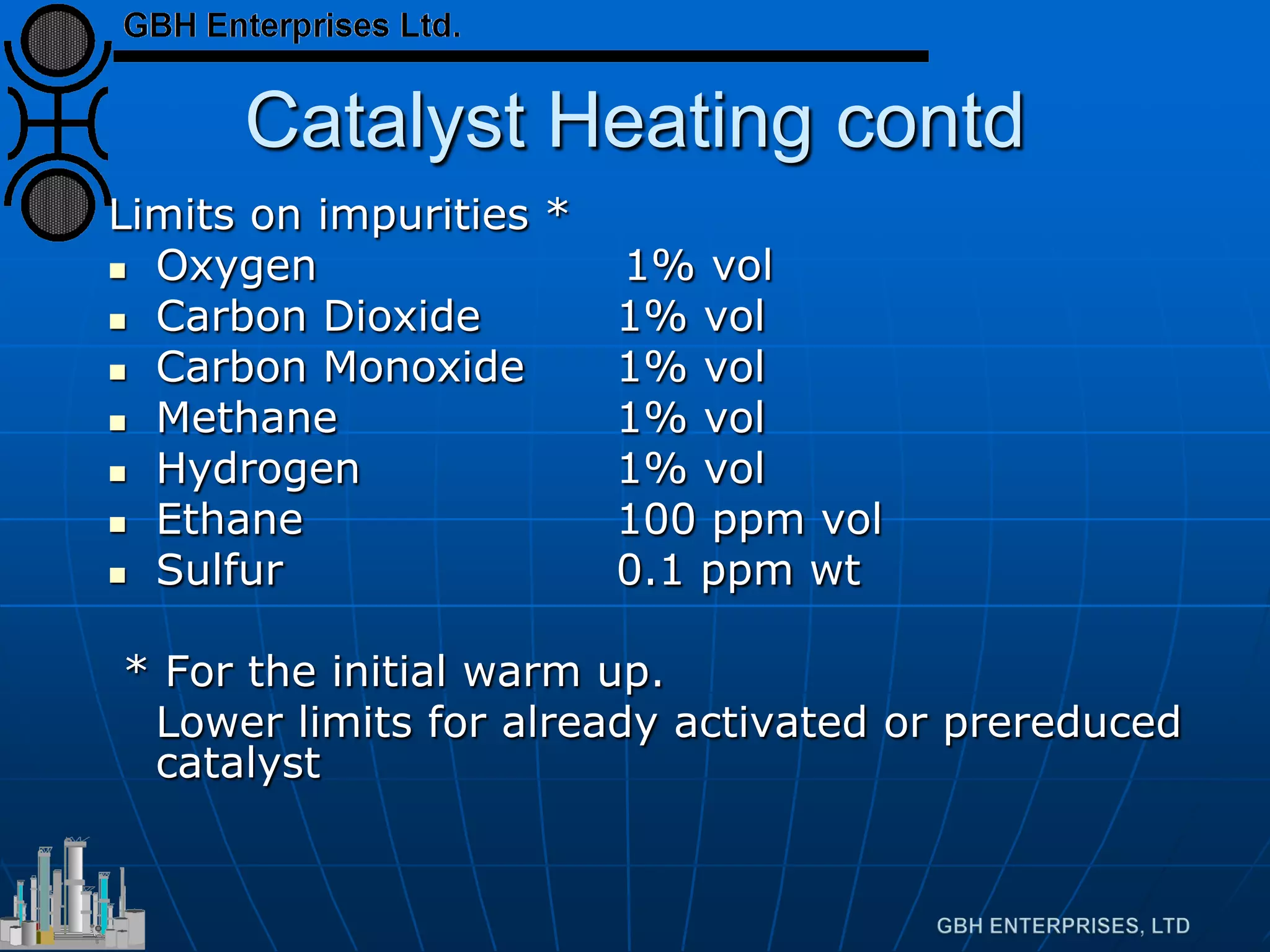
Limits on impurities *
 Oxygen 1% vol
 Carbon Dioxide 1% vol
 Carbon Monoxide 1% vol
 Methane 1% vol
 Hydrogen 1% vol
 Ethane 100 ppm vol
 Sulfur 0.1 ppm wt
* For the initial warm up.
Lower limits for already activated or prereduced
catalyst
Catalyst Heating contd
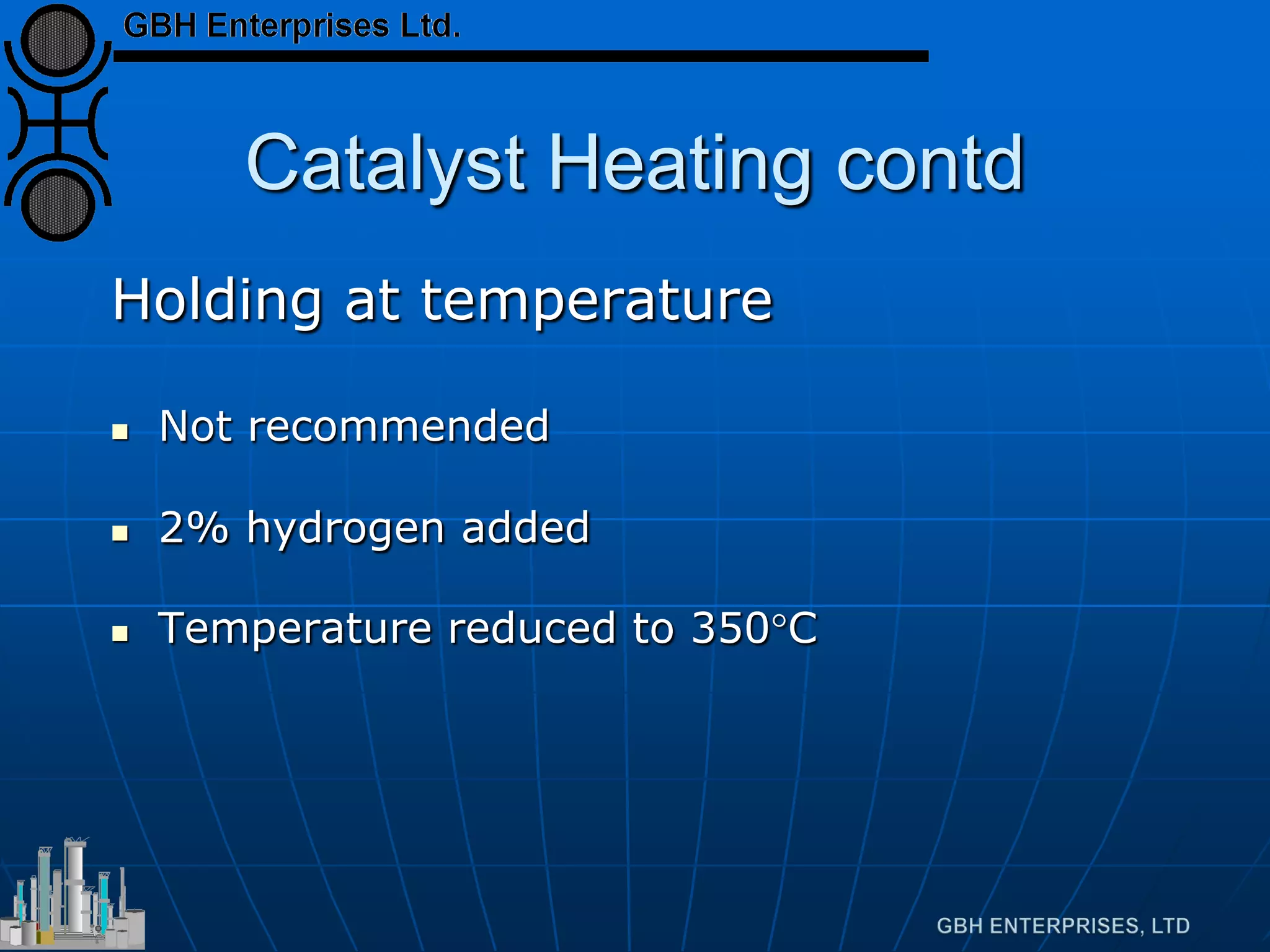
Holding at temperature
 Not recommended
 2% hydrogen added
 Temperature reduced to 350°C
Catalyst Start-up
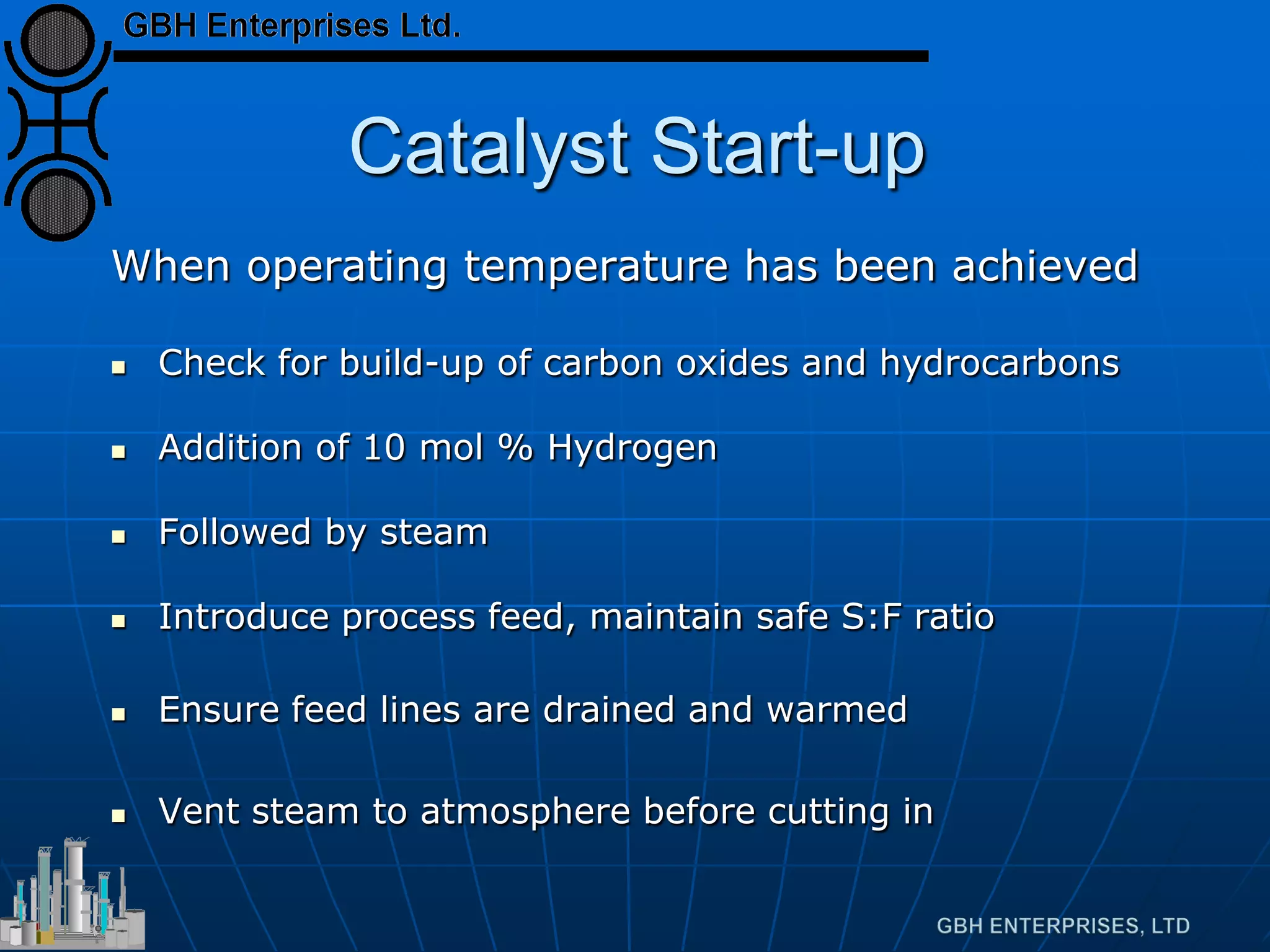
When operating temperature has been achieved
 Check for build-up of carbon oxides and hydrocarbons
 Addition of 10 mol % Hydrogen
 Followed by steam
 Introduce process feed, maintain safe S:F ratio
 Ensure feed lines are drained and warmed
 Vent steam to atmosphere before cutting in
Heating using Natural Gas
Using NG as heating medium
 No impurities
 Immediate start-up
 50°C per hour, max differential 100°C
 At 200°C introduce steam
• Min S:C 0.3kg/kg at 200°C
• Min S:C 0.5kg/kg at 400°C to 450°C
• Increase to design feed and S:F
Contents
 GBHE pre-reforming background
• Markets
• Flow-schemes
• Feed-stocks
• Catalyst handling, loading & start-up
 Benefits of a pre-reformer
• Case studies
• Effects upon primary reformer
• Data analysis
• Reactor temperature profiles
• Catalyst management
 Summary
Process benefits of pre-reforming
 Moves reforming load from
Primary
 Better reformer design
• Higher thermal efficiency in radiant box
• Raises pre-heat temps before carbon formation
issues
• Feedstock flexibility
 Reduced steam export
• Heat is recovered from duct
 Demonstrated using case studies
Process Benefits- Case Study
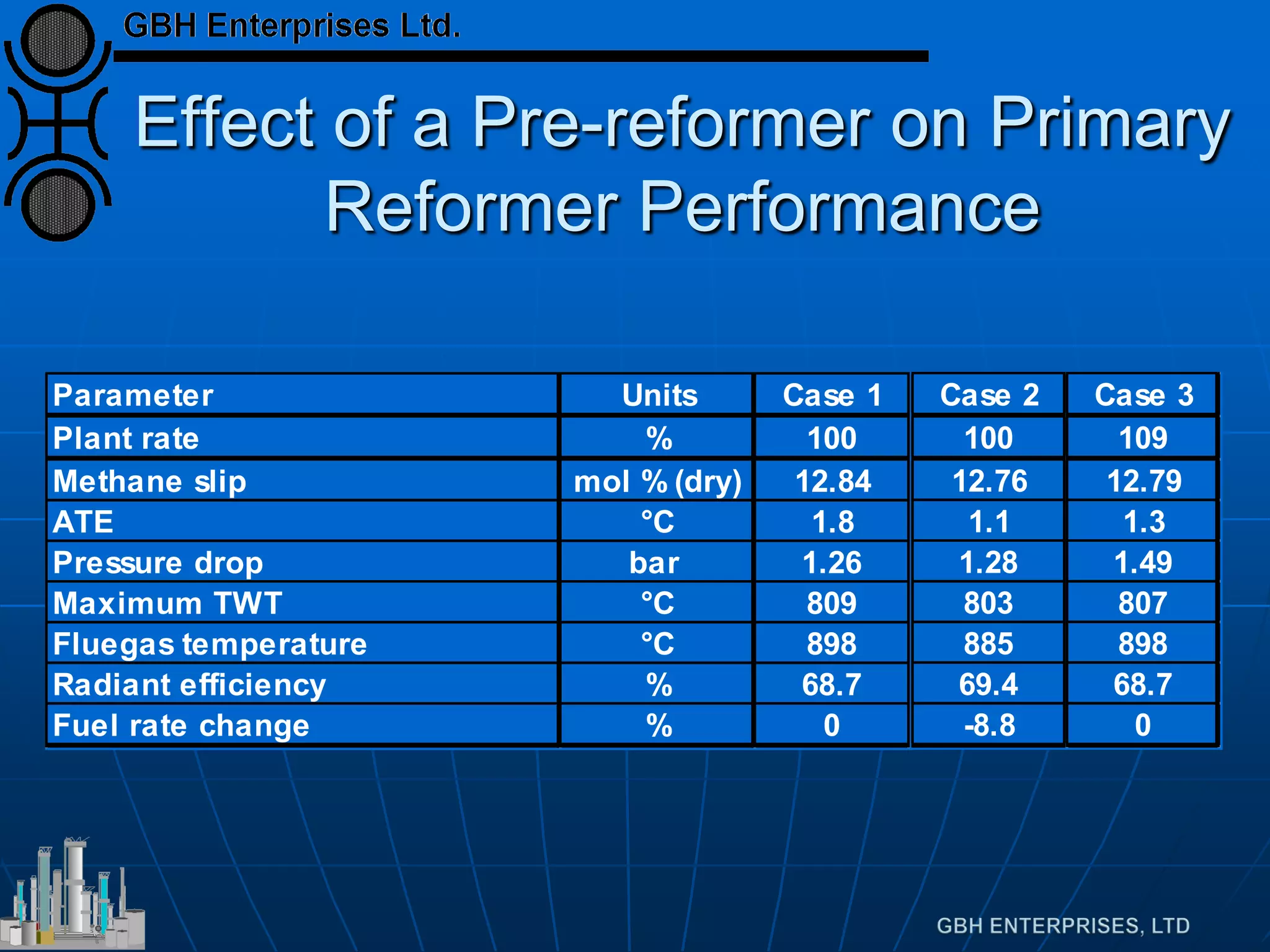
 Case 1 – Base Case – no pre-reformer installed
 Case 2 – Pre-reformer installed
 Case 3 – Pre-reformer installed and plant rate
increased until firing on the reformer is the same
as Case 1
Effect of a Pre-reformer on Primary
Reformer Performance
Parameter Units Case 1
Plant rate % 100
Methane slip mol % (dry) 12.84
ATE °C 1.8
Pressure drop bar 1.26
Maximum TWT °C 809
Fluegas temperature °C 898
Radiant efficiency % 68.7
Fuel rate change % 0
Case 2
100
12.76
1.1
1.28
803
885
69.4
-8.8
Case 3
109
12.79
1.3
1.49
807
898
68.7
0
Contents
 GBHE pre-reforming background
• Markets
• Flow-schemes
• Feed-stocks
• Catalyst handling, loading & start-up
 Benefits of a pre-reformer
• Case studies
• Effects upon primary reformer
• Data analysis
• Reactor temperature profiles
• Catalyst management
 Summary
Effect of a Pre-reformer on Primary
Reformer Performance
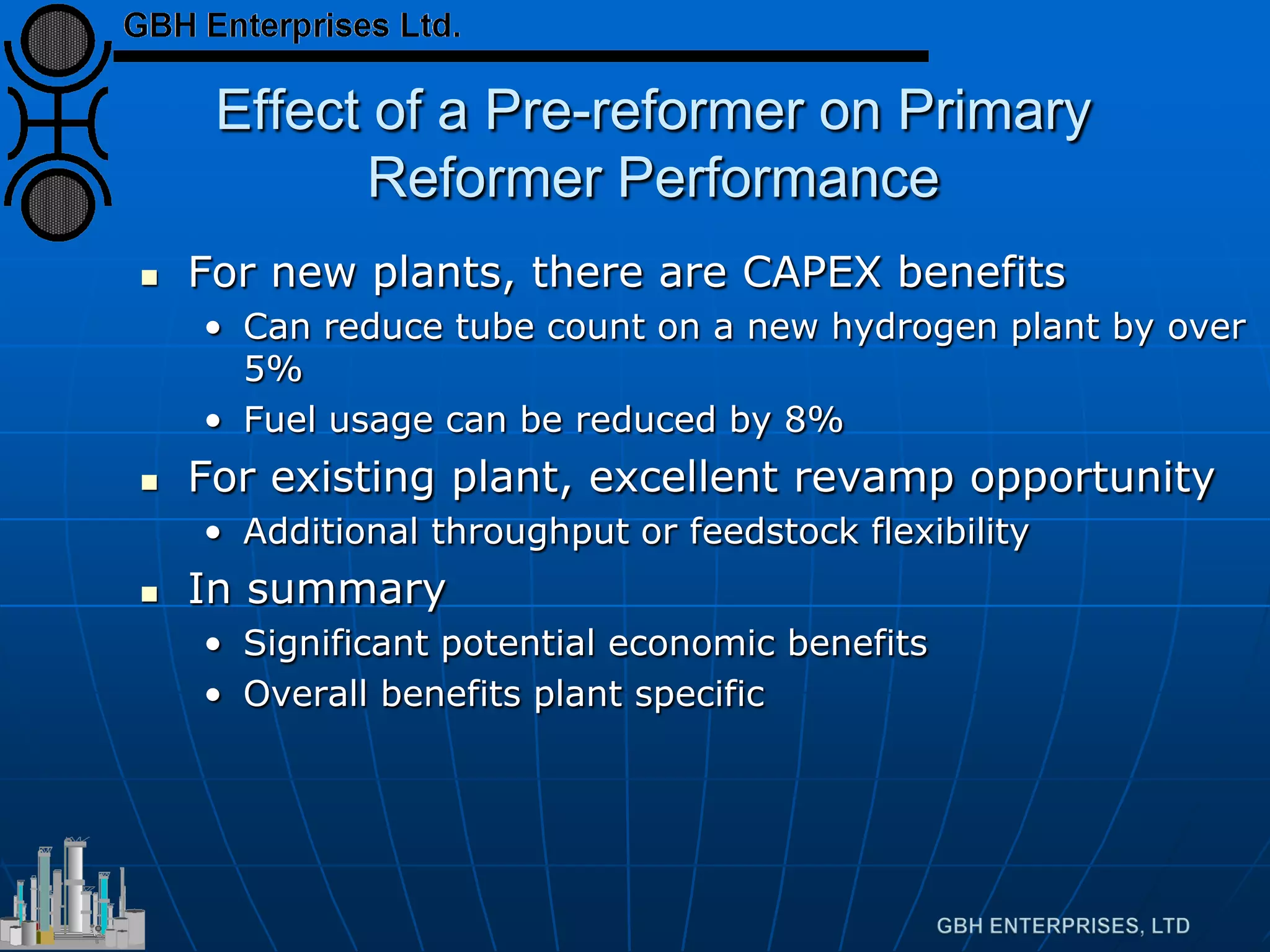
 For new plants, there are CAPEX benefits
• Can reduce tube count on a new hydrogen plant by over
5%
• Fuel usage can be reduced by 8%
 For existing plant, excellent revamp opportunity
• Additional throughput or feedstock flexibility
 In summary
• Significant potential economic benefits
• Overall benefits plant specific
Effect of a Pre-reformer on Primary
Reformer Performance contd
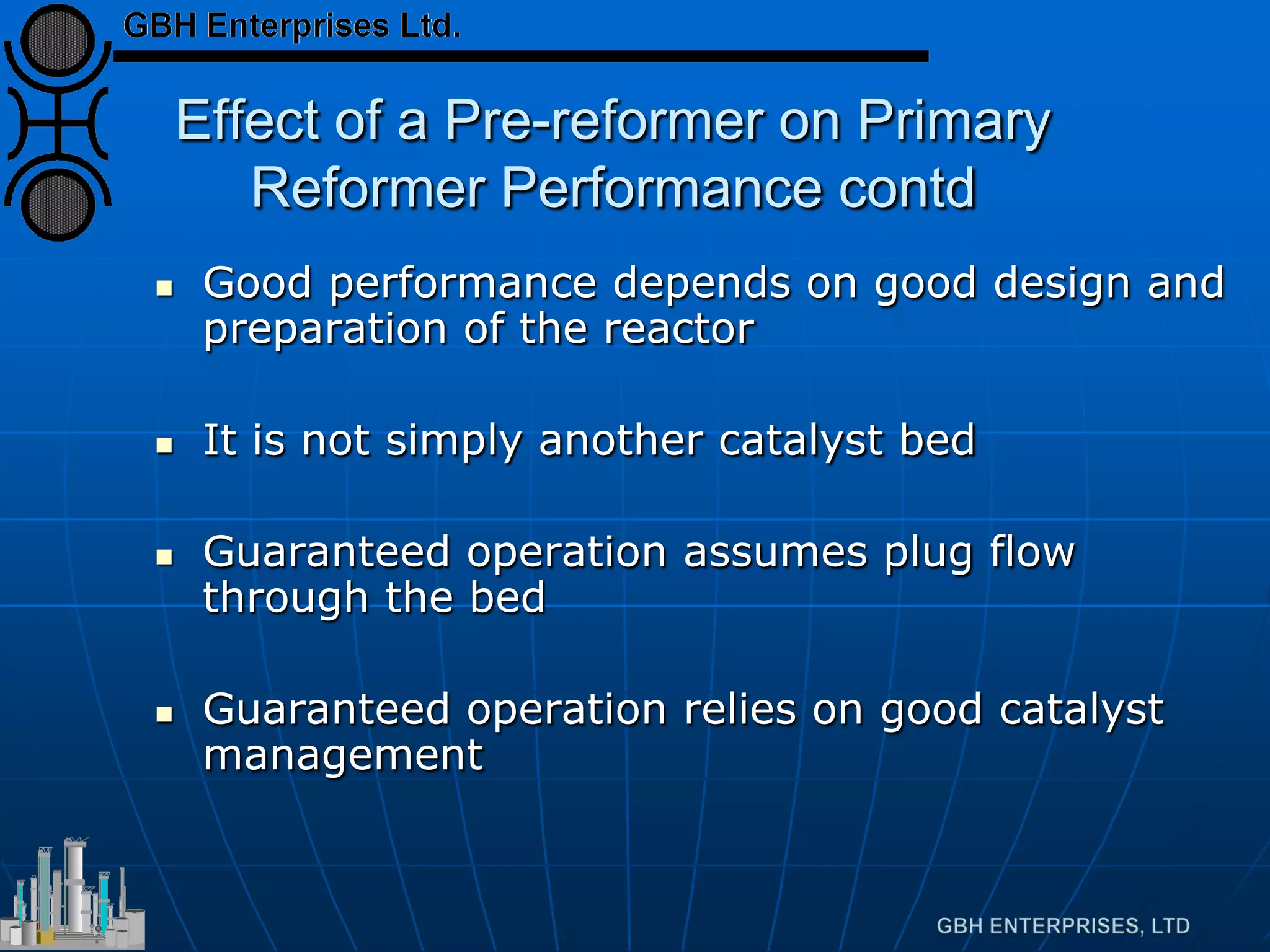
 Good performance depends on good design and
preparation of the reactor
 It is not simply another catalyst bed
 Guaranteed operation assumes plug flow
through the bed
 Guaranteed operation relies on good catalyst
management
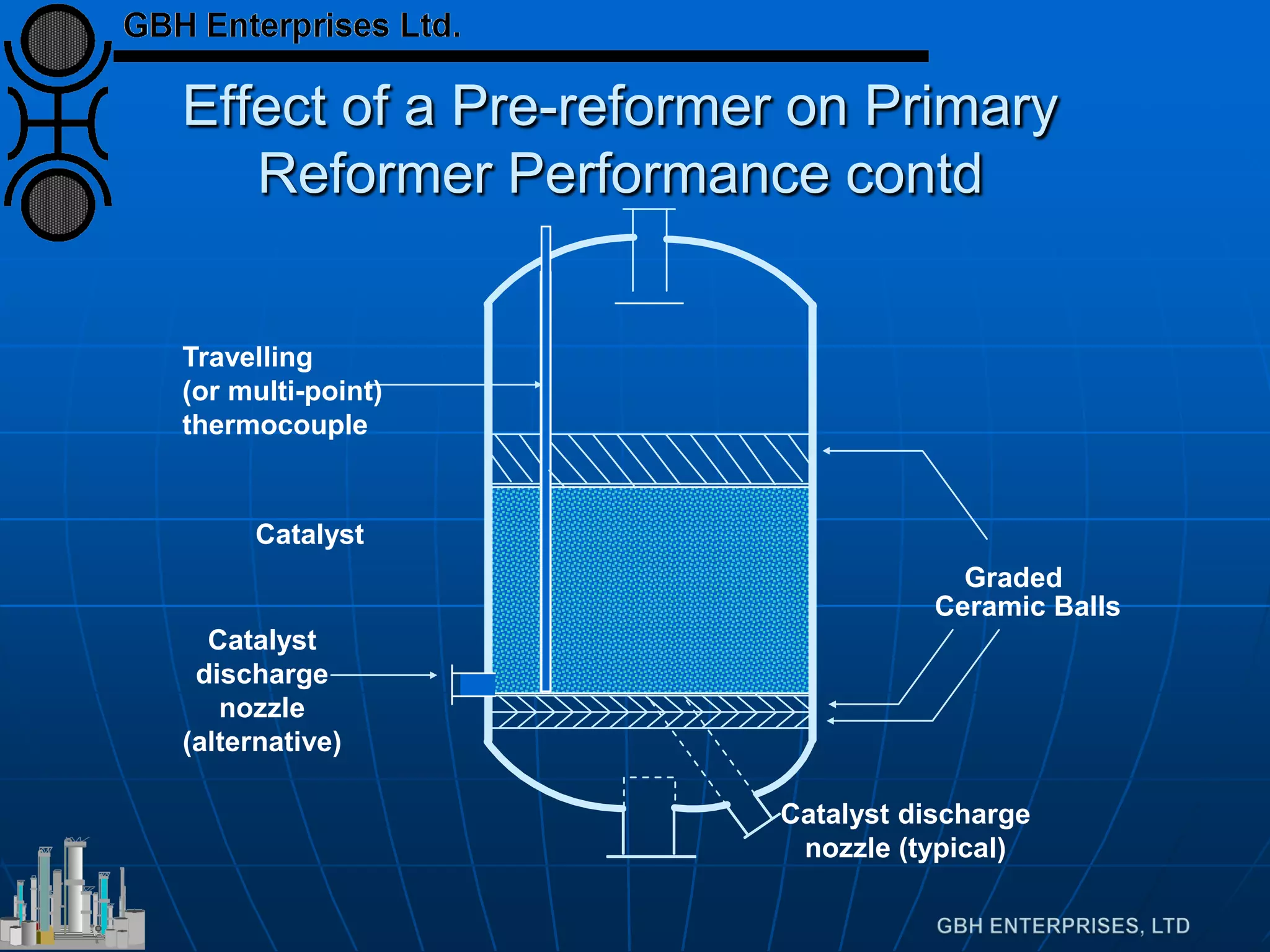
Effect of a Pre-reformer on Primary
Reformer Performance contd
Travelling
(or multi-point)
thermocouple
Catalyst
Graded
Ceramic Balls
Catalyst
discharge
nozzle
(alternative)
Catalyst discharge
nozzle (typical)
Effect of a Pre-reformer on Primary
Reformer Performance contd
Good performance is achieved
through
 Even gas distribution
 Adequate temperature
measurement
 Thorough pre-commissioning
 Correct catalyst charging
procedures
 Good operating practices
Contents
 GBHE pre-reforming background
• Markets
• Flow-schemes
• Feed-stocks
• Catalyst handling, loading & start-up
 Benefits of a pre-reformer
• Case studies
• Effects upon primary reformer
• Data analysis
• Reactor temperature profiles
• Catalyst management
 Summary
Pre Reforming Data Analysis
 Good data is key to understanding
performance of the pre reformer
 Data includes
• Temperatures inlet and outlet the bed
• Temperatures through the bed
• Gas analysis inlet and outlet bed
• Feedstock and steam flows inlet bed
• Bed pressure drop trend
Pre Reforming Data Analysis
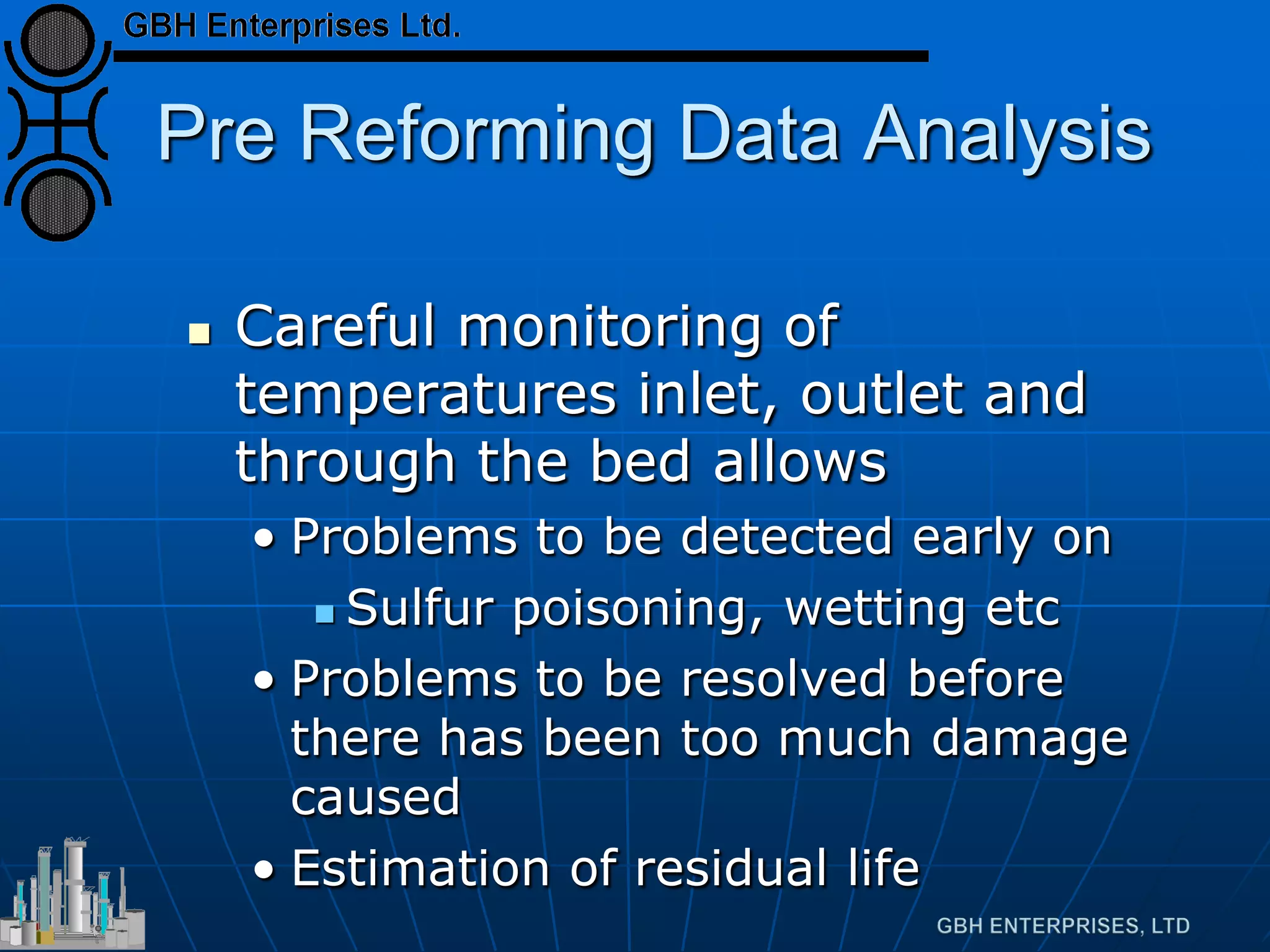
 Careful monitoring of
temperatures inlet, outlet and
through the bed allows
• Problems to be detected early on
 Sulfur poisoning, wetting etc
• Problems to be resolved before
there has been too much damage
caused
• Estimation of residual life
Contents
 GBHE pre-reforming background
• Markets
• Flow-schemes
• Feed-stocks
• Catalyst handling, loading & start-up
 Benefits of a pre-reformer
• Case studies
• Effects upon primary reformer
• Data analysis
• Reactor temperature profiles
• Catalyst management
 Summary
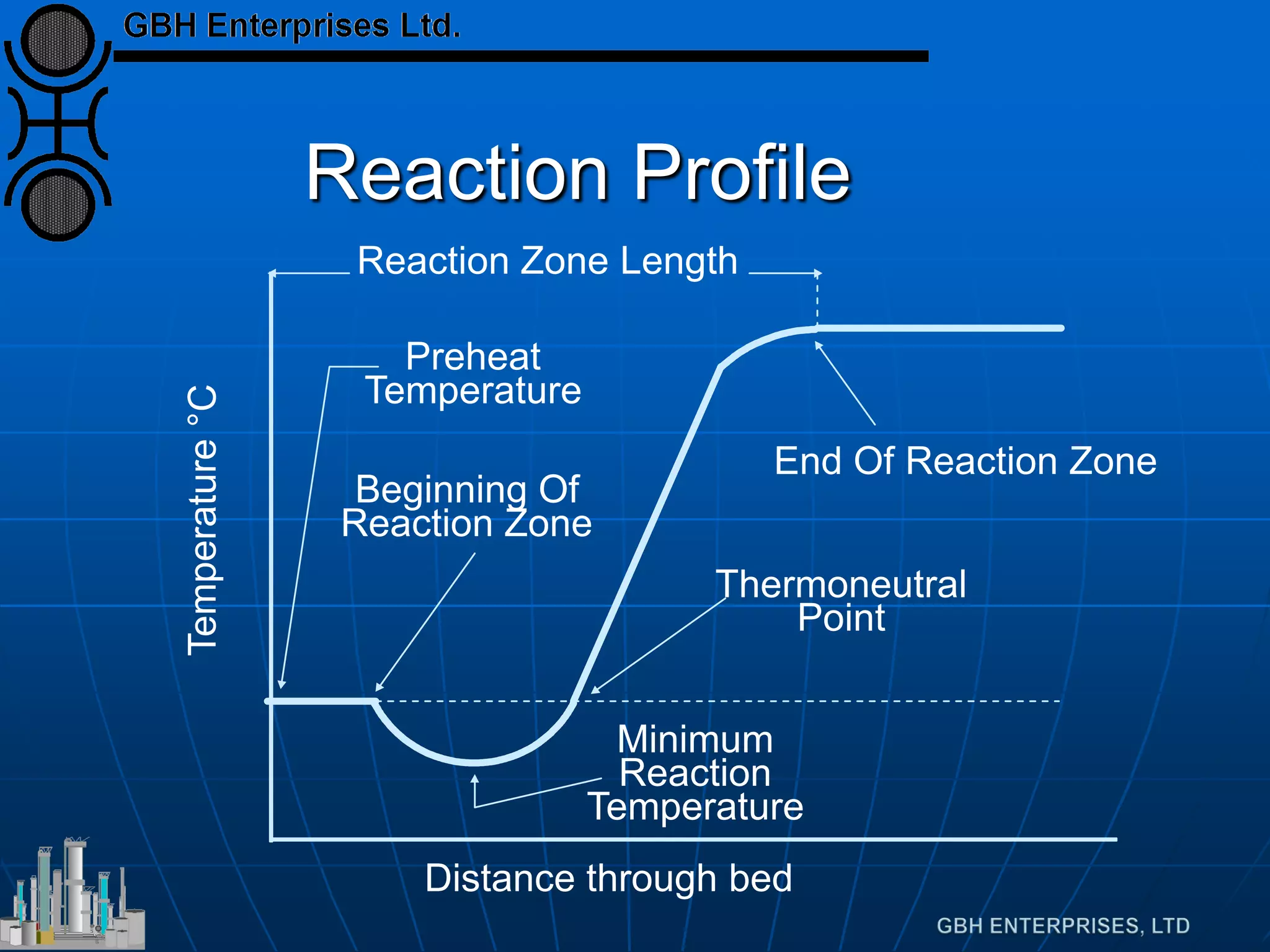
Reaction Profile
Reaction Zone Length
End Of Reaction Zone
Thermoneutral
Point
Minimum
Reaction
Temperature
Beginning Of
Reaction Zone
Preheat
Temperature
Temperature°C
Distance through bed
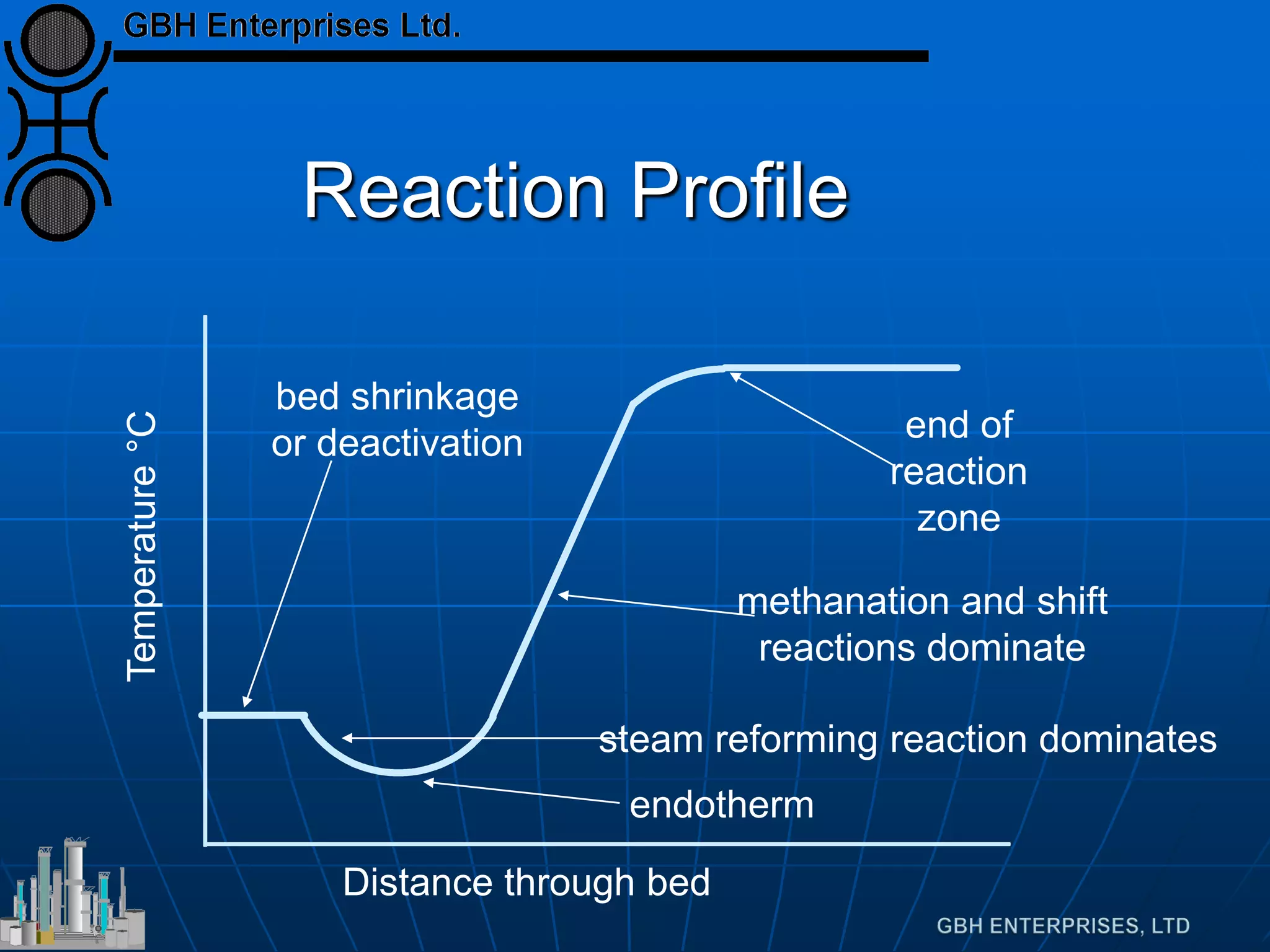
Reaction Profile
end of
reaction
zone
methanation and shift
reactions dominate
bed shrinkage
or deactivation
Temperature°C
Distance through bed
endotherm
steam reforming reaction dominates
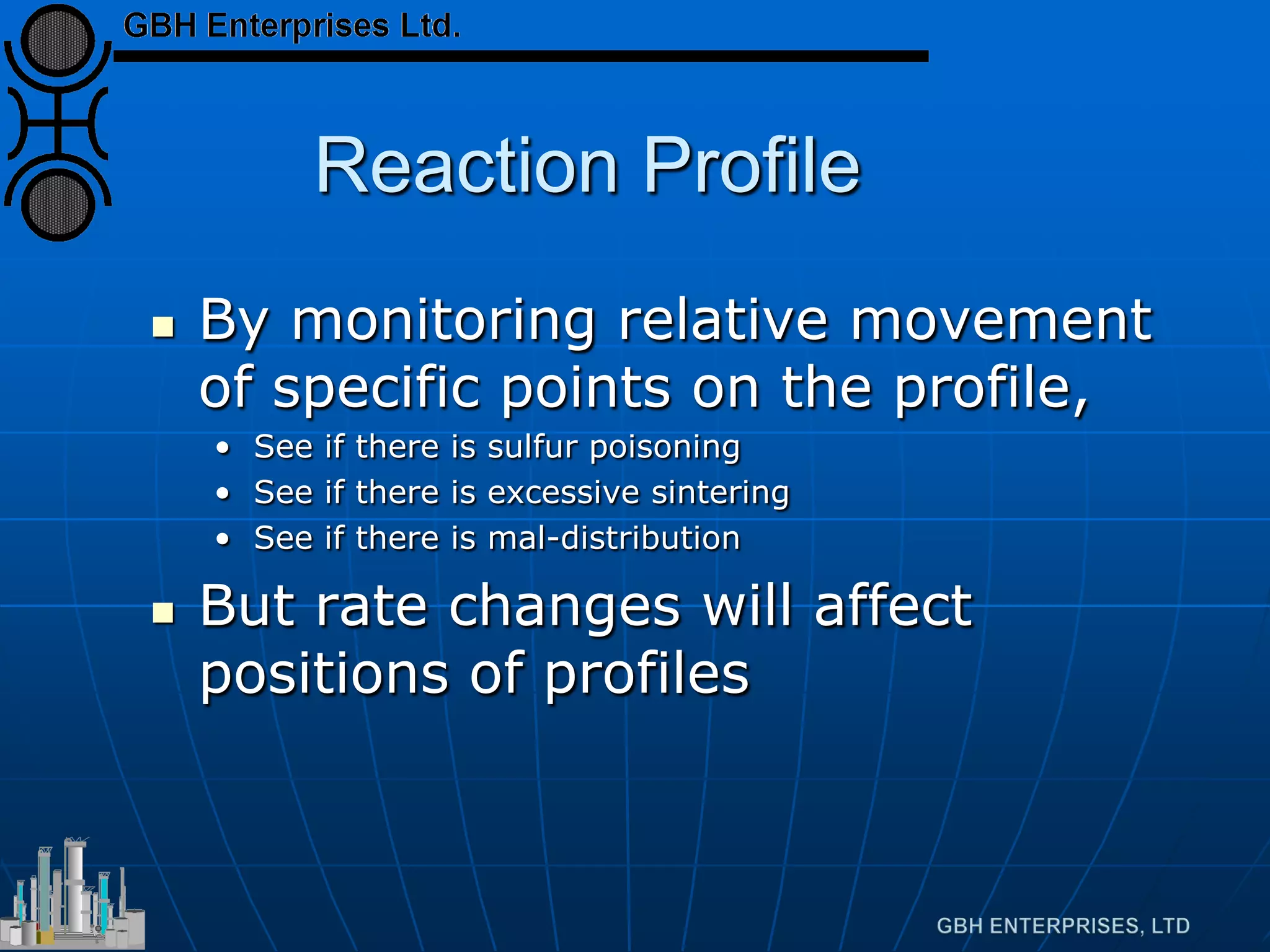
Reaction Profile
 By monitoring relative movement
of specific points on the profile,
• See if there is sulfur poisoning
• See if there is excessive sintering
• See if there is mal-distribution
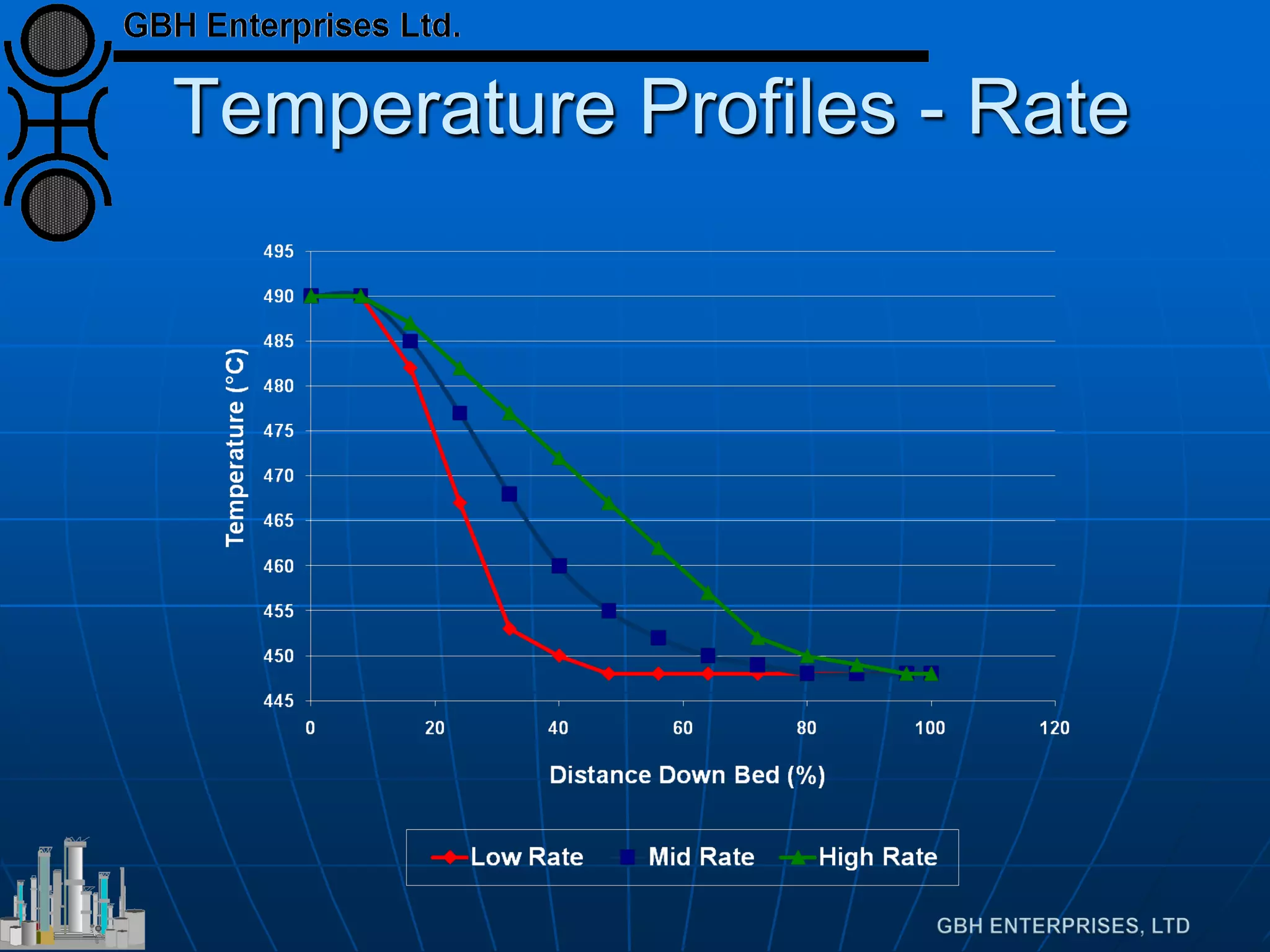
 But rate changes will affect
positions of profiles
Temperature Profiles - Rate
Temperature Profiles
Natural Gas - Effect of Plant Rate
 Changes in plant rate affect
profile
• Increases in rate
 Increases the length of profile
 Decreases the gradient
• Can be mistaken for sintering
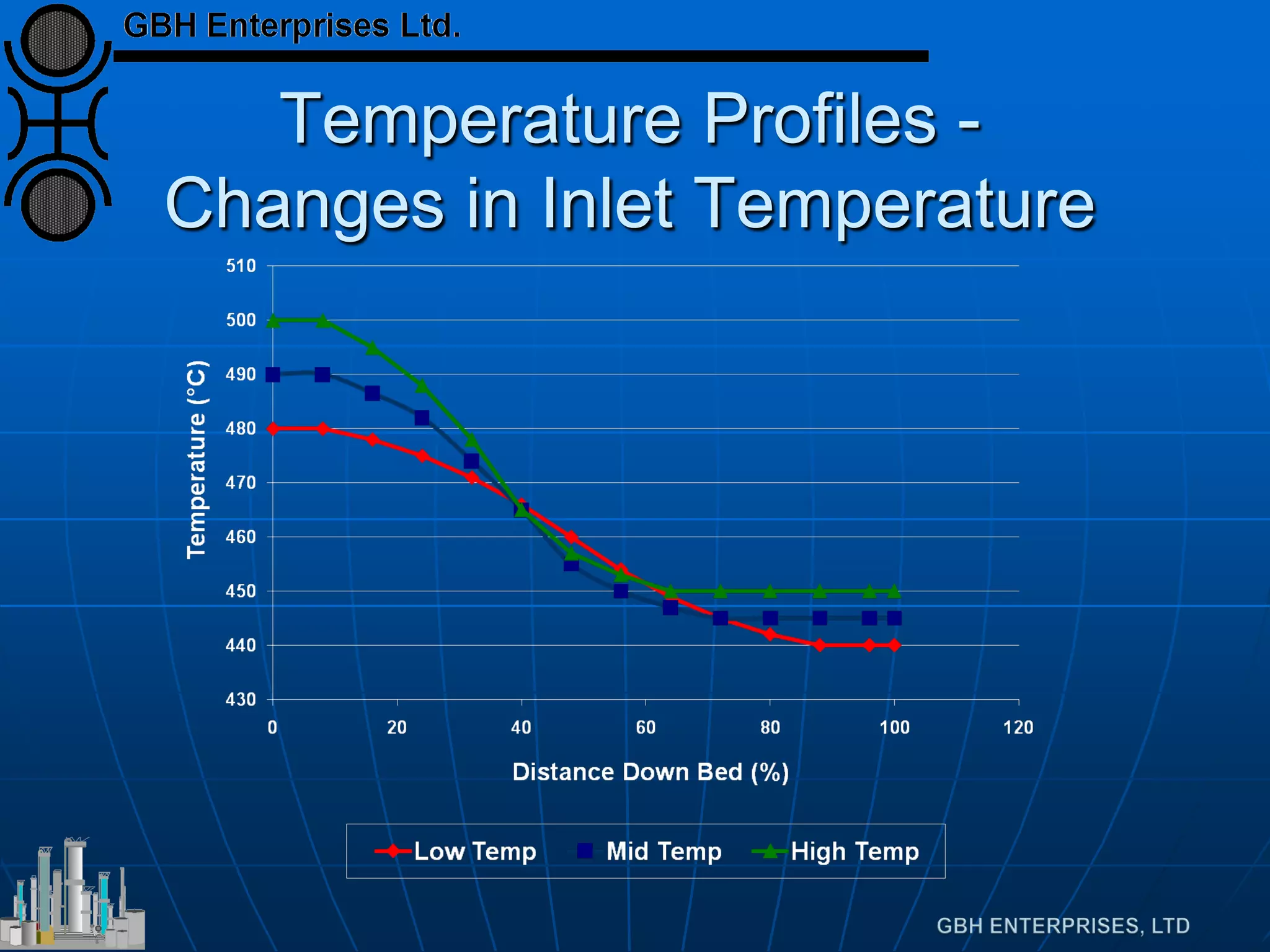
Temperature Profiles -
Changes in Inlet Temperature
Temperature Profiles
Changes in Inlet Temperature
 Increases in inlet temperature
• Shorten profile length
• Steeper profile gradient
• Change exit temperature
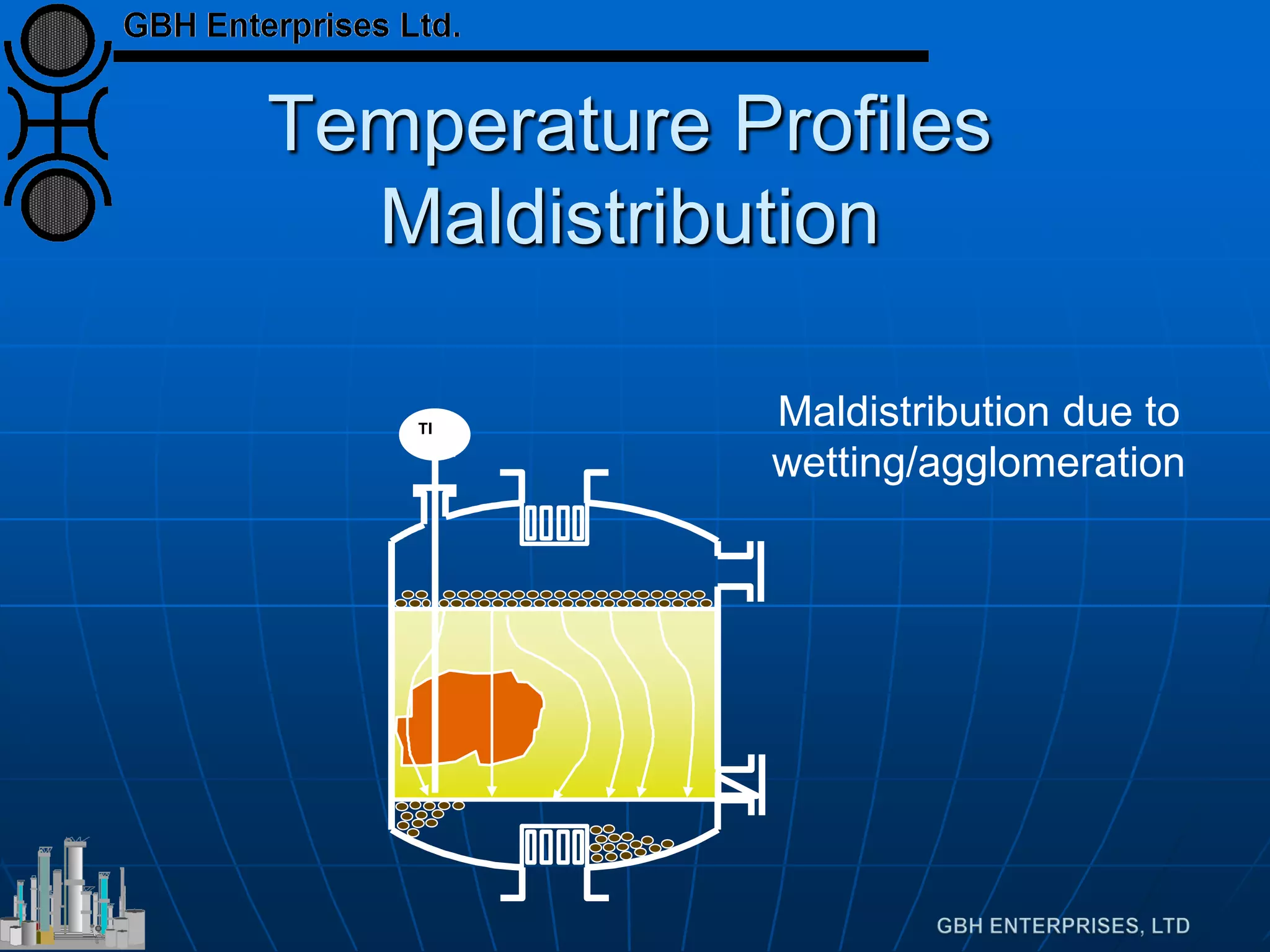
Temperature Profiles
Maldistribution
TI
Maldistribution due to
wetting/agglomeration
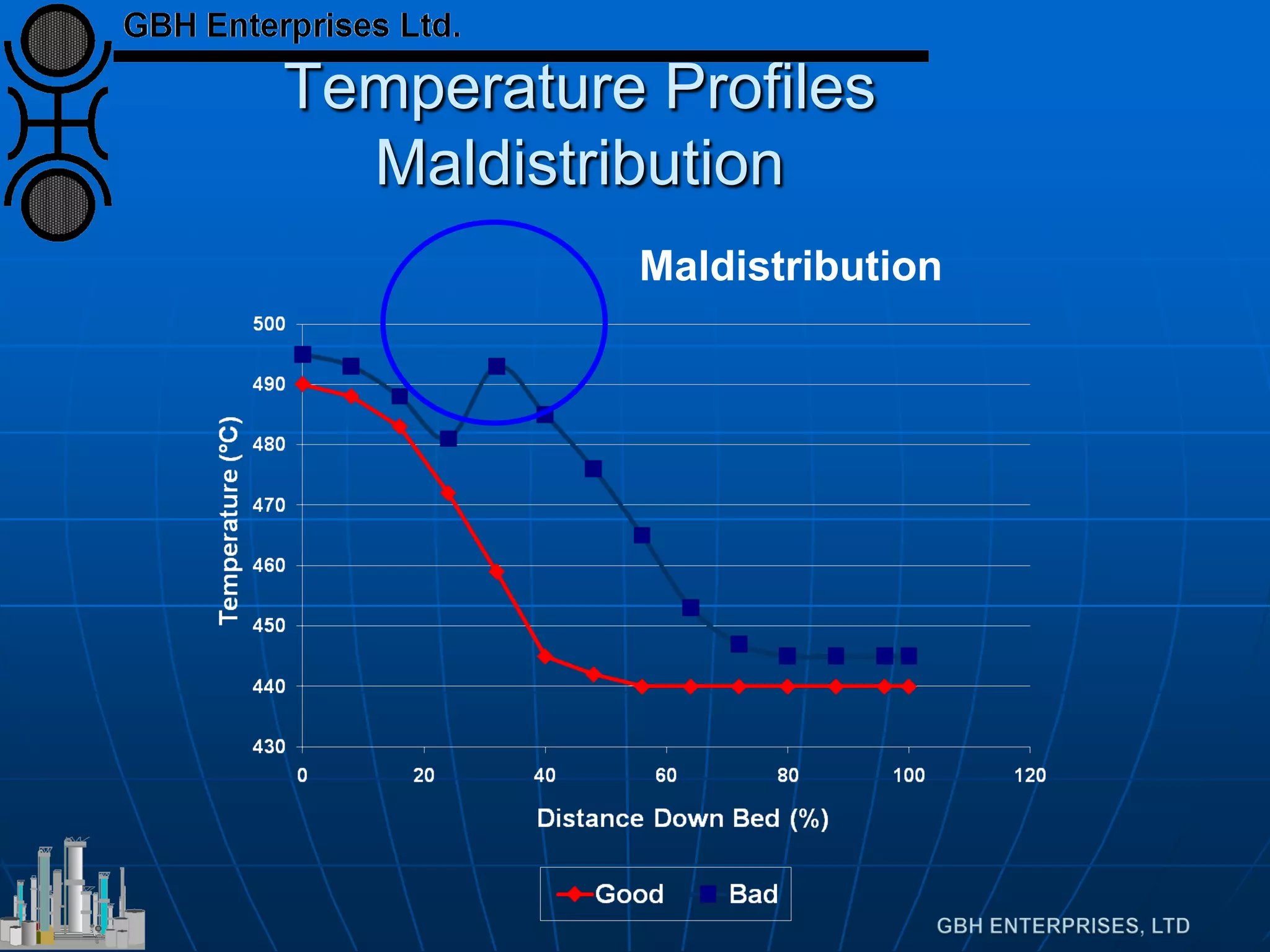
Temperature Profiles
Maldistribution
Maldistribution
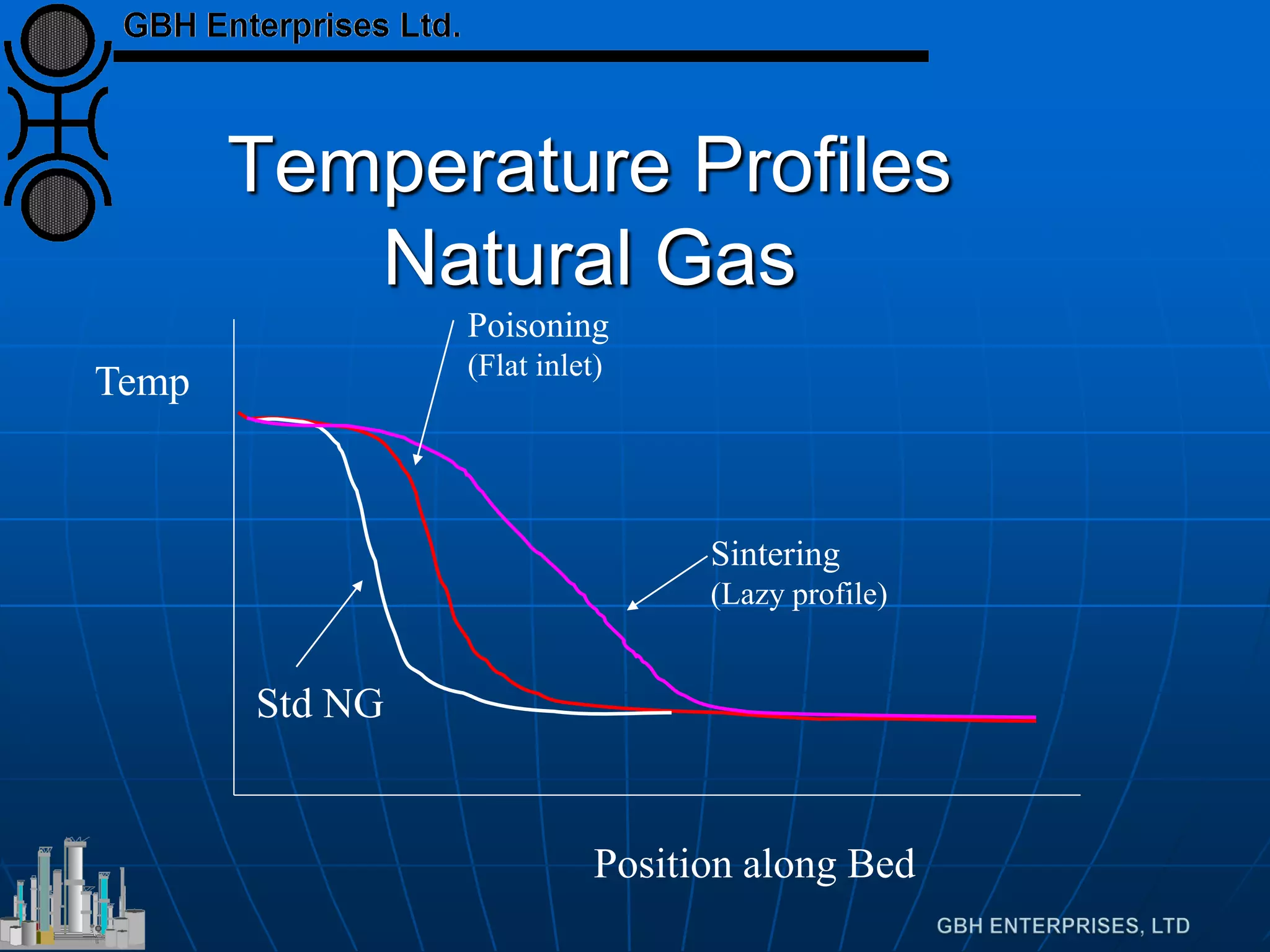
Temperature Profiles
Natural Gas
Temp
Position along Bed
Std NG
Sintering
(Lazy profile)
Poisoning
(Flat inlet)
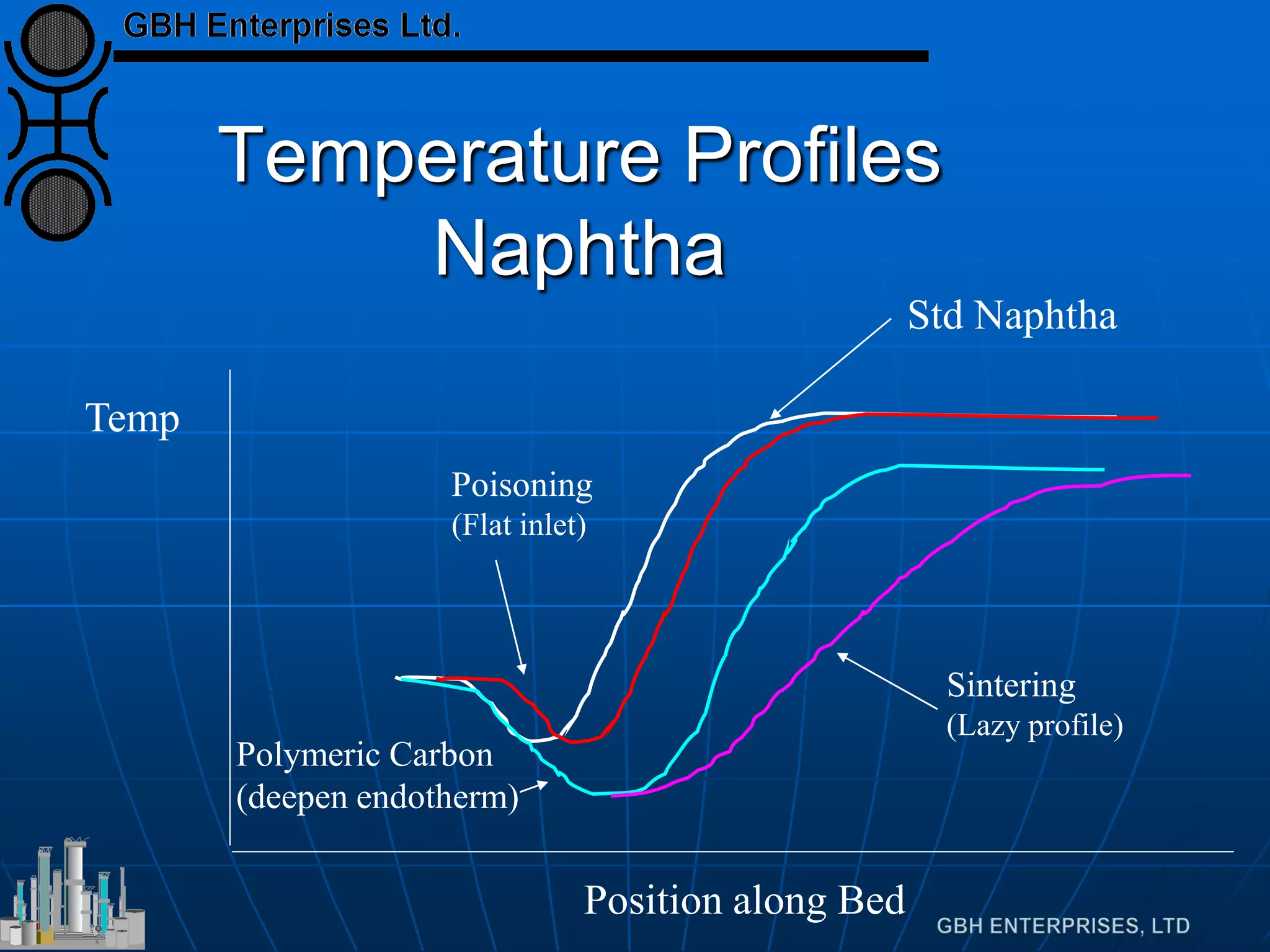
Temperature Profiles
Naphtha
Temp
Position along Bed
Std Naphtha
Sintering
(Lazy profile)
Poisoning
(Flat inlet)
Polymeric Carbon
(deepen endotherm)
Contents
 GBHE pre-reforming background
• Markets
• Flow-schemes
• Feed-stocks
• Catalyst handling, loading & start-up
 Benefits of a pre-reformer
• Case studies
• Effects upon primary reformer
• Data analysis
• Reactor temperature profiles
• Catalyst management
 Summary
Catalyst Management
 Draw the pre-reformer catalyst profile
weekly
 Examine profile and check for
• poisoning
• carbon polymer formation
• sintering
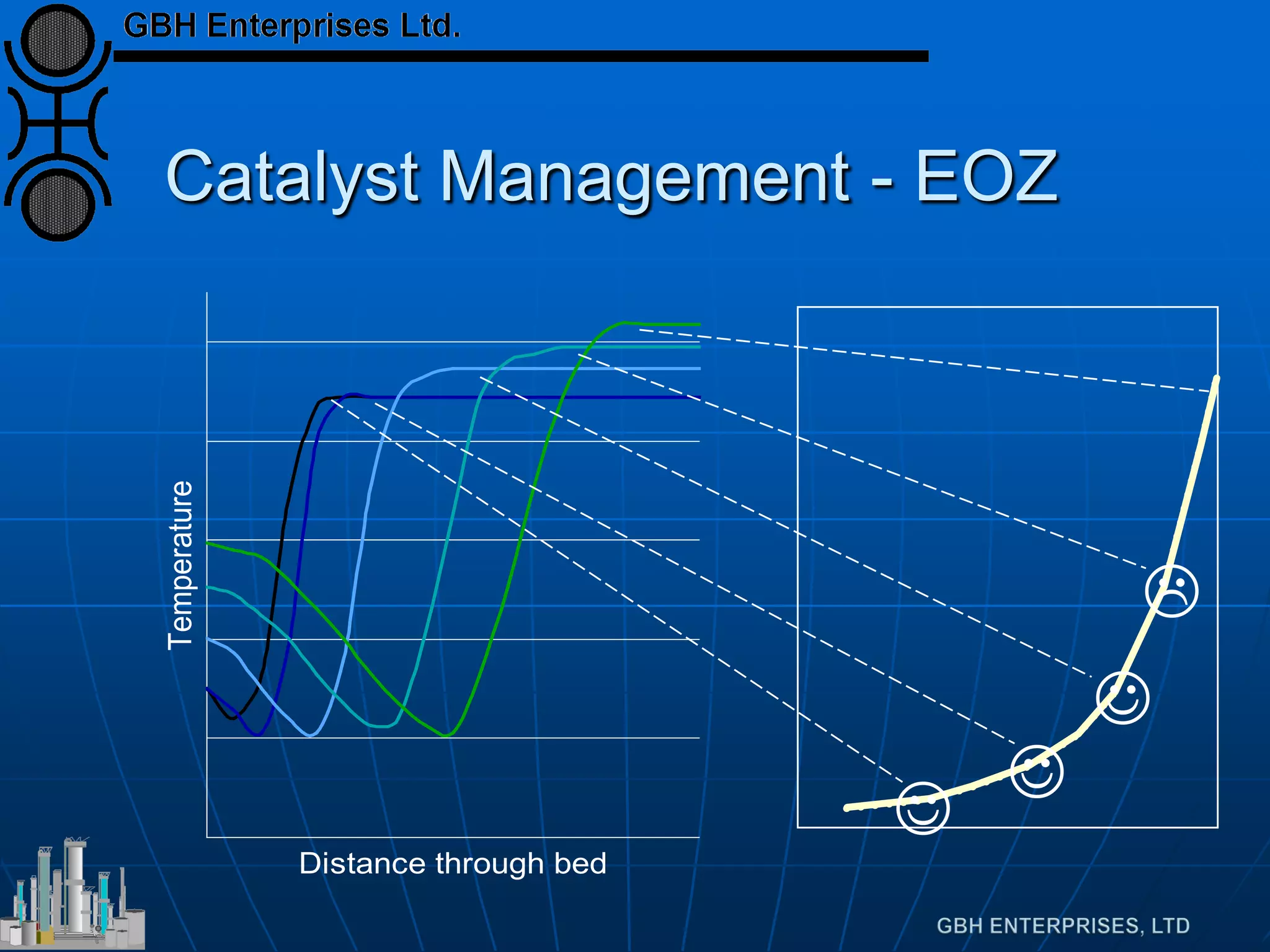
 Plot “end of reaction zone” (EOZ or
Z90) against time
Catalyst Management - EOZ
Distance through bed
Temperature




Predicting End-of-Life
 The EOZ (or Z90) plot is the most useful tool
 Waiting for ethane or higher hydrocarbon
slip is too late
 Ultimate limits are
 when feed preheat limitations are
reached
 when C2
+ slip is unacceptable for
reforming catalyst
• EOL of VSG-Z101 catalyst often taken to
be when C2
+ slip of 2000 ppm v/v of the
wet rich gas.
Summary
Successful Pre-reforming requires
• A good catalyst
• Careful Operation/Procedures
GBHE VSG-Z101 catalysts are well suited
to withstand operating rigors
And come with the GBHE Experience - the
learning which is so essential to well
advised operation
Principles of Pre-reforming Technology

Principles of Pre-reforming Technology

  • 1.
  • 2.
    Contents  Pre-reforming  Flow-schemes •Feed-stocks • Catalyst handling, loading & start-up  Benefits of a pre-reformer • Case studies • Effects upon primary reformer • Data analysis • Reactor temperature profiles • Catalyst management  Summary
  • 3.
    Markets  Towns Gas •Naphtha => Town Gas, reforming & methanation • Market declining due to NG availability  Hydrogen • Utility/chemical/refinery • C1 though to naphtha => H2 • Feedstock flexibility/smaller primary • Growing market for pre-reforming
  • 4.
    Markets (contd)  Methanol •Retrofits, increase output/efficiency • Growing market, technology enabler, big reactors  Ammonia • Retrofits only  GTL • 1,2 stage • Very big reactors
  • 5.
    Contents  GBHE pre-reformingbackground • Markets • Flow-schemes • Feed-stocks • Catalyst handling, loading & start-up  Benefits of a pre-reformer • Case studies • Effects upon primary reformer • Data analysis • Reactor temperature profiles • Catalyst management  Summary
  • 6.
    Flow-schemes - whatdoes Pre-Reforming do? What is the aim of a pre-reformer?  To react hydrocarbon feed with steam to give a methane rich product suitable for further downstream reforming.  Pre-reforming works as an adiabatic steam reforming step over a Ni based catalyst.  The basis for the reforming may be considered as the reaction between a hydrocarbon and steam • steam / methane reaction • water / gas shift reaction
  • 7.
  • 8.
    Flow Scheme - Desulfurization Pre-Reforming catalyst is poisoned by sulfur.  The performance of the sulfur removal system is important for the pre-reformer.  The sulfur removal system may be designed in accordance with any well proven system but must achieve less than 0.1 ppm wt sulfur throughout the catalyst life.  Ultra-purification recommended for natural gas applications
  • 9.
    Advantages of Pre-reforming Fuel savings over stand alone primary reformer  Reduced capital cost of reformer  Higher primary reformer preheat temperatures  Lower involuntary steam production  Increased feedstock flexibility  Higher activity primary reforming catalyst for naphtha based plants  Lower overall steam to carbon ratios  Provides protection for the main reformer  Reliable and easy operation
  • 10.
    Contents  GBHE pre-reformingbackground • Markets • Flow-schemes • Feed-stocks • Catalyst handling, loading & start-up  Benefits of a pre-reformer • Case studies • Effects upon primary reformer • Data analysis • Reactor temperature profiles • Catalyst management  Summary
  • 11.
    Feedstock Following feeds maybe fed to a pre- reformer reactor • Natural gas • Refinery Off Gas • Synthesis Gas derived from coal/oil gasification • LPG’s • Naphtha (up to FBP 240°C) • Kerosene • Methanol • Ethanol
  • 12.
    Feedstock Feed Specification  Poisonsin feed Sulfur < 0.1 ppm wt Chloride < 1.0 ppm wt * Total heavy metals < 1.0 ppm wt (inc Lead) * Lead < 0.2 ppm wt * * - inlet purification section  Steam Quality Sodium < 0.2 ppm wt Chloride < 0.1 ppm wt Sulphide < 0.1 ppm wt Silica < 0.1 ppm wt
  • 13.
    Feedstock contd For naphthafeeds over pre-reforming catalyst there are limits on • Aromatic content – normally 10 wt% • Naphthene content – normally 25 wt% • When considered together < 40 wt% has been applied
  • 14.
    Feedstock contd Following feedstockdata is required for assessment of performance: •Gas and LPG feeds •Full composition •Level of impurities •For Naphtha feeds •PONA analysis •Level of impurities •C/H ratio and molecular weight •FBP
  • 15.
    Contents  GBHE pre-reformingbackground • Markets • Flow-schemes • Feed-stocks • Catalyst handling, loading & start-up  Benefits of a pre-reformer • Case studies • Effects upon primary reformer • Data analysis • Reactor temperature profiles • Catalyst management  Summary
  • 16.
    Pre Reformer Loading Extremely important to achieve a uniform loading  Any zones of low or high voidage will reduce catalyst life • Check man-way plugs  No meshes should be used in the vessel  Thermocouples must be positioned correctly and height recorded  Loading procedure will be provided  Loading assistance may be provided
  • 17.
    Prereformer Installation  AdiabaticPre-Reformer  Axial flow with Thermowell  Bed of pre-reforming catalyst.
  • 18.
    Pre-reformer Start-up  Drying Heating  Start-up  Reduction
  • 19.
    Catalyst Drying For catalystsubjected to low temperature (ie <0oC)  Dry using Nitrogen  175 to 250°C  NG can be used below 200°C  4 to 24 hours  Dry air, not suitable for prereduced  First start-up of prereduced
  • 20.
    Catalyst Heating  Normallyheated using nitrogen  Absorbed moisture  Initial heating rate, 50°C per hour  Max temp differential in bed 100°C  At 200°C, 70°C per hour  Heating till peak 400°C, min 370°C  High circ rate, max pd 2 bar
  • 21.
    Catalyst Heating continued Warm-uprates  Rapid warm-up minimises energy usage/time  Traditional constraints of equipment  Controllability  Limited by mechanical considerations of vessel  Catalyst, 150-170oC per hour
  • 22.
    Catalyst Heating contd Limitson impurities *  Oxygen 1% vol  Carbon Dioxide 1% vol  Carbon Monoxide 1% vol  Methane 1% vol  Hydrogen 1% vol  Ethane 100 ppm vol  Sulfur 0.1 ppm wt * For the initial warm up. Lower limits for already activated or prereduced catalyst
  • 23.
    Catalyst Heating contd Holdingat temperature  Not recommended  2% hydrogen added  Temperature reduced to 350°C
  • 24.
    Catalyst Start-up When operatingtemperature has been achieved  Check for build-up of carbon oxides and hydrocarbons  Addition of 10 mol % Hydrogen  Followed by steam  Introduce process feed, maintain safe S:F ratio  Ensure feed lines are drained and warmed  Vent steam to atmosphere before cutting in
  • 25.
    Heating using NaturalGas Using NG as heating medium  No impurities  Immediate start-up  50°C per hour, max differential 100°C  At 200°C introduce steam • Min S:C 0.3kg/kg at 200°C • Min S:C 0.5kg/kg at 400°C to 450°C • Increase to design feed and S:F
  • 26.
    Contents  GBHE pre-reformingbackground • Markets • Flow-schemes • Feed-stocks • Catalyst handling, loading & start-up  Benefits of a pre-reformer • Case studies • Effects upon primary reformer • Data analysis • Reactor temperature profiles • Catalyst management  Summary
  • 27.
    Process benefits ofpre-reforming  Moves reforming load from Primary  Better reformer design • Higher thermal efficiency in radiant box • Raises pre-heat temps before carbon formation issues • Feedstock flexibility  Reduced steam export • Heat is recovered from duct  Demonstrated using case studies
  • 28.
    Process Benefits- CaseStudy  Case 1 – Base Case – no pre-reformer installed  Case 2 – Pre-reformer installed  Case 3 – Pre-reformer installed and plant rate increased until firing on the reformer is the same as Case 1
  • 29.
    Effect of aPre-reformer on Primary Reformer Performance Parameter Units Case 1 Plant rate % 100 Methane slip mol % (dry) 12.84 ATE °C 1.8 Pressure drop bar 1.26 Maximum TWT °C 809 Fluegas temperature °C 898 Radiant efficiency % 68.7 Fuel rate change % 0 Case 2 100 12.76 1.1 1.28 803 885 69.4 -8.8 Case 3 109 12.79 1.3 1.49 807 898 68.7 0
  • 30.
    Contents  GBHE pre-reformingbackground • Markets • Flow-schemes • Feed-stocks • Catalyst handling, loading & start-up  Benefits of a pre-reformer • Case studies • Effects upon primary reformer • Data analysis • Reactor temperature profiles • Catalyst management  Summary
  • 31.
    Effect of aPre-reformer on Primary Reformer Performance  For new plants, there are CAPEX benefits • Can reduce tube count on a new hydrogen plant by over 5% • Fuel usage can be reduced by 8%  For existing plant, excellent revamp opportunity • Additional throughput or feedstock flexibility  In summary • Significant potential economic benefits • Overall benefits plant specific
  • 32.
    Effect of aPre-reformer on Primary Reformer Performance contd  Good performance depends on good design and preparation of the reactor  It is not simply another catalyst bed  Guaranteed operation assumes plug flow through the bed  Guaranteed operation relies on good catalyst management
  • 33.
    Effect of aPre-reformer on Primary Reformer Performance contd Travelling (or multi-point) thermocouple Catalyst Graded Ceramic Balls Catalyst discharge nozzle (alternative) Catalyst discharge nozzle (typical)
  • 34.
    Effect of aPre-reformer on Primary Reformer Performance contd Good performance is achieved through  Even gas distribution  Adequate temperature measurement  Thorough pre-commissioning  Correct catalyst charging procedures  Good operating practices
  • 35.
    Contents  GBHE pre-reformingbackground • Markets • Flow-schemes • Feed-stocks • Catalyst handling, loading & start-up  Benefits of a pre-reformer • Case studies • Effects upon primary reformer • Data analysis • Reactor temperature profiles • Catalyst management  Summary
  • 36.
    Pre Reforming DataAnalysis  Good data is key to understanding performance of the pre reformer  Data includes • Temperatures inlet and outlet the bed • Temperatures through the bed • Gas analysis inlet and outlet bed • Feedstock and steam flows inlet bed • Bed pressure drop trend
  • 37.
    Pre Reforming DataAnalysis  Careful monitoring of temperatures inlet, outlet and through the bed allows • Problems to be detected early on  Sulfur poisoning, wetting etc • Problems to be resolved before there has been too much damage caused • Estimation of residual life
  • 38.
    Contents  GBHE pre-reformingbackground • Markets • Flow-schemes • Feed-stocks • Catalyst handling, loading & start-up  Benefits of a pre-reformer • Case studies • Effects upon primary reformer • Data analysis • Reactor temperature profiles • Catalyst management  Summary
  • 39.
    Reaction Profile Reaction ZoneLength End Of Reaction Zone Thermoneutral Point Minimum Reaction Temperature Beginning Of Reaction Zone Preheat Temperature Temperature°C Distance through bed
  • 40.
    Reaction Profile end of reaction zone methanationand shift reactions dominate bed shrinkage or deactivation Temperature°C Distance through bed endotherm steam reforming reaction dominates
  • 41.
    Reaction Profile  Bymonitoring relative movement of specific points on the profile, • See if there is sulfur poisoning • See if there is excessive sintering • See if there is mal-distribution  But rate changes will affect positions of profiles
  • 42.
  • 43.
    Temperature Profiles Natural Gas- Effect of Plant Rate  Changes in plant rate affect profile • Increases in rate  Increases the length of profile  Decreases the gradient • Can be mistaken for sintering
  • 44.
    Temperature Profiles - Changesin Inlet Temperature
  • 45.
    Temperature Profiles Changes inInlet Temperature  Increases in inlet temperature • Shorten profile length • Steeper profile gradient • Change exit temperature
  • 46.
  • 47.
  • 48.
    Temperature Profiles Natural Gas Temp Positionalong Bed Std NG Sintering (Lazy profile) Poisoning (Flat inlet)
  • 49.
    Temperature Profiles Naphtha Temp Position alongBed Std Naphtha Sintering (Lazy profile) Poisoning (Flat inlet) Polymeric Carbon (deepen endotherm)
  • 50.
    Contents  GBHE pre-reformingbackground • Markets • Flow-schemes • Feed-stocks • Catalyst handling, loading & start-up  Benefits of a pre-reformer • Case studies • Effects upon primary reformer • Data analysis • Reactor temperature profiles • Catalyst management  Summary
  • 51.
    Catalyst Management  Drawthe pre-reformer catalyst profile weekly  Examine profile and check for • poisoning • carbon polymer formation • sintering  Plot “end of reaction zone” (EOZ or Z90) against time
  • 52.
    Catalyst Management -EOZ Distance through bed Temperature    
  • 53.
    Predicting End-of-Life  TheEOZ (or Z90) plot is the most useful tool  Waiting for ethane or higher hydrocarbon slip is too late  Ultimate limits are  when feed preheat limitations are reached  when C2 + slip is unacceptable for reforming catalyst • EOL of VSG-Z101 catalyst often taken to be when C2 + slip of 2000 ppm v/v of the wet rich gas.
  • 54.
    Summary Successful Pre-reforming requires •A good catalyst • Careful Operation/Procedures GBHE VSG-Z101 catalysts are well suited to withstand operating rigors And come with the GBHE Experience - the learning which is so essential to well advised operation