Steam Reforming - Poisons
Gerard B. Hawkins
Managing Director
WWW.GBHENTERPRISES.COM
 The aim of this presentation is to
• Introduce the various poisons
• Indicate actions that need to be taken if
catalyst is poisoned
• Effect of ultra purification
WWW.GBHENTERPRISES.COM
 Common poisons include
• Sulfur
• Chlorides and other halides
• Metals including arsenic, vanadium, mercury,
alkali metals (including potassium)
• Phosphates
• Organo-metalics
WWW.GBHENTERPRISES.COM
 Reduced catalyst activity
 In primary reformer this means
• Reduced reaction
• Reduced reaction heat load
• High tube/process gas temperatures
• More susceptible to carbon formation
• Hot bands
WWW.GBHENTERPRISES.COM
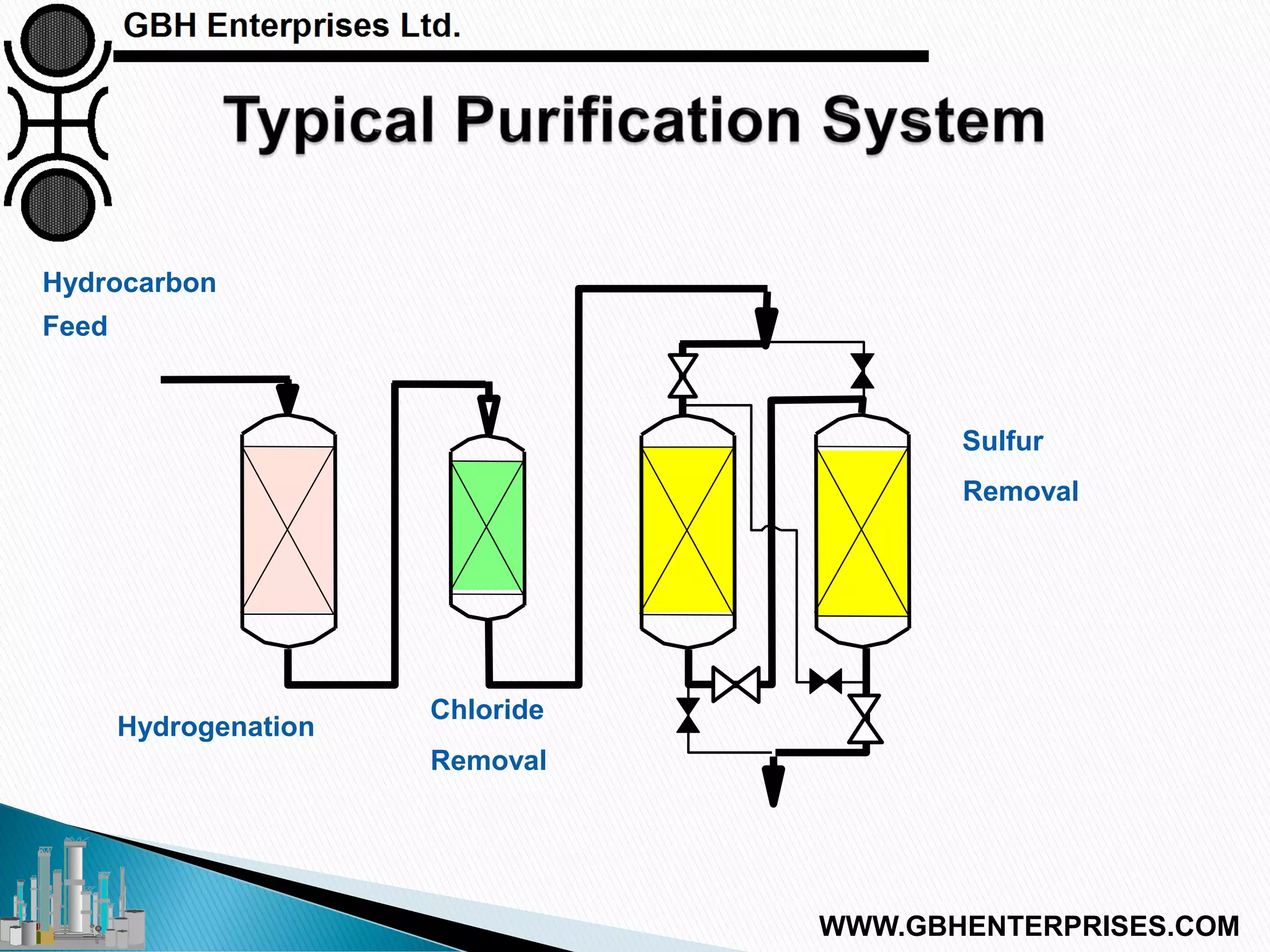
Hydrocarbon
Feed
Hydrogenation
Chloride
Removal
Sulfur
Removal
WWW.GBHENTERPRISES.COM
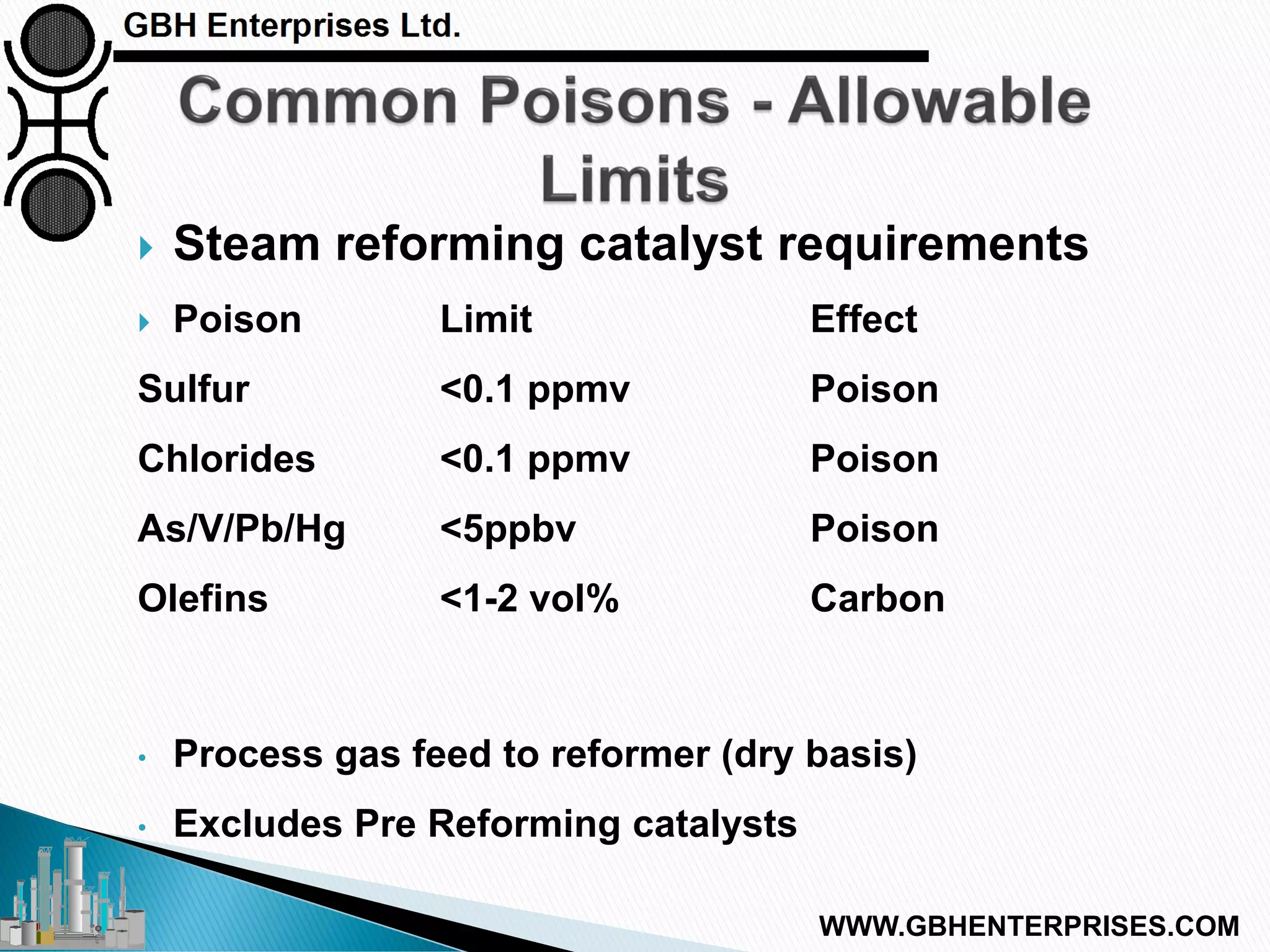
 Steam reforming catalyst requirements
 Poison Limit Effect
Sulfur <0.1 ppmv Poison
Chlorides <0.1 ppmv Poison
As/V/Pb/Hg <5ppbv Poison
Olefins <1-2 vol% Carbon
• Process gas feed to reformer (dry basis)
• Excludes Pre Reforming catalysts
WWW.GBHENTERPRISES.COM
 For Pre Reformers must be lower than for
primary reformers
 Sulfur specified at 25 ppb or less
 But needs to be checked using a space
velocity calculation
 Chlorides and Sodium are also poisons
 Silica is also an issue
WWW.GBHENTERPRISES.COM
• Sulfur Feedstock
• Chlorides/halides Feedstock
• Arsenic Vetrocoke
• Vanadium Benfield
• Mercury Feedstock
• Alkali metals Steam/BFW
• Phosphates Steam/BFW
WWW.GBHENTERPRISES.COM
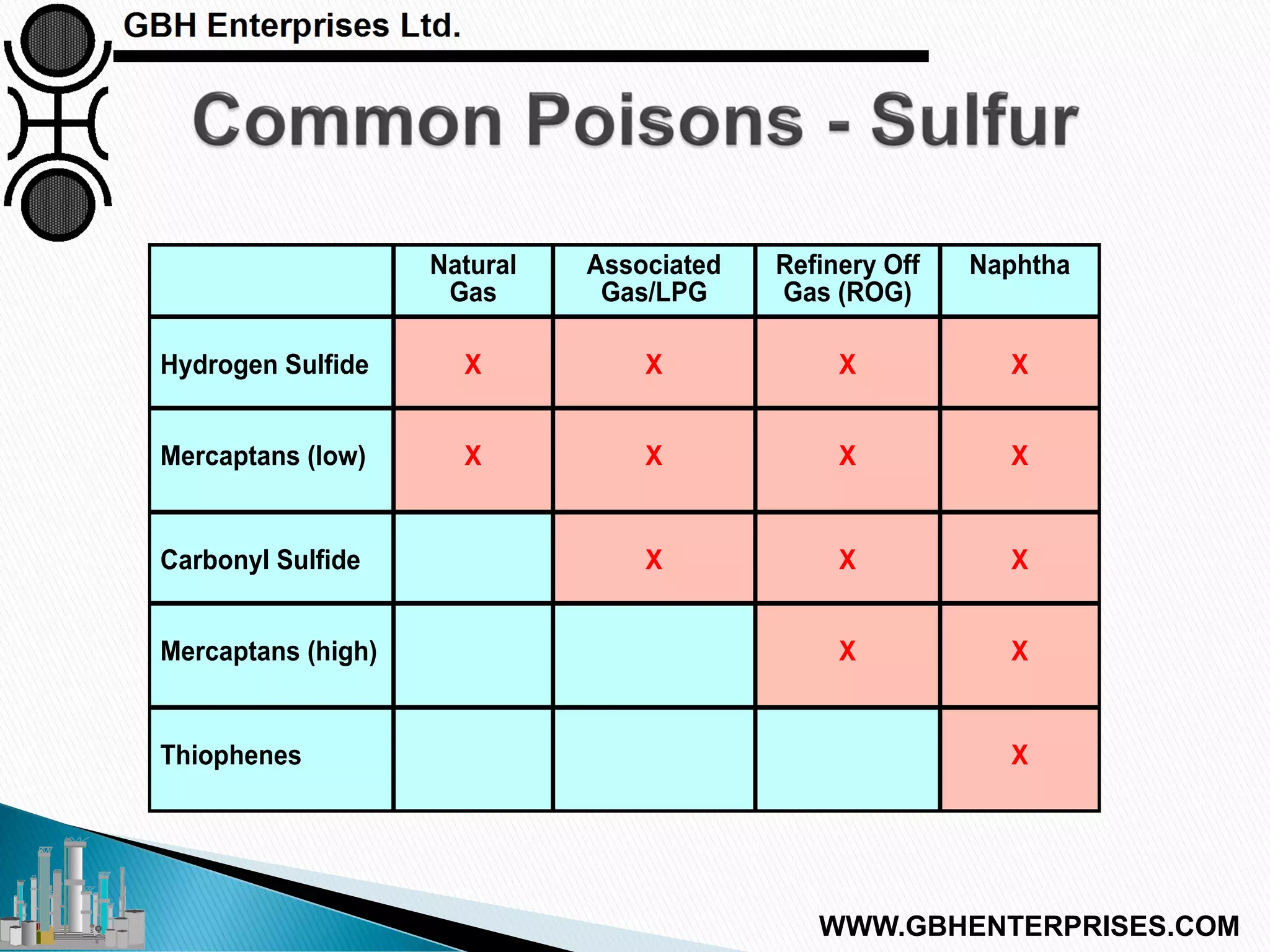
Natural
Gas
Associated
Gas/LPG
Refinery Off
Gas (ROG)
Naphtha
Hydrogen Sulfide X X X X
Mercaptans (low) X X X X
Carbonyl Sulfide X X X
Mercaptans (high) X X
Thiophenes X
WWW.GBHENTERPRISES.COM
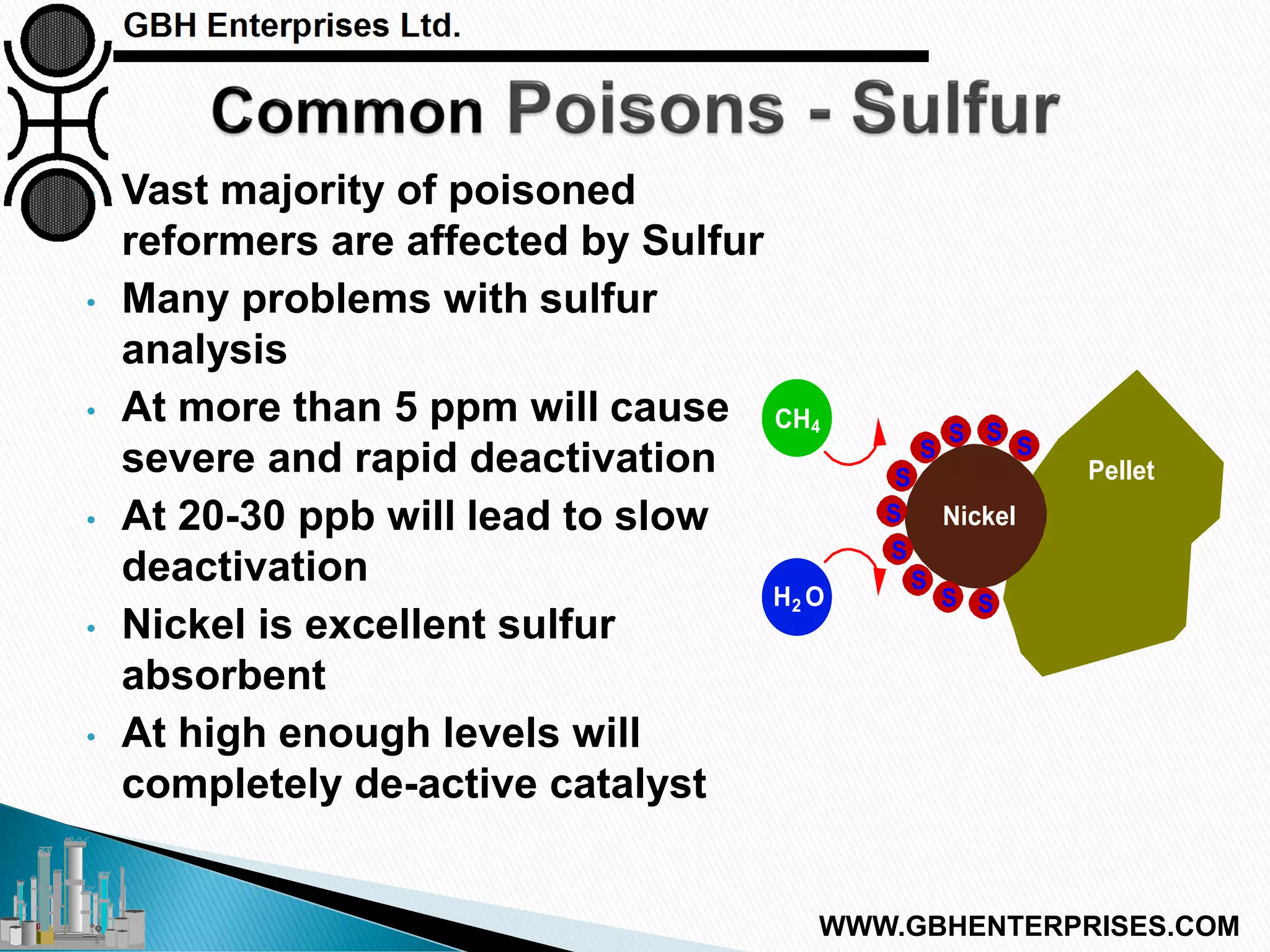
• Vast majority of poisoned
reformers are affected by Sulfur
• Many problems with sulfur
analysis
• At more than 5 ppm will cause
severe and rapid deactivation
• At 20-30 ppb will lead to slow
deactivation
• Nickel is excellent sulfur
absorbent
• At high enough levels will
completely de-active catalyst
Pellet
S
SS
S
S
S
S
S
S S
Nickel
CH
H O
4
2
WWW.GBHENTERPRISES.COM
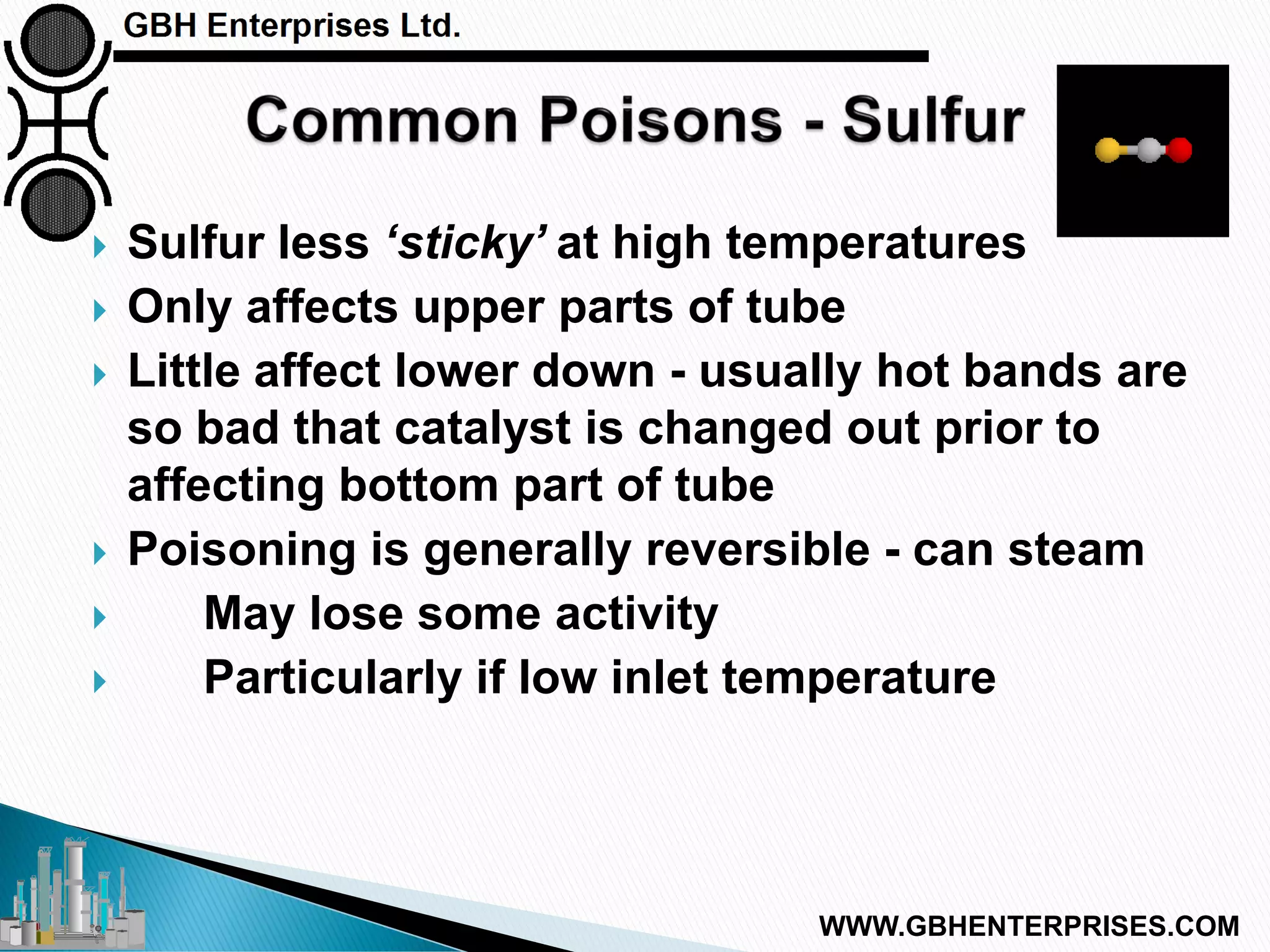
 Sulfur less ‘sticky’ at high temperatures
 Only affects upper parts of tube
 Little affect lower down - usually hot bands are
so bad that catalyst is changed out prior to
affecting bottom part of tube
 Poisoning is generally reversible - can steam
 May lose some activity
 Particularly if low inlet temperature
WWW.GBHENTERPRISES.COM
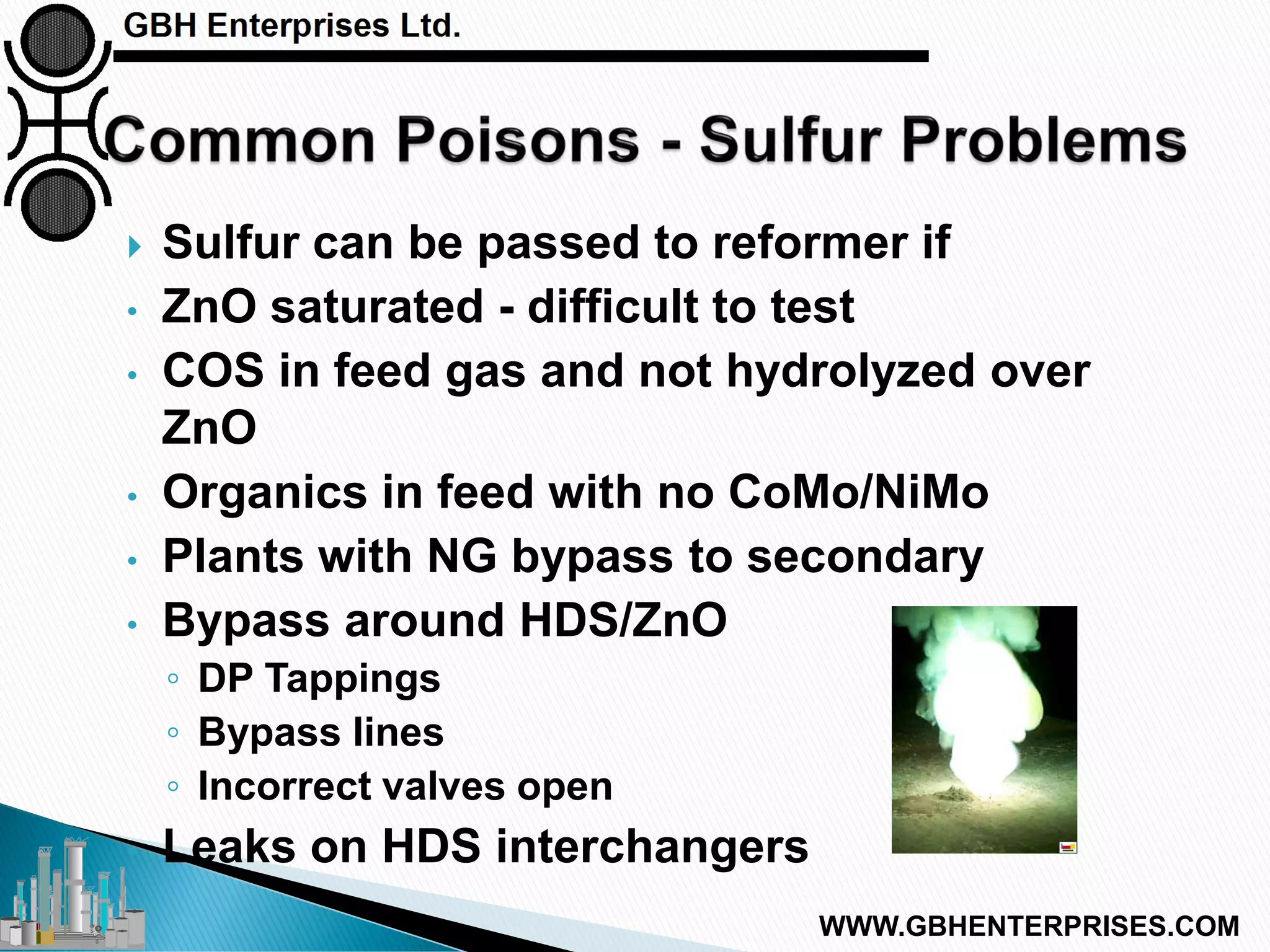
 Sulfur can be passed to reformer if
• ZnO saturated - difficult to test
• COS in feed gas and not hydrolyzed over
ZnO
• Organics in feed with no CoMo/NiMo
• Plants with NG bypass to secondary
• Bypass around HDS/ZnO
◦ DP Tappings
◦ Bypass lines
◦ Incorrect valves open
• Leaks on HDS interchangers
WWW.GBHENTERPRISES.COM
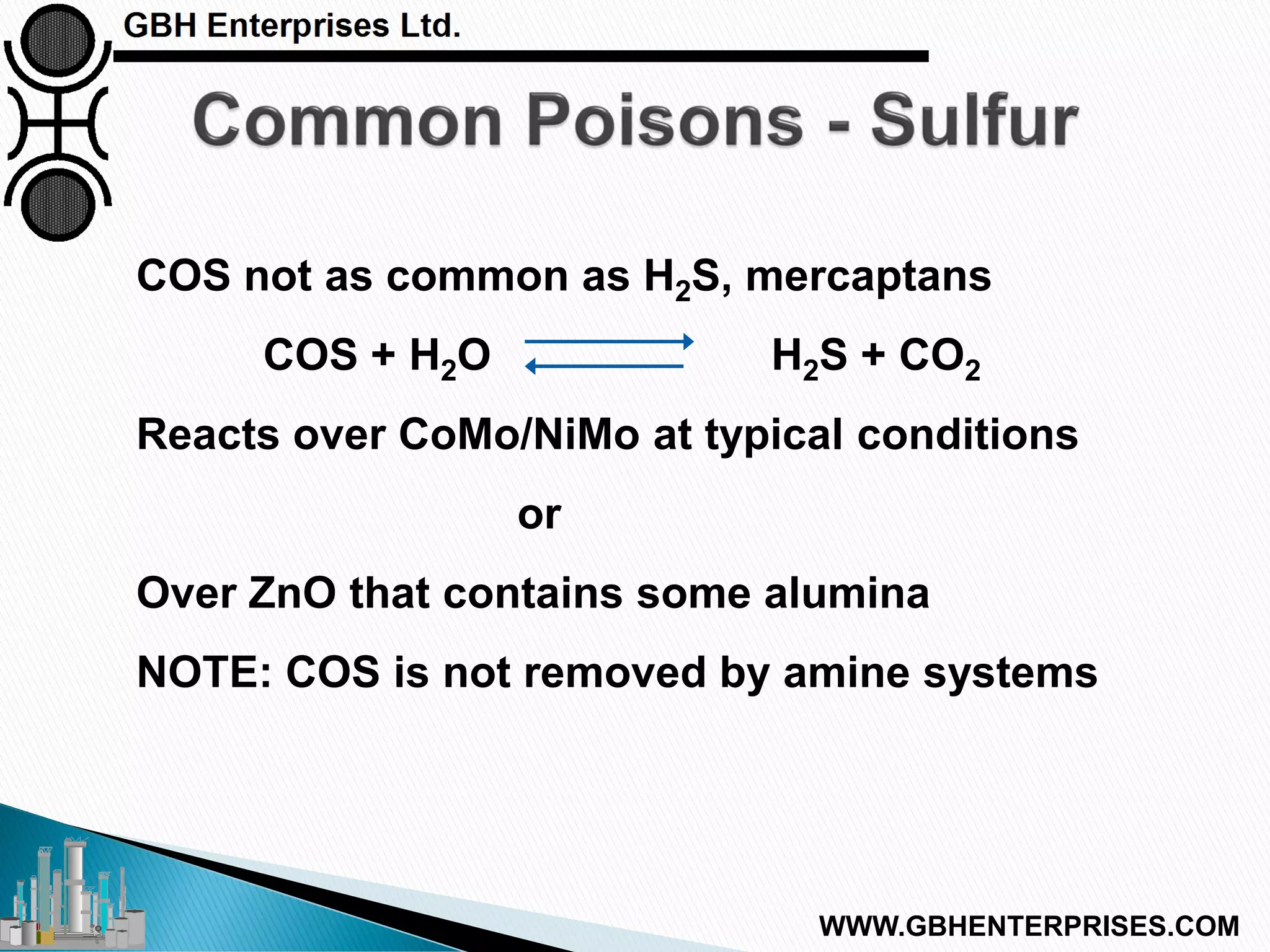
COS not as common as H2S, mercaptans
COS + H2O H2S + CO2
Reacts over CoMo/NiMo at typical conditions
or
Over ZnO that contains some alumina
NOTE: COS is not removed by amine systems
WWW.GBHENTERPRISES.COM
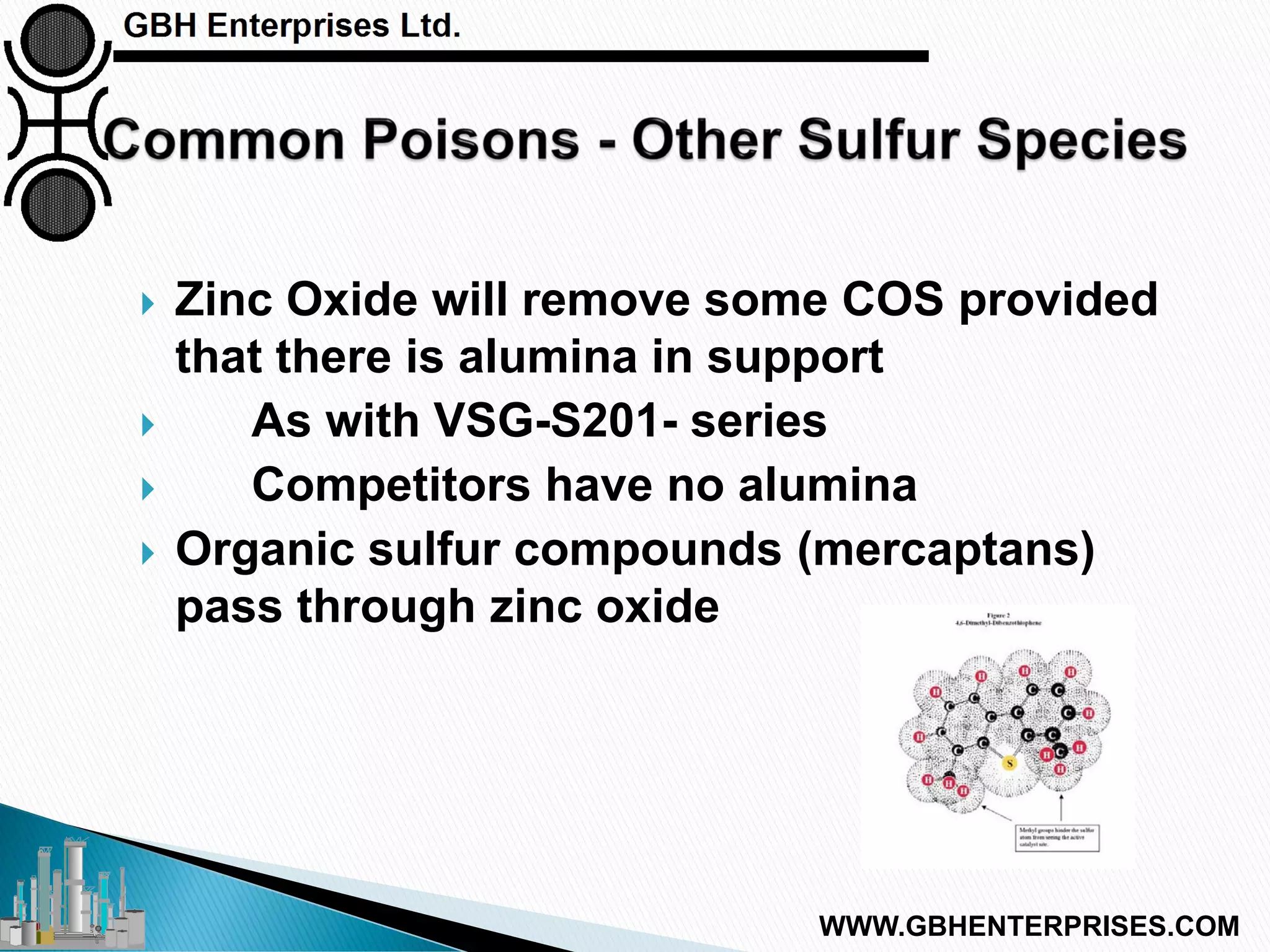
 Zinc Oxide will remove some COS provided
that there is alumina in support
 As with VSG-S201- series
 Competitors have no alumina
 Organic sulfur compounds (mercaptans)
pass through zinc oxide
WWW.GBHENTERPRISES.COM
• Difficult to set up analysis
• Tests are difficult
• Tests not accurate
• Looking at low levels
• Generally looking for sulfur at detection limit
of the laboratory equipment
• Limit is 10 ppb
• ZnO will slip about 10 ppb
WWW.GBHENTERPRISES.COM
• Problems of sampling
• Pipe work must be of stainless
• Sulfur absorbs into Carbon Steel
• Will absorb into stainless but at lower rate
• Short pipe runs
• Prevent absorption
• Sample keeps for four hours
• In a stainless steel sample bomb
• Use plastic sample bags if sample to be
transported
WWW.GBHENTERPRISES.COM
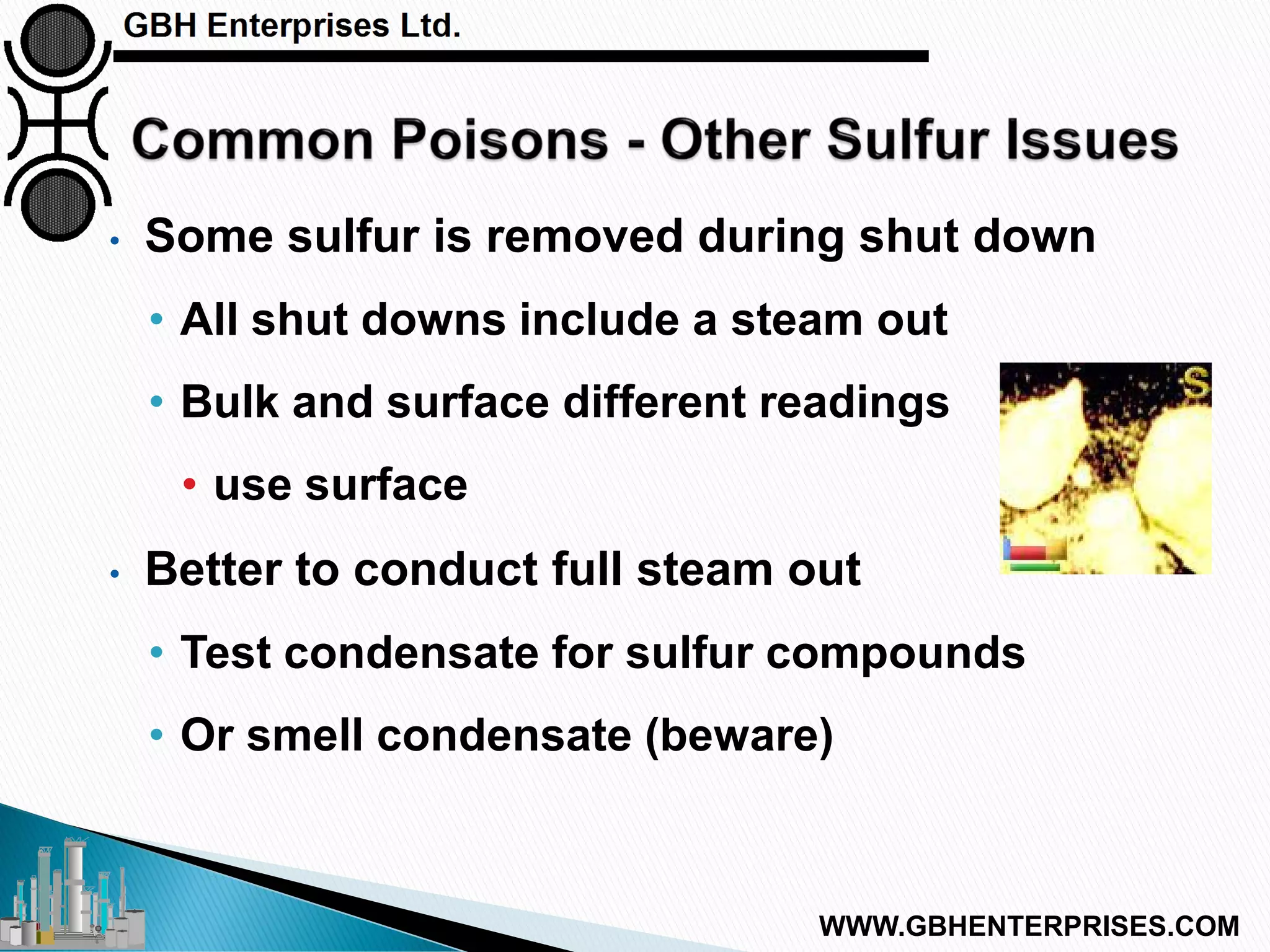
• Some sulfur is removed during shut down
• All shut downs include a steam out
• Bulk and surface different readings
• use surface
• Better to conduct full steam out
• Test condensate for sulfur compounds
• Or smell condensate (beware)
WWW.GBHENTERPRISES.COM
 Of benefit to most plants
 Effect most pronounced in tough conditions
◦ Low S/C operation where Carbon formation is likely
◦ Prereformers which are very sensitive
◦ GHRs where deactivation impacts heat transfer
◦ Heavy feed reforming where poisoning and carbon
formation determine life
◦ Heavily stressed reformers
WWW.GBHENTERPRISES.COM
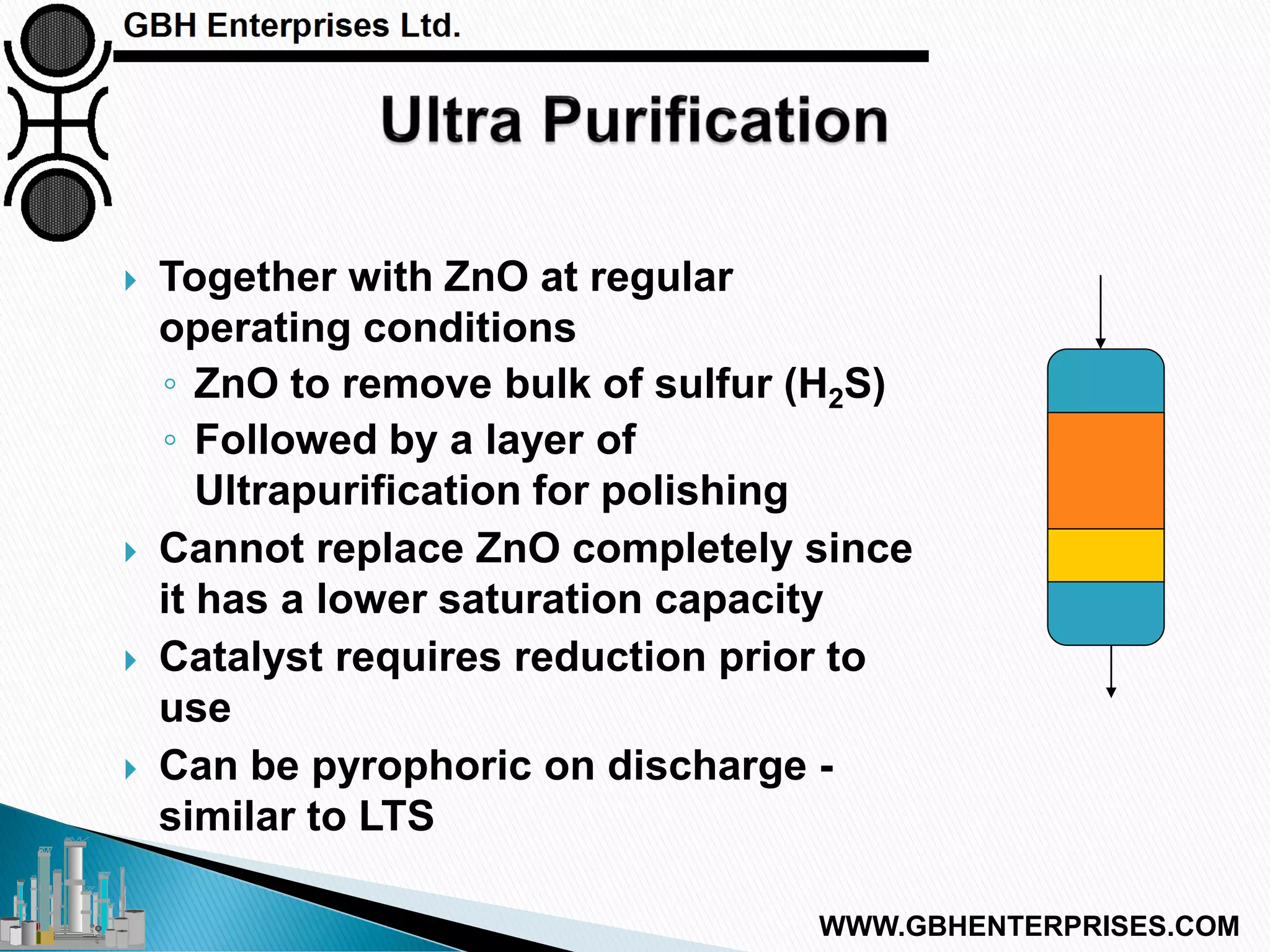
 Together with ZnO at regular
operating conditions
◦ ZnO to remove bulk of sulfur (H2S)
◦ Followed by a layer of
Ultrapurification for polishing
 Cannot replace ZnO completely since
it has a lower saturation capacity
 Catalyst requires reduction prior to
use
 Can be pyrophoric on discharge -
similar to LTS
WWW.GBHENTERPRISES.COM
 Unfortunately, measuring low ppbv levels of
sulfur is difficult
 So proof has to come from lab/field work
 We wanted to test the concept
 So we chose a plant where we can measure
the effect of deactivation, a reformer we
know suffers from deactivation, and where
LTS catalysts are known to pick up sulfur
WWW.GBHENTERPRISES.COM
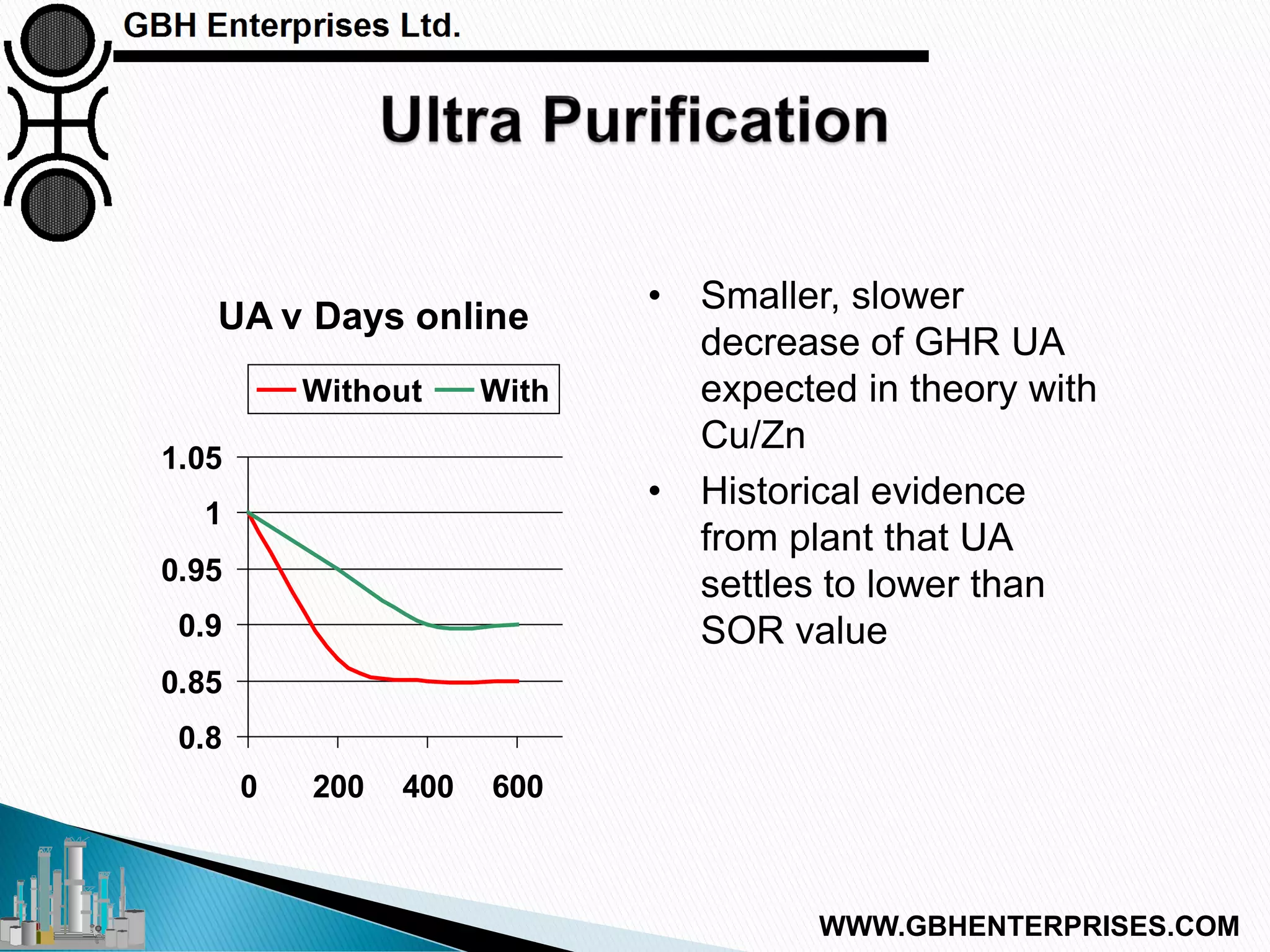
• Smaller, slower
decrease of GHR UA
expected in theory with
Cu/Zn
• Historical evidence
from plant that UA
settles to lower than
SOR value
UA v Days online
0.8
0.85
0.9
0.95
1
1.05
0 200 400 600
Without With
WWW.GBHENTERPRISES.COM
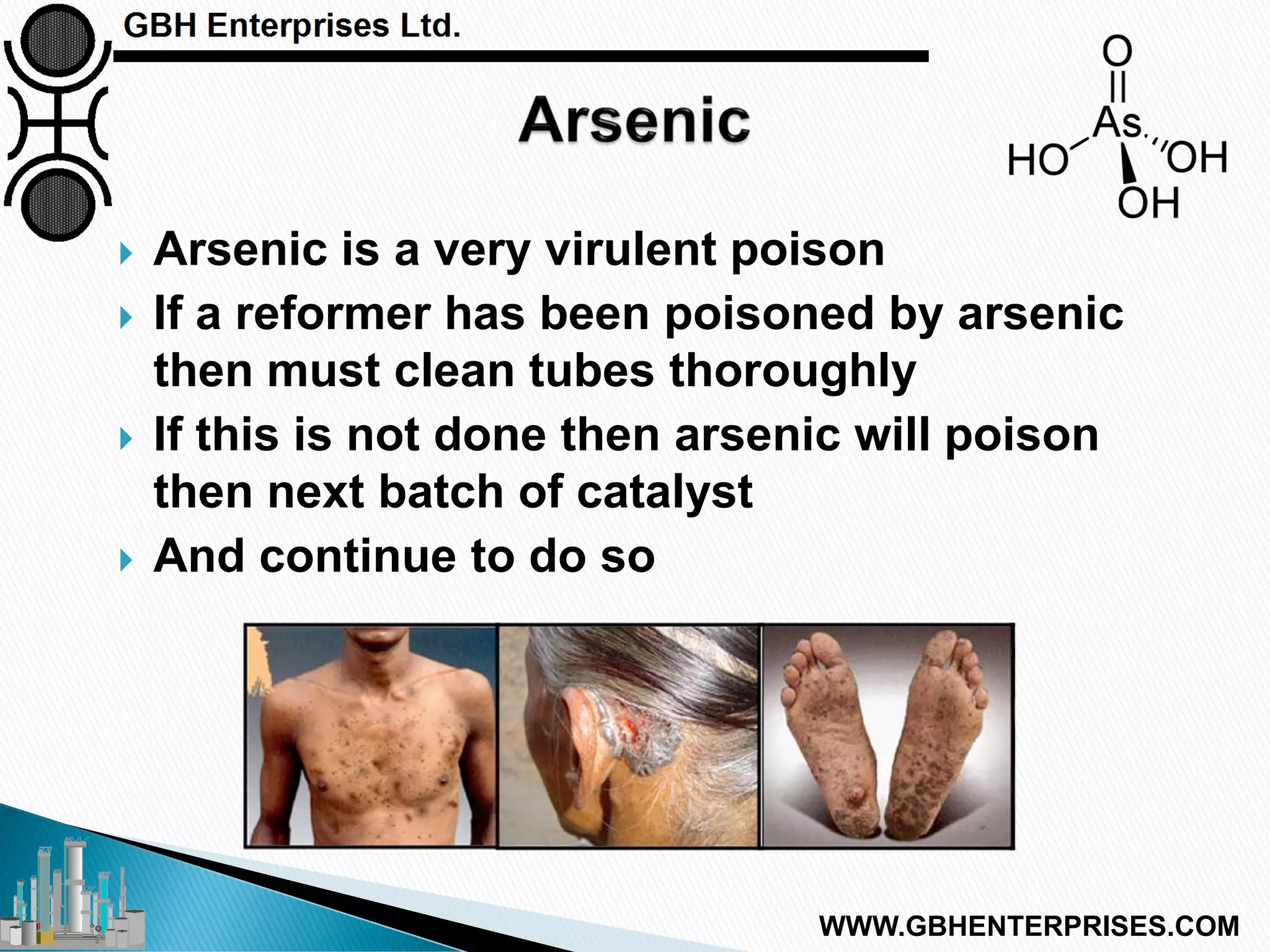
 Arsenic is a very virulent poison
 If a reformer has been poisoned by arsenic
then must clean tubes thoroughly
 If this is not done then arsenic will poison
then next batch of catalyst
 And continue to do so
WWW.GBHENTERPRISES.COM
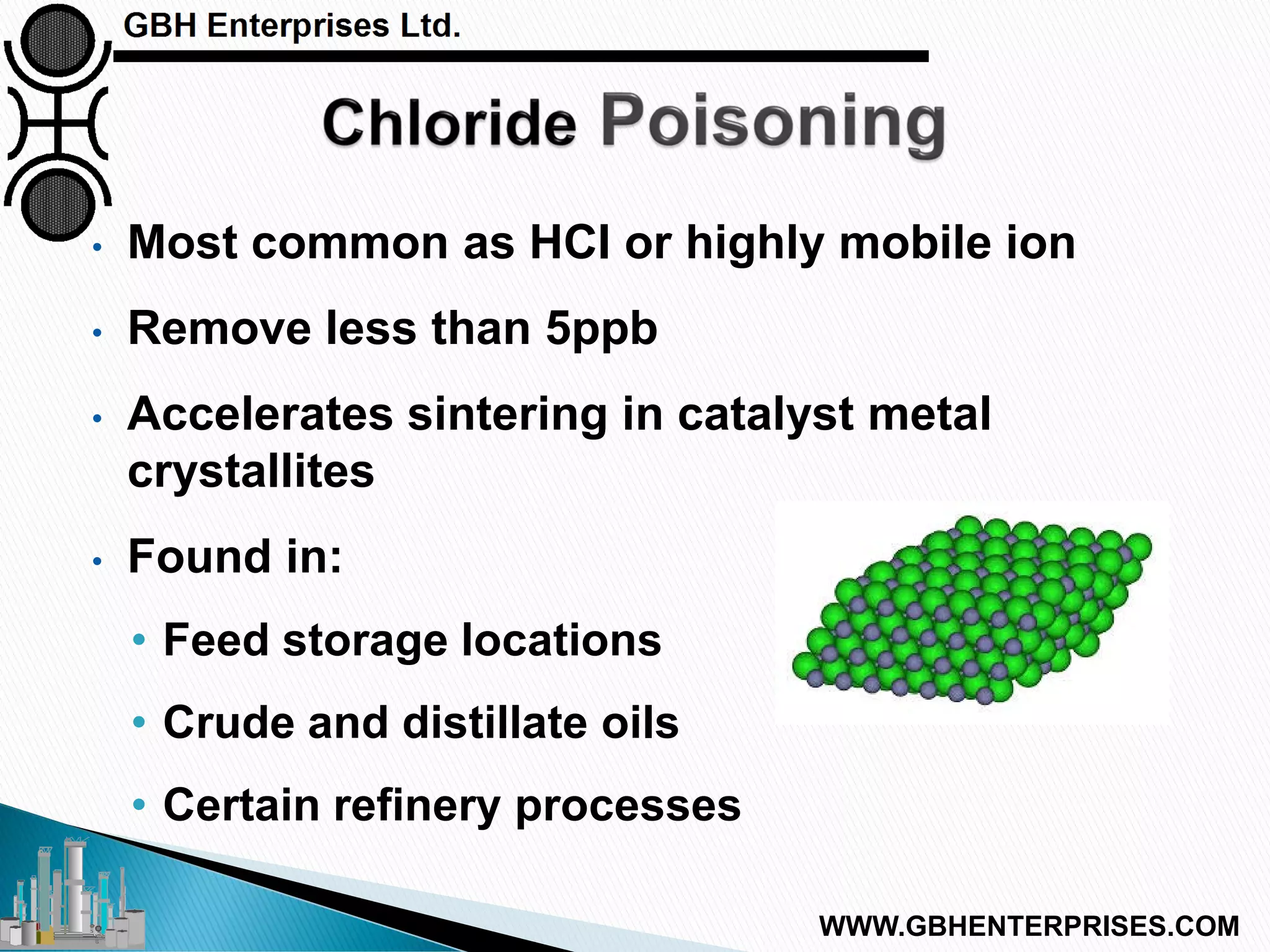
• Most common as HCI or highly mobile ion
• Remove less than 5ppb
• Accelerates sintering in catalyst metal
crystallites
• Found in:
• Feed storage locations
• Crude and distillate oils
• Certain refinery processes
WWW.GBHENTERPRISES.COM
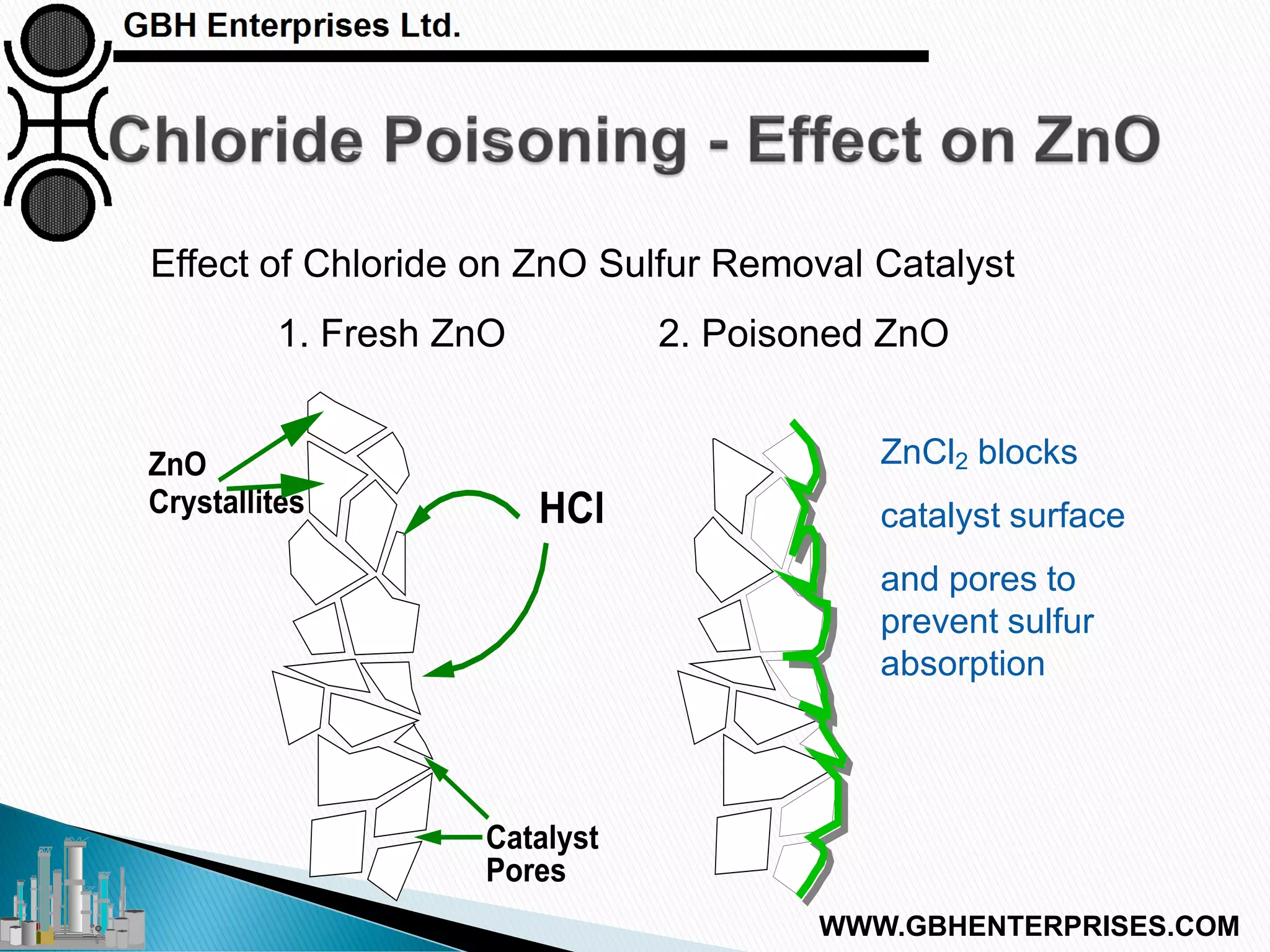
Effect of Chloride on ZnO Sulfur Removal Catalyst
1. Fresh ZnO 2. Poisoned ZnO
HCl
ZnO
Crystallites
Catalyst
Pores
ZnCl2 blocks
catalyst surface
and pores to
prevent sulfur
absorption
WWW.GBHENTERPRISES.COM
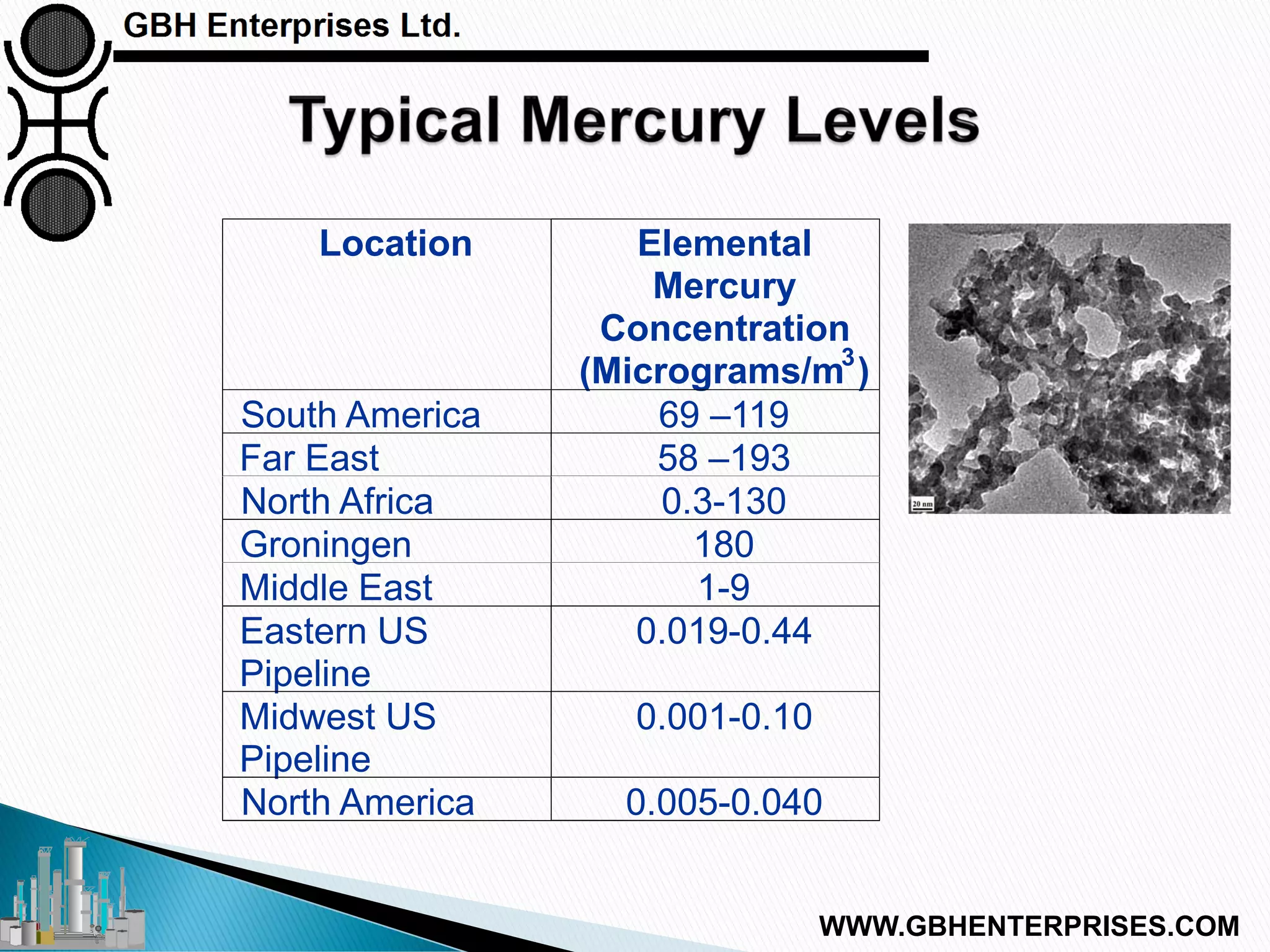
Location Elemental
Mercury
Concentration
(Micrograms/m3
)
South America 69 –119
Far East 58 –193
North Africa 0.3-130
Groningen 180
Middle East 1-9
Eastern US
Pipeline
0.019-0.44
Midwest US
Pipeline
0.001-0.10
North America 0.005-0.040
WWW.GBHENTERPRISES.COM
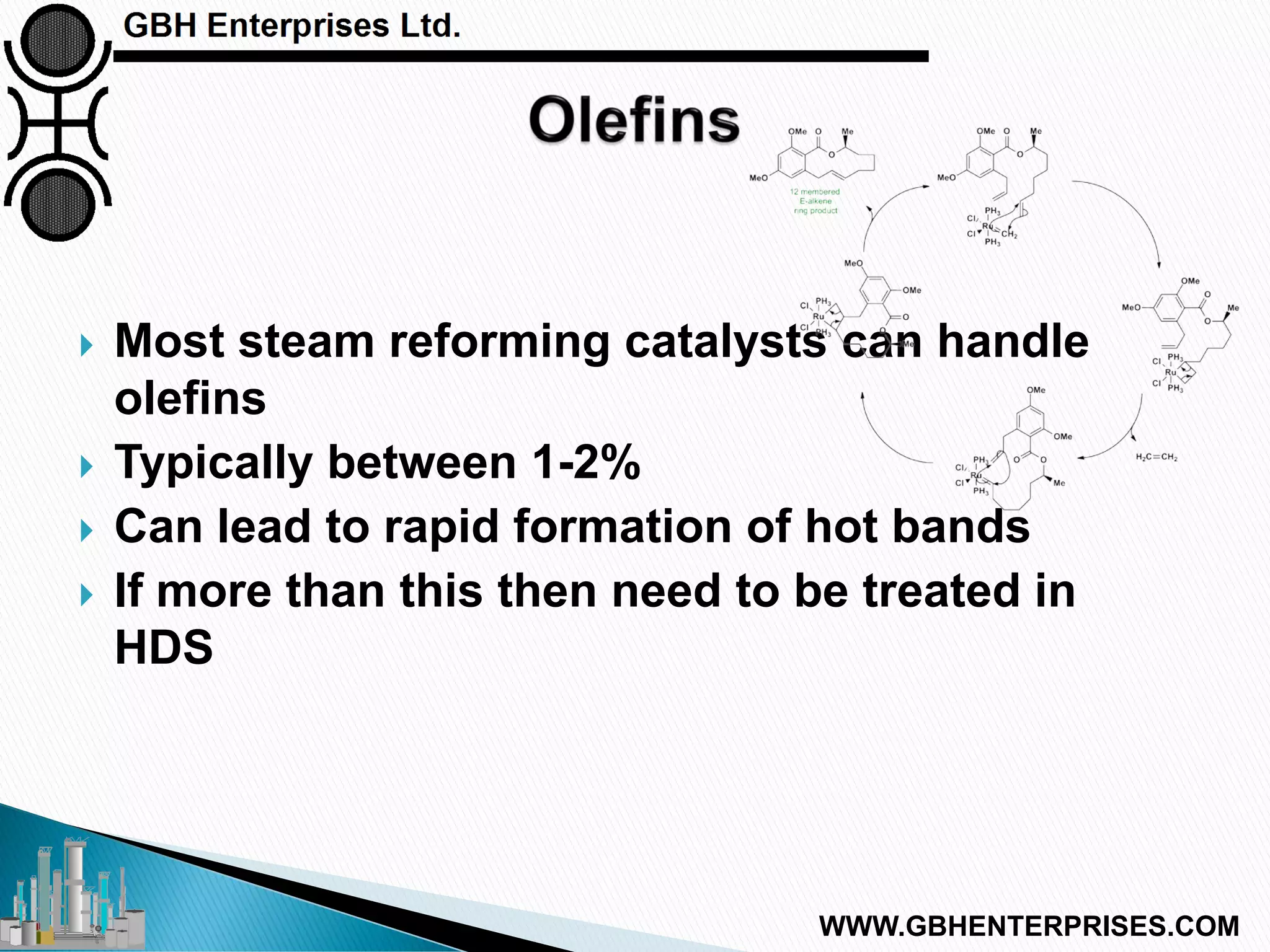
 Most steam reforming catalysts can handle
olefins
 Typically between 1-2%
 Can lead to rapid formation of hot bands
 If more than this then need to be treated in
HDS
WWW.GBHENTERPRISES.COM
Steam Reforming - Poisons

Steam Reforming - Poisons

  • 1.
    Steam Reforming -Poisons Gerard B. Hawkins Managing Director WWW.GBHENTERPRISES.COM
  • 2.
     The aimof this presentation is to • Introduce the various poisons • Indicate actions that need to be taken if catalyst is poisoned • Effect of ultra purification WWW.GBHENTERPRISES.COM
  • 3.
     Common poisonsinclude • Sulfur • Chlorides and other halides • Metals including arsenic, vanadium, mercury, alkali metals (including potassium) • Phosphates • Organo-metalics WWW.GBHENTERPRISES.COM
  • 4.
     Reduced catalystactivity  In primary reformer this means • Reduced reaction • Reduced reaction heat load • High tube/process gas temperatures • More susceptible to carbon formation • Hot bands WWW.GBHENTERPRISES.COM
  • 5.
  • 6.
     Steam reformingcatalyst requirements  Poison Limit Effect Sulfur <0.1 ppmv Poison Chlorides <0.1 ppmv Poison As/V/Pb/Hg <5ppbv Poison Olefins <1-2 vol% Carbon • Process gas feed to reformer (dry basis) • Excludes Pre Reforming catalysts WWW.GBHENTERPRISES.COM
  • 7.
     For PreReformers must be lower than for primary reformers  Sulfur specified at 25 ppb or less  But needs to be checked using a space velocity calculation  Chlorides and Sodium are also poisons  Silica is also an issue WWW.GBHENTERPRISES.COM
  • 8.
    • Sulfur Feedstock •Chlorides/halides Feedstock • Arsenic Vetrocoke • Vanadium Benfield • Mercury Feedstock • Alkali metals Steam/BFW • Phosphates Steam/BFW WWW.GBHENTERPRISES.COM
  • 9.
    Natural Gas Associated Gas/LPG Refinery Off Gas (ROG) Naphtha HydrogenSulfide X X X X Mercaptans (low) X X X X Carbonyl Sulfide X X X Mercaptans (high) X X Thiophenes X WWW.GBHENTERPRISES.COM
  • 10.
    • Vast majorityof poisoned reformers are affected by Sulfur • Many problems with sulfur analysis • At more than 5 ppm will cause severe and rapid deactivation • At 20-30 ppb will lead to slow deactivation • Nickel is excellent sulfur absorbent • At high enough levels will completely de-active catalyst Pellet S SS S S S S S S S Nickel CH H O 4 2 WWW.GBHENTERPRISES.COM
  • 11.
     Sulfur less‘sticky’ at high temperatures  Only affects upper parts of tube  Little affect lower down - usually hot bands are so bad that catalyst is changed out prior to affecting bottom part of tube  Poisoning is generally reversible - can steam  May lose some activity  Particularly if low inlet temperature WWW.GBHENTERPRISES.COM
  • 12.
     Sulfur canbe passed to reformer if • ZnO saturated - difficult to test • COS in feed gas and not hydrolyzed over ZnO • Organics in feed with no CoMo/NiMo • Plants with NG bypass to secondary • Bypass around HDS/ZnO ◦ DP Tappings ◦ Bypass lines ◦ Incorrect valves open • Leaks on HDS interchangers WWW.GBHENTERPRISES.COM
  • 13.
    COS not ascommon as H2S, mercaptans COS + H2O H2S + CO2 Reacts over CoMo/NiMo at typical conditions or Over ZnO that contains some alumina NOTE: COS is not removed by amine systems WWW.GBHENTERPRISES.COM
  • 14.
     Zinc Oxidewill remove some COS provided that there is alumina in support  As with VSG-S201- series  Competitors have no alumina  Organic sulfur compounds (mercaptans) pass through zinc oxide WWW.GBHENTERPRISES.COM
  • 15.
    • Difficult toset up analysis • Tests are difficult • Tests not accurate • Looking at low levels • Generally looking for sulfur at detection limit of the laboratory equipment • Limit is 10 ppb • ZnO will slip about 10 ppb WWW.GBHENTERPRISES.COM
  • 16.
    • Problems ofsampling • Pipe work must be of stainless • Sulfur absorbs into Carbon Steel • Will absorb into stainless but at lower rate • Short pipe runs • Prevent absorption • Sample keeps for four hours • In a stainless steel sample bomb • Use plastic sample bags if sample to be transported WWW.GBHENTERPRISES.COM
  • 17.
    • Some sulfuris removed during shut down • All shut downs include a steam out • Bulk and surface different readings • use surface • Better to conduct full steam out • Test condensate for sulfur compounds • Or smell condensate (beware) WWW.GBHENTERPRISES.COM
  • 18.
     Of benefitto most plants  Effect most pronounced in tough conditions ◦ Low S/C operation where Carbon formation is likely ◦ Prereformers which are very sensitive ◦ GHRs where deactivation impacts heat transfer ◦ Heavy feed reforming where poisoning and carbon formation determine life ◦ Heavily stressed reformers WWW.GBHENTERPRISES.COM
  • 19.
     Together withZnO at regular operating conditions ◦ ZnO to remove bulk of sulfur (H2S) ◦ Followed by a layer of Ultrapurification for polishing  Cannot replace ZnO completely since it has a lower saturation capacity  Catalyst requires reduction prior to use  Can be pyrophoric on discharge - similar to LTS WWW.GBHENTERPRISES.COM
  • 20.
     Unfortunately, measuringlow ppbv levels of sulfur is difficult  So proof has to come from lab/field work  We wanted to test the concept  So we chose a plant where we can measure the effect of deactivation, a reformer we know suffers from deactivation, and where LTS catalysts are known to pick up sulfur WWW.GBHENTERPRISES.COM
  • 21.
    • Smaller, slower decreaseof GHR UA expected in theory with Cu/Zn • Historical evidence from plant that UA settles to lower than SOR value UA v Days online 0.8 0.85 0.9 0.95 1 1.05 0 200 400 600 Without With WWW.GBHENTERPRISES.COM
  • 22.
     Arsenic isa very virulent poison  If a reformer has been poisoned by arsenic then must clean tubes thoroughly  If this is not done then arsenic will poison then next batch of catalyst  And continue to do so WWW.GBHENTERPRISES.COM
  • 23.
    • Most commonas HCI or highly mobile ion • Remove less than 5ppb • Accelerates sintering in catalyst metal crystallites • Found in: • Feed storage locations • Crude and distillate oils • Certain refinery processes WWW.GBHENTERPRISES.COM
  • 24.
    Effect of Chlorideon ZnO Sulfur Removal Catalyst 1. Fresh ZnO 2. Poisoned ZnO HCl ZnO Crystallites Catalyst Pores ZnCl2 blocks catalyst surface and pores to prevent sulfur absorption WWW.GBHENTERPRISES.COM
  • 25.
    Location Elemental Mercury Concentration (Micrograms/m3 ) South America69 –119 Far East 58 –193 North Africa 0.3-130 Groningen 180 Middle East 1-9 Eastern US Pipeline 0.019-0.44 Midwest US Pipeline 0.001-0.10 North America 0.005-0.040 WWW.GBHENTERPRISES.COM
  • 26.
     Most steamreforming catalysts can handle olefins  Typically between 1-2%  Can lead to rapid formation of hot bands  If more than this then need to be treated in HDS WWW.GBHENTERPRISES.COM