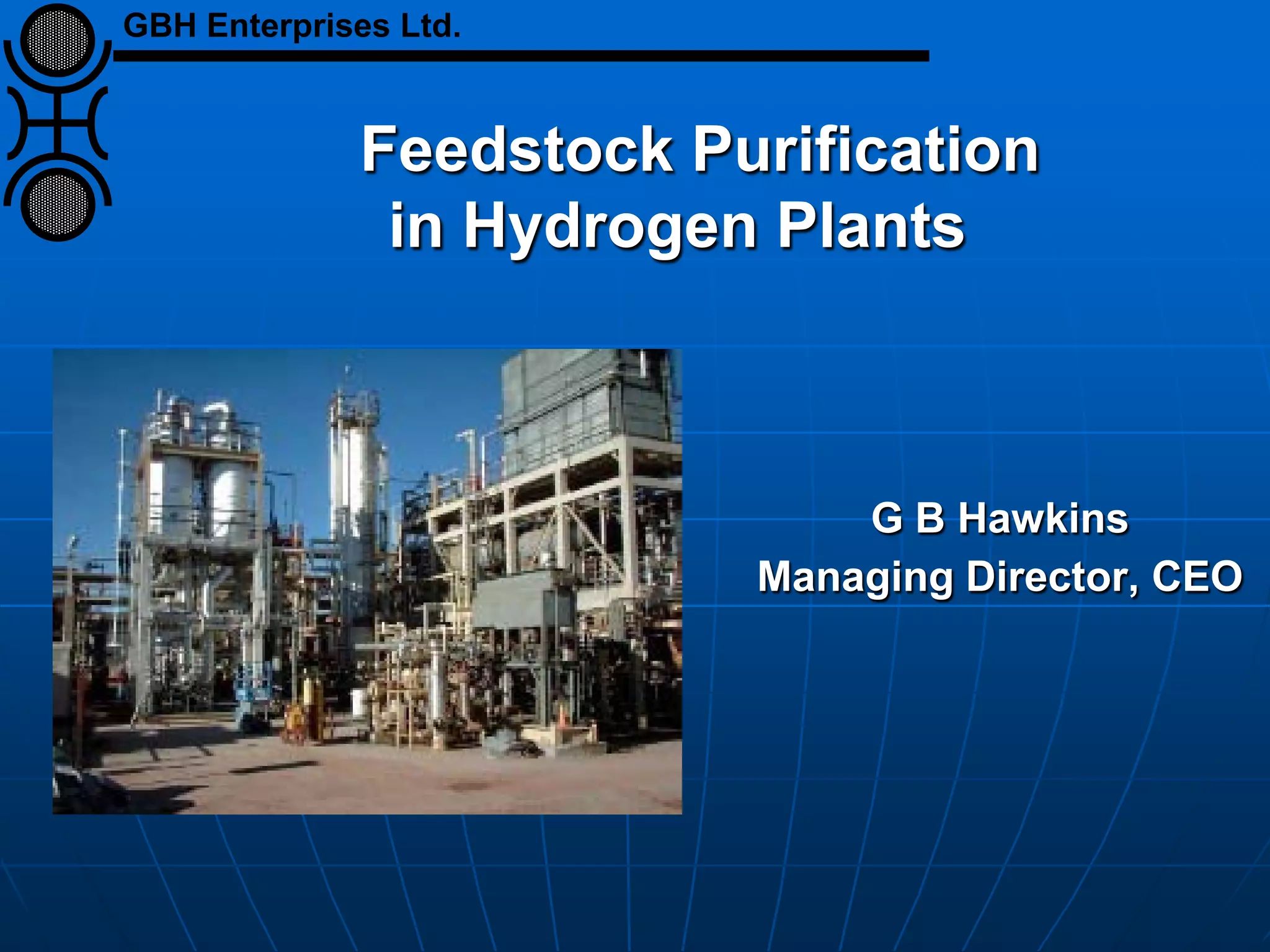
Feedstock Purification
in Hydrogen Plants
G B Hawkins
Managing Director, CEO
GBH Enterprises Ltd.
Feedstock Purification in Hydrogen
Plants
 1. Introduction
 reasons for purification, types of
poisons, and typical systems
 2. Hydrogenation
 3. Dechlorination
 4. Sulfur Removal
 5. Purification system start-up and
shut-down
GBH Enterprises Ltd.
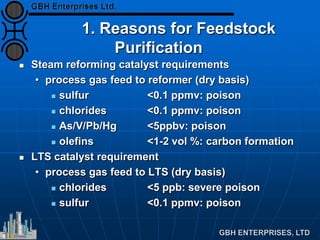
1. Reasons for Feedstock
Purification
 Steam reforming catalyst requirements
• process gas feed to reformer (dry basis)
 sulfur <0.1 ppmv: poison
 chlorides <0.1 ppmv: poison
 As/V/Pb/Hg <5ppbv: poison
 olefins <1-2 vol %: carbon formation
 LTS catalyst requirement
• process gas feed to LTS (dry basis)
 chlorides <5 ppb: severe poison
 sulfur <0.1 ppmv: poison
1. Reasons for Feedstock
Purification
 Steam reformer catalyst poisoning
• Increased methane slip
 low plant efficiency
• Hot tubes
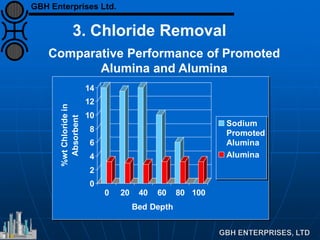
 tube life reduction or failure
• Carbons formation
 increased pressure drop
 increased methane slip and hot tubes
• Sulfur poisoning can be recovered by
steaming the steam reforming catalyst
GBH Enterprises Ltd.
1. Reasons for Feedstock
Purification
 LTS catalyst poisoning
• Reduced life
 premature plant S/D due to high Co slip
and high pressure drop
• Chloride deactivates catalyst at
concentrations of only 0.05 wt%
• Cu poisoning is not reversible
GBH Enterprises Ltd.
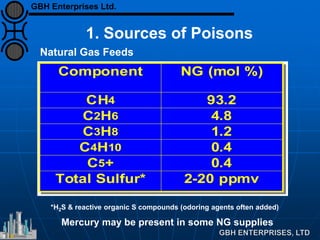
Natural Gas Feeds
Mercury may be present in some NG supplies
*H2S & reactive organic S compounds (odoring agents often added)
Component NG (mol %)
CH4 93.2
C2H6 4.8
C3H8 1.2
C4H10 0.4
C5+ 0.4
Total Sulfur* 2-20 ppmv
1. Sources of Poisons
GBH Enterprises Ltd.
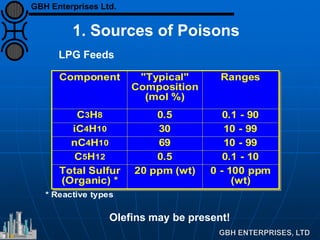
Component "Typical"
Composition
(mol %)
Ranges
C3H8 0.5 0.1 - 90
iC4H10 30 10 - 99
nC4H10 69 10 - 99
C5H12 0.5 0.1 - 10
Total Sulfur
(Organic) *
20 ppm (wt) 0 - 100 ppm
(wt)
* Reactive types
Olefins may be present!
LPG Feeds
1. Sources of Poisons
GBH Enterprises Ltd.
Component Offgas #1
(mol %)
Offgas #2
(mol%)
H2 27.6 35.2
CH4 35.6 26.5
C2H6 19.2 15.2
C3H8 9.9 12
C4H10 6.7 8.8
C5H12 0.8 2
C6H14 0.2 0.3
Total Sulfur* 2 ppmv 10 ppmv
Total Chloride 1-2 ppmv -
Refinery Offgas Feeds
1. Sources of Poisons
*H2S & reactive organic S compounds
GBH Enterprises Ltd.
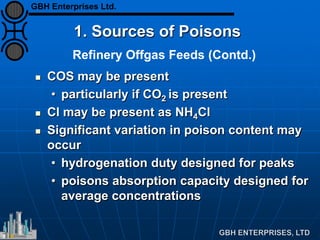
Refinery Offgas Feeds (Contd.)
1. Sources of Poisons
 COS may be present
• particularly if CO2 is present
 Cl may be present as NH4Cl
 Significant variation in poison content may
occur
• hydrogenation duty designed for peaks
• poisons absorption capacity designed for
average concentrations
GBH Enterprises Ltd.
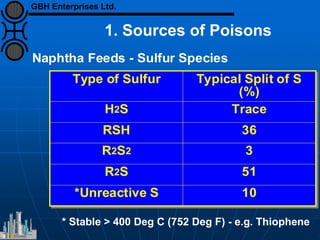
Type of Sulfur Typical Split of S
(%)
H2S Trace
RSH 36
R2S2 3
R2S 51
*Unreactive S 10
Naphtha Feeds - Sulfur Species
* Stable > 400 Deg C (752 Deg F) - e.g. Thiophene
1. Sources of Poisons
GBH Enterprises Ltd.
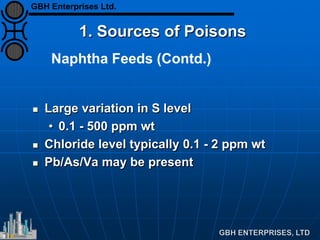
Naphtha Feeds (Contd.)
1. Sources of Poisons
 Large variation in S level
• 0.1 - 500 ppm wt
 Chloride level typically 0.1 - 2 ppm wt
 Pb/As/Va may be present
GBH Enterprises Ltd.
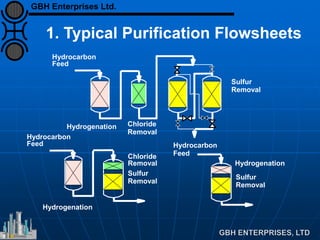
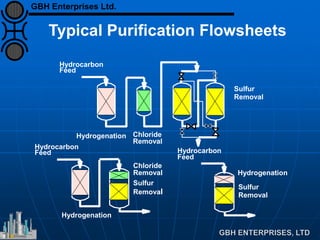
Hydrocarbon
Feed
Hydrogenation Chloride
Removal
Sulfur
Removal
Hydrocarbon
Feed
Hydrogenation
Sulfur
Removal
Chloride
Removal
Hydrocarbon
Feed
Sulfur
Removal
Hydrogenation
1. Typical Purification Flowsheets
GBH Enterprises Ltd.
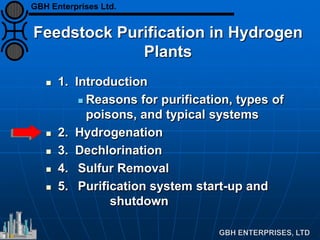
Feedstock Purification in Hydrogen
Plants
 1. Introduction
 Reasons for purification, types of
poisons, and typical systems
 2. Hydrogenation
 3. Dechlorination
 4. Sulfur Removal
 5. Purification system start-up and
shutdown
GBH Enterprises Ltd.
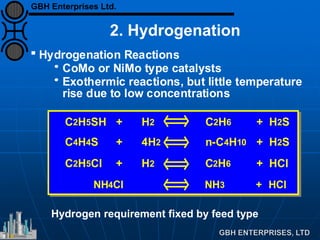
Hydrogenation Reactions
CoMo or NiMo type catalysts
Exothermic reactions, but little temperature
rise due to low concentrations
C2H5Cl + H2 C2H6 + HCl
C2H5SH + H2 C2H6 + H2S
C4H4S + 4H2 n-C4H10 + H2S
NH4Cl NH3 + HCl
Hydrogen requirement fixed by feed type
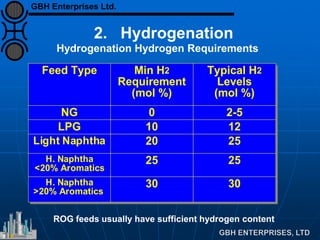
2. Hydrogenation
GBH Enterprises Ltd.
Feed Type Min H2
Requirement
(mol %)
Typical H2
Levels
(mol %)
NG 0 2-5
LPG 10 12
Light Naphtha 20 25
H. Naphtha
<20% Aromatics
25 25
H. Naphtha
>20% Aromatics
30 30
ROG feeds usually have sufficient hydrogen content
Hydrogenation Hydrogen Requirements
2. Hydrogenation
GBH Enterprises Ltd.
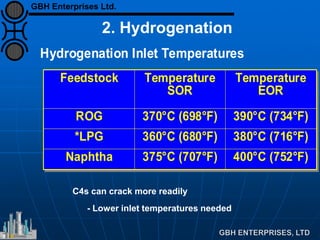
Feedstock Temperature
SOR
Temperature
EOR
ROG 370°C (698°F) 390°C (734°F)
*LPG 360°C (680°F) 380°C (716°F)
Naphtha 375°C (707°F) 400°C (752°F)
Hydrogenation Inlet Temperatures
- Lower inlet temperatures needed
C4s can crack more readily
2. Hydrogenation
GBH Enterprises Ltd.
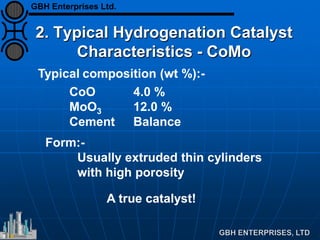
2. Typical Hydrogenation Catalyst
Characteristics - CoMo
Typical composition (wt %):-
CoO 4.0 %
MoO3 12.0 %
Cement Balance
Form:-
Usually extruded thin cylinders
with high porosity
A true catalyst!
GBH Enterprises Ltd.
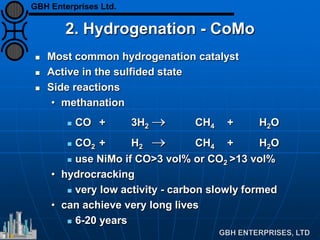
2. Hydrogenation - CoMo
 Most common hydrogenation catalyst
 Active in the sulfided state
 Side reactions
• methanation
 CO + 3H2 → CH4 + H2O
 CO2 + H2 → CH4 + H2O
 use NiMo if CO>3 vol% or CO2 >13 vol%
• hydrocracking
 very low activity - carbon slowly formed
• can achieve very long lives
 6-20 years
GBH Enterprises Ltd.
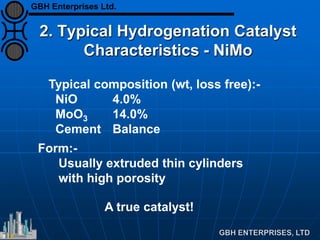
2. Typical Hydrogenation Catalyst
Characteristics - NiMo
Typical composition (wt, loss free):-
NiO 4.0%
MoO3 14.0%
Cement Balance
Form:-
Usually extruded thin cylinders
with high porosity
A true catalyst!
GBH Enterprises Ltd.
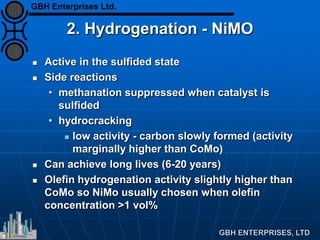
2. Hydrogenation - NiMO
 Active in the sulfided state
 Side reactions
• methanation suppressed when catalyst is
sulfided
• hydrocracking
 low activity - carbon slowly formed (activity
marginally higher than CoMo)
 Can achieve long lives (6-20 years)
 Olefin hydrogenation activity slightly higher than
CoMo so NiMo usually chosen when olefin
concentration >1 vol%
GBH Enterprises Ltd.
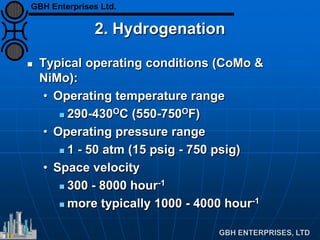
2. Hydrogenation
 Typical operating conditions (CoMo &
NiMo):
• Operating temperature range
 290-430OC (550-750OF)
• Operating pressure range
 1 - 50 atm (15 psig - 750 psig)
• Space velocity
 300 - 8000 hour-1
 more typically 1000 - 4000 hour-1
GBH Enterprises Ltd.
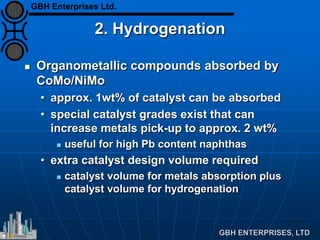
2. Hydrogenation
 Organometallic compounds absorbed by
CoMo/NiMo
• approx. 1wt% of catalyst can be absorbed
• special catalyst grades exist that can
increase metals pick-up to approx. 2 wt%
 useful for high Pb content naphthas
• extra catalyst design volume required
 catalyst volume for metals absorption plus
catalyst volume for hydrogenation
GBH Enterprises Ltd.
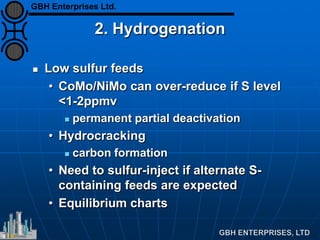
2. Hydrogenation
 Low sulfur feeds
• CoMo/NiMo can over-reduce if S level
<1-2ppmv
 permanent partial deactivation
• Hydrocracking
 carbon formation
• Need to sulfur-inject if alternate S-
containing feeds are expected
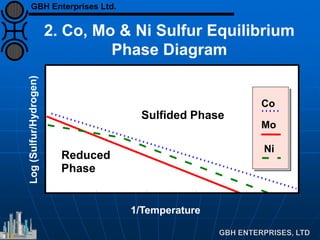
• Equilibrium charts
GBH Enterprises Ltd.
826 F 665 F1040 F 540 F
1/Temperature
Co
Mo
Ni
Sulfided Phase
Reduced
Phase
2. Co, Mo & Ni Sulfur Equilibrium
Phase Diagram
GBH Enterprises Ltd.
2. Hydrogenation
 Aromatics Hydrogenation
• Naphtha feeds contains aromatics
• Hydrogenation rate very slow over CoMo/NiMo
 in reality - negligible
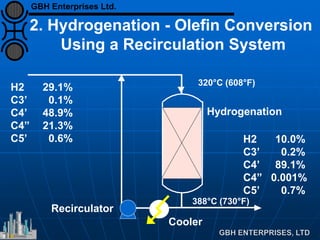
 Olefin hydrogenation
• Maximum olefins to steam reformer = 1-2 vol%
• Hydrogen “consumption” needs to be taken
into account (increase hydrogen R/C”
• Temperature rise implications
 re-circulation system can be used to limit
impact of temperature rise
GBH Enterprises Ltd.
Hydrogenation
320°C (608°F)
388°C (730°F)
2. Hydrogenation - Olefin Conversion
Using a Recirculation System
H2 29.1%
C3’ 0.1%
C4’ 48.9%
C4” 21.3%
C5’ 0.6% H2 10.0%
C3’ 0.2%
C4’ 89.1%
C4” 0.001%
C5’ 0.7%
Recirculator
Cooler
GBH Enterprises Ltd.
2. Hydrogenation
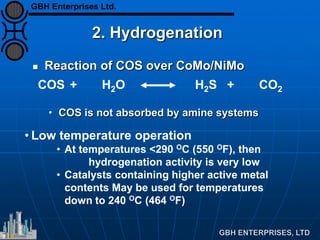
 Reaction of COS over CoMo/NiMo
• COS is not absorbed by amine systems
• Low temperature operation
• At temperatures <290 OC (550 OF), then
hydrogenation activity is very low
• Catalysts containing higher active metal
contents May be used for temperatures
down to 240 OC (464 OF)
COS + H2O H2S + CO2
GBH Enterprises Ltd.
2.Hydrogenation - Typical Problems
 Pressure drop increase
 carbon formation
• formed from hydrocarbon cracking
 carry-over of solids
 Sulfur slippage
 low temperature of operation
• e.g. small plants with high heat loss
 rate Increase
 sulfur level increase
• very significant if sulfur is unreactive type
GBH Enterprises Ltd.
Feedstock Purification in Hydrogen
Plants
 1. Introduction
 2. Hydrogenation
 3. Dechlorination
 sources of chloride
 effects of chloride
 removal of chloride
 4. Sulfur Removal
 5. Purification system start-up & shut-
down
GBH Enterprises Ltd.
3. Chloride Removal
 Possible sources of chlorides
• offgas from certain catalytic reformer
plants
 HCI & NH4Cl
• LPG and naphtha feeds
 organic chlorides
Some chlorides might originate from the process
steam due to incorrect boiler feed water quality
control
GBH Enterprises Ltd.
Hydrocarbon
Feed
Hydrocarbon
Feed
Hydrogenation Chloride
Removal
Sulfur
Removal
Hydrogenation
Sulfur
Removal
Chloride
Removal
Hydrocarbon
Feed
Sulfur
Removal
Hydrogenation
Typical Purification Flowsheets
GBH Enterprises Ltd.
3. Chloride Removal
 ZnO catalyst
• Some of the chlorides will react with the
ZnO to form ZnCl2
 this significantly reduces the ZnO capacity
to absorb sulfur
 weakens the catalyst
 ZnCl2 sublimes at purification section
normal operating temperatures and can
deposit Zn and Cl on downstream reforming
catalyst
Why remove the chlorides before ZnO?
GBH Enterprises Ltd.
HClZnO
Crystallites
Catalyst
Pore
s
Effect of Chloride on ZnO Sulfur Removal Catalyst
1. Fresh ZnO 2. Poisoned
ZnCl2 blocks
catalyst surface
and pores to
prevent sulfur
absorption
3. Chloride Removal
GBH Enterprises Ltd.
HCl + NaAlO2 AlOOH + NaCl
2HCl + 2NaAlO2 Al2O3 + 2NaCl + H2O
Removing chlorides at elevated temperatures
requires a chemical absorbent
Physical absorbents like activated aluminas can not
operate at normal purification system temperatures
as absorbent must operate downstream of the
hydrogenation catalyst
Need to use a promoted alumina
- e.g. Na2O/Al2O3
3. Chloride Removal
GBH Enterprises Ltd.
3. Chloride Removal - Operational
Aspects
 Operation very straightforward
 Temperature range
• 0 - 400OC (32 - 752OF)
 Pressure range
• 0 - 50 atm (14 - 750 psig)
 Space velocity
• experience of up to 10000/hr
• typically 1000-4000/hr
 Absorbent sensitive to condensation
• pressure drop increase could be due to
condensation
GBH Enterprises Ltd.
• Design Cl slip = <0.1ppmv
• (Typically 0.05 ppmv or less)
• Monitor HCl slip on a regular basis
• If inlet chloride known, then life of catalyst can
be calculated approximately
• 12-14 weight % of chloride in catalyst
• High space velocities are possible
• Catalyst can be installed as a "ZnO" top-up
• Other Halogens
• Fluoride and bromide can also be removed
3. Chloride Removal
GBH Enterprises Ltd.
Comparative Performance of Promoted
Alumina and Alumina
3. Chloride Removal
0
2
4
6
8
10
12
14
%wtChloridein
Absorbent
0 20 40 60 80 100
Bed Depth
Sodium
Promoted
Alumina
Alumina
GBH Enterprises Ltd.
Feedstock Purification in Hydrogen
Plants
 1 Introduction
 2 Hydrogenation
 3 Dechlorination
 4 Sulfur Removal
• catalysts/absorbents
• sulfur pick-up
• operational aspects
 Purification system start-up & shut-
down
GBH Enterprises Ltd.
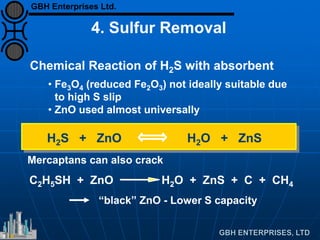
• Fe3O4 (reduced Fe2O3) not ideally suitable due
to high S slip
• ZnO used almost universally
“black” ZnO - Lower S capacity
H2S + ZnO H2O + ZnS
Mercaptans can also crack
C2H5SH + ZnO H2O + ZnS + C + CH4
4. Sulfur Removal
Chemical Reaction of H2S with absorbent
GBH Enterprises Ltd.
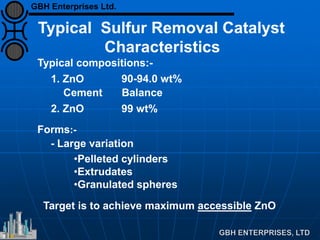
Typical compositions:-
1. ZnO 90-94.0 wt%
Cement Balance
2. ZnO 99 wt%
Forms:-
- Large variation
•Pelleted cylinders
•Extrudates
•Granulated spheres
Typical Sulfur Removal Catalyst
Characteristics
Target is to achieve maximum accessible ZnO
GBH Enterprises Ltd.
4. Sulfur Removal - Total Pick-up
 Catalyst requirements (high S pick-up)
• High porosity
 allows access of H2S to centre of catalyst
pellet
 porosity maintained as ZnO is converted to
ZnS
 upstream chloride slip has lower effect on
catalyst S capacity
• Highly accessible surface area
 sharp S absorption profile at high space
velocities
GBH Enterprises Ltd.
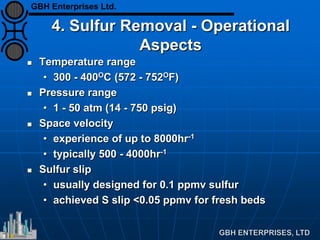
4. Sulfur Removal - Operational
Aspects
 Temperature range
• 300 - 400OC (572 - 752OF)
 Pressure range
• 1 - 50 atm (14 - 750 psig)
 Space velocity
• experience of up to 8000hr-1
• typically 500 - 4000hr-1
 Sulfur slip
• usually designed for 0.1 ppmv sulfur
• achieved S slip <0.05 ppmv for fresh beds
GBH Enterprises Ltd.
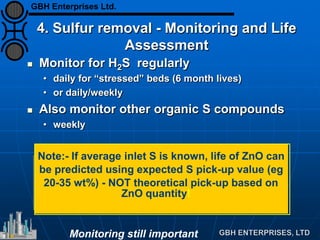
4. Sulfur removal - Monitoring and Life
Assessment
 Monitor for H2S regularly
• daily for “stressed” beds (6 month lives)
• or daily/weekly
 Also monitor other organic S compounds
• weekly
Note:- If average inlet S is known, life of ZnO can
be predicted using expected S pick-up value (eg
20-35 wt%) - NOT theoretical pick-up based on
ZnO quantity!
Monitoring still important
GBH Enterprises Ltd.
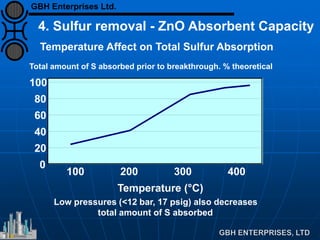
Temperature Affect on Total Sulfur Absorption
100 200 300 400
0
20
40
60
80
100
Temperature (°C)
Total amount of S absorbed prior to breakthrough. % theoretical
4. Sulfur removal - ZnO Absorbent Capacity
Low pressures (<12 bar, 17 psig) also decreases
total amount of S absorbed
GBH Enterprises Ltd.
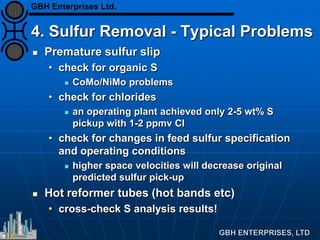
4. Sulfur Removal - Typical Problems
 Premature sulfur slip
• check for organic S
 CoMo/NiMo problems
• check for chlorides
 an operating plant achieved only 2-5 wt% S
pickup with 1-2 ppmv Cl
• check for changes in feed sulfur specification
and operating conditions
 higher space velocities will decrease original
predicted sulfur pick-up
 Hot reformer tubes (hot bands etc)
• cross-check S analysis results!
GBH Enterprises Ltd.
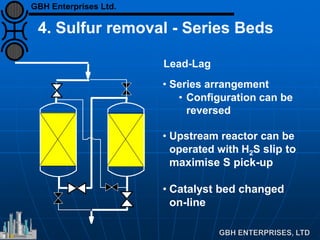
Lead-Lag
• Series arrangement
• Configuration can be
reversed
• Upstream reactor can be
operated with H2S slip to
maximise S pick-up
• Catalyst bed changed
on-line
4. Sulfur removal - Series Beds
GBH Enterprises Ltd.
4. Sulfur removal - Carbon Beds
 Beds of activated carbon promoted with
copper
 Carbon removes organic sulfur and
copper removes H2S
 Regenerable
• Steam generation removes organic sulfur
• H2S can not be easily removed from Cu unless
steam/air regeneration used
• Effluent problems
 H2S removal capabilities decrease with
time
GBH Enterprises Ltd.
Feedstock Purification in Hydrogen
Plants
1. Introduction
2. Hydrogenation
3. Dechloration
4. Sulfur Removal
5. Purification system start-up and
shut down
GBH Enterprises Ltd.
5. Purification System Start-up
 Usually heated-up with an inert gas or NG
• Heat up rate typically 50OC/hr (90OF/hr)
• If sour NG is used, avoid passing to the steam
reformer until conditions are reached for H2S
conversion and adsorption
 For re -start of naphtha/LPG based plants,
ensure that the catalyst beds have been fully
purged of hydrocarbons before reformer is
brought on line
GBH Enterprises Ltd.
5. Purification System - Start-up
 CoMo/NiMo usually sulfided as hydrocarbon
feed is introduced
• In some cases, in situ pre-sulfiding may be
required
 Feeds with high CO2/CO content
 Sulfur-free C4 stream
 Involves injection of carbon disulfide or
dimethyl disulfide etc in a flow of N2 or NG at
200OC (390OF)
 Purification system usually effective at
reduced rates once 300OC (572OF) is achieved
• monitoring of S slip still important however
GBH Enterprises Ltd.
5. Purification System - Shut-down
 Beds should be purged with inert gas
cooling to < 38OC (100OF) before
depressurization
• For naphtha/LPG type feeds, if steam is
already isolated, purging should be done
to flare and not through the reformer
 Discharged catalyst should be considered
pyrophoric
• Fine carbon, residual hydrocarbons & iron
carry-over
• During discharge, have water hoses ready
GBH Enterprises Ltd.
Purification Catalyst for Hydrogen
Plants - Summary
 Types of poisons, required poison limits,
and typical purification systems
 Hydrogenation
• CoMo/NiMo
• Aromatics and Olefin hydrogenation
• Sulfur equilibrium
• Dechlorination
• Sulfur removal
• Start-up and shut-down
GBH Enterprises Ltd.
Feedstock Purfication in Hydrogen Plants

Feedstock Purfication in Hydrogen Plants

  • 1.
    Feedstock Purification in HydrogenPlants G B Hawkins Managing Director, CEO GBH Enterprises Ltd.
  • 2.
    Feedstock Purification inHydrogen Plants  1. Introduction  reasons for purification, types of poisons, and typical systems  2. Hydrogenation  3. Dechlorination  4. Sulfur Removal  5. Purification system start-up and shut-down GBH Enterprises Ltd.
  • 3.
    1. Reasons forFeedstock Purification  Steam reforming catalyst requirements • process gas feed to reformer (dry basis)  sulfur <0.1 ppmv: poison  chlorides <0.1 ppmv: poison  As/V/Pb/Hg <5ppbv: poison  olefins <1-2 vol %: carbon formation  LTS catalyst requirement • process gas feed to LTS (dry basis)  chlorides <5 ppb: severe poison  sulfur <0.1 ppmv: poison
  • 4.
    1. Reasons forFeedstock Purification  Steam reformer catalyst poisoning • Increased methane slip  low plant efficiency • Hot tubes  tube life reduction or failure • Carbons formation  increased pressure drop  increased methane slip and hot tubes • Sulfur poisoning can be recovered by steaming the steam reforming catalyst GBH Enterprises Ltd.
  • 5.
    1. Reasons forFeedstock Purification  LTS catalyst poisoning • Reduced life  premature plant S/D due to high Co slip and high pressure drop • Chloride deactivates catalyst at concentrations of only 0.05 wt% • Cu poisoning is not reversible GBH Enterprises Ltd.
  • 6.
    Natural Gas Feeds Mercurymay be present in some NG supplies *H2S & reactive organic S compounds (odoring agents often added) Component NG (mol %) CH4 93.2 C2H6 4.8 C3H8 1.2 C4H10 0.4 C5+ 0.4 Total Sulfur* 2-20 ppmv 1. Sources of Poisons GBH Enterprises Ltd.
  • 7.
    Component "Typical" Composition (mol %) Ranges C3H80.5 0.1 - 90 iC4H10 30 10 - 99 nC4H10 69 10 - 99 C5H12 0.5 0.1 - 10 Total Sulfur (Organic) * 20 ppm (wt) 0 - 100 ppm (wt) * Reactive types Olefins may be present! LPG Feeds 1. Sources of Poisons GBH Enterprises Ltd.
  • 8.
    Component Offgas #1 (mol%) Offgas #2 (mol%) H2 27.6 35.2 CH4 35.6 26.5 C2H6 19.2 15.2 C3H8 9.9 12 C4H10 6.7 8.8 C5H12 0.8 2 C6H14 0.2 0.3 Total Sulfur* 2 ppmv 10 ppmv Total Chloride 1-2 ppmv - Refinery Offgas Feeds 1. Sources of Poisons *H2S & reactive organic S compounds GBH Enterprises Ltd.
  • 9.
    Refinery Offgas Feeds(Contd.) 1. Sources of Poisons  COS may be present • particularly if CO2 is present  Cl may be present as NH4Cl  Significant variation in poison content may occur • hydrogenation duty designed for peaks • poisons absorption capacity designed for average concentrations GBH Enterprises Ltd.
  • 10.
    Type of SulfurTypical Split of S (%) H2S Trace RSH 36 R2S2 3 R2S 51 *Unreactive S 10 Naphtha Feeds - Sulfur Species * Stable > 400 Deg C (752 Deg F) - e.g. Thiophene 1. Sources of Poisons GBH Enterprises Ltd.
  • 11.
    Naphtha Feeds (Contd.) 1.Sources of Poisons  Large variation in S level • 0.1 - 500 ppm wt  Chloride level typically 0.1 - 2 ppm wt  Pb/As/Va may be present GBH Enterprises Ltd.
  • 12.
  • 13.
    Feedstock Purification inHydrogen Plants  1. Introduction  Reasons for purification, types of poisons, and typical systems  2. Hydrogenation  3. Dechlorination  4. Sulfur Removal  5. Purification system start-up and shutdown GBH Enterprises Ltd.
  • 14.
    Hydrogenation Reactions CoMo orNiMo type catalysts Exothermic reactions, but little temperature rise due to low concentrations C2H5Cl + H2 C2H6 + HCl C2H5SH + H2 C2H6 + H2S C4H4S + 4H2 n-C4H10 + H2S NH4Cl NH3 + HCl Hydrogen requirement fixed by feed type 2. Hydrogenation GBH Enterprises Ltd.
  • 15.
    Feed Type MinH2 Requirement (mol %) Typical H2 Levels (mol %) NG 0 2-5 LPG 10 12 Light Naphtha 20 25 H. Naphtha <20% Aromatics 25 25 H. Naphtha >20% Aromatics 30 30 ROG feeds usually have sufficient hydrogen content Hydrogenation Hydrogen Requirements 2. Hydrogenation GBH Enterprises Ltd.
  • 16.
    Feedstock Temperature SOR Temperature EOR ROG 370°C(698°F) 390°C (734°F) *LPG 360°C (680°F) 380°C (716°F) Naphtha 375°C (707°F) 400°C (752°F) Hydrogenation Inlet Temperatures - Lower inlet temperatures needed C4s can crack more readily 2. Hydrogenation GBH Enterprises Ltd.
  • 17.
    2. Typical HydrogenationCatalyst Characteristics - CoMo Typical composition (wt %):- CoO 4.0 % MoO3 12.0 % Cement Balance Form:- Usually extruded thin cylinders with high porosity A true catalyst! GBH Enterprises Ltd.
  • 18.
    2. Hydrogenation -CoMo  Most common hydrogenation catalyst  Active in the sulfided state  Side reactions • methanation  CO + 3H2 → CH4 + H2O  CO2 + H2 → CH4 + H2O  use NiMo if CO>3 vol% or CO2 >13 vol% • hydrocracking  very low activity - carbon slowly formed • can achieve very long lives  6-20 years GBH Enterprises Ltd.
  • 19.
    2. Typical HydrogenationCatalyst Characteristics - NiMo Typical composition (wt, loss free):- NiO 4.0% MoO3 14.0% Cement Balance Form:- Usually extruded thin cylinders with high porosity A true catalyst! GBH Enterprises Ltd.
  • 20.
    2. Hydrogenation -NiMO  Active in the sulfided state  Side reactions • methanation suppressed when catalyst is sulfided • hydrocracking  low activity - carbon slowly formed (activity marginally higher than CoMo)  Can achieve long lives (6-20 years)  Olefin hydrogenation activity slightly higher than CoMo so NiMo usually chosen when olefin concentration >1 vol% GBH Enterprises Ltd.
  • 21.
    2. Hydrogenation  Typicaloperating conditions (CoMo & NiMo): • Operating temperature range  290-430OC (550-750OF) • Operating pressure range  1 - 50 atm (15 psig - 750 psig) • Space velocity  300 - 8000 hour-1  more typically 1000 - 4000 hour-1 GBH Enterprises Ltd.
  • 22.
    2. Hydrogenation  Organometalliccompounds absorbed by CoMo/NiMo • approx. 1wt% of catalyst can be absorbed • special catalyst grades exist that can increase metals pick-up to approx. 2 wt%  useful for high Pb content naphthas • extra catalyst design volume required  catalyst volume for metals absorption plus catalyst volume for hydrogenation GBH Enterprises Ltd.
  • 23.
    2. Hydrogenation  Lowsulfur feeds • CoMo/NiMo can over-reduce if S level <1-2ppmv  permanent partial deactivation • Hydrocracking  carbon formation • Need to sulfur-inject if alternate S- containing feeds are expected • Equilibrium charts GBH Enterprises Ltd.
  • 24.
    826 F 665F1040 F 540 F 1/Temperature Co Mo Ni Sulfided Phase Reduced Phase 2. Co, Mo & Ni Sulfur Equilibrium Phase Diagram GBH Enterprises Ltd.
  • 25.
    2. Hydrogenation  AromaticsHydrogenation • Naphtha feeds contains aromatics • Hydrogenation rate very slow over CoMo/NiMo  in reality - negligible  Olefin hydrogenation • Maximum olefins to steam reformer = 1-2 vol% • Hydrogen “consumption” needs to be taken into account (increase hydrogen R/C” • Temperature rise implications  re-circulation system can be used to limit impact of temperature rise GBH Enterprises Ltd.
  • 26.
    Hydrogenation 320°C (608°F) 388°C (730°F) 2.Hydrogenation - Olefin Conversion Using a Recirculation System H2 29.1% C3’ 0.1% C4’ 48.9% C4” 21.3% C5’ 0.6% H2 10.0% C3’ 0.2% C4’ 89.1% C4” 0.001% C5’ 0.7% Recirculator Cooler GBH Enterprises Ltd.
  • 27.
    2. Hydrogenation  Reactionof COS over CoMo/NiMo • COS is not absorbed by amine systems • Low temperature operation • At temperatures <290 OC (550 OF), then hydrogenation activity is very low • Catalysts containing higher active metal contents May be used for temperatures down to 240 OC (464 OF) COS + H2O H2S + CO2 GBH Enterprises Ltd.
  • 28.
    2.Hydrogenation - TypicalProblems  Pressure drop increase  carbon formation • formed from hydrocarbon cracking  carry-over of solids  Sulfur slippage  low temperature of operation • e.g. small plants with high heat loss  rate Increase  sulfur level increase • very significant if sulfur is unreactive type GBH Enterprises Ltd.
  • 29.
    Feedstock Purification inHydrogen Plants  1. Introduction  2. Hydrogenation  3. Dechlorination  sources of chloride  effects of chloride  removal of chloride  4. Sulfur Removal  5. Purification system start-up & shut- down GBH Enterprises Ltd.
  • 30.
    3. Chloride Removal Possible sources of chlorides • offgas from certain catalytic reformer plants  HCI & NH4Cl • LPG and naphtha feeds  organic chlorides Some chlorides might originate from the process steam due to incorrect boiler feed water quality control GBH Enterprises Ltd.
  • 31.
  • 32.
    3. Chloride Removal ZnO catalyst • Some of the chlorides will react with the ZnO to form ZnCl2  this significantly reduces the ZnO capacity to absorb sulfur  weakens the catalyst  ZnCl2 sublimes at purification section normal operating temperatures and can deposit Zn and Cl on downstream reforming catalyst Why remove the chlorides before ZnO? GBH Enterprises Ltd.
  • 33.
    HClZnO Crystallites Catalyst Pore s Effect of Chlorideon ZnO Sulfur Removal Catalyst 1. Fresh ZnO 2. Poisoned ZnCl2 blocks catalyst surface and pores to prevent sulfur absorption 3. Chloride Removal GBH Enterprises Ltd.
  • 34.
    HCl + NaAlO2AlOOH + NaCl 2HCl + 2NaAlO2 Al2O3 + 2NaCl + H2O Removing chlorides at elevated temperatures requires a chemical absorbent Physical absorbents like activated aluminas can not operate at normal purification system temperatures as absorbent must operate downstream of the hydrogenation catalyst Need to use a promoted alumina - e.g. Na2O/Al2O3 3. Chloride Removal GBH Enterprises Ltd.
  • 35.
    3. Chloride Removal- Operational Aspects  Operation very straightforward  Temperature range • 0 - 400OC (32 - 752OF)  Pressure range • 0 - 50 atm (14 - 750 psig)  Space velocity • experience of up to 10000/hr • typically 1000-4000/hr  Absorbent sensitive to condensation • pressure drop increase could be due to condensation GBH Enterprises Ltd.
  • 36.
    • Design Clslip = <0.1ppmv • (Typically 0.05 ppmv or less) • Monitor HCl slip on a regular basis • If inlet chloride known, then life of catalyst can be calculated approximately • 12-14 weight % of chloride in catalyst • High space velocities are possible • Catalyst can be installed as a "ZnO" top-up • Other Halogens • Fluoride and bromide can also be removed 3. Chloride Removal GBH Enterprises Ltd.
  • 37.
    Comparative Performance ofPromoted Alumina and Alumina 3. Chloride Removal 0 2 4 6 8 10 12 14 %wtChloridein Absorbent 0 20 40 60 80 100 Bed Depth Sodium Promoted Alumina Alumina GBH Enterprises Ltd.
  • 38.
    Feedstock Purification inHydrogen Plants  1 Introduction  2 Hydrogenation  3 Dechlorination  4 Sulfur Removal • catalysts/absorbents • sulfur pick-up • operational aspects  Purification system start-up & shut- down GBH Enterprises Ltd.
  • 39.
    • Fe3O4 (reducedFe2O3) not ideally suitable due to high S slip • ZnO used almost universally “black” ZnO - Lower S capacity H2S + ZnO H2O + ZnS Mercaptans can also crack C2H5SH + ZnO H2O + ZnS + C + CH4 4. Sulfur Removal Chemical Reaction of H2S with absorbent GBH Enterprises Ltd.
  • 40.
    Typical compositions:- 1. ZnO90-94.0 wt% Cement Balance 2. ZnO 99 wt% Forms:- - Large variation •Pelleted cylinders •Extrudates •Granulated spheres Typical Sulfur Removal Catalyst Characteristics Target is to achieve maximum accessible ZnO GBH Enterprises Ltd.
  • 41.
    4. Sulfur Removal- Total Pick-up  Catalyst requirements (high S pick-up) • High porosity  allows access of H2S to centre of catalyst pellet  porosity maintained as ZnO is converted to ZnS  upstream chloride slip has lower effect on catalyst S capacity • Highly accessible surface area  sharp S absorption profile at high space velocities GBH Enterprises Ltd.
  • 42.
    4. Sulfur Removal- Operational Aspects  Temperature range • 300 - 400OC (572 - 752OF)  Pressure range • 1 - 50 atm (14 - 750 psig)  Space velocity • experience of up to 8000hr-1 • typically 500 - 4000hr-1  Sulfur slip • usually designed for 0.1 ppmv sulfur • achieved S slip <0.05 ppmv for fresh beds GBH Enterprises Ltd.
  • 43.
    4. Sulfur removal- Monitoring and Life Assessment  Monitor for H2S regularly • daily for “stressed” beds (6 month lives) • or daily/weekly  Also monitor other organic S compounds • weekly Note:- If average inlet S is known, life of ZnO can be predicted using expected S pick-up value (eg 20-35 wt%) - NOT theoretical pick-up based on ZnO quantity! Monitoring still important GBH Enterprises Ltd.
  • 44.
    Temperature Affect onTotal Sulfur Absorption 100 200 300 400 0 20 40 60 80 100 Temperature (°C) Total amount of S absorbed prior to breakthrough. % theoretical 4. Sulfur removal - ZnO Absorbent Capacity Low pressures (<12 bar, 17 psig) also decreases total amount of S absorbed GBH Enterprises Ltd.
  • 45.
    4. Sulfur Removal- Typical Problems  Premature sulfur slip • check for organic S  CoMo/NiMo problems • check for chlorides  an operating plant achieved only 2-5 wt% S pickup with 1-2 ppmv Cl • check for changes in feed sulfur specification and operating conditions  higher space velocities will decrease original predicted sulfur pick-up  Hot reformer tubes (hot bands etc) • cross-check S analysis results! GBH Enterprises Ltd.
  • 46.
    Lead-Lag • Series arrangement •Configuration can be reversed • Upstream reactor can be operated with H2S slip to maximise S pick-up • Catalyst bed changed on-line 4. Sulfur removal - Series Beds GBH Enterprises Ltd.
  • 47.
    4. Sulfur removal- Carbon Beds  Beds of activated carbon promoted with copper  Carbon removes organic sulfur and copper removes H2S  Regenerable • Steam generation removes organic sulfur • H2S can not be easily removed from Cu unless steam/air regeneration used • Effluent problems  H2S removal capabilities decrease with time GBH Enterprises Ltd.
  • 48.
    Feedstock Purification inHydrogen Plants 1. Introduction 2. Hydrogenation 3. Dechloration 4. Sulfur Removal 5. Purification system start-up and shut down GBH Enterprises Ltd.
  • 49.
    5. Purification SystemStart-up  Usually heated-up with an inert gas or NG • Heat up rate typically 50OC/hr (90OF/hr) • If sour NG is used, avoid passing to the steam reformer until conditions are reached for H2S conversion and adsorption  For re -start of naphtha/LPG based plants, ensure that the catalyst beds have been fully purged of hydrocarbons before reformer is brought on line GBH Enterprises Ltd.
  • 50.
    5. Purification System- Start-up  CoMo/NiMo usually sulfided as hydrocarbon feed is introduced • In some cases, in situ pre-sulfiding may be required  Feeds with high CO2/CO content  Sulfur-free C4 stream  Involves injection of carbon disulfide or dimethyl disulfide etc in a flow of N2 or NG at 200OC (390OF)  Purification system usually effective at reduced rates once 300OC (572OF) is achieved • monitoring of S slip still important however GBH Enterprises Ltd.
  • 51.
    5. Purification System- Shut-down  Beds should be purged with inert gas cooling to < 38OC (100OF) before depressurization • For naphtha/LPG type feeds, if steam is already isolated, purging should be done to flare and not through the reformer  Discharged catalyst should be considered pyrophoric • Fine carbon, residual hydrocarbons & iron carry-over • During discharge, have water hoses ready GBH Enterprises Ltd.
  • 52.
    Purification Catalyst forHydrogen Plants - Summary  Types of poisons, required poison limits, and typical purification systems  Hydrogenation • CoMo/NiMo • Aromatics and Olefin hydrogenation • Sulfur equilibrium • Dechlorination • Sulfur removal • Start-up and shut-down GBH Enterprises Ltd.