1
Presented By,
Prem Baboo
Sr. Manager(Prod)
National Fertilizers Ltd. Vijaipur, India
2
To understand how to utilize feed stock
efficiently
To reduce plant down time
To improve man & machine safety
To reduce pollution level
To reduce capital cost
To optimize the process
3
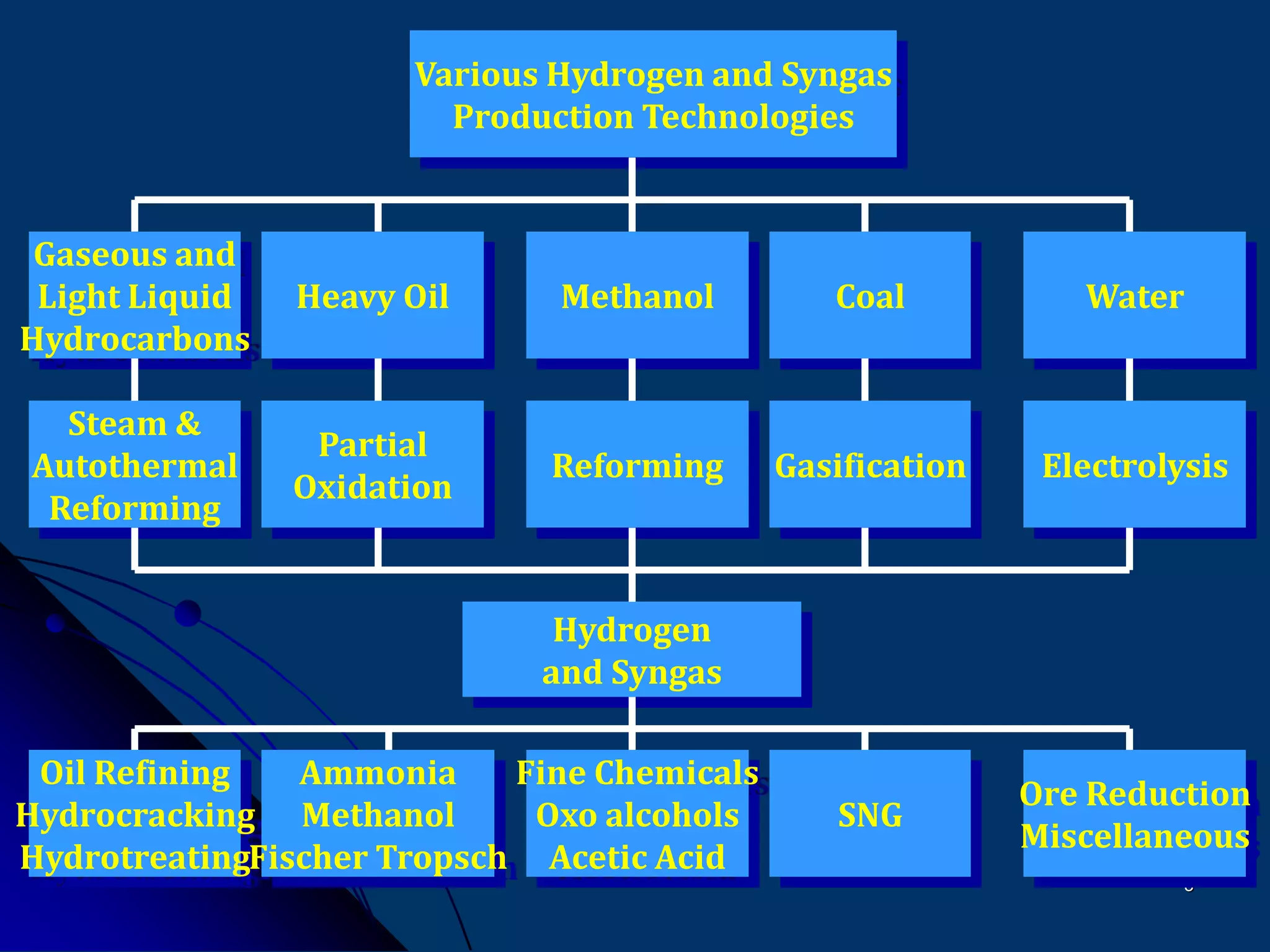
Various Hydrogen and Syngas
Production Technologies
Gaseous and
Light Liquid
Hydrocarbons
Heavy Oil Methanol Coal Water
Steam &
Autothermal
Reforming
Partial
Oxidation
Reforming Gasification Electrolysis
Hydrogen
and Syngas
Oil Refining
Hydrocracking
Hydrotreating
Ammonia
Methanol
Fischer Tropsch
Fine Chemicals
Oxo alcohols
Acetic Acid
SNG
Ore Reduction
Miscellaneous
4
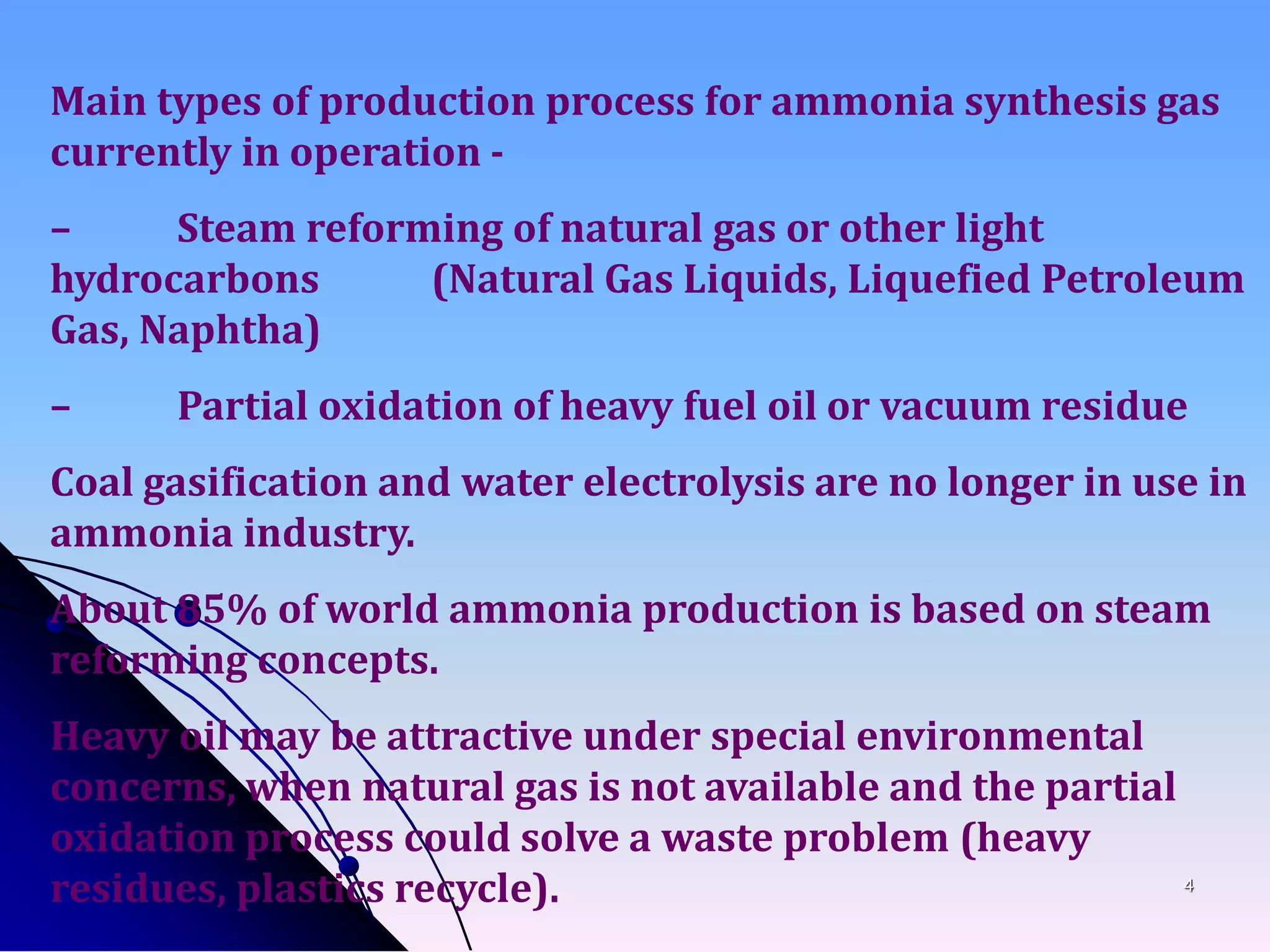
Main types of production process for ammonia synthesis gas
currently in operation -
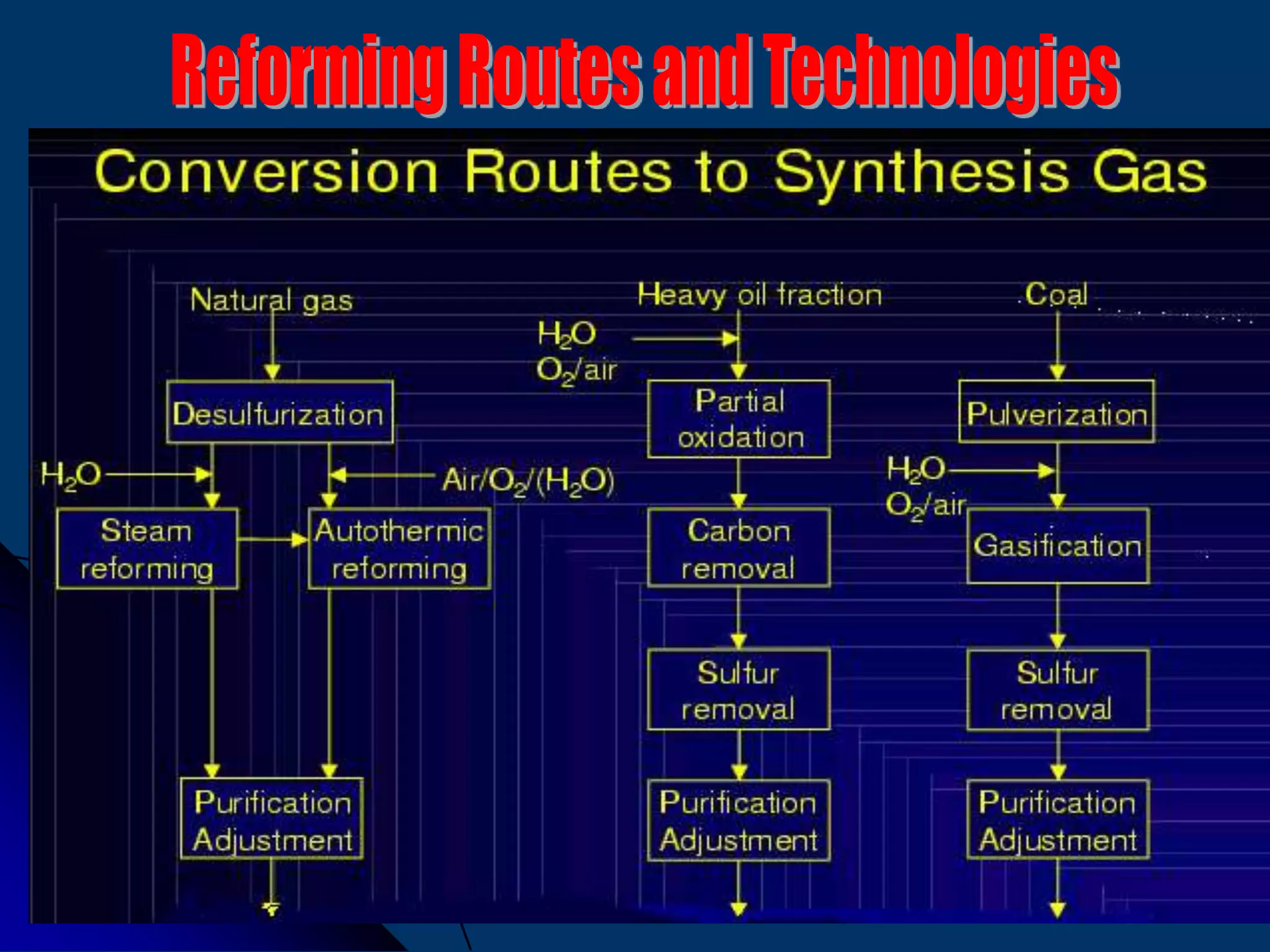
– Steam reforming of natural gas or other light
hydrocarbons (Natural Gas Liquids, Liquefied Petroleum
Gas, Naphtha)
– Partial oxidation of heavy fuel oil or vacuum residue
Coal gasification and water electrolysis are no longer in use in
ammonia industry.
About 85% of world ammonia production is based on steam
reforming concepts.
Heavy oil may be attractive under special environmental
concerns, when natural gas is not available and the partial
oxidation process could solve a waste problem (heavy
residues, plastics recycle).
5
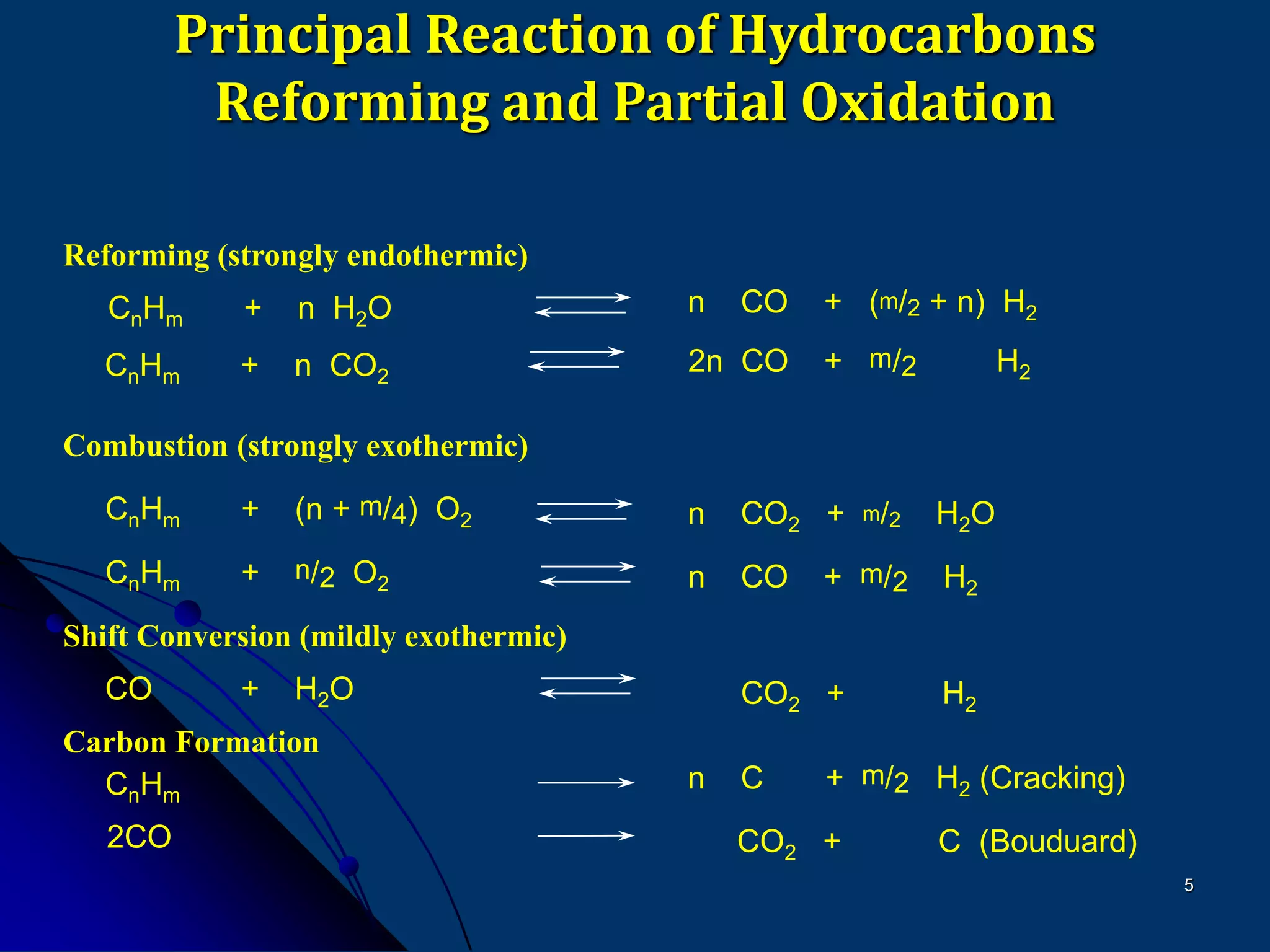
Principal Reaction of Hydrocarbons
Reforming and Partial Oxidation
Reforming (strongly endothermic)
CnHm + n H2O n CO + (m/2 + n) H2
CnHm + n CO2
2n CO + m/2 H2
Combustion (strongly exothermic)
CnHm + (n + m/4) O2 n CO2 + m/2 H2O
CnHm + n/2 O2 n CO + m/2 H2
Shift Conversion (mildly exothermic)
CO + H2O CO2 + H2
Carbon Formation
CnHm
n C + m/2 H2 (Cracking)
2CO CO2 + C (Bouduard)
6
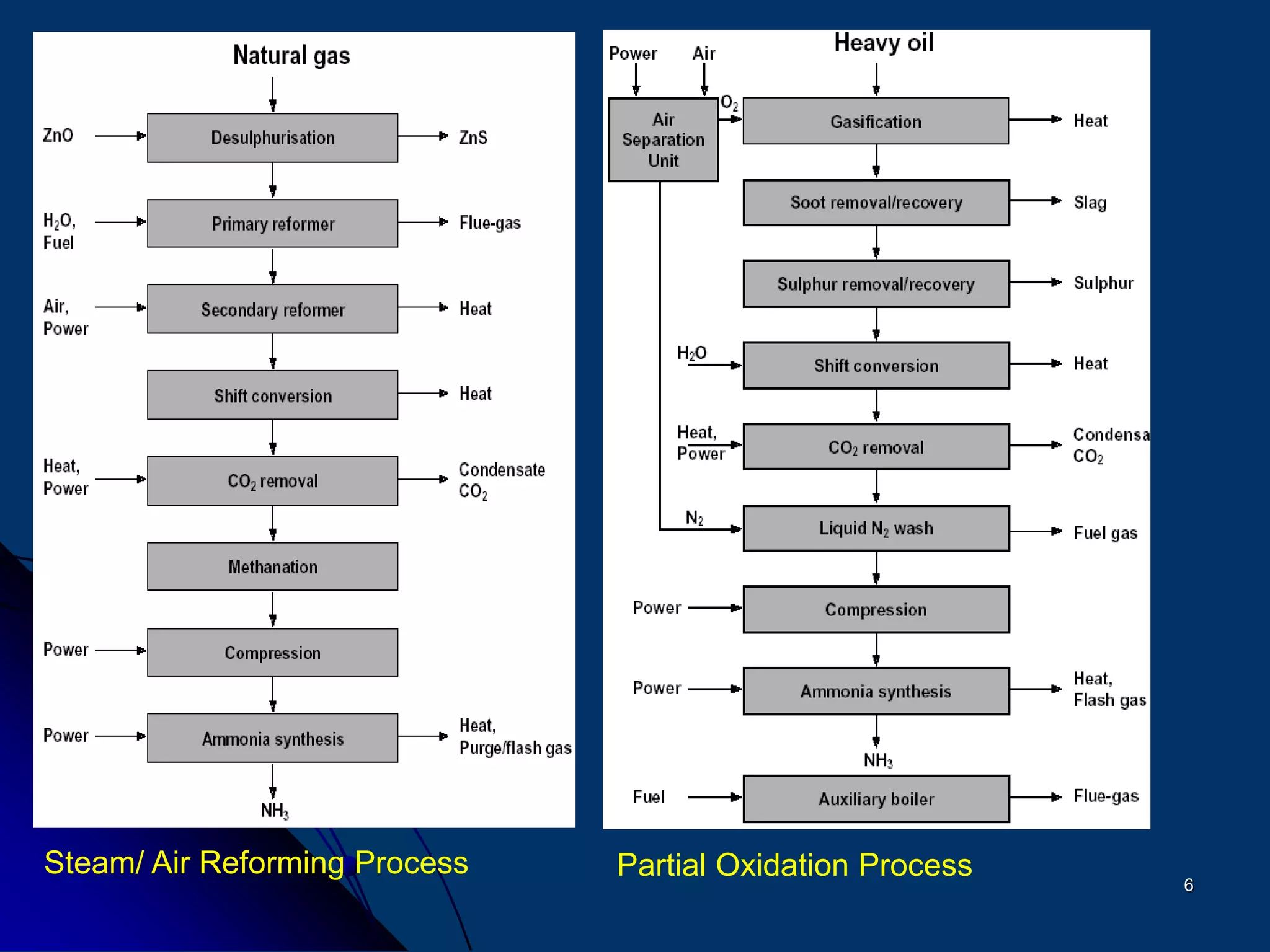
Steam/ Air Reforming Process Partial Oxidation Process
7
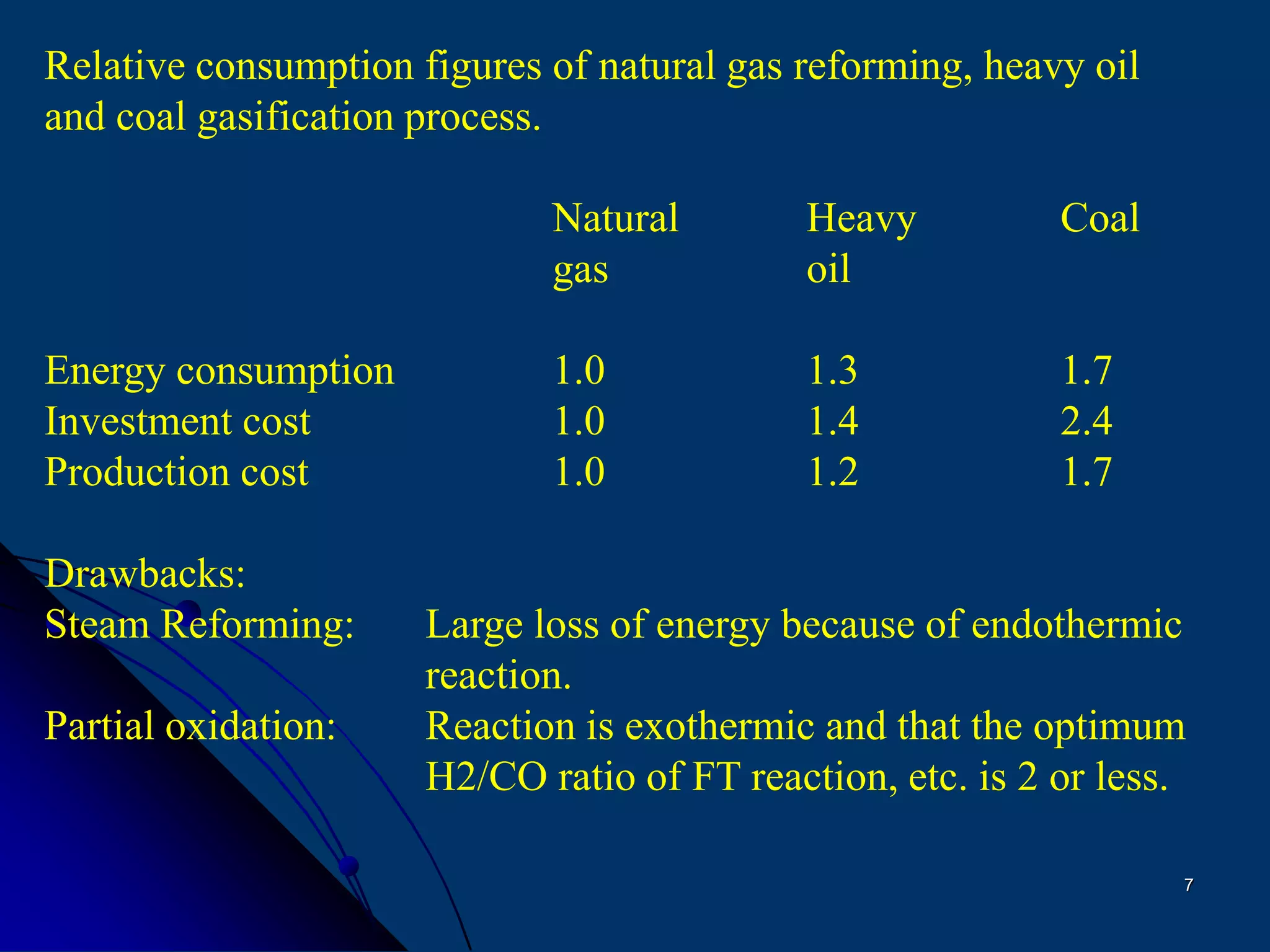
Relative consumption figures of natural gas reforming, heavy oil
and coal gasification process.
Natural Heavy Coal
gas oil
Energy consumption 1.0 1.3 1.7
Investment cost 1.0 1.4 2.4
Production cost 1.0 1.2 1.7
Drawbacks:
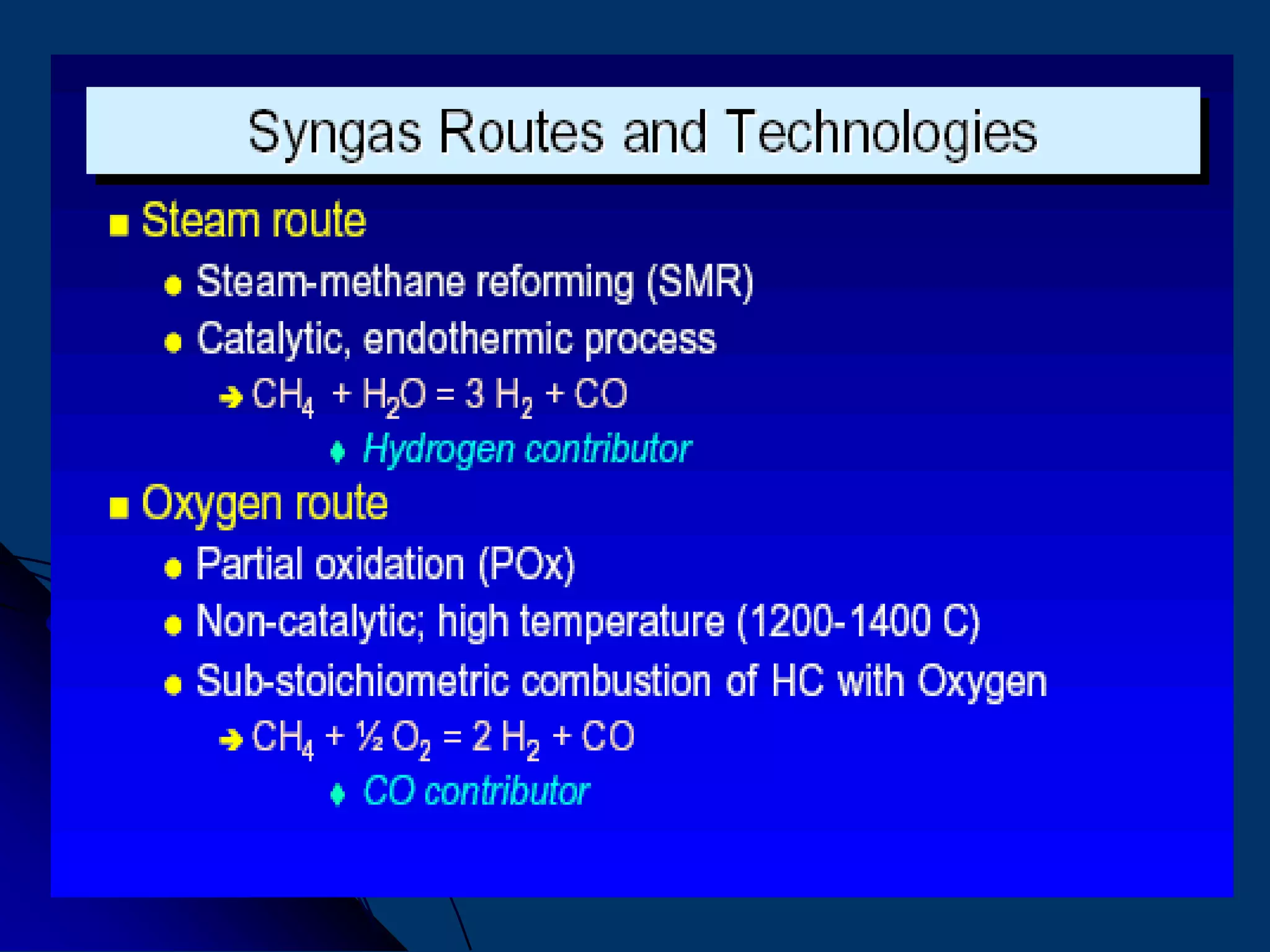
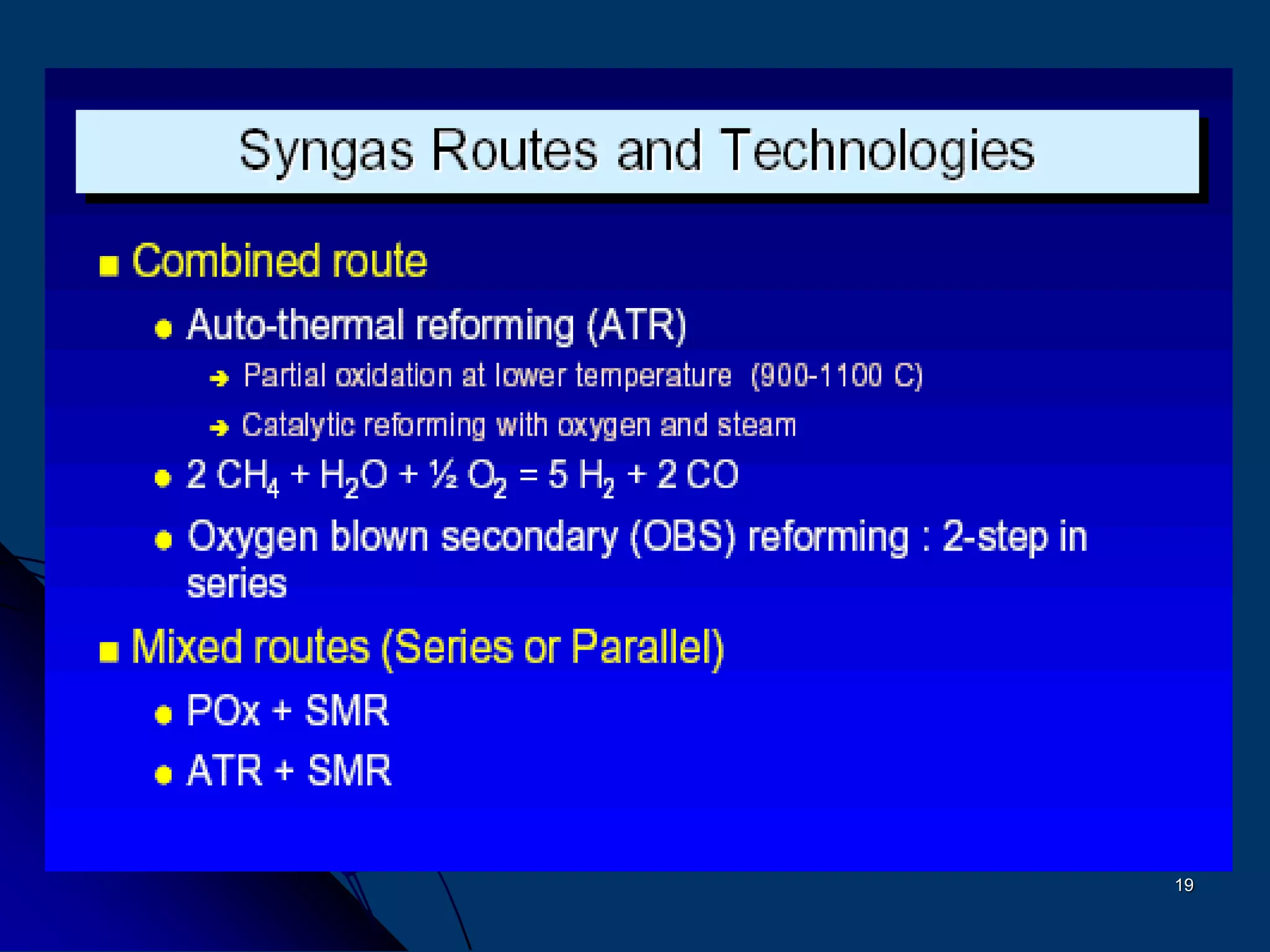
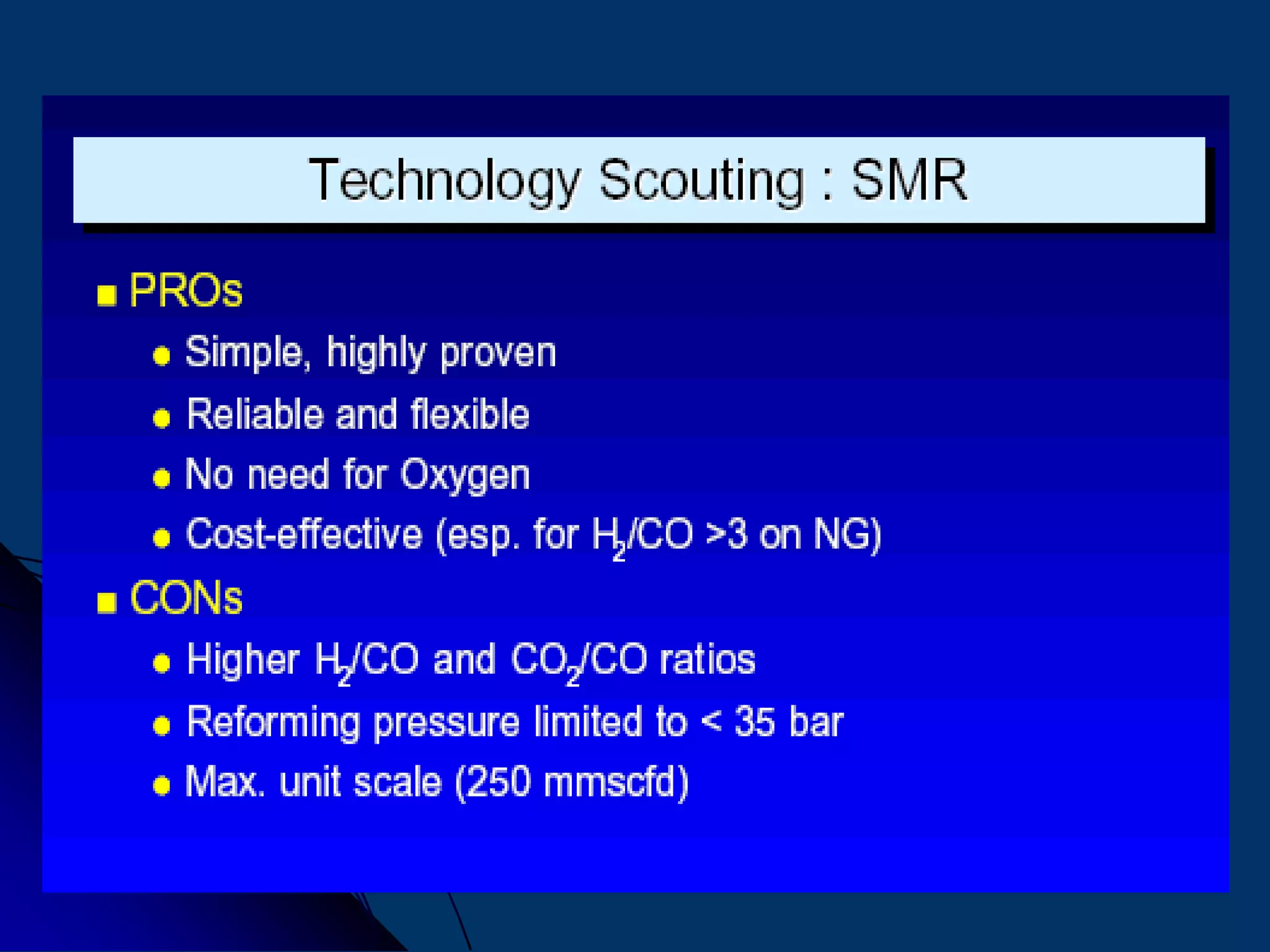
Steam Reforming: Large loss of energy because of endothermic
reaction.
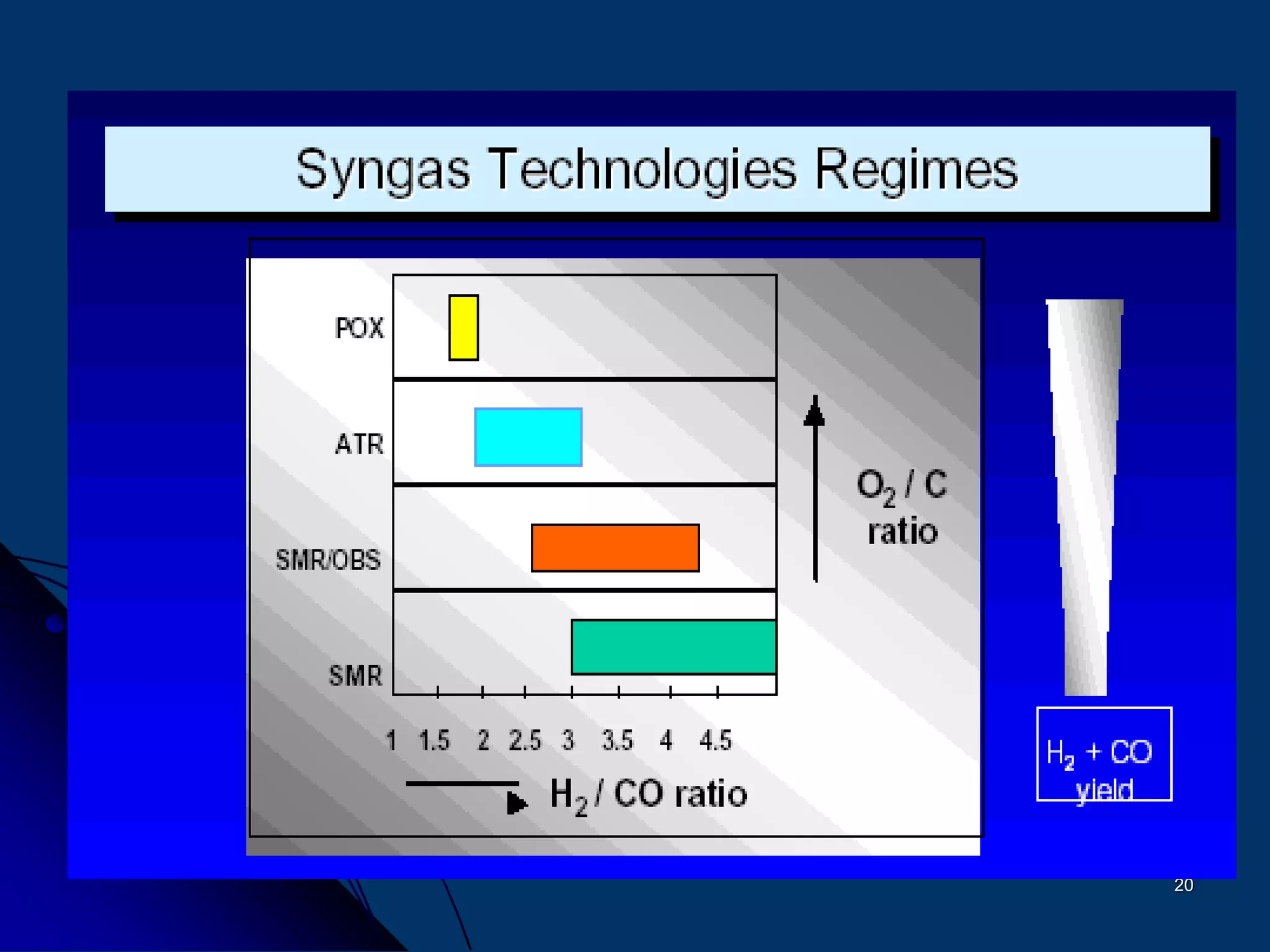
Partial oxidation: Reaction is exothermic and that the optimum
H2/CO ratio of FT reaction, etc. is 2 or less.
8
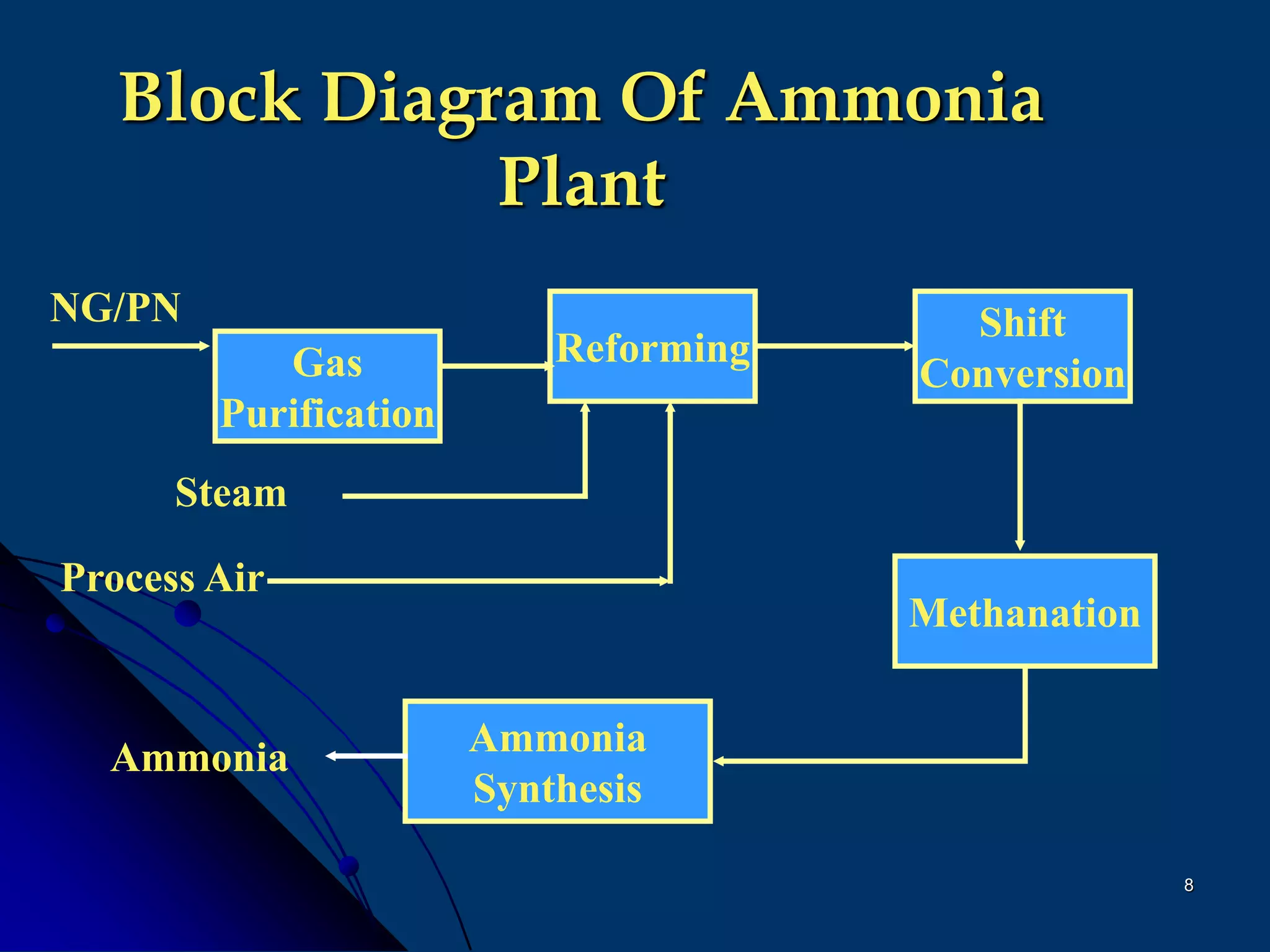
Block Diagram Of Ammonia
Plant
Gas
Purification
Reforming
Shift
Conversion
Methanation
Ammonia
Synthesis
Steam
Process Air
NG/PN
Ammonia
9
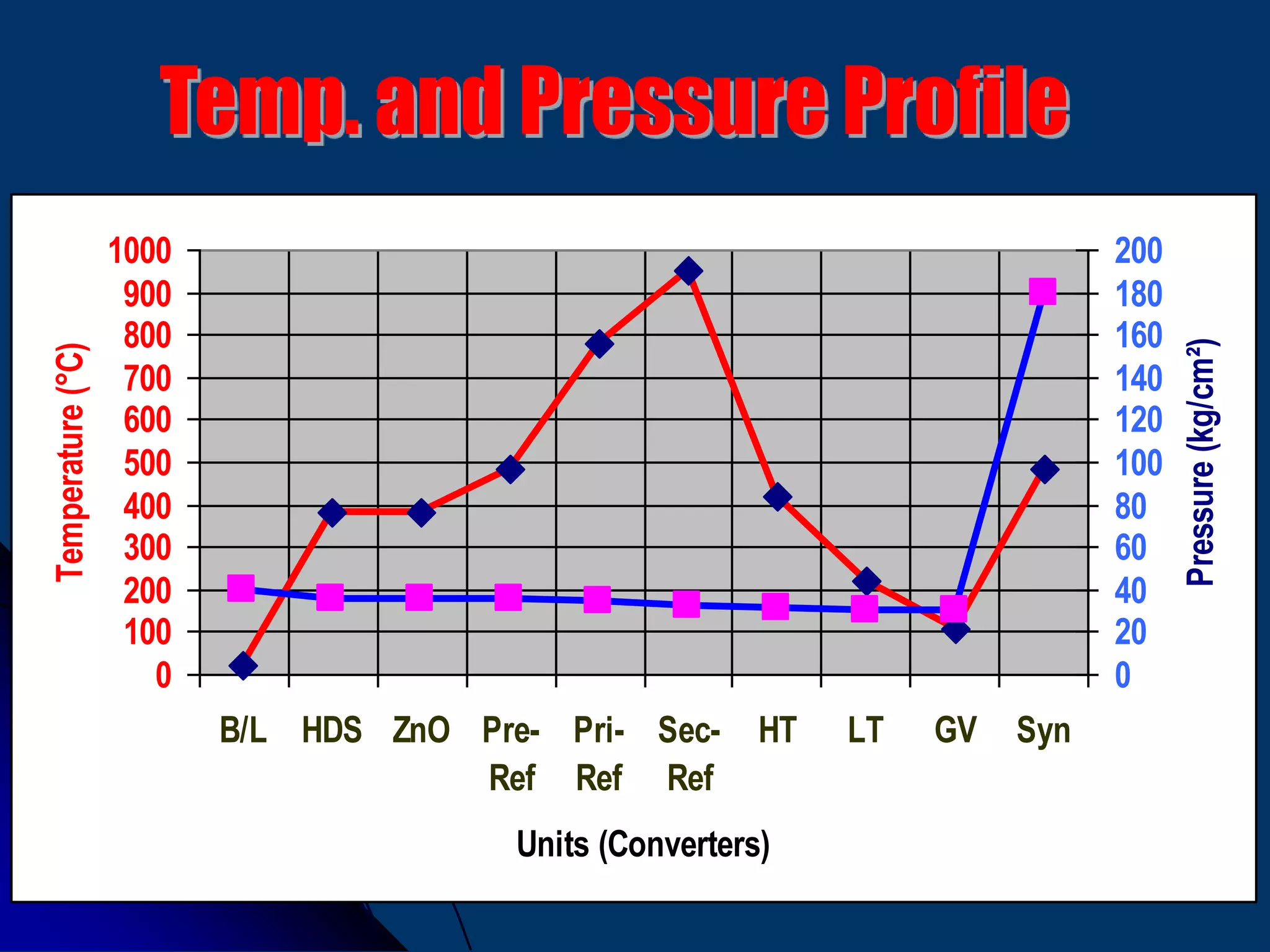
0
100
200
300
400
500
600
700
800
900
1000
B/L HDS ZnO Pre-
Ref
Pri-
Ref
Sec-
Ref
HT LT GV Syn
Units (Converters)
Temperature(°C)
0
20
40
60
80
100
120
140
160
180
200
Pressure(kg/cm²)
10
11
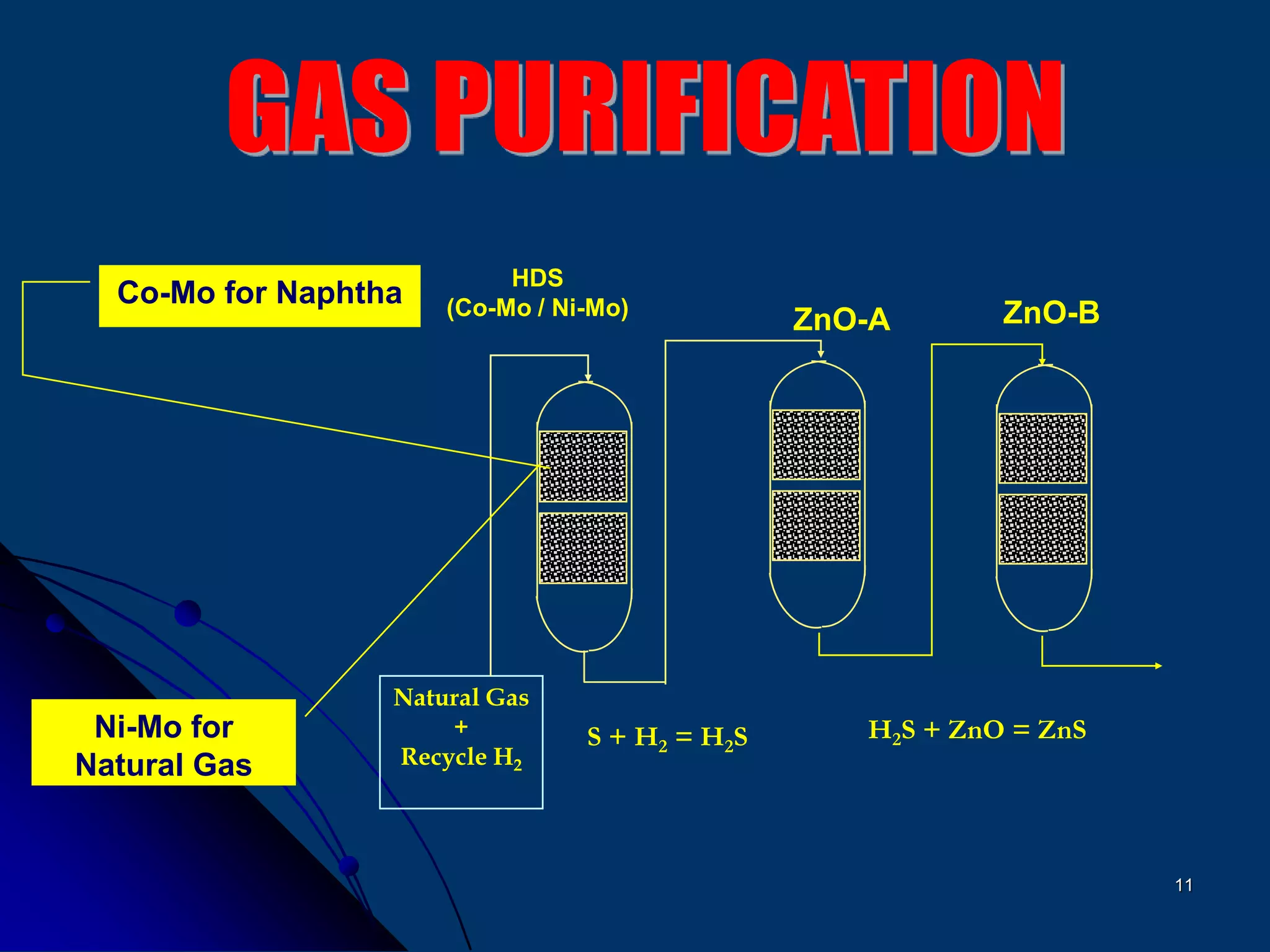
Natural Gas
+
Recycle H2
HDS
(Co-Mo / Ni-Mo)
ZnO-A ZnO-B
S + H2 = H2S H2S + ZnO = ZnS
Co-Mo for Naphtha
Ni-Mo for
Natural Gas
12
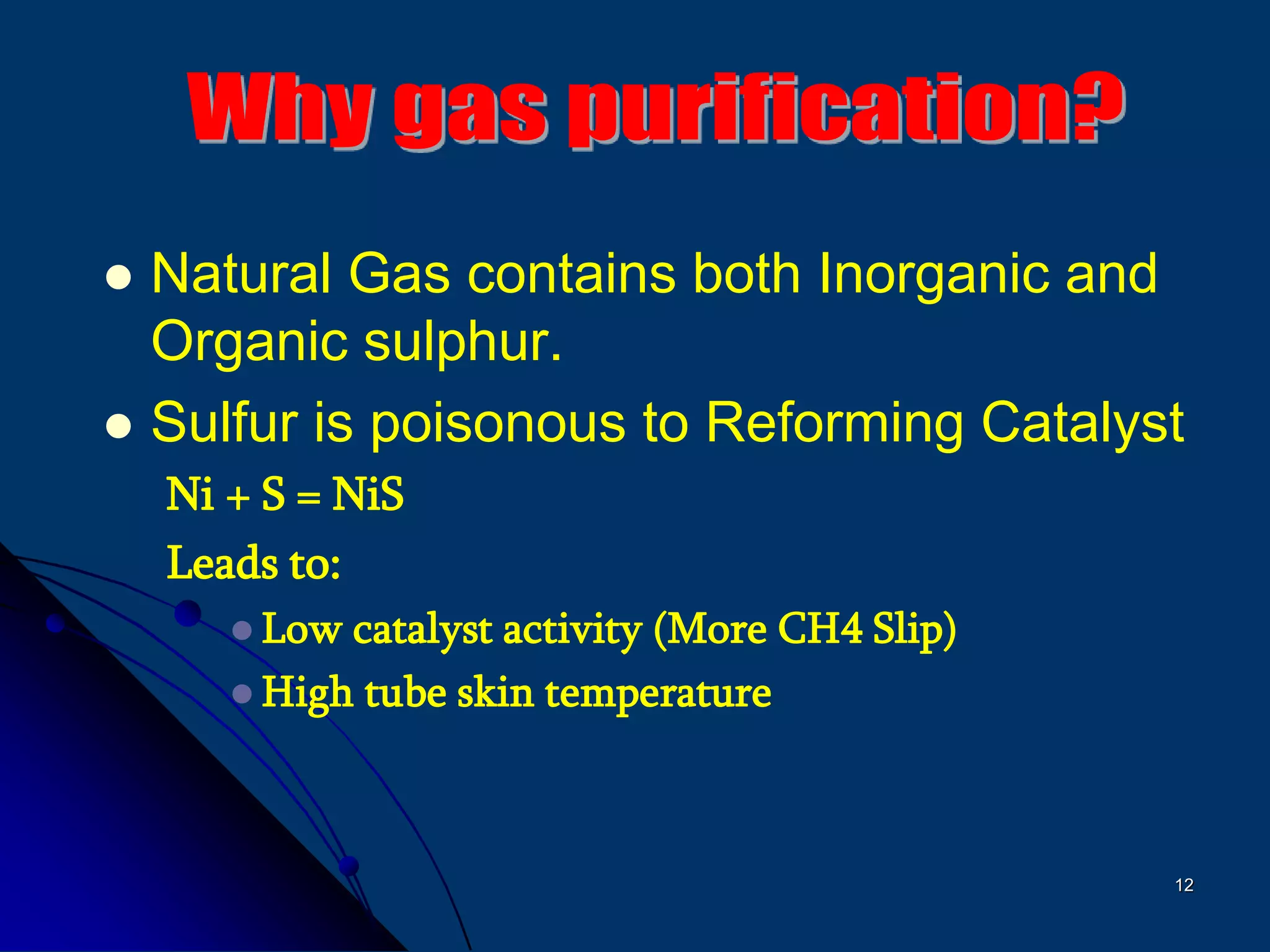
 Natural Gas contains both Inorganic and
Organic sulphur.
 Sulfur is poisonous to Reforming Catalyst
Ni + S = NiS
Leads to:
 Low catalyst activity (More CH4 Slip)
 High tube skin temperature
13
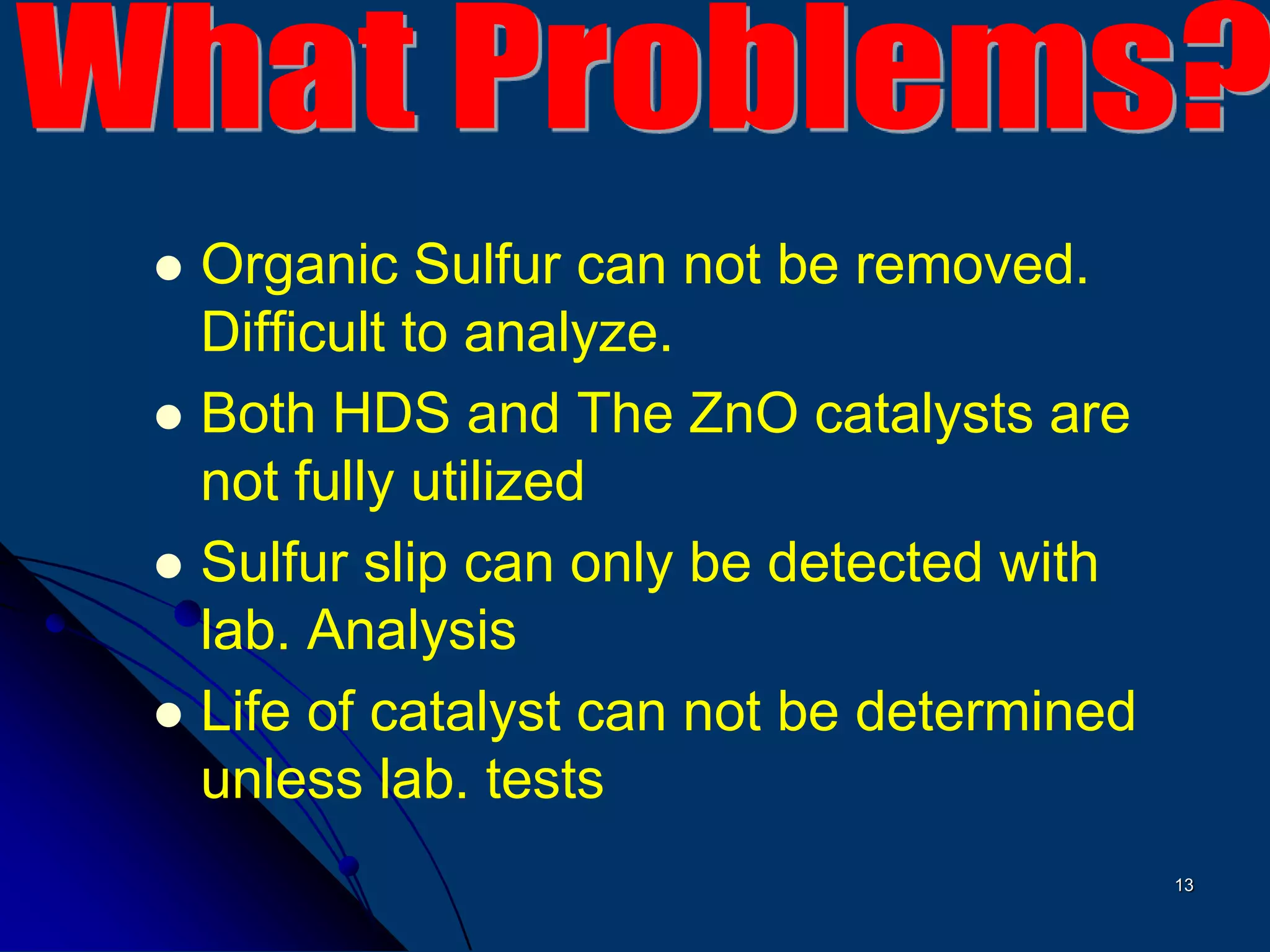
 Organic Sulfur can not be removed.
Difficult to analyze.
 Both HDS and The ZnO catalysts are
not fully utilized
 Sulfur slip can only be detected with
lab. Analysis
 Life of catalyst can not be determined
unless lab. tests
14
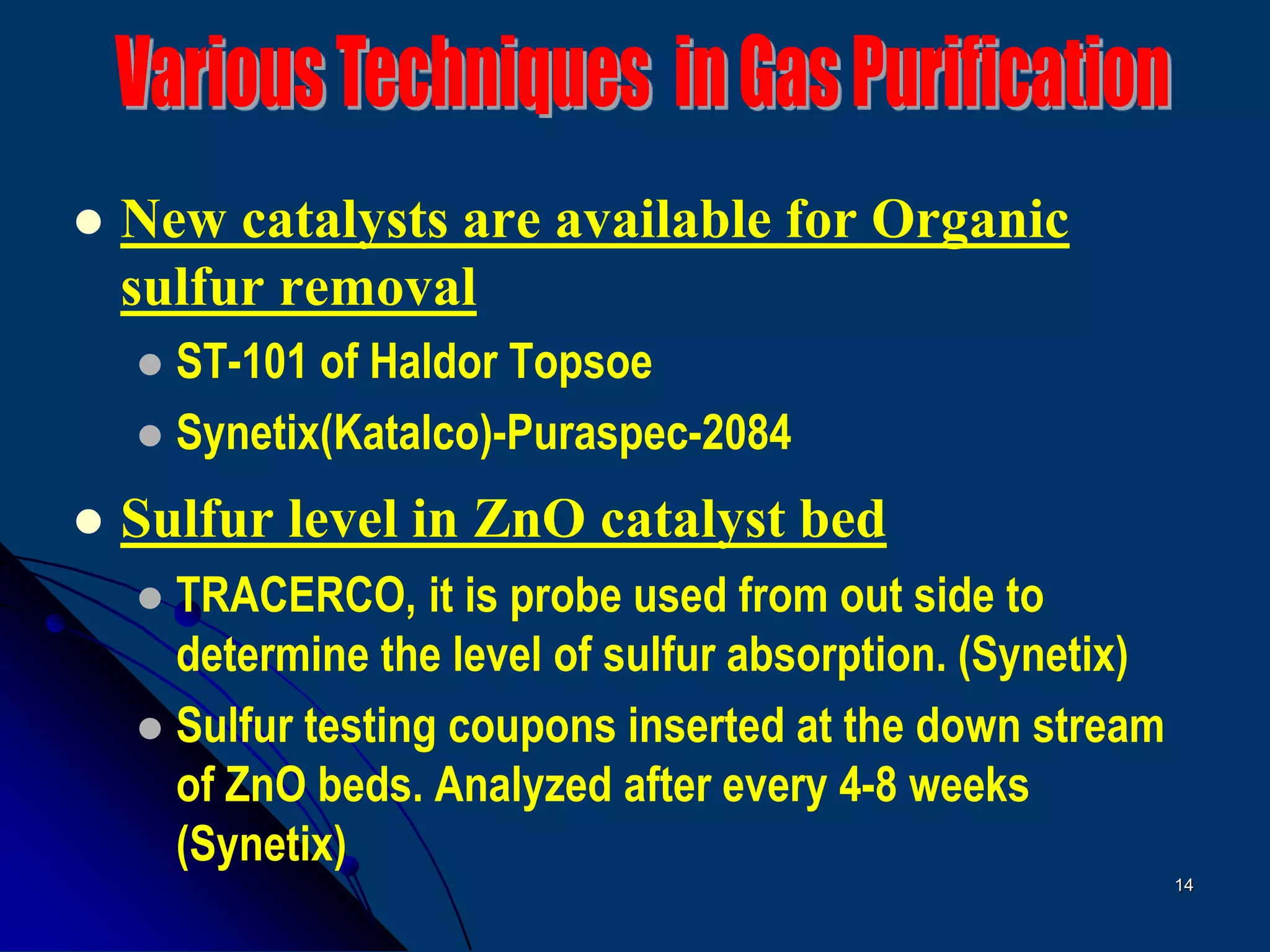
 New catalysts are available for Organic
sulfur removal
 ST-101 of Haldor Topsoe
 Synetix(Katalco)-Puraspec-2084
 Sulfur level in ZnO catalyst bed
 TRACERCO, it is probe used from out side to
determine the level of sulfur absorption. (Synetix)
 Sulfur testing coupons inserted at the down stream
of ZnO beds. Analyzed after every 4-8 weeks
(Synetix)
15
16
17
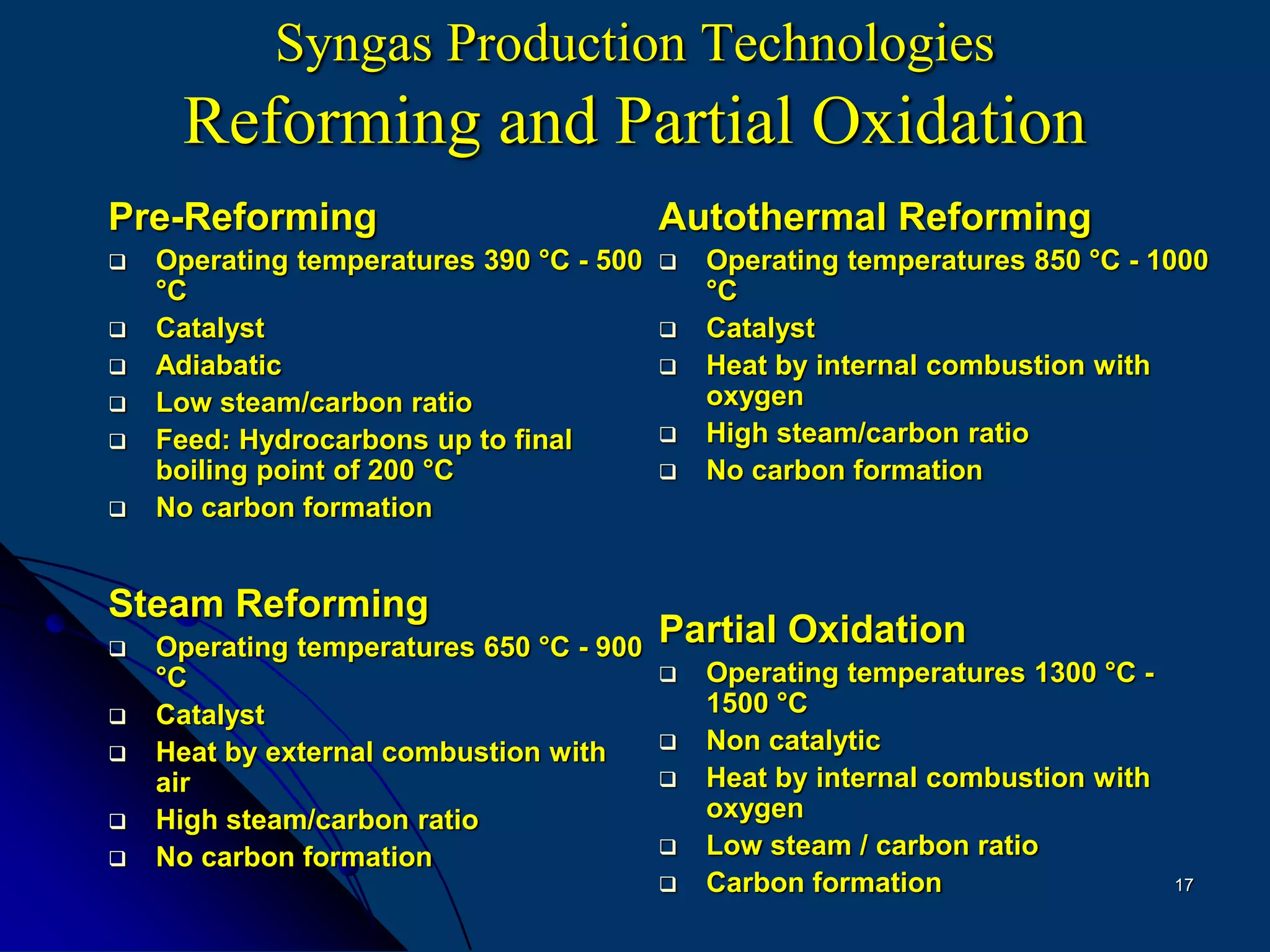
Syngas Production Technologies
Reforming and Partial Oxidation
Pre-Reforming
 Operating temperatures 390 °C - 500
°C
 Catalyst
 Adiabatic
 Low steam/carbon ratio
 Feed: Hydrocarbons up to final
boiling point of 200 °C
 No carbon formation
Steam Reforming
 Operating temperatures 650 °C - 900
°C
 Catalyst
 Heat by external combustion with
air
 High steam/carbon ratio
 No carbon formation
Autothermal Reforming
 Operating temperatures 850 °C - 1000
°C
 Catalyst
 Heat by internal combustion with
oxygen
 High steam/carbon ratio
 No carbon formation
Partial Oxidation
 Operating temperatures 1300 °C -
1500 °C
 Non catalytic
 Heat by internal combustion with
oxygen
 Low steam / carbon ratio
 Carbon formation
18
19
20
21
22
23
24
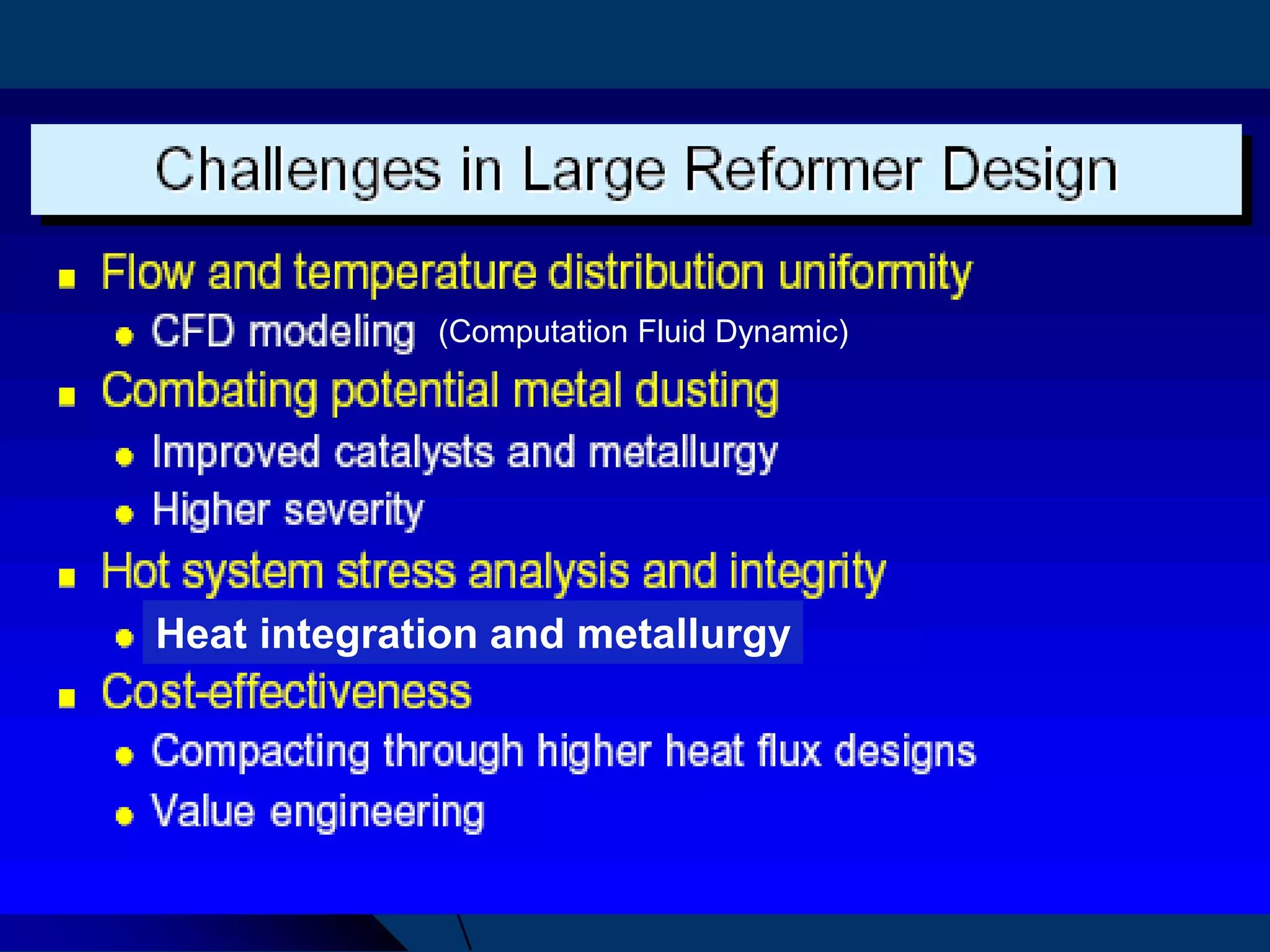
(Computation Fluid Dynamic)
Heat integration and metallurgy
25
 To reduce High Capital Cost
 To reduce High Stack Losses and Pollution
 To reduce High surface heat loss
 To reduce Large Structure
 To reduce Pressure drop
 To reduce Costly catalyst tubes
 To reduce startup time
26
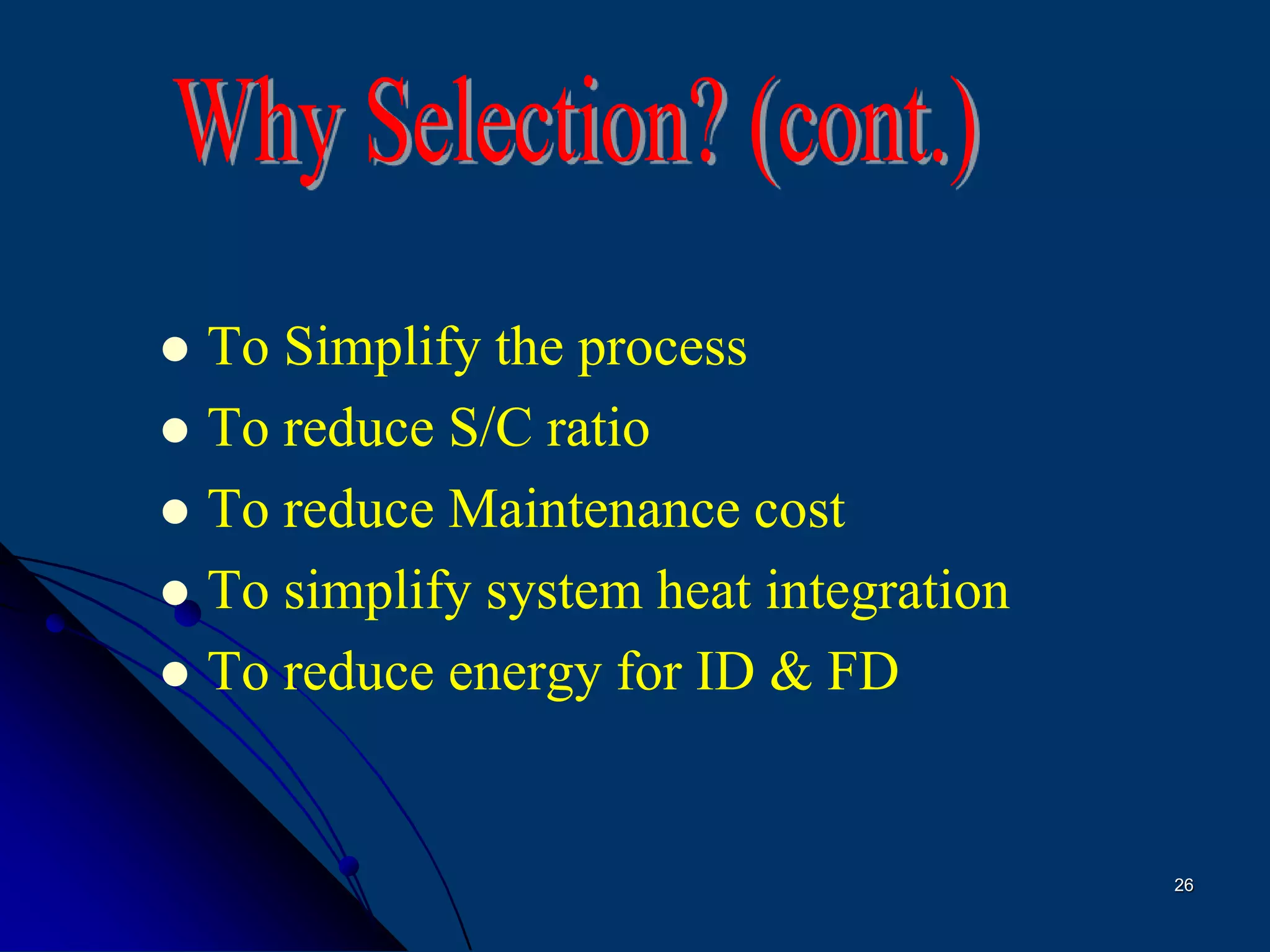
 To Simplify the process
 To reduce S/C ratio
 To reduce Maintenance cost
 To simplify system heat integration
 To reduce energy for ID & FD
27
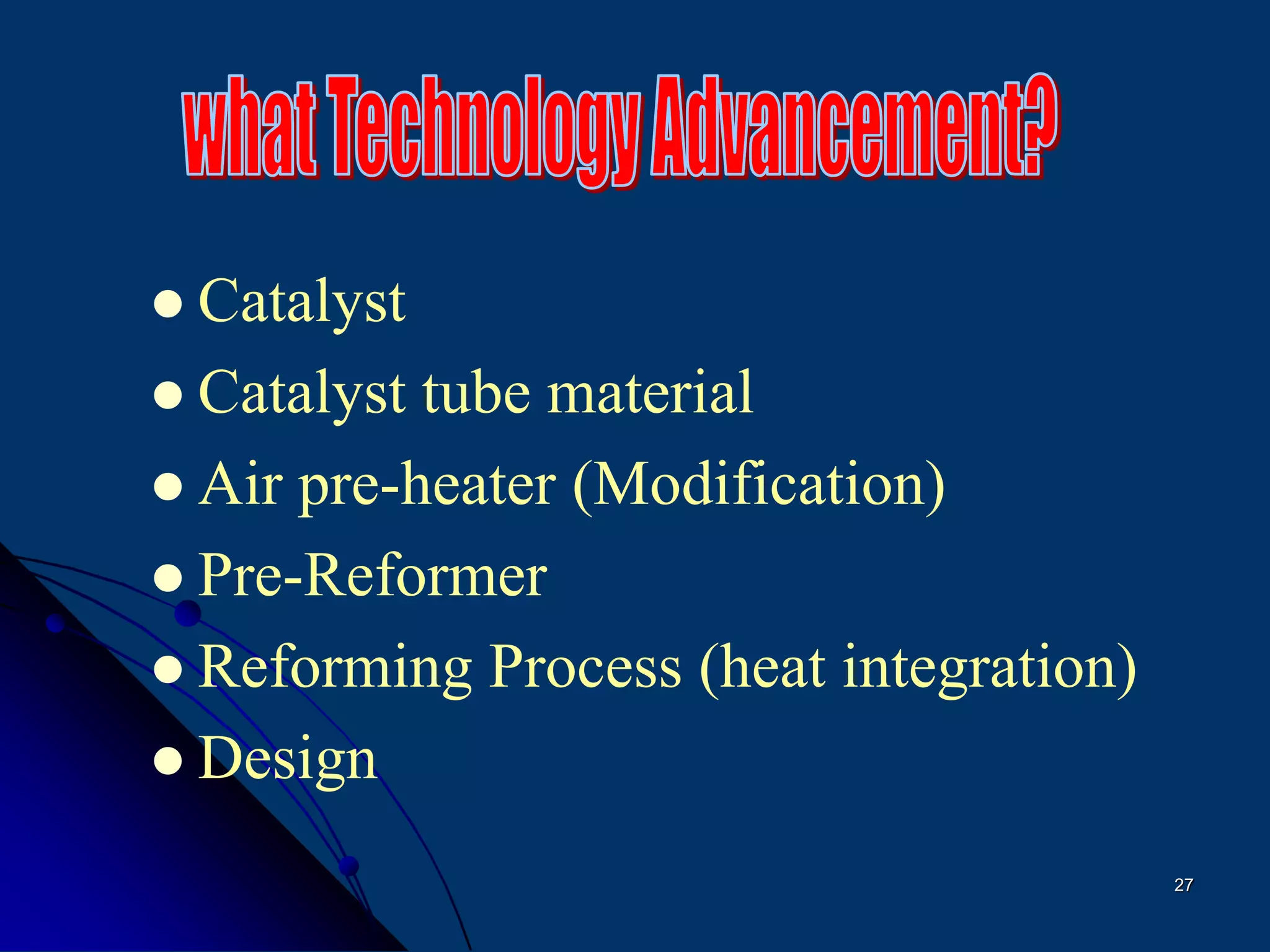
 Catalyst
 Catalyst tube material
 Air pre-heater (Modification)
 Pre-Reformer
 Reforming Process (heat integration)
 Design
28
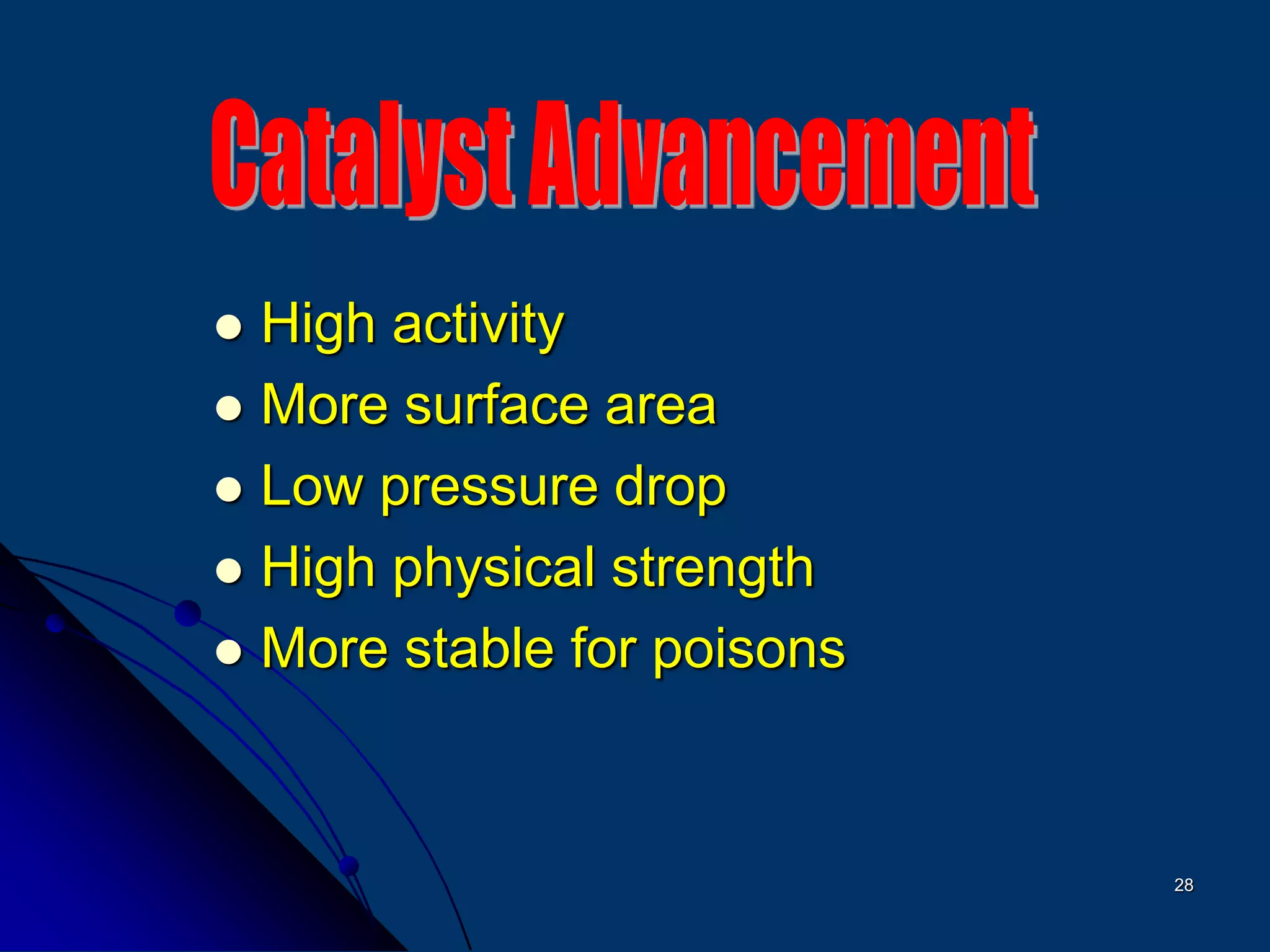
 High activity
 More surface area
 Low pressure drop
 High physical strength
 More stable for poisons
29
 Reforming Catalysts
RING WAGON WHEEL
5-HOLE
DD-RING
Monolithic10-HOLE
Latest by
Synetix
30
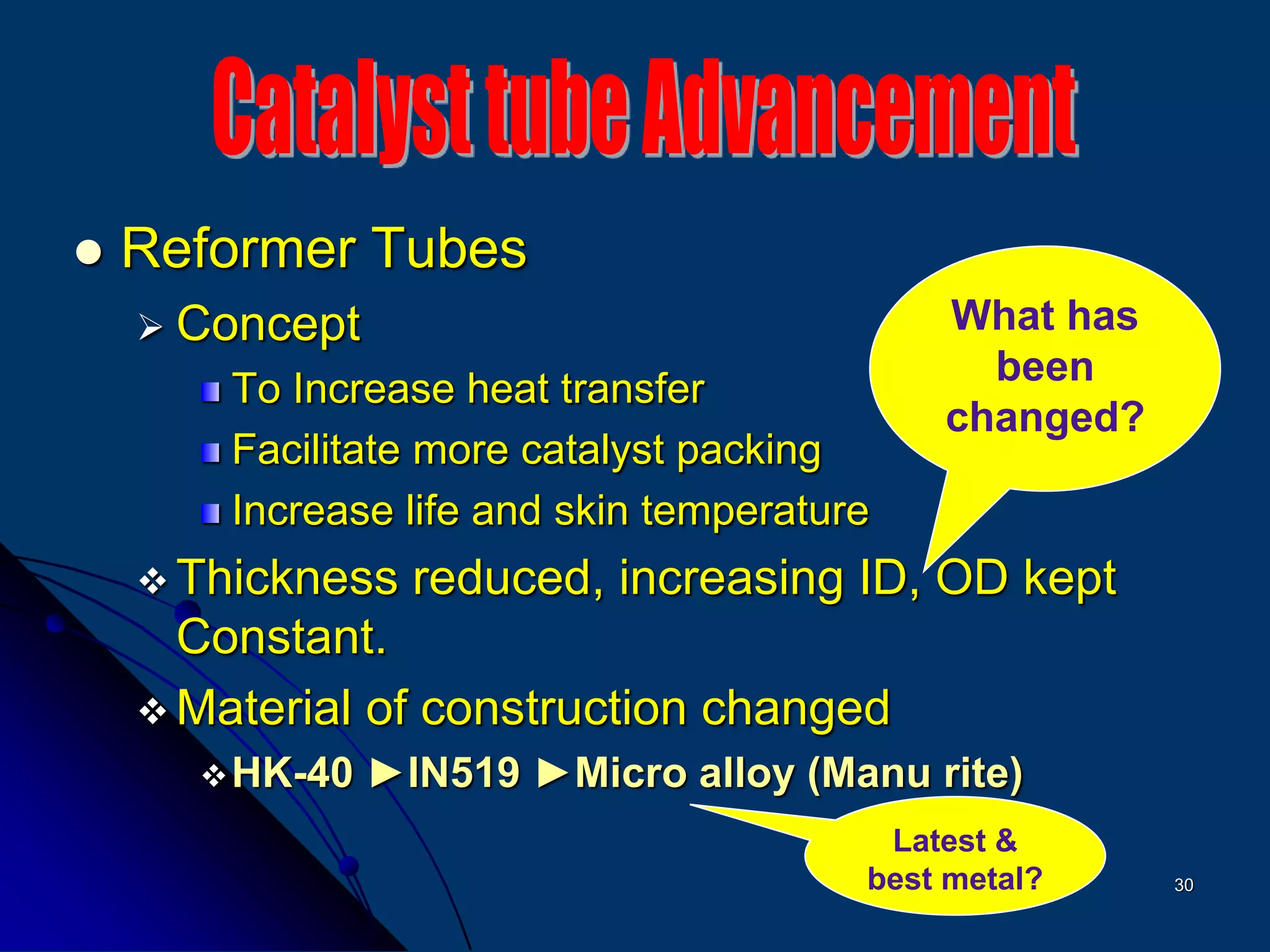
 Reformer Tubes
 Concept
To Increase heat transfer
Facilitate more catalyst packing
Increase life and skin temperature
 Thickness reduced, increasing ID, OD kept
Constant.
 Material of construction changed
HK-40 ►IN519 ►Micro alloy (Manu rite)
What has
been
changed?
Latest &
best metal?
31
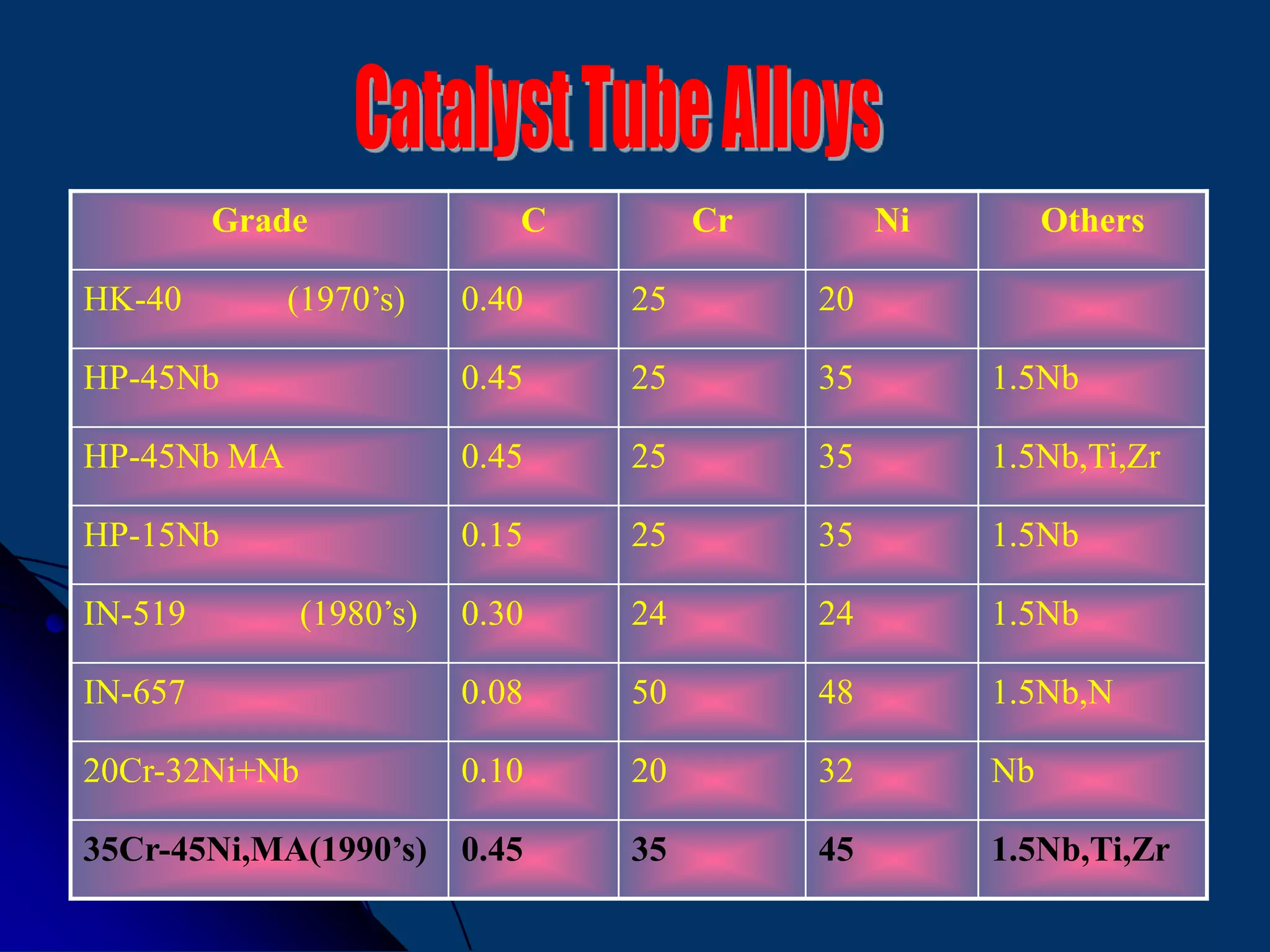
Grade C Cr Ni Others
HK-40 (1970’s) 0.40 25 20
HP-45Nb 0.45 25 35 1.5Nb
HP-45Nb MA 0.45 25 35 1.5Nb,Ti,Zr
HP-15Nb 0.15 25 35 1.5Nb
IN-519 (1980’s) 0.30 24 24 1.5Nb
IN-657 0.08 50 48 1.5Nb,N
20Cr-32Ni+Nb 0.10 20 32 Nb
35Cr-45Ni,MA(1990’s) 0.45 35 45 1.5Nb,Ti,Zr
32
 Basic reason is to reduce heat loss
through Primary Reformer stack
 To save Fuel and proper combustion.
 ID fan load is reduced.
33
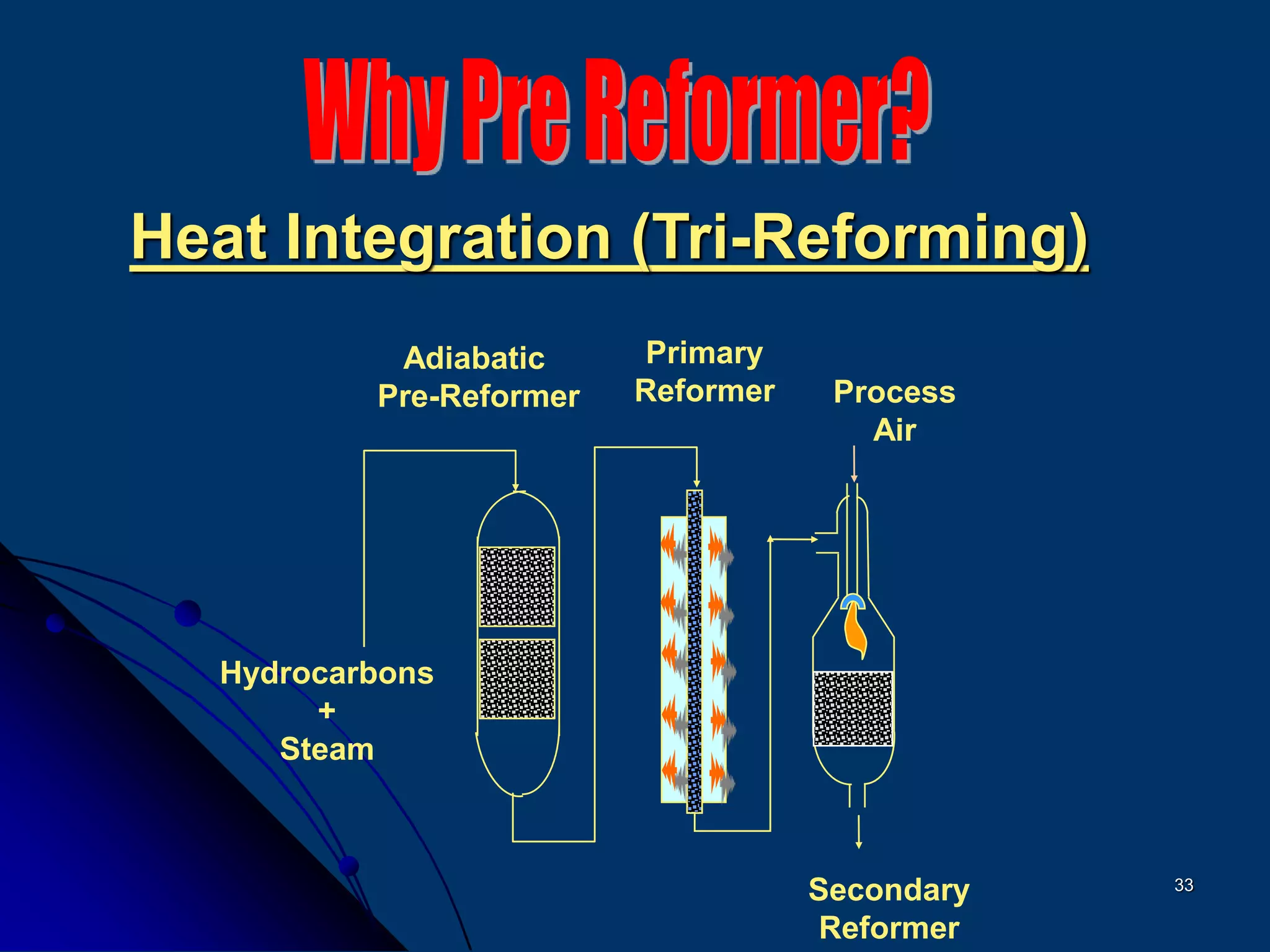
Process
Air
Hydrocarbons
+
Steam
Adiabatic
Pre-Reformer
Primary
Reformer
Secondary
Reformer
Heat Integration (Tri-Reforming)
34
Feed Stock flexibility (Higher hydrocarbons)
Reduced Load on Primary Reformer
Improvement of Primary Reformer catalyst
life
Lower tube skin temperature
As guard for Primary Reformer Catalyst
Easy replacement of catalyst (without
complete plant shut down)
35
Feed 5.4 to 5.6 Gcal/MT NH3
Fuel 1.7 to 2.5 Gcal/MT NH3
Power 0.05 to 0.09 Gcal/MT NH3
Steam + or - Gcal/MT NH3
Total 7.15 to 8.2 Gcal/MT NH3
Steam energy depends on the internal generation & consumption
36
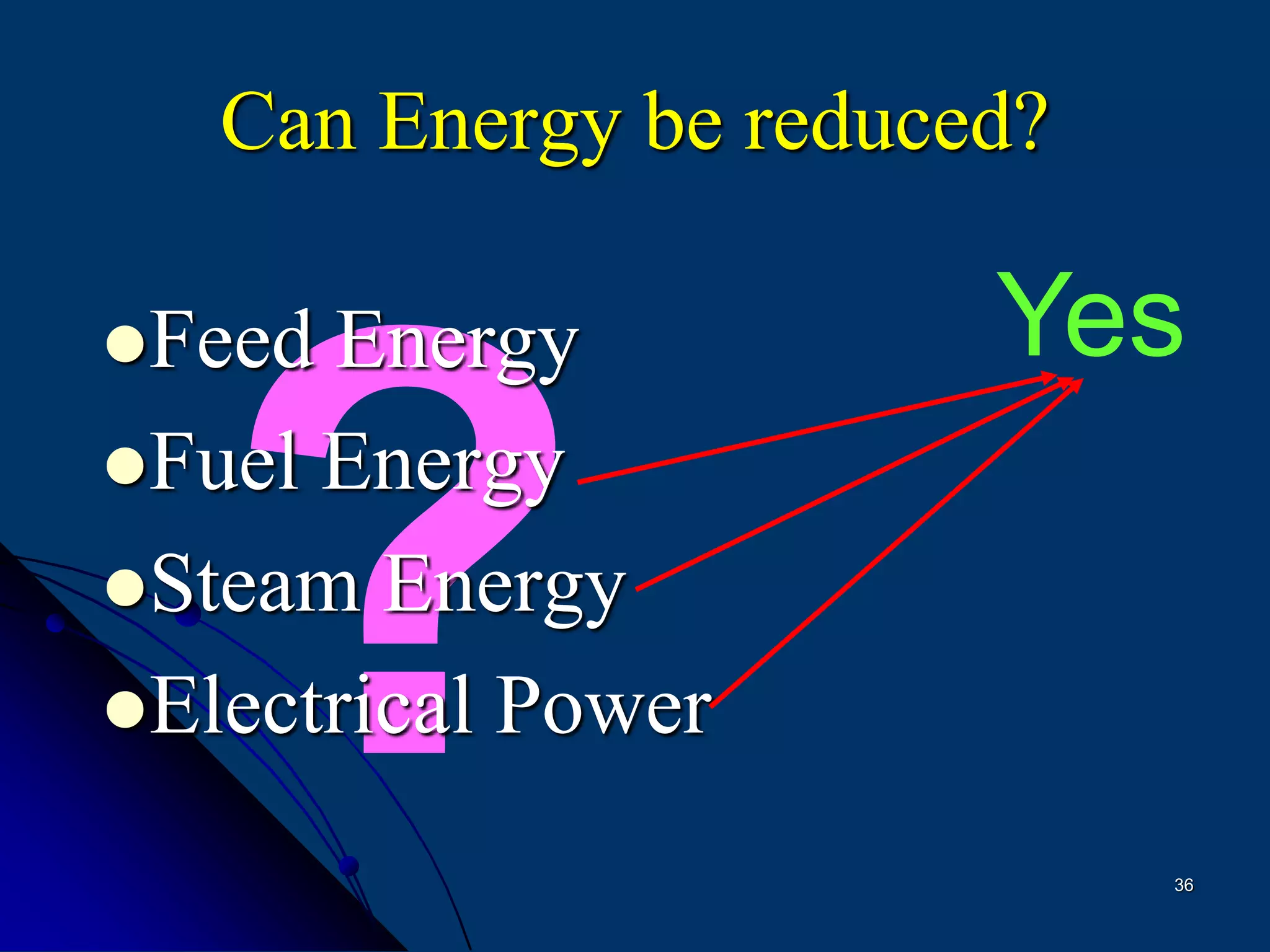
Can Energy be reduced?
Feed Energy
Fuel Energy
Steam Energy
Electrical Power
Yes
37
 Steam-Methane-Reforming (SMR)
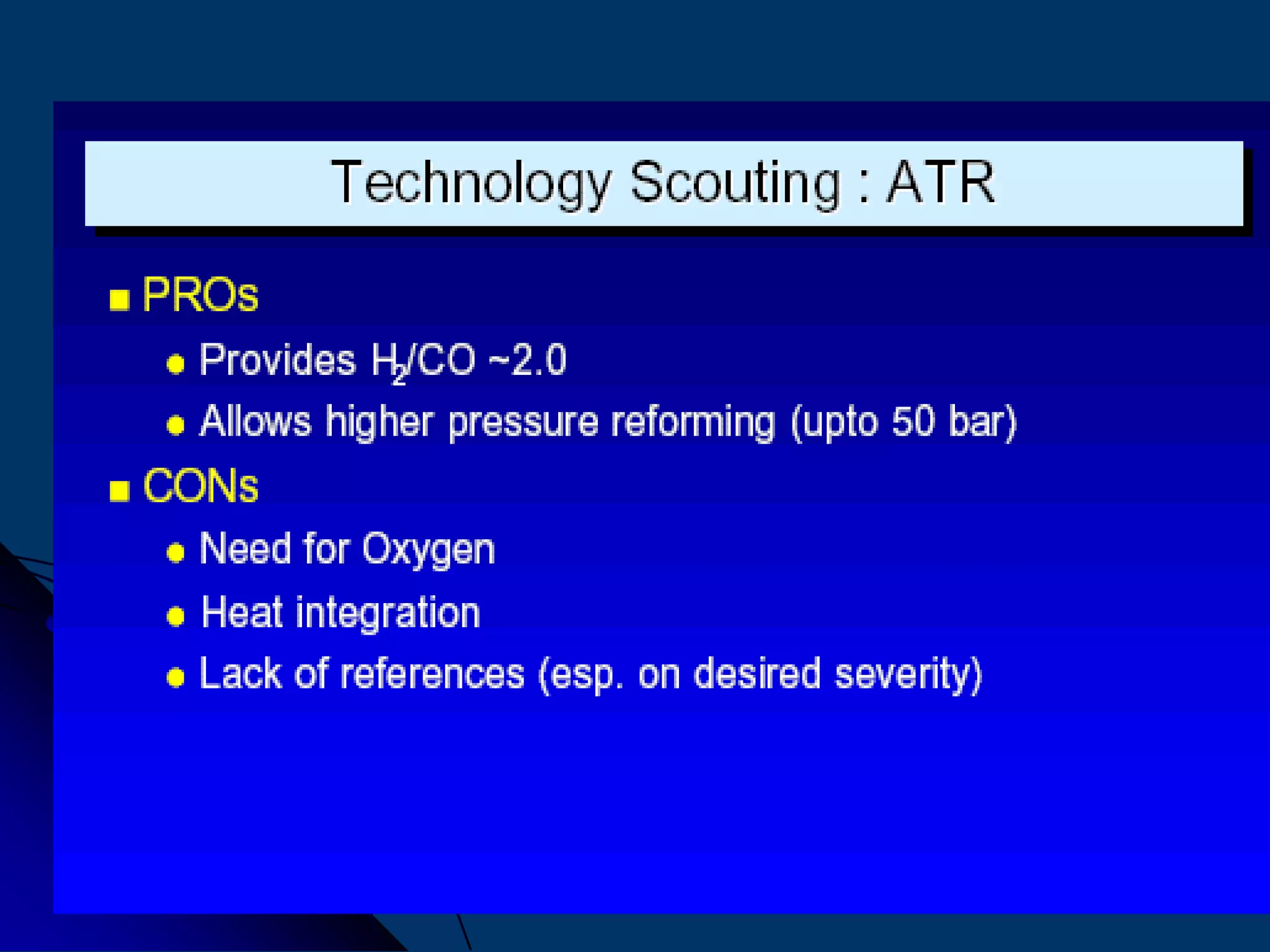
 Auto thermal Reforming (ATR)
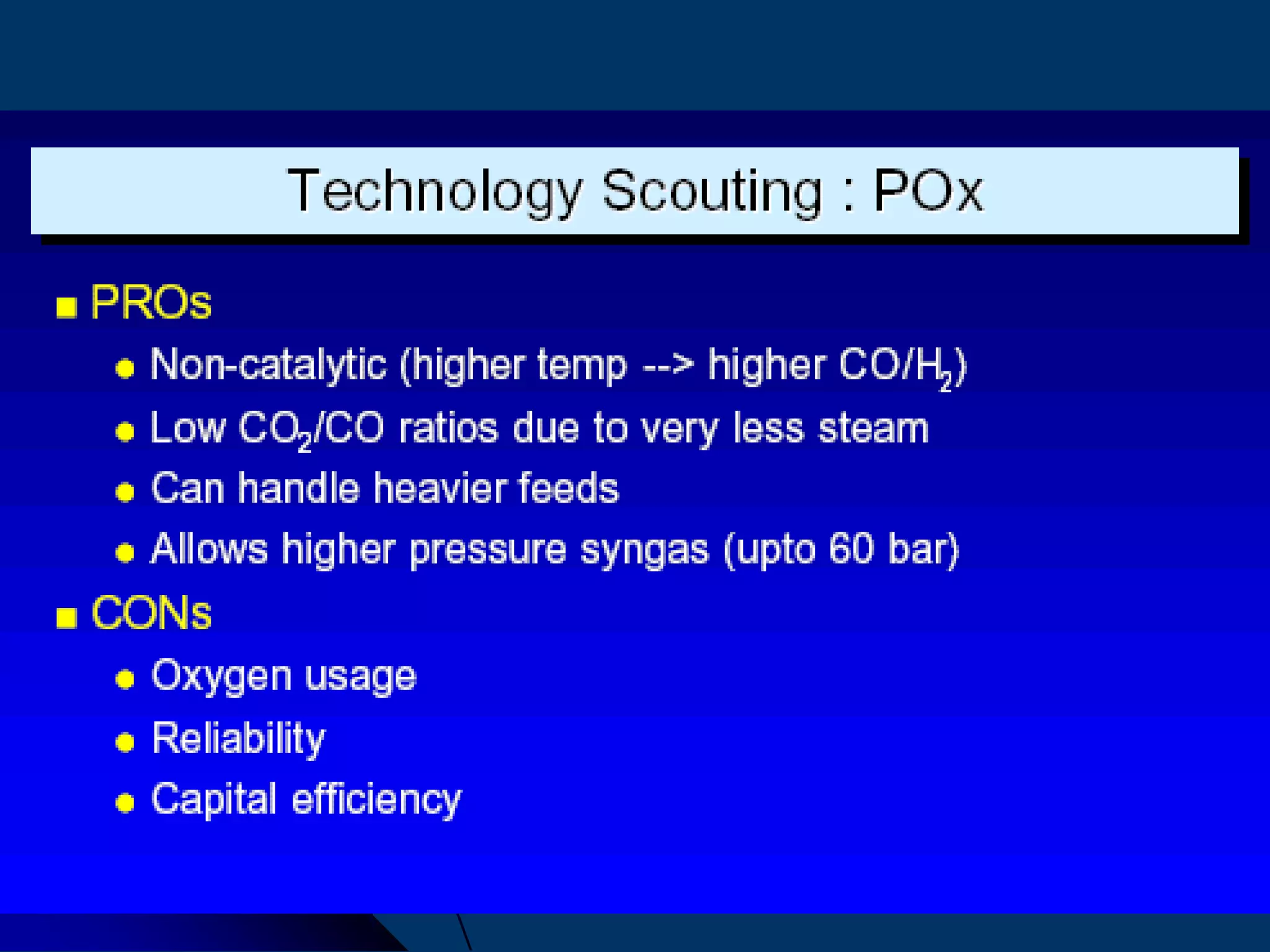
 Non-Catalytic Partial Oxidation
(NCPOX)
 Catalytic Partial Oxidation (CPOX)
 Combined Reforming (CR)
38
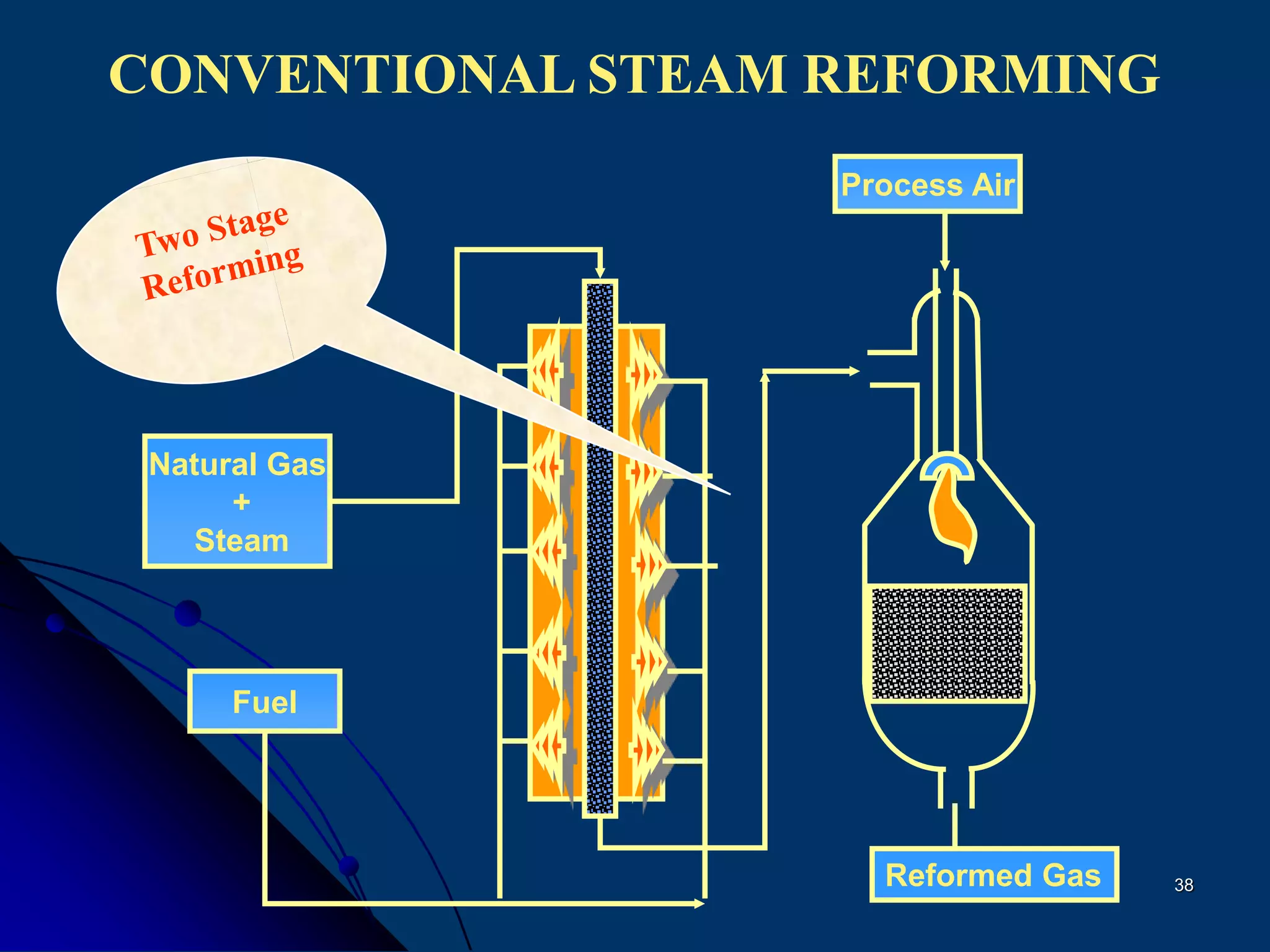
CONVENTIONAL STEAM REFORMING
Process Air
Natural Gas
+
Steam
Reformed Gas
Fuel
39
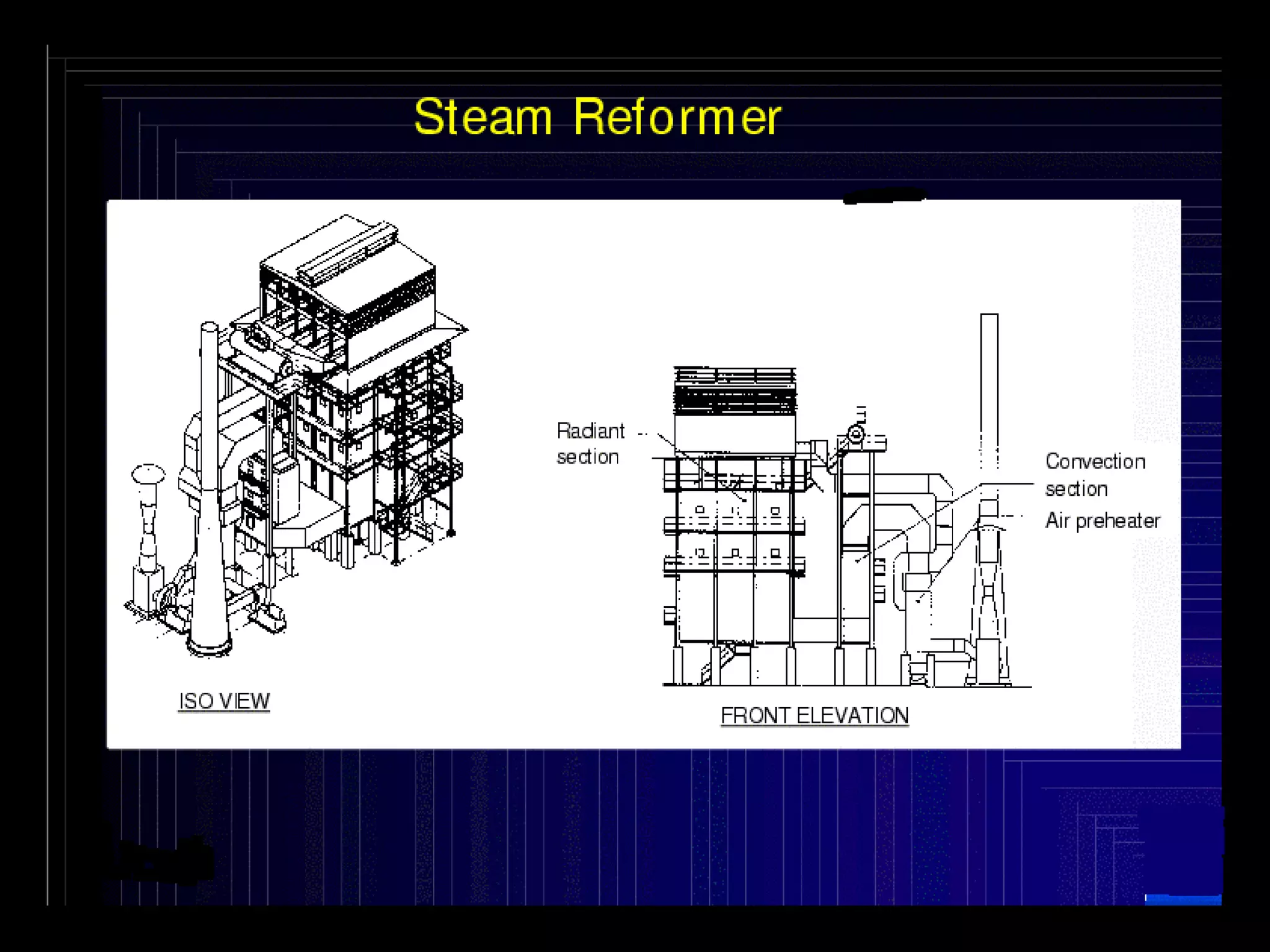
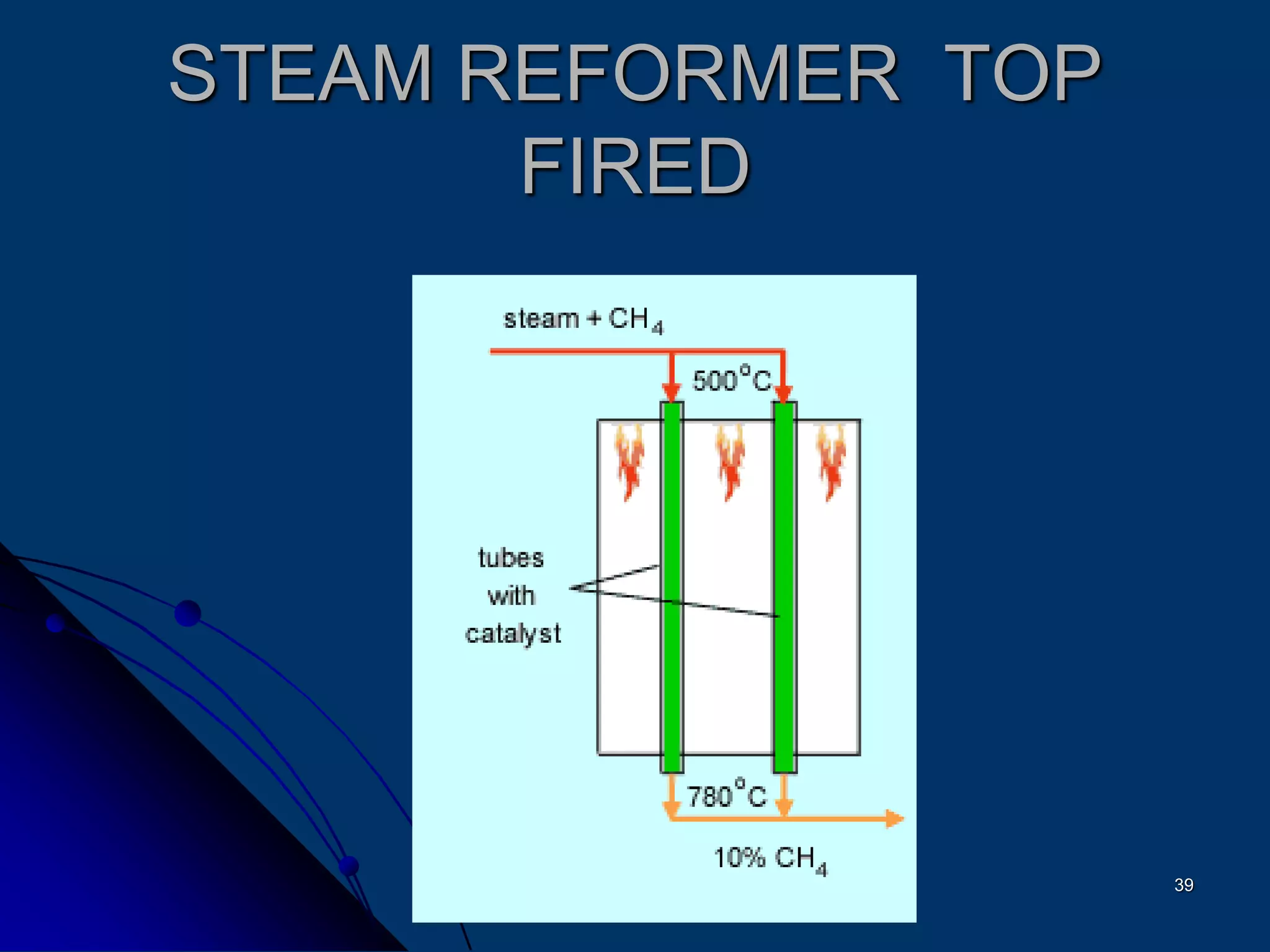
STEAM REFORMER TOP
FIRED
40
41
Steam-Methane Reforming
 Advancements
 Reduction in numbers of catalyst tubes
 Primary Reformer size reduction
 Elimination of FD fan
 Dual fuel firing system
 To improve combustion, improved burner designs
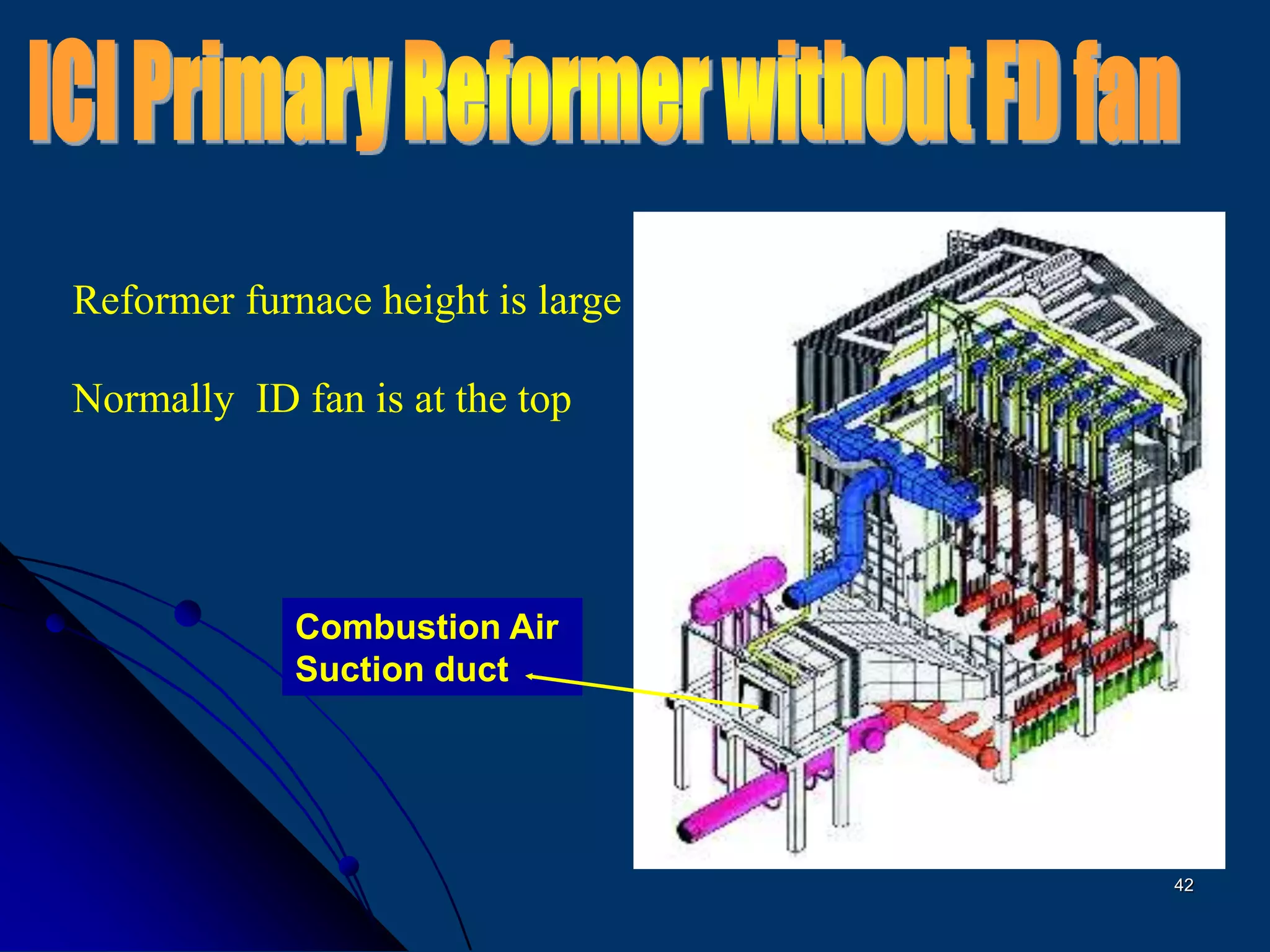
42
Combustion Air
Suction duct
Reformer furnace height is large
Normally ID fan is at the top
43
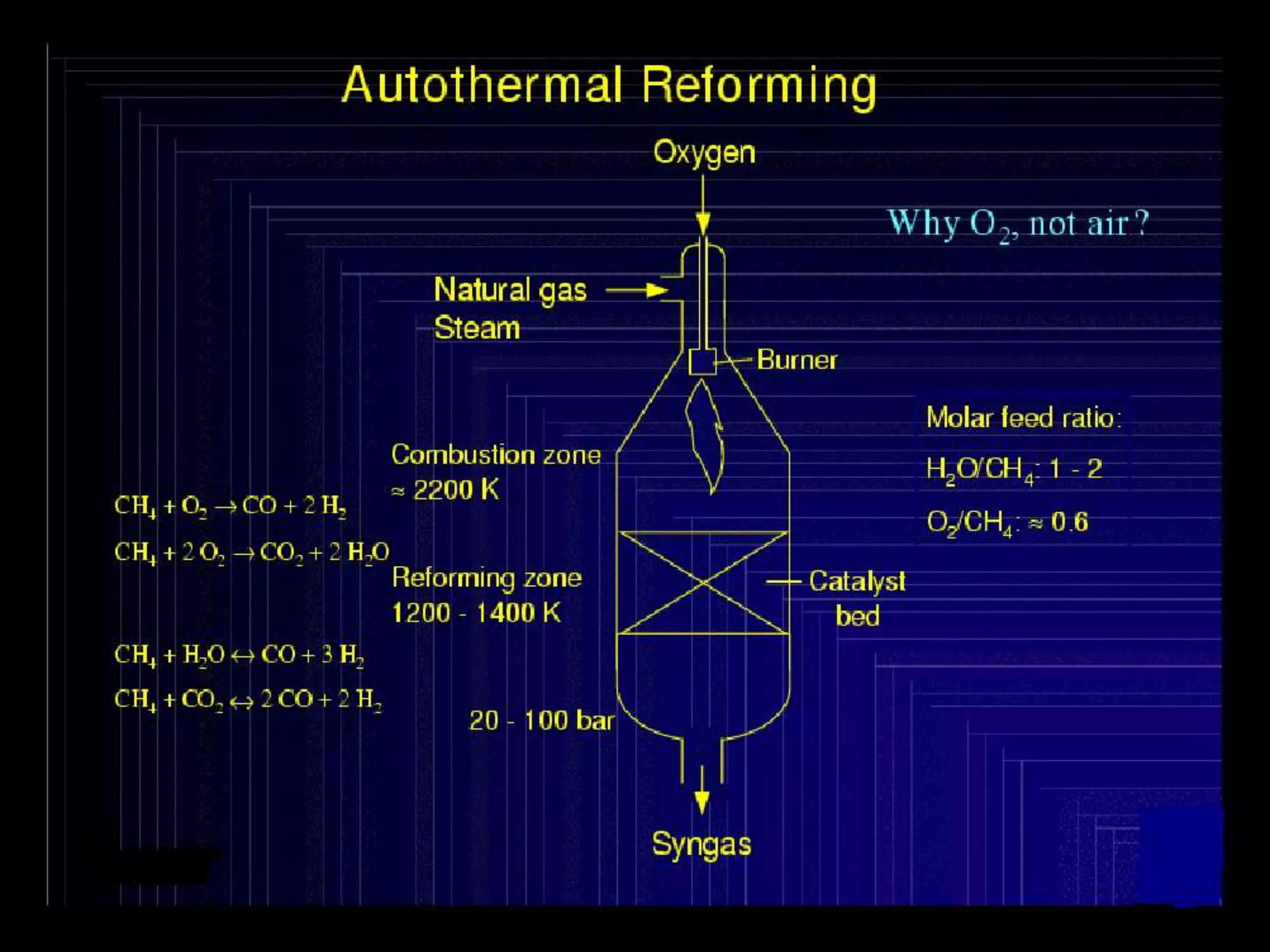
Auto Thermal Reformer
 Auto thermal reformer is a pressure vessel similar to
that of Secondary Reformer.
 Catalyst is advanced, resistance to high temperature.
 It can be operated up to a pressure of 50kg/cm²G.
 Start up time is minimum as compared to
conventional reforming.
 It is economic if used in large capacity
plants(1800MTPD & above)
 CH4 conversion is more than 99%
44
45
Auto Thermal Reforming Route
ATR technology is offered by three Process Licensors
M/s Lurgi, Germany
M/s KBR, USA
M/s HTAS, Denmark
46
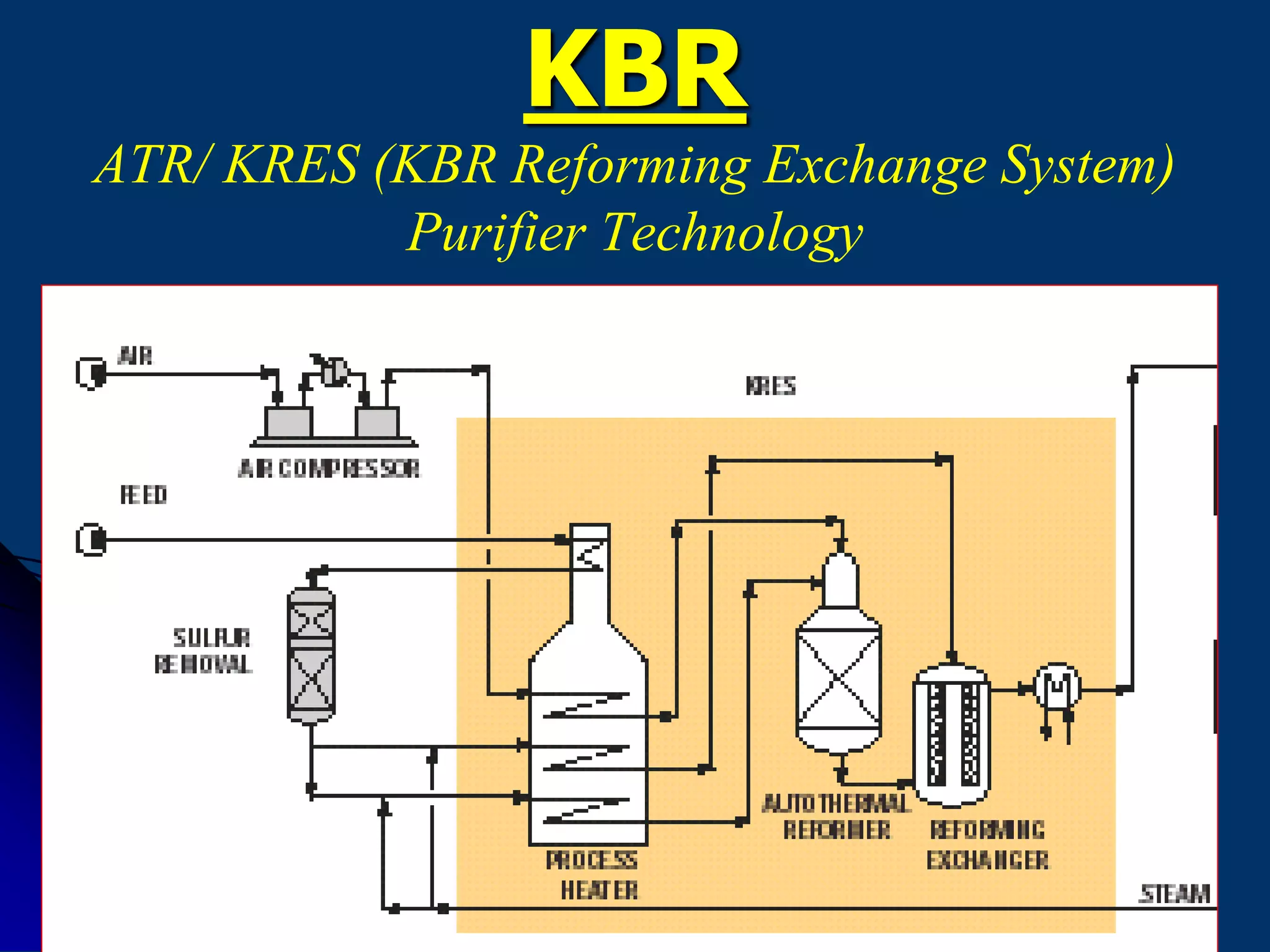
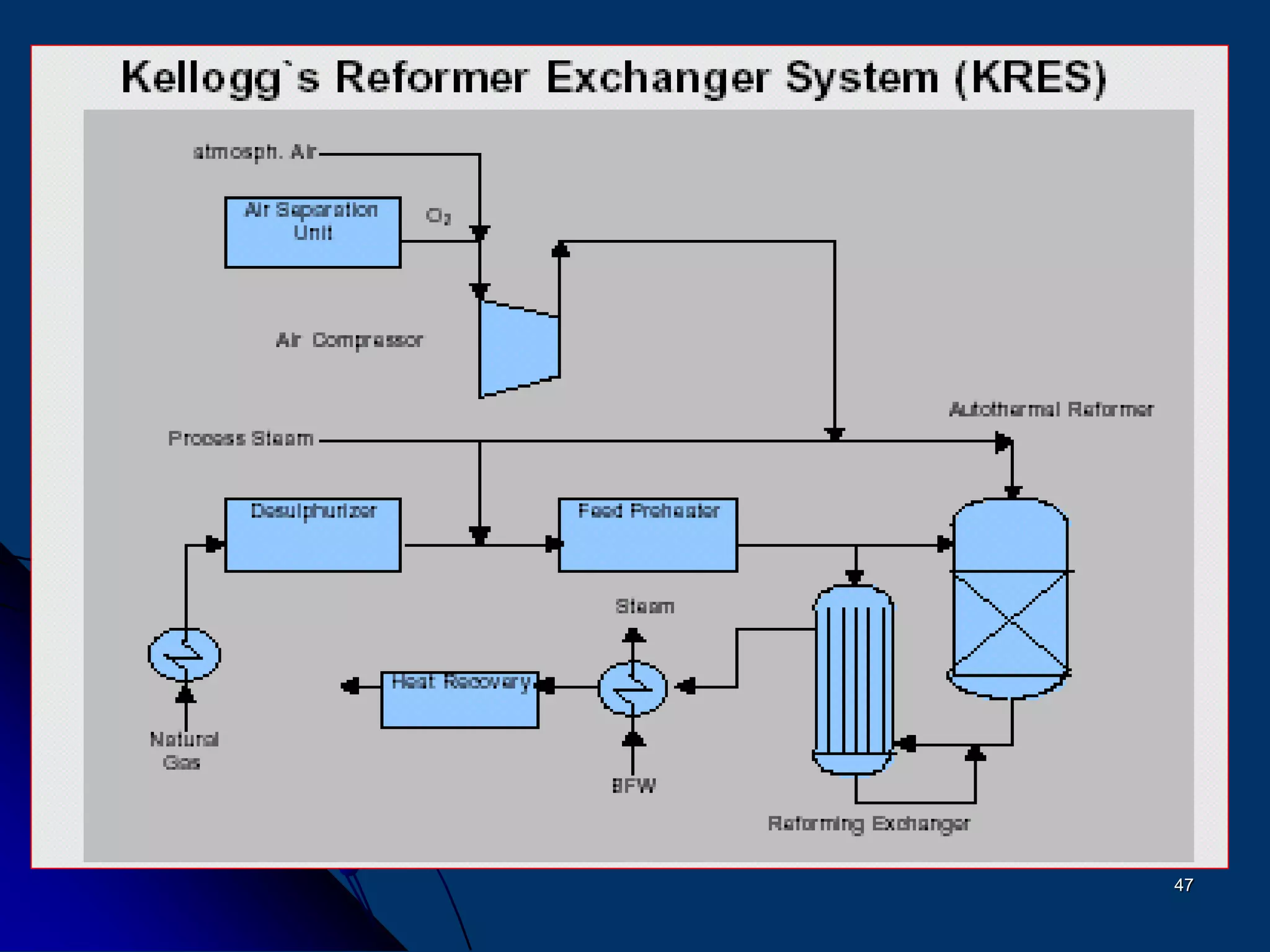
KBR
ATR/ KRES (KBR Reforming Exchange System)
Purifier Technology
47
48
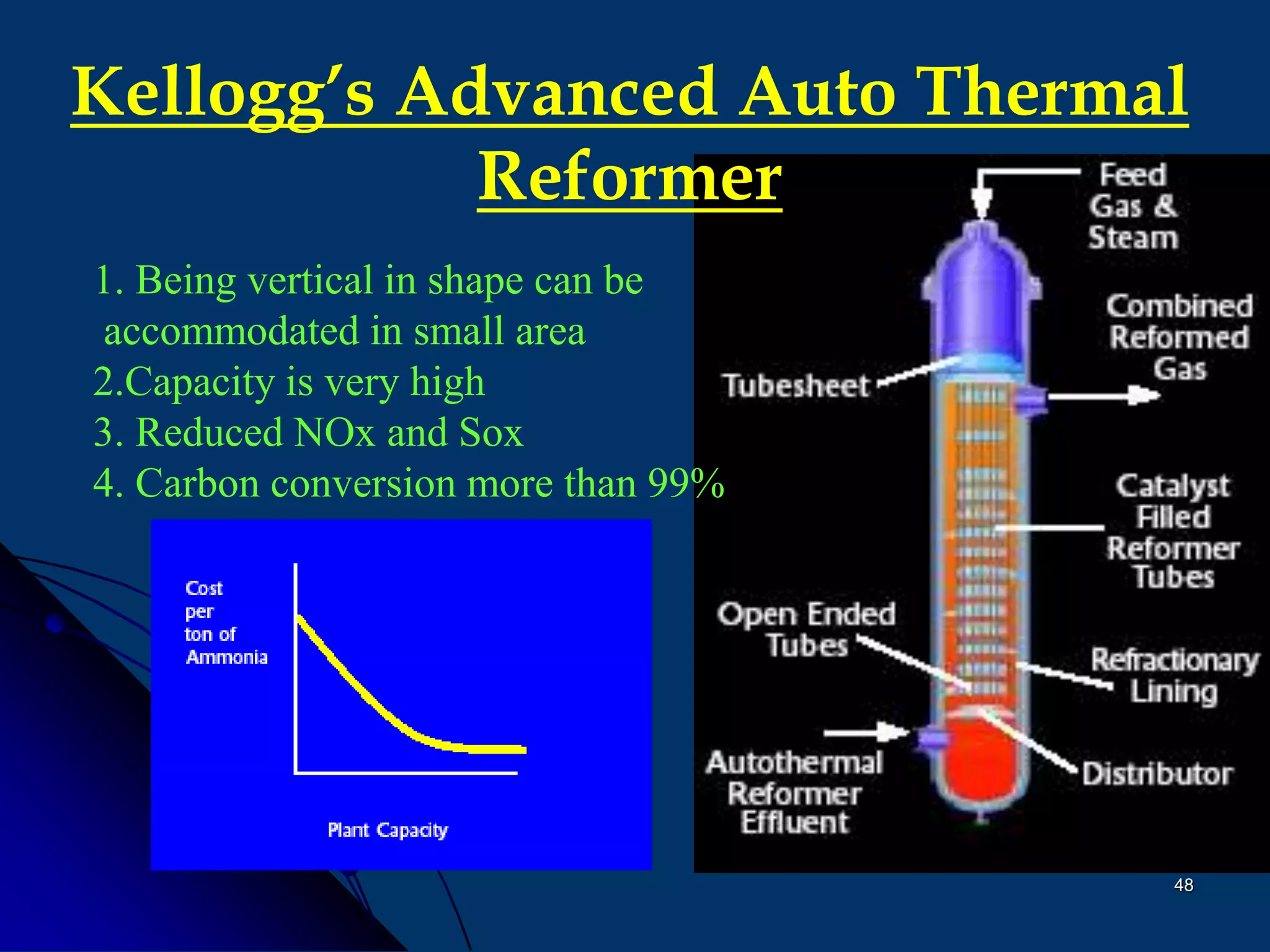
Kellogg’s Advanced Auto Thermal
Reformer
1. Being vertical in shape can be
accommodated in small area
2.Capacity is very high
3. Reduced NOx and Sox
4. Carbon conversion more than 99%
49
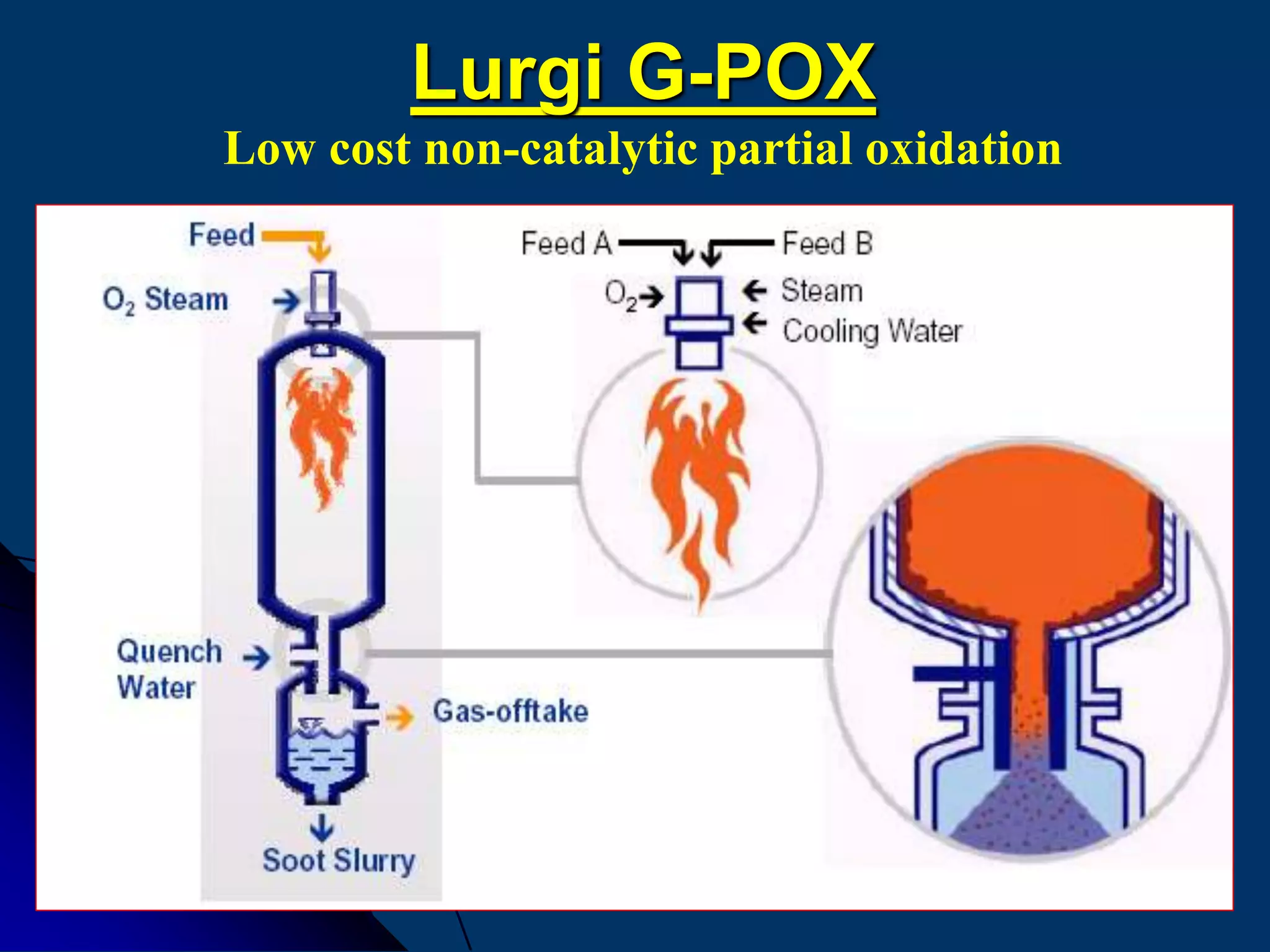
Lurgi G-POX
Low cost non-catalytic partial oxidation
50
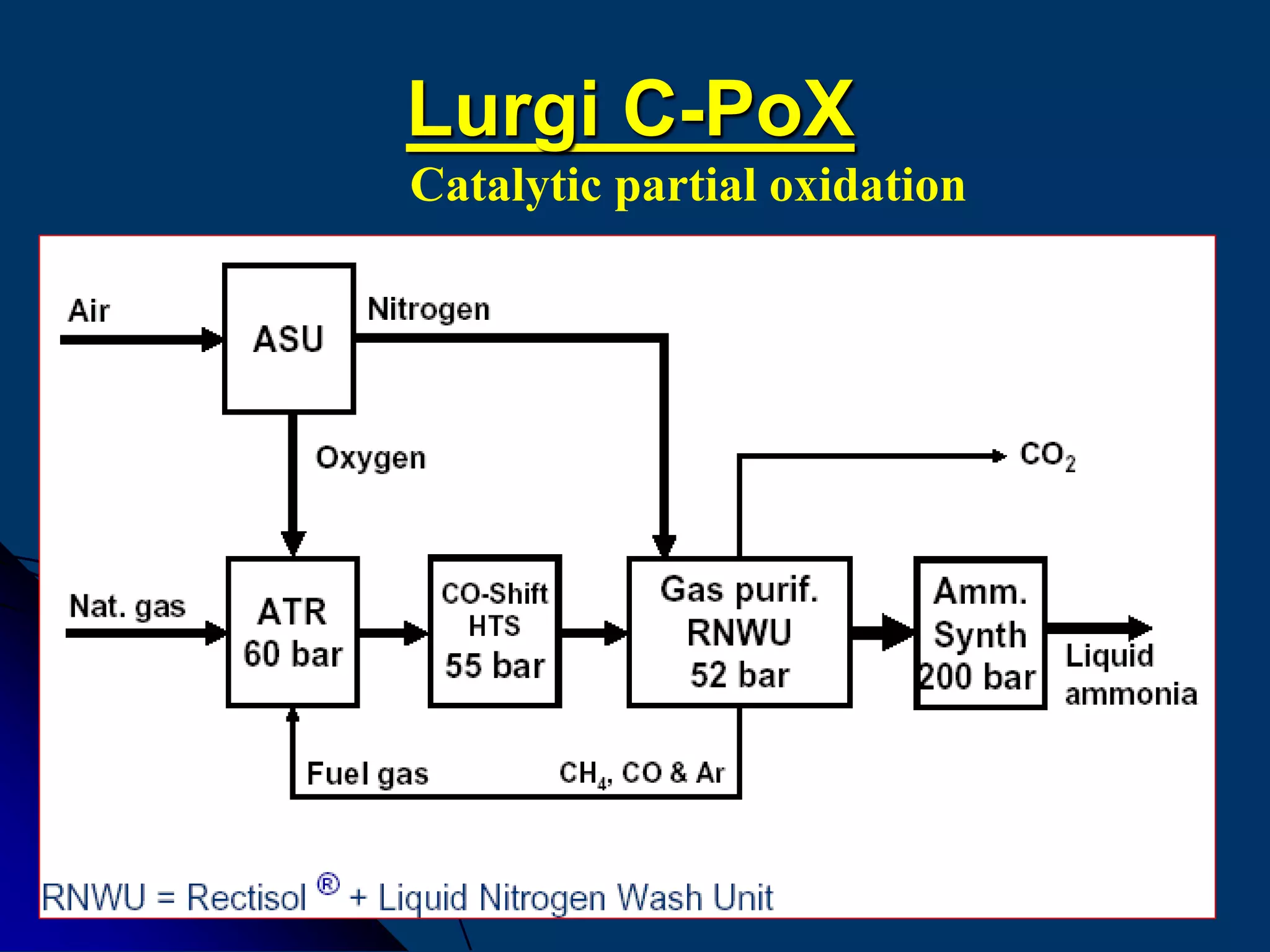
Lurgi C-PoX
Catalytic partial oxidation
51
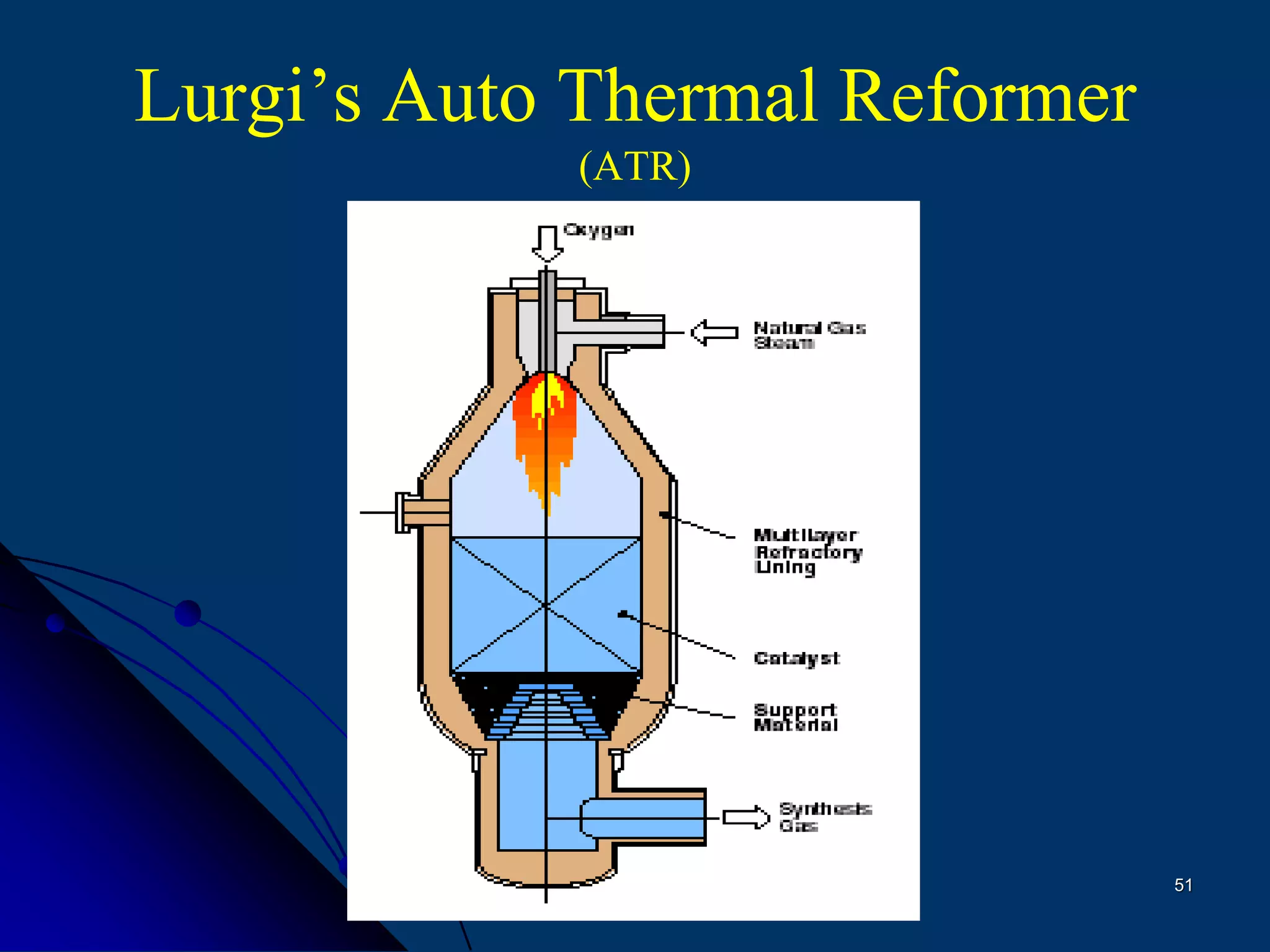
Lurgi’s Auto Thermal Reformer
(ATR)
52
HTAS
The key elements of the technology are the design
of the burner, the catalyst formulation, and
refinement of the operating conditions.
Topsøe’s proprietary burner design has been
developed on the basis of computational fluid
dynamics, hydraulic simulation, pilot plant
testing, and feedback from industrial operation.
53
Secondary Reformer
 Critical parts
 Burner (gun)
 Catalyst and top bricks
 Insulation material
 Material of construction
54
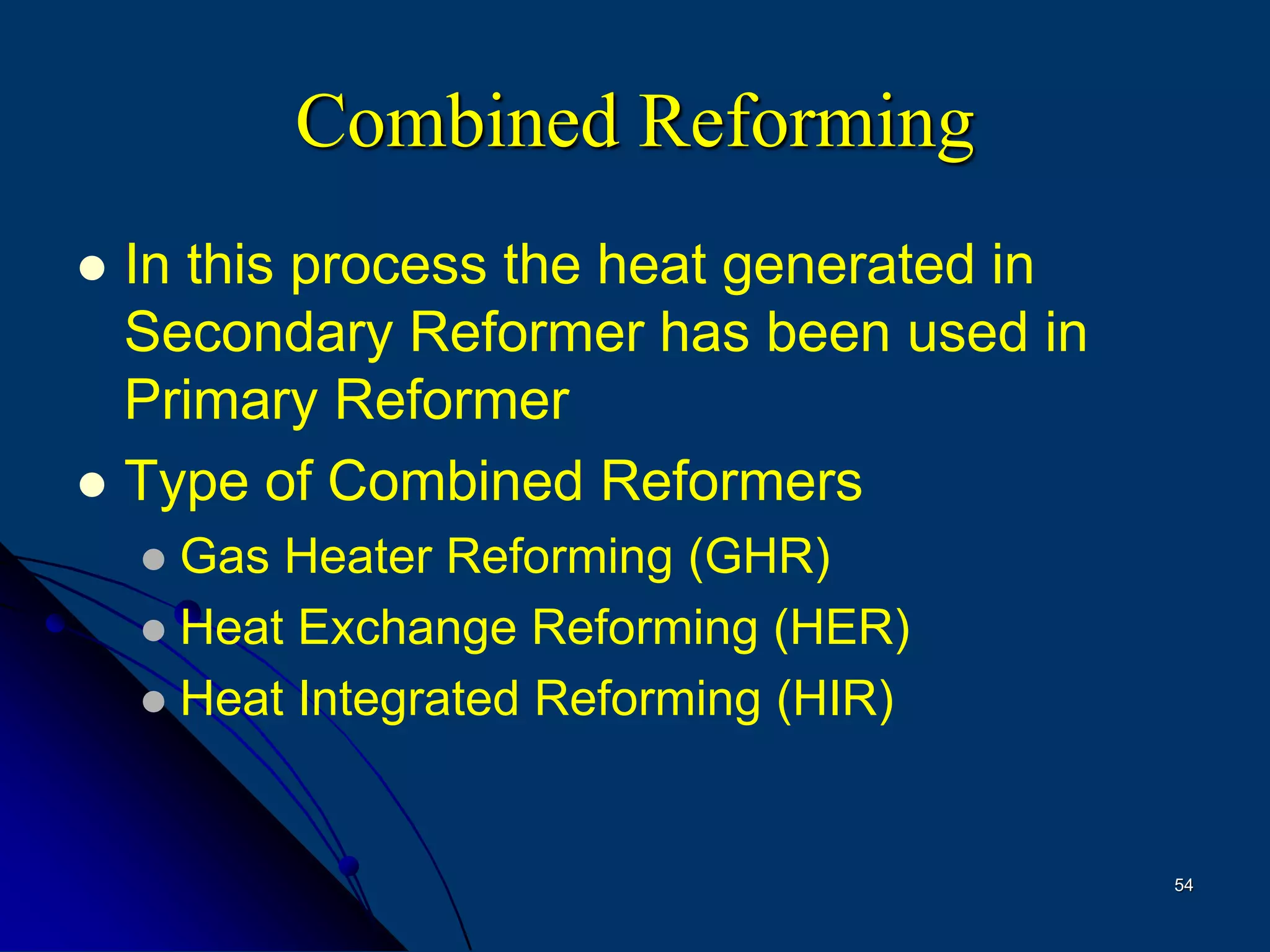
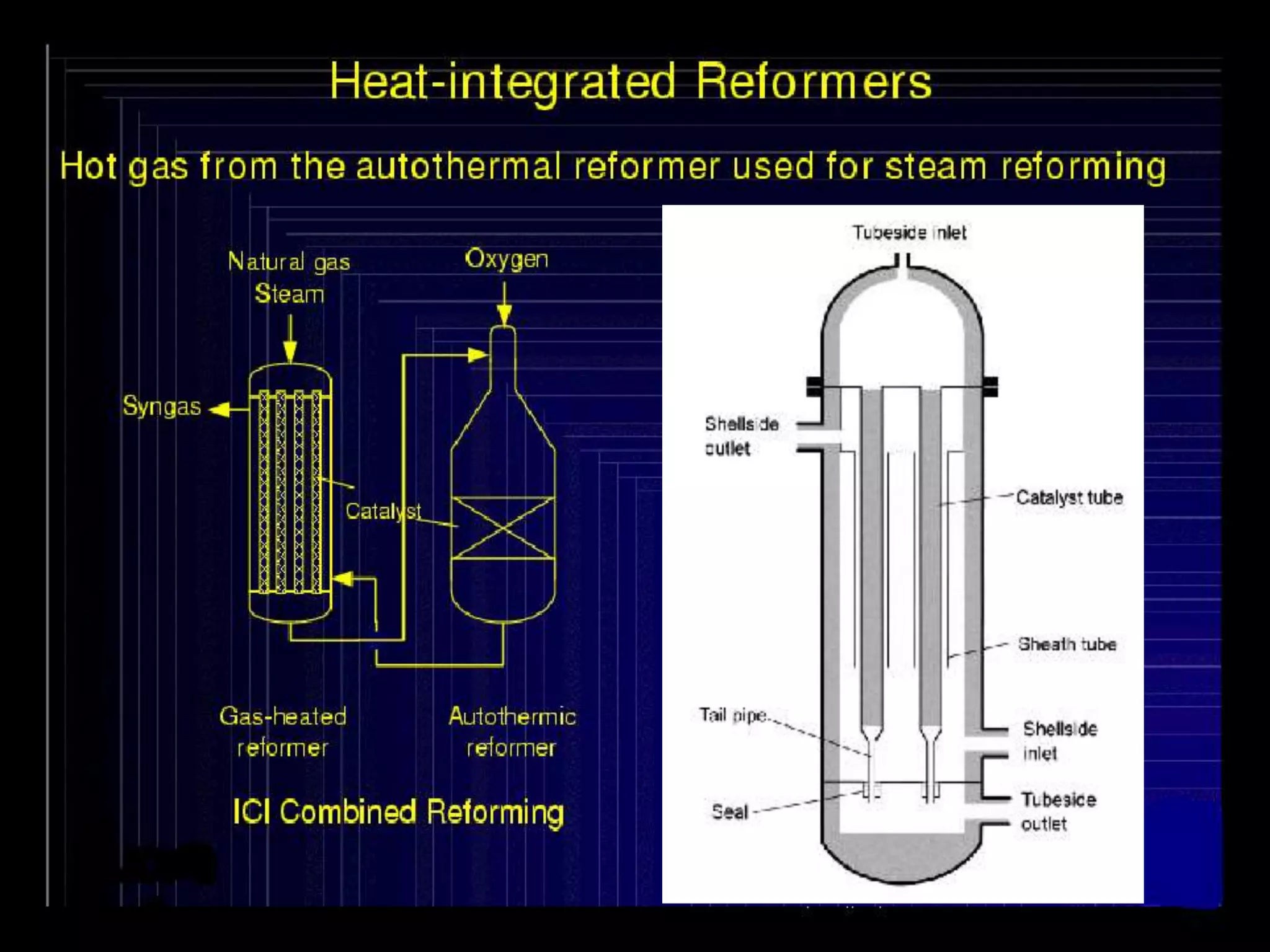
Combined Reforming
 In this process the heat generated in
Secondary Reformer has been used in
Primary Reformer
 Type of Combined Reformers
 Gas Heater Reforming (GHR)
 Heat Exchange Reforming (HER)
 Heat Integrated Reforming (HIR)
55
56
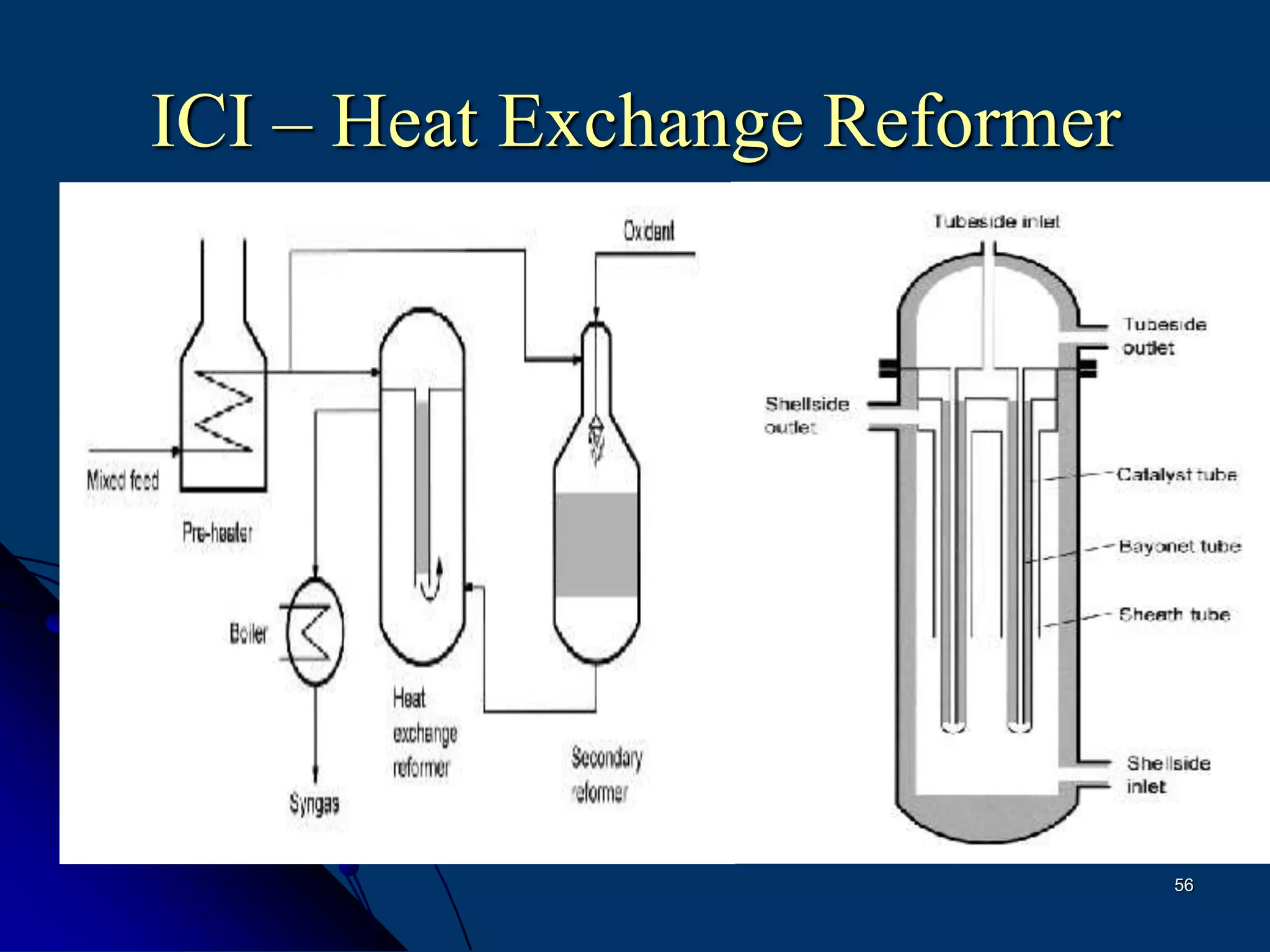
ICI – Heat Exchange Reformer
57
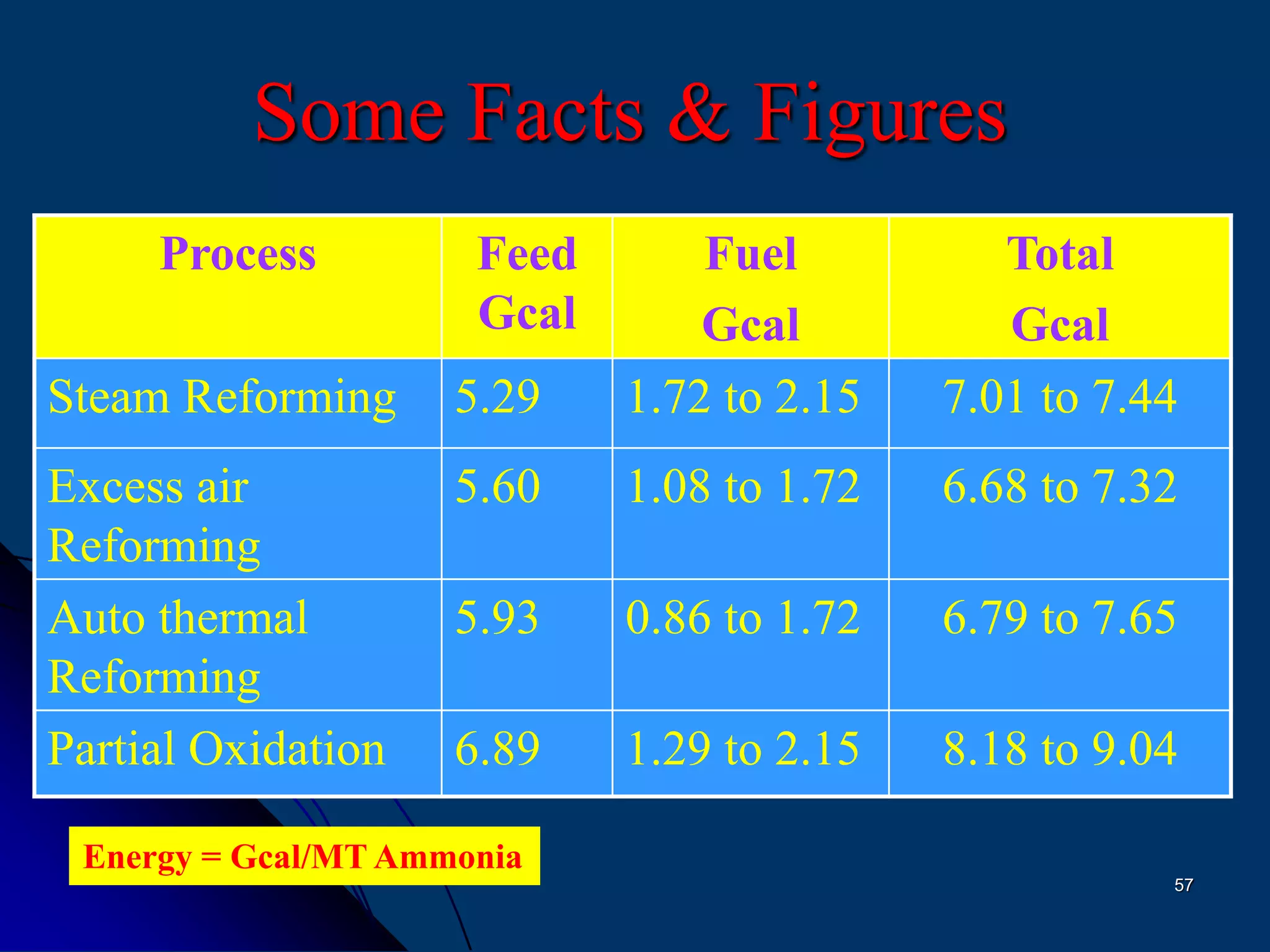
Some Facts & Figures
Process Feed
Gcal
Fuel
Gcal
Total
Gcal
Steam Reforming 5.29 1.72 to 2.15 7.01 to 7.44
Excess air
Reforming
5.60 1.08 to 1.72 6.68 to 7.32
Auto thermal
Reforming
5.93 0.86 to 1.72 6.79 to 7.65
Partial Oxidation 6.89 1.29 to 2.15 8.18 to 9.04
Energy = Gcal/MT Ammonia
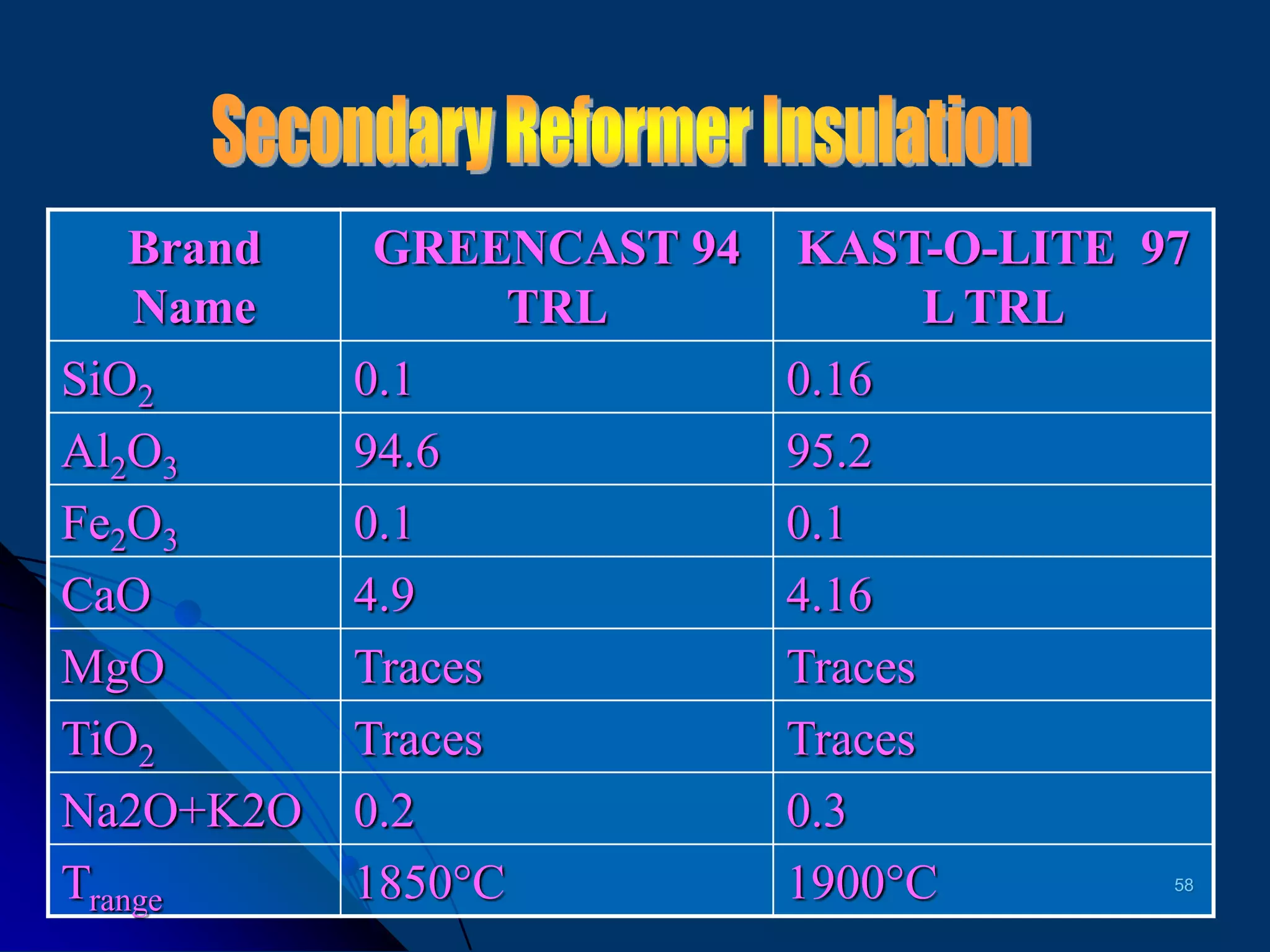
58
Brand
Name
GREENCAST 94
TRL
KAST-O-LITE 97
L TRL
SiO2 0.1 0.16
Al2O3 94.6 95.2
Fe2O3 0.1 0.1
CaO 4.9 4.16
MgO Traces Traces
TiO2 Traces Traces
Na2O+K2O 0.2 0.3
Trange 1850°C 1900°C
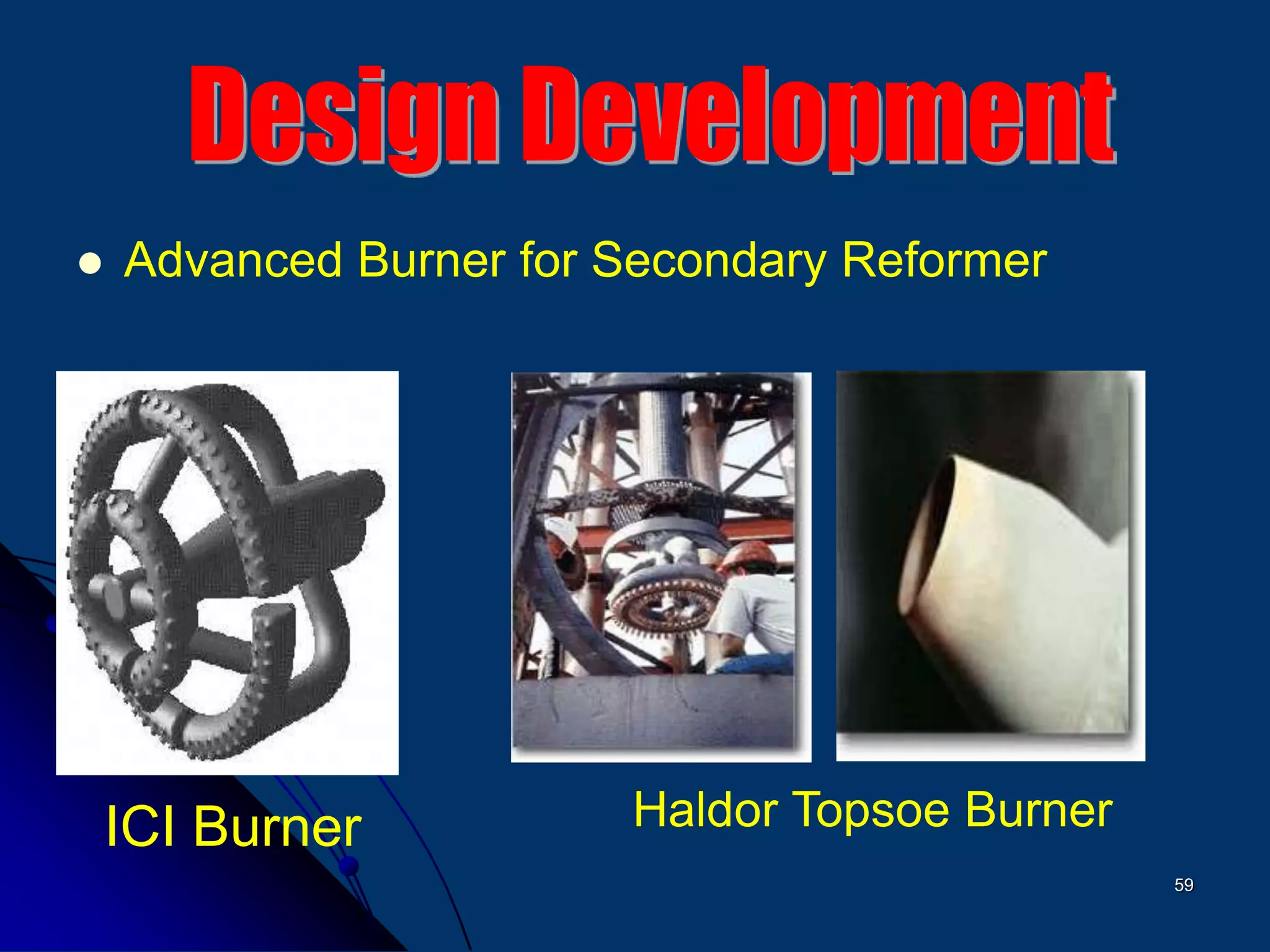
59
 Advanced Burner for Secondary Reformer
ICI Burner Haldor Topsoe Burner
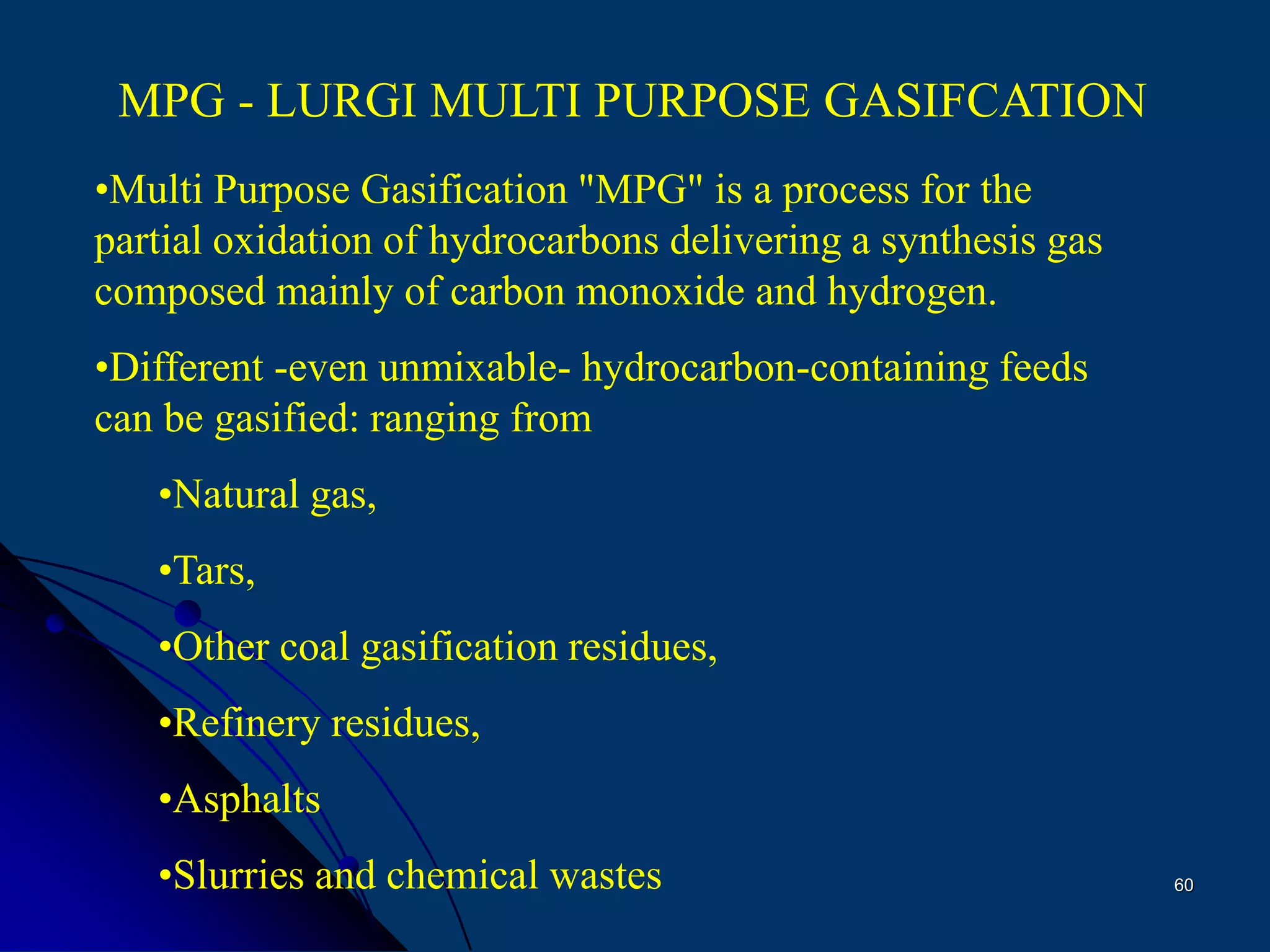
60
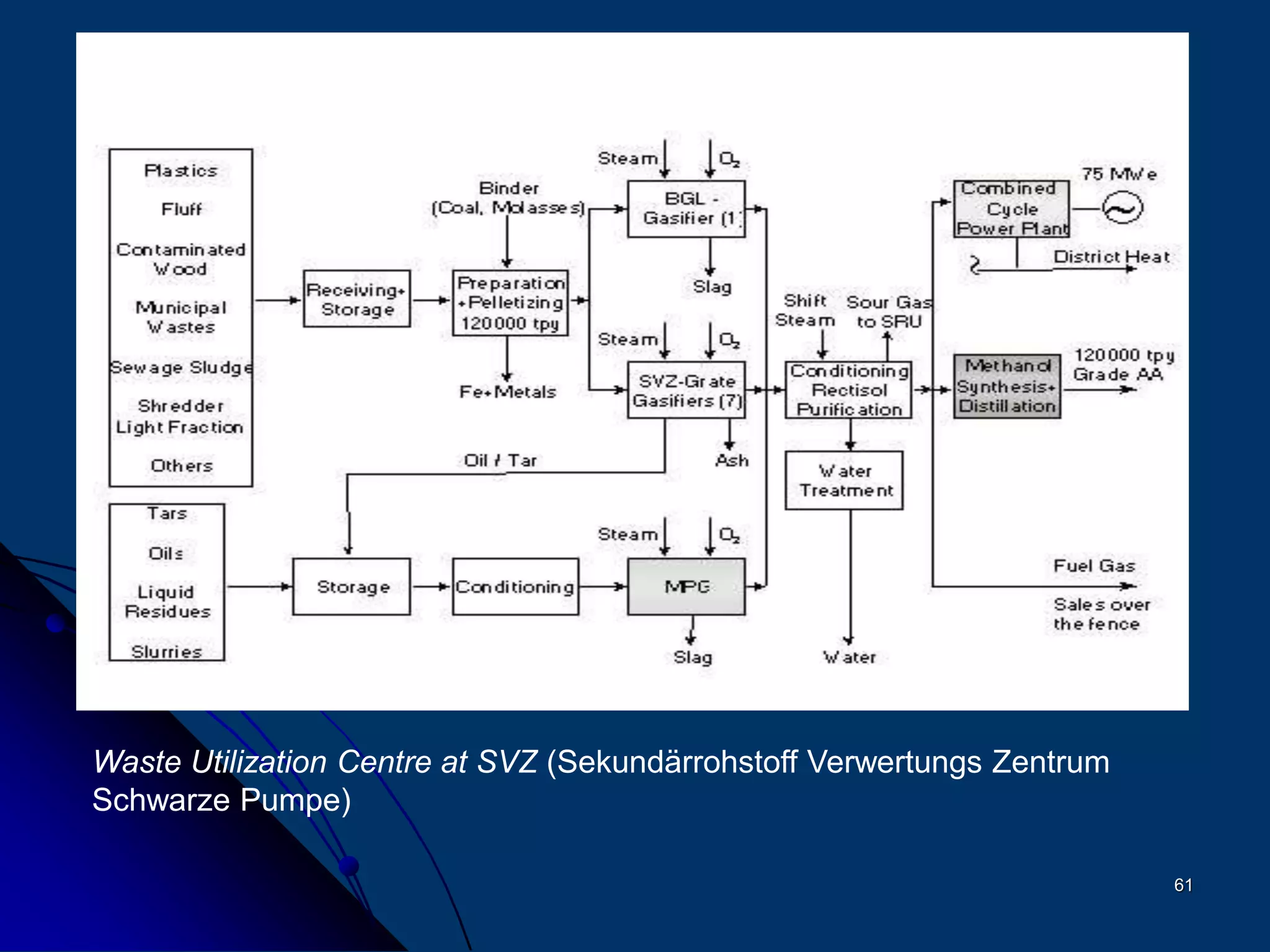
MPG - LURGI MULTI PURPOSE GASIFCATION
•Multi Purpose Gasification "MPG" is a process for the
partial oxidation of hydrocarbons delivering a synthesis gas
composed mainly of carbon monoxide and hydrogen.
•Different -even unmixable- hydrocarbon-containing feeds
can be gasified: ranging from
•Natural gas,
•Tars,
•Other coal gasification residues,
•Refinery residues,
•Asphalts
•Slurries and chemical wastes
61
Waste Utilization Centre at SVZ (Sekundärrohstoff Verwertungs Zentrum
Schwarze Pumpe)
62
Gasifiers operated at SVZ (Sekundärrohstoff Verwertungs
Zentrum Schwarze Pumpe)
•Fixed bed gasifiers (FBG)
•British Gas/Lurgi gasifier (BGL)
•Multi Purpose gasifier (MPG)
63
MPG Gas-gasification
Gasification occurs in the empty, refractory-lined reactor at temperatures between 1200°C
and 1400°C
A water-scrubbing tower removes traces of soot, HCN and NH3
Soot formation in the process is extremely low, so that no special filtration is necessary
with the wastewater passing to a sour-water stripper and final treatment
A desulfurization unit can be located either upstream or downstream of the gasification,
depending again on the heat utilization and on the material selection for the equipment in
areas prone to metal dusting.
64
ATR Gas-MPG
pressure [bar] 35 70
temperature inlet [°C] 750 500
temperature outlet [°C] 950 1400
O2 / natural gas [mol/mol] 0.4 0.7
steam / natural gas [mol/mol] 1.5 … 1.7 0.05…0.2
Comparison of Lurgi´s catalytic and non-catalytic partial
oxidation processes
65
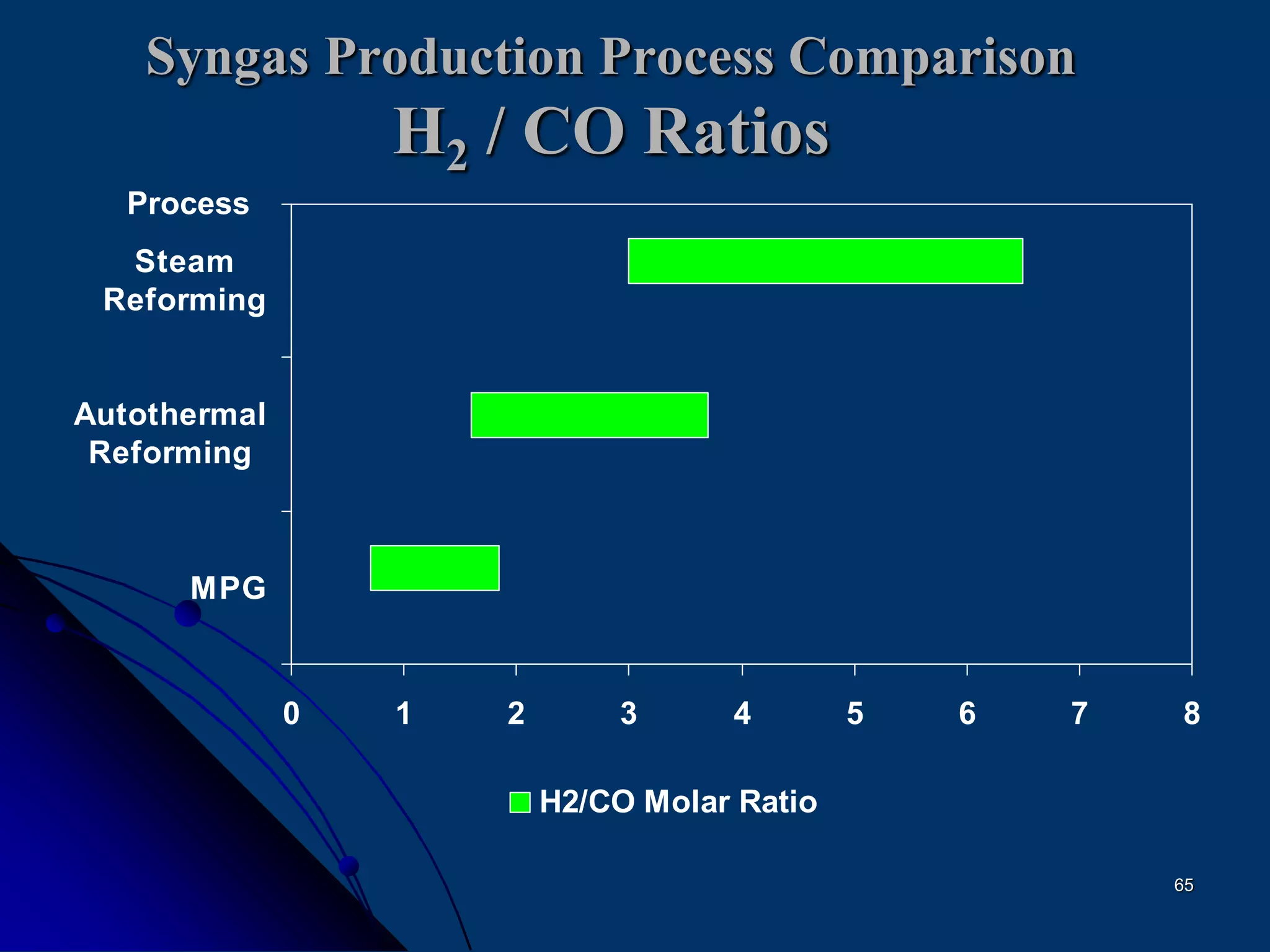
0 1 2 3 4 5 6 7 8
MPG
Autothermal
Reforming
Steam
Reforming
H2/CO Molar Ratio
Process
Syngas Production Process Comparison
H2 / CO Ratios
66
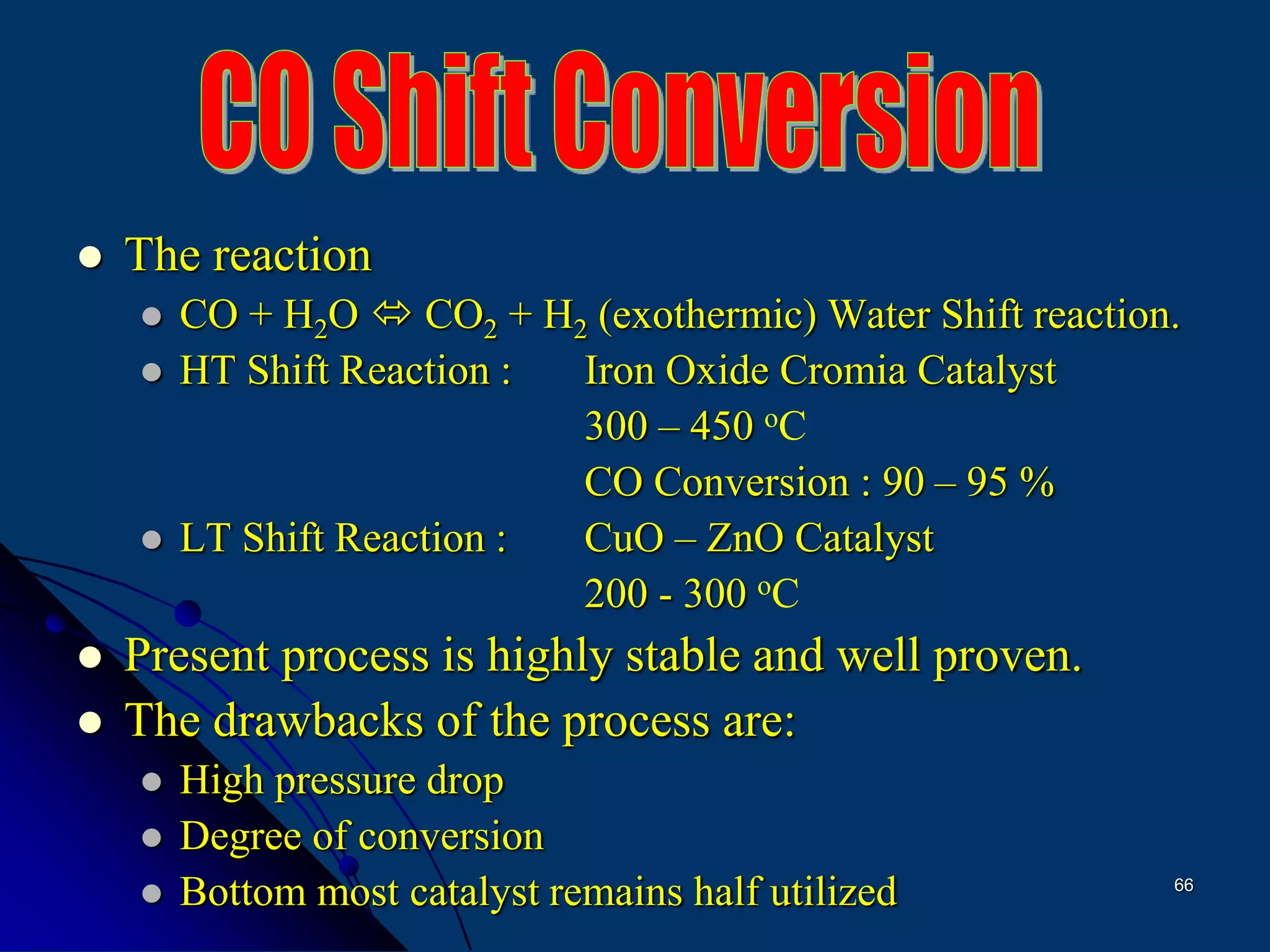
 The reaction
 CO + H2O  CO2 + H2 (exothermic) Water Shift reaction.
 HT Shift Reaction : Iron Oxide Cromia Catalyst
300 – 450 oC
CO Conversion : 90 – 95 %
 LT Shift Reaction : CuO – ZnO Catalyst
200 - 300 oC
 Present process is highly stable and well proven.
 The drawbacks of the process are:
 High pressure drop
 Degree of conversion
 Bottom most catalyst remains half utilized
67
 Isothermal reactors were tested to improve the
CO conversion but failed.
 Reasons
 High pressure drop
 Mechanical failure of inter bed exchangers
What is successful ?
68
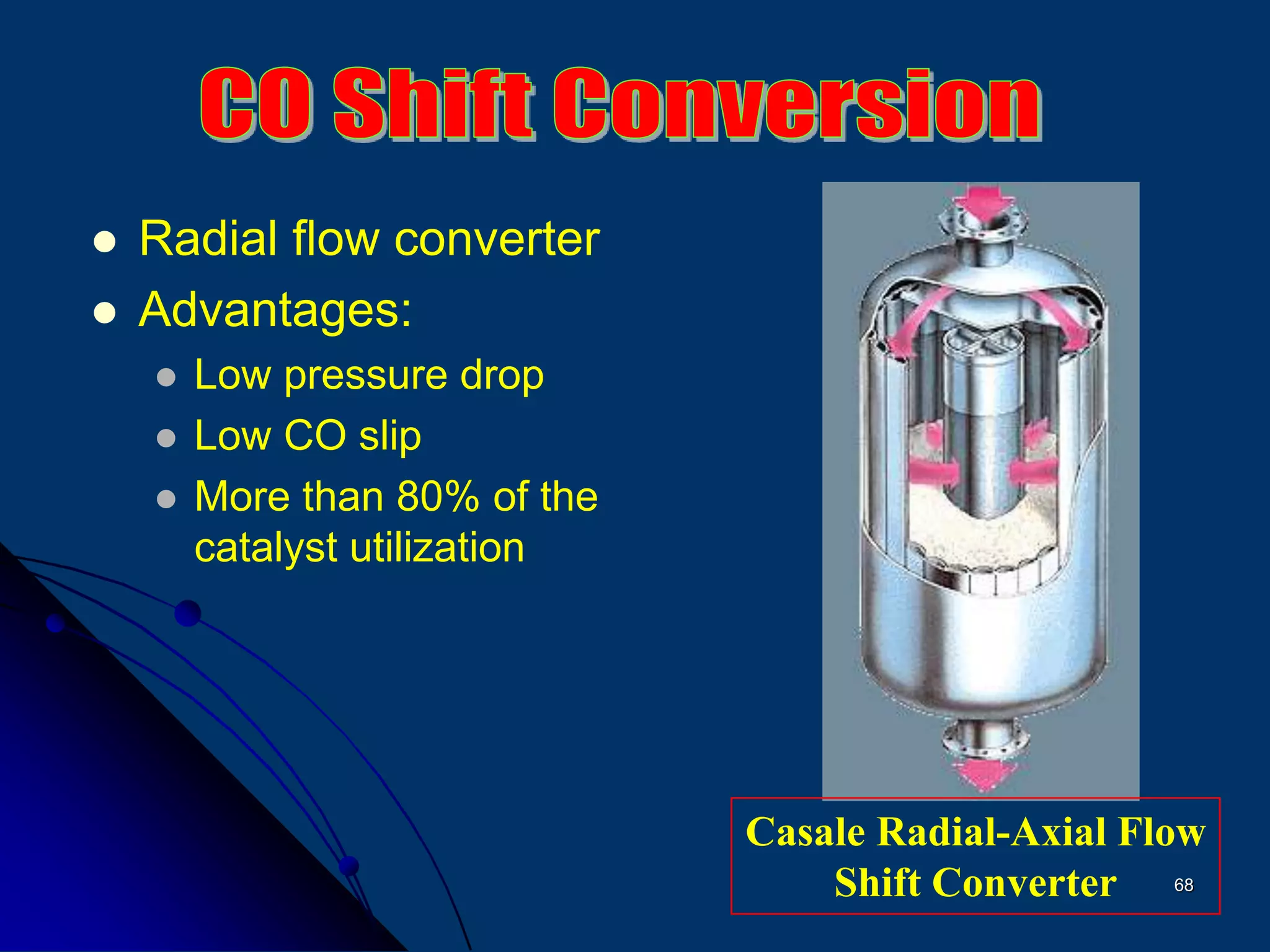
 Radial flow converter
 Advantages:
 Low pressure drop
 Low CO slip
 More than 80% of the
catalyst utilization
Casale Radial-Axial Flow
Shift Converter
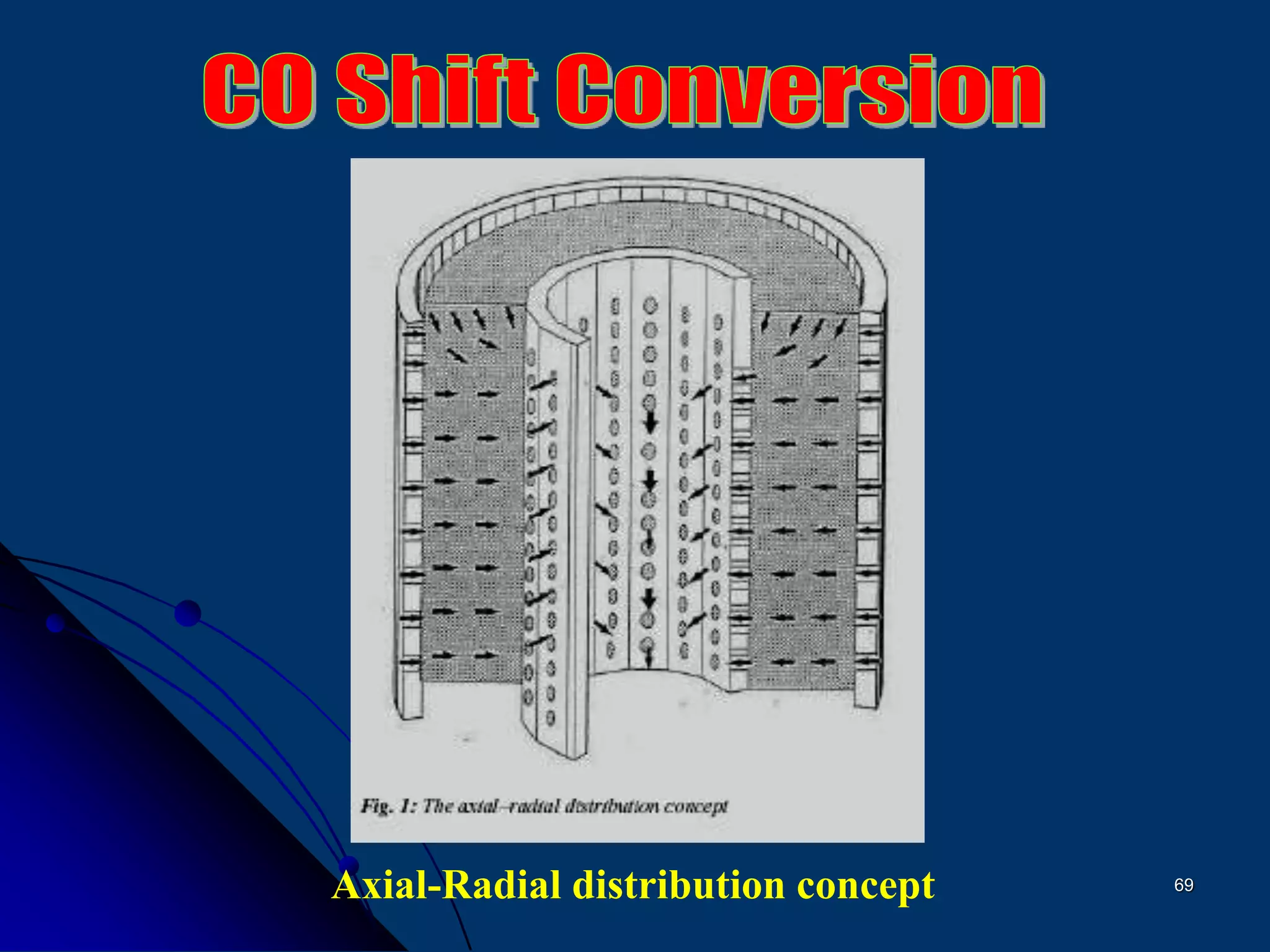
69Axial-Radial distribution concept
70
Process
 Chemical absorption
 Benfield, GV, Glycine, Catacarb, MEA.
 Physical absorption
 Methanol (Rectisol), Sulfolane (Sulfinol),
Dimethyl ether of propylene Glycol (Selexol)
 Adsorptive Purification
 Zeolites (PSA)
 Membrane Seperation
 CMS (Carbon molecular Sieves): hydrogen
permeation
 Nanoporous Carbon membranes: Carbon
dioxide permeation
71
72
73
74
75
76
 Advancements Why?
 High loop pressure
 Low conversion per path
 Compressor Recycle stage Efficiency Low
 High pressure drop across the loop
 High Compression power
77
 Advancements What?
 Improved catalyst activity
 Reduce pressure +drop
 Increase conversion per path
 Reduce synthesis gas compressor size and
increase efficiency.
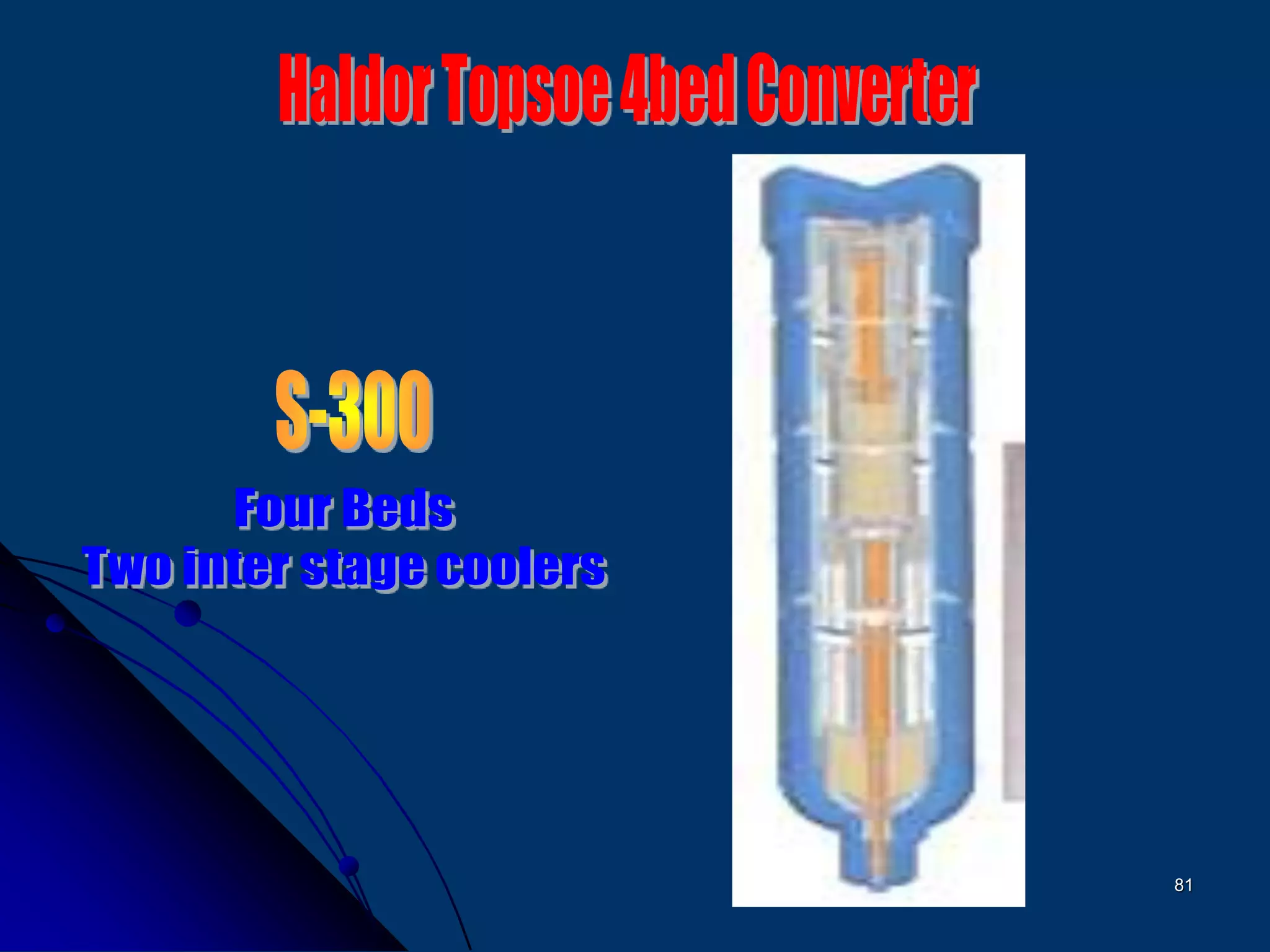
78
 Synthesis gas purification (eliminate CH4,
Ar)/Reduction in gas volume
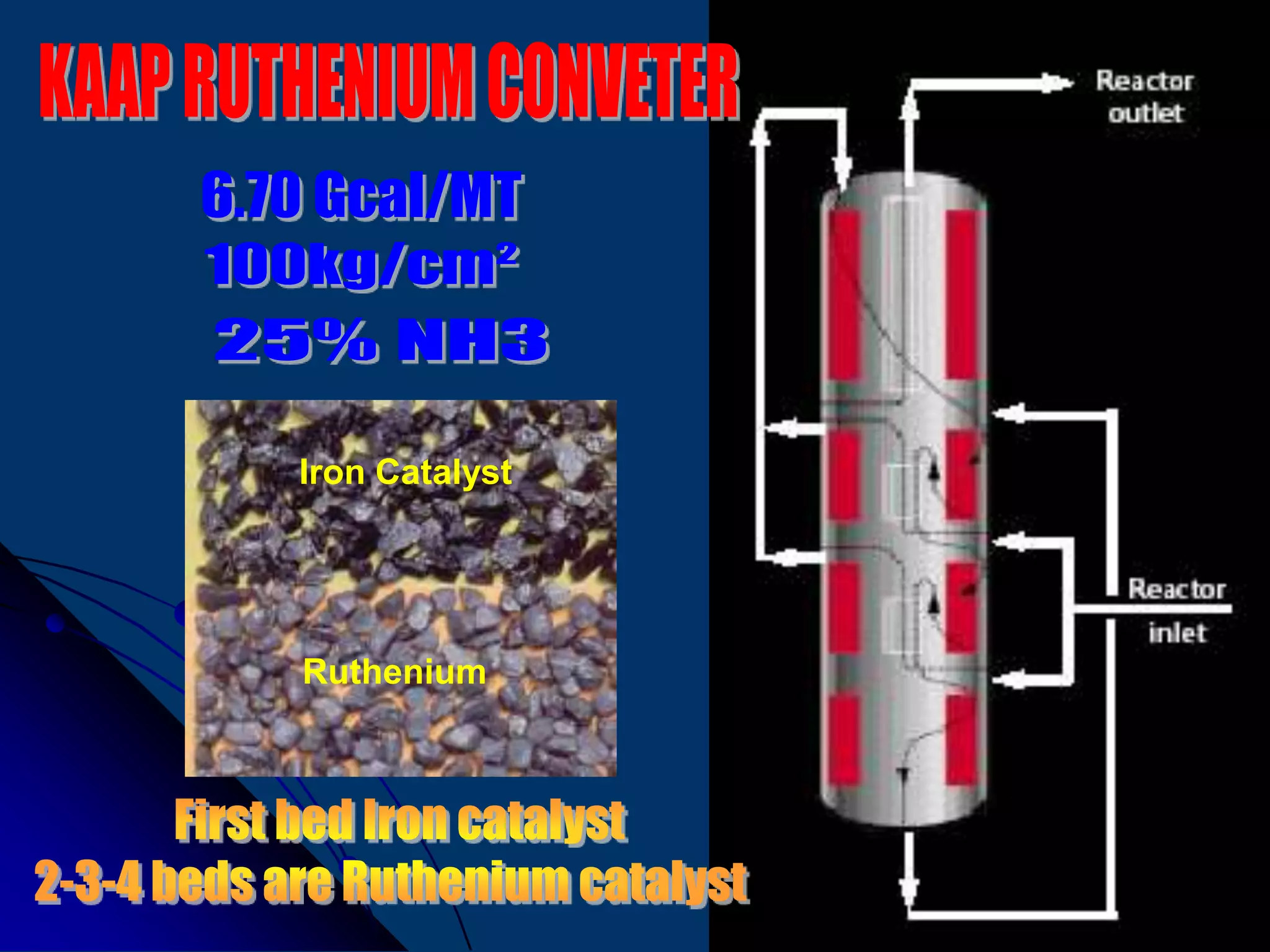
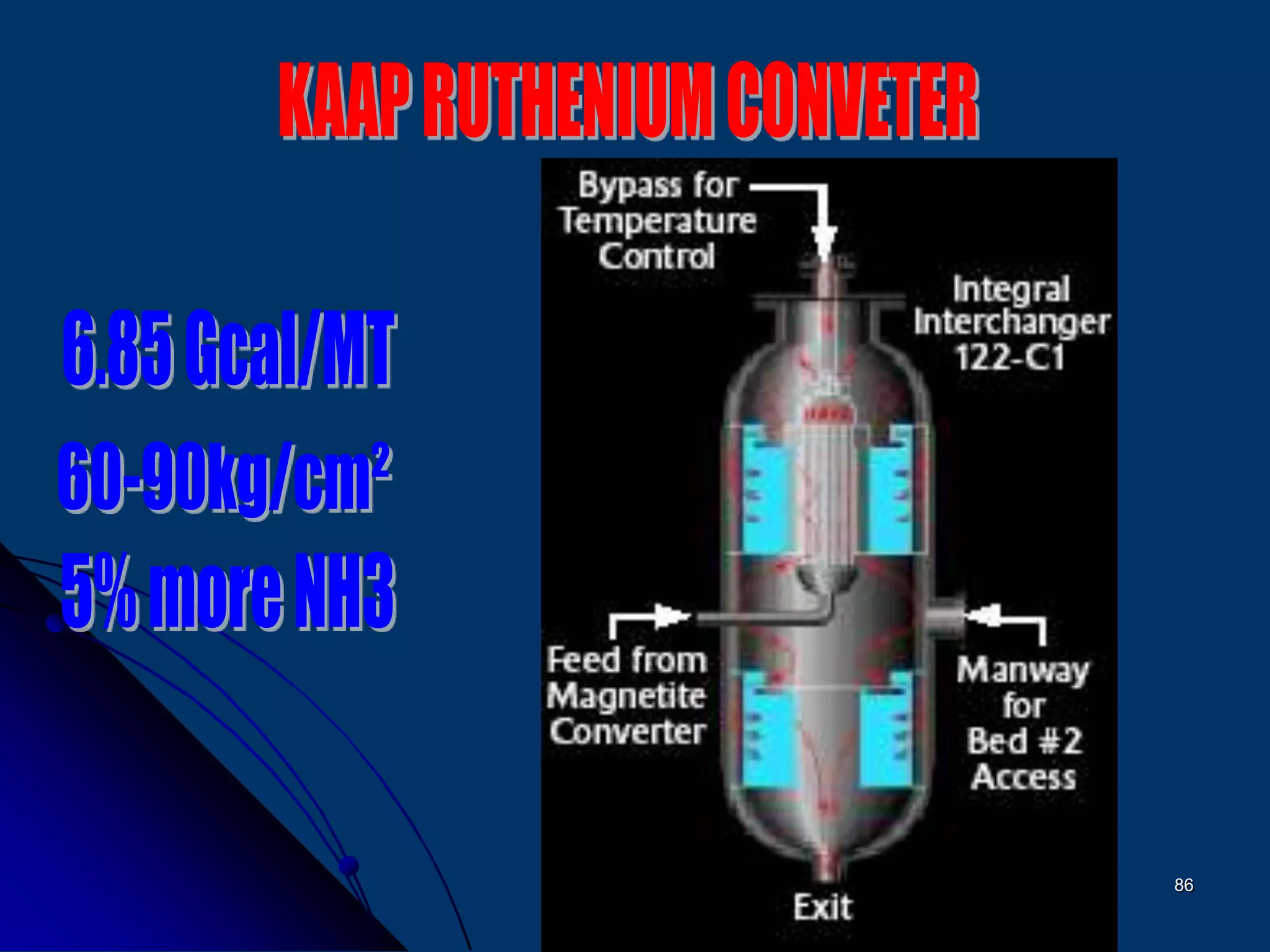
 Latest Ruthenium catalyst (Reduced loop
pressure)
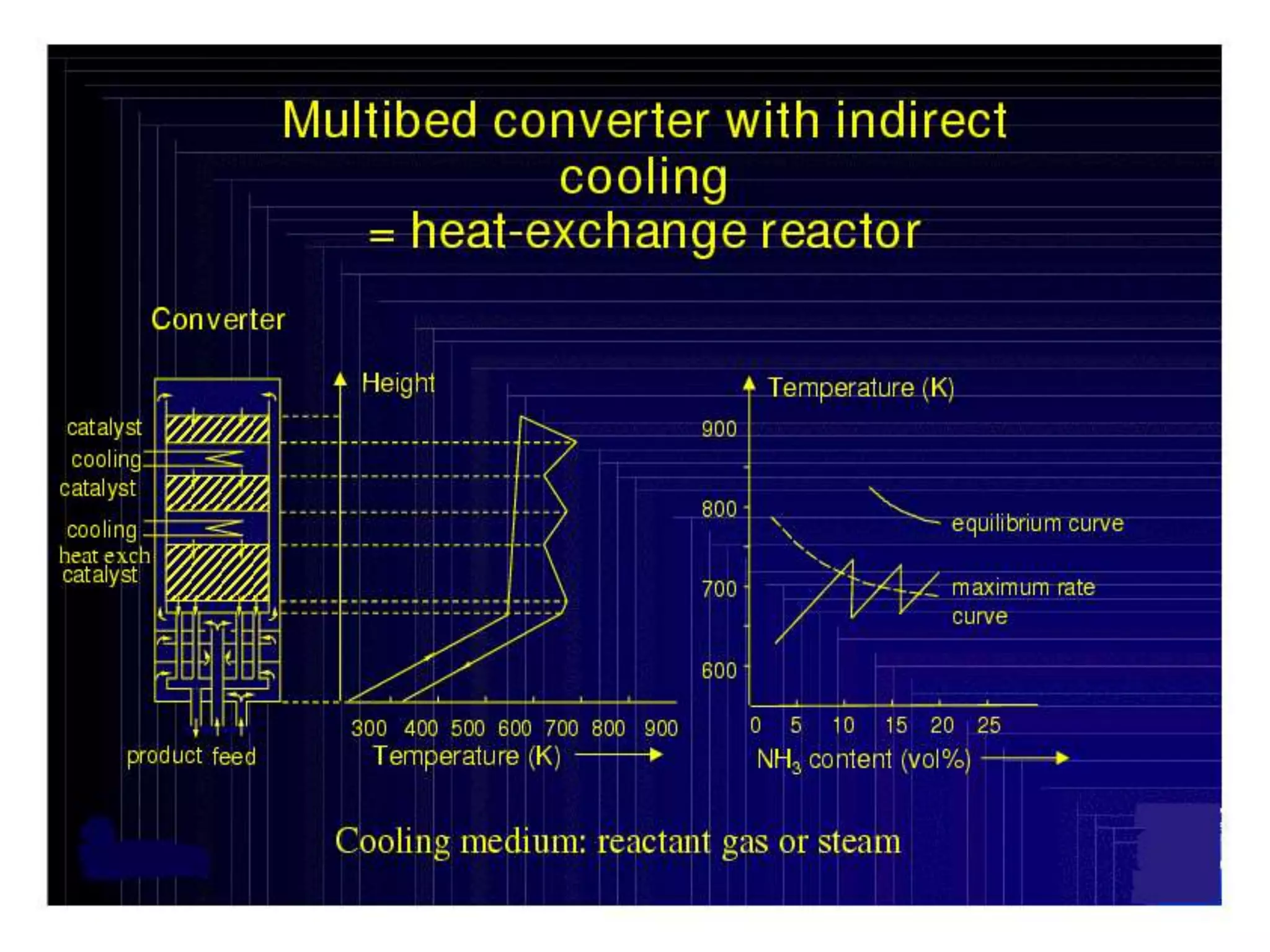
 Using catalyst in multi-beds with inter-stage
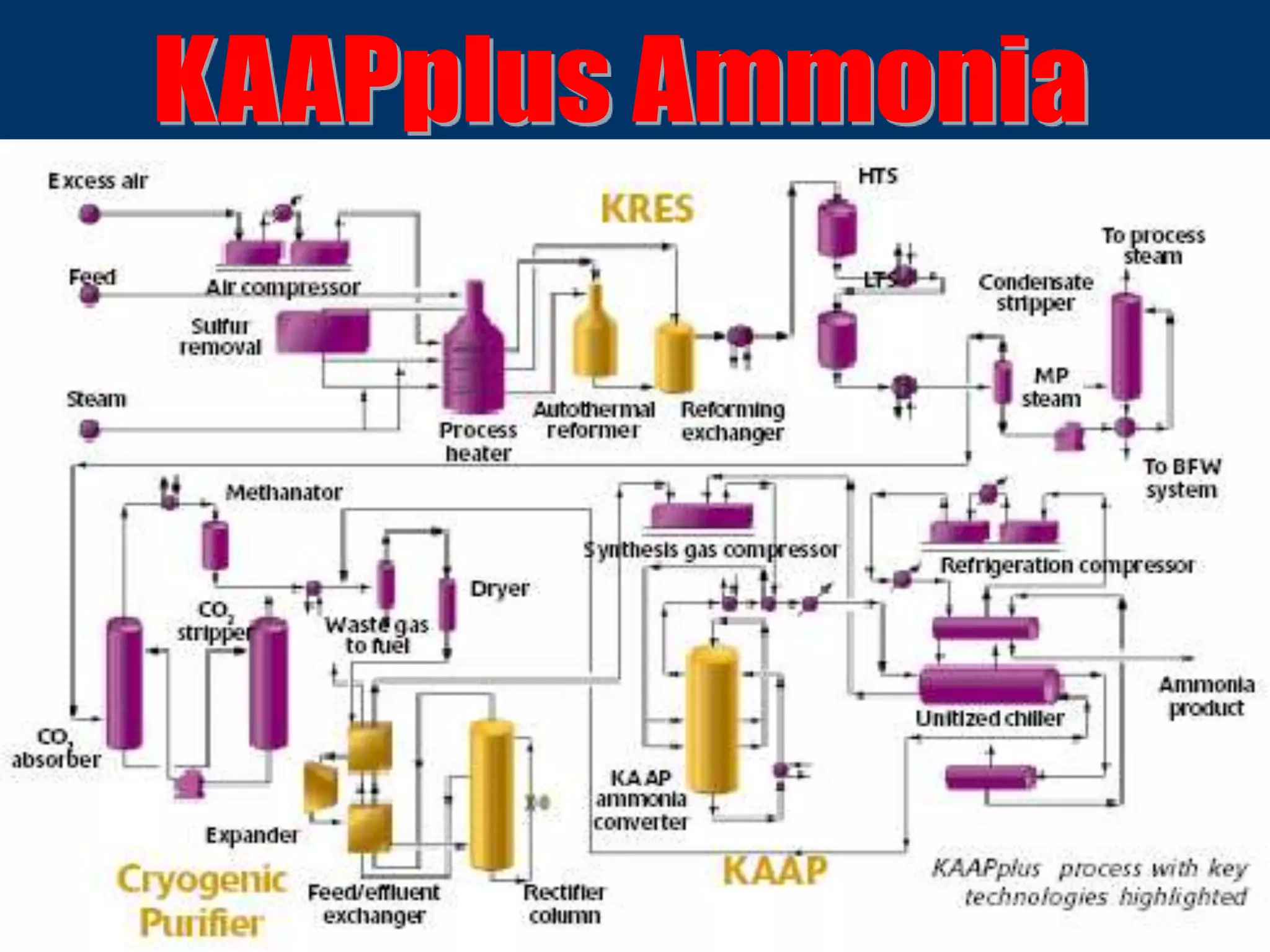
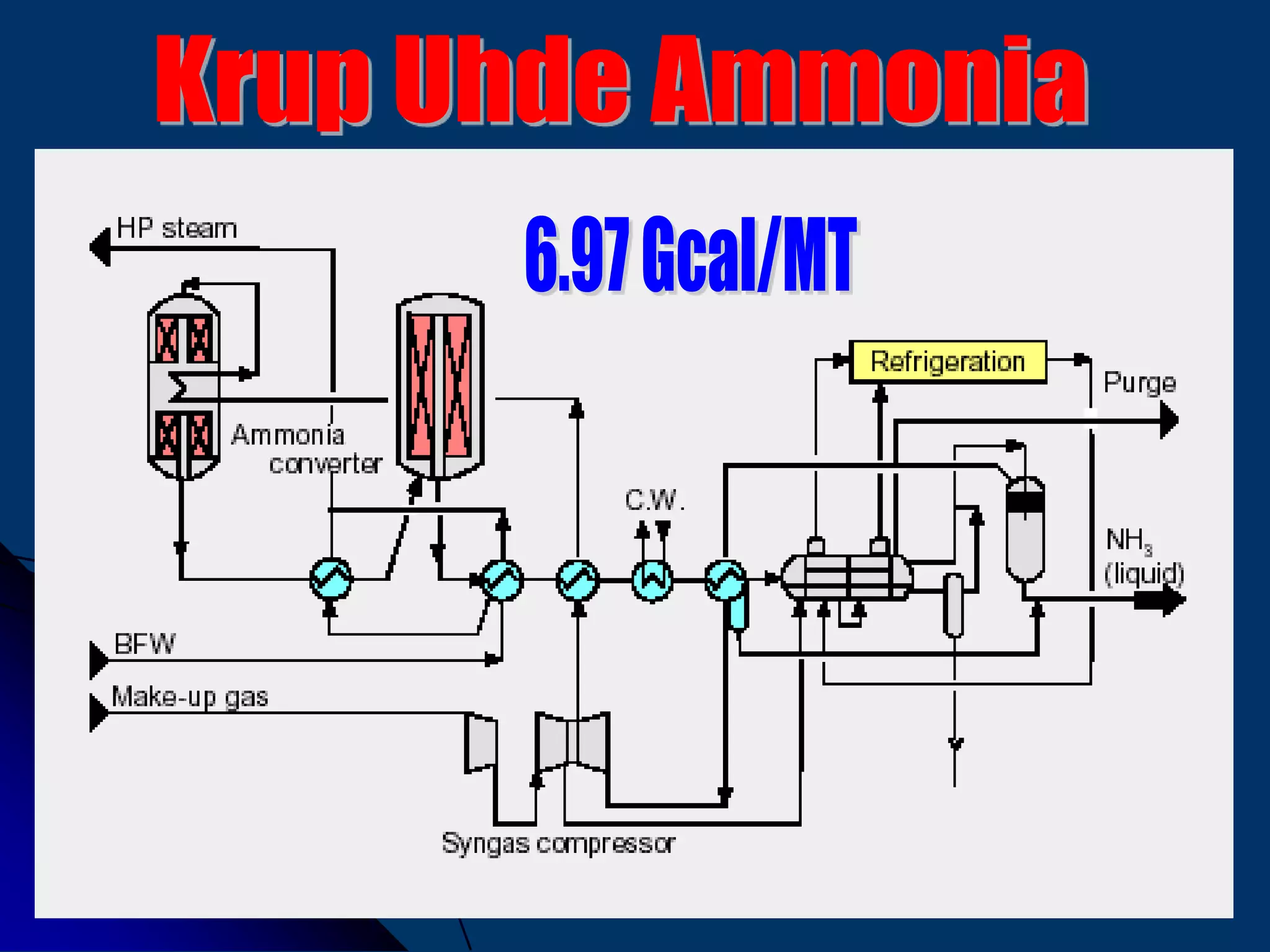
cooler.
 Drying and cooling synthesis gas
 Eliminate inter cooler separators (or make
compact)
 Improved design
79
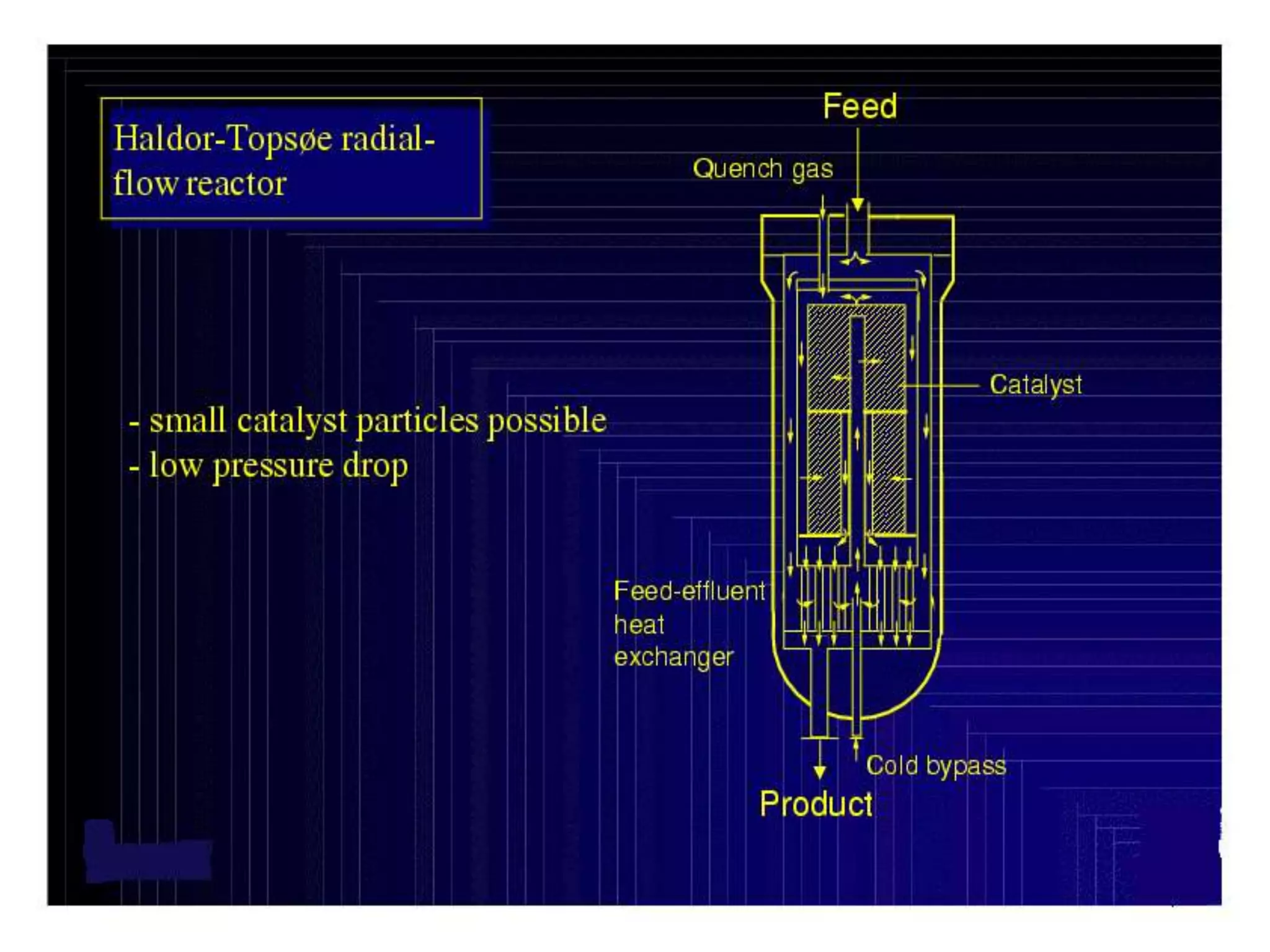
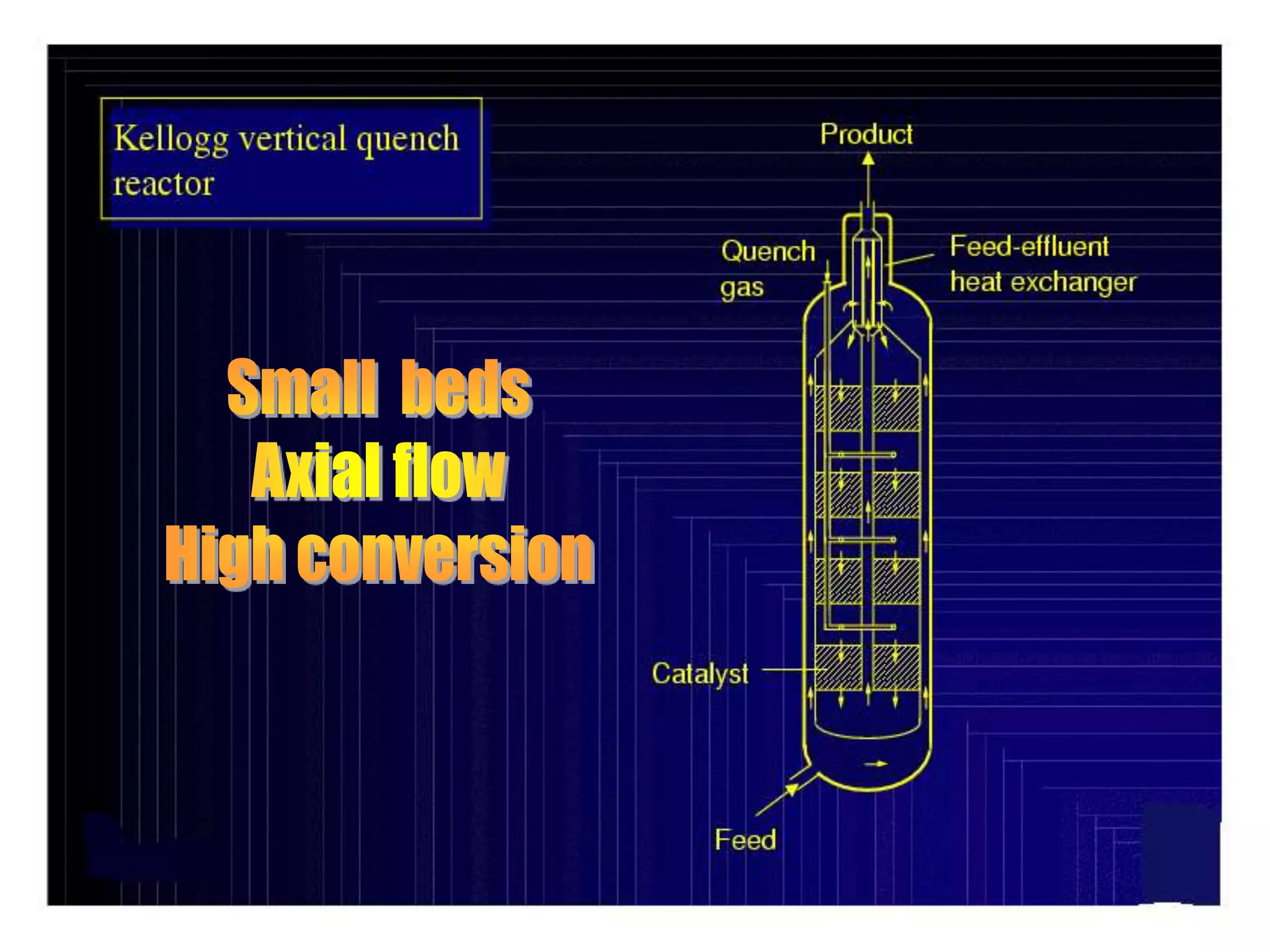
 Haldor Topsoe
 Kellogg(KRES)
 Kellogg-Braun-Root(KAAP, KBR)
 Foster Wheeler
 Krupp-Uhde
 ICI, LeadingConcept Ammonia (LCA)
Most widly used Technologies
80
81
82
83
84
85
Iron Catalyst
Ruthenium
86
87
88
89
90
91
92
93
Ammonia Casale Axial Radial
Converter:
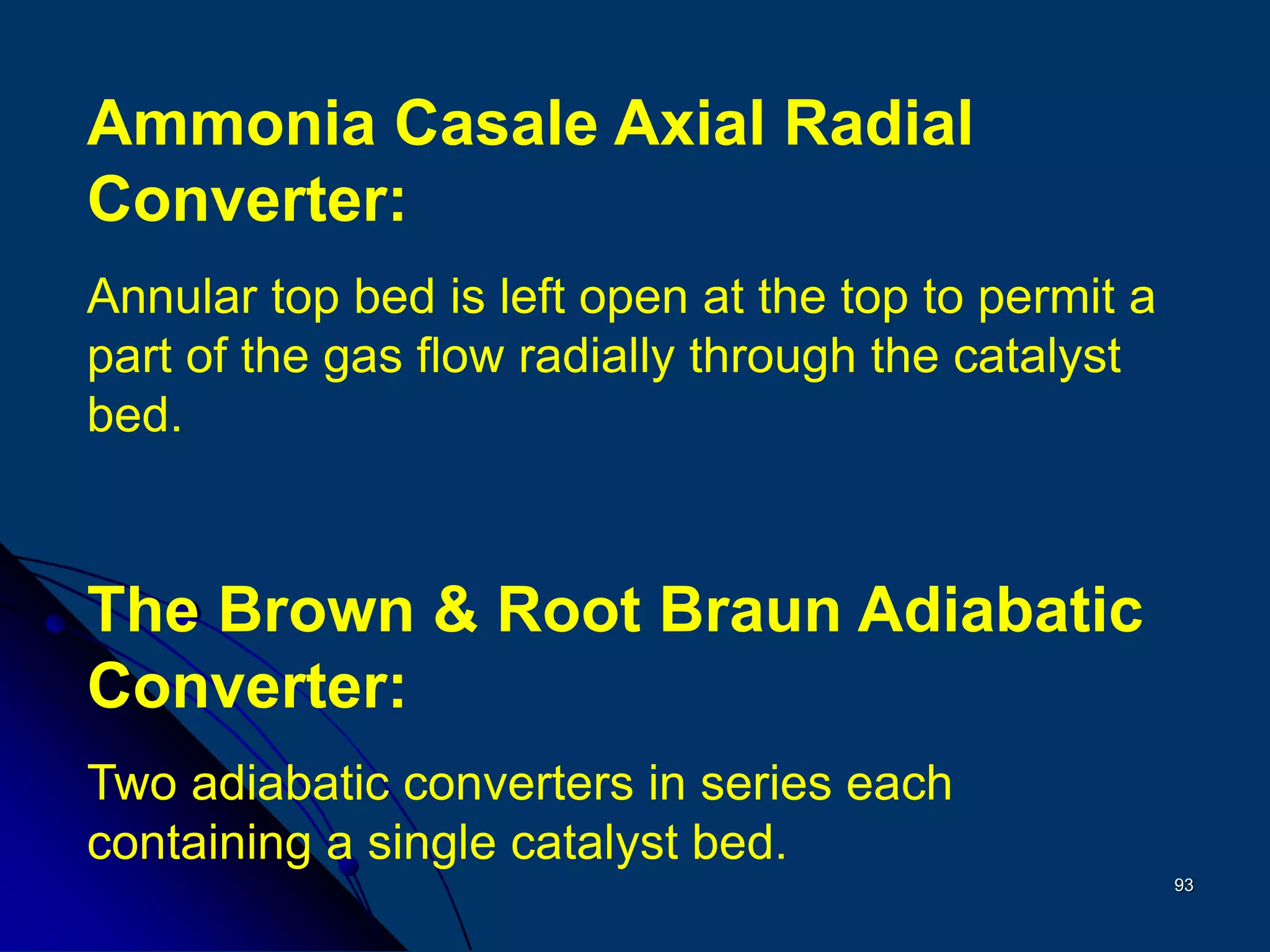
Annular top bed is left open at the top to permit a
part of the gas flow radially through the catalyst
bed.
The Brown & Root Braun Adiabatic
Converter:
Two adiabatic converters in series each
containing a single catalyst bed.
94
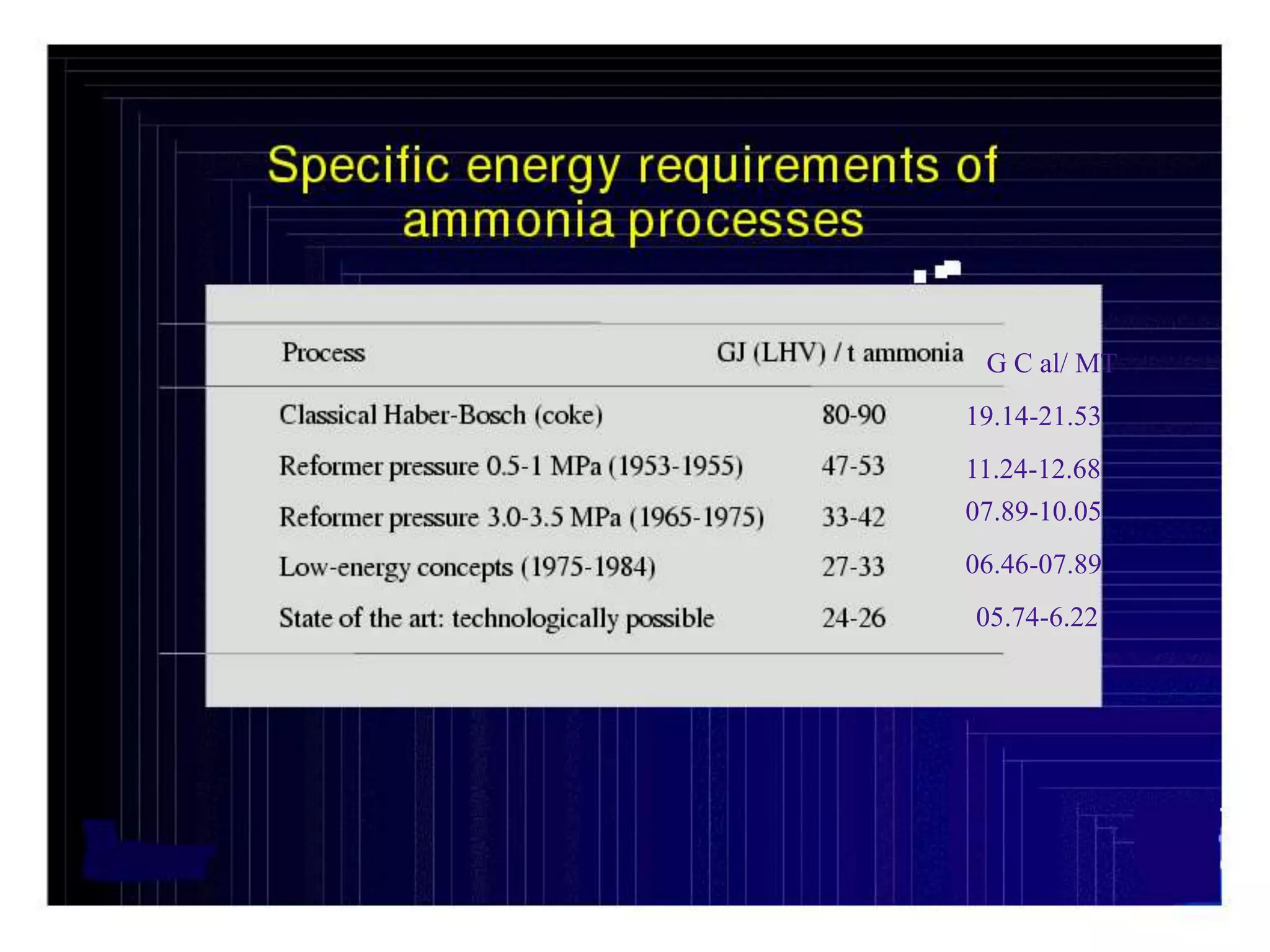
19.14-21.53
G C al/ MT
11.24-12.68
07.89-10.05
06.46-07.89
05.74-6.22
95

Various ammonia technology

  • 1.
    1 Presented By, Prem Baboo Sr.Manager(Prod) National Fertilizers Ltd. Vijaipur, India
  • 2.
    2 To understand howto utilize feed stock efficiently To reduce plant down time To improve man & machine safety To reduce pollution level To reduce capital cost To optimize the process
  • 3.
    3 Various Hydrogen andSyngas Production Technologies Gaseous and Light Liquid Hydrocarbons Heavy Oil Methanol Coal Water Steam & Autothermal Reforming Partial Oxidation Reforming Gasification Electrolysis Hydrogen and Syngas Oil Refining Hydrocracking Hydrotreating Ammonia Methanol Fischer Tropsch Fine Chemicals Oxo alcohols Acetic Acid SNG Ore Reduction Miscellaneous
  • 4.
    4 Main types ofproduction process for ammonia synthesis gas currently in operation - – Steam reforming of natural gas or other light hydrocarbons (Natural Gas Liquids, Liquefied Petroleum Gas, Naphtha) – Partial oxidation of heavy fuel oil or vacuum residue Coal gasification and water electrolysis are no longer in use in ammonia industry. About 85% of world ammonia production is based on steam reforming concepts. Heavy oil may be attractive under special environmental concerns, when natural gas is not available and the partial oxidation process could solve a waste problem (heavy residues, plastics recycle).
  • 5.
    5 Principal Reaction ofHydrocarbons Reforming and Partial Oxidation Reforming (strongly endothermic) CnHm + n H2O n CO + (m/2 + n) H2 CnHm + n CO2 2n CO + m/2 H2 Combustion (strongly exothermic) CnHm + (n + m/4) O2 n CO2 + m/2 H2O CnHm + n/2 O2 n CO + m/2 H2 Shift Conversion (mildly exothermic) CO + H2O CO2 + H2 Carbon Formation CnHm n C + m/2 H2 (Cracking) 2CO CO2 + C (Bouduard)
  • 6.
    6 Steam/ Air ReformingProcess Partial Oxidation Process
  • 7.
    7 Relative consumption figuresof natural gas reforming, heavy oil and coal gasification process. Natural Heavy Coal gas oil Energy consumption 1.0 1.3 1.7 Investment cost 1.0 1.4 2.4 Production cost 1.0 1.2 1.7 Drawbacks: Steam Reforming: Large loss of energy because of endothermic reaction. Partial oxidation: Reaction is exothermic and that the optimum H2/CO ratio of FT reaction, etc. is 2 or less.
  • 8.
    8 Block Diagram OfAmmonia Plant Gas Purification Reforming Shift Conversion Methanation Ammonia Synthesis Steam Process Air NG/PN Ammonia
  • 9.
    9 0 100 200 300 400 500 600 700 800 900 1000 B/L HDS ZnOPre- Ref Pri- Ref Sec- Ref HT LT GV Syn Units (Converters) Temperature(°C) 0 20 40 60 80 100 120 140 160 180 200 Pressure(kg/cm²)
  • 10.
  • 11.
    11 Natural Gas + Recycle H2 HDS (Co-Mo/ Ni-Mo) ZnO-A ZnO-B S + H2 = H2S H2S + ZnO = ZnS Co-Mo for Naphtha Ni-Mo for Natural Gas
  • 12.
    12  Natural Gascontains both Inorganic and Organic sulphur.  Sulfur is poisonous to Reforming Catalyst Ni + S = NiS Leads to:  Low catalyst activity (More CH4 Slip)  High tube skin temperature
  • 13.
    13  Organic Sulfurcan not be removed. Difficult to analyze.  Both HDS and The ZnO catalysts are not fully utilized  Sulfur slip can only be detected with lab. Analysis  Life of catalyst can not be determined unless lab. tests
  • 14.
    14  New catalystsare available for Organic sulfur removal  ST-101 of Haldor Topsoe  Synetix(Katalco)-Puraspec-2084  Sulfur level in ZnO catalyst bed  TRACERCO, it is probe used from out side to determine the level of sulfur absorption. (Synetix)  Sulfur testing coupons inserted at the down stream of ZnO beds. Analyzed after every 4-8 weeks (Synetix)
  • 15.
  • 16.
  • 17.
    17 Syngas Production Technologies Reformingand Partial Oxidation Pre-Reforming  Operating temperatures 390 °C - 500 °C  Catalyst  Adiabatic  Low steam/carbon ratio  Feed: Hydrocarbons up to final boiling point of 200 °C  No carbon formation Steam Reforming  Operating temperatures 650 °C - 900 °C  Catalyst  Heat by external combustion with air  High steam/carbon ratio  No carbon formation Autothermal Reforming  Operating temperatures 850 °C - 1000 °C  Catalyst  Heat by internal combustion with oxygen  High steam/carbon ratio  No carbon formation Partial Oxidation  Operating temperatures 1300 °C - 1500 °C  Non catalytic  Heat by internal combustion with oxygen  Low steam / carbon ratio  Carbon formation
  • 18.
  • 19.
  • 20.
  • 21.
  • 22.
  • 23.
  • 24.
    24 (Computation Fluid Dynamic) Heatintegration and metallurgy
  • 25.
    25  To reduceHigh Capital Cost  To reduce High Stack Losses and Pollution  To reduce High surface heat loss  To reduce Large Structure  To reduce Pressure drop  To reduce Costly catalyst tubes  To reduce startup time
  • 26.
    26  To Simplifythe process  To reduce S/C ratio  To reduce Maintenance cost  To simplify system heat integration  To reduce energy for ID & FD
  • 27.
    27  Catalyst  Catalysttube material  Air pre-heater (Modification)  Pre-Reformer  Reforming Process (heat integration)  Design
  • 28.
    28  High activity More surface area  Low pressure drop  High physical strength  More stable for poisons
  • 29.
    29  Reforming Catalysts RINGWAGON WHEEL 5-HOLE DD-RING Monolithic10-HOLE Latest by Synetix
  • 30.
    30  Reformer Tubes Concept To Increase heat transfer Facilitate more catalyst packing Increase life and skin temperature  Thickness reduced, increasing ID, OD kept Constant.  Material of construction changed HK-40 ►IN519 ►Micro alloy (Manu rite) What has been changed? Latest & best metal?
  • 31.
    31 Grade C CrNi Others HK-40 (1970’s) 0.40 25 20 HP-45Nb 0.45 25 35 1.5Nb HP-45Nb MA 0.45 25 35 1.5Nb,Ti,Zr HP-15Nb 0.15 25 35 1.5Nb IN-519 (1980’s) 0.30 24 24 1.5Nb IN-657 0.08 50 48 1.5Nb,N 20Cr-32Ni+Nb 0.10 20 32 Nb 35Cr-45Ni,MA(1990’s) 0.45 35 45 1.5Nb,Ti,Zr
  • 32.
    32  Basic reasonis to reduce heat loss through Primary Reformer stack  To save Fuel and proper combustion.  ID fan load is reduced.
  • 33.
  • 34.
    34 Feed Stock flexibility(Higher hydrocarbons) Reduced Load on Primary Reformer Improvement of Primary Reformer catalyst life Lower tube skin temperature As guard for Primary Reformer Catalyst Easy replacement of catalyst (without complete plant shut down)
  • 35.
    35 Feed 5.4 to5.6 Gcal/MT NH3 Fuel 1.7 to 2.5 Gcal/MT NH3 Power 0.05 to 0.09 Gcal/MT NH3 Steam + or - Gcal/MT NH3 Total 7.15 to 8.2 Gcal/MT NH3 Steam energy depends on the internal generation & consumption
  • 36.
    36 Can Energy bereduced? Feed Energy Fuel Energy Steam Energy Electrical Power Yes
  • 37.
    37  Steam-Methane-Reforming (SMR) Auto thermal Reforming (ATR)  Non-Catalytic Partial Oxidation (NCPOX)  Catalytic Partial Oxidation (CPOX)  Combined Reforming (CR)
  • 38.
    38 CONVENTIONAL STEAM REFORMING ProcessAir Natural Gas + Steam Reformed Gas Fuel
  • 39.
  • 40.
  • 41.
    41 Steam-Methane Reforming  Advancements Reduction in numbers of catalyst tubes  Primary Reformer size reduction  Elimination of FD fan  Dual fuel firing system  To improve combustion, improved burner designs
  • 42.
    42 Combustion Air Suction duct Reformerfurnace height is large Normally ID fan is at the top
  • 43.
    43 Auto Thermal Reformer Auto thermal reformer is a pressure vessel similar to that of Secondary Reformer.  Catalyst is advanced, resistance to high temperature.  It can be operated up to a pressure of 50kg/cm²G.  Start up time is minimum as compared to conventional reforming.  It is economic if used in large capacity plants(1800MTPD & above)  CH4 conversion is more than 99%
  • 44.
  • 45.
    45 Auto Thermal ReformingRoute ATR technology is offered by three Process Licensors M/s Lurgi, Germany M/s KBR, USA M/s HTAS, Denmark
  • 46.
    46 KBR ATR/ KRES (KBRReforming Exchange System) Purifier Technology
  • 47.
  • 48.
    48 Kellogg’s Advanced AutoThermal Reformer 1. Being vertical in shape can be accommodated in small area 2.Capacity is very high 3. Reduced NOx and Sox 4. Carbon conversion more than 99%
  • 49.
    49 Lurgi G-POX Low costnon-catalytic partial oxidation
  • 50.
  • 51.
  • 52.
    52 HTAS The key elementsof the technology are the design of the burner, the catalyst formulation, and refinement of the operating conditions. Topsøe’s proprietary burner design has been developed on the basis of computational fluid dynamics, hydraulic simulation, pilot plant testing, and feedback from industrial operation.
  • 53.
    53 Secondary Reformer  Criticalparts  Burner (gun)  Catalyst and top bricks  Insulation material  Material of construction
  • 54.
    54 Combined Reforming  Inthis process the heat generated in Secondary Reformer has been used in Primary Reformer  Type of Combined Reformers  Gas Heater Reforming (GHR)  Heat Exchange Reforming (HER)  Heat Integrated Reforming (HIR)
  • 55.
  • 56.
    56 ICI – HeatExchange Reformer
  • 57.
    57 Some Facts &Figures Process Feed Gcal Fuel Gcal Total Gcal Steam Reforming 5.29 1.72 to 2.15 7.01 to 7.44 Excess air Reforming 5.60 1.08 to 1.72 6.68 to 7.32 Auto thermal Reforming 5.93 0.86 to 1.72 6.79 to 7.65 Partial Oxidation 6.89 1.29 to 2.15 8.18 to 9.04 Energy = Gcal/MT Ammonia
  • 58.
    58 Brand Name GREENCAST 94 TRL KAST-O-LITE 97 LTRL SiO2 0.1 0.16 Al2O3 94.6 95.2 Fe2O3 0.1 0.1 CaO 4.9 4.16 MgO Traces Traces TiO2 Traces Traces Na2O+K2O 0.2 0.3 Trange 1850°C 1900°C
  • 59.
    59  Advanced Burnerfor Secondary Reformer ICI Burner Haldor Topsoe Burner
  • 60.
    60 MPG - LURGIMULTI PURPOSE GASIFCATION •Multi Purpose Gasification "MPG" is a process for the partial oxidation of hydrocarbons delivering a synthesis gas composed mainly of carbon monoxide and hydrogen. •Different -even unmixable- hydrocarbon-containing feeds can be gasified: ranging from •Natural gas, •Tars, •Other coal gasification residues, •Refinery residues, •Asphalts •Slurries and chemical wastes
  • 61.
    61 Waste Utilization Centreat SVZ (Sekundärrohstoff Verwertungs Zentrum Schwarze Pumpe)
  • 62.
    62 Gasifiers operated atSVZ (Sekundärrohstoff Verwertungs Zentrum Schwarze Pumpe) •Fixed bed gasifiers (FBG) •British Gas/Lurgi gasifier (BGL) •Multi Purpose gasifier (MPG)
  • 63.
    63 MPG Gas-gasification Gasification occursin the empty, refractory-lined reactor at temperatures between 1200°C and 1400°C A water-scrubbing tower removes traces of soot, HCN and NH3 Soot formation in the process is extremely low, so that no special filtration is necessary with the wastewater passing to a sour-water stripper and final treatment A desulfurization unit can be located either upstream or downstream of the gasification, depending again on the heat utilization and on the material selection for the equipment in areas prone to metal dusting.
  • 64.
    64 ATR Gas-MPG pressure [bar]35 70 temperature inlet [°C] 750 500 temperature outlet [°C] 950 1400 O2 / natural gas [mol/mol] 0.4 0.7 steam / natural gas [mol/mol] 1.5 … 1.7 0.05…0.2 Comparison of Lurgi´s catalytic and non-catalytic partial oxidation processes
  • 65.
    65 0 1 23 4 5 6 7 8 MPG Autothermal Reforming Steam Reforming H2/CO Molar Ratio Process Syngas Production Process Comparison H2 / CO Ratios
  • 66.
    66  The reaction CO + H2O  CO2 + H2 (exothermic) Water Shift reaction.  HT Shift Reaction : Iron Oxide Cromia Catalyst 300 – 450 oC CO Conversion : 90 – 95 %  LT Shift Reaction : CuO – ZnO Catalyst 200 - 300 oC  Present process is highly stable and well proven.  The drawbacks of the process are:  High pressure drop  Degree of conversion  Bottom most catalyst remains half utilized
  • 67.
    67  Isothermal reactorswere tested to improve the CO conversion but failed.  Reasons  High pressure drop  Mechanical failure of inter bed exchangers What is successful ?
  • 68.
    68  Radial flowconverter  Advantages:  Low pressure drop  Low CO slip  More than 80% of the catalyst utilization Casale Radial-Axial Flow Shift Converter
  • 69.
  • 70.
    70 Process  Chemical absorption Benfield, GV, Glycine, Catacarb, MEA.  Physical absorption  Methanol (Rectisol), Sulfolane (Sulfinol), Dimethyl ether of propylene Glycol (Selexol)  Adsorptive Purification  Zeolites (PSA)  Membrane Seperation  CMS (Carbon molecular Sieves): hydrogen permeation  Nanoporous Carbon membranes: Carbon dioxide permeation
  • 71.
  • 72.
  • 73.
  • 74.
  • 75.
  • 76.
    76  Advancements Why? High loop pressure  Low conversion per path  Compressor Recycle stage Efficiency Low  High pressure drop across the loop  High Compression power
  • 77.
    77  Advancements What? Improved catalyst activity  Reduce pressure +drop  Increase conversion per path  Reduce synthesis gas compressor size and increase efficiency.
  • 78.
    78  Synthesis gaspurification (eliminate CH4, Ar)/Reduction in gas volume  Latest Ruthenium catalyst (Reduced loop pressure)  Using catalyst in multi-beds with inter-stage cooler.  Drying and cooling synthesis gas  Eliminate inter cooler separators (or make compact)  Improved design
  • 79.
    79  Haldor Topsoe Kellogg(KRES)  Kellogg-Braun-Root(KAAP, KBR)  Foster Wheeler  Krupp-Uhde  ICI, LeadingConcept Ammonia (LCA) Most widly used Technologies
  • 80.
  • 81.
  • 82.
  • 83.
  • 84.
  • 85.
  • 86.
  • 87.
  • 88.
  • 89.
  • 90.
  • 91.
  • 92.
  • 93.
    93 Ammonia Casale AxialRadial Converter: Annular top bed is left open at the top to permit a part of the gas flow radially through the catalyst bed. The Brown & Root Braun Adiabatic Converter: Two adiabatic converters in series each containing a single catalyst bed.
  • 94.
    94 19.14-21.53 G C al/MT 11.24-12.68 07.89-10.05 06.46-07.89 05.74-6.22
  • 95.