Avoiding Syngas
Catalyst Mal-Operation
By
Gerard B. Hawkins
Managing Director, C.E.O.
Objective
 This presentation covers frequent and costly
incidents related to catalysts mal-operation with
the focus of providing the plant operator with
recommendations to avoid plant outages and
catalyst losses.
Process Information Disclaimer
 Information contained in this publication or as otherwise
supplied to Users is believed to be accurate and correct at time
of going to press, and is given in good faith, but it is for the
User to satisfy itself of the suitability of the Product for its own
particular purpose. GBHE gives no warranty as to the fitness of
the Product for any particular purpose and any implied
warranty or condition (statutory or otherwise) is excluded
except to the extent that exclusion is prevented by law. GBHE
accepts no liability for loss or damage resulting from reliance
on this information. Freedom under Patent, Copyright and
Designs cannot be assumed.
Content
 Review of incidents by reactor
• Primary reforming
• Secondary reforming
• HTS
• LTS
• Methanator
 Reactor loading
 Support media
 Some general comments on alternative actions when a
plant gets into abnormal operation
Reformer Catalyst Loading
 UNIDENSETM is now established as key to an even
reformer loading
 However UNIDENSE requires some care to
achieve its full potential
 A reformer in South America was loaded by an
inexperienced team and had to be unloaded and
reloaded with 20 % catalyst losses.
 Lesson – check experience of UNIDENSE loading
supervisors
UNIDENSE is a trademark of Yara International ASA
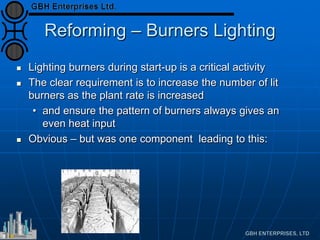
Reforming – Burners Lighting
 Lighting burners during start-up is a critical activity
 The clear requirement is to increase the number of lit
burners as the plant rate is increased
• and ensure the pattern of burners always gives an
even heat input
 Obvious – but was one component leading to this:
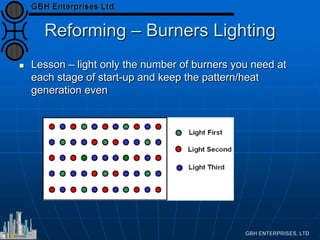
Reforming – Burners Lighting
 Lesson – light only the number of burners you need at
each stage of start-up and keep the pattern/heat
generation even
Reformer - Carbon
 Carbon deposition will occur when excess hydrocarbons
are introduced
 There are several ways to do this:
• Inadequate purging during a plant trip can lead to feed
being stored in the desulfurization vessel / pipe work
 Then introducing nitrogen purge pushes this
hydrocarbon into the reformer
• Naphtha fed plants have a high risk of feed condensing
and sitting in dead legs until some motive force pushes
this into the furnace
• Erroneous feed flow measurement – more critical in
low steam ratio plants
Reformer – Carbon from Naphtha
 Introduction of nitrogen during a start-up increased the
reformer pressure drop from 1.4 to 7 bar in 2 minutes
 The nitrogen feed line was 100mm diameter and around
1km long, capable of holding up to 10te of naphtha
 A spectacle plate was not swung during earlier operation
 On previous occasions a drain valve was opened on the
nitrogen compressor – this time the valve was not
operable
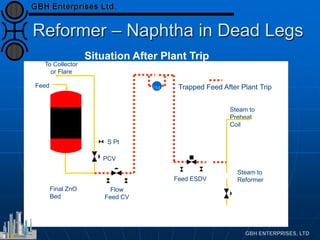
Reformer – Naphtha in Dead Legs
Situation After Plant Trip
Steam to
Reformer
Flow
Feed CV
Feed ESDV
Steam to
Preheat
Coil
FM
Final ZnO
Bed
Feed
To Collector
or Flare
PCV
S Pt
Trapped Feed After Plant Trip
Reforming - Carbon from Liquid
HCs
 A couple of ammonia plants in South America had
problems before the natural gas condensate removal
plant was installed
 These plants took their feed off the bottom of the supply
line and hence took any liquids that were present
 The liquid did not register in the flow meters which were
orifice plate type – thereby reducing the actual steam to
feed ratio
 Non-alkalized catalysts lasted as little as 6 weeks – and
when replaced by alkalized products lasted a 2 year run
Reforming - Carbon from Liquid
HCs
 Lessons
• Gas flow meters largely ignore the presence
of condensed higher hydrocarbons
• Note also that during startup flowmeters may
read in error if not compensated for
temperature and pressure
• Alkalized reforming catalysts give very
significant additional margin against carbon
formation in primary reformers
Reforming – Tube Failure from
Higher Hydrocarbons
 A plant in North America was the sole user of gas that
came down a branch that went under a river
 During a start-up after an extended shutdown - when
lighting burners – liquid was seen flowing from a few
burners onto tubes
 While the operator exited and radioed the control room
to shut off the fuel - a tube burst leading to significant
damage to the furnace/tubes
Reforming – Tube Failure from
Higher Hydrocarbons
 It was thought that hydrocarbons had
condensed in the cooler section of pipe under
the river
 Lessons:
• Consider potential for condensation of higher
hydrocarbons, especially
 If lines are cooled below normal
 If levels of higher hydrocarbons increase
Reforming – Failure from
Condensation
 We have another example of catalyst breakage
from condensation on start-up
 A naphtha fed plant was not able to provide
nitrogen purge for the initial phase of start-up and
so heated the reformer using steam
 Around 20 start-ups from cold eventually led to
breakage of catalyst, poor flow distribution, hot
spots and required catalyst change
Reforming – Failure from
Condensation
 Lesson:
• Reforming catalyst should be warmed up to
50°C above the dew point before introduction
of steam
Secondary Reforming
 All incidents on secondary reformers are related
to the burners
 The problem of increasing plant rate to the point
that there is inadequate mixing zone is well
understood but requires detailed CFD modelling
to predict
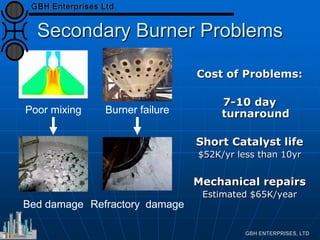
Secondary Burner Problems
Cost of Problems:
7-10 day
turnaround
Short Catalyst life
$52K/yr less than 10yr
Mechanical repairs
Estimated $65K/year
Poor mixing Burner failure
Bed damage Refractory damage
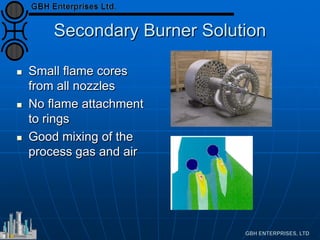
Secondary Burner Solution
 Small flame cores
from all nozzles
 No flame attachment
to rings
 Good mixing of the
process gas and air
HTS
 The main problem with HTS reactors is
upstream boiler leaks
 We have another case where dehydration of the
catalyst has lead to an exotherm on startup
HTS - Boiler Leaks
 This is a potential problem on ammonia plants with high pressure
boilers upstream of the HTS
 Boiler leaks put stress onto the HTS catalyst by:
• rapid wetting/drying and
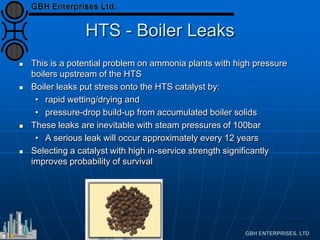
• pressure-drop build-up from accumulated boiler solids
 These leaks are inevitable with steam pressures of 100bar
• A serious leak will occur approximately every 12 years
 Selecting a catalyst with high in-service strength significantly
improves probability of survival
HTS VSG-F101 Resists Boiler
Leaks
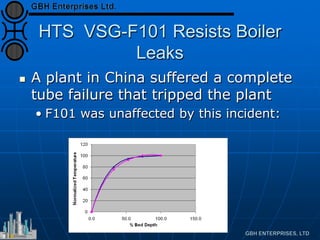
 A plant in China suffered a complete
tube failure that tripped the plant
• F101 was unaffected by this incident:
HTS - Dehydration
 A plant in China had kept a charge of HTS catalyst in a spare reactor
for 1 year – but had left this reactor open to the air – so the catalyst
had adsorbed water
 The start-up required nitrogen heating for 2 days to dry the whole bed
– and in doing so dehydrated the catalyst in the top/bulk of the bed
 100% steam was switched into the reactor against our advice of 5%
 An exotherm started and then (unrelated) the plant tripped (site power
trip) which held the reactor with 100% steam
 The exotherm reached 530°C, and look several hours to cool down
with N2
 The final activity when on-line looked good, with expected low
pressure-drop.
HTS Lessons
 Do not leave catalysts exposed to damp
atmospheres
 VSG-F101 give the best survival of boiler leak
and over-reduction incidents
 Incorporate the GBHE VULCAN Series
procedures when over-reduction is suspected
LTS
 A plant in North America had to top skim its LTS
bed due to high pressure drop
 The main cause was poor atomization of quench
water
 This was not helped by the competitive catalyst
installed which developed very poor strength
when wetted
LTS
 Lessons:
• Ensure quench water nozzles are on the
shutdown inspection list
• Check for adequate pipe length for
vaporization
• Use catalyst with good strength after
wetting
Methanator
 The main hazards when methanation reactors
are shutdown are nickel carbonyl (see plant
safety presentation on nickel Carbonyl) and self
heating when exposed to air
 An example of self heating comes from a
methanator on an olefin cracker
Methanator self heating
 The plant was shut down and purged with
nitrogen
 The inlet and exit valves and thermocouples
were removed for repair
 Open ends were covered in plastic sheet
 Catalyst was in reduced state, with N2 purge
Methanator Self-heating
 A reading of 454°C/850°F was seen on re-
connection of the thermocouples
• The plastic sheeting was not adequate isolation
• Air entered the vessel and
 A downward purge of nitrogen then gave a
reading of 649°C/1200°F on the bottom
thermocouple
 Decided to change catalyst as needed 5 yr run
 GBHE had product on site within 4 days
(including a weekend)
Methanator Learning
 Reduced methanation catalyst becomes very hot
when exposed to air
 Secure isolation/inert purge is essential for
maintenance on vessels containing reduced
catalyst
 With little or no gas flow, thermocouples do not
show the peak temperature
Support Media
 Don’t spoil a ship for a few cents worth of tar!
 Below Bed:
• Support media does a key job preventing catalyst pass
through the exit collector – and doing this with low
pressure-drop
 Above Bed:
• Support media placed on top of the bed protects
catalysts from high inlet gas velocities - which have the
potential to break catalysts through disturbance and
milling
• High voidage media can also be used to reduce the
effects of boiler solid build-up
Support Media - problems
 A plant decided to use some old support
balls that had been stored outside for some
years
 This was a LTS duty so either alumina or
silica-alumina would be suitable
 Shortly after start-up the reactor pressure-
drop started to increase
 This eventually required a shutdown to
address
Support Media - problems
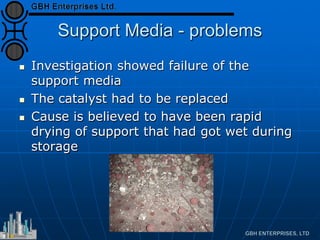
 Investigation showed failure of the
support media
 The catalyst had to be replaced
 Cause is believed to have been rapid
drying of support that had got wet during
storage
Support Media – use of Si/Al
 Silica-alumina support is cheaper
 A plant decided to use silica-alumina balls in a high
temperature shift bed
 It was thought that this would be a low enough
temperature for silica migration not to be an issue
 Not true – silica migrated downstream and
collected on the tubes of the exchanger before the
LTS – which required regular shutdowns to clean
 A recent enquiry associated with HDS and HTS
catalysts simply specified ‘ceramic balls’
Support Media – Catalyst
Protection
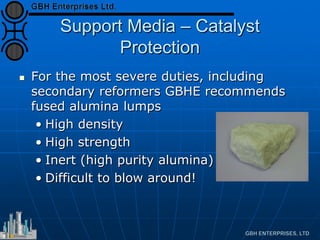
 For the most severe duties, including
secondary reformers GBHE recommends
fused alumina lumps
• High density
• High strength
• Inert (high purity alumina)
• Difficult to blow around!
Support Media - advice
 Lessons:
• Store support media to the same standard as
catalysts – the cost will be the same if they
fail!
• Only use high purity alumina support above
300°C in steam environments
• Use GBHE ‘A2ST’ for protection against
accumulation of boiler solids from boiler leaks
• Use fused alumina lumps for the ultimate
protection against bed disturbance
‘A2ST’ Advanced Alumina Support Technology
Reactor loading
 Don’t be tempted to put that last bit in!
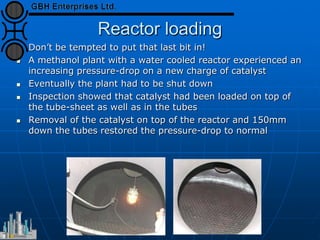
 A methanol plant with a water cooled reactor experienced an
increasing pressure-drop on a new charge of catalyst
 Eventually the plant had to be shut down
 Inspection showed that catalyst had been loaded on top of
the tube-sheet as well as in the tubes
 Removal of the catalyst on top of the reactor and 150mm
down the tubes restored the pressure-drop to normal
Reactor overloading
 A hydrogen plant in Europe implemented a plant up-rate
and as part of this increased the HTS volume (we advised
it could be lowered)
 In order to maximize the catalyst volume the hold-down
system was removed!
 Milling then increased the pressure-drop
 A reactor ‘inlet distributor’ is better described as ‘inlet gas
momentum destruction device’
 Lesson – gas distribution/bed protection requires careful
design along with the rest of a plant up-rate
Reactor loading
 A plant with a HTS reactor with two beds (one
vessel) went with a short load and split the short
load equally between each of the two beds.
 The net effect was a bed L/D of 0.2 – a long way
below the minimum recommendation of 1.0
 The charge had to be replaced after 2 years
 One can debate the merits of two beds with L/D
of 0.2 with gas mixing in-between or one bed with
an L/D of 0.4
 The key is neither – but to load the bed(s)
carefully:
Reactor Loading
 The ideal catalyst loading method is by sock with
the minimum or raking
 Any raking will introduce density differences that
will lead to early discharge of the catalyst due to
the uneven flow distribution produced
 Lesson: allowing your loading company to rake
catalyst is equivalent to throwing catalyst away
Priorities When Things go Wrong
 There is no universal advice – but some
up-front thinking can lead to faster more
confident decisions
 A number of incidents have involved
exotherms on catalysts which threatened
the integrity of their reactors
Example exotherm and action
 Hydrogen was being removed from a process
stream using a copper oxide catalyst
 During commissioning a hydrogen stream was
mistakenly introduced and the catalyst
temperature rose to 1000°C
 GBHE staff on site advised immediate
depressurization
 Vessel damage was avoided
 There were problems later on downstream mol
sieve driers from water produced which
accumulated in a dead leg
Depressurization vs Purging
 With the previous example in mind it is
worth reflecting on the merits of
depressurization and purging
Depressurization
 Several advantages:
• It decreases the partial pressure of
reactants which may help slow the
temperature rise
• It reduces the stress on equipment
enabling the handling of higher
temperatures
• No motive force is required – so it is
reliable
• Lowering the pressure makes purging
more effective
Depressurization
 Risks
• Depressurization can generate high gas
velocities – enough to fluidize catalyst beds
• Fluidized catalyst beds can lose their top
protective layer (into the bed) and suffer:
 flow distribution problems or
 pressure drop increase if loss of the top layer
allows milling
Purging
 Advantages
• Can maintain plant pressure (but is
better if pressure reduced)
• Fluidization risks to catalyst beds much
lower
Purging
 Disadvantages
• Difficult to achieve high flow-rates – steam is
often the purge gas with highest availability
• Steam can deactivate catalysts through
oxidation and in some cases sintering
• Nitrogen is a good inert material – but often
the available flow is limited
• Need to consider trace oxygen in nitrogen
 Ideal is nitrogen with enough hydrogen to ensure
reducing conditions
Conclusions
 The incidents here suggest:
• Selecting the right catalyst has a significant
impact on the ability of a plant to continue
operation through an unplanned event
• Operator training/procedures are key to
avoiding incidents
Avoid syn gas catalyst mal operation

Avoid syn gas catalyst mal operation

  • 1.
    Avoiding Syngas Catalyst Mal-Operation By GerardB. Hawkins Managing Director, C.E.O.
  • 2.
    Objective  This presentationcovers frequent and costly incidents related to catalysts mal-operation with the focus of providing the plant operator with recommendations to avoid plant outages and catalyst losses.
  • 3.
    Process Information Disclaimer Information contained in this publication or as otherwise supplied to Users is believed to be accurate and correct at time of going to press, and is given in good faith, but it is for the User to satisfy itself of the suitability of the Product for its own particular purpose. GBHE gives no warranty as to the fitness of the Product for any particular purpose and any implied warranty or condition (statutory or otherwise) is excluded except to the extent that exclusion is prevented by law. GBHE accepts no liability for loss or damage resulting from reliance on this information. Freedom under Patent, Copyright and Designs cannot be assumed.
  • 4.
    Content  Review ofincidents by reactor • Primary reforming • Secondary reforming • HTS • LTS • Methanator  Reactor loading  Support media  Some general comments on alternative actions when a plant gets into abnormal operation
  • 5.
    Reformer Catalyst Loading UNIDENSETM is now established as key to an even reformer loading  However UNIDENSE requires some care to achieve its full potential  A reformer in South America was loaded by an inexperienced team and had to be unloaded and reloaded with 20 % catalyst losses.  Lesson – check experience of UNIDENSE loading supervisors UNIDENSE is a trademark of Yara International ASA
  • 6.
    Reforming – BurnersLighting  Lighting burners during start-up is a critical activity  The clear requirement is to increase the number of lit burners as the plant rate is increased • and ensure the pattern of burners always gives an even heat input  Obvious – but was one component leading to this:
  • 7.
    Reforming – BurnersLighting  Lesson – light only the number of burners you need at each stage of start-up and keep the pattern/heat generation even
  • 8.
    Reformer - Carbon Carbon deposition will occur when excess hydrocarbons are introduced  There are several ways to do this: • Inadequate purging during a plant trip can lead to feed being stored in the desulfurization vessel / pipe work  Then introducing nitrogen purge pushes this hydrocarbon into the reformer • Naphtha fed plants have a high risk of feed condensing and sitting in dead legs until some motive force pushes this into the furnace • Erroneous feed flow measurement – more critical in low steam ratio plants
  • 9.
    Reformer – Carbonfrom Naphtha  Introduction of nitrogen during a start-up increased the reformer pressure drop from 1.4 to 7 bar in 2 minutes  The nitrogen feed line was 100mm diameter and around 1km long, capable of holding up to 10te of naphtha  A spectacle plate was not swung during earlier operation  On previous occasions a drain valve was opened on the nitrogen compressor – this time the valve was not operable
  • 10.
    Reformer – Naphthain Dead Legs Situation After Plant Trip Steam to Reformer Flow Feed CV Feed ESDV Steam to Preheat Coil FM Final ZnO Bed Feed To Collector or Flare PCV S Pt Trapped Feed After Plant Trip
  • 11.
    Reforming - Carbonfrom Liquid HCs  A couple of ammonia plants in South America had problems before the natural gas condensate removal plant was installed  These plants took their feed off the bottom of the supply line and hence took any liquids that were present  The liquid did not register in the flow meters which were orifice plate type – thereby reducing the actual steam to feed ratio  Non-alkalized catalysts lasted as little as 6 weeks – and when replaced by alkalized products lasted a 2 year run
  • 12.
    Reforming - Carbonfrom Liquid HCs  Lessons • Gas flow meters largely ignore the presence of condensed higher hydrocarbons • Note also that during startup flowmeters may read in error if not compensated for temperature and pressure • Alkalized reforming catalysts give very significant additional margin against carbon formation in primary reformers
  • 13.
    Reforming – TubeFailure from Higher Hydrocarbons  A plant in North America was the sole user of gas that came down a branch that went under a river  During a start-up after an extended shutdown - when lighting burners – liquid was seen flowing from a few burners onto tubes  While the operator exited and radioed the control room to shut off the fuel - a tube burst leading to significant damage to the furnace/tubes
  • 14.
    Reforming – TubeFailure from Higher Hydrocarbons  It was thought that hydrocarbons had condensed in the cooler section of pipe under the river  Lessons: • Consider potential for condensation of higher hydrocarbons, especially  If lines are cooled below normal  If levels of higher hydrocarbons increase
  • 15.
    Reforming – Failurefrom Condensation  We have another example of catalyst breakage from condensation on start-up  A naphtha fed plant was not able to provide nitrogen purge for the initial phase of start-up and so heated the reformer using steam  Around 20 start-ups from cold eventually led to breakage of catalyst, poor flow distribution, hot spots and required catalyst change
  • 16.
    Reforming – Failurefrom Condensation  Lesson: • Reforming catalyst should be warmed up to 50°C above the dew point before introduction of steam
  • 17.
    Secondary Reforming  Allincidents on secondary reformers are related to the burners  The problem of increasing plant rate to the point that there is inadequate mixing zone is well understood but requires detailed CFD modelling to predict
  • 18.
    Secondary Burner Problems Costof Problems: 7-10 day turnaround Short Catalyst life $52K/yr less than 10yr Mechanical repairs Estimated $65K/year Poor mixing Burner failure Bed damage Refractory damage
  • 19.
    Secondary Burner Solution Small flame cores from all nozzles  No flame attachment to rings  Good mixing of the process gas and air
  • 20.
    HTS  The mainproblem with HTS reactors is upstream boiler leaks  We have another case where dehydration of the catalyst has lead to an exotherm on startup
  • 21.
    HTS - BoilerLeaks  This is a potential problem on ammonia plants with high pressure boilers upstream of the HTS  Boiler leaks put stress onto the HTS catalyst by: • rapid wetting/drying and • pressure-drop build-up from accumulated boiler solids  These leaks are inevitable with steam pressures of 100bar • A serious leak will occur approximately every 12 years  Selecting a catalyst with high in-service strength significantly improves probability of survival
  • 22.
    HTS VSG-F101 ResistsBoiler Leaks  A plant in China suffered a complete tube failure that tripped the plant • F101 was unaffected by this incident:
  • 23.
    HTS - Dehydration A plant in China had kept a charge of HTS catalyst in a spare reactor for 1 year – but had left this reactor open to the air – so the catalyst had adsorbed water  The start-up required nitrogen heating for 2 days to dry the whole bed – and in doing so dehydrated the catalyst in the top/bulk of the bed  100% steam was switched into the reactor against our advice of 5%  An exotherm started and then (unrelated) the plant tripped (site power trip) which held the reactor with 100% steam  The exotherm reached 530°C, and look several hours to cool down with N2  The final activity when on-line looked good, with expected low pressure-drop.
  • 24.
    HTS Lessons  Donot leave catalysts exposed to damp atmospheres  VSG-F101 give the best survival of boiler leak and over-reduction incidents  Incorporate the GBHE VULCAN Series procedures when over-reduction is suspected
  • 25.
    LTS  A plantin North America had to top skim its LTS bed due to high pressure drop  The main cause was poor atomization of quench water  This was not helped by the competitive catalyst installed which developed very poor strength when wetted
  • 26.
    LTS  Lessons: • Ensurequench water nozzles are on the shutdown inspection list • Check for adequate pipe length for vaporization • Use catalyst with good strength after wetting
  • 27.
    Methanator  The mainhazards when methanation reactors are shutdown are nickel carbonyl (see plant safety presentation on nickel Carbonyl) and self heating when exposed to air  An example of self heating comes from a methanator on an olefin cracker
  • 28.
    Methanator self heating The plant was shut down and purged with nitrogen  The inlet and exit valves and thermocouples were removed for repair  Open ends were covered in plastic sheet  Catalyst was in reduced state, with N2 purge
  • 29.
    Methanator Self-heating  Areading of 454°C/850°F was seen on re- connection of the thermocouples • The plastic sheeting was not adequate isolation • Air entered the vessel and  A downward purge of nitrogen then gave a reading of 649°C/1200°F on the bottom thermocouple  Decided to change catalyst as needed 5 yr run  GBHE had product on site within 4 days (including a weekend)
  • 30.
    Methanator Learning  Reducedmethanation catalyst becomes very hot when exposed to air  Secure isolation/inert purge is essential for maintenance on vessels containing reduced catalyst  With little or no gas flow, thermocouples do not show the peak temperature
  • 31.
    Support Media  Don’tspoil a ship for a few cents worth of tar!  Below Bed: • Support media does a key job preventing catalyst pass through the exit collector – and doing this with low pressure-drop  Above Bed: • Support media placed on top of the bed protects catalysts from high inlet gas velocities - which have the potential to break catalysts through disturbance and milling • High voidage media can also be used to reduce the effects of boiler solid build-up
  • 32.
    Support Media -problems  A plant decided to use some old support balls that had been stored outside for some years  This was a LTS duty so either alumina or silica-alumina would be suitable  Shortly after start-up the reactor pressure- drop started to increase  This eventually required a shutdown to address
  • 33.
    Support Media -problems  Investigation showed failure of the support media  The catalyst had to be replaced  Cause is believed to have been rapid drying of support that had got wet during storage
  • 34.
    Support Media –use of Si/Al  Silica-alumina support is cheaper  A plant decided to use silica-alumina balls in a high temperature shift bed  It was thought that this would be a low enough temperature for silica migration not to be an issue  Not true – silica migrated downstream and collected on the tubes of the exchanger before the LTS – which required regular shutdowns to clean  A recent enquiry associated with HDS and HTS catalysts simply specified ‘ceramic balls’
  • 35.
    Support Media –Catalyst Protection  For the most severe duties, including secondary reformers GBHE recommends fused alumina lumps • High density • High strength • Inert (high purity alumina) • Difficult to blow around!
  • 36.
    Support Media -advice  Lessons: • Store support media to the same standard as catalysts – the cost will be the same if they fail! • Only use high purity alumina support above 300°C in steam environments • Use GBHE ‘A2ST’ for protection against accumulation of boiler solids from boiler leaks • Use fused alumina lumps for the ultimate protection against bed disturbance ‘A2ST’ Advanced Alumina Support Technology
  • 37.
    Reactor loading  Don’tbe tempted to put that last bit in!  A methanol plant with a water cooled reactor experienced an increasing pressure-drop on a new charge of catalyst  Eventually the plant had to be shut down  Inspection showed that catalyst had been loaded on top of the tube-sheet as well as in the tubes  Removal of the catalyst on top of the reactor and 150mm down the tubes restored the pressure-drop to normal
  • 38.
    Reactor overloading  Ahydrogen plant in Europe implemented a plant up-rate and as part of this increased the HTS volume (we advised it could be lowered)  In order to maximize the catalyst volume the hold-down system was removed!  Milling then increased the pressure-drop  A reactor ‘inlet distributor’ is better described as ‘inlet gas momentum destruction device’  Lesson – gas distribution/bed protection requires careful design along with the rest of a plant up-rate
  • 39.
    Reactor loading  Aplant with a HTS reactor with two beds (one vessel) went with a short load and split the short load equally between each of the two beds.  The net effect was a bed L/D of 0.2 – a long way below the minimum recommendation of 1.0  The charge had to be replaced after 2 years  One can debate the merits of two beds with L/D of 0.2 with gas mixing in-between or one bed with an L/D of 0.4  The key is neither – but to load the bed(s) carefully:
  • 40.
    Reactor Loading  Theideal catalyst loading method is by sock with the minimum or raking  Any raking will introduce density differences that will lead to early discharge of the catalyst due to the uneven flow distribution produced  Lesson: allowing your loading company to rake catalyst is equivalent to throwing catalyst away
  • 41.
    Priorities When Thingsgo Wrong  There is no universal advice – but some up-front thinking can lead to faster more confident decisions  A number of incidents have involved exotherms on catalysts which threatened the integrity of their reactors
  • 42.
    Example exotherm andaction  Hydrogen was being removed from a process stream using a copper oxide catalyst  During commissioning a hydrogen stream was mistakenly introduced and the catalyst temperature rose to 1000°C  GBHE staff on site advised immediate depressurization  Vessel damage was avoided  There were problems later on downstream mol sieve driers from water produced which accumulated in a dead leg
  • 43.
    Depressurization vs Purging With the previous example in mind it is worth reflecting on the merits of depressurization and purging
  • 44.
    Depressurization  Several advantages: •It decreases the partial pressure of reactants which may help slow the temperature rise • It reduces the stress on equipment enabling the handling of higher temperatures • No motive force is required – so it is reliable • Lowering the pressure makes purging more effective
  • 45.
    Depressurization  Risks • Depressurizationcan generate high gas velocities – enough to fluidize catalyst beds • Fluidized catalyst beds can lose their top protective layer (into the bed) and suffer:  flow distribution problems or  pressure drop increase if loss of the top layer allows milling
  • 46.
    Purging  Advantages • Canmaintain plant pressure (but is better if pressure reduced) • Fluidization risks to catalyst beds much lower
  • 47.
    Purging  Disadvantages • Difficultto achieve high flow-rates – steam is often the purge gas with highest availability • Steam can deactivate catalysts through oxidation and in some cases sintering • Nitrogen is a good inert material – but often the available flow is limited • Need to consider trace oxygen in nitrogen  Ideal is nitrogen with enough hydrogen to ensure reducing conditions
  • 48.
    Conclusions  The incidentshere suggest: • Selecting the right catalyst has a significant impact on the ability of a plant to continue operation through an unplanned event • Operator training/procedures are key to avoiding incidents