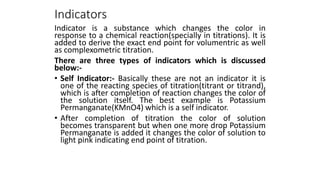
1. Indicators are substances that change color in response to chemical reactions, especially titrations, allowing the determination of an endpoint.
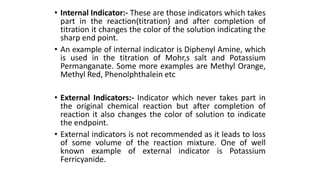
2. There are three types of indicators: self-indicators that change color on their own, internal indicators that participate in the reaction, and external indicators that do not participate but still change color at the endpoint.
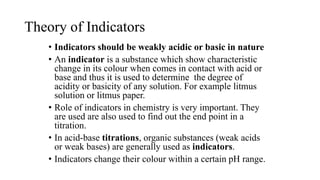
3. Indicator color changes are explained by two theories: Ostwald's theory of ionization states that indicators are weak acids or bases whose color depends on whether they are ionized or not. The quinonoid theory proposes that indicators exist in colored or colorless tautomeric forms that interchange depending on pH.

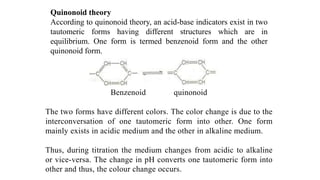
![1. Phenolphthalein
• It is represented as HPh. This indicator being a weak acid ionises in
solution to a small extent as follows:
HPh H+ + Ph-
Colourless Pink
Acid Base
• Applying law of mass action, we get
K = [H+][Ph-]/[HPh]
• The undissociated molecules of phenolphthalein are colourless while the
Ph- ions are pink in colour. In presence of an acid , ionisation of HPh is
practically negligible as the equilibrium shifts to left hand side due to high
concentration of H+ ions.
• Thus, the solution would remain colourless. On addition of alkali,
hydrogen ions are removed by OH- ions in the form of water molecules
and the equilibrium shifts to right hand side.
• Thus, the concentration of Ph- ions increases in solution and they impart
pink colour to the solution.](https://image.slidesharecdn.com/theoryofindicators-220323102141/85/Theory-of-Indicators-pptx-6-320.jpg)
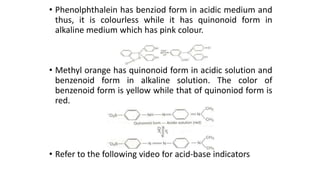
![2. Methyl Orange
It is a very weak base and can be represented as MeOH. It is ionized in
solution to give Me+ and OH- ions.
MeOH Me+ + OH-
Yellow Red
Basic acidic
Applying law of mass action,
K = [Me+ ][OH- ]/[MeOH]
• In presence of an acid, OH- ions are removed in the form of water
molecules and the above equilibrium shifts to right hand side.
• Thus, sufficient Me+ ions are produced which impart red colour to
the solution. On addition of alkali, the concentra¬tion of OH- ions
increases in the solution and the equilibrium shifts to left hand side,
i.e., the ionisation of MeOH is practi¬cally negligible.
• Thus, the solution acquires the colour of unionised methyl orange
molecules, i.e., yellow.](https://image.slidesharecdn.com/theoryofindicators-220323102141/85/Theory-of-Indicators-pptx-7-320.jpg)


![CTEV [ clubfoot] DR ARUN LAL ,DR MOHAMED ASHRAF travancore medical college k...](https://cdn.slidesharecdn.com/ss_thumbnails/ctevclubfootdrarunlaldrmohamedashraftravancoremedicalcollegekollamkeralaindia-260208063247-18fc466c-thumbnail.jpg?width=640&height=640&fit=bounds)


![PERI-PROSTHETIC FRACTURE NAIL-PLATE CONSTRUCT [NPC].pptx](https://cdn.slidesharecdn.com/ss_thumbnails/drarunkumardrmohamedashrafperiprostheticfrasturenail-plateconstructnpc-260209164459-7e9d15a1-thumbnail.jpg?width=640&height=640&fit=bounds)