Practical Shielding, EMC/EMI, Noise Reduction, 
Earthing and Circuit Board Layout 
Technology www.idc-online.com/slideshare Technology TTrraaiinniinngg tthhaatt Wwoorrkkss
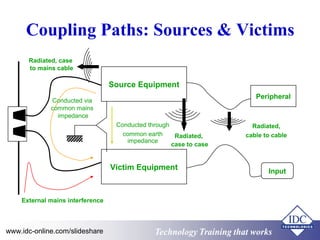
Coupling Paths: Sources & Victims 
Source Equipment 
Radiated, cable to cable 
case to case 
Conducted through 
common earth 
impedance 
Victim Equipment 
Peripheral 
Radiated, 
Input 
Radiated, case 
to mains cable 
Conducted via 
common mains 
impedance 
External mains interference 
Technology www.idc-online.com/slideshare Technology TTrraaiinniinngg tthhaatt Wwoorrkkss
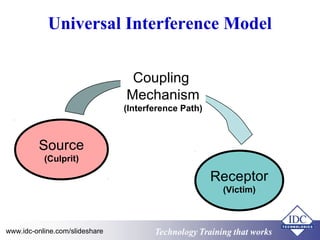
Universal Interference Model 
Source 
(Culprit) 
Receptor 
(Victim) 
Coupling 
Mechanism 
(Interference Path) 
Technology www.idc-online.com/slideshare Technology TTrraaiinniinngg tthhaatt Wwoorrkkss
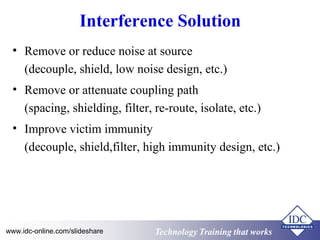
Interference Solution 
• Remove or reduce noise at source 
(decouple, shield, low noise design, etc.) 
• Remove or attenuate coupling path 
(spacing, shielding, filter, re-route, isolate, etc.) 
• Improve victim immunity 
(decouple, shield,filter, high immunity design, etc.) 
Technology www.idc-online.com/slideshare Technology TTrraaiinniinngg tthhaatt Wwoorrkkss
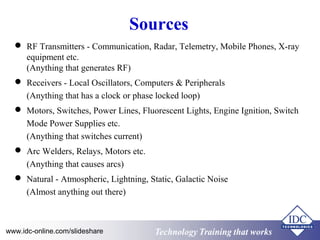
Sources 
 RF Transmitters - Communication, Radar, Telemetry, Mobile Phones, X-ray 
equipment etc. 
(Anything that generates RF) 
 Receivers - Local Oscillators, Computers & Peripherals 
(Anything that has a clock or phase locked loop) 
 Motors, Switches, Power Lines, Fluorescent Lights, Engine Ignition, Switch 
Mode Power Supplies etc. 
(Anything that switches current) 
 Arc Welders, Relays, Motors etc. 
(Anything that causes arcs) 
 Natural - Atmospheric, Lightning, Static, Galactic Noise 
(Almost anything out there) 
Technology www.idc-online.com/slideshare Technology TTrraaiinniinngg tthhaatt Wwoorrkkss
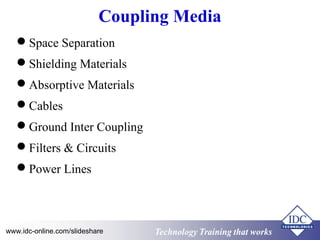
Coupling Media 
Space Separation 
Shielding Materials 
Absorptive Materials 
Cables 
Ground Inter Coupling 
Filters & Circuits 
Power Lines 
Technology www.idc-online.com/slideshare Technology TTrraaiinniinngg tthhaatt Wwoorrkkss
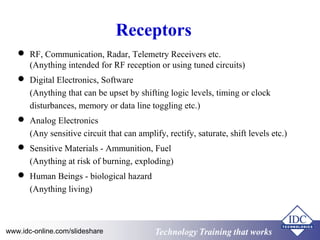
Receptors 
 RF, Communication, Radar, Telemetry Receivers etc. 
(Anything intended for RF reception or using tuned circuits) 
 Digital Electronics, Software 
(Anything that can be upset by shifting logic levels, timing or clock 
disturbances, memory or data line toggling etc.) 
 Analog Electronics 
(Any sensitive circuit that can amplify, rectify, saturate, shift levels etc.) 
 Sensitive Materials - Ammunition, Fuel 
(Anything at risk of burning, exploding) 
 Human Beings - biological hazard 
(Anything living) 
Technology www.idc-online.com/slideshare Technology TTrraaiinniinngg tthhaatt Wwoorrkkss
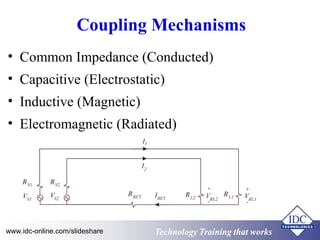
Coupling Mechanisms 
• Common Impedance (Conducted) 
• Capacitive (Electrostatic) 
• Inductive (Magnetic) 
• Electromagnetic (Radiated) 
Technology www.idc-online.com/slideshare Technology TTrraaiinniinngg tthhaatt Wwoorrkkss
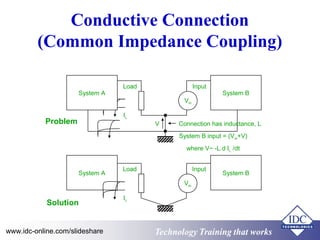
Conductive Connection 
(Common Impedance Coupling) 
System B 
Load Input 
Vin 
V Connection has inductance, L 
System B input = (Vin+V) 
where V~ -L.d IL /dt 
System A 
IL 
Input 
Vin 
Load 
System A System B 
IL 
Problem 
Solution 
Technology www.idc-online.com/slideshare Technology TTrraaiinniinngg tthhaatt Wwoorrkkss
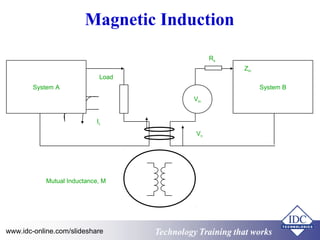
Magnetic Induction 
Load 
System A 
IL 
System B 
Vin 
Rs 
Zin 
Vn 
Mutual Inductance, M 
Technology www.idc-online.com/slideshare Technology TTrraaiinniinngg tthhaatt Wwoorrkkss
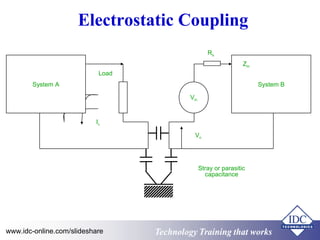
Electrostatic Coupling 
Vin 
System B 
Load 
System A 
IL 
Rs 
Zin 
Vn 
Stray or parasitic 
capacitance 
Technology www.idc-online.com/slideshare Technology TTrraaiinniinngg tthhaatt Wwoorrkkss
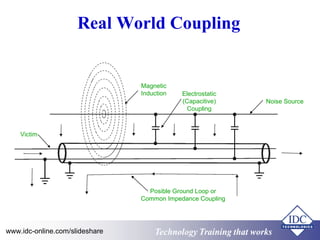
Real World Coupling 
Noise Source 
Magnetic 
Induction 
Victim 
Electrostatic 
(Capacitive) 
Coupling 
Posible Ground Loop or 
Common Impedance Coupling 
Technology www.idc-online.com/slideshare Technology TTrraaiinniinngg tthhaatt Wwoorrkkss
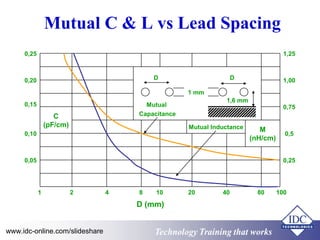
Mutual C & L vs Lead Spacing 
0,25 1,25 
0,20 
0,15 
0,10 
0,05 
1,00 
0,75 
0,5 
0,25 
D D 
1 mm 
1,6 mm 
C 
Mutual 
Capacitance 
(pF/cm) M 
(nH/cm) 
Mutual Inductance 
1 2 4 8 10 20 40 80 100 
D (mm) 
Technology www.idc-online.com/slideshare Technology TTrraaiinniinngg tthhaatt Wwoorrkkss
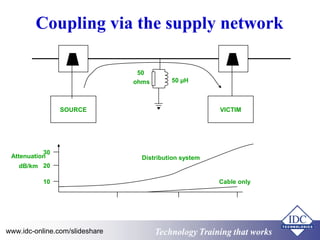
Coupling via the supply network 
50 
ohms 50 μH 
SOURCE VICTIM 
Attenuation30 
dB/km 
20 
10 
Distribution system 
Cable only 
Technology www.idc-online.com/slideshare Technology TTrraaiinniinngg tthhaatt Wwoorrkkss
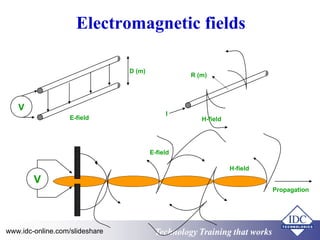
Electromagnetic fields 
V 
D (m) 
E-field I 
R (m) 
H-field 
Propagation 
V 
E-field 
H-field 
Technology www.idc-online.com/slideshare Technology TTrraaiinniinngg tthhaatt Wwoorrkkss
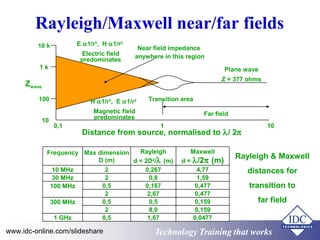
Rayleigh/Maxwell near/far fields 
E a1/r3, H a1/r2 
Electric field 
predominates 
Near field impedance 
anywhere in this region 
H a1/r3, E a1/r2 
Magnetic field 
predominates 
Plane wave 
Z = 377 ohms 
Far field 
Transition area 
0,1 1 10 
10 k 
1 k 
Zwave 
100 
10 
Distance from source, normalised to l/ 2p 
Frequency Max dimension 
D (m) 
Rayleigh 
d = 2D2/l (m) 
Maxwell 
d = l/2p (m) 
10 MHz 
30 MHz 
2 
2 
2 
0,5 
0,5 
2 
0,5 
100 MHz 
300 MHz 
1 GHz 
0,267 4,77 
0,8 
0,167 
2,67 
0,5 
8,0 
1,67 
1,59 
0,477 
0,477 
0,159 
0,159 
0,0477 
Rayleigh & Maxwell 
distances for 
transition to 
far field 
Technology www.idc-online.com/slideshare Technology TTrraaiinniinngg tthhaatt Wwoorrkkss
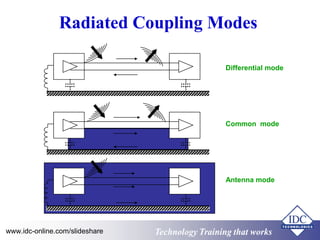
Radiated Coupling Modes 
Differential mode 
Common mode 
Antenna mode 
Technology www.idc-online.com/slideshare Technology TTrraaiinniinngg tthhaatt Wwoorrkkss
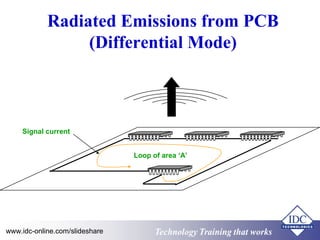
Radiated Emissions from PCB 
(Differential Mode) 
Signal current 
Loop of area ‘A’ 
Technology www.idc-online.com/slideshare Technology TTrraaiinniinngg tthhaatt Wwoorrkkss
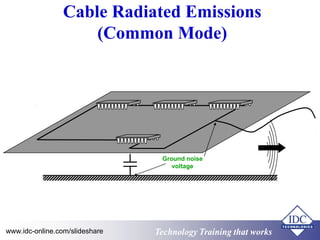
Cable Radiated Emissions 
(Common Mode) 
Ground noise 
voltage 
Technology www.idc-online.com/slideshare Technology TTrraaiinniinngg tthhaatt Wwoorrkkss
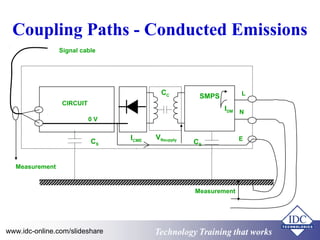
Coupling Paths - Conducted Emissions 
SMPS L 
N 
E 
Signal cable 
CIRCUIT 
ICME 
0 V 
CC 
VNsupply 
CS CS 
IDM 
Measurement 
Measurement 
Technology www.idc-online.com/slideshare Technology TTrraaiinniinngg tthhaatt Wwoorrkkss
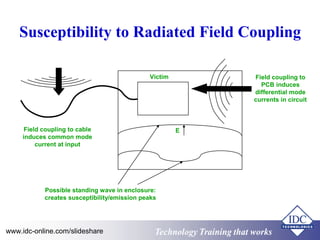
Susceptibility to Radiated Field Coupling 
E 
Victim 
Field coupling to cable 
induces common mode 
current at input 
Possible standing wave in enclosure: 
creates susceptibility/emission peaks 
Field coupling to 
PCB induces 
differential mode 
currents in circuit 
Technology www.idc-online.com/slideshare Technology TTrraaiinniinngg tthhaatt Wwoorrkkss
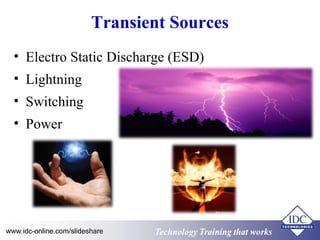
Transient Sources 
• Electro Static Discharge (ESD) 
• Lightning 
• Switching 
• Power 
Technology www.idc-online.com/slideshare Technology TTrraaiinniinngg tthhaatt Wwoorrkkss
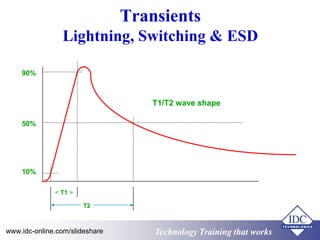
Transients 
Lightning, Switching & ESD 
90% 
50% 
10% 
< T1 > 
T2 
T1/T2 wave shape 
Technology www.idc-online.com/slideshare Technology TTrraaiinniinngg tthhaatt Wwoorrkkss
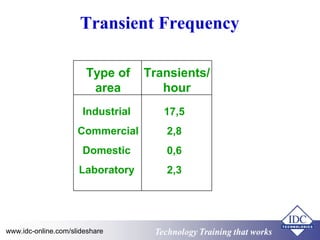
Transient Frequency 
Type of 
area 
Transients/ 
hour 
Industrial 
Commercial 
Domestic 
Laboratory 
17,5 
2,8 
0,6 
2,3 
Technology www.idc-online.com/slideshare Technology TTrraaiinniinngg tthhaatt Wwoorrkkss
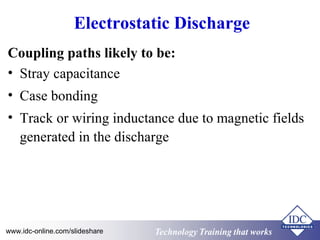
Electrostatic Discharge 
Coupling paths likely to be: 
• Stray capacitance 
• Case bonding 
• Track or wiring inductance due to magnetic fields 
generated in the discharge 
Technology www.idc-online.com/slideshare Technology TTrraaiinniinngg tthhaatt Wwoorrkkss
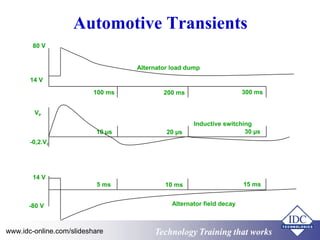
Automotive Transients 
Alternator load dump 
100 ms 200 ms 300 ms 
Inductive switching 
10 μs 20 μs 30 μs 
5 ms 10 ms 15 ms 
Alternator field decay 
80 V 
14 V 
VP 
-0,2.VP 
14 V 
-80 V 
Technology www.idc-online.com/slideshare Technology TTrraaiinniinngg tthhaatt Wwoorrkkss
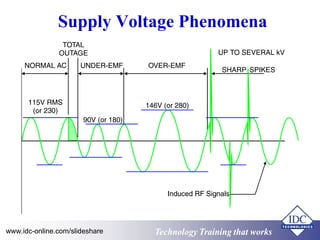
Supply Voltage Phenomena 
Technology www.idc-online.com/slideshare Technology TTrraaiinniinngg tthhaatt Wwoorrkkss
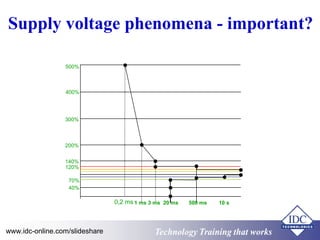
Supply voltage phenomena - important? 
1 ms 3 ms 20 ms 500 ms 10 s 
500% 
400% 
300% 
200% 
140% 
120% 
70% 
40% 
0,2 ms 
Technology www.idc-online.com/slideshare Technology TTrraaiinniinngg tthhaatt Wwoorrkkss
DO YOU WANT TO KNOW MORE? 
If you are interested in further training or information, 
please visit: 
http://idc-online.com/slideshare 
Technology www.idc-online.com/slideshare Technology TTrraaiinniinngg tthhaatt Wwoorrkkss

Practical Shielding, EMC/EMI, Noise Reduction, Earthing and Circuit Board Layout

  • 1.
    Practical Shielding, EMC/EMI,Noise Reduction, Earthing and Circuit Board Layout Technology www.idc-online.com/slideshare Technology TTrraaiinniinngg tthhaatt Wwoorrkkss
  • 2.
    Coupling Paths: Sources& Victims Source Equipment Radiated, cable to cable case to case Conducted through common earth impedance Victim Equipment Peripheral Radiated, Input Radiated, case to mains cable Conducted via common mains impedance External mains interference Technology www.idc-online.com/slideshare Technology TTrraaiinniinngg tthhaatt Wwoorrkkss
  • 3.
    Universal Interference Model Source (Culprit) Receptor (Victim) Coupling Mechanism (Interference Path) Technology www.idc-online.com/slideshare Technology TTrraaiinniinngg tthhaatt Wwoorrkkss
  • 4.
    Interference Solution •Remove or reduce noise at source (decouple, shield, low noise design, etc.) • Remove or attenuate coupling path (spacing, shielding, filter, re-route, isolate, etc.) • Improve victim immunity (decouple, shield,filter, high immunity design, etc.) Technology www.idc-online.com/slideshare Technology TTrraaiinniinngg tthhaatt Wwoorrkkss
  • 5.
    Sources  RFTransmitters - Communication, Radar, Telemetry, Mobile Phones, X-ray equipment etc. (Anything that generates RF)  Receivers - Local Oscillators, Computers & Peripherals (Anything that has a clock or phase locked loop)  Motors, Switches, Power Lines, Fluorescent Lights, Engine Ignition, Switch Mode Power Supplies etc. (Anything that switches current)  Arc Welders, Relays, Motors etc. (Anything that causes arcs)  Natural - Atmospheric, Lightning, Static, Galactic Noise (Almost anything out there) Technology www.idc-online.com/slideshare Technology TTrraaiinniinngg tthhaatt Wwoorrkkss
  • 6.
    Coupling Media SpaceSeparation Shielding Materials Absorptive Materials Cables Ground Inter Coupling Filters & Circuits Power Lines Technology www.idc-online.com/slideshare Technology TTrraaiinniinngg tthhaatt Wwoorrkkss
  • 7.
    Receptors  RF,Communication, Radar, Telemetry Receivers etc. (Anything intended for RF reception or using tuned circuits)  Digital Electronics, Software (Anything that can be upset by shifting logic levels, timing or clock disturbances, memory or data line toggling etc.)  Analog Electronics (Any sensitive circuit that can amplify, rectify, saturate, shift levels etc.)  Sensitive Materials - Ammunition, Fuel (Anything at risk of burning, exploding)  Human Beings - biological hazard (Anything living) Technology www.idc-online.com/slideshare Technology TTrraaiinniinngg tthhaatt Wwoorrkkss
  • 8.
    Coupling Mechanisms •Common Impedance (Conducted) • Capacitive (Electrostatic) • Inductive (Magnetic) • Electromagnetic (Radiated) Technology www.idc-online.com/slideshare Technology TTrraaiinniinngg tthhaatt Wwoorrkkss
  • 9.
    Conductive Connection (CommonImpedance Coupling) System B Load Input Vin V Connection has inductance, L System B input = (Vin+V) where V~ -L.d IL /dt System A IL Input Vin Load System A System B IL Problem Solution Technology www.idc-online.com/slideshare Technology TTrraaiinniinngg tthhaatt Wwoorrkkss
  • 10.
    Magnetic Induction Load System A IL System B Vin Rs Zin Vn Mutual Inductance, M Technology www.idc-online.com/slideshare Technology TTrraaiinniinngg tthhaatt Wwoorrkkss
  • 11.
    Electrostatic Coupling Vin System B Load System A IL Rs Zin Vn Stray or parasitic capacitance Technology www.idc-online.com/slideshare Technology TTrraaiinniinngg tthhaatt Wwoorrkkss
  • 12.
    Real World Coupling Noise Source Magnetic Induction Victim Electrostatic (Capacitive) Coupling Posible Ground Loop or Common Impedance Coupling Technology www.idc-online.com/slideshare Technology TTrraaiinniinngg tthhaatt Wwoorrkkss
  • 13.
    Mutual C &L vs Lead Spacing 0,25 1,25 0,20 0,15 0,10 0,05 1,00 0,75 0,5 0,25 D D 1 mm 1,6 mm C Mutual Capacitance (pF/cm) M (nH/cm) Mutual Inductance 1 2 4 8 10 20 40 80 100 D (mm) Technology www.idc-online.com/slideshare Technology TTrraaiinniinngg tthhaatt Wwoorrkkss
  • 14.
    Coupling via thesupply network 50 ohms 50 μH SOURCE VICTIM Attenuation30 dB/km 20 10 Distribution system Cable only Technology www.idc-online.com/slideshare Technology TTrraaiinniinngg tthhaatt Wwoorrkkss
  • 15.
    Electromagnetic fields V D (m) E-field I R (m) H-field Propagation V E-field H-field Technology www.idc-online.com/slideshare Technology TTrraaiinniinngg tthhaatt Wwoorrkkss
  • 16.
    Rayleigh/Maxwell near/far fields E a1/r3, H a1/r2 Electric field predominates Near field impedance anywhere in this region H a1/r3, E a1/r2 Magnetic field predominates Plane wave Z = 377 ohms Far field Transition area 0,1 1 10 10 k 1 k Zwave 100 10 Distance from source, normalised to l/ 2p Frequency Max dimension D (m) Rayleigh d = 2D2/l (m) Maxwell d = l/2p (m) 10 MHz 30 MHz 2 2 2 0,5 0,5 2 0,5 100 MHz 300 MHz 1 GHz 0,267 4,77 0,8 0,167 2,67 0,5 8,0 1,67 1,59 0,477 0,477 0,159 0,159 0,0477 Rayleigh & Maxwell distances for transition to far field Technology www.idc-online.com/slideshare Technology TTrraaiinniinngg tthhaatt Wwoorrkkss
  • 17.
    Radiated Coupling Modes Differential mode Common mode Antenna mode Technology www.idc-online.com/slideshare Technology TTrraaiinniinngg tthhaatt Wwoorrkkss
  • 18.
    Radiated Emissions fromPCB (Differential Mode) Signal current Loop of area ‘A’ Technology www.idc-online.com/slideshare Technology TTrraaiinniinngg tthhaatt Wwoorrkkss
  • 19.
    Cable Radiated Emissions (Common Mode) Ground noise voltage Technology www.idc-online.com/slideshare Technology TTrraaiinniinngg tthhaatt Wwoorrkkss
  • 20.
    Coupling Paths -Conducted Emissions SMPS L N E Signal cable CIRCUIT ICME 0 V CC VNsupply CS CS IDM Measurement Measurement Technology www.idc-online.com/slideshare Technology TTrraaiinniinngg tthhaatt Wwoorrkkss
  • 21.
    Susceptibility to RadiatedField Coupling E Victim Field coupling to cable induces common mode current at input Possible standing wave in enclosure: creates susceptibility/emission peaks Field coupling to PCB induces differential mode currents in circuit Technology www.idc-online.com/slideshare Technology TTrraaiinniinngg tthhaatt Wwoorrkkss
  • 22.
    Transient Sources •Electro Static Discharge (ESD) • Lightning • Switching • Power Technology www.idc-online.com/slideshare Technology TTrraaiinniinngg tthhaatt Wwoorrkkss
  • 23.
    Transients Lightning, Switching& ESD 90% 50% 10% < T1 > T2 T1/T2 wave shape Technology www.idc-online.com/slideshare Technology TTrraaiinniinngg tthhaatt Wwoorrkkss
  • 24.
    Transient Frequency Typeof area Transients/ hour Industrial Commercial Domestic Laboratory 17,5 2,8 0,6 2,3 Technology www.idc-online.com/slideshare Technology TTrraaiinniinngg tthhaatt Wwoorrkkss
  • 25.
    Electrostatic Discharge Couplingpaths likely to be: • Stray capacitance • Case bonding • Track or wiring inductance due to magnetic fields generated in the discharge Technology www.idc-online.com/slideshare Technology TTrraaiinniinngg tthhaatt Wwoorrkkss
  • 26.
    Automotive Transients Alternatorload dump 100 ms 200 ms 300 ms Inductive switching 10 μs 20 μs 30 μs 5 ms 10 ms 15 ms Alternator field decay 80 V 14 V VP -0,2.VP 14 V -80 V Technology www.idc-online.com/slideshare Technology TTrraaiinniinngg tthhaatt Wwoorrkkss
  • 27.
    Supply Voltage Phenomena Technology www.idc-online.com/slideshare Technology TTrraaiinniinngg tthhaatt Wwoorrkkss
  • 28.
    Supply voltage phenomena- important? 1 ms 3 ms 20 ms 500 ms 10 s 500% 400% 300% 200% 140% 120% 70% 40% 0,2 ms Technology www.idc-online.com/slideshare Technology TTrraaiinniinngg tthhaatt Wwoorrkkss
  • 29.
    DO YOU WANTTO KNOW MORE? If you are interested in further training or information, please visit: http://idc-online.com/slideshare Technology www.idc-online.com/slideshare Technology TTrraaiinniinngg tthhaatt Wwoorrkkss

Editor's Notes

  • #2 Electromagnetic Interference requires two parties: a source, and a victim. Any electronic device has the potential to radiate or conduct emissions, and at the same time be susceptible to them itself. Some problems may exist where the victim is also the source. Understanding of the mechanisms by which this takes place is essential to solving EMC problems.
  • #3 To ensure compatibility between one item of equipment and any other in a given electromagnetic environment requires a comprehensive understanding of the ways in which this source to victim coupling is possible. The slide above outlines the ways in which this can happen. Keep in mind that some of the paths only exist because of the parameters which are not taken into account - the inductance and capacitance of cables, for example.
  • #4 EMI works like this. Always a noise source, a coupling path and a receptor.
  • #5 The solution for reducing interference can be at the source, path or receptor.
  • #6 Noise sources are everywhere.
  • #7 Above is a list of considerations when changing the coupling between source and victim.
  • #8 Receptors everywhere!
  • #9 Any EMI problem will involve any or a combination of the above coupling mechanisms.
  • #10 A minor re-routing can often eliminate a problem by removing a common conductor, which we are inclined to forget has resistance, inductance and capacitance whether we like it or not.
  • #11 AC current in a conductor creates a magnetic field. This can couple with a nearby conductor and induce a current in that conductor. This usually happens where there are large and/or fast variations in current (i.e. high di/dt). Note that there is no need for a common ground for this to take place - it can happen between isolated circuits.
  • #12 One conductor can be affected by a changing voltage on another. The extent of this depends on the ratio of impedances between the load and the source. The source impedance will be determined by the distance between conductors, their effective areas and the composition of whatever is between them (dielectric). Electrostatic (capacitive) coupling usually happens where there are large and/or fast variations in voltage (i.e. high dv/dt).
  • #13 A combination of coupling mechanisms exist in the real world. One type of coupling can dominate, but sometimes a combination is present.
  • #14 This graph shows the effects of the spacing between conductors on their ability to couple from one circuit to another.
  • #15 Although the picture above of the supply system impedance, this is in an ideal world. In reality, the impedance is determined very largely by whatever is connected to the supply. This is shown by the graph above, and makes predictions of coupling difficult.
  • #16 Any conductor with an applied voltage and current will generate an electric and a magnetic field as shown. The way in which these fields develop will be determined by the physical layout. Whether the electric or magnetic field will dominate depends on whether the current or voltage is predominant.
  • #17 Radiated emissions can be divided into ‘near field’ and ‘far field’. In the near field, separate electric and magnetic fields exist. Which one will predominate depends on the source impedance as shown above. It is important to understand this, because they are measured differently and different measures are used to counteract a magnetic or electric field. In the far field, the two merge into a composite electromagnetic plane wave. This is often considered to take place at about one sixth of a wavelength (/2), mainly because of Maxwell. This is true of point sources, but is substantially affected by the source dimensions as shown by Rayleigh, and illustrated in the chart above.
  • #18 In most cases, the wanted signal is produced in differential mode. It is also possible to have interfering signals which are induced into a conductor in differential mode, and can in turn be radiated in differential mode. Ground plays no part in this case. The cable can also carry signals in common mode, usually interfering signals they could also be internally generated). These are referenced to ground, very often by stray capacitances and inductances and can of course be radiated as common mode signals. Common mode signals become a problem when they are converted into differential mode, and get confused with the wanted signal. In antenna mode, currents are equally induced in the signal conductors, and in the reference plane (often happens in aircraft travelling through magnetic fields). Becomes a problem if converted to differential mode. Although depicted as happening between two separate modules, it is very possible for this to take place on a PCB.
  • #19 The circuit drawn above shows a ‘small loop antenna’ smaller than  /4 at the frequency of interest. (All PCB tracks are ‘small loop antennae’ up to a few hundred MHz). The field varies with the square of the frequency, and is directly proportional to the signal current and the loop area, and can be substantial. Keep the area small.
  • #20 Cable radiation is generally common mode, which is generally far worse than differential mode. These common mode voltages can easily arise due to poor termination, as we will see in the module on cables and connectors. The loop area is uncontrolled, hence unpredictable. Common mode current generally needs to be under 5 µA to meet cable emission standards!
  • #21 As in the drawing above, where there are high switch-mode frequencies, capacitance to ground plays a major part. This allows large common-mode voltages to develop relative to ground. In addition, differential mode signals can appear on the supply line or the signal cable as a result of SMPS noise being getting through to the signal cable from the supply lines, or directly onto the Live and Neutral from the switching oscillator.
  • #22 Coupling can take place either directly to the circuitry, or via I/O or mains lines. Common mode interference eventually translates into differential mode, and resonance within an enclosure must be regarded as a possibility.
  • #23 Transients and spikes are different from continuously generated EMI. Above is a list of likely sources.
  • #24 Virtually all transient wave-forms are classified in this way. There is some variation in where the second time period, T2, starts from. In this slide it is shown as being from almost the start of the rise of the wave. However, as both of these times are specified as being + or - 30% in most cases, it is difficult to see why anyone bothers!
  • #25 The graph above shows the results of a study carried out on mains supply and telecom lines to record the number and amplitude of transient voltages. These figures obviously depend on the lightning strike density in various parts of the world, and the degree of heavy load switching in the vicinity of a particular site. Particularly with lightning (but also with switching surges) the mains connection density plays a part.
  • #27 This slide shows different transients that can exist in a 12V automotive system. If not designed for, 12V components will fail at these high voltages.
  • #28 The supply voltage can exhibit a variety of disturbances.
  • #29 The ITIC (Information Technology Industries Council) curve shown above, demonstrates the fluctuation levels and time periods which are likely to upset a PC. From this it is obvious that short-duration voltage variations can definitely affect electronic equipment. It is just as necessary to ensure that mains-powered equipment doesn’t introduce any of these phenomena which are voltage dips (short-duration reductions in voltage) interruptions (complete absence of power for longer than ~ 3 s) harmonics unbalance (voltage differences between phases) flicker (rapid voltage variations which are annoying as they affect incandescent lighting) transients