EMI/EMC
Contents








Crosstalk In Transmission Lines
Transients In Power Supply Lines
Surge voltages from lightning
Switching Transients
Electromagnetic Interference
Open Area Test Sites
Open Area Test Site Measurements
Crosstalk In Transmission Lines
• Crosstalk is the coupling of EM energy from one transmission
line to the another via:
- Mutual Inductance(magnetic field)
- Mutual Capacitance(electric field)
Mechanism of coupling

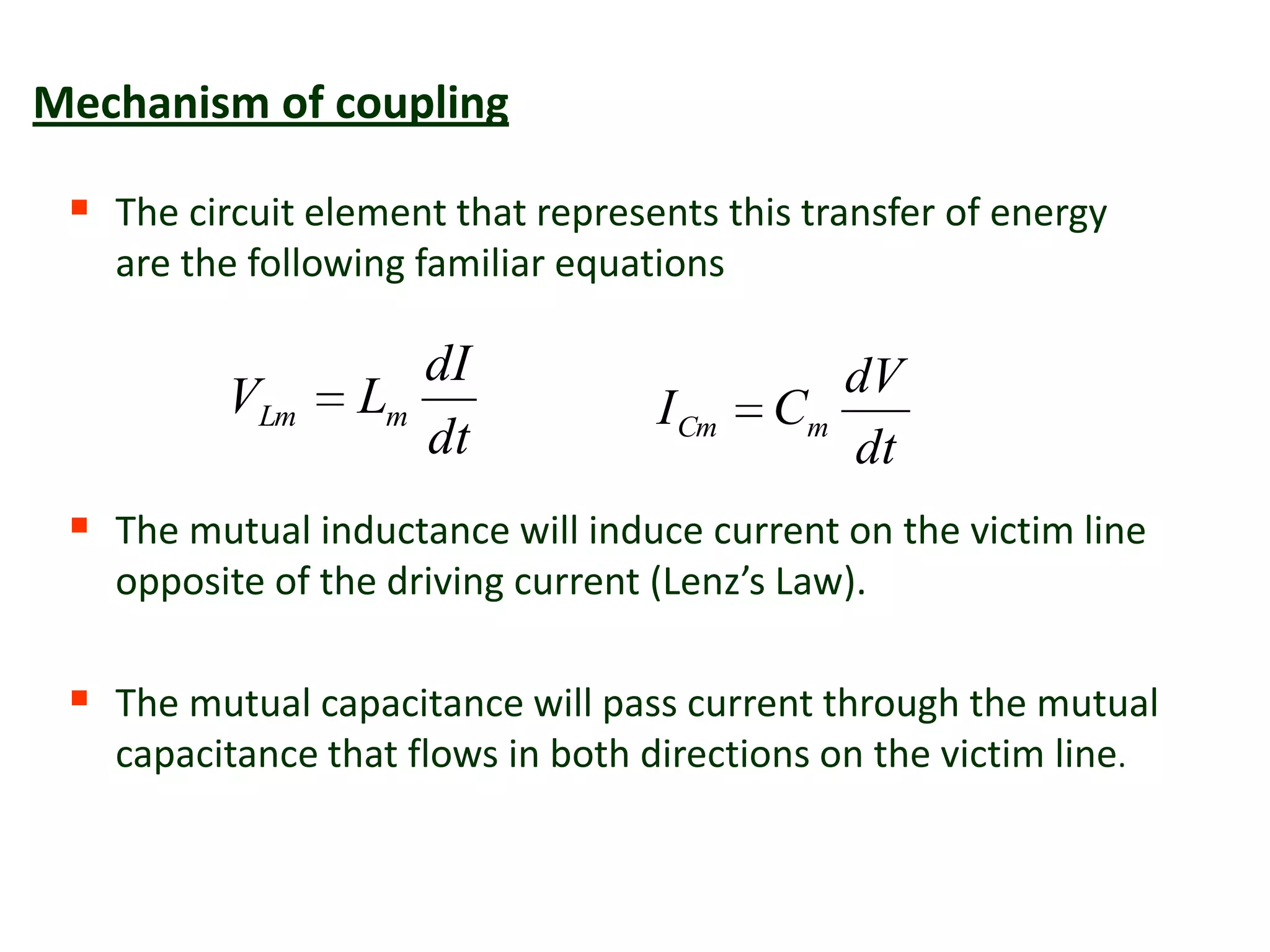
 The circuit element that represents this transfer of energy
are the following familiar equations

VLm

dI
Lm
dt

I Cm

dV
Cm
dt

 The mutual inductance will induce current on the victim line
opposite of the driving current (Lenz’s Law).

 The mutual capacitance will pass current through the mutual
capacitance that flows in both directions on the victim line.
Crosstalk In Transmission Lines
Summary of analysis:
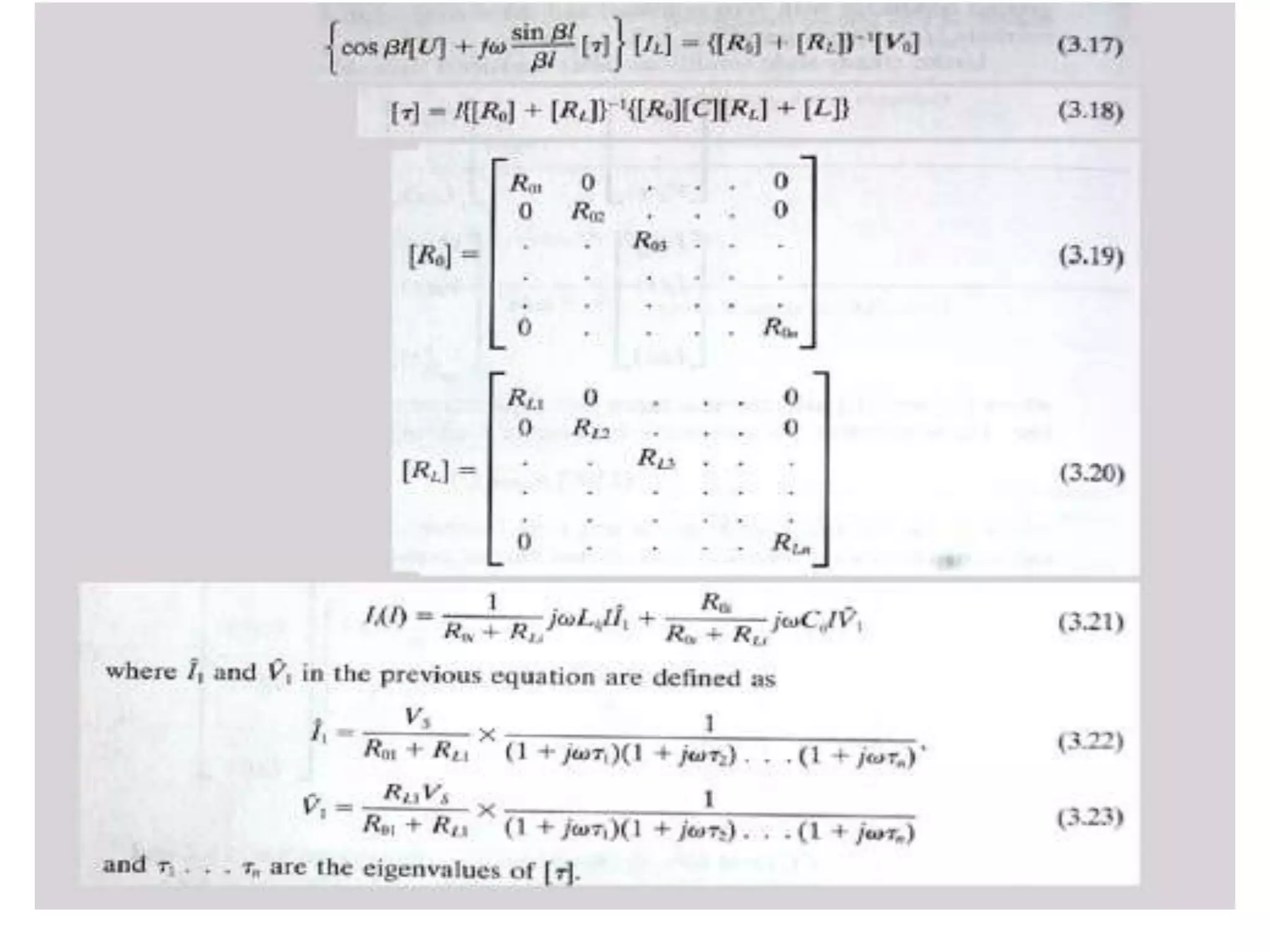
 It is clear that superposition of inductive and
capacitive coupling is a function of
geometrical config., number of conductors
and terminal impedances.
 Thus the freq. range for which the analysis is
valid depends on no. of line conductors, crosssectional configuration of line and terminal
impedances Roi and RLi
Transients In Power Supply Lines
What are transient voltages?
•

"Transients or Transient Voltages“ is
generally called as "surges" or "spikes".
•
Transients are momentary changes in
voltage or current that occur over a short
period of time.
•
This interval is usually described as
approximately 1/16 (one sixteenth) of a
voltage cycle
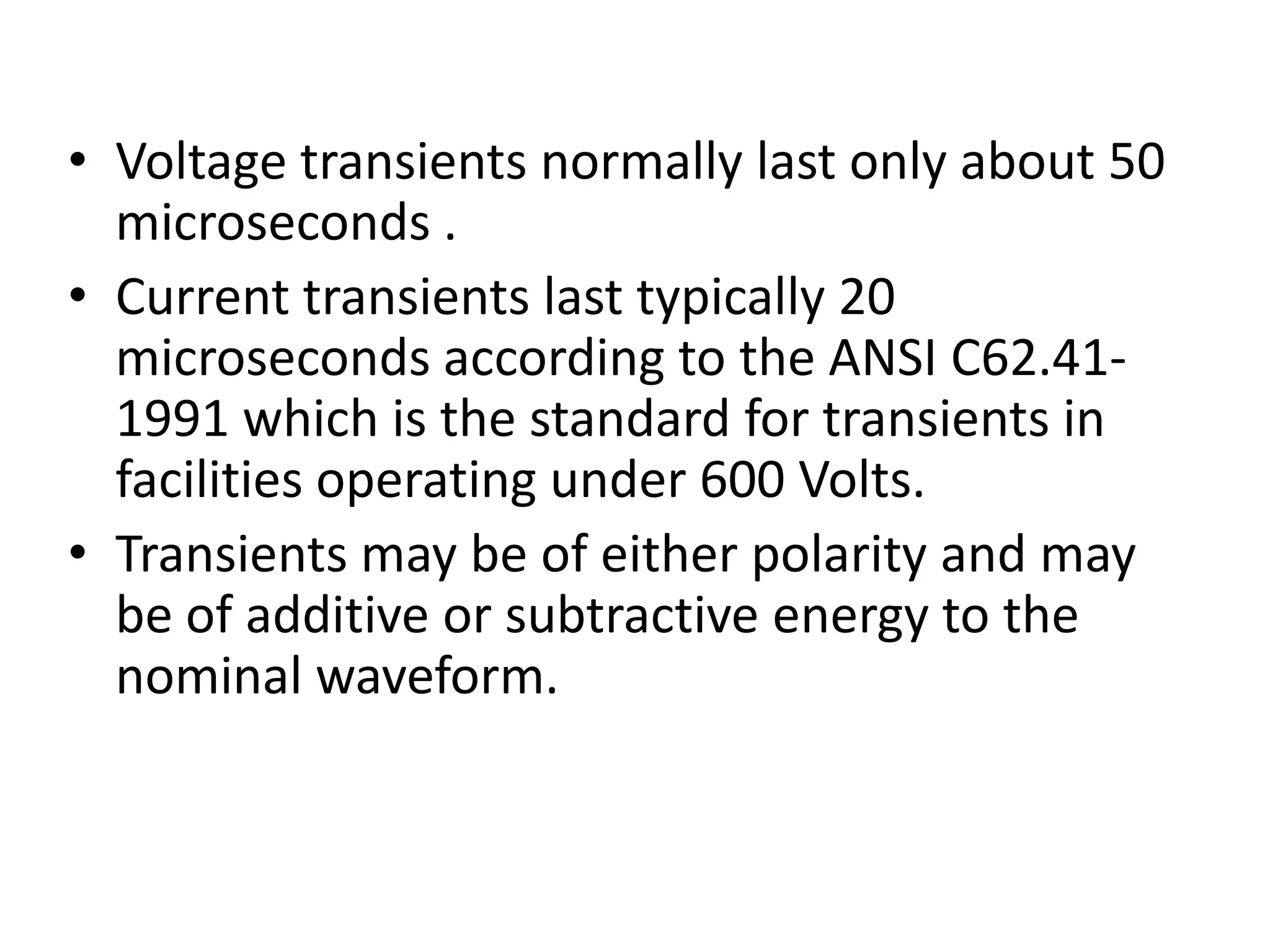
• Voltage transients normally last only about 50
microseconds .
• Current transients last typically 20
microseconds according to the ANSI C62.411991 which is the standard for transients in
facilities operating under 600 Volts.
• Transients may be of either polarity and may
be of additive or subtractive energy to the
nominal waveform.
Characteristics of the Transient Voltage
Waveform
a) Oscillatory transient

b) Impulsive transient
Transients In Power Supply Lines
 Transient over-voltages (probably as a result of terrestrial
phenomena such as lightning.
 Radiation from strong radar/radio/communication transmissions
within the vicinity, which are picked up by the power
transmission lines.
 Sudden decrease or increase in the mains voltage (caused by
the switching of low impedance loads).
 Burst of high frequency noise (probably due to switching of
reactive loads).
Surge voltages from lightning





A nearby lightning strike to objects
Lightning ground-current flow
The rapid drop of voltage
A direct lightning strike to high-voltage
primary circuits.
 Lightning strikes the secondary circuits
directly.
Switching Transients
• Minor switching near the point of interest
• Periodic transients (voltage notching) that occur
each cycle during the commutation in electronic
power converters
• Multiple re-ignitions or re-strikes during a switch
operation
• Major power system switching disturbances
• Various system faults, such as short circuits and
arcing faults
Electromagnetic Interference

• Undesired or unintentional coupling of
electromagnetic energy from one equipment
(emitter) to another equipment (receptor).
The so called source-path-receptor model suggests
that electromagnetic interference can be prevented in
one of three ways:
 Suppress emissions at the source.
 Interrupt or reduce the efficiency of the
path.
 Make the receptor immune to emissions.

coupling

One of the greatest difficulties in diagnosing interference is determining
exactly which coupling path interference is following to the receptor.
Coupling paths are typically classified as belonging to one of four general
classes.
1. Conductive coupling
 Conductive coupling occurs when the path of
interference between the source and the
receptor is formed by a conducting body.
• By means of a power cord, interface
cables, antenna input terminals, ground
returns, or
• Unintentional external conductors such as
metallic cases or housings.
2. Radiation coupling
 Radiation/electromagnetic coupling occurs when the
path of interference lies through free space, or some
other non-conductive medium.
 Radiation coupling usually occurs when distances
between the source and receptor are on the order of
several wavelengths.
 Because of this wide separation, the source is usually
not affected by the presence of the receptor.
 Radiation fields decay as 1/R for points far away from
the source.
3) Induction coupling
 Inductive/magnetic coupling is associated with
near-fields, in a region where the magnetic
field is dominant.
 Occurs when distances between the source and
receptor are much less than a wavelength.
 Due to the relatively small separation, the
presence of the receptor can affect the behaviour
of the source, referred to as mutual coupling.
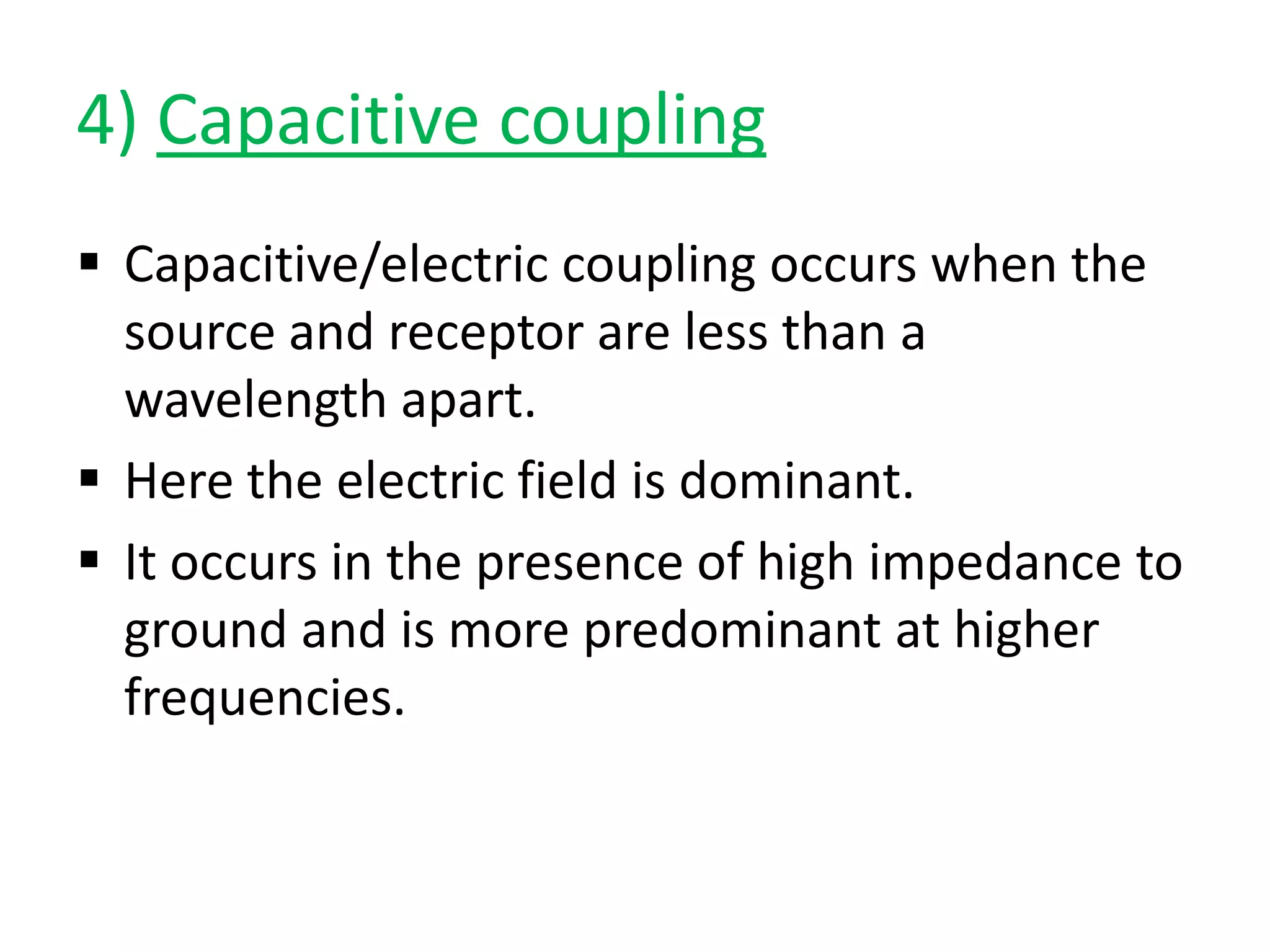
4) Capacitive coupling
 Capacitive/electric coupling occurs when the
source and receptor are less than a
wavelength apart.
 Here the electric field is dominant.
 It occurs in the presence of high impedance to
ground and is more predominant at higher
frequencies.
Open Area Test Sites & Measurements
Here we are going to study about
 Open Area Test Site
 Open Area Test Site Measurements
 Measurement of RE
 Measurement of RS
 Measurement precautions
OPEN -AREA TEST SITE
• The shape and size of the open-area test site will need
to be appropriate to avoid scattered signals.
• ANS recommend that Sc ≤ Sd -6dB -----(1)
where Sc & Sd are the scattered signal from obstructions
located at the boundary of open-area test site and the
direct signal between EUT and the Tx/Rx antenna.
OPEN AREA TEST SITE MEASUREMENTS
 The measurements of radiated emissions (RE) and radiated susceptibility
(RS) of an equipment constitute the two basic EMI and EMC
measurements.
 The purpose of radiation susceptibility testing is to determine the

degradation in equipment performance caused by externally coupled
electro magnetic energy.
 Open site measurement is most direct and universally accepted standard
approach for measuring radiated emissions from an equipment or the
radiation susceptibility of an equipment.
Measurement of RE


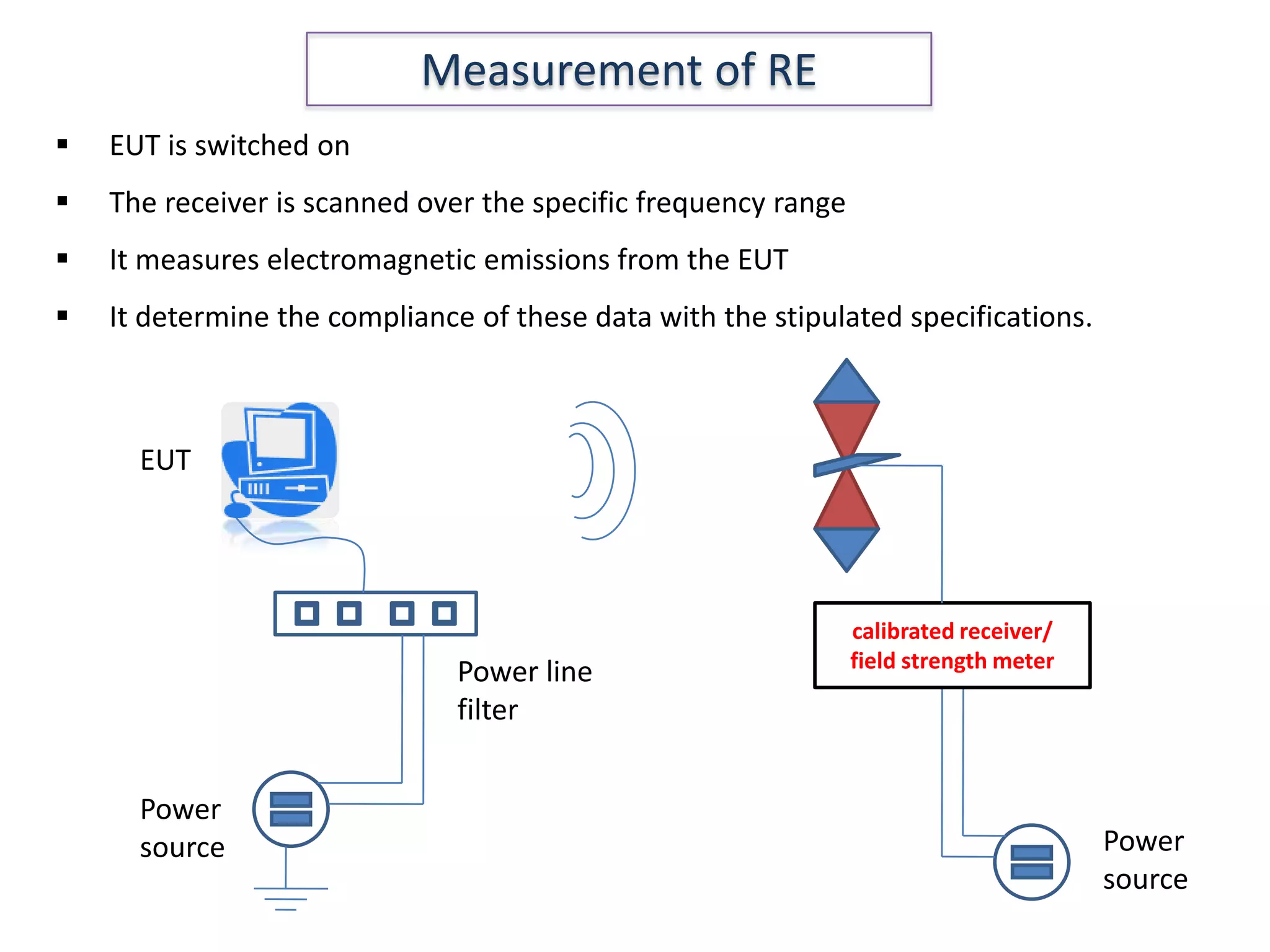
EUT is switched on



The receiver is scanned over the specific frequency range



It measures electromagnetic emissions from the EUT



It determine the compliance of these data with the stipulated specifications.

EUT

Power line
filter
Power
source

calibrated receiver/
field strength meter

Power
source
Measurement of RS
1) EUT is placed in an electromagnetic field created with the help of suitable radiating
antenna.
2) The intensity of the electromagnetic field is varied by varying the power delivered to
the antenna by the transmitter amplifier

3) Performance of EUT are then observed under different levels of electromagnetic
field intensity.
EUT

Power line
filter
Power
source

Transmitter

Power line
filter
Power
source
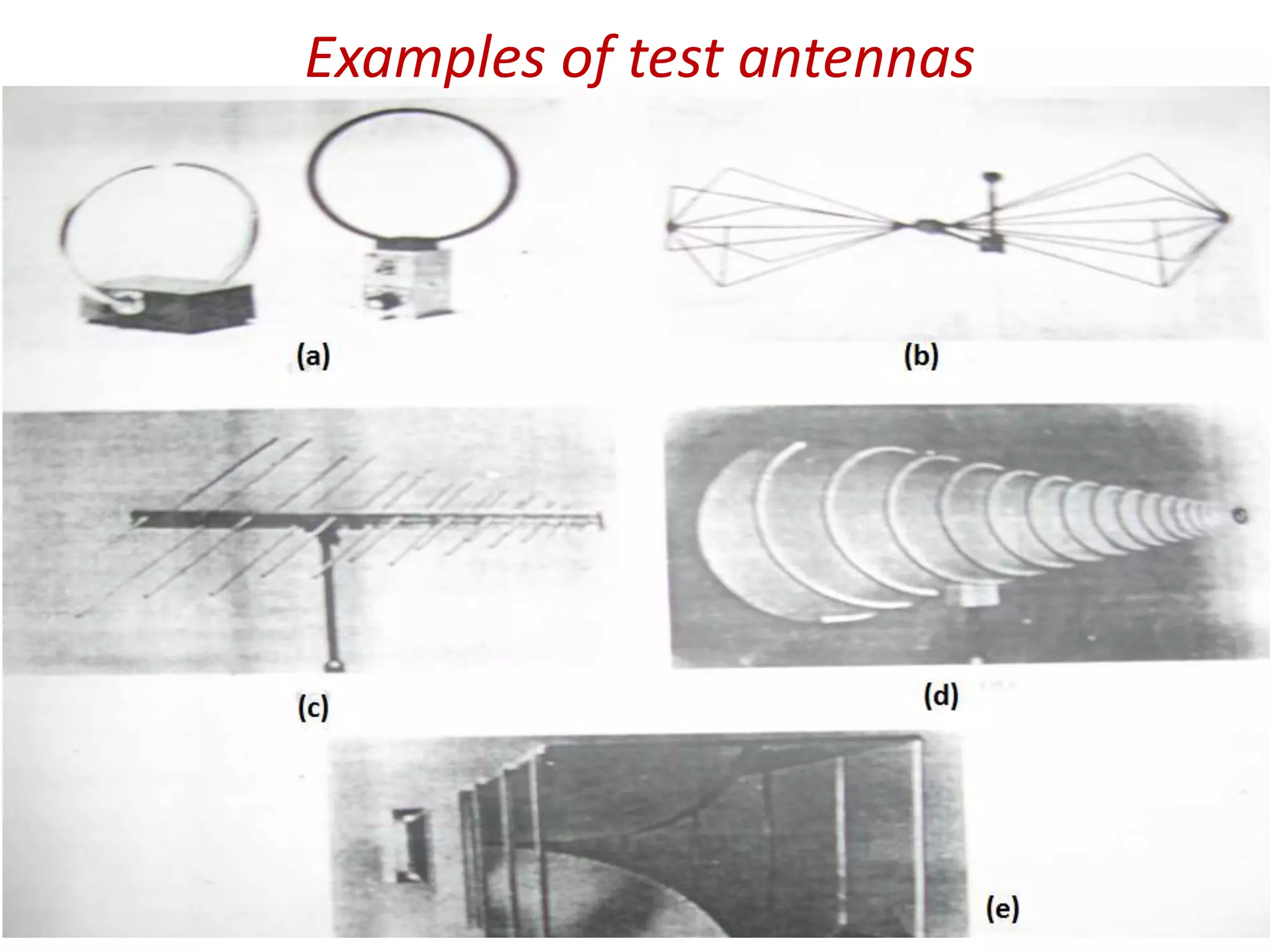
Test Antennas
• A convenient approach to illuminate an equipment under test with known
field strengths is to used exact half wave length a long dipoles at fixed
frequencies.
• This arrangement is superior when compared to connecting a test antenna
to a signal source using co-axial cable that might distort the field pattern.
Antenna Type

Frequency, MHz

Rod antenna

1 - 30

Loop antenna

1 – 30

Biconical antenna

30 – 220

Dipole antenna

30 - 1000

Log periodic antenna

200 -1000

Conical log spiral

200 – 10000

Wave guide horn

Above 1000
Examples of test antennas
Measurement Precautions
1) Electro magnetic environment
According to ANS, it is desirable that the conducted and radiated ambient radio noise
and signal levels measured at the test site with the EUT de-energized, be at least 6 dB

below the allowable limit of the applicable specification.
2) Electro magnetic scatterers
One method for avoiding interference from underground scatters is to use a metallic
ground plane to eliminate strong reflections from under ground sources such as
buried metallic objects.
3) Power and cable connections
The power leads used to energize the EUT, receiver and transmitter should also pass

through filters to eliminate the conducted interferences carried by power lines.
EMI/EMC

EMI/EMC

  • 1.
  • 2.
    Contents        Crosstalk In TransmissionLines Transients In Power Supply Lines Surge voltages from lightning Switching Transients Electromagnetic Interference Open Area Test Sites Open Area Test Site Measurements
  • 3.
    Crosstalk In TransmissionLines • Crosstalk is the coupling of EM energy from one transmission line to the another via: - Mutual Inductance(magnetic field) - Mutual Capacitance(electric field)
  • 4.
    Mechanism of coupling The circuit element that represents this transfer of energy are the following familiar equations VLm dI Lm dt I Cm dV Cm dt  The mutual inductance will induce current on the victim line opposite of the driving current (Lenz’s Law).  The mutual capacitance will pass current through the mutual capacitance that flows in both directions on the victim line.
  • 5.
  • 8.
    Summary of analysis: It is clear that superposition of inductive and capacitive coupling is a function of geometrical config., number of conductors and terminal impedances.  Thus the freq. range for which the analysis is valid depends on no. of line conductors, crosssectional configuration of line and terminal impedances Roi and RLi
  • 9.
    Transients In PowerSupply Lines
  • 10.
    What are transientvoltages? • "Transients or Transient Voltages“ is generally called as "surges" or "spikes". • Transients are momentary changes in voltage or current that occur over a short period of time. • This interval is usually described as approximately 1/16 (one sixteenth) of a voltage cycle
  • 11.
    • Voltage transientsnormally last only about 50 microseconds . • Current transients last typically 20 microseconds according to the ANSI C62.411991 which is the standard for transients in facilities operating under 600 Volts. • Transients may be of either polarity and may be of additive or subtractive energy to the nominal waveform.
  • 12.
    Characteristics of theTransient Voltage Waveform a) Oscillatory transient b) Impulsive transient
  • 13.
    Transients In PowerSupply Lines  Transient over-voltages (probably as a result of terrestrial phenomena such as lightning.  Radiation from strong radar/radio/communication transmissions within the vicinity, which are picked up by the power transmission lines.  Sudden decrease or increase in the mains voltage (caused by the switching of low impedance loads).  Burst of high frequency noise (probably due to switching of reactive loads).
  • 14.
    Surge voltages fromlightning     A nearby lightning strike to objects Lightning ground-current flow The rapid drop of voltage A direct lightning strike to high-voltage primary circuits.  Lightning strikes the secondary circuits directly.
  • 15.
    Switching Transients • Minorswitching near the point of interest • Periodic transients (voltage notching) that occur each cycle during the commutation in electronic power converters • Multiple re-ignitions or re-strikes during a switch operation • Major power system switching disturbances • Various system faults, such as short circuits and arcing faults
  • 16.
  • 17.
    Electromagnetic Interference • Undesiredor unintentional coupling of electromagnetic energy from one equipment (emitter) to another equipment (receptor).
  • 18.
    The so calledsource-path-receptor model suggests that electromagnetic interference can be prevented in one of three ways:  Suppress emissions at the source.  Interrupt or reduce the efficiency of the path.  Make the receptor immune to emissions. coupling One of the greatest difficulties in diagnosing interference is determining exactly which coupling path interference is following to the receptor. Coupling paths are typically classified as belonging to one of four general classes.
  • 19.
    1. Conductive coupling Conductive coupling occurs when the path of interference between the source and the receptor is formed by a conducting body. • By means of a power cord, interface cables, antenna input terminals, ground returns, or • Unintentional external conductors such as metallic cases or housings.
  • 20.
    2. Radiation coupling Radiation/electromagnetic coupling occurs when the path of interference lies through free space, or some other non-conductive medium.  Radiation coupling usually occurs when distances between the source and receptor are on the order of several wavelengths.  Because of this wide separation, the source is usually not affected by the presence of the receptor.  Radiation fields decay as 1/R for points far away from the source.
  • 21.
    3) Induction coupling Inductive/magnetic coupling is associated with near-fields, in a region where the magnetic field is dominant.  Occurs when distances between the source and receptor are much less than a wavelength.  Due to the relatively small separation, the presence of the receptor can affect the behaviour of the source, referred to as mutual coupling.
  • 22.
    4) Capacitive coupling Capacitive/electric coupling occurs when the source and receptor are less than a wavelength apart.  Here the electric field is dominant.  It occurs in the presence of high impedance to ground and is more predominant at higher frequencies.
  • 23.
    Open Area TestSites & Measurements
  • 24.
    Open Area TestSites & Measurements Here we are going to study about  Open Area Test Site  Open Area Test Site Measurements  Measurement of RE  Measurement of RS  Measurement precautions
  • 25.
    OPEN -AREA TESTSITE • The shape and size of the open-area test site will need to be appropriate to avoid scattered signals. • ANS recommend that Sc ≤ Sd -6dB -----(1) where Sc & Sd are the scattered signal from obstructions located at the boundary of open-area test site and the direct signal between EUT and the Tx/Rx antenna.
  • 26.
    OPEN AREA TESTSITE MEASUREMENTS  The measurements of radiated emissions (RE) and radiated susceptibility (RS) of an equipment constitute the two basic EMI and EMC measurements.  The purpose of radiation susceptibility testing is to determine the degradation in equipment performance caused by externally coupled electro magnetic energy.  Open site measurement is most direct and universally accepted standard approach for measuring radiated emissions from an equipment or the radiation susceptibility of an equipment.
  • 27.
    Measurement of RE  EUTis switched on  The receiver is scanned over the specific frequency range  It measures electromagnetic emissions from the EUT  It determine the compliance of these data with the stipulated specifications. EUT Power line filter Power source calibrated receiver/ field strength meter Power source
  • 28.
    Measurement of RS 1)EUT is placed in an electromagnetic field created with the help of suitable radiating antenna. 2) The intensity of the electromagnetic field is varied by varying the power delivered to the antenna by the transmitter amplifier 3) Performance of EUT are then observed under different levels of electromagnetic field intensity. EUT Power line filter Power source Transmitter Power line filter Power source
  • 29.
    Test Antennas • Aconvenient approach to illuminate an equipment under test with known field strengths is to used exact half wave length a long dipoles at fixed frequencies. • This arrangement is superior when compared to connecting a test antenna to a signal source using co-axial cable that might distort the field pattern. Antenna Type Frequency, MHz Rod antenna 1 - 30 Loop antenna 1 – 30 Biconical antenna 30 – 220 Dipole antenna 30 - 1000 Log periodic antenna 200 -1000 Conical log spiral 200 – 10000 Wave guide horn Above 1000
  • 30.
  • 31.
    Measurement Precautions 1) Electromagnetic environment According to ANS, it is desirable that the conducted and radiated ambient radio noise and signal levels measured at the test site with the EUT de-energized, be at least 6 dB below the allowable limit of the applicable specification. 2) Electro magnetic scatterers One method for avoiding interference from underground scatters is to use a metallic ground plane to eliminate strong reflections from under ground sources such as buried metallic objects. 3) Power and cable connections The power leads used to energize the EUT, receiver and transmitter should also pass through filters to eliminate the conducted interferences carried by power lines.