General fuse terms:
 Fuse element is that part which melts and opens the circuit
 Minimum Fusing current is the minimum value of current at
which the fuse element melts.
 Current rating of a fuse is that value of current which a fuse
element is capable of passing for indefinite time without
heating.
 Fusing factor = Minimum fusing current / current rating of fuse
element
Since current rating is less than the minimum fusing current,
therefore, fusing factor > 1
 Prospective current is the RMS value of the alternating current or
D,C current which would flow in the circuit immediately following
the fuse when a short circuit occurs assuming that the fuse has
been replaced by a link of negligible resistance.
 Peak let through current is the current which passes through the
fuse before the fuse element melts.
 Melting time is the time elapsed between the fault occurrence and
melting of fuse element. It is also called pre-arcing time.
 Arcing time is the time elapsed between melting of fuse element
and consequent arc production to the ultimate extinction of arc.
Total clearing time = pre-arcing time + arcing time
 Breaking capacity of a fuse is the product of its service voltage
and the rms. value of prospective current. Fuses of high breaking
capacity or rupturing capacity are termed as HRC fuses.
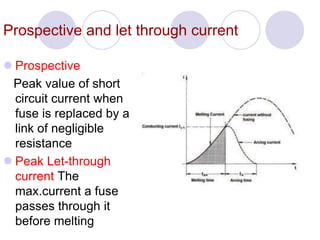
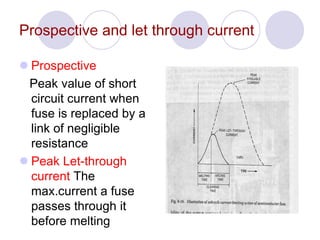
Prospective and let through current
 Prospective
Peak value of short
circuit current when
fuse is replaced by a
link of negligible
resistance
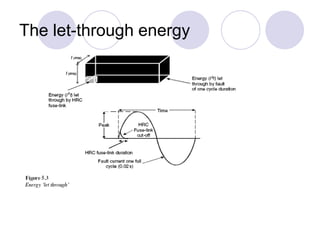
 Peak Let-through
current The
max.current a fuse
passes through it
before melting
Prospective and let through current
 Prospective
Peak value of short
circuit current when
fuse is replaced by a
link of negligible
resistance
 Peak Let-through
current The
max.current a fuse
passes through it
before melting
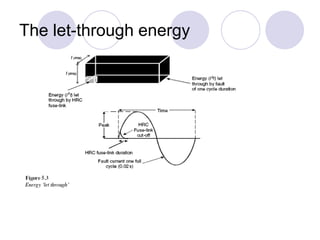
The let-through energy
Types of Fuse
 according to voltage rating :
LV ( < 1 kV ) and HV ( > 1 kV )
 according to construction
Semi enclosed or re-wire able type
Cartridge or HRC fuses
 according to operation:
 Current limiting HRC fuses : the fuse element melts
at a current value much lower than the first peak of the
prospective current and clears the fault in the first half
cycle. Such an operation is termed as sub-cycle
clearance of fault and is an important characteristic of
HRC fuses.
 Non-current limiting fuses : they open the circuit
within one or two cycles after the inception of the short
circuit. semi enclosed fuses are the example of such
fuses.
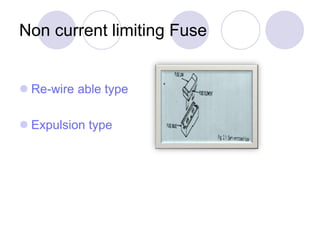
Non current limiting Fuse
 Re-wire able type
 Expulsion type
MATERIAL FOR FUSE ELEMENT
 Desirable features: low melting point, high conductivity, free
from deterioration from oxidation, low cost
 Tin , lead , Cu .,Zn , Ag , Al
 Silver is mostly used which has least resistivity (1.59 x 10⁻⁸ Ω-m)
and melting point of 1761 ˚F (=961 ˚ C). While copper has a higher
resistivity (1.68 x 10⁻⁸ Ω-m) and melts at 1083 ˚ C.
 Silver is not oxidized but when air is moist and contains H2S, it
attacks the silver surface and alloy of AgS is formed at the top which
shields the metal from further attack.
 For small current up to 10A, tin or standard alloy wires are also
used. Standard alloy wire contains 63 %tin and 37 % lead. For high
current, Copper or silver element is used
 Melting point : Cu =2000 F , lead = 624 F , tin =463 F
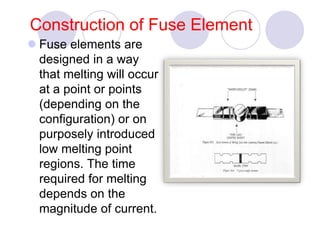
Construction of Fuse Element
 Fuse elements are
designed in a way
that melting will occur
at a point or points
(depending on the
configuration) or on
purposely introduced
low melting point
regions. The time
required for melting
depends on the
magnitude of current.
Non current limiting Fuse
 Re-wire able type
 Expulsion type
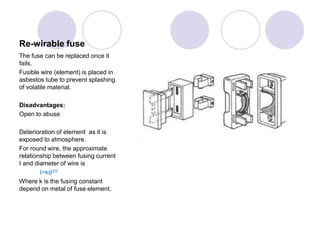
Re-wirable fuse
The fuse can be replaced once it
fails.
Fusible wire (element) is placed in
asbestos tube to prevent splashing
of volatile material.
Disadvantages:
Open to abuse
Deterioration of element as it is
exposed to atmosphere.
For round wire, the approximate
relationship between fusing current
I and diameter of wire is
I=kd3/2
Where k is the fusing constant
depend on metal of fuse element.
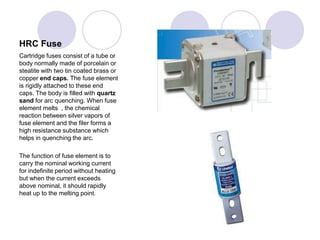
HRC Fuse
Cartridge fuses consist of a tube or
body normally made of porcelain or
steatite with two tin coated brass or
copper end caps. The fuse element
is rigidly attached to these end
caps. The body is filled with quartz
sand for arc quenching. When fuse
element melts , the chemical
reaction between silver vapors of
fuse element and the filer forms a
high resistance substance which
helps in quenching the arc.
The function of fuse element is to
carry the nominal working current
for indefinite period without heating
but when the current exceeds
above nominal, it should rapidly
heat up to the melting point.
Application of Fuse
 Fuse can be used as either combined over-load and short circuit
protection or only for short circuit protection.
 Circuits where load does not vary much above normal value during
switching on and operating condition such as resistive circuits . Hence
fuse can be used as overload as well as short circuit protection.
 Circuits where load varies considerably compared to normal rating e.g.,
direct on-line motors , cranes, rolling mills, welding set etc. in these
cases fuses are used to provide short circuit protection as it is not
possible to select a fuse size meeting both overload and inrush current.
How to select a fuse?
Determination of available short circuit
current
Use sub transient reactance of all
generators, synchronous motors, induction
motors in short circuit calculations.
Use multiplying factor of 1.6 for first
current peak
Available short circuit current for fuse =
Momentary current for circuit breaker
MATERIAL FOR FUSE ELEMENT
 Tin , lead , Cu .,Zn , Ag , Al
 Silver is mostly used which has melting point of 1830 F and
specific resistance of 1.64 u ohm-cm. Silver is not oxidized but when
air is moist and contains H2S, it attacks the silver surface and alloy
of AgS is formed at the top which shields the metal from further
attack.
 Copper wire, tinned Cu wire or standard alloy wires are also used.
Standard alloy wire contains 63 %tin and 37 % lead.
 Melting point : Cu =2000 F , lead = 624 F , tin =463 F
FUSE
CHARACTERISTICS
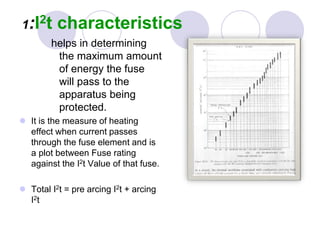
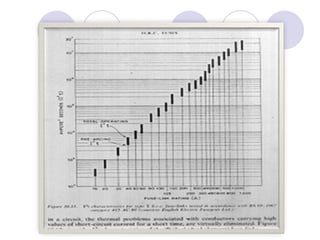
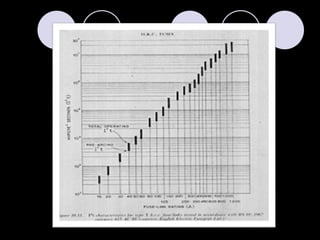
1:I2t characteristics
helps in determining
the maximum amount
of energy the fuse
will pass to the
apparatus being
protected.
 It is the measure of heating
effect when current passes
through the fuse element and is
a plot between Fuse rating
against the I2t Value of that fuse.
 Total I2t = pre arcing I2t + arcing
I2t
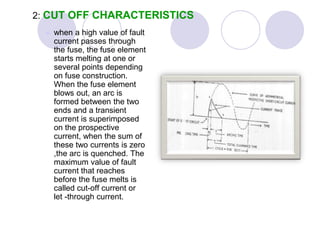
2: CUT OFF CHARACTERISTICS
 when a high value of fault
current passes through
the fuse, the fuse element
starts melting at one or
several points depending
on fuse construction.
When the fuse element
blows out, an arc is
formed between the two
ends and a transient
current is superimposed
on the prospective
current, when the sum of
these two currents is zero
,the arc is quenched. The
maximum value of fault
current that reaches
before the fuse melts is
called cut-off current or
let -through current.
The let-through energy
Significance of Cut off characteristics
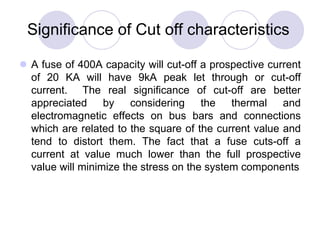
 A fuse of 400A capacity will cut-off a prospective current
of 20 KA will have 9kA peak let through or cut-off
current. The real significance of cut-off are better
appreciated by considering the thermal and
electromagnetic effects on bus bars and connections
which are related to the square of the current value and
tend to distort them. The fact that a fuse cuts-off a
current at value much lower than the full prospective
value will minimize the stress on the system components
3:Time/current characteristics ( TCC )
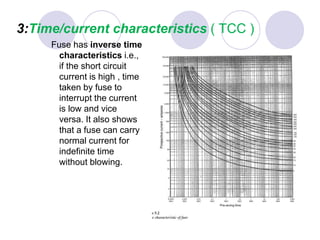
Fuse has inverse time
characteristics i.e.,
if the short circuit
current is high , time
taken by fuse to
interrupt the current
is low and vice
versa. It also shows
that a fuse can carry
normal current for
indefinite time
without blowing.
Fuse Applications
Cable protection
Motor protection
Control gear protection
SCR protection
Discrimination & co-ordination
between a number of Fuses present
in a system.
Coordination b/w two over current devices
coordination b/w two fuses in series
How to achieve coordination?
 protection of a motor and
cables. In such a case,
coordination between the two
over-current devices e.g., a
contactor and a fuse is done
in a manner that the breaking
capacity of the tripping device
is fully utilized.
 In such applications the
important feature is that the
fuse provides back-up
protection to another circuit
interrupting device, which has
only limited ability, but
allowing that ability to be used
to the full so that unnecessary
fuse operation is avoided.
 In case of DOL starting a
motor, the time-current
characteristics of both
fuse and the other device
should also be selected
so that neither of two
should operate when
motor draws a current 6
to 8 times of the rating
during the starting period.
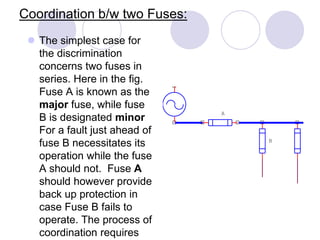
Coordination b/w two Fuses:
 The simplest case for
the discrimination
concerns two fuses in
series. Here in the fig.
Fuse A is known as the
major fuse, while fuse
B is designated minor
For a fault just ahead of
fuse B necessitates its
operation while the fuse
A should not. Fuse A
should however provide
back up protection in
case Fuse B fails to
operate. The process of
coordination requires
B
A
Conditions :
 Time-current characteristics of fuse link B
must lie throughout its length below that of
fuse A.
The pre-arcing time of the major fuse must
be greater than the total operating time of
the minor. An accepted rule for fuse
coordination is that max. clearing time of
protecting(minor) fuse should not exceed
75% of min. melting time of major fuse.
Example:
Suppose that a system is known to have a prospective
fault level of 15000 A ( rms. symmetrical ), a value at
which cut-off will be exhibited by the fuse-link selected.
Fuse link B is chosen rated at 200 A by load
considerations. It is now required to select fuse-link A
such that the discrimination at the fault level will be
assured.
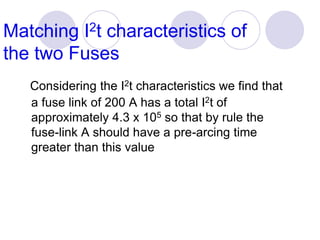
Matching I2t characteristics of
the two Fuses
Considering the I2t characteristics we find that
a fuse link of 200 A has a total I2t of
approximately 4.3 x 10⁵ so that by rule the
fuse-link A should have a pre-arcing time
greater than this value
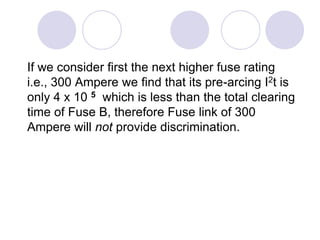
If we consider first the next higher fuse rating
i.e., 300 Ampere we find that its pre-arcing I2t is
only 4 x 10 5 which is less than the total clearing
time of Fuse B, therefore Fuse link of 300
Ampere will not provide discrimination.
Choosing the next higher
rating, 350 A
350 A fuse , however has a pre-arcing I2t
of 6 x 10 5 i.e., greater by a good margin
than the total I2t of the 200A fuse link B,
and therefore fuse link A must be rated not
less than 350 A.
A comparison between Circuit
breakers and Fuse
Speed of operation : HRC fuses exhibit sub-
cycle operation and are fast enough to give
adequate protection to semi conductor devices .
Moreover especially designed Semi conductor
fuses are even faster than conventional HRC fuses
. Circuit breakers on the other hand have clearing
time that is usually more than one power cycle but
can adequately protect the power equipment.
·Rupturing capacity : Since fuses operate in sub-
cycle ( ¼ cycle ) they are never called upon to
carry current up to their rupturing capacity . Circuit
breakers, on the other hand may be handling a
current up to the maximum rating and therefore
electromagnetic and thermal stresses on the
associated system (bus bars and connections )
can not be limited.
Non-deteriorating characteristics :
Fuse maintain their characteristics
throughout their service life and are
therefore maintenance-free. Such is not
the case with circuit breakers.
 Physical size of fuse depends on current
rating whereas the size of circuit breaker
depends on the breaking capacity . This fact
favors fuse applications in areas having high
fault level

Fuse and its types

  • 1.
    General fuse terms: Fuse element is that part which melts and opens the circuit  Minimum Fusing current is the minimum value of current at which the fuse element melts.  Current rating of a fuse is that value of current which a fuse element is capable of passing for indefinite time without heating.  Fusing factor = Minimum fusing current / current rating of fuse element Since current rating is less than the minimum fusing current, therefore, fusing factor > 1
  • 2.
     Prospective currentis the RMS value of the alternating current or D,C current which would flow in the circuit immediately following the fuse when a short circuit occurs assuming that the fuse has been replaced by a link of negligible resistance.  Peak let through current is the current which passes through the fuse before the fuse element melts.  Melting time is the time elapsed between the fault occurrence and melting of fuse element. It is also called pre-arcing time.  Arcing time is the time elapsed between melting of fuse element and consequent arc production to the ultimate extinction of arc. Total clearing time = pre-arcing time + arcing time  Breaking capacity of a fuse is the product of its service voltage and the rms. value of prospective current. Fuses of high breaking capacity or rupturing capacity are termed as HRC fuses.
  • 3.
    Prospective and letthrough current  Prospective Peak value of short circuit current when fuse is replaced by a link of negligible resistance  Peak Let-through current The max.current a fuse passes through it before melting
  • 4.
    Prospective and letthrough current  Prospective Peak value of short circuit current when fuse is replaced by a link of negligible resistance  Peak Let-through current The max.current a fuse passes through it before melting
  • 5.
  • 6.
    Types of Fuse according to voltage rating : LV ( < 1 kV ) and HV ( > 1 kV )  according to construction Semi enclosed or re-wire able type Cartridge or HRC fuses
  • 7.
     according tooperation:  Current limiting HRC fuses : the fuse element melts at a current value much lower than the first peak of the prospective current and clears the fault in the first half cycle. Such an operation is termed as sub-cycle clearance of fault and is an important characteristic of HRC fuses.  Non-current limiting fuses : they open the circuit within one or two cycles after the inception of the short circuit. semi enclosed fuses are the example of such fuses.
  • 8.
    Non current limitingFuse  Re-wire able type  Expulsion type
  • 9.
    MATERIAL FOR FUSEELEMENT  Desirable features: low melting point, high conductivity, free from deterioration from oxidation, low cost  Tin , lead , Cu .,Zn , Ag , Al  Silver is mostly used which has least resistivity (1.59 x 10⁻⁸ Ω-m) and melting point of 1761 ˚F (=961 ˚ C). While copper has a higher resistivity (1.68 x 10⁻⁸ Ω-m) and melts at 1083 ˚ C.  Silver is not oxidized but when air is moist and contains H2S, it attacks the silver surface and alloy of AgS is formed at the top which shields the metal from further attack.  For small current up to 10A, tin or standard alloy wires are also used. Standard alloy wire contains 63 %tin and 37 % lead. For high current, Copper or silver element is used  Melting point : Cu =2000 F , lead = 624 F , tin =463 F
  • 10.
    Construction of FuseElement  Fuse elements are designed in a way that melting will occur at a point or points (depending on the configuration) or on purposely introduced low melting point regions. The time required for melting depends on the magnitude of current.
  • 11.
    Non current limitingFuse  Re-wire able type  Expulsion type
  • 12.
    Re-wirable fuse The fusecan be replaced once it fails. Fusible wire (element) is placed in asbestos tube to prevent splashing of volatile material. Disadvantages: Open to abuse Deterioration of element as it is exposed to atmosphere. For round wire, the approximate relationship between fusing current I and diameter of wire is I=kd3/2 Where k is the fusing constant depend on metal of fuse element.
  • 13.
    HRC Fuse Cartridge fusesconsist of a tube or body normally made of porcelain or steatite with two tin coated brass or copper end caps. The fuse element is rigidly attached to these end caps. The body is filled with quartz sand for arc quenching. When fuse element melts , the chemical reaction between silver vapors of fuse element and the filer forms a high resistance substance which helps in quenching the arc. The function of fuse element is to carry the nominal working current for indefinite period without heating but when the current exceeds above nominal, it should rapidly heat up to the melting point.
  • 14.
    Application of Fuse Fuse can be used as either combined over-load and short circuit protection or only for short circuit protection.  Circuits where load does not vary much above normal value during switching on and operating condition such as resistive circuits . Hence fuse can be used as overload as well as short circuit protection.  Circuits where load varies considerably compared to normal rating e.g., direct on-line motors , cranes, rolling mills, welding set etc. in these cases fuses are used to provide short circuit protection as it is not possible to select a fuse size meeting both overload and inrush current.
  • 15.
  • 16.
    Determination of availableshort circuit current Use sub transient reactance of all generators, synchronous motors, induction motors in short circuit calculations. Use multiplying factor of 1.6 for first current peak Available short circuit current for fuse = Momentary current for circuit breaker
  • 17.
    MATERIAL FOR FUSEELEMENT  Tin , lead , Cu .,Zn , Ag , Al  Silver is mostly used which has melting point of 1830 F and specific resistance of 1.64 u ohm-cm. Silver is not oxidized but when air is moist and contains H2S, it attacks the silver surface and alloy of AgS is formed at the top which shields the metal from further attack.  Copper wire, tinned Cu wire or standard alloy wires are also used. Standard alloy wire contains 63 %tin and 37 % lead.  Melting point : Cu =2000 F , lead = 624 F , tin =463 F
  • 18.
  • 19.
    1:I2t characteristics helps indetermining the maximum amount of energy the fuse will pass to the apparatus being protected.  It is the measure of heating effect when current passes through the fuse element and is a plot between Fuse rating against the I2t Value of that fuse.  Total I2t = pre arcing I2t + arcing I2t
  • 21.
    2: CUT OFFCHARACTERISTICS  when a high value of fault current passes through the fuse, the fuse element starts melting at one or several points depending on fuse construction. When the fuse element blows out, an arc is formed between the two ends and a transient current is superimposed on the prospective current, when the sum of these two currents is zero ,the arc is quenched. The maximum value of fault current that reaches before the fuse melts is called cut-off current or let -through current.
  • 22.
  • 23.
    Significance of Cutoff characteristics  A fuse of 400A capacity will cut-off a prospective current of 20 KA will have 9kA peak let through or cut-off current. The real significance of cut-off are better appreciated by considering the thermal and electromagnetic effects on bus bars and connections which are related to the square of the current value and tend to distort them. The fact that a fuse cuts-off a current at value much lower than the full prospective value will minimize the stress on the system components
  • 24.
    3:Time/current characteristics (TCC ) Fuse has inverse time characteristics i.e., if the short circuit current is high , time taken by fuse to interrupt the current is low and vice versa. It also shows that a fuse can carry normal current for indefinite time without blowing.
  • 25.
    Fuse Applications Cable protection Motorprotection Control gear protection SCR protection
  • 26.
    Discrimination & co-ordination betweena number of Fuses present in a system. Coordination b/w two over current devices coordination b/w two fuses in series
  • 27.
    How to achievecoordination?  protection of a motor and cables. In such a case, coordination between the two over-current devices e.g., a contactor and a fuse is done in a manner that the breaking capacity of the tripping device is fully utilized.  In such applications the important feature is that the fuse provides back-up protection to another circuit interrupting device, which has only limited ability, but allowing that ability to be used to the full so that unnecessary fuse operation is avoided.  In case of DOL starting a motor, the time-current characteristics of both fuse and the other device should also be selected so that neither of two should operate when motor draws a current 6 to 8 times of the rating during the starting period.
  • 28.
    Coordination b/w twoFuses:  The simplest case for the discrimination concerns two fuses in series. Here in the fig. Fuse A is known as the major fuse, while fuse B is designated minor For a fault just ahead of fuse B necessitates its operation while the fuse A should not. Fuse A should however provide back up protection in case Fuse B fails to operate. The process of coordination requires B A
  • 29.
    Conditions :  Time-currentcharacteristics of fuse link B must lie throughout its length below that of fuse A. The pre-arcing time of the major fuse must be greater than the total operating time of the minor. An accepted rule for fuse coordination is that max. clearing time of protecting(minor) fuse should not exceed 75% of min. melting time of major fuse.
  • 30.
    Example: Suppose that asystem is known to have a prospective fault level of 15000 A ( rms. symmetrical ), a value at which cut-off will be exhibited by the fuse-link selected. Fuse link B is chosen rated at 200 A by load considerations. It is now required to select fuse-link A such that the discrimination at the fault level will be assured.
  • 31.
    Matching I2t characteristicsof the two Fuses Considering the I2t characteristics we find that a fuse link of 200 A has a total I2t of approximately 4.3 x 10⁵ so that by rule the fuse-link A should have a pre-arcing time greater than this value
  • 33.
    If we considerfirst the next higher fuse rating i.e., 300 Ampere we find that its pre-arcing I2t is only 4 x 10 5 which is less than the total clearing time of Fuse B, therefore Fuse link of 300 Ampere will not provide discrimination.
  • 34.
    Choosing the nexthigher rating, 350 A 350 A fuse , however has a pre-arcing I2t of 6 x 10 5 i.e., greater by a good margin than the total I2t of the 200A fuse link B, and therefore fuse link A must be rated not less than 350 A.
  • 35.
    A comparison betweenCircuit breakers and Fuse
  • 36.
    Speed of operation: HRC fuses exhibit sub- cycle operation and are fast enough to give adequate protection to semi conductor devices . Moreover especially designed Semi conductor fuses are even faster than conventional HRC fuses . Circuit breakers on the other hand have clearing time that is usually more than one power cycle but can adequately protect the power equipment. ·Rupturing capacity : Since fuses operate in sub- cycle ( ¼ cycle ) they are never called upon to carry current up to their rupturing capacity . Circuit breakers, on the other hand may be handling a current up to the maximum rating and therefore electromagnetic and thermal stresses on the associated system (bus bars and connections ) can not be limited.
  • 37.
    Non-deteriorating characteristics : Fusemaintain their characteristics throughout their service life and are therefore maintenance-free. Such is not the case with circuit breakers.  Physical size of fuse depends on current rating whereas the size of circuit breaker depends on the breaking capacity . This fact favors fuse applications in areas having high fault level