Circuit 
Breaker 
as 
a 
protection 
device
Main point will covered in this presentation 
1- General 
2- circuit breaker 
2.1- General 
2.2- Rate terms of circuit breaker 
2.3- operating principle 
2.4- the insulation fluids commonly used as insulation 
medium during the separation of contact 
3- Arc phenomena 
3.1- General 
3.2- initiation of an arc 
3.3- Maintenance of arc 
3.4- Arc voltage 
4- Arc Extinction 
4.1- General 
4.2- Method of Arc phenomena 
4.2.1- High Resistance Method 
4.2.2- LOW Resistance Method
5- Classification of circuit breaker 
6- Main type of circuit breaker 
7- scoop on some types with some details 
8-Tesying of circuit breaker
1. General 
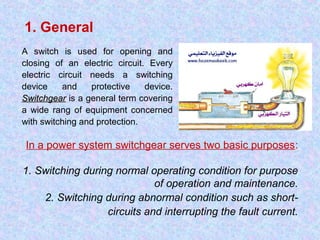
A switch is used for opening and 
closing of an electric circuit. Every 
electric circuit needs a switching 
device and protective device. 
SSwwiittcchhggeeaarr is a general term covering 
a wide rang of equipment concerned 
with switching and protection. 
In a power system switchgear serves two basic purposes: 
1. Switching during normal operating condition for purpose 
of operation and maintenance. 
2. Switching during abnormal condition such as short-circuits 
and interrupting the fault current.
The first of above could be served by relatively simple 
switches because it is relatively simple as it involves 
normal current which are easy to interrupt. The second 
function is however complex. 
With the advancement of electrical power system the lines 
and other equipment operate at very high voltage and 
carry large current. Whenever a short-circuit occurs, a 
heavy current flows through the equipment causing 
considerable damage to the equipment and interruption 
the service. 
In order to avoid such damage every part of the power 
system is provided with a protective relaying system and 
an associated switching device. The relaying equipment is 
aided in this task by circuit breaker.
2. Circuit breaker 
2.1 General 
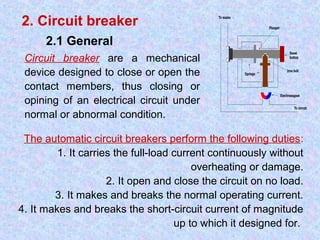
Circuit breaker are a mechanical 
device designed to close or open the 
contact members, thus closing or 
opining of an electrical circuit under 
normal or abnormal condition. 
The automatic circuit breakers perform the following duties: 
1. It carries the full-load current continuously without 
overheating or damage. 
2. It open and close the circuit on no load. 
3. It makes and breaks the normal operating current. 
4. It makes and breaks the short-circuit current of magnitude 
up to which it designed for.
2.2 Rate terms of circuit breaker 
• Max voltage 
• NO, of poles 
• Frequency 
• Maximum continuous current 
carrying capacity 
• Max interrupting capacity 
• Max momentary
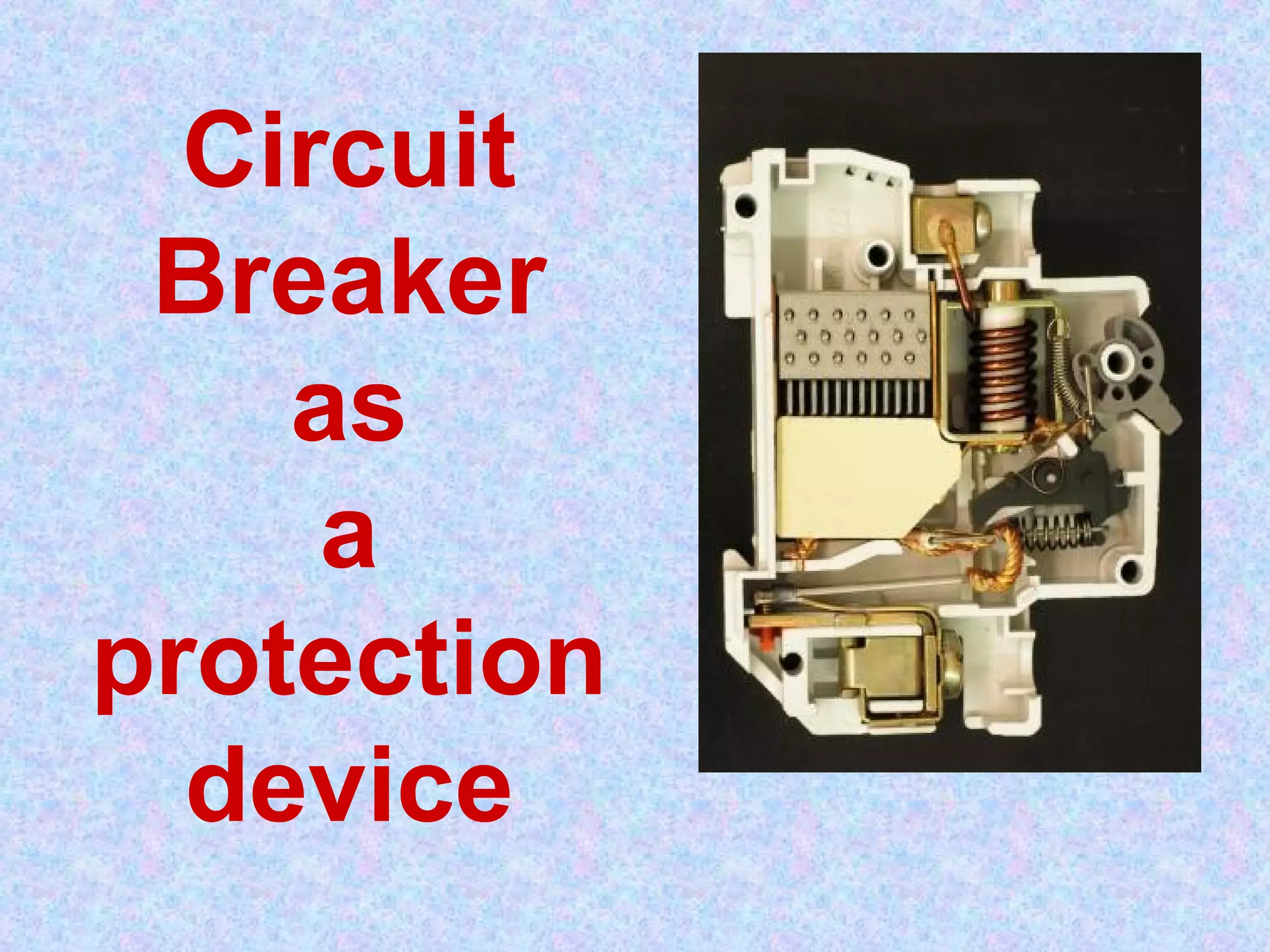
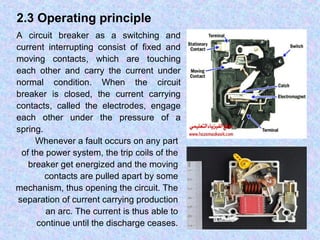
2.3 Operating principle 
A circuit breaker as a switching and 
current interrupting consist of fixed and 
moving contacts, which are touching 
each other and carry the current under 
normal condition. When the circuit 
breaker is closed, the current carrying 
contacts, called the electrodes, engage 
each other under the pressure of a 
spring. 
Whenever a fault occurs on any part 
of the power system, the trip coils of the 
breaker get energized and the moving 
contacts are pulled apart by some 
mechanism, thus opening the circuit. The 
separation of current carrying production 
an arc. The current is thus able to 
continue until the discharge ceases.
Therefore the main problem in circuit breaker is to 
extinguish the arc within the shortest possible time so 
that heats generated by it not reach a dangerous 
value. 
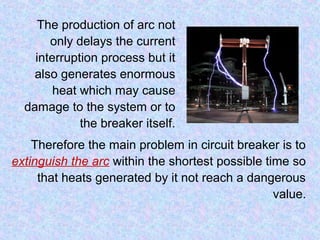
The production of arc not 
only delays the current 
interruption process but it 
also generates enormous 
heat which may cause 
damage to the system or to 
the breaker itself.
The basic construction of circuit breaker requires the 
separation of the contacts in an insulating fluid which 
serve two functions: 
1. Extinguishes the arc drawn between the contacts when 
the circuit breaker opens. 
2. Provides insulation between the contact and from each 
contact to earth. 
The insulating fluids commonly used for this purpose 
are as follows: 
1. Air and atmospheric pressure. 
2. Compressed air. 
3. Oil producing hydrogen for arc extinction. 
4. Ultra high vacuum 
5. Sulphur hexa-fluoride (SF6)
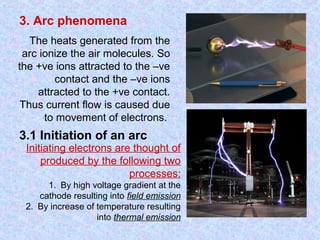
3. Arc phenomena 
The heats generated from the 
arc ionize the air molecules. So 
the +ve ions attracted to the –ve 
contact and the –ve ions 
attracted to the +ve contact. 
Thus current flow is caused due 
to movement of electrons. 
3.1 Initiation of an arc 
Initiating electrons are thought of 
produced by the following two 
processes: 
1. By high voltage gradient at the 
cathode resulting into field emission 
2. By increase of temperature resulting 
into thermal emission
THANK YOU 
FOR LISTHINING 
2/11/2010
3.2 maintenance of arc 
The ionization is further by: 
1. High temperature of the medium around the contacts 
caused by high current densities. 
2. The field strength or voltage gradient which increases 
the kinetic energy of moving electrons and increases 
the chances of detaching from neutral molecules. 
3. An increase of mean free path-the distance through 
which the electron moves freely. 
All above three processes (thermal emission – ionization – 
and field emission) may start either one after the other or 
almost simultaneously and enable the arc to be initiated 
and maintained.
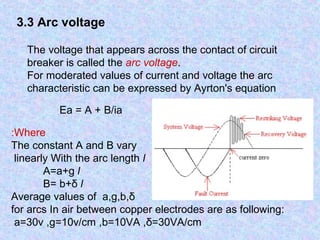
3.3 Arc voltage 
The voltage that appears across the contact of circuit 
breaker is called the arc voltage. 
For moderated values of current and voltage the arc 
characteristic can be expressed by Ayrton's equation 
Ea = A + B/ia 
:Where 
The constant A and B vary 
linearly With the arc length l 
A=a+g l 
B= b+δ l 
Average values of a,g,b,δ 
for arcs In air between copper electrodes are as following: 
a=30v ,g=10v/cm ,b=10VA ,δ=30VA/cm
HHIINNTT 
AARRCC FFOORR FFUUNN 
11..AArrcc ccaann bbee uusseedd ttoo ggeenneerraattee mmuussiicc 
22..IItt ccaann bbee uusseedd iinn ddrraawwiinngg
4. Arc extinction 
The conductance of the arc is proportional to 
1. The number of electrons per cubic centimeter 
produced by ionization 
2. The square of the diameter of the arc 
3. Reciprocal of the length 
The arc extinction can, therefore, be facilitated by 
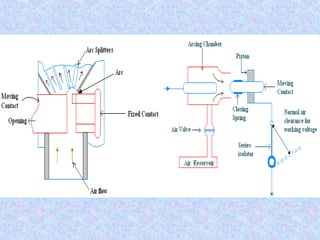
deionizing the arc path. This may be achieved by cooling 
the arc or bodily removing the ionized particles from the 
space between the circuit breaker contacts.
4.1 Method of arc extinction 
High Resistance Method 4.1.1 
In this case the arc is controlled in such a way that its effective 
resistance increases with the time so that the current is 
reduced to such a value that heat produced by it is not 
sufficient to maintain the arc and the current is interrupted or 
the arc is extinguished. 
The resistance of the arc can be increased by: 
1. Cooling of arc 
2. Increasing the length of arc 
3. Reducing the cross-section of arc 
4. Splitting of arc
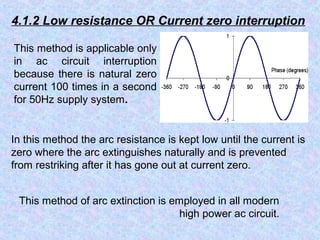
4.1.2 Low resistance OR Current zero interruption 
This method is applicable only 
in ac circuit interruption 
because there is natural zero 
current 100 times in a second 
for 50Hz supply system. 
In this method the arc resistance is kept low until the current is 
zero where the arc extinguishes naturally and is prevented 
from restriking after it has gone out at current zero. 
This method of arc extinction is employed in all modern 
high power ac circuit.
5. Duties of circuit breakers 
1. Interruption of small inductive current 
2. Switching of unloaded transmission lines and unloaded 
cables 
3. Switching of capacitor banks 
4. Interruption of terminal faults 
5. Interruption of short-line faults (kilometric fault) 
6. Asynchronous switching
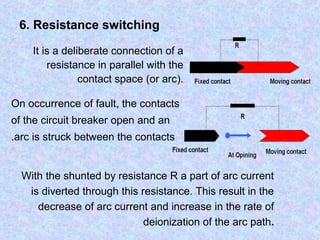
6. Resistance switching 
It is a deliberate connection of a 
resistance in parallel with the 
contact space (or arc). 
On occurrence of fault, the contacts 
of the circuit breaker open and an 
arc is struck . between the contacts 
With the shunted by resistance R a part of arc current 
is diverted through this resistance. This result in the 
decrease of arc current and increase in the rate of 
deionization of the arc path.
7. Classification of circuit breaker 
1. Oil circuit breakers 
2. Water type circuit breaker 
3. Air-Break circuit breaker 
4. Air blast circuit breaker 
5. Sulphur Hexafluoride (SF6 ) circuit breaker 
6. Vacuum circuit breaker
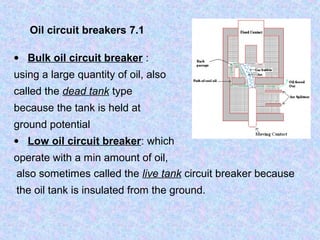
Oil circuit breakers 7.1 
· Bulk oil circuit breaker : 
using a large quantity of oil, also 
called the dead tank type 
because the tank is held at 
ground potential 
· Low oil circuit breaker: which 
operate with a min amount of oil, 
also sometimes called the live tank circuit breaker because 
the oil tank is insulated from the ground.
Advantage: 
1. Arc energy is absorbed in decomposing of oil. 
2. The gas formed which mainly hydrogen is provided good 
cooling properties. 
3. The oil has a high dielectric insulating between the 
contacts after the arc extinguished. 
4. The very good insulation medium allows smaller clearance 
between line conductors and earth components
Disadvantage 
1. Oil is inflammable and may cause fire hazards. 
2. There is a risk of formation of explosive mixture with air. 
3. Due to decomposition of oil in the arc, the oil becomes 
pouted by carbon particles, which reduce its dielectric 
strength.
Maintenance of oil circuit breaker 
1. All current carrying parts be checked and arcing 
contacts be attended if necessary. 
2. Dielectric strength condition and level of oil should be 
checked. 
3. Inspect the insulation for possible damage. Clean the 
surface and remove deposits of carbon 
4. Check closing, tripping and interlock mechanism 
5. Check indicating devices and lamps
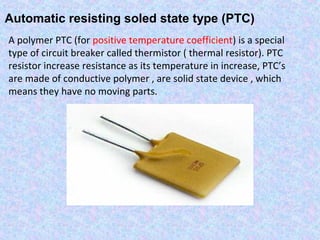
Automatic resisting soled state type (PTC) 
A polymer PTC (for positive temperature coefficient) is a special 
type of circuit breaker called thermistor ( thermal resistor). PTC 
resistor increase resistance as its temperature in increase, PTC’s 
are made of conductive polymer , are solid state device , which 
means they have no moving parts.
Polymer PTC construction and operation 
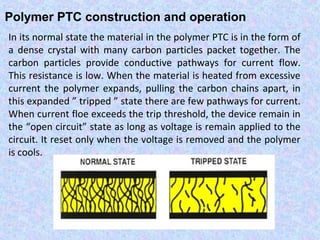
In its normal state the material in the polymer PTC is in the form of 
a dense crystal with many carbon particles packet together. The 
carbon particles provide conductive pathways for current flow. 
This resistance is low. When the material is heated from excessive 
current the polymer expands, pulling the carbon chains apart, in 
this expanded ” tripped ” state there are few pathways for current. 
When current floe exceeds the trip threshold, the device remain in 
the “open circuit” state as long as voltage is remain applied to the 
circuit. It reset only when the voltage is removed and the polymer 
is cools.

Circuit breaker

  • 1.
    Circuit Breaker as a protection device
  • 2.
    Main point willcovered in this presentation 1- General 2- circuit breaker 2.1- General 2.2- Rate terms of circuit breaker 2.3- operating principle 2.4- the insulation fluids commonly used as insulation medium during the separation of contact 3- Arc phenomena 3.1- General 3.2- initiation of an arc 3.3- Maintenance of arc 3.4- Arc voltage 4- Arc Extinction 4.1- General 4.2- Method of Arc phenomena 4.2.1- High Resistance Method 4.2.2- LOW Resistance Method
  • 3.
    5- Classification ofcircuit breaker 6- Main type of circuit breaker 7- scoop on some types with some details 8-Tesying of circuit breaker
  • 4.
    1. General Aswitch is used for opening and closing of an electric circuit. Every electric circuit needs a switching device and protective device. SSwwiittcchhggeeaarr is a general term covering a wide rang of equipment concerned with switching and protection. In a power system switchgear serves two basic purposes: 1. Switching during normal operating condition for purpose of operation and maintenance. 2. Switching during abnormal condition such as short-circuits and interrupting the fault current.
  • 5.
    The first ofabove could be served by relatively simple switches because it is relatively simple as it involves normal current which are easy to interrupt. The second function is however complex. With the advancement of electrical power system the lines and other equipment operate at very high voltage and carry large current. Whenever a short-circuit occurs, a heavy current flows through the equipment causing considerable damage to the equipment and interruption the service. In order to avoid such damage every part of the power system is provided with a protective relaying system and an associated switching device. The relaying equipment is aided in this task by circuit breaker.
  • 6.
    2. Circuit breaker 2.1 General Circuit breaker are a mechanical device designed to close or open the contact members, thus closing or opining of an electrical circuit under normal or abnormal condition. The automatic circuit breakers perform the following duties: 1. It carries the full-load current continuously without overheating or damage. 2. It open and close the circuit on no load. 3. It makes and breaks the normal operating current. 4. It makes and breaks the short-circuit current of magnitude up to which it designed for.
  • 7.
    2.2 Rate termsof circuit breaker • Max voltage • NO, of poles • Frequency • Maximum continuous current carrying capacity • Max interrupting capacity • Max momentary
  • 8.
    2.3 Operating principle A circuit breaker as a switching and current interrupting consist of fixed and moving contacts, which are touching each other and carry the current under normal condition. When the circuit breaker is closed, the current carrying contacts, called the electrodes, engage each other under the pressure of a spring. Whenever a fault occurs on any part of the power system, the trip coils of the breaker get energized and the moving contacts are pulled apart by some mechanism, thus opening the circuit. The separation of current carrying production an arc. The current is thus able to continue until the discharge ceases.
  • 9.
    Therefore the mainproblem in circuit breaker is to extinguish the arc within the shortest possible time so that heats generated by it not reach a dangerous value. The production of arc not only delays the current interruption process but it also generates enormous heat which may cause damage to the system or to the breaker itself.
  • 10.
    The basic constructionof circuit breaker requires the separation of the contacts in an insulating fluid which serve two functions: 1. Extinguishes the arc drawn between the contacts when the circuit breaker opens. 2. Provides insulation between the contact and from each contact to earth. The insulating fluids commonly used for this purpose are as follows: 1. Air and atmospheric pressure. 2. Compressed air. 3. Oil producing hydrogen for arc extinction. 4. Ultra high vacuum 5. Sulphur hexa-fluoride (SF6)
  • 11.
    3. Arc phenomena The heats generated from the arc ionize the air molecules. So the +ve ions attracted to the –ve contact and the –ve ions attracted to the +ve contact. Thus current flow is caused due to movement of electrons. 3.1 Initiation of an arc Initiating electrons are thought of produced by the following two processes: 1. By high voltage gradient at the cathode resulting into field emission 2. By increase of temperature resulting into thermal emission
  • 12.
    THANK YOU FORLISTHINING 2/11/2010
  • 13.
    3.2 maintenance ofarc The ionization is further by: 1. High temperature of the medium around the contacts caused by high current densities. 2. The field strength or voltage gradient which increases the kinetic energy of moving electrons and increases the chances of detaching from neutral molecules. 3. An increase of mean free path-the distance through which the electron moves freely. All above three processes (thermal emission – ionization – and field emission) may start either one after the other or almost simultaneously and enable the arc to be initiated and maintained.
  • 14.
    3.3 Arc voltage The voltage that appears across the contact of circuit breaker is called the arc voltage. For moderated values of current and voltage the arc characteristic can be expressed by Ayrton's equation Ea = A + B/ia :Where The constant A and B vary linearly With the arc length l A=a+g l B= b+δ l Average values of a,g,b,δ for arcs In air between copper electrodes are as following: a=30v ,g=10v/cm ,b=10VA ,δ=30VA/cm
  • 15.
    HHIINNTT AARRCC FFOORRFFUUNN 11..AArrcc ccaann bbee uusseedd ttoo ggeenneerraattee mmuussiicc 22..IItt ccaann bbee uusseedd iinn ddrraawwiinngg
  • 16.
    4. Arc extinction The conductance of the arc is proportional to 1. The number of electrons per cubic centimeter produced by ionization 2. The square of the diameter of the arc 3. Reciprocal of the length The arc extinction can, therefore, be facilitated by deionizing the arc path. This may be achieved by cooling the arc or bodily removing the ionized particles from the space between the circuit breaker contacts.
  • 17.
    4.1 Method ofarc extinction High Resistance Method 4.1.1 In this case the arc is controlled in such a way that its effective resistance increases with the time so that the current is reduced to such a value that heat produced by it is not sufficient to maintain the arc and the current is interrupted or the arc is extinguished. The resistance of the arc can be increased by: 1. Cooling of arc 2. Increasing the length of arc 3. Reducing the cross-section of arc 4. Splitting of arc
  • 19.
    4.1.2 Low resistanceOR Current zero interruption This method is applicable only in ac circuit interruption because there is natural zero current 100 times in a second for 50Hz supply system. In this method the arc resistance is kept low until the current is zero where the arc extinguishes naturally and is prevented from restriking after it has gone out at current zero. This method of arc extinction is employed in all modern high power ac circuit.
  • 20.
    5. Duties ofcircuit breakers 1. Interruption of small inductive current 2. Switching of unloaded transmission lines and unloaded cables 3. Switching of capacitor banks 4. Interruption of terminal faults 5. Interruption of short-line faults (kilometric fault) 6. Asynchronous switching
  • 21.
    6. Resistance switching It is a deliberate connection of a resistance in parallel with the contact space (or arc). On occurrence of fault, the contacts of the circuit breaker open and an arc is struck . between the contacts With the shunted by resistance R a part of arc current is diverted through this resistance. This result in the decrease of arc current and increase in the rate of deionization of the arc path.
  • 22.
    7. Classification ofcircuit breaker 1. Oil circuit breakers 2. Water type circuit breaker 3. Air-Break circuit breaker 4. Air blast circuit breaker 5. Sulphur Hexafluoride (SF6 ) circuit breaker 6. Vacuum circuit breaker
  • 23.
    Oil circuit breakers7.1 · Bulk oil circuit breaker : using a large quantity of oil, also called the dead tank type because the tank is held at ground potential · Low oil circuit breaker: which operate with a min amount of oil, also sometimes called the live tank circuit breaker because the oil tank is insulated from the ground.
  • 24.
    Advantage: 1. Arcenergy is absorbed in decomposing of oil. 2. The gas formed which mainly hydrogen is provided good cooling properties. 3. The oil has a high dielectric insulating between the contacts after the arc extinguished. 4. The very good insulation medium allows smaller clearance between line conductors and earth components
  • 25.
    Disadvantage 1. Oilis inflammable and may cause fire hazards. 2. There is a risk of formation of explosive mixture with air. 3. Due to decomposition of oil in the arc, the oil becomes pouted by carbon particles, which reduce its dielectric strength.
  • 26.
    Maintenance of oilcircuit breaker 1. All current carrying parts be checked and arcing contacts be attended if necessary. 2. Dielectric strength condition and level of oil should be checked. 3. Inspect the insulation for possible damage. Clean the surface and remove deposits of carbon 4. Check closing, tripping and interlock mechanism 5. Check indicating devices and lamps
  • 27.
    Automatic resisting soledstate type (PTC) A polymer PTC (for positive temperature coefficient) is a special type of circuit breaker called thermistor ( thermal resistor). PTC resistor increase resistance as its temperature in increase, PTC’s are made of conductive polymer , are solid state device , which means they have no moving parts.
  • 28.
    Polymer PTC constructionand operation In its normal state the material in the polymer PTC is in the form of a dense crystal with many carbon particles packet together. The carbon particles provide conductive pathways for current flow. This resistance is low. When the material is heated from excessive current the polymer expands, pulling the carbon chains apart, in this expanded ” tripped ” state there are few pathways for current. When current floe exceeds the trip threshold, the device remain in the “open circuit” state as long as voltage is remain applied to the circuit. It reset only when the voltage is removed and the polymer is cools.