EE6702
Protection & Switchgear
DEPARTMENTS: EEE {semester 07}
Regulation : 2013
Collected by
C.GOKUL,AP/EEE
Velalar College of Engg & Tech , Erode
Email: gokulvlsi@gmail.com
Website: gokulvlsi.blogspot.in
DEPARTMENTS: EEE {semester 07}
Regulation : 2013
Book Reference:
1. Principles of power systems by V.K.Metha
2. Power system engineering by Rajput
3. Switchgear & Protection by Badri Ram
4. Protection & Switchgear by U.A.Bakshi
EE6702 PROTECTION & SWITCHGEAR
R2013 Syllabus
Power system
basics
Power system
basics
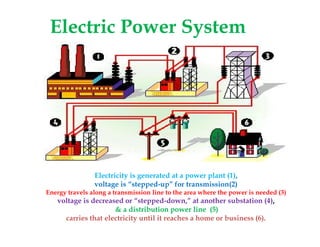
Electric Power SystemElectric Power System
Electricity is generated at a power plant (1),
voltage is “stepped-up” for transmission(2)
Energy travels along a transmission line to the area where the power is needed (3)
voltage is decreased or “stepped-down,” at another substation (4),
& a distribution power line (5)
carries that electricity until it reaches a home or business (6).
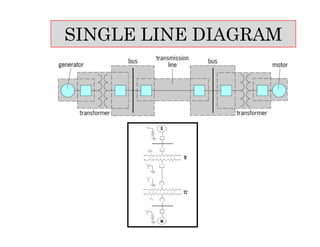
SINGLE LINE DIAGRAM
INTRODUCTION
UNITUNIT
11
INTRODUCTION
6
Presented by
C.GOKUL,AP/EEE
Velalar College of Engg & Tech , Erode
UNIT 1 PROTECTION SCHEMES
Syllabus
 Principles and need for protective schemes
 Nature and causes of faults
 Types of faults
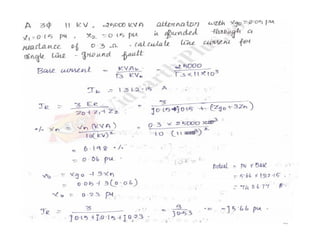
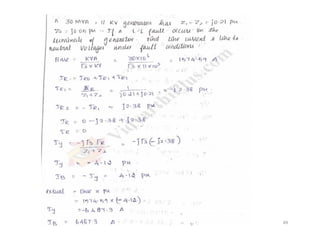
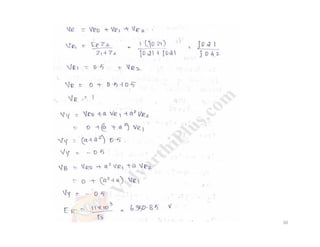
 Fault current calculation using symmetrical
components
 Methods of Neutral grounding
 Zones of protection and essential qualities of
protection
 Protection schemes
 Principles and need for protective schemes
 Nature and causes of faults
 Types of faults
 Fault current calculation using symmetrical
components
 Methods of Neutral grounding
 Zones of protection and essential qualities of
protection
 Protection schemes 7
Principles & need for
protective schemes
Principles & need for
protective schemes
8Presented by C.GOKUL,AP/EEE, Velalar College of Engg & Tech , Erode
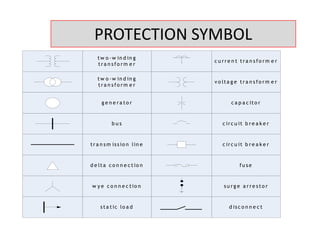
PROTECTION SYMBOL
t w o-w in d in g
t r a n s f o r m e r
c u r r e n t t r a n s f o r m e r
t w o-w in d in g
t r a n s f o r m e r
g e n e r a t o r
b u s
v o lt a g e t r a n s f o r m e r
c a p a c it o r
c ir c u it b r e a k e r
t r a n s m is s io n lin e
d e lt a c o n n e c t io n
w y e c o n n e c t io n
c ir c u it b r e a k e r
f u s e
s u r g e a r r e s t o r
s t a t ic lo a d d is c o n n e c t
t w o-w in d in g
t r a n s f o r m e r
c u r r e n t t r a n s f o r m e r
t w o-w in d in g
t r a n s f o r m e r
g e n e r a t o r
b u s
v o lt a g e t r a n s f o r m e r
c a p a c it o r
c ir c u it b r e a k e r
t r a n s m is s io n lin e
d e lt a c o n n e c t io n
w y e c o n n e c t io n
c ir c u it b r e a k e r
f u s e
s u r g e a r r e s t o r
s t a t ic lo a d d is c o n n e c t
Primary Equipment & ComponentsPrimary Equipment & Components
• Transformers - to step up or step down voltage level
• Breakers - to energize equipment and interrupt fault current to
isolate faulted equipment
• Insulators - to insulate equipment from ground and other phases
• Isolators (switches) - to create a visible and permanent isolation
of primary equipment for maintenance purposes and route power
flow over certain buses.
• Bus - to allow multiple connections (feeders) to the same source
of power (transformer).
• Transformers - to step up or step down voltage level
• Breakers - to energize equipment and interrupt fault current to
isolate faulted equipment
• Insulators - to insulate equipment from ground and other phases
• Isolators (switches) - to create a visible and permanent isolation
of primary equipment for maintenance purposes and route power
flow over certain buses.
• Bus - to allow multiple connections (feeders) to the same source
of power (transformer).
Primary Equipment & ComponentsPrimary Equipment & Components
• Grounding - to operate and maintain equipment safely
• Arrester - to protect primary equipment of sudden overvoltage
(lightning strike).
• Switchgear – integrated components to switch, protect, meter
and control power flow
• Reactors - to limit fault current (series) or compensate for charge
current (shunt)
• VT and CT - to measure primary current and voltage and supply
scaled down values to P&C, metering, SCADA, etc.
• Regulators - voltage, current, VAR, phase angle, etc.
• Grounding - to operate and maintain equipment safely
• Arrester - to protect primary equipment of sudden overvoltage
(lightning strike).
• Switchgear – integrated components to switch, protect, meter
and control power flow
• Reactors - to limit fault current (series) or compensate for charge
current (shunt)
• VT and CT - to measure primary current and voltage and supply
scaled down values to P&C, metering, SCADA, etc.
• Regulators - voltage, current, VAR, phase angle, etc.
Why A System Needs Protection?
• There is no ‘fault free’ system.
• Ensure safety of personnel.
• Usually faults are caused by breakdown
of insulation due to various reasons:
system over current, over voltage,
lighting, etc.
• There is no ‘fault free’ system.
• Ensure safety of personnel.
• Usually faults are caused by breakdown
of insulation due to various reasons:
system over current, over voltage,
lighting, etc.
13
14
15
POWER SYSTEM WITHOUT PROTECTION
• Short circuits and other abnormal conditions
often occur on the power system. The heavy
current associated with short circuits is likely to
cause damage to the equipment
• Short circuits and other abnormal conditions
often occur on the power system. The heavy
current associated with short circuits is likely to
cause damage to the equipment
Element of protection system
(1)Current and Voltage Transformers
(2)Relays
(3)Circuit breakers
(4)Batteries
(5)Fuses
(6)Lighting Arresters
(1)Current and Voltage Transformers
(2)Relays
(3)Circuit breakers
(4)Batteries
(5)Fuses
(6)Lighting Arresters
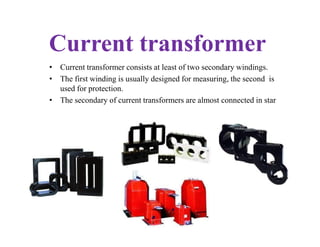
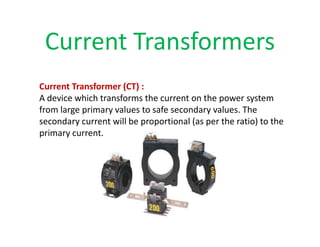
Current transformer
• Current transformer consists at least of two secondary windings.
• The first winding is usually designed for measuring, the second is
used for protection.
• The secondary of current transformers are almost connected in star
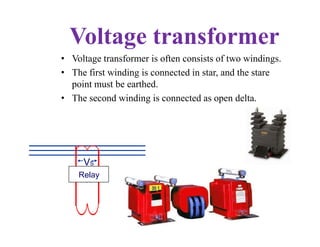
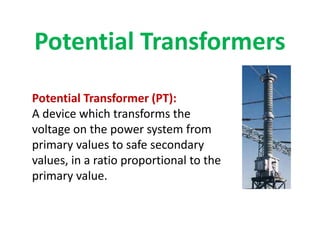
Voltage transformer
• Voltage transformer is often consists of two windings.
• The first winding is connected in star, and the stare
point must be earthed.
• The second winding is connected as open delta.
• Voltage transformer is often consists of two windings.
• The first winding is connected in star, and the stare
point must be earthed.
• The second winding is connected as open delta.
VVPP
VVSS
Relay
Relay Purpose
 Isolate controlling circuit from controlled circuit.
 Control high voltage system with low voltage.
 Control high current system with low current.
 Logic Functions
 Isolate controlling circuit from controlled circuit.
 Control high voltage system with low voltage.
 Control high current system with low current.
 Logic Functions
Advantages for Using
Protective Relays
• Detect system failures when they occur
and isolate the faulted section from the
remaining of the system.
• Mitigating the effects of failures after
they occur.
• Minimize risk of fire, danger to personal
and other high voltage systems.
• Detect system failures when they occur
and isolate the faulted section from the
remaining of the system.
• Mitigating the effects of failures after
they occur.
• Minimize risk of fire, danger to personal
and other high voltage systems.
CIRCUIT BREAKER
• Low voltage circuit breaker
• Magnetic circuit breaker
• Medium voltage circuit breaker
• High voltage circuit breaker
• Low voltage circuit breaker
• Magnetic circuit breaker
• Medium voltage circuit breaker
• High voltage circuit breaker
Battery bank
• Battery bank are called as
backbone of protection system
• Emergency use for power
system
• Battery bank are called as
backbone of protection system
• Emergency use for power
system
Fuse
• Fuses are selected to allow passage of normal
current and of excessive current only for short
periods.
• It is used to protect the low voltage or current
rating devices
• Fuses are selected to allow passage of normal
current and of excessive current only for short
periods.
• It is used to protect the low voltage or current
rating devices
Lighting arrester
• A lightning arrester is a device used on
electrical power system to protect the
insulation damaging effect of lightning.
• All lighting arrester are earthed
• A lightning arrester is a device used on
electrical power system to protect the
insulation damaging effect of lightning.
• All lighting arrester are earthed
What is Switchgear ?
• Switchgear is the combination of switches,
fuses or circuit breakers(CB) used to
control , protect & isolate electrical
equipment.
• It is used de-energize equipment & clear
faults.
• Switchgear is the combination of switches,
fuses or circuit breakers(CB) used to
control , protect & isolate electrical
equipment.
• It is used de-energize equipment & clear
faults.
Different elements of switchgear
• Circuit breaker
Air ckt breaker ACB
Vacuumed ckt breaker VCB
Oil filled ckt breaker OCB
SF6 Ckt Breaker
• MCCB (Moulded Case Ckt
Breakers)
• MCB
(Miniature Circuit Breaker)
• RCCB
Residual current circuit breaker
• Load Breaking Switch LBS
• By pass and changeover
switches
• Isolators(switches)
• Fuses
• Circuit breaker
Air ckt breaker ACB
Vacuumed ckt breaker VCB
Oil filled ckt breaker OCB
SF6 Ckt Breaker
• MCCB (Moulded Case Ckt
Breakers)
• MCB
(Miniature Circuit Breaker)
• RCCB
Residual current circuit breaker
• Load Breaking Switch LBS
• By pass and changeover
switches
• Isolators(switches)
• Fuses
Function wise categories
• Automatic & Manual operation
{ example: Circuit breaker ,MCB , MCCB }
• Only automatic operation
Fuse
• Only manually activated / operated
Isolator, LBS
• Automatic & Manual operation
{ example: Circuit breaker ,MCB , MCCB }
• Only automatic operation
Fuse
• Only manually activated / operated
Isolator, LBS
Voltage wise switchgear categories
• Low voltage Switchgear
up to 11KV
• Medium voltage switchgear
up to 66KV
• High Voltage switchgear
up to 400KV
• Extra High Voltage switchgear
up to 765KV
• HVDC Switchgear
• Low voltage Switchgear
up to 11KV
• Medium voltage switchgear
up to 66KV
• High Voltage switchgear
up to 400KV
• Extra High Voltage switchgear
up to 765KV
• HVDC Switchgear
Nature and causes of
faults
Types of faults
Presented by C.GOKUL,AP/EEE, Velalar College of Engg & Tech , Erode
NATURE & CAUSES OF FAULTS
•Insulation failure.
•Conducting path failure.
•Over voltages due to lightening or switching surges.
•Puncturing or breaking of insulators.
•Failure of conducting path due to broken conductors.
•Failure of solid insulation due to aging, heat, moisture,
overvoltage , accidental contact with earth or earth screens,
flash over voltages and etc.,
•Insulation failure.
•Conducting path failure.
•Over voltages due to lightening or switching surges.
•Puncturing or breaking of insulators.
•Failure of conducting path due to broken conductors.
•Failure of solid insulation due to aging, heat, moisture,
overvoltage , accidental contact with earth or earth screens,
flash over voltages and etc.,
 A power system fault may be defined as any
condition or abnormality of the system which
involves the electrical failure of primary
equipment such as generators, transformers,
busbars, overhead lines and cables and all other
items of plant which operate at power system
voltage.
 Electrical failure generally implies one or the
other (or both) of two types of failure, namely
insulation failure resulting in a short-circuit
condition or conducting path failure resulting in
an open-circuit condition, the former being by far
the more common type of failure.
FAULT IN POWER SYSTEM
 A power system fault may be defined as any
condition or abnormality of the system which
involves the electrical failure of primary
equipment such as generators, transformers,
busbars, overhead lines and cables and all other
items of plant which operate at power system
voltage.
 Electrical failure generally implies one or the
other (or both) of two types of failure, namely
insulation failure resulting in a short-circuit
condition or conducting path failure resulting in
an open-circuit condition, the former being by far
the more common type of failure.
 Symmetrical fault
Faults giving rise to equal currents in lines
displaced by
equal phase angles i.e 120o in three phase
systems.
Example: short circuit of all three phase
conductors of a cable at a single location
 Unsymmetrical fault
Faults in which not all the line currents are equal
and not all have the same phase.
Example (any one): single phase line to ground
fault (L-G), two phase to ground (LL-G) fault and
phase to phase (L-L) fault.
FAULT IN POWER SYSTEM
 Symmetrical fault
Faults giving rise to equal currents in lines
displaced by
equal phase angles i.e 120o in three phase
systems.
Example: short circuit of all three phase
conductors of a cable at a single location
 Unsymmetrical fault
Faults in which not all the line currents are equal
and not all have the same phase.
Example (any one): single phase line to ground
fault (L-G), two phase to ground (LL-G) fault and
phase to phase (L-L) fault.
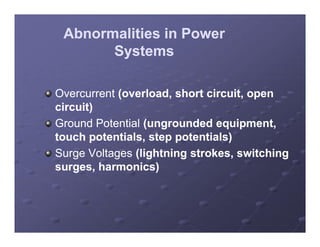
Abnormalities in PowerAbnormalities in Power
SystemsSystems
Abnormalities in PowerAbnormalities in Power
SystemsSystems
OvercurrentOvercurrent (overload, short circuit, open(overload, short circuit, open
circuit)circuit)
Ground PotentialGround Potential (ungrounded equipment,(ungrounded equipment,
touch potentials, step potentials)touch potentials, step potentials)
Surge VoltagesSurge Voltages (lightning strokes, switching(lightning strokes, switching
surges, harmonics)surges, harmonics)
OvercurrentOvercurrent (overload, short circuit, open(overload, short circuit, open
circuit)circuit)
Ground PotentialGround Potential (ungrounded equipment,(ungrounded equipment,
touch potentials, step potentials)touch potentials, step potentials)
Surge VoltagesSurge Voltages (lightning strokes, switching(lightning strokes, switching
surges, harmonics)surges, harmonics)
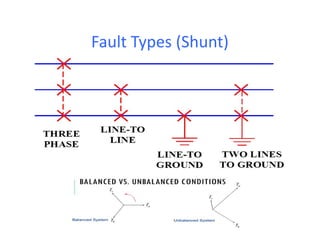
Fault Types (Shunt)
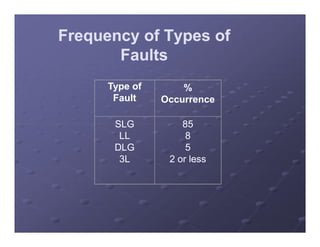
Frequency of Types ofFrequency of Types of
FaultsFaults
Frequency of Types ofFrequency of Types of
FaultsFaults
Type of
Fault
%
Occurrence
SLG
LL
DLG
3L
85
8
5
2 or less
SLG
LL
DLG
3L
85
8
5
2 or less
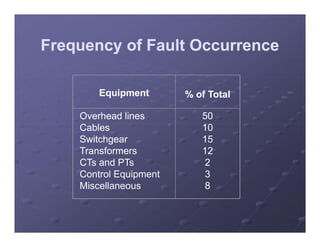
Frequency of Fault OccurrenceFrequency of Fault OccurrenceFrequency of Fault OccurrenceFrequency of Fault Occurrence
Equipment % of Total
Overhead lines
Cables
Switchgear
Transformers
CTs and PTs
Control Equipment
Miscellaneous
50
10
15
12
2
3
8
Overhead lines
Cables
Switchgear
Transformers
CTs and PTs
Control Equipment
Miscellaneous
50
10
15
12
2
3
8
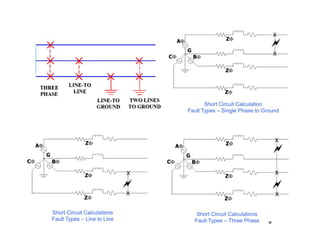
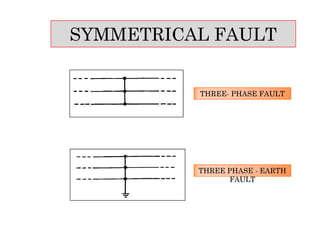
SYMMETRICAL FAULT
THREETHREE-- PHASE FAULTPHASE FAULTTHREETHREE-- PHASE FAULTPHASE FAULT
THREE PHASETHREE PHASE -- EARTHEARTH
FAULTFAULT
THREE PHASETHREE PHASE -- EARTHEARTH
FAULTFAULT
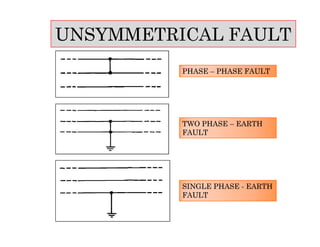
UNSYMMETRICAL FAULT
PHASEPHASE –– PHASE FAULTPHASE FAULTPHASEPHASE –– PHASE FAULTPHASE FAULT
TWO PHASETWO PHASE –– EARTHEARTH
FAULTFAULT
TWO PHASETWO PHASE –– EARTHEARTH
FAULTFAULT
TWO PHASETWO PHASE –– EARTHEARTH
FAULTFAULT
TWO PHASETWO PHASE –– EARTHEARTH
FAULTFAULT
SINGLE PHASESINGLE PHASE -- EARTHEARTH
FAULTFAULT
SINGLE PHASESINGLE PHASE -- EARTHEARTH
FAULTFAULT
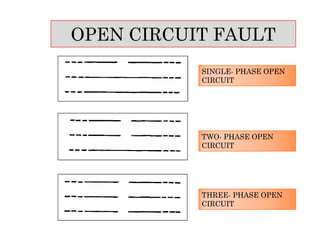
OPEN CIRCUIT FAULT
SINGLESINGLE-- PHASE OPENPHASE OPEN
CIRCUITCIRCUIT
SINGLESINGLE-- PHASE OPENPHASE OPEN
CIRCUITCIRCUIT
TWOTWO-- PHASE OPENPHASE OPEN
CIRCUITCIRCUIT
TWOTWO-- PHASE OPENPHASE OPEN
CIRCUITCIRCUIT
THREETHREE-- PHASE OPENPHASE OPEN
CIRCUITCIRCUIT
THREETHREE-- PHASE OPENPHASE OPEN
CIRCUITCIRCUIT
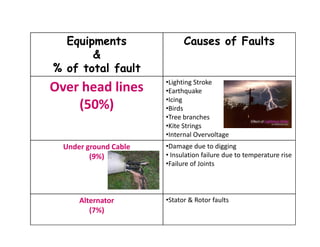
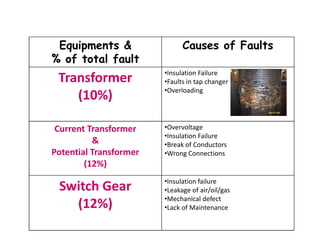
Equipments
&
% of total fault
Causes of Faults
Over head lines
(50%)
•Lighting Stroke
•Earthquake
•Icing
•Birds
•Tree branches
•Kite Strings
•Internal Overvoltage
•Lighting Stroke
•Earthquake
•Icing
•Birds
•Tree branches
•Kite Strings
•Internal Overvoltage
Under ground Cable
(9%)
•Damage due to digging
• Insulation failure due to temperature rise
•Failure of Joints
Alternator
(7%)
•Stator & Rotor faults
Equipments &
% of total fault
Causes of Faults
Transformer
(10%)
•Insulation Failure
•Faults in tap changer
•Overloading
Current Transformer
&
Potential Transformer
(12%)
•Overvoltage
•Insulation Failure
•Break of Conductors
•Wrong Connections
Current Transformer
&
Potential Transformer
(12%)
•Overvoltage
•Insulation Failure
•Break of Conductors
•Wrong Connections
Switch Gear
(12%)
•Insulation failure
•Leakage of air/oil/gas
•Mechanical defect
•Lack of Maintenance
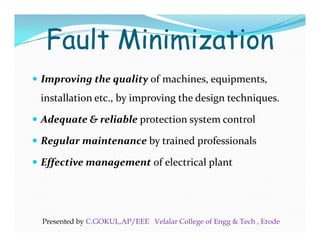
Fault Minimization
 Improving the quality of machines, equipments,
installation etc., by improving the design techniques.
 Adequate & reliable protection system control
 Regular maintenance by trained professionals
 Effective management of electrical plant
 Improving the quality of machines, equipments,
installation etc., by improving the design techniques.
 Adequate & reliable protection system control
 Regular maintenance by trained professionals
 Effective management of electrical plant
Presented by C.GOKUL,AP/EEE Velalar College of Engg & Tech , Erode
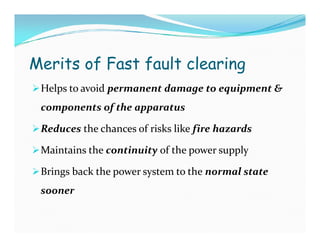
Merits of Fast fault clearing
Helps to avoid permanent damage to equipment &
components of the apparatus
Reduces the chances of risks like fire hazards
Maintains the continuity of the power supply
Brings back the power system to the normal state
sooner
Helps to avoid permanent damage to equipment &
components of the apparatus
Reduces the chances of risks like fire hazards
Maintains the continuity of the power supply
Brings back the power system to the normal state
sooner
Fault current
calculation using
symmetrical
components
Fault current
calculation using
symmetrical
components
47
48
49
50
51
52
53
54
55
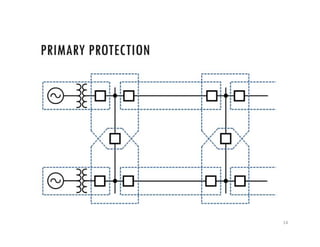
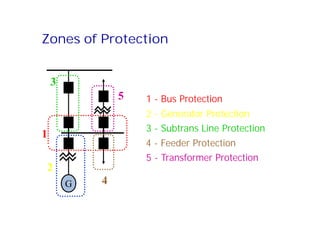
Regions (zones) of power system that can be protectedRegions (zones) of power system that can be protected
adequately with fault recognition and removal resulting inadequately with fault recognition and removal resulting in
isolation of a minimum amount of equipment.isolation of a minimum amount of equipment.
Requirements: All power system elements must beAll power system elements must be
encompassed by at least one zoneencompassed by at least one zone
•• Zones of protection must overlap to prevent any systemZones of protection must overlap to prevent any system
element from being unprotected (no “blind spots”).element from being unprotected (no “blind spots”).
Zones of ProtectionZones of Protection
Regions (zones) of power system that can be protectedRegions (zones) of power system that can be protected
adequately with fault recognition and removal resulting inadequately with fault recognition and removal resulting in
isolation of a minimum amount of equipment.isolation of a minimum amount of equipment.
Requirements: All power system elements must beAll power system elements must be
encompassed by at least one zoneencompassed by at least one zone
•• Zones of protection must overlap to prevent any systemZones of protection must overlap to prevent any system
element from being unprotected (no “blind spots”).element from being unprotected (no “blind spots”).
Zones of ProtectionZones of Protection
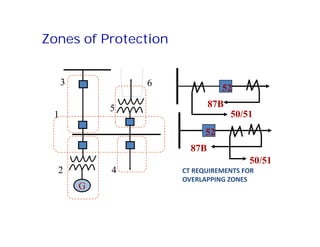
52
87B
50/511
3
5
6
52
CT REQUIREMENTS FOR
OVERLAPPING ZONES
G
42
50/51
52
87B
Zones of ProtectionZones of Protection
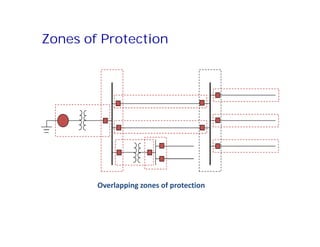
Overlapping zones of protection
1
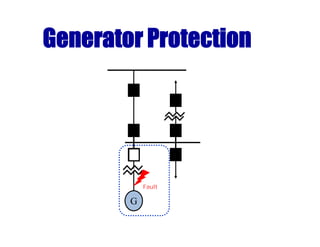
1 - Bus Protection
2 - Generator Protection
3
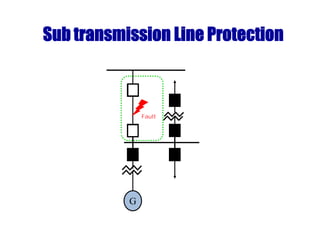
3 - Subtrans Line Protection
5
Zones of ProtectionZones of Protection
G
1
2
3 - Subtrans Line Protection
4
4 - Feeder Protection
5 - Transformer Protection
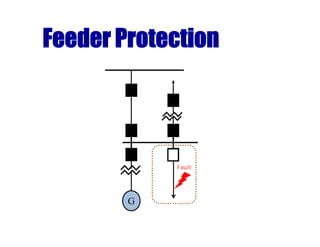
Feeder Protection
G
Fault
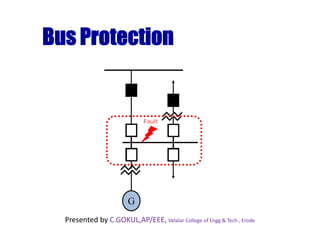
Bus Protection
Fault
G
Fault
Presented by C.GOKUL,AP/EEE, Velalar College of Engg & Tech , Erode
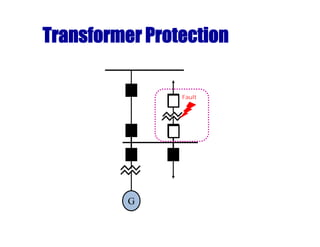
Transformer Protection
Fault
G
Sub transmission Line Protection
Fault
G
Generator Protection
G
Fault
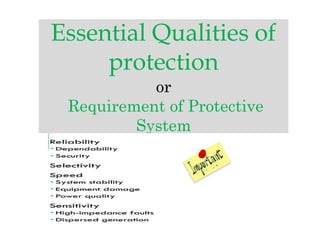
Essential Qualities of
protection
or
Requirement of Protective
System
Essential Qualities of
protection
or
Requirement of Protective
System
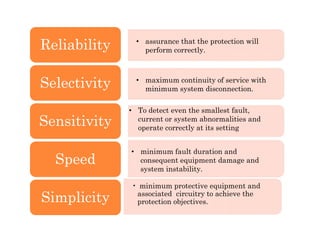
Reliability
Selectivity
Sensitivity
• assurance that the protection will
perform correctly.
• maximum continuity of service with
minimum system disconnection.
• To detect even the smallest fault,
current or system abnormalities and
operate correctly at its setting
Sensitivity
Speed
• minimum protective equipment and
associated circuitry to achieve the
protection objectives.Simplicity
• minimum fault duration and
consequent equipment damage and
system instability.
• To detect even the smallest fault,
current or system abnormalities and
operate correctly at its setting
Reliability
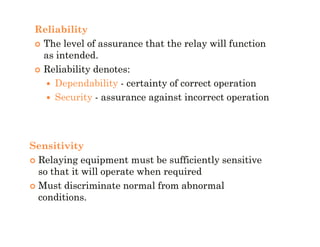
 The level of assurance that the relay will functionThe level of assurance that the relay will function
as intended.as intended.
 Reliability denotes:Reliability denotes:
 Dependability -- certainty of correct operationcertainty of correct operation
 Security -- assurance against incorrect operationassurance against incorrect operation
Sensitivity
 Relaying equipment must be sufficiently sensitiveRelaying equipment must be sufficiently sensitive
so that it will operate when requiredso that it will operate when required
 Must discriminate normal from abnormalMust discriminate normal from abnormal
conditions.conditions.
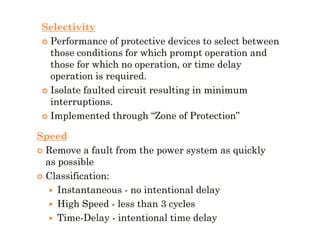
Selectivity
 Performance of protective devices to select betweenPerformance of protective devices to select between
those conditions for which prompt operation andthose conditions for which prompt operation and
those for which no operation, or time delaythose for which no operation, or time delay
operation is required.operation is required.
 Isolate faulted circuit resulting in minimumIsolate faulted circuit resulting in minimum
interruptions.interruptions.
 Implemented through “Zone of Protection”Implemented through “Zone of Protection”
Speed
 Remove a fault from the power system as quicklyRemove a fault from the power system as quickly
as possibleas possible
 Classification:Classification:
 InstantaneousInstantaneous -- no intentional delayno intentional delay
 High SpeedHigh Speed -- less than 3 cyclesless than 3 cycles
 TimeTime--DelayDelay -- intentional time delayintentional time delay
Methods of Neutral
grounding
(OR)
Power System Earthing
Methods of Neutral
grounding
(OR)
Power System Earthing
•Neutral Earthing/Grounding
•Peterson coil
•Arcing Grounds
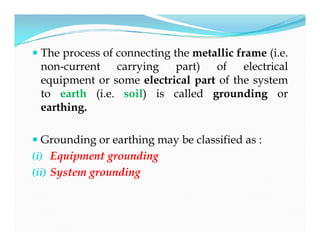
 The process of connecting the metallic frame (i.e.
non-current carrying part) of electrical
equipment or some electrical part of the system
to earth (i.e. soil) is called grounding or
earthing.
 Grounding or earthing may be classified as :
(i) Equipment grounding
(ii) System grounding
 The process of connecting the metallic frame (i.e.
non-current carrying part) of electrical
equipment or some electrical part of the system
to earth (i.e. soil) is called grounding or
earthing.
 Grounding or earthing may be classified as :
(i) Equipment grounding
(ii) System grounding
Equipment Grounding
 The process of connecting non-current-carrying
metal parts of the electrical equipment to earth.
System GroundingSystem Grounding
•The process of connecting some electrical part of the
power system to earth (i.e. soil) is called system
grounding.
Neutral
Earthing
Neutral
Earthing
Neutral Grounding
 Connecting neutral point to earth (i.e. soil) either
directly or some circuit element
(e.g. resistance, reactance , Peterson coil etc.)
is called neutral grounding.
 Neutral grounding provides protection to equipment.
(during earth fault, the current path is completed
neutral)
 Connecting neutral point to earth (i.e. soil) either
directly or some circuit element
(e.g. resistance, reactance , Peterson coil etc.)
is called neutral grounding.
 Neutral grounding provides protection to equipment.
(during earth fault, the current path is completed
neutral)
Advantages of Neutral Grounding
(i) Voltages of the healthy phases do not exceed line to
ground voltages i.e. they remain nearly constant.
(ii) The high voltages due to arcing grounds are
eliminated.
(iii) Life of insulation is long.
(iv) The over voltages is reduced.
(v) It provides greater safety to personnel and equipment.
(vi) It provides improved service reliability.
(vii)Operating and maintenance expenditures are
reduced.
(i) Voltages of the healthy phases do not exceed line to
ground voltages i.e. they remain nearly constant.
(ii) The high voltages due to arcing grounds are
eliminated.
(iii) Life of insulation is long.
(iv) The over voltages is reduced.
(v) It provides greater safety to personnel and equipment.
(vi) It provides improved service reliability.
(vii)Operating and maintenance expenditures are
reduced.
Methods of Neutral Grounding
(i) Solid or effective grounding
(ii) Resistance grounding
(iii) Reactance grounding
(iv) Peterson-coil grounding
(v) Voltage transformer earthing
(i) Solid or effective grounding
(ii) Resistance grounding
(iii) Reactance grounding
(iv) Peterson-coil grounding
(v) Voltage transformer earthing
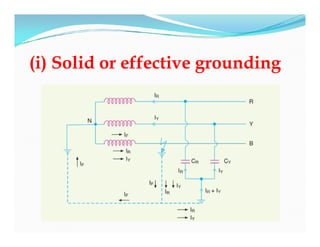
(i) Solid or effective grounding
 When the neutral point of a 3-phase system is
directly connected to earth (i.e. soil) is called
solid grounding or effective grounding.
 When an earth fault occurs between earth and
any one phase , the voltage to earth of the faulty
phase becomes zero, but the healthy phases
remains at normal phase values.
 Fault current(IF) completely nullified by
capacitive current(IC)
 When the neutral point of a 3-phase system is
directly connected to earth (i.e. soil) is called
solid grounding or effective grounding.
 When an earth fault occurs between earth and
any one phase , the voltage to earth of the faulty
phase becomes zero, but the healthy phases
remains at normal phase values.
 Fault current(IF) completely nullified by
capacitive current(IC)
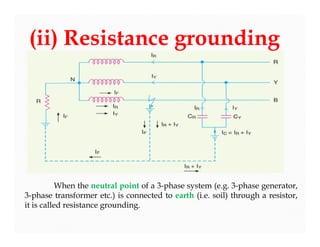
(ii) Resistance grounding
When the neutral point of a 3-phase system (e.g. 3-phase generator,
3-phase transformer etc.) is connected to earth (i.e. soil) through a resistor,
it is called resistance grounding.
Advantages:
 By adjusting the value of R, the arcing grounds can be minimized.
 It improves the stability
 Less interference
 Minimize hazards
 By adjusting the value of R, the arcing grounds can be minimized.
 It improves the stability
 Less interference
 Minimize hazards
Disadvantages:
 By adjusting the value of R, the arcing grounds can be minimized.
 It improves the stability
 Less interference
 Minimize hazards
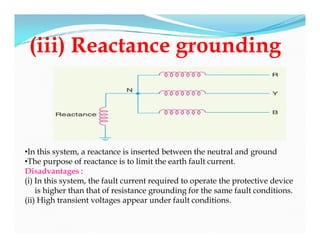
(iii) Reactance grounding
•In this system, a reactance is inserted between the neutral and ground
•The purpose of reactance is to limit the earth fault current.
Disadvantages :
(i) In this system, the fault current required to operate the protective device
is higher than that of resistance grounding for the same fault conditions.
(ii) High transient voltages appear under fault conditions.
Presented by C.GOKUL,AP/EEE Velalar College of Engg & Tech , Erode
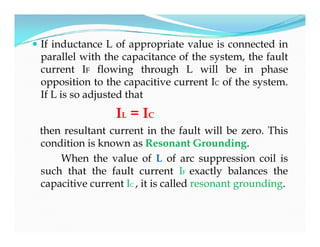
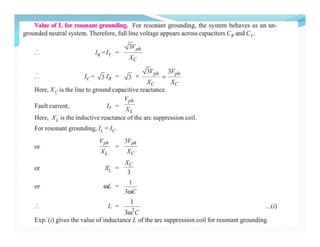
 If inductance L of appropriate value is connected in
parallel with the capacitance of the system, the fault
current IF flowing through L will be in phase
opposition to the capacitive current IC of the system.
If L is so adjusted that
IL = IC
then resultant current in the fault will be zero. This
condition is known as Resonant Grounding.
When the value of L of arc suppression coil is
such that the fault current IF exactly balances the
capacitive current IC , it is called resonant grounding.
 If inductance L of appropriate value is connected in
parallel with the capacitance of the system, the fault
current IF flowing through L will be in phase
opposition to the capacitive current IC of the system.
If L is so adjusted that
IL = IC
then resultant current in the fault will be zero. This
condition is known as Resonant Grounding.
When the value of L of arc suppression coil is
such that the fault current IF exactly balances the
capacitive current IC , it is called resonant grounding.
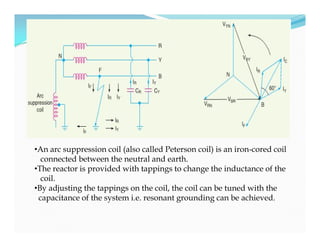
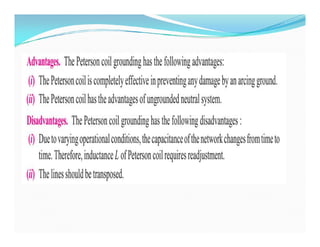
•An arc suppression coil (also called Peterson coil) is an iron-cored coil
connected between the neutral and earth.
•The reactor is provided with tappings to change the inductance of the
coil.
•By adjusting the tappings on the coil, the coil can be tuned with the
capacitance of the system i.e. resonant grounding can be achieved.
• Suppose line to ground fault occurs in the line B at point
F. The fault current IF and capacitive currents IR and IY will
flow as shown in Fig
• Note that IF flows through the Peterson coil (or Arc
suppression coil) to neutral and back through the fault. The
total capacitive current IC is the phasor sum of IR & IY
as shown in phasor diagram in Fig.
• The voltage of the faulty phase is applied across the arc
suppression coil. Therefore, fault current IF lags the faulty
phase voltage by 90°.
• The current IF is in phase opposition to capacitive
current IC [See Fig].
By adjusting the tappings on the Peterson coil, the
resultant current in the fault can be reduced. If inductance
of the coil is so adjusted that IL= IC , then resultant current
in the fault will be zero.
• Suppose line to ground fault occurs in the line B at point
F. The fault current IF and capacitive currents IR and IY will
flow as shown in Fig
• Note that IF flows through the Peterson coil (or Arc
suppression coil) to neutral and back through the fault. The
total capacitive current IC is the phasor sum of IR & IY
as shown in phasor diagram in Fig.
• The voltage of the faulty phase is applied across the arc
suppression coil. Therefore, fault current IF lags the faulty
phase voltage by 90°.
• The current IF is in phase opposition to capacitive
current IC [See Fig].
By adjusting the tappings on the Peterson coil, the
resultant current in the fault can be reduced. If inductance
of the coil is so adjusted that IL= IC , then resultant current
in the fault will be zero.
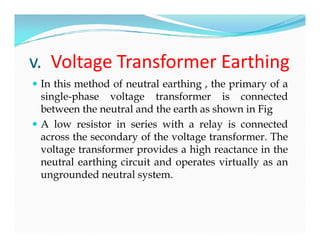
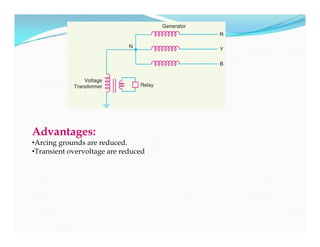
v. Voltage Transformer Earthing
 In this method of neutral earthing , the primary of a
single-phase voltage transformer is connected
between the neutral and the earth as shown in Fig
 A low resistor in series with a relay is connected
across the secondary of the voltage transformer. The
voltage transformer provides a high reactance in the
neutral earthing circuit and operates virtually as an
ungrounded neutral system.
 In this method of neutral earthing , the primary of a
single-phase voltage transformer is connected
between the neutral and the earth as shown in Fig
 A low resistor in series with a relay is connected
across the secondary of the voltage transformer. The
voltage transformer provides a high reactance in the
neutral earthing circuit and operates virtually as an
ungrounded neutral system.
Advantages:
•Arcing grounds are reduced.
•Transient overvoltage are reduced
Advantages:
•Arcing grounds are reduced.
•Transient overvoltage are reduced
Protection
schemes
Protection
schemes
REFER BOOK
Presented by C.GOKUL,AP/EEE, Velalar College of Engg & Tech , Erode
Electromagnetic
RELAY
UNITUNIT
22Electromagnetic
RELAY
1
Presented by
C.GOKUL,AP/EEE
Velalar College of Engg & Tech , Erode
2
UNIT 2 Syllabus - Electromagnetic relays
• Operating principles of relays
• The Universal relay - Torque equation
• R-X diagram
• Electromagnetic Relays
• Overcurrent relays
• Directional relays
• Distance relays
• Differential relays
• Negative sequence relays
• Under frequency relays
• Operating principles of relays
• The Universal relay - Torque equation
• R-X diagram
• Electromagnetic Relays
• Overcurrent relays
• Directional relays
• Distance relays
• Differential relays
• Negative sequence relays
• Under frequency relays
3
Relay Overview
Operating
principles of relays
Relay Overview
Operating
principles of relays
4
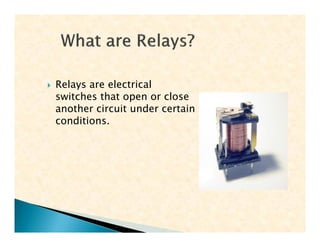
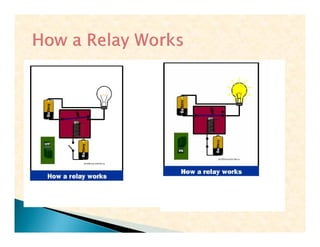
 Relays are electrical
switches that open or close
another circuit under certain
conditions.
 Relays are electrical
switches that open or close
another circuit under certain
conditions.
Protective relays are devices which
monitor power system conditions and
operate to quickly and accurately isolate
faults or dangerous conditions. A well
designed protective system can limit
damage to equipment, as well as minimize
the extent of associated service
interruption.
Protective relays are devices which
monitor power system conditions and
operate to quickly and accurately isolate
faults or dangerous conditions. A well
designed protective system can limit
damage to equipment, as well as minimize
the extent of associated service
interruption.
 Isolate controlling circuit from controlled circuit.
 Control high voltage system with low voltage.
 Control high current system with low current.
 Logic Functions
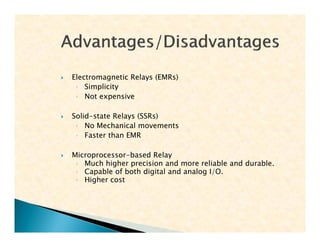
 Electromagnetic Relays (EMRs)
 Solid-state Relays (SSRs)
◦ There is no mechanical contacts to switch the circuit.
 Microprocessor Based Relays
Commonly used in power system monitoring and protection.
 Electromagnetic Relays (EMRs)
◦ Simplicity
◦ Not expensive
 Solid-state Relays (SSRs)
◦ No Mechanical movements
◦ Faster than EMR
 Microprocessor-based Relay
◦ Much higher precision and more reliable and durable.
◦ Capable of both digital and analog I/O.
◦ Higher cost
 Electromagnetic Relays (EMRs)
◦ Simplicity
◦ Not expensive
 Solid-state Relays (SSRs)
◦ No Mechanical movements
◦ Faster than EMR
 Microprocessor-based Relay
◦ Much higher precision and more reliable and durable.
◦ Capable of both digital and analog I/O.
◦ Higher cost
 Detect system failures when they occur and
isolate the faulted section from the remaining of
the system.
 Mitigating the effects of failures after they occur.
Minimize risk of fire, danger to personal and
other high voltage systems.
 Detect system failures when they occur and
isolate the faulted section from the remaining of
the system.
 Mitigating the effects of failures after they occur.
Minimize risk of fire, danger to personal and
other high voltage systems.
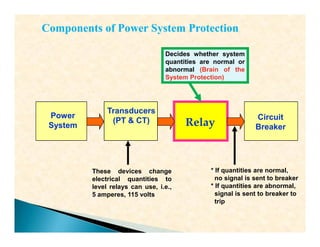
Transducers
(PT & CT) Relay
Decides whether system
quantities are normal or
abnormal (Brain of the
System Protection)
Circuit
Breaker
Power
System
Components of Power System ProtectionComponents of Power System Protection
Transducers
(PT & CT) Relay
* If quantities are normal,
no signal is sent to breaker
* If quantities are abnormal,
signal is sent to breaker to
trip
These devices change
electrical quantities to
level relays can use, i.e.,
5 amperes, 115 volts
Circuit
Breaker
Power
System
Relay-definitionsRelay-definitions
 Primary Relay: relay connected directly in the circuit
 Secondary Relay: relay connected to the protected circuit
through CT & VT.
 Auxiliary Relay: relay operate in response to opening or
closing of another relay.
 Measuring Relay: It performs the measurement of
normal & abnormal conditions in the power system.
 Electro Magnetic Relay: It operates on the principle of
Electromagnetic induction.
 Static Relay(Solid-state relay): They use diodes ,
transistors , SCRs , Logic gates etc.
(Static circuit is the measuring circuit & no moving parts)
 Microprocessor Based Relay: All functions of a relay can
done by using microprocessor . Relays are programmable.
µP can compare , compute and send trip signals.
 Primary Relay: relay connected directly in the circuit
 Secondary Relay: relay connected to the protected circuit
through CT & VT.
 Auxiliary Relay: relay operate in response to opening or
closing of another relay.
 Measuring Relay: It performs the measurement of
normal & abnormal conditions in the power system.
 Electro Magnetic Relay: It operates on the principle of
Electromagnetic induction.
 Static Relay(Solid-state relay): They use diodes ,
transistors , SCRs , Logic gates etc.
(Static circuit is the measuring circuit & no moving parts)
 Microprocessor Based Relay: All functions of a relay can
done by using microprocessor . Relays are programmable.
µP can compare , compute and send trip signals.
 Thermal Relay: It operates on the principle of Electro-
thermal effect.
 Distance Relay: relay measures the impedance or
reactance or admittance.
 Impedance Relay: relay measures the impedance of the
transmission line.
 Reactance Relay: relay measures the reactance of the
transmission line.
 Over-current Relay: relay operates when the current
exceeds a pre-set value.
 Under-voltage Relay: relay operates when the voltage
falls a pre-set value.
 Directional Relay: relay able to sense whether fault lies in
forward or reverse direction.
 Polarized Relay: relay depends on the direction of the
current.
 Thermal Relay: It operates on the principle of Electro-
thermal effect.
 Distance Relay: relay measures the impedance or
reactance or admittance.
 Impedance Relay: relay measures the impedance of the
transmission line.
 Reactance Relay: relay measures the reactance of the
transmission line.
 Over-current Relay: relay operates when the current
exceeds a pre-set value.
 Under-voltage Relay: relay operates when the voltage
falls a pre-set value.
 Directional Relay: relay able to sense whether fault lies in
forward or reverse direction.
 Polarized Relay: relay depends on the direction of the
current.
 Differential Relay: it measures the difference b/w 2 actual
quantities.
 Earth fault Relay: It is used for protection of element of a
power system against Earth faults.
 Phase fault Relay: It is used for protection of element of a
power system against phase faults.
 Negative Sequence Relay: relay uses negative sequence
current as its actuating quantity.
 Zero Sequence Relay: relay uses zero sequence current as
its actuating quantity.
 Differential Relay: it measures the difference b/w 2 actual
quantities.
 Earth fault Relay: It is used for protection of element of a
power system against Earth faults.
 Phase fault Relay: It is used for protection of element of a
power system against phase faults.
 Negative Sequence Relay: relay uses negative sequence
current as its actuating quantity.
 Zero Sequence Relay: relay uses zero sequence current as
its actuating quantity.
Presented by C.GOKUL,AP/EEE Velalar College of Engg & Tech , Erode
UUNIVERSALNIVERSAL RELAYRELAYUUNIVERSALNIVERSAL RELAYRELAY
REFER BOOK
Electromagnetic
Relay
Electromagnetic
Relay
18
They work on the following two main operating principles :
(i) Electromagnetic attraction
(ii) Electromagnetic induction
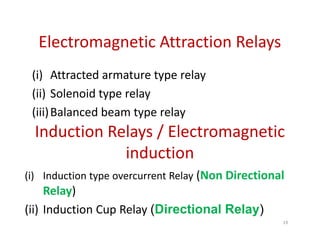
Electromagnetic Attraction Relays
(i) Attracted armature type relay
(ii) Solenoid type relay
(iii)Balanced beam type relay
Induction Relays / Electromagnetic
induction
19
Induction Relays / Electromagnetic
induction
(i) Induction type overcurrent Relay (Non Directional
Relay)
(ii) Induction Cup Relay (Directional Relay)
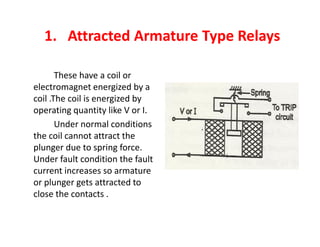
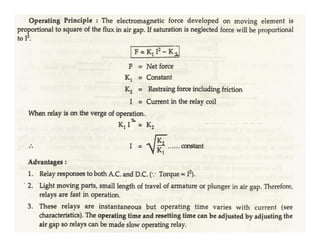
1. Attracted Armature Type Relays
These have a coil or
electromagnet energized by a
coil .The coil is energized by
operating quantity like V or I.
Under normal conditions
the coil cannot attract the
plunger due to spring force.
Under fault condition the fault
current increases so armature
or plunger gets attracted to
close the contacts .
These have a coil or
electromagnet energized by a
coil .The coil is energized by
operating quantity like V or I.
Under normal conditions
the coil cannot attract the
plunger due to spring force.
Under fault condition the fault
current increases so armature
or plunger gets attracted to
close the contacts .
Attracted Armature Type RelaysThese have a coil or
electromagnet energized by a
coil .The coil is energized by
operating quantity like V or I.
Under normal conditions the coil
cannot attract the plunger due
to spring force. Under fault
condition the fault current
increases so armature or
plunger gets attracted to close
the contacts .
These have a coil or
electromagnet energized by a
coil .The coil is energized by
operating quantity like V or I.
Under normal conditions the coil
cannot attract the plunger due
to spring force. Under fault
condition the fault current
increases so armature or
plunger gets attracted to close
the contacts .
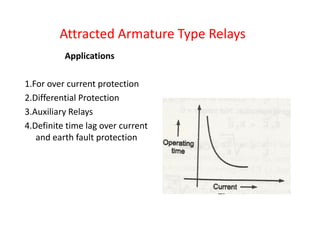
Attracted Armature Type Relays
Applications
1.For over current protection
2.Differential Protection
3.Auxiliary Relays
4.Definite time lag over current
and earth fault protection
Applications
1.For over current protection
2.Differential Protection
3.Auxiliary Relays
4.Definite time lag over current
and earth fault protection
(ii) Solenoid type relay
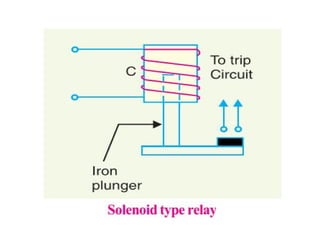
• It consists of a solenoid and movable iron plunger
arranged as shown.
• Under normal operating conditions, the current
through the relay coil C is such that it holds the
plunger by gravity or spring in the position shown.
• However, on the occurrence of a fault, the current
through the relay coil becomes more than the
pickup value, causing the plunger to be attracted to
the solenoid. The upward movement of the plunger
closes the trip circuit, thus opening the circuit
breaker and disconnecting the faulty circuit.
• It consists of a solenoid and movable iron plunger
arranged as shown.
• Under normal operating conditions, the current
through the relay coil C is such that it holds the
plunger by gravity or spring in the position shown.
• However, on the occurrence of a fault, the current
through the relay coil becomes more than the
pickup value, causing the plunger to be attracted to
the solenoid. The upward movement of the plunger
closes the trip circuit, thus opening the circuit
breaker and disconnecting the faulty circuit.
23
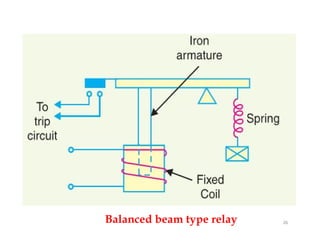
(iii) Balanced beam type relay
• It consists of an iron armature fastened to a
balance beam. Under normal operating
conditions , the current through the relay coil is
such that the beam is held in the horizontal
position by the spring.
• When a fault occurs, the current through the
relay coil becomes greater than the pickup value
and the beam is attracted to close the trip circuit.
This causes the opening of the circuit breaker to
isolate the faulty circuit.
• It consists of an iron armature fastened to a
balance beam. Under normal operating
conditions , the current through the relay coil is
such that the beam is held in the horizontal
position by the spring.
• When a fault occurs, the current through the
relay coil becomes greater than the pickup value
and the beam is attracted to close the trip circuit.
This causes the opening of the circuit breaker to
isolate the faulty circuit.
25
26Balanced beam type relay
Induction cup structureInduction cup structure
27
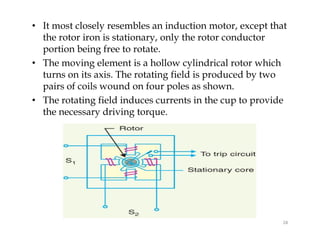
• It most closely resembles an induction motor, except that
the rotor iron is stationary, only the rotor conductor
portion being free to rotate.
• The moving element is a hollow cylindrical rotor which
turns on its axis. The rotating field is produced by two
pairs of coils wound on four poles as shown.
• The rotating field induces currents in the cup to provide
the necessary driving torque.
28
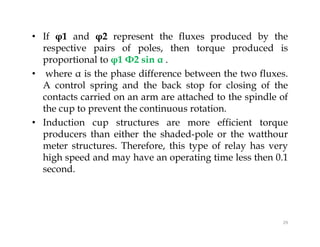
• If φ1 and φ2 represent the fluxes produced by the
respective pairs of poles, then torque produced is
proportional to φ1 Φ2 sin α .
• where α is the phase difference between the two fluxes.
A control spring and the back stop for closing of the
contacts carried on an arm are attached to the spindle of
the cup to prevent the continuous rotation.
• Induction cup structures are more efficient torque
producers than either the shaded-pole or the watthour
meter structures. Therefore, this type of relay has very
high speed and may have an operating time less then 0.1
second.
• If φ1 and φ2 represent the fluxes produced by the
respective pairs of poles, then torque produced is
proportional to φ1 Φ2 sin α .
• where α is the phase difference between the two fluxes.
A control spring and the back stop for closing of the
contacts carried on an arm are attached to the spindle of
the cup to prevent the continuous rotation.
• Induction cup structures are more efficient torque
producers than either the shaded-pole or the watthour
meter structures. Therefore, this type of relay has very
high speed and may have an operating time less then 0.1
second.
29
Induction type
overcurrent Relay
(Non Directional Relay)
Induction type
overcurrent Relay
(Non Directional Relay)
30
• This type of relay works on the induction
principle and initiates corrective measures
when current in the circuit exceeds the
predetermined value.
• The actuating source is a current in the
circuit supplied to the relay from a current
transformer. These relays are used on a.c.
circuits only and can operate for fault
current flow in either direction.
• This type of relay works on the induction
principle and initiates corrective measures
when current in the circuit exceeds the
predetermined value.
• The actuating source is a current in the
circuit supplied to the relay from a current
transformer. These relays are used on a.c.
circuits only and can operate for fault
current flow in either direction.
31
32
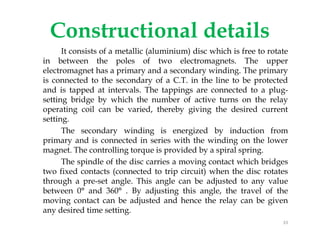
Constructional details
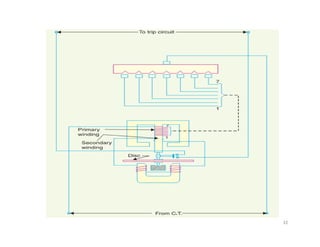
It consists of a metallic (aluminium) disc which is free to rotate
in between the poles of two electromagnets. The upper
electromagnet has a primary and a secondary winding. The primary
is connected to the secondary of a C.T. in the line to be protected
and is tapped at intervals. The tappings are connected to a plug-
setting bridge by which the number of active turns on the relay
operating coil can be varied, thereby giving the desired current
setting.
The secondary winding is energized by induction from
primary and is connected in series with the winding on the lower
magnet. The controlling torque is provided by a spiral spring.
The spindle of the disc carries a moving contact which bridges
two fixed contacts (connected to trip circuit) when the disc rotates
through a pre-set angle. This angle can be adjusted to any value
between 0° and 360° . By adjusting this angle, the travel of the
moving contact can be adjusted and hence the relay can be given
any desired time setting.
It consists of a metallic (aluminium) disc which is free to rotate
in between the poles of two electromagnets. The upper
electromagnet has a primary and a secondary winding. The primary
is connected to the secondary of a C.T. in the line to be protected
and is tapped at intervals. The tappings are connected to a plug-
setting bridge by which the number of active turns on the relay
operating coil can be varied, thereby giving the desired current
setting.
The secondary winding is energized by induction from
primary and is connected in series with the winding on the lower
magnet. The controlling torque is provided by a spiral spring.
The spindle of the disc carries a moving contact which bridges
two fixed contacts (connected to trip circuit) when the disc rotates
through a pre-set angle. This angle can be adjusted to any value
between 0° and 360° . By adjusting this angle, the travel of the
moving contact can be adjusted and hence the relay can be given
any desired time setting.
33
Operation
The driving torque on the aluminium disc is set up due to
the induction principle. This torque is opposed by the
restraining torque provided by the spring.
Under normal operating conditions, restraining torque is
greater than the driving torque produced by the relay coil
current. Therefore, the aluminium disc remains stationary.
If the current in the protected circuit exceeds the pre-set
value, the driving torque becomes greater than the restraining
torque. Consequently, the disc rotates and the moving contact
bridges the fixed contacts when the disc has rotated through a
pre-set angle. The trip circuit operates the circuit breaker
which isolates the faulty section.
The driving torque on the aluminium disc is set up due to
the induction principle. This torque is opposed by the
restraining torque provided by the spring.
Under normal operating conditions, restraining torque is
greater than the driving torque produced by the relay coil
current. Therefore, the aluminium disc remains stationary.
If the current in the protected circuit exceeds the pre-set
value, the driving torque becomes greater than the restraining
torque. Consequently, the disc rotates and the moving contact
bridges the fixed contacts when the disc has rotated through a
pre-set angle. The trip circuit operates the circuit breaker
which isolates the faulty section.
34
DIRECTIONAL
RELAY
DIRECTIONAL
RELAY
35
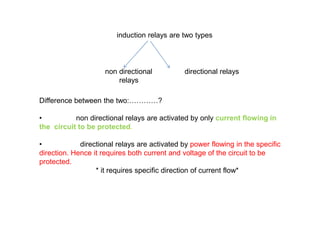
induction relays are two types
non directional directional relays
relays
Difference between the two:…………?
• non directional relays are activated by only current flowing in
the circuit to be protected.
• directional relays are activated by power flowing in the specific
direction. Hence it requires both current and voltage of the circuit to be
protected.
* it requires specific direction of current flow*
Difference between the two:…………?
• non directional relays are activated by only current flowing in
the circuit to be protected.
• directional relays are activated by power flowing in the specific
direction. Hence it requires both current and voltage of the circuit to be
protected.
* it requires specific direction of current flow*
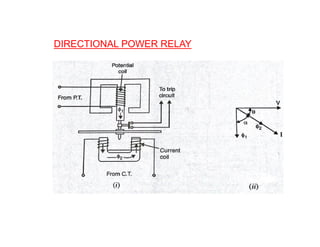
DIRECTIONAL POWER RELAY
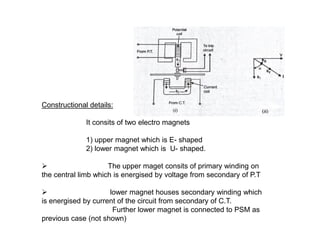
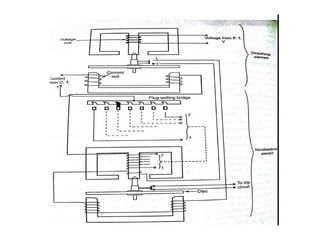
Constructional details:
It consits of two electro magnets
1) upper magnet which is E- shaped
2) lower magnet which is U- shaped.
 The upper maget consits of primary winding on
the central limb which is energised by voltage from secondary of P.T
 lower magnet houses secondary winding which
is energised by current of the circuit from secondary of C.T.
Further lower magnet is connected to PSM as
previous case (not shown)
Constructional details:
It consits of two electro magnets
1) upper magnet which is E- shaped
2) lower magnet which is U- shaped.
 The upper maget consits of primary winding on
the central limb which is energised by voltage from secondary of P.T
 lower magnet houses secondary winding which
is energised by current of the circuit from secondary of C.T.
Further lower magnet is connected to PSM as
previous case (not shown)
 In between this two electro magnets we have aluminium disc pivoted as
shown
 This alumunium disc carries a moving contact which can bridge fixed
contact by rotating though a pre set angle.
 The time of operation depends upon the pre set angle
 Restraining torque is provide by spring which twists in reverse direction.
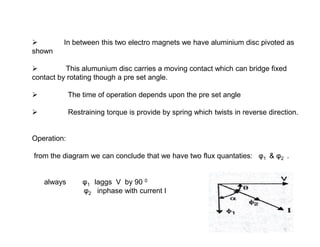
Operation:
from the diagram we can conclude that we have two flux quantaties: φ1 & φ2 .
always φ1 laggs V by 90 0
φ2 inphase with current I
 In between this two electro magnets we have aluminium disc pivoted as
shown
 This alumunium disc carries a moving contact which can bridge fixed
contact by rotating though a pre set angle.
 The time of operation depends upon the pre set angle
 Restraining torque is provide by spring which twists in reverse direction.
Operation:
from the diagram we can conclude that we have two flux quantaties: φ1 & φ2 .
always φ1 laggs V by 90 0
φ2 inphase with current I
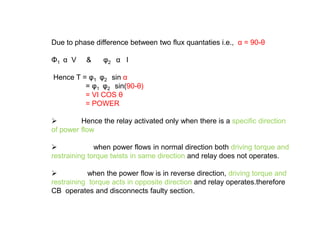
Due to phase difference between two flux quantaties i.e., α = 90-θ
Φ1 α V & φ2 α I
Hence T = φ1 φ2 sin α
= φ1 φ2 sin(90-θ)
= VI COS θ
= POWER
 Hence the relay activated only when there is a specific direction
of power flowof power flow
 when power flows in normal direction both driving torque and
restraining torque twists in same direction and relay does not operates.
 when the power flow is in reverse direction, driving torque and
restraining torque acts in opposite direction and relay operates.therefore
CB operates and disconnects faulty section.
Due to phase difference between two flux quantaties i.e., α = 90-θ
Φ1 α V & φ2 α I
Hence T = φ1 φ2 sin α
= φ1 φ2 sin(90-θ)
= VI COS θ
= POWER
 Hence the relay activated only when there is a specific direction
of power flowof power flow
 when power flows in normal direction both driving torque and
restraining torque twists in same direction and relay does not operates.
 when the power flow is in reverse direction, driving torque and
restraining torque acts in opposite direction and relay operates.therefore
CB operates and disconnects faulty section.
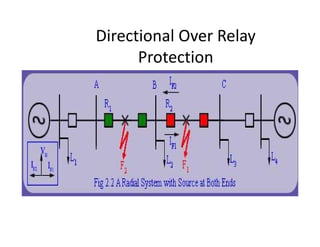
DIRECTIONAL OVER CURRENT RELAY:
From the previous discussion
T = V I COS θ
Under abnormal condition
under abnormal conditions voltage in the circuit is too low.
Therefore the driving torque becomes abnormally too small
.Hence the relay does not operate.
ie., the directional power relay is not suitable for
short circuit conditions.
This problem can be overcome by directional over
current relay.
DIRECTIONAL OVER CURRENT RELAY:
From the previous discussion
T = V I COS θ
Under abnormal condition
under abnormal conditions voltage in the circuit is too low.
Therefore the driving torque becomes abnormally too small
.Hence the relay does not operate.
ie., the directional power relay is not suitable for
short circuit conditions.
This problem can be overcome by directional over
current relay.
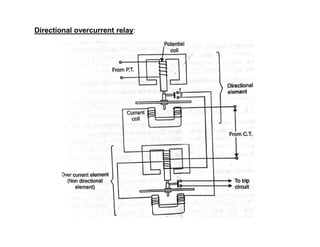
Directional overcurrent relay:
Directional overcurrent relay makes use of two relays
i) directional power relay ( directional element)
ii) Non directional current relay (non-directional element)
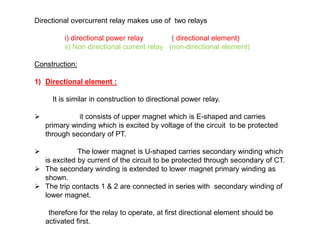
Construction:
1) Directional element :
It is similar in construction to directional power relay.
 it consists of upper magnet which is E-shaped and carries
primary winding which is excited by voltage of the circuit to be protected
through secondary of PT.
 The lower magnet is U-shaped carries secondary winding which
is excited by current of the circuit to be protected through secondary of CT.
 The secondary winding is extended to lower magnet primary winding as
shown.
 The trip contacts 1 & 2 are connected in series with secondary winding of
lower magnet.
therefore for the relay to operate, at first directional element should be
activated first.
Directional overcurrent relay makes use of two relays
i) directional power relay ( directional element)
ii) Non directional current relay (non-directional element)
Construction:
1) Directional element :
It is similar in construction to directional power relay.
 it consists of upper magnet which is E-shaped and carries
primary winding which is excited by voltage of the circuit to be protected
through secondary of PT.
 The lower magnet is U-shaped carries secondary winding which
is excited by current of the circuit to be protected through secondary of CT.
 The secondary winding is extended to lower magnet primary winding as
shown.
 The trip contacts 1 & 2 are connected in series with secondary winding of
lower magnet.
therefore for the relay to operate, at first directional element should be
activated first.
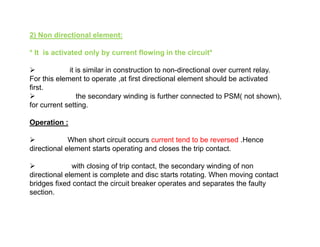
2) Non directional element:
* It is activated only by current flowing in the circuit*
 it is similar in construction to non-directional over current relay.
For this element to operate ,at first directional element should be activated
first.
 the secondary winding is further connected to PSM( not shown),
for current setting.
Operation :
 When short circuit occurs current tend to be reversed .Hence
directional element starts operating and closes the trip contact.
 with closing of trip contact, the secondary winding of non
directional element is complete and disc starts rotating. When moving contact
bridges fixed contact the circuit breaker operates and separates the faulty
section.
2) Non directional element:
* It is activated only by current flowing in the circuit*
 it is similar in construction to non-directional over current relay.
For this element to operate ,at first directional element should be activated
first.
 the secondary winding is further connected to PSM( not shown),
for current setting.
Operation :
 When short circuit occurs current tend to be reversed .Hence
directional element starts operating and closes the trip contact.
 with closing of trip contact, the secondary winding of non
directional element is complete and disc starts rotating. When moving contact
bridges fixed contact the circuit breaker operates and separates the faulty
section.
Distance Relay
(mho relay)
Distance Relay
(mho relay)
46
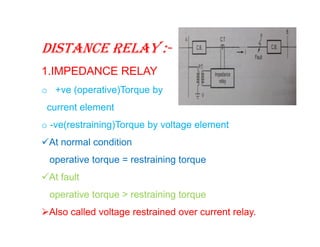
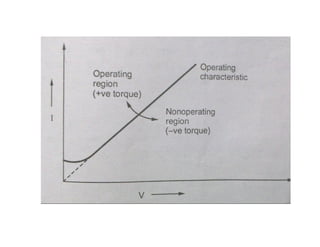
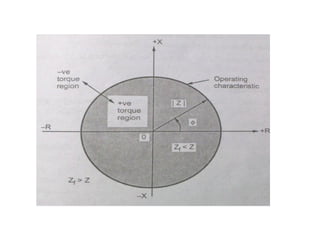
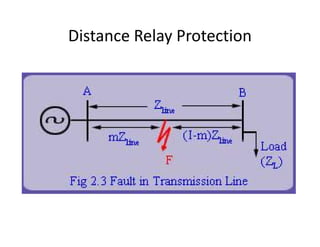
Distance relay :-
1.IMPEDANCE RELAY
o +ve (operative)Torque by
current element
o -ve(restraining)Torque by voltage element
At normal condition
operative torque = restraining torque
At fault
operative torque > restraining torque
Also called voltage restrained over current relay.
Distance relay :-
1.IMPEDANCE RELAY
o +ve (operative)Torque by
current element
o -ve(restraining)Torque by voltage element
At normal condition
operative torque = restraining torque
At fault
operative torque > restraining torque
Also called voltage restrained over current relay.
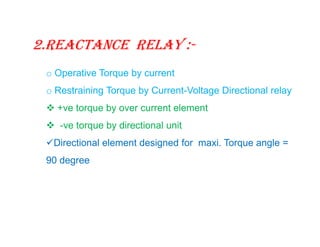
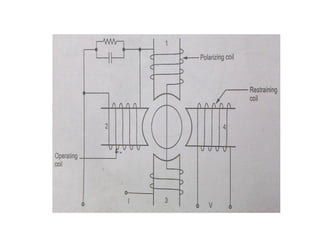
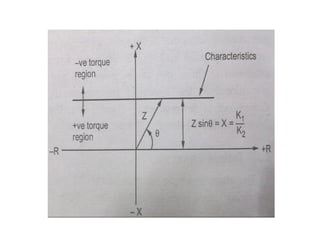
2.Reactance relay :-
o Operative Torque by current
o Restraining Torque by Current-Voltage Directional relay
 +ve torque by over current element
 -ve torque by directional unit
Directional element designed for maxi. Torque angle =
90 degree
o Operative Torque by current
o Restraining Torque by Current-Voltage Directional relay
 +ve torque by over current element
 -ve torque by directional unit
Directional element designed for maxi. Torque angle =
90 degree
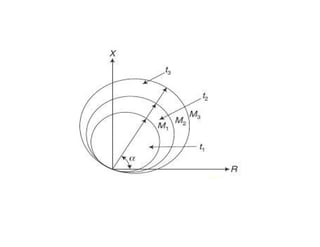
3.Mho relay :-
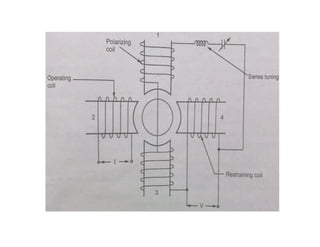
Induction cup type structure.
oOperative Torque produced by V & I element.
o Restraining Torque by Voltage element.
Also called Admittance relay.
Induction cup type structure.
oOperative Torque produced by V & I element.
o Restraining Torque by Voltage element.
Also called Admittance relay.
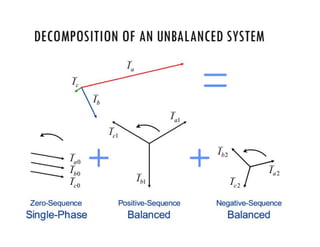
NEGATIVE SEQUENCE RELAY
 The negative relays are also called phase unbalance
relays because these relays provide protection
against negative sequence component of unbalanced
currents existing due to unbalanced loads or phase-
phase faults.
 The unbalanced currents are dangerous from
generators and motors point of view as these currents
can cause overheating. Negative sequence relays are
generally used to give protection to generators and
motors against unbalanced currents.
 The negative relays are also called phase unbalance
relays because these relays provide protection
against negative sequence component of unbalanced
currents existing due to unbalanced loads or phase-
phase faults.
 The unbalanced currents are dangerous from
generators and motors point of view as these currents
can cause overheating. Negative sequence relays are
generally used to give protection to generators and
motors against unbalanced currents.
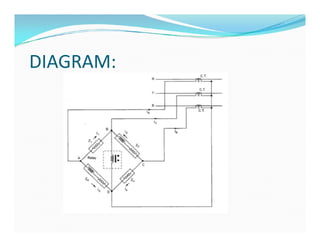
DIAGRAM:
CONSTRUCTION:
 It consists of a resistance bridge network.
 The magnitudes of the impedances of all the branches
of the network are equal.
 The impedances Z1 and Z3 are purely resistive while the
impedances Z2 and Z4 are the combinations of
resistance and reactance.
 The currents in the branches Z2 and Z4 lag by 60o from
the currents in the branches Z1 and Z3.
 The vertical branch B-D consists of inverse time
characteristics relay. The relay has negligible
impedance.
 It consists of a resistance bridge network.
 The magnitudes of the impedances of all the branches
of the network are equal.
 The impedances Z1 and Z3 are purely resistive while the
impedances Z2 and Z4 are the combinations of
resistance and reactance.
 The currents in the branches Z2 and Z4 lag by 60o from
the currents in the branches Z1 and Z3.
 The vertical branch B-D consists of inverse time
characteristics relay. The relay has negligible
impedance.
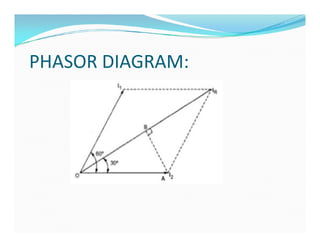
PHASOR DIAGRAM:
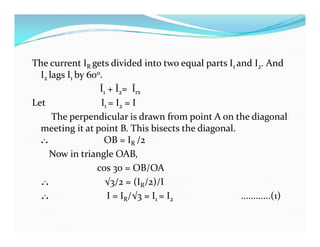
The current IR gets divided into two equal parts I1 and I2. And
I2 lags I1 by 60o.
Ī1 + Ī2= Īrs
Let I1 = I2 = I
The perpendicular is drawn from point A on the diagonal
meeting it at point B. This bisects the diagonal.
... OB = IR /2
Now in triangle OAB,
cos 30 = OB/OA
... √3/2 = (IR/2)/I
... I = IR/√3 = I1 = I2 ............(1)
The current IR gets divided into two equal parts I1 and I2. And
I2 lags I1 by 60o.
Ī1 + Ī2= Īrs
Let I1 = I2 = I
The perpendicular is drawn from point A on the diagonal
meeting it at point B. This bisects the diagonal.
... OB = IR /2
Now in triangle OAB,
cos 30 = OB/OA
... √3/2 = (IR/2)/I
... I = IR/√3 = I1 = I2 ............(1)
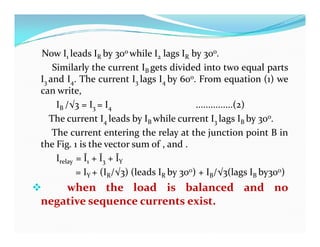
Now I1 leads IR by 30o while I2 lags IR by 30o.
Similarly the current IB gets divided into two equal parts
I3 and I4. The current I3 lags I4 by 60o. From equation (1) we
can write,
IB /√3 = I3 = I4 ...............(2)
The current I4 leads by IB while current I3 lags IB by 30o.
The current entering the relay at the junction point B in
the Fig. 1 is the vector sum of , and .
Irelay = Ī1 + Ī3 + ĪY
= IY + (IR/√3) (leads IR by 30o) + IB/√3(lags IB by30o)
 when the load is balanced and no
negative sequence currents exist.
Now I1 leads IR by 30o while I2 lags IR by 30o.
Similarly the current IB gets divided into two equal parts
I3 and I4. The current I3 lags I4 by 60o. From equation (1) we
can write,
IB /√3 = I3 = I4 ...............(2)
The current I4 leads by IB while current I3 lags IB by 30o.
The current entering the relay at the junction point B in
the Fig. 1 is the vector sum of , and .
Irelay = Ī1 + Ī3 + ĪY
= IY + (IR/√3) (leads IR by 30o) + IB/√3(lags IB by30o)
 when the load is balanced and no
negative sequence currents exist.
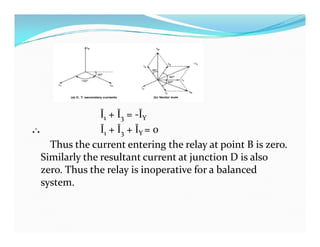
Ī1 + Ī3 = -ĪY
... Ī1 + Ī3 + ĪY = 0
Thus the current entering the relay at point B is zero.
Similarly the resultant current at junction D is also
zero. Thus the relay is inoperative for a balanced
system.
Ī1 + Ī3 = -ĪY
... Ī1 + Ī3 + ĪY = 0
Thus the current entering the relay at point B is zero.
Similarly the resultant current at junction D is also
zero. Thus the relay is inoperative for a balanced
system.
UNDER FAULTY CONDITION:
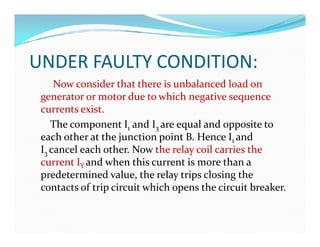
Now consider that there is unbalanced load on
generator or motor due to which negative sequence
currents exist.
The component I1 and I3 are equal and opposite to
each other at the junction point B. Hence I1 and
I3 cancel each other. Now the relay coil carries the
current IY and when this current is more than a
predetermined value, the relay trips closing the
contacts of trip circuit which opens the circuit breaker.
Now consider that there is unbalanced load on
generator or motor due to which negative sequence
currents exist.
The component I1 and I3 are equal and opposite to
each other at the junction point B. Hence I1 and
I3 cancel each other. Now the relay coil carries the
current IY and when this current is more than a
predetermined value, the relay trips closing the
contacts of trip circuit which opens the circuit breaker.
ZERO SEQUENCE CURRENT:
 Under zero sequence currents the total current of
twice the zero sequence current flows through the
relay. Hence the relay operates to open the circuit
breaker.
 To make the relay sensitive to only negative
sequence currents by making it inoperative under the
influence of zero sequence currents is possible by
connecting the current transformers in delta .Under
delta connection of current transformers, no zero
sequence current can flow in the network.
 Under zero sequence currents the total current of
twice the zero sequence current flows through the
relay. Hence the relay operates to open the circuit
breaker.
 To make the relay sensitive to only negative
sequence currents by making it inoperative under the
influence of zero sequence currents is possible by
connecting the current transformers in delta .Under
delta connection of current transformers, no zero
sequence current can flow in the network.
Definition
A two-winding relay that operates when the difference
between the currents in the two windings reaches a
predetermined value is called differential relays.
A two-winding relay that operates when the difference
between the currents in the two windings reaches a
predetermined value.
Definition
A two-winding relay that operates when the difference
between the currents in the two windings reaches a
predetermined value is called differential relays.
A two-winding relay that operates when the difference
between the currents in the two windings reaches a
predetermined value.
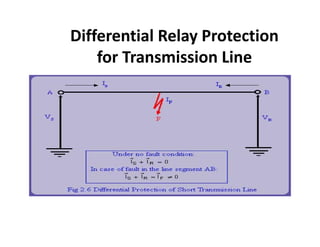
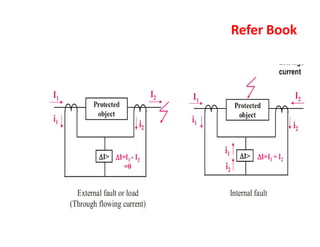
• In case of electrical quantities exceed a predetermined
value, a current differential relay is one that compares the
current entering a section of the system with current leaving
the section.
• Under normal operating conditions, the two currents are
equal but as soon as fault occurs, this condition no longer
applies. The difference between the incoming and outgoing
currents is arranged to flow through relay operating coil. If
this difference is equal to or greater than the pick up value
the relay will operate and open the circuit breaker and
isolate the faulty section.
• Any type of relay when connected in a particular way can be
made to operate as a differential relay. It is not the relay
construction but the way in which relay is connected in a
circuit makes it a differential relay.
• In case of electrical quantities exceed a predetermined
value, a current differential relay is one that compares the
current entering a section of the system with current leaving
the section.
• Under normal operating conditions, the two currents are
equal but as soon as fault occurs, this condition no longer
applies. The difference between the incoming and outgoing
currents is arranged to flow through relay operating coil. If
this difference is equal to or greater than the pick up value
the relay will operate and open the circuit breaker and
isolate the faulty section.
• Any type of relay when connected in a particular way can be
made to operate as a differential relay. It is not the relay
construction but the way in which relay is connected in a
circuit makes it a differential relay.
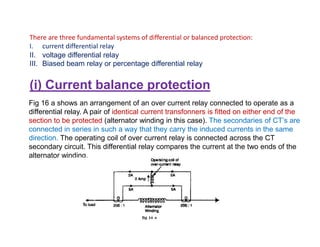
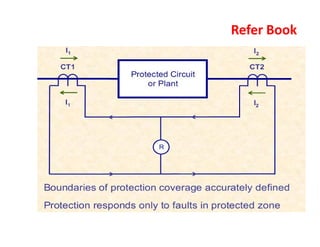
There are three fundamental systems of differential or balanced protection:
I. current differential relay
II. voltage differential relay
III. Biased beam relay or percentage differential relay
(i) Current balance protection
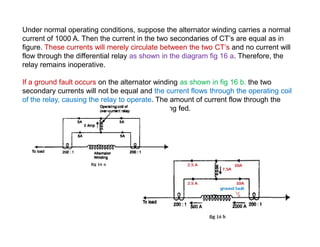
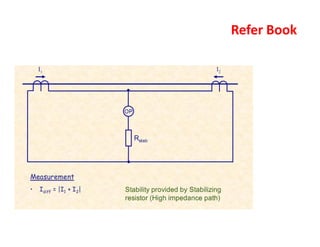
Fig 16 a shows an arrangement of an over current relay connected to operate as a
differential relay. A pair of identical current transfonners is fitted on either end of the
section to be protected (alternator winding in this case). The secondaries of CT’s are
connected in series in such a way that they carry the induced currents in the same
direction. The operating coil of over current relay is connected across the CT
secondary circuit. This differential relay compares the current at the two ends of the
alternator winding.
Fig 16 a shows an arrangement of an over current relay connected to operate as a
differential relay. A pair of identical current transfonners is fitted on either end of the
section to be protected (alternator winding in this case). The secondaries of CT’s are
connected in series in such a way that they carry the induced currents in the same
direction. The operating coil of over current relay is connected across the CT
secondary circuit. This differential relay compares the current at the two ends of the
alternator winding.
Under normal operating conditions, suppose the alternator winding carries a normal
current of 1000 A. Then the current in the two secondaries of CT’s are equal as in
figure. These currents will merely circulate between the two CT’s and no current will
flow through the differential relay as shown in the diagram fig 16 a. Therefore, the
relay remains inoperative.
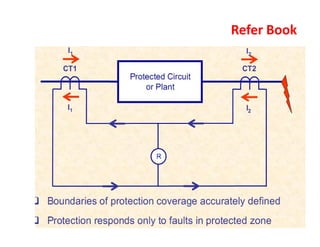
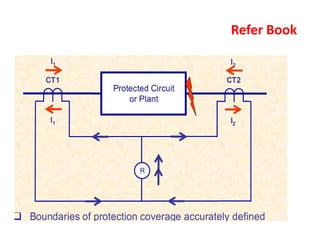
If a ground fault occurs on the alternator winding as shown in fig 16 b. the two
secondary currents will not be equal and the current flows through the operating coil
of the relay, causing the relay to operate. The amount of current flow through the
relay will depend upon the way the fault is being fed.
Disadvantages
 The impedance of the pilot cables generally
causes a slight difference between the currents at the
two ends of the section to be protected, then the small
differential current flowing through the relay may
cause it to operate even under no fault conditions.
 Pilot cable capacitance causes incorrect
operation of the relay when a large current flows
 Accurate matching of current transformers
cannot be achieved due to pilot circuit impedance
Disadvantages
 The impedance of the pilot cables generally
causes a slight difference between the currents at the
two ends of the section to be protected, then the small
differential current flowing through the relay may
cause it to operate even under no fault conditions.
 Pilot cable capacitance causes incorrect
operation of the relay when a large current flows
 Accurate matching of current transformers
cannot be achieved due to pilot circuit impedance
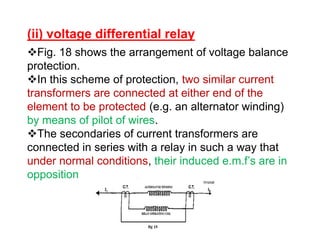
(ii) voltage differential relay
Fig. 18 shows the arrangement of voltage balance
protection.
In this scheme of protection, two similar current
transformers are connected at either end of the
element to be protected (e.g. an alternator winding)
by means of pilot of wires.
The secondaries of current transformers are
connected in series with a relay in such a way that
under normal conditions, their induced e.m.f’s are in
opposition
Fig. 18 shows the arrangement of voltage balance
protection.
In this scheme of protection, two similar current
transformers are connected at either end of the
element to be protected (e.g. an alternator winding)
by means of pilot of wires.
The secondaries of current transformers are
connected in series with a relay in such a way that
under normal conditions, their induced e.m.f’s are in
opposition
Under healthy conditions, equal currents will flow
in both primary windings. Therefore, the secondary
voltages of the two transformers are balanced
against each other and no current will flow through
the relay-operating coil.
When a fault occurs in the protected zone, the
currents in the two primaries will differ from one
another and their secondary voltages will no longer
be in balance.
This voltage difference will cause a current to flow
through the operating coil of the relay, which closes
the trip circuit.
Under healthy conditions, equal currents will flow
in both primary windings. Therefore, the secondary
voltages of the two transformers are balanced
against each other and no current will flow through
the relay-operating coil.
When a fault occurs in the protected zone, the
currents in the two primaries will differ from one
another and their secondary voltages will no longer
be in balance.
This voltage difference will cause a current to flow
through the operating coil of the relay, which closes
the trip circuit.
Disadvantages
The voltage balance system suffers from the
following drawbacks
 A multi-gap transformer construction is required
to achieve the accurate balance between current
transformer pairs.
 The system is suitable for protection of cables of
relatively short, lengths due to the capacitance of
pilot wires.
Disadvantages
The voltage balance system suffers from the
following drawbacks
 A multi-gap transformer construction is required
to achieve the accurate balance between current
transformer pairs.
 The system is suitable for protection of cables of
relatively short, lengths due to the capacitance of
pilot wires.
The biased beam relay also called percentage differential relay is designed to
respond to the differential current in terms of its fractional relation to the current
flowing through the protected section.
It’s called percentage differential relay because the ratio of differential operating
current to average restraining current is a fixed percentage.
It’s called bias relay because restraining known as biased coil produces the bias
force. Fig 17 a, shows the schematic arrangements of biased beam relay. It is
essentially an over current balanced beam type relay with an additional restraining
coil. The restraining coil produces a bias force in the opposite direction to the
operating force.
III. Biased beam relay or percentage differential relay
The biased beam relay also called percentage differential relay is designed to
respond to the differential current in terms of its fractional relation to the current
flowing through the protected section.
It’s called percentage differential relay because the ratio of differential operating
current to average restraining current is a fixed percentage.
It’s called bias relay because restraining known as biased coil produces the bias
force. Fig 17 a, shows the schematic arrangements of biased beam relay. It is
essentially an over current balanced beam type relay with an additional restraining
coil. The restraining coil produces a bias force in the opposite direction to the
operating force.
Under normal and through load conditions, the bias
force due to restraining coil is greater than operating
force. Therefore, the relay remains inoperative.
When an internal fault occurs, the operating
force exceeds the bias force. Consequently the
trip contacts are closed to open the circuit
breaker.
The bias force can be adjusted by varying the
number of turns on the restraining coil.
Under
frequency
relays
Under
frequency
relays
78
79
80
81
Apparatus Protection
UNITUNIT
33
Apparatus Protection
1
Presented by
C.GOKUL,AP/EEE
Velalar College of Engg & Tech , Erode
UNIT 3 Syllabus
• Protection of transformer.
• Protection of generator.
• Protection of motor.
• Protection of busbars.
• Protection of transmission line.
• Protection of transformer.
• Protection of generator.
• Protection of motor.
• Protection of busbars.
• Protection of transmission line.
2
Introduction
The two major items of equipment in a
power system are the generators and transformers.
They have very high chance of fault occurrence
and usually takes much time and money to repair
the damage.
The two major items of equipment in a
power system are the generators and transformers.
They have very high chance of fault occurrence
and usually takes much time and money to repair
the damage.
Fault and Abnormal
Conditions
 Generator : Over Current, Over Voltage, Under Voltage, Under
Frequency, Unbalanced Current, Loss of Excitation, Reverse Power,
Winding Inter turn Fault, Winding Earth Fault etc.
 Transformer : Over Current, Winding Inter turn fault, Excessive
Temperature Rise, Unbalance Current, Over fluxing etc.
 Motors : Over Current, Under Voltage, Unbalance Current, Winding
Short Circuit, Stator Earth Fault, etc.
 Transmission Line : Single Phase to ground fault, Phase to Phase
Fault, three phase to ground fault, Over Current etc.
 Generator : Over Current, Over Voltage, Under Voltage, Under
Frequency, Unbalanced Current, Loss of Excitation, Reverse Power,
Winding Inter turn Fault, Winding Earth Fault etc.
 Transformer : Over Current, Winding Inter turn fault, Excessive
Temperature Rise, Unbalance Current, Over fluxing etc.
 Motors : Over Current, Under Voltage, Unbalance Current, Winding
Short Circuit, Stator Earth Fault, etc.
 Transmission Line : Single Phase to ground fault, Phase to Phase
Fault, three phase to ground fault, Over Current etc.
Faults occurring in Transformers
 Open-Circuit faults
 Earth faults
 Phase-to-Phase faults
 Inter-Turn faults
 Overheating
 Open-Circuit faults
 Earth faults
 Phase-to-Phase faults
 Inter-Turn faults
 Overheating
Factors in choosing Protective Gear
for a Transformer
 Type of Transformer
 Size of the Transformer
 Type of Cooling
 System where used
 Importance of service for which it is required
 Type of Transformer
 Size of the Transformer
 Type of Cooling
 System where used
 Importance of service for which it is required
Transformer Relaying Scheme
Buchholz Protection
Also known as gas accumulator relay, commonly used on
all oil-immersed transformer provided with conservator.
Working Principle:
Whenever a fault occur inside the transformer, the
oil of the tank gets overheated and gases are generated.
The heat generated by the high local current causes the
transformer oil to decompose and produce gas which can
be used to detect the winding faults
Also known as gas accumulator relay, commonly used on
all oil-immersed transformer provided with conservator.
Working Principle:
Whenever a fault occur inside the transformer, the
oil of the tank gets overheated and gases are generated.
The heat generated by the high local current causes the
transformer oil to decompose and produce gas which can
be used to detect the winding faults
Buchholz Protection
Core-Balance Leakage Protection
This system is used to provide protection against earth
faults on high voltage winding. When earth fault occurs,
the sum of the three currents is no longer zero and a
current is induced in the secondary of the CT causing
the trip relay to operate and isolate the transformer from
the bus-bars.
This system is used to provide protection against earth
faults on high voltage winding. When earth fault occurs,
the sum of the three currents is no longer zero and a
current is induced in the secondary of the CT causing
the trip relay to operate and isolate the transformer from
the bus-bars.
Combined Leakage and Overload
Protection
The core-balance protection cannot provide protection
against overload. It is usual practice to provide combined
leakage and overload protection for transformer. The
earth relay has low current setting and operates under
earth faults only. The overload relays have high current
setting and are arrange to operate against faults
between the phases
The core-balance protection cannot provide protection
against overload. It is usual practice to provide combined
leakage and overload protection for transformer. The
earth relay has low current setting and operates under
earth faults only. The overload relays have high current
setting and are arrange to operate against faults
between the phases
 In this system, two overload relay and one earth relay
are connected. The two overload relays are sufficient to
protect against phase to phase faults. The trip contacts
of overload relays and earth fault relay are connected
in parallel. Therefore the energizing of either one of
them, the circuit breaker will tripped.
Transformer Protection
Overheating
Normal maximum working temp. = 95 °C
8-10 °C rise will halve the life of the transformer.
Overcurrent
Fuses for distribution transformer
Overcurrent relaying for 5MVA and above
Characteristics:
– Must be below the damage curve
– Must be above magnetizing inrush
Overheating
Normal maximum working temp. = 95 °C
8-10 °C rise will halve the life of the transformer.
Overcurrent
Fuses for distribution transformer
Overcurrent relaying for 5MVA and above
Characteristics:
– Must be below the damage curve
– Must be above magnetizing inrush
Conclusion
 Open-circuit faults, earth faults, phase-to-phase faults,
inter-turn faults and overheating are the fault that are
likely occur in a transformer
 Relays control output circuits of a much higher
power.
 Safety is increased
 Protective relays are essential for keeping faults in the
system isolated and keep equipment from being
damaged.
 Open-circuit faults, earth faults, phase-to-phase faults,
inter-turn faults and overheating are the fault that are
likely occur in a transformer
 Relays control output circuits of a much higher
power.
 Safety is increased
 Protective relays are essential for keeping faults in the
system isolated and keep equipment from being
damaged.
IntroductionIntroduction
 Generator is the electrical end of a turboGenerator is the electrical end of a turbo--generator set.generator set.
Without Generator, turbine/boiler/any Power Plant EquipmentWithout Generator, turbine/boiler/any Power Plant Equipment
is meaningless. Generator is the most precious/valuableis meaningless. Generator is the most precious/valuable
equipment in PP which actually converts the mechanicalequipment in PP which actually converts the mechanical
energy of turbine into electricity. So, Generator should beenergy of turbine into electricity. So, Generator should be
protected from faults occurring within generator and also fromprotected from faults occurring within generator and also from
external faults/abnormal operating condition in the GRIDexternal faults/abnormal operating condition in the GRID
which affected the generator.which affected the generator.
 Various relays/devices are used to detect the abnormalities inVarious relays/devices are used to detect the abnormalities in
operations and whenever fault conditions appear, they can giveoperations and whenever fault conditions appear, they can give
warning alarms to the operators or trip the unit automatically.warning alarms to the operators or trip the unit automatically.
 Generally automatic tripping are provided if the time forGenerally automatic tripping are provided if the time for
operator to take corrective action is less or the fault is likely tooperator to take corrective action is less or the fault is likely to
cause serious damage to the unit.cause serious damage to the unit.
 Generator is the electrical end of a turboGenerator is the electrical end of a turbo--generator set.generator set.
Without Generator, turbine/boiler/any Power Plant EquipmentWithout Generator, turbine/boiler/any Power Plant Equipment
is meaningless. Generator is the most precious/valuableis meaningless. Generator is the most precious/valuable
equipment in PP which actually converts the mechanicalequipment in PP which actually converts the mechanical
energy of turbine into electricity. So, Generator should beenergy of turbine into electricity. So, Generator should be
protected from faults occurring within generator and also fromprotected from faults occurring within generator and also from
external faults/abnormal operating condition in the GRIDexternal faults/abnormal operating condition in the GRID
which affected the generator.which affected the generator.
 Various relays/devices are used to detect the abnormalities inVarious relays/devices are used to detect the abnormalities in
operations and whenever fault conditions appear, they can giveoperations and whenever fault conditions appear, they can give
warning alarms to the operators or trip the unit automatically.warning alarms to the operators or trip the unit automatically.
 Generally automatic tripping are provided if the time forGenerally automatic tripping are provided if the time for
operator to take corrective action is less or the fault is likely tooperator to take corrective action is less or the fault is likely to
cause serious damage to the unit.cause serious damage to the unit.
FAULT IN THE GENERATORFAULT IN THE GENERATOR
 StatorStator
 Phase to Phase fault.Phase to Phase fault.
 InterInter –– turn faultturn fault
 Earth fault (80% & 100%)Earth fault (80% & 100%)
 RotorRotor
 Rotor E/FRotor E/F –– Two stage relay: a) Alarm b) TripTwo stage relay: a) Alarm b) Trip
 Over voltage in the rotor.Over voltage in the rotor.
 StatorStator
 Phase to Phase fault.Phase to Phase fault.
 InterInter –– turn faultturn fault
 Earth fault (80% & 100%)Earth fault (80% & 100%)
 RotorRotor
 Rotor E/FRotor E/F –– Two stage relay: a) Alarm b) TripTwo stage relay: a) Alarm b) Trip
 Over voltage in the rotor.Over voltage in the rotor.
ABNORMAL OPERATINGABNORMAL OPERATING
CONDITIONS:CONDITIONS:
Which affects the generatorWhich affects the generator
 Negative Phase sequenceNegative Phase sequence
 Loss of ExcitationLoss of Excitation
 Over fluxing protectionOver fluxing protection
 Reverse powerReverse power
 OverOver--speedingspeeding
 Pole slipping/ Out of StepPole slipping/ Out of Step
Which affects the generatorWhich affects the generator
 Negative Phase sequenceNegative Phase sequence
 Loss of ExcitationLoss of Excitation
 Over fluxing protectionOver fluxing protection
 Reverse powerReverse power
 OverOver--speedingspeeding
 Pole slipping/ Out of StepPole slipping/ Out of Step
PROTECTION CATEGORYPROTECTION CATEGORY
 Complete Generator protection is divided into two category i.e.Complete Generator protection is divided into two category i.e.
 ClassClass –– A ProtectionA Protection
 ClassClass –– B ProtectionB Protection
 CLASSCLASS –– A: Protection where electrical isolation is an emergency.(A: Protection where electrical isolation is an emergency.(
Insulation failure, ,S.C. etc.). Trip the GCB/Turbine/Boiler withoutInsulation failure, ,S.C. etc.). Trip the GCB/Turbine/Boiler without
time delay or Generator automatic trips.time delay or Generator automatic trips.
 .Class.Class –– A follows;A follows;
 Gen. Differential Prot.Gen. Differential Prot.
 Gen. 100% E/FGen. 100% E/F
 Gen. SB E/FGen. SB E/F
 Gen. NVDGen. NVD
 Gen. O/CGen. O/C
 Rotor 2nd stage E/FRotor 2nd stage E/F
 Gen. Brg. Temp. highGen. Brg. Temp. high
 Complete Generator protection is divided into two category i.e.Complete Generator protection is divided into two category i.e.
 ClassClass –– A ProtectionA Protection
 ClassClass –– B ProtectionB Protection
 CLASSCLASS –– A: Protection where electrical isolation is an emergency.(A: Protection where electrical isolation is an emergency.(
Insulation failure, ,S.C. etc.). Trip the GCB/Turbine/Boiler withoutInsulation failure, ,S.C. etc.). Trip the GCB/Turbine/Boiler without
time delay or Generator automatic trips.time delay or Generator automatic trips.
 .Class.Class –– A follows;A follows;
 Gen. Differential Prot.Gen. Differential Prot.
 Gen. 100% E/FGen. 100% E/F
 Gen. SB E/FGen. SB E/F
 Gen. NVDGen. NVD
 Gen. O/CGen. O/C
 Rotor 2nd stage E/FRotor 2nd stage E/F
 Gen. Brg. Temp. highGen. Brg. Temp. high
CLASSCLASS -- BB
 CLASSCLASS –– B: Protection where externalB: Protection where external
abnormalities come into picture, such as temp.abnormalities come into picture, such as temp.
rise. Generator trips through LFP relay.rise. Generator trips through LFP relay.
 ClassClass –– BB follows;follows;
 Reverse powerReverse power
 Voltage restrained O/CVoltage restrained O/C
 Thermal O/CThermal O/C
 Negative Phase sequenceNegative Phase sequence
 U/V and O/V 2nd stageU/V and O/V 2nd stage
 Over fluxing/ Field failureOver fluxing/ Field failure
 Gen. over/under frequency.Gen. over/under frequency.
 CLASSCLASS –– B: Protection where externalB: Protection where external
abnormalities come into picture, such as temp.abnormalities come into picture, such as temp.
rise. Generator trips through LFP relay.rise. Generator trips through LFP relay.
 ClassClass –– BB follows;follows;
 Reverse powerReverse power
 Voltage restrained O/CVoltage restrained O/C
 Thermal O/CThermal O/C
 Negative Phase sequenceNegative Phase sequence
 U/V and O/V 2nd stageU/V and O/V 2nd stage
 Over fluxing/ Field failureOver fluxing/ Field failure
 Gen. over/under frequency.Gen. over/under frequency.
EARTH FAULT:EARTH FAULT:
 When fault current flows through earth return path,When fault current flows through earth return path,
the fault is called Earth Fault.the fault is called Earth Fault.
 Possible causes are ;(a) Insulation failure, (b) due toPossible causes are ;(a) Insulation failure, (b) due to
over heating (Failure of water/air circulation throughover heating (Failure of water/air circulation through
stator conductor).stator conductor).
 Earth fault may occur between any phase conductorEarth fault may occur between any phase conductor
and core.and core.
 It is usually practice to limit the earth fault current toIt is usually practice to limit the earth fault current to
avoid extensive damage to the stator core.avoid extensive damage to the stator core.
 When fault current flows through earth return path,When fault current flows through earth return path,
the fault is called Earth Fault.the fault is called Earth Fault.
 Possible causes are ;(a) Insulation failure, (b) due toPossible causes are ;(a) Insulation failure, (b) due to
over heating (Failure of water/air circulation throughover heating (Failure of water/air circulation through
stator conductor).stator conductor).
 Earth fault may occur between any phase conductorEarth fault may occur between any phase conductor
and core.and core.
 It is usually practice to limit the earth fault current toIt is usually practice to limit the earth fault current to
avoid extensive damage to the stator core.avoid extensive damage to the stator core.
STAND BY EARTH FAULT:STAND BY EARTH FAULT:
 This protection is practically protects 95% ofThis protection is practically protects 95% of
generator winding. Therefore a current setting ofgenerator winding. Therefore a current setting of
5% of in to be set.5% of in to be set.
 E/F current is generally limited to about 15/20Amps.E/F current is generally limited to about 15/20Amps.
 Earth fault current of even 100A for few seconds canEarth fault current of even 100A for few seconds can
cause external damage. So the earth fault is restrictedcause external damage. So the earth fault is restricted
to 100Amps. By providing NGR of 63.5 ohms atto 100Amps. By providing NGR of 63.5 ohms at
11KV Voltage Level.11KV Voltage Level.
 This is a BackThis is a Back--Up protection.Up protection.
 This protection is practically protects 95% ofThis protection is practically protects 95% of
generator winding. Therefore a current setting ofgenerator winding. Therefore a current setting of
5% of in to be set.5% of in to be set.
 E/F current is generally limited to about 15/20Amps.E/F current is generally limited to about 15/20Amps.
 Earth fault current of even 100A for few seconds canEarth fault current of even 100A for few seconds can
cause external damage. So the earth fault is restrictedcause external damage. So the earth fault is restricted
to 100Amps. By providing NGR of 63.5 ohms atto 100Amps. By providing NGR of 63.5 ohms at
11KV Voltage Level.11KV Voltage Level.
 This is a BackThis is a Back--Up protection.Up protection.
100% STATOR EARTH FAULT:100% STATOR EARTH FAULT:
 In this protection, where neutral voltage measurement is madeIn this protection, where neutral voltage measurement is made
at generator terminals, (By Broken Delta), the third harmonicat generator terminals, (By Broken Delta), the third harmonic
voltage element is used.voltage element is used.
 First earth fault very near to neutral produces negligibleFirst earth fault very near to neutral produces negligible
current as driving voltage is nearly zero. But if a 2nd earthcurrent as driving voltage is nearly zero. But if a 2nd earth
fault occurs at machine terminal, line to ground fault is notfault occurs at machine terminal, line to ground fault is not
limited by NGR. The resulting fault current can be high.limited by NGR. The resulting fault current can be high.
Hence, the 1st E/F very near to neutral has to be detected earlyHence, the 1st E/F very near to neutral has to be detected early
and isolated.and isolated.
 All generators produce continuous current of 3rd harmonicAll generators produce continuous current of 3rd harmonic
voltage. Under normal condition, 3rd harmonic voltage isvoltage. Under normal condition, 3rd harmonic voltage is
present. If there is a fault near neutral, the amount of 3rdpresent. If there is a fault near neutral, the amount of 3rd
harmonic voltage comes down and this is used for detection.harmonic voltage comes down and this is used for detection.
 In this protection, where neutral voltage measurement is madeIn this protection, where neutral voltage measurement is made
at generator terminals, (By Broken Delta), the third harmonicat generator terminals, (By Broken Delta), the third harmonic
voltage element is used.voltage element is used.
 First earth fault very near to neutral produces negligibleFirst earth fault very near to neutral produces negligible
current as driving voltage is nearly zero. But if a 2nd earthcurrent as driving voltage is nearly zero. But if a 2nd earth
fault occurs at machine terminal, line to ground fault is notfault occurs at machine terminal, line to ground fault is not
limited by NGR. The resulting fault current can be high.limited by NGR. The resulting fault current can be high.
Hence, the 1st E/F very near to neutral has to be detected earlyHence, the 1st E/F very near to neutral has to be detected early
and isolated.and isolated.
 All generators produce continuous current of 3rd harmonicAll generators produce continuous current of 3rd harmonic
voltage. Under normal condition, 3rd harmonic voltage isvoltage. Under normal condition, 3rd harmonic voltage is
present. If there is a fault near neutral, the amount of 3rdpresent. If there is a fault near neutral, the amount of 3rd
harmonic voltage comes down and this is used for detection.harmonic voltage comes down and this is used for detection.
STATOR EARTH FAULT PROTECTIONSTATOR EARTH FAULT PROTECTION
Generator
Yellow
Red
Blue
RelayCT
Neutral Earth
Resistance
ROTOR EARTH FAULT:ROTOR EARTH FAULT:
 Since rotorSince rotor circuits operate ungrounded, a single earth fault iscircuits operate ungrounded, a single earth fault is
caused by insulation failure due to moisture, ageing ofcaused by insulation failure due to moisture, ageing of
insulation or vibration of rotor etc. But existence of singleinsulation or vibration of rotor etc. But existence of single
ground fault increases the chance of a second ground fault.ground fault increases the chance of a second ground fault.
The occurrence of second earth fault can cause fault currentThe occurrence of second earth fault can cause fault current
flows. This results unsymmetrical flux distribution. The airflows. This results unsymmetrical flux distribution. The air
gap flux is badly distorted. The rotor is displaced enough togap flux is badly distorted. The rotor is displaced enough to
rub stator leading to severe vibrations and can damage therub stator leading to severe vibrations and can damage the
bearing.bearing.
 Although a machine can continuously run on a single earthAlthough a machine can continuously run on a single earth
fault but second rotor earth fault, if allowed to occur,fault but second rotor earth fault, if allowed to occur,
should be detected immediately and generator should beshould be detected immediately and generator should be
tripped.tripped.
 Since rotorSince rotor circuits operate ungrounded, a single earth fault iscircuits operate ungrounded, a single earth fault is
caused by insulation failure due to moisture, ageing ofcaused by insulation failure due to moisture, ageing of
insulation or vibration of rotor etc. But existence of singleinsulation or vibration of rotor etc. But existence of single
ground fault increases the chance of a second ground fault.ground fault increases the chance of a second ground fault.
The occurrence of second earth fault can cause fault currentThe occurrence of second earth fault can cause fault current
flows. This results unsymmetrical flux distribution. The airflows. This results unsymmetrical flux distribution. The air
gap flux is badly distorted. The rotor is displaced enough togap flux is badly distorted. The rotor is displaced enough to
rub stator leading to severe vibrations and can damage therub stator leading to severe vibrations and can damage the
bearing.bearing.
 Although a machine can continuously run on a single earthAlthough a machine can continuously run on a single earth
fault but second rotor earth fault, if allowed to occur,fault but second rotor earth fault, if allowed to occur,
should be detected immediately and generator should beshould be detected immediately and generator should be
tripped.tripped.
DIFFERENTIAL PROTECTIONDIFFERENTIAL PROTECTION
 Differential protection is very reliable method for statorDifferential protection is very reliable method for stator
winding phase to phase fault. In this, currents on bothwinding phase to phase fault. In this, currents on both
sides of the generator are compared.sides of the generator are compared.
 Under normal condition or for a fault outside of theUnder normal condition or for a fault outside of the
protected zone, current i1s is equal to current i2s.protected zone, current i1s is equal to current i2s.
Therefore, the currents in the CTs secondaries are alsoTherefore, the currents in the CTs secondaries are also
equal, i1s=i2s and no current flows through the currentequal, i1s=i2s and no current flows through the current
relays.relays.
 If a fault develops inside of the protected zone, current i1sIf a fault develops inside of the protected zone, current i1s
and i2s are no longer equal, therefore i1s and i2s are notand i2s are no longer equal, therefore i1s and i2s are not
equal and therefore a current flowing in the current relay.equal and therefore a current flowing in the current relay.
 Differential protection is very reliable method for statorDifferential protection is very reliable method for stator
winding phase to phase fault. In this, currents on bothwinding phase to phase fault. In this, currents on both
sides of the generator are compared.sides of the generator are compared.
 Under normal condition or for a fault outside of theUnder normal condition or for a fault outside of the
protected zone, current i1s is equal to current i2s.protected zone, current i1s is equal to current i2s.
Therefore, the currents in the CTs secondaries are alsoTherefore, the currents in the CTs secondaries are also
equal, i1s=i2s and no current flows through the currentequal, i1s=i2s and no current flows through the current
relays.relays.
 If a fault develops inside of the protected zone, current i1sIf a fault develops inside of the protected zone, current i1s
and i2s are no longer equal, therefore i1s and i2s are notand i2s are no longer equal, therefore i1s and i2s are not
equal and therefore a current flowing in the current relay.equal and therefore a current flowing in the current relay.
Negative Phase Sequence Protection:Negative Phase Sequence Protection:
 When the generator is connected to a balanced load, the phase currents areWhen the generator is connected to a balanced load, the phase currents are
equal in magnitude and displaced electrically by 120equal in magnitude and displaced electrically by 120°°. The ATs wave. The ATs wave
produced by the stator currents rotate synchronously with the rotor and noproduced by the stator currents rotate synchronously with the rotor and no
eddy currents are induced in the rotor parts.eddy currents are induced in the rotor parts.
 If there is an unbalanced loading of the generator, and then the statorIf there is an unbalanced loading of the generator, and then the stator
currents have acurrents have a ––ve sequence component. The stator field due to theseve sequence component. The stator field due to these ––veve
sequence currents rotates at synchronous speed but in a direction oppositesequence currents rotates at synchronous speed but in a direction opposite
to the direction of the field structure on the rotor. Thus, theto the direction of the field structure on the rotor. Thus, the ––ve sequenceve sequence
stator armature mmf rotates at a speedstator armature mmf rotates at a speed ––Ns, while the rotor field speed isNs, while the rotor field speed is
+Ns. There is a relative velocity of 2Ns between the two.+Ns. There is a relative velocity of 2Ns between the two.
 These causes double frequency currents, of large amplitude to be inducedThese causes double frequency currents, of large amplitude to be induced
in the rotor conductors and iron part. So both the eddy currents as well asin the rotor conductors and iron part. So both the eddy currents as well as
the hystersis losses increase due to these double frequencies inducedthe hystersis losses increase due to these double frequencies induced
currents in the rotor.currents in the rotor.
 Unbalanced loading affects ;(a) Rotor heating (b) Severe vibration &Unbalanced loading affects ;(a) Rotor heating (b) Severe vibration &
heating of stator.heating of stator.
 When the generator is connected to a balanced load, the phase currents areWhen the generator is connected to a balanced load, the phase currents are
equal in magnitude and displaced electrically by 120equal in magnitude and displaced electrically by 120°°. The ATs wave. The ATs wave
produced by the stator currents rotate synchronously with the rotor and noproduced by the stator currents rotate synchronously with the rotor and no
eddy currents are induced in the rotor parts.eddy currents are induced in the rotor parts.
 If there is an unbalanced loading of the generator, and then the statorIf there is an unbalanced loading of the generator, and then the stator
currents have acurrents have a ––ve sequence component. The stator field due to theseve sequence component. The stator field due to these ––veve
sequence currents rotates at synchronous speed but in a direction oppositesequence currents rotates at synchronous speed but in a direction opposite
to the direction of the field structure on the rotor. Thus, theto the direction of the field structure on the rotor. Thus, the ––ve sequenceve sequence
stator armature mmf rotates at a speedstator armature mmf rotates at a speed ––Ns, while the rotor field speed isNs, while the rotor field speed is
+Ns. There is a relative velocity of 2Ns between the two.+Ns. There is a relative velocity of 2Ns between the two.
 These causes double frequency currents, of large amplitude to be inducedThese causes double frequency currents, of large amplitude to be induced
in the rotor conductors and iron part. So both the eddy currents as well asin the rotor conductors and iron part. So both the eddy currents as well as
the hystersis losses increase due to these double frequencies inducedthe hystersis losses increase due to these double frequencies induced
currents in the rotor.currents in the rotor.
 Unbalanced loading affects ;(a) Rotor heating (b) Severe vibration &Unbalanced loading affects ;(a) Rotor heating (b) Severe vibration &
heating of stator.heating of stator.
FIELD FAILURE PROTECTION:FIELD FAILURE PROTECTION:
 Acts as an Induction Generator.Acts as an Induction Generator.
 Possible Causes;Possible Causes;
 AVR FaultAVR Fault
 Tripping of Field C.B.Tripping of Field C.B.
 Open circuit or Short circuit occurring in the D.C. circuit.Open circuit or Short circuit occurring in the D.C. circuit.
 PMG failurePMG failure
 In normal condition, generator when running shares the reactive demand of theIn normal condition, generator when running shares the reactive demand of the
system. If excitation fails, synchronous generator runs at a supersystem. If excitation fails, synchronous generator runs at a super--synchronoussynchronous
speed, draws reactive power from the power system instead of supplying the Qe.speed, draws reactive power from the power system instead of supplying the Qe.
In case, the other generators can’t meet the requirement of reactive power, thisIn case, the other generators can’t meet the requirement of reactive power, this
shall result in large voltage drop which may ultimately result in instability.shall result in large voltage drop which may ultimately result in instability.
 In this case, slip becomesIn this case, slip becomes ––Ve result in slip frequency currents. Rotor getsVe result in slip frequency currents. Rotor gets
heated up due to induced currents in the rotor winding, core or damage theheated up due to induced currents in the rotor winding, core or damage the
winding if this condition is sustained. Stator heats up due to high stator currentswinding if this condition is sustained. Stator heats up due to high stator currents
due to increase in reactive current from the system.due to increase in reactive current from the system.
 By monitor (i) Field current, IfBy monitor (i) Field current, If
 (ii) Phase current & voltage.(ii) Phase current & voltage.
 Acts as an Induction Generator.Acts as an Induction Generator.
 Possible Causes;Possible Causes;
 AVR FaultAVR Fault
 Tripping of Field C.B.Tripping of Field C.B.
 Open circuit or Short circuit occurring in the D.C. circuit.Open circuit or Short circuit occurring in the D.C. circuit.
 PMG failurePMG failure
 In normal condition, generator when running shares the reactive demand of theIn normal condition, generator when running shares the reactive demand of the
system. If excitation fails, synchronous generator runs at a supersystem. If excitation fails, synchronous generator runs at a super--synchronoussynchronous
speed, draws reactive power from the power system instead of supplying the Qe.speed, draws reactive power from the power system instead of supplying the Qe.
In case, the other generators can’t meet the requirement of reactive power, thisIn case, the other generators can’t meet the requirement of reactive power, this
shall result in large voltage drop which may ultimately result in instability.shall result in large voltage drop which may ultimately result in instability.
 In this case, slip becomesIn this case, slip becomes ––Ve result in slip frequency currents. Rotor getsVe result in slip frequency currents. Rotor gets
heated up due to induced currents in the rotor winding, core or damage theheated up due to induced currents in the rotor winding, core or damage the
winding if this condition is sustained. Stator heats up due to high stator currentswinding if this condition is sustained. Stator heats up due to high stator currents
due to increase in reactive current from the system.due to increase in reactive current from the system.
 By monitor (i) Field current, IfBy monitor (i) Field current, If
 (ii) Phase current & voltage.(ii) Phase current & voltage.
REVERSE POWERREVERSE POWER
PROTECTION:PROTECTION:
 This protection is provided to protect against motoring.This protection is provided to protect against motoring.
 A generator is expected to supply active power to the connected system inA generator is expected to supply active power to the connected system in
normal operation. If the generator primover fails, a generator that is connectednormal operation. If the generator primover fails, a generator that is connected
in parallel with another source of electrical supply will to begin to motor. Thisin parallel with another source of electrical supply will to begin to motor. This
reversal of power flow due to loss of prime mover can be detected by reversereversal of power flow due to loss of prime mover can be detected by reverse
power element.power element.
 Possible Causes:Possible Causes:
 When immediately after Synchronising control valves are not operated whichWhen immediately after Synchronising control valves are not operated which
may happen due to some fault in the system or some delay by the operatingmay happen due to some fault in the system or some delay by the operating
personnel.personnel.
 In case of sudden closure of stop valves or control valves when the generatorIn case of sudden closure of stop valves or control valves when the generator
unit is still connected to the grid.unit is still connected to the grid.
 Reverse power operation is harmful to the turbine since without steam flow inReverse power operation is harmful to the turbine since without steam flow in
the turbine. If the turbine continues to rotate, it will result in heating of turbinethe turbine. If the turbine continues to rotate, it will result in heating of turbine
blades due to churning action. However, the period for the turbine to overheatblades due to churning action. However, the period for the turbine to overheat
may vary from a few seconds to minutes depending upon the turbine &may vary from a few seconds to minutes depending upon the turbine &
operating conditions.operating conditions.
 This protection is provided to protect against motoring.This protection is provided to protect against motoring.
 A generator is expected to supply active power to the connected system inA generator is expected to supply active power to the connected system in
normal operation. If the generator primover fails, a generator that is connectednormal operation. If the generator primover fails, a generator that is connected
in parallel with another source of electrical supply will to begin to motor. Thisin parallel with another source of electrical supply will to begin to motor. This
reversal of power flow due to loss of prime mover can be detected by reversereversal of power flow due to loss of prime mover can be detected by reverse
power element.power element.
 Possible Causes:Possible Causes:
 When immediately after Synchronising control valves are not operated whichWhen immediately after Synchronising control valves are not operated which
may happen due to some fault in the system or some delay by the operatingmay happen due to some fault in the system or some delay by the operating
personnel.personnel.
 In case of sudden closure of stop valves or control valves when the generatorIn case of sudden closure of stop valves or control valves when the generator
unit is still connected to the grid.unit is still connected to the grid.
 Reverse power operation is harmful to the turbine since without steam flow inReverse power operation is harmful to the turbine since without steam flow in
the turbine. If the turbine continues to rotate, it will result in heating of turbinethe turbine. If the turbine continues to rotate, it will result in heating of turbine
blades due to churning action. However, the period for the turbine to overheatblades due to churning action. However, the period for the turbine to overheat
may vary from a few seconds to minutes depending upon the turbine &may vary from a few seconds to minutes depending upon the turbine &
operating conditions.operating conditions.
OVER FLUXING PROTECTION:OVER FLUXING PROTECTION:
 Fundamental VoltageFundamental Voltage-- Flux relation:Flux relation:
 V = 4.44 * N * f * øV = 4.44 * N * f * ø
 V/f = 4.44 * N * øV/f = 4.44 * N * ø
 = K * ø = K * B/A= K * ø = K * B/A
 V/f is a measure of flux in machine. That means, over fluxing can occur if the ratioV/f is a measure of flux in machine. That means, over fluxing can occur if the ratio
of voltage to frequency exceeds certain limits. High voltage or low frequency,of voltage to frequency exceeds certain limits. High voltage or low frequency,
causing a rise in the V/f ratio, will produce high flux densities in the magnetic corecausing a rise in the V/f ratio, will produce high flux densities in the magnetic core
of the generator.This could cause the core of the machine to saturate & stray flux toof the generator.This could cause the core of the machine to saturate & stray flux to
be induced in the unlamilated components that have not designed to carry flux. Thebe induced in the unlamilated components that have not designed to carry flux. The
resulting eddy currents in the solid components e.g. core bolts & clamps and end ofresulting eddy currents in the solid components e.g. core bolts & clamps and end of
core laminations can cause rapid overheating and damage.core laminations can cause rapid overheating and damage.
 POSSIBLE CAUSES:POSSIBLE CAUSES:
 AVR failureAVR failure
 Load rejection under manual AVR controlLoad rejection under manual AVR control
 Excessive excitation with Generator Offline.Excessive excitation with Generator Offline.
 Decreasing Speed with operator tries to maintain rated stator voltage.Decreasing Speed with operator tries to maintain rated stator voltage.
 AUTO to Manual transfer of AVR.AUTO to Manual transfer of AVR.
 Fundamental VoltageFundamental Voltage-- Flux relation:Flux relation:
 V = 4.44 * N * f * øV = 4.44 * N * f * ø
 V/f = 4.44 * N * øV/f = 4.44 * N * ø
 = K * ø = K * B/A= K * ø = K * B/A
 V/f is a measure of flux in machine. That means, over fluxing can occur if the ratioV/f is a measure of flux in machine. That means, over fluxing can occur if the ratio
of voltage to frequency exceeds certain limits. High voltage or low frequency,of voltage to frequency exceeds certain limits. High voltage or low frequency,
causing a rise in the V/f ratio, will produce high flux densities in the magnetic corecausing a rise in the V/f ratio, will produce high flux densities in the magnetic core
of the generator.This could cause the core of the machine to saturate & stray flux toof the generator.This could cause the core of the machine to saturate & stray flux to
be induced in the unlamilated components that have not designed to carry flux. Thebe induced in the unlamilated components that have not designed to carry flux. The
resulting eddy currents in the solid components e.g. core bolts & clamps and end ofresulting eddy currents in the solid components e.g. core bolts & clamps and end of
core laminations can cause rapid overheating and damage.core laminations can cause rapid overheating and damage.
 POSSIBLE CAUSES:POSSIBLE CAUSES:
 AVR failureAVR failure
 Load rejection under manual AVR controlLoad rejection under manual AVR control
 Excessive excitation with Generator Offline.Excessive excitation with Generator Offline.
 Decreasing Speed with operator tries to maintain rated stator voltage.Decreasing Speed with operator tries to maintain rated stator voltage.
 AUTO to Manual transfer of AVR.AUTO to Manual transfer of AVR.
 Fan, Blower
 Pump, Compressor
 Conveyor
 Mixer
 Cranes
Various Industry Motor Applications
 Fan, Blower
 Pump, Compressor
 Conveyor
 Mixer
 Cranes
External Fault Internal Fault
Mechanical Load Bearing Failure
Unbalance Supply
Voltage
Winding phase and
earth fault
Types of Fault in Motors
Unbalance Supply
Voltage
Winding phase and
earth fault
Single Phasing
Phase Reversal
Motor Protection Summary
 THERMAL OVERLOAD
 SHORT CIRCUIT
 EARTH FAULT
 UNBALANCE
 BLOCKED ROTOR/STALLING PROTECTION
Motor Protection Summary
 THERMAL OVERLOAD
 SHORT CIRCUIT
 EARTH FAULT
 UNBALANCE
 BLOCKED ROTOR/STALLING PROTECTION
Thermal Stress Causes Motor Failure
 Most of the motor failure contributors and failed motor components are
related to motor overheating.
 Thermal stress potentially can cause the failure of all the major motor
parts: Stator, Rotor, Bearings, Shaft and Frame.
Thermal Overload
•Consider a motor is as homogenous body
•Developing heat at constant rate.
•Dissipating heat at constant rate.
Heat disspation is proportional to temperature
rise
•Consider a motor is as homogenous body
•Developing heat at constant rate.
•Dissipating heat at constant rate.
Heat disspation is proportional to temperature
rise
T = KIR
2 (1-e –t/τ )
Rotor I2t Protection
I I1
I2
I = I1 (positive sequence) + k * I2 (negative
sequence)
(Overload protection includes additional heating effect of negative sequence current)
• Main Factors and Elements Comprising
the Thermal Model are:
• Overload Pickup Level
• Overload Curve
• Cooling Time Constants
• Hot/Cold Stall Time Ratio
Overload Protection - Thermal Model
• Main Factors and Elements Comprising
the Thermal Model are:
• Overload Pickup Level
• Overload Curve
• Cooling Time Constants
• Hot/Cold Stall Time Ratio
THERMAL OVERLOAD cont……
SETTING CRITERIA : Thermal Element
Motor running
Time in sec
Current
(Amperes)1370 A293 A
Starting
time :10s
1720 A
Short- circuit
elem ent
Motor running
Time in sec
Current
(Amperes)1370 A293 A
Starting
time :10s
1720 A
Short- circuit
elem ent
SHORT CIRCUIT PROTECTION
 What is:-Motor short-circuit protection -
provided to cater for major stator winding faults
and terminal flashovers.
 Settings - Definite time over current relay
element, set to about 130% of motor starting
current and time delay set at 100ms.
 What is:-Motor short-circuit protection -
provided to cater for major stator winding faults
and terminal flashovers.
 Settings - Definite time over current relay
element, set to about 130% of motor starting
current and time delay set at 100ms.
Differential Protection
• Differential protection may be considered the first
line of protection for internal phase-to-phase or
phase-to-ground faults.
Summation method with six CTs:
• If six CTs are used in a summing
configuration, during motor starting, the
values from the two CTs on each phase
may not be equal as the CTs are not
perfectly identical and asymmetrical
currents may cause the CTs on each phase
to have different outputs.
• The running differential delay can then be
fine tuned to an application such that it
responds very fast and is sensitive to low
differential current levels.
Summation method with six CTs:
• If six CTs are used in a summing
configuration, during motor starting, the
values from the two CTs on each phase
may not be equal as the CTs are not
perfectly identical and asymmetrical
currents may cause the CTs on each phase
to have different outputs.
• The running differential delay can then be
fine tuned to an application such that it
responds very fast and is sensitive to low
differential current levels.
• What is:-A ground fault is a fault that
creates a path for current to flow from one
of the phases directly to the neutral through
the earth bypassing the load
• Ground faults in a motor occur:
• When its phase conductor’s insulation
is damaged for example due to voltage
stress, moisture or internal fault occurs
between the conductor and ground
• To limit :-the level of the ground fault
current connect an resistance known as
stablising resistance
Ground Fault Protection
• What is:-A ground fault is a fault that
creates a path for current to flow from one
of the phases directly to the neutral through
the earth bypassing the load
• Ground faults in a motor occur:
• When its phase conductor’s insulation
is damaged for example due to voltage
stress, moisture or internal fault occurs
between the conductor and ground
• To limit :-the level of the ground fault
current connect an resistance known as
stablising resistance
Phase Unbalance
 What is:-In a balanced system the three line-neutral
voltages are equal in magnitude and are 120 degrees
out of phase with each other. Otherwise, the system is
unbalanced.
Positive Sequence Negative Sequence
Main causes of current unbalance
• Blown fuses
• Loose connections
• Stator turn-to-turn faults
• System voltage distortion and
unbalance
• Faults
Effects
• Motor winding overheating
• Excessive vibrations
• Cause motor insulation/winding/bearing
damage
Main causes of current unbalance
• Blown fuses
• Loose connections
• Stator turn-to-turn faults
• System voltage distortion and
unbalance
• Faults
Effects
• Motor winding overheating
• Excessive vibrations
• Cause motor insulation/winding/bearing
damage
What is:-It happens when motor circuits are energized,
but motor rotor is not rotating. It is also called locked
rotor.
 Effects:
This will result in excessive currents flow given the
same load. This will cause thermal damage to the
motor winding and insulation.
Motor Protection Stalling
What is:-It happens when motor circuits are energized,
but motor rotor is not rotating. It is also called locked
rotor.
 Effects:
This will result in excessive currents flow given the
same load. This will cause thermal damage to the
motor winding and insulation.
Motor Protection Stalling
Required for
Stalling during starting Stalling during running
Cases
Starting time < Stall withstand time
Stall withstand time< Starting time
CURRENT RELAYS
IDMT RELAYS :
These relays have inverse characteristic and the operating
time decreases as the magnitude of current increases.
GENERAL RELAY EQUATION :
t = TMS X K/((I/In)^n – 1)
t = RELAY OPERATING TIME
I = FAULT CURRENT
n = CONSTANT
K = CONSTANT
In = RELAY PLUG SETTING ( PICK UP )
TMS = TIME MULTIPLIER SETTING
IDMT RELAYS :
These relays have inverse characteristic and the operating
time decreases as the magnitude of current increases.
GENERAL RELAY EQUATION :
t = TMS X K/((I/In)^n – 1)
t = RELAY OPERATING TIME
I = FAULT CURRENT
n = CONSTANT
K = CONSTANT
In = RELAY PLUG SETTING ( PICK UP )
TMS = TIME MULTIPLIER SETTING
Pilot Relays
Why needed:-Overcome diffculties of overcurrent
Relay ie
•Coordination
•Excessive fault clearance times
Principle:-
•Measurement of current at each end feeders
•Transmission of information
•No time and current gradation required
•Supervision facility.
•Merz price Circulating scheme
Why needed:-Overcome diffculties of overcurrent
Relay ie
•Coordination
•Excessive fault clearance times
Principle:-
•Measurement of current at each end feeders
•Transmission of information
•No time and current gradation required
•Supervision facility.
•Merz price Circulating scheme
Bus Bar Protection
Bus Differential: Current into bus must equal
current out of bus
Bus Protection
Bus Fault
Busbar Protection
Typical Bus Arrangements:
 Single bus
 Double bus, double breaker
 Breaker-and-a-half
 Main and transfer buses with single breaker
 Ring bus
Typical Bus Arrangements:
 Single bus
 Double bus, double breaker
 Breaker-and-a-half
 Main and transfer buses with single breaker
 Ring bus
Bus differential connection (single-bus)
87B
Busbar Protection
86B
TRIPS AND LOCKS-
OUT ALL BREAKERS
CONNECTED TO BUS
NOTE: All CTs connected to the bus differential
must have same ratios.BUS
Bus differential connection (double-bus, double-breaker)
86B
87B87B
86B
TRIPS AND LOCKS-
OUT ALL BREAKERS
CONNECTED TO
BUS 1
Busbar Protection
TRIPS AND LOCKS-
OUT ALL BREAKERS
CONNECTED TO
BUS 2
BUS 1
BUS 2
Bus differential connection (breaker-and-a-half)
86B
87B87B
86B
TRIPS AND
LOCKS-OUT ALL
BREAKERS
CONNECTED TO
BUS 1
Busbar Protection
TRIPS AND
LOCKS-OUT ALL
BREAKERS
CONNECTED TO
BUS 2
TRIPS AND
LOCKS-OUT ALL
BREAKERS
CONNECTED TO
BUS 1
BUS 1
BUS 2
Bus differential connection (main and transfer bus)
BUS 1
BUS 2
TRIPS AND LOCKS-OUT ALL
BREAKERS CONNECTEDTO
BUS 1
Busbar Protection
86B2
87B2
TRIPS AND LOCKS-OUT ALL
BREAKERS CONNECTEDTO BUS
2
86B1
87B1
BUS IMAGING
RELAY
Bus differential connection (ring bus)
Busbar Protection
NOTE: No bus differential protection is needed. The
busses are covered by line or transformer protection.
Two Busbar Protection Schemes:
Low Impedance - using time overcurrent relays
 inexpensive but affected by CT saturation.
 low voltage application; 34.5kV and below
• High Impedance - using overvoltage relays (this
scheme loads the CTs with a high impedance to force the
differential current through the CTs instead of the relay
operating coil.)
 expensive but provides higher protection security.
 115kV and above voltage application or some 34.5kV
bus voltages which require high protection security.
Busbar Protection
Two Busbar Protection Schemes:
Low Impedance - using time overcurrent relays
 inexpensive but affected by CT saturation.
 low voltage application; 34.5kV and below
• High Impedance - using overvoltage relays (this
scheme loads the CTs with a high impedance to force the
differential current through the CTs instead of the relay
operating coil.)
 expensive but provides higher protection security.
 115kV and above voltage application or some 34.5kV
bus voltages which require high protection security.
66
Transmission Line Protection
• Distance Protection
• Over Current Protection
• Differential Protection.
• Main and Back up Protection
• Distance Protection
• Over Current Protection
• Differential Protection.
• Main and Back up Protection
Distance Relay Protection
• The basic principle is that the apparent impedance
seen by the relay reduces drastically in case of line
fault.
• If the ratio of apparent impedance to the positive
sequence impedance is less than unity, it indicates a
fault.
• This protection scheme is inherently directional.
• Impedance relay and Mho relay use this principle.
• The basic principle is that the apparent impedance
seen by the relay reduces drastically in case of line
fault.
• If the ratio of apparent impedance to the positive
sequence impedance is less than unity, it indicates a
fault.
• This protection scheme is inherently directional.
• Impedance relay and Mho relay use this principle.
Distance Relay Protection
Over Current Relay Protection
Principle of Over current Protection
• When the current in a system exceeds a
predetermined value, it indicates the presence of a
fault.
• Relaying decision is based solely on the magnitude of
current.
• Over current relaying and fuse protection uses this
principle
• Used in radial distribution systems.
Principle of Over current Protection
• When the current in a system exceeds a
predetermined value, it indicates the presence of a
fault.
• Relaying decision is based solely on the magnitude of
current.
• Over current relaying and fuse protection uses this
principle
• Used in radial distribution systems.
Over Current Relay Protection
Directional Over Relay
Protection
• Directional Over current Protection Uses both
magnitude of current and phase angle
information for decision making.
• Used in radial distribution systems with source
at both ends
• Directional Over current Protection Uses both
magnitude of current and phase angle
information for decision making.
• Used in radial distribution systems with source
at both ends
Directional Over Relay
Protection
Differential Relay Protection for
Transmission Line
• By comparing the two currents either in
magnitude or in phase or in both, fault can be
determined.
• Its implementation requires a communication
channel.
• It is extremely accurate.
• Its zone is demarkated by CTs
• By comparing the two currents either in
magnitude or in phase or in both, fault can be
determined.
• Its implementation requires a communication
channel.
• It is extremely accurate.
• Its zone is demarkated by CTs
Differential Relay Protection
for Transmission Line
76
Current and Voltage Transformers
in Protective Relaying System
 Protective Relays in A.C. Power Systems are connected
from the secondary circuits of C.T. & P.T.
 Current Transformers : C.T. are used for measurement
and Protection. Its step down the current from high value
to low current value. Their ratio is constant for given
range of Primary & Secondary Current.
 Potential Transformer : P.T. are used for measurement
and Protection. Its step down the high voltage to low
voltage value. The ratio is constant for given range of
Primary and Secondary voltage.
 Protective Relays in A.C. Power Systems are connected
from the secondary circuits of C.T. & P.T.
 Current Transformers : C.T. are used for measurement
and Protection. Its step down the current from high value
to low current value. Their ratio is constant for given
range of Primary & Secondary Current.
 Potential Transformer : P.T. are used for measurement
and Protection. Its step down the high voltage to low
voltage value. The ratio is constant for given range of
Primary and Secondary voltage.
Current Transformers
Current Transformer (CT) :
A device which transforms the current on the power system
from large primary values to safe secondary values. The
secondary current will be proportional (as per the ratio) to the
primary current.
Current Transformer (CT) :
A device which transforms the current on the power system
from large primary values to safe secondary values. The
secondary current will be proportional (as per the ratio) to the
primary current.
Potential Transformers
Potential Transformer (PT):
A device which transforms the
voltage on the power system from
primary values to safe secondary
values, in a ratio proportional to the
primary value.
Potential Transformer (PT):
A device which transforms the
voltage on the power system from
primary values to safe secondary
values, in a ratio proportional to the
primary value.
STATIC RELAYS &
NUMERICAL PROTECTION
UNITUNIT
44
STATIC RELAYS &
NUMERICAL PROTECTION
1
Presented by
C.GOKUL,AP/EEE
Velalar College of Engg & Tech , Erode
UNIT-4 Syllabus STATIC RELAYS &
NUMERICAL PROTECTION
• Static relays
• Phase, Amplitude Comparators
• Synthesis of various relays using Static comparators
• Block diagram of Numerical relays
• Overcurrent protection
• Transformer differential protection
• Distant protection of transmission lines.
• Static relays
• Phase, Amplitude Comparators
• Synthesis of various relays using Static comparators
• Block diagram of Numerical relays
• Overcurrent protection
• Transformer differential protection
• Distant protection of transmission lines.
Static RelayStatic Relay
3
Refer Book for Detail Study
• The static relay is the next generation relay after
electromechanical type.
• The Solid Static relays was first introduced in 1960’s.
The term ‘static’ implies that the relay has no
moving mechanical parts in it.
• Compared to the Electromechanical Relay, the Solid
Static relay has longer life-span, decreased
noise when operates and faster respond speed.
• The static relays have been designed to replace
almost all the functions which were being achieved
earlier by electromechanical relays.
• The static relay is the next generation relay after
electromechanical type.
• The Solid Static relays was first introduced in 1960’s.
The term ‘static’ implies that the relay has no
moving mechanical parts in it.
• Compared to the Electromechanical Relay, the Solid
Static relay has longer life-span, decreased
noise when operates and faster respond speed.
• The static relays have been designed to replace
almost all the functions which were being achieved
earlier by electromechanical relays.
4
Principle of operation
• The essential components of static relays are shown in figure below.
The output of CT and PT are not suitable for static components so
they are brought down to suitable level by auxiliary CT and PT.
Then auxiliary CT output is given to rectifier.
• Rectifier rectifies the relaying quantity i.e., the output from a CT or
PT or a Transducer.
• The essential components of static relays are shown in figure below.
The output of CT and PT are not suitable for static components so
they are brought down to suitable level by auxiliary CT and PT.
Then auxiliary CT output is given to rectifier.
• Rectifier rectifies the relaying quantity i.e., the output from a CT or
PT or a Transducer.
5
• The rectified output is supplied to a measuring
unit comprising of comparators, level detectors,
filters, logic circuits.
• The output is actuated when the dynamic input
(i.e., the relaying quantity) attains the threshold
value. This output of the measuring unit is
amplified by amplifier and fed to the output unit
device, which is usually an electromagnetic one.
• The output unit energizes the trip coil only when
relay operates.
• The rectified output is supplied to a measuring
unit comprising of comparators, level detectors,
filters, logic circuits.
• The output is actuated when the dynamic input
(i.e., the relaying quantity) attains the threshold
value. This output of the measuring unit is
amplified by amplifier and fed to the output unit
device, which is usually an electromagnetic one.
• The output unit energizes the trip coil only when
relay operates.
6
Advantages of Solid State Relay
• Low Weight
• Arc less switching
• Static Relay burden is less than electromagnetic type
of relays. Hence error is less.
• Fast response.
• Long life
• Less power consumption
• More Accurate compared to electromechanical Relay
• Low Weight
• Arc less switching
• Static Relay burden is less than electromagnetic type
of relays. Hence error is less.
• Fast response.
• Long life
• Less power consumption
• More Accurate compared to electromechanical Relay
7
Disadvantages
1.Reliability cannot be predicted
2.Construction is not very robust.
3.Easily affected by surrounding interference.
4.Auxiliarty DC supply is required
5,.Affected by voltage transients.
Applications
1.Ultra high speed protection of EHV AC transmission lines
utilizing distance protection.
2.In over current and earth fault protection schemes
3.As main element in differential relay
Disadvantages
1.Reliability cannot be predicted
2.Construction is not very robust.
3.Easily affected by surrounding interference.
4.Auxiliarty DC supply is required
5,.Affected by voltage transients.
Applications
1.Ultra high speed protection of EHV AC transmission lines
utilizing distance protection.
2.In over current and earth fault protection schemes
3.As main element in differential relay
NUMERICAL
RELAY
NUMERICAL
RELAYRefer Book for Detail Study
FundamentalFundamental requirements of numericalrequirements of numerical
relayrelay
• SPEED
• SENSITIVITY
• RELIABILITY
• SELECTIVITY
• SIMPLICITY
• ECONOMY
• SPEED
• SENSITIVITY
• RELIABILITY
• SELECTIVITY
• SIMPLICITY
• ECONOMY
TYPICAL NUMERICAL RELAY HARDWARE
VA G
A
L
V
A
N
I
C
I
S
O
L
A
T
I
O
N
VB
VC
A
N
T
I
A
L
I
S
I
N
G
F
I
L
T
E
R
S
S
A
M
P
L
E
&
H
O
L
D
C
K
T
MU
LTI
PLE
XER
E
ADC MICRO
PROCESSO
R
G
A
L
V
A
N
I
C
I
S
O
L
A
T
I
O
N
IA
IB
IC
A
N
T
I
A
L
I
S
I
N
G
F
I
L
T
E
R
S
S
A
M
P
L
E
&
H
O
L
D
C
K
T
E2 PROMROM RAM
DIGITA
L I/O
KEYBOAR
D &
DISPLAY
COMM
UNICAT
IONOPTO
ISOLATO
R
CB STATUS
REED
REALY
CB TRIP
RELAY HARDWARERELAY HARDWARE
STRUCTURESTRUCTURE
• GALVANIC ISOLATION MODULE :
CONVERTS CURRENT SIGNAL TO VOLTAGE &
ELECTRICALLY ISOLATES THE SIGNAL BETWEEN
DIGITAL & ANALOGUE CIRCUIT.
• ANTIALIAS FILTERS :
SAMPLING FREQUENCY SHOULD BE MORE THAN
TWICE THAT OF HIGHEST FREQUENCY OF INTEREST.
• SAMPLE & HOLD CIRCUIT :
ANALOGUE TO DIGITAL CONVERSATION REQUIRES
SOME FINITE TIME(25µS). THIS CKT HOLDS THE SIGNAL
FOR PROPER CONVERSATION.
• GALVANIC ISOLATION MODULE :
CONVERTS CURRENT SIGNAL TO VOLTAGE &
ELECTRICALLY ISOLATES THE SIGNAL BETWEEN
DIGITAL & ANALOGUE CIRCUIT.
• ANTIALIAS FILTERS :
SAMPLING FREQUENCY SHOULD BE MORE THAN
TWICE THAT OF HIGHEST FREQUENCY OF INTEREST.
• SAMPLE & HOLD CIRCUIT :
ANALOGUE TO DIGITAL CONVERSATION REQUIRES
SOME FINITE TIME(25µS). THIS CKT HOLDS THE SIGNAL
FOR PROPER CONVERSATION.
• MULTIPLEXER :
USES A SINGLE MICROPROCESSOR ANALOGUE
MULTIPLEXER FOR SEQUENTIAL SELECTION OF
SIGNALS
• A/D CONVERTER:
CONVERTS TO DIGITAL SIGNALS FOR HANDLING IN
MICROPROCESSOR.
• MICROPROCESSOR :
DIGITAL SIGNAL HANDLED FOR ALGORITHMS &
SCHEME LOGIC FUNCTION.
• ROM :
CONTAINS THE RELAYING PROGRAMME
• MULTIPLEXER :
USES A SINGLE MICROPROCESSOR ANALOGUE
MULTIPLEXER FOR SEQUENTIAL SELECTION OF
SIGNALS
• A/D CONVERTER:
CONVERTS TO DIGITAL SIGNALS FOR HANDLING IN
MICROPROCESSOR.
• MICROPROCESSOR :
DIGITAL SIGNAL HANDLED FOR ALGORITHMS &
SCHEME LOGIC FUNCTION.
• ROM :
CONTAINS THE RELAYING PROGRAMME
• RAM :
USED FOR STORING SAMPLED QUANTITIES &
INTERMEDIATE PRODUCTS IN RELAYING
ALGORITHMS.
• E2PROM :
USED FOR STORING RELAY SETTINGS.
• KEYBOARD & DISPLAY :
Used for change in settings & display functions.
• DIGITAL I/O :
Device takes the breaker status through opto
isolators & issues trip commands through reed
relays.
• RAM :
USED FOR STORING SAMPLED QUANTITIES &
INTERMEDIATE PRODUCTS IN RELAYING
ALGORITHMS.
• E2PROM :
USED FOR STORING RELAY SETTINGS.
• KEYBOARD & DISPLAY :
Used for change in settings & display functions.
• DIGITAL I/O :
Device takes the breaker status through opto
isolators & issues trip commands through reed
relays.
• COMMUNICATION :
Helps to communicate with other relays or
with the system.
• POWER SUPPLY :
In built switching mode power supply
modules are used for quality aux. supply.
• COMMUNICATION :
Helps to communicate with other relays or
with the system.
• POWER SUPPLY :
In built switching mode power supply
modules are used for quality aux. supply.
Advantages of numericalAdvantages of numerical
relayrelay
• Flexibility in wide parameter adjustment.
• Programmable function setting
• Multiple functions by the same relay
• Internal fault diagnosis.
• Memory & recording function
• Programmable ct & pt ratio
• Digitally communication facility
• Flexibility in wide parameter adjustment.
• Programmable function setting
• Multiple functions by the same relay
• Internal fault diagnosis.
• Memory & recording function
• Programmable ct & pt ratio
• Digitally communication facility
Disadvantages ofDisadvantages of
numerical relaysnumerical relays
• High initial cost
• Requires stable power supply.
• If used for multifunction in a single feeder, failure of
relay may cause total protection failure for the
equipment.
• Requires emc environment.
• High initial cost
• Requires stable power supply.
• If used for multifunction in a single feeder, failure of
relay may cause total protection failure for the
equipment.
• Requires emc environment.
ApplicationsApplications
• Control a high-voltage circuit with a low-voltage signal, as in
some types of modems or audio amplifiers,
• Control a high-current circuit with a low-current signal, as in
the starter solenoid of an automobile
• Detect and isolate faults on transmission and distribution lines
by opening and closing circuit breakers (protection relays)
• Control a high-voltage circuit with a low-voltage signal, as in
some types of modems or audio amplifiers,
• Control a high-current circuit with a low-current signal, as in
the starter solenoid of an automobile
• Detect and isolate faults on transmission and distribution lines
by opening and closing circuit breakers (protection relays)
CONCLUSIONCONCLUSION
Numerical relays need to be incorporated in the
design stage of the plant which will help to
 reduce the panel size.
 Panel wiring cost.
 Population of relays in the plant.
 Meet space constraints.
 Reduce the quantum of spares.
Numerical relays need to be incorporated in the
design stage of the plant which will help to
 reduce the panel size.
 Panel wiring cost.
 Population of relays in the plant.
 Meet space constraints.
 Reduce the quantum of spares.
Characteristic Electro-
mechanical
Static Micro-
processor
based
Micro-
Controller
based
Numerical
Speed of response Slow Fast Fast Fast Very Fast
Timing Accuracy Temp.
Dependant
Temp.
Dependant
Stable Stable Stable
Size Bulky Small Small Small Very Compact
Comparisons of Different type of RelaysComparisons of Different type of Relays
Size Bulky Small Small Small Very Compact
Draw-out required Required Required Not required Not required Not required
CT Burden High Low Low Low Low
Reset Time Very High Less Less Less Less
Functions Single
function
Single
function
Multi
function
Multi
function
Multi
function
Maintenance Frequent Frequent Low Low Very Low
Deterioration due to
frequent operations
Yes No No No No
Reliability High Low Low High High
SCADA Compatibility No No Possible Possible Yes
Transformer differential
protection
Transformer differential
protection
Refer Book
DIFFERENTIAL PROTECTION
Refer Book
Differential protection Refer Book
Differential protection application
Refer Book
Refer Book
Refer Book
Refer Book
Refer Book
Refer Book
Refer Book
 Transformers are a critical and expensive component of the
power system. Due to the long lead time for repair and
replacement of transformers, a major goal of transformer
protection is limiting the damage to a faulted transformer.
 Numerical relay protection of transformer is an advanced method
of protection.
 The main aim of this project is to protect the transformer from the
faulty conditions with in a short span of time.
 The type of protection for the transformers varies depending on
the application of the transformer.
INTRODUCTION
Numerical Relay Protection Of Transformer
 Transformers are a critical and expensive component of the
power system. Due to the long lead time for repair and
replacement of transformers, a major goal of transformer
protection is limiting the damage to a faulted transformer.
 Numerical relay protection of transformer is an advanced method
of protection.
 The main aim of this project is to protect the transformer from the
faulty conditions with in a short span of time.
 The type of protection for the transformers varies depending on
the application of the transformer.
Numerical Relay Protection Of Transformer
 DIFFERENTIAL PROTECTION:
 Differential protection is a unit-type protection for a
specified zone or piece of equipment. It is based on the fact
that it is only in the case of faults internal to the zone that the
differential current (difference between input and output
currents) will be high. However, the differential current can
sometimes be substantial even without an internal fault. This
is due to certain characteristics of current transformers
(different saturation levels, nonlinearities) measuring the
input and output currents, and of the power transformer being
protected.
 It is based on the fact that any fault within an electrical
equipment would cause the current entering it to be different
from the current leaving it.
 By comparing the two currents either in magnitude or in
phase or in both, fault can be determined.
Numerical Relay Protection Of Transformer
 DIFFERENTIAL PROTECTION:
 Differential protection is a unit-type protection for a
specified zone or piece of equipment. It is based on the fact
that it is only in the case of faults internal to the zone that the
differential current (difference between input and output
currents) will be high. However, the differential current can
sometimes be substantial even without an internal fault. This
is due to certain characteristics of current transformers
(different saturation levels, nonlinearities) measuring the
input and output currents, and of the power transformer being
protected.
 It is based on the fact that any fault within an electrical
equipment would cause the current entering it to be different
from the current leaving it.
 By comparing the two currents either in magnitude or in
phase or in both, fault can be determined.
Numerical Relay Protection Of Transformer
NEED FOR PROTECTION:
 Transformer is an extream device in power system which
has 99.99% of efficiency. Improved power transformer
protection using numerical relays, Large power
transformers belong to a class of very expensive and vital
components in electric power systems.
 If a power transformer experiences a fault, it is necessary
to take the transformer out of service as soon as possible so
that the damage is minimized.
 The costs associated with repairing a damaged transformer
may be very high. So there is a necessity of protection of
transformer.
 Transformer is an extream device in power system which
has 99.99% of efficiency. Improved power transformer
protection using numerical relays, Large power
transformers belong to a class of very expensive and vital
components in electric power systems.
 If a power transformer experiences a fault, it is necessary
to take the transformer out of service as soon as possible so
that the damage is minimized.
 The costs associated with repairing a damaged transformer
may be very high. So there is a necessity of protection of
transformer.
Numerical Relay Protection Of Transformer
NEED FOR PROTECTION:
 Here in this project numerical Relay (
Microprocessor Relay) plays a vital role to protect the
large rating of power transformers.
Fault detection and correction is necessary for the
safe operation of transformer.
Protection of large power transformers is perhaps the
most challenging problem in the power system
relaying.
Here we are using numerical relay for the protection
of Power Transformer.
Microprocessor Relay) plays a vital role to protect the
large rating of power transformers.
Fault detection and correction is necessary for the
safe operation of transformer.
Protection of large power transformers is perhaps the
most challenging problem in the power system
relaying.
Here we are using numerical relay for the protection
of Power Transformer.
Numerical Relay Protection Of Transformer
WORKING:
OVER LOADING PROTECTION:
 Initially the transformer is operated under normal
condition the relay operation isabsent.
 The transformer has a maximum safe current rating
value for certain load, if the load is increased on the
transformer then the load current is alsoincreased.
 If the load current is exceeds the maximum rated
current of the transformer then the relay will operate
and the transformer is isolate from the mainsupply.
OVER LOADING PROTECTION:
 Initially the transformer is operated under normal
condition the relay operation isabsent.
 The transformer has a maximum safe current rating
value for certain load, if the load is increased on the
transformer then the load current is alsoincreased.
 If the load current is exceeds the maximum rated
current of the transformer then the relay will operate
and the transformer is isolate from the mainsupply.
DIFFERENTIALPROTECTION:
At normal operating condition the differential currents of
CTs is zero. So here in this case the differential relay will
not operate. As we know that the differential relay is
operate only for internal faultcondition.
If the fault occurred in internal zone(between transformer
and CTs) then a differential current flows in the relay, the
relay is tripped and isolate the transformer from the mains.
Numerical Relay Protection Of Transformer
DIFFERENTIALPROTECTION:
At normal operating condition the differential currents of
CTs is zero. So here in this case the differential relay will
not operate. As we know that the differential relay is
operate only for internal faultcondition.
If the fault occurred in internal zone(between transformer
and CTs) then a differential current flows in the relay, the
relay is tripped and isolate the transformer from the mains.
Numerical Relay Protection Of Transformer
BLOCK DIAGRAM:
Numerical Relay Protection Of
Transformer
COMPONENTS USED:
 Potential transformer(24/230v, 1A)
 Current transformer
 Auto transformer (0 to 270v)
 Data acquisition (DAQ USB-6009)
 Resistive load (15w bulb -2, 60w bulb -1)
COMPONENTS USED:
 Potential transformer(24/230v, 1A)
 Current transformer
 Auto transformer (0 to 270v)
 Data acquisition (DAQ USB-6009)
 Resistive load (15w bulb -2, 60w bulb -1)
Numerical Relay Protection Of Transformer
 RESULTS:
 When ever the fault occured on transformerthe
relay will trip.
 Numerical relay protection is a very fast acting,when
comparing with other protection schemes.
 The output results are shown infigures.
 When ever the fault occured on transformerthe
relay will trip.
 Numerical relay protection is a very fast acting,when
comparing with other protection schemes.
 The output results are shown infigures.
Numerical Relay Protection Of Transformer
Normal operating condition
Numerical Relay Protection Of Transformer
Over loading condition
Numerical Relay Protection Of Transformer
Before internal fault
Numerical Relay Protection Of Transformer
Internal fault condition
Numerical Relay Protection Of Transformer
ADVANTAGES:
1.It is the simplest form of transformer protection.
2.It detects the incipient faults at a stage much earlier than is
possible with other forms of protection.
DISADVANTAGES:
3.It can only be the used with oil immersed transformer
equipped with conservator tanks.
4.The device can detect only faults below oil level in the
transformer. Therefore, separate protection is needed for
connecting cables.
CONCLUSION:
Relay control output circuits of a much higher power.
 Safety is increased.
 Protective relays are essential for keeping faults in the system
isolated and keep equipment from being damage.
Numerical Relay Protection Of Transformer
ADVANTAGES:
1.It is the simplest form of transformer protection.
2.It detects the incipient faults at a stage much earlier than is
possible with other forms of protection.
DISADVANTAGES:
3.It can only be the used with oil immersed transformer
equipped with conservator tanks.
4.The device can detect only faults below oil level in the
transformer. Therefore, separate protection is needed for
connecting cables.
CONCLUSION:
Relay control output circuits of a much higher power.
 Safety is increased.
 Protective relays are essential for keeping faults in the system
isolated and keep equipment from being damage.
Numerical Relay Protection Of Transformer
 SCOPE:
 This project aimed at providing protection to the transformer
from numerical relay. This project can be used for many faults
which are sensed by current.
 For overload protection of transformers this project is to be
modified by using numerical relay. The actual operating
current of transformer is monitored continuously and that
is compared with the safe value of current limit.
 This project not only provides overload protection but also
provides different charecteristics protection of transformer
protection over wide range of faults whose presence can be
known by numerical relay.
 This project aimed at providing protection to the transformer
from numerical relay. This project can be used for many faults
which are sensed by current.
 For overload protection of transformers this project is to be
modified by using numerical relay. The actual operating
current of transformer is monitored continuously and that
is compared with the safe value of current limit.
 This project not only provides overload protection but also
provides different charecteristics protection of transformer
protection over wide range of faults whose presence can be
known by numerical relay.
Distant protection
of transmission
lines
Distant protection
of transmission
lines
Refer Book
CIRCUIT BREAKERS
UNITUNIT
55
2
Presented by
C.GOKUL,AP/EEE
Velalar College of Engg & Tech , Erode
Unit-5 Syllabus: CIRCUIT BREAKERS
• Physics of arcing phenomenon and arc interruption
• DC and AC circuit breaking
• Re-striking voltage and recovery voltage
• Rate of rise of recovery voltage
• Resistance switching
• Current chopping
• Interruption of capacitive current
• Types of circuit breakers:
– Air blast
– Air break
– Oil
– SF6
– Vacuum circuit breakers
• Comparison of different circuit breakers
• Rating and Selection of Circuit breakers.
• Physics of arcing phenomenon and arc interruption
• DC and AC circuit breaking
• Re-striking voltage and recovery voltage
• Rate of rise of recovery voltage
• Resistance switching
• Current chopping
• Interruption of capacitive current
• Types of circuit breakers:
– Air blast
– Air break
– Oil
– SF6
– Vacuum circuit breakers
• Comparison of different circuit breakers
• Rating and Selection of Circuit breakers. 3
The ARC
The electric arc constitute a basic ,indispensable and active
element in the process of current interruption.
1.Basic theory of electric discharge
The conduction of electricity is through the gases or vapors
which contain positive and negative charge carriers and all types of
discharge involve the very fundamental process of production
,movement & absorption of these carriers which is the mode of
carrying the current between the electrodes. The gas discharge
phenomena can broadly classified as:
a. The non-self sustained discharge
b. The self sustaining discharges
The electric arc constitute a basic ,indispensable and active
element in the process of current interruption.
1.Basic theory of electric discharge
The conduction of electricity is through the gases or vapors
which contain positive and negative charge carriers and all types of
discharge involve the very fundamental process of production
,movement & absorption of these carriers which is the mode of
carrying the current between the electrodes. The gas discharge
phenomena can broadly classified as:
a. The non-self sustained discharge
b. The self sustaining discharges
Initiation of an Arc
 By high voltage gradient
at the cathode resulting
into field emission.
 By increase of
temperature resulting
into thermo ionic
emission
 By high voltage gradient
at the cathode resulting
into field emission.
 By increase of
temperature resulting
into thermo ionic
emission
Maintenance of Arc
 High temperature of the medium around the contacts
caused by high current densities, with high temp the
kinetic energy gained by moving electrons increased.
 The field strength or volt. gradient which increases
the kinetic energy of the moving electrons and
increases the chances of detaching electrons from
neutral molecule.
 An increase in mean free path-the distance through
which the electron moves freely.
 High temperature of the medium around the contacts
caused by high current densities, with high temp the
kinetic energy gained by moving electrons increased.
 The field strength or volt. gradient which increases
the kinetic energy of the moving electrons and
increases the chances of detaching electrons from
neutral molecule.
 An increase in mean free path-the distance through
which the electron moves freely.
Methods of Arc Extinction
 High resistance method
a. cooling of arc
b. increasing the arc length
c. reducing the cross section of arc
d. splitting of arc
 Low resistance or current zero interruption
a. Lengthening of the gap
b.increasing the pressure in the vicinity of the arc
c. Cooling
d. Blast Effect
 High resistance method
a. cooling of arc
b. increasing the arc length
c. reducing the cross section of arc
d. splitting of arc
 Low resistance or current zero interruption
a. Lengthening of the gap
b.increasing the pressure in the vicinity of the arc
c. Cooling
d. Blast Effect
Phenomenon of arc extinction
 Energy Balance or Cassie Theory
This theory states that if the rate of heat
dissipation between the contacts is greater
then the rate at which heat is generated ,the
arc will be extinguished ,otherwise it will
restrike.
 Recovery rate or Slepian’s Theory
This theory states that if the rate at which
the ions and electrons combine to form or
replaced by neutral molecules.
 Energy Balance or Cassie Theory
This theory states that if the rate of heat
dissipation between the contacts is greater
then the rate at which heat is generated ,the
arc will be extinguished ,otherwise it will
restrike.
 Recovery rate or Slepian’s Theory
This theory states that if the rate at which
the ions and electrons combine to form or
replaced by neutral molecules.
Restriking Voltage & Recovery Voltage
 The transient voltage which appears across the breaker contacts
at the instant of arc being extinguished is known as restriking
voltage.
 The power frequency rms voltage ,which appears across the
breaker contacts after the arc is finally extinguished and
transient oscillation die out is called recovery voltage.
 The transient voltage which appears across the breaker contacts
at the instant of arc being extinguished is known as restriking
voltage.
 The power frequency rms voltage ,which appears across the
breaker contacts after the arc is finally extinguished and
transient oscillation die out is called recovery voltage.
Arc Extinction
Arc Voltage:
The Voltage
drop across the
arc is called Arc
Voltage.
Arc Quenching: ( C.B )
• The Arc Produced not only delays the
current interruption process but it also generates
enormous heat which may cause damage to the
system or to the circuit breaker itself.
• Therefore main problem in a C.B is to
extinguish the arc within the shortest possible
time so the heat generated by it may not reach a
dangerous value.
Arc Quenching: ( C.B )
• The Arc Produced not only delays the
current interruption process but it also generates
enormous heat which may cause damage to the
system or to the circuit breaker itself.
• Therefore main problem in a C.B is to
extinguish the arc within the shortest possible
time so the heat generated by it may not reach a
dangerous value.
ARC PHENOMENON
During arcing period, the current flowing between the
contacts depends upon the resistance. The greater
resistance smaller the current that flows between the
contacts.
The arc resistance depends upon
i) Degree of ionisation ( Arc resistance increases with the
decrease in number of ionised particles b/w the contact )
ii) Length of Arc ( Arc resistance increases with the
length of arc )
iii) Cross section of Arc ( Arc resistance increases with
the decrease in X- section of the arc )
During arcing period, the current flowing between the
contacts depends upon the resistance. The greater
resistance smaller the current that flows between the
contacts.
The arc resistance depends upon
i) Degree of ionisation ( Arc resistance increases with the
decrease in number of ionised particles b/w the contact )
ii) Length of Arc ( Arc resistance increases with the
length of arc )
iii) Cross section of Arc ( Arc resistance increases with
the decrease in X- section of the arc )
The factors that are responsible for
maintenance of arc between the
contacts are:
i) Potential Difference between the
contacts.
ii) ionised particles between the
contacts.
The factors that are responsible for
maintenance of arc between the
contacts are:
i) Potential Difference between the
contacts.
ii) ionised particles between the
contacts.
Methods of Arc Interruption
• There are two methods of Arc Interruption
or Extinction are
i) High resistance interruption
ii) Current zero interruption
High resistance interruption
The arc resistance can be increased by
cooling, lengthening, reducing x- section
and splitting the arc.
• There are two methods of Arc Interruption
or Extinction are
i) High resistance interruption
ii) Current zero interruption
High resistance interruption
The arc resistance can be increased by
cooling, lengthening, reducing x- section
and splitting the arc.
It is employed for low power AC and DC
circuit breakers.
Current zero interruption
There are two theories to explain the zero
current interruption of the arc.
i) Recovery rate theory(Slepain’s Theory)
ii) Energy balance theory(Cassie’s Theory)
It is employed for low power AC and DC
circuit breakers.
Current zero interruption
There are two theories to explain the zero
current interruption of the arc.
i) Recovery rate theory(Slepain’s Theory)
ii) Energy balance theory(Cassie’s Theory)
Recovery rate theory
Energy balance theory
Arc Extinction in oil Circuit Breaker
In case of oil circuit breaker the
opening of contact which heats the oil
surrounds the contact due to arc which
causes hydrogen gas bubble to evolve
and its removes the heat from the surface.
If the rate of heat removal is faster than its
generation then the arc is extinguished.
In case of oil circuit breaker the
opening of contact which heats the oil
surrounds the contact due to arc which
causes hydrogen gas bubble to evolve
and its removes the heat from the surface.
If the rate of heat removal is faster than its
generation then the arc is extinguished.
Arc interruption
(or) Extinction
methods
Arc interruption
(or) Extinction
methods
a) Lengthening the arc : by arc runners
b) Splitting the Arc:
In this method the arc is elongated and splitted by arc splitters. These are
made with plates of resin bonded fiber gas. These are placed perpendicular
to arc and arc is pulled into them by electromagnetic forces.
c) Cooling of Arc :
It causes recombination of ionized particles. Cooling remove the heat from
the Arc. Efficient cooling may be obtained by gas blast directed along Arc .
2) Low resistance (or) current zero interruption:
This method is used for Arc Extinction in A.C circuit breakers. In this method
the resistance kept low until current is zero.
2) Low resistance (or) current zero interruption:
This method is used for Arc Extinction in A.C circuit breakers. In this method
the resistance kept low until current is zero.
The rapid increase of dielectric strength of the medium near current zero
can be achieved by
1)Lengthening of Arc
2)Cooling
3)Blast effect
Refer Book
How is dc breaking done?
The contacts of the DC breaker separate and the
arc is transferred from contacts to the runners
where it rises upwards and extinguishes on its
own.
How is dc breaking done?
The contacts of the DC breaker separate and the
arc is transferred from contacts to the runners
where it rises upwards and extinguishes on its
own.
Drawbacks of HVDC circuit breaking
 The amount of energy to be dissipated during the
short interval of breaking is very high as
compared to the conventional a.c circuit breakers
 The natural zero current does not occur as in the
case of a.c cb, resistance switching and the
efficient cooling by forcing the liquid or air blast
are used to dissipate the high amount of energy.
Drawbacks of HVDC circuit breaking
 The amount of energy to be dissipated during the
short interval of breaking is very high as
compared to the conventional a.c circuit breakers
 The natural zero current does not occur as in the
case of a.c cb, resistance switching and the
efficient cooling by forcing the liquid or air blast
are used to dissipate the high amount of energy.
SIMPLE D.C CIRCUIT
•B circuit breaker.
•Assuming CB “B” breaks the current I
(=E/R)
ARC CHARACTERISTICS
 The diff equn of the ckt is,
L(di/dt)+Ri+eb=E
L(di/dt)=(E – Ri)-eb(i)=∆e
 ∆e negative:
Current will decrease
 ∆e positive:
Increase the current
 The diff equn of the ckt is,
L(di/dt)+Ri+eb=E
L(di/dt)=(E – Ri)-eb(i)=∆e
 ∆e negative:
Current will decrease
 ∆e positive:
Increase the current
Basic requirement
 Progressive lengthening of arc is a basic
requirement of dc circuit breakers.
In designing an HVDC circuit breaker there are
there main problems to be solved
 How to produce a current zero?
 How to prevent restriking?
 How to dissipate the stored energy?
Producing current zero
 This approach involves changing the form of arc
current by commutation principle
 Quenching gear of well proven HVAC ckt breaker
 Principle of oscillatory circuit
In designing an HVDC circuit breaker there are
there main problems to be solved
 How to produce a current zero?
 How to prevent restriking?
 How to dissipate the stored energy?
Producing current zero
 This approach involves changing the form of arc
current by commutation principle
 Quenching gear of well proven HVAC ckt breaker
 Principle of oscillatory circuit
Prevention of restrikes
 To produce a good ionizing arc the space between two
walls of arc chute can be narrowed to restrict the arc
 At the same time it can be broken into number of arcs
by inserting a grating of vertical metal plane
Dissipation of stored energy
 A protective spark gap can be used across the CB to
reduce the size of the commuting capacitor.
 It will keep the abnormal voltage produced at the
switching time below the undesired level
 By means of high frequency currents the spark gap
acts as an energy dissipating device
Prevention of restrikes
 To produce a good ionizing arc the space between two
walls of arc chute can be narrowed to restrict the arc
 At the same time it can be broken into number of arcs
by inserting a grating of vertical metal plane
Dissipation of stored energy
 A protective spark gap can be used across the CB to
reduce the size of the commuting capacitor.
 It will keep the abnormal voltage produced at the
switching time below the undesired level
 By means of high frequency currents the spark gap
acts as an energy dissipating device
Interruption of
capacitive current
Interruption of
capacitive current
INTERRUPTION OF CAPACITIVE CURRENT
Effect:
 The interruption of capacitive current produces
high voltage transients across the gap of the
circuit breaker.
When?
 This occurs when an unloaded long transmission
line or a capacitor bank is switched off.
Effect:
 The interruption of capacitive current produces
high voltage transients across the gap of the
circuit breaker.
When?
 This occurs when an unloaded long transmission
line or a capacitor bank is switched off.
•Considering a electrical circuit of a simple power
system
•C stray capacitance of the circuit
breaker
•C L line capacitance
TRANSIENT VOLTAGE ACROSS THE GAP
OF THE CIRCUIT BREAKER WHEN THE
CAPACITIVE CURRENT IS INTERRUPTED
At the instant M
 The capacitive current is 0.
 System voltage is maximum
 If interruption occurs
 Capacitor CL remains charged at the maximum value of
system voltage.
After the instant M
 Voltage across the breaker gap is
the difference of Vc and VcL.
At the instant M
 The capacitive current is 0.
 System voltage is maximum
 If interruption occurs
 Capacitor CL remains charged at the maximum value of
system voltage.
After the instant M
 Voltage across the breaker gap is
the difference of Vc and VcL.
At the instant N
 The voltage across the gap is twice the maximum
 Value of Vc.
If the breaker restrikes
 The voltage across the gap become partially zero.
 Voltage falls from 2Vcmax to zero.
 A severe high frequency oscillation occurs
(about the point S)
 Interrupted again.( if restriking current=0)
 The capacitor CL at the voltage -3emax.
At the instant N
 The voltage across the gap is twice the maximum
 Value of Vc.
If the breaker restrikes
 The voltage across the gap become partially zero.
 Voltage falls from 2Vcmax to zero.
 A severe high frequency oscillation occurs
(about the point S)
 Interrupted again.( if restriking current=0)
 The capacitor CL at the voltage -3emax.
At the instant P
 The system voltage reaches its positive
maximum.(point T)
 Voltage across the gap becomes 4emax.
 The capacitive current reaches zero again and there
may be an interruption.
 The transient voltage oscillates between -3emax and
+5emax. (point P—Q)
 Thus voltage across the gap goes on increasing
At the instant P
 The system voltage reaches its positive
maximum.(point T)
 Voltage across the gap becomes 4emax.
 The capacitive current reaches zero again and there
may be an interruption.
 The transient voltage oscillates between -3emax and
+5emax. (point P—Q)
 Thus voltage across the gap goes on increasing
UNIT 5
PART-2
Types of circuit breakers
1. Air Blast circuit breaker
2. Vacuum circuit breaker
3. Oil circuit breaker
4. SF6 circuit breaker
Comparison of Airblast,Vacuum,Oil,SF6
Testing of circuit breakers.
Types of circuit breakers
1. Air Blast circuit breaker
2. Vacuum circuit breaker
3. Oil circuit breaker
4. SF6 circuit breaker
Comparison of Airblast,Vacuum,Oil,SF6
Testing of circuit breakers.
Types Of Circuit Breakers
 Oil Circuit Breakers
 Vacuum Circuit Breakers
 Air Blast Circuit Breakers
 SF6 Circuit Breakers
 Oil Circuit Breakers
 Vacuum Circuit Breakers
 Air Blast Circuit Breakers
 SF6 Circuit Breakers
1. OIL CIRCUIT BREAKER
It is designed for 11kv-765kv.
These are of two types
• BOCB (Bulk oil Circuit Breaker)
• MOCB (Minimum oil Circuit Breaker)
The contacts are immersed in
oil bath.
Oil provides cooling by
hydrogen created by arc.
It acts as a good dielectric
medium and quenches the arc.
It is designed for 11kv-765kv.
These are of two types
• BOCB (Bulk oil Circuit Breaker)
• MOCB (Minimum oil Circuit Breaker)
The contacts are immersed in
oil bath.
Oil provides cooling by
hydrogen created by arc.
It acts as a good dielectric
medium and quenches the arc.
Advantages:
Oil has good dielectric strength.
 Low cost.
Oil is easily available.
It has wide range of breaking capability.
Disadvantages:
Slower operation , takes about 20 cycles for arc
quenching.
It is highly inflammable , so high risk of fire.
High maintenance cost.
Advantages:
Oil has good dielectric strength.
 Low cost.
Oil is easily available.
It has wide range of breaking capability.
Disadvantages:
Slower operation , takes about 20 cycles for arc
quenching.
It is highly inflammable , so high risk of fire.
High maintenance cost.
2. VACCUM CIRCUIT BREAKER
It is designed for medium voltage
range (3.3-33kv).
This consists of vacuum of pressure
(1*10-6) inside arc extinction chamber.
The arc burns in metal vapour when
the contacts are disconnected.
At high voltage , it’s rate of dielectric
strength recovery is very high.
Due to vacuum arc extinction is very
fast.
The contacts loose metals gradually
due to formation of metal vapours.
It is designed for medium voltage
range (3.3-33kv).
This consists of vacuum of pressure
(1*10-6) inside arc extinction chamber.
The arc burns in metal vapour when
the contacts are disconnected.
At high voltage , it’s rate of dielectric
strength recovery is very high.
Due to vacuum arc extinction is very
fast.
The contacts loose metals gradually
due to formation of metal vapours.
Advantages:
Free from arc and fire hazards.
Low cost for maintenance & simpler mechanism.
Low arcing time & high contact life.
Silent and less vibrational operation.
Due to vacuum contacts remain free from corrosion.
No byproducts formed.
Disadvantages:
High initial cost due to creation of vacuum.
Surface of contacts are depleted due to metal vapours.
High cost & size required for high voltage breakers.
Advantages:
Free from arc and fire hazards.
Low cost for maintenance & simpler mechanism.
Low arcing time & high contact life.
Silent and less vibrational operation.
Due to vacuum contacts remain free from corrosion.
No byproducts formed.
Disadvantages:
High initial cost due to creation of vacuum.
Surface of contacts are depleted due to metal vapours.
High cost & size required for high voltage breakers.
3. AIR BLAST CIRCUIT BREAKERS
This operates using high velocity blast of air which
quenches the arc.
It consists of blast valve , blast tube & contacts.
Blast valve contains air at high pressure.
Blast tube carries the air at high pressure & opens the
moving contact attached to spring.
There is no carbonization of surface as in VCB.
Air should be kept clean & dry to operate it properly.
This operates using high velocity blast of air which
quenches the arc.
It consists of blast valve , blast tube & contacts.
Blast valve contains air at high pressure.
Blast tube carries the air at high pressure & opens the
moving contact attached to spring.
There is no carbonization of surface as in VCB.
Air should be kept clean & dry to operate it properly.
Advantages:
High speed operation as compared to OCB.
Ability to withstand frequent switching.
Facility for high speed reclosure.
Less maintenance as compared to OCB.
Disadvantages:
Little moisture content prolongs arcing time.
Pressure should be checked frequently for frequent
operation.
Risk of fire hazards due to over voltages.
It can’t be used for high voltage operation due to
prolonged arc quenching.
Advantages:
High speed operation as compared to OCB.
Ability to withstand frequent switching.
Facility for high speed reclosure.
Less maintenance as compared to OCB.
Disadvantages:
Little moisture content prolongs arcing time.
Pressure should be checked frequently for frequent
operation.
Risk of fire hazards due to over voltages.
It can’t be used for high voltage operation due to
prolonged arc quenching.
4. SF6 CIRCUIT BREAKERS
 It contains an arc interruption chamber containing SF6 gas.
 In closed position the contacts remain surrounded
by SF6 gas at a pressure of 2.8 kg/cm2 .
 During opening high pressure SF6 gas at 14 kg/cm2 from its
reservoir flows towards the chamber by valve mechanism.
 SF6 rapidly absorbs the free electrons in the arc path to
form immobile negative ions to build up high dielectric
strength.
 It also cools the arc and extinguishes it.
 After operation the valve is closed by the action of a set of
springs.
 Absorbent materials are used to absorb the byproducts and
moisture.
 It contains an arc interruption chamber containing SF6 gas.
 In closed position the contacts remain surrounded
by SF6 gas at a pressure of 2.8 kg/cm2 .
 During opening high pressure SF6 gas at 14 kg/cm2 from its
reservoir flows towards the chamber by valve mechanism.
 SF6 rapidly absorbs the free electrons in the arc path to
form immobile negative ions to build up high dielectric
strength.
 It also cools the arc and extinguishes it.
 After operation the valve is closed by the action of a set of
springs.
 Absorbent materials are used to absorb the byproducts and
moisture.
Advantages:
 Very short arcing period due to superior arc quenching
property of SF6 .
 Can interrupt much larger currents as compared to other
breakers.
 No risk of fire.
 Low maintenance, light foundation.
 No over voltage problem.
 There are no carbon deposits.
 Very short arcing period due to superior arc quenching
property of SF6 .
 Can interrupt much larger currents as compared to other
breakers.
 No risk of fire.
 Low maintenance, light foundation.
 No over voltage problem.
 There are no carbon deposits.
 SF6 breakers are costly due to high cost of SF6.
 SF6 gas has to be reconditioned after every operation of the
breaker, additional equipment is required for this purpose.
Disadvantages:
Comparison of Circuit Breakers
59
CONCLUSION:
Therefore, we conclude that circuit breaker is
the most essential part of the electrical
networks as it protects every device from
damage. It helps us to detect the fault and area
affected by it. Nowadays vacuum and SF6
circuit breakers are widely used due to their
reliable and fast operations.
Therefore, we conclude that circuit breaker is
the most essential part of the electrical
networks as it protects every device from
damage. It helps us to detect the fault and area
affected by it. Nowadays vacuum and SF6
circuit breakers are widely used due to their
reliable and fast operations.
Rating and Selection of
Circuit breakers
Rating and Selection of
Circuit breakers
REFER BOOK

EE6702 Protection and Switchgear notes R2013

  • 1.
    EE6702 Protection & Switchgear DEPARTMENTS:EEE {semester 07} Regulation : 2013 Collected by C.GOKUL,AP/EEE Velalar College of Engg & Tech , Erode Email: gokulvlsi@gmail.com Website: gokulvlsi.blogspot.in DEPARTMENTS: EEE {semester 07} Regulation : 2013 Book Reference: 1. Principles of power systems by V.K.Metha 2. Power system engineering by Rajput 3. Switchgear & Protection by Badri Ram 4. Protection & Switchgear by U.A.Bakshi
  • 2.
    EE6702 PROTECTION &SWITCHGEAR R2013 Syllabus
  • 3.
  • 4.
    Electric Power SystemElectricPower System Electricity is generated at a power plant (1), voltage is “stepped-up” for transmission(2) Energy travels along a transmission line to the area where the power is needed (3) voltage is decreased or “stepped-down,” at another substation (4), & a distribution power line (5) carries that electricity until it reaches a home or business (6).
  • 5.
  • 6.
  • 7.
    UNIT 1 PROTECTIONSCHEMES Syllabus  Principles and need for protective schemes  Nature and causes of faults  Types of faults  Fault current calculation using symmetrical components  Methods of Neutral grounding  Zones of protection and essential qualities of protection  Protection schemes  Principles and need for protective schemes  Nature and causes of faults  Types of faults  Fault current calculation using symmetrical components  Methods of Neutral grounding  Zones of protection and essential qualities of protection  Protection schemes 7
  • 8.
    Principles & needfor protective schemes Principles & need for protective schemes 8Presented by C.GOKUL,AP/EEE, Velalar College of Engg & Tech , Erode
  • 9.
    PROTECTION SYMBOL t wo-w in d in g t r a n s f o r m e r c u r r e n t t r a n s f o r m e r t w o-w in d in g t r a n s f o r m e r g e n e r a t o r b u s v o lt a g e t r a n s f o r m e r c a p a c it o r c ir c u it b r e a k e r t r a n s m is s io n lin e d e lt a c o n n e c t io n w y e c o n n e c t io n c ir c u it b r e a k e r f u s e s u r g e a r r e s t o r s t a t ic lo a d d is c o n n e c t t w o-w in d in g t r a n s f o r m e r c u r r e n t t r a n s f o r m e r t w o-w in d in g t r a n s f o r m e r g e n e r a t o r b u s v o lt a g e t r a n s f o r m e r c a p a c it o r c ir c u it b r e a k e r t r a n s m is s io n lin e d e lt a c o n n e c t io n w y e c o n n e c t io n c ir c u it b r e a k e r f u s e s u r g e a r r e s t o r s t a t ic lo a d d is c o n n e c t
  • 10.
    Primary Equipment &ComponentsPrimary Equipment & Components • Transformers - to step up or step down voltage level • Breakers - to energize equipment and interrupt fault current to isolate faulted equipment • Insulators - to insulate equipment from ground and other phases • Isolators (switches) - to create a visible and permanent isolation of primary equipment for maintenance purposes and route power flow over certain buses. • Bus - to allow multiple connections (feeders) to the same source of power (transformer). • Transformers - to step up or step down voltage level • Breakers - to energize equipment and interrupt fault current to isolate faulted equipment • Insulators - to insulate equipment from ground and other phases • Isolators (switches) - to create a visible and permanent isolation of primary equipment for maintenance purposes and route power flow over certain buses. • Bus - to allow multiple connections (feeders) to the same source of power (transformer).
  • 11.
    Primary Equipment &ComponentsPrimary Equipment & Components • Grounding - to operate and maintain equipment safely • Arrester - to protect primary equipment of sudden overvoltage (lightning strike). • Switchgear – integrated components to switch, protect, meter and control power flow • Reactors - to limit fault current (series) or compensate for charge current (shunt) • VT and CT - to measure primary current and voltage and supply scaled down values to P&C, metering, SCADA, etc. • Regulators - voltage, current, VAR, phase angle, etc. • Grounding - to operate and maintain equipment safely • Arrester - to protect primary equipment of sudden overvoltage (lightning strike). • Switchgear – integrated components to switch, protect, meter and control power flow • Reactors - to limit fault current (series) or compensate for charge current (shunt) • VT and CT - to measure primary current and voltage and supply scaled down values to P&C, metering, SCADA, etc. • Regulators - voltage, current, VAR, phase angle, etc.
  • 12.
    Why A SystemNeeds Protection? • There is no ‘fault free’ system. • Ensure safety of personnel. • Usually faults are caused by breakdown of insulation due to various reasons: system over current, over voltage, lighting, etc. • There is no ‘fault free’ system. • Ensure safety of personnel. • Usually faults are caused by breakdown of insulation due to various reasons: system over current, over voltage, lighting, etc.
  • 13.
  • 14.
  • 15.
  • 16.
    POWER SYSTEM WITHOUTPROTECTION • Short circuits and other abnormal conditions often occur on the power system. The heavy current associated with short circuits is likely to cause damage to the equipment • Short circuits and other abnormal conditions often occur on the power system. The heavy current associated with short circuits is likely to cause damage to the equipment
  • 17.
    Element of protectionsystem (1)Current and Voltage Transformers (2)Relays (3)Circuit breakers (4)Batteries (5)Fuses (6)Lighting Arresters (1)Current and Voltage Transformers (2)Relays (3)Circuit breakers (4)Batteries (5)Fuses (6)Lighting Arresters
  • 18.
    Current transformer • Currenttransformer consists at least of two secondary windings. • The first winding is usually designed for measuring, the second is used for protection. • The secondary of current transformers are almost connected in star
  • 19.
    Voltage transformer • Voltagetransformer is often consists of two windings. • The first winding is connected in star, and the stare point must be earthed. • The second winding is connected as open delta. • Voltage transformer is often consists of two windings. • The first winding is connected in star, and the stare point must be earthed. • The second winding is connected as open delta. VVPP VVSS Relay
  • 20.
    Relay Purpose  Isolatecontrolling circuit from controlled circuit.  Control high voltage system with low voltage.  Control high current system with low current.  Logic Functions  Isolate controlling circuit from controlled circuit.  Control high voltage system with low voltage.  Control high current system with low current.  Logic Functions
  • 21.
    Advantages for Using ProtectiveRelays • Detect system failures when they occur and isolate the faulted section from the remaining of the system. • Mitigating the effects of failures after they occur. • Minimize risk of fire, danger to personal and other high voltage systems. • Detect system failures when they occur and isolate the faulted section from the remaining of the system. • Mitigating the effects of failures after they occur. • Minimize risk of fire, danger to personal and other high voltage systems.
  • 22.
    CIRCUIT BREAKER • Lowvoltage circuit breaker • Magnetic circuit breaker • Medium voltage circuit breaker • High voltage circuit breaker • Low voltage circuit breaker • Magnetic circuit breaker • Medium voltage circuit breaker • High voltage circuit breaker
  • 23.
    Battery bank • Batterybank are called as backbone of protection system • Emergency use for power system • Battery bank are called as backbone of protection system • Emergency use for power system
  • 24.
    Fuse • Fuses areselected to allow passage of normal current and of excessive current only for short periods. • It is used to protect the low voltage or current rating devices • Fuses are selected to allow passage of normal current and of excessive current only for short periods. • It is used to protect the low voltage or current rating devices
  • 25.
    Lighting arrester • Alightning arrester is a device used on electrical power system to protect the insulation damaging effect of lightning. • All lighting arrester are earthed • A lightning arrester is a device used on electrical power system to protect the insulation damaging effect of lightning. • All lighting arrester are earthed
  • 26.
    What is Switchgear? • Switchgear is the combination of switches, fuses or circuit breakers(CB) used to control , protect & isolate electrical equipment. • It is used de-energize equipment & clear faults. • Switchgear is the combination of switches, fuses or circuit breakers(CB) used to control , protect & isolate electrical equipment. • It is used de-energize equipment & clear faults.
  • 27.
    Different elements ofswitchgear • Circuit breaker Air ckt breaker ACB Vacuumed ckt breaker VCB Oil filled ckt breaker OCB SF6 Ckt Breaker • MCCB (Moulded Case Ckt Breakers) • MCB (Miniature Circuit Breaker) • RCCB Residual current circuit breaker • Load Breaking Switch LBS • By pass and changeover switches • Isolators(switches) • Fuses • Circuit breaker Air ckt breaker ACB Vacuumed ckt breaker VCB Oil filled ckt breaker OCB SF6 Ckt Breaker • MCCB (Moulded Case Ckt Breakers) • MCB (Miniature Circuit Breaker) • RCCB Residual current circuit breaker • Load Breaking Switch LBS • By pass and changeover switches • Isolators(switches) • Fuses
  • 28.
    Function wise categories •Automatic & Manual operation { example: Circuit breaker ,MCB , MCCB } • Only automatic operation Fuse • Only manually activated / operated Isolator, LBS • Automatic & Manual operation { example: Circuit breaker ,MCB , MCCB } • Only automatic operation Fuse • Only manually activated / operated Isolator, LBS
  • 29.
    Voltage wise switchgearcategories • Low voltage Switchgear up to 11KV • Medium voltage switchgear up to 66KV • High Voltage switchgear up to 400KV • Extra High Voltage switchgear up to 765KV • HVDC Switchgear • Low voltage Switchgear up to 11KV • Medium voltage switchgear up to 66KV • High Voltage switchgear up to 400KV • Extra High Voltage switchgear up to 765KV • HVDC Switchgear
  • 30.
    Nature and causesof faults Types of faults Presented by C.GOKUL,AP/EEE, Velalar College of Engg & Tech , Erode
  • 31.
    NATURE & CAUSESOF FAULTS •Insulation failure. •Conducting path failure. •Over voltages due to lightening or switching surges. •Puncturing or breaking of insulators. •Failure of conducting path due to broken conductors. •Failure of solid insulation due to aging, heat, moisture, overvoltage , accidental contact with earth or earth screens, flash over voltages and etc., •Insulation failure. •Conducting path failure. •Over voltages due to lightening or switching surges. •Puncturing or breaking of insulators. •Failure of conducting path due to broken conductors. •Failure of solid insulation due to aging, heat, moisture, overvoltage , accidental contact with earth or earth screens, flash over voltages and etc.,
  • 32.
     A powersystem fault may be defined as any condition or abnormality of the system which involves the electrical failure of primary equipment such as generators, transformers, busbars, overhead lines and cables and all other items of plant which operate at power system voltage.  Electrical failure generally implies one or the other (or both) of two types of failure, namely insulation failure resulting in a short-circuit condition or conducting path failure resulting in an open-circuit condition, the former being by far the more common type of failure. FAULT IN POWER SYSTEM  A power system fault may be defined as any condition or abnormality of the system which involves the electrical failure of primary equipment such as generators, transformers, busbars, overhead lines and cables and all other items of plant which operate at power system voltage.  Electrical failure generally implies one or the other (or both) of two types of failure, namely insulation failure resulting in a short-circuit condition or conducting path failure resulting in an open-circuit condition, the former being by far the more common type of failure.
  • 33.
     Symmetrical fault Faultsgiving rise to equal currents in lines displaced by equal phase angles i.e 120o in three phase systems. Example: short circuit of all three phase conductors of a cable at a single location  Unsymmetrical fault Faults in which not all the line currents are equal and not all have the same phase. Example (any one): single phase line to ground fault (L-G), two phase to ground (LL-G) fault and phase to phase (L-L) fault. FAULT IN POWER SYSTEM  Symmetrical fault Faults giving rise to equal currents in lines displaced by equal phase angles i.e 120o in three phase systems. Example: short circuit of all three phase conductors of a cable at a single location  Unsymmetrical fault Faults in which not all the line currents are equal and not all have the same phase. Example (any one): single phase line to ground fault (L-G), two phase to ground (LL-G) fault and phase to phase (L-L) fault.
  • 34.
    Abnormalities in PowerAbnormalitiesin Power SystemsSystems Abnormalities in PowerAbnormalities in Power SystemsSystems OvercurrentOvercurrent (overload, short circuit, open(overload, short circuit, open circuit)circuit) Ground PotentialGround Potential (ungrounded equipment,(ungrounded equipment, touch potentials, step potentials)touch potentials, step potentials) Surge VoltagesSurge Voltages (lightning strokes, switching(lightning strokes, switching surges, harmonics)surges, harmonics) OvercurrentOvercurrent (overload, short circuit, open(overload, short circuit, open circuit)circuit) Ground PotentialGround Potential (ungrounded equipment,(ungrounded equipment, touch potentials, step potentials)touch potentials, step potentials) Surge VoltagesSurge Voltages (lightning strokes, switching(lightning strokes, switching surges, harmonics)surges, harmonics)
  • 35.
  • 37.
    Frequency of TypesofFrequency of Types of FaultsFaults Frequency of Types ofFrequency of Types of FaultsFaults Type of Fault % Occurrence SLG LL DLG 3L 85 8 5 2 or less SLG LL DLG 3L 85 8 5 2 or less
  • 38.
    Frequency of FaultOccurrenceFrequency of Fault OccurrenceFrequency of Fault OccurrenceFrequency of Fault Occurrence Equipment % of Total Overhead lines Cables Switchgear Transformers CTs and PTs Control Equipment Miscellaneous 50 10 15 12 2 3 8 Overhead lines Cables Switchgear Transformers CTs and PTs Control Equipment Miscellaneous 50 10 15 12 2 3 8
  • 39.
    SYMMETRICAL FAULT THREETHREE-- PHASEFAULTPHASE FAULTTHREETHREE-- PHASE FAULTPHASE FAULT THREE PHASETHREE PHASE -- EARTHEARTH FAULTFAULT THREE PHASETHREE PHASE -- EARTHEARTH FAULTFAULT
  • 40.
    UNSYMMETRICAL FAULT PHASEPHASE ––PHASE FAULTPHASE FAULTPHASEPHASE –– PHASE FAULTPHASE FAULT TWO PHASETWO PHASE –– EARTHEARTH FAULTFAULT TWO PHASETWO PHASE –– EARTHEARTH FAULTFAULT TWO PHASETWO PHASE –– EARTHEARTH FAULTFAULT TWO PHASETWO PHASE –– EARTHEARTH FAULTFAULT SINGLE PHASESINGLE PHASE -- EARTHEARTH FAULTFAULT SINGLE PHASESINGLE PHASE -- EARTHEARTH FAULTFAULT
  • 41.
    OPEN CIRCUIT FAULT SINGLESINGLE--PHASE OPENPHASE OPEN CIRCUITCIRCUIT SINGLESINGLE-- PHASE OPENPHASE OPEN CIRCUITCIRCUIT TWOTWO-- PHASE OPENPHASE OPEN CIRCUITCIRCUIT TWOTWO-- PHASE OPENPHASE OPEN CIRCUITCIRCUIT THREETHREE-- PHASE OPENPHASE OPEN CIRCUITCIRCUIT THREETHREE-- PHASE OPENPHASE OPEN CIRCUITCIRCUIT
  • 42.
    Equipments & % of totalfault Causes of Faults Over head lines (50%) •Lighting Stroke •Earthquake •Icing •Birds •Tree branches •Kite Strings •Internal Overvoltage •Lighting Stroke •Earthquake •Icing •Birds •Tree branches •Kite Strings •Internal Overvoltage Under ground Cable (9%) •Damage due to digging • Insulation failure due to temperature rise •Failure of Joints Alternator (7%) •Stator & Rotor faults
  • 43.
    Equipments & % oftotal fault Causes of Faults Transformer (10%) •Insulation Failure •Faults in tap changer •Overloading Current Transformer & Potential Transformer (12%) •Overvoltage •Insulation Failure •Break of Conductors •Wrong Connections Current Transformer & Potential Transformer (12%) •Overvoltage •Insulation Failure •Break of Conductors •Wrong Connections Switch Gear (12%) •Insulation failure •Leakage of air/oil/gas •Mechanical defect •Lack of Maintenance
  • 45.
    Fault Minimization  Improvingthe quality of machines, equipments, installation etc., by improving the design techniques.  Adequate & reliable protection system control  Regular maintenance by trained professionals  Effective management of electrical plant  Improving the quality of machines, equipments, installation etc., by improving the design techniques.  Adequate & reliable protection system control  Regular maintenance by trained professionals  Effective management of electrical plant Presented by C.GOKUL,AP/EEE Velalar College of Engg & Tech , Erode
  • 46.
    Merits of Fastfault clearing Helps to avoid permanent damage to equipment & components of the apparatus Reduces the chances of risks like fire hazards Maintains the continuity of the power supply Brings back the power system to the normal state sooner Helps to avoid permanent damage to equipment & components of the apparatus Reduces the chances of risks like fire hazards Maintains the continuity of the power supply Brings back the power system to the normal state sooner
  • 47.
    Fault current calculation using symmetrical components Faultcurrent calculation using symmetrical components 47
  • 48.
  • 49.
  • 50.
  • 51.
  • 52.
  • 53.
  • 54.
  • 55.
  • 56.
    Regions (zones) ofpower system that can be protectedRegions (zones) of power system that can be protected adequately with fault recognition and removal resulting inadequately with fault recognition and removal resulting in isolation of a minimum amount of equipment.isolation of a minimum amount of equipment. Requirements: All power system elements must beAll power system elements must be encompassed by at least one zoneencompassed by at least one zone •• Zones of protection must overlap to prevent any systemZones of protection must overlap to prevent any system element from being unprotected (no “blind spots”).element from being unprotected (no “blind spots”). Zones of ProtectionZones of Protection Regions (zones) of power system that can be protectedRegions (zones) of power system that can be protected adequately with fault recognition and removal resulting inadequately with fault recognition and removal resulting in isolation of a minimum amount of equipment.isolation of a minimum amount of equipment. Requirements: All power system elements must beAll power system elements must be encompassed by at least one zoneencompassed by at least one zone •• Zones of protection must overlap to prevent any systemZones of protection must overlap to prevent any system element from being unprotected (no “blind spots”).element from being unprotected (no “blind spots”).
  • 57.
    Zones of ProtectionZonesof Protection 52 87B 50/511 3 5 6 52 CT REQUIREMENTS FOR OVERLAPPING ZONES G 42 50/51 52 87B
  • 58.
    Zones of ProtectionZonesof Protection Overlapping zones of protection
  • 59.
    1 1 - BusProtection 2 - Generator Protection 3 3 - Subtrans Line Protection 5 Zones of ProtectionZones of Protection G 1 2 3 - Subtrans Line Protection 4 4 - Feeder Protection 5 - Transformer Protection
  • 60.
  • 61.
    Bus Protection Fault G Fault Presented byC.GOKUL,AP/EEE, Velalar College of Engg & Tech , Erode
  • 62.
  • 63.
    Sub transmission LineProtection Fault G
  • 64.
  • 65.
    Essential Qualities of protection or Requirementof Protective System Essential Qualities of protection or Requirement of Protective System
  • 66.
    Reliability Selectivity Sensitivity • assurance thatthe protection will perform correctly. • maximum continuity of service with minimum system disconnection. • To detect even the smallest fault, current or system abnormalities and operate correctly at its setting Sensitivity Speed • minimum protective equipment and associated circuitry to achieve the protection objectives.Simplicity • minimum fault duration and consequent equipment damage and system instability. • To detect even the smallest fault, current or system abnormalities and operate correctly at its setting
  • 67.
    Reliability  The levelof assurance that the relay will functionThe level of assurance that the relay will function as intended.as intended.  Reliability denotes:Reliability denotes:  Dependability -- certainty of correct operationcertainty of correct operation  Security -- assurance against incorrect operationassurance against incorrect operation Sensitivity  Relaying equipment must be sufficiently sensitiveRelaying equipment must be sufficiently sensitive so that it will operate when requiredso that it will operate when required  Must discriminate normal from abnormalMust discriminate normal from abnormal conditions.conditions.
  • 68.
    Selectivity  Performance ofprotective devices to select betweenPerformance of protective devices to select between those conditions for which prompt operation andthose conditions for which prompt operation and those for which no operation, or time delaythose for which no operation, or time delay operation is required.operation is required.  Isolate faulted circuit resulting in minimumIsolate faulted circuit resulting in minimum interruptions.interruptions.  Implemented through “Zone of Protection”Implemented through “Zone of Protection” Speed  Remove a fault from the power system as quicklyRemove a fault from the power system as quickly as possibleas possible  Classification:Classification:  InstantaneousInstantaneous -- no intentional delayno intentional delay  High SpeedHigh Speed -- less than 3 cyclesless than 3 cycles  TimeTime--DelayDelay -- intentional time delayintentional time delay
  • 69.
    Methods of Neutral grounding (OR) PowerSystem Earthing Methods of Neutral grounding (OR) Power System Earthing •Neutral Earthing/Grounding •Peterson coil •Arcing Grounds
  • 70.
     The processof connecting the metallic frame (i.e. non-current carrying part) of electrical equipment or some electrical part of the system to earth (i.e. soil) is called grounding or earthing.  Grounding or earthing may be classified as : (i) Equipment grounding (ii) System grounding  The process of connecting the metallic frame (i.e. non-current carrying part) of electrical equipment or some electrical part of the system to earth (i.e. soil) is called grounding or earthing.  Grounding or earthing may be classified as : (i) Equipment grounding (ii) System grounding
  • 71.
    Equipment Grounding  Theprocess of connecting non-current-carrying metal parts of the electrical equipment to earth. System GroundingSystem Grounding •The process of connecting some electrical part of the power system to earth (i.e. soil) is called system grounding.
  • 72.
  • 73.
    Neutral Grounding  Connectingneutral point to earth (i.e. soil) either directly or some circuit element (e.g. resistance, reactance , Peterson coil etc.) is called neutral grounding.  Neutral grounding provides protection to equipment. (during earth fault, the current path is completed neutral)  Connecting neutral point to earth (i.e. soil) either directly or some circuit element (e.g. resistance, reactance , Peterson coil etc.) is called neutral grounding.  Neutral grounding provides protection to equipment. (during earth fault, the current path is completed neutral)
  • 74.
    Advantages of NeutralGrounding (i) Voltages of the healthy phases do not exceed line to ground voltages i.e. they remain nearly constant. (ii) The high voltages due to arcing grounds are eliminated. (iii) Life of insulation is long. (iv) The over voltages is reduced. (v) It provides greater safety to personnel and equipment. (vi) It provides improved service reliability. (vii)Operating and maintenance expenditures are reduced. (i) Voltages of the healthy phases do not exceed line to ground voltages i.e. they remain nearly constant. (ii) The high voltages due to arcing grounds are eliminated. (iii) Life of insulation is long. (iv) The over voltages is reduced. (v) It provides greater safety to personnel and equipment. (vi) It provides improved service reliability. (vii)Operating and maintenance expenditures are reduced.
  • 75.
    Methods of NeutralGrounding (i) Solid or effective grounding (ii) Resistance grounding (iii) Reactance grounding (iv) Peterson-coil grounding (v) Voltage transformer earthing (i) Solid or effective grounding (ii) Resistance grounding (iii) Reactance grounding (iv) Peterson-coil grounding (v) Voltage transformer earthing
  • 76.
    (i) Solid oreffective grounding
  • 77.
     When theneutral point of a 3-phase system is directly connected to earth (i.e. soil) is called solid grounding or effective grounding.  When an earth fault occurs between earth and any one phase , the voltage to earth of the faulty phase becomes zero, but the healthy phases remains at normal phase values.  Fault current(IF) completely nullified by capacitive current(IC)  When the neutral point of a 3-phase system is directly connected to earth (i.e. soil) is called solid grounding or effective grounding.  When an earth fault occurs between earth and any one phase , the voltage to earth of the faulty phase becomes zero, but the healthy phases remains at normal phase values.  Fault current(IF) completely nullified by capacitive current(IC)
  • 78.
    (ii) Resistance grounding Whenthe neutral point of a 3-phase system (e.g. 3-phase generator, 3-phase transformer etc.) is connected to earth (i.e. soil) through a resistor, it is called resistance grounding.
  • 79.
    Advantages:  By adjustingthe value of R, the arcing grounds can be minimized.  It improves the stability  Less interference  Minimize hazards  By adjusting the value of R, the arcing grounds can be minimized.  It improves the stability  Less interference  Minimize hazards Disadvantages:  By adjusting the value of R, the arcing grounds can be minimized.  It improves the stability  Less interference  Minimize hazards
  • 80.
    (iii) Reactance grounding •Inthis system, a reactance is inserted between the neutral and ground •The purpose of reactance is to limit the earth fault current. Disadvantages : (i) In this system, the fault current required to operate the protective device is higher than that of resistance grounding for the same fault conditions. (ii) High transient voltages appear under fault conditions.
  • 81.
    Presented by C.GOKUL,AP/EEEVelalar College of Engg & Tech , Erode
  • 82.
     If inductanceL of appropriate value is connected in parallel with the capacitance of the system, the fault current IF flowing through L will be in phase opposition to the capacitive current IC of the system. If L is so adjusted that IL = IC then resultant current in the fault will be zero. This condition is known as Resonant Grounding. When the value of L of arc suppression coil is such that the fault current IF exactly balances the capacitive current IC , it is called resonant grounding.  If inductance L of appropriate value is connected in parallel with the capacitance of the system, the fault current IF flowing through L will be in phase opposition to the capacitive current IC of the system. If L is so adjusted that IL = IC then resultant current in the fault will be zero. This condition is known as Resonant Grounding. When the value of L of arc suppression coil is such that the fault current IF exactly balances the capacitive current IC , it is called resonant grounding.
  • 83.
    •An arc suppressioncoil (also called Peterson coil) is an iron-cored coil connected between the neutral and earth. •The reactor is provided with tappings to change the inductance of the coil. •By adjusting the tappings on the coil, the coil can be tuned with the capacitance of the system i.e. resonant grounding can be achieved.
  • 84.
    • Suppose lineto ground fault occurs in the line B at point F. The fault current IF and capacitive currents IR and IY will flow as shown in Fig • Note that IF flows through the Peterson coil (or Arc suppression coil) to neutral and back through the fault. The total capacitive current IC is the phasor sum of IR & IY as shown in phasor diagram in Fig. • The voltage of the faulty phase is applied across the arc suppression coil. Therefore, fault current IF lags the faulty phase voltage by 90°. • The current IF is in phase opposition to capacitive current IC [See Fig]. By adjusting the tappings on the Peterson coil, the resultant current in the fault can be reduced. If inductance of the coil is so adjusted that IL= IC , then resultant current in the fault will be zero. • Suppose line to ground fault occurs in the line B at point F. The fault current IF and capacitive currents IR and IY will flow as shown in Fig • Note that IF flows through the Peterson coil (or Arc suppression coil) to neutral and back through the fault. The total capacitive current IC is the phasor sum of IR & IY as shown in phasor diagram in Fig. • The voltage of the faulty phase is applied across the arc suppression coil. Therefore, fault current IF lags the faulty phase voltage by 90°. • The current IF is in phase opposition to capacitive current IC [See Fig]. By adjusting the tappings on the Peterson coil, the resultant current in the fault can be reduced. If inductance of the coil is so adjusted that IL= IC , then resultant current in the fault will be zero.
  • 87.
    v. Voltage TransformerEarthing  In this method of neutral earthing , the primary of a single-phase voltage transformer is connected between the neutral and the earth as shown in Fig  A low resistor in series with a relay is connected across the secondary of the voltage transformer. The voltage transformer provides a high reactance in the neutral earthing circuit and operates virtually as an ungrounded neutral system.  In this method of neutral earthing , the primary of a single-phase voltage transformer is connected between the neutral and the earth as shown in Fig  A low resistor in series with a relay is connected across the secondary of the voltage transformer. The voltage transformer provides a high reactance in the neutral earthing circuit and operates virtually as an ungrounded neutral system.
  • 88.
    Advantages: •Arcing grounds arereduced. •Transient overvoltage are reduced Advantages: •Arcing grounds are reduced. •Transient overvoltage are reduced
  • 89.
    Protection schemes Protection schemes REFER BOOK Presented byC.GOKUL,AP/EEE, Velalar College of Engg & Tech , Erode
  • 90.
  • 91.
  • 92.
    UNIT 2 Syllabus- Electromagnetic relays • Operating principles of relays • The Universal relay - Torque equation • R-X diagram • Electromagnetic Relays • Overcurrent relays • Directional relays • Distance relays • Differential relays • Negative sequence relays • Under frequency relays • Operating principles of relays • The Universal relay - Torque equation • R-X diagram • Electromagnetic Relays • Overcurrent relays • Directional relays • Distance relays • Differential relays • Negative sequence relays • Under frequency relays 3
  • 93.
    Relay Overview Operating principles ofrelays Relay Overview Operating principles of relays 4
  • 94.
     Relays areelectrical switches that open or close another circuit under certain conditions.  Relays are electrical switches that open or close another circuit under certain conditions.
  • 95.
    Protective relays aredevices which monitor power system conditions and operate to quickly and accurately isolate faults or dangerous conditions. A well designed protective system can limit damage to equipment, as well as minimize the extent of associated service interruption. Protective relays are devices which monitor power system conditions and operate to quickly and accurately isolate faults or dangerous conditions. A well designed protective system can limit damage to equipment, as well as minimize the extent of associated service interruption.
  • 96.
     Isolate controllingcircuit from controlled circuit.  Control high voltage system with low voltage.  Control high current system with low current.  Logic Functions
  • 97.
     Electromagnetic Relays(EMRs)  Solid-state Relays (SSRs) ◦ There is no mechanical contacts to switch the circuit.  Microprocessor Based Relays Commonly used in power system monitoring and protection.
  • 98.
     Electromagnetic Relays(EMRs) ◦ Simplicity ◦ Not expensive  Solid-state Relays (SSRs) ◦ No Mechanical movements ◦ Faster than EMR  Microprocessor-based Relay ◦ Much higher precision and more reliable and durable. ◦ Capable of both digital and analog I/O. ◦ Higher cost  Electromagnetic Relays (EMRs) ◦ Simplicity ◦ Not expensive  Solid-state Relays (SSRs) ◦ No Mechanical movements ◦ Faster than EMR  Microprocessor-based Relay ◦ Much higher precision and more reliable and durable. ◦ Capable of both digital and analog I/O. ◦ Higher cost
  • 99.
     Detect systemfailures when they occur and isolate the faulted section from the remaining of the system.  Mitigating the effects of failures after they occur. Minimize risk of fire, danger to personal and other high voltage systems.  Detect system failures when they occur and isolate the faulted section from the remaining of the system.  Mitigating the effects of failures after they occur. Minimize risk of fire, danger to personal and other high voltage systems.
  • 101.
    Transducers (PT & CT)Relay Decides whether system quantities are normal or abnormal (Brain of the System Protection) Circuit Breaker Power System Components of Power System ProtectionComponents of Power System Protection Transducers (PT & CT) Relay * If quantities are normal, no signal is sent to breaker * If quantities are abnormal, signal is sent to breaker to trip These devices change electrical quantities to level relays can use, i.e., 5 amperes, 115 volts Circuit Breaker Power System
  • 102.
  • 103.
     Primary Relay:relay connected directly in the circuit  Secondary Relay: relay connected to the protected circuit through CT & VT.  Auxiliary Relay: relay operate in response to opening or closing of another relay.  Measuring Relay: It performs the measurement of normal & abnormal conditions in the power system.  Electro Magnetic Relay: It operates on the principle of Electromagnetic induction.  Static Relay(Solid-state relay): They use diodes , transistors , SCRs , Logic gates etc. (Static circuit is the measuring circuit & no moving parts)  Microprocessor Based Relay: All functions of a relay can done by using microprocessor . Relays are programmable. µP can compare , compute and send trip signals.  Primary Relay: relay connected directly in the circuit  Secondary Relay: relay connected to the protected circuit through CT & VT.  Auxiliary Relay: relay operate in response to opening or closing of another relay.  Measuring Relay: It performs the measurement of normal & abnormal conditions in the power system.  Electro Magnetic Relay: It operates on the principle of Electromagnetic induction.  Static Relay(Solid-state relay): They use diodes , transistors , SCRs , Logic gates etc. (Static circuit is the measuring circuit & no moving parts)  Microprocessor Based Relay: All functions of a relay can done by using microprocessor . Relays are programmable. µP can compare , compute and send trip signals.
  • 104.
     Thermal Relay:It operates on the principle of Electro- thermal effect.  Distance Relay: relay measures the impedance or reactance or admittance.  Impedance Relay: relay measures the impedance of the transmission line.  Reactance Relay: relay measures the reactance of the transmission line.  Over-current Relay: relay operates when the current exceeds a pre-set value.  Under-voltage Relay: relay operates when the voltage falls a pre-set value.  Directional Relay: relay able to sense whether fault lies in forward or reverse direction.  Polarized Relay: relay depends on the direction of the current.  Thermal Relay: It operates on the principle of Electro- thermal effect.  Distance Relay: relay measures the impedance or reactance or admittance.  Impedance Relay: relay measures the impedance of the transmission line.  Reactance Relay: relay measures the reactance of the transmission line.  Over-current Relay: relay operates when the current exceeds a pre-set value.  Under-voltage Relay: relay operates when the voltage falls a pre-set value.  Directional Relay: relay able to sense whether fault lies in forward or reverse direction.  Polarized Relay: relay depends on the direction of the current.
  • 105.
     Differential Relay:it measures the difference b/w 2 actual quantities.  Earth fault Relay: It is used for protection of element of a power system against Earth faults.  Phase fault Relay: It is used for protection of element of a power system against phase faults.  Negative Sequence Relay: relay uses negative sequence current as its actuating quantity.  Zero Sequence Relay: relay uses zero sequence current as its actuating quantity.  Differential Relay: it measures the difference b/w 2 actual quantities.  Earth fault Relay: It is used for protection of element of a power system against Earth faults.  Phase fault Relay: It is used for protection of element of a power system against phase faults.  Negative Sequence Relay: relay uses negative sequence current as its actuating quantity.  Zero Sequence Relay: relay uses zero sequence current as its actuating quantity. Presented by C.GOKUL,AP/EEE Velalar College of Engg & Tech , Erode
  • 106.
  • 107.
    Electromagnetic Relay Electromagnetic Relay 18 They work onthe following two main operating principles : (i) Electromagnetic attraction (ii) Electromagnetic induction
  • 108.
    Electromagnetic Attraction Relays (i)Attracted armature type relay (ii) Solenoid type relay (iii)Balanced beam type relay Induction Relays / Electromagnetic induction 19 Induction Relays / Electromagnetic induction (i) Induction type overcurrent Relay (Non Directional Relay) (ii) Induction Cup Relay (Directional Relay)
  • 109.
    1. Attracted ArmatureType Relays These have a coil or electromagnet energized by a coil .The coil is energized by operating quantity like V or I. Under normal conditions the coil cannot attract the plunger due to spring force. Under fault condition the fault current increases so armature or plunger gets attracted to close the contacts . These have a coil or electromagnet energized by a coil .The coil is energized by operating quantity like V or I. Under normal conditions the coil cannot attract the plunger due to spring force. Under fault condition the fault current increases so armature or plunger gets attracted to close the contacts .
  • 110.
    Attracted Armature TypeRelaysThese have a coil or electromagnet energized by a coil .The coil is energized by operating quantity like V or I. Under normal conditions the coil cannot attract the plunger due to spring force. Under fault condition the fault current increases so armature or plunger gets attracted to close the contacts . These have a coil or electromagnet energized by a coil .The coil is energized by operating quantity like V or I. Under normal conditions the coil cannot attract the plunger due to spring force. Under fault condition the fault current increases so armature or plunger gets attracted to close the contacts .
  • 111.
    Attracted Armature TypeRelays Applications 1.For over current protection 2.Differential Protection 3.Auxiliary Relays 4.Definite time lag over current and earth fault protection Applications 1.For over current protection 2.Differential Protection 3.Auxiliary Relays 4.Definite time lag over current and earth fault protection
  • 112.
    (ii) Solenoid typerelay • It consists of a solenoid and movable iron plunger arranged as shown. • Under normal operating conditions, the current through the relay coil C is such that it holds the plunger by gravity or spring in the position shown. • However, on the occurrence of a fault, the current through the relay coil becomes more than the pickup value, causing the plunger to be attracted to the solenoid. The upward movement of the plunger closes the trip circuit, thus opening the circuit breaker and disconnecting the faulty circuit. • It consists of a solenoid and movable iron plunger arranged as shown. • Under normal operating conditions, the current through the relay coil C is such that it holds the plunger by gravity or spring in the position shown. • However, on the occurrence of a fault, the current through the relay coil becomes more than the pickup value, causing the plunger to be attracted to the solenoid. The upward movement of the plunger closes the trip circuit, thus opening the circuit breaker and disconnecting the faulty circuit. 23
  • 114.
    (iii) Balanced beamtype relay • It consists of an iron armature fastened to a balance beam. Under normal operating conditions , the current through the relay coil is such that the beam is held in the horizontal position by the spring. • When a fault occurs, the current through the relay coil becomes greater than the pickup value and the beam is attracted to close the trip circuit. This causes the opening of the circuit breaker to isolate the faulty circuit. • It consists of an iron armature fastened to a balance beam. Under normal operating conditions , the current through the relay coil is such that the beam is held in the horizontal position by the spring. • When a fault occurs, the current through the relay coil becomes greater than the pickup value and the beam is attracted to close the trip circuit. This causes the opening of the circuit breaker to isolate the faulty circuit. 25
  • 115.
  • 116.
  • 117.
    • It mostclosely resembles an induction motor, except that the rotor iron is stationary, only the rotor conductor portion being free to rotate. • The moving element is a hollow cylindrical rotor which turns on its axis. The rotating field is produced by two pairs of coils wound on four poles as shown. • The rotating field induces currents in the cup to provide the necessary driving torque. 28
  • 118.
    • If φ1and φ2 represent the fluxes produced by the respective pairs of poles, then torque produced is proportional to φ1 Φ2 sin α . • where α is the phase difference between the two fluxes. A control spring and the back stop for closing of the contacts carried on an arm are attached to the spindle of the cup to prevent the continuous rotation. • Induction cup structures are more efficient torque producers than either the shaded-pole or the watthour meter structures. Therefore, this type of relay has very high speed and may have an operating time less then 0.1 second. • If φ1 and φ2 represent the fluxes produced by the respective pairs of poles, then torque produced is proportional to φ1 Φ2 sin α . • where α is the phase difference between the two fluxes. A control spring and the back stop for closing of the contacts carried on an arm are attached to the spindle of the cup to prevent the continuous rotation. • Induction cup structures are more efficient torque producers than either the shaded-pole or the watthour meter structures. Therefore, this type of relay has very high speed and may have an operating time less then 0.1 second. 29
  • 119.
    Induction type overcurrent Relay (NonDirectional Relay) Induction type overcurrent Relay (Non Directional Relay) 30
  • 120.
    • This typeof relay works on the induction principle and initiates corrective measures when current in the circuit exceeds the predetermined value. • The actuating source is a current in the circuit supplied to the relay from a current transformer. These relays are used on a.c. circuits only and can operate for fault current flow in either direction. • This type of relay works on the induction principle and initiates corrective measures when current in the circuit exceeds the predetermined value. • The actuating source is a current in the circuit supplied to the relay from a current transformer. These relays are used on a.c. circuits only and can operate for fault current flow in either direction. 31
  • 121.
  • 122.
    Constructional details It consistsof a metallic (aluminium) disc which is free to rotate in between the poles of two electromagnets. The upper electromagnet has a primary and a secondary winding. The primary is connected to the secondary of a C.T. in the line to be protected and is tapped at intervals. The tappings are connected to a plug- setting bridge by which the number of active turns on the relay operating coil can be varied, thereby giving the desired current setting. The secondary winding is energized by induction from primary and is connected in series with the winding on the lower magnet. The controlling torque is provided by a spiral spring. The spindle of the disc carries a moving contact which bridges two fixed contacts (connected to trip circuit) when the disc rotates through a pre-set angle. This angle can be adjusted to any value between 0° and 360° . By adjusting this angle, the travel of the moving contact can be adjusted and hence the relay can be given any desired time setting. It consists of a metallic (aluminium) disc which is free to rotate in between the poles of two electromagnets. The upper electromagnet has a primary and a secondary winding. The primary is connected to the secondary of a C.T. in the line to be protected and is tapped at intervals. The tappings are connected to a plug- setting bridge by which the number of active turns on the relay operating coil can be varied, thereby giving the desired current setting. The secondary winding is energized by induction from primary and is connected in series with the winding on the lower magnet. The controlling torque is provided by a spiral spring. The spindle of the disc carries a moving contact which bridges two fixed contacts (connected to trip circuit) when the disc rotates through a pre-set angle. This angle can be adjusted to any value between 0° and 360° . By adjusting this angle, the travel of the moving contact can be adjusted and hence the relay can be given any desired time setting. 33
  • 123.
    Operation The driving torqueon the aluminium disc is set up due to the induction principle. This torque is opposed by the restraining torque provided by the spring. Under normal operating conditions, restraining torque is greater than the driving torque produced by the relay coil current. Therefore, the aluminium disc remains stationary. If the current in the protected circuit exceeds the pre-set value, the driving torque becomes greater than the restraining torque. Consequently, the disc rotates and the moving contact bridges the fixed contacts when the disc has rotated through a pre-set angle. The trip circuit operates the circuit breaker which isolates the faulty section. The driving torque on the aluminium disc is set up due to the induction principle. This torque is opposed by the restraining torque provided by the spring. Under normal operating conditions, restraining torque is greater than the driving torque produced by the relay coil current. Therefore, the aluminium disc remains stationary. If the current in the protected circuit exceeds the pre-set value, the driving torque becomes greater than the restraining torque. Consequently, the disc rotates and the moving contact bridges the fixed contacts when the disc has rotated through a pre-set angle. The trip circuit operates the circuit breaker which isolates the faulty section. 34
  • 124.
  • 125.
    induction relays aretwo types non directional directional relays relays Difference between the two:…………? • non directional relays are activated by only current flowing in the circuit to be protected. • directional relays are activated by power flowing in the specific direction. Hence it requires both current and voltage of the circuit to be protected. * it requires specific direction of current flow* Difference between the two:…………? • non directional relays are activated by only current flowing in the circuit to be protected. • directional relays are activated by power flowing in the specific direction. Hence it requires both current and voltage of the circuit to be protected. * it requires specific direction of current flow*
  • 126.
  • 127.
    Constructional details: It consitsof two electro magnets 1) upper magnet which is E- shaped 2) lower magnet which is U- shaped.  The upper maget consits of primary winding on the central limb which is energised by voltage from secondary of P.T  lower magnet houses secondary winding which is energised by current of the circuit from secondary of C.T. Further lower magnet is connected to PSM as previous case (not shown) Constructional details: It consits of two electro magnets 1) upper magnet which is E- shaped 2) lower magnet which is U- shaped.  The upper maget consits of primary winding on the central limb which is energised by voltage from secondary of P.T  lower magnet houses secondary winding which is energised by current of the circuit from secondary of C.T. Further lower magnet is connected to PSM as previous case (not shown)
  • 128.
     In betweenthis two electro magnets we have aluminium disc pivoted as shown  This alumunium disc carries a moving contact which can bridge fixed contact by rotating though a pre set angle.  The time of operation depends upon the pre set angle  Restraining torque is provide by spring which twists in reverse direction. Operation: from the diagram we can conclude that we have two flux quantaties: φ1 & φ2 . always φ1 laggs V by 90 0 φ2 inphase with current I  In between this two electro magnets we have aluminium disc pivoted as shown  This alumunium disc carries a moving contact which can bridge fixed contact by rotating though a pre set angle.  The time of operation depends upon the pre set angle  Restraining torque is provide by spring which twists in reverse direction. Operation: from the diagram we can conclude that we have two flux quantaties: φ1 & φ2 . always φ1 laggs V by 90 0 φ2 inphase with current I
  • 129.
    Due to phasedifference between two flux quantaties i.e., α = 90-θ Φ1 α V & φ2 α I Hence T = φ1 φ2 sin α = φ1 φ2 sin(90-θ) = VI COS θ = POWER  Hence the relay activated only when there is a specific direction of power flowof power flow  when power flows in normal direction both driving torque and restraining torque twists in same direction and relay does not operates.  when the power flow is in reverse direction, driving torque and restraining torque acts in opposite direction and relay operates.therefore CB operates and disconnects faulty section. Due to phase difference between two flux quantaties i.e., α = 90-θ Φ1 α V & φ2 α I Hence T = φ1 φ2 sin α = φ1 φ2 sin(90-θ) = VI COS θ = POWER  Hence the relay activated only when there is a specific direction of power flowof power flow  when power flows in normal direction both driving torque and restraining torque twists in same direction and relay does not operates.  when the power flow is in reverse direction, driving torque and restraining torque acts in opposite direction and relay operates.therefore CB operates and disconnects faulty section.
  • 130.
    DIRECTIONAL OVER CURRENTRELAY: From the previous discussion T = V I COS θ Under abnormal condition under abnormal conditions voltage in the circuit is too low. Therefore the driving torque becomes abnormally too small .Hence the relay does not operate. ie., the directional power relay is not suitable for short circuit conditions. This problem can be overcome by directional over current relay. DIRECTIONAL OVER CURRENT RELAY: From the previous discussion T = V I COS θ Under abnormal condition under abnormal conditions voltage in the circuit is too low. Therefore the driving torque becomes abnormally too small .Hence the relay does not operate. ie., the directional power relay is not suitable for short circuit conditions. This problem can be overcome by directional over current relay.
  • 131.
  • 132.
    Directional overcurrent relaymakes use of two relays i) directional power relay ( directional element) ii) Non directional current relay (non-directional element) Construction: 1) Directional element : It is similar in construction to directional power relay.  it consists of upper magnet which is E-shaped and carries primary winding which is excited by voltage of the circuit to be protected through secondary of PT.  The lower magnet is U-shaped carries secondary winding which is excited by current of the circuit to be protected through secondary of CT.  The secondary winding is extended to lower magnet primary winding as shown.  The trip contacts 1 & 2 are connected in series with secondary winding of lower magnet. therefore for the relay to operate, at first directional element should be activated first. Directional overcurrent relay makes use of two relays i) directional power relay ( directional element) ii) Non directional current relay (non-directional element) Construction: 1) Directional element : It is similar in construction to directional power relay.  it consists of upper magnet which is E-shaped and carries primary winding which is excited by voltage of the circuit to be protected through secondary of PT.  The lower magnet is U-shaped carries secondary winding which is excited by current of the circuit to be protected through secondary of CT.  The secondary winding is extended to lower magnet primary winding as shown.  The trip contacts 1 & 2 are connected in series with secondary winding of lower magnet. therefore for the relay to operate, at first directional element should be activated first.
  • 133.
    2) Non directionalelement: * It is activated only by current flowing in the circuit*  it is similar in construction to non-directional over current relay. For this element to operate ,at first directional element should be activated first.  the secondary winding is further connected to PSM( not shown), for current setting. Operation :  When short circuit occurs current tend to be reversed .Hence directional element starts operating and closes the trip contact.  with closing of trip contact, the secondary winding of non directional element is complete and disc starts rotating. When moving contact bridges fixed contact the circuit breaker operates and separates the faulty section. 2) Non directional element: * It is activated only by current flowing in the circuit*  it is similar in construction to non-directional over current relay. For this element to operate ,at first directional element should be activated first.  the secondary winding is further connected to PSM( not shown), for current setting. Operation :  When short circuit occurs current tend to be reversed .Hence directional element starts operating and closes the trip contact.  with closing of trip contact, the secondary winding of non directional element is complete and disc starts rotating. When moving contact bridges fixed contact the circuit breaker operates and separates the faulty section.
  • 135.
  • 136.
    Distance relay :- 1.IMPEDANCERELAY o +ve (operative)Torque by current element o -ve(restraining)Torque by voltage element At normal condition operative torque = restraining torque At fault operative torque > restraining torque Also called voltage restrained over current relay. Distance relay :- 1.IMPEDANCE RELAY o +ve (operative)Torque by current element o -ve(restraining)Torque by voltage element At normal condition operative torque = restraining torque At fault operative torque > restraining torque Also called voltage restrained over current relay.
  • 139.
    2.Reactance relay :- oOperative Torque by current o Restraining Torque by Current-Voltage Directional relay  +ve torque by over current element  -ve torque by directional unit Directional element designed for maxi. Torque angle = 90 degree o Operative Torque by current o Restraining Torque by Current-Voltage Directional relay  +ve torque by over current element  -ve torque by directional unit Directional element designed for maxi. Torque angle = 90 degree
  • 142.
    3.Mho relay :- Inductioncup type structure. oOperative Torque produced by V & I element. o Restraining Torque by Voltage element. Also called Admittance relay. Induction cup type structure. oOperative Torque produced by V & I element. o Restraining Torque by Voltage element. Also called Admittance relay.
  • 146.
    NEGATIVE SEQUENCE RELAY The negative relays are also called phase unbalance relays because these relays provide protection against negative sequence component of unbalanced currents existing due to unbalanced loads or phase- phase faults.  The unbalanced currents are dangerous from generators and motors point of view as these currents can cause overheating. Negative sequence relays are generally used to give protection to generators and motors against unbalanced currents.  The negative relays are also called phase unbalance relays because these relays provide protection against negative sequence component of unbalanced currents existing due to unbalanced loads or phase- phase faults.  The unbalanced currents are dangerous from generators and motors point of view as these currents can cause overheating. Negative sequence relays are generally used to give protection to generators and motors against unbalanced currents.
  • 147.
  • 148.
    CONSTRUCTION:  It consistsof a resistance bridge network.  The magnitudes of the impedances of all the branches of the network are equal.  The impedances Z1 and Z3 are purely resistive while the impedances Z2 and Z4 are the combinations of resistance and reactance.  The currents in the branches Z2 and Z4 lag by 60o from the currents in the branches Z1 and Z3.  The vertical branch B-D consists of inverse time characteristics relay. The relay has negligible impedance.  It consists of a resistance bridge network.  The magnitudes of the impedances of all the branches of the network are equal.  The impedances Z1 and Z3 are purely resistive while the impedances Z2 and Z4 are the combinations of resistance and reactance.  The currents in the branches Z2 and Z4 lag by 60o from the currents in the branches Z1 and Z3.  The vertical branch B-D consists of inverse time characteristics relay. The relay has negligible impedance.
  • 149.
  • 150.
    The current IRgets divided into two equal parts I1 and I2. And I2 lags I1 by 60o. Ī1 + Ī2= Īrs Let I1 = I2 = I The perpendicular is drawn from point A on the diagonal meeting it at point B. This bisects the diagonal. ... OB = IR /2 Now in triangle OAB, cos 30 = OB/OA ... √3/2 = (IR/2)/I ... I = IR/√3 = I1 = I2 ............(1) The current IR gets divided into two equal parts I1 and I2. And I2 lags I1 by 60o. Ī1 + Ī2= Īrs Let I1 = I2 = I The perpendicular is drawn from point A on the diagonal meeting it at point B. This bisects the diagonal. ... OB = IR /2 Now in triangle OAB, cos 30 = OB/OA ... √3/2 = (IR/2)/I ... I = IR/√3 = I1 = I2 ............(1)
  • 151.
    Now I1 leadsIR by 30o while I2 lags IR by 30o. Similarly the current IB gets divided into two equal parts I3 and I4. The current I3 lags I4 by 60o. From equation (1) we can write, IB /√3 = I3 = I4 ...............(2) The current I4 leads by IB while current I3 lags IB by 30o. The current entering the relay at the junction point B in the Fig. 1 is the vector sum of , and . Irelay = Ī1 + Ī3 + ĪY = IY + (IR/√3) (leads IR by 30o) + IB/√3(lags IB by30o)  when the load is balanced and no negative sequence currents exist. Now I1 leads IR by 30o while I2 lags IR by 30o. Similarly the current IB gets divided into two equal parts I3 and I4. The current I3 lags I4 by 60o. From equation (1) we can write, IB /√3 = I3 = I4 ...............(2) The current I4 leads by IB while current I3 lags IB by 30o. The current entering the relay at the junction point B in the Fig. 1 is the vector sum of , and . Irelay = Ī1 + Ī3 + ĪY = IY + (IR/√3) (leads IR by 30o) + IB/√3(lags IB by30o)  when the load is balanced and no negative sequence currents exist.
  • 152.
    Ī1 + Ī3= -ĪY ... Ī1 + Ī3 + ĪY = 0 Thus the current entering the relay at point B is zero. Similarly the resultant current at junction D is also zero. Thus the relay is inoperative for a balanced system. Ī1 + Ī3 = -ĪY ... Ī1 + Ī3 + ĪY = 0 Thus the current entering the relay at point B is zero. Similarly the resultant current at junction D is also zero. Thus the relay is inoperative for a balanced system.
  • 153.
    UNDER FAULTY CONDITION: Nowconsider that there is unbalanced load on generator or motor due to which negative sequence currents exist. The component I1 and I3 are equal and opposite to each other at the junction point B. Hence I1 and I3 cancel each other. Now the relay coil carries the current IY and when this current is more than a predetermined value, the relay trips closing the contacts of trip circuit which opens the circuit breaker. Now consider that there is unbalanced load on generator or motor due to which negative sequence currents exist. The component I1 and I3 are equal and opposite to each other at the junction point B. Hence I1 and I3 cancel each other. Now the relay coil carries the current IY and when this current is more than a predetermined value, the relay trips closing the contacts of trip circuit which opens the circuit breaker.
  • 154.
    ZERO SEQUENCE CURRENT: Under zero sequence currents the total current of twice the zero sequence current flows through the relay. Hence the relay operates to open the circuit breaker.  To make the relay sensitive to only negative sequence currents by making it inoperative under the influence of zero sequence currents is possible by connecting the current transformers in delta .Under delta connection of current transformers, no zero sequence current can flow in the network.  Under zero sequence currents the total current of twice the zero sequence current flows through the relay. Hence the relay operates to open the circuit breaker.  To make the relay sensitive to only negative sequence currents by making it inoperative under the influence of zero sequence currents is possible by connecting the current transformers in delta .Under delta connection of current transformers, no zero sequence current can flow in the network.
  • 156.
    Definition A two-winding relaythat operates when the difference between the currents in the two windings reaches a predetermined value is called differential relays. A two-winding relay that operates when the difference between the currents in the two windings reaches a predetermined value. Definition A two-winding relay that operates when the difference between the currents in the two windings reaches a predetermined value is called differential relays. A two-winding relay that operates when the difference between the currents in the two windings reaches a predetermined value.
  • 157.
    • In caseof electrical quantities exceed a predetermined value, a current differential relay is one that compares the current entering a section of the system with current leaving the section. • Under normal operating conditions, the two currents are equal but as soon as fault occurs, this condition no longer applies. The difference between the incoming and outgoing currents is arranged to flow through relay operating coil. If this difference is equal to or greater than the pick up value the relay will operate and open the circuit breaker and isolate the faulty section. • Any type of relay when connected in a particular way can be made to operate as a differential relay. It is not the relay construction but the way in which relay is connected in a circuit makes it a differential relay. • In case of electrical quantities exceed a predetermined value, a current differential relay is one that compares the current entering a section of the system with current leaving the section. • Under normal operating conditions, the two currents are equal but as soon as fault occurs, this condition no longer applies. The difference between the incoming and outgoing currents is arranged to flow through relay operating coil. If this difference is equal to or greater than the pick up value the relay will operate and open the circuit breaker and isolate the faulty section. • Any type of relay when connected in a particular way can be made to operate as a differential relay. It is not the relay construction but the way in which relay is connected in a circuit makes it a differential relay.
  • 158.
    There are threefundamental systems of differential or balanced protection: I. current differential relay II. voltage differential relay III. Biased beam relay or percentage differential relay (i) Current balance protection Fig 16 a shows an arrangement of an over current relay connected to operate as a differential relay. A pair of identical current transfonners is fitted on either end of the section to be protected (alternator winding in this case). The secondaries of CT’s are connected in series in such a way that they carry the induced currents in the same direction. The operating coil of over current relay is connected across the CT secondary circuit. This differential relay compares the current at the two ends of the alternator winding. Fig 16 a shows an arrangement of an over current relay connected to operate as a differential relay. A pair of identical current transfonners is fitted on either end of the section to be protected (alternator winding in this case). The secondaries of CT’s are connected in series in such a way that they carry the induced currents in the same direction. The operating coil of over current relay is connected across the CT secondary circuit. This differential relay compares the current at the two ends of the alternator winding.
  • 159.
    Under normal operatingconditions, suppose the alternator winding carries a normal current of 1000 A. Then the current in the two secondaries of CT’s are equal as in figure. These currents will merely circulate between the two CT’s and no current will flow through the differential relay as shown in the diagram fig 16 a. Therefore, the relay remains inoperative. If a ground fault occurs on the alternator winding as shown in fig 16 b. the two secondary currents will not be equal and the current flows through the operating coil of the relay, causing the relay to operate. The amount of current flow through the relay will depend upon the way the fault is being fed.
  • 160.
    Disadvantages  The impedanceof the pilot cables generally causes a slight difference between the currents at the two ends of the section to be protected, then the small differential current flowing through the relay may cause it to operate even under no fault conditions.  Pilot cable capacitance causes incorrect operation of the relay when a large current flows  Accurate matching of current transformers cannot be achieved due to pilot circuit impedance Disadvantages  The impedance of the pilot cables generally causes a slight difference between the currents at the two ends of the section to be protected, then the small differential current flowing through the relay may cause it to operate even under no fault conditions.  Pilot cable capacitance causes incorrect operation of the relay when a large current flows  Accurate matching of current transformers cannot be achieved due to pilot circuit impedance
  • 161.
    (ii) voltage differentialrelay Fig. 18 shows the arrangement of voltage balance protection. In this scheme of protection, two similar current transformers are connected at either end of the element to be protected (e.g. an alternator winding) by means of pilot of wires. The secondaries of current transformers are connected in series with a relay in such a way that under normal conditions, their induced e.m.f’s are in opposition Fig. 18 shows the arrangement of voltage balance protection. In this scheme of protection, two similar current transformers are connected at either end of the element to be protected (e.g. an alternator winding) by means of pilot of wires. The secondaries of current transformers are connected in series with a relay in such a way that under normal conditions, their induced e.m.f’s are in opposition
  • 162.
    Under healthy conditions,equal currents will flow in both primary windings. Therefore, the secondary voltages of the two transformers are balanced against each other and no current will flow through the relay-operating coil. When a fault occurs in the protected zone, the currents in the two primaries will differ from one another and their secondary voltages will no longer be in balance. This voltage difference will cause a current to flow through the operating coil of the relay, which closes the trip circuit. Under healthy conditions, equal currents will flow in both primary windings. Therefore, the secondary voltages of the two transformers are balanced against each other and no current will flow through the relay-operating coil. When a fault occurs in the protected zone, the currents in the two primaries will differ from one another and their secondary voltages will no longer be in balance. This voltage difference will cause a current to flow through the operating coil of the relay, which closes the trip circuit.
  • 163.
    Disadvantages The voltage balancesystem suffers from the following drawbacks  A multi-gap transformer construction is required to achieve the accurate balance between current transformer pairs.  The system is suitable for protection of cables of relatively short, lengths due to the capacitance of pilot wires. Disadvantages The voltage balance system suffers from the following drawbacks  A multi-gap transformer construction is required to achieve the accurate balance between current transformer pairs.  The system is suitable for protection of cables of relatively short, lengths due to the capacitance of pilot wires.
  • 164.
    The biased beamrelay also called percentage differential relay is designed to respond to the differential current in terms of its fractional relation to the current flowing through the protected section. It’s called percentage differential relay because the ratio of differential operating current to average restraining current is a fixed percentage. It’s called bias relay because restraining known as biased coil produces the bias force. Fig 17 a, shows the schematic arrangements of biased beam relay. It is essentially an over current balanced beam type relay with an additional restraining coil. The restraining coil produces a bias force in the opposite direction to the operating force. III. Biased beam relay or percentage differential relay The biased beam relay also called percentage differential relay is designed to respond to the differential current in terms of its fractional relation to the current flowing through the protected section. It’s called percentage differential relay because the ratio of differential operating current to average restraining current is a fixed percentage. It’s called bias relay because restraining known as biased coil produces the bias force. Fig 17 a, shows the schematic arrangements of biased beam relay. It is essentially an over current balanced beam type relay with an additional restraining coil. The restraining coil produces a bias force in the opposite direction to the operating force.
  • 165.
    Under normal andthrough load conditions, the bias force due to restraining coil is greater than operating force. Therefore, the relay remains inoperative.
  • 166.
    When an internalfault occurs, the operating force exceeds the bias force. Consequently the trip contacts are closed to open the circuit breaker. The bias force can be adjusted by varying the number of turns on the restraining coil.
  • 167.
  • 168.
  • 169.
  • 170.
  • 171.
    Apparatus Protection UNITUNIT 33 Apparatus Protection 1 Presentedby C.GOKUL,AP/EEE Velalar College of Engg & Tech , Erode
  • 172.
    UNIT 3 Syllabus •Protection of transformer. • Protection of generator. • Protection of motor. • Protection of busbars. • Protection of transmission line. • Protection of transformer. • Protection of generator. • Protection of motor. • Protection of busbars. • Protection of transmission line. 2
  • 174.
    Introduction The two majoritems of equipment in a power system are the generators and transformers. They have very high chance of fault occurrence and usually takes much time and money to repair the damage. The two major items of equipment in a power system are the generators and transformers. They have very high chance of fault occurrence and usually takes much time and money to repair the damage.
  • 175.
    Fault and Abnormal Conditions Generator : Over Current, Over Voltage, Under Voltage, Under Frequency, Unbalanced Current, Loss of Excitation, Reverse Power, Winding Inter turn Fault, Winding Earth Fault etc.  Transformer : Over Current, Winding Inter turn fault, Excessive Temperature Rise, Unbalance Current, Over fluxing etc.  Motors : Over Current, Under Voltage, Unbalance Current, Winding Short Circuit, Stator Earth Fault, etc.  Transmission Line : Single Phase to ground fault, Phase to Phase Fault, three phase to ground fault, Over Current etc.  Generator : Over Current, Over Voltage, Under Voltage, Under Frequency, Unbalanced Current, Loss of Excitation, Reverse Power, Winding Inter turn Fault, Winding Earth Fault etc.  Transformer : Over Current, Winding Inter turn fault, Excessive Temperature Rise, Unbalance Current, Over fluxing etc.  Motors : Over Current, Under Voltage, Unbalance Current, Winding Short Circuit, Stator Earth Fault, etc.  Transmission Line : Single Phase to ground fault, Phase to Phase Fault, three phase to ground fault, Over Current etc.
  • 177.
    Faults occurring inTransformers  Open-Circuit faults  Earth faults  Phase-to-Phase faults  Inter-Turn faults  Overheating  Open-Circuit faults  Earth faults  Phase-to-Phase faults  Inter-Turn faults  Overheating
  • 178.
    Factors in choosingProtective Gear for a Transformer  Type of Transformer  Size of the Transformer  Type of Cooling  System where used  Importance of service for which it is required  Type of Transformer  Size of the Transformer  Type of Cooling  System where used  Importance of service for which it is required
  • 179.
  • 180.
    Buchholz Protection Also knownas gas accumulator relay, commonly used on all oil-immersed transformer provided with conservator. Working Principle: Whenever a fault occur inside the transformer, the oil of the tank gets overheated and gases are generated. The heat generated by the high local current causes the transformer oil to decompose and produce gas which can be used to detect the winding faults Also known as gas accumulator relay, commonly used on all oil-immersed transformer provided with conservator. Working Principle: Whenever a fault occur inside the transformer, the oil of the tank gets overheated and gases are generated. The heat generated by the high local current causes the transformer oil to decompose and produce gas which can be used to detect the winding faults
  • 181.
  • 182.
    Core-Balance Leakage Protection Thissystem is used to provide protection against earth faults on high voltage winding. When earth fault occurs, the sum of the three currents is no longer zero and a current is induced in the secondary of the CT causing the trip relay to operate and isolate the transformer from the bus-bars. This system is used to provide protection against earth faults on high voltage winding. When earth fault occurs, the sum of the three currents is no longer zero and a current is induced in the secondary of the CT causing the trip relay to operate and isolate the transformer from the bus-bars.
  • 184.
    Combined Leakage andOverload Protection The core-balance protection cannot provide protection against overload. It is usual practice to provide combined leakage and overload protection for transformer. The earth relay has low current setting and operates under earth faults only. The overload relays have high current setting and are arrange to operate against faults between the phases The core-balance protection cannot provide protection against overload. It is usual practice to provide combined leakage and overload protection for transformer. The earth relay has low current setting and operates under earth faults only. The overload relays have high current setting and are arrange to operate against faults between the phases
  • 185.
     In thissystem, two overload relay and one earth relay are connected. The two overload relays are sufficient to protect against phase to phase faults. The trip contacts of overload relays and earth fault relay are connected in parallel. Therefore the energizing of either one of them, the circuit breaker will tripped.
  • 186.
    Transformer Protection Overheating Normal maximumworking temp. = 95 °C 8-10 °C rise will halve the life of the transformer. Overcurrent Fuses for distribution transformer Overcurrent relaying for 5MVA and above Characteristics: – Must be below the damage curve – Must be above magnetizing inrush Overheating Normal maximum working temp. = 95 °C 8-10 °C rise will halve the life of the transformer. Overcurrent Fuses for distribution transformer Overcurrent relaying for 5MVA and above Characteristics: – Must be below the damage curve – Must be above magnetizing inrush
  • 187.
    Conclusion  Open-circuit faults,earth faults, phase-to-phase faults, inter-turn faults and overheating are the fault that are likely occur in a transformer  Relays control output circuits of a much higher power.  Safety is increased  Protective relays are essential for keeping faults in the system isolated and keep equipment from being damaged.  Open-circuit faults, earth faults, phase-to-phase faults, inter-turn faults and overheating are the fault that are likely occur in a transformer  Relays control output circuits of a much higher power.  Safety is increased  Protective relays are essential for keeping faults in the system isolated and keep equipment from being damaged.
  • 189.
    IntroductionIntroduction  Generator isthe electrical end of a turboGenerator is the electrical end of a turbo--generator set.generator set. Without Generator, turbine/boiler/any Power Plant EquipmentWithout Generator, turbine/boiler/any Power Plant Equipment is meaningless. Generator is the most precious/valuableis meaningless. Generator is the most precious/valuable equipment in PP which actually converts the mechanicalequipment in PP which actually converts the mechanical energy of turbine into electricity. So, Generator should beenergy of turbine into electricity. So, Generator should be protected from faults occurring within generator and also fromprotected from faults occurring within generator and also from external faults/abnormal operating condition in the GRIDexternal faults/abnormal operating condition in the GRID which affected the generator.which affected the generator.  Various relays/devices are used to detect the abnormalities inVarious relays/devices are used to detect the abnormalities in operations and whenever fault conditions appear, they can giveoperations and whenever fault conditions appear, they can give warning alarms to the operators or trip the unit automatically.warning alarms to the operators or trip the unit automatically.  Generally automatic tripping are provided if the time forGenerally automatic tripping are provided if the time for operator to take corrective action is less or the fault is likely tooperator to take corrective action is less or the fault is likely to cause serious damage to the unit.cause serious damage to the unit.  Generator is the electrical end of a turboGenerator is the electrical end of a turbo--generator set.generator set. Without Generator, turbine/boiler/any Power Plant EquipmentWithout Generator, turbine/boiler/any Power Plant Equipment is meaningless. Generator is the most precious/valuableis meaningless. Generator is the most precious/valuable equipment in PP which actually converts the mechanicalequipment in PP which actually converts the mechanical energy of turbine into electricity. So, Generator should beenergy of turbine into electricity. So, Generator should be protected from faults occurring within generator and also fromprotected from faults occurring within generator and also from external faults/abnormal operating condition in the GRIDexternal faults/abnormal operating condition in the GRID which affected the generator.which affected the generator.  Various relays/devices are used to detect the abnormalities inVarious relays/devices are used to detect the abnormalities in operations and whenever fault conditions appear, they can giveoperations and whenever fault conditions appear, they can give warning alarms to the operators or trip the unit automatically.warning alarms to the operators or trip the unit automatically.  Generally automatic tripping are provided if the time forGenerally automatic tripping are provided if the time for operator to take corrective action is less or the fault is likely tooperator to take corrective action is less or the fault is likely to cause serious damage to the unit.cause serious damage to the unit.
  • 190.
    FAULT IN THEGENERATORFAULT IN THE GENERATOR  StatorStator  Phase to Phase fault.Phase to Phase fault.  InterInter –– turn faultturn fault  Earth fault (80% & 100%)Earth fault (80% & 100%)  RotorRotor  Rotor E/FRotor E/F –– Two stage relay: a) Alarm b) TripTwo stage relay: a) Alarm b) Trip  Over voltage in the rotor.Over voltage in the rotor.  StatorStator  Phase to Phase fault.Phase to Phase fault.  InterInter –– turn faultturn fault  Earth fault (80% & 100%)Earth fault (80% & 100%)  RotorRotor  Rotor E/FRotor E/F –– Two stage relay: a) Alarm b) TripTwo stage relay: a) Alarm b) Trip  Over voltage in the rotor.Over voltage in the rotor.
  • 191.
    ABNORMAL OPERATINGABNORMAL OPERATING CONDITIONS:CONDITIONS: Whichaffects the generatorWhich affects the generator  Negative Phase sequenceNegative Phase sequence  Loss of ExcitationLoss of Excitation  Over fluxing protectionOver fluxing protection  Reverse powerReverse power  OverOver--speedingspeeding  Pole slipping/ Out of StepPole slipping/ Out of Step Which affects the generatorWhich affects the generator  Negative Phase sequenceNegative Phase sequence  Loss of ExcitationLoss of Excitation  Over fluxing protectionOver fluxing protection  Reverse powerReverse power  OverOver--speedingspeeding  Pole slipping/ Out of StepPole slipping/ Out of Step
  • 192.
    PROTECTION CATEGORYPROTECTION CATEGORY Complete Generator protection is divided into two category i.e.Complete Generator protection is divided into two category i.e.  ClassClass –– A ProtectionA Protection  ClassClass –– B ProtectionB Protection  CLASSCLASS –– A: Protection where electrical isolation is an emergency.(A: Protection where electrical isolation is an emergency.( Insulation failure, ,S.C. etc.). Trip the GCB/Turbine/Boiler withoutInsulation failure, ,S.C. etc.). Trip the GCB/Turbine/Boiler without time delay or Generator automatic trips.time delay or Generator automatic trips.  .Class.Class –– A follows;A follows;  Gen. Differential Prot.Gen. Differential Prot.  Gen. 100% E/FGen. 100% E/F  Gen. SB E/FGen. SB E/F  Gen. NVDGen. NVD  Gen. O/CGen. O/C  Rotor 2nd stage E/FRotor 2nd stage E/F  Gen. Brg. Temp. highGen. Brg. Temp. high  Complete Generator protection is divided into two category i.e.Complete Generator protection is divided into two category i.e.  ClassClass –– A ProtectionA Protection  ClassClass –– B ProtectionB Protection  CLASSCLASS –– A: Protection where electrical isolation is an emergency.(A: Protection where electrical isolation is an emergency.( Insulation failure, ,S.C. etc.). Trip the GCB/Turbine/Boiler withoutInsulation failure, ,S.C. etc.). Trip the GCB/Turbine/Boiler without time delay or Generator automatic trips.time delay or Generator automatic trips.  .Class.Class –– A follows;A follows;  Gen. Differential Prot.Gen. Differential Prot.  Gen. 100% E/FGen. 100% E/F  Gen. SB E/FGen. SB E/F  Gen. NVDGen. NVD  Gen. O/CGen. O/C  Rotor 2nd stage E/FRotor 2nd stage E/F  Gen. Brg. Temp. highGen. Brg. Temp. high
  • 193.
    CLASSCLASS -- BB CLASSCLASS –– B: Protection where externalB: Protection where external abnormalities come into picture, such as temp.abnormalities come into picture, such as temp. rise. Generator trips through LFP relay.rise. Generator trips through LFP relay.  ClassClass –– BB follows;follows;  Reverse powerReverse power  Voltage restrained O/CVoltage restrained O/C  Thermal O/CThermal O/C  Negative Phase sequenceNegative Phase sequence  U/V and O/V 2nd stageU/V and O/V 2nd stage  Over fluxing/ Field failureOver fluxing/ Field failure  Gen. over/under frequency.Gen. over/under frequency.  CLASSCLASS –– B: Protection where externalB: Protection where external abnormalities come into picture, such as temp.abnormalities come into picture, such as temp. rise. Generator trips through LFP relay.rise. Generator trips through LFP relay.  ClassClass –– BB follows;follows;  Reverse powerReverse power  Voltage restrained O/CVoltage restrained O/C  Thermal O/CThermal O/C  Negative Phase sequenceNegative Phase sequence  U/V and O/V 2nd stageU/V and O/V 2nd stage  Over fluxing/ Field failureOver fluxing/ Field failure  Gen. over/under frequency.Gen. over/under frequency.
  • 194.
    EARTH FAULT:EARTH FAULT: When fault current flows through earth return path,When fault current flows through earth return path, the fault is called Earth Fault.the fault is called Earth Fault.  Possible causes are ;(a) Insulation failure, (b) due toPossible causes are ;(a) Insulation failure, (b) due to over heating (Failure of water/air circulation throughover heating (Failure of water/air circulation through stator conductor).stator conductor).  Earth fault may occur between any phase conductorEarth fault may occur between any phase conductor and core.and core.  It is usually practice to limit the earth fault current toIt is usually practice to limit the earth fault current to avoid extensive damage to the stator core.avoid extensive damage to the stator core.  When fault current flows through earth return path,When fault current flows through earth return path, the fault is called Earth Fault.the fault is called Earth Fault.  Possible causes are ;(a) Insulation failure, (b) due toPossible causes are ;(a) Insulation failure, (b) due to over heating (Failure of water/air circulation throughover heating (Failure of water/air circulation through stator conductor).stator conductor).  Earth fault may occur between any phase conductorEarth fault may occur between any phase conductor and core.and core.  It is usually practice to limit the earth fault current toIt is usually practice to limit the earth fault current to avoid extensive damage to the stator core.avoid extensive damage to the stator core.
  • 195.
    STAND BY EARTHFAULT:STAND BY EARTH FAULT:  This protection is practically protects 95% ofThis protection is practically protects 95% of generator winding. Therefore a current setting ofgenerator winding. Therefore a current setting of 5% of in to be set.5% of in to be set.  E/F current is generally limited to about 15/20Amps.E/F current is generally limited to about 15/20Amps.  Earth fault current of even 100A for few seconds canEarth fault current of even 100A for few seconds can cause external damage. So the earth fault is restrictedcause external damage. So the earth fault is restricted to 100Amps. By providing NGR of 63.5 ohms atto 100Amps. By providing NGR of 63.5 ohms at 11KV Voltage Level.11KV Voltage Level.  This is a BackThis is a Back--Up protection.Up protection.  This protection is practically protects 95% ofThis protection is practically protects 95% of generator winding. Therefore a current setting ofgenerator winding. Therefore a current setting of 5% of in to be set.5% of in to be set.  E/F current is generally limited to about 15/20Amps.E/F current is generally limited to about 15/20Amps.  Earth fault current of even 100A for few seconds canEarth fault current of even 100A for few seconds can cause external damage. So the earth fault is restrictedcause external damage. So the earth fault is restricted to 100Amps. By providing NGR of 63.5 ohms atto 100Amps. By providing NGR of 63.5 ohms at 11KV Voltage Level.11KV Voltage Level.  This is a BackThis is a Back--Up protection.Up protection.
  • 197.
    100% STATOR EARTHFAULT:100% STATOR EARTH FAULT:  In this protection, where neutral voltage measurement is madeIn this protection, where neutral voltage measurement is made at generator terminals, (By Broken Delta), the third harmonicat generator terminals, (By Broken Delta), the third harmonic voltage element is used.voltage element is used.  First earth fault very near to neutral produces negligibleFirst earth fault very near to neutral produces negligible current as driving voltage is nearly zero. But if a 2nd earthcurrent as driving voltage is nearly zero. But if a 2nd earth fault occurs at machine terminal, line to ground fault is notfault occurs at machine terminal, line to ground fault is not limited by NGR. The resulting fault current can be high.limited by NGR. The resulting fault current can be high. Hence, the 1st E/F very near to neutral has to be detected earlyHence, the 1st E/F very near to neutral has to be detected early and isolated.and isolated.  All generators produce continuous current of 3rd harmonicAll generators produce continuous current of 3rd harmonic voltage. Under normal condition, 3rd harmonic voltage isvoltage. Under normal condition, 3rd harmonic voltage is present. If there is a fault near neutral, the amount of 3rdpresent. If there is a fault near neutral, the amount of 3rd harmonic voltage comes down and this is used for detection.harmonic voltage comes down and this is used for detection.  In this protection, where neutral voltage measurement is madeIn this protection, where neutral voltage measurement is made at generator terminals, (By Broken Delta), the third harmonicat generator terminals, (By Broken Delta), the third harmonic voltage element is used.voltage element is used.  First earth fault very near to neutral produces negligibleFirst earth fault very near to neutral produces negligible current as driving voltage is nearly zero. But if a 2nd earthcurrent as driving voltage is nearly zero. But if a 2nd earth fault occurs at machine terminal, line to ground fault is notfault occurs at machine terminal, line to ground fault is not limited by NGR. The resulting fault current can be high.limited by NGR. The resulting fault current can be high. Hence, the 1st E/F very near to neutral has to be detected earlyHence, the 1st E/F very near to neutral has to be detected early and isolated.and isolated.  All generators produce continuous current of 3rd harmonicAll generators produce continuous current of 3rd harmonic voltage. Under normal condition, 3rd harmonic voltage isvoltage. Under normal condition, 3rd harmonic voltage is present. If there is a fault near neutral, the amount of 3rdpresent. If there is a fault near neutral, the amount of 3rd harmonic voltage comes down and this is used for detection.harmonic voltage comes down and this is used for detection.
  • 198.
    STATOR EARTH FAULTPROTECTIONSTATOR EARTH FAULT PROTECTION Generator Yellow Red Blue RelayCT Neutral Earth Resistance
  • 199.
    ROTOR EARTH FAULT:ROTOREARTH FAULT:  Since rotorSince rotor circuits operate ungrounded, a single earth fault iscircuits operate ungrounded, a single earth fault is caused by insulation failure due to moisture, ageing ofcaused by insulation failure due to moisture, ageing of insulation or vibration of rotor etc. But existence of singleinsulation or vibration of rotor etc. But existence of single ground fault increases the chance of a second ground fault.ground fault increases the chance of a second ground fault. The occurrence of second earth fault can cause fault currentThe occurrence of second earth fault can cause fault current flows. This results unsymmetrical flux distribution. The airflows. This results unsymmetrical flux distribution. The air gap flux is badly distorted. The rotor is displaced enough togap flux is badly distorted. The rotor is displaced enough to rub stator leading to severe vibrations and can damage therub stator leading to severe vibrations and can damage the bearing.bearing.  Although a machine can continuously run on a single earthAlthough a machine can continuously run on a single earth fault but second rotor earth fault, if allowed to occur,fault but second rotor earth fault, if allowed to occur, should be detected immediately and generator should beshould be detected immediately and generator should be tripped.tripped.  Since rotorSince rotor circuits operate ungrounded, a single earth fault iscircuits operate ungrounded, a single earth fault is caused by insulation failure due to moisture, ageing ofcaused by insulation failure due to moisture, ageing of insulation or vibration of rotor etc. But existence of singleinsulation or vibration of rotor etc. But existence of single ground fault increases the chance of a second ground fault.ground fault increases the chance of a second ground fault. The occurrence of second earth fault can cause fault currentThe occurrence of second earth fault can cause fault current flows. This results unsymmetrical flux distribution. The airflows. This results unsymmetrical flux distribution. The air gap flux is badly distorted. The rotor is displaced enough togap flux is badly distorted. The rotor is displaced enough to rub stator leading to severe vibrations and can damage therub stator leading to severe vibrations and can damage the bearing.bearing.  Although a machine can continuously run on a single earthAlthough a machine can continuously run on a single earth fault but second rotor earth fault, if allowed to occur,fault but second rotor earth fault, if allowed to occur, should be detected immediately and generator should beshould be detected immediately and generator should be tripped.tripped.
  • 201.
    DIFFERENTIAL PROTECTIONDIFFERENTIAL PROTECTION Differential protection is very reliable method for statorDifferential protection is very reliable method for stator winding phase to phase fault. In this, currents on bothwinding phase to phase fault. In this, currents on both sides of the generator are compared.sides of the generator are compared.  Under normal condition or for a fault outside of theUnder normal condition or for a fault outside of the protected zone, current i1s is equal to current i2s.protected zone, current i1s is equal to current i2s. Therefore, the currents in the CTs secondaries are alsoTherefore, the currents in the CTs secondaries are also equal, i1s=i2s and no current flows through the currentequal, i1s=i2s and no current flows through the current relays.relays.  If a fault develops inside of the protected zone, current i1sIf a fault develops inside of the protected zone, current i1s and i2s are no longer equal, therefore i1s and i2s are notand i2s are no longer equal, therefore i1s and i2s are not equal and therefore a current flowing in the current relay.equal and therefore a current flowing in the current relay.  Differential protection is very reliable method for statorDifferential protection is very reliable method for stator winding phase to phase fault. In this, currents on bothwinding phase to phase fault. In this, currents on both sides of the generator are compared.sides of the generator are compared.  Under normal condition or for a fault outside of theUnder normal condition or for a fault outside of the protected zone, current i1s is equal to current i2s.protected zone, current i1s is equal to current i2s. Therefore, the currents in the CTs secondaries are alsoTherefore, the currents in the CTs secondaries are also equal, i1s=i2s and no current flows through the currentequal, i1s=i2s and no current flows through the current relays.relays.  If a fault develops inside of the protected zone, current i1sIf a fault develops inside of the protected zone, current i1s and i2s are no longer equal, therefore i1s and i2s are notand i2s are no longer equal, therefore i1s and i2s are not equal and therefore a current flowing in the current relay.equal and therefore a current flowing in the current relay.
  • 203.
    Negative Phase SequenceProtection:Negative Phase Sequence Protection:  When the generator is connected to a balanced load, the phase currents areWhen the generator is connected to a balanced load, the phase currents are equal in magnitude and displaced electrically by 120equal in magnitude and displaced electrically by 120°°. The ATs wave. The ATs wave produced by the stator currents rotate synchronously with the rotor and noproduced by the stator currents rotate synchronously with the rotor and no eddy currents are induced in the rotor parts.eddy currents are induced in the rotor parts.  If there is an unbalanced loading of the generator, and then the statorIf there is an unbalanced loading of the generator, and then the stator currents have acurrents have a ––ve sequence component. The stator field due to theseve sequence component. The stator field due to these ––veve sequence currents rotates at synchronous speed but in a direction oppositesequence currents rotates at synchronous speed but in a direction opposite to the direction of the field structure on the rotor. Thus, theto the direction of the field structure on the rotor. Thus, the ––ve sequenceve sequence stator armature mmf rotates at a speedstator armature mmf rotates at a speed ––Ns, while the rotor field speed isNs, while the rotor field speed is +Ns. There is a relative velocity of 2Ns between the two.+Ns. There is a relative velocity of 2Ns between the two.  These causes double frequency currents, of large amplitude to be inducedThese causes double frequency currents, of large amplitude to be induced in the rotor conductors and iron part. So both the eddy currents as well asin the rotor conductors and iron part. So both the eddy currents as well as the hystersis losses increase due to these double frequencies inducedthe hystersis losses increase due to these double frequencies induced currents in the rotor.currents in the rotor.  Unbalanced loading affects ;(a) Rotor heating (b) Severe vibration &Unbalanced loading affects ;(a) Rotor heating (b) Severe vibration & heating of stator.heating of stator.  When the generator is connected to a balanced load, the phase currents areWhen the generator is connected to a balanced load, the phase currents are equal in magnitude and displaced electrically by 120equal in magnitude and displaced electrically by 120°°. The ATs wave. The ATs wave produced by the stator currents rotate synchronously with the rotor and noproduced by the stator currents rotate synchronously with the rotor and no eddy currents are induced in the rotor parts.eddy currents are induced in the rotor parts.  If there is an unbalanced loading of the generator, and then the statorIf there is an unbalanced loading of the generator, and then the stator currents have acurrents have a ––ve sequence component. The stator field due to theseve sequence component. The stator field due to these ––veve sequence currents rotates at synchronous speed but in a direction oppositesequence currents rotates at synchronous speed but in a direction opposite to the direction of the field structure on the rotor. Thus, theto the direction of the field structure on the rotor. Thus, the ––ve sequenceve sequence stator armature mmf rotates at a speedstator armature mmf rotates at a speed ––Ns, while the rotor field speed isNs, while the rotor field speed is +Ns. There is a relative velocity of 2Ns between the two.+Ns. There is a relative velocity of 2Ns between the two.  These causes double frequency currents, of large amplitude to be inducedThese causes double frequency currents, of large amplitude to be induced in the rotor conductors and iron part. So both the eddy currents as well asin the rotor conductors and iron part. So both the eddy currents as well as the hystersis losses increase due to these double frequencies inducedthe hystersis losses increase due to these double frequencies induced currents in the rotor.currents in the rotor.  Unbalanced loading affects ;(a) Rotor heating (b) Severe vibration &Unbalanced loading affects ;(a) Rotor heating (b) Severe vibration & heating of stator.heating of stator.
  • 204.
    FIELD FAILURE PROTECTION:FIELDFAILURE PROTECTION:  Acts as an Induction Generator.Acts as an Induction Generator.  Possible Causes;Possible Causes;  AVR FaultAVR Fault  Tripping of Field C.B.Tripping of Field C.B.  Open circuit or Short circuit occurring in the D.C. circuit.Open circuit or Short circuit occurring in the D.C. circuit.  PMG failurePMG failure  In normal condition, generator when running shares the reactive demand of theIn normal condition, generator when running shares the reactive demand of the system. If excitation fails, synchronous generator runs at a supersystem. If excitation fails, synchronous generator runs at a super--synchronoussynchronous speed, draws reactive power from the power system instead of supplying the Qe.speed, draws reactive power from the power system instead of supplying the Qe. In case, the other generators can’t meet the requirement of reactive power, thisIn case, the other generators can’t meet the requirement of reactive power, this shall result in large voltage drop which may ultimately result in instability.shall result in large voltage drop which may ultimately result in instability.  In this case, slip becomesIn this case, slip becomes ––Ve result in slip frequency currents. Rotor getsVe result in slip frequency currents. Rotor gets heated up due to induced currents in the rotor winding, core or damage theheated up due to induced currents in the rotor winding, core or damage the winding if this condition is sustained. Stator heats up due to high stator currentswinding if this condition is sustained. Stator heats up due to high stator currents due to increase in reactive current from the system.due to increase in reactive current from the system.  By monitor (i) Field current, IfBy monitor (i) Field current, If  (ii) Phase current & voltage.(ii) Phase current & voltage.  Acts as an Induction Generator.Acts as an Induction Generator.  Possible Causes;Possible Causes;  AVR FaultAVR Fault  Tripping of Field C.B.Tripping of Field C.B.  Open circuit or Short circuit occurring in the D.C. circuit.Open circuit or Short circuit occurring in the D.C. circuit.  PMG failurePMG failure  In normal condition, generator when running shares the reactive demand of theIn normal condition, generator when running shares the reactive demand of the system. If excitation fails, synchronous generator runs at a supersystem. If excitation fails, synchronous generator runs at a super--synchronoussynchronous speed, draws reactive power from the power system instead of supplying the Qe.speed, draws reactive power from the power system instead of supplying the Qe. In case, the other generators can’t meet the requirement of reactive power, thisIn case, the other generators can’t meet the requirement of reactive power, this shall result in large voltage drop which may ultimately result in instability.shall result in large voltage drop which may ultimately result in instability.  In this case, slip becomesIn this case, slip becomes ––Ve result in slip frequency currents. Rotor getsVe result in slip frequency currents. Rotor gets heated up due to induced currents in the rotor winding, core or damage theheated up due to induced currents in the rotor winding, core or damage the winding if this condition is sustained. Stator heats up due to high stator currentswinding if this condition is sustained. Stator heats up due to high stator currents due to increase in reactive current from the system.due to increase in reactive current from the system.  By monitor (i) Field current, IfBy monitor (i) Field current, If  (ii) Phase current & voltage.(ii) Phase current & voltage.
  • 205.
    REVERSE POWERREVERSE POWER PROTECTION:PROTECTION: This protection is provided to protect against motoring.This protection is provided to protect against motoring.  A generator is expected to supply active power to the connected system inA generator is expected to supply active power to the connected system in normal operation. If the generator primover fails, a generator that is connectednormal operation. If the generator primover fails, a generator that is connected in parallel with another source of electrical supply will to begin to motor. Thisin parallel with another source of electrical supply will to begin to motor. This reversal of power flow due to loss of prime mover can be detected by reversereversal of power flow due to loss of prime mover can be detected by reverse power element.power element.  Possible Causes:Possible Causes:  When immediately after Synchronising control valves are not operated whichWhen immediately after Synchronising control valves are not operated which may happen due to some fault in the system or some delay by the operatingmay happen due to some fault in the system or some delay by the operating personnel.personnel.  In case of sudden closure of stop valves or control valves when the generatorIn case of sudden closure of stop valves or control valves when the generator unit is still connected to the grid.unit is still connected to the grid.  Reverse power operation is harmful to the turbine since without steam flow inReverse power operation is harmful to the turbine since without steam flow in the turbine. If the turbine continues to rotate, it will result in heating of turbinethe turbine. If the turbine continues to rotate, it will result in heating of turbine blades due to churning action. However, the period for the turbine to overheatblades due to churning action. However, the period for the turbine to overheat may vary from a few seconds to minutes depending upon the turbine &may vary from a few seconds to minutes depending upon the turbine & operating conditions.operating conditions.  This protection is provided to protect against motoring.This protection is provided to protect against motoring.  A generator is expected to supply active power to the connected system inA generator is expected to supply active power to the connected system in normal operation. If the generator primover fails, a generator that is connectednormal operation. If the generator primover fails, a generator that is connected in parallel with another source of electrical supply will to begin to motor. Thisin parallel with another source of electrical supply will to begin to motor. This reversal of power flow due to loss of prime mover can be detected by reversereversal of power flow due to loss of prime mover can be detected by reverse power element.power element.  Possible Causes:Possible Causes:  When immediately after Synchronising control valves are not operated whichWhen immediately after Synchronising control valves are not operated which may happen due to some fault in the system or some delay by the operatingmay happen due to some fault in the system or some delay by the operating personnel.personnel.  In case of sudden closure of stop valves or control valves when the generatorIn case of sudden closure of stop valves or control valves when the generator unit is still connected to the grid.unit is still connected to the grid.  Reverse power operation is harmful to the turbine since without steam flow inReverse power operation is harmful to the turbine since without steam flow in the turbine. If the turbine continues to rotate, it will result in heating of turbinethe turbine. If the turbine continues to rotate, it will result in heating of turbine blades due to churning action. However, the period for the turbine to overheatblades due to churning action. However, the period for the turbine to overheat may vary from a few seconds to minutes depending upon the turbine &may vary from a few seconds to minutes depending upon the turbine & operating conditions.operating conditions.
  • 207.
    OVER FLUXING PROTECTION:OVERFLUXING PROTECTION:  Fundamental VoltageFundamental Voltage-- Flux relation:Flux relation:  V = 4.44 * N * f * øV = 4.44 * N * f * ø  V/f = 4.44 * N * øV/f = 4.44 * N * ø  = K * ø = K * B/A= K * ø = K * B/A  V/f is a measure of flux in machine. That means, over fluxing can occur if the ratioV/f is a measure of flux in machine. That means, over fluxing can occur if the ratio of voltage to frequency exceeds certain limits. High voltage or low frequency,of voltage to frequency exceeds certain limits. High voltage or low frequency, causing a rise in the V/f ratio, will produce high flux densities in the magnetic corecausing a rise in the V/f ratio, will produce high flux densities in the magnetic core of the generator.This could cause the core of the machine to saturate & stray flux toof the generator.This could cause the core of the machine to saturate & stray flux to be induced in the unlamilated components that have not designed to carry flux. Thebe induced in the unlamilated components that have not designed to carry flux. The resulting eddy currents in the solid components e.g. core bolts & clamps and end ofresulting eddy currents in the solid components e.g. core bolts & clamps and end of core laminations can cause rapid overheating and damage.core laminations can cause rapid overheating and damage.  POSSIBLE CAUSES:POSSIBLE CAUSES:  AVR failureAVR failure  Load rejection under manual AVR controlLoad rejection under manual AVR control  Excessive excitation with Generator Offline.Excessive excitation with Generator Offline.  Decreasing Speed with operator tries to maintain rated stator voltage.Decreasing Speed with operator tries to maintain rated stator voltage.  AUTO to Manual transfer of AVR.AUTO to Manual transfer of AVR.  Fundamental VoltageFundamental Voltage-- Flux relation:Flux relation:  V = 4.44 * N * f * øV = 4.44 * N * f * ø  V/f = 4.44 * N * øV/f = 4.44 * N * ø  = K * ø = K * B/A= K * ø = K * B/A  V/f is a measure of flux in machine. That means, over fluxing can occur if the ratioV/f is a measure of flux in machine. That means, over fluxing can occur if the ratio of voltage to frequency exceeds certain limits. High voltage or low frequency,of voltage to frequency exceeds certain limits. High voltage or low frequency, causing a rise in the V/f ratio, will produce high flux densities in the magnetic corecausing a rise in the V/f ratio, will produce high flux densities in the magnetic core of the generator.This could cause the core of the machine to saturate & stray flux toof the generator.This could cause the core of the machine to saturate & stray flux to be induced in the unlamilated components that have not designed to carry flux. Thebe induced in the unlamilated components that have not designed to carry flux. The resulting eddy currents in the solid components e.g. core bolts & clamps and end ofresulting eddy currents in the solid components e.g. core bolts & clamps and end of core laminations can cause rapid overheating and damage.core laminations can cause rapid overheating and damage.  POSSIBLE CAUSES:POSSIBLE CAUSES:  AVR failureAVR failure  Load rejection under manual AVR controlLoad rejection under manual AVR control  Excessive excitation with Generator Offline.Excessive excitation with Generator Offline.  Decreasing Speed with operator tries to maintain rated stator voltage.Decreasing Speed with operator tries to maintain rated stator voltage.  AUTO to Manual transfer of AVR.AUTO to Manual transfer of AVR.
  • 209.
     Fan, Blower Pump, Compressor  Conveyor  Mixer  Cranes Various Industry Motor Applications  Fan, Blower  Pump, Compressor  Conveyor  Mixer  Cranes
  • 210.
    External Fault InternalFault Mechanical Load Bearing Failure Unbalance Supply Voltage Winding phase and earth fault Types of Fault in Motors Unbalance Supply Voltage Winding phase and earth fault Single Phasing Phase Reversal
  • 211.
    Motor Protection Summary THERMAL OVERLOAD  SHORT CIRCUIT  EARTH FAULT  UNBALANCE  BLOCKED ROTOR/STALLING PROTECTION Motor Protection Summary  THERMAL OVERLOAD  SHORT CIRCUIT  EARTH FAULT  UNBALANCE  BLOCKED ROTOR/STALLING PROTECTION
  • 212.
    Thermal Stress CausesMotor Failure  Most of the motor failure contributors and failed motor components are related to motor overheating.  Thermal stress potentially can cause the failure of all the major motor parts: Stator, Rotor, Bearings, Shaft and Frame.
  • 213.
    Thermal Overload •Consider amotor is as homogenous body •Developing heat at constant rate. •Dissipating heat at constant rate. Heat disspation is proportional to temperature rise •Consider a motor is as homogenous body •Developing heat at constant rate. •Dissipating heat at constant rate. Heat disspation is proportional to temperature rise T = KIR 2 (1-e –t/τ )
  • 214.
    Rotor I2t Protection II1 I2 I = I1 (positive sequence) + k * I2 (negative sequence) (Overload protection includes additional heating effect of negative sequence current)
  • 215.
    • Main Factorsand Elements Comprising the Thermal Model are: • Overload Pickup Level • Overload Curve • Cooling Time Constants • Hot/Cold Stall Time Ratio Overload Protection - Thermal Model • Main Factors and Elements Comprising the Thermal Model are: • Overload Pickup Level • Overload Curve • Cooling Time Constants • Hot/Cold Stall Time Ratio
  • 216.
    THERMAL OVERLOAD cont…… SETTINGCRITERIA : Thermal Element Motor running Time in sec Current (Amperes)1370 A293 A Starting time :10s 1720 A Short- circuit elem ent Motor running Time in sec Current (Amperes)1370 A293 A Starting time :10s 1720 A Short- circuit elem ent
  • 217.
    SHORT CIRCUIT PROTECTION What is:-Motor short-circuit protection - provided to cater for major stator winding faults and terminal flashovers.  Settings - Definite time over current relay element, set to about 130% of motor starting current and time delay set at 100ms.  What is:-Motor short-circuit protection - provided to cater for major stator winding faults and terminal flashovers.  Settings - Definite time over current relay element, set to about 130% of motor starting current and time delay set at 100ms.
  • 218.
    Differential Protection • Differentialprotection may be considered the first line of protection for internal phase-to-phase or phase-to-ground faults. Summation method with six CTs: • If six CTs are used in a summing configuration, during motor starting, the values from the two CTs on each phase may not be equal as the CTs are not perfectly identical and asymmetrical currents may cause the CTs on each phase to have different outputs. • The running differential delay can then be fine tuned to an application such that it responds very fast and is sensitive to low differential current levels. Summation method with six CTs: • If six CTs are used in a summing configuration, during motor starting, the values from the two CTs on each phase may not be equal as the CTs are not perfectly identical and asymmetrical currents may cause the CTs on each phase to have different outputs. • The running differential delay can then be fine tuned to an application such that it responds very fast and is sensitive to low differential current levels.
  • 219.
    • What is:-Aground fault is a fault that creates a path for current to flow from one of the phases directly to the neutral through the earth bypassing the load • Ground faults in a motor occur: • When its phase conductor’s insulation is damaged for example due to voltage stress, moisture or internal fault occurs between the conductor and ground • To limit :-the level of the ground fault current connect an resistance known as stablising resistance Ground Fault Protection • What is:-A ground fault is a fault that creates a path for current to flow from one of the phases directly to the neutral through the earth bypassing the load • Ground faults in a motor occur: • When its phase conductor’s insulation is damaged for example due to voltage stress, moisture or internal fault occurs between the conductor and ground • To limit :-the level of the ground fault current connect an resistance known as stablising resistance
  • 220.
    Phase Unbalance  Whatis:-In a balanced system the three line-neutral voltages are equal in magnitude and are 120 degrees out of phase with each other. Otherwise, the system is unbalanced. Positive Sequence Negative Sequence
  • 221.
    Main causes ofcurrent unbalance • Blown fuses • Loose connections • Stator turn-to-turn faults • System voltage distortion and unbalance • Faults Effects • Motor winding overheating • Excessive vibrations • Cause motor insulation/winding/bearing damage Main causes of current unbalance • Blown fuses • Loose connections • Stator turn-to-turn faults • System voltage distortion and unbalance • Faults Effects • Motor winding overheating • Excessive vibrations • Cause motor insulation/winding/bearing damage
  • 222.
    What is:-It happenswhen motor circuits are energized, but motor rotor is not rotating. It is also called locked rotor.  Effects: This will result in excessive currents flow given the same load. This will cause thermal damage to the motor winding and insulation. Motor Protection Stalling What is:-It happens when motor circuits are energized, but motor rotor is not rotating. It is also called locked rotor.  Effects: This will result in excessive currents flow given the same load. This will cause thermal damage to the motor winding and insulation.
  • 223.
    Motor Protection Stalling Requiredfor Stalling during starting Stalling during running Cases Starting time < Stall withstand time Stall withstand time< Starting time
  • 224.
    CURRENT RELAYS IDMT RELAYS: These relays have inverse characteristic and the operating time decreases as the magnitude of current increases. GENERAL RELAY EQUATION : t = TMS X K/((I/In)^n – 1) t = RELAY OPERATING TIME I = FAULT CURRENT n = CONSTANT K = CONSTANT In = RELAY PLUG SETTING ( PICK UP ) TMS = TIME MULTIPLIER SETTING IDMT RELAYS : These relays have inverse characteristic and the operating time decreases as the magnitude of current increases. GENERAL RELAY EQUATION : t = TMS X K/((I/In)^n – 1) t = RELAY OPERATING TIME I = FAULT CURRENT n = CONSTANT K = CONSTANT In = RELAY PLUG SETTING ( PICK UP ) TMS = TIME MULTIPLIER SETTING
  • 225.
    Pilot Relays Why needed:-Overcomediffculties of overcurrent Relay ie •Coordination •Excessive fault clearance times Principle:- •Measurement of current at each end feeders •Transmission of information •No time and current gradation required •Supervision facility. •Merz price Circulating scheme Why needed:-Overcome diffculties of overcurrent Relay ie •Coordination •Excessive fault clearance times Principle:- •Measurement of current at each end feeders •Transmission of information •No time and current gradation required •Supervision facility. •Merz price Circulating scheme
  • 227.
    Bus Bar Protection BusDifferential: Current into bus must equal current out of bus
  • 228.
  • 229.
    Busbar Protection Typical BusArrangements:  Single bus  Double bus, double breaker  Breaker-and-a-half  Main and transfer buses with single breaker  Ring bus Typical Bus Arrangements:  Single bus  Double bus, double breaker  Breaker-and-a-half  Main and transfer buses with single breaker  Ring bus
  • 230.
    Bus differential connection(single-bus) 87B Busbar Protection 86B TRIPS AND LOCKS- OUT ALL BREAKERS CONNECTED TO BUS NOTE: All CTs connected to the bus differential must have same ratios.BUS
  • 231.
    Bus differential connection(double-bus, double-breaker) 86B 87B87B 86B TRIPS AND LOCKS- OUT ALL BREAKERS CONNECTED TO BUS 1 Busbar Protection TRIPS AND LOCKS- OUT ALL BREAKERS CONNECTED TO BUS 2 BUS 1 BUS 2
  • 232.
    Bus differential connection(breaker-and-a-half) 86B 87B87B 86B TRIPS AND LOCKS-OUT ALL BREAKERS CONNECTED TO BUS 1 Busbar Protection TRIPS AND LOCKS-OUT ALL BREAKERS CONNECTED TO BUS 2 TRIPS AND LOCKS-OUT ALL BREAKERS CONNECTED TO BUS 1 BUS 1 BUS 2
  • 233.
    Bus differential connection(main and transfer bus) BUS 1 BUS 2 TRIPS AND LOCKS-OUT ALL BREAKERS CONNECTEDTO BUS 1 Busbar Protection 86B2 87B2 TRIPS AND LOCKS-OUT ALL BREAKERS CONNECTEDTO BUS 2 86B1 87B1 BUS IMAGING RELAY
  • 234.
    Bus differential connection(ring bus) Busbar Protection NOTE: No bus differential protection is needed. The busses are covered by line or transformer protection.
  • 235.
    Two Busbar ProtectionSchemes: Low Impedance - using time overcurrent relays  inexpensive but affected by CT saturation.  low voltage application; 34.5kV and below • High Impedance - using overvoltage relays (this scheme loads the CTs with a high impedance to force the differential current through the CTs instead of the relay operating coil.)  expensive but provides higher protection security.  115kV and above voltage application or some 34.5kV bus voltages which require high protection security. Busbar Protection Two Busbar Protection Schemes: Low Impedance - using time overcurrent relays  inexpensive but affected by CT saturation.  low voltage application; 34.5kV and below • High Impedance - using overvoltage relays (this scheme loads the CTs with a high impedance to force the differential current through the CTs instead of the relay operating coil.)  expensive but provides higher protection security.  115kV and above voltage application or some 34.5kV bus voltages which require high protection security.
  • 236.
  • 237.
    Transmission Line Protection •Distance Protection • Over Current Protection • Differential Protection. • Main and Back up Protection • Distance Protection • Over Current Protection • Differential Protection. • Main and Back up Protection
  • 238.
    Distance Relay Protection •The basic principle is that the apparent impedance seen by the relay reduces drastically in case of line fault. • If the ratio of apparent impedance to the positive sequence impedance is less than unity, it indicates a fault. • This protection scheme is inherently directional. • Impedance relay and Mho relay use this principle. • The basic principle is that the apparent impedance seen by the relay reduces drastically in case of line fault. • If the ratio of apparent impedance to the positive sequence impedance is less than unity, it indicates a fault. • This protection scheme is inherently directional. • Impedance relay and Mho relay use this principle.
  • 239.
  • 240.
    Over Current RelayProtection Principle of Over current Protection • When the current in a system exceeds a predetermined value, it indicates the presence of a fault. • Relaying decision is based solely on the magnitude of current. • Over current relaying and fuse protection uses this principle • Used in radial distribution systems. Principle of Over current Protection • When the current in a system exceeds a predetermined value, it indicates the presence of a fault. • Relaying decision is based solely on the magnitude of current. • Over current relaying and fuse protection uses this principle • Used in radial distribution systems.
  • 241.
  • 242.
    Directional Over Relay Protection •Directional Over current Protection Uses both magnitude of current and phase angle information for decision making. • Used in radial distribution systems with source at both ends • Directional Over current Protection Uses both magnitude of current and phase angle information for decision making. • Used in radial distribution systems with source at both ends
  • 243.
  • 244.
    Differential Relay Protectionfor Transmission Line • By comparing the two currents either in magnitude or in phase or in both, fault can be determined. • Its implementation requires a communication channel. • It is extremely accurate. • Its zone is demarkated by CTs • By comparing the two currents either in magnitude or in phase or in both, fault can be determined. • Its implementation requires a communication channel. • It is extremely accurate. • Its zone is demarkated by CTs
  • 245.
  • 246.
  • 247.
    Current and VoltageTransformers in Protective Relaying System  Protective Relays in A.C. Power Systems are connected from the secondary circuits of C.T. & P.T.  Current Transformers : C.T. are used for measurement and Protection. Its step down the current from high value to low current value. Their ratio is constant for given range of Primary & Secondary Current.  Potential Transformer : P.T. are used for measurement and Protection. Its step down the high voltage to low voltage value. The ratio is constant for given range of Primary and Secondary voltage.  Protective Relays in A.C. Power Systems are connected from the secondary circuits of C.T. & P.T.  Current Transformers : C.T. are used for measurement and Protection. Its step down the current from high value to low current value. Their ratio is constant for given range of Primary & Secondary Current.  Potential Transformer : P.T. are used for measurement and Protection. Its step down the high voltage to low voltage value. The ratio is constant for given range of Primary and Secondary voltage.
  • 248.
    Current Transformers Current Transformer(CT) : A device which transforms the current on the power system from large primary values to safe secondary values. The secondary current will be proportional (as per the ratio) to the primary current. Current Transformer (CT) : A device which transforms the current on the power system from large primary values to safe secondary values. The secondary current will be proportional (as per the ratio) to the primary current.
  • 249.
    Potential Transformers Potential Transformer(PT): A device which transforms the voltage on the power system from primary values to safe secondary values, in a ratio proportional to the primary value. Potential Transformer (PT): A device which transforms the voltage on the power system from primary values to safe secondary values, in a ratio proportional to the primary value.
  • 250.
    STATIC RELAYS & NUMERICALPROTECTION UNITUNIT 44 STATIC RELAYS & NUMERICAL PROTECTION 1 Presented by C.GOKUL,AP/EEE Velalar College of Engg & Tech , Erode
  • 251.
    UNIT-4 Syllabus STATICRELAYS & NUMERICAL PROTECTION • Static relays • Phase, Amplitude Comparators • Synthesis of various relays using Static comparators • Block diagram of Numerical relays • Overcurrent protection • Transformer differential protection • Distant protection of transmission lines. • Static relays • Phase, Amplitude Comparators • Synthesis of various relays using Static comparators • Block diagram of Numerical relays • Overcurrent protection • Transformer differential protection • Distant protection of transmission lines.
  • 252.
    Static RelayStatic Relay 3 ReferBook for Detail Study
  • 253.
    • The staticrelay is the next generation relay after electromechanical type. • The Solid Static relays was first introduced in 1960’s. The term ‘static’ implies that the relay has no moving mechanical parts in it. • Compared to the Electromechanical Relay, the Solid Static relay has longer life-span, decreased noise when operates and faster respond speed. • The static relays have been designed to replace almost all the functions which were being achieved earlier by electromechanical relays. • The static relay is the next generation relay after electromechanical type. • The Solid Static relays was first introduced in 1960’s. The term ‘static’ implies that the relay has no moving mechanical parts in it. • Compared to the Electromechanical Relay, the Solid Static relay has longer life-span, decreased noise when operates and faster respond speed. • The static relays have been designed to replace almost all the functions which were being achieved earlier by electromechanical relays. 4
  • 254.
    Principle of operation •The essential components of static relays are shown in figure below. The output of CT and PT are not suitable for static components so they are brought down to suitable level by auxiliary CT and PT. Then auxiliary CT output is given to rectifier. • Rectifier rectifies the relaying quantity i.e., the output from a CT or PT or a Transducer. • The essential components of static relays are shown in figure below. The output of CT and PT are not suitable for static components so they are brought down to suitable level by auxiliary CT and PT. Then auxiliary CT output is given to rectifier. • Rectifier rectifies the relaying quantity i.e., the output from a CT or PT or a Transducer. 5
  • 255.
    • The rectifiedoutput is supplied to a measuring unit comprising of comparators, level detectors, filters, logic circuits. • The output is actuated when the dynamic input (i.e., the relaying quantity) attains the threshold value. This output of the measuring unit is amplified by amplifier and fed to the output unit device, which is usually an electromagnetic one. • The output unit energizes the trip coil only when relay operates. • The rectified output is supplied to a measuring unit comprising of comparators, level detectors, filters, logic circuits. • The output is actuated when the dynamic input (i.e., the relaying quantity) attains the threshold value. This output of the measuring unit is amplified by amplifier and fed to the output unit device, which is usually an electromagnetic one. • The output unit energizes the trip coil only when relay operates. 6
  • 256.
    Advantages of SolidState Relay • Low Weight • Arc less switching • Static Relay burden is less than electromagnetic type of relays. Hence error is less. • Fast response. • Long life • Less power consumption • More Accurate compared to electromechanical Relay • Low Weight • Arc less switching • Static Relay burden is less than electromagnetic type of relays. Hence error is less. • Fast response. • Long life • Less power consumption • More Accurate compared to electromechanical Relay 7
  • 257.
    Disadvantages 1.Reliability cannot bepredicted 2.Construction is not very robust. 3.Easily affected by surrounding interference. 4.Auxiliarty DC supply is required 5,.Affected by voltage transients. Applications 1.Ultra high speed protection of EHV AC transmission lines utilizing distance protection. 2.In over current and earth fault protection schemes 3.As main element in differential relay Disadvantages 1.Reliability cannot be predicted 2.Construction is not very robust. 3.Easily affected by surrounding interference. 4.Auxiliarty DC supply is required 5,.Affected by voltage transients. Applications 1.Ultra high speed protection of EHV AC transmission lines utilizing distance protection. 2.In over current and earth fault protection schemes 3.As main element in differential relay
  • 258.
  • 259.
    FundamentalFundamental requirements ofnumericalrequirements of numerical relayrelay • SPEED • SENSITIVITY • RELIABILITY • SELECTIVITY • SIMPLICITY • ECONOMY • SPEED • SENSITIVITY • RELIABILITY • SELECTIVITY • SIMPLICITY • ECONOMY
  • 260.
    TYPICAL NUMERICAL RELAYHARDWARE VA G A L V A N I C I S O L A T I O N VB VC A N T I A L I S I N G F I L T E R S S A M P L E & H O L D C K T MU LTI PLE XER E ADC MICRO PROCESSO R G A L V A N I C I S O L A T I O N IA IB IC A N T I A L I S I N G F I L T E R S S A M P L E & H O L D C K T E2 PROMROM RAM DIGITA L I/O KEYBOAR D & DISPLAY COMM UNICAT IONOPTO ISOLATO R CB STATUS REED REALY CB TRIP
  • 261.
    RELAY HARDWARERELAY HARDWARE STRUCTURESTRUCTURE •GALVANIC ISOLATION MODULE : CONVERTS CURRENT SIGNAL TO VOLTAGE & ELECTRICALLY ISOLATES THE SIGNAL BETWEEN DIGITAL & ANALOGUE CIRCUIT. • ANTIALIAS FILTERS : SAMPLING FREQUENCY SHOULD BE MORE THAN TWICE THAT OF HIGHEST FREQUENCY OF INTEREST. • SAMPLE & HOLD CIRCUIT : ANALOGUE TO DIGITAL CONVERSATION REQUIRES SOME FINITE TIME(25µS). THIS CKT HOLDS THE SIGNAL FOR PROPER CONVERSATION. • GALVANIC ISOLATION MODULE : CONVERTS CURRENT SIGNAL TO VOLTAGE & ELECTRICALLY ISOLATES THE SIGNAL BETWEEN DIGITAL & ANALOGUE CIRCUIT. • ANTIALIAS FILTERS : SAMPLING FREQUENCY SHOULD BE MORE THAN TWICE THAT OF HIGHEST FREQUENCY OF INTEREST. • SAMPLE & HOLD CIRCUIT : ANALOGUE TO DIGITAL CONVERSATION REQUIRES SOME FINITE TIME(25µS). THIS CKT HOLDS THE SIGNAL FOR PROPER CONVERSATION.
  • 262.
    • MULTIPLEXER : USESA SINGLE MICROPROCESSOR ANALOGUE MULTIPLEXER FOR SEQUENTIAL SELECTION OF SIGNALS • A/D CONVERTER: CONVERTS TO DIGITAL SIGNALS FOR HANDLING IN MICROPROCESSOR. • MICROPROCESSOR : DIGITAL SIGNAL HANDLED FOR ALGORITHMS & SCHEME LOGIC FUNCTION. • ROM : CONTAINS THE RELAYING PROGRAMME • MULTIPLEXER : USES A SINGLE MICROPROCESSOR ANALOGUE MULTIPLEXER FOR SEQUENTIAL SELECTION OF SIGNALS • A/D CONVERTER: CONVERTS TO DIGITAL SIGNALS FOR HANDLING IN MICROPROCESSOR. • MICROPROCESSOR : DIGITAL SIGNAL HANDLED FOR ALGORITHMS & SCHEME LOGIC FUNCTION. • ROM : CONTAINS THE RELAYING PROGRAMME
  • 263.
    • RAM : USEDFOR STORING SAMPLED QUANTITIES & INTERMEDIATE PRODUCTS IN RELAYING ALGORITHMS. • E2PROM : USED FOR STORING RELAY SETTINGS. • KEYBOARD & DISPLAY : Used for change in settings & display functions. • DIGITAL I/O : Device takes the breaker status through opto isolators & issues trip commands through reed relays. • RAM : USED FOR STORING SAMPLED QUANTITIES & INTERMEDIATE PRODUCTS IN RELAYING ALGORITHMS. • E2PROM : USED FOR STORING RELAY SETTINGS. • KEYBOARD & DISPLAY : Used for change in settings & display functions. • DIGITAL I/O : Device takes the breaker status through opto isolators & issues trip commands through reed relays.
  • 264.
    • COMMUNICATION : Helpsto communicate with other relays or with the system. • POWER SUPPLY : In built switching mode power supply modules are used for quality aux. supply. • COMMUNICATION : Helps to communicate with other relays or with the system. • POWER SUPPLY : In built switching mode power supply modules are used for quality aux. supply.
  • 265.
    Advantages of numericalAdvantagesof numerical relayrelay • Flexibility in wide parameter adjustment. • Programmable function setting • Multiple functions by the same relay • Internal fault diagnosis. • Memory & recording function • Programmable ct & pt ratio • Digitally communication facility • Flexibility in wide parameter adjustment. • Programmable function setting • Multiple functions by the same relay • Internal fault diagnosis. • Memory & recording function • Programmable ct & pt ratio • Digitally communication facility
  • 266.
    Disadvantages ofDisadvantages of numericalrelaysnumerical relays • High initial cost • Requires stable power supply. • If used for multifunction in a single feeder, failure of relay may cause total protection failure for the equipment. • Requires emc environment. • High initial cost • Requires stable power supply. • If used for multifunction in a single feeder, failure of relay may cause total protection failure for the equipment. • Requires emc environment.
  • 267.
    ApplicationsApplications • Control ahigh-voltage circuit with a low-voltage signal, as in some types of modems or audio amplifiers, • Control a high-current circuit with a low-current signal, as in the starter solenoid of an automobile • Detect and isolate faults on transmission and distribution lines by opening and closing circuit breakers (protection relays) • Control a high-voltage circuit with a low-voltage signal, as in some types of modems or audio amplifiers, • Control a high-current circuit with a low-current signal, as in the starter solenoid of an automobile • Detect and isolate faults on transmission and distribution lines by opening and closing circuit breakers (protection relays)
  • 268.
    CONCLUSIONCONCLUSION Numerical relays needto be incorporated in the design stage of the plant which will help to  reduce the panel size.  Panel wiring cost.  Population of relays in the plant.  Meet space constraints.  Reduce the quantum of spares. Numerical relays need to be incorporated in the design stage of the plant which will help to  reduce the panel size.  Panel wiring cost.  Population of relays in the plant.  Meet space constraints.  Reduce the quantum of spares.
  • 269.
    Characteristic Electro- mechanical Static Micro- processor based Micro- Controller based Numerical Speedof response Slow Fast Fast Fast Very Fast Timing Accuracy Temp. Dependant Temp. Dependant Stable Stable Stable Size Bulky Small Small Small Very Compact Comparisons of Different type of RelaysComparisons of Different type of Relays Size Bulky Small Small Small Very Compact Draw-out required Required Required Not required Not required Not required CT Burden High Low Low Low Low Reset Time Very High Less Less Less Less Functions Single function Single function Multi function Multi function Multi function Maintenance Frequent Frequent Low Low Very Low Deterioration due to frequent operations Yes No No No No Reliability High Low Low High High SCADA Compatibility No No Possible Possible Yes
  • 270.
  • 271.
  • 272.
  • 273.
  • 274.
  • 275.
  • 276.
  • 277.
  • 278.
  • 279.
  • 280.
     Transformers area critical and expensive component of the power system. Due to the long lead time for repair and replacement of transformers, a major goal of transformer protection is limiting the damage to a faulted transformer.  Numerical relay protection of transformer is an advanced method of protection.  The main aim of this project is to protect the transformer from the faulty conditions with in a short span of time.  The type of protection for the transformers varies depending on the application of the transformer. INTRODUCTION Numerical Relay Protection Of Transformer  Transformers are a critical and expensive component of the power system. Due to the long lead time for repair and replacement of transformers, a major goal of transformer protection is limiting the damage to a faulted transformer.  Numerical relay protection of transformer is an advanced method of protection.  The main aim of this project is to protect the transformer from the faulty conditions with in a short span of time.  The type of protection for the transformers varies depending on the application of the transformer.
  • 281.
    Numerical Relay ProtectionOf Transformer  DIFFERENTIAL PROTECTION:  Differential protection is a unit-type protection for a specified zone or piece of equipment. It is based on the fact that it is only in the case of faults internal to the zone that the differential current (difference between input and output currents) will be high. However, the differential current can sometimes be substantial even without an internal fault. This is due to certain characteristics of current transformers (different saturation levels, nonlinearities) measuring the input and output currents, and of the power transformer being protected.  It is based on the fact that any fault within an electrical equipment would cause the current entering it to be different from the current leaving it.  By comparing the two currents either in magnitude or in phase or in both, fault can be determined. Numerical Relay Protection Of Transformer  DIFFERENTIAL PROTECTION:  Differential protection is a unit-type protection for a specified zone or piece of equipment. It is based on the fact that it is only in the case of faults internal to the zone that the differential current (difference between input and output currents) will be high. However, the differential current can sometimes be substantial even without an internal fault. This is due to certain characteristics of current transformers (different saturation levels, nonlinearities) measuring the input and output currents, and of the power transformer being protected.  It is based on the fact that any fault within an electrical equipment would cause the current entering it to be different from the current leaving it.  By comparing the two currents either in magnitude or in phase or in both, fault can be determined.
  • 282.
    Numerical Relay ProtectionOf Transformer NEED FOR PROTECTION:  Transformer is an extream device in power system which has 99.99% of efficiency. Improved power transformer protection using numerical relays, Large power transformers belong to a class of very expensive and vital components in electric power systems.  If a power transformer experiences a fault, it is necessary to take the transformer out of service as soon as possible so that the damage is minimized.  The costs associated with repairing a damaged transformer may be very high. So there is a necessity of protection of transformer.  Transformer is an extream device in power system which has 99.99% of efficiency. Improved power transformer protection using numerical relays, Large power transformers belong to a class of very expensive and vital components in electric power systems.  If a power transformer experiences a fault, it is necessary to take the transformer out of service as soon as possible so that the damage is minimized.  The costs associated with repairing a damaged transformer may be very high. So there is a necessity of protection of transformer.
  • 283.
    Numerical Relay ProtectionOf Transformer NEED FOR PROTECTION:  Here in this project numerical Relay ( Microprocessor Relay) plays a vital role to protect the large rating of power transformers. Fault detection and correction is necessary for the safe operation of transformer. Protection of large power transformers is perhaps the most challenging problem in the power system relaying. Here we are using numerical relay for the protection of Power Transformer. Microprocessor Relay) plays a vital role to protect the large rating of power transformers. Fault detection and correction is necessary for the safe operation of transformer. Protection of large power transformers is perhaps the most challenging problem in the power system relaying. Here we are using numerical relay for the protection of Power Transformer.
  • 284.
    Numerical Relay ProtectionOf Transformer WORKING: OVER LOADING PROTECTION:  Initially the transformer is operated under normal condition the relay operation isabsent.  The transformer has a maximum safe current rating value for certain load, if the load is increased on the transformer then the load current is alsoincreased.  If the load current is exceeds the maximum rated current of the transformer then the relay will operate and the transformer is isolate from the mainsupply. OVER LOADING PROTECTION:  Initially the transformer is operated under normal condition the relay operation isabsent.  The transformer has a maximum safe current rating value for certain load, if the load is increased on the transformer then the load current is alsoincreased.  If the load current is exceeds the maximum rated current of the transformer then the relay will operate and the transformer is isolate from the mainsupply.
  • 285.
    DIFFERENTIALPROTECTION: At normal operatingcondition the differential currents of CTs is zero. So here in this case the differential relay will not operate. As we know that the differential relay is operate only for internal faultcondition. If the fault occurred in internal zone(between transformer and CTs) then a differential current flows in the relay, the relay is tripped and isolate the transformer from the mains. Numerical Relay Protection Of Transformer DIFFERENTIALPROTECTION: At normal operating condition the differential currents of CTs is zero. So here in this case the differential relay will not operate. As we know that the differential relay is operate only for internal faultcondition. If the fault occurred in internal zone(between transformer and CTs) then a differential current flows in the relay, the relay is tripped and isolate the transformer from the mains.
  • 286.
    Numerical Relay ProtectionOf Transformer BLOCK DIAGRAM:
  • 287.
    Numerical Relay ProtectionOf Transformer COMPONENTS USED:  Potential transformer(24/230v, 1A)  Current transformer  Auto transformer (0 to 270v)  Data acquisition (DAQ USB-6009)  Resistive load (15w bulb -2, 60w bulb -1) COMPONENTS USED:  Potential transformer(24/230v, 1A)  Current transformer  Auto transformer (0 to 270v)  Data acquisition (DAQ USB-6009)  Resistive load (15w bulb -2, 60w bulb -1)
  • 288.
    Numerical Relay ProtectionOf Transformer  RESULTS:  When ever the fault occured on transformerthe relay will trip.  Numerical relay protection is a very fast acting,when comparing with other protection schemes.  The output results are shown infigures.  When ever the fault occured on transformerthe relay will trip.  Numerical relay protection is a very fast acting,when comparing with other protection schemes.  The output results are shown infigures.
  • 289.
    Numerical Relay ProtectionOf Transformer Normal operating condition
  • 290.
    Numerical Relay ProtectionOf Transformer Over loading condition
  • 291.
    Numerical Relay ProtectionOf Transformer Before internal fault
  • 292.
    Numerical Relay ProtectionOf Transformer Internal fault condition Internal fault condition
  • 293.
    Numerical Relay ProtectionOf Transformer ADVANTAGES: 1.It is the simplest form of transformer protection. 2.It detects the incipient faults at a stage much earlier than is possible with other forms of protection. DISADVANTAGES: 3.It can only be the used with oil immersed transformer equipped with conservator tanks. 4.The device can detect only faults below oil level in the transformer. Therefore, separate protection is needed for connecting cables. CONCLUSION: Relay control output circuits of a much higher power.  Safety is increased.  Protective relays are essential for keeping faults in the system isolated and keep equipment from being damage. Numerical Relay Protection Of Transformer ADVANTAGES: 1.It is the simplest form of transformer protection. 2.It detects the incipient faults at a stage much earlier than is possible with other forms of protection. DISADVANTAGES: 3.It can only be the used with oil immersed transformer equipped with conservator tanks. 4.The device can detect only faults below oil level in the transformer. Therefore, separate protection is needed for connecting cables. CONCLUSION: Relay control output circuits of a much higher power.  Safety is increased.  Protective relays are essential for keeping faults in the system isolated and keep equipment from being damage.
  • 294.
    Numerical Relay ProtectionOf Transformer  SCOPE:  This project aimed at providing protection to the transformer from numerical relay. This project can be used for many faults which are sensed by current.  For overload protection of transformers this project is to be modified by using numerical relay. The actual operating current of transformer is monitored continuously and that is compared with the safe value of current limit.  This project not only provides overload protection but also provides different charecteristics protection of transformer protection over wide range of faults whose presence can be known by numerical relay.  This project aimed at providing protection to the transformer from numerical relay. This project can be used for many faults which are sensed by current.  For overload protection of transformers this project is to be modified by using numerical relay. The actual operating current of transformer is monitored continuously and that is compared with the safe value of current limit.  This project not only provides overload protection but also provides different charecteristics protection of transformer protection over wide range of faults whose presence can be known by numerical relay.
  • 295.
    Distant protection of transmission lines Distantprotection of transmission lines Refer Book
  • 297.
  • 298.
    Unit-5 Syllabus: CIRCUITBREAKERS • Physics of arcing phenomenon and arc interruption • DC and AC circuit breaking • Re-striking voltage and recovery voltage • Rate of rise of recovery voltage • Resistance switching • Current chopping • Interruption of capacitive current • Types of circuit breakers: – Air blast – Air break – Oil – SF6 – Vacuum circuit breakers • Comparison of different circuit breakers • Rating and Selection of Circuit breakers. • Physics of arcing phenomenon and arc interruption • DC and AC circuit breaking • Re-striking voltage and recovery voltage • Rate of rise of recovery voltage • Resistance switching • Current chopping • Interruption of capacitive current • Types of circuit breakers: – Air blast – Air break – Oil – SF6 – Vacuum circuit breakers • Comparison of different circuit breakers • Rating and Selection of Circuit breakers. 3
  • 300.
    The ARC The electricarc constitute a basic ,indispensable and active element in the process of current interruption. 1.Basic theory of electric discharge The conduction of electricity is through the gases or vapors which contain positive and negative charge carriers and all types of discharge involve the very fundamental process of production ,movement & absorption of these carriers which is the mode of carrying the current between the electrodes. The gas discharge phenomena can broadly classified as: a. The non-self sustained discharge b. The self sustaining discharges The electric arc constitute a basic ,indispensable and active element in the process of current interruption. 1.Basic theory of electric discharge The conduction of electricity is through the gases or vapors which contain positive and negative charge carriers and all types of discharge involve the very fundamental process of production ,movement & absorption of these carriers which is the mode of carrying the current between the electrodes. The gas discharge phenomena can broadly classified as: a. The non-self sustained discharge b. The self sustaining discharges
  • 301.
    Initiation of anArc  By high voltage gradient at the cathode resulting into field emission.  By increase of temperature resulting into thermo ionic emission  By high voltage gradient at the cathode resulting into field emission.  By increase of temperature resulting into thermo ionic emission
  • 302.
    Maintenance of Arc High temperature of the medium around the contacts caused by high current densities, with high temp the kinetic energy gained by moving electrons increased.  The field strength or volt. gradient which increases the kinetic energy of the moving electrons and increases the chances of detaching electrons from neutral molecule.  An increase in mean free path-the distance through which the electron moves freely.  High temperature of the medium around the contacts caused by high current densities, with high temp the kinetic energy gained by moving electrons increased.  The field strength or volt. gradient which increases the kinetic energy of the moving electrons and increases the chances of detaching electrons from neutral molecule.  An increase in mean free path-the distance through which the electron moves freely.
  • 306.
    Methods of ArcExtinction  High resistance method a. cooling of arc b. increasing the arc length c. reducing the cross section of arc d. splitting of arc  Low resistance or current zero interruption a. Lengthening of the gap b.increasing the pressure in the vicinity of the arc c. Cooling d. Blast Effect  High resistance method a. cooling of arc b. increasing the arc length c. reducing the cross section of arc d. splitting of arc  Low resistance or current zero interruption a. Lengthening of the gap b.increasing the pressure in the vicinity of the arc c. Cooling d. Blast Effect
  • 307.
    Phenomenon of arcextinction  Energy Balance or Cassie Theory This theory states that if the rate of heat dissipation between the contacts is greater then the rate at which heat is generated ,the arc will be extinguished ,otherwise it will restrike.  Recovery rate or Slepian’s Theory This theory states that if the rate at which the ions and electrons combine to form or replaced by neutral molecules.  Energy Balance or Cassie Theory This theory states that if the rate of heat dissipation between the contacts is greater then the rate at which heat is generated ,the arc will be extinguished ,otherwise it will restrike.  Recovery rate or Slepian’s Theory This theory states that if the rate at which the ions and electrons combine to form or replaced by neutral molecules.
  • 308.
    Restriking Voltage &Recovery Voltage  The transient voltage which appears across the breaker contacts at the instant of arc being extinguished is known as restriking voltage.  The power frequency rms voltage ,which appears across the breaker contacts after the arc is finally extinguished and transient oscillation die out is called recovery voltage.  The transient voltage which appears across the breaker contacts at the instant of arc being extinguished is known as restriking voltage.  The power frequency rms voltage ,which appears across the breaker contacts after the arc is finally extinguished and transient oscillation die out is called recovery voltage.
  • 309.
    Arc Extinction Arc Voltage: TheVoltage drop across the arc is called Arc Voltage.
  • 310.
    Arc Quenching: (C.B ) • The Arc Produced not only delays the current interruption process but it also generates enormous heat which may cause damage to the system or to the circuit breaker itself. • Therefore main problem in a C.B is to extinguish the arc within the shortest possible time so the heat generated by it may not reach a dangerous value. Arc Quenching: ( C.B ) • The Arc Produced not only delays the current interruption process but it also generates enormous heat which may cause damage to the system or to the circuit breaker itself. • Therefore main problem in a C.B is to extinguish the arc within the shortest possible time so the heat generated by it may not reach a dangerous value.
  • 311.
    ARC PHENOMENON During arcingperiod, the current flowing between the contacts depends upon the resistance. The greater resistance smaller the current that flows between the contacts. The arc resistance depends upon i) Degree of ionisation ( Arc resistance increases with the decrease in number of ionised particles b/w the contact ) ii) Length of Arc ( Arc resistance increases with the length of arc ) iii) Cross section of Arc ( Arc resistance increases with the decrease in X- section of the arc ) During arcing period, the current flowing between the contacts depends upon the resistance. The greater resistance smaller the current that flows between the contacts. The arc resistance depends upon i) Degree of ionisation ( Arc resistance increases with the decrease in number of ionised particles b/w the contact ) ii) Length of Arc ( Arc resistance increases with the length of arc ) iii) Cross section of Arc ( Arc resistance increases with the decrease in X- section of the arc )
  • 312.
    The factors thatare responsible for maintenance of arc between the contacts are: i) Potential Difference between the contacts. ii) ionised particles between the contacts. The factors that are responsible for maintenance of arc between the contacts are: i) Potential Difference between the contacts. ii) ionised particles between the contacts.
  • 313.
    Methods of ArcInterruption • There are two methods of Arc Interruption or Extinction are i) High resistance interruption ii) Current zero interruption High resistance interruption The arc resistance can be increased by cooling, lengthening, reducing x- section and splitting the arc. • There are two methods of Arc Interruption or Extinction are i) High resistance interruption ii) Current zero interruption High resistance interruption The arc resistance can be increased by cooling, lengthening, reducing x- section and splitting the arc.
  • 314.
    It is employedfor low power AC and DC circuit breakers. Current zero interruption There are two theories to explain the zero current interruption of the arc. i) Recovery rate theory(Slepain’s Theory) ii) Energy balance theory(Cassie’s Theory) It is employed for low power AC and DC circuit breakers. Current zero interruption There are two theories to explain the zero current interruption of the arc. i) Recovery rate theory(Slepain’s Theory) ii) Energy balance theory(Cassie’s Theory)
  • 315.
  • 316.
  • 317.
    Arc Extinction inoil Circuit Breaker In case of oil circuit breaker the opening of contact which heats the oil surrounds the contact due to arc which causes hydrogen gas bubble to evolve and its removes the heat from the surface. If the rate of heat removal is faster than its generation then the arc is extinguished. In case of oil circuit breaker the opening of contact which heats the oil surrounds the contact due to arc which causes hydrogen gas bubble to evolve and its removes the heat from the surface. If the rate of heat removal is faster than its generation then the arc is extinguished.
  • 318.
    Arc interruption (or) Extinction methods Arcinterruption (or) Extinction methods
  • 320.
    a) Lengthening thearc : by arc runners
  • 321.
    b) Splitting theArc: In this method the arc is elongated and splitted by arc splitters. These are made with plates of resin bonded fiber gas. These are placed perpendicular to arc and arc is pulled into them by electromagnetic forces.
  • 322.
    c) Cooling ofArc : It causes recombination of ionized particles. Cooling remove the heat from the Arc. Efficient cooling may be obtained by gas blast directed along Arc . 2) Low resistance (or) current zero interruption: This method is used for Arc Extinction in A.C circuit breakers. In this method the resistance kept low until current is zero. 2) Low resistance (or) current zero interruption: This method is used for Arc Extinction in A.C circuit breakers. In this method the resistance kept low until current is zero.
  • 323.
    The rapid increaseof dielectric strength of the medium near current zero can be achieved by 1)Lengthening of Arc 2)Cooling 3)Blast effect
  • 324.
  • 326.
    How is dcbreaking done? The contacts of the DC breaker separate and the arc is transferred from contacts to the runners where it rises upwards and extinguishes on its own. How is dc breaking done? The contacts of the DC breaker separate and the arc is transferred from contacts to the runners where it rises upwards and extinguishes on its own.
  • 327.
    Drawbacks of HVDCcircuit breaking  The amount of energy to be dissipated during the short interval of breaking is very high as compared to the conventional a.c circuit breakers  The natural zero current does not occur as in the case of a.c cb, resistance switching and the efficient cooling by forcing the liquid or air blast are used to dissipate the high amount of energy. Drawbacks of HVDC circuit breaking  The amount of energy to be dissipated during the short interval of breaking is very high as compared to the conventional a.c circuit breakers  The natural zero current does not occur as in the case of a.c cb, resistance switching and the efficient cooling by forcing the liquid or air blast are used to dissipate the high amount of energy.
  • 328.
    SIMPLE D.C CIRCUIT •Bcircuit breaker. •Assuming CB “B” breaks the current I (=E/R)
  • 329.
  • 330.
     The diffequn of the ckt is, L(di/dt)+Ri+eb=E L(di/dt)=(E – Ri)-eb(i)=∆e  ∆e negative: Current will decrease  ∆e positive: Increase the current  The diff equn of the ckt is, L(di/dt)+Ri+eb=E L(di/dt)=(E – Ri)-eb(i)=∆e  ∆e negative: Current will decrease  ∆e positive: Increase the current
  • 331.
    Basic requirement  Progressivelengthening of arc is a basic requirement of dc circuit breakers.
  • 332.
    In designing anHVDC circuit breaker there are there main problems to be solved  How to produce a current zero?  How to prevent restriking?  How to dissipate the stored energy? Producing current zero  This approach involves changing the form of arc current by commutation principle  Quenching gear of well proven HVAC ckt breaker  Principle of oscillatory circuit In designing an HVDC circuit breaker there are there main problems to be solved  How to produce a current zero?  How to prevent restriking?  How to dissipate the stored energy? Producing current zero  This approach involves changing the form of arc current by commutation principle  Quenching gear of well proven HVAC ckt breaker  Principle of oscillatory circuit
  • 333.
    Prevention of restrikes To produce a good ionizing arc the space between two walls of arc chute can be narrowed to restrict the arc  At the same time it can be broken into number of arcs by inserting a grating of vertical metal plane Dissipation of stored energy  A protective spark gap can be used across the CB to reduce the size of the commuting capacitor.  It will keep the abnormal voltage produced at the switching time below the undesired level  By means of high frequency currents the spark gap acts as an energy dissipating device Prevention of restrikes  To produce a good ionizing arc the space between two walls of arc chute can be narrowed to restrict the arc  At the same time it can be broken into number of arcs by inserting a grating of vertical metal plane Dissipation of stored energy  A protective spark gap can be used across the CB to reduce the size of the commuting capacitor.  It will keep the abnormal voltage produced at the switching time below the undesired level  By means of high frequency currents the spark gap acts as an energy dissipating device
  • 334.
  • 335.
    INTERRUPTION OF CAPACITIVECURRENT Effect:  The interruption of capacitive current produces high voltage transients across the gap of the circuit breaker. When?  This occurs when an unloaded long transmission line or a capacitor bank is switched off. Effect:  The interruption of capacitive current produces high voltage transients across the gap of the circuit breaker. When?  This occurs when an unloaded long transmission line or a capacitor bank is switched off.
  • 337.
    •Considering a electricalcircuit of a simple power system •C stray capacitance of the circuit breaker •C L line capacitance
  • 338.
    TRANSIENT VOLTAGE ACROSSTHE GAP OF THE CIRCUIT BREAKER WHEN THE CAPACITIVE CURRENT IS INTERRUPTED
  • 339.
    At the instantM  The capacitive current is 0.  System voltage is maximum  If interruption occurs  Capacitor CL remains charged at the maximum value of system voltage. After the instant M  Voltage across the breaker gap is the difference of Vc and VcL. At the instant M  The capacitive current is 0.  System voltage is maximum  If interruption occurs  Capacitor CL remains charged at the maximum value of system voltage. After the instant M  Voltage across the breaker gap is the difference of Vc and VcL.
  • 340.
    At the instantN  The voltage across the gap is twice the maximum  Value of Vc. If the breaker restrikes  The voltage across the gap become partially zero.  Voltage falls from 2Vcmax to zero.  A severe high frequency oscillation occurs (about the point S)  Interrupted again.( if restriking current=0)  The capacitor CL at the voltage -3emax. At the instant N  The voltage across the gap is twice the maximum  Value of Vc. If the breaker restrikes  The voltage across the gap become partially zero.  Voltage falls from 2Vcmax to zero.  A severe high frequency oscillation occurs (about the point S)  Interrupted again.( if restriking current=0)  The capacitor CL at the voltage -3emax.
  • 341.
    At the instantP  The system voltage reaches its positive maximum.(point T)  Voltage across the gap becomes 4emax.  The capacitive current reaches zero again and there may be an interruption.  The transient voltage oscillates between -3emax and +5emax. (point P—Q)  Thus voltage across the gap goes on increasing At the instant P  The system voltage reaches its positive maximum.(point T)  Voltage across the gap becomes 4emax.  The capacitive current reaches zero again and there may be an interruption.  The transient voltage oscillates between -3emax and +5emax. (point P—Q)  Thus voltage across the gap goes on increasing
  • 342.
    UNIT 5 PART-2 Types ofcircuit breakers 1. Air Blast circuit breaker 2. Vacuum circuit breaker 3. Oil circuit breaker 4. SF6 circuit breaker Comparison of Airblast,Vacuum,Oil,SF6 Testing of circuit breakers. Types of circuit breakers 1. Air Blast circuit breaker 2. Vacuum circuit breaker 3. Oil circuit breaker 4. SF6 circuit breaker Comparison of Airblast,Vacuum,Oil,SF6 Testing of circuit breakers.
  • 343.
    Types Of CircuitBreakers  Oil Circuit Breakers  Vacuum Circuit Breakers  Air Blast Circuit Breakers  SF6 Circuit Breakers  Oil Circuit Breakers  Vacuum Circuit Breakers  Air Blast Circuit Breakers  SF6 Circuit Breakers
  • 344.
    1. OIL CIRCUITBREAKER It is designed for 11kv-765kv. These are of two types • BOCB (Bulk oil Circuit Breaker) • MOCB (Minimum oil Circuit Breaker) The contacts are immersed in oil bath. Oil provides cooling by hydrogen created by arc. It acts as a good dielectric medium and quenches the arc. It is designed for 11kv-765kv. These are of two types • BOCB (Bulk oil Circuit Breaker) • MOCB (Minimum oil Circuit Breaker) The contacts are immersed in oil bath. Oil provides cooling by hydrogen created by arc. It acts as a good dielectric medium and quenches the arc.
  • 345.
    Advantages: Oil has gooddielectric strength.  Low cost. Oil is easily available. It has wide range of breaking capability. Disadvantages: Slower operation , takes about 20 cycles for arc quenching. It is highly inflammable , so high risk of fire. High maintenance cost. Advantages: Oil has good dielectric strength.  Low cost. Oil is easily available. It has wide range of breaking capability. Disadvantages: Slower operation , takes about 20 cycles for arc quenching. It is highly inflammable , so high risk of fire. High maintenance cost.
  • 346.
    2. VACCUM CIRCUITBREAKER It is designed for medium voltage range (3.3-33kv). This consists of vacuum of pressure (1*10-6) inside arc extinction chamber. The arc burns in metal vapour when the contacts are disconnected. At high voltage , it’s rate of dielectric strength recovery is very high. Due to vacuum arc extinction is very fast. The contacts loose metals gradually due to formation of metal vapours. It is designed for medium voltage range (3.3-33kv). This consists of vacuum of pressure (1*10-6) inside arc extinction chamber. The arc burns in metal vapour when the contacts are disconnected. At high voltage , it’s rate of dielectric strength recovery is very high. Due to vacuum arc extinction is very fast. The contacts loose metals gradually due to formation of metal vapours.
  • 347.
    Advantages: Free from arcand fire hazards. Low cost for maintenance & simpler mechanism. Low arcing time & high contact life. Silent and less vibrational operation. Due to vacuum contacts remain free from corrosion. No byproducts formed. Disadvantages: High initial cost due to creation of vacuum. Surface of contacts are depleted due to metal vapours. High cost & size required for high voltage breakers. Advantages: Free from arc and fire hazards. Low cost for maintenance & simpler mechanism. Low arcing time & high contact life. Silent and less vibrational operation. Due to vacuum contacts remain free from corrosion. No byproducts formed. Disadvantages: High initial cost due to creation of vacuum. Surface of contacts are depleted due to metal vapours. High cost & size required for high voltage breakers.
  • 348.
    3. AIR BLASTCIRCUIT BREAKERS This operates using high velocity blast of air which quenches the arc. It consists of blast valve , blast tube & contacts. Blast valve contains air at high pressure. Blast tube carries the air at high pressure & opens the moving contact attached to spring. There is no carbonization of surface as in VCB. Air should be kept clean & dry to operate it properly. This operates using high velocity blast of air which quenches the arc. It consists of blast valve , blast tube & contacts. Blast valve contains air at high pressure. Blast tube carries the air at high pressure & opens the moving contact attached to spring. There is no carbonization of surface as in VCB. Air should be kept clean & dry to operate it properly.
  • 350.
    Advantages: High speed operationas compared to OCB. Ability to withstand frequent switching. Facility for high speed reclosure. Less maintenance as compared to OCB. Disadvantages: Little moisture content prolongs arcing time. Pressure should be checked frequently for frequent operation. Risk of fire hazards due to over voltages. It can’t be used for high voltage operation due to prolonged arc quenching. Advantages: High speed operation as compared to OCB. Ability to withstand frequent switching. Facility for high speed reclosure. Less maintenance as compared to OCB. Disadvantages: Little moisture content prolongs arcing time. Pressure should be checked frequently for frequent operation. Risk of fire hazards due to over voltages. It can’t be used for high voltage operation due to prolonged arc quenching.
  • 351.
    4. SF6 CIRCUITBREAKERS  It contains an arc interruption chamber containing SF6 gas.  In closed position the contacts remain surrounded by SF6 gas at a pressure of 2.8 kg/cm2 .  During opening high pressure SF6 gas at 14 kg/cm2 from its reservoir flows towards the chamber by valve mechanism.  SF6 rapidly absorbs the free electrons in the arc path to form immobile negative ions to build up high dielectric strength.  It also cools the arc and extinguishes it.  After operation the valve is closed by the action of a set of springs.  Absorbent materials are used to absorb the byproducts and moisture.  It contains an arc interruption chamber containing SF6 gas.  In closed position the contacts remain surrounded by SF6 gas at a pressure of 2.8 kg/cm2 .  During opening high pressure SF6 gas at 14 kg/cm2 from its reservoir flows towards the chamber by valve mechanism.  SF6 rapidly absorbs the free electrons in the arc path to form immobile negative ions to build up high dielectric strength.  It also cools the arc and extinguishes it.  After operation the valve is closed by the action of a set of springs.  Absorbent materials are used to absorb the byproducts and moisture.
  • 353.
    Advantages:  Very shortarcing period due to superior arc quenching property of SF6 .  Can interrupt much larger currents as compared to other breakers.  No risk of fire.  Low maintenance, light foundation.  No over voltage problem.  There are no carbon deposits.  Very short arcing period due to superior arc quenching property of SF6 .  Can interrupt much larger currents as compared to other breakers.  No risk of fire.  Low maintenance, light foundation.  No over voltage problem.  There are no carbon deposits.  SF6 breakers are costly due to high cost of SF6.  SF6 gas has to be reconditioned after every operation of the breaker, additional equipment is required for this purpose. Disadvantages:
  • 354.
  • 355.
    CONCLUSION: Therefore, we concludethat circuit breaker is the most essential part of the electrical networks as it protects every device from damage. It helps us to detect the fault and area affected by it. Nowadays vacuum and SF6 circuit breakers are widely used due to their reliable and fast operations. Therefore, we conclude that circuit breaker is the most essential part of the electrical networks as it protects every device from damage. It helps us to detect the fault and area affected by it. Nowadays vacuum and SF6 circuit breakers are widely used due to their reliable and fast operations.
  • 356.
    Rating and Selectionof Circuit breakers Rating and Selection of Circuit breakers REFER BOOK