Practical Malware Analysis
Ch 15: Anti-Disassembly
Understanding Anti-
Disassembly
Anti-Disassembly
• Specially crafted code or data
• Causes disassembly analysis tools to
produce an incorrect listing
• Analysis requires more skill and/or time
• Prevents automated analysis techniques
Understanding Anti-Disassembly
• Assumptions and limitations of
disassemblers
• Each byte of a program can only be
part of one instruction at a time
• Tricking a disassembler into using the
wrong offset will obscure a valid
instruction
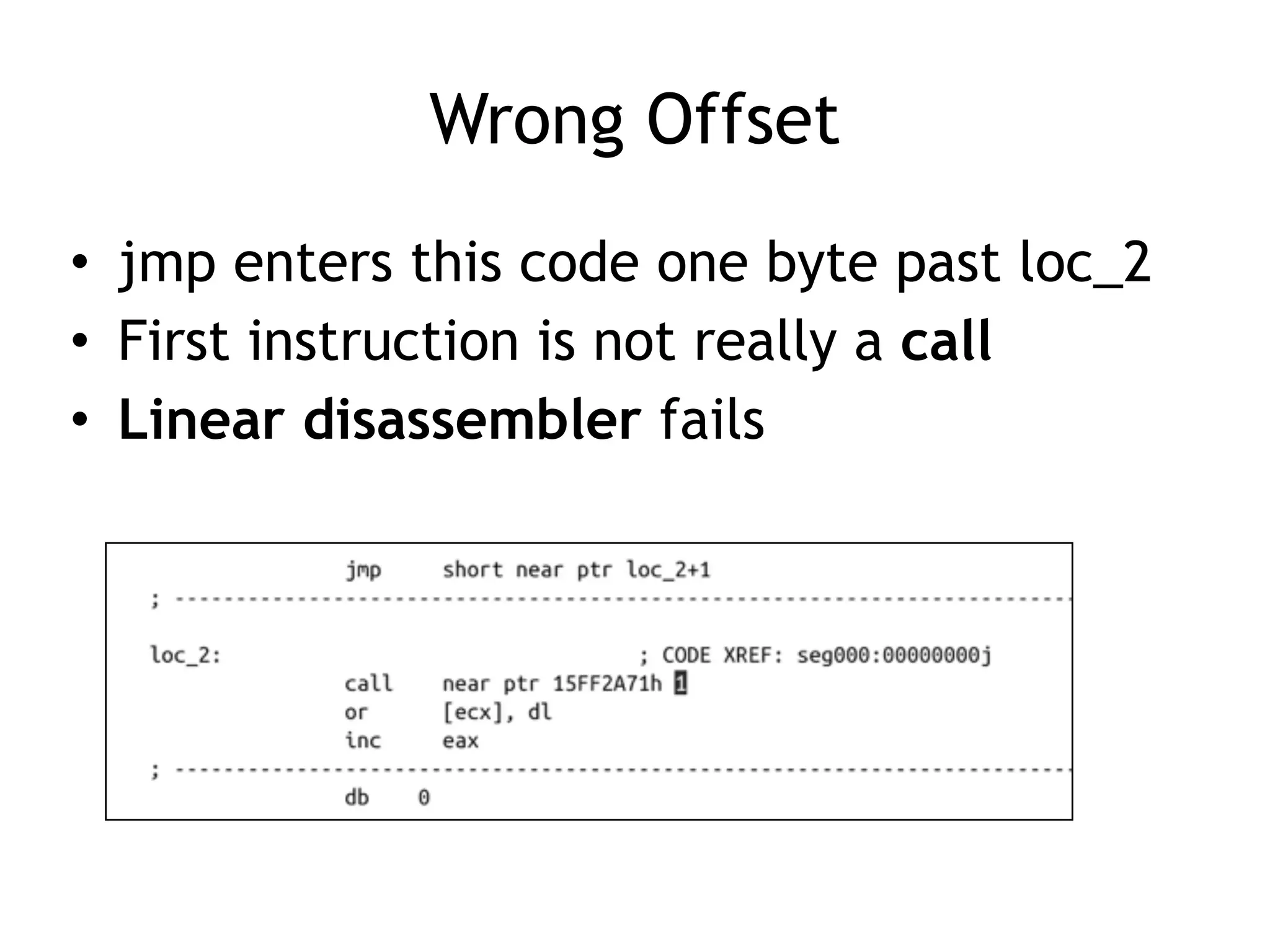
Wrong Offset
• jmp enters this code one byte past loc_2
• First instruction is not really a call
• Linear disassembler fails
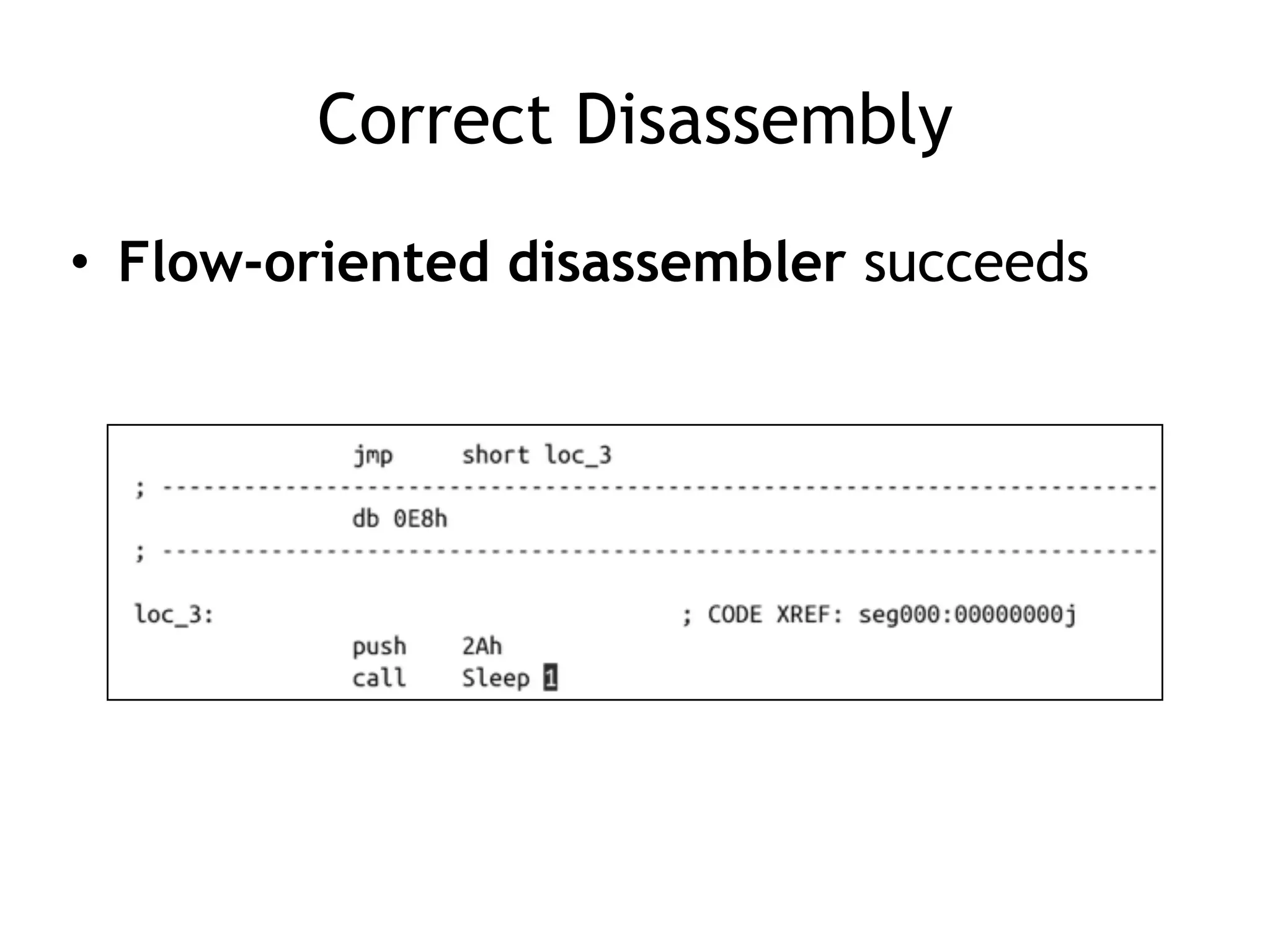
Correct Disassembly
• Flow-oriented disassembler succeeds
Defeating Disassembly
Algorithms
Linear Disassembly
• Integrates through a block of bytes
• Disassembling one instruction at a time
linearly, without deviating
• The size of an instruction determines
which byte begins the next instruction
• Does not pay attention to flow-control
instructions like jmp
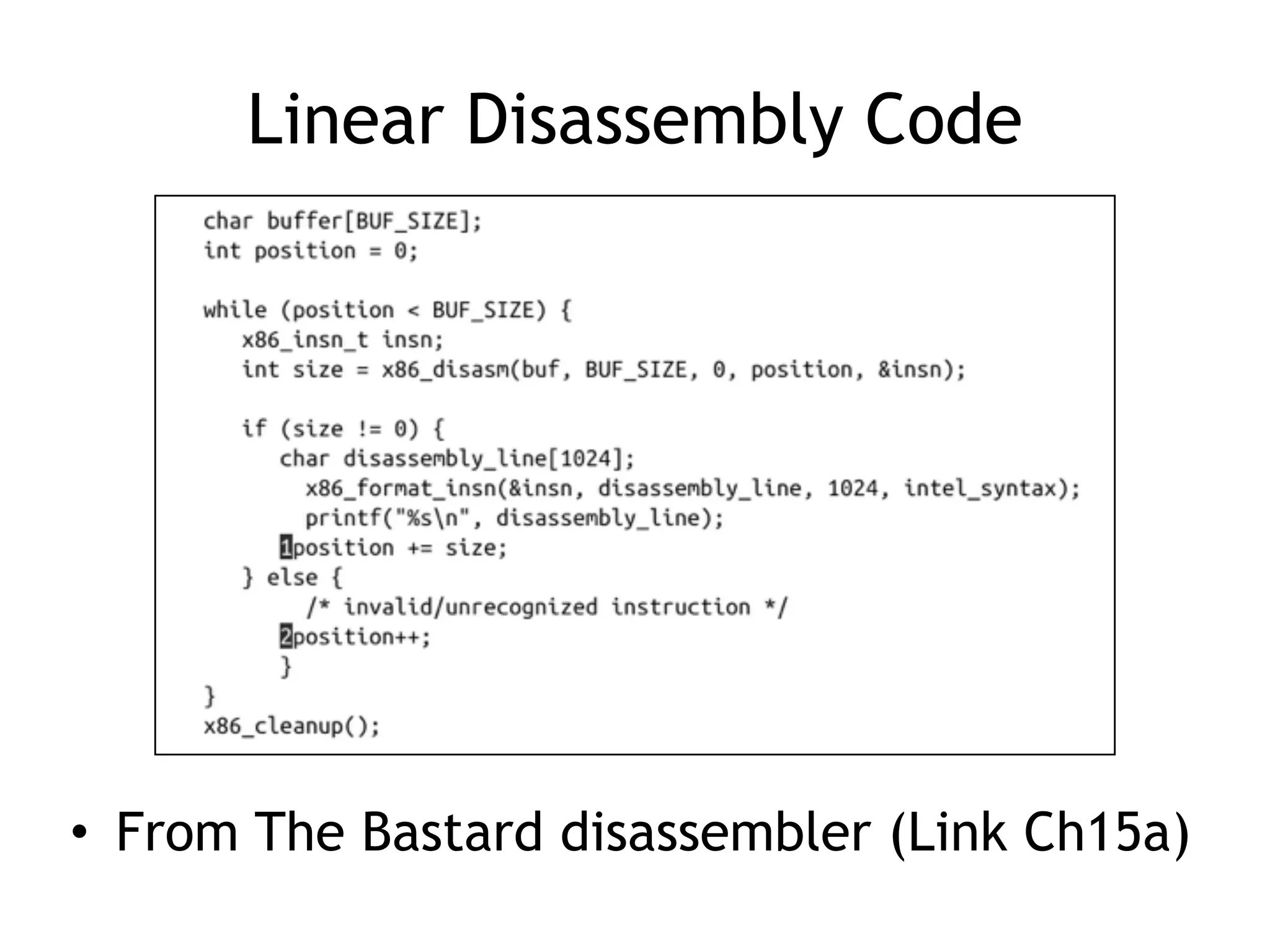
Linear Disassembly Code
• From The Bastard disassembler (Link Ch15a)
Linear Disassembly Flaws
• Always disassembles every byte
• Even when only a portion of the code is
used by flow-control code
• the .text section almost always includes
some data as well as code
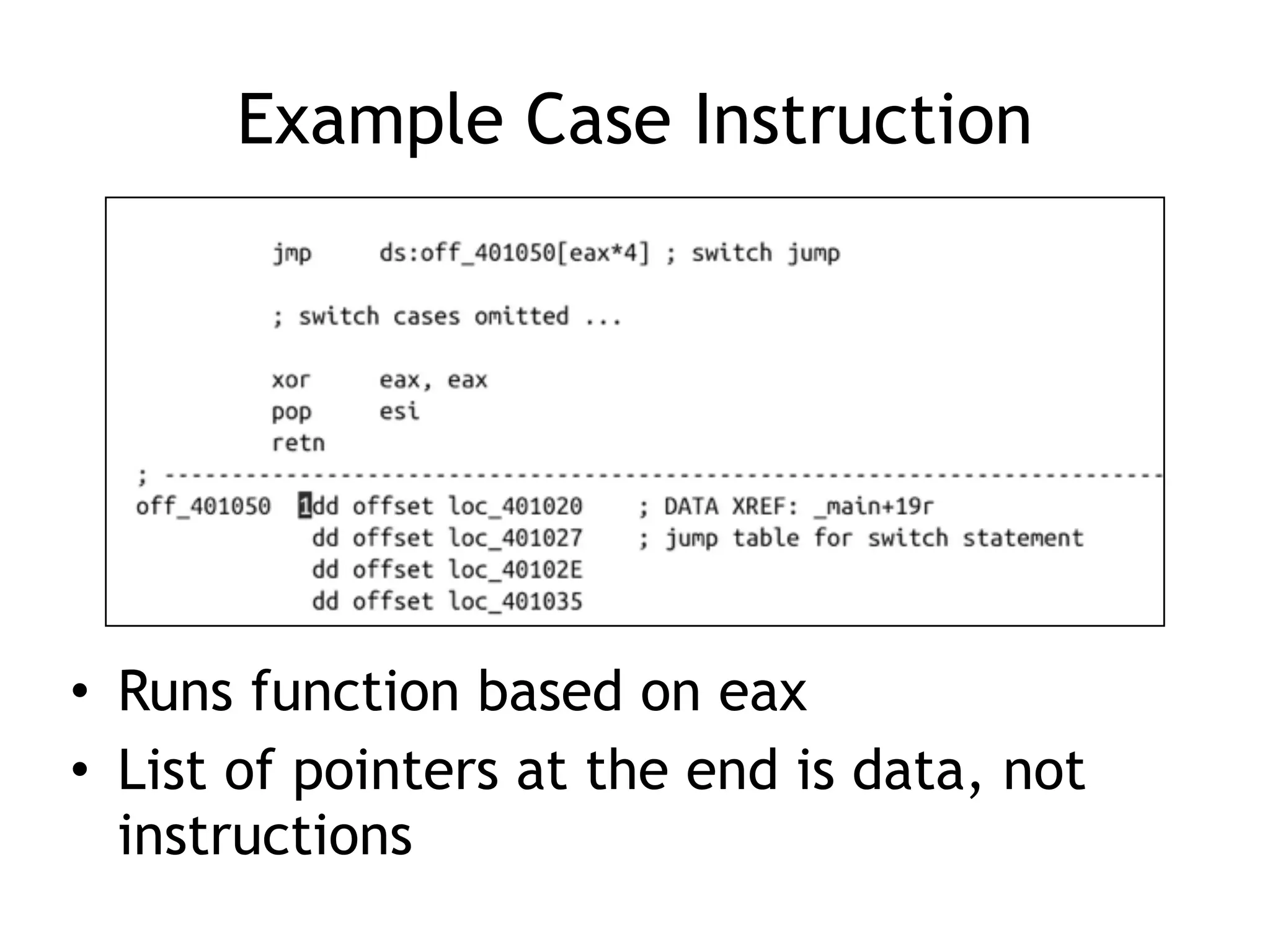
Example Case Instruction
• Runs function based on eax
• List of pointers at the end is data, not
instructions
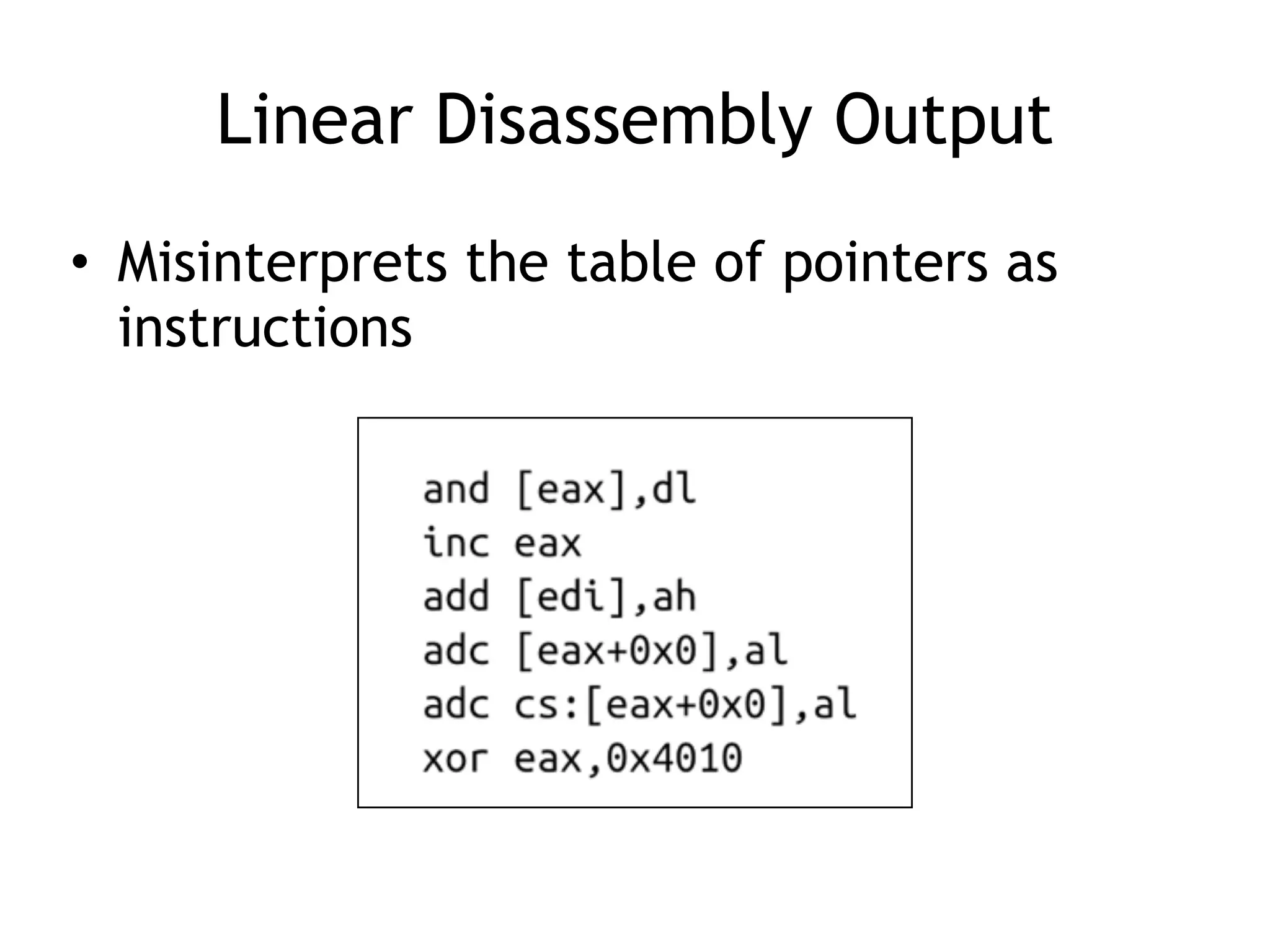
Linear Disassembly Output
• Misinterprets the table of pointers as
instructions
Multibyte Instructions
• call
• 5 bytes long
• 0xE8 followed by a 4-byte address
• Malware authors place bytes like 0xE8 in
code to confuse linear disassemblers
Flow-Oriented Disassembly
• Used by most commercial disassemblers
such as IDA Pro
• Doesn't assume the bytes are all
instructions
• Examines each instruction and builds a list
of locations to disassemble
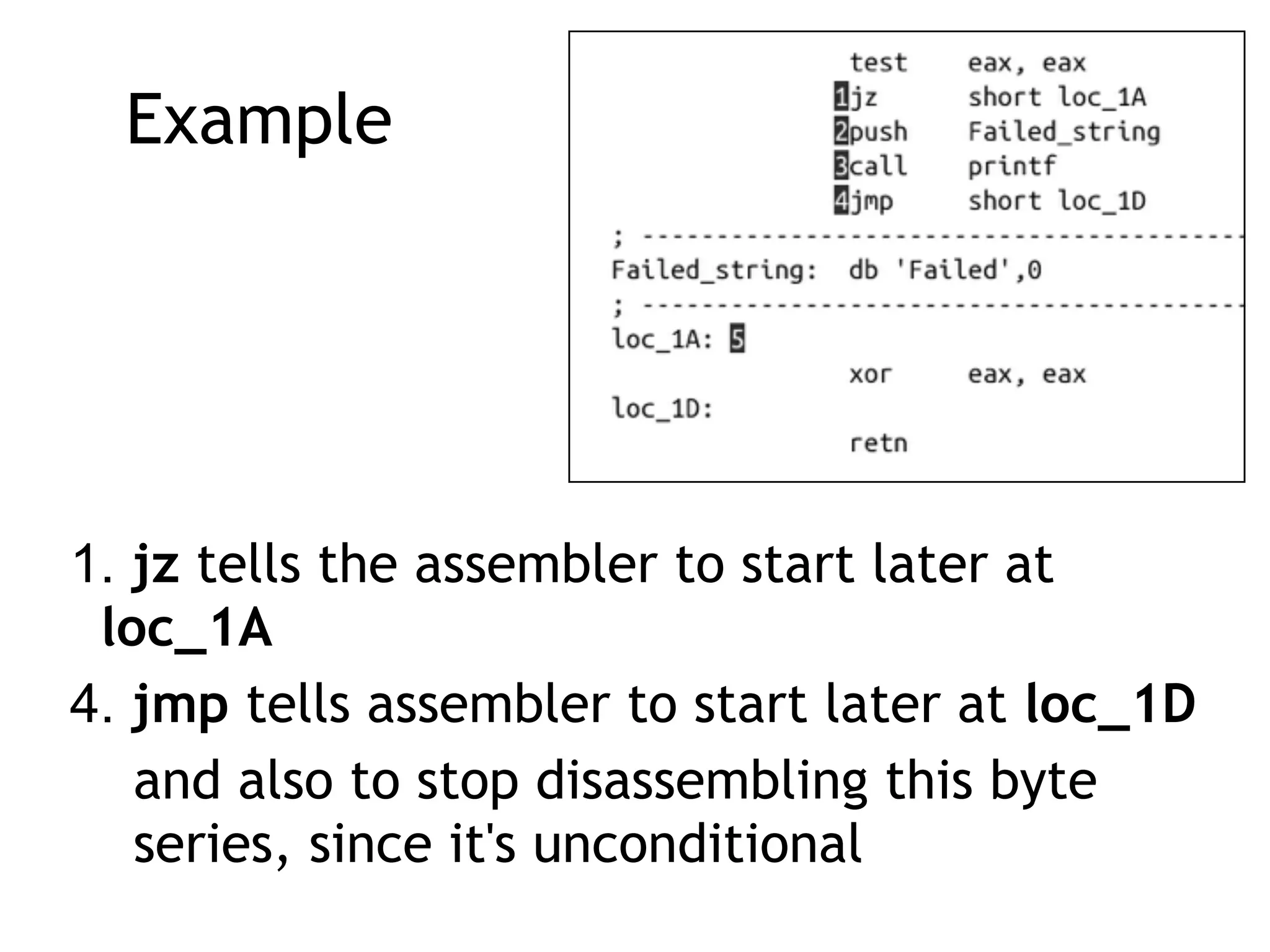
Example
1. jz tells the assembler to start later at
loc_1A
4. jmp tells assembler to start later at loc_1D
and also to stop disassembling this byte
series, since it's unconditional
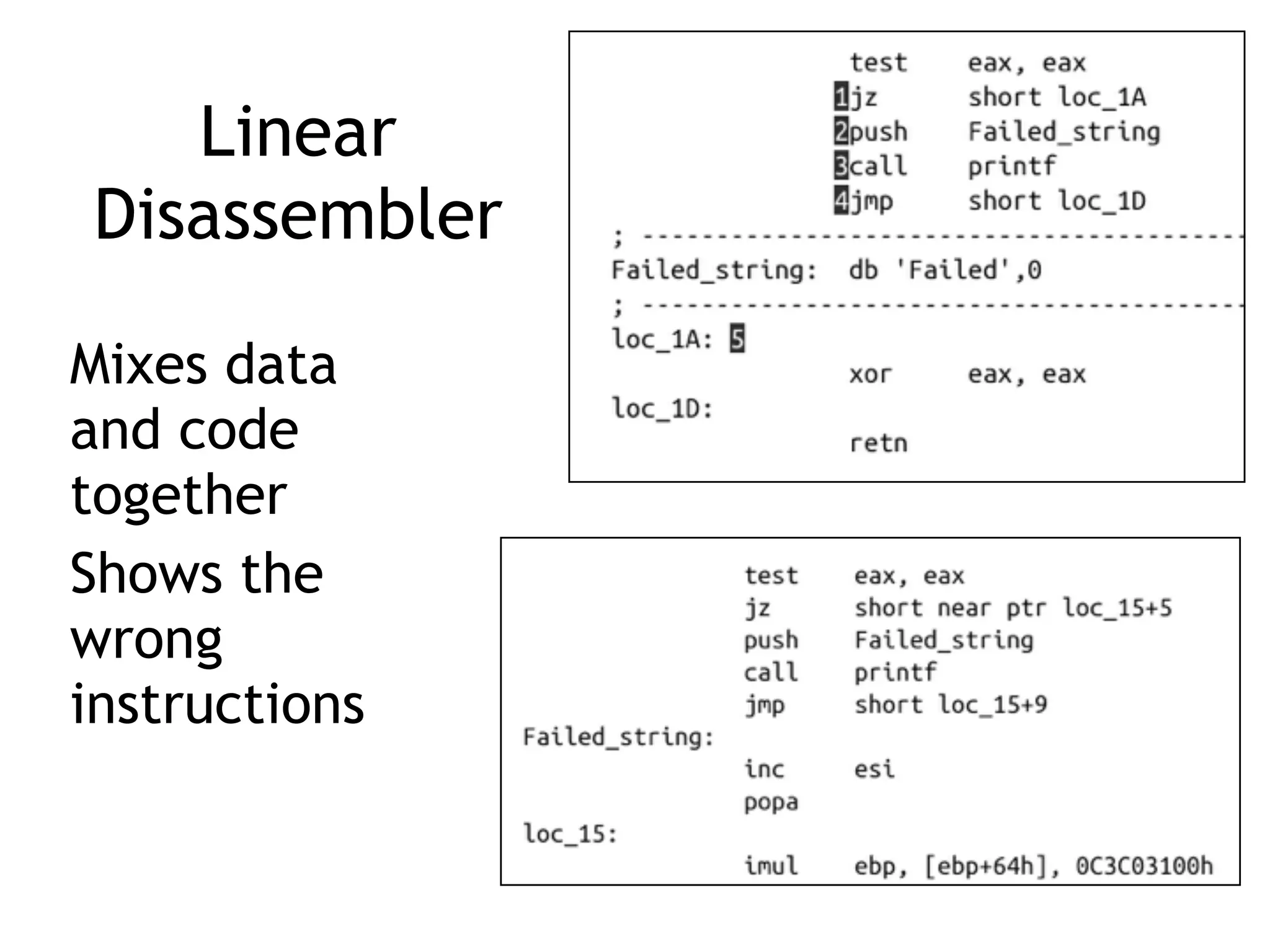
Linear
Disassembler
Mixes data
and code
together
Shows the
wrong
instructions
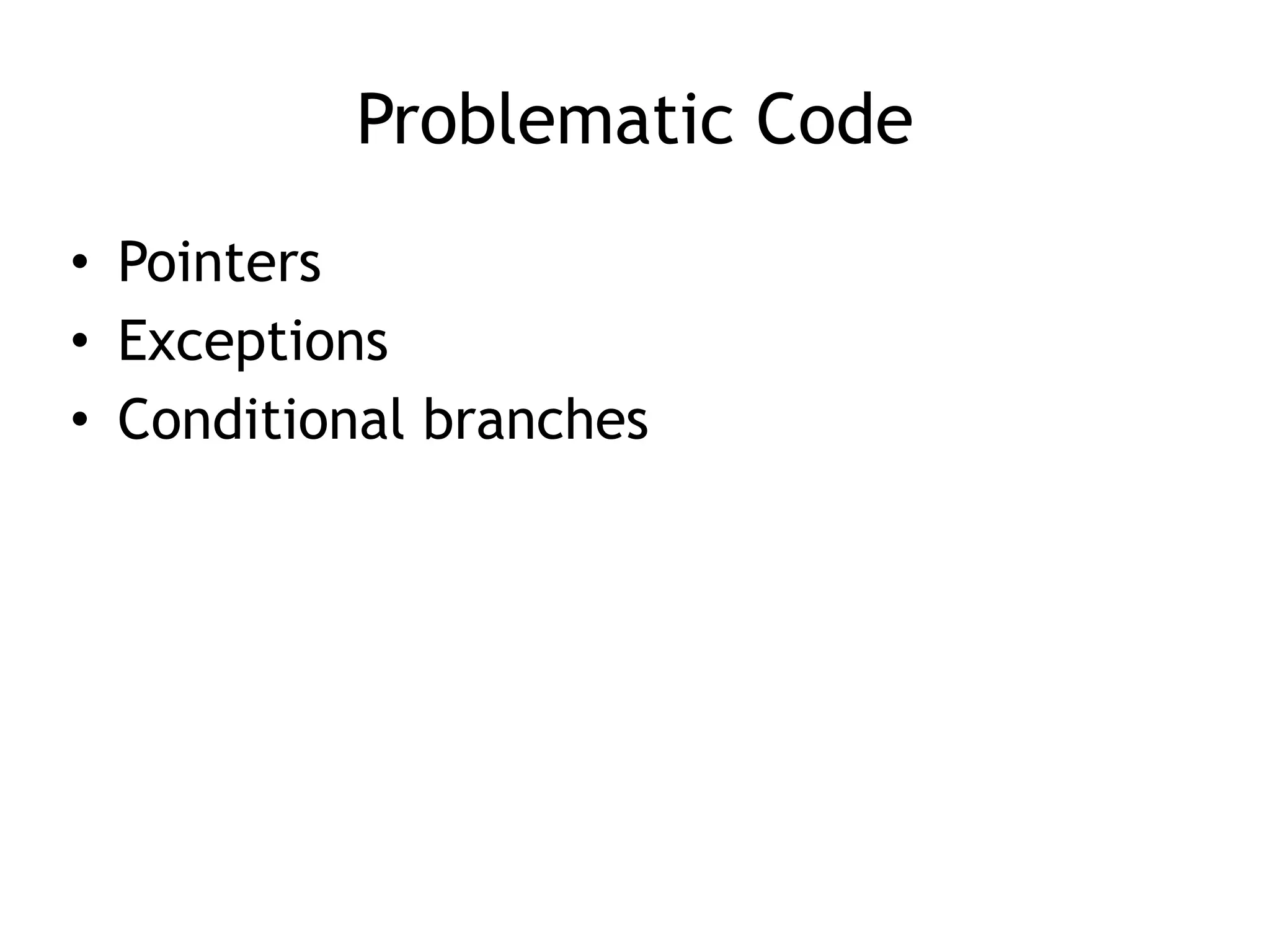
Problematic Code
• Pointers
• Exceptions
• Conditional branches
Conditional Branches
• Give flow-oriented disassembler two places
to disassemble
• True branch and False branch
• They'd be the same in compiler-generated
code
• But can have different disassembly in
handwritten and anti-disassembly code
• Most flow-oriented disassemblers trust the
false branch first
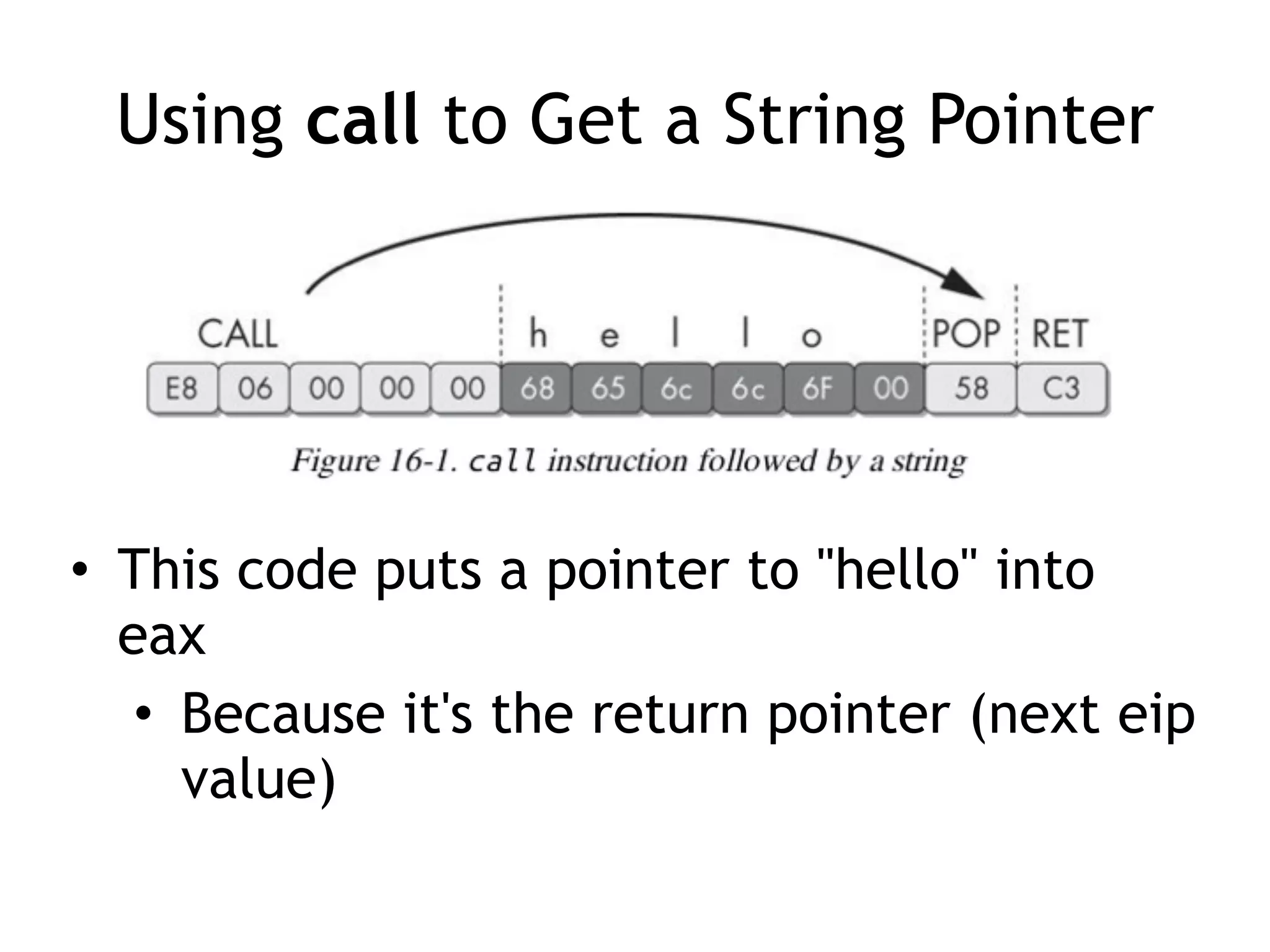
Using call to Get a String Pointer
• This code puts a pointer to "hello" into
eax
• Because it's the return pointer (next eip
value)
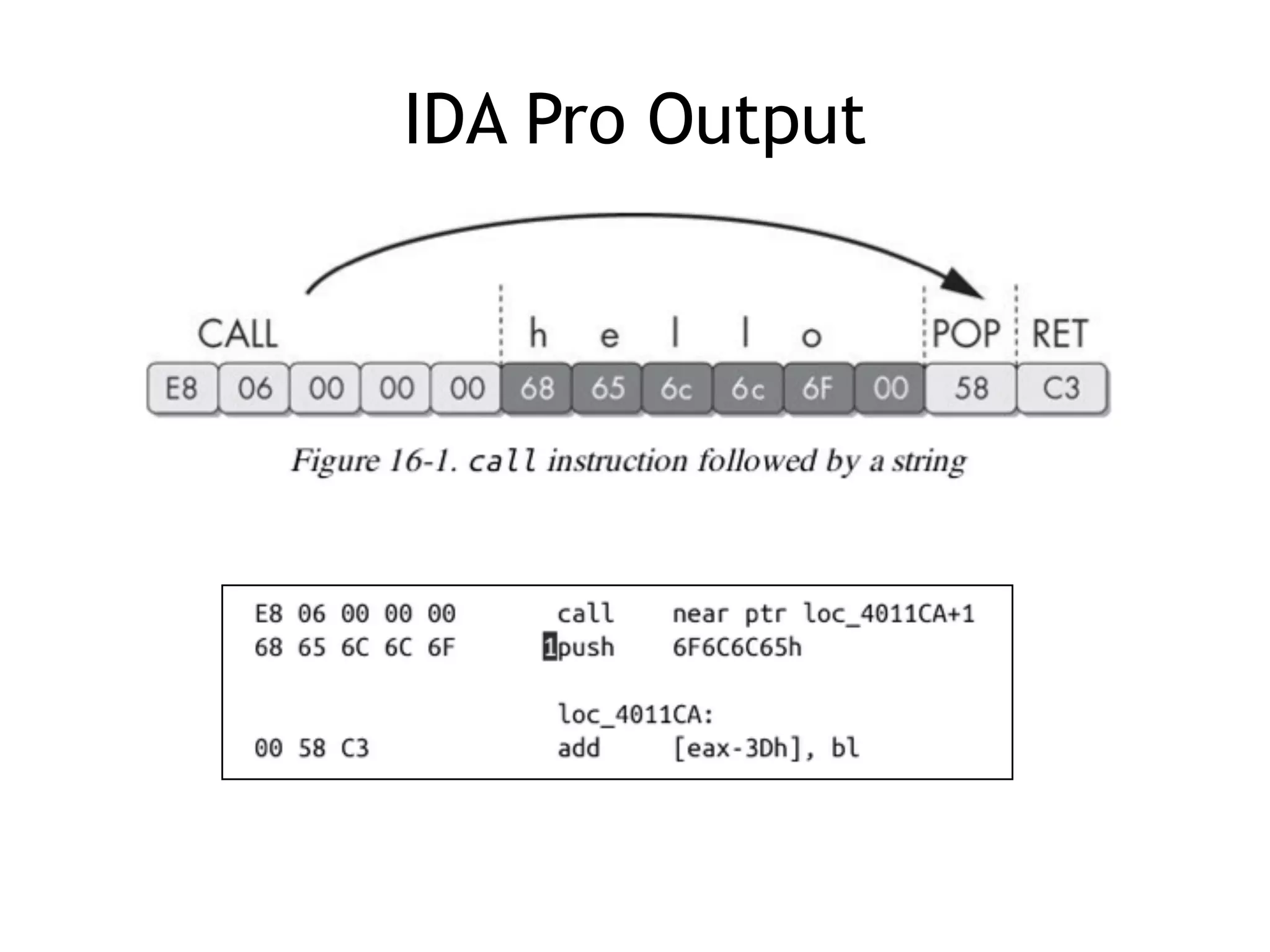
IDA Pro Output
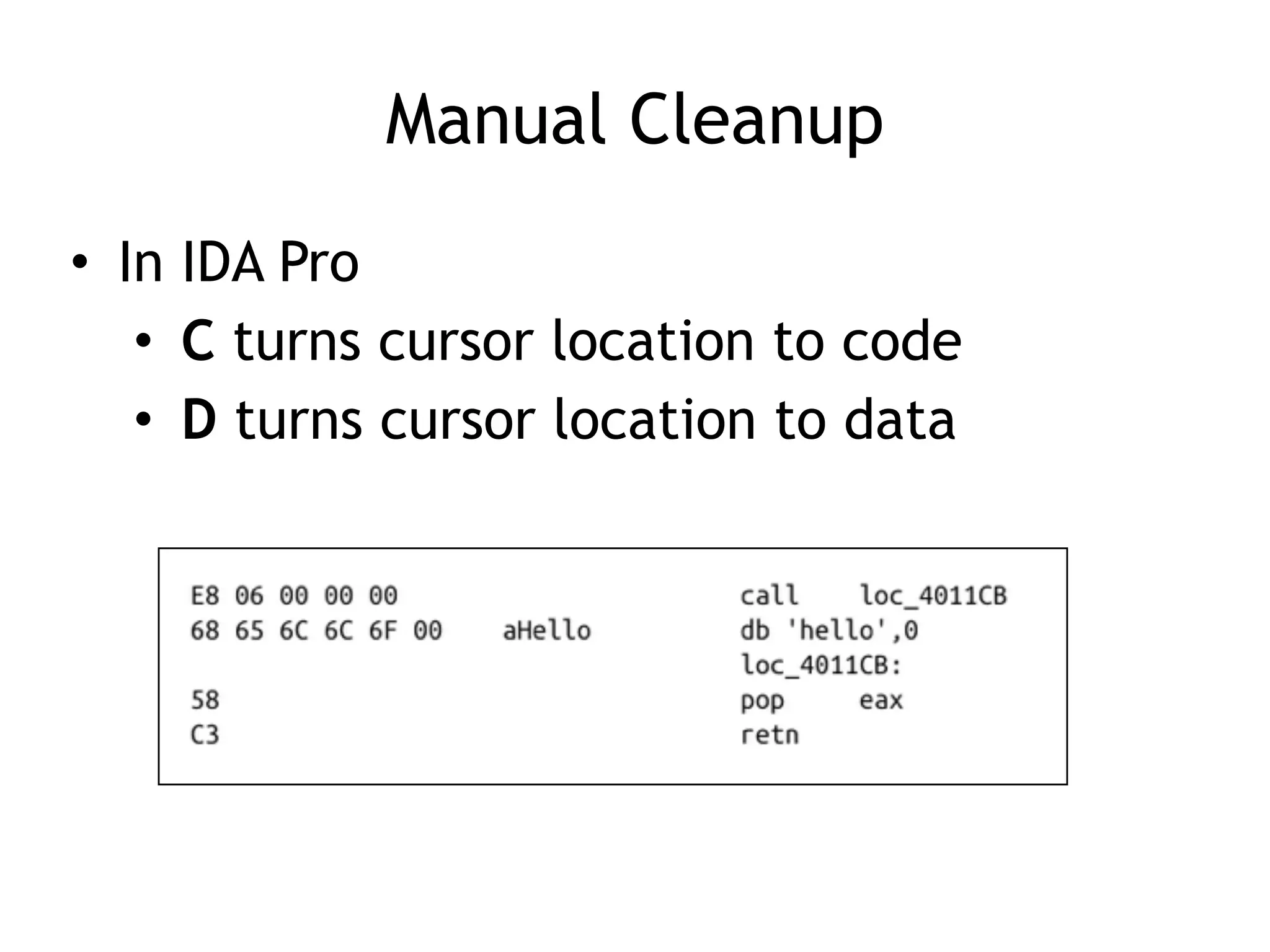
Manual Cleanup
• In IDA Pro
• C turns cursor location to code
• D turns cursor location to data
Anti-Disassembly Techniques
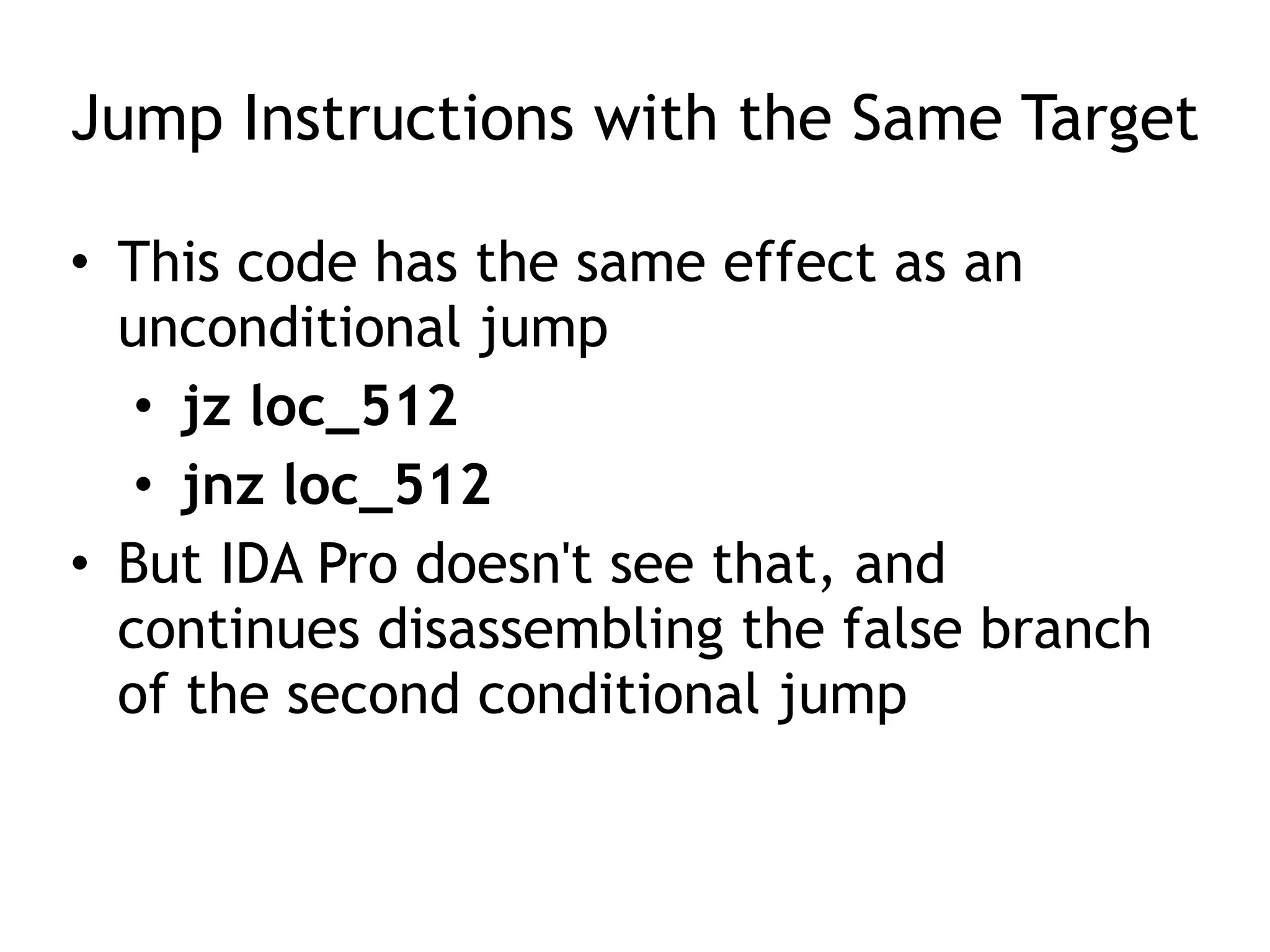
Jump Instructions with the Same Target
• This code has the same effect as an
unconditional jump
• jz loc_512
• jnz loc_512
• But IDA Pro doesn't see that, and
continues disassembling the false branch
of the second conditional jump
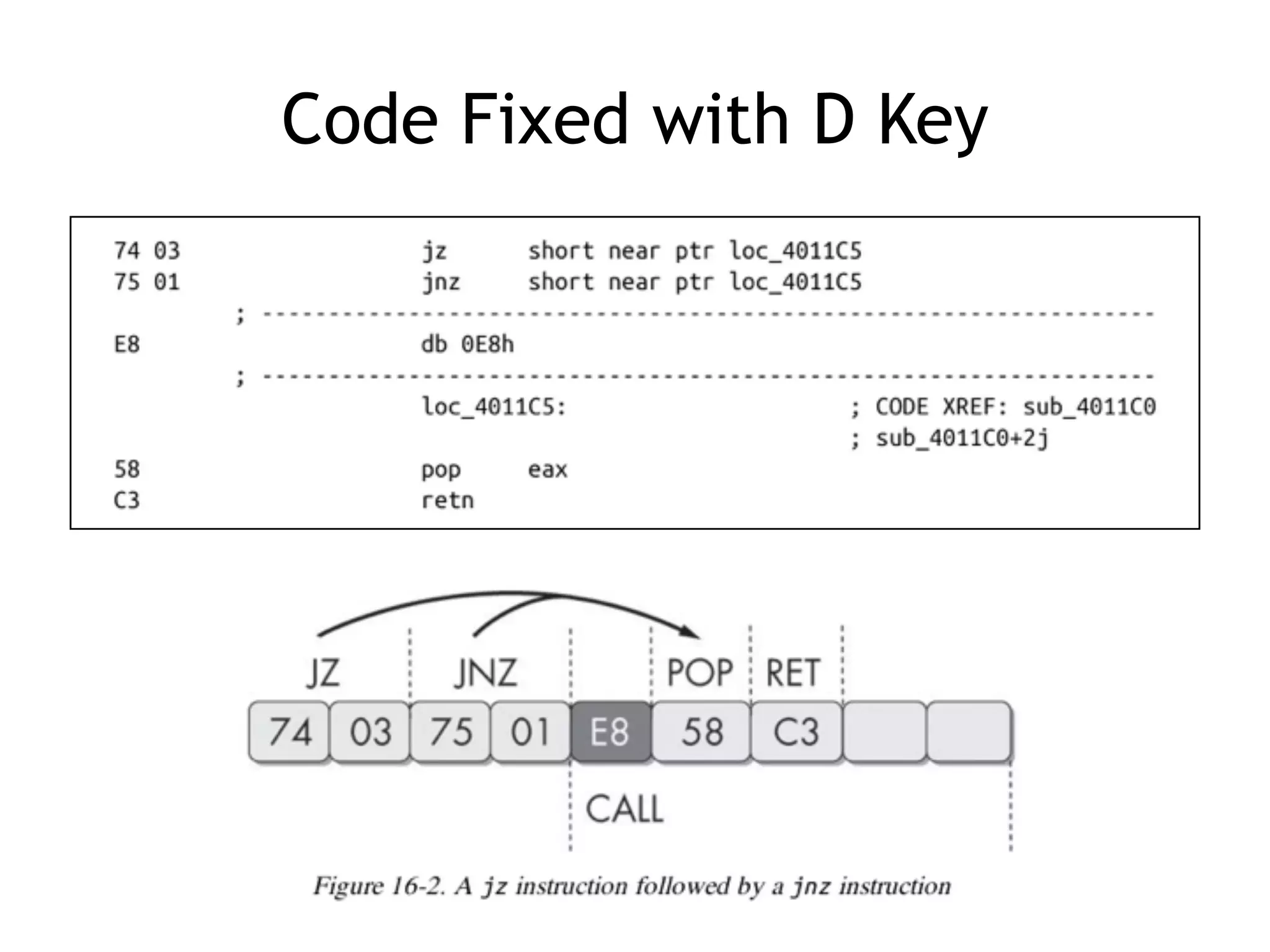
Fooling IDA Pro
• Actual instruction starts at 58, not E8
• Cross-references to loc_4011C4 will appear
in red
• Because actual references point inside the
instruction
• A warning sign of anti-disassembly
Code Fixed with D Key
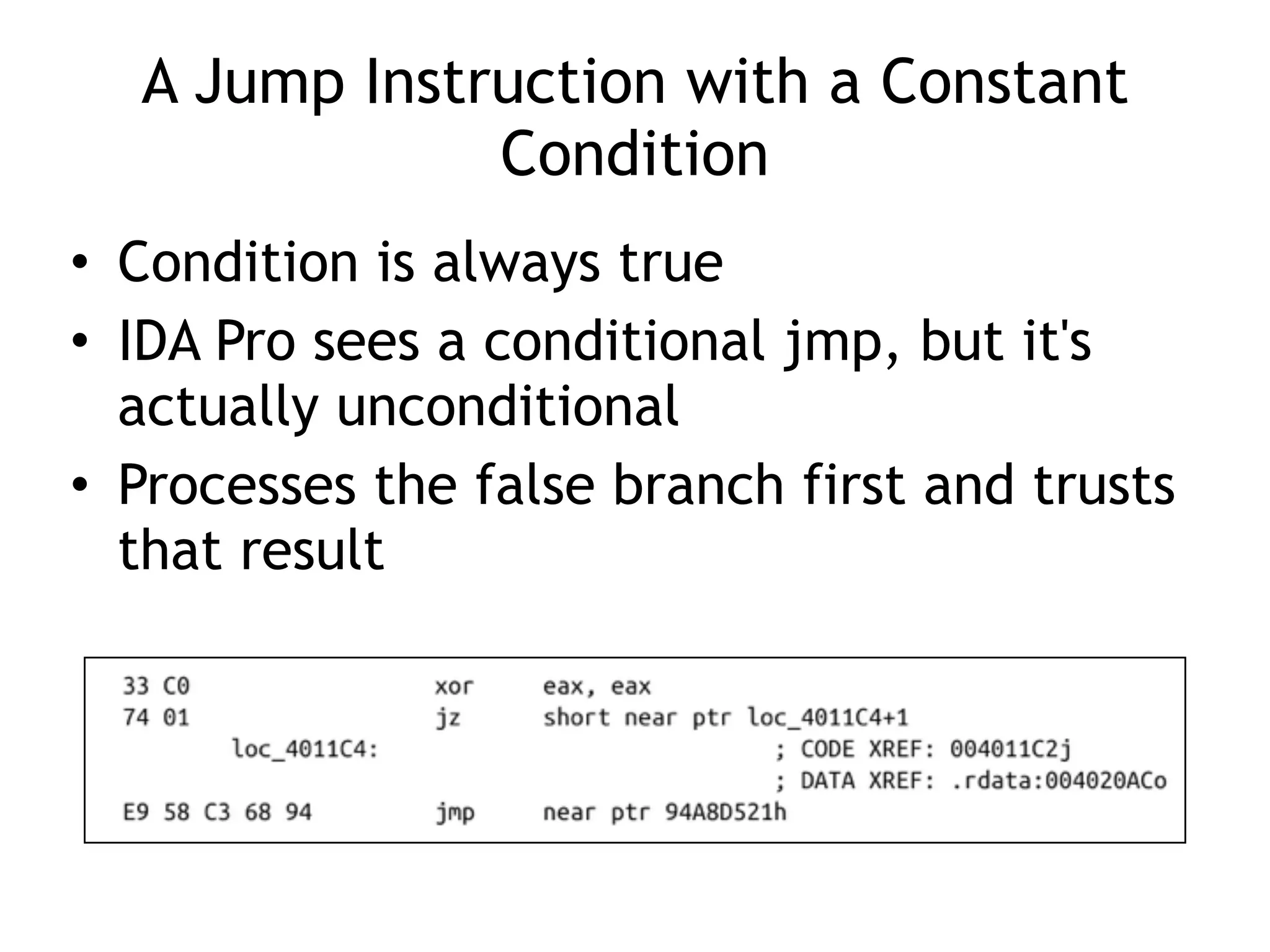
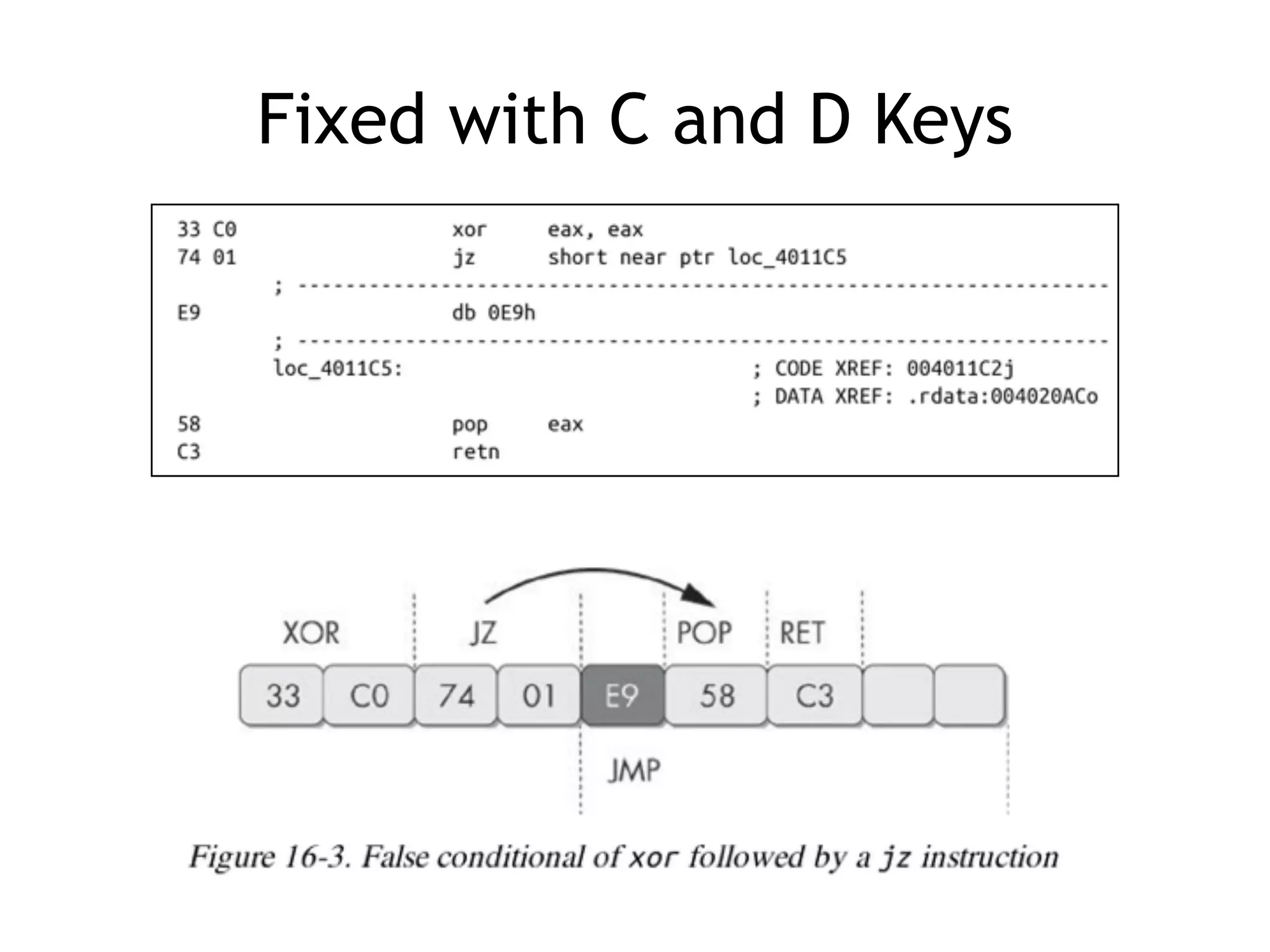
A Jump Instruction with a Constant
Condition
• Condition is always true
• IDA Pro sees a conditional jmp, but it's
actually unconditional
• Processes the false branch first and trusts
that result
Fixed with C and D Keys
Impossible Disassembly
• Previous techniques use an extra byte
after the jumps
• A rogue byte
• In those examples, the rogue byte can be
ignored
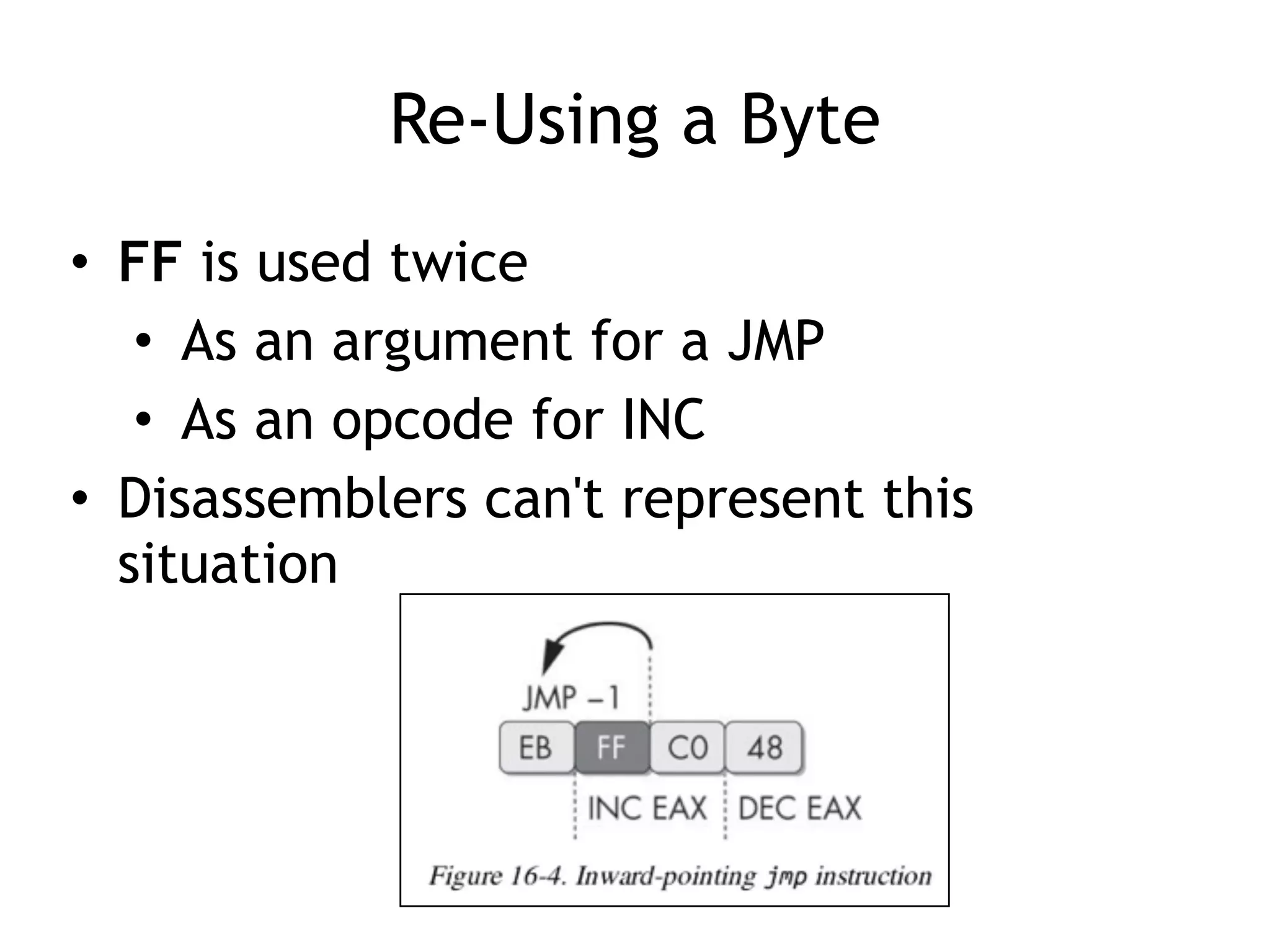
Re-Using a Byte
• FF is used twice
• As an argument for a JMP
• As an opcode for INC
• Disassemblers can't represent this
situation
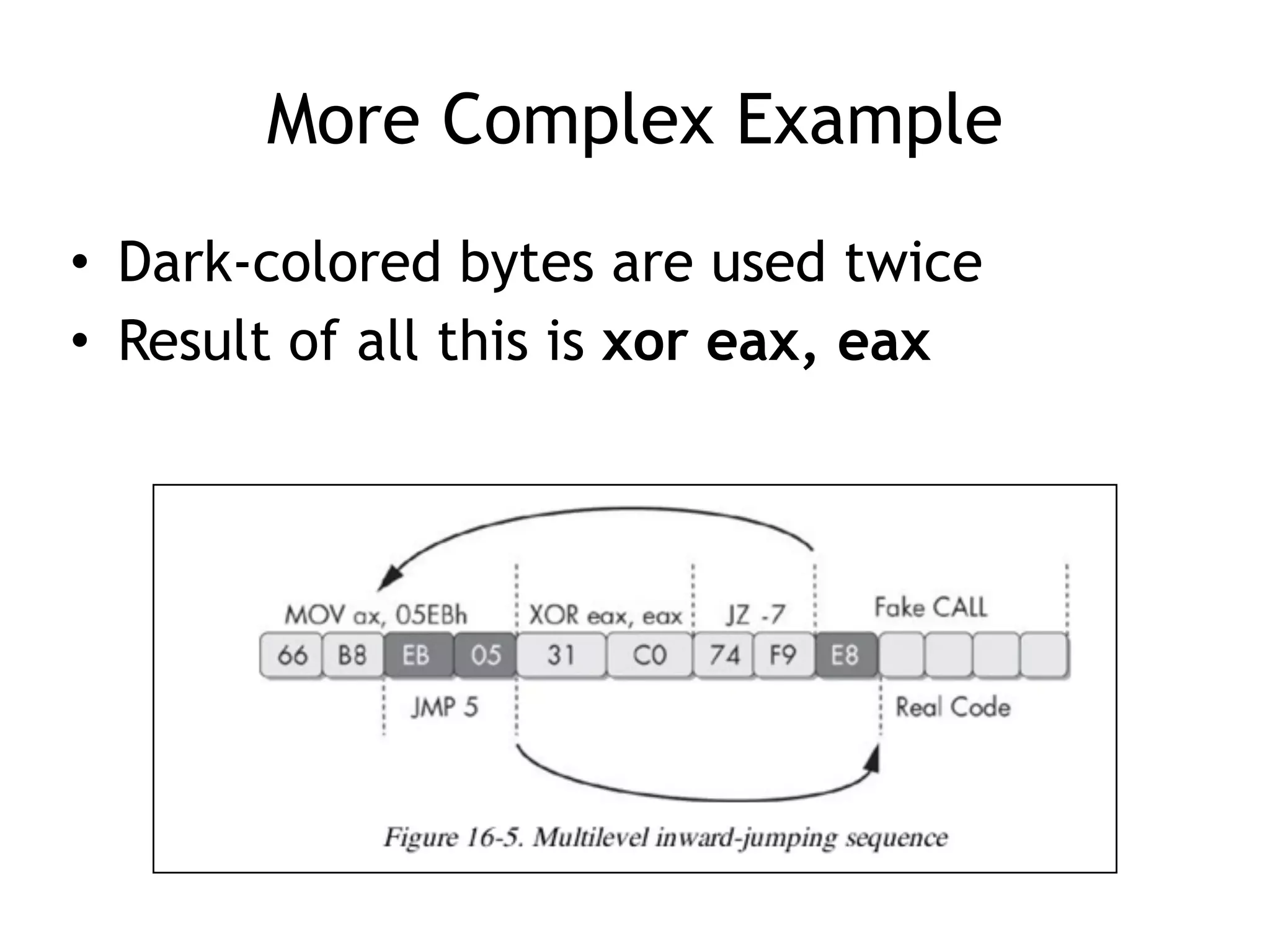
More Complex Example
• Dark-colored bytes are used twice
• Result of all this is xor eax, eax
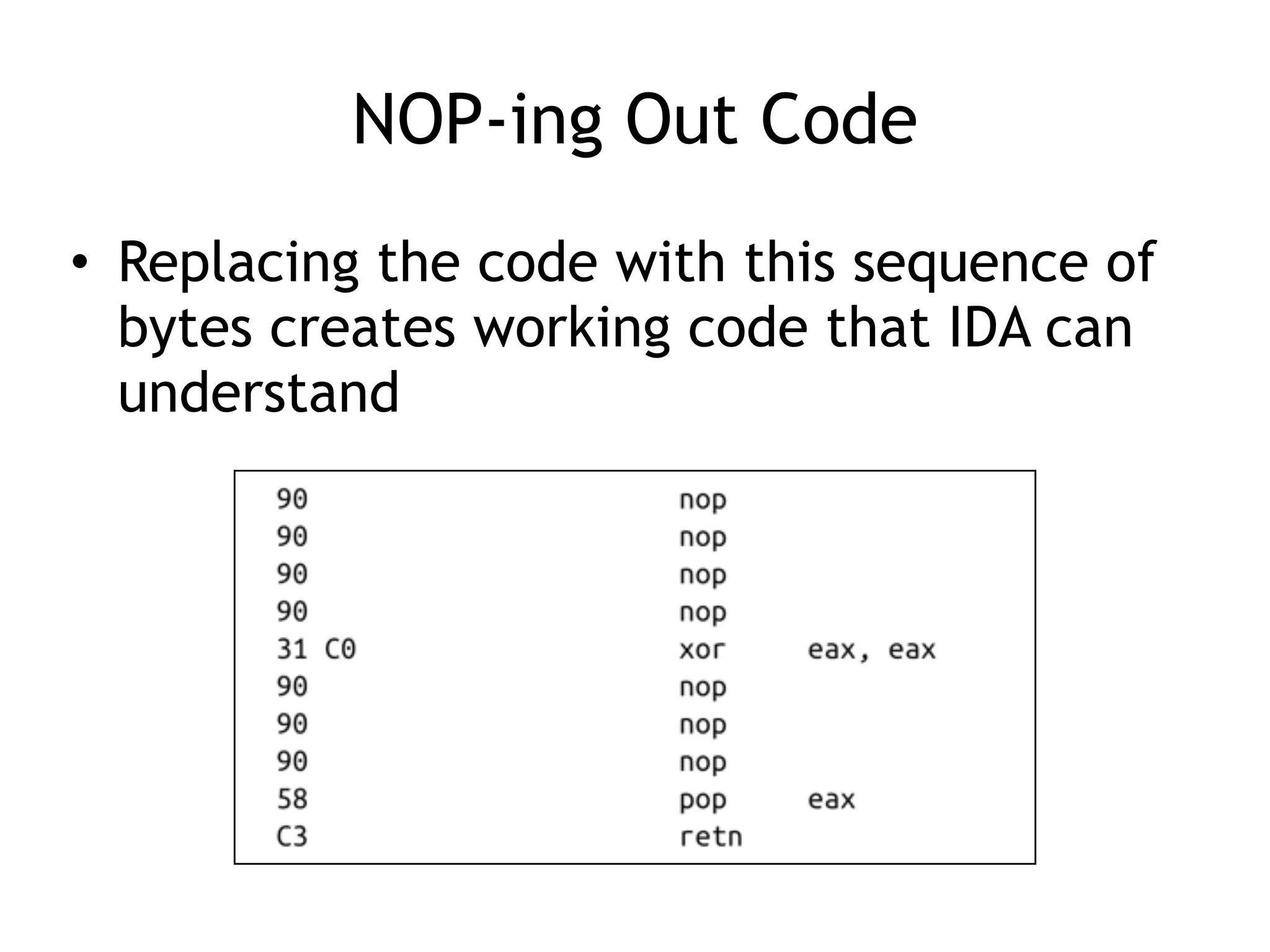
NOP-ing Out Code
• Replacing the code with this sequence of
bytes creates working code that IDA can
understand
Obscuring Flow Control
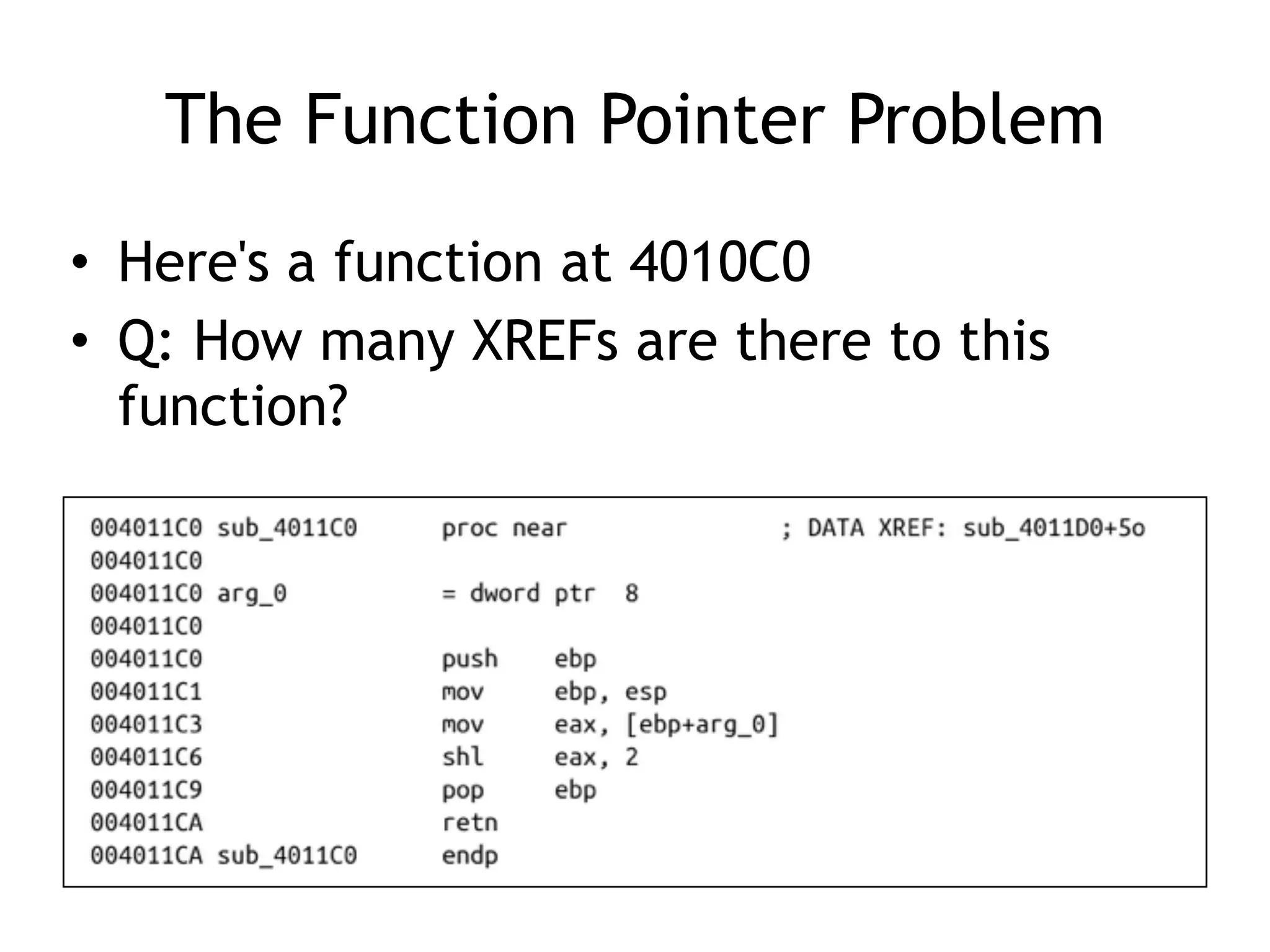
The Function Pointer Problem
• Here's a function at 4010C0
• Q: How many XREFs are there to this
function?
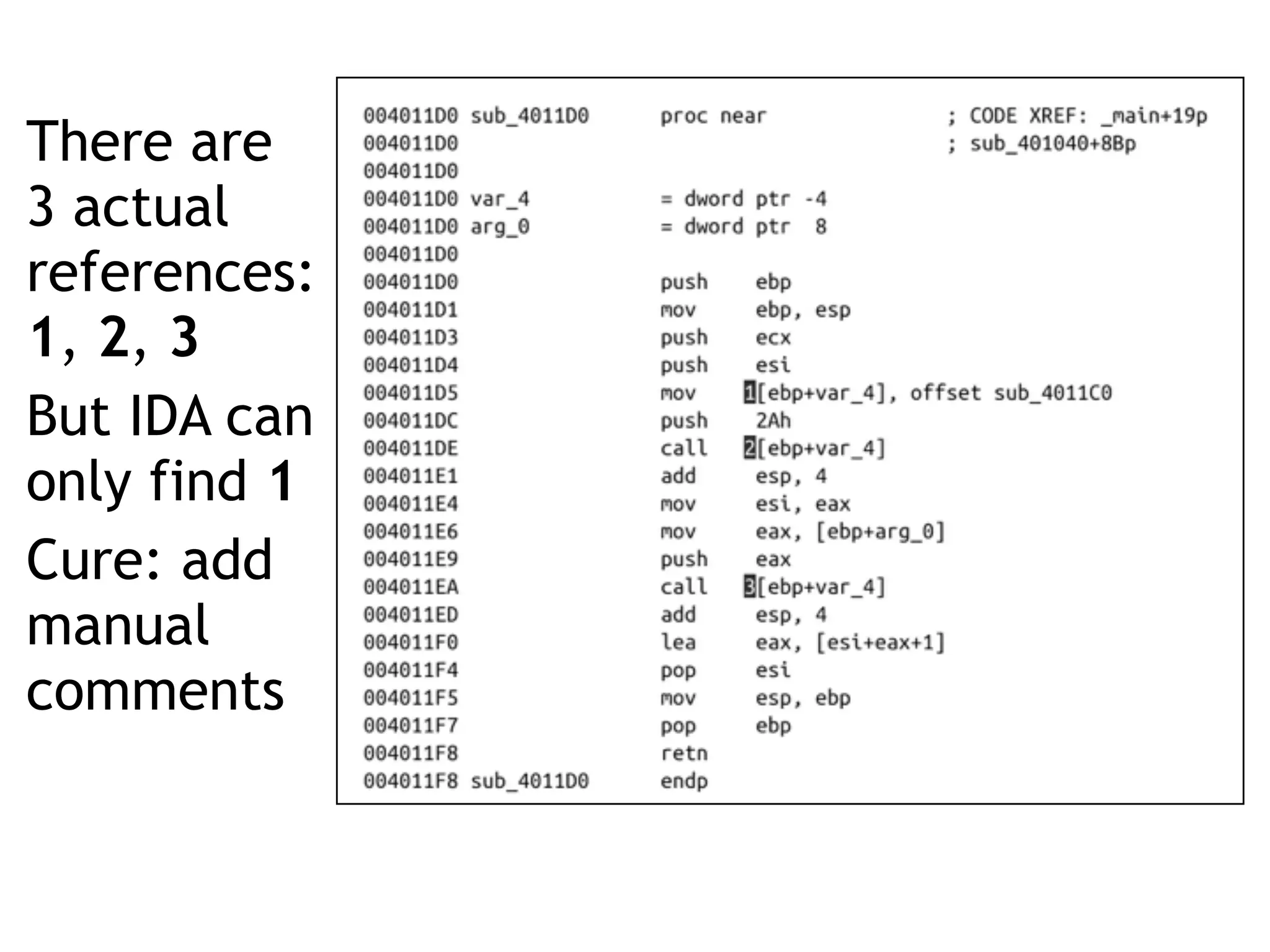
There are
3 actual
references:
1, 2, 3
But IDA can
only find 1
Cure: add
manual
comments
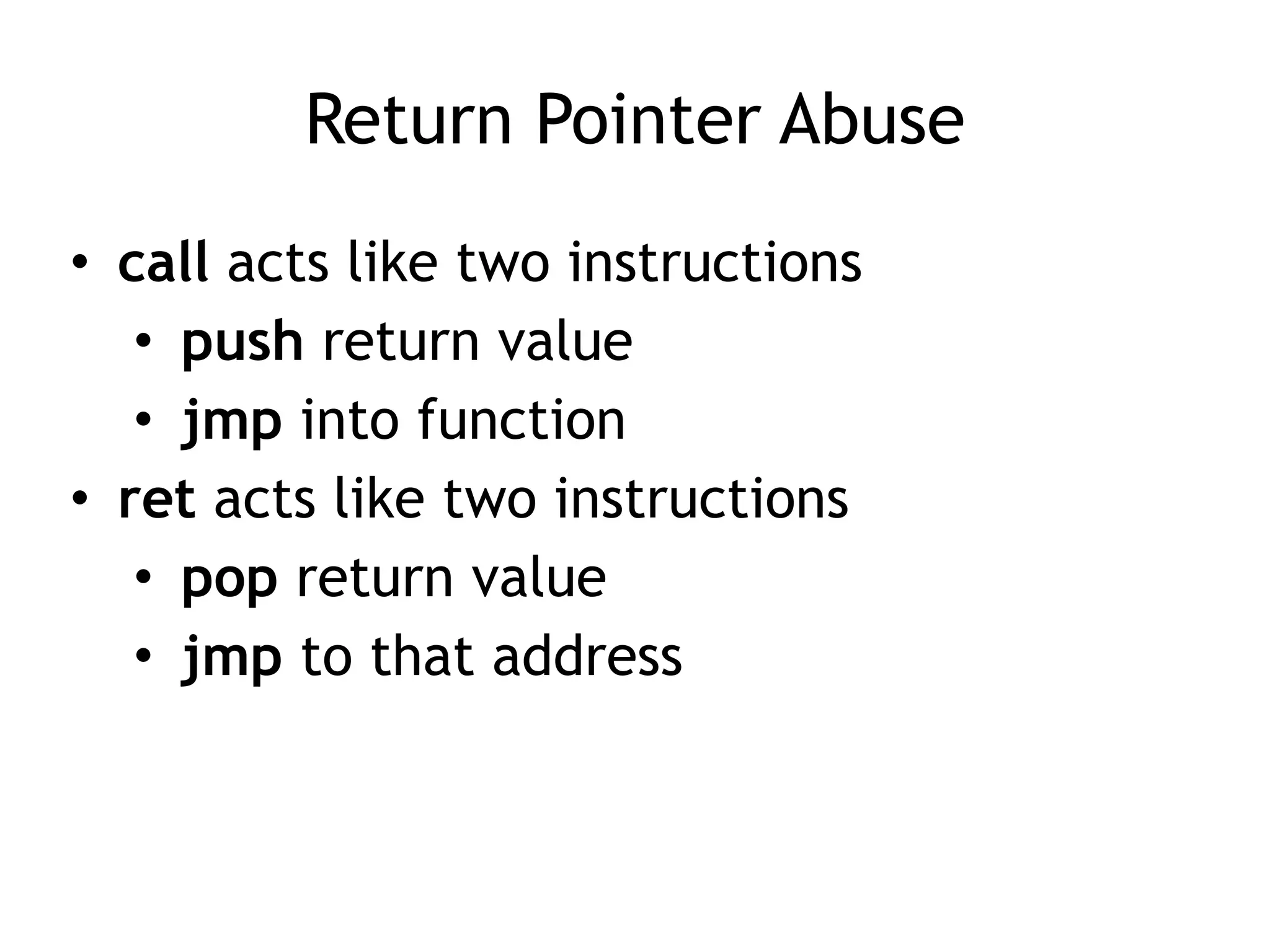
Return Pointer Abuse
• Normally, call and jmp are used to control
flow
• However, ret can be abused to perform a
jmp
Return Pointer Abuse
• call acts like two instructions
• push return value
• jmp into function
• ret acts like two instructions
• pop return value
• jmp to that address
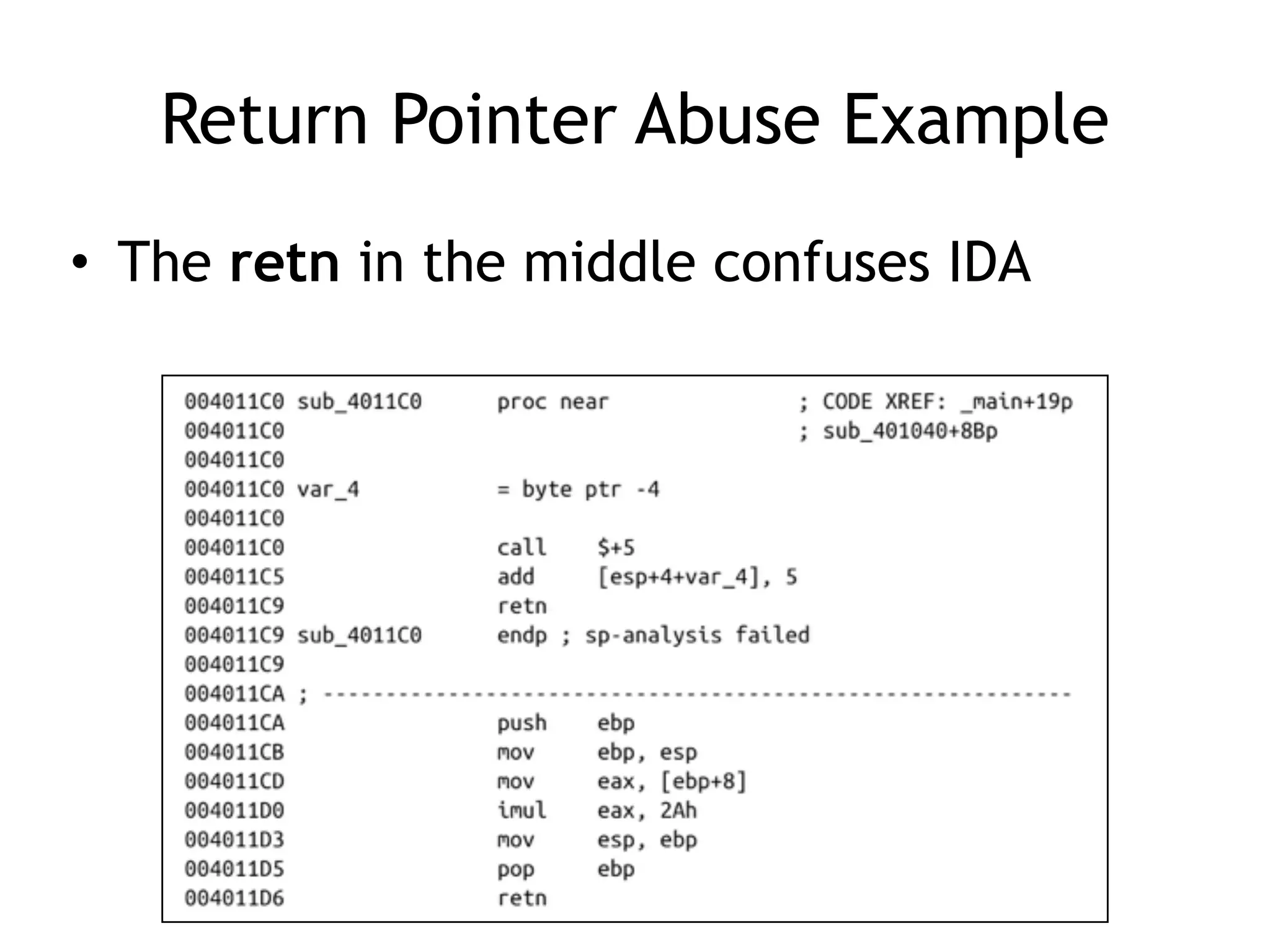
Return Pointer Abuse Example
• The retn in the middle confuses IDA
Return Pointer Abuse Example
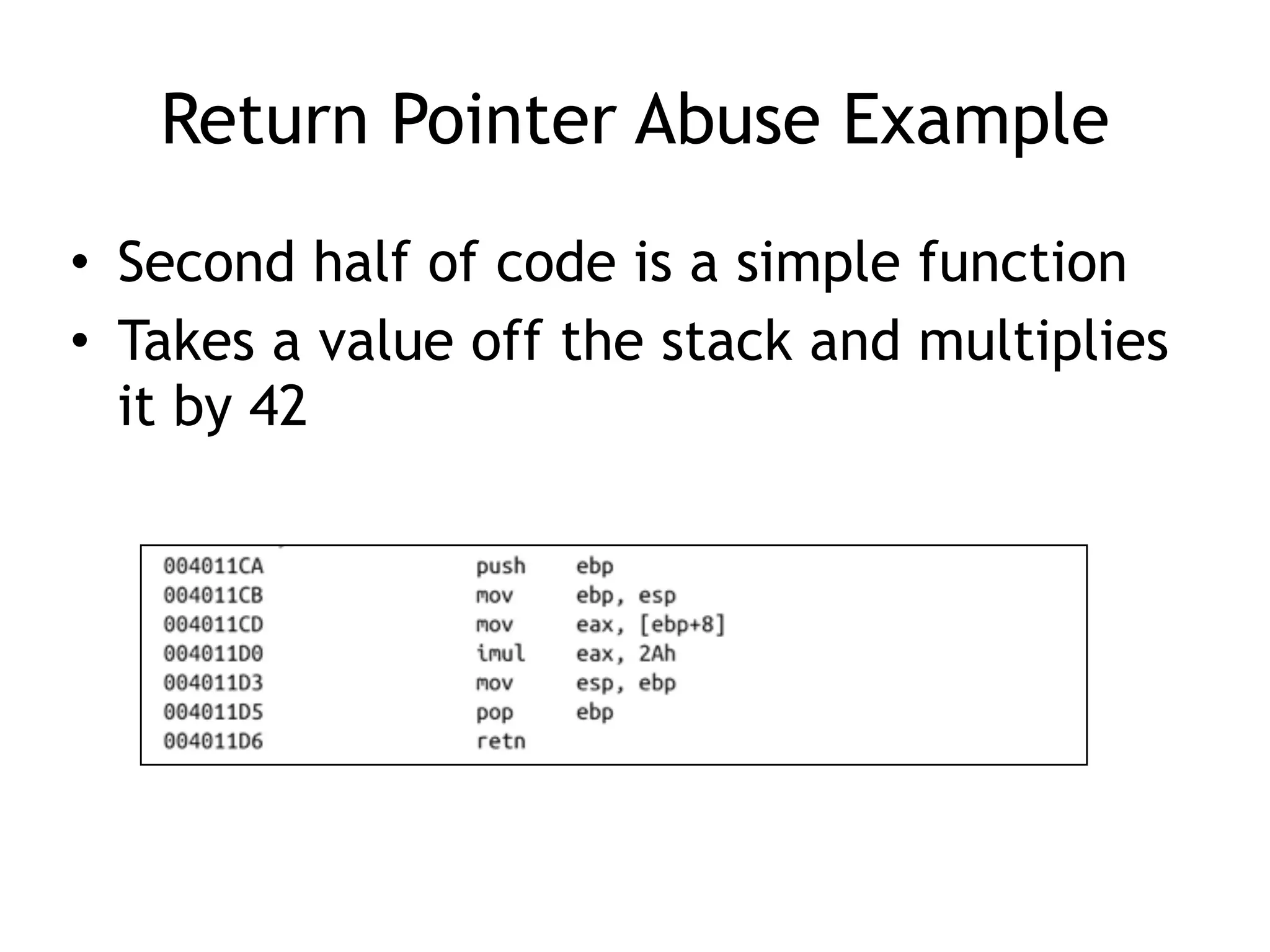
• Second half of code is a simple function
• Takes a value off the stack and multiplies
it by 42
Return Pointer Abuse Example
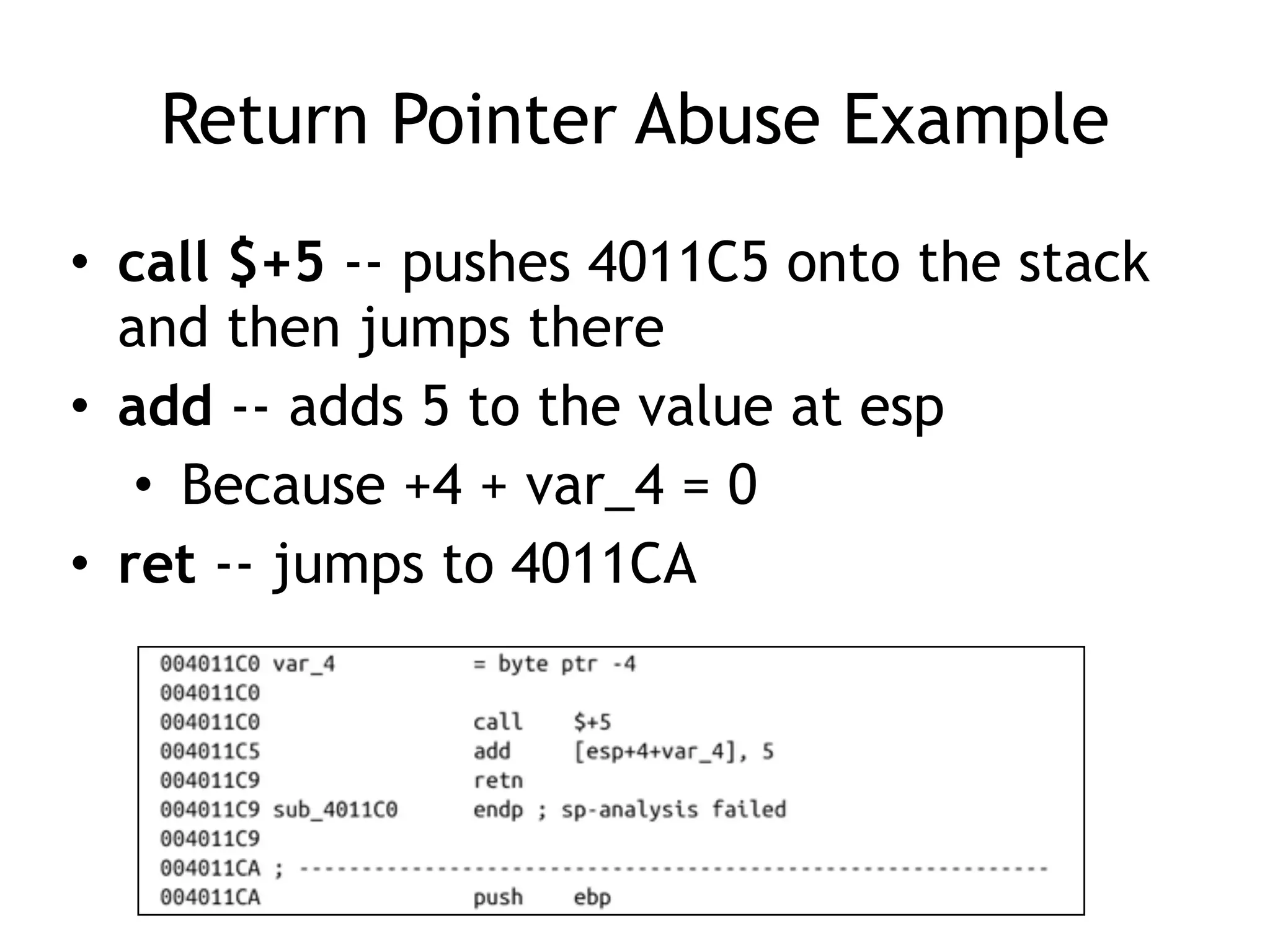
• call $+5 -- pushes 4011C5 onto the stack
and then jumps there
• add -- adds 5 to the value at esp
• Because +4 + var_4 = 0
• ret -- jumps to 4011CA
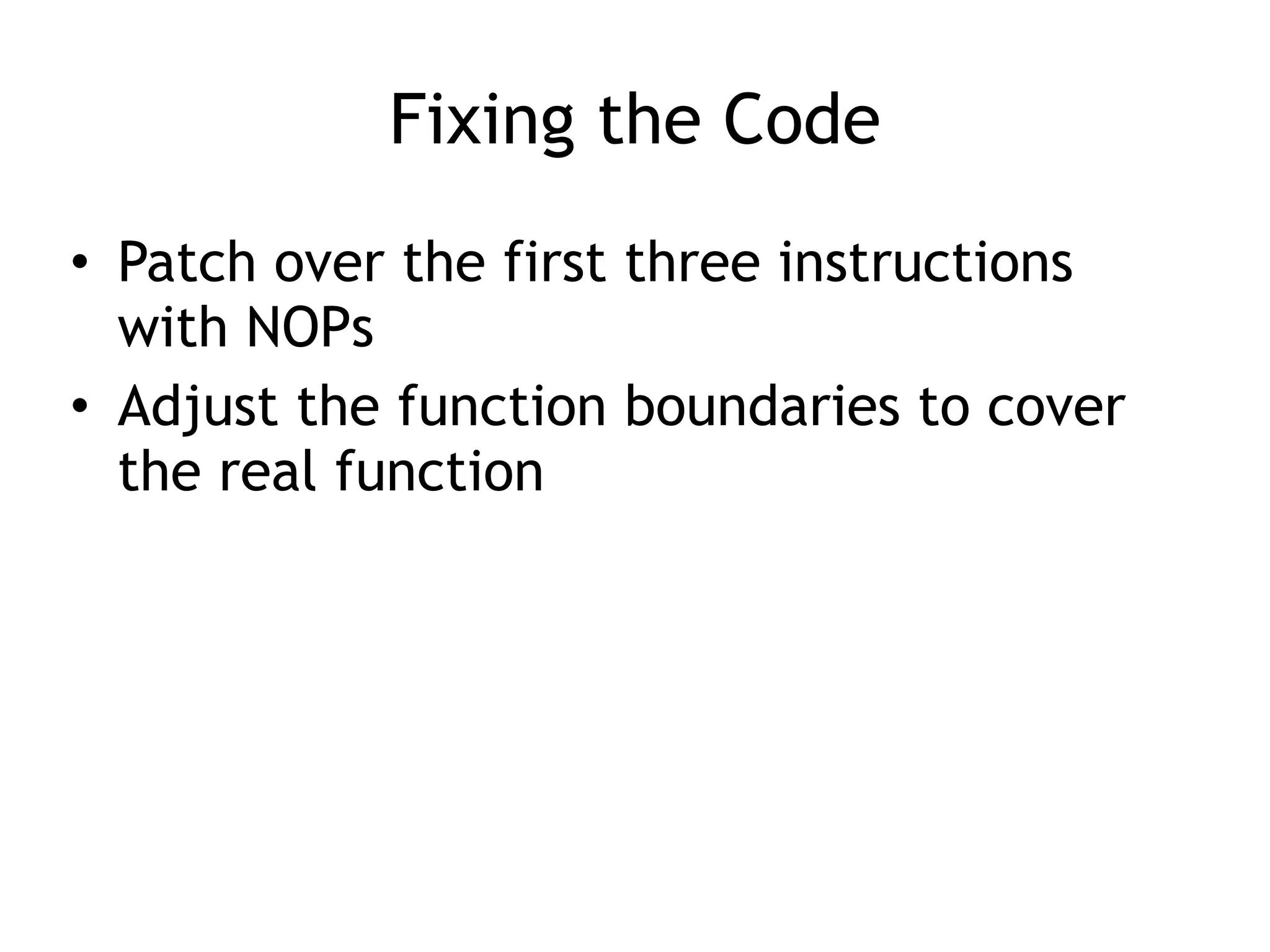
Fixing the Code
• Patch over the first three instructions
with NOPs
• Adjust the function boundaries to cover
the real function
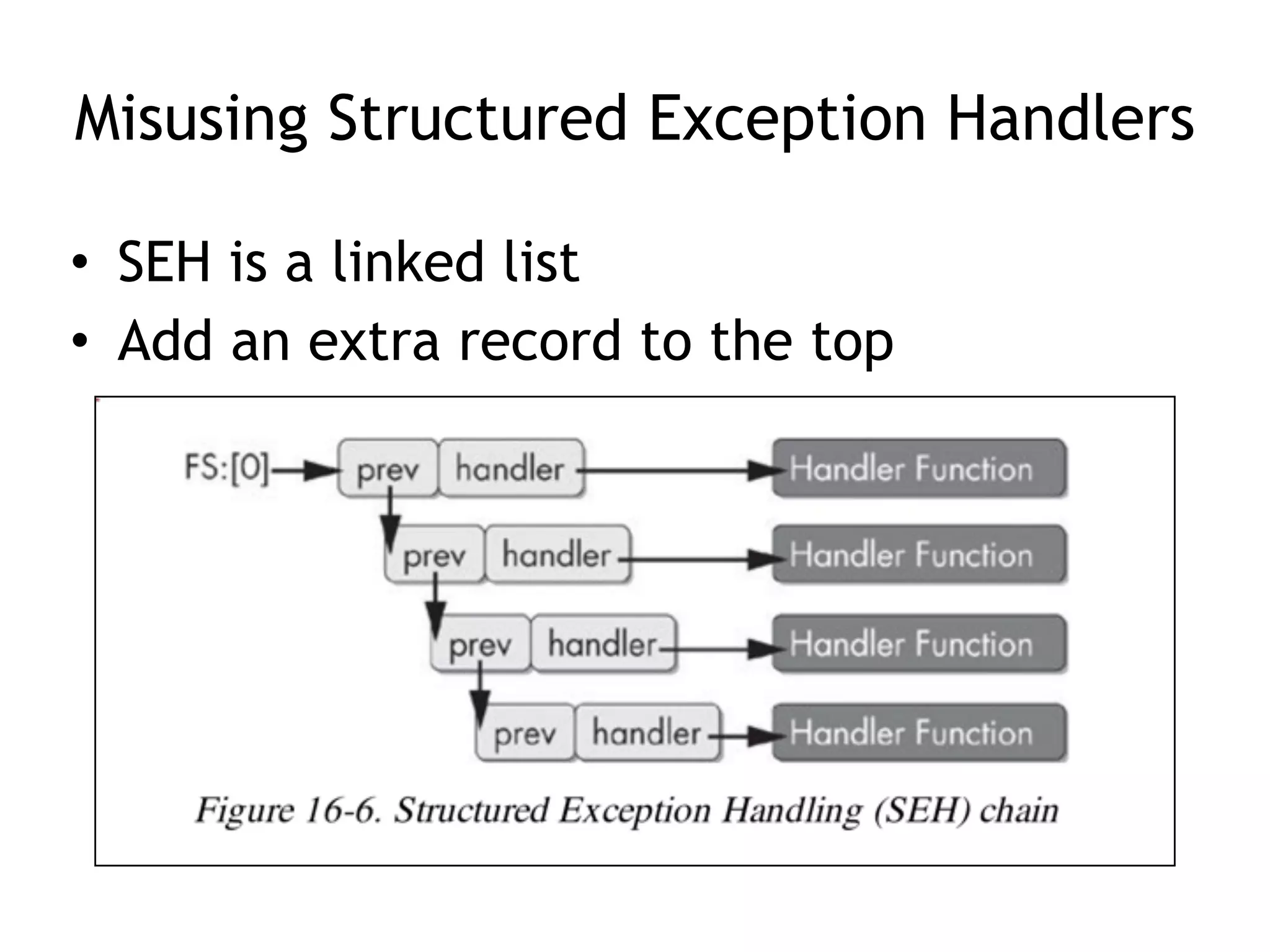
Misusing Structured Exception Handlers
• SEH is a linked list
• Add an extra record to the top
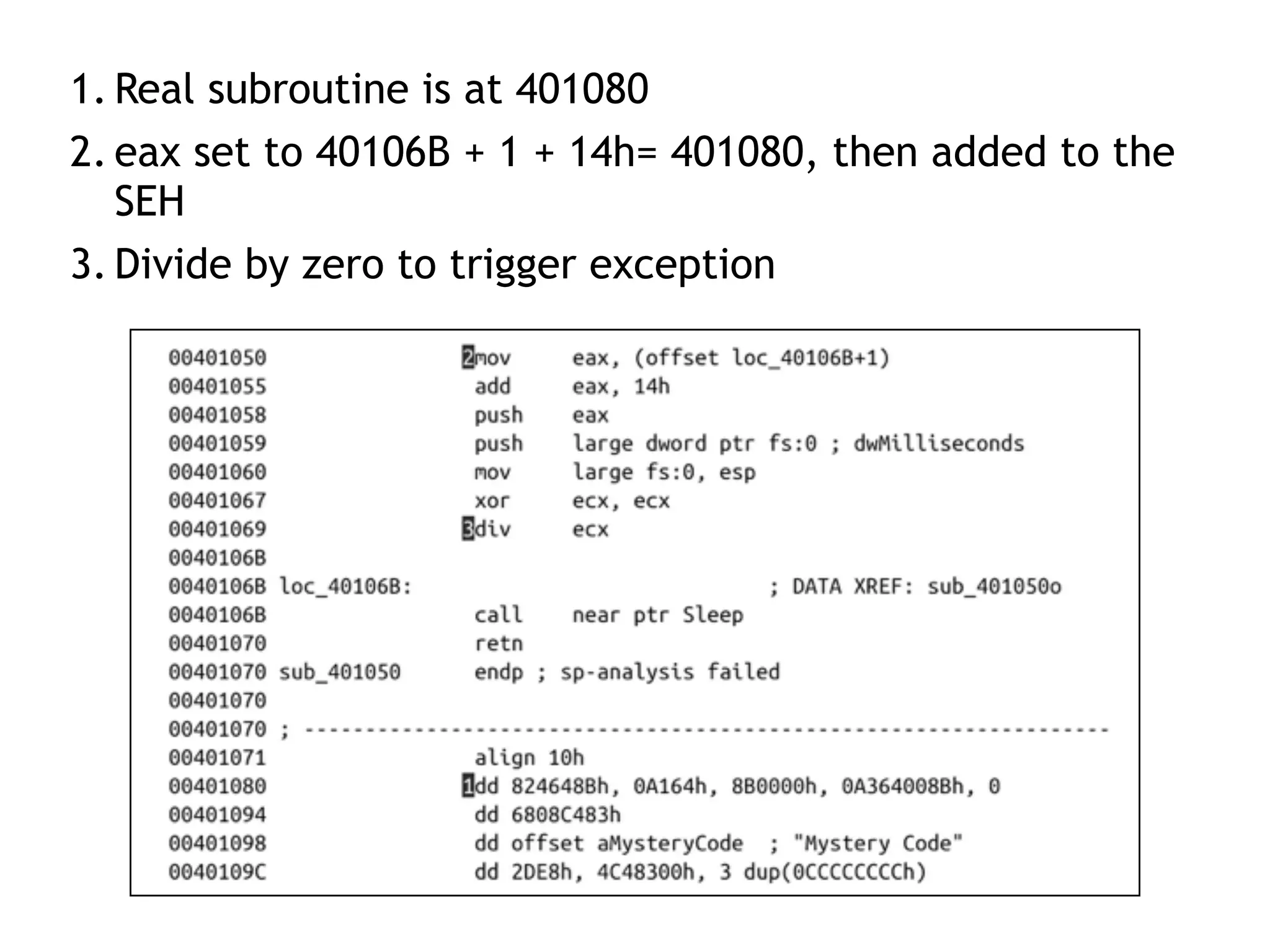
1. Real subroutine is at 401080
2. eax set to 40106B + 1 + 14h= 401080, then added to the
SEH
3. Divide by zero to trigger exception
Thwarting Stack-Frame
Analysis
Stack Frame Analysis
• IDA has to decide how many stack bytes a
function uses
• This is usually easy, the function prologue
sets ebp and esp in an obvious way
• IDA adds the sizes of local variables to the
size of the stack frame
Example
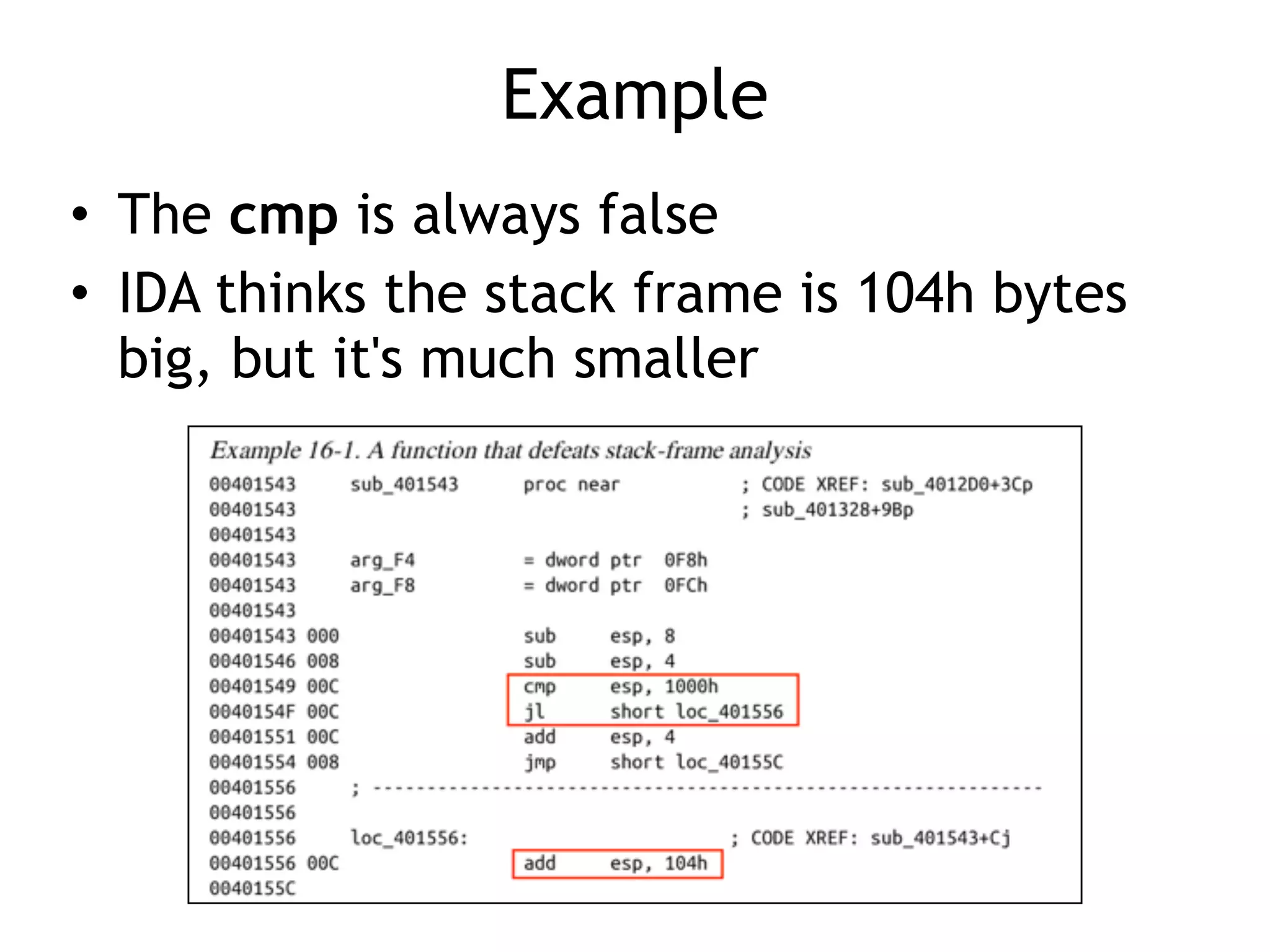
• The cmp is always false
• IDA thinks the stack frame is 104h bytes
big, but it's much smaller

Practical Malware Analysis: Ch 15: Anti-Disassembly