Registry Analysis
  and Memory
   Forensics:
Together at Last
     Brendan Dolan-Gavitt
 Georgia Institute of Technology
Who I Am

• Developer on
  Volatility project

• Grad student and
  researcher at
  Georgia Tech

• Author of “Push the
  Red Button” blog
Overview
Overview

• Registry Analysis
Overview

• Registry Analysis

• Memory Forensics      +
Overview

• Registry Analysis

• Memory Forensics      +

• Combining the
  fields                 =
Overview

• Registry Analysis

• Memory Forensics      +

• Combining the
  fields                 =
• Lots of examples
  throughout
Windows Registry


• Centralized, hierarchical configuration
  database
• Structured like a filesystem
 • Keys = Directories, Values = Files
• Rich source of forensic information
Windows Registry
         (cont.)

• Registry appears as unified tree, but is
  made up of distinct hives
• Standard set of systemwide hives, as
  well as per-user hives
• Note: Registry contains some volatile
  data available only at runtime
Registry Data


• Removable media / USB keys
• Artifacts from P2P programs
• Malware persistence artifacts
• Password hashes (encrypted)
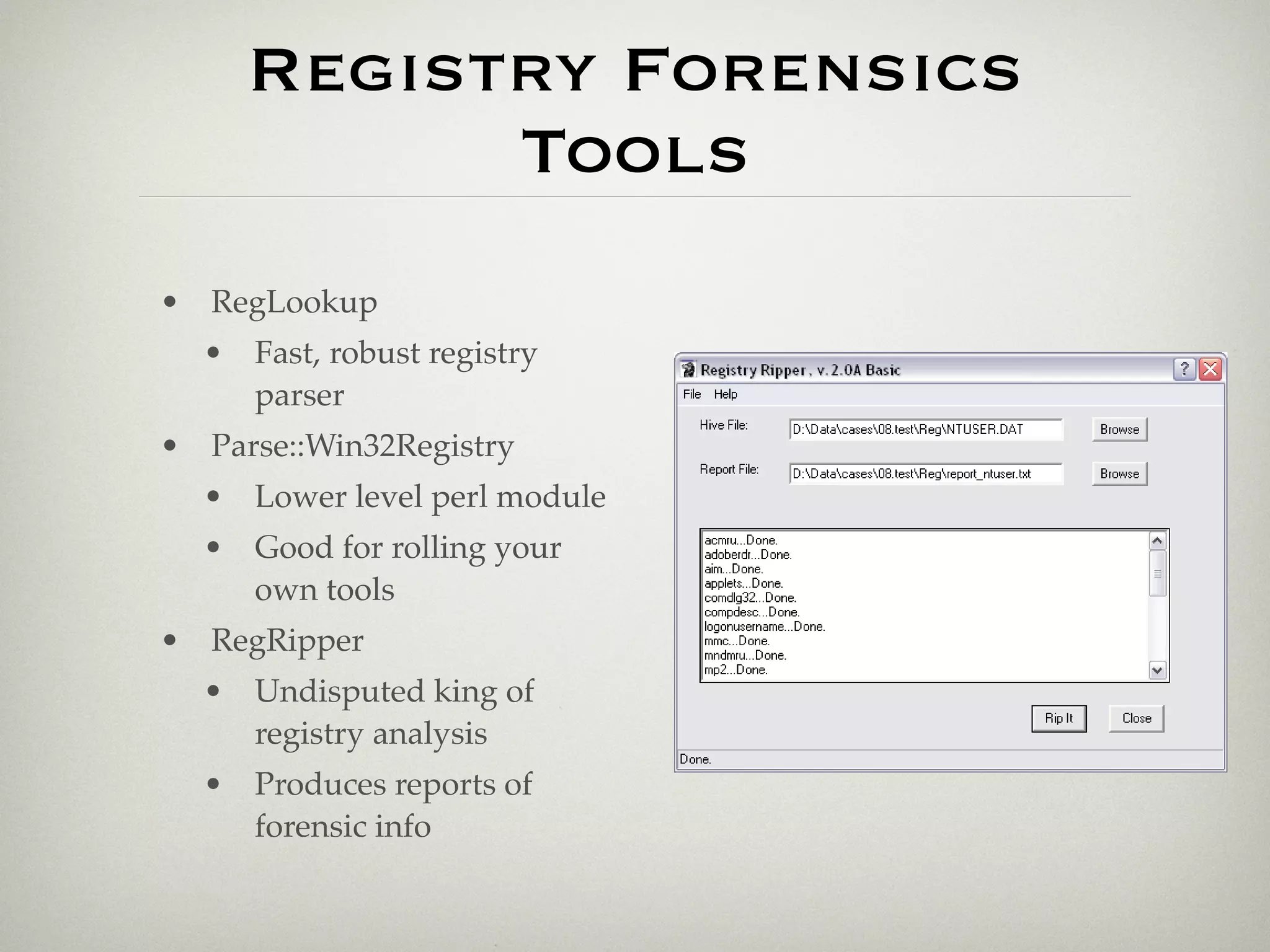
Registry Forensics
           Tools
• RegLookup
  • Fast, robust registry
    parser
• Parse::Win32Registry
  • Lower level perl module
  • Good for rolling your
    own tools
• RegRipper
  • Undisputed king of
    registry analysis
  • Produces reports of
    forensic info
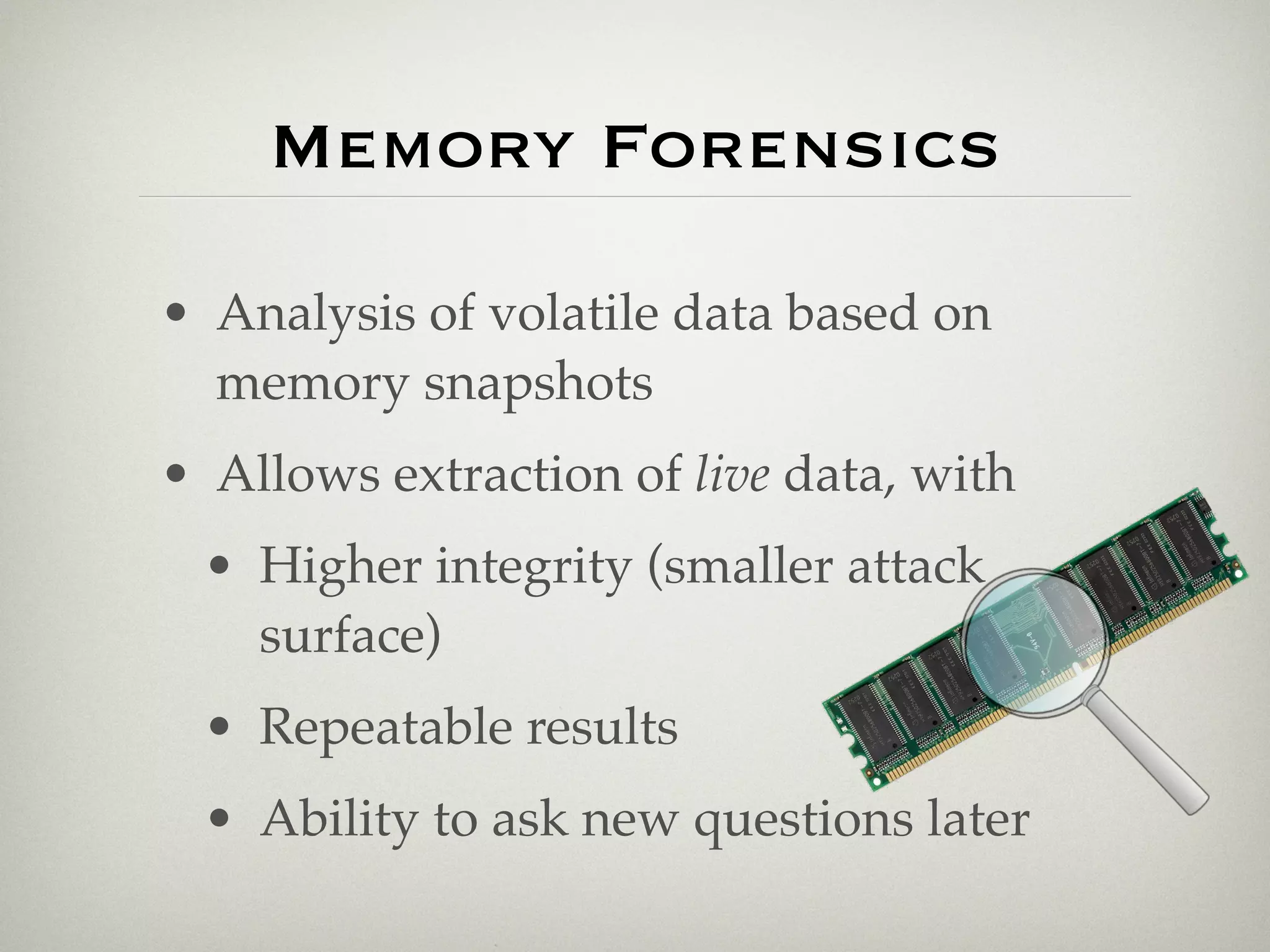
Memory Forensics

• Analysis of volatile data based on
  memory snapshots
• Allows extraction of live data, with
 • Higher integrity (smaller attack
   surface)
 • Repeatable results
 • Ability to ask new questions later
Memory Forensics Tools

• Memoryze
• HBGary Responder
• Volatility
 • GPL, collaborative development
 • Supports plugins
 • My favorite ;)
Data in Memory
• Current tools can extract a ton of
  information from memory images

• Processes           • Loaded DLLs
• Threads             • Rootkit behavior
• Drivers             • Injected code
• Open files           • Encryption keys
Combining Registry and
   Memory Analysis


• Windows keeps registry data in
  memory
• By figuring out the internals of the
  Windows Configuration Manager...
• We can combine these two fields!
Design Goals


• Access stable registry data
• Access volatile registry data
• Speed up incident response
• Apply existing registry analyses
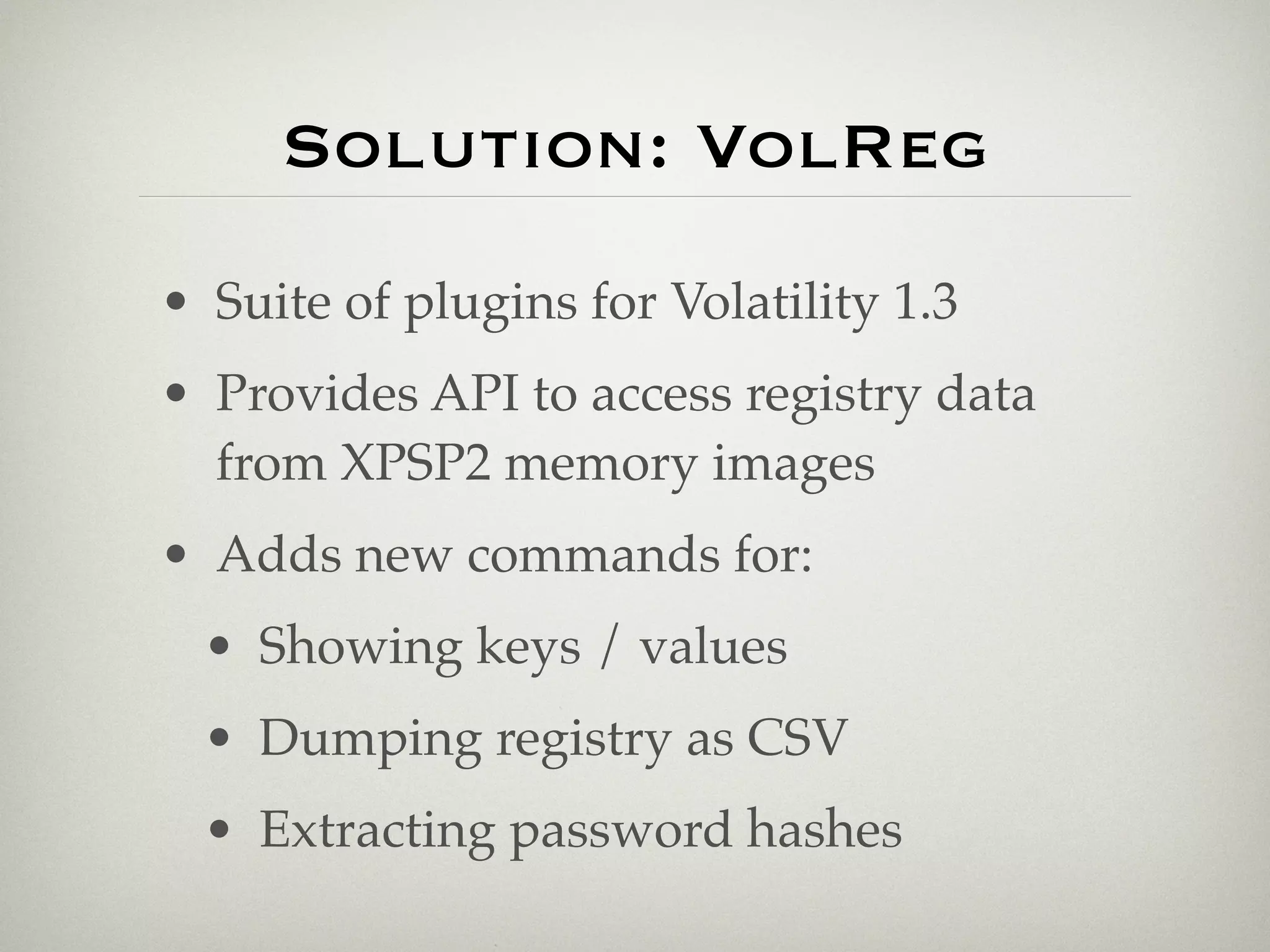
Solution: VolReg
• Suite of plugins for Volatility 1.3
• Provides API to access registry data
  from XPSP2 memory images
• Adds new commands for:
  • Showing keys / values
  • Dumping registry as CSV
  • Extracting password hashes
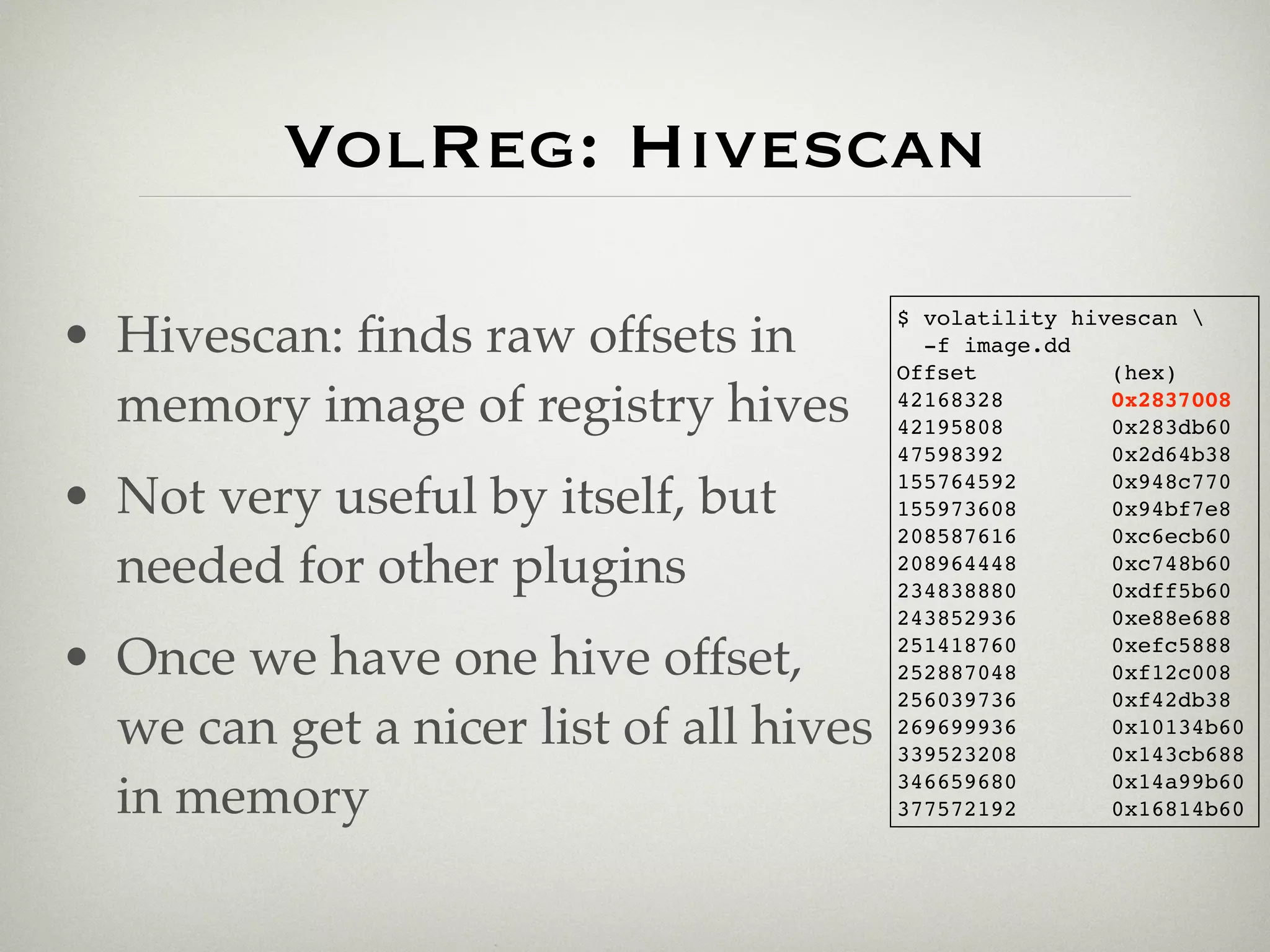
VolReg: Hivescan
                                         $ volatility hivescan 
• Hivescan: finds raw offsets in            -f image.dd
                                         Offset          (hex)
  memory image of registry hives         42168328
                                         42195808
                                                         0x2837008
                                                         0x283db60
                                         47598392        0x2d64b38

• Not very useful by itself, but         155764592
                                         155973608
                                                         0x948c770
                                                         0x94bf7e8
                                         208587616       0xc6ecb60
  needed for other plugins               208964448
                                         234838880
                                                         0xc748b60
                                                         0xdff5b60
                                         243852936       0xe88e688

• Once we have one hive offset,          251418760
                                         252887048
                                                         0xefc5888
                                                         0xf12c008
                                         256039736       0xf42db38
  we can get a nicer list of all hives   269699936
                                         339523208
                                                         0x10134b60
                                                         0x143cb688

  in memory                              346659680
                                         377572192
                                                         0x14a99b60
                                                         0x16814b60
VolReg: Hivelist


• Given one of the offsets from hivescan,
  finds all other hives in memory
• Keep this list around!
• The addresses in this list are what we
  will use for the other registry plugins
Hivelist Example
$ volatility   hivelist -f image.dd -o 0x2837008
Address        Name
0xe2610b60     Documents and SettingsS----Local Settings[...]UsrClass.dat
0xe25f0578     Documents and SettingsS----NTUSER.DAT
0xe1d33008     Documents and SettingsLocalServiceLocal Settings[...]UsrClass.dat
0xe1c73888     Documents and SettingsLocalServiceNTUSER.DAT
0xe1c04688     Documents and SettingsNetworkServiceLocal Settings[...]UsrClass.dat
0xe1b70b60     Documents and SettingsNetworkServiceNTUSER.DAT
0xe1658b60     WINDOWSsystem32configsoftware
0xe1a5a7e8     WINDOWSsystem32configdefault
0xe165cb60     WINDOWSsystem32configSAM
0xe1a4f770     WINDOWSsystem32configSECURITY
0xe1559b38     [no name]
0xe1035b60     WINDOWSsystem32configsystem
0xe102e008     [no name]
VolReg: Printkey

• Given a hive address and a key, prints
  the key and its subkeys and values
• Shows last modified time, formats
  values according to type
• Includes volatile keys & values as well
• Good for just looking around
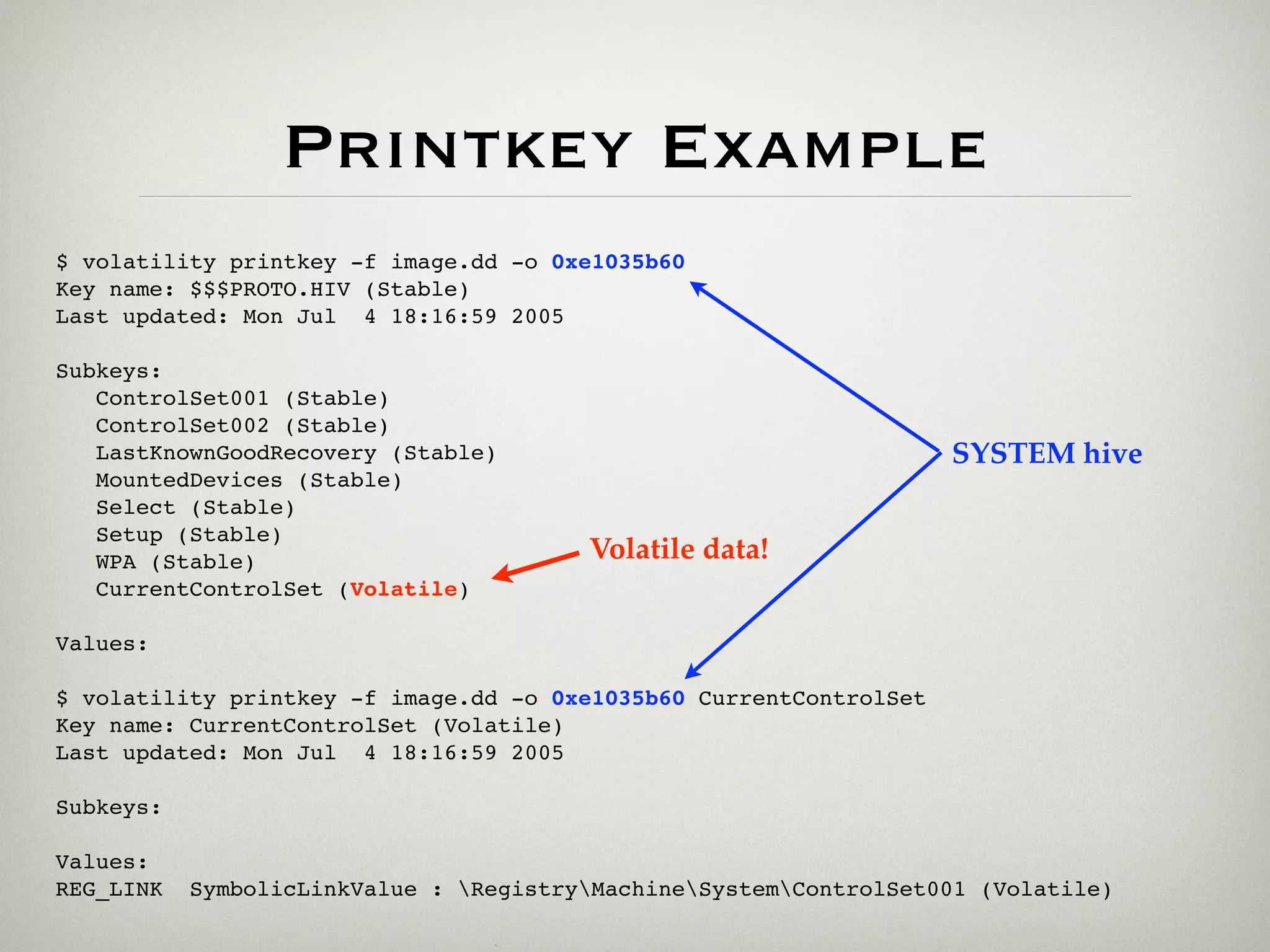
Printkey Example
$ volatility printkey -f image.dd -o 0xe1035b60
Key name: $$$PROTO.HIV (Stable)
Last updated: Mon Jul 4 18:16:59 2005

Subkeys:
   ControlSet001 (Stable)
   ControlSet002 (Stable)
   LastKnownGoodRecovery (Stable)                                   SYSTEM hive
   MountedDevices (Stable)
   Select (Stable)
   Setup (Stable)
   WPA (Stable)                         Volatile data!
   CurrentControlSet (Volatile)

Values:

$ volatility printkey -f image.dd -o 0xe1035b60 CurrentControlSet
Key name: CurrentControlSet (Volatile)
Last updated: Mon Jul 4 18:16:59 2005

Subkeys:

Values:
REG_LINK   SymbolicLinkValue : RegistryMachineSystemControlSet001 (Volatile)
VolReg: Hashdump

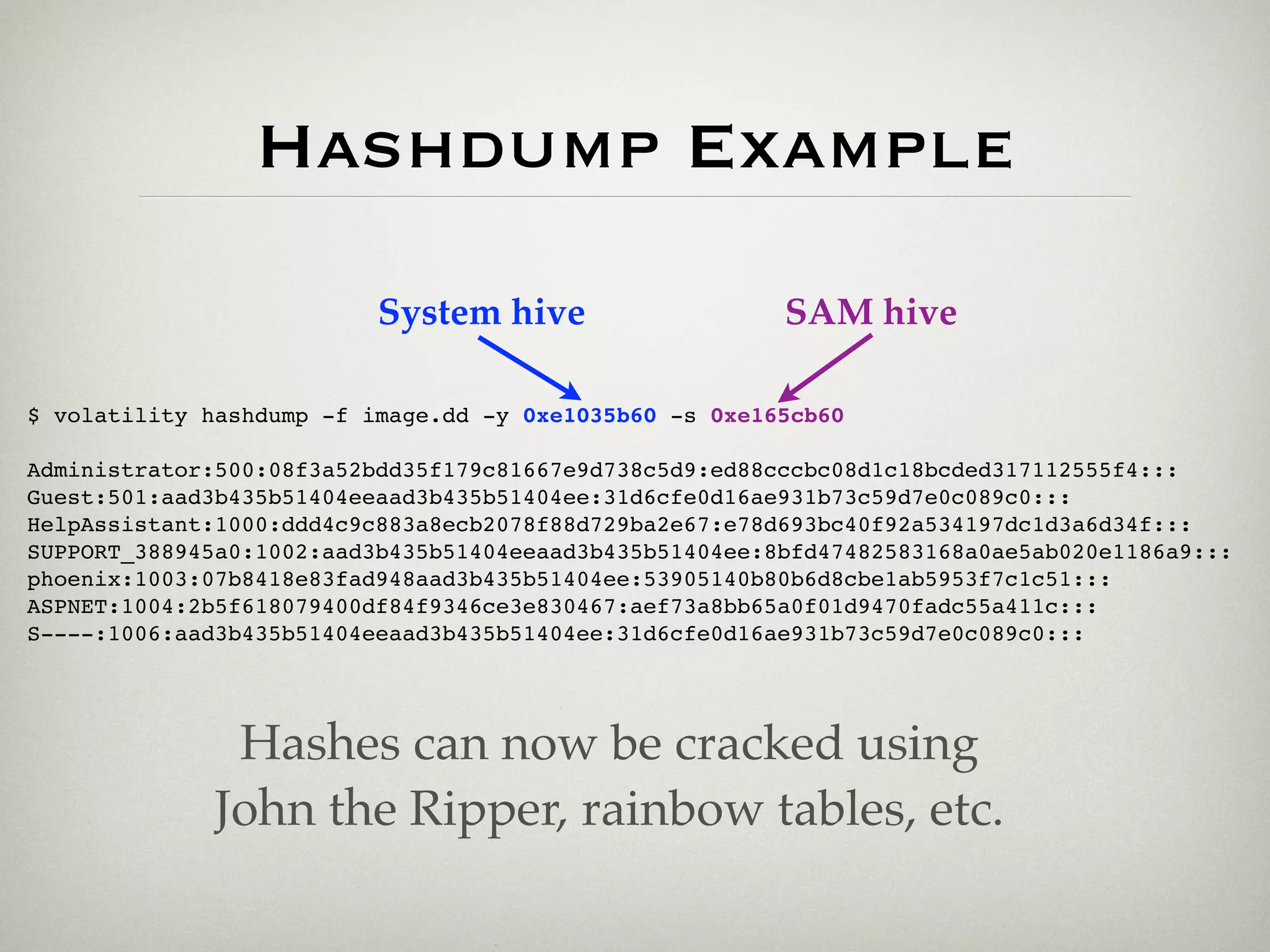
• Local account password hashes are
  stored in the registry (encrypted)
• Hashdump module decrypts and prints
  these hashes
• If LanMan hash is in use, rainbow
  tables can recover password in minutes
• Use this power for good :)
Hashdump Example
                          System hive                   SAM hive

$ volatility hashdump -f image.dd -y 0xe1035b60 -s 0xe165cb60

Administrator:500:08f3a52bdd35f179c81667e9d738c5d9:ed88cccbc08d1c18bcded317112555f4:::
Guest:501:aad3b435b51404eeaad3b435b51404ee:31d6cfe0d16ae931b73c59d7e0c089c0:::
HelpAssistant:1000:ddd4c9c883a8ecb2078f88d729ba2e67:e78d693bc40f92a534197dc1d3a6d34f:::
SUPPORT_388945a0:1002:aad3b435b51404eeaad3b435b51404ee:8bfd47482583168a0ae5ab020e1186a9:::
phoenix:1003:07b8418e83fad948aad3b435b51404ee:53905140b80b6d8cbe1ab5953f7c1c51:::
ASPNET:1004:2b5f618079400df84f9346ce3e830467:aef73a8bb65a0f01d9470fadc55a411c:::
S----:1006:aad3b435b51404eeaad3b435b51404ee:31d6cfe0d16ae931b73c59d7e0c089c0:::


              Hashes can now be cracked using
             John the Ripper, rainbow tables, etc.
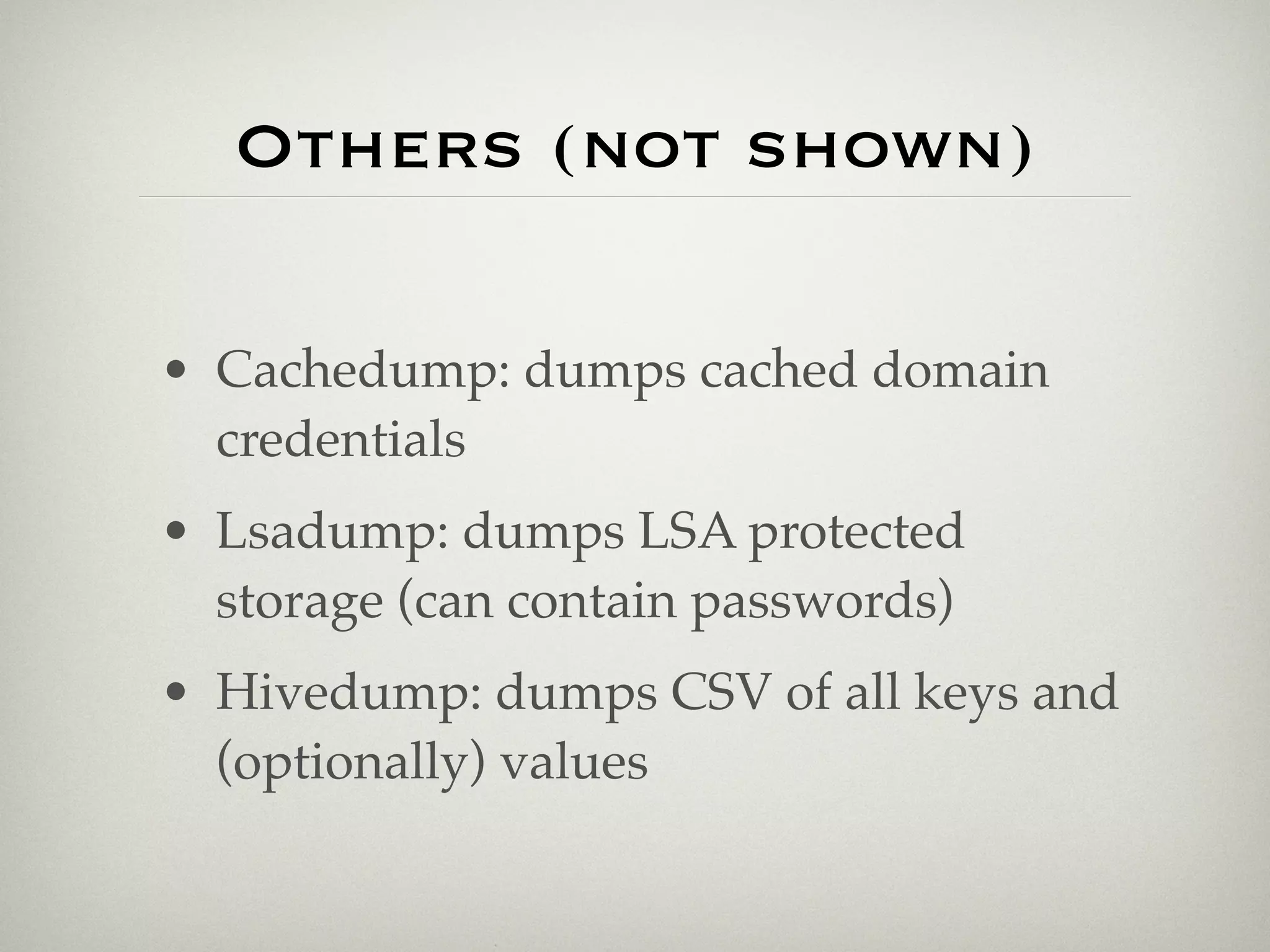
Others (not shown)

• Cachedump: dumps cached domain
  credentials
• Lsadump: dumps LSA protected
  storage (can contain passwords)
• Hivedump: dumps CSV of all keys and
  (optionally) values
Design Goals


• Access stable registry data        [✓]
• Access volatile registry data      [✓]
• Speed up incident response         [?]
• Apply existing registry analyses   [X]
Solution: VolRip


• Python→Perl interface that makes
  VolReg look like Parse::Win32Registry
• Now we can run RegRipper against
  memory!
• Existing analysis plugins just work
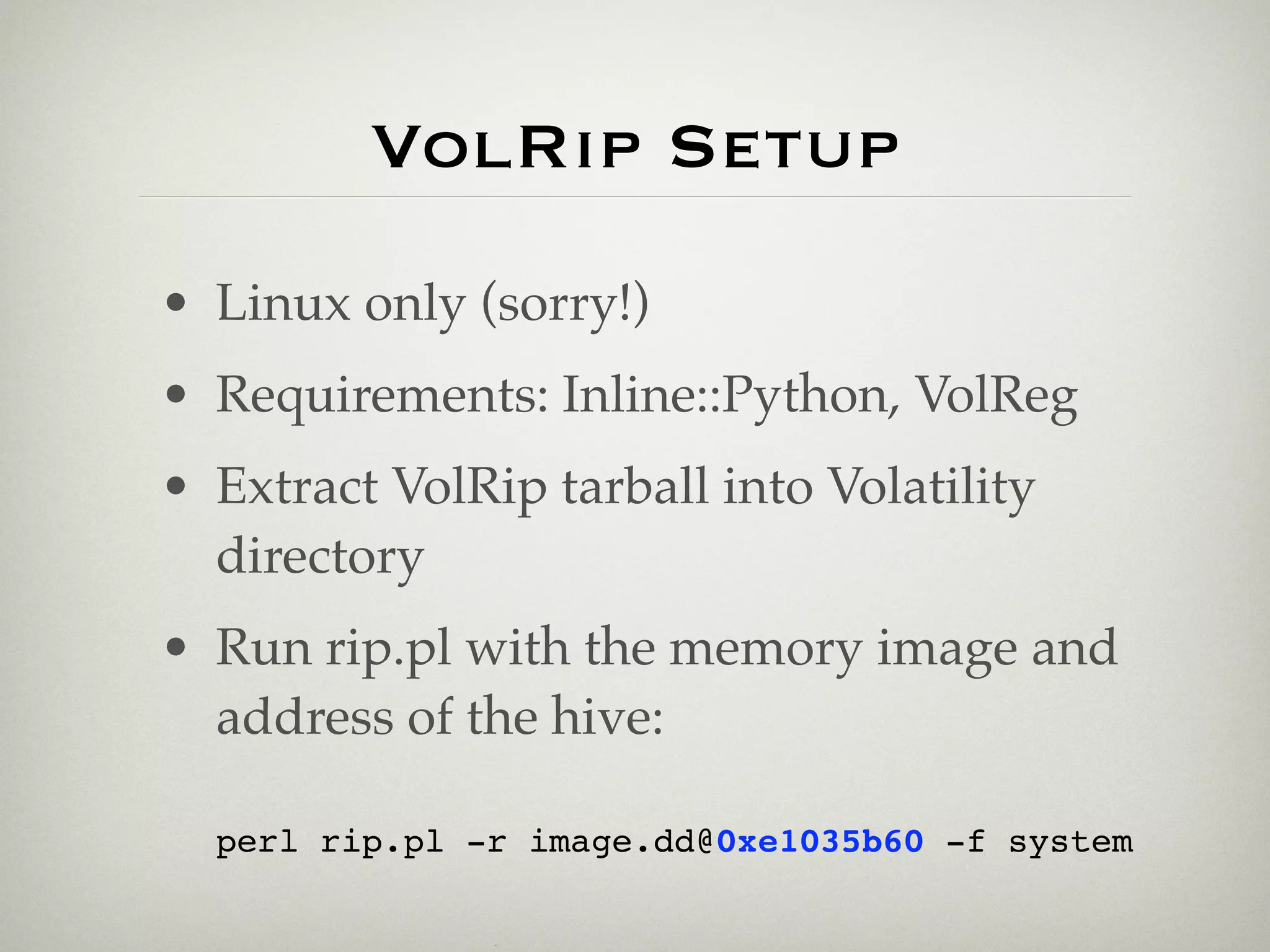
VolRip Setup
• Linux only (sorry!)
• Requirements: Inline::Python, VolReg
• Extract VolRip tarball into Volatility
  directory
• Run rip.pl with the memory image and
  address of the hive:

  perl rip.pl -r image.dd@0xe1035b60 -f system
VolRip Example:
              Tracking USB Keys
$ perl rip.pl -r image.dd@0xe1035b60 -p usbstor
Launching usbstor v.20080418
USBStor
ControlSet001EnumUSBStor

Disk&Ven_Generic&Prod_STORAGE_DEVICE&Rev_0.01 [Sun Jun 27 05:58:42 2004]
  S/N: 6&a344881&0 [Wed Jun 30 00:23:07 2004]
    FriendlyName : Generic STORAGE DEVICE USB Device
    ParentIdPrefix: 7&192c45c3&0

Disk&Ven_LEXAR&Prod_JUMPDRIVE_SPORT&Rev_1000 [Sat Jun 25 16:50:48 2005]
  S/N: 0A4F1011180132130804&0 [Mon Jul 4 18:17:50 2005]
    FriendlyName : LEXAR JUMPDRIVE SPORT USB Device
    ParentIdPrefix: 7&2930a404&0


$ perl rip.pl -r image.dd@0xe1035b60 -p usbstor2
SPLATITUDE,Disk&Ven_Generic&Prod_STORAGE_DEVICE&Rev_0.01,6&a344881&0,
  1088554987,Generic STORAGE DEVICE USB Device,7&192c45c3&0,DosDevicesE:
SPLATITUDE,Disk&Ven_LEXAR&Prod_JUMPDRIVE_SPORT&Rev_1000,0A4F1011180132130804&0,
  1120501070,LEXAR JUMPDRIVE SPORT USB Device,7&2930a404&0,DosDevicesD:
Design Goals


• Access stable registry data        [✓]
• Access volatile registry data      [✓]
• Speed up incident response         [✓]
• Apply existing registry analyses   [✓]
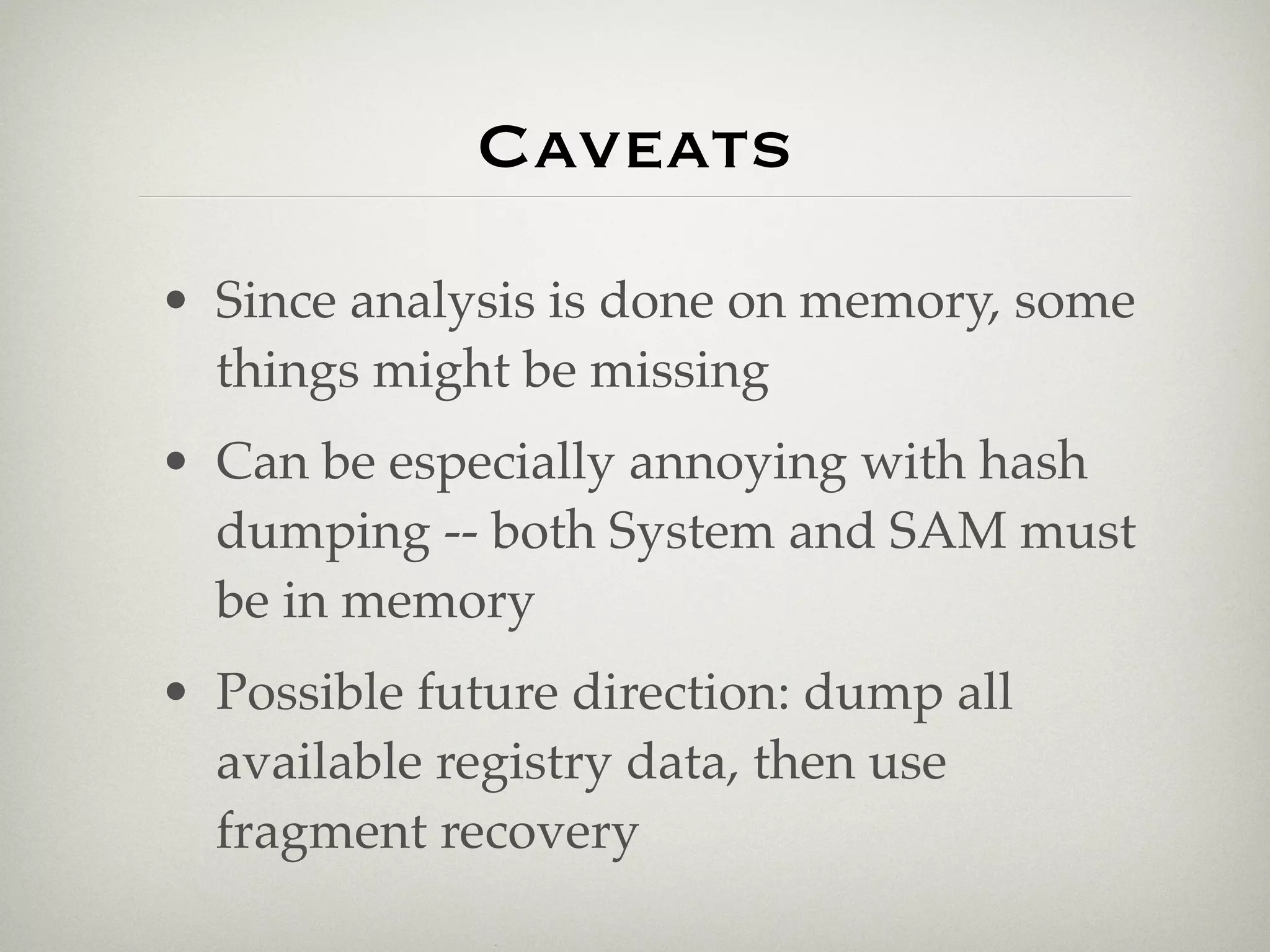
Caveats
• Since analysis is done on memory, some
  things might be missing
• Can be especially annoying with hash
  dumping -- both System and SAM must
  be in memory
• Possible future direction: dump all
  available registry data, then use
  fragment recovery
Conclusions

• Applying registry analysis to memory
  can give you powerful new tools!
• Some existing registry tools can be
  coaxed into working with memory
• Still need tools to analyze volatile
  registry data (new RegRipper plugins?)
Thanks!
    • To you all, for listening
    • To AAron Walters and the folks in
      #volatility
    • To Harlan Carvey, Tim Morgan, and
      many others for their work and insight
      on all matters registry-related


?             ?                           ?
         ?
                  ...any questions?   ?       ?

SANS Forensics 2009 - Memory Forensics and Registry Analysis

  • 1.
    Registry Analysis and Memory Forensics: Together at Last Brendan Dolan-Gavitt Georgia Institute of Technology
  • 2.
    Who I Am •Developer on Volatility project • Grad student and researcher at Georgia Tech • Author of “Push the Red Button” blog
  • 3.
  • 4.
  • 5.
  • 6.
    Overview • Registry Analysis •Memory Forensics + • Combining the fields =
  • 7.
    Overview • Registry Analysis •Memory Forensics + • Combining the fields = • Lots of examples throughout
  • 8.
    Windows Registry • Centralized,hierarchical configuration database • Structured like a filesystem • Keys = Directories, Values = Files • Rich source of forensic information
  • 9.
    Windows Registry (cont.) • Registry appears as unified tree, but is made up of distinct hives • Standard set of systemwide hives, as well as per-user hives • Note: Registry contains some volatile data available only at runtime
  • 10.
    Registry Data • Removablemedia / USB keys • Artifacts from P2P programs • Malware persistence artifacts • Password hashes (encrypted)
  • 11.
    Registry Forensics Tools • RegLookup • Fast, robust registry parser • Parse::Win32Registry • Lower level perl module • Good for rolling your own tools • RegRipper • Undisputed king of registry analysis • Produces reports of forensic info
  • 12.
    Memory Forensics • Analysisof volatile data based on memory snapshots • Allows extraction of live data, with • Higher integrity (smaller attack surface) • Repeatable results • Ability to ask new questions later
  • 13.
    Memory Forensics Tools •Memoryze • HBGary Responder • Volatility • GPL, collaborative development • Supports plugins • My favorite ;)
  • 14.
    Data in Memory •Current tools can extract a ton of information from memory images • Processes • Loaded DLLs • Threads • Rootkit behavior • Drivers • Injected code • Open files • Encryption keys
  • 15.
    Combining Registry and Memory Analysis • Windows keeps registry data in memory • By figuring out the internals of the Windows Configuration Manager... • We can combine these two fields!
  • 16.
    Design Goals • Accessstable registry data • Access volatile registry data • Speed up incident response • Apply existing registry analyses
  • 17.
    Solution: VolReg • Suiteof plugins for Volatility 1.3 • Provides API to access registry data from XPSP2 memory images • Adds new commands for: • Showing keys / values • Dumping registry as CSV • Extracting password hashes
  • 18.
    VolReg: Hivescan $ volatility hivescan • Hivescan: finds raw offsets in -f image.dd Offset (hex) memory image of registry hives 42168328 42195808 0x2837008 0x283db60 47598392 0x2d64b38 • Not very useful by itself, but 155764592 155973608 0x948c770 0x94bf7e8 208587616 0xc6ecb60 needed for other plugins 208964448 234838880 0xc748b60 0xdff5b60 243852936 0xe88e688 • Once we have one hive offset, 251418760 252887048 0xefc5888 0xf12c008 256039736 0xf42db38 we can get a nicer list of all hives 269699936 339523208 0x10134b60 0x143cb688 in memory 346659680 377572192 0x14a99b60 0x16814b60
  • 19.
    VolReg: Hivelist • Givenone of the offsets from hivescan, finds all other hives in memory • Keep this list around! • The addresses in this list are what we will use for the other registry plugins
  • 20.
    Hivelist Example $ volatility hivelist -f image.dd -o 0x2837008 Address Name 0xe2610b60 Documents and SettingsS----Local Settings[...]UsrClass.dat 0xe25f0578 Documents and SettingsS----NTUSER.DAT 0xe1d33008 Documents and SettingsLocalServiceLocal Settings[...]UsrClass.dat 0xe1c73888 Documents and SettingsLocalServiceNTUSER.DAT 0xe1c04688 Documents and SettingsNetworkServiceLocal Settings[...]UsrClass.dat 0xe1b70b60 Documents and SettingsNetworkServiceNTUSER.DAT 0xe1658b60 WINDOWSsystem32configsoftware 0xe1a5a7e8 WINDOWSsystem32configdefault 0xe165cb60 WINDOWSsystem32configSAM 0xe1a4f770 WINDOWSsystem32configSECURITY 0xe1559b38 [no name] 0xe1035b60 WINDOWSsystem32configsystem 0xe102e008 [no name]
  • 21.
    VolReg: Printkey • Givena hive address and a key, prints the key and its subkeys and values • Shows last modified time, formats values according to type • Includes volatile keys & values as well • Good for just looking around
  • 22.
    Printkey Example $ volatilityprintkey -f image.dd -o 0xe1035b60 Key name: $$$PROTO.HIV (Stable) Last updated: Mon Jul 4 18:16:59 2005 Subkeys: ControlSet001 (Stable) ControlSet002 (Stable) LastKnownGoodRecovery (Stable) SYSTEM hive MountedDevices (Stable) Select (Stable) Setup (Stable) WPA (Stable) Volatile data! CurrentControlSet (Volatile) Values: $ volatility printkey -f image.dd -o 0xe1035b60 CurrentControlSet Key name: CurrentControlSet (Volatile) Last updated: Mon Jul 4 18:16:59 2005 Subkeys: Values: REG_LINK SymbolicLinkValue : RegistryMachineSystemControlSet001 (Volatile)
  • 23.
    VolReg: Hashdump • Localaccount password hashes are stored in the registry (encrypted) • Hashdump module decrypts and prints these hashes • If LanMan hash is in use, rainbow tables can recover password in minutes • Use this power for good :)
  • 24.
    Hashdump Example System hive SAM hive $ volatility hashdump -f image.dd -y 0xe1035b60 -s 0xe165cb60 Administrator:500:08f3a52bdd35f179c81667e9d738c5d9:ed88cccbc08d1c18bcded317112555f4::: Guest:501:aad3b435b51404eeaad3b435b51404ee:31d6cfe0d16ae931b73c59d7e0c089c0::: HelpAssistant:1000:ddd4c9c883a8ecb2078f88d729ba2e67:e78d693bc40f92a534197dc1d3a6d34f::: SUPPORT_388945a0:1002:aad3b435b51404eeaad3b435b51404ee:8bfd47482583168a0ae5ab020e1186a9::: phoenix:1003:07b8418e83fad948aad3b435b51404ee:53905140b80b6d8cbe1ab5953f7c1c51::: ASPNET:1004:2b5f618079400df84f9346ce3e830467:aef73a8bb65a0f01d9470fadc55a411c::: S----:1006:aad3b435b51404eeaad3b435b51404ee:31d6cfe0d16ae931b73c59d7e0c089c0::: Hashes can now be cracked using John the Ripper, rainbow tables, etc.
  • 25.
    Others (not shown) •Cachedump: dumps cached domain credentials • Lsadump: dumps LSA protected storage (can contain passwords) • Hivedump: dumps CSV of all keys and (optionally) values
  • 26.
    Design Goals • Accessstable registry data [✓] • Access volatile registry data [✓] • Speed up incident response [?] • Apply existing registry analyses [X]
  • 27.
    Solution: VolRip • Python→Perlinterface that makes VolReg look like Parse::Win32Registry • Now we can run RegRipper against memory! • Existing analysis plugins just work
  • 28.
    VolRip Setup • Linuxonly (sorry!) • Requirements: Inline::Python, VolReg • Extract VolRip tarball into Volatility directory • Run rip.pl with the memory image and address of the hive: perl rip.pl -r image.dd@0xe1035b60 -f system
  • 29.
    VolRip Example: Tracking USB Keys $ perl rip.pl -r image.dd@0xe1035b60 -p usbstor Launching usbstor v.20080418 USBStor ControlSet001EnumUSBStor Disk&Ven_Generic&Prod_STORAGE_DEVICE&Rev_0.01 [Sun Jun 27 05:58:42 2004] S/N: 6&a344881&0 [Wed Jun 30 00:23:07 2004] FriendlyName : Generic STORAGE DEVICE USB Device ParentIdPrefix: 7&192c45c3&0 Disk&Ven_LEXAR&Prod_JUMPDRIVE_SPORT&Rev_1000 [Sat Jun 25 16:50:48 2005] S/N: 0A4F1011180132130804&0 [Mon Jul 4 18:17:50 2005] FriendlyName : LEXAR JUMPDRIVE SPORT USB Device ParentIdPrefix: 7&2930a404&0 $ perl rip.pl -r image.dd@0xe1035b60 -p usbstor2 SPLATITUDE,Disk&Ven_Generic&Prod_STORAGE_DEVICE&Rev_0.01,6&a344881&0, 1088554987,Generic STORAGE DEVICE USB Device,7&192c45c3&0,DosDevicesE: SPLATITUDE,Disk&Ven_LEXAR&Prod_JUMPDRIVE_SPORT&Rev_1000,0A4F1011180132130804&0, 1120501070,LEXAR JUMPDRIVE SPORT USB Device,7&2930a404&0,DosDevicesD:
  • 30.
    Design Goals • Accessstable registry data [✓] • Access volatile registry data [✓] • Speed up incident response [✓] • Apply existing registry analyses [✓]
  • 31.
    Caveats • Since analysisis done on memory, some things might be missing • Can be especially annoying with hash dumping -- both System and SAM must be in memory • Possible future direction: dump all available registry data, then use fragment recovery
  • 32.
    Conclusions • Applying registryanalysis to memory can give you powerful new tools! • Some existing registry tools can be coaxed into working with memory • Still need tools to analyze volatile registry data (new RegRipper plugins?)
  • 33.
    Thanks! • To you all, for listening • To AAron Walters and the folks in #volatility • To Harlan Carvey, Tim Morgan, and many others for their work and insight on all matters registry-related ? ? ? ? ...any questions? ? ?