
Intro to Reverse
Engineering By: Tsvetelin (Vincent) Choranov
OWASP
Open Web Application
Security Project
Schedule
• 9:00 – 10:30 am
• C Refresher
• Data Types
• Process Structure and Virtual Memory
• 10:30 – 10:45 am
• Break
• 10:45 – Noon
• X86 Registers
• Stack
• Noon – 1:00 pm
• Lunch
• 1:00 – 2:30 pm
• Assembly Instructions
• Calling Conventions
• 2:30 – 2:45 pm
• Break
• 2:45 – 4:30 pm
• Debuggers Disassemblers and Decompilers
C refresher - Control Flow
• If statement
• If-else
• While / Until
• For loops
• Switch/Case statements ( Jump tables )
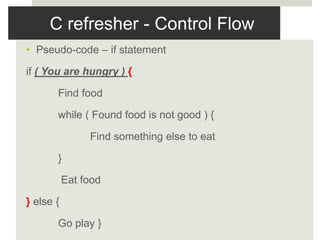
C refresher - Control Flow
• Pseudo-code – if statement
if ( You are hungry ) {
Find food
while ( Found food is not good ) {
Find something else to eat
}
Eat food
} else {
Go play }
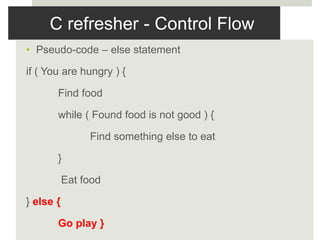
C refresher - Control Flow
• Pseudo-code – else statement
if ( You are hungry ) {
Find food
while ( Found food is not good ) {
Find something else to eat
}
Eat food
} else {
Go play }
C refresher - Control Flow
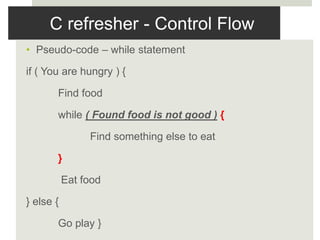
• Pseudo-code – while statement
if ( You are hungry ) {
Find food
while ( Found food is not good ) {
Find something else to eat
}
Eat food
} else {
Go play }
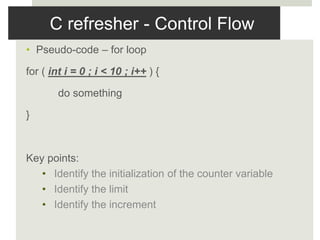
C refresher - Control Flow
• Pseudo-code – for loop
for ( int i = 0 ; i < 10 ; i++ ) {
do something
}
Key points:
• Identify the initialization of the counter variable
• Identify the limit
• Identify the increment
C refresher - Control Flow
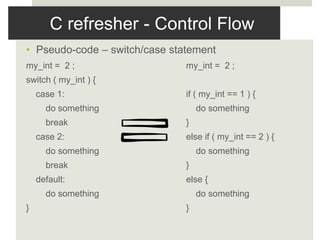
• Pseudo-code – switch/case statement
my_int = 2 ; my_int = 2 ;
switch ( my_int ) {
case 1: if ( my_int == 1 ) {
do something do something
break }
case 2: else if ( my_int == 2 ) {
do something do something
break }
default: else {
do something do something
} }
C refresher - Control Flow
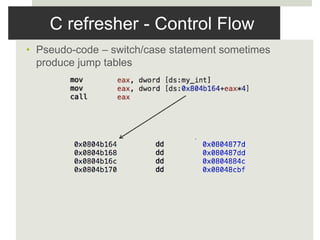
• Pseudo-code – switch/case statement sometimes
produce jump tables
C refresher - Variables
• Local
• Global
• Initialized / Uninitialized
• Signed / Unsigned Integer
• Pointer
• Structure
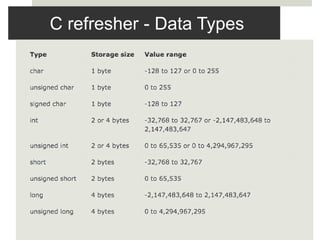
C refresher - Data Types
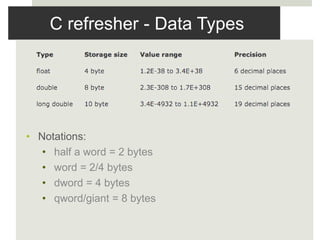
• Notations:
• half a word = 2 bytes
• word = 2/4 bytes
• dword = 4 bytes
• qword/giant = 8 bytes
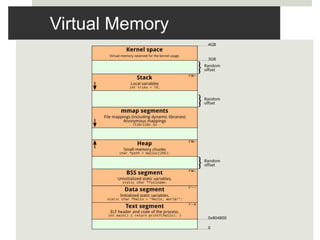
Virtual Memory
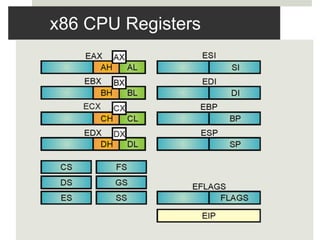
x86 CPU Registers
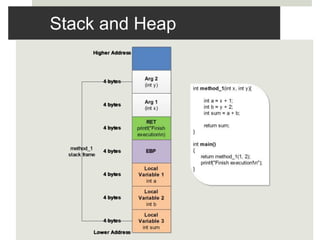
Stack and Heap
Assembly
Endianness
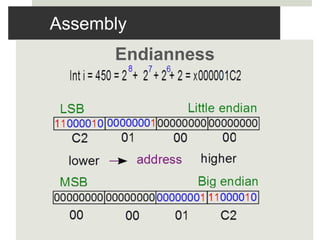
• Big-endian and little-endian are terms that describe
the order in which a sequence of bytes are stored in
computer memory. Big-endian is an order in which the
"big end" (most significant value in the sequence) is
stored first (at the lowest storage address).
Assembly
Endianness
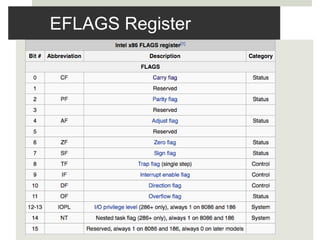
EFLAGS Register
Assembly
NOP
• No operation
• 0x90
• Used for alignment
• In exploitation used for NOP-sleds
Assembly
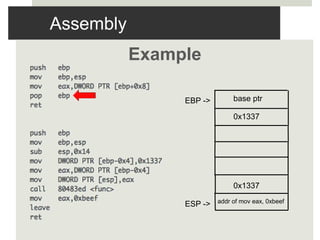
PUSH
• Pushes data to the stack
• Size of data is word, dword, qword
• Data can be an immediate value or register
• Decrements ESP
Assembly
POP
• Pops a value from the stack to a register
• Increments ESP
Assembly
MOV
• Move operation
• Moves:
• register to register
• memory to register
• register to memory
• immediate to register
• immediate to memory
• memory to memory
• MOV EAX, [EBX]
Assembly
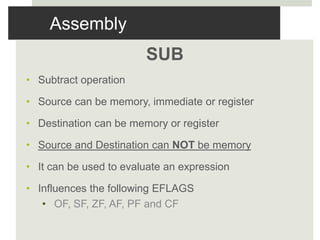
SUB
• Subtract operation
• Source can be memory, immediate or register
• Destination can be memory or register
• Source and Destination can NOT be memory
• It can be used to evaluate an expression
• Influences the following EFLAGS
• OF, SF, ZF, AF, PF and CF
Assembly
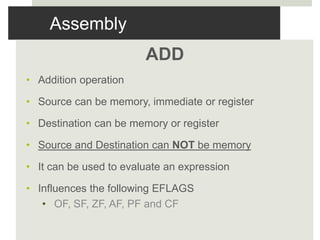
ADD
• Addition operation
• Source can be memory, immediate or register
• Destination can be memory or register
• Source and Destination can NOT be memory
• It can be used to evaluate an expression
• Influences the following EFLAGS
• OF, SF, ZF, AF, PF and CF
Assembly
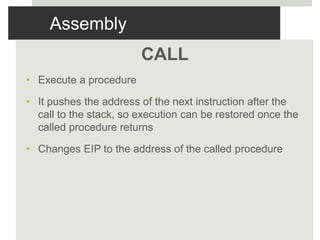
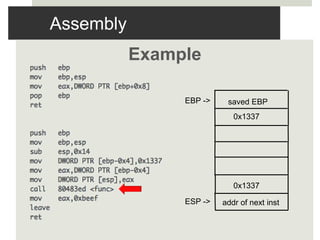
CALL
• Execute a procedure
• It pushes the address of the next instruction after the
call to the stack, so execution can be restored once the
called procedure returns
• Changes EIP to the address of the called procedure
Assembly
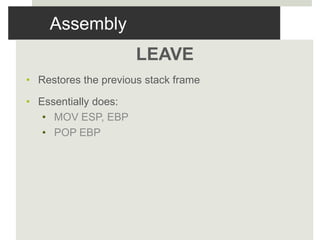
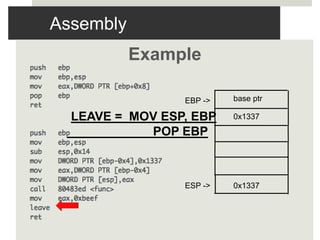
LEAVE
• Restores the previous stack frame
• Essentially does:
• MOV ESP, EBP
• POP EBP
Assembly
RET
• Return from a procedure
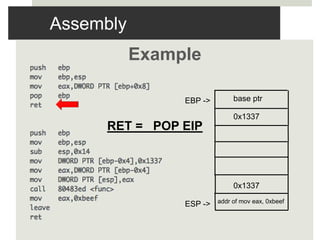
• RET == POP EIP
• POP increments ESP
• Also seen as RET 0x?? which pops into EIP and
increments ESP by 0x??
Assembly
• NOP
• PUSH
• POP
• MOV
• SUB
• ADD
• RET
• LEAVE
• CALL
Assembly
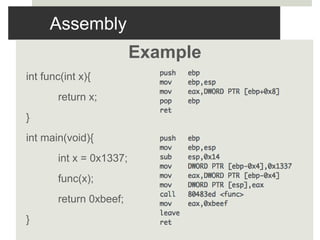
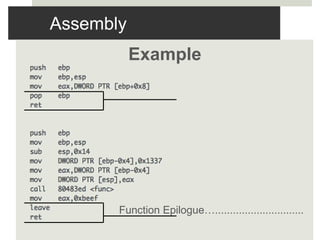
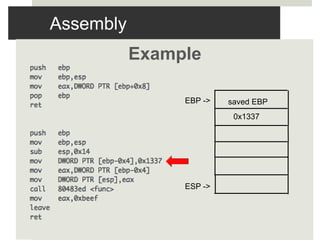
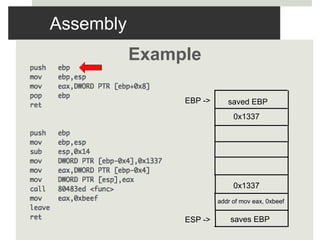
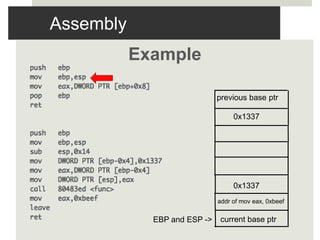
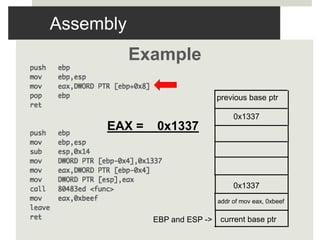
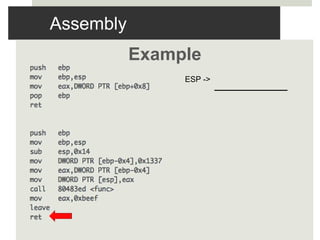
Example
int func(int x){
return x;
}
int main(void){
int x = 0x1337;
func(x);
return 0xbeef;
}
Assembly
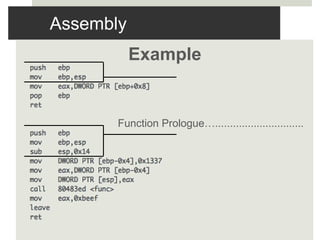
Example
Function Prologue…..............................
Assembly
Example
Function Epilogue…..............................
Assembly
Example
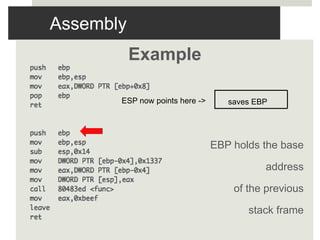
EBP holds the base
address
of the previous
stack frame
saves EBPESP now points here ->
Assembly
Example
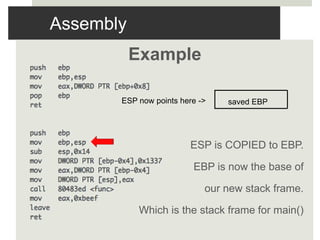
ESP is COPIED to EBP.
EBP is now the base of
our new stack frame.
Which is the stack frame for main()
saved EBPESP now points here ->
Assembly
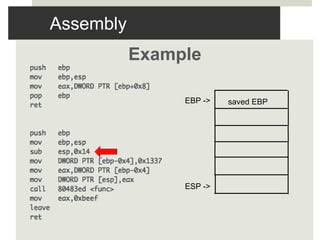
Example
saved EBP
ESP ->
EBP ->
Assembly
Example
saved EBPEBP ->
ESP ->
0x1337
Assembly
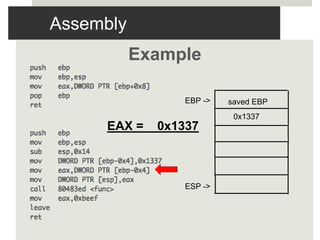
Example
EBP ->
ESP ->
saved EBP
0x1337
EAX = 0x1337
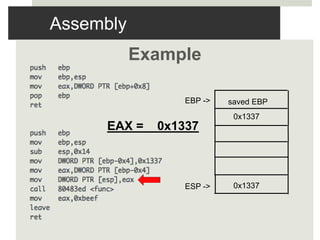
Assembly
Example
EBP ->
ESP ->
saved EBP
0x1337
EAX = 0x1337
0x1337
Assembly
Example
EBP ->
ESP ->
saved EBP
0x1337
0x1337
addr of next inst
Assembly
Example
EBP ->
ESP ->
saved EBP
0x1337
0x1337
addr of mov eax, 0xbeef
saves EBP
Assembly
Example
EBP and ESP ->
previous base ptr
0x1337
0x1337
current base ptr
addr of mov eax, 0xbeef
Assembly
Example
EBP and ESP ->
previous base ptr
0x1337
0x1337
current base ptr
EAX = 0x1337
addr of mov eax, 0xbeef
Assembly
Example
base ptr
0x1337
0x1337
EBP ->
ESP -> addr of mov eax, 0xbeef
Assembly
Example
0x1337
0x1337
EBP ->
ESP -> addr of mov eax, 0xbeef
RET = POP EIP
base ptr
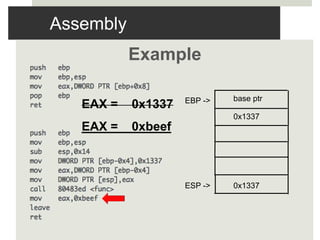
Assembly
Example
0x1337
0x1337
EBP ->
ESP ->
base ptr
EAX = 0x1337
EAX = 0xbeef
Assembly
Example
0x1337
0x1337
EBP ->
ESP ->
base ptr
LEAVE = MOV ESP, EBP
POP EBP
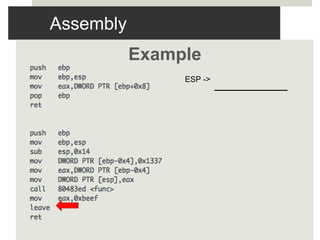
Assembly
Example
ESP ->
Assembly
Example
ESP ->
Assembly
LEA
• Load Effective Address
• Does not dereference square brackets – []
• Often used with pointer arithmetic
• Often used for loading the address of a local buffer into
a register
• LEA EAX, [EBP-0x64]
Assembly
JMP
• Unconditional Jump
• Changes EIP to the address of the jump
• Does not push the return address to the stack like a
CALL does
• Relative and Absolute
Assembly
Jcc
• Conditional Jump – jump is taken only if the condition is
met
Assembly
JNE / JNZ
• Jump if Not Equal / Jump if Not Zero
• Both check if the ZF is 0
• Jump is taken if the ZF is 1
Assembly
JE / JZ
• Jump if Equal / Jump if Zero
• Both check if the ZF is 0
• Jump is taken if ZF is 0
Assembly
JLE / JNG
• Jump if Less or Equal / Jump if Not Greater
• Jump if ZF == 1
• Jump if SF != OF
Assembly
JGE / JNL
• Jump if Greater or Equal / Jump if Not Less
• Jump if ZF == 1
• Jump if CF == 1
Assembly
JBE
• Jump if Below or Equal
• Jump if ZF == 1
• Jump if CF == 1
Assembly
JB / JL
• Jump if Below / Jump if Less
• Jump if CF == 1
Assembly
What sets the EFLAGS ?
• What we care about: CMP and TEST
• Any arithmetic can set a flag !
Assembly
CMP
• Compare
• CMP does a SUB but discards the result
• Affects flags: CF, OF, SF, ZF, AF and PF
Assembly
TEST
• Does bitwise logical AND
• Sets the flags and discards the result
• Affected flags: SF, ZF and PF
• Very frequently used for checking if value in question is
0 or anything else
Assembly
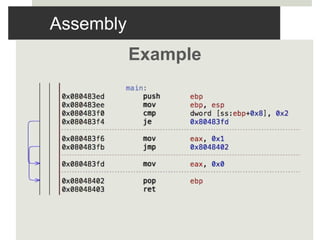
Example
int main(int argc, char* argv[]){
if (argc != 2) {
return 1;
}
else {
return 0;
}
}
Assembly
Example
Assembly
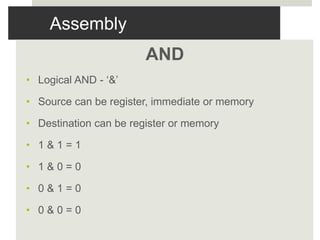
AND
• Logical AND - ‘&’
• Source can be register, immediate or memory
• Destination can be register or memory
• 1 & 1 = 1
• 1 & 0 = 0
• 0 & 1 = 0
• 0 & 0 = 0
Assembly
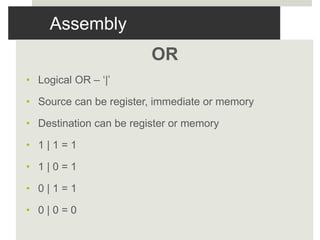
OR
• Logical OR – ‘|’
• Source can be register, immediate or memory
• Destination can be register or memory
• 1 | 1 = 1
• 1 | 0 = 1
• 0 | 1 = 1
• 0 | 0 = 0
Assembly
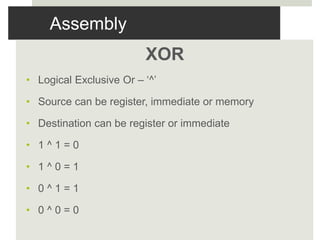
XOR
• Logical Exclusive Or – ‘^’
• Source can be register, immediate or memory
• Destination can be register or immediate
• 1 ^ 1 = 0
• 1 ^ 0 = 1
• 0 ^ 1 = 1
• 0 ^ 0 = 0
Assembly
NOT
• Flips the bits – One’s compliment
• Single source/destination operand can be register,
immediate or memory
Assembly
What we know so far
• NOP
• PUSH/POP
• CALL/RET/LEAVE
• MOV/LEA
• ADD/SUB
• JMP/Jcc
• CMP/TEST
• AND/OR/XOR/NOT
Assembly
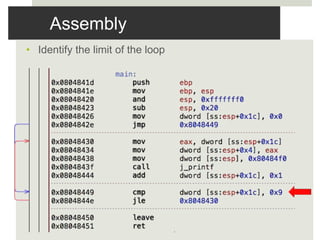
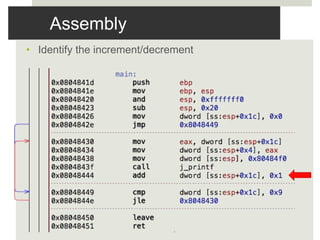
LOOPS
• Identify the initialization of the loop counter variable
• Identify the limit of the loop
• Identify the increment/decrement
Assembly
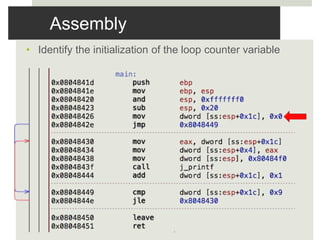
Example
#include <stdio.h>
int main(int argc, char* argv[]){
int i;
for (i = 0; i < 10; i++){
printf("Looping %dn", i);
}
}
Assembly
• Identify the initialization of the loop counter variable
Assembly
• Identify the limit of the loop
Assembly
• Identify the increment/decrement
Assembly
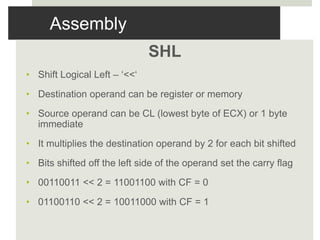
SHL
• Shift Logical Left – ‘<<‘
• Destination operand can be register or memory
• Source operand can be CL (lowest byte of ECX) or 1 byte
immediate
• It multiplies the destination operand by 2 for each bit shifted
• Bits shifted off the left side of the operand set the carry flag
• 00110011 << 2 = 11001100 with CF = 0
• 01100110 << 2 = 10011000 with CF = 1
Assembly
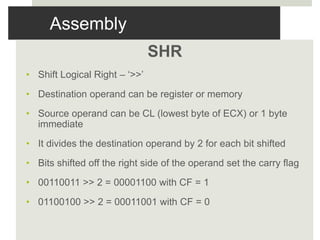
SHR
• Shift Logical Right – ‘>>’
• Destination operand can be register or memory
• Source operand can be CL (lowest byte of ECX) or 1 byte
immediate
• It divides the destination operand by 2 for each bit shifted
• Bits shifted off the right side of the operand set the carry flag
• 00110011 >> 2 = 00001100 with CF = 1
• 01100100 >> 2 = 00011001 with CF = 0
Assembly
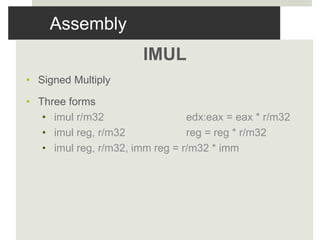
IMUL
• Signed Multiply
• Three forms
• imul r/m32 edx:eax = eax * r/m32
• imul reg, r/m32 reg = reg * r/m32
• imul reg, r/m32, imm reg = r/m32 * imm
Assembly
MUL
• Same as IMUL but unsigned
Assembly
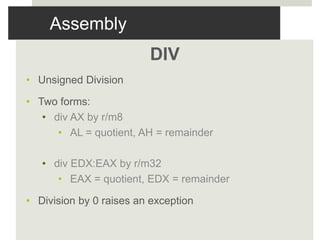
DIV
• Unsigned Division
• Two forms:
• div AX by r/m8
• AL = quotient, AH = remainder
• div EDX:EAX by r/m32
• EAX = quotient, EDX = remainder
• Division by 0 raises an exception
Assembly
IDIV
• Same as DIV but signed
Assembly
REP STOS
• Repeat Store String
• REP is standalone repetition instruction
• STOS is also standalone instruction
• Uses ECX as a counter
• Can move a byte or dword at at time
• Moves byte AL into [EDI] or dword EAX into [EDI]
• Increments EDI register by 1 or 4
• Pre-requisites:
• Set EDI to the destination address
• Initialize EAX with value to store
• Initialize ECX as counter
Assembly
REP MOVS
• Repeat Move Data String to String
• Same as REP STOS but instead of storing a single
byte/dword from EAX we can copy data from source to
destination via ESI as source operand and EDI as
destination operand
• Each loop increments ESI, EDI and decrements ECX
• REP MOVS DWORD PTR [ESI], DWORD PTR [EDI]
• Pre-requisites:
• Initialize ESI with the address of the data source
• Initialize EDI with the address of the data dest
• Initialize ECX as the counter
Assembly
NEG
• Negate – Performs two’s compliment
• Single operand can be r/m32
• Two’s Compliment = Flip the bits and add 1
• Turns positive to negative and vice versa
Assembly
What we know so far
• NOP
• PUSH/POP
• CALL/RET/LEAVE
• MOV/LEA
• ADD/SUB
• JMP/Jcc
• CMP/TEST
• AND/OR/XOR/NOT
• SHL/SHR
• MUL/IMUL
• DIV/IDIV
• REP STOS
• REP MOVS
• NEG
• LOOPS
Assembly
Example
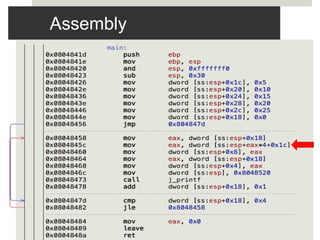
#include <stdio.h>
int main(int argc, char* argv[]){
int int_array[5] = {0x5, 0x10, 0x15, 0x20, 0x25};
int i;
for (i = 0; i < 5; i++){
printf("Int at index %d is %dn", i, int_array[i]);
}
}
Assembly
Example
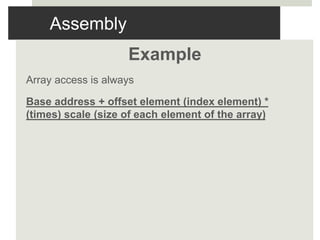
Array access is always
Base address + offset element (index element) *
(times) scale (size of each element of the array)
Assembly
Calling Conventions
What are calling conventions ?
• How arguments are passed to functions
Calling Conventions
What are calling conventions ?
• How arguments are passed to functions
Calling Conventions
What are calling conventions ?
• How arguments are passed to functions
• Who cleans the stack
• Return values
Calling Conventions
CDECL
• C Declaration
• Arguments are pushed to the stack right to left –
meaning the first argument will be on top of the stack
• Return value is stored in EAX or EDX:EAX
• Caller is responsible for cleaning the stack – meaning
cleaning up the arguments pushed
Calling Conventions
STDCALL
• Standard Call
• Arguments are pushed to the stack right to left –
meaning the first argument will be on top of the stack
• Return value is stored in EAX
• Callee is responsible for cleaning the stack – meaning
callee function is responsible for cleaning up the
arguments pushed by the Caller function
Debuggers and
Disassemblers
Decompilers
• Opposite to compiler, takes compiled binary as input
and produces high level source code.
• Hex-Rays Decompiler ~$3,000 per architecture
• The Hopper ~$80
• Free - https://retdec.com/
Debuggers and
Disassemblers
Disassemblers
• Translates machine language into assembly language
• Static Analysis – The binary application is not executed
• IDA Pro – The Interactive Disassembler
• The Hopper
• Objdump
Debuggers and
Disassemblers
Disassemblers Hotkeys
• space – Switch between linear view / graph view
• n – name a variable/function/argument
• g – Go to address
• x – Cross reference
• esc – Go back to the previous location / Move out of a function
• d – Convert code to data or change the data type from
byte/word/dword/qword
• c – Convert data to code
• p – Define a procedure
• u – Undefine a procedure
• ; – Set a comment
Debuggers and
Disassemblers
Debuggers
• Can disassemble
• Dynamic Analysis – Executes the binary program
• GDB
• OllyDbg
• WinDbg
• Radare2
• IDA Pro
• Edb
Debuggers and
Disassemblers
GDB Commands
• break <func>/*<addr> – sets a breakpoint
• disassemble <func> – disassemblers a routine
• x – Examine
• x/2wx $esp – examine 2 words (4 bytes) in hex from
ESP (top of the stack) towards EBP, UP
• x/10i $eip – examine 10 instructions from EIP
• x/2bx $eax – examine 2 bytes in hex from EAX
• x/s $esp – examine as ASCII string
Debuggers and
Disassemblers
GDB Commands
• set $eax = 1 – set EAX to 1
• set *$eax = 1 – write 1 to the address where EAX points
to
• info registers – display content of the registers
• si/stepi – single step
• ni/nexti – step over
• finish – step out
Where to Now ?
• CTFs !!!
• Lena’s tutorials
• Practical Malware Analysis book
• CrackMe !!!
• Malware
• Practice Practice Practice… and more practice

Intro to reverse engineering owasp

  • 1.
    Intro to Reverse EngineeringBy: Tsvetelin (Vincent) Choranov OWASP Open Web Application Security Project
  • 2.
    Schedule • 9:00 –10:30 am • C Refresher • Data Types • Process Structure and Virtual Memory • 10:30 – 10:45 am • Break • 10:45 – Noon • X86 Registers • Stack • Noon – 1:00 pm • Lunch • 1:00 – 2:30 pm • Assembly Instructions • Calling Conventions • 2:30 – 2:45 pm • Break • 2:45 – 4:30 pm • Debuggers Disassemblers and Decompilers
  • 3.
    C refresher -Control Flow • If statement • If-else • While / Until • For loops • Switch/Case statements ( Jump tables )
  • 4.
    C refresher -Control Flow • Pseudo-code – if statement if ( You are hungry ) { Find food while ( Found food is not good ) { Find something else to eat } Eat food } else { Go play }
  • 5.
    C refresher -Control Flow • Pseudo-code – else statement if ( You are hungry ) { Find food while ( Found food is not good ) { Find something else to eat } Eat food } else { Go play }
  • 6.
    C refresher -Control Flow • Pseudo-code – while statement if ( You are hungry ) { Find food while ( Found food is not good ) { Find something else to eat } Eat food } else { Go play }
  • 7.
    C refresher -Control Flow • Pseudo-code – for loop for ( int i = 0 ; i < 10 ; i++ ) { do something } Key points: • Identify the initialization of the counter variable • Identify the limit • Identify the increment
  • 8.
    C refresher -Control Flow • Pseudo-code – switch/case statement my_int = 2 ; my_int = 2 ; switch ( my_int ) { case 1: if ( my_int == 1 ) { do something do something break } case 2: else if ( my_int == 2 ) { do something do something break } default: else { do something do something } }
  • 9.
    C refresher -Control Flow • Pseudo-code – switch/case statement sometimes produce jump tables
  • 10.
    C refresher -Variables • Local • Global • Initialized / Uninitialized • Signed / Unsigned Integer • Pointer • Structure
  • 11.
    C refresher -Data Types
  • 12.
    C refresher -Data Types • Notations: • half a word = 2 bytes • word = 2/4 bytes • dword = 4 bytes • qword/giant = 8 bytes
  • 13.
  • 14.
  • 15.
  • 16.
    Assembly Endianness • Big-endian andlittle-endian are terms that describe the order in which a sequence of bytes are stored in computer memory. Big-endian is an order in which the "big end" (most significant value in the sequence) is stored first (at the lowest storage address).
  • 17.
  • 18.
  • 19.
    Assembly NOP • No operation •0x90 • Used for alignment • In exploitation used for NOP-sleds
  • 20.
    Assembly PUSH • Pushes datato the stack • Size of data is word, dword, qword • Data can be an immediate value or register • Decrements ESP
  • 21.
    Assembly POP • Pops avalue from the stack to a register • Increments ESP
  • 22.
    Assembly MOV • Move operation •Moves: • register to register • memory to register • register to memory • immediate to register • immediate to memory • memory to memory • MOV EAX, [EBX]
  • 23.
    Assembly SUB • Subtract operation •Source can be memory, immediate or register • Destination can be memory or register • Source and Destination can NOT be memory • It can be used to evaluate an expression • Influences the following EFLAGS • OF, SF, ZF, AF, PF and CF
  • 24.
    Assembly ADD • Addition operation •Source can be memory, immediate or register • Destination can be memory or register • Source and Destination can NOT be memory • It can be used to evaluate an expression • Influences the following EFLAGS • OF, SF, ZF, AF, PF and CF
  • 25.
    Assembly CALL • Execute aprocedure • It pushes the address of the next instruction after the call to the stack, so execution can be restored once the called procedure returns • Changes EIP to the address of the called procedure
  • 26.
    Assembly LEAVE • Restores theprevious stack frame • Essentially does: • MOV ESP, EBP • POP EBP
  • 27.
    Assembly RET • Return froma procedure • RET == POP EIP • POP increments ESP • Also seen as RET 0x?? which pops into EIP and increments ESP by 0x??
  • 28.
    Assembly • NOP • PUSH •POP • MOV • SUB • ADD • RET • LEAVE • CALL
  • 29.
    Assembly Example int func(int x){ returnx; } int main(void){ int x = 0x1337; func(x); return 0xbeef; }
  • 30.
  • 31.
  • 32.
    Assembly Example EBP holds thebase address of the previous stack frame saves EBPESP now points here ->
  • 33.
    Assembly Example ESP is COPIEDto EBP. EBP is now the base of our new stack frame. Which is the stack frame for main() saved EBPESP now points here ->
  • 34.
  • 35.
  • 36.
    Assembly Example EBP -> ESP -> savedEBP 0x1337 EAX = 0x1337
  • 37.
    Assembly Example EBP -> ESP -> savedEBP 0x1337 EAX = 0x1337 0x1337
  • 38.
    Assembly Example EBP -> ESP -> savedEBP 0x1337 0x1337 addr of next inst
  • 39.
    Assembly Example EBP -> ESP -> savedEBP 0x1337 0x1337 addr of mov eax, 0xbeef saves EBP
  • 40.
    Assembly Example EBP and ESP-> previous base ptr 0x1337 0x1337 current base ptr addr of mov eax, 0xbeef
  • 41.
    Assembly Example EBP and ESP-> previous base ptr 0x1337 0x1337 current base ptr EAX = 0x1337 addr of mov eax, 0xbeef
  • 42.
  • 43.
    Assembly Example 0x1337 0x1337 EBP -> ESP ->addr of mov eax, 0xbeef RET = POP EIP base ptr
  • 44.
  • 45.
    Assembly Example 0x1337 0x1337 EBP -> ESP -> baseptr LEAVE = MOV ESP, EBP POP EBP
  • 46.
  • 47.
  • 48.
    Assembly LEA • Load EffectiveAddress • Does not dereference square brackets – [] • Often used with pointer arithmetic • Often used for loading the address of a local buffer into a register • LEA EAX, [EBP-0x64]
  • 49.
    Assembly JMP • Unconditional Jump •Changes EIP to the address of the jump • Does not push the return address to the stack like a CALL does • Relative and Absolute
  • 50.
    Assembly Jcc • Conditional Jump– jump is taken only if the condition is met
  • 51.
    Assembly JNE / JNZ •Jump if Not Equal / Jump if Not Zero • Both check if the ZF is 0 • Jump is taken if the ZF is 1
  • 52.
    Assembly JE / JZ •Jump if Equal / Jump if Zero • Both check if the ZF is 0 • Jump is taken if ZF is 0
  • 53.
    Assembly JLE / JNG •Jump if Less or Equal / Jump if Not Greater • Jump if ZF == 1 • Jump if SF != OF
  • 54.
    Assembly JGE / JNL •Jump if Greater or Equal / Jump if Not Less • Jump if ZF == 1 • Jump if CF == 1
  • 55.
    Assembly JBE • Jump ifBelow or Equal • Jump if ZF == 1 • Jump if CF == 1
  • 56.
    Assembly JB / JL •Jump if Below / Jump if Less • Jump if CF == 1
  • 57.
    Assembly What sets theEFLAGS ? • What we care about: CMP and TEST • Any arithmetic can set a flag !
  • 58.
    Assembly CMP • Compare • CMPdoes a SUB but discards the result • Affects flags: CF, OF, SF, ZF, AF and PF
  • 59.
    Assembly TEST • Does bitwiselogical AND • Sets the flags and discards the result • Affected flags: SF, ZF and PF • Very frequently used for checking if value in question is 0 or anything else
  • 60.
    Assembly Example int main(int argc,char* argv[]){ if (argc != 2) { return 1; } else { return 0; } }
  • 61.
  • 62.
    Assembly AND • Logical AND- ‘&’ • Source can be register, immediate or memory • Destination can be register or memory • 1 & 1 = 1 • 1 & 0 = 0 • 0 & 1 = 0 • 0 & 0 = 0
  • 63.
    Assembly OR • Logical OR– ‘|’ • Source can be register, immediate or memory • Destination can be register or memory • 1 | 1 = 1 • 1 | 0 = 1 • 0 | 1 = 1 • 0 | 0 = 0
  • 64.
    Assembly XOR • Logical ExclusiveOr – ‘^’ • Source can be register, immediate or memory • Destination can be register or immediate • 1 ^ 1 = 0 • 1 ^ 0 = 1 • 0 ^ 1 = 1 • 0 ^ 0 = 0
  • 65.
    Assembly NOT • Flips thebits – One’s compliment • Single source/destination operand can be register, immediate or memory
  • 66.
    Assembly What we knowso far • NOP • PUSH/POP • CALL/RET/LEAVE • MOV/LEA • ADD/SUB • JMP/Jcc • CMP/TEST • AND/OR/XOR/NOT
  • 67.
    Assembly LOOPS • Identify theinitialization of the loop counter variable • Identify the limit of the loop • Identify the increment/decrement
  • 68.
    Assembly Example #include <stdio.h> int main(intargc, char* argv[]){ int i; for (i = 0; i < 10; i++){ printf("Looping %dn", i); } }
  • 69.
    Assembly • Identify theinitialization of the loop counter variable
  • 70.
    Assembly • Identify thelimit of the loop
  • 71.
    Assembly • Identify theincrement/decrement
  • 72.
    Assembly SHL • Shift LogicalLeft – ‘<<‘ • Destination operand can be register or memory • Source operand can be CL (lowest byte of ECX) or 1 byte immediate • It multiplies the destination operand by 2 for each bit shifted • Bits shifted off the left side of the operand set the carry flag • 00110011 << 2 = 11001100 with CF = 0 • 01100110 << 2 = 10011000 with CF = 1
  • 73.
    Assembly SHR • Shift LogicalRight – ‘>>’ • Destination operand can be register or memory • Source operand can be CL (lowest byte of ECX) or 1 byte immediate • It divides the destination operand by 2 for each bit shifted • Bits shifted off the right side of the operand set the carry flag • 00110011 >> 2 = 00001100 with CF = 1 • 01100100 >> 2 = 00011001 with CF = 0
  • 74.
    Assembly IMUL • Signed Multiply •Three forms • imul r/m32 edx:eax = eax * r/m32 • imul reg, r/m32 reg = reg * r/m32 • imul reg, r/m32, imm reg = r/m32 * imm
  • 75.
    Assembly MUL • Same asIMUL but unsigned
  • 76.
    Assembly DIV • Unsigned Division •Two forms: • div AX by r/m8 • AL = quotient, AH = remainder • div EDX:EAX by r/m32 • EAX = quotient, EDX = remainder • Division by 0 raises an exception
  • 77.
  • 78.
    Assembly REP STOS • RepeatStore String • REP is standalone repetition instruction • STOS is also standalone instruction • Uses ECX as a counter • Can move a byte or dword at at time • Moves byte AL into [EDI] or dword EAX into [EDI] • Increments EDI register by 1 or 4 • Pre-requisites: • Set EDI to the destination address • Initialize EAX with value to store • Initialize ECX as counter
  • 79.
    Assembly REP MOVS • RepeatMove Data String to String • Same as REP STOS but instead of storing a single byte/dword from EAX we can copy data from source to destination via ESI as source operand and EDI as destination operand • Each loop increments ESI, EDI and decrements ECX • REP MOVS DWORD PTR [ESI], DWORD PTR [EDI] • Pre-requisites: • Initialize ESI with the address of the data source • Initialize EDI with the address of the data dest • Initialize ECX as the counter
  • 80.
    Assembly NEG • Negate –Performs two’s compliment • Single operand can be r/m32 • Two’s Compliment = Flip the bits and add 1 • Turns positive to negative and vice versa
  • 81.
    Assembly What we knowso far • NOP • PUSH/POP • CALL/RET/LEAVE • MOV/LEA • ADD/SUB • JMP/Jcc • CMP/TEST • AND/OR/XOR/NOT • SHL/SHR • MUL/IMUL • DIV/IDIV • REP STOS • REP MOVS • NEG • LOOPS
  • 82.
    Assembly Example #include <stdio.h> int main(intargc, char* argv[]){ int int_array[5] = {0x5, 0x10, 0x15, 0x20, 0x25}; int i; for (i = 0; i < 5; i++){ printf("Int at index %d is %dn", i, int_array[i]); } }
  • 83.
    Assembly Example Array access isalways Base address + offset element (index element) * (times) scale (size of each element of the array)
  • 84.
  • 85.
    Calling Conventions What arecalling conventions ? • How arguments are passed to functions
  • 86.
    Calling Conventions What arecalling conventions ? • How arguments are passed to functions
  • 87.
    Calling Conventions What arecalling conventions ? • How arguments are passed to functions • Who cleans the stack • Return values
  • 88.
    Calling Conventions CDECL • CDeclaration • Arguments are pushed to the stack right to left – meaning the first argument will be on top of the stack • Return value is stored in EAX or EDX:EAX • Caller is responsible for cleaning the stack – meaning cleaning up the arguments pushed
  • 89.
    Calling Conventions STDCALL • StandardCall • Arguments are pushed to the stack right to left – meaning the first argument will be on top of the stack • Return value is stored in EAX • Callee is responsible for cleaning the stack – meaning callee function is responsible for cleaning up the arguments pushed by the Caller function
  • 90.
    Debuggers and Disassemblers Decompilers • Oppositeto compiler, takes compiled binary as input and produces high level source code. • Hex-Rays Decompiler ~$3,000 per architecture • The Hopper ~$80 • Free - https://retdec.com/
  • 91.
    Debuggers and Disassemblers Disassemblers • Translatesmachine language into assembly language • Static Analysis – The binary application is not executed • IDA Pro – The Interactive Disassembler • The Hopper • Objdump
  • 92.
    Debuggers and Disassemblers Disassemblers Hotkeys •space – Switch between linear view / graph view • n – name a variable/function/argument • g – Go to address • x – Cross reference • esc – Go back to the previous location / Move out of a function • d – Convert code to data or change the data type from byte/word/dword/qword • c – Convert data to code • p – Define a procedure • u – Undefine a procedure • ; – Set a comment
  • 93.
    Debuggers and Disassemblers Debuggers • Candisassemble • Dynamic Analysis – Executes the binary program • GDB • OllyDbg • WinDbg • Radare2 • IDA Pro • Edb
  • 94.
    Debuggers and Disassemblers GDB Commands •break <func>/*<addr> – sets a breakpoint • disassemble <func> – disassemblers a routine • x – Examine • x/2wx $esp – examine 2 words (4 bytes) in hex from ESP (top of the stack) towards EBP, UP • x/10i $eip – examine 10 instructions from EIP • x/2bx $eax – examine 2 bytes in hex from EAX • x/s $esp – examine as ASCII string
  • 95.
    Debuggers and Disassemblers GDB Commands •set $eax = 1 – set EAX to 1 • set *$eax = 1 – write 1 to the address where EAX points to • info registers – display content of the registers • si/stepi – single step • ni/nexti – step over • finish – step out
  • 96.
    Where to Now? • CTFs !!! • Lena’s tutorials • Practical Malware Analysis book • CrackMe !!! • Malware • Practice Practice Practice… and more practice

Editor's Notes

  • #2 Introduce yourself Mention CTFs What is Reverse Engineering all about
  • #14  15 min break
  • #16 Last-In-First-Out Local variables Arguments Back trace (keeps track of which functions were called before that)
  • #19 For now we only care about two: Zero Flag - its set if the result of some instruction is zero, otherwise it’s cleared Sign Flag - Set equal to the MSB of the result, which is the sign bit of a signed integer (0 indicates positive value, 1 indicates negative value)
  • #23 - Explain about square brackets mean dereference
  • #35 This is main()’s current stack frame All the local variables will be placed between this virtual address space, between EBP and ESP EBP is referred as THE BASE POINTER because all the local variables will be referenced by an offset from EBP.
  • #51 Jump Check condition
  • #52 Both are the same
  • #53 Jump Check condition
  • #54 Jump Check condition
  • #55 Jump Check condition
  • #56 Jump Check condition
  • #57 Don’t memorize the FLAGS, memorize the meaning of the jump – meaning BELOW, LESS THAN, EQUAL, NOT EQUAL, GREATER THAN, BELOW and so on…
  • #58 Jump Check condition
  • #66 - One’s compliment is simply flipping all the bits
  • #75 - Explain r/m32 meaning REGISTER or MEMORY operand
  • #79 - All REP instructions use ECX as a counter
  • #83 - Array access
  • #84 - Array access
  • #85 Array access Base+offset*scale
  • #89 - Caller is the outer function that calls the callee function
  • #90 - Caller is the outer function that calls the callee function
  • #92 - Opposite of assemblers