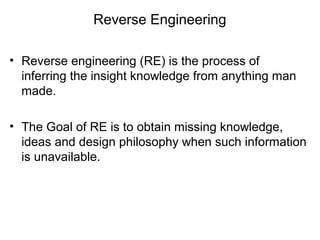
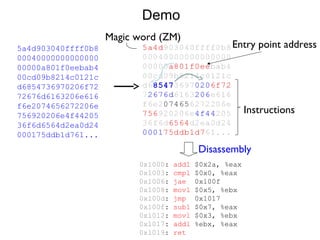
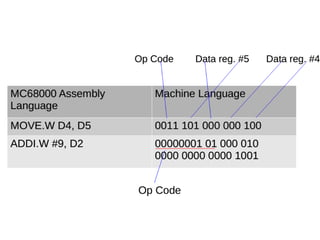
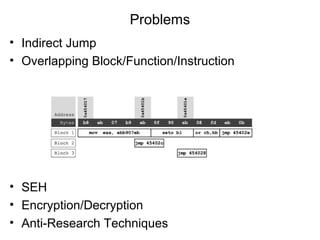
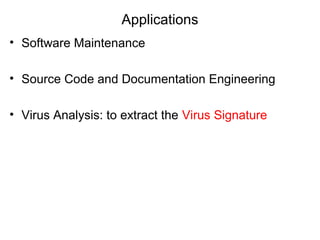
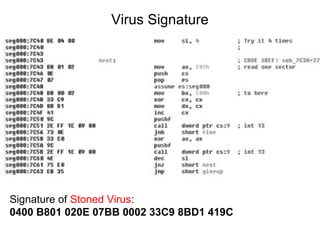
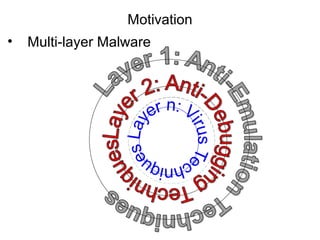
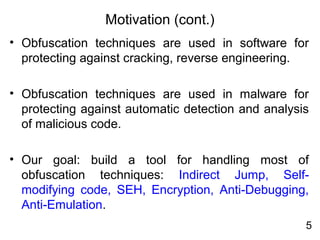
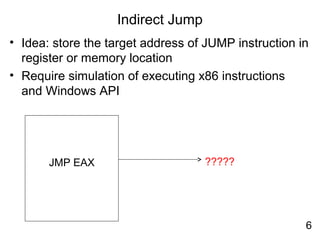
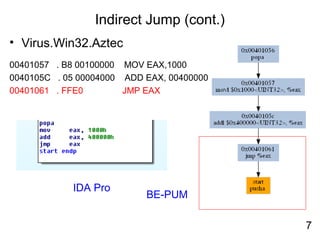
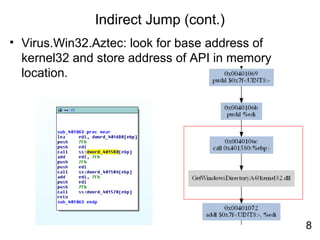
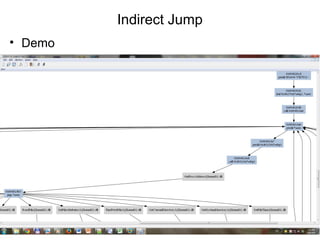
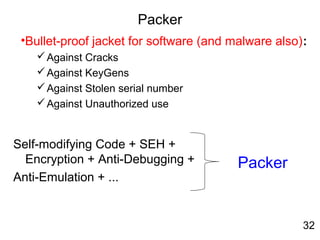
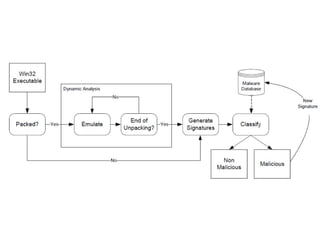
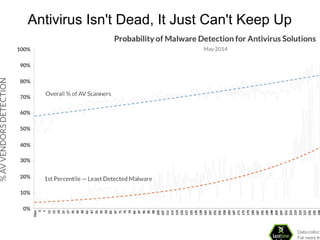
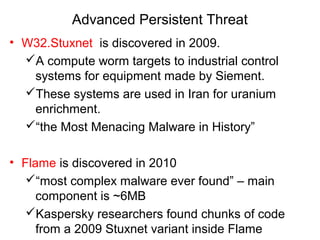
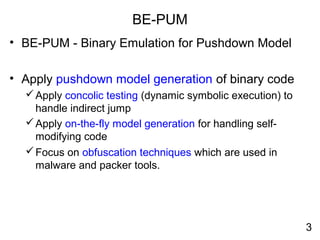
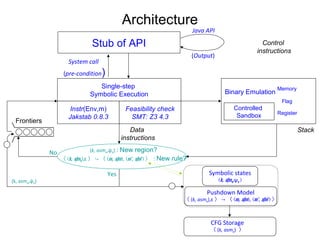
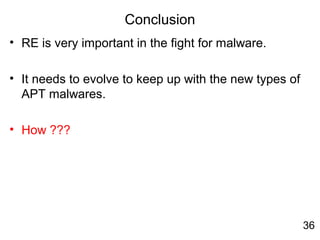
Reverse engineering techniques are used to analyze malware and understand obfuscated code. The document discusses various anti-research techniques used by malware authors to obstruct reverse engineering, including indirect jumps, self-modifying code, encryption, anti-debugging methods, and anti-emulation tricks. It also presents the author's research on a binary emulation system called BE-PUM that uses symbolic execution and pushdown modeling to analyze obfuscated code and handle anti-research obstructions.

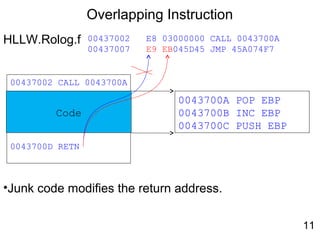
![Self-Modifying Code
• Virus.Win32.Seppuku.1606 : Self-Modifying Code
00401646 E8 B5F9FFFF CALL 00401000
EDI = 401067
004010E5 MOV EAX,DWORD PTR SS:[EBP+401489]
004010EB STOS DWORD PTR ES:[EDI]
00401646 E8 00000000 CALL 0040164B
13](https://image.slidesharecdn.com/reverseengineering20151112-160309034803/85/Reverse-engineering20151112-19-320.jpg)
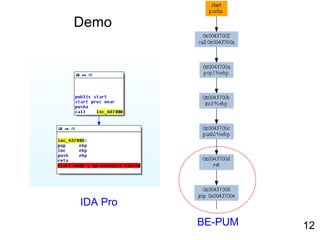
![Decryption
• Email-Worm.Win32.Kickin.d : Self-decryption
00609223 pop ebp
00609224 push 3d
00609226 mov byte ptr ds:[esi+9cccd0e5],dh
0060922C retn 8d9e
0060922F pxor mm5,mm3
00609232 dec ecx
00609233 fiadd word ptr ds:[ecx+80a6b31]
Decryption loop
ecx was set to 0CAh0060933A mov ecx,0ca
00609345 lods byte ptr ds:[esi]
00609346 xor al,ah
00609348 inc ah
0060934A rol ah,2
0060934D add ah,90
00609350 stos byte ptr es:[edi]
00609351 loopd 00609345
00609223 call 00609228
00609228 mov ebx, [ebp+402705]
0060922E add ebx,28
00609231 pop eax
00609232 sub eax,ebx
00609234 mov [ebp+40270d],eax
14](https://image.slidesharecdn.com/reverseengineering20151112-160309034803/85/Reverse-engineering20151112-20-320.jpg)
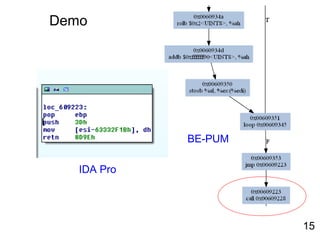
![SEH
• SEH - Structured Exception Handler
• Used to handle error in running code
• Malware uses this method to intentionally cause a
change in the execution flow
push offset SEH_Handler
push dword ptr fs:[0]
mov fs:[0],esp
16](https://image.slidesharecdn.com/reverseengineering20151112-160309034803/85/Reverse-engineering20151112-22-320.jpg)
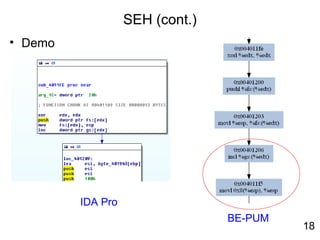
![SEH (cont.)
004011FE xor edx, edx
00401200 push dword ptr [edx]
00401203 mov dword ptr [edx], esp
00401206 inc dword ptr [edx]
00401209 lea esi,dword ptr [ebp+401943]
edx = 0
Set up SEH
Exception occurs!
17](https://image.slidesharecdn.com/reverseengineering20151112-160309034803/85/Reverse-engineering20151112-23-320.jpg)
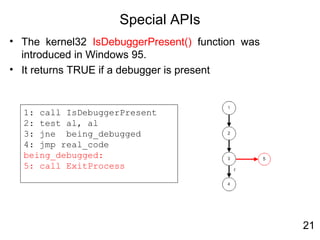
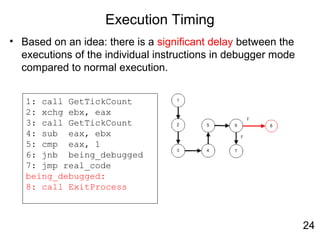
![Anti-debugging
• Use NtGlobalFlag field which exists at offset 0x68 in the PEB
(Process Environemnt Block)
• PEB is a structure created in process initialization
• PEB contains data necessary to the execution of a process.
• Used by ExeCryptor
1: mov eax, fs:[30h] ;PEB
;check NtGlobalFlag
2: cmp byte [eax+68h], 70h
3: jne being_debugged
4: jmp real_code
being_debugged:
5: call ExitProcess
19](https://image.slidesharecdn.com/reverseengineering20151112-160309034803/85/Reverse-engineering20151112-26-320.jpg)
![Anti-debugging (cont.)
• Use the process default heap to find presence of
debugging artifacts
1: mov eax, fs:[30h] ;PEB
;get process heap base
2: mov eax, [eax+18h]
3: mov eax, [eax+0ch] ;Flags
4: dec eax
5: dec eax
6: jne being_debugged
7: jmp real_code
being_debugged:
8: call ExitProcess
20](https://image.slidesharecdn.com/reverseengineering20151112-160309034803/85/Reverse-engineering20151112-27-320.jpg)
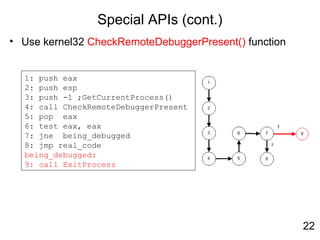
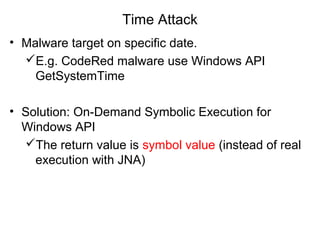
![Demo
• Win32.Voltage
1: lea eax,[ebp + SYSTEMTIME]
2: push eax
3: call [ebp + GetLocalTime]
4: cmp word ptr [ebp+wMonth],12
5: jne NoPayLoad
6: cmp word ptr [ebp +wDay],29
7: jne NoPayLoad
8: push eax
9: push eax
10: push 0h
11: call [ebp + MessageBox]
NoPayLoad:
12: Call ExitProcess](https://image.slidesharecdn.com/reverseengineering20151112-160309034803/85/Reverse-engineering20151112-31-320.jpg)
![Exception
• Using exceptions to alter the value of eip
• An effective anti-debugging technique
• Used by packer PECompact
1: xor eax, eax
2: push offset l3
3: push dw fs:[eax]
4: mov fs:[eax], esp
l1:
5: call l1
l2:
6: jmp l3
l3:
7: pop eax
25](https://image.slidesharecdn.com/reverseengineering20151112-160309034803/85/Reverse-engineering20151112-33-320.jpg)
![Exception (cont.)
• Used in packer Telock
00407A1B PUSHAD
00407A1C CALL 00407A27
00407A27 PUSH DWORD PTR FS:[0]
00407A2D MOV DWORD PTR FS:[0],ESP
00407A33 PUSHFD
00407A34 OR DWORD PTR SS:[ESP],100
00407A3B POPFD
00407A3C CLC
00407A3D JNB SHORT 00407A1B
26](https://image.slidesharecdn.com/reverseengineering20151112-160309034803/85/Reverse-engineering20151112-34-320.jpg)




![[ROOTCON13] Pilot Study on Semi-Automated Patch Diffing by Applying Machine-L...](https://cdn.slidesharecdn.com/ss_thumbnails/rootcon-200517103713-thumbnail.jpg?width=640&height=640&fit=bounds)


![Fermín J. Serna - Exploits & Mitigations: EMET [RootedCON 2010]](https://cdn.slidesharecdn.com/ss_thumbnails/ferminjserna-exploitsmitigationsemet-100328034335-phpapp02-thumbnail.jpg?width=640&height=640&fit=bounds)


