CNIT 125:
Information Security
Professional
(CISSP
Preparation)
Ch 8. Software Development
Security
Updated 5-9-23
Programming Concepts
Machine Code, Source Code, and
Assembly Language
• Machine code
• Binary language built into CPU
• Source code
• Human-readable language like C
• Assembly Language
• Low-level commands one step above
machine language
• Commands like ADD, SUB, PUSH
Compilers, Interpreters, and Bytecode
• Compilers translate source code into
machine code
• Interpreters translate each line of code
into machine code on the fly while the
program runs
• Bytecode is an intermediary form
between source code and machine code,
ready to be executed in a Java Virtual
Machine
Procedural and Object-Oriented
Languages
• Procedural languages use subroutines,
procedures and functions
• Ex: C, FORTRAN
• Object-oriented languages define
abstract objects
• Have attributes and methods
• Can inherit properties from parent
objects
• Ex: C++, Ruby, Python
Metasploit Source Code
• Link Ch 9a
Fourth-Generation Programming
Languages (4GL)
• Automate creation of code
Computer-Aided Software Engineering
(CASE)
• Programs assist in creation and
maintenance of other programs
• Three types
• Tools: support one task
• Workbenches: Integrate several tools
• Environments: Support entire process
• 4GL, object-oriented languages, and
GUIs are used as components of CASE
Top-Down vs. Bottom-Up Programming
• Top-Down
• Starts with high-level requirements
• Common with procedural languages
• Bottom-Up
• Starts with low-level technical
implementation details
• Common with object-oriented
languages
Types of Publicly Released Software
• Closed Source
• Source code is confidential
• Open Source
• Free Software
• May cost $0, or be open to modify
• Freeware: costs $0
• Shareware: free trial period
• Crippleware: limited free version
Software Licensing
• Public domain (free to use)
• Proprietary software is copyrighted, and
sometimes patented
• EULA (End User License Agreement)
• Open-source licenses
• GNU Public License (GPL)
• Berkeley Software Distribution (BSD)
• Apache
Application Development Methods
Waterfall Model
• From 1969
• One-way
• No iteration
• Unrealistic
Modified Waterfall Model
Sashimi Model
• Steps
overlap
Agile Software Development
• Agile methods include Scrum and
Extreme Programming (XP)
• Agile Manifesto
Scrum
• Stop running the relay race
• Doing only one step and handing off
the project
• Take up rugby
• A team goes the distance as a unit
Extreme Programming (XP)
• Pairs of programmers work off a detailed
specification
• Constant communication with fellow
programmers and customers
Spiral
• Many rounds
• Each round is a project; may use
waterfall model
• Risk analysis performed for each round
Rapid Application Development (RAD)
• Goal: quickly meet business needs
• Uses prototypes, "dummy" GUIs, and
back-end databases
Prototyping
• Breaks projects into smaller tasks
• Create multiple mockups (prototypes)
• Customer sees realistic-looking results
long before the final product is
completed
SDLC
• Systems Development Life Cycle
• or Software Development Life Cycle
• Security included in every phase
• NIST Special Publication 800-14
SDLC Phases
• Initiation
• Development / Acquisition
• Implementation
• Operation
• Disposal
• Security plan should be first step
SDLC Overview
• Prepare security plan
• Initiation: define need and purpose
• Sensitivity Assessment
• Development / Acquisition
• Determine security requirements and
incorporate them into specifications
• Implementation
• Install controls, security testing,
accreditation
SDLC Overview
• Operation / Maintenance
• Security operations and administration:
backups, training, key management,
etc.
• Audits and monitoring
• Disposal
• Archiving
• Media sanitization
Integrated Product Teams
• A customer-focused group that focuses
on the entire lifecycle of a project
• More agile than traditional hierarchical
teams
Software Escrow
• Third party archives source code of
proprietary software
• Source code is revealed if the product is
orphaned
Code Repository Security
• Like GitHub
• Contents must be protected
• Developers shouldn't publish code that
contains secrets
Security of Application Programming
Interfaces (APIs)
• API allows apps to use a service, like
Facebook
• API exploits abuse the API to
compromise security
OWASP Enterprise Security API Toolkits
Software Change and Configuration
Management
• Ensures that changes occur in an orderly
fashion, and don't harm security
• NIST SP 80-128 describes a
Configuration Management Plan (CMP)
• Configuration Control Board (CCB)
• Configuration Item Identification
• Configuration Change Control
• Configuration Monitoring
DevOps
• Old system had strict separation of
duties between developers, quality
assurance, and production
• DevOps is more agile, with everyone
working together in the entire service
lifecycle
Ch 8a
Databases
Database
• Structured collection of data
• Databases allow
• Queries (searches)
• Insertions
• Deletions
• Database Management Systems (DBMS)
• Controls all access to the database
• Enforces database security
Database Concepts
• Database Administrator (DBA)
• Query language
• Ex: Structured Query Language (SQL)
• Inference attack
• Enumerating low-privilege data to find
missing items, which must be
high-privilege
• Aggregation attack
• Combining many low-privilege records to
deduce high-privilege data
Types of Databases
• Relational
• Hierarchical
• Object-oriented
• Flat file
• Simple text file
Relational Databases
Relational Database Terms
• Tables have rows (records or tuples) and
columns (fields or attributes)
• Primary Key field is guaranteed to be
unique, like a SSN
• Foreign key is a field in another table that
matched the primary key
• Join connects two tables by a matching
field
Integrity
• Referential Integrity
• Foreign keys match primary keys
• Semantic Integrity
• Field values match data type (no letters
in numerical fields)
• Entity Integrity
• Each tuple has a non-null primary key
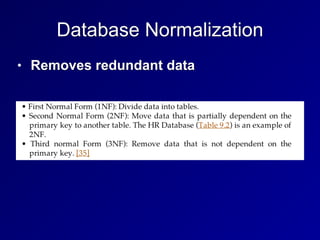
Database Normalization
• Removes redundant data
Database Views
• Contained user interface
• Shows only some data and options
• Like a PoS (Point of Sale) device
Data Dictionary
• Describes the tables
• This is metadata -- data about data
• Database schema
• Describes the attributes and values of
the tables
Query Languages
• Two subsets of commands
• Data Definition Language (DDL)
• Data Manipulation Language (DML)
• Structured Query Language (SQL) is the
most common query language
• Many types
• MySQL, ANSI SQL (used by Microsoft),
PL/SQL (Procedural Language/SQL,
used by Oracle), and more
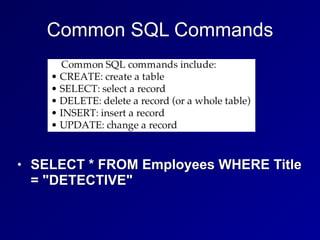
Common SQL Commands
• SELECT * FROM Employees WHERE Title
= "DETECTIVE"
Hierarchical Databases
• A tree, like DNS
Object-Oriented Databases
• Combines data and functions in an
object-oriented framework
• Uses Object Oriented Programming
(OOP)
• and Object Database Management
System (OBMS)
Database Integrity
• Mitigate unauthorized data modification
• Two users may attempt to change the
same record simultaneously
• The DBMS attempts to commit an update
• If the commit is unsuccessful, the DBMS
can rollback and restore from a save
point
• Database journal logs all transactions
Database Replication and Shadowing
• Highly Available (HA) databases
• Multiple servers
• Multiple copies of tables
• Database replication
• Mirrors a live database
• Original and copy are in use, serving
clients
• Shadow database
• Live backup, not used
Data Warehousing and Data Mining
• Data Warehouse
• A large collection of data
• Terabytes (1000 GB)
• Petabytes (1000 TB)
• Data Mining
• Searching for patterns
• Ex: finding credit card fraud
Object-Oriented Design and
Programming
Object-Oriented Programming (OOP)
• A program is a series of connected
objects that communicate via messages
• Ex: Java, C++, Smalltalk, Ruby
• Objects contain data and methods
• Objects provide data hiding
• Internal structure not visible from the
outside
• Also called encapsulation
Object-Oriented Programming Concepts
• Objects
• Methods
• Messages
• Inheritance
• Delegation
• Polymorphism
• Polyinstantiation
Example
• Addy is an object
• It has a method of addition
• Input message is "1+2"
• Output message is "3"
Delegation and Polymorphism
Polymorphism: the same "Addy" could
process integers and string inputs
Polyinstantiation
• Multiple records for the same primary
key, with different clearance levels
Object Request Brokers (ORBs)
• Middleware
• Connect programs to other programs
• Object search engines
• Common ORBs
• COM, DCOM, CORBA
COM and DCOM
• Component Object Model
• Distributed Component Object Model
• From Microsoft
• Allows objects written in different OOP
languages to communicate
• Assemble a program by connecting
components together like puzzle pieces
• Includes ActiveX objects and Object
Linking and Embedding (OLE)
• COM and DCOM are being supplanted by
Microsoft.NET
CORBA
• Common Object Request Broker
Architecture
• Open vendor-neutral framework
• Competes with Microsoft's proprietary
DCOM
• Objects communicate via Interface
Definition Language (IDL)
Object-Oriented Analysis (OOA) &
Object-Oriented Design (OOD)
• Object-Oriented Analysis (OOA)
• Analyzes a problem domain
• Identifies all objects and interactions
• Object-Oriented Design (OOD)
• Then develops the solution
Ch 8b
Assessing the Effectiveness
of Software Security
Software Vulnerabilities
• 15-50 errors per 1000 lines of code
• Windows Vista has 50 million lines of
code
Types of Software Vulnerabilities
• Hard-coded credentials
• Buffer overflow
• SQL injection
• Directory path traversal
• PHP Remote File Inclusion
Buffer Overflow
• Program reserves space for a variable
• Ex: name[20]
• User submits data that's too long to fit
• Data written beyond the reserved space
and corrupts memory
• Can lead to Remote Code Execution
TOCTOU / Race Conditions
• Time of Check/Time of Use (TOCTOU)
attacks (also called Race Conditions)
• A brief time of vulnerability
• Attacker needs to "win the race"
Cross-Site Scripting (XSS)
• Insert Javascript into a page
• For example, a comment box
• The code executes on another user's
machine
• BeEF (Browser Exploitation Framework)
• Allows an attacker to control targets'
browsers
Cross-Site Request Forgery (CSRF)
• Trick a user into executing an unintended
action
• With a malicious URL
• Or by using a stolen cookie
Privilege Escalation
• Vertical escalation
• Attacker increases privilege level
• To "Administrator", "root", or
"SYSTEM"
• Horizontal escalation
• To another user's account
Backdoor
• Shortcut into a system, bypassing
security checks like username/password
• May be through exploiting a vulnerability
• Or a backdoor account left in the system
by its developer
Disclosure
• Actions taken by a security researcher
after finding a software vulnerability
• Full Disclosure
• Release all details publicly
• Responsible Disclosure
• Tell vendor privately
• Give them time to patch it
Software Capability Maturity Model
(CMM)
• From Carnegie Mellon
• A methodical framework for creating
quality software
Five Levels of CMM
1. Initial - ad-hoc & chaotic
• Depends on individual effort
2. Repeatable - basic project management
3. Defined
• Documented standardized process
4. Managed
• Controlled, measured process & quality
5. Optimizing
• Continual process improvement
Acceptance Testing
• ISTQB (International Software Testing
Qualifications Board) has 4 levels
• User acceptance test
• Operational acceptance test
• Contract acceptance testing
• Compliance acceptance testing
Security Impact of Acquired Software
• Commercial Off-the-Shelf (COTS)
Software
• Compare vendor claims with third-party
research
• Consider vendors going out of
business, and support
• Custom-Developed Third Party Products
• Service Level Agreements (SLA) are
vital
Artificial Intelligence
Expert Systems
• Two components
• Knowledge Base
• If/then statements
• Contain rules that the expert system
uses to make decisions
• Inference Engine
• Follows the tree formed by the
knowledge base
Multi-Layer Artificial Neural Network
• Simulates
real brains
Bayesian Filtering
• Looks for probabilities of words in spam
v. good email
Genetic Algorithms and Programming
• Simulates evolution
Ch 8c

8. Software Development Security

  • 1.
    CNIT 125: Information Security Professional (CISSP Preparation) Ch8. Software Development Security Updated 5-9-23
  • 2.
  • 3.
    Machine Code, SourceCode, and Assembly Language • Machine code • Binary language built into CPU • Source code • Human-readable language like C • Assembly Language • Low-level commands one step above machine language • Commands like ADD, SUB, PUSH
  • 4.
    Compilers, Interpreters, andBytecode • Compilers translate source code into machine code • Interpreters translate each line of code into machine code on the fly while the program runs • Bytecode is an intermediary form between source code and machine code, ready to be executed in a Java Virtual Machine
  • 5.
    Procedural and Object-Oriented Languages •Procedural languages use subroutines, procedures and functions • Ex: C, FORTRAN • Object-oriented languages define abstract objects • Have attributes and methods • Can inherit properties from parent objects • Ex: C++, Ruby, Python
  • 6.
  • 7.
  • 8.
    Computer-Aided Software Engineering (CASE) •Programs assist in creation and maintenance of other programs • Three types • Tools: support one task • Workbenches: Integrate several tools • Environments: Support entire process • 4GL, object-oriented languages, and GUIs are used as components of CASE
  • 9.
    Top-Down vs. Bottom-UpProgramming • Top-Down • Starts with high-level requirements • Common with procedural languages • Bottom-Up • Starts with low-level technical implementation details • Common with object-oriented languages
  • 10.
    Types of PubliclyReleased Software • Closed Source • Source code is confidential • Open Source • Free Software • May cost $0, or be open to modify • Freeware: costs $0 • Shareware: free trial period • Crippleware: limited free version
  • 11.
    Software Licensing • Publicdomain (free to use) • Proprietary software is copyrighted, and sometimes patented • EULA (End User License Agreement) • Open-source licenses • GNU Public License (GPL) • Berkeley Software Distribution (BSD) • Apache
  • 12.
  • 13.
    Waterfall Model • From1969 • One-way • No iteration • Unrealistic
  • 14.
  • 15.
  • 16.
    Agile Software Development •Agile methods include Scrum and Extreme Programming (XP) • Agile Manifesto
  • 17.
    Scrum • Stop runningthe relay race • Doing only one step and handing off the project • Take up rugby • A team goes the distance as a unit
  • 18.
    Extreme Programming (XP) •Pairs of programmers work off a detailed specification • Constant communication with fellow programmers and customers
  • 19.
    Spiral • Many rounds •Each round is a project; may use waterfall model • Risk analysis performed for each round
  • 21.
    Rapid Application Development(RAD) • Goal: quickly meet business needs • Uses prototypes, "dummy" GUIs, and back-end databases
  • 22.
    Prototyping • Breaks projectsinto smaller tasks • Create multiple mockups (prototypes) • Customer sees realistic-looking results long before the final product is completed
  • 23.
    SDLC • Systems DevelopmentLife Cycle • or Software Development Life Cycle • Security included in every phase • NIST Special Publication 800-14
  • 24.
    SDLC Phases • Initiation •Development / Acquisition • Implementation • Operation • Disposal • Security plan should be first step
  • 25.
    SDLC Overview • Preparesecurity plan • Initiation: define need and purpose • Sensitivity Assessment • Development / Acquisition • Determine security requirements and incorporate them into specifications • Implementation • Install controls, security testing, accreditation
  • 26.
    SDLC Overview • Operation/ Maintenance • Security operations and administration: backups, training, key management, etc. • Audits and monitoring • Disposal • Archiving • Media sanitization
  • 27.
    Integrated Product Teams •A customer-focused group that focuses on the entire lifecycle of a project • More agile than traditional hierarchical teams
  • 28.
    Software Escrow • Thirdparty archives source code of proprietary software • Source code is revealed if the product is orphaned
  • 29.
    Code Repository Security •Like GitHub • Contents must be protected • Developers shouldn't publish code that contains secrets
  • 30.
    Security of ApplicationProgramming Interfaces (APIs) • API allows apps to use a service, like Facebook • API exploits abuse the API to compromise security
  • 31.
  • 32.
    Software Change andConfiguration Management • Ensures that changes occur in an orderly fashion, and don't harm security • NIST SP 80-128 describes a Configuration Management Plan (CMP) • Configuration Control Board (CCB) • Configuration Item Identification • Configuration Change Control • Configuration Monitoring
  • 33.
    DevOps • Old systemhad strict separation of duties between developers, quality assurance, and production • DevOps is more agile, with everyone working together in the entire service lifecycle
  • 34.
  • 35.
  • 36.
    Database • Structured collectionof data • Databases allow • Queries (searches) • Insertions • Deletions • Database Management Systems (DBMS) • Controls all access to the database • Enforces database security
  • 37.
    Database Concepts • DatabaseAdministrator (DBA) • Query language • Ex: Structured Query Language (SQL) • Inference attack • Enumerating low-privilege data to find missing items, which must be high-privilege • Aggregation attack • Combining many low-privilege records to deduce high-privilege data
  • 38.
    Types of Databases •Relational • Hierarchical • Object-oriented • Flat file • Simple text file
  • 39.
  • 40.
    Relational Database Terms •Tables have rows (records or tuples) and columns (fields or attributes) • Primary Key field is guaranteed to be unique, like a SSN • Foreign key is a field in another table that matched the primary key • Join connects two tables by a matching field
  • 41.
    Integrity • Referential Integrity •Foreign keys match primary keys • Semantic Integrity • Field values match data type (no letters in numerical fields) • Entity Integrity • Each tuple has a non-null primary key
  • 43.
  • 44.
    Database Views • Containeduser interface • Shows only some data and options • Like a PoS (Point of Sale) device
  • 45.
    Data Dictionary • Describesthe tables • This is metadata -- data about data • Database schema • Describes the attributes and values of the tables
  • 47.
    Query Languages • Twosubsets of commands • Data Definition Language (DDL) • Data Manipulation Language (DML) • Structured Query Language (SQL) is the most common query language • Many types • MySQL, ANSI SQL (used by Microsoft), PL/SQL (Procedural Language/SQL, used by Oracle), and more
  • 48.
    Common SQL Commands •SELECT * FROM Employees WHERE Title = "DETECTIVE"
  • 49.
  • 50.
    Object-Oriented Databases • Combinesdata and functions in an object-oriented framework • Uses Object Oriented Programming (OOP) • and Object Database Management System (OBMS)
  • 51.
    Database Integrity • Mitigateunauthorized data modification • Two users may attempt to change the same record simultaneously • The DBMS attempts to commit an update • If the commit is unsuccessful, the DBMS can rollback and restore from a save point • Database journal logs all transactions
  • 52.
    Database Replication andShadowing • Highly Available (HA) databases • Multiple servers • Multiple copies of tables • Database replication • Mirrors a live database • Original and copy are in use, serving clients • Shadow database • Live backup, not used
  • 53.
    Data Warehousing andData Mining • Data Warehouse • A large collection of data • Terabytes (1000 GB) • Petabytes (1000 TB) • Data Mining • Searching for patterns • Ex: finding credit card fraud
  • 54.
  • 55.
    Object-Oriented Programming (OOP) •A program is a series of connected objects that communicate via messages • Ex: Java, C++, Smalltalk, Ruby • Objects contain data and methods • Objects provide data hiding • Internal structure not visible from the outside • Also called encapsulation
  • 56.
    Object-Oriented Programming Concepts •Objects • Methods • Messages • Inheritance • Delegation • Polymorphism • Polyinstantiation
  • 57.
    Example • Addy isan object • It has a method of addition • Input message is "1+2" • Output message is "3"
  • 58.
    Delegation and Polymorphism Polymorphism:the same "Addy" could process integers and string inputs
  • 59.
    Polyinstantiation • Multiple recordsfor the same primary key, with different clearance levels
  • 60.
    Object Request Brokers(ORBs) • Middleware • Connect programs to other programs • Object search engines • Common ORBs • COM, DCOM, CORBA
  • 61.
    COM and DCOM •Component Object Model • Distributed Component Object Model • From Microsoft • Allows objects written in different OOP languages to communicate • Assemble a program by connecting components together like puzzle pieces • Includes ActiveX objects and Object Linking and Embedding (OLE) • COM and DCOM are being supplanted by Microsoft.NET
  • 62.
    CORBA • Common ObjectRequest Broker Architecture • Open vendor-neutral framework • Competes with Microsoft's proprietary DCOM • Objects communicate via Interface Definition Language (IDL)
  • 63.
    Object-Oriented Analysis (OOA)& Object-Oriented Design (OOD) • Object-Oriented Analysis (OOA) • Analyzes a problem domain • Identifies all objects and interactions • Object-Oriented Design (OOD) • Then develops the solution
  • 65.
  • 66.
  • 67.
    Software Vulnerabilities • 15-50errors per 1000 lines of code • Windows Vista has 50 million lines of code
  • 68.
    Types of SoftwareVulnerabilities • Hard-coded credentials • Buffer overflow • SQL injection • Directory path traversal • PHP Remote File Inclusion
  • 69.
    Buffer Overflow • Programreserves space for a variable • Ex: name[20] • User submits data that's too long to fit • Data written beyond the reserved space and corrupts memory • Can lead to Remote Code Execution
  • 70.
    TOCTOU / RaceConditions • Time of Check/Time of Use (TOCTOU) attacks (also called Race Conditions) • A brief time of vulnerability • Attacker needs to "win the race"
  • 71.
    Cross-Site Scripting (XSS) •Insert Javascript into a page • For example, a comment box • The code executes on another user's machine • BeEF (Browser Exploitation Framework) • Allows an attacker to control targets' browsers
  • 72.
    Cross-Site Request Forgery(CSRF) • Trick a user into executing an unintended action • With a malicious URL • Or by using a stolen cookie
  • 73.
    Privilege Escalation • Verticalescalation • Attacker increases privilege level • To "Administrator", "root", or "SYSTEM" • Horizontal escalation • To another user's account
  • 74.
    Backdoor • Shortcut intoa system, bypassing security checks like username/password • May be through exploiting a vulnerability • Or a backdoor account left in the system by its developer
  • 75.
    Disclosure • Actions takenby a security researcher after finding a software vulnerability • Full Disclosure • Release all details publicly • Responsible Disclosure • Tell vendor privately • Give them time to patch it
  • 76.
    Software Capability MaturityModel (CMM) • From Carnegie Mellon • A methodical framework for creating quality software
  • 77.
    Five Levels ofCMM 1. Initial - ad-hoc & chaotic • Depends on individual effort 2. Repeatable - basic project management 3. Defined • Documented standardized process 4. Managed • Controlled, measured process & quality 5. Optimizing • Continual process improvement
  • 78.
    Acceptance Testing • ISTQB(International Software Testing Qualifications Board) has 4 levels • User acceptance test • Operational acceptance test • Contract acceptance testing • Compliance acceptance testing
  • 79.
    Security Impact ofAcquired Software • Commercial Off-the-Shelf (COTS) Software • Compare vendor claims with third-party research • Consider vendors going out of business, and support • Custom-Developed Third Party Products • Service Level Agreements (SLA) are vital
  • 80.
  • 81.
    Expert Systems • Twocomponents • Knowledge Base • If/then statements • Contain rules that the expert system uses to make decisions • Inference Engine • Follows the tree formed by the knowledge base
  • 82.
    Multi-Layer Artificial NeuralNetwork • Simulates real brains
  • 83.
    Bayesian Filtering • Looksfor probabilities of words in spam v. good email
  • 84.
    Genetic Algorithms andProgramming • Simulates evolution
  • 85.