CNIT 141
Cryptography for Computer Networks
9. Hard Problems
Updated 11-2-22
Topics
• Computational Hardness
• Complexity Classes
• The Factoring Problem
• The Discrete Logarithm Problem
• How Things Can Go Wrong
Computational Hardness
• Computationally hard problems
• Also called intractable problems
• Take an unreasonable amount of time to
solve
• Regardless of hardware
Measuring Running Time
• Search an array of n elements to find x
• Loop goes from 1 to n
• Expected value: n/2
• Complexity is linear in n
• Doubling n doubles running time
search(x, array, n)
:

for i from 1 to n
 

if (array[i] == x) return i
;

return 0;
Complexity Classes
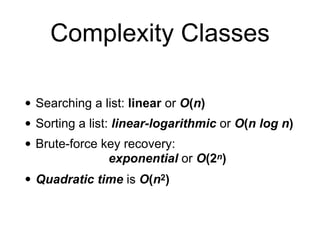
• Searching a list: linear or O(n)
• Sorting a list: linear-logarithmic or O(n log n)
• Brute-force key recovery:
exponential or O(2n)
• Quadratic time is O(n2)
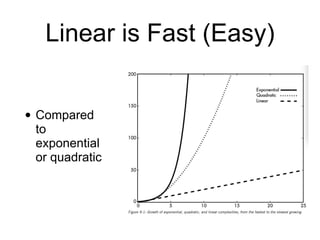
Linear is Fast (Easy)
• Compared
to
exponential
or quadratic
Polynomial vs.
Superpolynomial Time
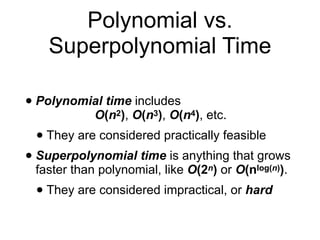
• Polynomial time includes
O(n2), O(n3), O(n4), etc.
• They are considered practically feasible
• Superpolynomial time is anything that grows
faster than polynomial, like O(2n) or O(nlog(n)).
• They are considered impractical, or hard
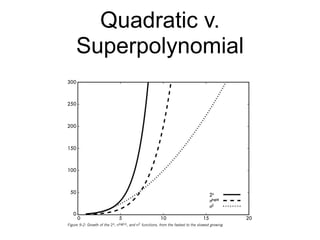
Quadratic v.
Superpolynomial
Complexity Classes
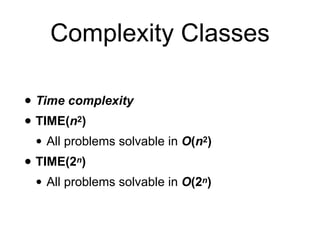
• Time complexity
• TIME(n2)
• All problems solvable in O(n2)
• TIME(2n)
• All problems solvable in O(2n)
Complexity Classes
Space Complexity
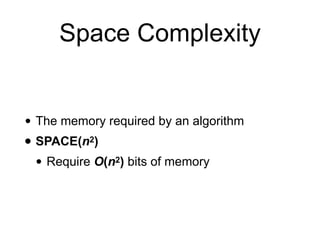
• The memory required by an algorithm
• SPACE(n2)
• Require O(n2) bits of memory
Nondeterministic
Polynomial Time
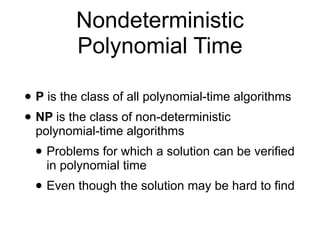
• P is the class of all polynomial-time algorithms
• NP is the class of non-deterministic
polynomial-time algorithms
• Problems for which a solution can be verified
in polynomial time
• Even though the solution may be hard to find
NP Problems
• Recovering a secret key with known plaintext
• Easy to verify whether a key is correct (P)
• Finding the key is hard but that's a different
problem
Problems Outside
NP and P
• Consider brute-forcing the one-time pad
• When the correct plaintext is unknown
• You cannot recognize the solution when you
find it
• This is very hard, not in P and not in NP
• Verify that no solution exists to a problem
• Must test all possible solutions
• An unlimited number of possibilities
NP-Complete Problems
• The hardest problems in the class NP
• We don't know how to solve them in
polynomial time
• But they are all equally hard
• An efficient solution for any one NP-complete
problem can be used to solve all the others
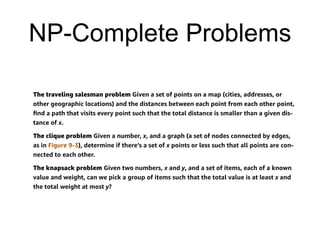
NP-Complete Problems
NP-Hard
• Some video games are NP-complete
• Tetris, Super Mario Brothers, Candy Crush
Saga
• Some are even harder: NP-hard
• Provably as difficult as NP-complete
problems
• May not be in NP
P vs. NP
• If you could solve the hardest NP problem in
polynomial time
• You could solve all NP problems in
polynomial time
• NP would equal P
• No one has proven this yet
• There's a $1 million bounty for the proof
Does P = NP?
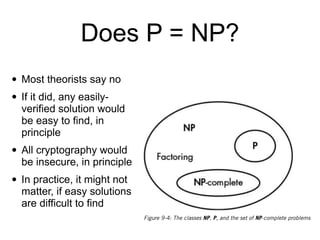
• Most theorists say no
• If it did, any easily-
verified solution would
be easy to find, in
principle
• All cryptography would
be insecure, in principle
• In practice, it might not
matter, if easy solutions
are difficult to find
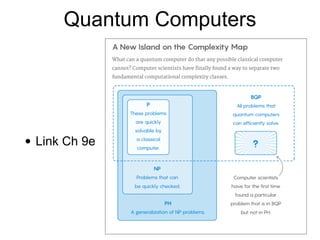
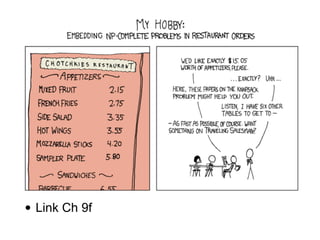
Quantum Computers
• Link Ch 9e
• Link Ch 9f
Practical Cryptography
• If breaking a cipher were NP-complete
• That would be a very strong cipher
• But NP-complete problems are impractical for
cryptography
• Because they are easy in specific cases
• So real cryptography uses problems that are
probably not NP-hard
Lattice Problems
• Including Learning With Errors
• The only NP-hard problems successfully used
in cryptography
• The basis for New Hope
• Made it to round 2, but not round 3, of the
NIST Post-Quantum Cryptography
Standardization Process
• Links Ch 9i, 9j, 9k
The Factoring Problem
• Given a large number N that is the product of
two primes p and q
• Find p and q
• How difficult is this problem?
• Prime numbers cannot be divided evenly by
any number other than themselves and one
• 1, 2, 3, 5, 7, 11 are prime
• 9=3x3 and 15=3x5 are not prime
Factoring Large Numbers
in Practice
• Simplest algorithm
• Try dividing by all numbers from 2 to N-1
• If n is the number of bits in N
• This is O(2n) --a hard problem
• Requires 2256 operations for 256-bit N
Factoring Large Numbers
in Practice
• Improved algorithm
• Try only primes from 2 to sqrt(N)
• This is O(2n/2/n) --still hard, but easier
• Requires 2120 operations for 256-bit N
Factoring Large Numbers
in Practice
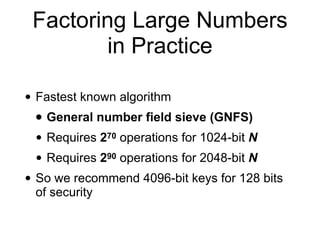
• Fastest known algorithm
• General number field sieve (GNFS)
• Requires 270 operations for 1024-bit N
• Requires 290 operations for 2048-bit N
• So we recommend 4096-bit keys for 128 bits
of security
Experimental Results
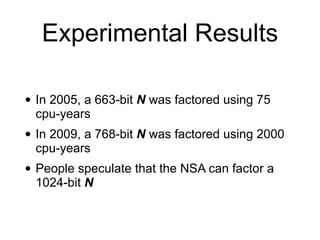
• In 2005, a 663-bit N was factored using 75
cpu-years
• In 2009, a 768-bit N was factored using 2000
cpu-years
• People speculate that the NSA can factor a
1024-bit N
Is Factoring
NP-Complete?
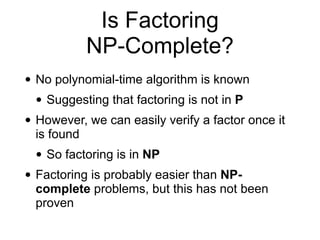
• No polynomial-time algorithm is known
• Suggesting that factoring is not in P
• However, we can easily verify a factor once it
is found
• So factoring is in NP
• Factoring is probably easier than NP-
complete problems, but this has not been
proven
Quantum Computers
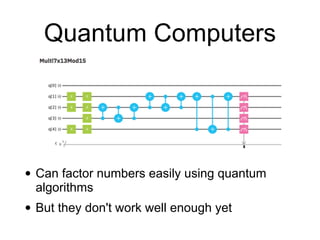
• Can factor numbers easily using quantum
algorithms
• But they don't work well enough yet
Hardness Assumption
• Cryptography starts from a problem which is
assumed to be hard
• The encryption is proven to be at least as hard
as that "hard" problem
• Factoring and discrete logarithm problems
are used as hardness assumptions
The Discrete Logarithm
Problem
What is a Group?
• A set of elements and an operation
✖︎
that
obey certain group axioms
• Example: Zp*
• Numbers from 1 to p-1, where p is prime
• Z5* contains {1, 2, 3, 4}
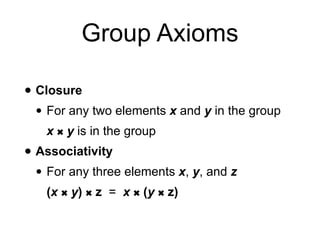
Group Axioms
• Closure
• Associativity
• Identity existence
• Inverse existence
Group Axioms
• Closure
• For any two elements x and y in the group
x
✖︎
y is in the group
• Associativity
• For any three elements x, y, and z
(x
✖︎
y)
✖︎
z = x
✖︎
(y
✖︎
z)
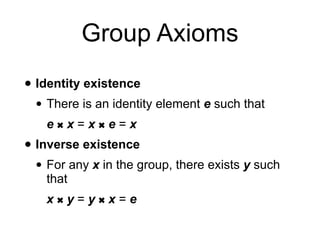
Group Axioms
• Identity existence
• There is an identity element e such that
e
✖︎
x = x
✖︎
e = x
• Inverse existence
• For any x in the group, there exists y such
that
x
✖︎
y = y
✖︎
x = e
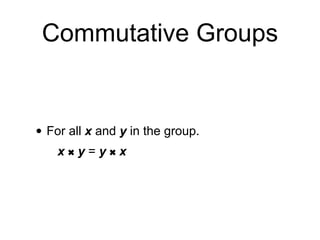
Commutative Groups
• For all x and y in the group.
x
✖︎
y = y
✖︎
x
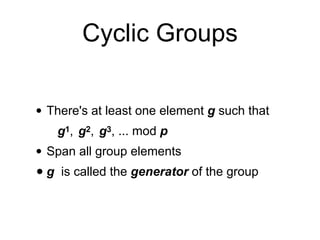
Cyclic Groups
• There's at least one element g such that
g1, g2, g3, ... mod p
• Span all group elements
• g is called the generator of the group
The Hard Thing
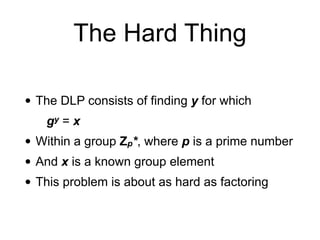
• The DLP consists of finding y for which
gy = x
• Within a group Zp*, where p is a prime number
• And x is a known group element
• This problem is about as hard as factoring
How Things Can Go
Wrong
Unlikely Problems
• These are possible but experts don't expect
them to happen
• Someone finding a fast algorithm to factor
numbers
• Someone proving that P = NP
When Factoring is Easy
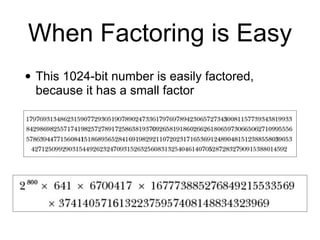
• This 1024-bit number is easily factored,
because it has a small factor
Other Easily-Factored
Numbers
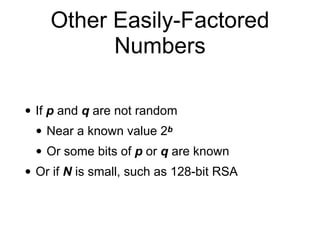
• If p and q are not random
• Near a known value 2b
• Or some bits of p or q are known
• Or if N is small, such as 128-bit RSA
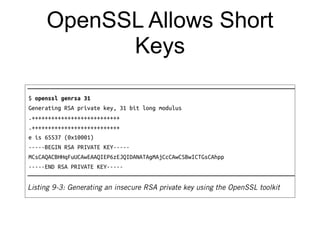
OpenSSL Allows Short
Keys
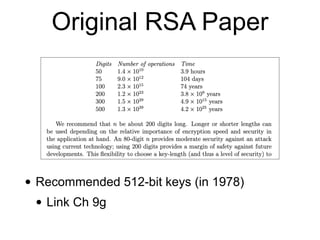
Original RSA Paper
• Recommended 512-bit keys (in 1978)
• Link Ch 9g
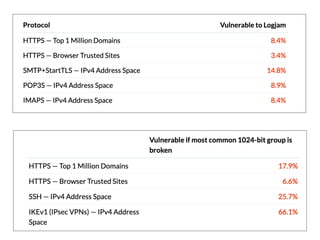
• 2015 paper presents two attacks
• Logjam MITM attack downgrades TLS to
"export-grade" with 512-bit keys
• State-level adversaries can probably find a
1024-bit secret prime number used by
millions of servers, and it appears that the
NSA has done so
• Link Ch 9h
9. Hard Problems
9. Hard Problems

9. Hard Problems

  • 1.
    CNIT 141 Cryptography forComputer Networks 9. Hard Problems Updated 11-2-22
  • 2.
    Topics • Computational Hardness •Complexity Classes • The Factoring Problem • The Discrete Logarithm Problem • How Things Can Go Wrong
  • 3.
  • 4.
    Computational Hardness • Computationallyhard problems • Also called intractable problems • Take an unreasonable amount of time to solve • Regardless of hardware
  • 5.
    Measuring Running Time •Search an array of n elements to find x • Loop goes from 1 to n • Expected value: n/2 • Complexity is linear in n • Doubling n doubles running time search(x, array, n) : for i from 1 to n if (array[i] == x) return i ; return 0;
  • 6.
    Complexity Classes • Searchinga list: linear or O(n) • Sorting a list: linear-logarithmic or O(n log n) • Brute-force key recovery: exponential or O(2n) • Quadratic time is O(n2)
  • 7.
    Linear is Fast(Easy) • Compared to exponential or quadratic
  • 8.
    Polynomial vs. Superpolynomial Time •Polynomial time includes O(n2), O(n3), O(n4), etc. • They are considered practically feasible • Superpolynomial time is anything that grows faster than polynomial, like O(2n) or O(nlog(n)). • They are considered impractical, or hard
  • 9.
  • 10.
  • 11.
    • Time complexity •TIME(n2) • All problems solvable in O(n2) • TIME(2n) • All problems solvable in O(2n) Complexity Classes
  • 12.
    Space Complexity • Thememory required by an algorithm • SPACE(n2) • Require O(n2) bits of memory
  • 13.
    Nondeterministic Polynomial Time • Pis the class of all polynomial-time algorithms • NP is the class of non-deterministic polynomial-time algorithms • Problems for which a solution can be verified in polynomial time • Even though the solution may be hard to find
  • 14.
    NP Problems • Recoveringa secret key with known plaintext • Easy to verify whether a key is correct (P) • Finding the key is hard but that's a different problem
  • 15.
    Problems Outside NP andP • Consider brute-forcing the one-time pad • When the correct plaintext is unknown • You cannot recognize the solution when you find it • This is very hard, not in P and not in NP • Verify that no solution exists to a problem • Must test all possible solutions • An unlimited number of possibilities
  • 16.
    NP-Complete Problems • Thehardest problems in the class NP • We don't know how to solve them in polynomial time • But they are all equally hard • An efficient solution for any one NP-complete problem can be used to solve all the others
  • 17.
  • 19.
    NP-Hard • Some videogames are NP-complete • Tetris, Super Mario Brothers, Candy Crush Saga • Some are even harder: NP-hard • Provably as difficult as NP-complete problems • May not be in NP
  • 20.
    P vs. NP •If you could solve the hardest NP problem in polynomial time • You could solve all NP problems in polynomial time • NP would equal P • No one has proven this yet • There's a $1 million bounty for the proof
  • 21.
    Does P =NP? • Most theorists say no • If it did, any easily- verified solution would be easy to find, in principle • All cryptography would be insecure, in principle • In practice, it might not matter, if easy solutions are difficult to find
  • 22.
  • 23.
  • 24.
    Practical Cryptography • Ifbreaking a cipher were NP-complete • That would be a very strong cipher • But NP-complete problems are impractical for cryptography • Because they are easy in specific cases • So real cryptography uses problems that are probably not NP-hard
  • 25.
    Lattice Problems • IncludingLearning With Errors • The only NP-hard problems successfully used in cryptography • The basis for New Hope • Made it to round 2, but not round 3, of the NIST Post-Quantum Cryptography Standardization Process • Links Ch 9i, 9j, 9k
  • 26.
  • 27.
    The Factoring Problem •Given a large number N that is the product of two primes p and q • Find p and q • How difficult is this problem? • Prime numbers cannot be divided evenly by any number other than themselves and one • 1, 2, 3, 5, 7, 11 are prime • 9=3x3 and 15=3x5 are not prime
  • 28.
    Factoring Large Numbers inPractice • Simplest algorithm • Try dividing by all numbers from 2 to N-1 • If n is the number of bits in N • This is O(2n) --a hard problem • Requires 2256 operations for 256-bit N
  • 29.
    Factoring Large Numbers inPractice • Improved algorithm • Try only primes from 2 to sqrt(N) • This is O(2n/2/n) --still hard, but easier • Requires 2120 operations for 256-bit N
  • 30.
    Factoring Large Numbers inPractice • Fastest known algorithm • General number field sieve (GNFS) • Requires 270 operations for 1024-bit N • Requires 290 operations for 2048-bit N • So we recommend 4096-bit keys for 128 bits of security
  • 31.
    Experimental Results • In2005, a 663-bit N was factored using 75 cpu-years • In 2009, a 768-bit N was factored using 2000 cpu-years • People speculate that the NSA can factor a 1024-bit N
  • 32.
    Is Factoring NP-Complete? • Nopolynomial-time algorithm is known • Suggesting that factoring is not in P • However, we can easily verify a factor once it is found • So factoring is in NP • Factoring is probably easier than NP- complete problems, but this has not been proven
  • 33.
    Quantum Computers • Canfactor numbers easily using quantum algorithms • But they don't work well enough yet
  • 34.
    Hardness Assumption • Cryptographystarts from a problem which is assumed to be hard • The encryption is proven to be at least as hard as that "hard" problem • Factoring and discrete logarithm problems are used as hardness assumptions
  • 35.
  • 36.
    What is aGroup? • A set of elements and an operation ✖︎ that obey certain group axioms • Example: Zp* • Numbers from 1 to p-1, where p is prime • Z5* contains {1, 2, 3, 4}
  • 37.
    Group Axioms • Closure •Associativity • Identity existence • Inverse existence
  • 38.
    Group Axioms • Closure •For any two elements x and y in the group x ✖︎ y is in the group • Associativity • For any three elements x, y, and z (x ✖︎ y) ✖︎ z = x ✖︎ (y ✖︎ z)
  • 39.
    Group Axioms • Identityexistence • There is an identity element e such that e ✖︎ x = x ✖︎ e = x • Inverse existence • For any x in the group, there exists y such that x ✖︎ y = y ✖︎ x = e
  • 40.
    Commutative Groups • Forall x and y in the group. x ✖︎ y = y ✖︎ x
  • 41.
    Cyclic Groups • There'sat least one element g such that g1, g2, g3, ... mod p • Span all group elements • g is called the generator of the group
  • 42.
    The Hard Thing •The DLP consists of finding y for which gy = x • Within a group Zp*, where p is a prime number • And x is a known group element • This problem is about as hard as factoring
  • 43.
  • 44.
    Unlikely Problems • Theseare possible but experts don't expect them to happen • Someone finding a fast algorithm to factor numbers • Someone proving that P = NP
  • 45.
    When Factoring isEasy • This 1024-bit number is easily factored, because it has a small factor
  • 46.
    Other Easily-Factored Numbers • Ifp and q are not random • Near a known value 2b • Or some bits of p or q are known • Or if N is small, such as 128-bit RSA
  • 47.
  • 48.
    Original RSA Paper •Recommended 512-bit keys (in 1978) • Link Ch 9g
  • 49.
    • 2015 paperpresents two attacks • Logjam MITM attack downgrades TLS to "export-grade" with 512-bit keys • State-level adversaries can probably find a 1024-bit secret prime number used by millions of servers, and it appears that the NSA has done so • Link Ch 9h