Contents
What is EEE programme?
Why EEE?
Who can do an EEE & what are the Eligibility criteria's
How to improve yourself while doing EEE course?
What future options one has after EEE?
Why EEE in SCT?
Conclusion
1
2
4
3
5
6
7
What is EEE programme?
Electrical and Electronics Engineering (EEE) is a Four - year (eight
semesters) professional Bachelor 's Degree in Electrical and Electronics
Engineering awarded in India.
Electrical and Electronic Engineering concerns the science and
technology related to generating, distributing and consuming electrical
energy for the benefit of mankind. Our future responsibility is to achieve
this in a safe, sustainable, environmentally benign and cost-effective way.
Why EEE?
Imagine a world without computers, mobile telephones, the
internet, electricity... that is where we would be without
Electrical Engineering. EEE underpins a significant part of
modern society and will shape the future.
Electrical engineering jobs represent over 25% of all available
jobs in engineering!
In India 30 % of the government jobs are from Electrical
Engineering sector
• A EEE student can enter in to the job market of Computer engineering,
Electronics & communication engineering, Instrumentation engineering,
control engineering, robotics, mechanical engineering, VHDL, VLSI. But
any branch of other engineering student can not enter in to the Electrical
Engineering job market.
Other than conventional Electrical Engineering jobs like power
generation, distribution, transmission, manufacturing and utilization
sectors, Electrical engineers are well positioned to address a variety of
the crucial engineering issues facing societies today.
Who can do an EEE & Eligibility
criteria's
REGULAR ENTRY:
 Any student having Mathematical Subject in HSC
LATERAL ENTRY:
 Any UG degree related to Mathematical subject
 Any Diploma students from EEE, ECE, E&I, CSE, IT
 PLC
 SCADA
 Embedded System
 MAT LAB
 Electrical CADD
How to improve yourselfHow to improve yourself
while doing EEE course?while doing EEE course?
What future options one
has after EEE?
AFTER COMPLETING EEE THE OPPORTUNITIES :
 Higher Studies:
 GATE
 ME
 PhD
 MS
 Government Sector:
 TNEB
 UPSC
 SSC
 Railway Central Board Exam
 TNPL
 Gail
 SAIL
 NLC
 BHEL
 ONGC
 NTPC
 BSNL
 MALCO
 HPCL
 IES
 ISRO
 CPRI
 Power GRID
 ISRO
 TNPSC
 TRB
OTHERS
 SIEMENS
 L&T
 Etc…
 Entrepreneur:
 Smart Scale
Electrical
manufacturing
Industries
 Hardware Sales&
Service
 Panel Board
Designing and
installation
 Solar panel & WIND
Mill Industries
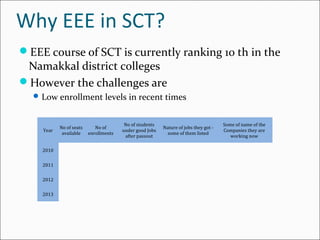
Why EEE in SCT?
EEE course of SCT is currently ranking 10 th in the
Namakkal district colleges
However the challenges are
Low enrollment levels in recent times
Year
No of seats
available
No of
enrollments
No of students
under good Jobs
after passout
Nature of jobs they got -
some of them listed
Some of name of the
Companies they are
working now
2010
2011
2012
2013
Conclusion
 EEE is a Bachelor degree, which has a very broad theoretical & Practical base in
Electrical Machines, Power System, control System and Electric Drives.
Any Questions?
Thank you

Eee ppt

  • 5.
    Contents What is EEEprogramme? Why EEE? Who can do an EEE & what are the Eligibility criteria's How to improve yourself while doing EEE course? What future options one has after EEE? Why EEE in SCT? Conclusion 1 2 4 3 5 6 7
  • 6.
    What is EEEprogramme?
  • 7.
    Electrical and ElectronicsEngineering (EEE) is a Four - year (eight semesters) professional Bachelor 's Degree in Electrical and Electronics Engineering awarded in India. Electrical and Electronic Engineering concerns the science and technology related to generating, distributing and consuming electrical energy for the benefit of mankind. Our future responsibility is to achieve this in a safe, sustainable, environmentally benign and cost-effective way.
  • 8.
    Why EEE? Imagine aworld without computers, mobile telephones, the internet, electricity... that is where we would be without Electrical Engineering. EEE underpins a significant part of modern society and will shape the future. Electrical engineering jobs represent over 25% of all available jobs in engineering! In India 30 % of the government jobs are from Electrical Engineering sector • A EEE student can enter in to the job market of Computer engineering, Electronics & communication engineering, Instrumentation engineering, control engineering, robotics, mechanical engineering, VHDL, VLSI. But any branch of other engineering student can not enter in to the Electrical Engineering job market. Other than conventional Electrical Engineering jobs like power generation, distribution, transmission, manufacturing and utilization sectors, Electrical engineers are well positioned to address a variety of the crucial engineering issues facing societies today.
  • 9.
    Who can doan EEE & Eligibility criteria's REGULAR ENTRY:  Any student having Mathematical Subject in HSC LATERAL ENTRY:  Any UG degree related to Mathematical subject  Any Diploma students from EEE, ECE, E&I, CSE, IT
  • 10.
     PLC  SCADA Embedded System  MAT LAB  Electrical CADD How to improve yourselfHow to improve yourself while doing EEE course?while doing EEE course?
  • 11.
    What future optionsone has after EEE? AFTER COMPLETING EEE THE OPPORTUNITIES :  Higher Studies:  GATE  ME  PhD  MS  Government Sector:  TNEB  UPSC  SSC  Railway Central Board Exam  TNPL  Gail  SAIL  NLC  BHEL  ONGC  NTPC  BSNL  MALCO  HPCL  IES  ISRO  CPRI  Power GRID  ISRO  TNPSC  TRB OTHERS  SIEMENS  L&T  Etc…  Entrepreneur:  Smart Scale Electrical manufacturing Industries  Hardware Sales& Service  Panel Board Designing and installation  Solar panel & WIND Mill Industries
  • 12.
    Why EEE inSCT? EEE course of SCT is currently ranking 10 th in the Namakkal district colleges However the challenges are Low enrollment levels in recent times Year No of seats available No of enrollments No of students under good Jobs after passout Nature of jobs they got - some of them listed Some of name of the Companies they are working now 2010 2011 2012 2013
  • 13.
    Conclusion  EEE isa Bachelor degree, which has a very broad theoretical & Practical base in Electrical Machines, Power System, control System and Electric Drives.
  • 14.
  • 15.