
1
Abhishek Anand
Smart grid
 What is an Electrical Grid?
 Traditional Electrical Grid Layout
 Problems with present grid
 What is a Smart Grid?
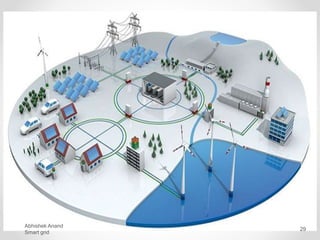
 Smart Grid Layout
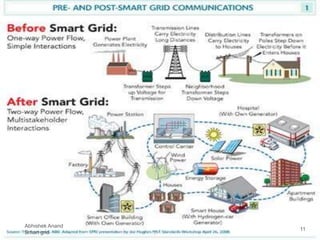
 Before and after Smart Grid
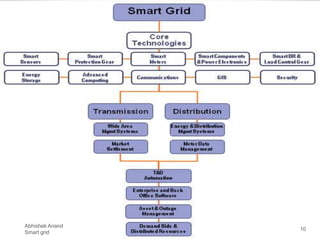
 Smart Grid technologies
 Smart Grid components
 Smart Grid benefits
 Smart Grid challenges
 INDIA and Smart Grid
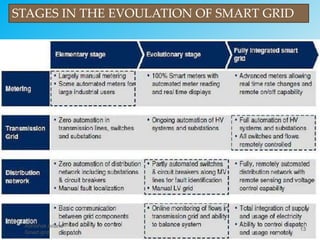
 Stages in the evolution of Smart Grid
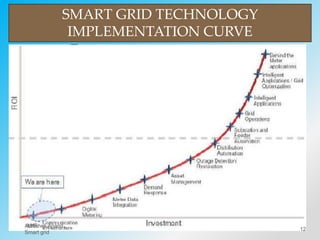
 Smart Grid technology implementation curve
 Characteristics of Smart Grid
TABLE OF CONTENTS
2
Abhishek Anand
Smart grid
WHAT IS AN ELECTRICAL GRID.
An electrical grid (also referred to as an electricity
grid or electric grid) is an interconnected network
for delivering electricity from suppliers to
consumers. It consists of generating stations that
produce electrical power, high-voltage
transmission lines that carry power from distant
sources to demand center ,and distribution lines
that connect individual customers
3
Abhishek Anand
Smart grid
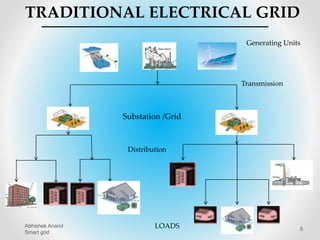
TRADITIONAL ELECTRICAL GRID
4
Abhishek Anand
Smart grid
TRADITIONAL ELECTRICAL GRID
Transmission
Distribution
Generating Units
Substation /Grid
LOADS 5
Abhishek Anand
Smart grid
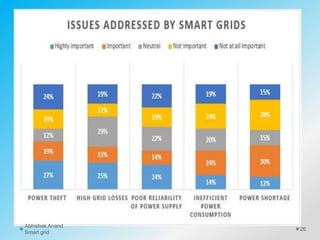
PROBLEMS WITH PRESENT GRID
 No power management
 Power Theft
 High Grid Losses
 Poor Reliability of Power Supply ie. interruption
 Insufficient Power Consumption and Power
Shortage
 Limited delivery system
 High cost of power outage and power quality
 Inefficient at managing peak load
 Communication too slow
 Major source is fossil fuel
 Almost zero customer participation
 Low billing and collecting efficiency
6
Abhishek Anand
Smart grid
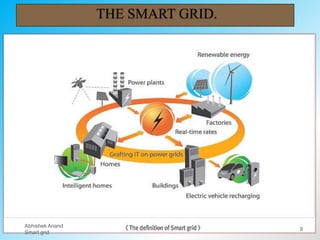
WHAT IS A SMART GRID.
 A smart grid is an evolved grid system that manages
electricity demand in a sustainable, reliable and
economic manner, built on advanced infrastructure and
tuned to facilitate the integration of all involved.
 It uses digital communications and information
technology in the generation, delivery and consumption
of electrical energy.
7
Abhishek Anand
Smart grid
THE SMART GRID.
8
Abhishek Anand
Smart grid
SMART GRID OVERVIEW
9
Abhishek Anand
Smart grid
10
Abhishek Anand
Smart grid
11
Abhishek Anand
Smart grid
SMART GRID TECHNOLOGY
IMPLEMENTATION CURVE
12
Abhishek Anand
Smart grid
STAGES IN THE EVOULATION OF SMART GRID
13
Abhishek Anand
Smart grid
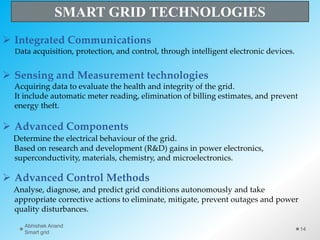
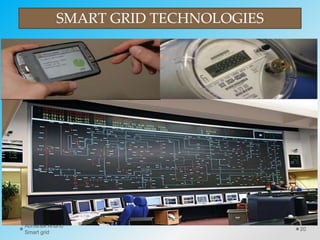
 Integrated Communications
Data acquisition, protection, and control, through intelligent electronic devices.
 Sensing and Measurement technologies
Acquiring data to evaluate the health and integrity of the grid.
It include automatic meter reading, elimination of billing estimates, and prevent
energy theft.
 Advanced Components
Determine the electrical behaviour of the grid.
Based on research and development (R&D) gains in power electronics,
superconductivity, materials, chemistry, and microelectronics.
 Advanced Control Methods
Analyse, diagnose, and predict grid conditions autonomously and take
appropriate corrective actions to eliminate, mitigate, prevent outages and power
quality disturbances.
SMART GRID TECHNOLOGIES
14
Abhishek Anand
Smart grid
Improved Interfaces and Decision Support
Convert complex power-system data into information that can be easily
understood by grid operators.
15
Abhishek Anand
Smart grid
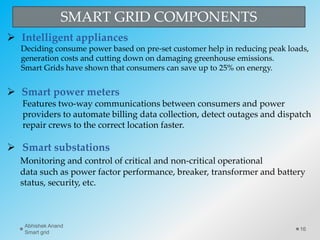
 Intelligent appliances
Deciding consume power based on pre-set customer help in reducing peak loads,
generation costs and cutting down on damaging greenhouse emissions.
Smart Grids have shown that consumers can save up to 25% on energy.
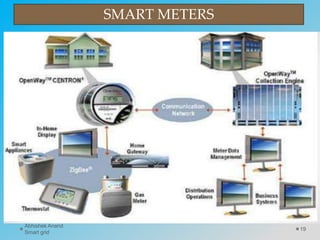
 Smart power meters
Features two-way communications between consumers and power
providers to automate billing data collection, detect outages and dispatch
repair crews to the correct location faster.
 Smart substations
Monitoring and control of critical and non-critical operational
data such as power factor performance, breaker, transformer and battery
status, security, etc.
SMART GRID COMPONENTS
16
Abhishek Anand
Smart grid
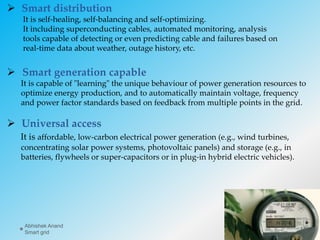
 Smart distribution
It is self-healing, self-balancing and self-optimizing.
It including superconducting cables, automated monitoring, analysis
tools capable of detecting or even predicting cable and failures based on
real-time data about weather, outage history, etc.
 Smart generation capable
It is capable of "learning" the unique behaviour of power generation resources to
optimize energy production, and to automatically maintain voltage, frequency
and power factor standards based on feedback from multiple points in the grid.
 Universal access
It is affordable, low-carbon electrical power generation (e.g., wind turbines,
concentrating solar power systems, photovoltaic panels) and storage (e.g., in
batteries, flywheels or super-capacitors or in plug-in hybrid electric vehicles).
17
Abhishek Anand
Smart grid
18
Abhishek Anand
Smart grid
SMART METERS
19
Abhishek Anand
Smart grid
SMART GRID TECHNOLOGIES
20
Abhishek Anand
Smart grid
ADVANCED DISTRIBUTION AUTOMATION
21
Abhishek Anand
Smart grid
SMART GRID BENEFITS
 Self-Healing
A smart grid automatically detects and responds to routine problems and
and quickly recovers if occur, minimizing downtime and financial
loss.
 Motivates and Includes the Consumer
A smart grid gives all consumers visibility into real-time pricing, and
help to choose the volume of consumption and price.
 Resists Attack
A smart grid has security built-in from the ground up.
 Provides Power Quality
Provides power free of sags, spikes, disturbances and interruptions.
It is use by the data centers, computers, electronics and robotic
manufacturing that will power our future economy.
22
Abhishek Anand
Smart grid
 Accommodates
A smart grid enables "plug-and-play" interconnection to multiple and
distributed sources of power and storage (e.g., wind, solar,
battery storage, etc.)
 Enables Markets
It provides consistently dependable coast-to-coast operation, a smart
grid supports energy markets that encourage both investment and
innovation.
 Optimizes Assets and Operates Efficiently
A smart grid enables us to build less new infrastructure, transmit more
power through existing systems, and thereby spend less to operate and
maintain the grid.
23
Abhishek Anand
Smart grid
SMART GRID CHALLENGES
 Financial Resources
Regulators require extensive proof before authorizing
major investments on grid for societial benefit.
 Government Support
Industry may not have the financial capacity to fund new
technologies, requires aid of government programs to
provide incentives to invest.
 Compatible Equipment
Older equipment needed to be replaced for making
compatible with smart grid technologies.
Equipment beyond its depreciated life minimizes the
capital cost to consumers but it’s early retirement may
become an issue. 24
Abhishek Anand
Smart grid
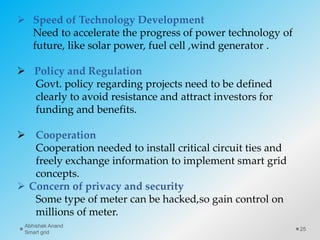
 Speed of Technology Development
Need to accelerate the progress of power technology of
future, like solar power, fuel cell ,wind generator .
 Policy and Regulation
Govt. policy regarding projects need to be defined
clearly to avoid resistance and attract investors for
funding and benefits.
 Cooperation
Cooperation needed to install critical circuit ties and
freely exchange information to implement smart grid
concepts.
 Concern of privacy and security
Some type of meter can be hacked,so gain control on
millions of meter.
25
Abhishek Anand
Smart grid
26
Abhishek Anand
Smart grid
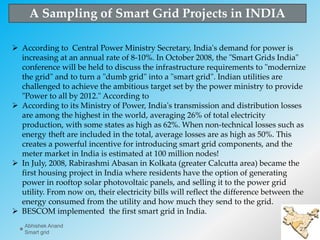
 According to Central Power Ministry Secretary, India's demand for power is
increasing at an annual rate of 8-10%. In October 2008, the "Smart Grids India"
conference will be held to discuss the infrastructure requirements to "modernize
the grid" and to turn a "dumb grid" into a "smart grid". Indian utilities are
challenged to achieve the ambitious target set by the power ministry to provide
"Power to all by 2012." According to
 According to its Ministry of Power, India's transmission and distribution losses
are among the highest in the world, averaging 26% of total electricity
production, with some states as high as 62%. When non-technical losses such as
energy theft are included in the total, average losses are as high as 50%. This
creates a powerful incentive for introducing smart grid components, and the
meter market in India is estimated at 100 million nodes!
 In July, 2008, Rabirashmi Abasan in Kolkata (greater Calcutta area) became the
first housing project in India where residents have the option of generating
power in rooftop solar photovoltaic panels, and selling it to the power grid
utility. From now on, their electricity bills will reflect the difference between the
energy consumed from the utility and how much they send to the grid.
 BESCOM implemented the first smart grid in India.
A Sampling of Smart Grid Projects in INDIA
27
Abhishek Anand
Smart grid
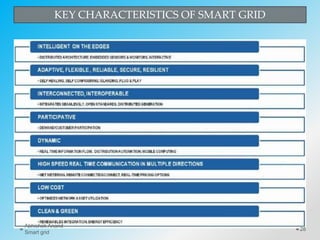
KEY CHARACTERISTICS OF SMART GRID
28
Abhishek Anand
Smart grid
29
Abhishek Anand
Smart grid
A STEP FORWARD FOR SMARTER FUTURE
THANKS
HAVE A NICE DAY
30
Abhishek Anand
Smart grid

The Smart Grid

  • 1.
  • 2.
     What isan Electrical Grid?  Traditional Electrical Grid Layout  Problems with present grid  What is a Smart Grid?  Smart Grid Layout  Before and after Smart Grid  Smart Grid technologies  Smart Grid components  Smart Grid benefits  Smart Grid challenges  INDIA and Smart Grid  Stages in the evolution of Smart Grid  Smart Grid technology implementation curve  Characteristics of Smart Grid TABLE OF CONTENTS 2 Abhishek Anand Smart grid
  • 3.
    WHAT IS ANELECTRICAL GRID. An electrical grid (also referred to as an electricity grid or electric grid) is an interconnected network for delivering electricity from suppliers to consumers. It consists of generating stations that produce electrical power, high-voltage transmission lines that carry power from distant sources to demand center ,and distribution lines that connect individual customers 3 Abhishek Anand Smart grid
  • 4.
  • 5.
    TRADITIONAL ELECTRICAL GRID Transmission Distribution GeneratingUnits Substation /Grid LOADS 5 Abhishek Anand Smart grid
  • 6.
    PROBLEMS WITH PRESENTGRID  No power management  Power Theft  High Grid Losses  Poor Reliability of Power Supply ie. interruption  Insufficient Power Consumption and Power Shortage  Limited delivery system  High cost of power outage and power quality  Inefficient at managing peak load  Communication too slow  Major source is fossil fuel  Almost zero customer participation  Low billing and collecting efficiency 6 Abhishek Anand Smart grid
  • 7.
    WHAT IS ASMART GRID.  A smart grid is an evolved grid system that manages electricity demand in a sustainable, reliable and economic manner, built on advanced infrastructure and tuned to facilitate the integration of all involved.  It uses digital communications and information technology in the generation, delivery and consumption of electrical energy. 7 Abhishek Anand Smart grid
  • 8.
  • 9.
  • 10.
  • 11.
  • 12.
    SMART GRID TECHNOLOGY IMPLEMENTATIONCURVE 12 Abhishek Anand Smart grid
  • 13.
    STAGES IN THEEVOULATION OF SMART GRID 13 Abhishek Anand Smart grid
  • 14.
     Integrated Communications Dataacquisition, protection, and control, through intelligent electronic devices.  Sensing and Measurement technologies Acquiring data to evaluate the health and integrity of the grid. It include automatic meter reading, elimination of billing estimates, and prevent energy theft.  Advanced Components Determine the electrical behaviour of the grid. Based on research and development (R&D) gains in power electronics, superconductivity, materials, chemistry, and microelectronics.  Advanced Control Methods Analyse, diagnose, and predict grid conditions autonomously and take appropriate corrective actions to eliminate, mitigate, prevent outages and power quality disturbances. SMART GRID TECHNOLOGIES 14 Abhishek Anand Smart grid
  • 15.
    Improved Interfaces andDecision Support Convert complex power-system data into information that can be easily understood by grid operators. 15 Abhishek Anand Smart grid
  • 16.
     Intelligent appliances Decidingconsume power based on pre-set customer help in reducing peak loads, generation costs and cutting down on damaging greenhouse emissions. Smart Grids have shown that consumers can save up to 25% on energy.  Smart power meters Features two-way communications between consumers and power providers to automate billing data collection, detect outages and dispatch repair crews to the correct location faster.  Smart substations Monitoring and control of critical and non-critical operational data such as power factor performance, breaker, transformer and battery status, security, etc. SMART GRID COMPONENTS 16 Abhishek Anand Smart grid
  • 17.
     Smart distribution Itis self-healing, self-balancing and self-optimizing. It including superconducting cables, automated monitoring, analysis tools capable of detecting or even predicting cable and failures based on real-time data about weather, outage history, etc.  Smart generation capable It is capable of "learning" the unique behaviour of power generation resources to optimize energy production, and to automatically maintain voltage, frequency and power factor standards based on feedback from multiple points in the grid.  Universal access It is affordable, low-carbon electrical power generation (e.g., wind turbines, concentrating solar power systems, photovoltaic panels) and storage (e.g., in batteries, flywheels or super-capacitors or in plug-in hybrid electric vehicles). 17 Abhishek Anand Smart grid
  • 18.
  • 19.
  • 20.
  • 21.
  • 22.
    SMART GRID BENEFITS Self-Healing A smart grid automatically detects and responds to routine problems and and quickly recovers if occur, minimizing downtime and financial loss.  Motivates and Includes the Consumer A smart grid gives all consumers visibility into real-time pricing, and help to choose the volume of consumption and price.  Resists Attack A smart grid has security built-in from the ground up.  Provides Power Quality Provides power free of sags, spikes, disturbances and interruptions. It is use by the data centers, computers, electronics and robotic manufacturing that will power our future economy. 22 Abhishek Anand Smart grid
  • 23.
     Accommodates A smartgrid enables "plug-and-play" interconnection to multiple and distributed sources of power and storage (e.g., wind, solar, battery storage, etc.)  Enables Markets It provides consistently dependable coast-to-coast operation, a smart grid supports energy markets that encourage both investment and innovation.  Optimizes Assets and Operates Efficiently A smart grid enables us to build less new infrastructure, transmit more power through existing systems, and thereby spend less to operate and maintain the grid. 23 Abhishek Anand Smart grid
  • 24.
    SMART GRID CHALLENGES Financial Resources Regulators require extensive proof before authorizing major investments on grid for societial benefit.  Government Support Industry may not have the financial capacity to fund new technologies, requires aid of government programs to provide incentives to invest.  Compatible Equipment Older equipment needed to be replaced for making compatible with smart grid technologies. Equipment beyond its depreciated life minimizes the capital cost to consumers but it’s early retirement may become an issue. 24 Abhishek Anand Smart grid
  • 25.
     Speed ofTechnology Development Need to accelerate the progress of power technology of future, like solar power, fuel cell ,wind generator .  Policy and Regulation Govt. policy regarding projects need to be defined clearly to avoid resistance and attract investors for funding and benefits.  Cooperation Cooperation needed to install critical circuit ties and freely exchange information to implement smart grid concepts.  Concern of privacy and security Some type of meter can be hacked,so gain control on millions of meter. 25 Abhishek Anand Smart grid
  • 26.
  • 27.
     According toCentral Power Ministry Secretary, India's demand for power is increasing at an annual rate of 8-10%. In October 2008, the "Smart Grids India" conference will be held to discuss the infrastructure requirements to "modernize the grid" and to turn a "dumb grid" into a "smart grid". Indian utilities are challenged to achieve the ambitious target set by the power ministry to provide "Power to all by 2012." According to  According to its Ministry of Power, India's transmission and distribution losses are among the highest in the world, averaging 26% of total electricity production, with some states as high as 62%. When non-technical losses such as energy theft are included in the total, average losses are as high as 50%. This creates a powerful incentive for introducing smart grid components, and the meter market in India is estimated at 100 million nodes!  In July, 2008, Rabirashmi Abasan in Kolkata (greater Calcutta area) became the first housing project in India where residents have the option of generating power in rooftop solar photovoltaic panels, and selling it to the power grid utility. From now on, their electricity bills will reflect the difference between the energy consumed from the utility and how much they send to the grid.  BESCOM implemented the first smart grid in India. A Sampling of Smart Grid Projects in INDIA 27 Abhishek Anand Smart grid
  • 28.
    KEY CHARACTERISTICS OFSMART GRID 28 Abhishek Anand Smart grid
  • 29.
  • 30.
    A STEP FORWARDFOR SMARTER FUTURE THANKS HAVE A NICE DAY 30 Abhishek Anand Smart grid