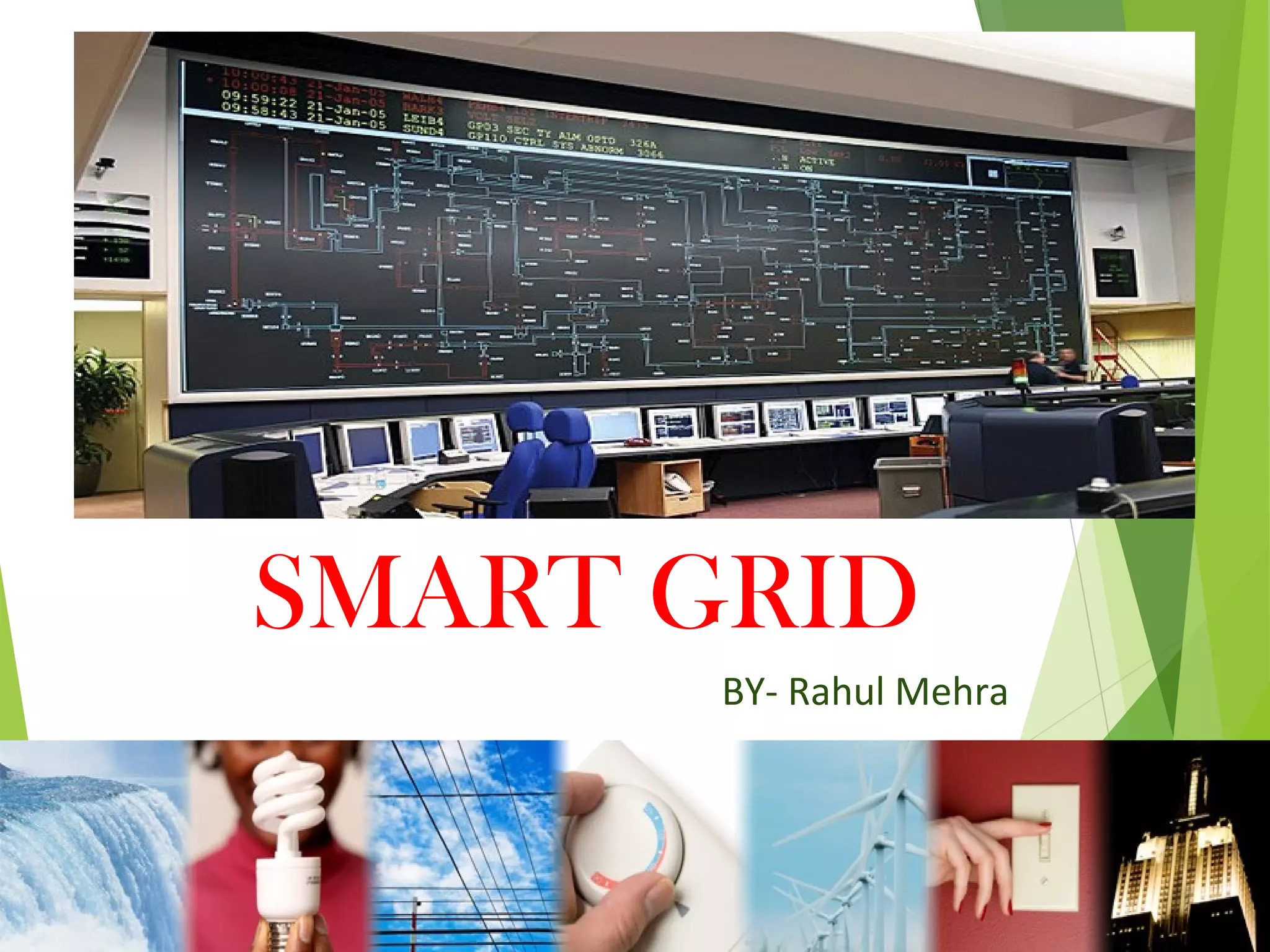
SMART GRID
BY- Rahul Mehra
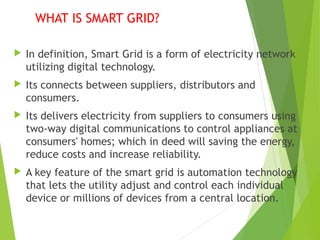
WHAT IS SMART GRID?
 In definition, Smart Grid is a form of electricity network
utilizing digital technology.
 Its connects between suppliers, distributors and
consumers.
 Its delivers electricity from suppliers to consumers using
two-way digital communications to control appliances at
consumers' homes; which in deed will saving the energy,
reduce costs and increase reliability.
 A key feature of the smart grid is automation technology
that lets the utility adjust and control each individual
device or millions of devices from a central location.
NEED OF SMART POWER GRID
 Increasing population and energy demand.
 Exhausting non- renewable energy resources.
 Non- reliability of traditional power supply &
Domino Effect .
 Negative effect of emissions from present
power generators on environment.
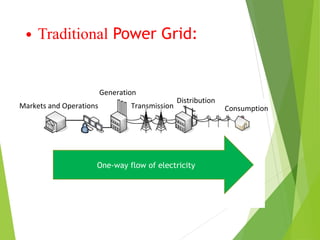
• Traditional Power Grid:
One-way flow of electricity
Markets and Operations
Generation
Transmission
Distribution
Consumption
• SMART POWER GRID
Markets and Operations
Generation
Transmission ConsumptionDistribution
Two‐way Flow of Electricity and Information
Power Infrastructure
Communications Infrastructure
CONCEPT OF SMART GRID
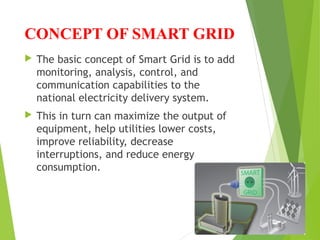
 The basic concept of Smart Grid is to add
monitoring, analysis, control, and
communication capabilities to the
national electricity delivery system.
 This in turn can maximize the output of
equipment, help utilities lower costs,
improve reliability, decrease
interruptions, and reduce energy
consumption.
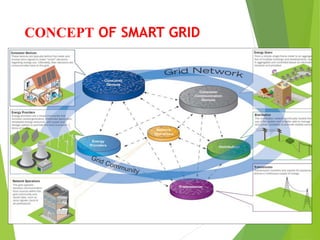
CONCEPT OF SMART GRID
THE FUNCTIONALITY OF SMART GRID
 A Smart Grid must functions as followings
 Be able to heal itself
 Motivate consumers to actively participate in operations
of the grid
 Resist attack
 Accommodate all energy generation and storage options
 High quality power
 Optimize asset to run more efficiently
 Enable high penetration of intermittent generation
sources
 
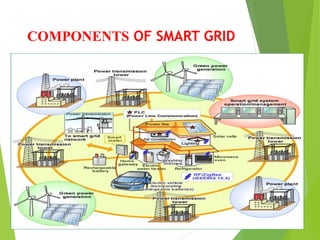
COMPONENTS OF SMART GRID
•CUSTOMER BENEFITS
 Ensures reliability & quality of energy supply.
 Offers efficiency gains for on-site applications.
 Enables savings on electricity.
 Provides a stand-alone power option.
 Provides customers a choice in satisfying their particular
energy needs.
National benefits
 Reduces greenhouse gas emissions.
 Responds to increasing energy demands.
 Responds to pollutant emission concerns.
 Provides low-cost, reliable energy essential to maintain
competitiveness in the world market.
 Creates numerous job opportunities.
Problems of Indian Power Grid
 * Poorly planned Distributed network
 * Over loading of system components
 * Lack of reactive power support & regulation services
 * Low metering efficiency & bill collection
 * Power theft
Prospects of Smart Grid in
India
 Smart grid implementation across India could
reduce transmission and distribution losses by
up to 30%.
 Minimize the need for increased generation
capacity
 Greater utilization of renewable and
decentralized sources of energy generation.
TOGETHERTOGETHER BUILDING ABUILDING A
PROSPEROUSPROSPEROUS
FUTUREFUTURE
THANK YOU

Smart Grid- By Rahul Mehra

  • 1.
  • 2.
    WHAT IS SMARTGRID?  In definition, Smart Grid is a form of electricity network utilizing digital technology.  Its connects between suppliers, distributors and consumers.  Its delivers electricity from suppliers to consumers using two-way digital communications to control appliances at consumers' homes; which in deed will saving the energy, reduce costs and increase reliability.  A key feature of the smart grid is automation technology that lets the utility adjust and control each individual device or millions of devices from a central location.
  • 3.
    NEED OF SMARTPOWER GRID  Increasing population and energy demand.  Exhausting non- renewable energy resources.  Non- reliability of traditional power supply & Domino Effect .  Negative effect of emissions from present power generators on environment.
  • 4.
    • Traditional PowerGrid: One-way flow of electricity Markets and Operations Generation Transmission Distribution Consumption
  • 5.
    • SMART POWERGRID Markets and Operations Generation Transmission ConsumptionDistribution Two‐way Flow of Electricity and Information Power Infrastructure Communications Infrastructure
  • 6.
    CONCEPT OF SMARTGRID  The basic concept of Smart Grid is to add monitoring, analysis, control, and communication capabilities to the national electricity delivery system.  This in turn can maximize the output of equipment, help utilities lower costs, improve reliability, decrease interruptions, and reduce energy consumption.
  • 7.
  • 8.
    THE FUNCTIONALITY OFSMART GRID  A Smart Grid must functions as followings  Be able to heal itself  Motivate consumers to actively participate in operations of the grid  Resist attack  Accommodate all energy generation and storage options  High quality power  Optimize asset to run more efficiently  Enable high penetration of intermittent generation sources
  • 9.
  • 10.
    •CUSTOMER BENEFITS  Ensuresreliability & quality of energy supply.  Offers efficiency gains for on-site applications.  Enables savings on electricity.  Provides a stand-alone power option.  Provides customers a choice in satisfying their particular energy needs.
  • 11.
    National benefits  Reducesgreenhouse gas emissions.  Responds to increasing energy demands.  Responds to pollutant emission concerns.  Provides low-cost, reliable energy essential to maintain competitiveness in the world market.  Creates numerous job opportunities.
  • 12.
    Problems of IndianPower Grid  * Poorly planned Distributed network  * Over loading of system components  * Lack of reactive power support & regulation services  * Low metering efficiency & bill collection  * Power theft
  • 13.
    Prospects of SmartGrid in India  Smart grid implementation across India could reduce transmission and distribution losses by up to 30%.  Minimize the need for increased generation capacity  Greater utilization of renewable and decentralized sources of energy generation.
  • 14.
    TOGETHERTOGETHER BUILDING ABUILDINGA PROSPEROUSPROSPEROUS FUTUREFUTURE
  • 15.