TOPIC:
SMART GRID and its challenges
(An Autonomous institute)
Department of Electrical and Electronics Engineering,AITAM,Tekkali
Aditya Institute of Technology And Management
Approved by AICTE , Permanently Affiliated to JNTU ,Kakinada
What is Smart grid?
A smart grid puts information and communication
technology into electricity generation, delivery, and
consumption, making systems cleaner, safer, and more
reliable and efficient.
U.S. Department of Energy Definition:
A smart grid integrates advanced sensing technologies,
control methods, and integrated communications into the
current electricity grid.
2
Department of Electrical and Electronics Engineering,AITAM,Tekkali
Some Smart Grid Definitions
 “An automated, widely distributed energy delivery network
characterized by a two-way flow of electricity and
information, capable of monitoring and responding to changes
in everything from power plants to customer preferences to
individual appliances.”
 “A smart grid is the electricity delivery system (from point of
generation to point of consumption) integrated with
communications and information technology”
 A smart grid is a modernized electrical grid that uses analog or
digital information and communications technology to gather and
act on information - such as information about the behaviors of
suppliers and consumers - in an automated fashion to improve the
efficiency, reliability, economics, and sustainability of the
production and distribution of electricity. Electronic power
conditioning and control of the production and distribution of
electricity are important aspects of the smart grid.
3
Department of Electrical and Electronics Engineering,AITAM,Tekkali
Aspects of Smart grid
 Reliability
 Efficiency
 Load adjustment/Load balancing
 leveling and time of use pricing
 Sustainability
 Market-enabling
 Demand response support
 Prevent Power Theft
 Self-Healing Network
 Islanding
 Two way flow of power and data
4
Department of Electrical and Electronics Engineering,AITAM,Tekkali
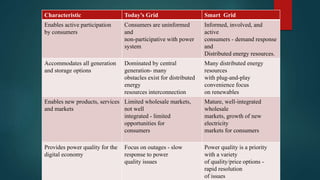
Characteristic Today’s Grid Smart Grid
Enables active participation
by consumers
Consumers are uninformed
and
non-participative with power
system
Informed, involved, and
active
consumers - demand response
and
Distributed energy resources.
Accommodates all generation
and storage options
Dominated by central
generation- many
obstacles exist for distributed
energy
resources interconnection
Many distributed energy
resources
with plug-and-play
convenience focus
on renewables
Enables new products, services
and markets
Limited wholesale markets,
not well
integrated - limited
opportunities for
consumers
Mature, well-integrated
wholesale
markets, growth of new
electricity
markets for consumers
Provides power quality for the
digital economy
Focus on outages - slow
response to power
quality issues
Power quality is a priority
with a variety
of quality/price options -
rapid resolution
of issues
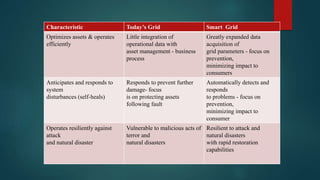
Characteristic Today’s Grid Smart Grid
Optimizes assets & operates
efficiently
Little integration of
operational data with
asset management - business
process
Greatly expanded data
acquisition of
grid parameters - focus on
prevention,
minimizing impact to
consumers
Anticipates and responds to
system
disturbances (self-heals)
Responds to prevent further
damage- focus
is on protecting assets
following fault
Automatically detects and
responds
to problems - focus on
prevention,
minimizing impact to
consumer
Operates resiliently against
attack
and natural disaster
Vulnerable to malicious acts of
terror and
natural disasters
Resilient to attack and
natural disasters
with rapid restoration
capabilities
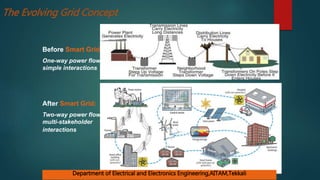
The Evolving Grid Concept
Before Smart Grid:
One-way power flow,
simple interactions
After Smart Grid:
Two-way power flow,
multi-stakeholder
interactions
Department of Electrical and Electronics Engineering,AITAM,Tekkali
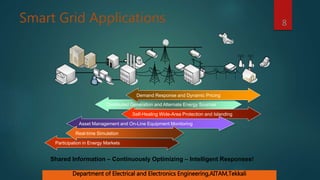
Smart Grid Applications 8
Distributed Generation and Alternate Energy Sources
Self-Healing Wide-Area Protection and Islanding
Asset Management and On-Line Equipment Monitoring
Demand Response and Dynamic Pricing
Participation in Energy Markets
Shared Information – Continuously Optimizing – Intelligent Responses!
Real-time Simulation
Department of Electrical and Electronics Engineering,AITAM,Tekkali
Design
 Trading Mechanism
 Buy/sell electricity
 Overload Prevention Mechanism
 Transmission charge
 Online Balancing Mechanism
 Price for extra demand and supply in real-time
9
Department of Electrical and Electronics Engineering,AITAM,Tekkali
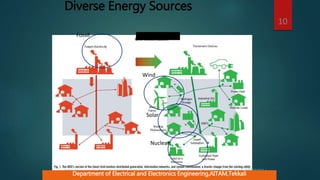
Diverse Energy Sources
10
http://powerelectronics.com/power_systems/smart-grid-success-rely-system-solutions-20091001/
Wind
Solar
Nuclear
Fossil
Department of Electrical and Electronics Engineering,AITAM,Tekkali
CHARACTERISTICS OF SMART GRID
 Intelligent – capable of sensing system overloads and rerouting power
 Efficient – capable of meeting increased consumer demand without adding
infrastructure
 Accommodating – accepting energy from virtually any fuel source including
Solar and wind as easily and transparently as coal and natural gas
 Motivating – enabling real-time communication between the consumer and utility
 Opportunistic – creating new opportunities and markets
 Resilient – increasingly resistant to attack and natural disasters
 “Green” – slowing the advance of global climate change and offering a genuine
path toward significant environmental improvement
Smart-grids for India
 Has to do much more than what is done elsewhere
 Smart-grids in India is to be used to
 Enable decentralized power-generation and optimize usage
 Explore alternate methods of storage, including storage of heat (cool)
 Handle peak-demand better
 Manage demand and supply to meet creatively at all points of time, by using storage and
high-cost instantaneous power-sources
 At local level
 At neighborhood level
 At district level, at state level, at national level
 Intelligently decide where to do load shedding if no other options
 enable time of day metering with remote monitoring
12
Department of Electrical and Electronics Engineering,AITAM,Tekkali
Integrated Communications and
Security
 High-speed, fully integrated, two-way communication technologies that
make the smart grid a dynamic, interactive “mega-infrastructure” for real-
time information and power exchange.
 Cyber Security: the new communication mechanism should consider
security, reliability, QoS.
13
Department of Electrical and Electronics Engineering,AITAM,Tekkali
Smart Grid Benefits
 Economic Development
 New Jobs: The manufacture, installation, operation and
maintenance of the smart grid and its components will
create new jobs within the state.
 Innovation: Smart grid innovation will enable the growth of
business while rewarding customers with valuable new
products.
 Lower Costs: Costs rise over time and energy is no
exception, but the smart grid should provide less costly
energy than otherwise would be possible. As such, it will
save customers money which can be invested or consumed
as they choose.
14
Department of Electrical and Electronics Engineering,AITAM,Tekkali
Smart Grid Benefits-cont
 Customer Satisfaction
 Higher Customer Satisfaction: The combination of lower costs,
improved reliability and better customer control will raise
satisfaction among all types of customers (residential,
commercial, industrial, institutional).
 Improved Reliability: Smart grid will reduce and shorten outages
and improve the quality of power.
 Customer Energy/Cost Savings: As pricing becomes more
transparent and is aligned with the underlying economics of
generation and distribution, customers’ decisions to save
money will benefit society as well
 Highest Security: Security will be incorporated into the design of
the smart grid and will require the implementation of practices
and procedures by individual stakeholders. In this way, the
physical and cyber security risks can be managed to the highest
standards possible.
15
Department of Electrical and Electronics Engineering,AITAM,Tekkali
SMART GRID BENEFITS
A Smart Grid will:
 Enable consumers to manage their own energy consumption through dashboards
and electronic energy advisories.
 Broadcast demand-response alerts to lower peak energy demand
 A Smart Grid will encourage home and building owners
 Ex: The introduction of EVs to act as temporary electricity storage devices,
 Utility companies can implement smart electric meters
 Underground transmission and distribution lines can control the meter theft
Department of Electrical and Electronics Engineering,AITAM,Tekkali
CHALLENGES FACING BY SMART GRID
 Present Infrastructure is inadequate
 Most renewable resources are not constant
 Regulatory Policies to deal with consequences of Smart
Grid; like off peak, peak tariffs and other related matters.
 Grid Operation : Monitoring & control
Department of Electrical and Electronics Engineering,AITAM,Tekkali
Key Challenges
 Government Support – funding and to ensure development
 National Road Map adopted and must implementation
 Access of financial resources particularly due to poor financial health of the
power utilities
 Lack of Policy and Regulation related to Smart Grid applications
 No proven commercial viability of large scale smart grid implementation –
Cost and benefit assessment (Most of the initiatives are pilots)
 Development of Smart Grid Standards including pilot models that can be
adopted by discoms based on their level of maturity to handle such
applications
 Ability of users to absorb implementation of advanced technology
 Lack of awareness requiring knowledge creation, training and capacity
building of both the utility and consumers
18
Department of Electrical and Electronics Engineering,AITAM,Tekkali
Way Forward
 Goals in the National Road Map to be accompanied by implementation
structure and mechanisms
 Need for coordinated development nationally as well with international
bodies
 Development of SG Regulations: Optimal regulatory response is of
immense importance to make the overall initiative successful and
attractive to all parties
 Need for creating awareness and acceptance of Smart Grid technologies
 Process support to demonstrate commercially viable pilots to
demonstrate success and dissemination of such initiatives to other
utilities/users
 Need to undertake initiatives to encourage indigenous vendor
development for reduction of costs and ensure long-term service
support
19
Department of Electrical and Electronics Engineering,AITAM,Tekkali
Risks and Challenges to SmartGrid
Concept Implementation
Unknown cost to complete. Total cost may be more than benefits.
AMI works but SmartGrid technologies may be years in development.
Regulatory policy is undefined therefore uncertain.
Technical terminology is confusing to non-technical users.
The scope of the national SmartGrid project may be too large.
The SmartGrid concept is not “universally” accepted in the U.S.
Security question of the day: Is one large grid easer to take out than
several small grids? Hacksaw, virus, etc.
Department of Electrical and Electronics Engineering,AITAM,Tekkali
Conclusion
 Smart Grid provides intelligent, advanced power control for the next
century
 Many new technologies involve for supporting sensing, controlling,
human interfaces.
 Charging electricity cost is fundamental infrastructure can be
implemented similar to stock market in smart grid.
 This smart grid technology is new and initial cost is more and we don’t
know that Present Infrastructure is adequate or not.
 Cyber Security: the new communication mechanism should consider
security, reliability, QoS.
21
Department of Electrical and Electronics Engineering,AITAM,Tekkali

Smart grid challenge

  • 1.
    TOPIC: SMART GRID andits challenges (An Autonomous institute) Department of Electrical and Electronics Engineering,AITAM,Tekkali Aditya Institute of Technology And Management Approved by AICTE , Permanently Affiliated to JNTU ,Kakinada
  • 2.
    What is Smartgrid? A smart grid puts information and communication technology into electricity generation, delivery, and consumption, making systems cleaner, safer, and more reliable and efficient. U.S. Department of Energy Definition: A smart grid integrates advanced sensing technologies, control methods, and integrated communications into the current electricity grid. 2 Department of Electrical and Electronics Engineering,AITAM,Tekkali
  • 3.
    Some Smart GridDefinitions  “An automated, widely distributed energy delivery network characterized by a two-way flow of electricity and information, capable of monitoring and responding to changes in everything from power plants to customer preferences to individual appliances.”  “A smart grid is the electricity delivery system (from point of generation to point of consumption) integrated with communications and information technology”  A smart grid is a modernized electrical grid that uses analog or digital information and communications technology to gather and act on information - such as information about the behaviors of suppliers and consumers - in an automated fashion to improve the efficiency, reliability, economics, and sustainability of the production and distribution of electricity. Electronic power conditioning and control of the production and distribution of electricity are important aspects of the smart grid. 3 Department of Electrical and Electronics Engineering,AITAM,Tekkali
  • 4.
    Aspects of Smartgrid  Reliability  Efficiency  Load adjustment/Load balancing  leveling and time of use pricing  Sustainability  Market-enabling  Demand response support  Prevent Power Theft  Self-Healing Network  Islanding  Two way flow of power and data 4 Department of Electrical and Electronics Engineering,AITAM,Tekkali
  • 5.
    Characteristic Today’s GridSmart Grid Enables active participation by consumers Consumers are uninformed and non-participative with power system Informed, involved, and active consumers - demand response and Distributed energy resources. Accommodates all generation and storage options Dominated by central generation- many obstacles exist for distributed energy resources interconnection Many distributed energy resources with plug-and-play convenience focus on renewables Enables new products, services and markets Limited wholesale markets, not well integrated - limited opportunities for consumers Mature, well-integrated wholesale markets, growth of new electricity markets for consumers Provides power quality for the digital economy Focus on outages - slow response to power quality issues Power quality is a priority with a variety of quality/price options - rapid resolution of issues
  • 6.
    Characteristic Today’s GridSmart Grid Optimizes assets & operates efficiently Little integration of operational data with asset management - business process Greatly expanded data acquisition of grid parameters - focus on prevention, minimizing impact to consumers Anticipates and responds to system disturbances (self-heals) Responds to prevent further damage- focus is on protecting assets following fault Automatically detects and responds to problems - focus on prevention, minimizing impact to consumer Operates resiliently against attack and natural disaster Vulnerable to malicious acts of terror and natural disasters Resilient to attack and natural disasters with rapid restoration capabilities
  • 7.
    The Evolving GridConcept Before Smart Grid: One-way power flow, simple interactions After Smart Grid: Two-way power flow, multi-stakeholder interactions Department of Electrical and Electronics Engineering,AITAM,Tekkali
  • 8.
    Smart Grid Applications8 Distributed Generation and Alternate Energy Sources Self-Healing Wide-Area Protection and Islanding Asset Management and On-Line Equipment Monitoring Demand Response and Dynamic Pricing Participation in Energy Markets Shared Information – Continuously Optimizing – Intelligent Responses! Real-time Simulation Department of Electrical and Electronics Engineering,AITAM,Tekkali
  • 9.
    Design  Trading Mechanism Buy/sell electricity  Overload Prevention Mechanism  Transmission charge  Online Balancing Mechanism  Price for extra demand and supply in real-time 9 Department of Electrical and Electronics Engineering,AITAM,Tekkali
  • 10.
  • 11.
    CHARACTERISTICS OF SMARTGRID  Intelligent – capable of sensing system overloads and rerouting power  Efficient – capable of meeting increased consumer demand without adding infrastructure  Accommodating – accepting energy from virtually any fuel source including Solar and wind as easily and transparently as coal and natural gas  Motivating – enabling real-time communication between the consumer and utility  Opportunistic – creating new opportunities and markets  Resilient – increasingly resistant to attack and natural disasters  “Green” – slowing the advance of global climate change and offering a genuine path toward significant environmental improvement
  • 12.
    Smart-grids for India Has to do much more than what is done elsewhere  Smart-grids in India is to be used to  Enable decentralized power-generation and optimize usage  Explore alternate methods of storage, including storage of heat (cool)  Handle peak-demand better  Manage demand and supply to meet creatively at all points of time, by using storage and high-cost instantaneous power-sources  At local level  At neighborhood level  At district level, at state level, at national level  Intelligently decide where to do load shedding if no other options  enable time of day metering with remote monitoring 12 Department of Electrical and Electronics Engineering,AITAM,Tekkali
  • 13.
    Integrated Communications and Security High-speed, fully integrated, two-way communication technologies that make the smart grid a dynamic, interactive “mega-infrastructure” for real- time information and power exchange.  Cyber Security: the new communication mechanism should consider security, reliability, QoS. 13 Department of Electrical and Electronics Engineering,AITAM,Tekkali
  • 14.
    Smart Grid Benefits Economic Development  New Jobs: The manufacture, installation, operation and maintenance of the smart grid and its components will create new jobs within the state.  Innovation: Smart grid innovation will enable the growth of business while rewarding customers with valuable new products.  Lower Costs: Costs rise over time and energy is no exception, but the smart grid should provide less costly energy than otherwise would be possible. As such, it will save customers money which can be invested or consumed as they choose. 14 Department of Electrical and Electronics Engineering,AITAM,Tekkali
  • 15.
    Smart Grid Benefits-cont Customer Satisfaction  Higher Customer Satisfaction: The combination of lower costs, improved reliability and better customer control will raise satisfaction among all types of customers (residential, commercial, industrial, institutional).  Improved Reliability: Smart grid will reduce and shorten outages and improve the quality of power.  Customer Energy/Cost Savings: As pricing becomes more transparent and is aligned with the underlying economics of generation and distribution, customers’ decisions to save money will benefit society as well  Highest Security: Security will be incorporated into the design of the smart grid and will require the implementation of practices and procedures by individual stakeholders. In this way, the physical and cyber security risks can be managed to the highest standards possible. 15 Department of Electrical and Electronics Engineering,AITAM,Tekkali
  • 16.
    SMART GRID BENEFITS ASmart Grid will:  Enable consumers to manage their own energy consumption through dashboards and electronic energy advisories.  Broadcast demand-response alerts to lower peak energy demand  A Smart Grid will encourage home and building owners  Ex: The introduction of EVs to act as temporary electricity storage devices,  Utility companies can implement smart electric meters  Underground transmission and distribution lines can control the meter theft Department of Electrical and Electronics Engineering,AITAM,Tekkali
  • 17.
    CHALLENGES FACING BYSMART GRID  Present Infrastructure is inadequate  Most renewable resources are not constant  Regulatory Policies to deal with consequences of Smart Grid; like off peak, peak tariffs and other related matters.  Grid Operation : Monitoring & control Department of Electrical and Electronics Engineering,AITAM,Tekkali
  • 18.
    Key Challenges  GovernmentSupport – funding and to ensure development  National Road Map adopted and must implementation  Access of financial resources particularly due to poor financial health of the power utilities  Lack of Policy and Regulation related to Smart Grid applications  No proven commercial viability of large scale smart grid implementation – Cost and benefit assessment (Most of the initiatives are pilots)  Development of Smart Grid Standards including pilot models that can be adopted by discoms based on their level of maturity to handle such applications  Ability of users to absorb implementation of advanced technology  Lack of awareness requiring knowledge creation, training and capacity building of both the utility and consumers 18 Department of Electrical and Electronics Engineering,AITAM,Tekkali
  • 19.
    Way Forward  Goalsin the National Road Map to be accompanied by implementation structure and mechanisms  Need for coordinated development nationally as well with international bodies  Development of SG Regulations: Optimal regulatory response is of immense importance to make the overall initiative successful and attractive to all parties  Need for creating awareness and acceptance of Smart Grid technologies  Process support to demonstrate commercially viable pilots to demonstrate success and dissemination of such initiatives to other utilities/users  Need to undertake initiatives to encourage indigenous vendor development for reduction of costs and ensure long-term service support 19 Department of Electrical and Electronics Engineering,AITAM,Tekkali
  • 20.
    Risks and Challengesto SmartGrid Concept Implementation Unknown cost to complete. Total cost may be more than benefits. AMI works but SmartGrid technologies may be years in development. Regulatory policy is undefined therefore uncertain. Technical terminology is confusing to non-technical users. The scope of the national SmartGrid project may be too large. The SmartGrid concept is not “universally” accepted in the U.S. Security question of the day: Is one large grid easer to take out than several small grids? Hacksaw, virus, etc. Department of Electrical and Electronics Engineering,AITAM,Tekkali
  • 21.
    Conclusion  Smart Gridprovides intelligent, advanced power control for the next century  Many new technologies involve for supporting sensing, controlling, human interfaces.  Charging electricity cost is fundamental infrastructure can be implemented similar to stock market in smart grid.  This smart grid technology is new and initial cost is more and we don’t know that Present Infrastructure is adequate or not.  Cyber Security: the new communication mechanism should consider security, reliability, QoS. 21 Department of Electrical and Electronics Engineering,AITAM,Tekkali