
RAGHU ENGINEERING COLLEGE
(AUTONOMOUS)
Department Of Electrical And Electronics Engineering
Academic year :2019-2020
II Year 2 – Semester
SEMINAR ON
WIRELESS POWER TRANSMISSION
UNDER THE GUIDANCE
Mr.P.RAVI KUMAR
BY
PEDIREDLA SANJAY KUMAR 18981A0241
D.SAI KRISHNA 18981A0217
PHANI KISHORE 18981A02
AVINESH 19981
CONTENTS :-
 INTRODUCTION
 DEFINITION
 HISTORY
 TYPES OF WPT
 Atmospheric conduction method
 Electrodynamic induction method
 Advantages and disadvantage
 Applications
 Conclusion
 References
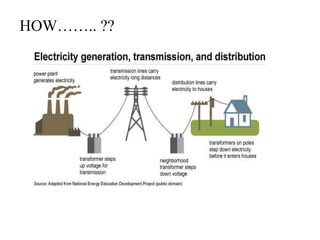
HOW…….. ??
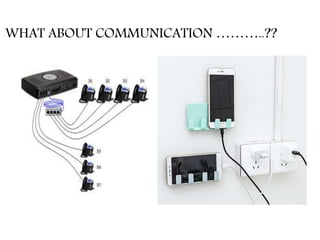
WHAT ABOUT COMMUNICATION ………..??
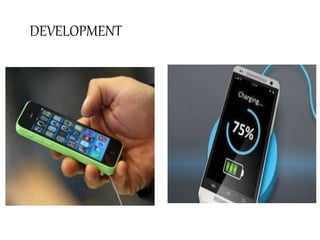
DEVELOPMENT
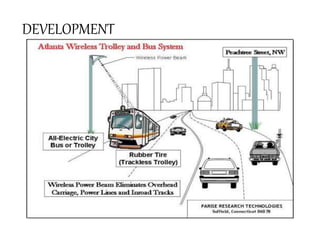
DEVELOPMENT
INTRODUCTION :-
• One of the major issues in power system is the losses occurring during
the transmission and distribution of electrical power.
• The percentage of loss of power during transmission and distribution is
approximated as 26%.
• The main reason for power loss during transmission and distribution is
the resistance of wires used in grid.
• Tesla has proposed methods of transmission of electricity using
electromagnetic induction.
• As the word wireless means “without wire”.
• Wireless energy transfer or wireless power is the transmission of
electrical energy from a power source to an electric load without
interconnecting man made conductors.
• Wireless transmission is useful in cases where interconnecting wires
are inconvenient, hazardous or impossible.
DEFINITION :-
HISTORY :-
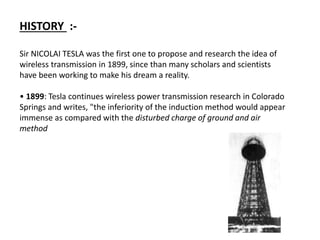
Sir NICOLAI TESLA was the first one to propose and research the idea of
wireless transmission in 1899, since than many scholars and scientists
have been working to make his dream a reality.
• 1899: Tesla continues wireless power transmission research in Colorado
Springs and writes, "the inferiority of the induction method would appear
immense as compared with the disturbed charge of ground and air
method
What is WPT?
 The transmission of energy from one place to another without using
wires
 Conventional energy transfer is using wires
 But, the wireless transmission is made possible by using various
technologies.
Why not wires?
 As per studies, most electrical energy transfer is through wires.
 Most of the energy loss is during transmission
On an average, more than 30%
In India, it exceeds 40%
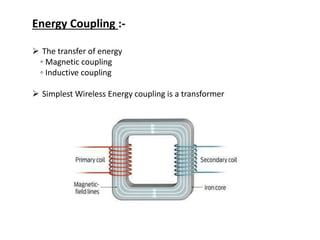
Energy Coupling :-
 The transfer of energy
◦ Magnetic coupling
◦ Inductive coupling
 Simplest Wireless Energy coupling is a transformer
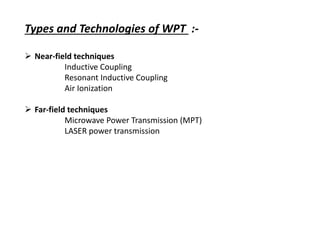
Types and Technologies of WPT :-
 Near-field techniques
Inductive Coupling
Resonant Inductive Coupling
Air Ionization
 Far-field techniques
Microwave Power Transmission (MPT)
LASER power transmission
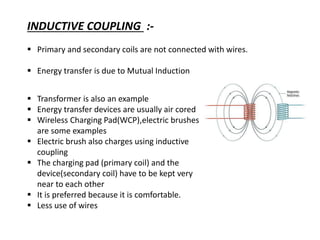
INDUCTIVE COUPLING :-
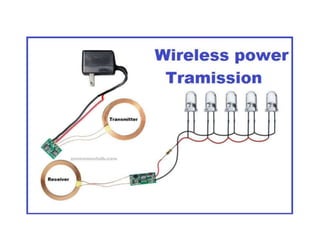
 Primary and secondary coils are not connected with wires.
 Energy transfer is due to Mutual Induction
 Transformer is also an example
 Energy transfer devices are usually air cored
 Wireless Charging Pad(WCP),electric brushes
are some examples
 Electric brush also charges using inductive
coupling
 The charging pad (primary coil) and the
device(secondary coil) have to be kept very
near to each other
 It is preferred because it is comfortable.
 Less use of wires
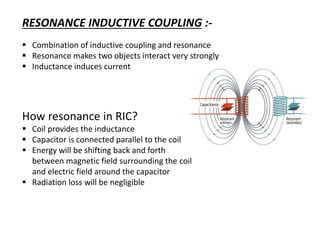
RESONANCE INDUCTIVE COUPLING :-
 Combination of inductive coupling and resonance
 Resonance makes two objects interact very strongly
 Inductance induces current
How resonance in RIC?
 Coil provides the inductance
 Capacitor is connected parallel to the coil
 Energy will be shifting back and forth
between magnetic field surrounding the coil
and electric field around the capacitor
 Radiation loss will be negligible
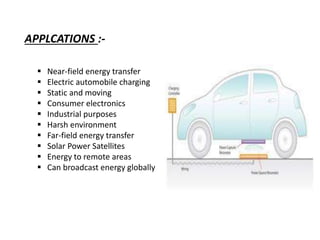
APPLCATIONS :-
 Near-field energy transfer
 Electric automobile charging
 Static and moving
 Consumer electronics
 Industrial purposes
 Harsh environment
 Far-field energy transfer
 Solar Power Satellites
 Energy to remote areas
 Can broadcast energy globally
ADVANTAGES :-
 Efficient
 Easy
 Need for grids, substations etc are eliminated
 Low maintenance cost
 More effective when the transmitting and receiving points are along a
line-of-sight
 Can reach the places which are remote Wireless
DISADVANTAGES :-
• When microwaves are used, interference may arise
• When LASERS are used, conversion is inefficient due to absorption losses.
• It is radioactive in nature
• Distance constraint , initial cost is high.
• Field strength has to be under safety levels
• High frequency signals should be supplied for air ionization which is not
feasible.
CONCLUSION :-
 Transmission without wires- a reality
 Efficient
 Low maintenance cost. But, high initial cost
 Better than conventional wired transfer
 Energy crisis can be decreased
 Low loss
 In near future, world will be completely Wireless
REFERENCES :-
 C.C. Leung, T.P. Chan, K.C. Lit, K.W. Tam and Lee Yi Chow, “Wireless Power
Transmission and Charging Pad”
 David Schneider, “Electrons unplugged”, IEEE Spectrum, May 2010
 Shahrzad Jalali Mazlouman, AlirezaMahanfar, Bozena Kaminska, “Mid-
range Wireless Energy Transfer Using Inductive Resonance for Wireless
Sensors”
WIRELESS POWER TRANSMISSION

WIRELESS POWER TRANSMISSION

  • 1.
    RAGHU ENGINEERING COLLEGE (AUTONOMOUS) DepartmentOf Electrical And Electronics Engineering Academic year :2019-2020 II Year 2 – Semester SEMINAR ON WIRELESS POWER TRANSMISSION UNDER THE GUIDANCE Mr.P.RAVI KUMAR BY PEDIREDLA SANJAY KUMAR 18981A0241 D.SAI KRISHNA 18981A0217 PHANI KISHORE 18981A02 AVINESH 19981
  • 2.
    CONTENTS :-  INTRODUCTION DEFINITION  HISTORY  TYPES OF WPT  Atmospheric conduction method  Electrodynamic induction method  Advantages and disadvantage  Applications  Conclusion  References
  • 3.
  • 4.
  • 5.
  • 6.
  • 8.
    INTRODUCTION :- • Oneof the major issues in power system is the losses occurring during the transmission and distribution of electrical power. • The percentage of loss of power during transmission and distribution is approximated as 26%. • The main reason for power loss during transmission and distribution is the resistance of wires used in grid. • Tesla has proposed methods of transmission of electricity using electromagnetic induction.
  • 9.
    • As theword wireless means “without wire”. • Wireless energy transfer or wireless power is the transmission of electrical energy from a power source to an electric load without interconnecting man made conductors. • Wireless transmission is useful in cases where interconnecting wires are inconvenient, hazardous or impossible. DEFINITION :-
  • 11.
    HISTORY :- Sir NICOLAITESLA was the first one to propose and research the idea of wireless transmission in 1899, since than many scholars and scientists have been working to make his dream a reality. • 1899: Tesla continues wireless power transmission research in Colorado Springs and writes, "the inferiority of the induction method would appear immense as compared with the disturbed charge of ground and air method
  • 12.
    What is WPT? The transmission of energy from one place to another without using wires  Conventional energy transfer is using wires  But, the wireless transmission is made possible by using various technologies. Why not wires?  As per studies, most electrical energy transfer is through wires.  Most of the energy loss is during transmission On an average, more than 30% In India, it exceeds 40%
  • 13.
    Energy Coupling :- The transfer of energy ◦ Magnetic coupling ◦ Inductive coupling  Simplest Wireless Energy coupling is a transformer
  • 14.
    Types and Technologiesof WPT :-  Near-field techniques Inductive Coupling Resonant Inductive Coupling Air Ionization  Far-field techniques Microwave Power Transmission (MPT) LASER power transmission
  • 15.
    INDUCTIVE COUPLING :- Primary and secondary coils are not connected with wires.  Energy transfer is due to Mutual Induction  Transformer is also an example  Energy transfer devices are usually air cored  Wireless Charging Pad(WCP),electric brushes are some examples  Electric brush also charges using inductive coupling  The charging pad (primary coil) and the device(secondary coil) have to be kept very near to each other  It is preferred because it is comfortable.  Less use of wires
  • 16.
    RESONANCE INDUCTIVE COUPLING:-  Combination of inductive coupling and resonance  Resonance makes two objects interact very strongly  Inductance induces current How resonance in RIC?  Coil provides the inductance  Capacitor is connected parallel to the coil  Energy will be shifting back and forth between magnetic field surrounding the coil and electric field around the capacitor  Radiation loss will be negligible
  • 17.
    APPLCATIONS :-  Near-fieldenergy transfer  Electric automobile charging  Static and moving  Consumer electronics  Industrial purposes  Harsh environment  Far-field energy transfer  Solar Power Satellites  Energy to remote areas  Can broadcast energy globally
  • 18.
    ADVANTAGES :-  Efficient Easy  Need for grids, substations etc are eliminated  Low maintenance cost  More effective when the transmitting and receiving points are along a line-of-sight  Can reach the places which are remote Wireless
  • 19.
    DISADVANTAGES :- • Whenmicrowaves are used, interference may arise • When LASERS are used, conversion is inefficient due to absorption losses. • It is radioactive in nature • Distance constraint , initial cost is high. • Field strength has to be under safety levels • High frequency signals should be supplied for air ionization which is not feasible.
  • 20.
    CONCLUSION :-  Transmissionwithout wires- a reality  Efficient  Low maintenance cost. But, high initial cost  Better than conventional wired transfer  Energy crisis can be decreased  Low loss  In near future, world will be completely Wireless
  • 21.
    REFERENCES :-  C.C.Leung, T.P. Chan, K.C. Lit, K.W. Tam and Lee Yi Chow, “Wireless Power Transmission and Charging Pad”  David Schneider, “Electrons unplugged”, IEEE Spectrum, May 2010  Shahrzad Jalali Mazlouman, AlirezaMahanfar, Bozena Kaminska, “Mid- range Wireless Energy Transfer Using Inductive Resonance for Wireless Sensors”