INTC 2610
September 18, 2013
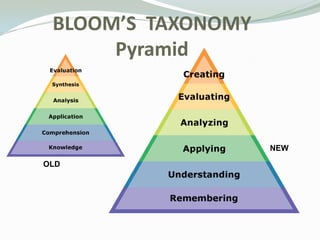
BLOOM’S TAXONOMY
Pyramid
OLD
NEW
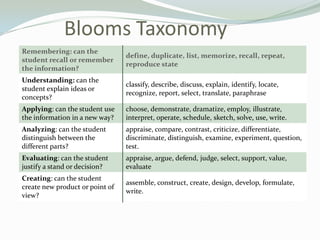
Blooms Taxonomy
Remembering: can the
student recall or remember
the information?
define, duplicate, list, memorize, recall, repeat,
reproduce state
Understanding: can the
student explain ideas or
concepts?
classify, describe, discuss, explain, identify, locate,
recognize, report, select, translate, paraphrase
Applying: can the student use
the information in a new way?
choose, demonstrate, dramatize, employ, illustrate,
interpret, operate, schedule, sketch, solve, use, write.
Analyzing: can the student
distinguish between the
different parts?
appraise, compare, contrast, criticize, differentiate,
discriminate, distinguish, examine, experiment, question,
test.
Evaluating: can the student
justify a stand or decision?
appraise, argue, defend, judge, select, support, value,
evaluate
Creating: can the student
create new product or point of
view?
assemble, construct, create, design, develop, formulate,
write.
What is a lesson plan?
A detailed description of the
individual lessons that a teacher
plans to teach on a given day. A
lesson plan is developed by a
teacher to guide instruction
throughout the day. It is a
method of planning and
preparation.
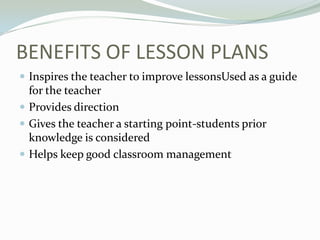
BENEFITS OF LESSON PLANS
 Inspires the teacher to improve lessonsUsed as a guide
for the teacher
 Provides direction
 Gives the teacher a starting point-students prior
knowledge is considered
 Helps keep good classroom management
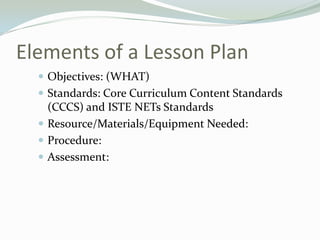
Elements of a Lesson Plan
 Objectives: (WHAT)
 Standards: Core Curriculum Content Standards
(CCCS) and ISTE NETs Standards
 Resource/Materials/Equipment Needed:
 Procedure:
 Assessment:
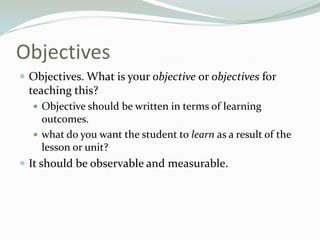
Objectives
 Objectives. What is your objective or objectives for
teaching this?
 Objective should be written in terms of learning
outcomes.
 what do you want the student to learn as a result of the
lesson or unit?
 It should be observable and measurable.
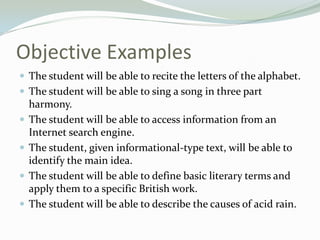
Objective Examples
 The student will be able to recite the letters of the alphabet.
 The student will be able to sing a song in three part
harmony.
 The student will be able to access information from an
Internet search engine.
 The student, given informational-type text, will be able to
identify the main idea.
 The student will be able to define basic literary terms and
apply them to a specific British work.
 The student will be able to describe the causes of acid rain.
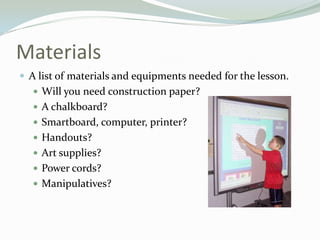
Materials
 A list of materials and equipments needed for the lesson.
 Will you need construction paper?
 A chalkboard?
 Smartboard, computer, printer?
 Handouts?
 Art supplies?
 Power cords?
 Manipulatives?
Procedure
 State, step-by-step, how you are going to implement
your plan.
 How are you going to introduce the lesson?
 How will you activate prior knowledge?
 If you are using handouts or manipulatives, when and
how will you hand them out?
 Will you close with a review?
 How will you tie the lesson together?
Assessment
 Rubrics
 Orals
 Presentation
 Evaluations do not always have to be the formal, other
examples:
 Observation.. whether the student has met the
objectives,
 conference with the student,
 orally review as a group.
Standards
 New Jersey Core Curriculum Content Standards
http://www.state.nj.us/education/cccs/
http://www.iste.org/standards/nets-for-students/nets-
student-standards-2007.aspx
Assignments
 Create a lesson plan incorporating the iPad.
 Please remember the focus is on the objective which
adhers to a NJ State Standard.
 The iPad is the delivery system for the content NOT
the focus.

Ppt blooms lesson_plans

  • 1.
  • 2.
  • 3.
    Blooms Taxonomy Remembering: canthe student recall or remember the information? define, duplicate, list, memorize, recall, repeat, reproduce state Understanding: can the student explain ideas or concepts? classify, describe, discuss, explain, identify, locate, recognize, report, select, translate, paraphrase Applying: can the student use the information in a new way? choose, demonstrate, dramatize, employ, illustrate, interpret, operate, schedule, sketch, solve, use, write. Analyzing: can the student distinguish between the different parts? appraise, compare, contrast, criticize, differentiate, discriminate, distinguish, examine, experiment, question, test. Evaluating: can the student justify a stand or decision? appraise, argue, defend, judge, select, support, value, evaluate Creating: can the student create new product or point of view? assemble, construct, create, design, develop, formulate, write.
  • 4.
    What is alesson plan? A detailed description of the individual lessons that a teacher plans to teach on a given day. A lesson plan is developed by a teacher to guide instruction throughout the day. It is a method of planning and preparation.
  • 5.
    BENEFITS OF LESSONPLANS  Inspires the teacher to improve lessonsUsed as a guide for the teacher  Provides direction  Gives the teacher a starting point-students prior knowledge is considered  Helps keep good classroom management
  • 6.
    Elements of aLesson Plan  Objectives: (WHAT)  Standards: Core Curriculum Content Standards (CCCS) and ISTE NETs Standards  Resource/Materials/Equipment Needed:  Procedure:  Assessment:
  • 7.
    Objectives  Objectives. Whatis your objective or objectives for teaching this?  Objective should be written in terms of learning outcomes.  what do you want the student to learn as a result of the lesson or unit?  It should be observable and measurable.
  • 8.
    Objective Examples  Thestudent will be able to recite the letters of the alphabet.  The student will be able to sing a song in three part harmony.  The student will be able to access information from an Internet search engine.  The student, given informational-type text, will be able to identify the main idea.  The student will be able to define basic literary terms and apply them to a specific British work.  The student will be able to describe the causes of acid rain.
  • 9.
    Materials  A listof materials and equipments needed for the lesson.  Will you need construction paper?  A chalkboard?  Smartboard, computer, printer?  Handouts?  Art supplies?  Power cords?  Manipulatives?
  • 10.
    Procedure  State, step-by-step,how you are going to implement your plan.  How are you going to introduce the lesson?  How will you activate prior knowledge?  If you are using handouts or manipulatives, when and how will you hand them out?  Will you close with a review?  How will you tie the lesson together?
  • 11.
    Assessment  Rubrics  Orals Presentation  Evaluations do not always have to be the formal, other examples:  Observation.. whether the student has met the objectives,  conference with the student,  orally review as a group.
  • 12.
    Standards  New JerseyCore Curriculum Content Standards http://www.state.nj.us/education/cccs/ http://www.iste.org/standards/nets-for-students/nets- student-standards-2007.aspx
  • 13.
    Assignments  Create alesson plan incorporating the iPad.  Please remember the focus is on the objective which adhers to a NJ State Standard.  The iPad is the delivery system for the content NOT the focus.