NAME: AROOBA
 Assessment
 Classroom Assessment
 WH Questions
 Definition of Assessment
 The role of Assessment
 How is classroom assessment different?
 Types of Assessment
 General Principal of Assessment
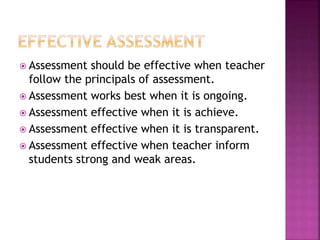
 Effective Assessment
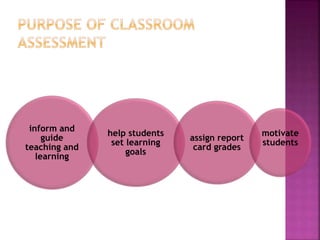
 Purpose of Classroom Assessment
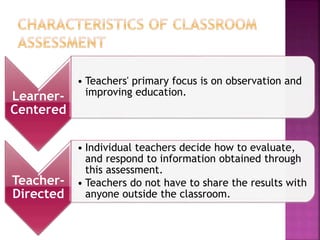
Characteristics of Classroom
Assessment
Importance of Assessment
Improve Learning Through Assessment
Classroom Assessment Techniques
How do I use Classroom Assessment
Techniques?
Conclusion
Reference
 The word ‘assess’ comes from the Latin verb
‘assidere’ meaning ‘to sit with’.
 In assessment one is suppose to sit with the
learner. This implies it is something we do
‘with’ and ‘for’ students and not ‘to’
students (Green, 1999)
 Assessment can focus on the individual
learner, the learning community (class,
workshop, or other organized group of
learners), the institution, or the educational
system.
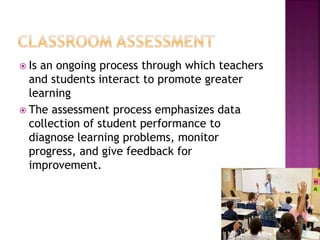
 Is an ongoing process through which teachers
and students interact to promote greater
learning
 The assessment process emphasizes data
collection of student performance to
diagnose learning problems, monitor
progress, and give feedback for
improvement.
 Involves using multiple methods in order to
obtain student information through a variety
of assessment strategies.
 All the processes involves in making decisions
about students’ learning progress.
 It’s more than just grades and tests!!
 Why to Assess
 Goals are met or not
 What to Assess
 Students current abilities in a given skills or
task.(knowledge, skills or behavior)
 Whom to Assess
 Real learners.
 How to Assess
 Through different instruments, formal or informal
 When to Assess
 Through out the process of teaching
 How much to Assess
 According to individual needs, ability and knowledge.
 Assessment is the process of documenting, usually
in measurable terms, knowledge, skill, attitudes,
and beliefs.
 The process of gathering quantitative and
qualitative data of what a student can do, and how
much a student possesses.
 It is the vital component of the teaching learning
process.
o Gathering of data
o Analyzing data
o Interpreting data
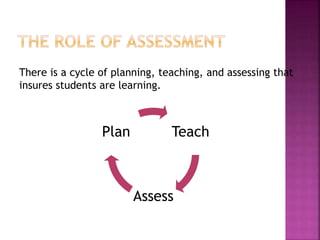
Teach
Assess
Plan
There is a cycle of planning, teaching, and assessing that
insures students are learning.
 Classroom assessment differs from tests and
other forms of student assessment in that it
is aimed at course improvement, rather than
at assigning grades.
 The primary goal is to better understand
your students' learning and so to improve
your teaching.
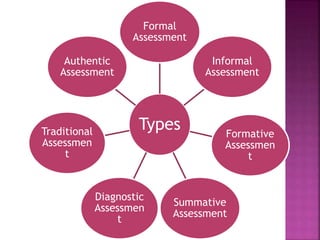
Types
Formal
Assessment
Informal
Assessment
Formative
Assessmen
t
Summative
Assessment
Diagnostic
Assessmen
t
Traditional
Assessmen
t
Authentic
Assessment
 Have data which support the conclusions
made from the test
 Usually refer to these types of tests as
standardized measures
 These tests have been tried before on
students and have statistics which support
the conclusion such as the student is reading
below average for his age
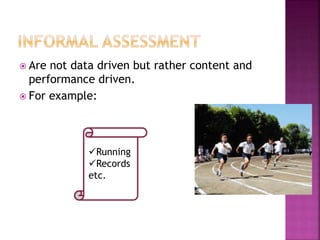
 Are not data driven but rather content and
performance driven.
 For example:
Running
Records
etc.
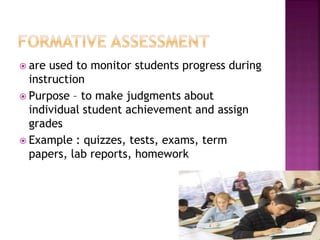
 are used to monitor students progress during
instruction
 Purpose – to make judgments about
individual student achievement and assign
grades
 Example : quizzes, tests, exams, term
papers, lab reports, homework
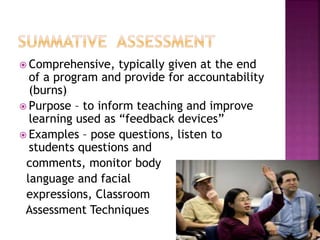
 Comprehensive, typically given at the end
of a program and provide for accountability
(burns)
 Purpose – to inform teaching and improve
learning used as “feedback devices”
 Examples – pose questions, listen to
students questions and
comments, monitor body
language and facial
expressions, Classroom
Assessment Techniques
 Used to determine, prior to instruction, a
student’s strengths, needs; knowledge and
skills.
 The result permit the instructor to re-
mediate student deficits and adjust
instruction and curriculum to meet each
pupil’s unique needs.
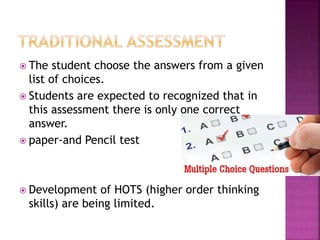
 The student choose the answers from a given
list of choices.
 Students are expected to recognized that in
this assessment there is only one correct
answer.
 paper-and Pencil test
 Development of HOTS (higher order thinking
skills) are being limited.
 Asked to perform a task or construct their
own response.
 The forms can be devise by the teacher with
the collaboration of the students.
 Variety of tasks and strategies.
 Given opportunity to evaluate his or her own
work.
 Development of HOTS is fostered to a great
extent.
 Assessment should be valid.
 Assessment should be reliable and
consistent.
 Formative assessment and summative
assessment should be included in each
program.
 Assessment should be planned.
 Assessment should be effective when teacher
follow the principals of assessment.
 Assessment works best when it is ongoing.
 Assessment effective when it is achieve.
 Assessment effective when it is transparent.
 Assessment effective when teacher inform
students strong and weak areas.
inform and
guide
teaching and
learning
help students
set learning
goals
assign report
card grades
motivate
students
Learner-
Centered
• Teachers' primary focus is on observation and
improving education.
Teacher-
Directed
• Individual teachers decide how to evaluate,
and respond to information obtained through
this assessment.
• Teachers do not have to share the results with
anyone outside the classroom.
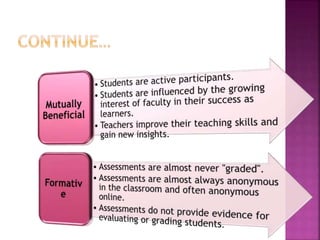
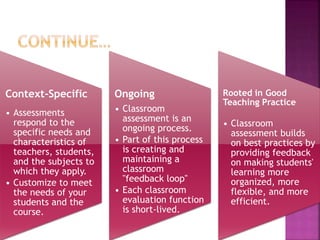
Context-Specific
• Assessments
respond to the
specific needs and
characteristics of
teachers, students,
and the subjects to
which they apply.
• Customize to meet
the needs of your
students and the
course.
Ongoing
• Classroom
assessment is an
ongoing process.
• Part of this process
is creating and
maintaining a
classroom
"feedback loop"
• Each classroom
evaluation function
is short-lived.
Rooted in Good
Teaching Practice
• Classroom
assessment builds
on best practices by
providing feedback
on making students'
learning more
organized, more
flexible, and more
efficient.
 Children who struggle with academics must
be identified early and provided
interventions (Torgesen, 2002)
 Assessments monitor progress by helping
determine instruction, identify specific
strengths and weaknesses, and evaluate
academic abilities (Deno, Mirkin, & Chiang,
1982; Salvia & Ysseldyke, 2004)
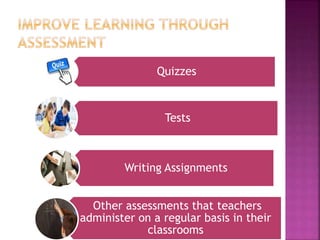
Quizzes
Tests
Writing Assignments
Other assessments that teachers
administer on a regular basis in their
classrooms
 Classroom Assessment Techniques (CATs) are
generally simple, non-graded, anonymous, in-
class activities designed to give you and your
students useful feedback on the teaching-
learning process as it is happening.
 The CATS are divided into three broad
categories:
 Techniques for assessing course-related
knowledge and skills
 Techniques for assessing learner
attitudes, values and self-awareness
 Techniques for assessing learner reactions
to instruction
 Decide what you want to learn from a classroom
assessment.
 Choose a Classroom Assessment Technique (CAT)
that provides this feedback, is consistent with
your teaching style, and can be easily
implemented in your class.
 Explain the purpose of the activity to students,
then conduct it.
 After class, review the results and decide what
changes, if any, to make.
 Let your students know what you learned from
the CAT and how you will use this information.
 Classroom Assessment Techniques are
formative evaluation methods that serve
two purposes. They can help you to assess
the degree to which your students
understand the course content and they
can provide you with information about
the effectiveness of your teaching
methods. Most are designed to be quick
and easy to use and each CAT provides
different kinds of information.
 https://www.slideshare.net/rdhaker2011/assess
mentppt
 https://www.slideshare.net/jho_anne/definition
-of-assessment
 https://youtu.be/CbU9xjDXrGg
 https://www.slideshare.net/rocelaalegado/class
room-assessment-29900285
 http://www.learnalberta.ca/content/mewa/htm
l/assessment/purpose.html
 https://terrymorris.net/cats/char1.htm
 http://www.hunter.cuny.edu/academicassessme
nt/repository/files/What%20is%20classroom%20a
ssessment-1.pdf
Classroom Assessment

Classroom Assessment

  • 1.
  • 2.
     Assessment  ClassroomAssessment  WH Questions  Definition of Assessment  The role of Assessment  How is classroom assessment different?  Types of Assessment  General Principal of Assessment  Effective Assessment  Purpose of Classroom Assessment
  • 3.
    Characteristics of Classroom Assessment Importanceof Assessment Improve Learning Through Assessment Classroom Assessment Techniques How do I use Classroom Assessment Techniques? Conclusion Reference
  • 4.
     The word‘assess’ comes from the Latin verb ‘assidere’ meaning ‘to sit with’.  In assessment one is suppose to sit with the learner. This implies it is something we do ‘with’ and ‘for’ students and not ‘to’ students (Green, 1999)  Assessment can focus on the individual learner, the learning community (class, workshop, or other organized group of learners), the institution, or the educational system.
  • 5.
     Is anongoing process through which teachers and students interact to promote greater learning  The assessment process emphasizes data collection of student performance to diagnose learning problems, monitor progress, and give feedback for improvement.
  • 6.
     Involves usingmultiple methods in order to obtain student information through a variety of assessment strategies.  All the processes involves in making decisions about students’ learning progress.  It’s more than just grades and tests!!
  • 7.
     Why toAssess  Goals are met or not  What to Assess  Students current abilities in a given skills or task.(knowledge, skills or behavior)  Whom to Assess  Real learners.  How to Assess  Through different instruments, formal or informal  When to Assess  Through out the process of teaching  How much to Assess  According to individual needs, ability and knowledge.
  • 8.
     Assessment isthe process of documenting, usually in measurable terms, knowledge, skill, attitudes, and beliefs.  The process of gathering quantitative and qualitative data of what a student can do, and how much a student possesses.  It is the vital component of the teaching learning process. o Gathering of data o Analyzing data o Interpreting data
  • 9.
    Teach Assess Plan There is acycle of planning, teaching, and assessing that insures students are learning.
  • 10.
     Classroom assessmentdiffers from tests and other forms of student assessment in that it is aimed at course improvement, rather than at assigning grades.  The primary goal is to better understand your students' learning and so to improve your teaching.
  • 11.
  • 12.
     Have datawhich support the conclusions made from the test  Usually refer to these types of tests as standardized measures  These tests have been tried before on students and have statistics which support the conclusion such as the student is reading below average for his age
  • 13.
     Are notdata driven but rather content and performance driven.  For example: Running Records etc.
  • 14.
     are usedto monitor students progress during instruction  Purpose – to make judgments about individual student achievement and assign grades  Example : quizzes, tests, exams, term papers, lab reports, homework
  • 15.
     Comprehensive, typicallygiven at the end of a program and provide for accountability (burns)  Purpose – to inform teaching and improve learning used as “feedback devices”  Examples – pose questions, listen to students questions and comments, monitor body language and facial expressions, Classroom Assessment Techniques
  • 16.
     Used todetermine, prior to instruction, a student’s strengths, needs; knowledge and skills.  The result permit the instructor to re- mediate student deficits and adjust instruction and curriculum to meet each pupil’s unique needs.
  • 17.
     The studentchoose the answers from a given list of choices.  Students are expected to recognized that in this assessment there is only one correct answer.  paper-and Pencil test  Development of HOTS (higher order thinking skills) are being limited.
  • 18.
     Asked toperform a task or construct their own response.  The forms can be devise by the teacher with the collaboration of the students.  Variety of tasks and strategies.  Given opportunity to evaluate his or her own work.  Development of HOTS is fostered to a great extent.
  • 19.
     Assessment shouldbe valid.  Assessment should be reliable and consistent.  Formative assessment and summative assessment should be included in each program.  Assessment should be planned.
  • 20.
     Assessment shouldbe effective when teacher follow the principals of assessment.  Assessment works best when it is ongoing.  Assessment effective when it is achieve.  Assessment effective when it is transparent.  Assessment effective when teacher inform students strong and weak areas.
  • 21.
    inform and guide teaching and learning helpstudents set learning goals assign report card grades motivate students
  • 22.
    Learner- Centered • Teachers' primaryfocus is on observation and improving education. Teacher- Directed • Individual teachers decide how to evaluate, and respond to information obtained through this assessment. • Teachers do not have to share the results with anyone outside the classroom.
  • 24.
    Context-Specific • Assessments respond tothe specific needs and characteristics of teachers, students, and the subjects to which they apply. • Customize to meet the needs of your students and the course. Ongoing • Classroom assessment is an ongoing process. • Part of this process is creating and maintaining a classroom "feedback loop" • Each classroom evaluation function is short-lived. Rooted in Good Teaching Practice • Classroom assessment builds on best practices by providing feedback on making students' learning more organized, more flexible, and more efficient.
  • 25.
     Children whostruggle with academics must be identified early and provided interventions (Torgesen, 2002)  Assessments monitor progress by helping determine instruction, identify specific strengths and weaknesses, and evaluate academic abilities (Deno, Mirkin, & Chiang, 1982; Salvia & Ysseldyke, 2004)
  • 26.
    Quizzes Tests Writing Assignments Other assessmentsthat teachers administer on a regular basis in their classrooms
  • 27.
     Classroom AssessmentTechniques (CATs) are generally simple, non-graded, anonymous, in- class activities designed to give you and your students useful feedback on the teaching- learning process as it is happening.  The CATS are divided into three broad categories:  Techniques for assessing course-related knowledge and skills  Techniques for assessing learner attitudes, values and self-awareness  Techniques for assessing learner reactions to instruction
  • 28.
     Decide whatyou want to learn from a classroom assessment.  Choose a Classroom Assessment Technique (CAT) that provides this feedback, is consistent with your teaching style, and can be easily implemented in your class.  Explain the purpose of the activity to students, then conduct it.  After class, review the results and decide what changes, if any, to make.  Let your students know what you learned from the CAT and how you will use this information.
  • 29.
     Classroom AssessmentTechniques are formative evaluation methods that serve two purposes. They can help you to assess the degree to which your students understand the course content and they can provide you with information about the effectiveness of your teaching methods. Most are designed to be quick and easy to use and each CAT provides different kinds of information.
  • 30.
     https://www.slideshare.net/rdhaker2011/assess mentppt  https://www.slideshare.net/jho_anne/definition -of-assessment https://youtu.be/CbU9xjDXrGg  https://www.slideshare.net/rocelaalegado/class room-assessment-29900285  http://www.learnalberta.ca/content/mewa/htm l/assessment/purpose.html  https://terrymorris.net/cats/char1.htm  http://www.hunter.cuny.edu/academicassessme nt/repository/files/What%20is%20classroom%20a ssessment-1.pdf

Editor's Notes

  • #14 Informal assessment indicate how well a student is reading a specific book. Scores such as 10 correctly, and most rubric scores; are given from this type of assessment.
  • #22 inform and guide teaching and learning A good classroom assessment plan gathers evidence of student learning that informs teachers' instructional decisions. It provides teachers with information about what students know and can do. To plan effective instruction, teachers also need to know what the student misunderstands and where the misconceptions lie. In addition to helping teachers formulate the next teaching steps, a good classroom assessment plan provides a road map for students. Students should, at all times, have access to the assessment so they can use it to inform and guide their learning. help students set learning goals Students need frequent opportunities to reflect on where their learning is at and what needs to be done to achieve their learning goals. When students are actively involved in assessing their own next learning steps and creating goals to accomplish them, they make major advances in directing their learning and what they understand about themselves as learners. assign report card grades Grades provide parents, employers, other schools, governments, post-secondary institutions and others with summary information about student learning. motivate students Research (Davies 2004; Stiggins et al. 2004) has shown that students will be motivated and confident learners when they experience progress and achievement, rather than the failure and defeat associated with being compared to more successful peers