The document explores the role of questioning as a critical language teaching method that facilitates classroom interaction and enhances student learning. It emphasizes the importance of different levels of questioning, from lower to higher order, and outlines the four stages of questioning skills: preparing, designing, controlling, and evaluating. Effective questioning techniques are also discussed to encourage student engagement and comprehension.
Questioning
As a skillof language
learning
Manik, 125, D, F:4.5
Reading and Reflecting On Texts
2.
Introduction
One of thekey language teaching
methods is to use questioning as a
learning tool to provide class room
interaction. Questions are easy to
trigger thinking ignite inquiry and
achieve these goals.
Questioning is a skill that is used in
order to make the students think
logically about the response to a
question.
3.
Definition
"Questioning isthe key to educative activity." - Parker
Teaching means skilful questioning to force the mind to see, to arrange,
to act." - Thring
In a nutshell we can say that Questions are used to help students recall
certain facts, exercise their reasoning ability and used their power of
recognition and discrimination in enhancing their learning.
4.
Importance of Questioningin Language
Learning
Universal Phenomenon
Important Technique
Classroom Interaction
Check the student's Understanding
Active Teaching Procedure
6.
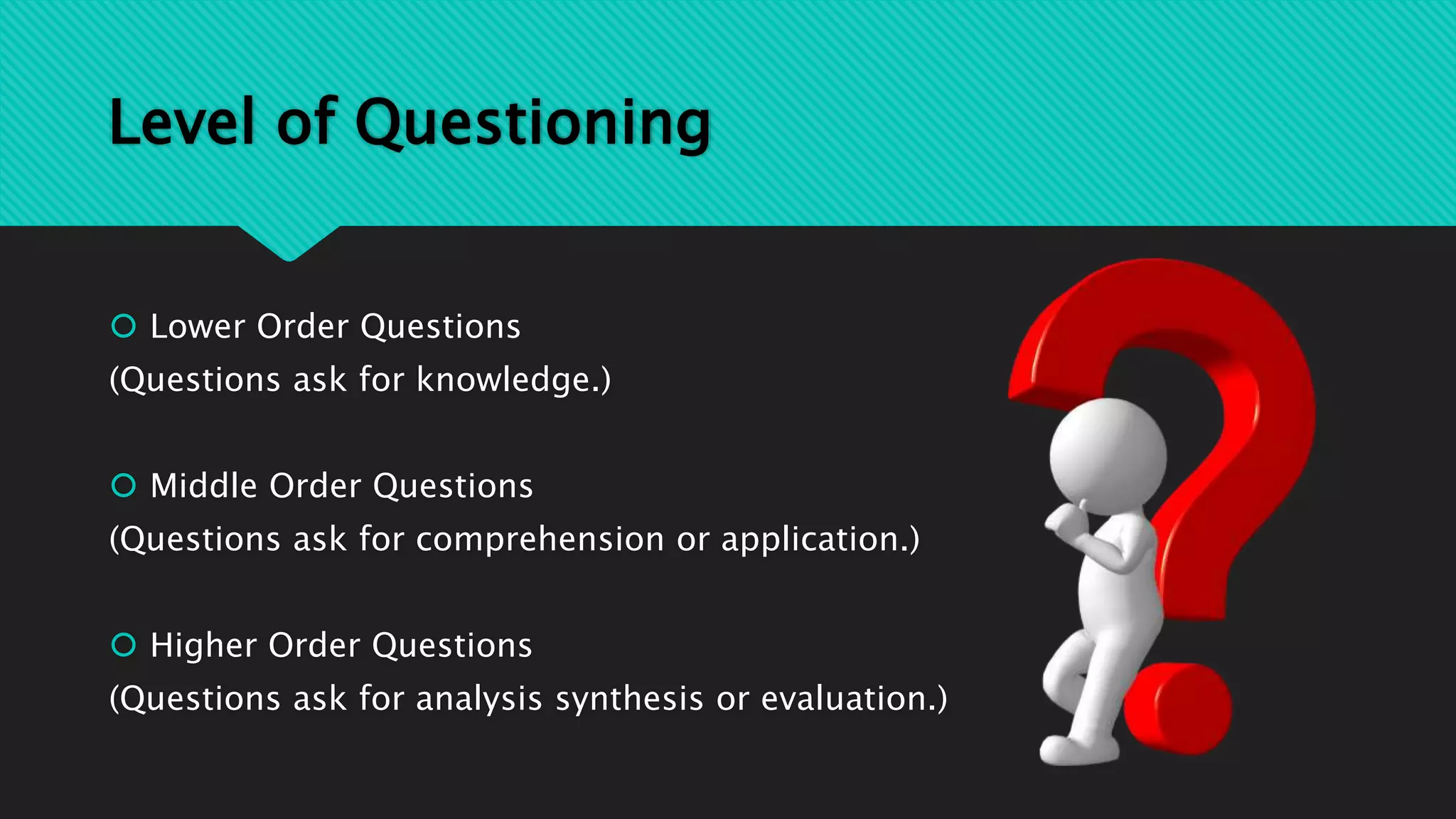
Level of Questioning
Lower Order Questions
(Questions ask for knowledge.)
Middle Order Questions
(Questions ask for comprehension or application.)
Higher Order Questions
(Questions ask for analysis synthesis or evaluation.)
7.
4 stages ofSkills of Questioning in
Language
The skills of preparing
(i) Deciding on the purpose for Questioning
(ii) Selecting Content for Questioning
(iii) Phrasing the Questions
(iv) Anticipating Problems
The skills of designing
(i) Increasing the number of Referential Questions
(ii) Asking Questions related to Students
8.
4 stages ofSkills of Questioning in
Language
Skills of Controlling
(i) Nominating after the Question
(ii) Nominating Non Volunteers
(iii) Probing
(iv) Increasing Wait-time
(v) Directing Attention to All
Skills of Evaluating
(i) Praising
(ii) Encouraging
(iii) Quoting
9.
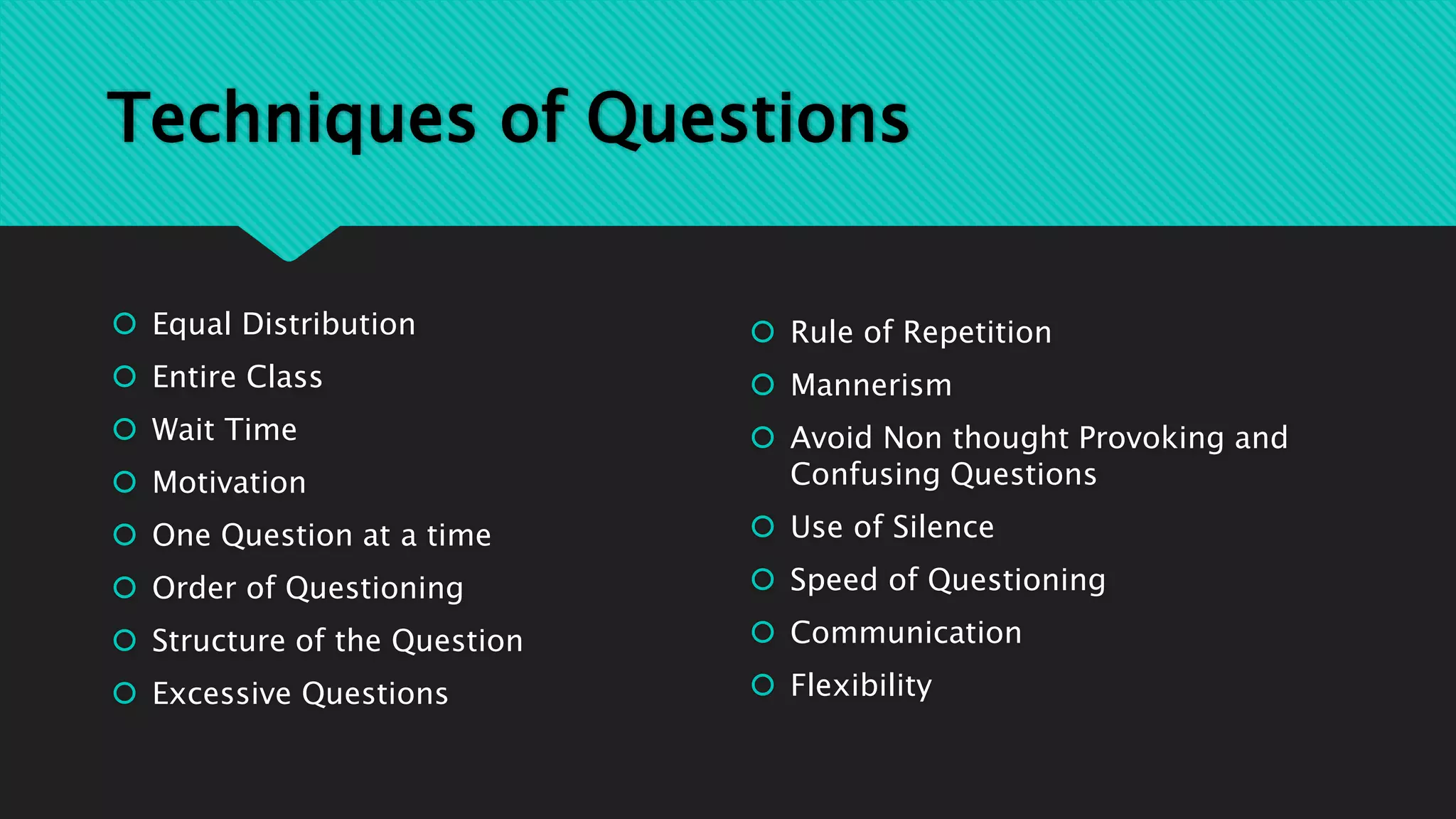
Techniques of Questions
Equal Distribution
Entire Class
Wait Time
Motivation
One Question at a time
Order of Questioning
Structure of the Question
Excessive Questions
Rule of Repetition
Mannerism
Avoid Non thought Provoking and
Confusing Questions
Use of Silence
Speed of Questioning
Communication
Flexibility