Bloom's Revised Taxonomy
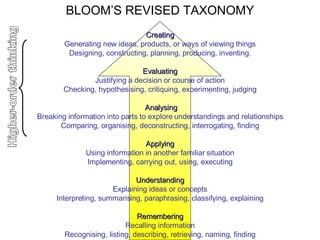
BLOOM’S REVISED TAXONOMY Creating Generating new ideas, products, or ways of viewing things Designing, constructing, planning, producing, inventing.   Evaluating Justifying a decision or course of action Checking, hypothesising, critiquing, experimenting, judging     Analysing Breaking information into parts to explore understandings and relationships Comparing, organising, deconstructing, interrogating, finding   Applying Using information in another familiar situation Implementing, carrying out, using, executing   Understanding Explaining ideas or concepts Interpreting, summarising, paraphrasing, classifying, explaining   Remembering Recalling information Recognising, listing, describing, retrieving, naming, finding   Higher-order thinking
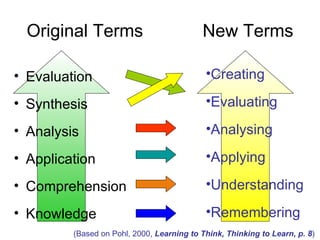
Original Terms  New Terms Evaluation Synthesis Analysis Application Comprehension Knowledge Creating Evaluating Analysing Applying Understanding Remembering (Based on Pohl, 2000,  Learning to Think, Thinking to Learn, p. 8 )
Remembering The learner is able to recall, restate and remember learned information. Recognising Listing Describing Identifying Retrieving Naming Locating Finding    Can you recall information?  
Understanding The learner grasps the meaning of information by interpreting and translating what has been learned. Interpreting Exemplifying Summarising Inferring Paraphrasing Classifying Comparing Explaining    Can you explain ideas or concepts?
Applying   The learner makes use of information in a context different from the one in which it was learned. Implementing Carrying out Using Executing     Can you use the information in another  familiar situation?
Analysing The learner breaks learned information into its parts to best understand that information. Comparing Organising Deconstructing Attributing Outlining Finding Structuring Integrating   Can you break information into parts to explore understandings and relationships?
Evaluating The learner makes decisions based on in-depth reflection, criticism and assessment. Checking Hypothesising Critiquing Experimenting Judging Testing Detecting Monitoring    Can you justify a decision or course of action?
Creating The learner creates new ideas and information using what has been previously learned. Designing Constructing Planning Producing Inventing Devising Making   Can you generate new products, ideas, or ways of viewing things?
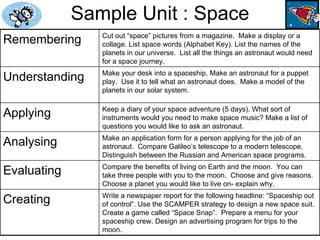
Sample Unit : Space Write a newspaper report for the following headline: “Spaceship out of control”. Use the SCAMPER strategy to design a new space suit. Create a game called “Space Snap”.  Prepare a menu for your spaceship crew. Design an advertising program for trips to the moon. Creating Compare the benefits of living on Earth and the moon.  You can take three people with you to the moon.  Choose and give reasons. Choose a planet you would like to live on- explain why. Evaluating Make an application form for a person applying for the job of an astronaut.  Compare Galileo’s telescope to a modern telescope.  Distinguish between the Russian and American space programs. Analysing Keep a diary of your space adventure (5 days). What sort of instruments would you need to make space music? Make a list of questions you would like to ask an astronaut. Applying Make your desk into a spaceship, Make an astronaut for a puppet play.  Use it to tell what an astronaut does.  Make a model of the planets in our solar system.  Understanding Cut out “space” pictures from a magazine.  Make a display or a collage. List space words (Alphabet Key). List the names of the planets in our universe.  List all the things an astronaut would need for a space journey. Remembering
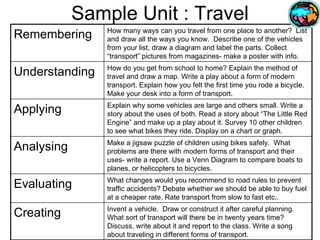
Sample Unit : Travel Invent a vehicle.  Draw or construct it after careful planning. What sort of transport will there be in twenty years time? Discuss, write about it and report to the class. Write a song about traveling in different forms of transport. Creating What changes would you recommend to road rules to prevent traffic accidents? Debate whether we should be able to buy fuel at a cheaper rate. Rate transport from slow to fast etc.. Evaluating Make a jigsaw puzzle of children using bikes safely.  What problems are there with modern forms of transport and their uses- write a report. Use a Venn Diagram to compare boats to planes, or helicopters to bicycles. Analysing Explain why some vehicles are large and others small. Write a story about the uses of both. Read a story about “The Little Red Engine” and make up a play about it. Survey 10 other children to see what bikes they ride. Display on a chart or graph. Applying How do you get from school to home? Explain the method of travel and draw a map. Write a play about a form of modern transport. Explain how you felt the first time you rode a bicycle. Make your desk into a form of transport.  Understanding How many ways can you travel from one place to another?  List and draw all the ways you know.  Describe one of the vehicles from your list, draw a diagram and label the parts. Collect “transport” pictures from magazines- make a poster with info. Remembering

Bloom's Taxonomy (Short Version)

  • 1.
  • 2.
    BLOOM’S REVISED TAXONOMYCreating Generating new ideas, products, or ways of viewing things Designing, constructing, planning, producing, inventing.   Evaluating Justifying a decision or course of action Checking, hypothesising, critiquing, experimenting, judging     Analysing Breaking information into parts to explore understandings and relationships Comparing, organising, deconstructing, interrogating, finding   Applying Using information in another familiar situation Implementing, carrying out, using, executing   Understanding Explaining ideas or concepts Interpreting, summarising, paraphrasing, classifying, explaining   Remembering Recalling information Recognising, listing, describing, retrieving, naming, finding   Higher-order thinking
  • 3.
    Original Terms New Terms Evaluation Synthesis Analysis Application Comprehension Knowledge Creating Evaluating Analysing Applying Understanding Remembering (Based on Pohl, 2000, Learning to Think, Thinking to Learn, p. 8 )
  • 4.
    Remembering The learneris able to recall, restate and remember learned information. Recognising Listing Describing Identifying Retrieving Naming Locating Finding    Can you recall information?  
  • 5.
    Understanding The learnergrasps the meaning of information by interpreting and translating what has been learned. Interpreting Exemplifying Summarising Inferring Paraphrasing Classifying Comparing Explaining    Can you explain ideas or concepts?
  • 6.
    Applying   Thelearner makes use of information in a context different from the one in which it was learned. Implementing Carrying out Using Executing     Can you use the information in another familiar situation?
  • 7.
    Analysing The learnerbreaks learned information into its parts to best understand that information. Comparing Organising Deconstructing Attributing Outlining Finding Structuring Integrating   Can you break information into parts to explore understandings and relationships?
  • 8.
    Evaluating The learnermakes decisions based on in-depth reflection, criticism and assessment. Checking Hypothesising Critiquing Experimenting Judging Testing Detecting Monitoring    Can you justify a decision or course of action?
  • 9.
    Creating The learnercreates new ideas and information using what has been previously learned. Designing Constructing Planning Producing Inventing Devising Making   Can you generate new products, ideas, or ways of viewing things?
  • 10.
    Sample Unit :Space Write a newspaper report for the following headline: “Spaceship out of control”. Use the SCAMPER strategy to design a new space suit. Create a game called “Space Snap”. Prepare a menu for your spaceship crew. Design an advertising program for trips to the moon. Creating Compare the benefits of living on Earth and the moon. You can take three people with you to the moon. Choose and give reasons. Choose a planet you would like to live on- explain why. Evaluating Make an application form for a person applying for the job of an astronaut. Compare Galileo’s telescope to a modern telescope. Distinguish between the Russian and American space programs. Analysing Keep a diary of your space adventure (5 days). What sort of instruments would you need to make space music? Make a list of questions you would like to ask an astronaut. Applying Make your desk into a spaceship, Make an astronaut for a puppet play. Use it to tell what an astronaut does. Make a model of the planets in our solar system. Understanding Cut out “space” pictures from a magazine. Make a display or a collage. List space words (Alphabet Key). List the names of the planets in our universe. List all the things an astronaut would need for a space journey. Remembering
  • 11.
    Sample Unit :Travel Invent a vehicle. Draw or construct it after careful planning. What sort of transport will there be in twenty years time? Discuss, write about it and report to the class. Write a song about traveling in different forms of transport. Creating What changes would you recommend to road rules to prevent traffic accidents? Debate whether we should be able to buy fuel at a cheaper rate. Rate transport from slow to fast etc.. Evaluating Make a jigsaw puzzle of children using bikes safely. What problems are there with modern forms of transport and their uses- write a report. Use a Venn Diagram to compare boats to planes, or helicopters to bicycles. Analysing Explain why some vehicles are large and others small. Write a story about the uses of both. Read a story about “The Little Red Engine” and make up a play about it. Survey 10 other children to see what bikes they ride. Display on a chart or graph. Applying How do you get from school to home? Explain the method of travel and draw a map. Write a play about a form of modern transport. Explain how you felt the first time you rode a bicycle. Make your desk into a form of transport. Understanding How many ways can you travel from one place to another? List and draw all the ways you know. Describe one of the vehicles from your list, draw a diagram and label the parts. Collect “transport” pictures from magazines- make a poster with info. Remembering