Clinical examination
   Ball and socket, Synovial, Multiaxial joint
   Compensations for hip deficits
   Referred pain to knee joint
   Neck shaft angle
   Femoral anteversion
   Arterial supply
   Calcar femorale
   Capsular reflections
   Extension-first movement to be lost
   Joint space- most accomodative in Fl, Abd,ER
   Pubic tubercle
   Femoral head
   Femoral neck
   Mid inguinal point
   Mid point of inguinal ligament
   Line joining PSIS
   Pain – Night cries
   Limp
   Trauma
   Steroid intake
   Alcohol intake
   Tuberculosis
   Bronchial asthma
   Complaint during childhood
 Gait
 Trendelenberg’s gait-DDH
 Short limb gait
 Antalgic gait-OA hip
 Waddling gait-osteomalacia
 High stepping gait-foot drop
 Scissors gait-cerebral diplegia
 DDH-wide   perinium
 Synovitis-Flex.,Abd.,ER.,App. lenthening
 Arthritis-Flex., Add.,IR.,+/- True shortening
 Posterior dislocation-Flex.,Add.,IR.,True and
  App. shortening
 Anterior dislocation-Flex.,Abd.,ER.,App.
  lenthening
 Fracture trochanter-Marked ER
 Fracture neck of femur-ER-not so marked-
  capsular catch
 Skin
 Exagerrated  lumbar lordosis
 Level of ASIS
 Wasting
 Shortening/Lengthening
 Soft tissue
 Bony points
 Swelling
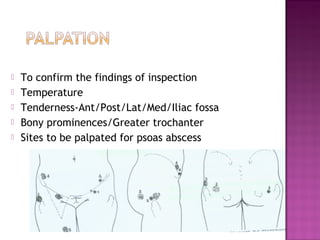
   To confirm the findings of inspection
   Temperature
   Tenderness-Ant/Post/Lat/Med/Iliac fossa
   Bony prominences/Greater trochanter
   Sites to be palpated for psoas abscess
NARATH’S SIGN
           Femoral arterial pulsations

Positive in
           Post. dislocation of hip
            Excised or dissolved head and neck
            Burger’s disease

Lymph nodes-Inguinal and External iliac
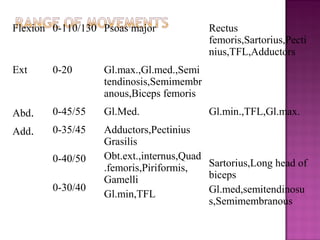
Flexion 0-110/130 Psoas major            Rectus
                                         femoris,Sartorius,Pecti
                                         nius,TFL,Adductors
Ext     0-20      Gl.max.,Gl.med.,Semi
                  tendinosis,Semimembr
                  anous,Biceps femoris
Abd.    0-45/55   Gl.Med.                Gl.min.,TFL,Gl.max.
Add.    0-35/45   Adductors,Pectinius
                  Grasilis
        0-40/50   Obt.ext.,internus,Quad
                  .femoris,Piriformis,   Sartorius,Long head of
                  Gamelli                biceps
        0-30/40                          Gl.med,semitendinosu
                  Gl.min,TFL
                                         s,Semimembranous
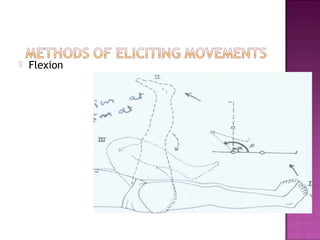
   Flexion
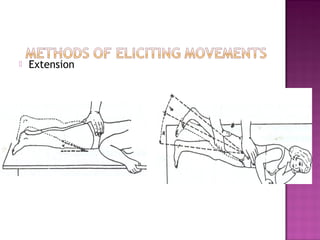
   Extension
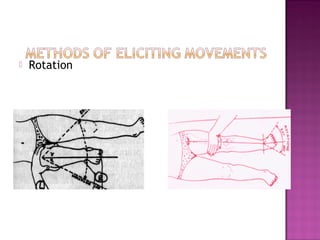
   Rotation
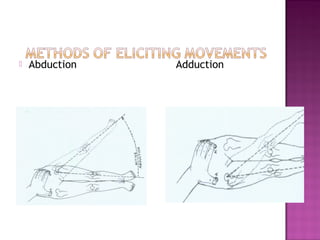
   Abduction   Adduction
   Line joining two ASIS cuts midline at right
    angle
   Fallacies-Not possible in fixed scoliosis
    due to fixed obliquity of pelvis
   Iatrogenic-ASIS removed for bone grafting
   Mal or ill development of hemipelvis e.g.
    residual polio myelitis
   Unreduced dislocation of SI joint
   Malunited or unreduced verticle fracture
    of ilium
   Position from where limb can’t be brought back
    to neutral position but further movement in
    same axis is possible
   Causes-Persistent muscular spasm
   Persistent posture to avoid pain or to conceal
    deformity
   Disparity of limb lengths
   Destructive changes in joint
   Fibrotic contractures in periarticular soft tissues
   Surgical interventions
   To conceal deformity
   To maintain equilibrium by shifting centre of
    gravity
   To apparently make up the disparity of limb
    lengths
   To stabilise the unstable hip

   To assess fixed deformity it is essential to
    neutralise compensatory mechanisms
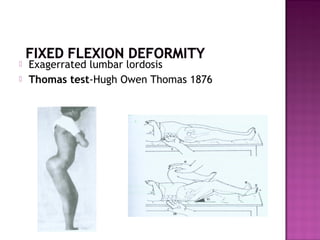
   Exagerrated lumbar lordosis
   Thomas test-Hugh Owen Thomas 1876
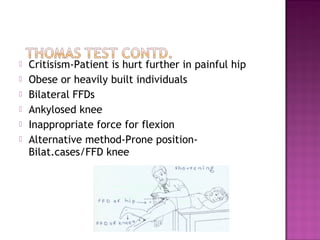
   Critisism-Patient is hurt further in painful hip
   Obese or heavily built individuals
   Bilateral FFDs
   Ankylosed knee
   Inappropriate force for flexion
   Alternative method-Prone position-
    Bilat.cases/FFD knee
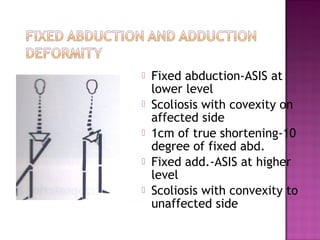
   Fixed abduction-ASIS at
    lower level
   Scoliosis with covexity on
    affected side
   1cm of true shortening-10
    degree of fixed abd.
   Fixed add.-ASIS at higher
    level
   Scoliosis with convexity to
    unaffected side
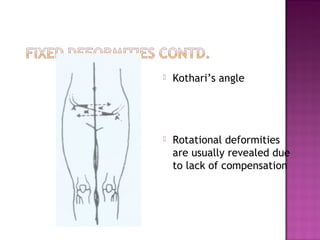
   Kothari’s angle


   Rotational deformities
    are usually revealed due
    to lack of compensation
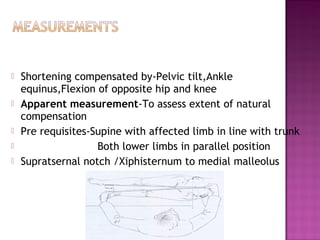
   Shortening compensated by-Pelvic tilt,Ankle
    equinus,Flexion of opposite hip and knee
   Apparent measurement-To assess extent of natural
    compensation
   Pre requisites-Supine with affected limb in line with trunk
                   Both lower limbs in parallel position
   Supratsernal notch /Xiphisternum to medial malleolus
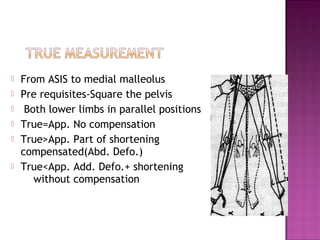
   From ASIS to medial malleolus
   Pre requisites-Square the pelvis
    Both lower limbs in parallel positions
   True=App. No compensation
   True>App. Part of shortening
    compensated(Abd. Defo.)
   True<App. Add. Defo.+ shortening
       without compensation
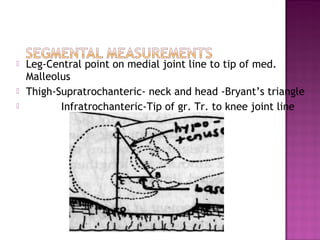
   Leg-Central point on medial joint line to tip of med.
    Malleolus
   Thigh-Supratrochanteric- neck and head -Bryant’s triangle
          Infratrochanteric-Tip of gr. Tr. to knee joint line
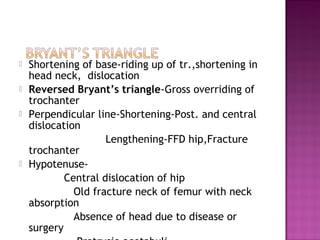
   Shortening of base-riding up of tr.,shortening in
    head neck, dislocation
   Reversed Bryant’s triangle-Gross overriding of
    trochanter
   Perpendicular line-Shortening-Post. and central
    dislocation
                     Lengthening-FFD hip,Fracture
    trochanter
   Hypotenuse-
            Central dislocation of hip
              Old fracture neck of femur with neck
    absorption
              Absence of head due to disease or
    surgery
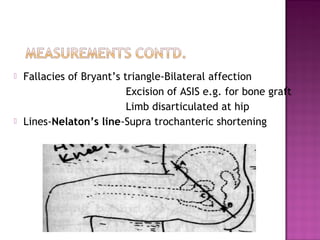
   Fallacies of Bryant’s triangle-Bilateral affection
                           Excision of ASIS e.g. for bone graft
                           Limb disarticulated at hip
   Lines-Nelaton’s line-Supra trochanteric shortening
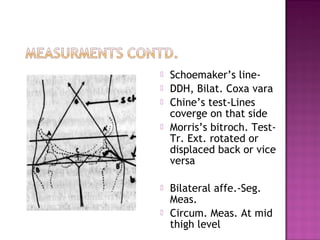
   Schoemaker’s line-
   DDH, Bilat. Coxa vara
   Chine’s test-Lines
    coverge on that side
   Morris’s bitroch. Test-
    Tr. Ext. rotated or
    displaced back or vice
    versa

   Bilateral affe.-Seg.
    Meas.
   Circum. Meas. At mid
    thigh level
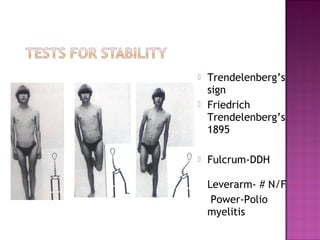
   Trendelenberg’s
    sign
   Friedrich
    Trendelenberg’s
    1895

   Fulcrum-DDH

    Leverarm- # N/F
     Power-Polio
    myelitis
   Fallacies-
   Intact Quadratus lumborum
   Incoordination of muscles-Cerebral palsy
   Affection of SI joint
   Medial shift of mechanical axis of leg below
    hip-bow knee
   Obese and bulky persons
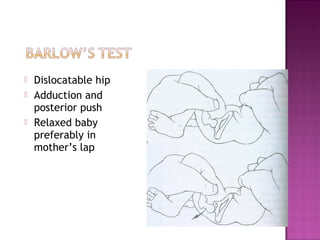
   Dislocatable hip
   Adduction and
    posterior push
   Relaxed baby
    preferably in
    mother’s lap
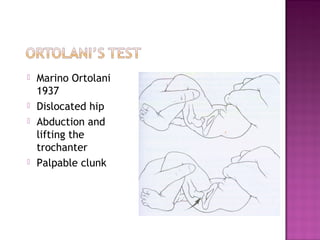
   Marino Ortolani
    1937
   Dislocated hip
   Abduction and
    lifting the
    trochanter
   Palpable clunk
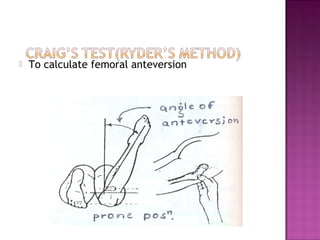
   To calculate femoral anteversion
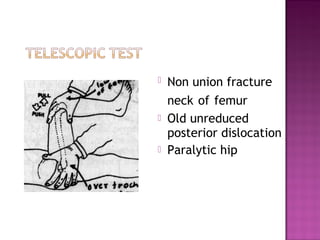
   Non union fracture
    neck of femur
   Old unreduced
    posterior dislocation
   Paralytic hip
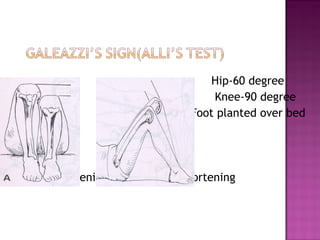
                                    Hip-60 degree
                                    Knee-90 degree
                                Foot planted over bed


   Tibial shortening   Femoral shortening
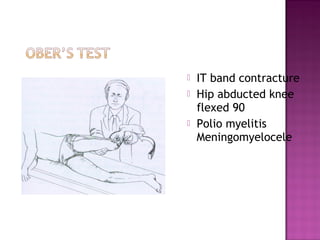
   IT band contracture
   Hip abducted knee
    flexed 90
   Polio myelitis
    Meningomyelocele
   Flexion
   Abduction
   External rotation
   Extension
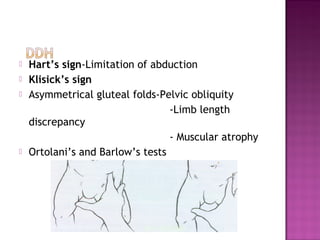
   Hart’s sign-Limitation of abduction
   Klisick’s sign
   Asymmetrical gluteal folds-Pelvic obliquity
                                  -Limb length
    discrepancy
                                  - Muscular atrophy
   Ortolani’s and Barlow’s tests

THAN   X

Clinical Examination of the Hip

  • 1.
  • 2.
    Ball and socket, Synovial, Multiaxial joint  Compensations for hip deficits  Referred pain to knee joint  Neck shaft angle  Femoral anteversion  Arterial supply  Calcar femorale  Capsular reflections  Extension-first movement to be lost  Joint space- most accomodative in Fl, Abd,ER
  • 3.
    Pubic tubercle  Femoral head  Femoral neck  Mid inguinal point  Mid point of inguinal ligament  Line joining PSIS
  • 4.
    Pain – Night cries  Limp  Trauma  Steroid intake  Alcohol intake  Tuberculosis  Bronchial asthma  Complaint during childhood
  • 5.
     Gait  Trendelenberg’sgait-DDH  Short limb gait  Antalgic gait-OA hip  Waddling gait-osteomalacia  High stepping gait-foot drop  Scissors gait-cerebral diplegia
  • 6.
     DDH-wide perinium  Synovitis-Flex.,Abd.,ER.,App. lenthening  Arthritis-Flex., Add.,IR.,+/- True shortening  Posterior dislocation-Flex.,Add.,IR.,True and App. shortening  Anterior dislocation-Flex.,Abd.,ER.,App. lenthening  Fracture trochanter-Marked ER  Fracture neck of femur-ER-not so marked- capsular catch
  • 7.
     Skin  Exagerrated lumbar lordosis  Level of ASIS  Wasting  Shortening/Lengthening  Soft tissue  Bony points  Swelling
  • 8.
    To confirm the findings of inspection  Temperature  Tenderness-Ant/Post/Lat/Med/Iliac fossa  Bony prominences/Greater trochanter  Sites to be palpated for psoas abscess
  • 9.
    NARATH’S SIGN Femoral arterial pulsations Positive in Post. dislocation of hip Excised or dissolved head and neck Burger’s disease Lymph nodes-Inguinal and External iliac
  • 10.
    Flexion 0-110/130 Psoasmajor Rectus femoris,Sartorius,Pecti nius,TFL,Adductors Ext 0-20 Gl.max.,Gl.med.,Semi tendinosis,Semimembr anous,Biceps femoris Abd. 0-45/55 Gl.Med. Gl.min.,TFL,Gl.max. Add. 0-35/45 Adductors,Pectinius Grasilis 0-40/50 Obt.ext.,internus,Quad .femoris,Piriformis, Sartorius,Long head of Gamelli biceps 0-30/40 Gl.med,semitendinosu Gl.min,TFL s,Semimembranous
  • 11.
    Flexion
  • 12.
    Extension
  • 13.
    Rotation
  • 14.
    Abduction Adduction
  • 15.
    Line joining two ASIS cuts midline at right angle  Fallacies-Not possible in fixed scoliosis due to fixed obliquity of pelvis  Iatrogenic-ASIS removed for bone grafting  Mal or ill development of hemipelvis e.g. residual polio myelitis  Unreduced dislocation of SI joint  Malunited or unreduced verticle fracture of ilium
  • 16.
    Position from where limb can’t be brought back to neutral position but further movement in same axis is possible  Causes-Persistent muscular spasm  Persistent posture to avoid pain or to conceal deformity  Disparity of limb lengths  Destructive changes in joint  Fibrotic contractures in periarticular soft tissues  Surgical interventions
  • 17.
    To conceal deformity  To maintain equilibrium by shifting centre of gravity  To apparently make up the disparity of limb lengths  To stabilise the unstable hip  To assess fixed deformity it is essential to neutralise compensatory mechanisms
  • 18.
    Exagerrated lumbar lordosis  Thomas test-Hugh Owen Thomas 1876
  • 19.
    Critisism-Patient is hurt further in painful hip  Obese or heavily built individuals  Bilateral FFDs  Ankylosed knee  Inappropriate force for flexion  Alternative method-Prone position- Bilat.cases/FFD knee
  • 20.
    Fixed abduction-ASIS at lower level  Scoliosis with covexity on affected side  1cm of true shortening-10 degree of fixed abd.  Fixed add.-ASIS at higher level  Scoliosis with convexity to unaffected side
  • 21.
    Kothari’s angle  Rotational deformities are usually revealed due to lack of compensation
  • 22.
    Shortening compensated by-Pelvic tilt,Ankle equinus,Flexion of opposite hip and knee  Apparent measurement-To assess extent of natural compensation  Pre requisites-Supine with affected limb in line with trunk  Both lower limbs in parallel position  Supratsernal notch /Xiphisternum to medial malleolus
  • 23.
    From ASIS to medial malleolus  Pre requisites-Square the pelvis  Both lower limbs in parallel positions  True=App. No compensation  True>App. Part of shortening compensated(Abd. Defo.)  True<App. Add. Defo.+ shortening without compensation
  • 24.
    Leg-Central point on medial joint line to tip of med. Malleolus  Thigh-Supratrochanteric- neck and head -Bryant’s triangle  Infratrochanteric-Tip of gr. Tr. to knee joint line
  • 25.
    Shortening of base-riding up of tr.,shortening in head neck, dislocation  Reversed Bryant’s triangle-Gross overriding of trochanter  Perpendicular line-Shortening-Post. and central dislocation Lengthening-FFD hip,Fracture trochanter  Hypotenuse- Central dislocation of hip Old fracture neck of femur with neck absorption Absence of head due to disease or surgery
  • 26.
    Fallacies of Bryant’s triangle-Bilateral affection Excision of ASIS e.g. for bone graft Limb disarticulated at hip  Lines-Nelaton’s line-Supra trochanteric shortening
  • 27.
    Schoemaker’s line-  DDH, Bilat. Coxa vara  Chine’s test-Lines coverge on that side  Morris’s bitroch. Test- Tr. Ext. rotated or displaced back or vice versa  Bilateral affe.-Seg. Meas.  Circum. Meas. At mid thigh level
  • 28.
    Trendelenberg’s sign  Friedrich Trendelenberg’s 1895  Fulcrum-DDH Leverarm- # N/F Power-Polio myelitis
  • 29.
    Fallacies-  Intact Quadratus lumborum  Incoordination of muscles-Cerebral palsy  Affection of SI joint  Medial shift of mechanical axis of leg below hip-bow knee  Obese and bulky persons
  • 30.
    Dislocatable hip  Adduction and posterior push  Relaxed baby preferably in mother’s lap
  • 31.
    Marino Ortolani 1937  Dislocated hip  Abduction and lifting the trochanter  Palpable clunk
  • 32.
    To calculate femoral anteversion
  • 33.
    Non union fracture neck of femur  Old unreduced posterior dislocation  Paralytic hip
  • 34.
    Hip-60 degree  Knee-90 degree  Foot planted over bed  Tibial shortening Femoral shortening
  • 35.
    IT band contracture  Hip abducted knee flexed 90  Polio myelitis Meningomyelocele
  • 36.
    Flexion  Abduction  External rotation  Extension
  • 37.
    Hart’s sign-Limitation of abduction  Klisick’s sign  Asymmetrical gluteal folds-Pelvic obliquity -Limb length discrepancy - Muscular atrophy  Ortolani’s and Barlow’s tests
  • 38.